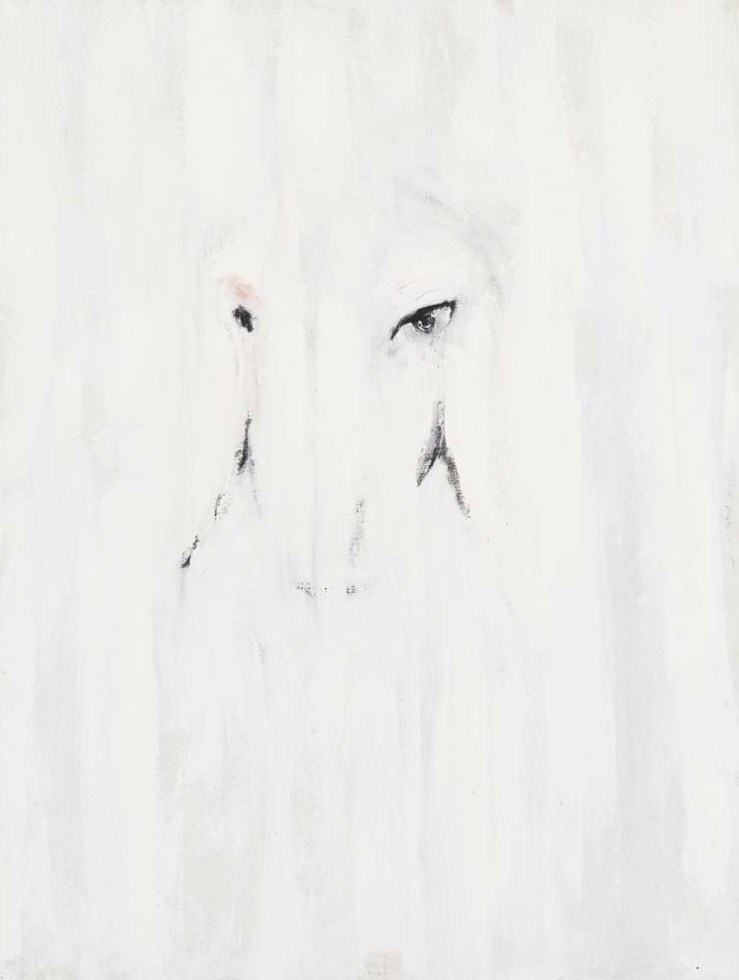
Gulap K. Hajarathbai (Indian), Temptation, 20th century. Oil on canvas, 18 × 20 in. Source: Herbert E. Hoefer, Christian Art in India (Chennai, India: Gurukul Lutheran Theological College and Research Institute, 1982)
“Tempted”by Eugene H. Peterson
Mark 1:12–13
Still wet behind the ears, he’s Spirit-pushed
up Jordan’s banks into the wilderness.
Angels hover praying ’round his head.
Animals couch against his knees and ankles
intuiting a better master. The Man
in the middle—new Adam in old Eden—
is up against it, matched with the ancient
Adversary. For forty days and nights
he tests the baptismal blessing and proves to his dismay
the Man is made of sterner stuff than Adam:
the Man will choose to be the Son God made him.
Mark dedicates a spare two verses to this initiatory event in the life of Christ: the forty days of temptation he endured immediately following his baptism: “The Spirit immediately drove him out into the wilderness. And he was in the wilderness forty days, being tempted by Satan. And he was with the wild animals, and the angels were ministering to him” (Mark 1:12–13, ESV; cf. Matthew 4:1–11, Luke 4:1–13).
I’m intrigued by Mark’s use of the word driven (ekballō) to describe the manner in which the Spirit imparts motion to Christ. Whereas Matthew and Luke use the gentler led (anagō), Mark implies something more forceful: ejected, cast forth, hurled. In his idiomatic translation of the Bible, The Message, Eugene H. Peterson uses push: “At once, this same Spirit pushed Jesus out into the wild” (emphasis mine).
So the same Spirit who had just alighted on Jesus in the waters of the Jordan, presiding over God’s pronouncement that “You are my beloved Son; with you I am well pleased” (Mark 1:11), now pushes Jesus into the Judean desert, away from civilization. Why? So that in the quiet, he could get to better know himself and the Father, to better discern the task to which he had been called. This process necessarily involved doing battle with the prospects of other paths, other identities.
“Turn these stones into bread.” “Jump; let’s see if God saves you.” “Worship me; I’ll give you the kingdom of earth.”
Satan tries to draw Jesus from a messiahship of self-sacrifice to a messiahship of power. Performing miracles for his own benefit, to avoid any discomfort or pain in life; performing miracles for show, like a magician, to impress the masses; becoming an earthly king, with political control and dominion—these are all temptations Jesus would face again. Here he has the opportunity to confront them head-on in preparation for his imminent ministry to the Israelites. Over this period of forty days, Jesus solidifies his mission, rejecting the vision of himself and his life that Satan lays out for him. Instead of gratification, pride, and riches, Jesus chooses purity, humility, and poverty. Continue reading “Voices in the desert—whose blessing will we heed?”→
As you may have noticed, I’ve had to ease up lately on my self-imposed one-post-a-week rule to accommodate other projects. For February and March, I’ve been teaching an adult Sunday school course at my church called “Art and the Church: Seeing the Sacred in Global Christian Art”; I have a really great group of people exploring the topic with me, and I’ve enjoyed seeing which images they respond to most. I’ve also been invited by three separate entities to produce content on their platforms this spring: by a missions organization, to curate an online gallery of Passion art; by a divinity school, to write a post for its blog; and by a Christian ministry at Brown University, to deliver a talk to undergraduates. Moreover, I just returned from a trip to California, where I attended a Biola University–sponsored art symposium called “Art in a Postsecular Age”; I got to meet Matthew Milliner and Jonathan Anderson and hear from a panel of other distinguished speakers.
So, while I had every intention of getting this list out last week to coincide with the start of Lent, slide preparations, permissions e-mails, and travels have claimed my focus. I regret that all this revving up has come during a season dedicated to slowing down. Please forgive the slackness, but I’ve decided to practice the “holy pause” for the next forty days (through Easter Sunday). To fast from my obsession with productivity. I will still honor my obligation to those who have commissioned me for specific tasks, but I will be lightening up on the frequency of blog posts. In lieu of Lent-related Art & Theology content, I lift up the following supports for your journey.
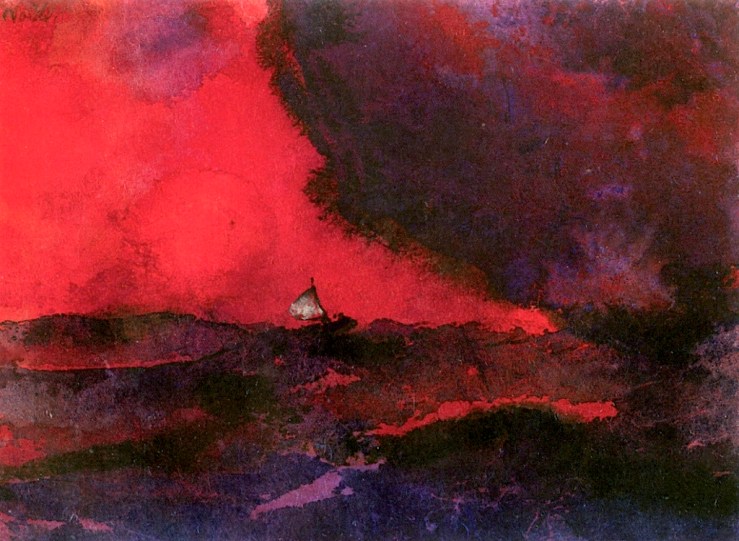
Online devotional with visual art and music: Each Lenten season since 2012, Kevin Greene, an associate pastor at West End Presbyterian Church in Richmond, Virginia, has published an online devotional that comprises for each day an art image, a short scripture reading, a prayer, and a music file. I absolutely love this model, with its spare style: because the entries are light on text, they invite silence, contemplation, seeing, listening. Greene’s image selection is stellar. He doesn’t go for the obvious choices but rather aims at something more atmospheric, more slant. Among the painted subjects, for example, you’ll find a stairway, a storm, a dancer, a reaper; day 1, Ash Wednesday, was a sailboat on troubled waters (pictured below). Fine-art viewing isn’t something that’s typically a part of Protestant devotional practice, so in response to questions he’s received, Greene has described how art operates on the imagination and the spirit. I’ve been greatly blessed moving through the first week of Lent with this companion, and I can’t wait to dive into the backlist entries later on. You can sign up via e-mail in the left sidebar, or simply bookmark the website and visit it each morning.
Emil Nolde (German, 1867–1956), Dark Red Sea, ca. 1938. Watercolor. Nolde Museum, Seebüll, Schleswig-Holstein, Germany.
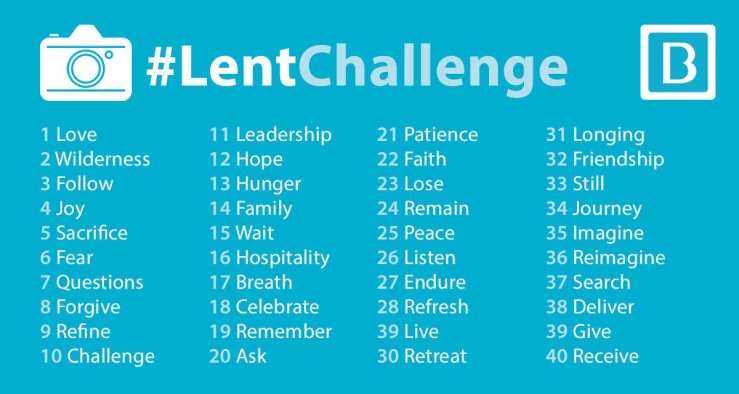
Lent Photo Challenge: The UK-based Bible Society invites people to take one photo per day throughout the season based on rotating themes (e.g., wilderness, hospitality, ask), then share them on social media using the hashtag #LentChallenge. Today is the sixth day of Lent (Sundays are excluded from the traditional forty-day count), and the assigned theme is “fear.”
Essays, short stories, poems, art: Founded in 1989, Image journal seeks “to demonstrate the continued vitality and diversity of contemporary art and literature that engage with the religious traditions of Western culture.” This Lent they’ve curated a selection of literary essays, short stories, poems, and art images from their back issues and their blog, Good Letters, that relate to the season, as well as to Easter. I especially enjoyed “Jeffrey Mongrain: An Iconography of Eloquence.” A few selections might be accessible only to subscribers (you can subscribe here; you won’t be disappointed!). Also available: the book God For Us: Rediscovering the Meaning of Lent and Easter, a full-color devotional with contributions by some of Image’s favorites. Lent is not about becoming lost in our brokenness, the description says, but about cleansing the palate so that we can taste life more fully.
Jeffrey Mongrain (American, 1956–), Blood Pool, 2006. Plexiglas, 47 × 88 in. Saint Peter’s Catholic Church, Columbia, South Carolina.
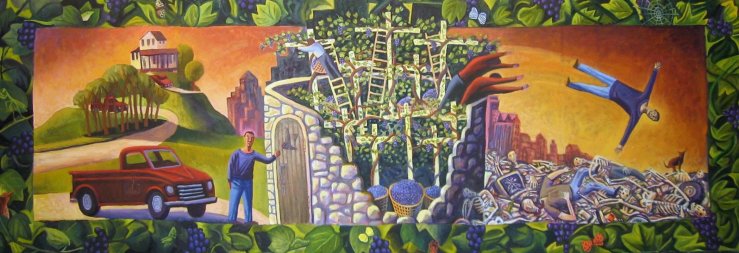
“Lent Is Here to Throw Us Off Again: Finding healing in repetition, community, and art” by W. David O. Taylor: An excellent introduction to Lent, addressing unselfing, dying a good death, opening up vacant space, and praying with the eyes. This Christianity Today article is adapted from the foreword Taylor wrote for artist James B. Janknegt’s new book, Lenten Meditations, which features forty of Janknegt’s paintings on the parables of Jesus, along with written reflections. Artists like Janknegt, Taylor writes, “fix before us an image of a world broken by our own doing, but not abandoned by God. They question our habits of sight. They arrest our attention. See this image. See it for the first time, again. See what has become hidden and distorted. See the neglected things. See the small but good things. It is in this way that artists can rescue us from what the poet Samuel Taylor Coleridge calls the ‘film of familiarity’ and the ‘lethargy of custom.’”
James B. Janknegt (American, 1953–), The Wicked Tenants, 2008. Oil on canvas, 24 × 72 in.
Stations of the Cross in Washington, DC: This Lent, Dr. Aaron Rosen and the Rev. Dr. Catriona Laing of the Church of the Epiphany have organized a combination pilgrimage and art exhibition, featuring works located throughout Washington, DC, in places both sacred and secular. Mostly contemporary, some newly commissioned, the works include George Segal’s Depression Bread Line, the Vietnam Women’s Memorial by Glenna Goodacre, Barnett Newman’s Stations cycle at the National Gallery of Art, a video installation at First Congregational United Church of Christ by Leni Diner Dothan, and more. Participants can follow the stations by downloading the app “Alight: Art and the Sacred,” which offers maps and audio commentary (my friend Peggy Parker is a contributor!). (If you don’t have a smartphone, you can view the maps and listen to the commentary through a browser by following the primary link above.) Also check out the accompanying devotional guide.
Lent by The Brilliance: This 2012 EP by The Brilliance, a duo comprising David Gungor and John Arndt, has seven tracks: “Dust We Are,”“Now and at the Hour of Our Death” (the rerelease on Brother removes the invocation to Mary), “Dayspring of Life,”“Does Your Heart Break?,” “Holy Communion,” “Violent Loving God,” and “Have You Forsaken Me?” Each one is a beautiful prayer, the words organized around a string quartet. Some take the shape of praise, others lament. God is supplicated for peace, mercy, light. The first track well captures the spirit of Lent: “Be still my soul and let it go, just let it go.” Click here to read a 2015 Hallels interview with The Brilliance, or here to listen to a podcast interview by David Santistevan.
Members of the majority white culture may not realize it, but white Jesus is a fraught symbol. According to black theologian Major J. Jones, when European colonialists came to Africa and began treating its people as less than human because of their color, it became “psychologically impossible” for Africans not to have problems with God’s color. How could they ever conceive of a God who looked just like their oppressor? This legacy of black oppression, of course, traveled to the Americas, where white Jesus is omnipresent in visual culture.
In her book Painting the Gospel: Black Public Art and Religion in Chicago (University of Illinois Press, 2016), art historian Kymberly N. Pinder unpacks some of the ways that twentieth- and twenty-first-century Christians have countered the dominance of white Jesus with alternative sacred imagery that is black-affirming. Lavishly illustrated with sixty color photographs and eight black-and-whites, the book explores African American religious images—murals, mosaics, stained glass, sculptures, even T-shirt designs—from Chicago churches and their neighborhoods between 1904 and the present, focusing on their intersection with the social, political, and theological climates of the times. The image of a black Christ, Pinder argues, participated in some of the most significant movements in black history, including gospel music, sermon broadcasts/televangelism, the Chicago Black Renaissance, the civil rights movement, Black Liberation Theology, and the Mural Movement. The stream of influence flowed both ways, as each church’s preaching and outreach, musical, and visual cultures fed into one another.
A collection of case studies rather than a comprehensive guide, Painting the Gospel features churches whose pastors consciously nurtured a strong visual culture. “These sites,” Pinder writes, “enable me to chart how the arts interact with each other in the performance of black belief in each space, explain how empathetic realism structures these interactions for a variety of publics, and observe how this public art sits within a larger history of mural histories” (2). “Empathetic realism” is a term Pinder develops throughout the book as she considers how religious images have the power to assert political agendas of equality and humanity and thereby empower viewers, providing social and spiritual uplift. “Christ’s own difference, for which he was persecuted, becomes a source of empathy and identity for the African American,” she writes (8).
Christ as a dreadlocked black man on the cross, hip-hop youth kneeling at his feet, and Mary as an African woman in traditional Nigerian dress activate personal narratives for a black audience where private and public, the personal and the holy, the real and the represented, all meld, allowing for a spiritually transformative experience. (22–23)
The book covers works of art that have been largely excluded from art historical, theological, and sociological scholarship because of their racial or religious particularity. Working at the confluence of these disciplines, Pinder is concerned not with the artistic merit of the images but rather how they make meaning, how they “work” for an individual or a community—and especially how they interacted with and impacted certain milestones in black history. Her approach, her angle of inquiry, is much in the vein of David Morgan and Sally Promey.
Mural by Engelbert Mveng, 1990, Holy Angels Catholic Church. The scenes depict moments when angels have intervened in the lives of Christ and the saints: (counterclockwise, from top center) The Star of Bethlehem; St. Michael Slaying the Dragon; The Three Men in the Fiery Furnace; The Liberation of St. Peter; The Annunciation; The Resurrection; The Agony in the Garden; Judgment Day; The Hospitality of Abraham; The Healing of Tobit; The Nativity. Photo courtesy of Holy Angels Catholic Church.
“Translate: Art as Mission” symposium, February 25, 9 a.m.–3:30 p.m.: This Saturday, Third Church of Richmond, Virginia, is bringing together twenty practitioners, advocates, and theorists of the arts as front-line missions (both local and abroad) for a series of presentations and discussions that is free and open to the public. “Our aim is to demonstrate that ‘art as mission’ is not about using people and objects merely as ‘tools’ for missions or proselytization, but is about recognizing that generative, creative practices can and should be intrinsically, inherently ‘missional’ because they put on display and draw people towards the rich, abundant life we were made to experience and have together as God’s children, renewed as the Body of Christ. Together we’ll explore how the arts are a distinctively integrative, incarnational way to be human, and to bear the image of our creator God.” Click on the link to see the schedule and to find out more about the speakers.
+++
“Charged with the Grandeur of God: Faithful Imaginations in a Meaningful Creation” lecture, February 25, 7–9 p.m.: Also on Saturday, Ken Myers, founder and host of Mars Hill Audio and author of All God’s Children and Blue Suede Shoes: Christians and Popular Culture, will be speaking at Wallace Presbyterian Church in College Park, Maryland, on how alert imaginations enable us to receive the meaning in Creation and to rearticulate Creation’s meaning in works of art. A former arts and humanities editor for NPR, Myers writes of the mission of Mars Hill’s bimonthly “audio journal”: “We explore the various factors that have given modern Western culture its distinctive character. We also try to describe what cultural life — its practices, beliefs, and artifacts — might look like if it was the product of thoughtful Christian imaginations.” Each issue features guests from a variety of disciplines (poets, visual artists, scientists, philosophers, musicians and musicologists, social commentators, etc.); you can listen to back issues here, and read a 2013 profile on Myers from the Weekly Standard here. This event is sponsored by the Eliot Society, a new nonprofit in Washington, DC, that aims to “draw Christian faith and artistic culture back together, by promoting the thoughtful exploration of the work of creative men and women from both the past and the present.” Click here to RSVP.
+++
Last season’s Italia’s Got Talent featured a group called Quadri Plastici (“Living Paintings,” or “Tableaux”), which uses actors in period costumes and special lighting effects to recreate famous religious paintings in the flesh. According to the group’s website, the tradition of staging live reproductions of paintings originated in Avigliano in southern Italy in the 1920s: the participants, frozen in position, would be rolled into the town square on mule-drawn carts as part of the celebration of Saint Vitus’s feast day on June 15. In their television performance last year, Quadri Plastici recreated three Caravaggio paintings: The Crucifixion of Saint Peter, The Calling of Saint Matthew, and The Death of the Virgin. Gabriele Finaldi, director of London’s National Gallery, was impressed, and he commissioned the group to perform two of the paintings from the museum’s “Beyond Caravaggio” exhibition in October: The Taking of Christ and Salome Receives the Head of John the Baptist. To better engage the public, these stagings took place outside in Trafalgar Square.
+++
Through Paul Neeley’s Global Christian Worship blog, I discovered a gem of a song: a heavy-metal arrangement of the nineteenth-century Swedish hymn “Bred dina vida vingar” (Thy Holy Wings) by the Finnish worship band Metallmässa (Metal Mass). Unlike its marginal status in most countries, heavy metal music is mainstream in Finland, which has the most heavy metal bands per capita in the world. “Metal masses”—church services performed in a heavy-metal style—became a trend in 2006; into this current stepped the group Metallmässa, whose lead singer, Christer Romberg, was a contestant on the 2007 Finnish Idols. Their headbanging rendition of “Bred dina vida vingar,” performed in the music video below, is from their 2012 EP Sanctus. The words are by Lina Sandell, “the Fanny Crosby of Sweden”; the tune—which I think is just beautiful (and quite catchy!)—is a traditional Swedish folk tune. Metallmässa is no longer active, but Romberg can be found performing a cappella with his four siblings as part of Vokalgruppen Romberg.
Augustine is a remarkable exegete of cultural liturgies that beset us—the rites and rituals of ambition, consumption, privilege, that aren’t just things that we do but do things to us. The frat house, the football stadium, the rituals of Wall Street finance—these are quasi-religious sites in late modern culture, not because they purvey a message but because they are incubators of love that are rife with rituals that train and direct our hearts and our desires. And conversion is no magical panacea for that; belief doesn’t inoculate our loves from their immersion in those cultural liturgies. So we need to constantly take stock of the formation of our loves and longings, all the subtle ways that secular liturgies bend our desires toward earth rather than heaven.
Consider, too, the act of looking as a cultural liturgy: at our phones and computer screens; at the staged displays in store windows, and the staged photos on social media; at the thirty-second commercial the network forces us to watch before we get back to our show, or the billboard we can’t help but notice when we’re stuck in traffic. Sometime around the year 600, Pope Gregory I insightfully wrote that pictures teach us what to adore, what to imitate. What pictures do you see throughout the day? Is Christ one of them?
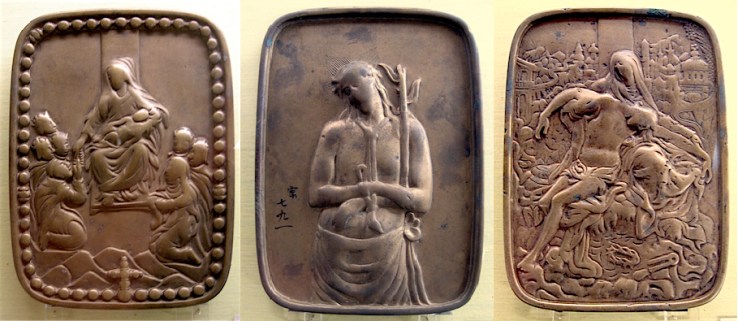
I first learned about fumi-e (“stepping-on pictures”) while reading about the history of Christian art in Japan. These objects are bronze likenesses of Jesus, sometimes shown together with his mother, Mary, that the religious authorities of the Tokugawa shogunate of Japan required suspected Christians to step on in order to prove that they were not members of that outlawed religion. If the apprehended persons refused, they were tortured and, if that didn’t break them, killed—most notoriously, by being boiled to death in the volcanic springs of Mount Unzen.
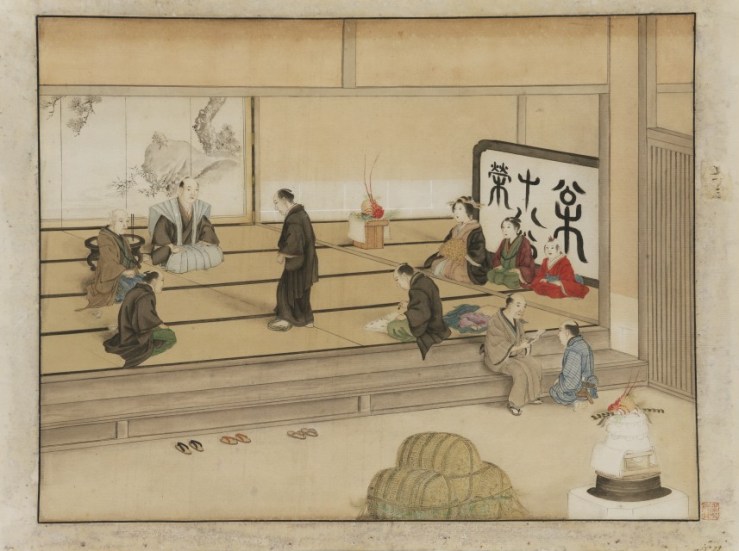
This painting by Keiga Kawahara, ca. 1826, shows an e-fumi (“picture stepping”) ceremony in Edo Japan, in which a man proves his aversion to Christianity by trampling an image of Christ. Location: National Library of the Netherlands.
This period of persecution lasted from 1629 to 1858.
Fumi-e factor heavily into Shūsaku Endo’s 1966 historical novel Chinmoku (Silence), which tells the story of two Jesuit missionaries who travel to Japan in 1639 to find their missing mentor—rumored to have apostatized—and to continue the work he started there with the underground church. Written by Endo partly in response to the discrimination he experienced as a Japanese Catholic, the novel is about the struggle for faith in a world marked by God’s seeming absence. It received the highly esteemed Tanizaki Prize the year of its release and instantly became a best seller; it was translated into English in 1969.
Two cover designs. Left: Christ is crucified on the Japanese kanji for “silence.” Right (illustration by Yuko Shimizu): Father Rodrigues prays desperately on a cliff’s edge, foregrounded by a blood-drenched moon.
Since then it has been the basis of several artistic adaptations: a stage play, also by Endo; a Japanese film by Masahiro Shinoda; a Portuguese film by João Mário Grilo; an opera by Teizo Matsumura; a symphony by James MacMillan—and now an American film by Martin Scorsese, the same director who brought us Raging Bull, The Last Temptation of Christ, The Departed, and The Wolf of Wall Street. He dedicates it “to Japanese Christians and their pastors.”
Twenty-eight years in the making, Scorsese’s “passion project,” Silence, has been lauded as “one of the best films ever made about Christian faith.” The Telegraph calls it a “plangent, scalding work of religious art . . . soul-pricklingly attuned to matters transcendent and eternal.” Time Out says it “ranks among the greatest achievements of spiritually minded cinema.” “An anguished masterwork of spiritual inquiry,” the Los Angeles Times declares, that “ponders the dogmas, riddles and anxieties of Christian faith with a rigor and seriousness that . . . has few recent equivalents in world cinema. . . . A work of insistent, altogether confounding grace.” Eric Metaxas says, “This may be the most Christian film I have ever seen—and that includes The Passion.”
Released in theaters December 23, 2016, Silence stars Andrew Garfield as lead character Father Sebastião Rodrigues, and Adam Driver as his compatriot, Father Francisco Garrpe. Liam Neeson plays the apostate Cristóvão Ferreira. See the trailer below.
CALL FOR BOOK PROPOSALS: Arts and the Sacred (ASAC) series: Brepols Publishers has launched a new academic series of richly illustrated books on theology and the arts, with a focus on visual art—historical and contemporary—and they’re looking for proposals. The series editors are Chloë Reddaway (Howard and Roberta Ahmanson Fellow in Art and Religion at the National Gallery, London) and Aaron Rosen (author of, among other titles, Art and Religion in the 21st Century). First-time authors are welcome.
+++
DOUBLE ALBUM RELEASE: Table Settings and Edenland by Liturgical Folk: This month Ryan Flanigan, worship director at All Saints Dallas, released the first two albums of his Liturgical Folk project, the aim of which is to root historical church language in the inherently joyful sounds of the American folk tradition. I love how Flanigan describes it: “a vision of something refreshingly old for churches that have grown tired of the same new thing.” The first volume, Table Settings, offers twelve traditional prayers and creeds—among them the Lord’s Prayer, the Gloria, and the Trisagion—for churches and families, set to singable tunes; accompanying Flanigan on vocals are his wife, Melissa, and his three kids. The second volume, Edenland, is a collaboration with retired priest and contemplative poet Nelson Koscheski, who wrote all the lyrics; it features a wider range of vocalists. The intergenerational partnership is one element that drew producer Isaac Wardell to the project and that is highlighted in last month’s Dallas News feature story, in addition to the project’s contributions to the liturgical renewal movement in North America.
+++
ART EXHIBITION: “Behold the Man: Jesus in Israeli Art,”December 22, 2016–April 16, 2017, Israel Museum, Jerusalem: “From the 19th century until today, Jewish and Israeli artists have engaged with the figure of Jesus, addressing complex questions of collective and individual identity. This exhibition, the result of extensive scholarly research, presents multivalent, unexpected, and at times subversive artistic responses: European artists reclaimed Jesus as a Jew and portrayed him as a symbol of Jewish suffering, and Zionist artists used the resurrection as a metaphor for the rebirth of the Jewish homeland; some Israeli artists related to Jesus as a social rebel or misunderstood prophet, while others identified with his personal torment or his sacrifice for the sake of humanity, which they connected to more recent victims of intolerance and warfare.” Click here to listen to audio commentary on fourteen of the works from the exhibition. See also this essay from the IMJ on the figure of Jesus in the work of Reuven Rubin.
Motti Mizrachi (Israeli, 1946–), Via Dolorosa, 1973. Lambda print. The Israel Museum, Jerusalem.Menashe Kadishman (Israeli, 1932–2015), Untitled (Lamb), 1999. Acrylic on canvas. Rachel and Dov Gottesman Collection, Tel Aviv.
+++
MOVIE TRAILER: Hacksaw Ridge, directed by Mel Gibson: The hero of one of this year’s Academy Award nominees for Best Picture is a Christian whose beliefs impel him to enlist in the US Army only on the condition that he not be made to carry a weapon—and this during World War II, when pacifism was far less acceptable than it is today. “While everybody else is takin’ life, I’m gonna be savin’ it,” says Desmond T. Doss, played by Andrew Garfield, in the trailer below. “That’s gonna be my way to serve.” Based on the true story of Desmond T. Doss, who served during the Battle of Okinawa and became the first man in American history to receive the Medal of Honor without firing a shot.
Horace Pippin (American, 1888–1946), Holy Mountain III, 1945. Oil on canvas, 25 1/4 × 30 1/4 in. (64.6 × 76.8 cm). Hirshhorn Museum, Washington, DC. Photo: Victoria Emily Jones.
In honor of Martin Luther King Jr. Day, I’d like to highlight the work of one who shared Dr. King’s vision, but whose microphone was a canvas.
The painting Holy Mountain III by self-taught African American artist Horace Pippin depicts the peaceable kingdom that’s prophesied about in the biblical book of Isaiah, chapter 11. When the Messiah establishes his rule on earth, writes the prophet,
The wolf shall dwell with the lamb,
and the leopard shall lie down with the young goat,
and the calf and the lion and the fattened calf together;
and a little child shall lead them.
The cow and the bear shall graze;
their young shall lie down together;
and the lion shall eat straw like the ox.
The nursing child shall play over the hole of the cobra,
and the weaned child shall put his hand on the adder’s den.
They shall not hurt or destroy
in all my holy mountain;
for the earth shall be full of the knowledge of the Lord
as the waters cover the sea. (vv. 6–9)
In spring 2013, this painting was featured in the exhibition “Ashe to Amen: African Americans and Biblical Imagery,” curated by the now-defunct Museum of Biblical Art in New York City. A MOBIA commentator pointed out the shadows of violence in the forest: a lynched black man (left), planes dropping bombs above a graveyard of crosses (center), and two armed soldiers and a tank (right). Yet, the commentator writes, Pippin chose to foreground the Holy Mountain, demonstrating his hope that such a scene would one day be actualized: “Rather than turning a blind eye to the painful realities of a sad and violent world, Pippin presents a vision of mankind moving out of the shadows and into the brilliant light of a peaceful clearing.” Continue reading “MLK, Pippin, and the Holy Mountain”→
I spend a lot of time “art surfing” the Internet, following click-trails that start maybe with a Google image search of a subject I’m researching and then end up somewhere totally different. One of those trails this weekend led me to the work of Ukrainian New Wave artist Igor Paneyko.
Paneyko was born on March 2, 1957, in the city of Stryi in the Lviv Oblast region of western Ukraine, in the foothills of the Carpathian Mountains. From 1975 to 1981 he studied at the Lviv State Institute of Applied and Decorative Art (now the Lviv National Academy of Arts), then spent a year working in Khiva, Uzbekistan. He currently lives and works in Uzhhorod, Ukraine, near the Hungarian border, in the region known as Transcarpathia.
Other than this general biographical information, I can find little else about the artist. An exhibition promo from 2012 suggests that he is a private person who’s “wary of publicity,” though he does exhibit his work. Using the Ukrainian spelling of his name, Игоря Панейка, yields more results than a search in English, but information is still sparse.
Many of Paneyko’s paintings are of visionary landscapes with floating, haloed figures. Candles, moons, and ladders (see Genesis 28:12) are often featured. Much of his work seems to me to carry on the legacy of Symbolism, a late nineteenth-century art movement that developed new and often abstract means to express psychological truth and the idea that behind the physical world lay a spiritual reality. Symbolists sought to give form to the ineffable, such as dreams and visions, and they emphasized emotions, feelings, ideas, and subjectivity over realism, often addressing the themes of religious mysticism and death. Gustav Klimt and Odilon Redon are two of Symbolism’s greatest artists.
Below is a compilation of some of Paneyko’s paintings that I find particularly appealing. I don’t know the specs for any of them, besides the year of those that have it painted large enough on the canvas, but I’ve linked each of them to its online source.
These first five are, to me, visually stunning. Ground and sky are not discernible from each other but rather interpenetrate, creating sacred space and evoking wonder.
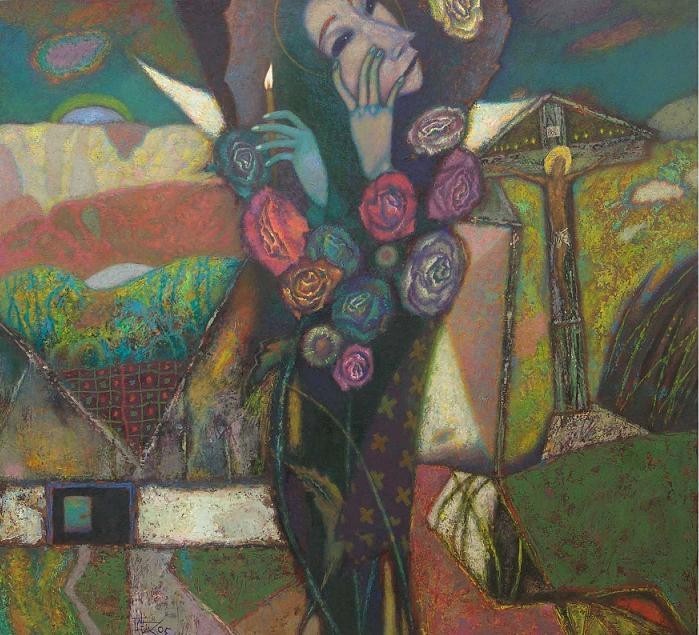
^ From 2005, we have a woman with a candle standing in contrapposto and covered in multicolored roses. The thin gold band around her head suggests a halo, and the purple burst behind her an aureola. It appears that she has come to pay devotion to Christ, as a wayside crucifix, whose patibulum supports the candles of previous pilgrims, is planted in the background. In the center of the woman’s chest, a little red kernel is encircled with light, representing the love that’s set aglow by her encounter; her loins, too, bear this mark—a possible allusion to the erotic language used by medieval mystics to describe their union with Christ.
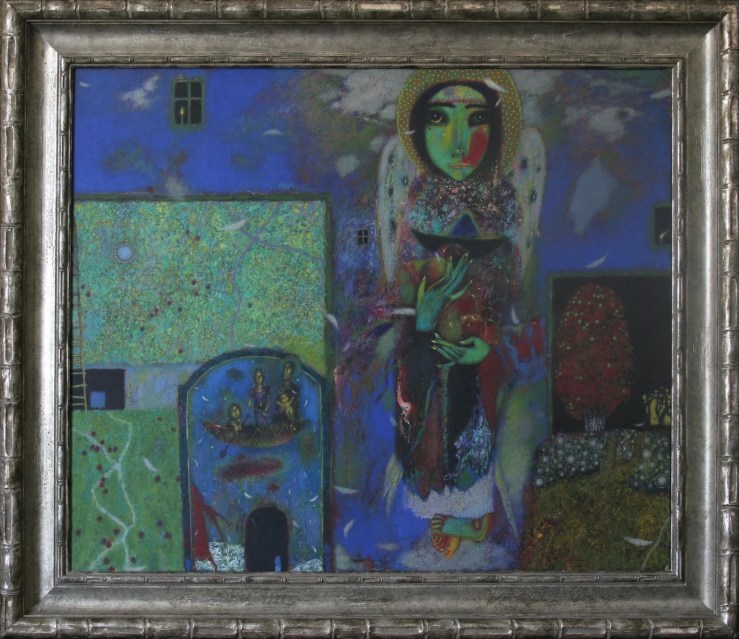
^ Here a haloed woman—maybe an angel (are those wings behind her?)—carries a load of pears and apples. To the left is a rowboat with four other haloed figures, one of them a baby; to the right, a garden. Some associations that come to my mind are Eden, Flight to Egypt, ship of salvation, fruit of the Spirit.
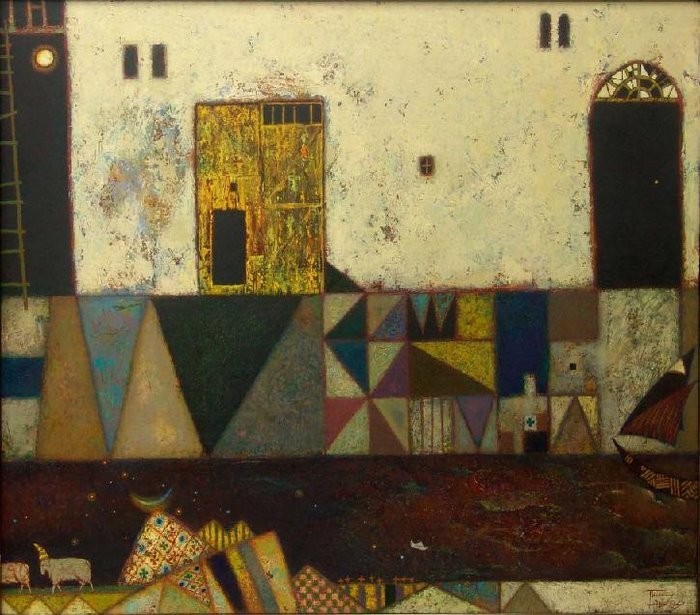
^ In this one, the focal point is the bottom left corner, where a yellow-green-blue crescent moon balances atop a patchwork mountain, and a row of nightcapped sheep saunters sleepily away. On the other side of the mountain a newspaper party hat floats over a cross-marked graveyard. Maybe it’s because we’ve just come out of Christmas, but I think of Bethlehem after Christ’s birth: the Judean hills alive and vibrant, having been touched by angel song; the shepherds’ charges seeking rest after the flurry of activity; and spreading a shadow over the celebration, the Massacre of the Innocents—Herod’s extermination of the town’s infant male population. Continue reading “Spiritual imagination in the art of Igor Paneyko”→
A popular song in choir repertoires, “Betelehemu” is a Yoruba Christmas carol by the Grammy-nominated drummer Babatunde Olatunji, arranged for men’s choir by Wendell P. Whalum. It came into being while Olatunji was a student on scholarship at Morehouse College in the 1950s: he shared it with Whalum, director of the school’s glee club, and that spawned a collaboration.
There have been numerous recordings of “Betelehemu” over the years, and each one has its own distinct flavor, especially in the percussion sections. I really like the one by The Young People’s Choir of New York City from the 2003 album It Is Possible. But here’s a version from Brazil, arranged for SATB by Jonathan Crutchfield:
Here are the Yoruba lyrics and English translation to follow along with, provided courtesy of my friends Ezekiel Olagoke and Temidayo Akinsanya. For a pronunciation guide, click here.
Betelehemu Awa yio ri Baba gbojule Awa yio ri Baba fehinti Nibo labi Jesu Nibo labe bi i Betelehemu, ilu ara Nibe labi Baba o daju Iyin, iyin, iyin nifun o Adupe fun o, adupe fun o, adupe fun ojo oni Baba oloreo Iyin, iyin, iyin fun o Baba anu Baba toda wasi Betelehemu
Bethlehem
We shall see that we have a Father to trust
We shall see that we have a Father to rely on
Where was Jesus born?
Where was he born?
Bethlehem, the city of wonder
That is where the Father was born for sure
Praise, praise, praise be to Him
We thank You, we thank You, we thank You for this day
Blessed Father
Praise, praise, praise be to You, merciful Father
Father who delivered us
Bethlehem
The lyrics are simple, rejoicing in the Father’s glory and grace in giving his Son over to be born in Bethlehem. I asked my Yoruba friends about the line “That is where the Father was born for sure,” which seems problematic from a Trinitarian perspective, because it was the Son, Jesus—not the Father—who was born in Bethlehem. The Yoruba word Baba has more nuance than the English “Father”; it is used to signify a biological relationship but also as an honorific for wise men or elders. But still I wondered whether it is theologically appropriate.
Ezekiel told me that Yoruba Christians understand the distinctions between the three persons of the Trinity and that Baba is not commonly used to refer to Jesus, but in defense of it, he pointed me to scripture passages like Daniel 7:9–14 (cf. the book of Revelation), which describes Jesus as “the Ancient of Days”; John 8:58, in which Jesus tells his disciples, “Before Abraham was, I am,” ascribing to himself a status greater than that of the greatest Jewish patriarch; and Colossians 1:15–17: “He [Jesus] is the image of the invisible God, the firstborn of all creation. For by him all things were created, in heaven and on earth, visible and invisible, whether thrones or dominions or rulers or authorities—all things were created through him and for him. And he is before all things, and in him all things hold together.” In Yoruba culture and other African cultures as well, says Ezekiel, Jesus is sometimes called “Chief” or “Ancestor,” a similar notion that emphasizes his being before all things, the eternal Source in whom all things consist.
Temi said that to avoid confusion, he would probably recommend a revision from Nibe labi Baba o daju to Nibe labi Jesu o daju (or else he’d drop the name so that the indefinite pronoun “he” is implied instead).
Both friends felt that the phrase Awa yio ri (“We shall see”) in the second and third lines is awkward in this context. All the other lyric translations I’ve found translate the phrase as “We are glad,” but that would be Awa ni, Ezekiel said—and that doesn’t quite fit the musical meter. It’s possible that the song is merging Advent with Christmas: it starts with looking forward to the birth, then it acknowledges the birth as having happened, eliciting appellations of praise.
Wooden door detail by George Bandele, 1962, showing the Adoration of the Magi. Collection of the SMA Fathers, Cadier en Keer, Netherlands. Source: Christliche Kunst in Afrika, p. 144
It seems that “Betelehemu” is more popular outside Nigeria than in. Ezekiel and Temi and one other Yoruba friend (from different generations) said that despite growing up in Christian homes in Nigeria, they’ve never heard it before, but they’ve heard ones similar to it. So while some sources credit “Betelehemu” as a “Yoruba folk text” and “Yoruba folk tune,” leaving Olatunji out entirely, I think it’s more likely that Olatunji drew on the song traditions of his people to create a new composition. At the very least, Olatunji introduced the song to the United States—and our Christmas concerts are all the richer for it! Continue reading “Yoruba Christmas carol and art (Nigeria)”→
WHY CELEBRATE ADVENT? Some of my evangelical friends don’t understand why I observe Advent. Cheryl Bridges Johns’s recent Seedbed article “Advent and the Winter of Our Disenchantment” answers the question so well, opening like this: “Advent is the time to open the first pages of the Church’s story of salvation. It is an enchanted portal into a world of darkness, deep mystery and the Spirit’s hidden brooding. Advent asks us to sit a while in the darkness, waiting for the light of God.” It’s a counterweight to “the unbearable lightness of Christmas,” a space to groan alongside our spiritual forebears. See also the Desiring God articles “Christmas Is Too Big for One Day” and “Seven Reasons to Celebrate Advent.” Christmas didn’t occur in a vacuum! Advent makes us mindful of the larger story of God’s promise to his people.
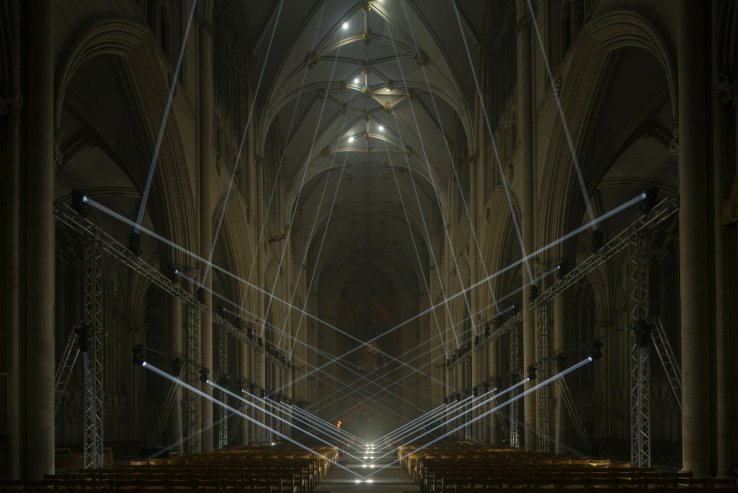
LIGHT MASONRY:Michael Wright tipped me off to this stunning light installation by Jason Bruges Studio in the main nave of York Minster. It was one of six works commissioned for Illuminating York, an annual nighttime festival supported by Arts Council England that encourages visitors to explore and discover the historic city through the imagination of artists who use the medium of light in all its forms. Designed to highlight the cathedral’s Gothic architecture, Light Masonry was constructed using a bespoke system of forty-eight computer-controlled, icon-beam moving-head luminaires (see the “making of” video) and was complemented by the live performance of Arvo Pärt’s Pari intervallo on organ. It ran October 26–29, 2016. The video below captures some of its magnificence.
Light Masonry installation by Jason Bruges Studio, York Minster, York, England, October 26–29, 2016.
BOOK LIST: I recently compiled an annotated bibliography of books published in English between 2014 and 2016 on the subject of Christianity and art: http://www.artway.eu/content.php?id=2204&action=show&lang=en. The thirty-seven entries, from a variety of authors and publishers, cover topics such as iconographic exegesis of the Hebrew Bible, the religious art of Pablo Picasso, contemporary church art commissions, visual culture in the Christian kingdom of Kongo, black public religious art in Chicago, a theology of human creativity, how to launch and manage a church gallery, and building a curriculum for the fine arts in Christian education. Let me know if I’m missing any!
INTERVIEW: Earlier this month I was interviewed by Joan Huyser-Honig for the Calvin Institute of Christian Worship about my vocation as a Christian arts blogger, the two Advent art resources I developed, and my participation in the “Bodies of Christ” seminar at Calvin College this summer. (Read the interview: “Victoria Emily Jones on Gazing as a Spiritual Practice.”) Joan had some good questions, including
When you post to your Art & Theology blog, who do you hope will see it and what do you hope they’ll do with it?
Your blog’s tagline is “Revitalizing the Christian imagination through painting, poetry, music, and more.” What might or does happen in Christians and congregations who are open to revitalizing imagination?
Picture a worship planner without your deep knowledge of art and theology. How might he or she start using resources from your blog in planning public worship?
THEOARTISTRY:TheoArtistry is a new initiative of the Institute for Theology, Imagination and the Arts at the University of St. Andrews in Scotland. “Through new projects and research, TheoArtistry celebrates the practice, making, performance, curatorship, and reception of Christian art. It also seeks to inform the scholarly and public perception of the role of the arts in theology and church practice.” The first project they’ve launched is a collaboration between internationally selected composers and PhD candidates in the St. Andrews Divinity School to set to music “annunciation” texts from the Hebrew Bible. (Two of the participants talk process in the recent Transpositions article “Setting Fire to Music.”) TheoArtistry will also be launching a new database that links artists interested in working with Christian themes, theologians interested in creative collaborations with artists, and commissioners of Christian art. I am SO stoked about all this! For more information, see http://theoartistry.org.





 In her book