Roundup: Bad-news blessing, the transfiguration of Marilyn Monroe, Christian speculative fiction anthology, European sacred art tour

BLESSING: “Blessing for Getting the News” by Jan L. Richardson: August brought two devastating pieces of news to me; I wasn’t in the line of direct impact, but I hurt for the two families who were. A blessing by artist-author Jan L. Richardson came at just the right time. Here’s an excerpt:

. . . when
the news comes,
may it be attended
by every grace,
including the ones
you will not be able
to see now.

When the news comes,
may there be hands
to enfold and bless,
even when
you cannot receive
their blessing now.

When the news comes,
may the humming
in your head
give way to song,
even if it will be
long and long
before you can
hear it,

before you can
comprehend the love
that latched onto you
in the rending—
the love that bound itself to you
even as it began its leaving
and has never
let you go.

Read more, and view original accompanying artwork, at http://paintedprayerbook.com.

ESSAY: “Transfiguring Gold: Andy Warhol’s Gold Marilyn Monroe” by James Romaine: In his latest visual meditation for ArtWay, art historian James Romaine writes on external versus essential beauty, and the Orthodox aesthetic, in one of Warhol’s most famous paintings. “A revelation of uncreated and transfiguring light” in the icon tradition, the use of gold, Romaine posits, was a theological choice on Warhol’s part, one influenced by his Byzantine Catholic faith. Warhol drew on celebrity imagery to encourage a transformation in viewers from material sight to metaphysical vision. This essay is adapted from a more extensive one titled “The Transfiguration of the Soup Can,” published in Beauty and the Beautiful in Eastern Christian Culture and linked to here with the author’s permission.

Gold Marilyn Monroe by Andy Warhol
Andy Warhol (American, 1928–1987), Gold Marilyn Monroe, 1962. Silkscreen ink on synthetic polymer paint on canvas, 211.4 × 144.7 cm. Museum of Modern Art, New York.

BOOK: Mysterion: Rediscovering the Mysteries of the Christian Faith, edited by Donald Crankshaw and Kristin Janz: Last week the husband and wife team of Donald Crankshaw and Kristin Janz published an anthology of science fiction, fantasy, and horror stories that engage with Christianity. It features twenty of the 450-plus submissions they received, all but four of which are published here for the first time. Describing their criteria for selection, Crankshaw writes in the introduction, “We wanted stories that were as untidy and as theologically imprecise as the Bible itself.” The result is a collection of diverse voices and approaches, exploring such topics as sin, forgiveness, the afterlife, the soul, mission, miracles, and supernatural agents. To read excerpts from the book, visit www.mysterionanthology.com.
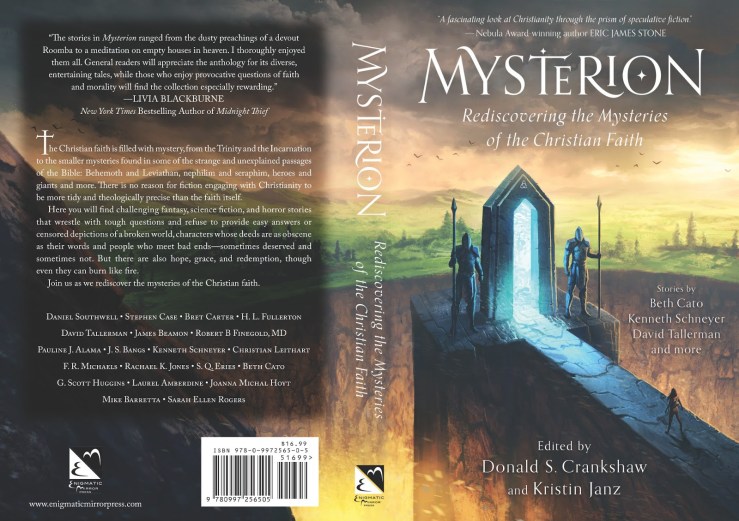
Mysterion cover

TOUR: “Reformanda 2017: Sacred Arts Today, Catholic and Protestant”: The Mount Tabor Ecumenical Centre for Art and Spirituality, founded by the Community of Jesus in Massachusetts, has organized a four-leg European tour for next May 10–30 that will explore the face of sacred art from the last five hundred years since the Reformation. With stops in France, Germany, Switzerland, and Italy, the itinerary includes visits to churches and contemporary art exhibitions, symposium lectures and discussions led by Msgr. Timothy Verdon, and Gloriae Dei Cantores choral concerts. Registration is now open.

Reformanda Tour Map

Christian-themed portraits by Kehinde Wiley

Painting is about the world we live in. Black people live in the world. My choice is to include them. This is my way of saying yes to us.

—Kehinde Wiley

Last weekend I visited the Virginia Museum of Fine Arts, where the exhibition Kehinde Wiley: A New Republic is showing through September 5, a fifteen-year survey of Wiley’s art organized by the Brooklyn Museum. An academically trained artist, Wiley paints black and brown bodies in proud poses against ornate decorative backgrounds on monumental canvases, riffing on art-historical masterpieces from the Renaissance and Baroque eras. He “street casts” his models: walks through inner-city neighborhoods, inviting black males, ages eighteen to thirty-five, to sit for portraits. In this collaborative process, the model chooses a painting from a book and reenacts, in his streetwear, the pose of the painting’s figure.

In the exhibition catalog, Connie H. Choi, a research associate at the Brooklyn Museum, writes,

In inserting the urban black male figure into the art-historical canon, the artist brings the canon up to date and at the same time questions its centuries-long exclusion of such figures. His manner of portraying African American men is Wiley’s way of affirming their presence in a society that has long discounted or undervalued them. (24)

Cultural critic Touré describes Wiley’s oeuvre as an “attempt to rehabilitate black images”—in the media (especially before the presidency of Barack Obama), often simplistically skewed toward hip-hop music videos and news reports of urban gang violence—“by putting them in the context of nobility, of import, of beauty” (52).

Kings, nobles, and wealthy merchants are among the subjects depicted in Wiley’s source material. But biblical and extrabiblical saints, and Christ himself, are also present. For centuries religious imagery had a commanding presence in churches, palaces, homes, and government buildings, exercising sway over the imagination and steering popular devotion. By translating European devotional paintings—fashioned in the image of the white ruling class—into a contemporary idiom that places black bodies up front and center, Wiley rectifies the lack of representation of racial minorities in and as the body of Christ.

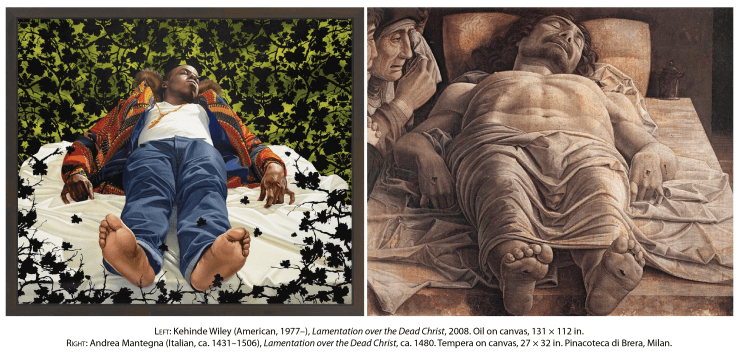
His Down series, which seeks to capture the majesty of fallen warriors and entombed saints, features three paintings of the dead Christ. Hans Holbein’s life-size predella panel on the subject was the starting point; showing Jesus’s putrefying corpse, it is regarded as one of the all-time most grotesque paintings of Jesus. In The Idiot, Dostoyevsky’s Prince Mishkin says that viewed in isolation from the Resurrection, the painting has the power to make one lose one’s Christian faith.

Dead Christ by Kehinde Wiley

In Wiley’s reconceptualization, Jesus’s body is fit, his skin radiant. Gone are the blue face, puncture wounds, and emaciation of the prototype. Art critics have recognized in this and many more of Wiley’s paintings a homoeroticism, reading them in light of Wiley’s sexuality. That’s their prerogative, but in the direct gaze and parted lips of Wiley’s dead Christ I hear not “Come hither” but “Look, white America, at what you have done, at what you are doing.”

The Down series predates the Black Lives Matter movement but speaks powerfully into that context. It challenges the public—especially the white public—to see the rampant shooting deaths of unarmed black men by police and to name it what it is: an injustice, a tragedy.

Veiled Christ by Kehinde Wiley

Lamentation (Kehinde Wiley)-01

For all their visual engagement with and meditation on the Passion, Christians at large have proven deficient in their willingness to mourn the suffering and death of black brothers and sisters. Maybe, just maybe, gazing on a dead black Christ could produce more empathy in us when we see news photos of black people whose lives have been taken from them. Maybe these paintings can lead us into lament. In Wiley’s Lamentation, for example, we’re invited to poke our heads into the void left by the excision of Mary and John and to wail and moan. (For more on racial tensions in America from a Christian perspective, I commend to you the lecture “The Heart Cry of #BlackLivesMatter” by Jemar Tisby, cofounder of the Reformed African American Network.)

In these three paintings Wiley continues the legacy of those Harlem Renaissance artists—poets, illustrators, musicians—who linked the nation’s destruction of black bodies through lynching to the crucifixion of Christ.   Continue reading “Christian-themed portraits by Kehinde Wiley” →

John Berger on how to see

John Berger—essayist, novelist, poet, screenwriter, art critic—loves to help people see what is around them, teach them how to look at the world. His life’s work is dedicated to this endeavor.

One of his most celebrated achievements is the BAFTA Award–winning Ways of Seeing, a four-episode television program written and presented by Berger and originally airing in 1972 on the BBC. “A British arts broadcasting landmark” and “a key moment in the democratisation of art education,” The Guardian calls it. The script was adapted the same year into a book, a collaboration among Berger, Mike Dibb (BBC producer/director), Richard Hollis (graphic designer), Chris Fox (consultant), and Sven Blomberg (artist). It’s still in print!

Berger’s super-conversational style and his bucking against tradition no doubt contribute to his appeal. In the first episode, he establishes his aim: to get people to cut the mumbo-jumbo that always rises up around art and instead approach art directly, much like children.

Here it is:

The episode points out the ways in which photographic technology has changed the way we look at art—it has made it more accessible, but it can also manipulate. When a painting is reproduced in a textbook, for example, details may be cut out to force your focus somewhere, or arranged to form a narrative, or compared with other works, and words surround the painting that will influence your reading of it. If presented on film, camera movement and music also play a part. Berger gives examples using, among others, Pieter Bruegel’s The Procession to Calvary [14:03]; Vincent Van Gogh’s Wheatfield with Crows [16:12]; and Francisco Goya’s The Third of May 1808 [18:28].

He says,

The camera, by making the work of art transmittable, has multiplied its possible meanings and destroyed its unique original meaning. Have works of art gained anything by this? They have lost and gained.

Paintings (especially sacred ones) used to be an integral part of the buildings for which they were designed, says Berger, but now they are often experienced outside that context, rendering their meanings ambiguous. Of paintings in churches, he says, “Everything around the image is part of its meaning. Its uniqueness is part of the uniqueness of the single place where it is. Everything around it confirms and consolidates its meaning” [05:20]. He briefly addresses icons, which I know some Orthodox believers are averse to having displayed in museums, where they cannot even be touched and thus lose part of the function for which they were created.   Continue reading “John Berger on how to see” →

ESSAY: “The Poetry of Jesus” by Edwin Markham

Edwin Markham (1852–1940) was a popular American literary figure during the first half of the twentieth century whose oeuvre fuses social justice concerns with religious faith. He gained international renown with his poem “The Man with the Hoe,” which, inspired by a Jean-François Millet painting of the same title, protests the plight of the exploited laborer. In addressing the issues of his day Markham looked to Jesus, who he considered an embodiment not only of peace, love, and other such virtues but of poetic genius as well. His essay “The Poetry of Jesus,” reprinted below, first appeared in the December 1905 issue of The Homiletic Review. Emphasis is mine.


Earth gives us hint and rumor of a divine beauty that broods above us, an ideal splendor that completes the real. To express that beauty is the perpetual aspiration of the poet. Poetry expresses this beauty in words; religion in deeds. So Jesus, as the supreme religious genius of the world, carried the vision of the poet—

The light that never was on sea or land,
The consecration and the poet’s dream.

This light is the light of the ideal; this consecration is the consecration to the service of humanity; and this dream is the dream of the social federation of the world. Toward these glorious finalities all religion labors and all poesy aspire.

Jesus, like every great poet, was stung with the pain of genius, the passion for perfection, the yearning for the ideal. No wonder, then, that He was “a man of sorrows and acquainted with grief.” Out of the long collision between the is and the ought-to-be, between the world that exists and the world that awaits us in the future, springs that majestic sorrow, that noble reticence, that touches with its shadow all elevated and poetic natures.

Upon Greece came the passion for beauty, upon Palestine the passion for righteousness. Jesus carried both ideals in His heart, for He saw the glory of the lilies in the furrow and also the perfidy of the oppressors who walk over graves. He was moved not only by the beauty of holiness, but also by the holiness of beauty.

Jesus preached artistically as the true poet always preaches; He twined the truth with the beauty. For the most part He spoke in symbol, in parable, leaving His hearer to point the moral—leaving the truth to be inferred from the beauty. If His art-feeling seems meager and His insistence upon beauty scant, let us remember that He was forced to spend most of His priceless life in teaching a few of the primary principles of conduct. Still, in spite of all obstacles, the inborn poetry of His nature was continually breaking forth through the crevices of His conversation. His message was flung forth in telling metaphor, vivid simile, pointed parable—the chief machinery of the poet. He unsouled Himself in the poet’s way, because the poet’s way is the natural and spontaneous utterance of the heart.

Feeling ever the pity and terror of our existence—its sad perversity, its pathetic brevity, and its tremendous import—still His poet’s heart took loving note of the beauty and wonder never wholly lost from these gray roads of men. He did not fail to note the wayward wind that bloweth where it listeth, the red evening sky that means fair weather, the cloud out of the west that brings the shower, the tempest in the sea, and the calm that follows after the storm. Nor did He overlook the birds of the air that feed on the Father’s bounty in the open fields and lodge in the branches of the mustard-trees; nor the green grass that glories in the field to-day and to-morrow is cast into the oven.

He knew all these, and He knew also the homely aspects of the day’s work—the bottling of the new wine, the sifting of the wheat with fans, the digging of the fallen ox from the pit, the casting of the fish-nets into the sea. He saw the young virgins trimming the lamps, the bowed women grinding at the mill, the housewife hiding the leaven in the measure of meal, and the mother forgetting the pangs of labor in the joy over the new-born child.   Continue reading “ESSAY: “The Poetry of Jesus” by Edwin Markham” →

Roundup: Controversial Eve painting, liturgy, protest, visualizing belief, and “Ya Hey”

“Mormon painting of a black Eve draws fire, but not for the reasons you might think” by Peggy Fletcher Stack, Salt Lake Tribune: Early this year a new painting of a seminude black Eve by Mormon artist J. Kirk Richards went on display at Writ & Vision gallery in Provo, Utah. While many Mormons have expressed how captivated and inspired they are by it (and I should note, black figures are extremely rare in Mormon art), a few have insisted it’s wrong for a white man to depict a nude black woman because it conjures up collective memories of sexual brutality and enslavement. The article features some interesting perspectives by black Mormon feminists. In addition to raising important questions surrounding racial histories and representation, the painting, I’ve noticed, also illustrates a distinctly Mormon view of the Fall, which differs from the orthodox Christian view—a fact Richards alludes to in his March 14 gallery talk. View the painting.

+++

“A Conversation about Creativity and the Liturgical Calendar,” panel discussion presented by Brehm Center and Fuller Studio: Moderator Edwin M. Willmington, composer-in-residence at Fuller Theological Seminary, talks with an all-star trio of creatives and liturgists comprising David Gungor of The Brilliance [00:50], on authenticity in songwriting and introducing liturgical practices to the evangelical church he attended; Todd E. Johnson [10:40], on the history, purpose, and major observances of the church calendar; and Lauralee Farrer [26:18], on discovering the Canonical Hours in a New Mexico desert and later developing them into characters for a film project. Questions: [34:02] How has liturgy shaped you? [36:20] Advice for artists on how to bring the church year to bear in their art? [37:11] Have you found that lament is generally embraced or resisted? [39:41] Advice for worship leaders?

+++

“An Art Historical Perspective on the Baton Rouge Protest Photo that Went Viral” by An Xiao Mina and Ray Drainville, Hyperallergic: During a July 10 protest following the fatal killing of Alton Sterling, Reuters photographer Jonathan Bachman captured the moment of twenty-eight-year-old Ieshia L. Evans’s arrest. As heavily armored policemen pressed in, the other protestors dropped back, but Ieshia stood assuredly in the middle of the three-lane highway, prepared to be bound. This article lauds the strength of this image of confrontation by citing compositionally and thematically similar paintings, including Briton Riviere’s Daniel in the Lion’s Den and Giotto’s The Arrest of Christ, and other works of art.

Ieshia Evans arrest photo

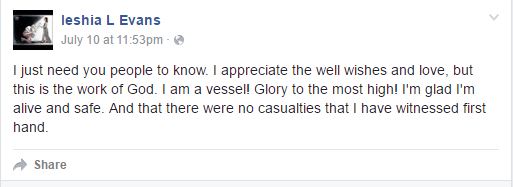
Ieshia considers herself a vessel of God, eager to be used by him to bring justice and peace. Here’s what she wrote on her Facebook wall the night of her release from jail:

Ieshia Evans statement

+++

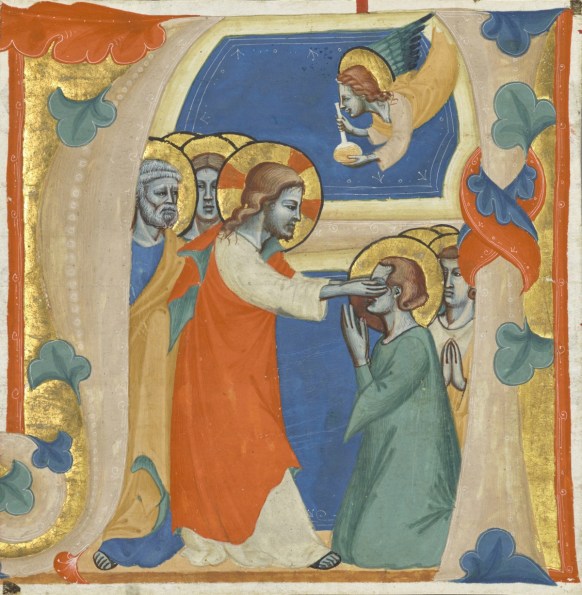
“Things Unseen: Vision, Belief, and Experience in Illuminated Manuscripts”: Running through September 25 at the Getty Center in Los Angeles, this exhibition “explores the visual challenges artists faced as they sought to render miraculous encounters with the divine, grand visions of the end of time, the intricacies of belief, and the intimate communications of prayer.” It includes a September 15 talk, “How Do We Depict Religious Experiences?”—that is, how do we convey metaphysical essence in physical form? I appreciated the Getty’s blog post this week featuring a newly acquired choir book leaf that’s part of the exhibition. Curator Bryan C. Keene writes about the difficulties of identifying the illuminator and about discovering, through an examination of the back and a search on the Cantus database, that the illumination depicts the wiping of tears from saints’ eyes, not, as previously assumed, the healing of the blind.

Christ wiping the tears from the eyes of the saved
Initial A: Christ Wiping the Tears from the Eyes of the Saved, attributed to the Master of the Antiphonary of San Giovanni Fuorcivitas, ca. 1345–50. Tempera and gold leaf on parchment, 5 1/3 × 5 1/3 in. (13.5 × 13.5 cm). The J. Paul Getty Museum, Ms. 113, recto. Digital image courtesy of the Getty’s Open Content Program.

+++

“Ya Hey” song cover by The Brilliance: Written by Ezra Koenig of Vampire Weekend, “Ya Hey” is a modern-day psalm that expresses frustration with God’s seeming unresponsiveness—to being spurned and being sought, to brokenness and suffering, to sin and struggle. The title is a play on the word Yahweh, the Hebrew name for God. The chorus references the burning bush of Exodus 3: “Through the fire and through the flames / You won’t even say your name / Only ‘I am that I am.’” The Brilliance’s acoustic cover of “Ya Hey” was released last month as a music video on YouTube featuring four New York City ballet dancers. It abandons the shrill vocoder and heavy percussion of the original song in favor of a softer, purer sound. Read the lyrics and an analysis at Sound: Interrupted.

Disciplining our eyes with holy images

Images shape our desires. As much as we like to think we’re immune to their influence, that we can encounter them without letting them tell us what is good or true or beautiful, they tend to work a subtle magic on us, especially after years of constant exposure.

I’m talking not just about advertisements and entertainment media, which perpetuate the myth that only one particular type of female body is attractive, and likewise one particular type of male body, and train us to desire that type for ourselves and for our partner.

I’m talking too about the seemingly innocuous images posted on social media. Studies have shown that regularly browsing Facebook, for example, can lead to depression, as users engage in social comparison that may cause them to resent both others’ lives as well as the image of themselves they feel they need to continuously maintain. A network member posts a photo of the just-because gift her amazing, so-thoughtful husband just bought her, and it makes you feel less loved. Another one posts a selfie taken from his scuba dive in Malta, and you wonder where all the adventure has gone in your life. A friend from high school posts a whole album of birthday photos of her two-year-old, and you are reminded of your ticking biological clock, or of her twenty-two-year-old in cap and gown, and you wish your kid had decided to go to college.

There’s nothing inherently wrong with images—creating or consuming. In fact, we need them. But we also need to beware of the propensity they have to plant themselves firmly in our minds and become idols. Whether it’s a perfume commercial on TV or an exotic dinner photo on Instagram, we need to break the power certain images have over us. Instead of allowing images to name us (“ugly,” “boring,” “unwanted,” “failure”), we must name them—denounce as false and unholy any image that claims ultimate authority in our lives, or that tries to redefine who we are against the definition scripture already gives us: we are Christ’s.

In his essay “The Desire of the Church,” published in The Community of the Word: Toward an Evangelical Ecclesiology (InterVarsity Press, 2005), Willie James Jennings discusses the distortion of sight and desire that is the result of the Fall. The tree of knowledge, he writes, was the first unholy icon in human history—an icon in the sense of being “a point of focus that facilitates desire and guides relationships” and “nurtures our seeing and knowing,” and unholy because to look on it was to begin the journey of disobedience. Gazing on the unholy icon of the tree, Adam and Eve saw themselves refracted through it, instead of gazing on God and seeing themselves reflected. By turning their gaze off God and fixating it on something lesser, they stopped seeing themselves, each other, and their Creator rightly.

“The only way to reverse this journey of disobedience,” Jennings says, “is to establish a new point of focus.” So into humanity comes the holy icon—Jesus Christ—whose life overcomes the fracture and fragment of desire. As the image of the invisible God, he reorients our gaze back onto the holy.   Continue reading “Disciplining our eyes with holy images” →

Coming Home to North Carolina: Shadows of Christian Faith in Junebug

Junebug movie coverWhen Madeleine (Embeth Davidtz), a Chicago gallerist, meets George Johnsten (Alessandro Nivola), a transplant from the South, it’s a whirlwind romance, clinched by a marriage ceremony at the end of week one. Six months later, it’s time to meet George’s family, so it’s off to Pfafftown, North Carolina.

A culture-clash dramedy written by Angus MacLachlan and directed by Phil Morrison, Junebug (2005) explores the themes of homecoming—geographic and spiritual—and escape. It was shot primarily in Winston-Salem, North Carolina, where both the writer and the director were born and raised, as well as in Greensboro and Wake Forest. Location is key to the story and aesthetic of the film, as the camera often fixates on empty rooms in the Johnsten house, or tracks through neighborhoods and past the local church.

Most scenes are played from the perspective of Madeleine, an outsider art dealer who herself becomes an outsider—an outsider to the religious and family culture of her husband. We are given a taste of the disorientation she feels in the very first frames: footage from a National Hollerin’ Contest, a folk tradition of the state’s Piedmont region.

Mama Peg (Celia Weston) is suspicious of Madeleine from the start, thinking her an ill-suited match for her son. George’s taciturn father, Eugene (Scott Wilson), on the other hand, is fond of Madeleine and spends most of the movie looking for his screwdriver so he can carve her a wooden bird. Johnny (Ben McKenzie), George’s sullen, underachieving brother, stays at a distance; he resents George for leaving town. But Johnny’s pregnant wife, Ashley (Amy Adams), is exceptionally and demonstrably thrilled to have a new sister-in-law; she’s wide-eyed, loquacious, and doting, and the emotional center of the film.

In Pfafftown, one of the differences from her cosmopolitan background that Madeleine encounters is the cultural saturation of Christianity. Jesus’s name is invoked at baby showers and potlucks, in Sunday-morning sermons and fridge magnets, in conversations and aphorisms.

This is the environment George grew up in, that shaped who he is. We get the sense that faith used to be an important part of his life but that it’s something he shook off, or maybe privatized, when he moved away. We’re never told why he moved—only that it caused a major rift between him and his brother. Why does anyone leave home? It’s usually to see and experience the world beyond their one small corner of it.

The film’s most pivotal scene takes place at a church supper, where George is reunited for the first time in years with his “home flock.” After spending time laughing and bonding with old friends across generations and receiving prayer from his former pastor (Madeleine peeks with surprise at the reverence George shows; this is presumably the first time she’s seen him pray), George is invited to sing a hymn for everyone: “Softly and Tenderly.”   Continue reading “Coming Home to North Carolina: Shadows of Christian Faith in Junebug“ →

More things are wrought by prayer . . .

Wrought by Prayer by Bill Hemmerling
Bill Hemmerling (American, 1943–2009), Wrought by Prayer. Oil on canvas, 20 × 30 in.

“. . . More things are wrought by prayer
Than this world dreams of. Wherefore, let thy voice
Rise like a fountain for me night and day.
For what are men better than sheep or goats
That nourish a blind life within the brain,
If, knowing God, they lift not hands of prayer
Both for themselves and those who call them friend?
For so the whole round earth is every way
Bound by gold chains about the feet of God.”

—King Arthur to Sir Bedivere, in “The Passing of Arthur,” from the twelve-poem narrative cycle Idylls of the King by Alfred, Lord Tennyson

“Confess your faults one to another, and pray one for another, that ye may be healed. The effectual fervent prayer of a righteous man availeth much.”

—James, the brother of Jesus, in a letter to Jewish Christians outside Palestine

Book of Romans album by Psallos

Paul’s epistle to the Romans is, I’d say, the most theologically foundational book of the Bible. As a young Christian I was taught the “Romans Road” method of sharing the gospel, using verses like Romans 3:23 (“For all have sinned and come short of the glory of God”), Romans 6:23 (“For the wages of sin is death; but the gift of God is eternal life through Jesus Christ our Lord”), and so on to teach the doctrines of sin and salvation. The book is definitely Paul’s magnum opus.

Countless commentaries on Romans have been produced, but none takes the unique approach of Cody Curtis: exegeting the entire text with music.

The project began, loosely, in 2011, when Curtis’s pastor asked him if he could set to music Paul’s benediction in Romans 11:33–36 to supplement a sermon series. The result, “O the Depth!,” was well received, which gave Curtis the confidence to experiment with lyrical adaptations and musical settings of other Romans passages. In 2014 he decided to pursue a full-out album in collaboration with other musical students, alumni, and friends of his alma mater Union University in Jackson, Tennessee. They call themselves Psallos, from the Greek verb psallō, translated in Ephesians 5 as “making melody”: “Be filled with the Spirit, addressing one another in psalms and hymns and spiritual songs, singing and making melody to the Lord with your heart” (vv. 18b–19).

Released in March 2015, Romans mines the theological depths of its eponymous book, bringing to life Paul’s teachings on sin, grace, sanctification, and divine promise with music. The predominant style could be described as orchestral folk pop, but elements of rock, soul, and jazz are also present on the album. (Read more about the eclectic style choices in Trevin Wax’s interview with Curtis from last year.) Besides your standard piano, guitar, and drums, other instruments include the violin, viola, cello, flute, clarinet, trumpet, trombone, and harmonium. Curtis’s compositions bring to bear his extensive music education—he’s a newly minted doctor of musical arts—as well as his experience leading music for church congregations. He presently serves as music minister at Pleasant Plains Baptist Church in Jackson, Tennessee.  

Continue reading “Book of Romans album by Psallos” →

Roundup: Free Bifrost Arts songs, civil religion hymn revised, Bono and Eugene Peterson talk Psalms, Crystal Cathedral transformation, mercy-themed movies

Entire Bifrost Arts catalog available for free download: For a limited time, the Christian music collective Bifrost Arts is offering all forty-eight of their songs for free download from NoiseTrade. Donations are welcome—100 percent of them will go to the Salt and Light Artist fund, which funds residencies for Christian artists in Arab countries, providing a platform for interaction with the local arts community.

Alternative song lyrics for “America, the Beautiful”: In 1993 Sister Miriam Therese Winter adapted the lyrics to “America, the Beautiful” to make the song more appropriate for a Christian worship service (i.e., less nationalistic). Her adaptation is #594 in the United Church of Christ’s New Century Hymnal.

Interview with Bono and Eugene Peterson on the Psalms: This short film, released in April, documents the friendship between Bono (of the band U2) and Eugene Peterson (author of contemporary-language Bible translation The Message) revolving around their common interest in the Psalms. Inspired by their conversation, interviewer David Taylor compiled a list of resources for exploring the Psalms.

Transforming a Protestant worship space into a Catholic one: The largest glass building in the world, the Crystal Cathedral in Orange County, California, has been undergoing renovations since having been sold in 2013 by the Reformed Church in America to the Roman Catholic Diocese of Orange. “Our charge is to convert an open, all-glass Evangelical church into a great Catholic cathedral to serve its centuries-old sacraments and ritual processions, and to reinforce the centrality of the Eucharist,” write architects Scott Johnson and Frank Clementi. This article published in Faith and Form describes some of the symbolic, aesthetic, environmental, and technical challenges of this project and includes renderings of the new space, which is scheduled to reopen next year.

Crystal Cathedral renovations

Top 25 films on mercy: I’ve been enjoying these top 25 film lists put together by the Arts & Faith online community—especially how they reach beyond the obvious choices, dipping into the silent era as well as non-American cinema. Here’s their latest, a list of films that “show us visions of a world so often lacking in mercy, as well as worlds in which one merciful act alters the landscape of human experience forever.” Click here to view their other lists: road films, horror films, divine comedies, films on marriage, and films on memory.