
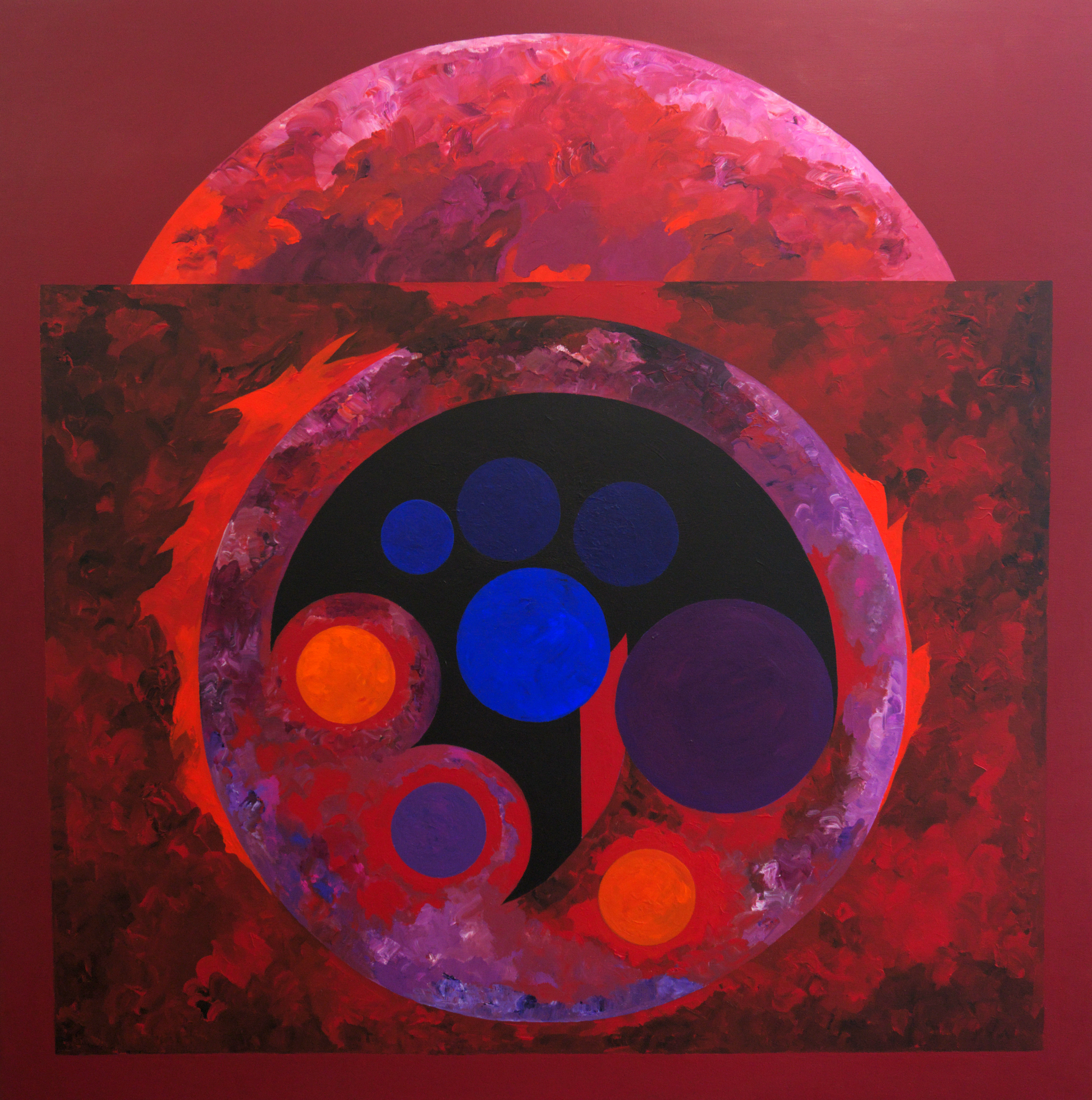
In the beginning (in the beginning of time to say the least) there were the compasses. Whirling in void, their feet traced out beginnings and endings, beginning and end in a single line. Wisdom danced also in circles, for these were her kingdom. The sun spun, worlds whirled, the seasons came round, and all things went their rounds; but in the beginning, beginning and end were in one.
And in the beginning was love. Love made a sphere, and all things grew within it. The sphere then encompassed beginnings and endings, beginning and end. Love had a compass whose whirling dance traced out a sphere of love in the void; in the center thereof rose a fountain.
This untitled prose poem that opens the “morning” section of The Circus of the Sun by Robert Lax was originally published in The Circus of the Sun (Journeyman Press, 1959) and subsequently in 33 Poems (New Directions, 1988, 2019), Love Had a Compass: Journals and Poetry (Grove Press, 1996, 2019), and Circus Days and Nights (Overlook Press, 2000). Copyright © 1959 by the Estate of Robert Lax. Reprinted by permission of New Directions Publishing Corp.
The Circus of the Sun is an effusive, metaphysical cycle of thirty-one poems by Robert Lax that presents the circus tent as a microcosm of the universe. The cycle unfolds over five sections—morning, afternoon, evening, the midway, and night—following the daily routine of a traveling circus troupe, from set-up to rehearsal to performance to tear-down.
The poem above is the second in the cycle (it’s preceded by an introductory tercet) and the first in the “morning” section. It describes the origins of the cosmos in the dance of the Trinity, drawing on Genesis 1 and the prologue to the Gospel of John, as well as the title “Alpha and Omega” that’s applied to both God the Father and God the Son in the book of Revelation. God is not so named, but there’s a measuring, loving Being behind the flurry of creativity that’s being narrated. There’s a sense of orchestration and design, with the beginning and the end traced out at once, held together in the mind of God, with all things in between.
(Related posts: “Art deco Wisdom sculpture at Rockefeller Center”; “Namasté Saté”)
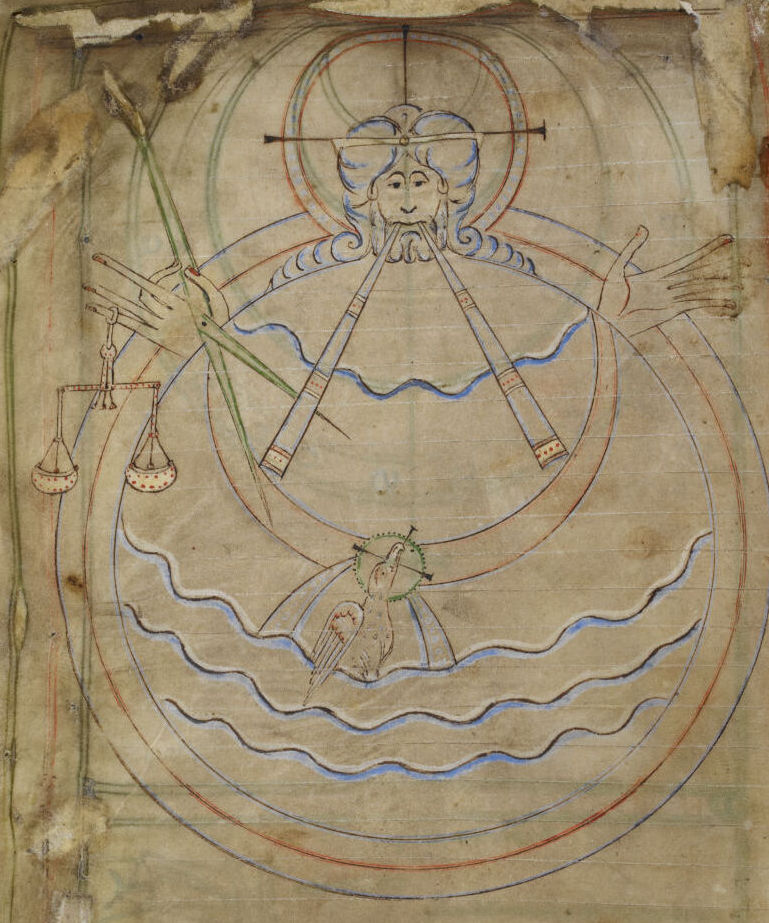
Many medieval depictions of the creation of the world show God holding a drafting compass, the tool of an architect, to mark out and circumscribe. Lax imagines the divine compass in balletic terms, its anchor leg fixed while its marking leg points and makes sweeping arcs, bringing about a fiery sun and spinning planets with wide orbits and seasonal cycles and so on.
Circles are symbols of eternity, wholeness, perfection. God is perfection, and God makes a perfect world.
And in the center of that world, this mystic poem suggests, is a fountain, representing the abundant life God is and gives. It’s cool and fresh and overflows. Jesus tells of this primordial fount to a Samaritan woman one day at Jacob’s well, describing it as a thirst-quenching “spring of water gushing up to eternal life” (John 4:14).
The theological orientation of The Circus of the Sun is established in part by its epigraph, Proverbs 8:23–27a (Douay–Rheims translation), where Wisdom personified speaks:
I was set up from eternity,
And of old
Before the earth was made:The depths were not as yet,
And I was already conceived;
Neither had the fountains of waters
As yet sprung out;The mountains with their huge bulk
Had not as yet been established;
Before the hills
I was brought forth:He had not yet made the earth,
Nor the rivers,
Nor the poles of the world:When he prepared the heavens,
I was there.
Wisdom dances, Lax writes, in the beginning, producing fecundity.
The connection of creation to the circus in the Circus’s second poem is not clear, but it becomes more so as the cycle progresses, as the circular shapes and movements are echoed in rings, balls, and somersaults.
The Circus of the Sun was inspired largely by Lax’s experience traveling with the Cristianis, a long-standing circus-performing family of equestrians and acrobats from Italy. On a writing assignment for The New Yorker, he toured with the Cristiani troupe through western Canada in summer 1949, occasionally performing as a clown in their show.
Lax was fascinated by the Cristianis, especially by how they approached the state of “pure act” (actus purus)—a term that Thomas Aquinas, whose writings Lax engaged deeply, used to describe God, in the sense that God is pure existence and actuality with no unfulfilled potential. Michael N. McGregor, Lax’s biographer, elaborates in the 2015 article “Poetic Man of God”:
The acrobats’ performance, Lax thought, was as close as anything he’d seen to a fully present existence, an ability to be entirely in the moment that was both practiced and spontaneous. This ability, this nearness to the essence of God, came not only from physical ability and mental acuity but also a spiritual awareness, a fullness of love. The family was Catholic and close, trusting completely in the skill and the intention—the whole person—of each other.
The Circus of the Sun—Lax’s first full-length poetic work—didn’t come out until ten years after his illuminating immersion in circus life. It was published in 1959 by Journeyman Press, a small operation founded by the illustrator Emil Antonucci, using money from a Guggenheim grant, expressly to disseminate Lax’s poetry, beginning a lifelong collaboration between the two. Antonucci provided a few line drawings for the volume.
The cycle has appeared in three compilation volumes since then, including, along with Lax’s other circus poems, Circus Days and Nights (Overlook Press, 2000), which composer Philip Glass adapted into an opera in 2021.
The Circus of the Sun marks the end of the early, lyrical phase of Lax’s career. His later poems are much more experimental and minimalistic, alienating some readers (including me!).
But this work, which I think is his best, is brilliant in its grand exploration of, as Lax interprets in one of the poems, “creation and glory, / of rising, / and fall: / and again of the rising / where we are all risen.” For Lax, the circus is a place of glory, grace, daring, mindfulness, joy, play, and wonder that points back to creation, forward to the eschaton, and right here to what the life of faith looks like, nomadic and whimsical and death-defying.
In his introduction to Circus Days and Nights, Paul Spaeth writes,
Circus of the Sun is a blending of devotional poetry, in the Catholic tradition, with the eye of a journalist and the delight of a child. I use the term “journalist” in the sense of being a reporter but also in the sense of one who keeps a journal or diary. Lax, the reporter seeing things with childlike grace, at times relates his vision like an Old Testament prophet, at times like St. Francis composing a new “Canticle of the Sun,” and at times like a kid wandering through the circus grounds eating popcorn.
Hear Lax read the entire poem cycle in this 1983 recording from Patmos Island. (I’ve cued up the creation poem, but feel free to rewind to the beginning.)
Robert Lax (1915–2000) was an American avant-garde poet who is especially respected among practitioners and admirers of concrete poetry. Born to Jewish immigrant parents in Olean, New York, he attended Columbia University in the late 1930s, studying literature under Mark Van Doren. There he became lifelong friends with classmate Thomas Merton (Merton mentions him in his autobiography, The Seven Storey Mountain), with whom he worked on the college humor magazine Jester and who influenced his conversion to Catholicism in 1943. At various times in his career, Lax worked as a university lecturer, book reviewer, film critic, Hollywood scriptwriter, editor at The New Yorker and the progressive Catholic magazine Jubilee, and even as a circus clown. In 1964 he moved to Greece, where he remained, with the exception of a few brief visits to the US and annual trips to the European mainland, for the rest of his life, writing.


Beautifully timed for the Feast of the Indiction (Beginning of the Ecclesiastical Year aka Orthodox Christians’ “New Year’s Day”)
O Logos, Christ our God,
Who constituted the universe with wisdom ineffable,
Who appointed seasons and years,
bless the works of Your hands;
and make our faithful leader glad in Your power,
giving tje,m might against foreign enemies, f
or You alone are good and benevolent.
–Doxosticon at the Orthros {Matins] Praises
LikeLike