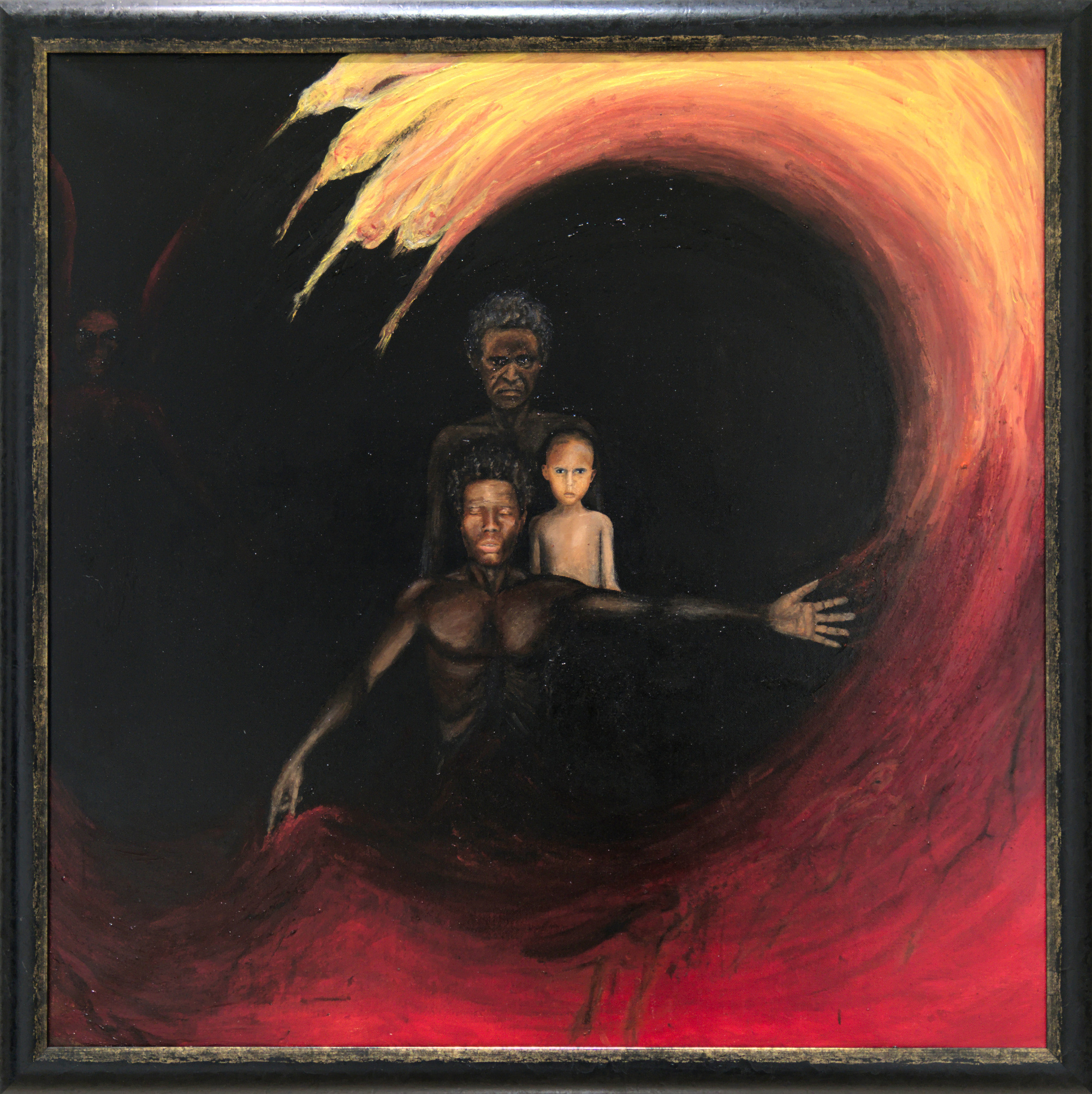
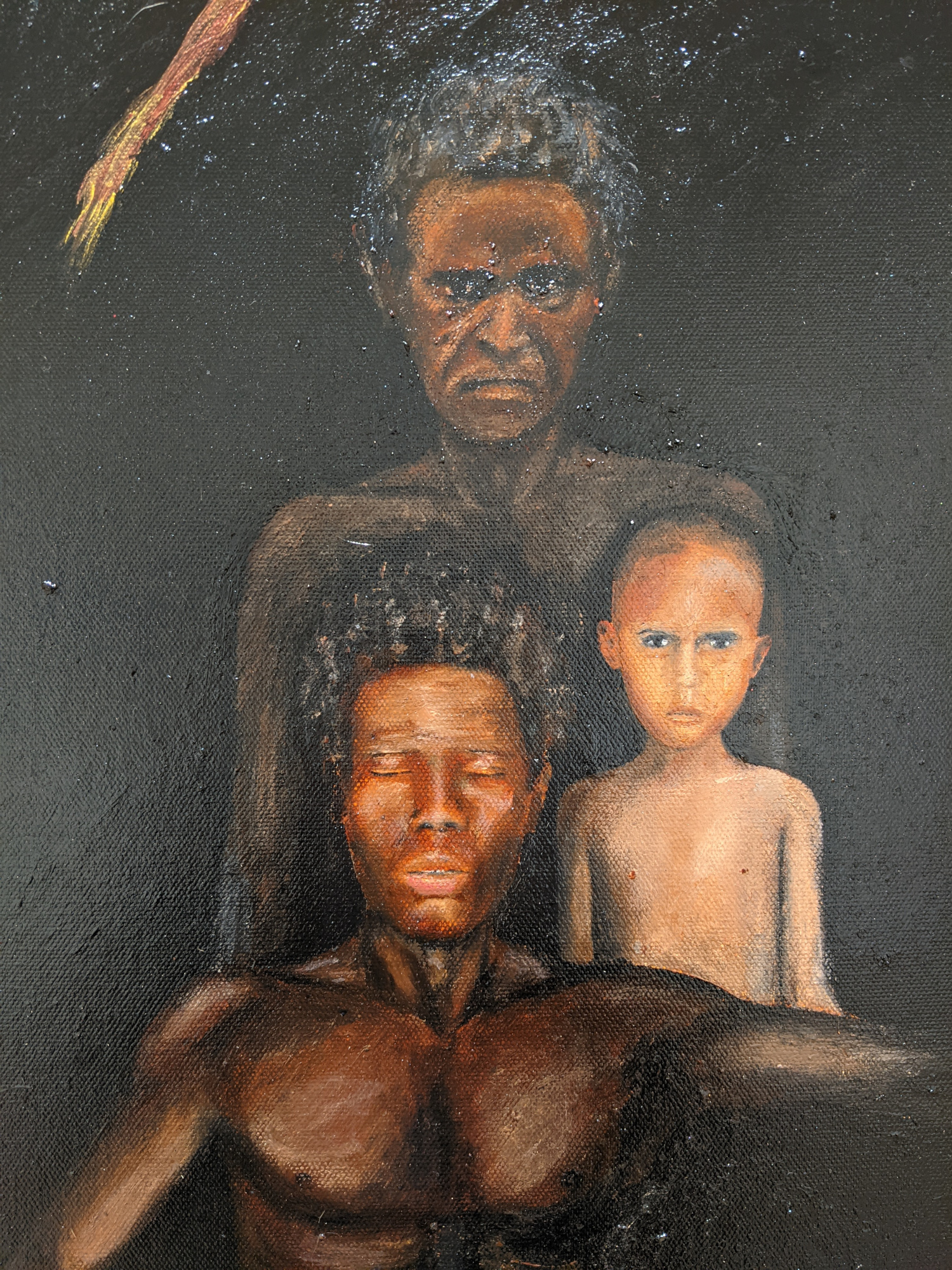
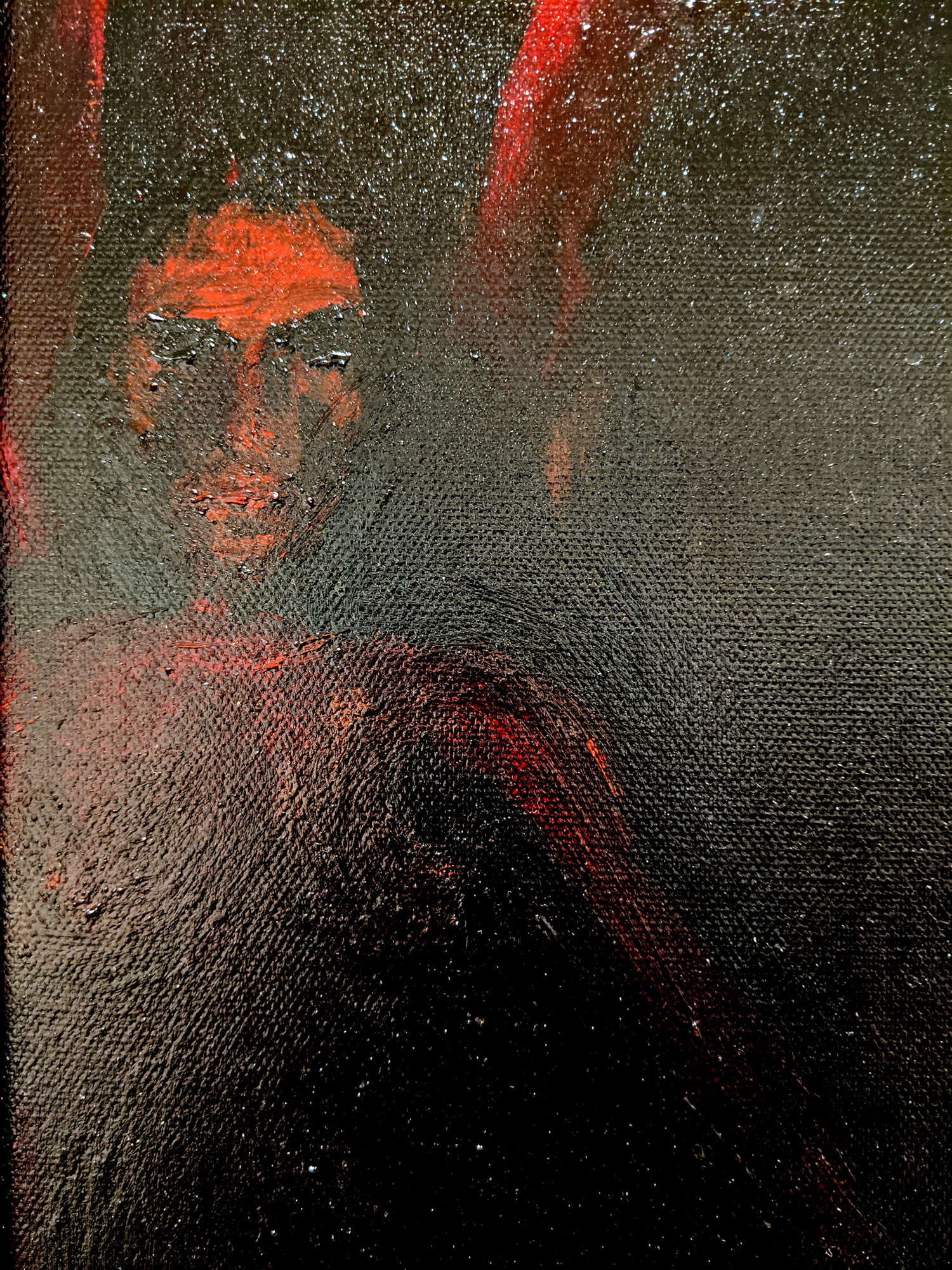
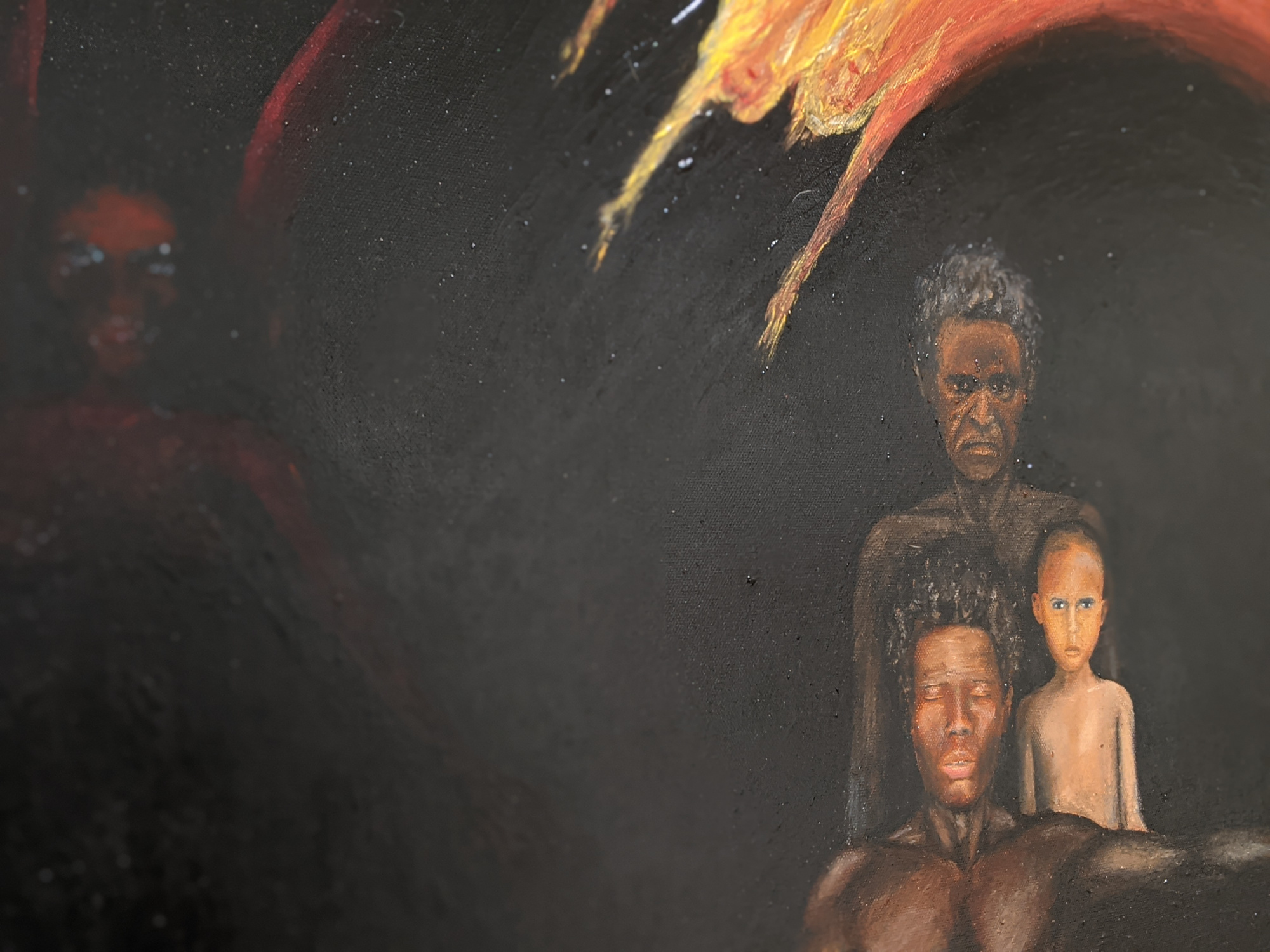
Rob Woodcox, El Espíritu Asciende (Part 3) (The Spirit Rises), 2018
You dragged me
Through the gates of pain
To song,
Love from my heart
Spilling over;
Reason, like Lucifer’s sin,
Burst away and fled.
Now the freer motion
Over the fertile ground
Will reign.
“Release” by Joseph Kariuki is from Poems from East Africa, ed. David Cook and David Rubadiri (Nairobi: East African Educational Publishers, 1971). Used by permission of the publisher.
Joseph E. Kariuki was born in 1931 in Banana Hill, Kenya. After receiving a BA from Makerere College in Uganda and further education at Cambridge University in England, he pursued a career in public administration, working with United Nations organizations in East and North Africa. He also wrote poetry, though less so after his appointment as director-general of the African Training and Research Centre in Administration for Development (CAFRAD) in 1969. His most famous poem is “Ode for Mzee” (1965), written to commemorate Jomo Kenyatta on the occasion of his becoming president of Kenya.
Tanja Butler (American, 1955–), Easter Panels: “The Angel at the Tomb,” “Christ’s Victory Over the Gates of Hell and Death,” “Christ Appearing to Mary in the Garden,” and “The Angel Guarding the Entrance to Paradise,” 2005. Acrylic on canvas, each 8 ft. high. Collection of the artist.
“The tomb is empty!” So declares the angel in the far-left panel of this Easter quadriptych by Tanja Butler, an artist from New England. The angel gestures toward Jesus’s bare and open coffin and his cast-aside graveclothes, telling the women (out of frame) that “he has been raised, as he said” (Matt. 28:6).
The second panel shows Jesus trampling down the gates of hell (the doors laid across each other in an X-shape references traditional iconography of Christ’s descent into Hades). He has defeated death, as indicated by the skull under his feet. A rainbow, symbol of God’s promise, arcs across the scene. Shaped in blessing and communicating doctrinal truths, the fingers on his right hand form the letters IC XC, the first and the last letters of the Greek words IHCOYC XPICTOC, “Jesus Christ.” His five wounds—on wrists, feet, and side—are still present on his resurrected body, but they have been transfigured.
The third panel shows the resurrected Christ appearing to Mary Magdalene in the garden of his burial. With one hand he reaches out to reassure her, but with the other he reminds her that he will be ascending soon, and so not to cling to him (Noli me tangere, as this scene is traditionally named). I believe that the twisting object that seems to proceed from Mary’s mouth and exits the garden gate is a speech scroll, suggesting that she is proclaiming the gospel; “apostle to the apostles,” she is tasked with delivering the news of resurrection to the Eleven. But with its riverine shape, it also reminds me of Jesus’s words to the Samaritan woman at the well: “Those who drink of the water that I will give them will never be thirsty. The water that I will give will become in them a spring of water gushing up to eternal life” (John 4:14).
(Update, 4/20/22: Butler tells me she had in mind the release of the Holy Spirit, breaking through walls and barriers.)
In the far-right scene, the angel who had been guarding paradise with a flaming sword (Gen. 3:24) has put down his sword and now invites us to enter. The sentry has become a porter! He gestures toward the doorway that Christ’s death and resurrection has opened for us. The fall has been undone. We are welcomed home.
“Tanja Butler (b. 1955) was born in Germany and moved to the United States as a young girl. She received her B.A. and M.A. from the University of Albany. Her artistic practice has focused on liturgical art, illustration, and community service projects. She is inspired by Byzantine icons, American and European folk art, Persian manuscripts and textile patterns, African art, Early Christian art, Russian Suprematist paintings, Cubism and Fauvist color. Informed by studies in art history and time working in Italy, she was particularly influenced by the frescoes of Fra Angelico in the Monastery of San Marco in Florence. Her collection of 600 graphic images, Icon: Visual Images for Every Sunday, was published by Augsburg Fortress Publishers. Her work is included in the collections of the Vatican Museum of Contemporary Religious Art; the Billy Graham Center Museum at Wheaton; the Boston Public Library; the DeCordova Museum; and the Armand Hammer Museum of Art, UCLA. In 2014 she retired from her position as an associate professor of art at Gordon College in Wenham, Massachusetts, where she taught painting, drawing, liturgical art, and illustration and frequently integrated service opportunities in her courses.” [source]
Temporary installation at Christ Church, Hamilton/Wenham, Massachusetts, 2005
1. Pourquoi, parmi les morts, chercher les vivants? Jésus est ressuscité! Comme la lumière du soleil levant, Jésus est ressuscité, alléluia, Jésus est ressuscité.
2. Que la terre entière sache la vérité Jésus est ressuscité! Comme la vie nouvelle qu’il nous a donnée, Jésus est ressuscité, alléluia, Jésus est ressuscité.
3. L’ennemi est vaincu, il est terrassé, Jésus est ressuscité! À lui la victoire, nous sommes libérés, Jésus est ressuscité, alléluia, Jésus est ressuscité.
4. Nous voyons sa gloire dans tout l’univers. Jésus est ressuscité! L’image parfaite du Dieu notre Père, Jésus est ressuscité, alléluia, Jésus est ressuscité.
5. Acclamons Jésus, il a vaincu la mort! Jésus est ressuscité! Dansons et chantons, car il est le plus fort, Jésus est ressuscité, alléluia, Jésus est ressuscité.
6. Pourquoi, parmi les morts, chercher les vivants? Jésus est ressuscité! Comme la lumière du soleil levant, Jésus est ressuscité, alléluia, Jésus est ressuscité.
English translation:
1. Why seek the living among the dead? Jesus is risen! Like the light of the rising sun, Jesus is risen, hallelujah, Jesus is risen.
2. Let the whole earth know the truth: Jesus is risen! Like the new life he gave us, Jesus is risen, hallelujah, Jesus is risen.
3. The enemy is defeated, he is struck down, Jesus is risen! To him the victory, we are freed, Jesus is risen, hallelujah, Jesus is risen.
4. We see his glory throughout the universe. Jesus is risen! The perfect image of God our Father, Jesus is risen, hallelujah, Jesus is risen.
5. Let us acclaim Jesus, he conquered death! Jesus is risen! Let’s dance and sing, because he is the strongest, Jesus is risen, hallelujah, Jesus is risen.
6. Why seek the living among the dead? Jesus is risen! Like the light of the rising sun, Jesus is risen, hallelujah, Jesus is risen.
Born and raised in South Africa, singer-songwriter Pat Berning moved to southern France with his wife Linda in 1988, following a call they felt while working for the international ministry Youth for Christ. Though he didn’t know the language at the time, now he sings and records primarily in French, and occasionally in English or Zulu.
His live performance above of his original song “Jésus est ressuscité” is from the Christian arts festival Psalmodia Gagnières—sometime in the early to mid-2000s. The album version uses male and female singers and has call-and-response elements. “Jesus is risen!” the refrain goes. Such a fun and celebratory song.
The hip-hop dancer in the video is Sodapop. He and his wife, Christine Jeanville (a classical and contemporary dancer), founded Machol Danser la Vie in 2005, named after the man in 1 Kings 4:31 whose name means “dancing.” The ministry organizes workshops that promote healing, empowerment, and connection with others and God through dance. And in 2018 they opened the Ecole de Formation sur l’ Identité et la Louange par le Mouvement (Training School on Identity and Worship through Movement).
Craig Goodworth (American, 1977–), Playa Studies, 2017. Site-specific land-based artwork, Great Basin Desert, Oregon. Photograph by the artist.
Craig Goodworth’s practice encompasses installation, poetry, drawing, research, teaching, and farm labor. He holds master’s degrees in fine art, sustainable communities, and divinity, and his interests include land, place, religion, mysticism, and folk traditions.
During a four-week residency in the Great Basin Desert in Oregon, he made a series of land-based artworks called Playa Studies, which he documented through photographs. (A playa is an area of flat, dried-up land.) The shape of this one evokes a grave.
LISTEN: “Aestimatus sum” (I am counted . . .) by Tomás Luis de Victoria, 1585| Performed by Ars Nova Copenhagen, dir. Paul Hillier, 2017
Aestimatus sum cum descendentibus in lacum, factus sum sicut homo sine adjutorio, inter mortuos liber. Versus: Posuerunt me in lacu inferiori, in tenebrosis et in umbra mortis. Factus sum sicut homo sine adjutorio, inter mortuos liber.
English translation:
I am counted with them that go down into the pit: I am as a man that hath no strength: free among the dead. Verse: They have laid me in the lowest pit, in darkness, in the deeps. I am as a man that hath no strength: free among the dead.
This is the eighth responsory for Holy Saturday. Tomás Luis de Victoria [previously] of Spain, one of the principal composers of the late Renaissance, set it to music in 1585. It’s the penultimate motet (a multivoiced musical composition sung without instrumental accompaniment) in a set of eighteen by Victoria, titled Tenebrae Responsories.
The text is taken from Psalm 87:5–7 of the Latin Vulgate (Psalm 88:4–6 in the King James Version and most modern translations). The most depressing psalm in the Psalter, Psalm 88 ends not on a note of hope but with the lament that “darkness has become my only companion.” (Hello darkness, my old friend.)
While the psalmist spoke in metaphors of death, Jesus went there literally. After suffering much affliction, he descended “into the pit” of the earth—his grave. He knew emotional and spiritual darkness, and now he was surrounded by the physical reality. The Light had gone out. The Word was made silent.
Imagine what Jesus’s followers must have felt the day after the Crucifixion. Grief, devastation, loneliness, bewilderment, hopelessness. They were left bereft of their Lord’s presence.
On Holy Saturday, we sit in the pocket of that grief, that loss.
N. T. Wright says, “We cannot be Easter people if we are not first Good Friday people and then Holy Saturday people. Don’t expect even a still, small voice. Stay still yourself, and let the quietness and darkness of the day be your only companions.”
[Transliterated Greek] Símeron kremátai epí xýlou, o en ýdasi tín gín kremásas. Stéfanon ex akanthón peritíthetai, o tón Angélon Vasiléfs. Psevdí porfýran periválletai, o perivállon tón ouranón en nefélais. Rápisma katedéxato, o en Iordáni eleftherósas tón Adám. Ílois prosilóthi, o Nymfíos tís Ekklisías. Lónchi ekentíthi, o Yiós tís Parthénou. Proskynoúmén sou tá Páthi Christé. Proskynoúmén sou tá Páthi Christé. Proskynoúmén sou tá Páthi Christé. Deíxon imín, kaí tín éndoxón sou Anástasin.
[English translation] Today he who hung the earth upon the waters is hung on the tree. The King of the angels is decked with a crown of thorns. He who wraps the heavens in clouds is wrapped in the purple of mockery. He who freed Adam in the Jordan is slapped on the face. The Bridegroom of the church is affixed to the cross with nails. The Son of the virgin is pierced by a spear. We worship thy passion, O Christ. We worship thy passion, O Christ. We worship thy passion, O Christ. Show us also thy glorious resurrection.
This is the fifteenth antiphon (short hymn) from the Matins service of Great and Holy Friday (as the day is called in the Orthodox tradition), celebrated on Thursday evening.
>> Arranged by Fr. Seraphim Dedes, chanted by Paul Barnes, 2019:
Paul Barnes is both a pianist and a Greek Orthodox chanter. Here he chants the “Simeron Kremate,” starting out in Greek and then using the following English translation:
Today he who suspended the earth on the waters is suspended on a cross. (×3) The King of the angels wears a crown of thorns. He who wraps the sky in clouds is wrapped in a fake purple robe. He who freed Adam in the Jordan accepts to be slapped. The Bridegroom of the church is fixed with nails to the cross. The Son of the virgin is pierced with a spear. We worship your passion, O Christ. (×3) Show us also your glorious resurrection.
Seven of his piano majors from the Glenn Korff School of Music provide the ison (drone note).
>> Simeron Kremate, a solo keyboard work by Victoria Bond based on the Greek Orthodox chant, performed by Paul Barnes, 2019:
Paul Barnes and composer Victoria Bond are longtime collaborators. He introduced her to the “Simeron Kremate” chant, and she built a piano composition around its five-note melody. Struck by its similar melodic contour, she incorporated the Jewish Passover chant “Tal” (Dew), a prayer that life-sustaining dew would water the land. This prayer is traditionally chanted on the first morning of Passover (which is tomorrow; the festival begins this evening). Bond, who is Jewish, notes the thematic resonance between the two chants as well: (in my own words) the one a request for fruitfulness and refreshment, the other a lament for the death of the One whose death bears fruit and brings life. She describes the musical elements of the composition as follows:
The work opens with the traditional apichima of the plagal of the second mode which aurally establishes the musical atmosphere of the mode. Victoria follows this with a Jewish style cantillation (based on the cantillation of the great cantor Yosele Rosenblatt) which leads to the first statement of the “Simeron” chant. These opening notes are then developed in multiple ways before the intimate entry of the “Tal” melody. The work concludes with a ‘tranquillo’ passage of rare beauty ingeniously combining both themes. The work ends tentatively and unresolved as the opening notes of the chant dissipate into eternity.
Hélène Mugot (French, 1953–), Du sang et des larmes (Blood and Tears), 2004. Triptych of 300 crystal drops and 200 red glass drops, 350 × 900 cm. Exhibition view from Icare encore at the Mandet Museum, Riom, France, October 22, 2011–January 22, 2012. (Foreground: Pour la gloire… [For the Glory…], 2011.)
When Jesus went out to the garden of Gethsemane to pray the night of his arrest, he pled with the Father to let the cup of suffering pass. Luke says he sweated drops of blood (22:44). He was in agony. He probably dreaded the physical torture he knew was coming, and maybe even more his disciples’ abandoning him. Perhaps he wept for the mother and friends he would leave behind in this next phase of ministry—or, with a mixture of grief and frustration, for the world’s failure to see who he truly was.
Hélène Mugot’s Du sang et des larmes, which translates to Blood and Tears, is an installation of glass pieces made to look like bodily fluids. They hang on the wall in the shape of a three-paneled altarpiece—blood in the center, tears on the wings. The globular forms catch the light from the room and shine.
When Du sang et des larmes was exhibited at the Mandet Museum in 2011, it was part of a larger show of Mugot’s work. On the floor in front of it was her Pour la gloire… (For the Glory…), a menacingly large braided wreath of thick, knotted, blackened vines whose stumps are dotted with red wax of the type used to seal wine bottles—both bandage and wound here, Mugot says. The piece is meant to evoke Jesus’s crown of thorns.
Hélène Mugot (French, 1953–), Pour la gloire… (For the Glory…), 2011. Old vines and red sealing wax, outside diameter 275 cm, height 50 cm. Exhibited at the Mandet Museum, Riom, France, 2011. Photo: Patrick André.
In 2013 Du sang et des larmes joined the collection of the Musée du Hiéron in Paray-le-Monial, France, a museum of Christian art from the Middle Ages to today. There it is staged as the backsplash to a seventeenth-century Virgin and Child statuette carved in wood, thus prompting us to read Christ’s infancy in light of his passion, and vice versa—the Incarnation as a total event, spanning birth to death. (Cue Simeon’s “A sword will pierce your soul . . .”)
Virgin and Child, 17th century; Du sang et des larmes by Hélène Mugot. Collection of the Musée du Hiéron, Paray-le-Monial, France. Photo: Jean-Pierre Gobillot.
To fit the space, the number of droplets and overall size changed slightly from the piece’s first few installations: at the Hiéron there are 311 crystal drops and 267 red glass drops, and the dimensions are 420 × 650 cm.
LISTEN: “Flow, My Tears”by Toivo Tulev, 2007 | Text based on a 1600 air by John Dowland and the Improperia (aka, the Reproaches), a series of antiphons and responses expressing the remonstrance of Jesus Christ with his people | Performed by the Latvian Radio Choir, dir. Kaspars Putniņš, on Tulev: Magnificat, 2018
Flow, my tears, fall from your springs, flow my tears, fall from your . . . Flow my tears, fall from your springs, fall, fall, fall, flow, flow, my tears, flow.
Down, vain lights, shine no more, no nights are dark enough, no lights, shine no more, flow no more, no more. Flow down, vain lights, shine no more, shine you no more.
I led you in a pillar of cloud but you led me to . . . I gave you saving water, but you gave me gall and you gave vinegar. My people, what have I done to you? What have I done to you? Answer me. How have I offended you, you, you? I opened the sea before you, I opened the sea, but you opened my side with a spear.
Flow, flow, flow down. Rain, drop down, cover the ground, drop down, my blood, flow, flow down, drop down, drop down, drop, flow, flow, flow, shine, flow, flow, shine! Flow, my blood, flow, flow, drop, flow down.
My blood spills from your wounds, drop, drop, drop, your wounds, flow, flow, flow down, flow, shine, drop, flow. Flow my tears, fall from your springs, flow, my blood. My blood, my blood spills from your wounds, my wounds, my blood, flow, blood, flow, flow, shine! Spills from your wounds my blood, shine! My wounds, my wounds, drop down, shine! From your, from my wounds, shine! Flow, drop down, shine! Flow, shine! My, your blood, shine!
My blood, flow, shine, flow, shine! shine! Fall, shine, fall, shine, fall from your . . . flow, fall . . . Shine! Shine! [source]
Toivo Tulev is an Estonian composer born in 1958. In this choral composition for twelve solo voices, he has combined words from a secular Renaissance lute song and the Christian Holy Week liturgy. It’s ponderous and grating, capturing well Jesus’s psychological affliction.
While in the first half the speaker, Jesus, wishes for light to “shine no more” so that he be left alone in darkness, that imperative eventually evolves into the affirmative: “Shine!” Blood: shine! Tears: shine! Tulev’s clever manipulation of his lyrical source material creates allusions to the glory, the illumination, that is to come. Paradoxically, when the sun is eclipsed from noon to three on the day of crucifixion, God’s love shines brighter than ever.
One line that stands out to me is “My blood spills from your wounds.” Who is the “your”? Earlier Jesus is talking to his people, but I interpret a shift here to God the Father as the addressee. Even though he sees through to the other side, he, too, is tremendously pained by what is unfolding—his only Son, killed. It’s as if Jesus’s wounds are his own (much like any parent would tell you, when their child is suffering). The unity of these two persons of the Godhead in the poetry of this song is really beautiful. Their heart is one.
While they were eating, Jesus took a loaf of bread, and after blessing it he broke it, gave it to the disciples, and said, “Take, eat; this is my body.” Then he took a cup, and after giving thanks he gave it to them, saying, “Drink from it, all of you; for this is my blood of the covenant, which is poured out for many for the forgiveness of sins.”
—Matthew 26:26–28 (cf. Mark 14:22–24; Luke 22:17–20)
The Lord Jesus on the night when he was betrayed took a loaf of bread, and when he had given thanks, he broke it and said, “This is my body that is foryou. Do this in remembrance of me.” In the same way he took the cup also, after supper, saying, “This cup is the new covenant in my blood. Do this, as often as you drink it, in remembrance of me.”For as often as you eat this bread and drink the cup, you proclaim the Lord’s death until he comes.
—1 Corinthians 11:23b–26
LOOK: TheLast Supper III by Bruce Onobrakpeya
Bruce Onobrakpeya (Nigerian, 1932–), The Last Supper III. Lino engraving on rice paper, 58 × 62 3/4 in. (147 × 195 cm). Edition 1/15.
A pioneer of modern African art, Bruce Onobrakpeya is an internationally renowned Nigerian printmaker, painter, and sculptor of Urhobo heritage. He was raised Christian and has fulfilled several commissions on Christian themes, especially from 1967 to 1981. (I wrote about his Stations of the Cross series of colored linocut prints on my old blog.) His work also explores Urhobo traditional religion, culture, and history and the modern world of Nigeria.
In Onobrakpeya’s Last Supper III, Jesus sits at the head of an oblong table with his twelve disciples, making eye contact with the viewer. The food and drink are highly stylized, but the men appear to be breaking bread. The background features the Ibiebe alphabet, a script of ideographic geometric and curvilinear glyphs that Onobrakpeya developed.
LISTEN: Adagio in G minor for violin, strings, and organ | Attributed to Tomaso Albioni, 18th century, but possibly entirely by Albioni biographer Remo Giazotto, 1958 | Performed by the Budapest Franz Liszt Chamber Orchestra
Today is the second day of Holy Week, the final week of Jesus’s life. One event that takes place during this period—on Wednesday, according to the chronologies of Matthew and Mark—is a woman’s anointing Jesus with oil. All four Gospel writers include the story, with variations (and Luke places it earlier in Jesus’s ministry). Love, hospitality, sacrifice, and honor are key themes. The woman is unnamed in the Synoptic Gospels, but John identifies her as Mary (of Bethany). Praising her initiative, Jesus clarifies to those gathered that she anoints him in preparation for his burial (Matt. 26:12; Mark 14:8; John 12:7). It was a solemn act.
Since the prophet in the Old Testament anointed the head of the Jewish king, the anointing of Jesus’ head must have been understood immediately as the prophetic recognition of Jesus, the Anointed, the Messiah, the Christ. According to the tradition it was a woman who named Jesus by and through her prophetic sign-action. It was politically a dangerous story. (xiv)
Sometimes it was a priest who anointed the new king, so the act could be read as not only prophetic but also sacramental. That is, Mary serving here as prophet and priest.
Someone, I forget who, once noted that Jesus would have gone to the cross with this aromatic fragrance still on him. The smell would have lingered with his sweat and blood and was perhaps a comfort to him in his hours of deepest distress, reminding him of the loving devotion of one of his disciples. It was also a proclamation to all the actors and bystanders, as he moved up Golgotha’s hill and was crucified, that he is indeed the Anointed One of God.
Easter Sunday is the most joyful day of the Christian year, kicking off a fifty-day season of feasting and celebration centered on the resurrection of Jesus Christ. While we celebrate the resurrection year-round (every Sunday is a “little Easter”), the liturgical calendar gives us this set-apart time to linger with and savor the mystery with particular focus and renewed fervor. Christ’s rising from the grave has far-reaching implications, which the church unpacks, most especially during Eastertide, through its liturgies, scripture readings, sermons—and music.
I compiled a Spotify playlist of songs and other musical pieces for this festal season—a mix of classical, gospel, choral, folk, and indie-pop, with some jazz and bluegrass. These selections span historical periods and geographic locales, ranging from early medieval hymns and liturgical refrains to newer releases, from Senegal, Tanzania, Chile, Tyendinaga Mohawk Territory (in Ontario), Serbia, Hungary, Germany, Ireland, France, the Middle East, and more.
You’ll find plenty of classic texts and tunes, some retunes and new arrangements of the classics and other oldies, and some through-and-through originals. And lots of Alleluias!
Sung in Byzantine-rite churches, the Paschal troparion—“Christ is risen from the dead, trampling down death by death, and on those in the tombs bestowing life”—is represented here by a few different settings in a few different languages, including Georgian (“Krist’e Aghsdga”) and Greek (“Hristos Anesti”). Church of the Apostles does a version in English that works well with a contemporary worship band.
The medieval French melody known as NOEL NOUVELET is often paired with two different Easter hymn texts, both of which I’m very fond of: “Welcome, Happy Morning!” by Venantius Fortunatus, a sixth-century hymnographer in the Merovingian court and later bishop of Poitiers, and the early twentieth-century “Now the Green Blade Riseth” by J. M. C. Crum, which has this wonderfully poetic refrain: “Love is come again like wheat that springeth green.” Claire Holley [previously] recorded a subdued, guitar-picked rendition of the latter, and for the former, here’s Redeemer Knoxville’s [previously] super-fun arrangement, which includes mandolins, trumpets, and a raucous energy!
Christ’s death and resurrection initiated a new exodus, so to speak, so some of the songs, like “Carol of the Exodus” [previously] and “Mary, Don’t You Weep” [previously] use the language of Pharaoh’s armies (i.e., agents of death) being overthrown, and liberation.
Also included on the list is a Swahili praise song whose key phrase, “Yesu ni wangu, wa uzima wamilele,” translates to “Jesus is mine, he is (the God of) everlasting life.” Some English versions of the song translate it as “Jesus is mine, he’s alive and he’s eternal.”
Classical selections include the Sinfonia (instrumental opening) of Bach’s Easter Oratorio; “Dum transisset Sabbatum” (When the Sabbath Was Past), a Renaissance motet setting of Mark 16:1–2 by John Taverner; a movement from a piano sonata by modern Finnish composer Einojuhani Rautavaara inspired by the icon of the holy women at the tomb; and a movement from a violin sonata by Austrian Baroque composer Heinrich Ignaz Franz Biber.
The latter two are among the several allusive instrumental pieces on the list, which also include “Viriditas” on jazz guitar by Charlie Rauh (its title references Hildegard of Bingen’s concept of greening, freshness, new life) and “Phoenix” on oud by Egyptian Australian virtuoso Joseph Tawadros (the phoenix is a mythological bird that dies and rises again, which the medieval church embraced as a symbol of Christ).
Two gems I discovered while searching for Easter music are settings of Gerard Manley Hopkins’s poem “Easter”: one a Celtic-influenced choral setting by Steven C. Warner, the other an alt-rock version by Jon Green (JG Hymns):
A popular Easter song in Spanish-speaking churches throughout the world is “Resucitó” (He Is Risen) by Kiko Argüello:
There are a few songs here written for kids, like “Jesus Is Alive” by Rain for Roots and “Risen Today” by John Burland, but which I find enjoyable myself!
And there are a handful of songs by James Ward [previously], a gospel songwriter and pianist from New City Fellowship in Chattanooga, Tennessee—such as “Morning Sun,” which is included in the Trinity Hymnal:
For a closer, I chose “Love Divine, Victorious,” written by Karl Digerness and arranged by Minna Choi, musicians at City Church San Francisco [previously]. I love its blend of classical and folk-rock styles, with an orchestra interacting with a banjo and drum kit. (The album recording has a full orchestra and a choir; the video below is a pared-down version from last year, with string orchestra and two vocalists.) The song looks back in remembrance and forward in anticipation, quoting the traditional memorial acclamation “Christ has died, Christ is risen, Christ will come again.”
To listen to all 130-plus songs on Spotify, open the Art & Theology Eastertide Playlist link, then click on the More (…) icon and select “Save to Library.” Then the list will be easily accessible to you throughout the season and will reflect any new song additions I make.
Playlist cover art: Edward Burra, Resurrection, ca. 1948–50
O give thanks to the LORD, for he is good; his steadfast love endures forever!
Let Israel say, “His steadfast love endures forever.”
. . .
Open to me the gates of righteousness, that I may enter through them and give thanks to the LORD.
This is the gate of the LORD; the righteous shall enter through it.
I thank you that you have answered me and have become my salvation. The stone that the builders rejected has become the chief cornerstone. This is the LORD’s doing; it is marvelous in our eyes. This is the day that the LORD has made; let us rejoice and be glad in it. Save us, we beseech you, O LORD! O LORD, we beseech you, give us success!
Blessed is the one who comes in the name of the LORD. We bless you from the house of the LORD. The LORD is God, and he has given us light. Bind the festal procession with branches, up to the horns of the altar.
You are my God, and I will give thanks to you; you are my God, I will extol you.
O give thanks to the LORD, for he is good, for his steadfast love endures forever.
—Psalm 118:1–2, 19–29
The crowds that went ahead of [Jesus] and that followed were shouting,
“Hosanna to the Son of David! Blessed is the one who comes in the name of the Lord! Hosanna in the highest heaven!”
—Matthew 21:9
LOOK: Palm Sunday, Home Depot Parking Lot by Gary Bergel
Gary Bergel (American, 1943–), Palm Sunday, Home Depot Parking Lot. Digital photograph. Part of the traveling CIVA exhibition Again & Again.