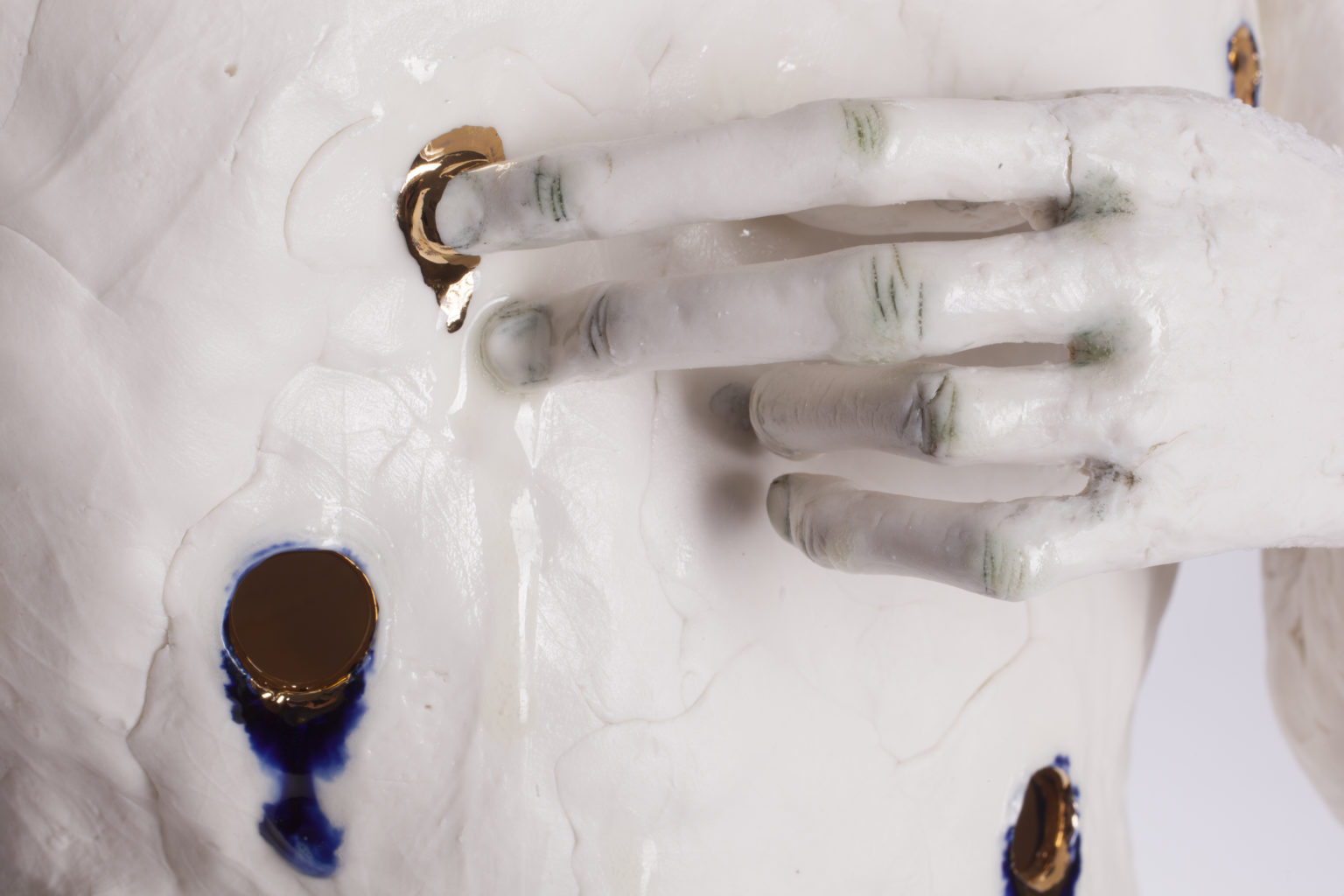
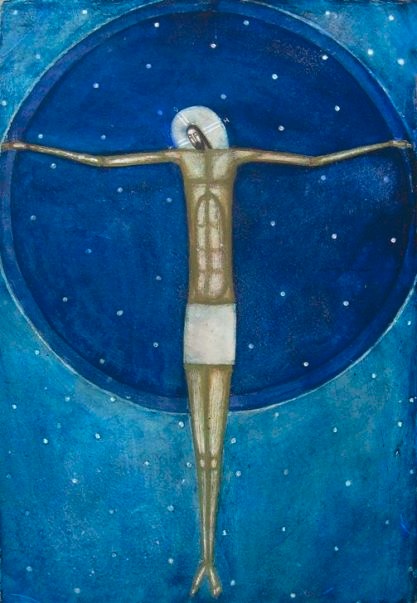
I encountered this striking image on the cover of Image no. 97 (Summer 2018). I’ve not been able to find a photograph of the full piece, but Curneen created a variation on it last year.
indications of internal states of transformation or transfiguration are not confined to gold. . . . Recently Curneen has begun to use a deep blue to create a similar effect. Like ultramarine, which was reserved for only the most significant parts of medieval paintings, this blue glaze is used only sparingly, painted onto faces, hands, and other areas where it will have the maximum impact. The effect is dramatic, with faces dissolving into an incorporeal void. For unlike gold, which reflects light, this deep blue holds light, absorbing our gaze into its pellucid depths. Curneen exploited this difference in one of her most recent works, Empty Tomb (2018), where blue and gold ooze from a series of gaping wounds, like the unmingled blood and water that flowed from the side of the dead Christ. With the tip of one finger, this elegiac figure gently points out one of these openings, echoing Saint Thomas, who needed to touch Jesus’s wounded side before he could believe. This gesture is the only moment of animation in a work that is otherwise still, but it is not the focus. That is to be found in the wounds themselves, which stand out starkly against the limpid porcelain. These are the empty tomb of the title, apertures exuding blue and gold, dark and light. They draw us in so that we find our attention focused entirely on these small rings. For a moment, as we teeter on this visual precipice, with solidity melting around us and the figure dissolving into the background, time stands still.
Oh Mary, why have you come? Come drop your oils and run You’ll find no one Find no one
Oh Thomas, can’t you see? Where bone and sinew meet You’ll find a hole Find a whole
Oh Saul, look down at your hands All red and dripping in the sand It’s the wrong blood The wrong blood
Come find the blood of the Son
Jesus meets people where they’re at: Mary Magdalene in her grief (John 20:11–18), Thomas in his doubt (John 20:24–29), Saul in his murderous zealotry (Acts 9:1–19). And he transforms them. After their encounters with the risen Christ, Mary’s tears give way to joy; Thomas’s doubt transposes into belief; and Saul goes from persecutor of Christians to key apostle, with a ministry of preaching the gospel, planting churches, and writing letters of teaching and encouragement that have become sacred scripture.
The song “Empty” by The Sowing Season reflects Christ’s gentle invitation to behold his transfigured wounds and to move, with him, from death into life.
LOOK: Ballet Skirt or Electric Light by Georgia O’Keeffe
Georgia O’Keeffe (American, 1887–1986), Ballet Skirt or Electric Light, 1927. Oil on canvas, 36 × 30 in. (91.4 × 76.2 cm). Art Institute of Chicago.
The Art Institute of Chicago, which owns this painting, offers the following description:
In the 1920s Georgia O’Keeffe began creating the paintings of enlarged flowers for which she is most famous, including a series of works devoted to the white rose; this painting is her most abstracted depiction of the subject. O’Keeffe simplified the energy of the blooming rose to its essence, so that it resembles a brilliant light radiating out of flat Cubist planes. She exhibited this painting as White Rose—Abstraction at Alfred Stieglitz’s Intimate Gallery in 1928 and retitled it Ballet Skirt or Electric Light (from the White Rose Motif) when she lent it to the Art Institute of Chicago’s 1943 retrospective of her work.
I was introduced to Ballet Skirt in Imaging the Word: An Arts and Lectionary Resource, volume 3, where it appears in the Easter section. So credit goes to that book’s editors (Susan A. Blain, et al.) for linking the image with Christ’s resurrection. Now I can’t see it any other way! Bright and explosive, the painting has as its focal point an orb of light near the bottom edge, which could be read as the figure of Christ standing in the open mouth of the tomb.
By the way, all three Imaging the Word volumes, which I chanced upon at Ollie’s Bargain Outlet some years ago, are excellent. Structured around the Revised Common Lectionary, years A through C, the books integrate scripture, visual art, poetry, sheet music, liturgies, fiction excerpts, quotes from Bible commentaries and spiritual nonfiction, and more. They are published by United Church Press.
LISTEN: “Aurora lucis rutilat” (Light’s Glittering Morn Bedecks the Sky) | Words attributed to Ambrose, 4th century; translated into English by John Mason Neale, 1851 | Music by Orlande de Lassus, ca. 1592, published posthumously in 1604 | Performed by the Choir of Clare College, Cambridge, dir. Graham Ross, 2016
2. Cum rex ille fortissimus, mortis confractis viribus, pede conculcans tartara solvit catena miseros!
3. Ille, qui clausus lapide custoditur sub milite, triumphans pompa nobile victor surgit de funere.
4. Solutis iam gemitibus et inferni doloribus, “Quia surrexit Dominus!” resplendens clamat angelus.
5. Tristes erant apostoli de nece sui Domini, quem poena mortis crudeli servi damnarant impii.
6. Sermone blando angelus praedixit mulieribus, “In Galilaea Dominus videndus est quantocius”
7. Illae dum pergunt concite apostolis hoc dicere, videntes eum vivere osculant pedes Domini.
8. Quo agnito discipuli in Galilaeam propere pergunt videre faciem desideratam Domini.
9. Claro paschali gaudio sol mundo nitet radio, cum Christum iam apostoli visu cernunt corporeo.
10. Ostensa sibi vulnera in Christi carne fulgida, resurrexisse Dominum voce fatentur publica.
11. Rex Christe clementissime, tu corda nostra posside, ut tibi laudes debitas reddamus omni tempore!
12. Deo patri sit gloria eiusque soli filio cum spiritu paraclito et nunc et in perpetuum.
Light’s glitt’ring morn bedecks the sky,
heav’n thunders forth its victor cry,
the glad earth shouts its triumph high,
and groaning hell makes wild reply.

While he, the King of glorious might,
treads down death’s strength in death’s despite,
and trampling hell by victor’s right,
brings forth his sleeping saints to light.

Fast barred beneath the stone of late
in watch and ward where soldiers wait,
now shining in triumphant state,
he rises Victor from death’s gate.

Hell’s pains are loosed and tears are fled;
captivity is captive led;
the angel, crowned with light, hath said,
“The Lord is risen from the dead.”

The apostles’ hearts were full of pain
for their dear Lord so lately slain:
that Lord his servants’ wicked train
with bitter scorn had dared arraign.

With gentle voice the angel gave
the women tidings at the grave;
“Forthwith your Master shall ye see:
he goes before to Galilee.”

And while with fear and joy they pressed
to tell these tidings to the rest,
their Lord, their living Lord, they meet,
and see his form, and kiss his feet.

The Eleven, when they hear, with speed
to Galilee forthwith proceed:
that there they may behold once more
the Lord’s dear face, as oft before.

In this our bright and Paschal day,
the sun shines out with purer ray,
when Christ, to earthly sight made plain,
the glad apostles see again.

The wounds, the riven wounds he shows
in that his flesh with light that glows,
in loud accord both far and nigh
the Lord’s arising testify.

O Christ, the King who lov’st to bless,
do thou our hearts and souls possess:
to thee our praise, that we may pay
to whom our laud is due for aye.
Orlande de Lassus’s setting of “Aurora lucis rutilat” is a motet for ten voices. Graham Ross describes the piece in the BBC Music Magazine article “The best choral music for Easter”:
A setting of an anonymous 4th century text – the Hymn for Lauds on Easter Sunday – Lassus’s motet begins by tenderly depicting the dawn of Easter morning, but soon leads to a double-choir celebration of the triumph of the resurrection, full of word-painting, jubilation and a brief triple-time passage proclaiming the joy of Easter day (‘in hoc pascali gaudio’). Written late in Lassus’s life, the work is a unique example in the Franco-Flemish composer’s output of Venetian polychoral technique, with harmonic completeness in each choir.
The hymn exists in several different English translations and variations and has been set to music by multiple composers or paired with preexisting hymn tunes. For example, I’ve heard it sung to LASST UNS ERFREUEN, a tune from seventeenth-century Germany that today is most associated with the hymn “All Creatures of Our God and King.” In this case, “alleluias” and other short acclamations are added to the verses.
If you want to use this hymn for congregational singing, I would recommend the following version (with LASST UNS ERFREUEN), which I cobbled together from a few different sources (including the Jubilate Hymns version and the Liturgy Fellowship Facebook group) but which draws heavily on Neale’s translation:
Light’s glittering morning fills the sky, heav’n thunders forth its victor cry: Christ is risen! Alleluia! The glad earth shouts its triumph high and groaning hell makes wild reply. Christ is risen! O praise him! Alleluia, alleluia, alleluia!
For Christ the Lord, the mighty King, despoils death and draws its sting. Christ is risen! Alleluia! He tramples down the pow’rs of night, brings forth his ransomed saints to light. Christ is risen! O praise him! Alleluia, alleluia, alleluia!
His rocky tomb the threefold guard of watch and stone and seal had barred. Alleluia, alleluia! But shining now in glorious state, he rises Victor from death’s gate. Christ is risen! O praise him! Alleluia, alleluia, alleluia!
Hell’s pains are loosed and tears are fled; captivity is captive led. Alleluia, alleluia! “Weep not!” an angel voice has said. “The Lord is risen from the dead!” O praise him, O praise him! Alleluia, alleluia, alleluia!
All praise be thine, O risen Lord, from death to endless life restored; Christ is risen! Alleluia! To Father, Son, and Spirit be all pow’r and praise eternally! Christ is risen! O praise him! Alleluia, alleluia, alleluia!
How did Jesus’s mother, Mary, come to find out that he had risen from the dead? Was she there when it happened, keeping vigil? Was she among the holy women at the tomb to whom the angel made the announcement, or did these women go to Mary to relay the news to her? Maybe an angel came to tell her personally? Or perhaps Jesus himself appeared to her, to tell and show, at the home where she was staying.
The Bible is silent as to Mary’s whereabouts between the time of Entombment and the events of Easter morning. Historically, there have been proponents of each of the above suppositions. But the one that has taken the strongest hold is the last one—that Jesus made direct personal contact with his mom after his resurrection, before appearing to anyone else. He wasn’t at the tomb when Mary Magdalene got there (unless, perhaps, he was lingering somewhere in the shadows). Where did he go in the early morning? Some scholars say he must have gone to console his mother.
The claim that Jesus appeared first to Mother Mary can be found as far back as Ambrose (340–397), who wrote in his De virginitate, “Therefore Mary saw the resurrection of the Lord: she saw it first and believed.”
Around 1300 the anonymous writer known as Pseudo-Bonaventure elaborated on this tradition in his highly influential Meditationes Vitae Christi (Meditations on the Life of Christ), providing a vivid and affecting narrative in which Mary, when the women depart for the tomb on Sunday morning, stays behind and prays for God to restore her son to her alive.
And with that, she so praying, sweet tears shedding, lo suddenly our Lord Jesus came and appeared to her, and in all white clothes, with a glad and lovely cheer, greeting her in these words: “Hail, holy mother.” And anon she turning said: “Art thou Jesus, my blessed son?” And therewith she kneeling down honored him; and he also kneeling beside her said: “My dear mother, I am. I have risen, and lo, I am with you.” And then both rising up kissed the other; and she with unspeakable joy clasped him, sadly, resting all upon him, and he gladly bare her up and sustained her. [as translated into Middle English by Nicholas Love in The Mirror of the Blessed Life of Jesus Christ, ca. 1400, with modernized spellings]
Pseudo-Bonaventure imagines a private, emotional reunion in a domestic interior. This episode was picked up by Ludolph of Saxony in his Vita Christi and by other writers, and it circulated throughout Europe. It made its way into the visual arts starting in the first half of the fourteenth century. The two most famous examples are the right wing of Rogier van der Weyden’s Miraflores Triptych and a woodcut from Albrecht Dürer’s Small Passion series.
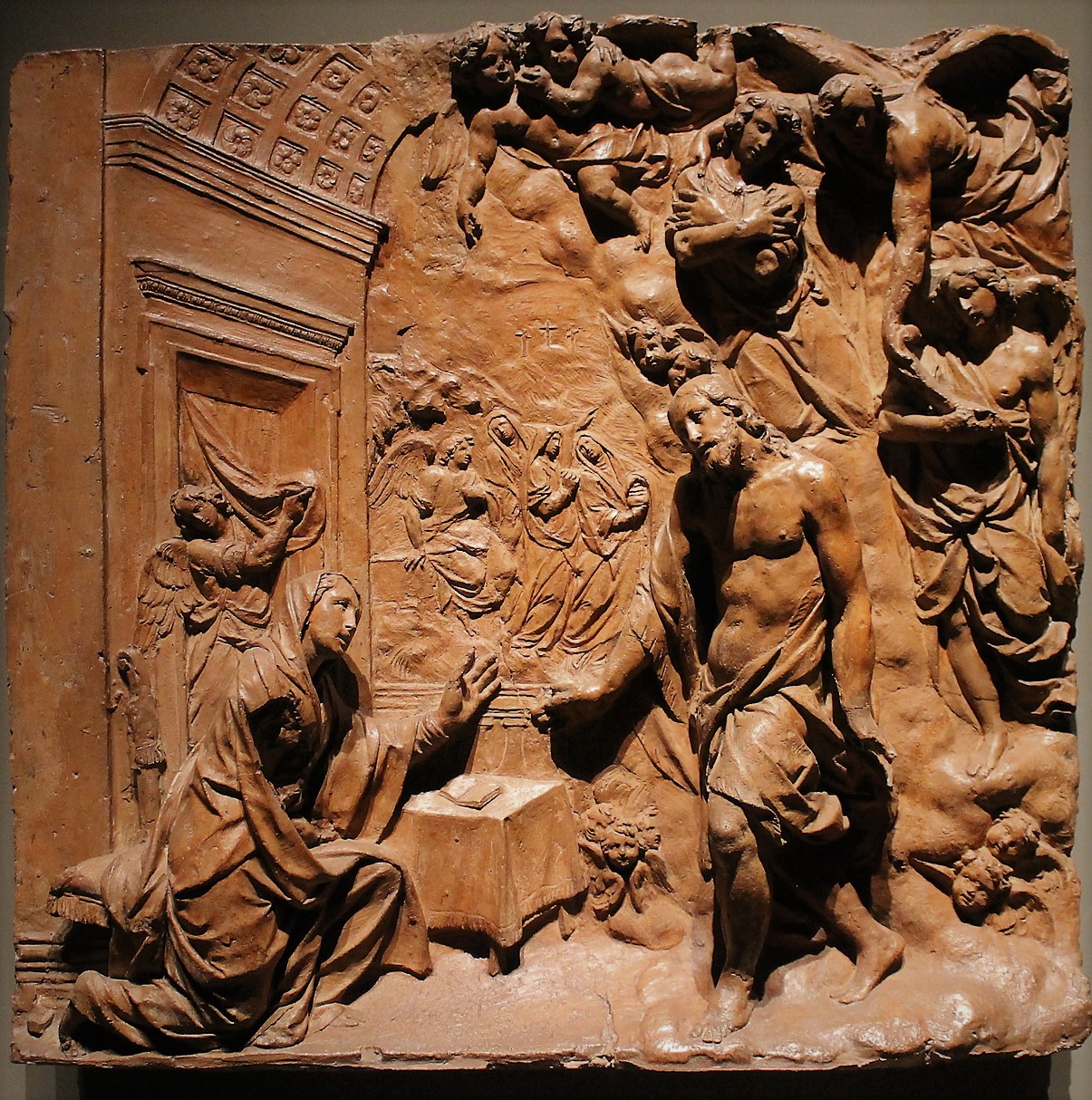
But I want to take a look at this Italian Baroque bas-relief by the minor artist Giovanni Pietro Lasagna.
LOOK: Christ Appearing to His Mother by Giovanni Pietro Lasagna
Giovanni Pietro Lasagna (Italian, d. 1658), Christ Appearing to His Mother, first quarter of 17th century. Terracotta.
I found this artwork in the blog article “Iconography of the Resurrection – Christ Appears to His Mother” by Margaret Duffy, which provides a fascinating compilation of images. Duffy cites its location as unknown, and I’ve not been able to find reference to it anywhere else. It was probably made in Milan, where the artist was active. An email inquiry I sent last month to the city’s Museo del Duomo, which has similar terracottas from the same period in its collection, has garnered no reply. It’s possible the work was made as a design for a marble sculpture.
Carved in low relief in the background, an angel sits on the edge of an empty sarcophagus and tells the three women with their ointment jars that Jesus is not here but is risen. Three untenanted crosses are visible in the distance on Mount Calvary, a shadow of Friday’s events.
In the foreground, sculpted in high relief, we see Mary at her prayer desk. She is interrupted by the triumphant entry of her risen son, attended by angels. Their arms reach out to embrace each other as her grief turns to joy.
To reinforce the news of resurrection, an angel who stands behind Mary peeks out from behind a curtained doorway and points to the concurrent scene that’s unfolding in the garden of Jesus’s burial.
I’m not certain of the identity of the figures behind Jesus. But in looking into it, I did find that there’s a legend, likely originating in fourteenth- or fifteenth-century Spain, that when Jesus appeared to his mother after the resurrection, he presented to her the redeemed of the Old Testament, whom he had just freed from Hades.* So it’s possible that the beardless young man at the upper left with his arms crossed over his chest is Adam, and that the figure at the right with one breast bared is Eve. And I think the man at the top right corner who’s touching them both is an angel.
Note the iconographic similarity to scenes of the Annunciation—Gabriel’s announcement to the young Mary that she had been chosen by God to bear his Son. This “emphasizes the parallelism between the heralding of the Incarnation by the Archangel, and Christ’s own announcement, to his mother, of the fulfillment of that Incarnation, that is, the Resurrection.”**
Be joyful, Mary, heav’nly queen Gaude, Maria! Your son who died was living seen Alleluia!
Laetare, O Maria O Maria
The son you bore by heaven’s grace Gaude, Maria! Did all our guilt and sin efface Alleluia!
Laetare, O Maria O Maria
The Lord has risen from the dead Gaude, Maria! He rose with might as he had said Alleluia!
Laetare, O Maria O Maria
This song has its roots in a medieval liturgical text that is still used as an antiphon (short hymn) in the Roman Catholic Church throughout the Easter season. Gaude means “rejoice”; laetare, “be glad.”
The lyrics could be in the voice of the women who went early to the tomb and are returning with the great news, or it could be that we the faithful are imaginatively addressing Mary across time, inserting ourselves into that story of the first Easter morning.
But if we have died with Christ, we believe that we will also live with him. We know that Christ, being raised from the dead, will never die again; death no longer has dominion over him. The death he died, he died to sin, once for all; but the life he lives, he lives to God.
—Romans 6:8–10
LOOK: Egg mosaics by Oksana Mas
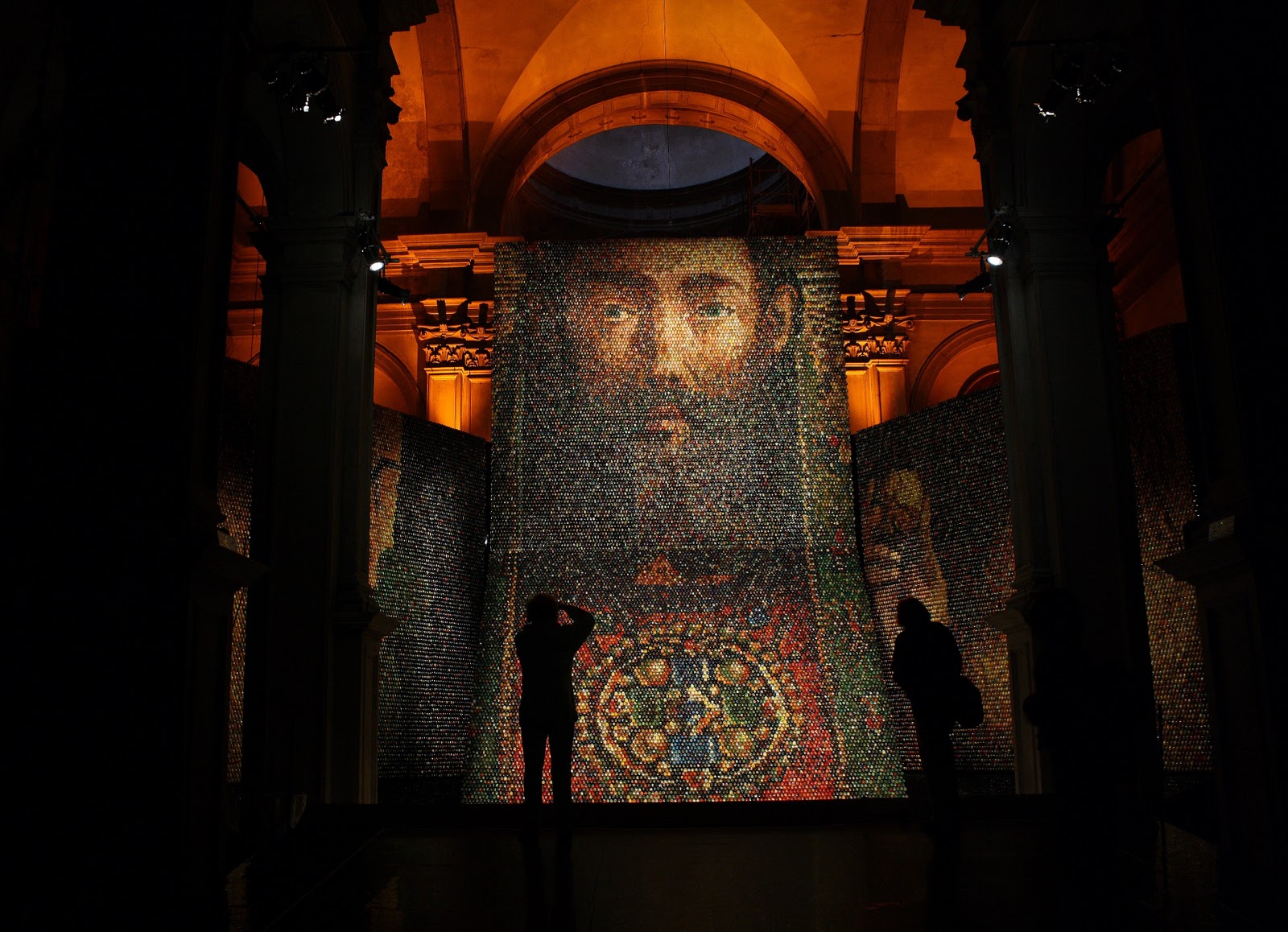
Oksana Mas (Ukrainian, 1969–), Post-vs-Proto-Renaissance, 2011. Hand-painted wooden eggs, installed in the Chiesa di San Fantin, Ukrainian Pavilion, 54th Venice Biennale, 2011.
Hand-painted wooden eggs are the primary material used by Ukrainian artist Oksana Mas in the past decade. She arranges them into colorful spheres or hemispheres or into monumental images, as she did for her Post-vs-Proto-Renaissance installation at the 54th Venice Biennale. This piece portrays segments of the van Eyck brothers’ Ghent Altarpiece [previously], whose two central scenes are (1) Christ (or God the Father, as some art historians argue) enthroned, and (2) the Adoration of the Mystic Lamb, based on John’s vision in the book of Revelation.
The Biennale installation—inside the church of San Fantin—was only a portion of the full piece, which is a massive 92 by 134 meters in total, comprising 3,640,000 eggs. It featured panels of the enthroned deity, the slain but risen Lamb, and details of Adam and Eve.
Mas is inspired by the Ukrainian folk custom of Easter egg decoration called pysanky. Traditionally, pysansky are raw eggs that are dyed using a wax-resist method, the designs inscribed in beeswax. But for her art, Mas starts with wooden eggs, and color is applied with a paintbrush. For Post-vs-Proto-Renaissance, she distributed plain wooden eggs to people from all walks of life and across forty-two countries, asking them to paint them and return them to her. Having received hundreds of thousands of painted egg contributions, she assembled them like tesserae, affixing them to boards that are then placed into an architectural framework so that, when viewed from a distance, they form recognizable figures from the Ghent Altarpiece. When you get up close, you can see the diverse patterns and other designs painted onto the individual eggs.
In May 2012, a different iteration of this piece was installed in Sofiyivska Square in Kyiv, which Mas called the Altarpiece of Nations.
Oksana Mas, Altarpiece of Nations, Kyiv, 2012. Crowned in a papal tiara, Christ is flanked by his mother Mary and John the Baptist, a traditional composition known as the Deesis.
As a traditional symbol of new life, eggs are often associated with Easter, and one could easily read Mas’s Ghent-inspired egg mosaics through that lens. In Venice, for example, you have Jesus in emblematic form as the sacrificial lamb, pouring out his blood at the altar, and then you have him exalted in majesty in his divine-human form, which together reference the death and resurrection narrative of the Gospels. Through that death and resurrection, we have been redeemed from the fall that’s alluded to in the wings—redeemed from sin and death, into life everlasting. It’s a very triumphal image, Mas’s. As is the liturgical artwork it’s based on, which shows all the redeemed in the new heavens and the new earth, gathered round “the Lamb at the center of the throne . . . [who] guide[s] them to springs of the water of life” (Rev. 7:17).
LISTEN: “Christus Resurgens,” Ireland, 12th century | Arr. Michael McGlynn, 2000 | Performed by Anúna on Cynara, 2000; compiled on The Best of Anúna, 2010
Christus resurgens ex mortuis, jam non moritur Mors illi ultra non dominabitur Quod enim vivit, vivit Deo
Alleluia (×4)
English translation:
Christ has arisen from the dead, and dies no more Death will no longer have dominion over him In that he lives, he lives unto God
Alleluia (×4)
“Christus resurgens” is an Easter chant in Latin that originated in medieval Ireland, its text taken from Romans 6:9–10. It is arranged here by Michael McGlynn and performed by the Irish vocal ensemble Anúna, which he founded in 1987. Much of Anúna’s repertoire comes from McGlynn’s arrangements, resettings, and reconstructions of early and medieval Irish music, as well as his original compositions.
LOOK: Adoration of the Lamb from the Escorial Beatus
Adoration of the Lamb, from the Escorial Beatus, Spain, 10th century
This folio is from an illustrated copy of Beatus of Liébana’s (d. ca. 800) hugely influential Commentary on the Apocalypse. The Beatus manuscripts (take a look on Pinterest for some real wacky, Revelation-based imagery) are one of the most significant book genres of the Middle Ages in northern Spain, and the Escorial Beatus (named after its current location) is a preeminent example. It probably originated in the famous scriptorium of San Millán de la Cogolla in La Rioja, Spain. Today it is kept in the Real Biblioteca del Monasterio de El Escorial, part of a royal complex situated at the foot of Mount Abantos in the Sierra de Guadarrama.
LISTEN: “Glory Hallelujah to the Risen Lamb” by Victor C. Johnson, 2009 | Performed by De Angelis Capella, 2019
Glory, glory, glory hallelujah to the risen Lamb! (×4)
Jesus hung on the cruel tree (Glory hallelujah to the risen Lamb!) He gave his life for the likes of me (Glory hallelujah to the risen Lamb!) Women came at the break of day (Glory hallelujah to the risen Lamb!) The angel rolled the stone away (Glory hallelujah to the risen Lamb!)
Glory, glory, glory hallelujah to the risen Lamb! (×4)
Glory, glory hallelujah Glory to the risen Lamb Glory, glory hallelujah Glory to the risen Lamb Glory, glory hallelujah Glory to the risen Lamb Glory, glory hallelujah Glory to the risen Lamb Glory, glory hallelujah Glory to the risen Lamb
Glory, glory, glory hallelujah to the risen Lamb! (×4)
Rob Woodcox, El Espíritu Asciende (Part 3) (The Spirit Rises), 2018
You dragged me
Through the gates of pain
To song,
Love from my heart
Spilling over;

Reason, like Lucifer’s sin,
Burst away and fled.

Now the freer motion
Over the fertile ground
Will reign.
“Release” by Joseph Kariuki is from Poems from East Africa, ed. David Cook and David Rubadiri (Nairobi: East African Educational Publishers, 1971). Used by permission of the publisher.
Joseph E. Kariuki was born in 1931 in Banana Hill, Kenya. After receiving a BA from Makerere College in Uganda and further education at Cambridge University in England, he pursued a career in public administration, working with United Nations organizations in East and North Africa. He also wrote poetry, though less so after his appointment as director-general of the African Training and Research Centre in Administration for Development (CAFRAD) in 1969. His most famous poem is “Ode for Mzee” (1965), written to commemorate Jomo Kenyatta on the occasion of his becoming president of Kenya.
Tanja Butler (American, 1955–), Easter Panels: “The Angel at the Tomb,” “Christ’s Victory Over the Gates of Hell and Death,” “Christ Appearing to Mary in the Garden,” and “The Angel Guarding the Entrance to Paradise,” 2005. Acrylic on canvas, each 8 ft. high. Collection of the artist.
“The tomb is empty!” So declares the angel in the far-left panel of this Easter quadriptych by Tanja Butler, an artist from New England. The angel gestures toward Jesus’s bare and open coffin and his cast-aside graveclothes, telling the women (out of frame) that “he has been raised, as he said” (Matt. 28:6).
The second panel shows Jesus trampling down the gates of hell (the doors laid across each other in an X-shape references traditional iconography of Christ’s descent into Hades). He has defeated death, as indicated by the skull under his feet. A rainbow, symbol of God’s promise, arcs across the scene. Shaped in blessing and communicating doctrinal truths, the fingers on his right hand form the letters IC XC, the first and the last letters of the Greek words IHCOYC XPICTOC, “Jesus Christ.” His five wounds—on wrists, feet, and side—are still present on his resurrected body, but they have been transfigured.
The third panel shows the resurrected Christ appearing to Mary Magdalene in the garden of his burial. With one hand he reaches out to reassure her, but with the other he reminds her that he will be ascending soon, and so not to cling to him (Noli me tangere, as this scene is traditionally named). I believe that the twisting object that seems to proceed from Mary’s mouth and exits the garden gate is a speech scroll, suggesting that she is proclaiming the gospel; “apostle to the apostles,” she is tasked with delivering the news of resurrection to the Eleven. But with its riverine shape, it also reminds me of Jesus’s words to the Samaritan woman at the well: “Those who drink of the water that I will give them will never be thirsty. The water that I will give will become in them a spring of water gushing up to eternal life” (John 4:14).
(Update, 4/20/22: Butler tells me she had in mind the release of the Holy Spirit, breaking through walls and barriers.)
In the far-right scene, the angel who had been guarding paradise with a flaming sword (Gen. 3:24) has put down his sword and now invites us to enter. The sentry has become a porter! He gestures toward the doorway that Christ’s death and resurrection has opened for us. The fall has been undone. We are welcomed home.
“Tanja Butler (b. 1955) was born in Germany and moved to the United States as a young girl. She received her B.A. and M.A. from the University of Albany. Her artistic practice has focused on liturgical art, illustration, and community service projects. She is inspired by Byzantine icons, American and European folk art, Persian manuscripts and textile patterns, African art, Early Christian art, Russian Suprematist paintings, Cubism and Fauvist color. Informed by studies in art history and time working in Italy, she was particularly influenced by the frescoes of Fra Angelico in the Monastery of San Marco in Florence. Her collection of 600 graphic images, Icon: Visual Images for Every Sunday, was published by Augsburg Fortress Publishers. Her work is included in the collections of the Vatican Museum of Contemporary Religious Art; the Billy Graham Center Museum at Wheaton; the Boston Public Library; the DeCordova Museum; and the Armand Hammer Museum of Art, UCLA. In 2014 she retired from her position as an associate professor of art at Gordon College in Wenham, Massachusetts, where she taught painting, drawing, liturgical art, and illustration and frequently integrated service opportunities in her courses.” [source]
Temporary installation at Christ Church, Hamilton/Wenham, Massachusetts, 2005
1. Pourquoi, parmi les morts, chercher les vivants? Jésus est ressuscité! Comme la lumière du soleil levant, Jésus est ressuscité, alléluia, Jésus est ressuscité.
2. Que la terre entière sache la vérité Jésus est ressuscité! Comme la vie nouvelle qu’il nous a donnée, Jésus est ressuscité, alléluia, Jésus est ressuscité.
3. L’ennemi est vaincu, il est terrassé, Jésus est ressuscité! À lui la victoire, nous sommes libérés, Jésus est ressuscité, alléluia, Jésus est ressuscité.
4. Nous voyons sa gloire dans tout l’univers. Jésus est ressuscité! L’image parfaite du Dieu notre Père, Jésus est ressuscité, alléluia, Jésus est ressuscité.
5. Acclamons Jésus, il a vaincu la mort! Jésus est ressuscité! Dansons et chantons, car il est le plus fort, Jésus est ressuscité, alléluia, Jésus est ressuscité.
6. Pourquoi, parmi les morts, chercher les vivants? Jésus est ressuscité! Comme la lumière du soleil levant, Jésus est ressuscité, alléluia, Jésus est ressuscité.
English translation:
1. Why seek the living among the dead? Jesus is risen! Like the light of the rising sun, Jesus is risen, hallelujah, Jesus is risen.
2. Let the whole earth know the truth: Jesus is risen! Like the new life he gave us, Jesus is risen, hallelujah, Jesus is risen.
3. The enemy is defeated, he is struck down, Jesus is risen! To him the victory, we are freed, Jesus is risen, hallelujah, Jesus is risen.
4. We see his glory throughout the universe. Jesus is risen! The perfect image of God our Father, Jesus is risen, hallelujah, Jesus is risen.
5. Let us acclaim Jesus, he conquered death! Jesus is risen! Let’s dance and sing, because he is the strongest, Jesus is risen, hallelujah, Jesus is risen.
6. Why seek the living among the dead? Jesus is risen! Like the light of the rising sun, Jesus is risen, hallelujah, Jesus is risen.
Born and raised in South Africa, singer-songwriter Pat Berning moved to southern France with his wife Linda in 1988, following a call they felt while working for the international ministry Youth for Christ. Though he didn’t know the language at the time, now he sings and records primarily in French, and occasionally in English or Zulu.
His live performance above of his original song “Jésus est ressuscité” is from the Christian arts festival Psalmodia Gagnières—sometime in the early to mid-2000s. The album version uses male and female singers and has call-and-response elements. “Jesus is risen!” the refrain goes. Such a fun and celebratory song.
The hip-hop dancer in the video is Sodapop. He and his wife, Christine Jeanville (a classical and contemporary dancer), founded Machol Danser la Vie in 2005, named after the man in 1 Kings 4:31 whose name means “dancing.” The ministry organizes workshops that promote healing, empowerment, and connection with others and God through dance. And in 2018 they opened the Ecole de Formation sur l’ Identité et la Louange par le Mouvement (Training School on Identity and Worship through Movement).
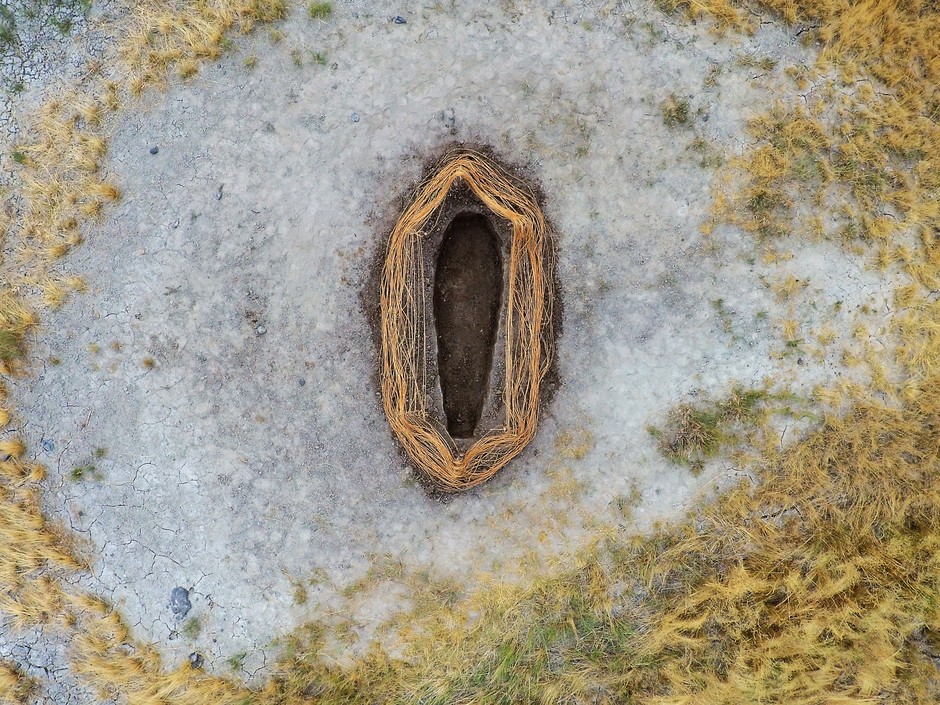
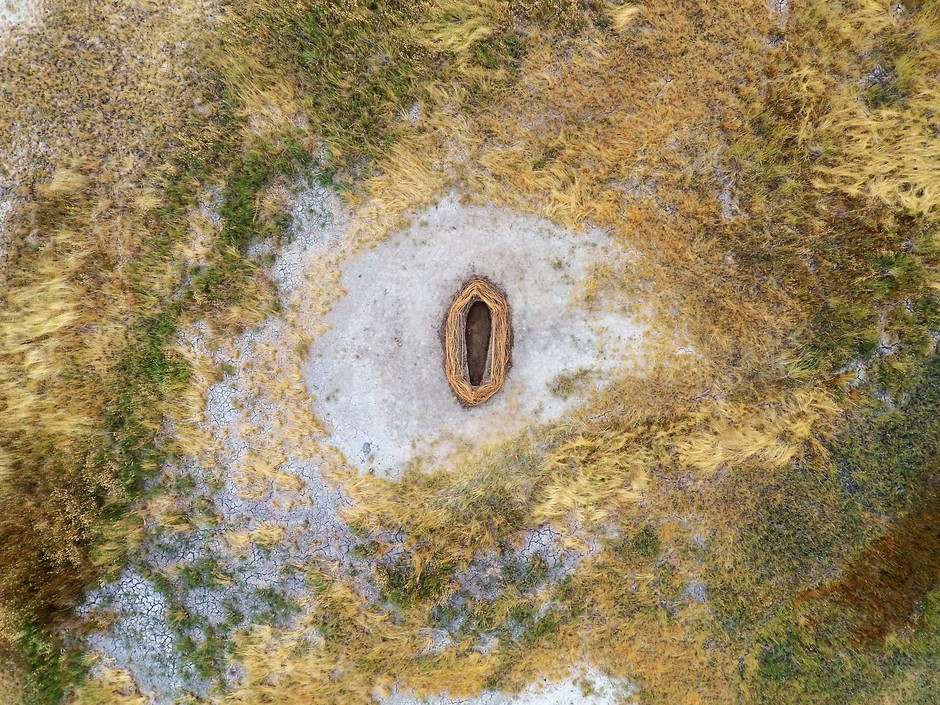
Craig Goodworth (American, 1977–), Playa Studies, 2017. Site-specific land-based artwork, Great Basin Desert, Oregon. Photograph by the artist.
Craig Goodworth’s practice encompasses installation, poetry, drawing, research, teaching, and farm labor. He holds master’s degrees in fine art, sustainable communities, and divinity, and his interests include land, place, religion, mysticism, and folk traditions.
During a four-week residency in the Great Basin Desert in Oregon, he made a series of land-based artworks called Playa Studies, which he documented through photographs. (A playa is an area of flat, dried-up land.) The shape of this one evokes a grave.
LISTEN: “Aestimatus sum” (I am counted . . .) by Tomás Luis de Victoria, 1585| Performed by Ars Nova Copenhagen, dir. Paul Hillier, 2017
Aestimatus sum cum descendentibus in lacum, factus sum sicut homo sine adjutorio, inter mortuos liber. Versus: Posuerunt me in lacu inferiori, in tenebrosis et in umbra mortis. Factus sum sicut homo sine adjutorio, inter mortuos liber.
English translation:
I am counted with them that go down into the pit: I am as a man that hath no strength: free among the dead. Verse: They have laid me in the lowest pit, in darkness, in the deeps. I am as a man that hath no strength: free among the dead.
This is the eighth responsory for Holy Saturday. Tomás Luis de Victoria [previously] of Spain, one of the principal composers of the late Renaissance, set it to music in 1585. It’s the penultimate motet (a multivoiced musical composition sung without instrumental accompaniment) in a set of eighteen by Victoria, titled Tenebrae Responsories.
The text is taken from Psalm 87:5–7 of the Latin Vulgate (Psalm 88:4–6 in the King James Version and most modern translations). The most depressing psalm in the Psalter, Psalm 88 ends not on a note of hope but with the lament that “darkness has become my only companion.” (Hello darkness, my old friend.)
While the psalmist spoke in metaphors of death, Jesus went there literally. After suffering much affliction, he descended “into the pit” of the earth—his grave. He knew emotional and spiritual darkness, and now he was surrounded by the physical reality. The Light had gone out. The Word was made silent.
Imagine what Jesus’s followers must have felt the day after the Crucifixion. Grief, devastation, loneliness, bewilderment, hopelessness. They were left bereft of their Lord’s presence.
On Holy Saturday, we sit in the pocket of that grief, that loss.
N. T. Wright says, “We cannot be Easter people if we are not first Good Friday people and then Holy Saturday people. Don’t expect even a still, small voice. Stay still yourself, and let the quietness and darkness of the day be your only companions.”
[Transliterated Greek] Símeron kremátai epí xýlou, o en ýdasi tín gín kremásas. Stéfanon ex akanthón peritíthetai, o tón Angélon Vasiléfs. Psevdí porfýran periválletai, o perivállon tón ouranón en nefélais. Rápisma katedéxato, o en Iordáni eleftherósas tón Adám. Ílois prosilóthi, o Nymfíos tís Ekklisías. Lónchi ekentíthi, o Yiós tís Parthénou. Proskynoúmén sou tá Páthi Christé. Proskynoúmén sou tá Páthi Christé. Proskynoúmén sou tá Páthi Christé. Deíxon imín, kaí tín éndoxón sou Anástasin.
[English translation] Today he who hung the earth upon the waters is hung on the tree. The King of the angels is decked with a crown of thorns. He who wraps the heavens in clouds is wrapped in the purple of mockery. He who freed Adam in the Jordan is slapped on the face. The Bridegroom of the church is affixed to the cross with nails. The Son of the virgin is pierced by a spear. We worship thy passion, O Christ. We worship thy passion, O Christ. We worship thy passion, O Christ. Show us also thy glorious resurrection.
This is the fifteenth antiphon (short hymn) from the Matins service of Great and Holy Friday (as the day is called in the Orthodox tradition), celebrated on Thursday evening.
>> Arranged by Fr. Seraphim Dedes, chanted by Paul Barnes, 2019:
Paul Barnes is both a pianist and a Greek Orthodox chanter. Here he chants the “Simeron Kremate,” starting out in Greek and then using the following English translation:
Today he who suspended the earth on the waters is suspended on a cross. (×3) The King of the angels wears a crown of thorns. He who wraps the sky in clouds is wrapped in a fake purple robe. He who freed Adam in the Jordan accepts to be slapped. The Bridegroom of the church is fixed with nails to the cross. The Son of the virgin is pierced with a spear. We worship your passion, O Christ. (×3) Show us also your glorious resurrection.
Seven of his piano majors from the Glenn Korff School of Music provide the ison (drone note).
>> Simeron Kremate, a solo keyboard work by Victoria Bond based on the Greek Orthodox chant, performed by Paul Barnes, 2019:
Paul Barnes and composer Victoria Bond are longtime collaborators. He introduced her to the “Simeron Kremate” chant, and she built a piano composition around its five-note melody. Struck by its similar melodic contour, she incorporated the Jewish Passover chant “Tal” (Dew), a prayer that life-sustaining dew would water the land. This prayer is traditionally chanted on the first morning of Passover (which is tomorrow; the festival begins this evening). Bond, who is Jewish, notes the thematic resonance between the two chants as well: (in my own words) the one a request for fruitfulness and refreshment, the other a lament for the death of the One whose death bears fruit and brings life. She describes the musical elements of the composition as follows:
The work opens with the traditional apichima of the plagal of the second mode which aurally establishes the musical atmosphere of the mode. Victoria follows this with a Jewish style cantillation (based on the cantillation of the great cantor Yosele Rosenblatt) which leads to the first statement of the “Simeron” chant. These opening notes are then developed in multiple ways before the intimate entry of the “Tal” melody. The work concludes with a ‘tranquillo’ passage of rare beauty ingeniously combining both themes. The work ends tentatively and unresolved as the opening notes of the chant dissipate into eternity.




.jpg)



 Art & Theology