Lent, Day 28

For waters shall break forth in the wilderness,
    and streams in the desert;
the burning sand shall become a pool,
    and the thirsty ground springs of water . . .

—Isaiah 35:6b–7a

I will open rivers on the bare heights,
    and fountains in the midst of the valleys;
I will make the wilderness a pool of water,
    and the dry land springs of water.

—Isaiah 41:18

I am about to do a new thing;
    now it springs forth, do you not perceive it?
I will make a way in the wilderness
    and rivers in the desert.

—Isaiah 43:19 (from tomorrow’s Old Testament lection)

LOOK: Paper River Flow in the Desert by Young-Ly Hong Chandra

Hong Chandra, Young-Ly_Paper River Flow in the Desert
Young-Ly Hong Chandra (Korean, 1970–), Paper River Flow in the Desert, Joshua Tree National Park, Southern California, 2021. Traditional Korean mulberry paper with acrylic, watercolor, ink, and gel.

Born and raised in Seoul and currently living in Pasadena, Young-Ly Hong Chandra is an artist who works primarily with paper, fabric, and found objects and in a range of sizes, from small collages to large-scale installations. From October 2020 to June 2021 she was an artist in residence at the Brehm Center at Fuller Theological Seminary, and she is now a facilitator in the program. She is also an artist in residence with Inbreak.co.

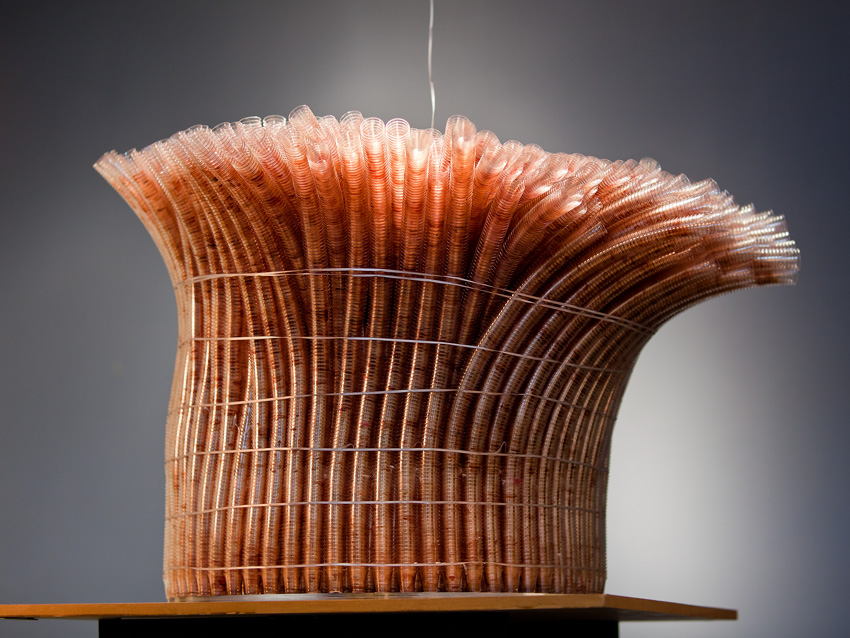
One of the main materials Hong Chandra uses is hanji, traditional handmade paper from Korea made from the inner bark of the paper mulberry tree. She cuts the paper and paints it on both sides with acrylic, watercolor, and ink, then she applies a thin coat of transparent gel to make it more durable and waterproof. “Paper stained glass” is what she calls these creations.

For her Paper River Flow series, she attaches together numerous pieces of this paper stained glass to form long blue rolls that can be rolled up or folded and packed in a bag so that when she travels nationally or internationally, or when she moves about her home city, she can carry them with her and create installations as the mood strikes her. “I am a small river bearer,” she says, “who’s conveying the big vision of the river flow to give life to many and will reflect the glory of God clear as crystal.”

The photos in this post are from Joshua Tree National Park. View more at https://younglyhongchandra.com/home/paper-river.

Last year Fuller Studio created a six-minute film about Hong Chandra and her art, including her Paper River Flow series:

The river is a symbol of healing and renewal, she says. In our dryness, in our barrenness, God springs up, offering life and nourishment. The image of the river is used many times in the prophetic book of Isaiah—I’ve cited just a few examples above—and also appears in the final book of the New Testament, where it flows down from the throne of God, watering the new creation (Rev. 22:1–2). Hong Chandra says,

The image of river for me is from Revelation 22 . . . the river flowing in the holy city, reflecting the glory of the Lamb of God sitting on the throne. And what I’m doing is still far from reflecting that glory. But I want this piece to be an invitation to others to come and taste the living water that was given so freely.

LISTEN: “하나님께서 | Agua viva fluye del Señor | May the Love of God” by ​Young Beom Kim, 2002 (CCLI #6461951); Spanish translation by ​Josh Davis and Juan Alberto Camacho; English translation by​ ​Greg Scheer (CCLI #7035272) | Performed by Jaewoo Kim, Josh Davis, and Grace Funderburgh of Proskuneo Ministries, 2020

KOREAN
하나님께서
당신을 통해
메마른 땅에
샘물나게 하시기를
가난한 영혼
목마른 영혼
당신을통해
주 사랑 알기 원하네

[Phonetic]
Ha na neem geh suh
Dang shin eul tong heh
Meh malun ttang eh
Sehm mul nag geh ha shi gee lul
Ga nan han young hone
Mohk mal luhn young hone
Dang shin eul tong heh
Joo sarang ahl gee wun ha neh

SPANISH
Agua viva
Fluye del Señor
A través de ti
A esta tierra seca
Al que tiene sed
Dale de beber
Que el amor de Dios
​Sea mostrado en ti siempre

ENGLISH
May the love of God
Spring up in your soul
Like a healing stream
In the wilderness flowing
And may the love of God
Quench the thirsty soul
Feed the hungry heart
May the love of God flow through you

Lent, Day 27

LOOK: It Is Finished by Anthony Falbo

Falbo, Anthony_It Is Finished
Anthony Falbo (American, 1953–), It Is Finished, 2004. Oil and charcoal on paper, 24 × 18 in.

Exaggerated proportions and a sense of humor and play are characteristic of Anthony Falbo’s paintings, including the ones on religious subjects. In It Is Finished, the title is a pun that refers to one of the seven last words of Christ while also affirming that yes, despite half of the paper being unpainted, this artwork is complete as is.

The contrast of minimalist charcoal sketch marks with richly hued oil paints is the painting’s most striking feature. The boxed outline around the Crucifixion and the concentration of color there create the impression of a picture within a picture. But the scene cannot be contained; it spills out, the cross-tree taking root outside the frame, the blood pooling there too. Here is where the mourners—traditionally John and the three Marys—stand, one of them reaching up into the picture. Angels fly about in the margins; one gestures toward the dying Christ as if to tell the viewer, “This is for you.”

The color helps center our attention on Christ’s face and punctuates other details—namely, the three nails, and the blood at the base of the tree. Christ’s figure is painted in some places but line-drawn in others, evoking a sense of fading—but fading out, or in? That is, are we witnessing life giving way to death, or death giving way to life? Is the picture losing color or gaining it? Surely both.

Two rich color fields meet in the background: purple and blue. In addition to royalty, purple is traditionally associated with penitence and mourning and is the liturgical color for Lent. Blue represents heaven and/or truth.

Falbo cleverly uses trompe l’oeil effects to allude to other elements of the Crucifixion narrative. The peeling back of a paint layer references the tearing of the temple veil, a symbolic grant of access for all people to God through the eternal mediating priesthood of Christ. Across from that, an apparent puncture in the picture references the piercing of Christ’s side by a Roman soldier to confirm his death, which unleashed a discharge of water and blood—the symbolic birthing fluids of the church.

Falbo also draws on the traditional tree of life motif, which pictures the cross as a still-living tree, that of Genesis 3:22 and Revelation 22:2. There is art historical precedent for the fusing of Christ’s body to the wood, seen here especially in the hands, suggesting that he himself is life. Uniquely, though, Falbo’s rendition shows hands dangling from the branches, grasping apples, harking back to the Genesis narrative of Adam and Eve’s disobedience in Eden and thereby reminding us of the sin from which Christ’s death redeems us.

LISTEN: “’Tis finished! The Messiah dies” | Words by Charles Wesley, 1751 and 1788, with additions by Austin Pfeiffer, 2016 | Music by Austin Pfeiffer, 2016 | Performed by Salem Presbyterian Church musicians at the PCA General Assembly in Greensboro, North Carolina, June 15, 2017 | CCLI #7192481 [Chord chart]

’Tis finished! The Messiah dies,
cut off for sins, but not his own.
Accomplished is the sacrifice,
the great redeeming work is done.
Done, done, done!

The veil is rent; in Christ alone
the living way to heav’n is seen;
the middle wall is broken down,
and all the world may enter in.
Enter in!

Refrain:
When the Messiah took on flesh
and he gave up throne and home to be with us,
the vict’ry we could never grasp
was captured when they cut and cast
his broken body on the altar of the Lord.

’Tis finished!—all my guilt and pain;
I want no sacrifice beside.
For me, for me the Lamb is slain;
’tis finished! I am justified.
Justified! [Refrain]

The reign of sin and death is o’er,
and all may live from sin set free.
Satan hath lost his mortal power;
’tis swallowed up in victory.
Victory! [Refrain]

The Rev. Austin Pfeiffer (ThM, Duke Divinity School) is an associate pastor at Salem Presbyterian Church in Winston-Salem, North Carolina, one of whose roles is to oversee music and liturgy. In summer 2017 he led a worship session at the annual business meeting of the Presbyterian Church in America (PCA) that included a retuned version he wrote, with new refrain, of Charles Wesley’s “’Tis finished! The Messiah dies.” The music really draws out the celebratory aspect of the lyrics and the sense of finality and accomplishment, especially with the accented repetition of each stanza’s end word or two. And the refrain expounds on Wesley’s imagery of sacrifice, in addition to connecting the Crucifixion and the Incarnation.

I’ve embedded a video of the performance above, extracted from the General Assembly livestream footage, with Pfeiffer’s permission. He is joined onstage by fellow musicians from Salem Pres: Hannah Proulx and Elizabeth Ottenjohn on vocals, Jared Meyer on vocals and guitar, Margaret Raney on fiddle, and John Daniel Ray on upright bass.

Pfeiffer, Meyer, and Ray make up the modern folk band The Pharaoh Sisters, whose debut album, Civil Dawn, is excellent. (I mentioned it here.)

I’ve featured Charles Wesley many times on the blog, as he’s perhaps my favorite hymn-writer. This hymn text of his exists in several iterations, as he returned to it with a revisionary touch throughout his life. The earliest version, consisting of two eight-line stanzas, appears in a manuscript he completed in 1751 and was first published in 1762 in volume 2 of his Short Hymns on Select Passages of the Holy Scriptures:

’Tis finished! The Messias dies,
Cut off for sins, but not his own!
Accomplished is the sacrifice,
The great redeeming work is done;
Finished the first transgression is,
And purged the guilt of actual sin,
And everlasting righteousness
Is now to all the world brought in.

’Tis finished, all my guilt and pain,
I want no sacrifice beside,
For me, for me, the Lamb is slain,
And I am more than justified;
Sin, death, and hell are now subdued,
All grace is now to sinners giv’n,
And lo, I plead th’ atoning blood,
For pardon, holiness, and heaven.

But the most commonly reproduced version in hymnals today uses lines 1–4 and 9–12 (slightly altered) of the original, plus two of the four additional stanzas Wesley wrote on his deathbed in 1788, which weren’t published until 1830. (See the final eight-stanza version by Wesley.)

The hymn is often paired with William Bradbury’s tune OLIVE BROW, from 1853. It’s an alright tune, but I much prefer Pfeiffer’s.

Lent, Day 26

The next day [John] saw Jesus coming toward him, and said, “Behold, the Lamb of God, who takes away the sin of the world!”

—John 1:29

Christ, our Passover lamb, has been sacrificed.

—1 Corinthians 5:7

You were ransomed . . . with the precious blood of Christ, like that of a lamb without blemish or spot.

—1 Peter 1:18–19

LOOK: Agnus Dei by Francisco de Zurbarán

Zurbaran, Francisco de_Agnus Dei
Francisco de Zurbarán (Spanish, 1598–1664), Agnus Dei, 1635–40. Oil on canvas, 37.3 × 62 cm. Museo del Prado, Madrid.

LISTEN: “Agnus Dei” by Samuel Barber, 1967 | Performed by Vlaams Radiokoor (Flemish Radio Choir), dir. Marcus Creed, 2015

Agnus Dei, qui tollis peccata mundi, miserere nobis.
Agnus Dei, qui tollis peccata mundi, dona nobis pacem.

English translation:

Lamb of God, who takes away the sins of the world, have mercy on us.
Lamb of God, who takes away the sins of the world, grant us peace.

Agnus Dei (Lamb of God) is a choral composition in one movement by Samuel Barber, his own arrangement of his Adagio for Strings (1936). In 1967, he set the Latin words of the liturgical Agnus Dei, a part of the Mass, for mixed chorus with optional organ or piano accompaniment. The music, in B-flat minor, has a duration of about eight minutes” [source]. It’s slow and expressive and sublime—one of my top ten favorite pieces of classical music.

Lent, Day 25

LOOK: Crucifix No. 9 by William Congdon

Congdon, William_Crucifix No. 9
William Congdon (American, 1912–1998), Crocefisso 9 (Crucifix 9), 1961. Oil on Masonite, 19 11/16 × 23 5/8 in. (50 × 60 cm). Private collection, Milan. Photo © The William G. Congdon Foundation.

William Grosvenor Congdon (1912–1998) was a modern American artist, often classified as an abstract expressionist, who spent much of his life in Italy after World War II. He converted to Catholicism in 1959 and for the next two decades painted dozens of Crucifixions, which became more and more abstract as he went on. The one above is one of his earliest, and the subject is still easily recognizable.

Christopher Reardon explains how Congdon achieved the thick surface textures of his paintings:

Typically Congdon applied paint with a palette knife, then incised the encrustations of oil with a jackknife or awl. The technique suited him to the end. “With a brush, it’s a kiss,” he said after painting one of his final landscapes last winter [1997]. “You have to fight with a knife.”

This technique contributes to the agitated feel of many of his Crucifixion paintings.

LISTEN: String Quartet No. 1 “Calvary” by Coleridge-Taylor Perkinson, 1956 | Performed by the Catalyst Quartet, 2021

Coleridge-Taylor Perkinson (1932–2004) was a prodigious American composer whose work spans many genres, including classical, jazz, pop, film, television, and dance. After receiving his bachelor’s and master’s degrees from the Manhattan School of Music, he cofounded the Symphony of the New World in New York in 1965 and later became its music director. He was also music director of Jerome Robbins’s American Theater Lab and the Alvin Ailey American Dance Theater.

Perkinson composed his first string quartet when he was twenty-three, basing it on the melody of the African American spiritual “Calvary.” It’s in three movements, which together capture the light and shade of the Crucifixion event:

I. Allegro
II. Quarter note = 54 (video time stamp: 5:40)
III. Rondo: Allegro vivace (video time stamp: 10:36)

The performance above is by the Grammy-winning Catalyst Quartet. It was part of the “Uncovered” series they played last year at The Greene Space at WNYC & WQXR, comprising three free concerts of work by five historically important Black composers: Florence B. Price, Jessie Montgomery, Coleridge-Taylor Perkinson, George Walker, and Samuel Coleridge-Taylor (Perkinson’s namesake!). View the full concert series here.

I wanted to show a performance caught on video so that you can better see how the instruments interact with one another, but for an album recording, see Perkinson: A Celebration (2000), where the piece is performed by the New Black Music Repertory Ensemble Quartet. I include two of the movements, in addition to the Calvary Ostinato from Perkinson’s Black Folk Song Suite, on my Holy Week Playlist.

Lent, Day 24

LOOK: Sheep in the Moonlight by Craigie Aitchison

Aitchison, Craigie_Sheep in the Moonlight
Craigie Aitchison (Scottish, 1926–2009), Sheep in the Moonlight, 1999. Screenprint in colors, edition of 75 in white ink, on black wove paper, 17 7/8 × 15 in. (45.5 × 38 cm) (full sheet, framed).

LISTEN: “There Is a Green Hill Far Away” | Words by Cecil Frances Alexander, 1848

There is a green hill far away,
Without a city wall,
Where the dear Lord was crucified,
Who died to save us all.

We may not know, we cannot tell,
What pains he had to bear,
But we believe it was for us
He hung and suffered there.

There was no other good enough
To pay the price of sin.
He only could unlock the gate
Of heav’n and let us in.

Oh, dearly, dearly has he loved!
And we must love him too,
And trust in his redeeming blood,
And try his works to do.

>> Version 1: Music by William Horsley, 1844 | Performed by The Gesualdo Six, dir. Owain Park, 2021:

>> Version 2: Music by John H. Gower, 1890 | Performed by The Lower Lights on A Hymn Revival, 2010:

Lent, Day 23

LOOK: Mola from the San Blas Islands

Christ on the Cross (mola)
Christ Nailed to the Cross, mola (reverse appliqué panel) from the San Blas Islands, late 20th century. Bowden Collections.

The Kuna (also spelled Guna or Cuna) Indians live on the San Blas archipelago off the east coast of Panama, a cluster of some 378 islands in the Caribbean Sea. They are politically autonomous, and much of their traditional culture is intact.

Since the late nineteenth century, Kuna women have been making what are called molas, reverse appliqué panels made in pairs for the front and back of women’s blouses. As mola collector Jane Gruver describes, “several layers of cloth are stacked together and the design is made by cutting through the different layers of fabric to expose the desired color. Once the specific shape is achieved, the area is stitched around. Sometimes embroidery and applique are also used to add detail.” This colorful, wearable textile art is an integral part of Kuna culture.

The earliest molas featured geometric designs, which the Kunas translated from their customary body painting designs, but now a vast variety of representational subjects are common, including animals, plants, domestic scenes, political satire, dragons, mermaids, superheroes, spacecraft—and biblical stories!

The first Christian missionary to the San Blas Islands was Annie Coope, a single woman from the United States who arrived in the first decade of the 1900s and established a school on the island of Nirgana in 1913. A significant number of the Kuna embraced Christianity, such that there are now churches on thirty of the islands, as well as eighteen Kuna churches in and around Panama City, according to Wycliffe. A Kuna translation of the New Testament was published in 1995, at the behest of Kuna pastor Lino Smith Arango, and a Kuna Old Testament was completed in 2014.

The mola above shows two men hammering nails into Christ’s palms as two mourning figures—presumably John and Mary—stand behind. This piece is from the collection of Sandra and Bob Bowden in Chatham, Massachusetts, who are among today’s major collectors of modern biblical art. It is one of forty molas in the traveling exhibition Eden to Eternity: Molas from the San Blas Islands, available for rental for a nominal fee.

LISTEN: “Nailed” by Nicholas Andrew Barber, on Stations (2020)

They nailed you to your cross
Yes, they nailed you to your cross
Like you said they would

And they drove those nails through your hands
And they drove those nails through your feet
Like a criminal
Like a criminal

O the pain you must have felt
O the agony
O the agony

Behold the precious Lamb of God
Nailed to the cross
Nailed to the cross

Favorite Films of 2021, Part 2

Read part 1 here.

11. Summer of Soul (. . . or, When the Revolution Could Not Be Televised), dir. Ahmir “Questlove” Thompson. The Harlem Cultural Festival of summer 1969, consisting of six free concerts spread out over six sequential Sundays, is a touchstone of Black music history and culture. Attracting over 300,000 people and known colloquially as “Black Woodstock” (Woodstock took place the same summer), it featured major pop, R&B, blues, jazz, funk, and gospel artists, including Nina Simone, Gladys Knight & the Pips, Mahalia Jackson, B. B. King, Stevie Wonder, the 5th Dimension, Edwin Hawkins, Mavis Staples, and Sly and the Family Stone. But because the festival got so little media attention, both during and in the fifty-plus years since, few people actually know about it.

Questlove combines archival footage of the incredible live concert performances—drawing from the forty-plus hours shot by festival coproducer Hal Tulchin, most of it never before seen—with interviews he conducted with participating musicians, audience members, and cultural commentators, as well as with other historical footage that gives a broader portrait of the times. Thoughtfully constructed, Summer of Soul highlights several movements taking place at the time within Black communities—civil rights, antiwar, Black pride, Black Power—anchoring them in musical expressions of those ideas. One thing that keeps coming up in the film is the therapeutic aspect of music, especially gospel music; several interviewees mention how music is one way they cope with unrest, trauma, and injustice and express their pain as well as their hope.

The concert took place only one year after the assassination of Martin Luther King Jr., and one of the highlights for me was gospel veteran Mahalia Jackson and a young Mavis Staples singing “Precious Lord, Take My Hand” as a tribute to him. (Seconds before King died, he had requested that song from Ben Branch, who was set to perform that night.) At one point Jackson passes the mic to Staples to let her solo, which could be read symbolically as her passing the gospel music baton to the next generation.

The most revelatory sequence for me was the one where the Staples Singers’ performance of “It’s Been a Change” is interwoven with contemporary interviews about the moon landing. As Apollo 11 touched down on July 20, 1969, and the astronauts’ disembarkment was being broadcast live around the world, thousands of Black people were gathered at a park in Harlem watching the festival concert, just as they had been for the past three Sundays, instead of their television screens. A journalist was there asking attendees why they were missing this important historic event, and the responses overwhelmingly boiled down to: it wasn’t relevant to them; this music was. Several expressed frustration that with the rampant poverty, hunger, and urban decay, the pouring of tax dollars into space exploration was not only a serious misuse of funds but also immoral. These sentiments are best encapsulated in the spoken-word poem “Whitey on the Moon,” written and performed by Gil Scott-Heron the following year.

Streaming on Disney+ and Hulu.

12. West Side Story, dir. Steven Spielberg. I was skeptical of this musical being remade, as the original film adaptation from 1961 is so iconic and well loved. But I must say, I actually prefer this version! The choreography, dancing, and cinematography are phenomenal. Filming dance sequences, especially with large ensembles, is a notorious challenge, and the scene of the school dance in the gym nails it. And rather than being confined to an apartment rooftop, as it was in ’61, the “America” number moves through the streets of Manhattan and is even more colorful and dynamic.

You’re probably already familiar with the storyline, which is inspired by Shakespeare’s Romeo and Juliet: two teenage lovers associated with rival New York street gangs, the Sharks (made up of Puerto Ricans) and the Jets (who are white), fall in love, with disastrous consequences. I’ve always thought the love story to be pretty shallow, and for all the narrative and character fixes/updates Tony Kushner makes to the source material in this screenplay, that doesn’t really change here. Tony (Ansel Elgort) and Maria (Rachel Zegler) are given a little more dimension, but I’m still not totally invested in their romance. And Maria’s quick forgiveness of Tony for what he does to her brother (no spoilers) is just baffling to me.

Still, I appreciate the added backstories given to several of the characters, and even to the turf wars. Spielberg makes it clear that the story is unfolding against the backdrop of the real-life slum-clearance projects in San Juan Hill (Lincoln Square), in which, beginning in 1959, the neighborhood’s majority Black and Hispanic tenants were evicted to make way for the building of Lincoln Center.

West Side Story (2021)
Anita (Ariana DeBose) leads the boisterous musical number “America” in Steven Spielberg’s West Side Story. Charismatic and layered, DeBose’s performance is my favorite in the film. (Her character is given more to do in this version.)

Spielberg also corrects an egregious flaw in the 1961 film, which was the casting of white actors in brownface to play Puerto Rican characters. (Even Rita Moreno, who was a Puerto Rican playing a Puerto Rican, was made to wear skin-darkening makeup as Anita in the original.) Spielberg took care to cast Latinx actors of various skin tones. He also has them speaking occasional Spanish in the film, which is not subtitled (he did not want to “other” the language). So there’s more ethnic and cultural authenticity, and the Puerto Rican characters are more rounded. However, I understand the criticism that the story itself, despite Spielberg’s modifications, still stereotypes Puerto Rican males as violent and ignorant, and Puerto Rican women as either virginal (like Maria) or fiery (like Anita).

For an alternative musical depiction of Puerto Ricans in New York City, set in the 2000s, I commend to you In the Heights, which also released last year. It didn’t crack my top 20, and I was not impressed by the female lead, but it’s a really enjoyable watch—and the concept, music, lyrics, and screenplay are actually by Puerto Ricans (Lin-Manuel Miranda and Quiara Alegría Hudes), not by white guys.

Streaming on Disney+ and HBO Max. (But if you can catch it on a big screen, do it!)

13. Together Together, dir. Nikole Beckwith. A type of aspiring parent that I’ve never seen onscreen before, and frankly have never even thought about, is the single man in middle age who, because he has no partner but really wants a child, uses a surrogate. This heartwarming pregnancy dramedy explores the odd relational dynamic between these two people—Matt (Ed Helms), who’s getting ready to be a father, and Anna (Patti Harrison), the young woman, a stranger at first, whom Matt hires to grow his child inside her.

Many Christians have strong opinions about how children should be brought into the world—that is, through the sexual union of a husband and wife. And while that is a beautiful and God-honoring process, not to mention the most practical, there are some for whom marriage never pans out but who still desire to experience the miracle of new life bred from one’s own genes, and the joys of parenthood. What might the bond between an expectant dad and his gestational surrogate look like? They share an incredibly intimate (but nonsexual) connection by virtue of the creative act they’re participating in together, but obviously it’s sticky, because one of the parties will have to cut her attachment to the child after the birth—or will she?

The movie subverts popular rom-com tropes by showing a deep platonic relationship between two nonrelated people of the opposite sex—and I really appreciate that. We’ve been programmed to want to see, and even to expect, these two people to become romantically involved, as that’s the happiest ending we can imagine. Beckwith gives us something different. Watching Matt and Anna’s friendship blossom throughout the film is so beautiful and gratifying, and the ending is perfect.

Streaming on Hulu.

14. The Mitchells vs. The Machines, dir. Michael Rianda and Jeff Rowe: In this animated family flick, the quirky and dysfunctional Mitchell family must band together to save the world from a robot apocalypse. It’s genuinely funny, and I appreciated the foregrounding of the father-daughter relationship, which starts out strained but heals and grows through shared crisis.

Streaming on Netflix.

15. Judas and the Black Messiah, dir. Shaka King. It’s Chicago, 1968. When Bill O’Neal (LaKeith Stanfield) is caught impersonating a federal officer to steal a car, the FBI agrees to drop all charges, plus give him a monthly stipend, if he will infiltrate the Illinois chapter of the Black Panther Party to gather intelligence on Chairman Fred Hampton (Daniel Kaluuya), whose message of Black liberation and community activism toward that goal have made him a perceived national threat.

This American biopic dramatizes Hampton’s rise to power and his assassination by police. A charismatic leader with strong organizational skills, Hampton was building an alliance among gangs and minority groups in Chicago—an antiracist, anticlass Rainbow Coalition. He taught political education classes, launched a project for community supervision of the police (to hold them accountable for brutality), helped set up a free medical clinic and a free breakfast program on the West Side, and more.  

After striking his deal with the FBI, O’Neal was able to gain the trust of Party members through deception. He became Hampton’s driver and, later, his security captain. The information he supplied to agents about Hampton’s apartment layout enabled the infamous police raid on December 4, 1969, in which Hampton was gunned down while sleeping next to his pregnant girlfriend (Dominique Fishback), who survived—and who served, alongside Fred Hampton Jr., as a consultant on the film.

Significant as he is, Fred Hampton is not a person I ever learned about in school, so this film was educative for me.

Streaming on HBO Max.

16. Hive, dir. Blerta Basholli. This Albanian-language drama from Kosovo is based on the real-life story of Fahrije Hoti (played by Yllka Gashi). The film opens seven years after Fahrije’s husband went missing in the Krusha massacre in March 1999, during the Kosovo War.

Fahrije is a beekeeper, but she’s struggling to provide for her two children and her disabled father-in-law with local honey sales alone. So she starts her own business making and selling ajvar (a condiment made from roasted red peppers), first at the grocery store in town and later for export to other European countries. For help in this venture she recruits many of the other widows in Krusha, of varying ages, who form a “hive” of support for one another. But because the culture is very patriarchal, the women meet with hostility from the older men in the village who believe it’s dishonorable for women to be entrepreneurs and who see their economic independence as a threat to traditional values.

Grief and empowerment are interwoven in this inspiring story of a woman who dares to imagine a future for herself and her family apart from her husband, whom she painfully acknowledges (though not out loud) may be dead.

It’s now been twenty-three years since the massacre, and people in Krusha are still holding out hope for husbands and sons to return, putting pressure on the government to redouble its search efforts. More than 240 men from the village have been confirmed dead, while sixty-four remain missing.

Streaming on Kanopy.

17. Licorice Pizza, dir. Paul Thomas Anderson. I don’t know what to say about this one, except that it’s wacky and entertaining. An ode to LA’s San Fernando Valley of the 1970s, where writer-director Paul Thomas Anderson grew up, it centers on the “goofily chaste romance” (Alissa Wilkinson’s words) between fifteen-year-old Gary Valentine (Cooper Hoffman) and twenty-five-year-old Alana Kane (Alana Haim). She’s flattered by the attention he gives her and charmed by his precocity and cheeky drive; he, besides simply crushing on her, relishes her cheerleading and practical support for his upstart business ventures, like selling waterbeds and opening a pinball arcade. Although the age difference between Gary and Alana is a bit uncomfortable, the tone is light and the stakes are low. Their chemistry is not an erotic one, but rather one that’s sparked and sustained by their having fun together on ridiculous adventures.

18. The Tragedy of Macbeth, dir. Joel Cohen. “A tale of murder, madness, ambition, and wrathful cunning,” adapted here with stunning visuals that capture the mood of the play just right. Add to that a stellar cast. Kathryn Hunter as the three witches (aka “the weird sisters”) is especially compelling—sent shivers down my spine!

Streaming on Apple TV+.

19. Our Friend, dir. Gabriela Cowperthwaite. A celebration of faithful, embodied friendship, this drama is adapted from the 2015 Esquire article “The Friend: Love Is Not a Big Enough Word” that Matt Teague wrote after his wife Nicole’s death from ovarian cancer at age thirty-six. When Nicole (Dakota Johnson) is diagnosed and starts getting sick, her and Matt’s (Casey Affleck) friend Dane (Jason Segal) leaves his management job and girlfriend in New Orleans and moves into the Teagues’ house in Fairhope, Alabama, to provide care and support for as long as he’s needed—which ends up being fourteen months! He gets their girls ready for school in the mornings, cooks meals, does the laundry, provides mental and emotional support, and helps Nicole accomplish her bucket list. The film is sweet and sad and joyful all at once.

Our Friend has been criticized for not portraying several of the physical horrors of cancer that Matt describes in the article. But I’d say that even though it’s not particularly graphic, the film still presents cancer as ugly and disruptive and painful and exhausting; rightfully, it does not romanticize terminal illness or death. What is a shame, I’ll mention, is that the central role Christian faith plays in the Teagues’ lives, as Matt has been vocal about in interviews and Nicole shared a lot about on her cancer blog and on YouTube, is entirely absent from the film.

Segal is excellent as Dane. And it’s beautiful to see not just Dane’s sacrificial love but also the Teagues’ dedication to and inclusion of Dane throughout their married life, as we see in the many flashbacks that develop their friendship story. Married couples, especially ones with kids, tend to maintain relationships mostly with other married couples, not with singles, which should not be so—so I love that the film highlights this trio of friends in a meaningful way.

Streaming on Amazon Prime.

20. A Hero, dir. Asghar Farhadi. Rahim (Amir Jadidi) is on leave from debtors’ prison when he finds a bag of gold. He seeks to return it to its owner and becomes a local celebrity—until some people start to question his integrity.

Streaming on Amazon Prime.

HONORABLE MENTIONS: The Pink Cloud; One Night in Miami; Luca; Spencer; Lorelei

Lent, Day 22

LOOK: The Prodigal Son by Samuel Songo

Songo, Samuel_Prodigal Son
Samuel Songo (Rhodesian, 1929–ca. 1977), The Prodigal Son, 1954. Soapstone, h. 26 cm. Source: Christliche Kunst in Afrika, p. 254.

Samuel Songo was a Shona artist who lived and work in what is today Zimbabwe. He used a wheelchair and had only partial use of his right hand, so he worked mainly with his left, executing stone carvings, wood reliefs, and paintings on both religious and secular subjects. He was associated with the Cyrene Mission School, where he began as a student and then became an instructor. He played a significant role in advancing modern art in Zimbabwe.

To learn more about the context out of which Songo came to prominence, see “Missionaries’ Impact on the Formation of Modern Art in Zimbabwe: A Case Study of Cyrene and Serima Art Workshops” by Grace Zhou and “Ned Paterson and the Cyrene Mission Tradition” by Elizabeth Morton.

[Related post: “Down the Road” (Artful Devotion)]

LISTEN: “When I Was Distant” by Matt Moore and Matte Cassidy of City Church Music, 2018 | Performed by Salina Turner, Allison Negus, and Joel Negus, 2020

When I was distant from my Lord
Opposing his plans and ignoring his word
My stubborn desire left me at war
When I was distant from my Lord

When I was reckless on my own
Avoiding the ruin my choices had sown
A prodigal lost and far from home
When I was reckless on my own

There in the shadow of my sin
Unable to dwell with my Maker again
Ashamed and afraid and wearing thin
There in the shadow of my sin

Then came my loving Savior’s plea:
“Lay down your burdens; find rest in me;
All faint and all weary, come and see.”
Then came my loving Savior’s plea

When I was distant, God came near
Enduring the evil, the torment and fear
That beauty and wonder could appear
When I was distant, God came near

This song was part of the Digital Vespers service for Good Friday 2020 at City Church in Cleveland Heights, Ohio. To view the full service, click here.

Lent, Day 21 (Feast of the Annunciation)

LOOK: The Annunciation by Steven Homestead

Homestead, Steven_The Annunciation
Steven Homestead (American, 1982–), The Annunciation, 2020. Digital collage.

Artist, composer, writer, curator, and speaker Steven Homestead of Orange County, California, created this collage by overlaying and manipulating three photographs from Unsplash. It depicts the moment when the angel Gabriel came to Mary of Nazareth to tell her that she had been chosen to bear God’s Son. Though Mary was initially taken aback by this announcement, she ultimately gave her full assent, leaning into the future God had for her. Through her fiat, her yes, God worked the salvation of the world.

Gabriel and Mary are represented here by two Brazilian models whose raised arms—his right, her left—form near symmetrical arcs. It’s as if he’s calling and she’s responding. She’s bending to God’s will, but not with the sort of demure posture so often assigned to her in art history; instead, her stance is one of freedom and power and becoming.

The curve of Gabriel’s hand matches the curve of the stained glass leading, which encircles his head and frames a representation of the Holy Spirit as dove, flying forth from a sunburst.

The setting is outdoors in a wooded area. Mary is dressed in white, like a bride. As she surrenders to the Divine, she becomes filled with light, the sun’s rays converging on her womb. A mystical veil falls around the two figures, suggesting sanctity and mystery. Her body has become the temple of the Lord.

March 25—exactly nine months before Christmas—is when the church celebrates the miraculous conception of Christ in Mary’s womb, the first stage of the Incarnation. It’s an event that fills me with awe and wonder—as it has thousands of artists over the centuries. I’m building a Pinterest board of Annunciation art that I find compelling, which you may be interested to browse: https://www.pinterest.com/art_and_theology/annunciation/. Homestead’s piece is my latest addition.

LISTEN: “Lord, Prepare Me to Be a Sanctuary” by Randy Lynn Scruggs and John W. Thompson, 1982 | Arranged and performed by the West Angeles COGIC Mass Choir and Congregation on No Limit, 2007

Lord, prepare me
To be a sanctuary
Pure and holy
Tried and true
And with thanksgiving
I’ll be a living
Sanctuary
For you

And whatever you tell me, my answer will be yes
Yes (yes)
Yes (yes to your will, Lord)
Yes (yes to your way)
Yes (Lord, I’ll go where you want me to go)
Yes (yes)
Yes, yes (yes)
Yes (whatever you tell me to do, Lord)
Yes
Yes (my will is your will for me, Lord)
Yes (come on, let’s take it higher, say yeah)

Lord, prepare me
To be a sanctuary
Pure and holy
Tried and true
And with thanksgiving
I’ll be a living
Sanctuary
For you

Hallelujah, hey!
Now I want the Lord to mold me
I want him to make me, I want him to shape me
I want him to direct me, I want him to purge me
I want him to wash me
Whatever he wants me to be
I’ll be just that, so I tell him:

Lord, mold me (mold me)
What you want me to be (what you want me to be)
Oh mold me (mold me)
What you want me to be (what you want me to be)
Oh and say mold me (mold me)
Say what you want me to be (what you want me to be)
Oh mold me (yes, what you want me to be) (mold me)
What you want me to be (what you want me to be)

Mold and we’ll say yes (yes)
Yes to your will say (yes to your will)
Say yeah, yeah (yeah)
Yes to your way, Lord (yes to your way)
Say yes everyday (yes everyday)
Yes to your way (yes to your way)
Say yes, I’ll obey (yes, I’ll obey)
Say yes to your way (yes to your way)

Lord, mold me
What you want me to be
Say what you want me to do
Where you want me to go
Say where you want me to go
When you want me to go
Say how you want me to go
What you want me to do

And you will say yeah (yeah)
Say yeah, yeah, yeah, yeah, yeah, yeah, yeah, yeah (yeah)
Say yes to your way (yes to your way)
Ooh ooh ooh yeah, yeah, yeah, yeah (yeah)
Say yes to your will (yes to your will)
Say, say yeah, yeah, yeah, yeah (yeah)
Say:

Lord, prepare me
To be a sanctuary
Pure and holy
Tried and true
And with thanksgiving
I’ll be a living
Sanctuary
For you

Hallelujah
Lord, I say yes
Lord, I say yes
Lord, I say yes
To your will and to your way
Not my time, but yours

If there’s one word I most associate with the Annunciation, it’s “yes.”

This song doesn’t directly reference the Annunciation, but it does capture the attitude of surrender to God that Mary modeled for us. “Lord, I say yes to your will and to your way.” We can assume that throughout her girlhood she cultivated a devotion that made her open and receptive to God’s call when it came. She was ready to offer herself as God’s sanctuary, a house for his incarnate presence. She literally became pregnant with God!

In a spiritual sense, we too are called to bear Christ within us (Rom. 8:10; 2 Cor. 4:6–7; 13:5; Gal. 1:15–16; 2:20). To be temples of his Spirit (1 Cor. 6:19–20). And to answer yes when God invites us into some new adventure.

Favorite Films of 2021, Part 1

I know, I know. My top 20 list of films from 2021 is very late. Several that I wanted to see before compiling the list didn’t come to a theater near me until after the Oscar nominees were announced . . . But better late than never, right?

I’m breaking up the list into two separate posts.

I am counting films as from 2021 if they were released in the US in that year. If the film is available for free through a streaming service to subscribers, I will mention that at the end of the description; most of the others can be rented online for a fee, or you might also try checking your local library for a DVD.

Note: Several of these films are rated R, and for a variety of reasons. If you want to avoid specific types of mature content, I suggest you consult the Parents’ Guide on the IMDB page of whatever movie you’re considering watching.

If you’d like to see my top 20 films of 2020, click here.

Belfast film still
The joy of cinema is one of the themes in Kenneth Branagh’s semiautobiographical film Belfast, as all three generations of Buddy’s family enjoy going to the movies together. In this still, they react to the flying car riding off the cliff in Chitty Chitty Bang Bang.

1. Belfast, dir. Kenneth Branagh. Drawn from writer-director Kenneth Branagh’s own childhood, Belfast takes place in 1969–70 in a working-class neighborhood in the Northern Ireland capital, at the beginning of the thirty-year period of political violence known as the Troubles. This conflict was between (mostly Catholic) nationalists seeking independence from Britain, and (mostly Protestant) loyalists who saw themselves as British and thus sought to preserve Northern Ireland’s union with Britain. The focus of the film, however, is on family, not politics, as all the events of the year are filtered through the perspective of nine-year-old Buddy (Jude Hill). He sees his dad, for example, who refuses to participate in the riots, as a hero in the vein of his favorite western film characters.

Belfast is poignant and nostalgic and not at all the worse for being so. The “Everlasting Love” scene near the end is euphoric—and well earned!—and made me cry. In the wake of a death and amid financial debt, impending displacement from what has been their family’s hometown for generations, and other marital strains, Pa (Jamie Dornan) sings a pop song to Ma (Caitriona Balfe) from a lounge stage and pulls her into a dance, creating a moment of pure celebration, love, and defiant survival. The film’s highlight for me is how it holds together life’s joys and struggles, sorrows and laughter. Branagh, who moved with his parents and brother from Belfast to Reading, England, at age nine to escape the violence, dedicated the film to “those who stayed, those who left, and those who were lost” in Belfast.

2. The Power of the Dog, dir. Jane Campion. An adaptation of a Thomas Savage novel, this film subverts the traditional image of the western cowboy, exploring male virility, vulnerability, and agency. What is required to protect those you love? Is it muscles and bluster and a “gloves off” sort of grit, or a courage rooted someplace else?

Set in Montana in 1925, the film centers on the macho-posturing Phil Burbank (Benedict Cumberbatch), who runs a cattle ranch with his brother George (Jesse Plemons). When George marries the widowed Rose (Kirsten Dunst), she and her impressionable teenage son Peter (Kodi Smit-McPhee) settle at the Burbank estate. Phil is set off by Peter’s “sissiness”—his willowy frame, his slight lisp, his delight in crafting paper flowers for his mother—and he reacts with incessant bullying. He is cruel, mocking, and emotionally abusive not only to Peter but also to Rose, whom he resents for layered reasons.

The ending makes us see one of the characters in a completely different light and therefore prompts us to reread some of the emotional dynamics we have witnessed. The title comes from Psalm 22:20: “Deliver my soul from the sword; my darling from the power of the dog” (KJV).

Streaming on Netflix.

3. The Lost Daughter, dir. Maggie Gyllenhaal. Ambivalence toward motherhood is rarely explored onscreen. We see mother characters overwhelmed and exhausted, even stifled, but the sacrifices they make in those roles are almost always portrayed as ultimately worth it for the profound love and joy they experience as a result of being a mom. Because we’re conditioned, culturally and religiously, to view children as an unmitigated blessing, to express any kind of regret about having children is taboo (we’re only allowed to regret not having children). Women are expected to relish their role as mothers and to find their deepest fulfillment in that role, and if they don’t, they’re branded as “bad” or selfish.

I can already hear the alarm bells going off with my readers right now. “Children are a gift from God! How dare we be anything less than grateful for them! Women are designed to bear and nurture life! What could possibly be more fulfilling than living out that design?” One of the great things about films is that they often help us to enter into other experiences and perspectives, to access the feelings of another and, through that, our own. That doesn’t mean we forsake our beliefs and convictions, but we open ourselves up to a story that could challenge our sometimes overly simplistic thinking. One doesn’t have to reject the Bible to acknowledge that motherhood is messy and that for many women it requires them to confront (or else bury) darker pulls and emotions. Contrary to what we’re often told, motherliness does not come naturally to all women! There’s much more I could say about this, but let’s get to The Lost Daughter:

First-time writer-director Maggie Gyllenhaal, who herself has two daughters, wanted to make a film that explores all the complicated, unresolved emotions surrounding motherhood, which can include terror, anxiety, doubt, annoyance, and despair. An adaptation of Elena Ferrante’s novel of the same title, it follows Leda (Olivia Colman), a middle-age literature professor on holiday in Greece. One day on the beach she encounters a young mother named Nina (Dakota Johnson), who triggers Leda’s memories of her own two daughters, now in their twenties. We see flashbacks to Leda’s life as a struggling twenty-something mom (played by Jessie Buckley). She loves her children but feels plundered by them. And so she does something “aberrant,” as Gyllenhaal put it in an interview, which we find out about halfway through the film.

The film neither punishes nor condones its protagonist’s behavior. To what degree Leda feels guilt, regret, or satisfaction, and about what specifically, is largely left to the viewer to interpret, as she’s a hard one to read. (Colman gives us a very interior performance, which I think is to her and the film’s credit.) She is obviously troubled by past decisions, as her dizzy spells and thievery would suggest. There is also quite a bit of open-ended symbolism at play throughout.

Streaming on Netflix.

4. Drive My Car, dir. Ryûsuke Hamaguchi. The forty-minute prologue of this three-hour film establishes the relationship between theater actor-director Yusuke Kafuku (Hidetoshi Nishijima) and his screenwriter wife, Oto (Reika Kirishima). Within this pocket of time, Oto dies of a cerebral hemorrhage—after Yusuke finds out about her having an affair but before he confronts her about it. Roll opening credits.

Based loosely on a short story by Haruki Murakami, Drive My Car is about grief, intimacy, betrayal, forgiveness, self-knowledge, and communication across barriers. Two years after his wife’s death, Yusuke participates in a residency in Hiroshima, where he has been invited to direct a multilingual stage production of Chekhov’s Uncle Vanya, about a forty-seven-year-old man who is so world-weary that he wants to die. Yusuke’s concept is for the actors to act in their native language—Mandarin, Japanese, Korean, Korean Sign Language—feeding off their dialogue partner’s tones, speech rhythms, body language, and facial expressions, while subtitles are projected on a screen for the play’s audience.

Yusuke’s emotional healing comes through his work on this play (“Chekhov is terrifying because his lines drag the real out of you,” he says) and through the friendship he develops with his assigned driver, Misaki Watari (Toko Miura), a young woman who also carries a private grief. The two help each other come to terms with loss and regret and learn how to live again.

Streaming on HBO Max.

5. Flee, dir. Jonas Poher Rasmussen. This animated documentary chronicles the refugee experience of Amin Nawabi (not his real name), who fled from Afghanistan to Russia with his family in 1992 when he was eleven to escape the Mujahedeen attacks that became more frequent in Kabul after the Soviet withdrawal. He sought asylum in Europe for the next few years as an unaccompanied minor and eventually settled in Denmark, where he attended high school in Copenhagen and became friends with classmate Jonas Poher Rasmussen, now a filmmaker. More than twenty years later, he is telling his story for the first time, and it is Rasmussen he has entrusted it to.

The use of animation, a rare but not unheard-of choice for a documentary, has several advantages. It enables the subject to remain anonymous for his own safety. It allows for the re-creation of scenes from Amin’s childhood that were not, and could not have been, captured on film. And it enhances the expressiveness, tone, and meaning of certain scenes. The animation is supplemented, sparingly, with archival newsreel footage that gives historical veracity to some of Amin’s memories. And an important link to “the real” is forged by the use of Amin’s own voice in the animated interview sessions, conducted over several years, and sometimes in voiceover in the flashbacks. (His younger self is voiced by actors who capture him at two different ages—nine to eleven, and fifteen to eighteen.)

Throughout the film, Amin works to integrate his past and present and to make a home (“someplace safe, somewhere you know you can stay, and you don’t have to move on”) with his fiancé, Kasper, whom he has not yet spoken his traumas to.

Streaming on Hulu.

6. CODA, dir. Sian Heder. Sure, this film follows a predictable narrative arc and hits all the notes you would expect. But it’s so good! Seventeen-year-old Ruby (Emilia Jones) is the only hearing member of her family (CODA = child of deaf adults). Before school each day she works on the family’s fishing boat with her dad (Troy Kotsur) and older brother (Daniel Durant), while her mom (Marlee Matlin) runs the business side of things. But she finds herself increasingly drawn toward singing as a career path, and she starts to consider applying to Berklee College of Music in Boston.

The conflict is a familiar one: follow the plans your parents have laid out for you, or chase your own dreams, your own calling. Ruby needs to find her identity apart from being her family’s interpreter. But how can she honor the talents she’s been gifted with and her family obligations? Ruby’s parents slowly learn to accept and support her ambitions, even though they revolve around an auditory art form that is not accessible to them, and even though it means she’ll have to leave home. A turning point comes when they see her sing a duet at a school concert. In what is the most moving scene in the film, they experience the performance through watching the reactions of others in the audience.

Streaming on Apple TV+.

7. The Killing of Two Lovers, dir. Robert Machoian. A stylish arthouse drama set in rural Utah, this film follows David (Clayne Crawford), who’s desperately trying to keep his family of six together during a separation from his wife, Niki (Sepideh Moafi). He refuses to accept that the marriage is over. Shot in a 4:3 aspect ratio and with lots of long takes, the film is raw, potent, unflinching. And I love where it ends up.

Streaming on Hulu.

8. The Truffle Hunters, dir. Michael Dweck and Gregory Kershaw. This documentary made me smile more than any other film I saw last year. It’s so tender, and so gorgeously shot. And it’s got to be my favorite dog movie!

Truffle hunters are typically a secretive bunch, but the filmmakers got access to several of these elderly men from northern Italy who forage the forests with their trusty dogs, seeking out the edible fungus, a gourmet delicacy, to sell at high-priced auctions or on the black market. There are no interviews, no voiceovers—just a quietly observant camera. Despite the high prices truffles fetch, the hunters live simple lives in their Piedmont villages. And each has his own personality.

There’s a heavy focus on the relationship between the men and their dogs. They share meals with them, take baths with them, sing “Happy Birthday” to them, bring them to church. Aurelio, who is single and has no children, looks for someone to take care of his dog Birba when he dies; his chatter with Birba, and his expressions of love (like baking her a cake for her birthday), is the most endearing part of the film. It was also precious to see Titina, Carlo’s dog, being blessed by a priest—to use her gift of scent to serve others, to bring joy, as her finds will end up being used to make delicious dishes.

9. The Father, dir. Florian Zeller. Because of the COVID-19 extended eligibility period for Oscar submissions last year, this film was technically part of the 2021 Academy Awards, even though it was released in February 2021. Anthony Hopkins, who won Best Actor for this role, plays Anthony, an elderly man with dementia. As he loses his grip on the things and people around him, he becomes easily agitated and resists the care of his daughter Anne (Olivia Colman).

Zeller said he wanted the audience to feel as though, like Anthony, they’re “groping their way through a labyrinth,” so he wove a complex narrative that mixes reality with Anthony’s memories. We are made to feel his confusion, terror, frustration, and disorientation, in part by the use of multiple actors to portray a single character, such that we’re also not sure who’s who and what’s going on. Kudos to editor Yorgos Lamprinos and production designer Peter Francis for their work, as both those skills are key in pulling off this kind of storytelling.

The film is heartbreaking—the biggest downer on my list, for sure, especially with its climactic scene where Anthony breaks down and cries for his mommy. But by inviting us into Anthony’s suffering, The Father develops our empathy for those whose brains stop functioning properly in old age, for whom the world no longer makes any sense—an incredibly fearful thing.

10. C’mon C’mon, dir. Mike Mills. Johnny (Joaquin Phoenix) is a radio journalist who travels the US asking kids big questions about life. When his sister (Gaby Hoffmann) is forced to deal with a mental health crisis her ex-husband is experiencing, Johnny becomes the caretaker of her son (Woody Norman) for an extended period. The uncle-nephew bonding that follows constitutes the core of the film. Unlike The Lost Daughter, C’mon C’mon paints a bright and affirmative portrait of parenthood. It acknowledges the challenges of raising children while also celebrating the many small, beautiful moments of connection that are possible between adult and child.

Read part 2.