LECTURE: “Georges Rouault and the Art of Sacred Engagement” by Fr. Terrence Dempsey, SJ: “From his earliest works, Georges Rouault [1871–1958] selected subjects that combined a strong religious conviction together with a concern for suffering humanity. This lecture by MOCRA Director Terrence Dempsey, S.J., offers an overview of Rouault’s work, including his paintings, prints, and stained glass. Dempsey presents Rouault as an artist who, from his early work through his mature work, remained concerned about the disadvantaged, the outsiders, and the victims of war, and who linked all of these people to the suffering of Christ. In this way, Rouault’s engagement with the world was not so much political (although one can find political tones in his work) as it was sacred. It involved the totality of who we are—corporeal and spiritual.”
Rouault is a favorite artist of mine. I got to see his entire Miserere et Guerre (“Have mercy,” a quotation from Psalm 51, and “War”) series of etchings in person a few years ago, and it’s phenomenal. Every Christian needs to know this series. I recommend a copy of This Anguished World of Shadows: George Rouault’s Miserere et Guerre for all bookshelves.
+++
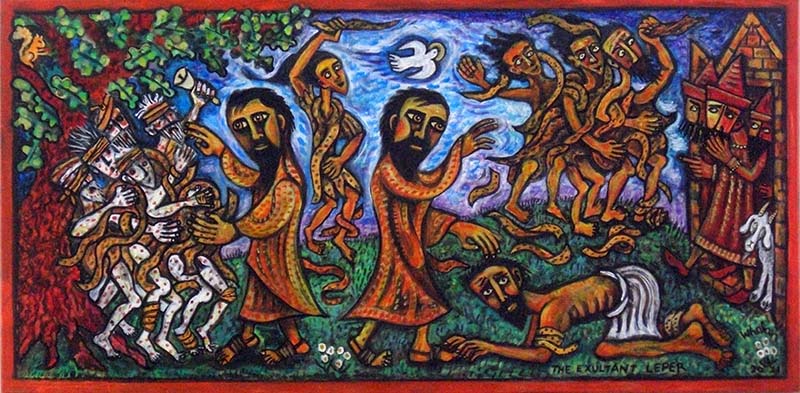
ART VIDEO: “The Story About the Painting Called The Exultant Leper”: Wilder Adkins shared this video with me of his uncle Les Smith interpreting a painting he owns before his congregation last summer at Trinity Episcopal Church in Martinsburg, West Virginia. He commissioned it from artist Brian Whelan, to depict the story of Jesus healing the ten lepers from Luke 17:11–19. Sadly, Smith passed away last month.
Brian Whelan (Irish, 1957–), The Exultant Leper, 2021. Mixed media on canvas. Private collection.
Smith said he requested the title “The Exultant Leper” and asked that it appear on the painting itself. “I am the exultant leper,” he says, pointing to the figure at the bottom right. “I am the guy who better always be at the feet of Jesus giving thanks.”
While I have certainly seen and shared plenty of academic presentations on art (such as the one on Rouault above), there is something so special about hearing ordinary folks (that is, nonspecialists) share with others art that is personally meaningful to them—and more than that, in this case, that they helped bring to fruition. Smith’s enthusiasm was such that even his neighborhood trash collectors have been invited into his home to enjoy the piece! I love that he took the step of supporting a living artist by commissioning an original artwork, and that he integrated that art into his home life, displaying it above his mantle, where he would see it daily and be reminded of his own story of transformation through Christ.
CROSS-DISCIPLINARY VIDEO PRESENTATION: “Psalms in Dialogue: (Be)Holding the Broken Pieces”:I shared Duke’s first “Psalms in Dialogue” in October 2020. Here’s their second offering in the same vein. “In this online presentation [which premiered October 2, 2021], Duke University Chapel and the Duke Chapel Choir will welcome visual artist Makoto Fujimura, theologian Dr. Ellen Davis, Tap Legacy Foundation co-founder Andrew Nemr, Ekklesia Contemporary Ballet, and dancer Paiter van Yperen for an evening of creativity and conversation inspired by the biblical Psalms. In the program, artists, musicians, theologians, singers, and dancers will present performances and works inspired by five Psalms: 46, 88, 90, 91, and 92.” I particularly enjoyed the teen ballet number choreographed by Elisa Schroth to Karl Jenkins’s “Healing Light: A Celtic Prayer” at 52:18 (lyrics below).
Deep peace of the running wave to you Deep peace of the flowing air to you Deep peace of the quiet earth to you
Amen
Deep peace of the shining stars to you Deep peace of the gentle night to you Moon and stars pour their healing light on you
Amen
Deep peace of Christ, the light of the world, to you Deep peace of Christ to you Deep peace of Christ, the light of the world, to you
Amen
+++
SONGS:
>> “Fill My Cup” by Thad Cockrell, feat. The New Respects: This song appears on Cockrell’s album If in Case You Feel the Same (2020); an older version is on Alone Together (2016) under the title “Walking to a City.”
>> “Victory of Christ” by Cory Dauber: Cory Dauber is a member of the Deeper Well Gospel Collective, a group of musicians and songwriters in the Portland, Oregon, area who are connected to Door of Hope church. Last year Dauber released his second full-length album, May All Times Go to You. This song appears on his debut album, Turn into a Mountain (2016).
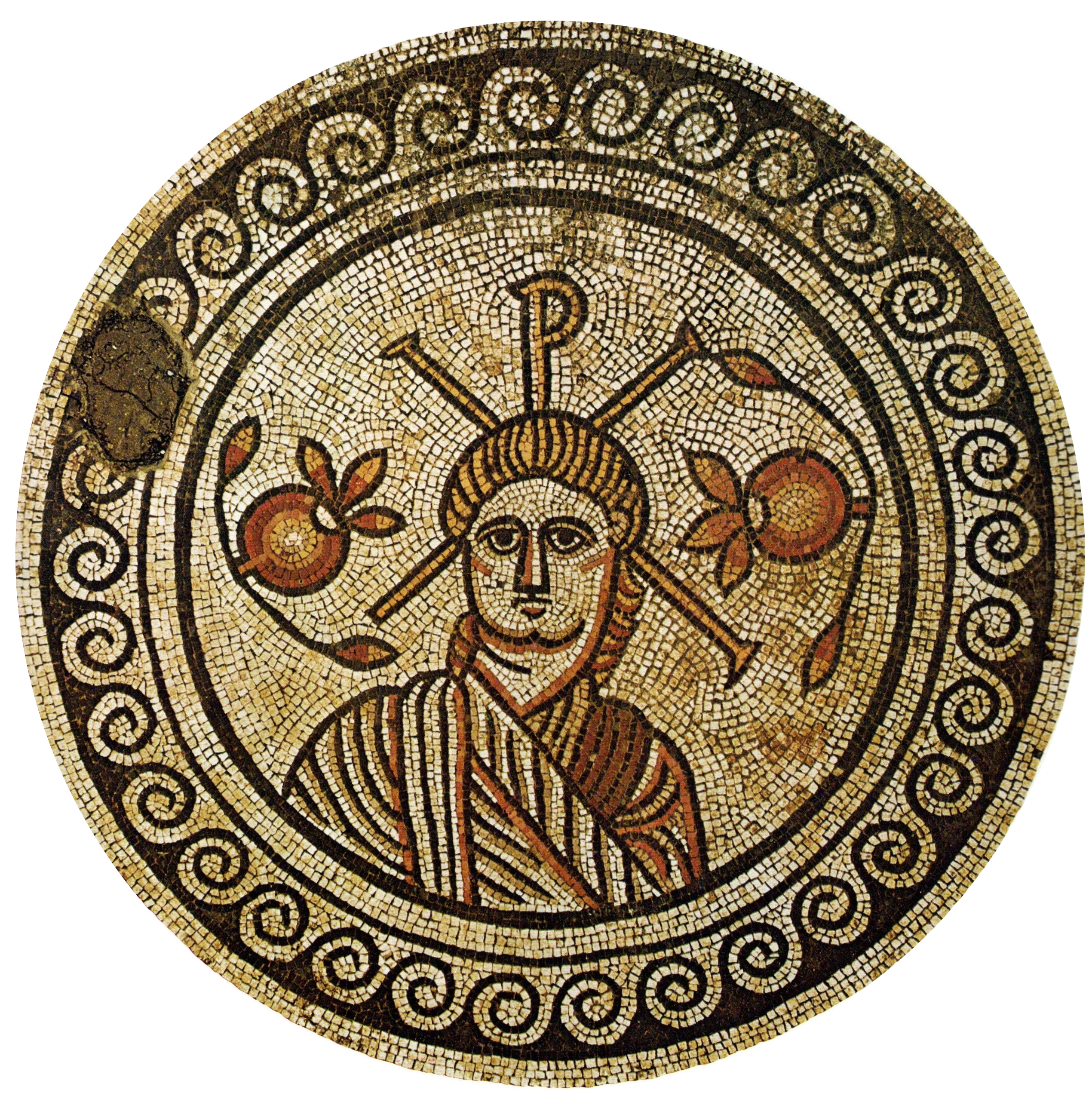
LOOK: Christ with Pomegranates (ancient Christian mosaic)
Mosaic from Hinton St. Mary, Dorset, England, early 4th century, preserved at the British Museum, London.
One of the earliest surviving portraits of Christ is in the central roundel of a stone mosaic pavement excavated in the English village of Hinton St. Mary in Dorset, from what was either a Roman villa or a church. It’s part of a larger program of images that covered the floor, which you can see and read about in this Instagram post of mine, and on the British Museum website.
Clean-shaven and wearing a pallium, Christ is crowned with his personal monogram, the chi-rho—the first two letters of the Greek title ΧΡΙΣΤΟΣ, Christos. He is flanked by pomegranates, a symbol of life, fertility, and abundance. In Jewish tradition the pomegranate symbolizes righteousness because it is said to have 613 seeds, corresponding to the 613 mitzvot (commandments) in the Torah. The fruit was woven onto the hems of the robes of the Jewish high priests (Exod. 28:33–34) and is customarily eaten on Rosh Hashanah.
To these symbolic associations, I would add another: sweetness!
On this track Assad sings the first and last stanzas of the traditional five—which are themselves extracted from a poem that was originally forty-two stanzas! The ending sounds abrupt because on the album it moves seamlessly into the next track, “Cathedrals.” For the full song (same tune but without the harmonies), see Angels and Saints at Ephesus by the Benedictines of Mary, Queen of Apostles.
Latin:

Jesu, dulcis memoria
dans vera cordis gaudia:
sed super mel et omnia
ejus dulcis praesentia.

Nil canitur suavius,
nil auditur jucundius,
nil cogitatur dulcius,
quam Jesus Dei Filius.

Jesu, spes paenitentibus,
quam pius es petentibus!
quam bonus te quaerentibus!
sed quid invenientibus?

Nec lingua valet dicere,
nec littera exprimere:
expertus potest credere,
quid sit Jesum diligere.

Sis, Jesu, nostrum gaudium,
qui es futurus praemium:
sit nostra in te gloria,
per cuncta semper saecula.
Amen.
Literal (nonmetrical) English translation:

Jesus, sweet remembrance,
Granting the heart its true joys,
But above honey and all things
Is His sweet presence.

Nothing more pleasing can be sung,
Nothing gladder can be heard,
Nothing sweeter can be thought
Than Jesus, Son of God.

Jesus, hope of the penitent,
How merciful you are to those who ask,
How good to those who seek;
But O, what you are to those who find!

Tongue has no power to describe
Nor writings to express,
But only belief can know by experience
What it is to love Jesus.

Be our joy, O Jesus,
Who will be the prize we win.
May all our glory be in you, always
And through all ages.
Amen.

Trans. Mick Swithinbank and Jamie Reid Baxter
Does this sound vaguely familiar? Edward Caswall translated it into metrical English in 1849 as “Jesus, the Very Thought of Thee,” a staple of modern American hymnals:
Jesus, the very thought of Thee With sweetness fills the breast! Yet sweeter far Thy face to see And in Thy Presence rest.
No voice can sing, no heart can frame, Nor can the memory find, A sweeter sound than Jesus’ Name, The Savior of mankind.
O hope of every contrite heart! O joy of all the meek! To those who fall, how kind Thou art! How good to those who seek!
But what to those who find? Ah! this Nor tongue nor pen can show The love of Jesus, what it is, None but His loved ones know.
Jesus! our only hope be Thou, As Thou our prize shalt be; In Thee be all our glory now, And through eternity. Amen.
I commend to you the recording on A Hymn Revival, Volume 3 by The Lower Lights. The tune, from 1866, is by John B. Dykes.
“Therefore I tell you, do not be anxious about your life, what you shall eat or what you shall drink, nor about your body, what you shall put on. Is not life more than food, and the body more than clothing? Look at the birds of the air: they neither sow nor reap nor gather into barns, and yet your heavenly Father feeds them. Are you not of more value than they? And which of you by being anxious can add one cubit to his span of life? And why are you anxious about clothing? Consider the lilies of the field, how they grow; they neither toil nor spin; yet I tell you, even Solomon in all his glory was not arrayed like one of these. But if God so clothes the grass of the field, which today is alive and tomorrow is thrown into the oven, will he not much more clothe you, O men of little faith? Therefore do not be anxious, saying, ‘What shall we eat?’ or ‘What shall we drink?’ or ‘What shall we wear?’ For the Gentiles seek all these things; and your heavenly Father knows that you need them all. But seek first his kingdom and his righteousness, and all these things shall be yours as well.”
—Matthew 6:25–33
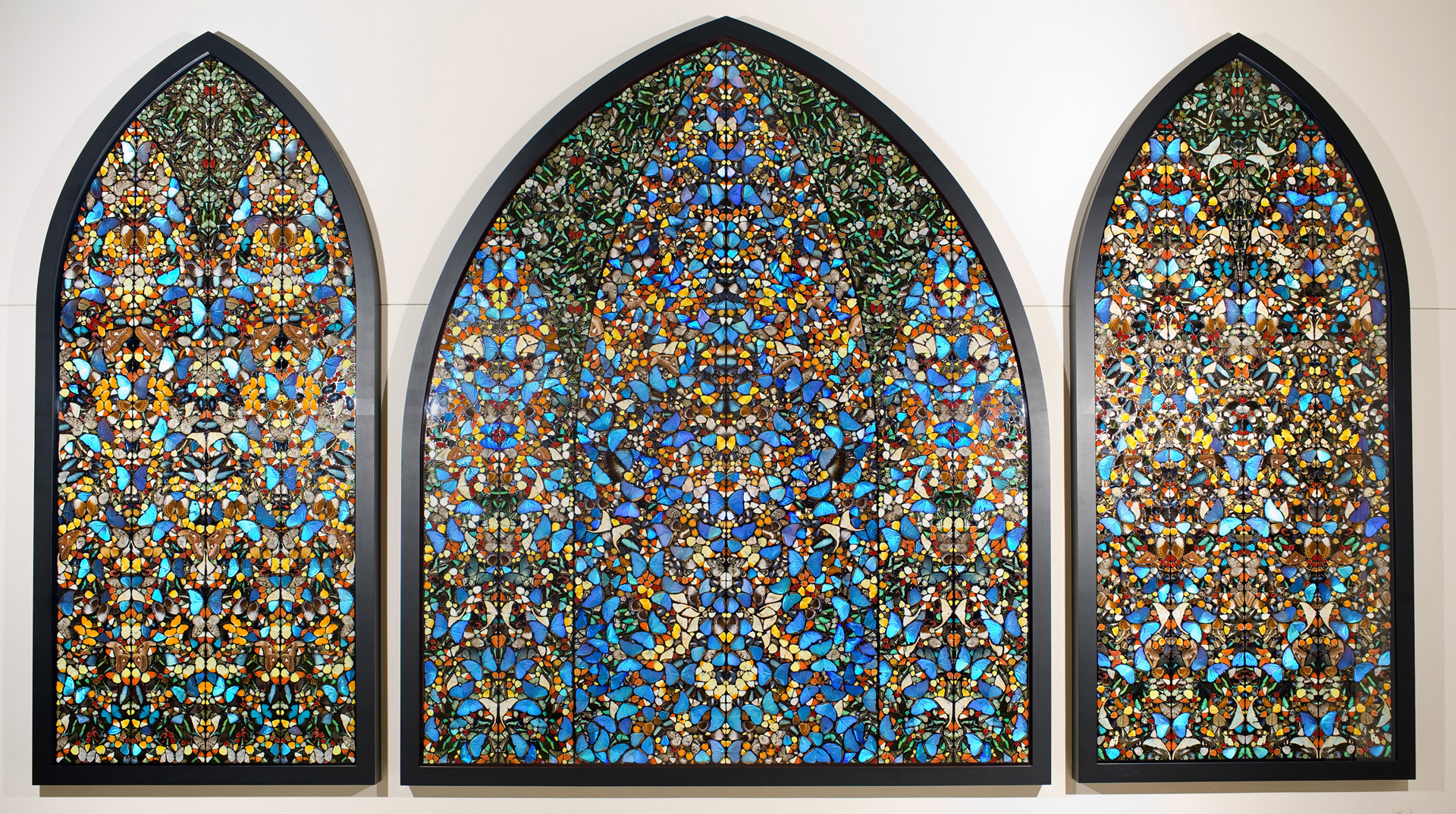
LOOK: The Kingdom of the Father by Damien Hirst
Damien Hirst (British, 1965–), The Kingdom of the Father, 2007. Butterflies and household gloss on three canvas panels, 115 7/8 × 190 in. (294.3 × 482.6 cm). Photo: Randy Boverman.Detail. Photo: Yvette Wohn.
Seek ye first the kingdom And watch God add to your life Seek ye first the kingdom of God And his righteousness, it shall be yours
No need to worry ’bout the lack in your life The God I know, he will supply Submit your request, make it known Give it to God, leave it alone But you must have faith and believe what he said In his word, trust his word
When you pray, seek his face, trust his word—trust and obey If it’s in his word, you can count on it, trust his word—trust and obey When you seek him, believe—trust and obey Trust him, then seek him, and you’ll find him—trust and obey
Seek ye first the kingdom of God And his righteousness, it shall be yours
I was searching for a good rendition of “Seek Ye First” by Karen Lafferty, a pioneer of the Jesus Movement of the 1970s—but instead I came across this awesome gospel song inspired by the same scripture passage! It was written by Emorja Roberson—pianist, conductor, workshop coordinator, composer, arranger, and classical and gospel vocalist. He graduated with a master’s of sacred music in vocal performance from the University of Notre Dame in 2017 and is currently a student in the school’s doctor of musical arts in choral conducting program, with a focus on the African American repertoire. He is the director of the Voices of Faith Gospel Choir.
In this season, we pause and examine the things that stand in the way of our relationship with God. Notre Dame’s Voices of Faith Gospel Choir reminds us that we must seek God first – before fame, riches, pleasure, or certainty. In order to anchor our lives in God and to direct our efforts towards the coming of the kingdom, we must trust in God’s providence. What might be taking priority in our lives over our relationship with God? How can we re-center this day, this week, and this Lenten season, by seeking God first?
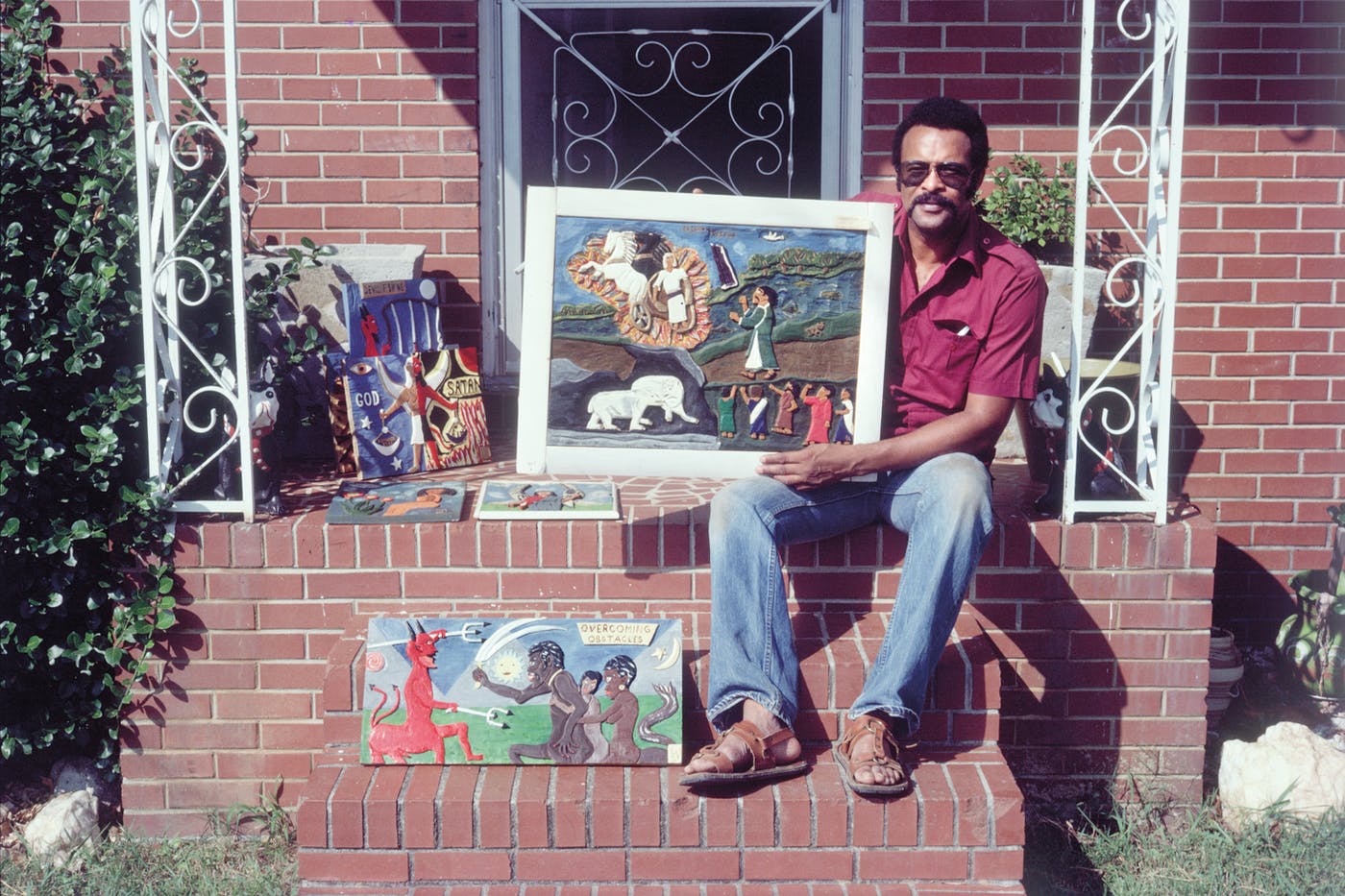
Leroy Almon (American, 1938–1997), Mr. & Mrs. Satan Fishing, 1991. Polychrome bas-relief wood carving, 22 1/2 × 24 in. Gordon Gallery, Nashville.
Leroy Almon (1938–1997) was born in Tallapoosa, Georgia, but grew up in Ohio. While working for Coca-Cola in Columbus, he met the self-taught woodcarver Elijah Pierce [previously] at Gay Tabernacle Baptist Church, where Pierce served as lay preacher, and in 1979 became apprenticed to him. Pierce taught Almon how to make low-relief carvings in wood using pocketknives and hand chisels, and then to paint them. Initially the two collaborated on pieces, until 1982, when Almon returned to Tallapoosa. There he restored his childhood home, converting the basement into an art studio. Like his mentor, he too combined the vocations of art making and evangelical preaching.
Almon is well known for his didactic carvings on the subjects of religion, politics, and African American history. The battle between good and evil is at the forefront of his art. Satan fishing for souls is a theme he developed and returned to many times in variation; see, for example, here, here, here, and here. Such carvings show a caricatured Satan (red, horned, spiky-tailed, and goateed) dangling various vices—gambling, promiscuity, sex, drugs, greed, hypocrisy, etc.—as bait before humans who appear ready to bite. Sometimes he’s joined by his wife, Mrs. Satan!
In the version at the Gordon Gallery in Nashville, cards, cash, a romantic couple (presumably unwed), alcohol, cigarettes, a bomb, hard drugs, and a church building are on the line. The latter symbolizes the false piety of many churchgoers and the corruption inside institutionalized Christianity.
In The New Encyclopedia of Southern Culture, Vol. 23: Folk Art, Jenifer P. Borum praises Almon’s ability to “mix fire-and-brimstone warnings about the world’s evils with a playful sense of humor”; she refers to the “comic moralism” of his work. My first reaction upon seeing Mr. & Mrs. Satan Fishing was to laugh out loud. But then I wondered whether the humor was intentional. Does the artist want us to chuckle? I haven’t been able to find any statements from Almon. The image likely represents very real temptations that afflicted his community and maybe, some of them, him personally. I suppose the humor could be self-conscious, but if so, it’s a dark humor—gravitas masked in levity. Almon knew that “like a roaring lion [our] adversary the devil prowls around, looking for someone to devour” (1 Pet. 5:8).
Leroy Almon on his front stoop in Tallapoosa, Georgia, 1987. Photo: Roger Manley.
LISTEN: “The Devil Ain’t Lazy” by Fred Rose; originally recorded by Bob Wills & His Texas Playboys, 1947 | Performed by Pokey LaFarge on Pokey LaFarge, 2013
The devil ain’t lazy (No siree) The devil ain’t lazy (No siree)
He roams around with sticks and stones Passing out his moans and groans The devil ain’t no lazy bones He works 24 hours a day
The devil ain’t lazy (No siree) The devil ain’t lazy (No siree)
He likes to see us fight and fuss Makes us mean enough to cuss Then he blames it all on us He works 24 hours a day
He travels like a lightning streak And he strikes from town to town Then he gets you when you’re weak He’ll tear your playhouse down
The devil ain’t lazy (No siree) The devil ain’t lazy (No siree)
He tells us he won’t hurt a fly Then he makes us steal and lie Keeps us sinning until we die He works 24 hours a day
The devil ain’t lazy (No siree) The devil ain’t lazy (No siree)
Gets his pitchfork out each night Gives the folks an awful fright I know he does it just for spite He works 24 hours a day
The devil ain’t lazy (No siree) The devil ain’t lazy (No siree)
Tells us how to find success I know he’ll wind up in distress I’ll tell ya why: the devil is an awful mess He works 24 hours a day
He likes to see things scorch and burn He don’t make no excuse If he catches you, he’ll turn you Every way but loose
The devil ain’t lazy (No siree) The devil ain’t lazy (No siree)
So if you think you’re strong and brave Smart enough to not behave You got one foot in the grave He works 24 hours a day 24 hours a day (Yes, he does!) He works 24 hours a day He works 24 hours a day
“Enter through the narrow gate; for the gate is wide and the road is easy that leads to destruction, and there are many who take it. For the gate is narrow and the road is hard that leads to life, and there are few who find it.”
—Matthew 7:13–14
Then Jesus told his disciples, “If any want to become my followers, let them deny themselves and take up their cross and follow me. For those who want to save their life will lose it, and those who lose their life for my sake will find it. For what will it profit them if they gain the whole world but forfeit their life? Or what will they give in return for their life?”
—Matthew 16:24–26
These teachings of Jesus give me pause. How do we square them with Jesus’s saying that his yoke is light, and that in him the heavy laden find rest (Matt. 11:28–30)? Crosses are hefty! They weigh down. To follow Christ, do we trade one burden (sin) for another (self-denial)? And is there not a wideness and a freedom to Christ’s way? Narrowness implies constriction. His embrace is certainly wide. But his gate is narrow?
I’ve seen this passage abused by Christians who insist that their own narrow parameters of belief and practice (and I’m talking apart from the historical creeds) constitute the one true path; without accounting for differences of conscience, culture, or biblical interpretation, they label this view or that behavior a “slippery slope” that will lead to destruction.
I have thoughts on some of these questions, but they’re not fully formed. Feel free to share your thoughts in the Comment field.
Rather than ignoring Bible passages that I find confusing or uncomfortable, I prefer to wrestle with them. Below I’ll look at how two artists engage these texts, setting them within a larger framework: German painter Laurentius de Neter and hymn writer Isaac Watts. Both works are old-fashioned, and I don’t give my full endorsement to either one, but I believe they are worth visiting.
LOOK: The Broad and Narrow Road by Laurentius de Neter (aka Laurence Neter)
Laurentius de Neter (German, 1600–1649), De brede en de smalle weg (The Broad and Narrow Road), ca. 1635. Oil on canvas, 59 × 78 cm. Museum Catharijneconvent, Utrecht, Netherlands.
The artist painted this image, popular among Protestants, during his three-year sojourn in the Netherlands from 1635 to 1638. I saw it when I was there in 2019, in one of the galleries of the Museum Catharijneconvent in Utrecht. There was a Dutch title given but no description. I spent a while looking at all the details.
In the center is a large tree—green and lush on the left, and dead and barren on the right. A man stands under it, being pulled in two directions.
To our right is a skeleton with a bow and arrow, standing in the shadows and representing death, and a finely dressed woman holding an apple, representing temptation. She tries to persuade the man toward a life of earthly pleasures, signified by a pile of cards and dice, a theatrical mask, musical instruments and sheet music, bags of coins, fancy vases, and armor. On this “worldly” side a regent sits on a dais under a canopy before a literal wall of gold—her head ensconced in a glass globe! She is living in a bubble, consumed with self and power. Nearby a lutist and a harpist play at an extravagant outdoor banquet, while in the background a contemporary “Lazarus,” hungry and barely clothed, sits outside the host’s house as two dogs lick his sores.
In the right background a crowd of people shuffle through a wide archway marked V[olu]pta[t]es, Latin for “pleasures.” (I’m not sure who the sculpted figures on top are supposed to represent.) They are heading toward destruction, as is clear from the blazing fire in the distance. This is one of the paths that is open to the indecisive man at the center.
His other option, though, is the way of Christ. He is beckoned there by a simply dressed woman with an infant, representing Christian love, and by an angel who points to the Ten Commandments with his sword.
This “narrow way” is marked by humble prayer and service. At the left, those who have chosen this way enact the seven works of mercy, derived mainly from Matthew 25: feeding the hungry, giving drink to the thirsty, clothing the naked, sheltering the stranger, visiting the prisoner, caring for the sick, and burying the dead. They have taken up their cross, and they head for a narrow footpath that stretches over a body of water and winds up and around a mountain. Those who fall off the path are in danger of landing in the fiery pit at the base.
Even though it’s a popular metaphor and has been for ages, I’m not so keen on envisioning the Christian life as an uphill climb. It’s meant to connote something of the struggle to press on as well as a sense of progression toward a goal—the mountaintop, which stands for heaven. But it seems this picture could falsely suggest that heaven is gained through self-exertion, through laborious effort, and that the journey of faith is one of continual progress or ascent, and that it looks the same for everyone. In reality, sometimes we start out high but regress. Sometimes we travel a different path for a while, but it meets back up with the main, bringing us to a point we couldn’t have gotten to any other way.
While I realize there are scriptures to support the view of faith as a feat of endurance (e.g., Phil. 3:12–14; 1 Cor. 9:24–27; Gal. 6:9), and I’m certainly not suggesting idleness, there are also numerous passages about relying on God’s strength rather than our own; on Christ’s merits, not our own.
I think that as long as we recognize the limitations of the mountain metaphor, bringing a more nuanced understanding to it, it’s fine to retain.
But another problematic idea that this painting could be read as insinuating is that all pleasures, such as good food, the theater, music, and games, ought to be repudiated as distractions at best, idolatries at worst. (No one on the narrow path is seen enjoying such things.) Enjoyment of the arts and of God’s good gifts is not sinful. However, if you come to live only for such pleasures, if you become so consumed with them that they cause you to ignore the needs of those around you and neglect your other Christian duties, then they can become destructive. One might discern this subtle distinction in de Neter’s portrayal of the bombastic displays of wealth and the diners’ apparent exclusion of the poor and disabled from their feast.
I do appreciate that the artist’s characterization of the “narrow path” includes not just personal pieties but also a social aspect—faith worked out in the public square in material ways, in interactions with neighbors.
LISTEN: “Windham” (Roud 15045) | Words by Isaac Watts, 1707–9 | Music by Daniel Read, 1785 | Performed by the Watersons on Sound, Sound Your Instruments of Joy, 1977
Broad is the road that leads to death And thousands walk together there But wisdom shows a narrow path With here and there a traveler
“Deny thyself and take thy cross” Is the Redeemer’s great command Nature must count it all but dross If she would gain this heavenly land
The fearful soul that tires and faints And walks the ways of God no more Is but esteemed almost a saint And makes his own destruction sure
Lord, let not all my hopes be vain Create my heart entirely new Which hypocrites could ne’er attain Which false apostates never knew
Isaac Watts titled this hymn—quite unattractively!—“Few saved: or, The almost Christian, the Hypocrite, and Apostate.” The tune, which is in the Sacred Harp (aka shape-note) tradition, is by New England composer Daniel Read (1757–1836); it’s named WINDHAM, I’m assuming after the town of Windham, Connecticut, Read’s state of residence. The famous British folk group The Watersons recorded the hymn under that title in the seventies. The text and tune complement each other very well.
I will say, though: I don’t like the third stanza. There’s no grace or compassion in it, no sense of God’s faithfulness to carry his own, his strength applied to our weakness, or his calling back the wayward wanderers. It may be influenced at least in part by Revelation 21:7–8 (KJV): “He that overcometh shall inherit all things; and I will be his God, and he shall be my son. But the fearful [i.e., cowardly], and unbelieving, and the abominable, and murderers, and whoremongers, and sorcerers, and idolaters, and all liars, shall have their part in the lake which burneth with fire and brimstone: which is the second death.” But Watts’s image of tiredness and fainting suggests someone who has picked up their cross and has buckled under its weight, as opposed to someone who outright rejects Christ’s call to cross taking. So in that case, Watts may have more in mind the passages of scripture that mention a believer’s “falling away,” or apostatizing, from the faith (Heb. 3:12; 6:4–12; 10:26–39; Rom. 11:22; 1 Cor. 9:25–27; etc.). Only those who persevere to the end will be saved.
I’m not sure how the “hypocrite” of the title fits into all this.
I don’t wish to get bogged down here with Calvinist versus Arminian debates about whether salvation can be lost, as that would detract from the main point, which is following Christ, staying committed.
I would not program this hymn into a worship service—it’s stark and severe and lacks, as I said, a perspective of divine grace, even if it does honor certain isolated scripture passages—but I wanted to introduce it here nonetheless. Being by the father of English hymnody, it circulated quite widely; the website Hymnary identifies its appearance in 441 hymnals. And it directly ties in to my two selected scripture texts, which are stark and severe, and I know of few other songs that address them. Not all hymns have to have a feel-good quality. Sometimes hymn writers give us something with bite, and that can be OK, even necessary. This one is an admonishment to stay on the straight and narrow. If you’ve veered off course, now is the time to come back!
His body doubled
    under the pack
    that sprawls untidily
    on his old back,
    the cold wet dead-beat
    plods up the track.

The cook peers out:
    oh, curse that old lag—
    here again
    with his clumsy swag
    made of a dirty old
    turnip-bag.

Bring him in, cook,
    from the cold level sleet:
    put silk on his body,
    slippers on his feet;
    give him fire
    and bread and meat.

Let the fruit be plucked
    and the cake be iced,
    the bed be snug
    and the wine be spiced
    for the old cove’s night-cap—
    for this is Christ.
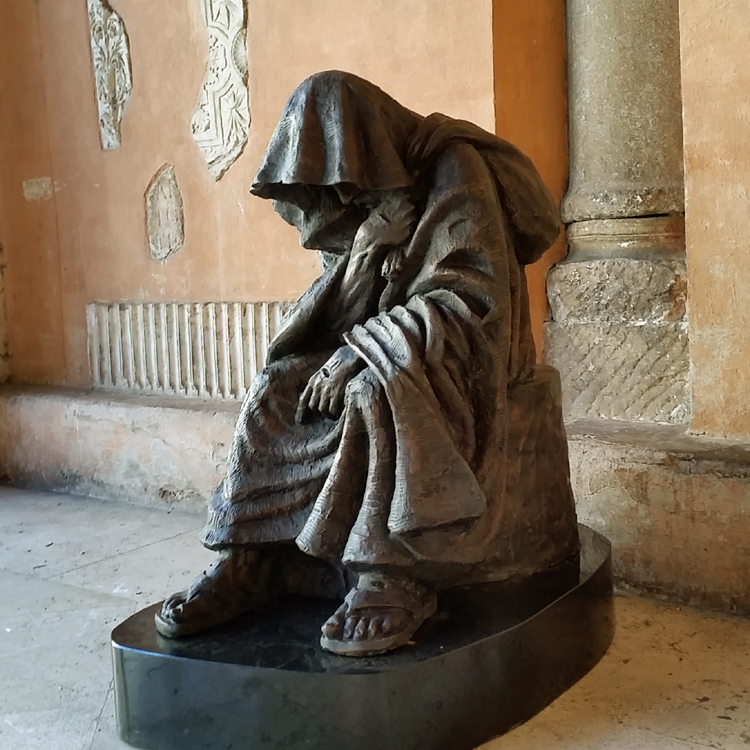
Timothy P. Schmalz (Canadian, 1969–), When I Was a Stranger, 2016. Bronze, 42 × 23 × 39 in. Basilica of San Lorenzo (Saint Lawrence), Lucina, Rome.
R. A. K. Mason (1905–1971) was one of New Zealand’s preeminent poets. Written around 1932, his poem “On the Swag” was inspired by Matthew 25:31–46, where Jesus says that our treatment of the poor redounds to him. That is, if we ignore the cries of the poor or even directly reject them, we are effectually ignoring or rejecting Christ—but if we welcome the poor into our homes and lives and endeavor to meet their needs, it is as if we welcome Christ himself.
In New Zealand and Australia, “swag” refers to a pack of personal belongings, and to “go on the swag” is an informal expression meaning to become a wandering foot-traveler, lacking a permanent residence and steady work. So in the poem a homeless man, hunched over in exhaustion and with his meager bag of possessions in tow, is passing down a neighborhood lane. A house cook sees him through the window and in vexation complains about what an eyesore he is, stinking up the streets and making the city look bad. She has seen him in these quarters before and wishes him good riddance.
But in the next two stanzas a more compassionate voice intervenes—probably the master or mistress of the house, or otherwise an intrusive narrator. This voice orders the cook to bring the man inside and to lavish him with the finest foods and dress, and then to make up a warm bed for the “old cove.” (“Cove” is an old-fashioned British word meaning “fellow.”) The last line tells us what impels this loving and urgent hospitality: “this is Christ.”
Whenever you encounter an outstretched hand or a dejected face, how might seeing it as the hand or face of Christ impact your response?
Copyright credit: “On the Swag” by R. A. K. Mason was originally published in 1932 in Kiwi: The Magazine of the Auckland University College and more recently has appeared in R. A. K. Mason: Collected Poems (Victoria University Press, 2014). It is reproduced here by permission of Hocken Library Uare Taoka o Hakena, University of Otago, Dunedin, the holder of Mason’s papers.
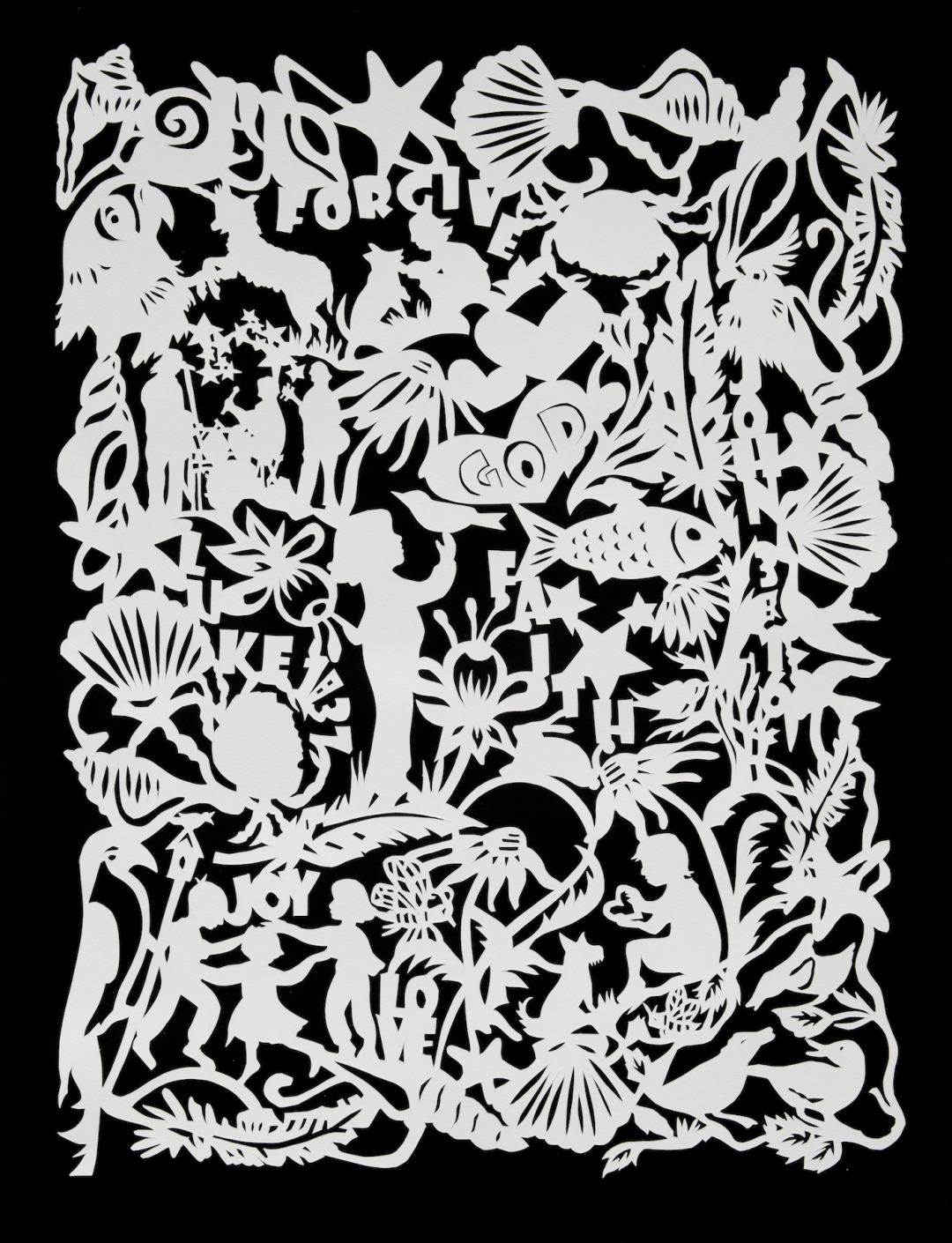
Nicholas Palumbo, Forgive, 2015‒16. Cut Bristol board on cardstock. Collection of Community Partners in Action, Hartford, Connecticut.
Nicholas Palumbo is one of thousands who have participated in Community Partners in Action’s Prison Arts Program over its forty-plus years of operation. Founded in 1977 and directed by Jeffrey Greene, the program “promotes self-examination and self-esteem in Connecticut inmates through participation in visual arts classes, exhibitions and publications, and brings the talent and creativity of the prison population to the community at large.”
This cut-out by Palumbo, titled Forgive, is one of the artworks the CPA purchased for its permanent art collection, which travels, along with new pieces, to public schools, universities, libraries, community centers, and galleries throughout the state. I came across it in a Hyperallergic review of the 2019 exhibition How Art Changed the Prison: The Work of CPA’s Prison Arts Program at the Aldrich Contemporary Art Museum in Ridgefield, Connecticut.
Full of whimsy, Palumbo’s piece brings together the words “God,” “joy,” “love,” “faith,” and “forgive” with scripture references (Luke 1:37, “For nothing will be impossible with God”; John 3:16, “For God so loved the world . . .”) and images of seashells, fish, birds, hearts, flowers, insects, a dog, a rock band under the stars, and children playing ring-around-the-rosy. I see it as an invitation into Christ’s joy-filled kingdom, which we must enter with faith like a child (Matt. 18:1-5; Mark 10:13-16; Luke 18:15-17)—in trust, curiosity, and wonder.
An alphabetical catechism, set to a buoyant, guitar-driven melody.
At all times give thanks, for this pleases God Be kind, loving, and forgiving to each other Christ died for our sins and rose again Don’t lie or cheat, but be truthful Even a child is known by what he does For God so loved the world that he gave his only Son God made the heavens and the earth Honor your father and mother It’s right to care for your animals Jesus said, “I am the Good Shepherd”
Alleluia, alleluia
Know that the Lord is God; he made us and we are his Love God with all your mind and strength Make the highest goal of your life love, for your Neighbors here and God above Obey your parents in the Lord Parents, gently correct, and teach your children in God’s ways Quench not the Holy Spirit Rejoice and be glad in the Lord
Alleluia, alleluia, alleluia
Serve the Lord happily and sing to him Temptations come to all, but God gives us strength to do right Unless you become like a child, you cannot enter heaven Victory over the world is our faith Worship the Lord and serve him only Except you be reborn, you will not see God’s truth You are the light of the world Zacchaeus, Jesus came to save those who are lost
Chunye He (Chinese, 1968–), Walking Together, 2018. Ink on rice paper, 67 × 43 cm.
This Chinese ink-wash painting is from Matter + Spirit: A Chinese/American Exhibition, the product of a 2018 gathering in Beijing of North American and Chinese art professors, sponsored by the Nagel Institute for the Study of World Christianity. According to curator Rachel Hostetter Smith, He’s piece, which shows two dragonflies flying in tandem, is “a poetic rendering of the way family, friends, and God ‘walk alongside’ us especially in times of trouble and loss.” It is stamped in red with the Chinese character for “earth,” which happens to be shaped like a cross.
This song was written by Leslie Jordan, Aaron Keyes, Orlando Palmer, Isaac Wardell, and Paul Zach of the Christian music collective The Porter’s Gate. The Spotify link is to their studio recording from 2019, whereas the YouTube video is a 2020 virtual performance by musicians from Whitworth Campus Ministries in Spokane, Washington.
Teach us Your ways, teach us Your ways As we learn from one another Learn to love each other Teach us Your ways
Teach us to give, teach us to give Give ourselves for one another Learn to love each other Teach us to give
Teach us to weep, teach us to weep Let us weep with one another Learn to love each other Teach us to weep
Hallelujah, hallelujah Let us learn from one another Learn to love each other Teach us Your ways
William H. Johnson (American, 1901–1970), Mount Calvary, ca. 1944. Oil on paperboard, 27 3/4 × 33 3/8 in. (70.5 × 84.9 cm). Smithsonian American Art Museum, Washington, DC.
LISTEN: “Draw Me Nearer” (I Am Thine, O Lord) | Words by Fanny Crosby, 1875 | Music by William H. Doane, 1875 | Performed by Nina Simone on Let It All Out, 1966
I am Thine, O Lord, I have heard Thy voice, And it told Thy love to me; But I long to rise in the arms of faith, And be closer drawn to Thee.
[Refrain] Draw me nearer, nearer, nearer, blessed Lord, To the cross where Thou hast died; Draw me nearer, nearer, nearer, blessed Lord, To Thy precious, bleeding side.
Consecrate me now to Thy service, Lord, By the pow’r of grace divine; Let my soul look up with a steadfast hope, And my will be lost in Thine.
Now there was a woman who had been suffering from hemorrhages for twelve years. She had endured much under many physicians, and had spent all that she had; and she was no better, but rather grew worse. She had heard about Jesus, and came up behind him in the crowd and touched his cloak, for she said, “If I but touch his clothes, I will be made well.” Immediately her hemorrhage stopped; and she felt in her body that she was healed of her disease. Immediately aware that power had gone forth from him, Jesus turned about in the crowd and said, “Who touched my clothes?” And his disciples said to him, “You see the crowd pressing in on you; how can you say, ‘Who touched me?’” He looked all around to see who had done it. But the woman, knowing what had happened to her, came in fear and trembling, fell down before him, and told him the whole truth. He said to her, “Daughter, your faith has made you well; go in peace, and be healed of your disease.”
—Mark 5:25–34
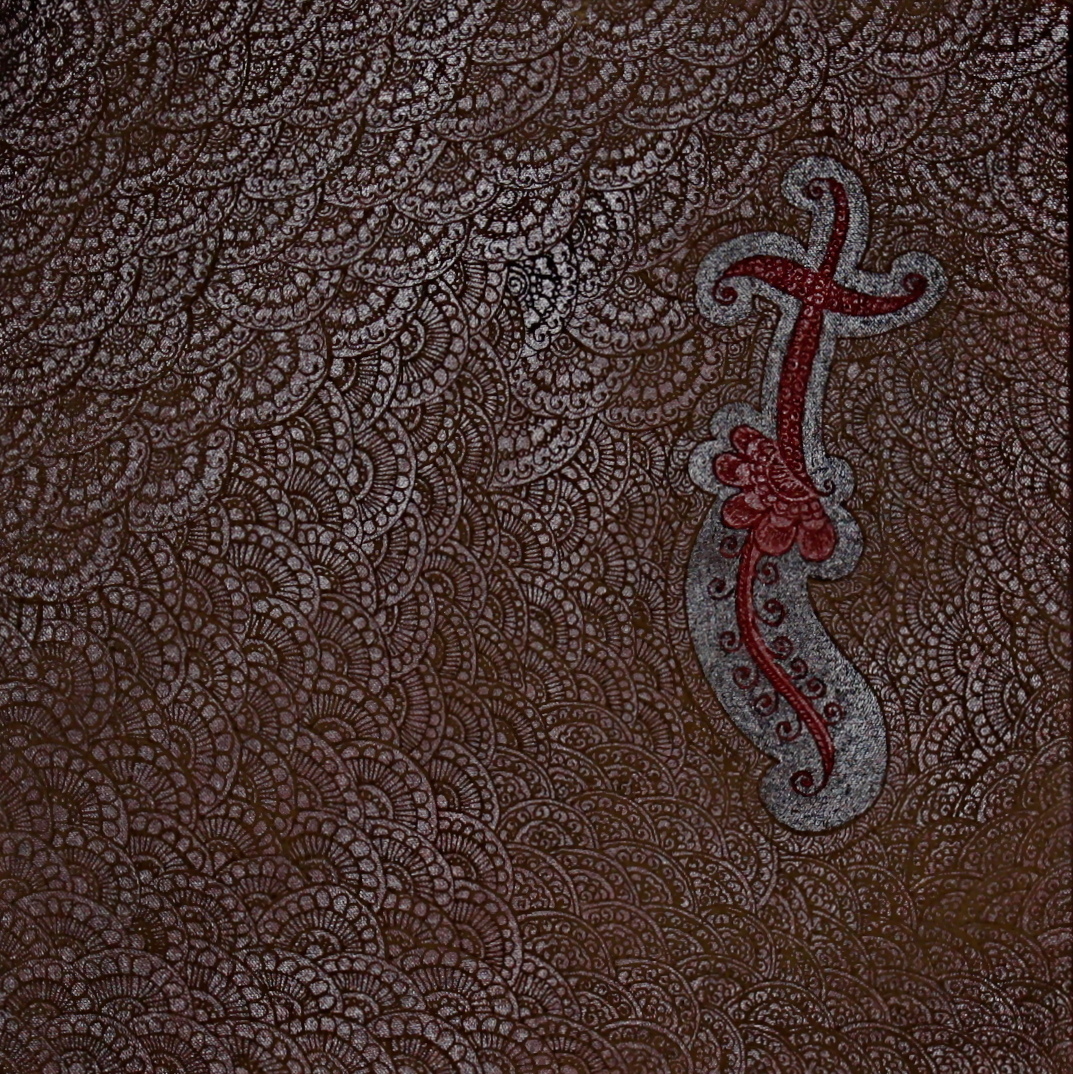
LOOK: Bleeding Woman by Kimberly Stephens
Kimberly Stephens, Bleeding Woman, 2010. Mehndi and acrylic on canvas.
Bleeding Woman is part of a series of eighteen biblical paintings originally exhibited in October 2010 at the L&P Hutheesing Visual Arts Centre in Ahmedabad, India, a country where Stephens lived for two years. Mehndi is a powder taken from the leaves of the henna plant and made into a paste. It’s traditionally applied to the skin as a form of temporary body art for weddings, religious festivals, and other celebrations, but Stephens has fixed it in more permanent form on canvas, and she uses it to tell the story of Jesus.
The episode depicted here is found in Mark 5:25–34 (cf. Matt. 9:20–22; Luke 8:43–47). A woman had been hemorrhaging for twelve years, which made her ceremonially unclean, and thus a social pariah, in the ancient Jewish culture in which she lived. Yet Stephens shows her confidently pressing her way through the crowd so that she can touch the hem of Jesus’s garment and be healed.
There is definitely a sense of claustrophobia in the painting, of tightness and crowding, achieved by the many overlapping waves. But something intimate, something private, is happening amid this very public throng: the woman reaches out to Jesus and immediately blossoms upon contact. Jesus restores her not only physically but also socially, emotionally, and spiritually—a holistic salvation.
Jesus and the woman are represented symbolically using the curled lines that are characteristic of mehndi designs, with Jesus’s form evoking the cross he will later die on. The thick, silvery outline around these two figures serves as an aura of sorts that sacramentalizes the encounter and draws the viewer’s attention to it but that also creates some breathing room and suggests the space of clarity and relief into which the woman has entered.
Reach out, reach out, the hem of his cloak One touch will heal the bleeding Press in, press in, the crowd draws near Your faith the pow’r is heeding
Written by Elizabeth Duffy and arranged by Kaitlyn Ferry of the group Sister Sinjin, “Talitha Koum” is a trilogy of short songs about three females from the New Testament: Jairus’s twelve-year-old daughter, whom Jesus raises from the dead (Matt. 9:18–26; Mark 5:21–43; Luke 8:40–56); the hemorrhaging woman discussed above; and the widow who puts her two small coins into the offering plate (Mark 12:41–44; Luke 21:1–4). The title is Aramaic, translating to “Little girl, arise!”—the words spoken by Jesus to Jairus’s daughter (Mark 5:41).
The song featured here is the second in the set. The woman with the issue of blood experienced a sort of resurrection herself, as Jesus raised her out of the pain, disruptiveness, and isolation of her condition, making possible a new life for her.
Imagine how freeing it must have felt to receive that jolt, I’ll call it, from the tzitzit (tassels) of Rabbi Jesus’s robe, and to know instantly that you have been healed! For over a decade the woman had suffered from continual bleeding, and no doctor was able to help. She lived on the margins of society. Until Jesus came along and she reached out in faith to claim the blessing of healing.
“Talitha Koum, Part 2” is sung in three-part harmony in G minor, but on the final syllable the key shifts up a half-step to G Major. This harmonic device (ending a minor song on a major chord) is known as a Picardy third [previously], and it’s used to lift what can be heard as sad, dark, or heavy into a lightness and brightness, into joy. I hear it as the woman’s sigh of relief. She had been holding her breath for so long, anxious for resolution, and now she can finally let it out.








 Art & Theology