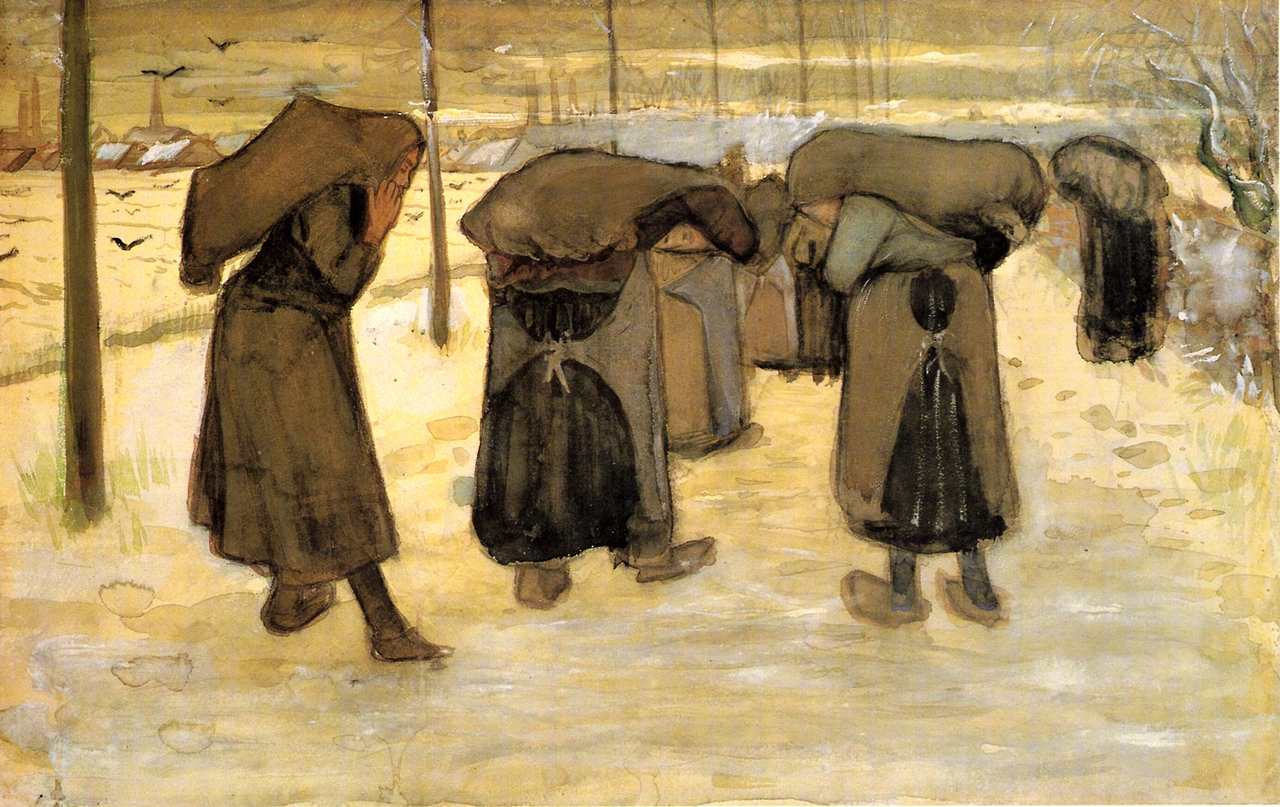
Vincent van Gogh (Dutch, 1853–1890), Women Carrying Sacks of Coal in the Snow, 1882. Chalk, brush in ink, and opaque and transparent watercolor on wove paper, 32.1 × 50.1 cm. Kröller-Müller Museum, Otterlo, Netherlands.
Those who carry grand pianos
to the tenth floor   wardrobes and coffins
the old man with a bundle of wood hobbling toward the horizon
the lady with a hump of nettles
the madwoman pushing her baby carriage
full of empty vodka bottles
they all will be raised up
like a seagull’s feather   like a dry leaf
like an eggshell   a scrap of newspaper on the street

Blessed are those who carry
for they will be raised
Today’s roundup brings together a theologian (Anderson Jeremiah), an art historian (Elissa Yukiko Weichbrodt), and a musician (Eric Lige and friends) who I think complement one another really well!
SONGS:
Eric Lige [previously] is “a music-maker who promotes Jesus, Justice, Faith, and Community.” He is the worship director at Ethnos Community Church in San Diego and the co-executive producer of The Ethnos Project, which creates a platform for new and emerging global voices in musical worship to be heard worldwide. Especially since COVID hit in 2019, he has been assembling multinational teams of musicians to produce YouTube videos, many of which are livestreamed as part of Ethnos worship services. Here are three examples (view more on Lige’s YouTube channel):
>> “Ξεδιψασμένος (No Longer Thirsty)” by Kostas Nikolaou: A contemporary Christian worship song in Greek, about how Christ, the living water, quenches our thirst for love and purpose. The lead vocalist is Nefeli Papanagi—and wow, do I love her voice!
>> “Ua Mau (Hosanna)” by Moses W. Kaaneikawahaale Keale (aka Keale Ta Kaula): Reyn and Joy Nishii perform this nineteenth-century Hawaiian hymn by Keale “the Prophet,” who converted to Christianity after calling on God during a hunting accident and finding rescue. The first verse translates to “Perpetual is the righteousness / That comes from the Father above / Let us gather together / In his goodness and grace.”
>> “Love’s in Need of Love Today” by Stevie Wonder: Edward Chen and friends—from Canada, the United States, Armenia, Venezuela, and Mexico—perform the opening track from Stevie Wonder’s Grammy-winning album Songs in the Key of Life. “God gave me this gift, and this particular song was a message I was supposed to deliver,” Wonder has said. “The concept I had in mind was that for love to be effective, it has to be fed.” See the full list of credits in the description on the video page. Eric Lige is the one in the maroon shirt.
+++
LECTURES:
>> “Many Faces of Jesus: Christologies from the Margins” by the Revd. Canon Dr. Anderson H. M. Jeremiah, October 12, 2021: Anderson Jeremiah is a senior lecturer in the politics, philosophy, and religion department at Lancaster University in the UK, whose areas of expertise include Christian theology in Asia, postcolonial approaches to theology, Dalit studies, liberation theology, modern missionary movements, and inculturation and faith. Ordained in the Church of South India (part of the Anglican Communion), he was installed as Canon Theologian of Blackburn Cathedral in September 2021, making him the first Dalit to be appointed to that role in any English cathedral.
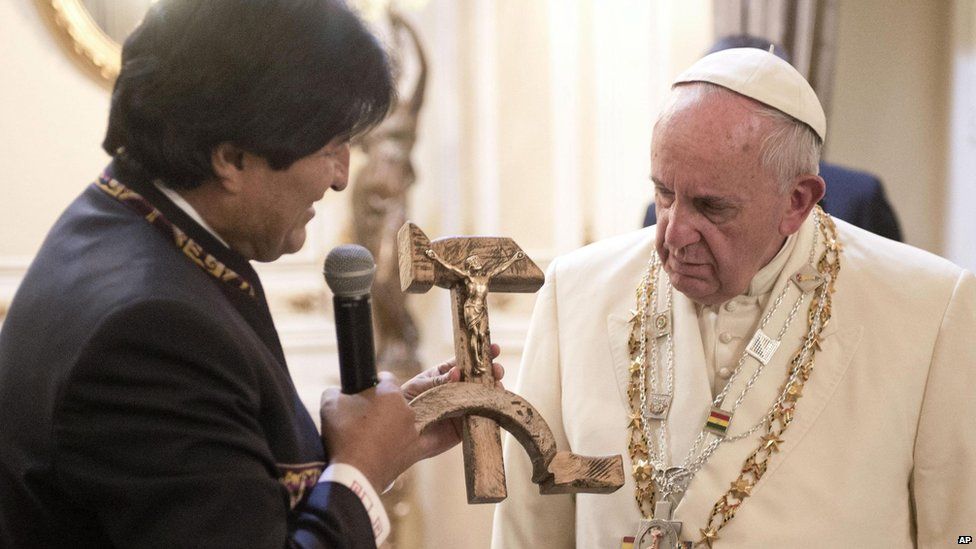
In this half-hour online talk given last fall for the Diocese of Manchester, Jeremiah discusses the Incarnation as a continuous event—Christ being born into human cultures—as expressed through a selection of visual artworks from Ghana, Bolivia, China, Japan, and India. These images subvert the predominant Western image of Christ and sometimes provide critique. New to me was the black marble crucifix from the Anglican chapel inside Cape Coast Castle, a former trading post (now a museum) where enslaved Africans were held before being loaded onto ships and sold in the Americas. I’m not sure who commissioned the sculpture or when it was placed at this site, but it definitely looks modern.
The Q&A that followed on the original Zoom event is not included in the video, but here’s one of Jeremiah’s comments from it that I transcribed: “Jesus is not foreign to my own experience; this Jesus is part and parcel of my own existential reality. It [the image] enables people who are seeking peace and emancipation; [they are] emboldened in that process of seeing themselves reflected in the image of Jesus. The normative image the church has been holding on to has not created that space.” When one attendee asked if images of white Jesus are always “wrong” or to be discouraged, Jeremiah replied that there’s nothing wrong with such an image in itself, but the problem is when it is imposed on the entire world as the only way of looking at Jesus. “When we hold up one image as normative, we lose the diverse ways God intends to manifest himself in diverse contexts,” he said. (I couldn’t agree more!)
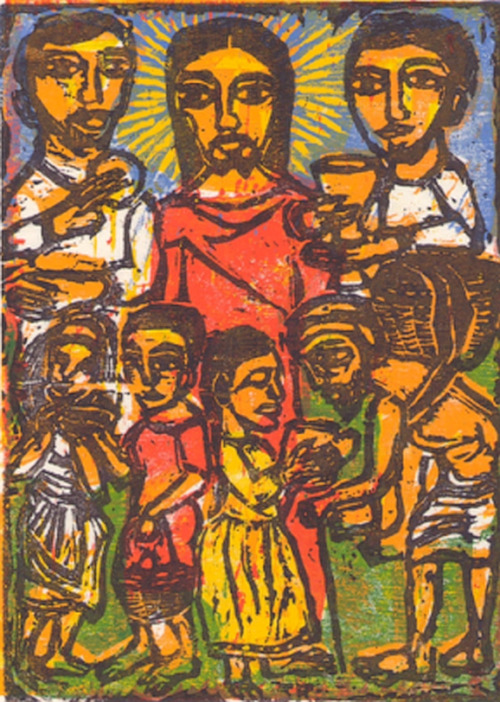
In July 2015 Bolivian president Evo Morales (who is Aymara) presented to Pope Francis a crucifix sculpted in the shape of a hammer and sickle. The crucifix is based on a design by Luís Espinal (1932–1980), a Jesuit priest assassinated in 1980 by right-wing militia. Bolivia’s communications minister, Marianela Paco, told Bolivian radio that “the sickle evokes the peasant, the hammer the carpenter, representing humble workers, God’s people.” Photo: AP.Solomon Raj (Indian, 1921–2019), The Lord Remembers the Hungry: Liberation from Hunger, 2006 (based on the 1988 original). Woodcut, from the series “Liberation in Luke’s Gospel.”
In this undergraduate lecture (starts at 4:06), Weichbrodt discusses how photography has been used to shape racial bias and even construct race, as well as gender, focusing on a famous 1957 photograph of school desegregation in Little Rock, Arkansas. She shows how this single photo is part of a larger web of meaning that contemporary news photos also play into. We’re always interpreting and categorizing images in relationship to things we’ve already seen, Weichbrodt says, creating a mental archive—for example, a file for “blackness,” a file for “womanhood.” And “as Christians called to recognize the dignity of God’s image in all people, we have to do actual work to acknowledge how our own archives may have hampered or distorted our love for our neighbors.” To look more faithfully, we need to look more; we need to build a broader archive.
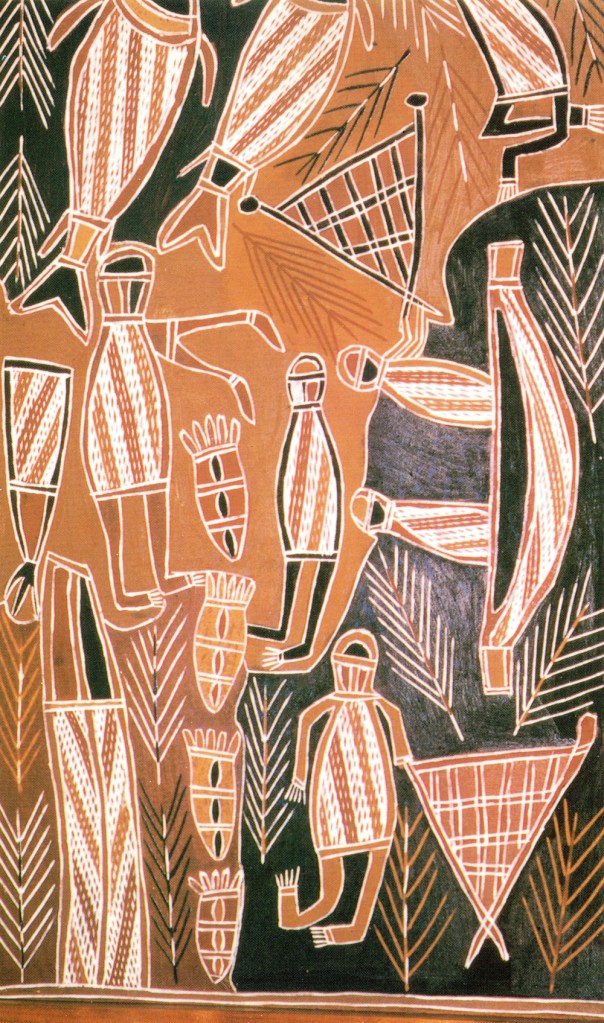
George Garawun (Djinang [Aboriginal Australian], 1945–1993), Calling the Disciples, natural earth pigments on eucalyptus bark, Maningrida Church, Arnhem Land, Northern Territory, Australia. Source: The Bible Through Asian Eyes, p. 93.
some Jesus
has come on me

i throw down my nets
into the water he walks

i loose the fish
he feeds to cities

and everyone calls me
an old name

as i follow out
laughing like God’s fool
behind this Jesus
“the calling of the disciples” by Lucille Clifton is the eleventh poem in a sixteen-poem sequence titled “some jesus,” originally published in Good News About the Earth (Random House, 1972) and later compiled in The Collected Poems of Lucille Clifton 1965–2010(BOA Editions, 2012).Used with permission.
SONG: “Put out into the deep” by David Bednall (2008), performed by The Gesualdo Six (2020): A verbatim setting of Luke 5:1–11 (RSV), the calling of the disciples, which is the Revised Common Lectionary reading for February 6.
+++
ESSAYS:
>> “Ghosts in Los Angeles” by Arthur Aghajanian, Ekstasis: The author of this essay reflects on Andres Serrano’s Nomads (1990), a humanizing series of portrait photographs of men and women experiencing homelessness in New York City. “Serrano titled each photograph with its subject’s first name, suggesting a familiarity with those portrayed while retaining their anonymity. . . . The images mimic the visual style of fashion and advertising, while also referencing historical portraits of the wealthy and powerful. The work restores the visibility along with the dignity of its subjects. . . . His diverse group reflects the vulnerabilities we all share, and the grace that sustains us in adversity.”
Andres Serrano (American, 1950–), Bertha, from the Nomads series, 1990. Cibachrome, 152 × 125 cm.
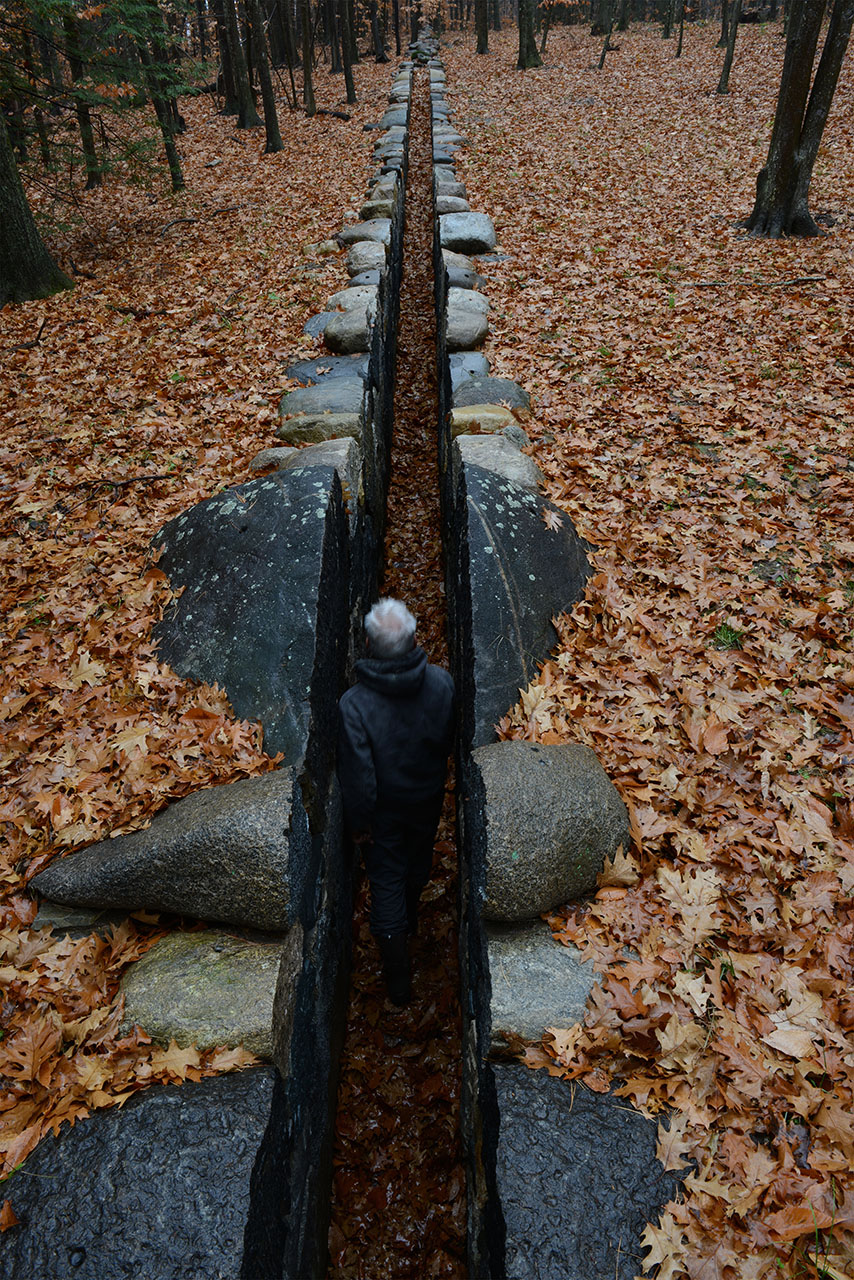
>> “The Cleft in the Rock: A Theology of Negative Spaces” by Daniel Drage, Image: This Image journal essay explores profound negative spaces in scripture—the first Sabbath, exile, the passage opened up by the parting of the Red Sea, empty wombs, tombs, nail wounds, the cleft of a rock, the space between the gold cherubim’s wings above the mercy seat—bringing them into conversation with works by contemporary British sculptors David Nash, Rachel Whiteread, and Andy Goldsworthy. Emptinesses that are full and presence via absence are key ideas.
Andy Goldsworthy (British, 1956–), Passage, 2015. Granite. Private collection, New Hampshire. Copyright of the artist.
+++
ANIMATED SHORT FILMS:
>> Migrants, dir. Hugo Caby, Antoine Dupriez, Aubin Kubiak, Lucas Lermytte, and Zoé Devise: The graduation project of five film students from the Pôle 3D school in France, this short follows a mother polar bear and her cub who are displaced from their Arctic home. When their ice float runs aground a new habitat and they’re forced to learn a new way of life, the native brown bears treat them with hostility. The filmmakers said the project was initially inspired by the story of the Aquarius, a watercraft filled with refugees that grabbed global headlines when it was refused entry at Italian ports in 2018. [HT: Colossal]
>> Tokri (The Basket), dir. Suresh Eriyat: A father-daughter story set in Mumbai, this stop-motion animated short from Studio Eeksaurus is about mistakes and forgiveness, and how meaningful a kind extended hand from a stranger can be . . . or not. [HT: Colossal]
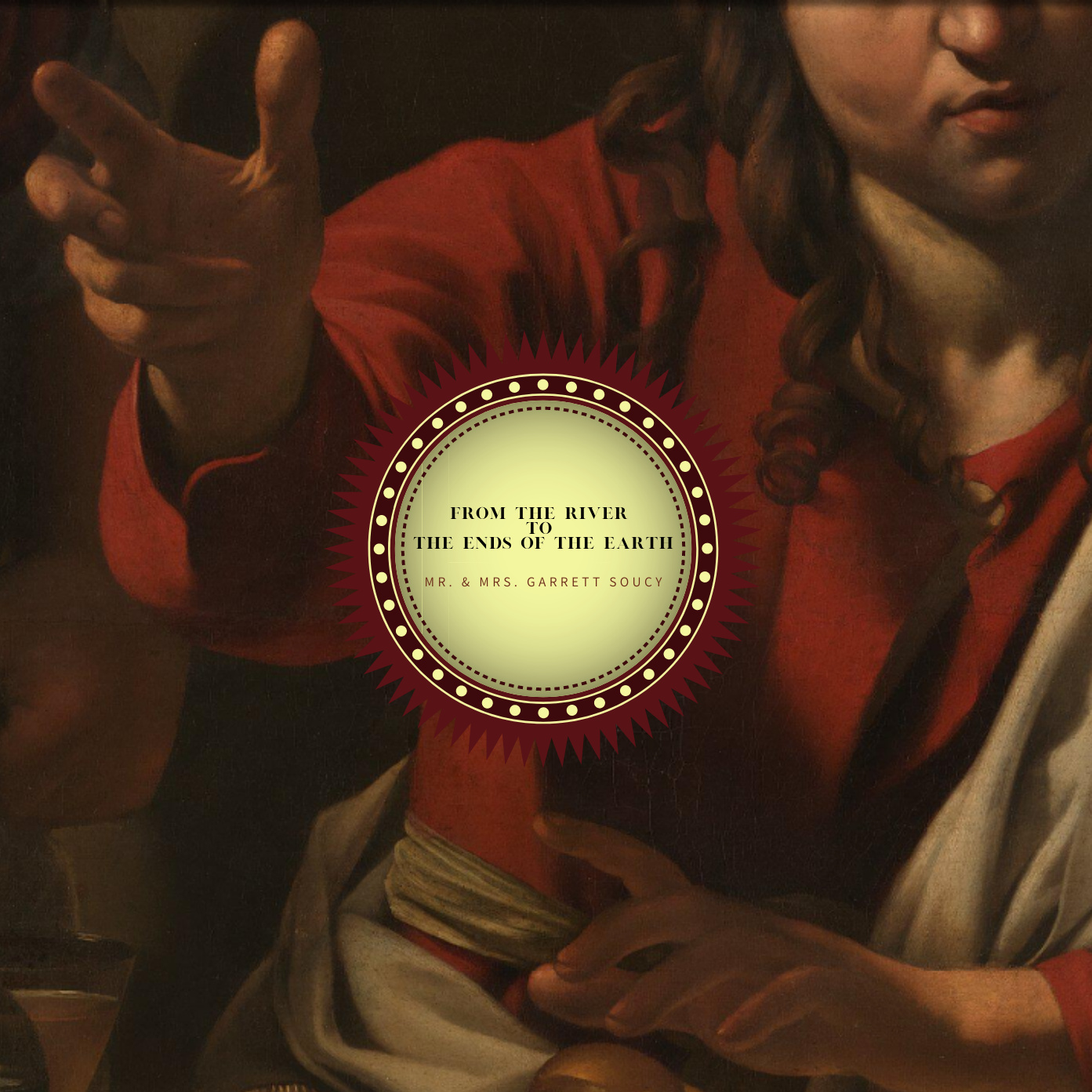
Garrett Soucy is a pastor, writer, and musician living on the coast of Maine with his wife, Siiri, and ten children. He and Siiri make up the indie-folk music duo Mr. & Mrs. Garrett Soucy; he writes the songs, sings lead, and plays guitar, and she backs him with vocal harmonies. From the River to the Ends of the Earth, released this month, is their fifth LP, after Mr. and Mrs. Garrett Soucy (2012), Procession of the Ram (2014), Wayword (2016), and According Lines (2020). An album of self-examination, of spiritual wandering and homecoming, From the River gives voice to the desire for meaning and rest, ultimately locating it in the person of Christ, whose welcome is wide and whose Way is life.
Lyrically subtle and complex, these songs express, for the most part, a restlessness of soul. The speaker sustains various dependencies and even the illusion of independence. But he also admits to weakness. “I lifted my Petrine eyes [i.e., eyes like Peter] and almost drowned.” He seems to want more faith, to want holiness. Without moralizing, the songs poke at idolatries, “broken crutch[es],” recognizing them to be just that and moving toward confession of the One who alone is worth leaning on.
The title of the album comes from Psalm 72:8:
May he have dominion from sea to sea, and from the River to the ends of the earth.
The opening track, “One Big Bruise,” is a breakup song, but it can also function allegorically. It seems to me to be inspired by Hosea 2 and the wider-spread metaphor of ancient Israel as God’s unfaithful (KJV “whoring”) wife, hooking up with other gods.
“1, 2, 3, 4” is a celebration of the four seasons.
“No American Savior” is a renunciation of hope in salvation through politics, on the one hand, and on the other, an admonishment against apathy or deferred responsibility when it comes to the welfare of the nation. Just because the Christian’s primary citizenship is in heaven doesn’t mean we ought not to care about the flourishing of others here and now, and just because our preferred party is not in office or we detest certain policies doesn’t mean we should dissociate ourselves from our country. However, lest we overestimate the ability of law to transform society, this song reminds us that a perfect, roomy kingdom with a perfect, loving head will one day come. Until then, let’s not stand passively by; let’s allow our primary allegiance to Christ to work itself out in our neighborhoods and cities. At least that’s what I hear in the song.
Next, “What’s Hiding in Thee” is a meditation on Matthew 12:33–37 (“out of the abundance of the heart the mouth speaks . . .”). Our speech often reveals what’s inside us.
“No Longer Egypt” is about not settling for anything less than what God has for us. It references the Israelites’ desire, upon encountering the hardships of their desert journey to the promised land, to return to Egypt (Exod. 16:2–3; Num. 14:1–4), the land of their enslavement, where at least things were familiar and predictable. In a similar way, we are sometimes drawn back to our former life of bondage to sin, which carried with it at least some form of stability, however savage. The song could also be interpreted as nudging us out of our bondage to play-it-safe normalcy. God is in the business of calling us out of our bubbles into unknown territory and uncomfortable, even risky, situations. How do we respond?
The most jubilant song on the album is “Love Like the World’s Never Known,” which uses the tune of the African American spiritual “I’ve Got a Home in Glory Land.” But instead of a home “way beyond the blue,” as the nineteenth-century lyric goes, Soucy sings about a home “that’s coming in slowly,” glory breaking in right here, right now. He sees it in the love and goodness of his wife, in his children at play, in the experience of forgiveness, and in the wisdom of God’s word lived out.
He relishes the process of sanctification, of being conformed more and more to the image of God’s Son. “I’m on a 1, 2, 3, 4, 5, 6, 7 storey mountain. I’ve gotta keep on drinking from an eternal fountain.” (The seven-story mountain refers to the mountain of purgatory from Dante’s Purgatorio.) He seeks to build a home of hospitality that reflects the hospitality of God, where anyone can come and sit at the table, know love, and be filled.
The poetic quality of Soucy’s lyrics is a hallmark of the album. I can’t say I grasp the meaning of all of them, but here is just a sampling of lines that stood out to me:
“Be it that the eyes of all of us should recognize Thee, being that true being is the essence of your Name. . . . Be it that the wills of all of us will follow rather than quench the One whose power is to keep us on the Way.” (“Two Sisters”)
“Part of us conquers. Part of us falls. Part of us feigns to be crushed ’neath it all. Atlas is grunting but sincere and still. Nobody’s told him that yoke has been filled.” (“Restless Heart”)
“Every love isn’t love. True enough, true enough. Sometimes what you think is a hand is a glove.” (“What’s That”)
Hear Mr. & Mrs. Garrett Soucy perform live with Bernie Nye at the Camden Opera House in Camden, Maine, in 2020, starting at 4:08 of the video below. Eight of the ten songs they sing at this concert appear on From the River.
Also, Soucy is enthusiastic about helping to foster the development of thoughtful art among Christians and to that end is a founding member, with Christopher Finn, of the Christian Artists Guild of New England (CAGNE), which had its inaugural gathering this month. Check them out if you’re in the Northeastern US!
          1 Cor 13

Embraces the woman whose child screams
on the floor of the cereal aisle.
Enters the friend’s new mansion,
lifts eyes to the skylights, gives thanks.
Yields the last word on the Facebook fight.
Looks the frowning barista in the eye.
Takes a breath and thanks God
there is even a zipper to get stuck.
Sends a gift to the wall-punching uncle.
Glances away from the handcuffed boys
on the side of the road and prays.
Smiles and listens to the grandmother complain
about her knees, rubs the knees,
ladles another bowl of soup.
Believes there is a reason that slumped man
in the alley was born. Trusts he’ll believe it.
Endures the quiet, thankless song of work.
Echoes long after the cymbals have died.
This poem is from Second Sky by Tania Runyan(Cascade/Wipf & Stock, 2013), a collection that “intertwines the life and writings of the Apostle Paul with the spiritual journey of a modern suburban woman confronting the broken world.”Used with permission.
“Lift Up Your Eyes” (Advent 2021): Kezia M’Clelland’s annual “Alternative Advent” video is here—a compilation of news photos from the year, from various photojournalists, matched with promises/declarations from scripture and a song. (I’ve described this project in years past; see here.) Migrant caravans, refugee camps, hospitals overwhelmed with COVID patients, a protest against a military coup, wildfires, volcanic aftermath . . . the global suffering we hear about in headlines and statistics is made personal in these intimate photographs of people who are experiencing it firsthand. M’Clelland bears tender witness to this suffering, but she also takes care to include signs of hope. Alongside images of devastation and misery are images of love, joy, and fortitude. The overall tone is one of somberness but not despair. As I do with each year’s “Alternative Advent,” I spent an afternoon interceding with God for each person in the photos and for others enduring the same harrowing journeys or disasters. I realize how my privilege as a white, middle-class US American insulates me from a lot of these realities, and I know that prayer must be accompanied by action.
Find out more context for the photos and their sources on Instagram @alternative_advent.
+++
VIDEO ROUNDUP FROM FULLER STUDIO: The Arts for the Life of the Church: In these six, five-minute videos shot by Fuller Studio, artists and creatives (most of them participants in the Brehm Residency) reflect on the diverse ways that the arts enliven, shape, and define their faith, their theology, and their work. Here’s one from the series, in which interdisciplinary artist Dea Jenkins discusses the ways the Spirit’s leading can be intertwined with the process of art-making, and how art has the capacity to be both prophetic and healing.
The other videos feature . . .
Young-Ly Hong Chandra on how she sees her creative work participating in God’s work of creation
Michelle Lang-Raymond on how theater and the arts can create opportunities for us to safely yet deeply engage with today’s polarizing issues
Rachel Morris on how incorporating the arts into worship services and pastoral care can contribute to the church’s healing work in the lives of its members
Jin Cho on the holistic, social, and communal dimensions of preaching and the liturgy
John Van Deusen on the significance of creating art in community and on the ways we are shaped by inviting both God and others into our creative processes
+++
ON BEING INTERVIEWS:
>> “Remembering Desmond Tutu”: The South African Anglican bishop, theologian, and human rights activist Desmond Tutu died December 26, 2021, and the On Being podcast re-released this 2010 interview Krista Tippett conducted with him. It’s a great introduction to his story, which includes especially his faith. He discusses the Bible as “dynamite,” our identity as “God-carriers,” the interfaith makeup of the anti-apartheid movement, God’s sense of humor, reconciliation as a process, his experience voting for the first time at age sixty-three (after decades of disenfranchisement), how entrenched racism had become in his own thinking, the beating heart of love at the center of existence, and more. And oh, his laughter is so sweet!
>> “A Life of Holy Curiosity: In Friendship with Rachel Held Evans” with Jeff Chu: Jeff Chu is a journalist, preacher, and co-leader of the Evolving Faith community. When his friend Rachel Held Evans, the famous Christian writer, died unexpectedly in 2019, he took it upon himself to bring to fruition the unfinished book she was working on, Wholehearted Faith (HarperOne, 2021). I enjoyed learning more about Evans through this conversation, and about Chu. He and Tippett read several excerpts from the book and discuss Chu’s Chinese Baptist upbringing, the recent phenomenon of “religious-but-in-exile,” the enormity of God’s love, the Incarnation, the Psalms, doubt, grief, and the lesson of the compost pile.
(As a side note: I recently came across Evans’s other posthumously published book, for children, titled What Is God Like?, in Target and bought it on a whim. It’s fabulous.)
+++
SONG: “I Lift My Eyes” by Christopher Tin: A setting of Psalm 121 in Arabic, performed by Abeer Nehme with Christopher Tin and the Angel City Chorale. Nehme is a Lebanese singer and musicologist, one of whose specializations is sacred music from the Syriac Maronite, Syriac Orthodox, and Byzantine traditions. [HT: Joy Clarkson]
Arise, shine; for your light has come, and the glory of the LORD has risen upon you. For darkness shall cover the earth, and thick darkness the peoples; but the LORD will arise upon you, and his glory will appear over you.
—Isaiah 60:1–2
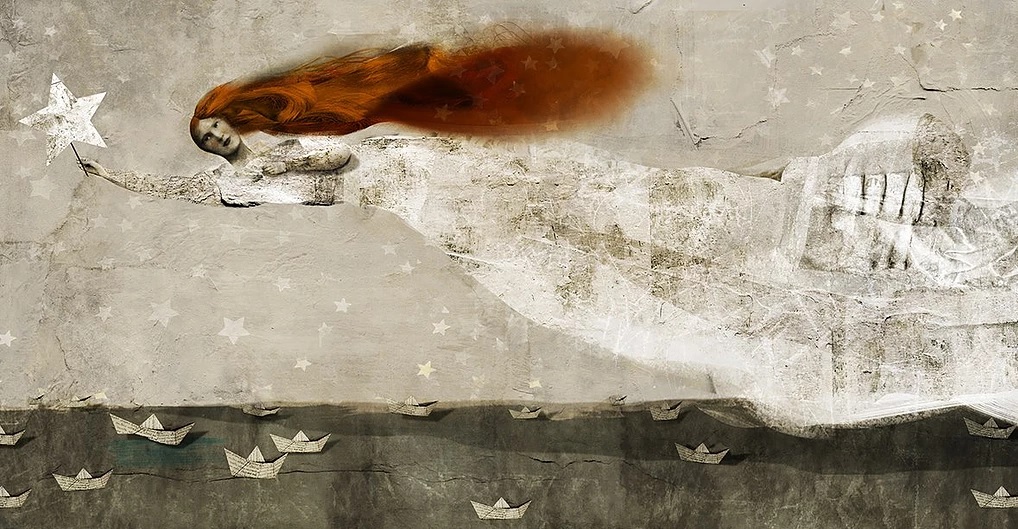
LOOK: Comet by Antonello Silverini
Comet, a digital collage by Antonello Silverini (Italian, 1966–). Used with permission.
LISTEN: “May It Be” | Words by Roma Ryan, 2001 | Music by Enya, 2001 | Performed by Voces8, 2018
May it be an evening star Shines down upon you May it be when darkness falls Your heart will be true You walk a lonely road Oh, how far you are from home
Mornië utúlië Believe and you will find your way Mornië alantië A promise lives within you now
May it be the shadow’s call Will fly away May it be you journey on To light the day When the night is overcome You may rise to find the sun
Mornië utúlië Believe and you will find your way Mornië alantië A promise lives within you now A promise lives within you now
At the behest of composer Howard Shore, film director Peter Jackson approached Enya to write a song for his 2001 epic fantasy adventure The Lord of the Rings: The Fellowship of the Ring, the first in a trilogy. Enya brought her lyricist Roma Ryan on board, and together they wrote “May It Be.” The song, which plays during the movie’s end credits, contains two lines in the fictional Elvish language Quenya that J. R. R. Tolkien invented: “Mornië utúlië” and “Mornië alantië,” which translate to “Darkness has come” and “Darkness has fallen.”
Why am I sharing this “secular” song (inspired by a tale of hobbits, elves, and wizards) on today’s feast of Epiphany, the grand finale of the Christmas season? I could have chosen one of the church’s many beautiful works of music written explicitly for this day (and I have in previous years, such as here, here, and here, not to mention yesterday’s festive feature)—perhaps something louder, brighter, more triumphant—but instead I wanted to cap off the Twelve Days of Christmas with a benediction. It’s from an unlikely source, sure, but it speaks well, I think, to where we’re at in the liturgical year.
According to Christianity, darkness entered the world with humanity’s rebellion against their Creator in the garden of Eden. Sin and death became a reality that, millennia later, we still grapple with. But a promise was spoken in the beginning, was born in a manger at Christmas, walked the dusty streets of Israel-Palestine teaching the Way and performing wonders, was nailed to a cross and buried but then rose from the grave and now lives in the hearts of millions. Jesus Christ is the embodiment of God’s promise of salvation and holistic restoration—shalom, the world set right again.
The light of Christ shone on the small Jewish town of Bethlehem at the Nativity and on the wider Gentile world at Epiphany (when the magi traveled from afar to receive personal revelation, an experience they brought back with them to their homelands), and it continues to shine, often in unexpected places.
Advent is a journey through the dark into the light that breaks at Christmas/Epiphany. Although in one sense morning has broken, in another sense this earth is still very much in darkness. Even the “children of light” (1 Thess. 5:5), those who have been reborn in Christ, experience (and sometimes, sadly, inflict) ache and horror as much as anyone else.
But hope has come. The Word has been spoken, redemption won, even if it’s not yet been consummated. We walk in the valley of shadows, but eventually the night will be vanquished, as Enya’s song says, and we will rise and greet the sun—or, to put a Christian inflection on it, the Son!
May we walk forward into 2022 true to our calling as sons and daughters of God. May we welcome God’s light and bear it to others, and trust the Promise that indwells us.
This is the final post in the 2021–22 Advent/Christmas series. Thanks for following! You can find a collation here (Advent) and here (Christmas). I will now return to my regular publication schedule of roughly one post a week.
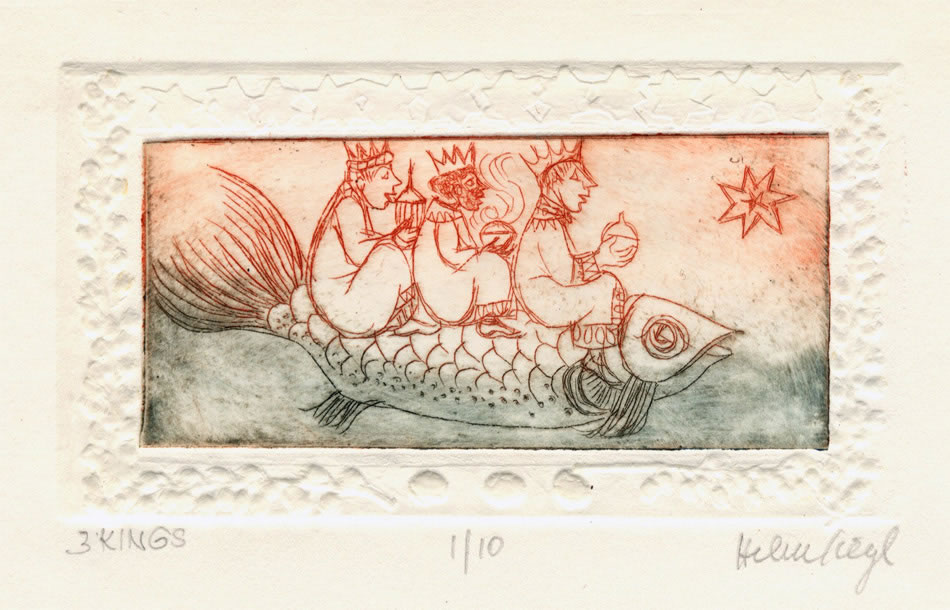
Helen Siegl (Austrian American, 1924–2009), 3 Kings, n.d. Etching and collagraph, 3 × 5 in. (7.6 × 12.7 cm).
Ah, such whimsy!
LISTEN: “We Three Cool Kings” | Words and music by John H. Hopkins, 1857 | Arranged by Eugene Gwozdz, 2015 | Sung by Alan H. Green, Mykal Kilgore, Dennis Stowe, Nili Bassman, Josh Davis, Kevin Smith Kirkwood, Linda Mugleston, Brian O’Brien, Mary Michael Patterson, Mike Schwitter, and Rashidra Scoti on Broadway’s Carols for a Cure, vol. 17, 2015
We three kings of Orient are; bearing gifts, we traverse afar, field and fountain, moor and mountain, following yonder star.
O star of wonder, star of light, star with royal beauty bright, westward leading, still proceeding, guide us to thy perfect light.
Born a king on Bethlehem’s plain, gold I bring to crown him again, King forever, ceasing never, over us all to reign.
Frankincense to offer have I; incense owns a Deity nigh; prayer and praising, voices raising, worshipping God most high.
Myrrh is mine; its bitter perfume breathes a life of gathering gloom; sorrowing, sighing, bleeding, dying, sealed in the stone-cold tomb.
Glorious now behold him arise, King and God and Sacrifice: Alleluia, Alleluia, sounds through the earth and skies.
This jazzified version of the Christmas classic “We Three Kings” is performed by the Broadway cast of At This Performance… Written in the voices of the magi (whose traditional names are Caspar, Melchior, and Balthazar), it propounds the symbolic significance of the three gifts they give to the Christ child. I love how the arranger has layered those middle three verses!
Launched in 1999, Carols for a Cure is an annual collection of seasonal songs sung by members of the Broadway and Off-Broadway theater community to raise money for the charity Broadway Cares / Equity Fights AIDS. Its latest volume, number 21, was released in 2019.


 Art & Theology