Favorite Films of 2025, Part 1

This is my sixth consecutive year of sharing my top twenty newly released films—see my favorites from 2024, 2023, 2022, 2021, and 2020. My criterion for qualifying as a 2025 release is the film had to have shown in commercial screenings in the US in that year; or if there was no theatrical release, it had to have become available through video on demand. I’ve seen over a hundred such films and will share with you the ones I like best, split across two posts.

Favorite Films of 2025

The first Shaker settlement in colonial New York, the forests of early twentieth-century Idaho, a juke joint in Jim Crow Mississippi, the political prisons of 1970s Brazil, a crumbling ranch during the Rhodesian Bush War, a night market in Taipei, the beaches of a remote Welsh island—these are some of the places where the stories unfold. They explore parent-child relational fracture; the grief of losing a child or a spouse; the experience of spiritual ecstasy; the beauty of building a life and a family; the pressures of unemployment; the struggles of settling into a new city, country, or living arrangement; the horrors of adolescence; the consuming urge for revenge against an oppressor, and what to do when you’re confronted with their humanity; art making in (virtual) community; and the complicated process of healing from the trauma of sexual assault; among other themes.

Viewer discretion advised: Please beware that about half of these films have R ratings and may contain content that some find offensive. I do not flag such content because I don’t keep track of it and I evaluate movies based on their merit as a whole, recognizing that “mature” content is often necessary to tell a particular story; my descriptions should give you a good sense of whether that story is one you’d like to engage. But of course, if your conscience proscribes you from viewing certain content, please consult a content guide beforehand to determine if the film will be safe for you.

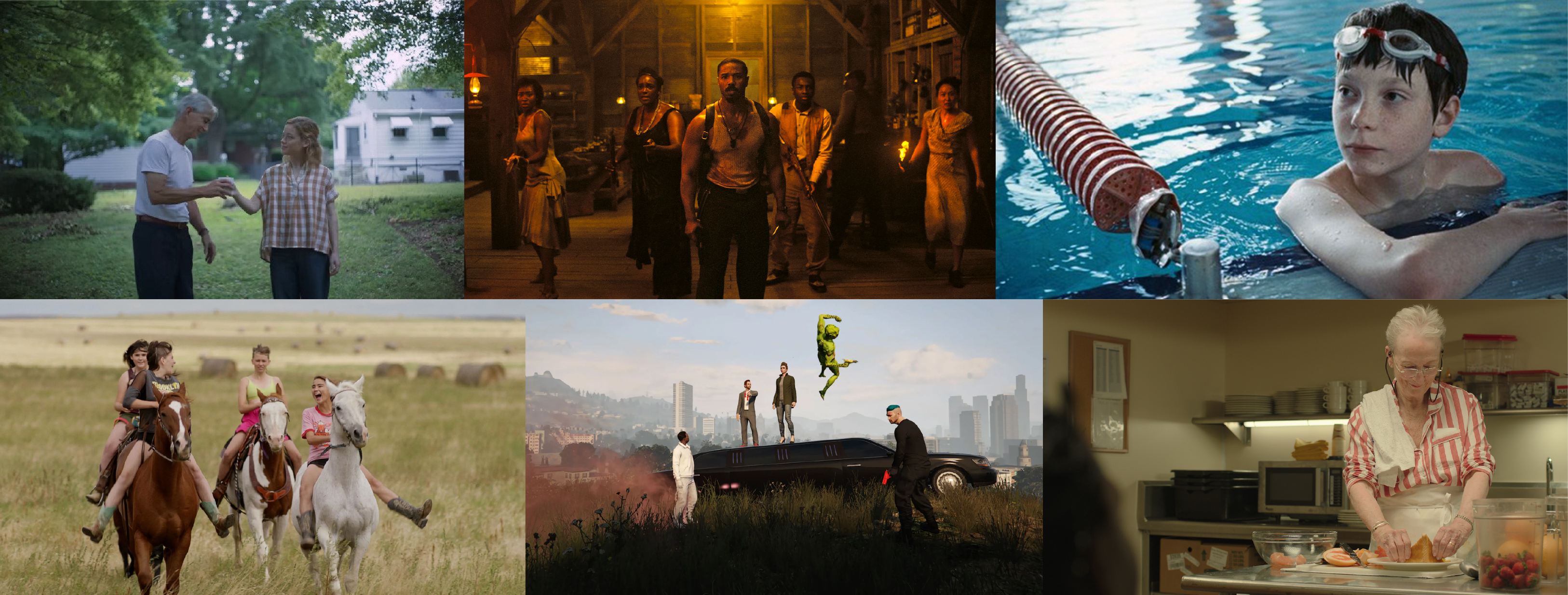
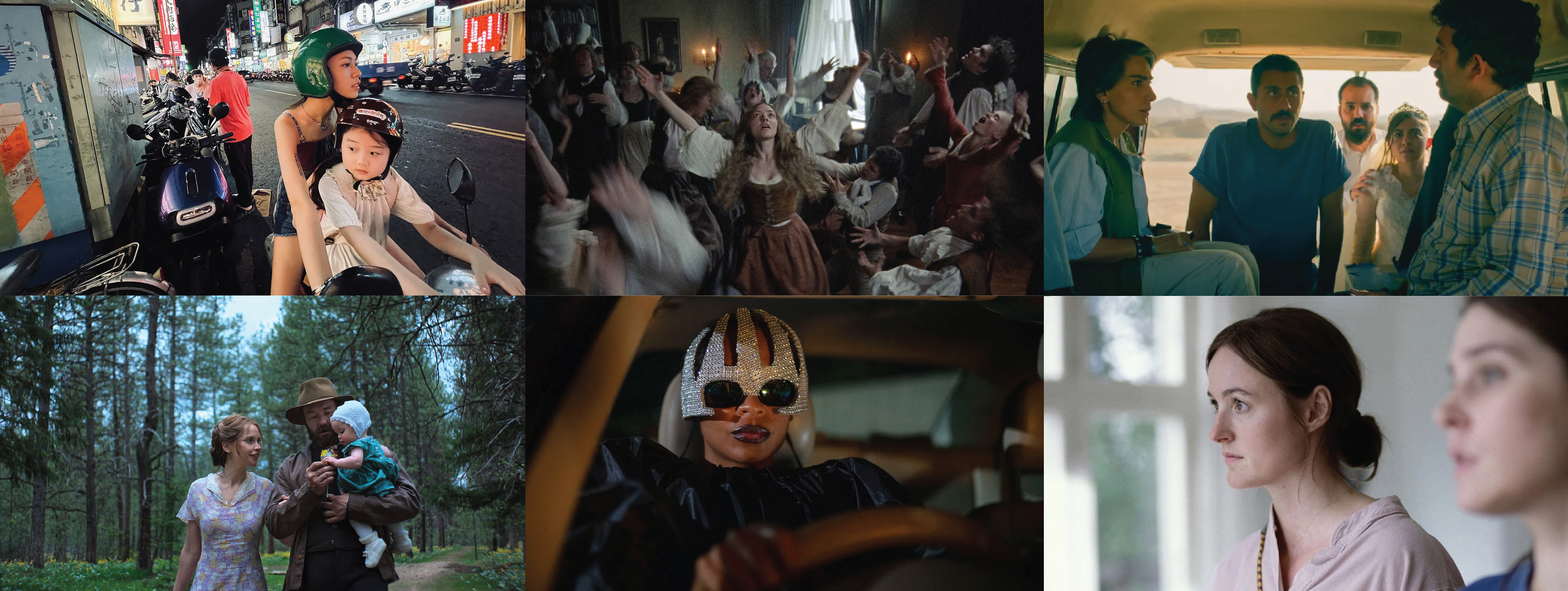
1. Sentimental Value, dir. Joachim Trier. Nora (Renate Reinsve), a stage actress, and her father Gustav (Stellan Skarsgård), a filmmaker, have a broken relationship. When she was a child her dad drank a lot, cheated on her mom, and left Norway for long periods of time to focus on his career. Now in his old age, Gustav wants to reconcile, and the only way he knows how to affirm the hurt his daughter feels and apologize for it is to write a role for her in a movie inspired by his own childhood, in which she would play a version of his mother. Nora has no interest in the project. She thinks it’s only a publicity stunt, not realizing it’s her dad’s way of saying, “I see you.”

Sentimental Value is about the emotional communication we lack, but also art as a way of translating pain into something we can share. (Film has the power to say things without saying them, fostering understanding.) It’s about the wounds family members inflict on each other, about love and rage and regret.

We come to learn that depression has afflicted three generations of this family: Nora, her mother, and her paternal grandmother. One of the most poignant scenes is where, when Nora is incapacitated again from her mental illness, her sister Agnes (Inga Ibsdotter Lilleaas) comes to clean her apartment while she lies awake on the couch—a simple act of care. The sisters’ bond is, I think, the sweetest aspect of the film.

2. The Testament of Ann Lee, dir. Mona Fastvold. The Testament of Ann Lee is a musical biopic of the primary founder of the Shakers, a Christian sect that emerged in mid-eighteenth-century England and that was known for its ecstatic worship (“shaking”); under the visionary Ann Lee’s leadership, it would also come to be distinguished by its practice of communal living, celibacy, gender and racial equality, pacifism, and meticulous craftsmanship. Fleeing religious persecution, Lee (played by Amanda Seyfried) emigrated to America in 1774 with a small group of followers, building a community in upstate New York—but their loud, night-long worship services (which sparked rumors of witchcraft), their refusal to fight in the Revolutionary War (due to their commitment to nonviolence), and many men’s disapproval of sexual abstinence (women, including wives, flocked to the new movement) led to attacks in their new home country too.

Visceral and rousing and built largely on the rhythm of breaths and body slaps, Daniel Blumberg’s soundtrack is phenomenal; much of it consists of new arrangements of old Shaker hymns, including “Hunger and Thirst,” “All Is Summer,” and “Pretty Mother’s Home,” but he also composed a few original songs as well. Using historical documentation of Shaker dancing as fodder for the imagination, choreographer Celia Rowlson-Hall designed the ways in which the characters commune with God together through movement, bringing all their emotions to bear in their bodies.

As someone deeply interested in Christian history (even unorthodox offshoots) and early American hymnody, I was already inclined to like this movie. But I did not expect to be as transported as I was. The story, the acting, the music and dancing, the costumes, the set design, the cinematography—all contribute to an electric, devotional film that illuminates the life and legacy of a radical woman preacher from centuries past. I did not know that Lee had had four children and lost them all in infancy; this repeated trauma likely prompted her teaching, which she claimed to have received in a revelation from God, about the sinfulness of sex. In many ways, the film is about moving through grief.

3. Hamnet, dir. Chloé Zhao. We don’t know much about William Shakespeare, and still less about his wife Anne (aka Agnes, pronounced AHN-yes). One thing we do know is that the couple had three children, and their only son Hamnet—a name interchangeable with “Hamlet” in the loose orthography of the time—died at age eleven, likely of the bubonic plague. Based on a novel by Maggie O’Farrell, Chloé Zhao’s Hamnet traces Will (Paul Mescal) and Agnes’s (Jessie Buckley) relationship from courtship to marriage to childbearing and -rearing and then, in the second half, through the waves of grief that hit them in different ways after the sudden death of Hamnet (Jacobi Jupe). The film focuses especially on Agnes’s perspective, opening with her nestled in the exposed roots of a giant tree (establishing her deep connection to nature), developing her as a feral yet tender character at first radiant with the joys of motherhood and then ripped apart by loss, and climaxing with a transcendent moment she experiences in community at the premiere performance of Hamlet at the Globe Theatre in London.

Several Shakespeare biographers have speculated that his writing Hamlet was a means by which he processed his grief over the loss of his son, reconfiguring that grief into a work of art. Even though it’s about the death of a father, the play contains ghosts, mourning, madness, guilt, and contemplations of suicide that may have been at least partially colored by Will’s own personal tragedy. O’Farrell and Zhao, who cowrote the Hamnet screenplay, have given this theory a compelling narrative framework, a story of marital love that’s strained by grief but that survives it.

4. No Other Choice, dir. Park Chan-wook. Man-su (Lee Byung-Hun) is a hardworking, upper middle-class South Korean family man with a wife (Son Ye-jin) and two kids. He takes pride in his work as a manager at a paper mill, producing beautiful products. Then suddenly, after twenty-five years at the same company, he’s laid off due to an American buyout. After more than a year of unemployment, he grows desperate and decides to eliminate the three highest-qualified men in competition with him for a job in the paper industry.

Often in dark comedy thrillers, murder is treated lightly. Not so here. We see the humanity of Man-su’s targets, the shocking and unjust nature of his determined course of action, and the soul-hollowing cost of moral compromise. Despite the film’s premise, there’s actually no graphic violence, other than when Man-su extracts from his mouth a rotting tooth, symbolic of his pained conscience, with pliers (plus a disturbing image having to do with bonsai wiring). A satire of capitalism and the male ego, the film explores the lengths to which a man is willing to go to maintain an affluent lifestyle for himself and his family. And oh, what wonderfully composed shots! (Props to cinematographer Woo-hyung Kim.)

5. I’m Still Here, dir. Walter Salles. This Brazilian biographical drama is about the real-life Eunice Paiva (played by Fernanda Torres), a mother of five who fought for the truth after her politically dissident husband, Rubens Paiva (Selton Mello), was forcibly disappeared by the country’s military dictatorship in 1971. Suddenly thrown into the role of sole head of family, Eunice must hold everyone together and reinvent herself. She moves her family to São Paulo, earns a law degree, and becomes an activist at the center of campaigns to open archives on the victims of the military regime. She is indefatigable in demanding answers and pursuing justice. Her endurance is a form of resistance.

The director of I’m Still Here, Walter Salles, spent time with the Paivas during his adolescence—he was friends with one of Eunice’s boys and frequented their teeming, music-filled oceanfront home in Rio de Janeiro before Rubens went missing. The first half hour of the film activates those memories, while the film as a whole is based on a book by Eunice’s son Marcelo Rubens Paiva.

Streaming on Netflix.

6. On Becoming a Guinea Fowl, dir. Rungano Nyoni. Made and set in Zambia, this comedy-drama is in Bemba and English. Its title is a metaphor referring to how guinea fowl use their voice—a screech—to warn the flock of predators or other impending dangers. The film opens with Shula (Susan Chardy) driving home from a party one night—wearing a glittering helmet and a puffy black jumpsuit inspired by Missy Elliott’s “The Rain” video—when she finds her uncle Fred lying dead in the road. She doesn’t seem upset, and later, when gathered with her relatives, they press her. Where are your tears? She observes her family’s performative grief for a man she knew to be immoral and their mistreatment of Fred’s widow, and she wants no part of it.

It’s hard to talk about this film without giving away a key reveal. But I can say that it’s about the silence families keep to maintain the myth of a happy and well-functioning unit, the behavior of elders that families pretend not to notice for the sake of cohesion. Consider who gets mourned and who/what does not. A critique of patriarchal culture in Zambia, the film confronts generational differences, especially as relates to traditionalist versus progressive notions of accountability, agency, respect, and respectability.

Streaming on HBO.

7. Train Dreams, dir. Clint Bentley. Adapted from Denis Johnson’s 2011 novella of the same name, Train Dreams spans the 1890s through 1960s in and around Bonners Ferry, Idaho. Both grand and quiet, transcendent and personal, it chronicles the small, simple frontier life of Robert Grainier (Joel Edgerton)—all the beauty and pain it holds. Orphaned at age six, Robert meets Gladys (Felicity Jones) sometime in his twenties, and the two marry. They build a cabin together near a river, and have a daughter. The family enjoys ordinary pleasures, like supper by candlelight, naps on the front porch, chasing chickens in the yard.

Robert works first as a railroad bridge builder, then as a logger—which takes him away from home for months at a time—then as a hauler. He suffers incredible loss, but he keeps moving on, into old age, as the wild country all around him modernizes and marvels like airplanes, television, and space travel are introduced. The film is about dreams realized and unrealized, about grief and change, about the fleetingness and yet (paradoxically) substantiality of human life.

Streaming on Netflix.

8. It Was Just an Accident, dir. Jafar Panahi. Working one day in an auto shop in Tehran, Vahid (Vahid Mobasseri) is traumatized by the voice and gait of a first-time customer, whom he swears is Eghbal (Ebrahim Azizi), an Iranian government security officer who, years earlier, had blindfolded and tortured him when he was imprisoned for speaking out for workers’ rights. In a thirst for vengeance, Vahid kidnaps the man and is in the process of burying him alive in the desert when he starts to have doubts as to whether he’s the right person. He tracks down a few of his fellow ex-prisoners, including a wedding photographer (Mariam Afshari) and a young bride-to-be (Hadis Pakbaten), to provide identity confirmation—but they, too, have mixed degrees of certainty.

Equal parts retribution drama, moral thriller, and screwball road comedy, this film explores what happens when four victimized men and women turn the tables on their victimizer. It wrestles with justice and mercy—what they look like, which is more virtuous or more prudent in this situation, and what would distinguish the civilians’ act of killing from the murders committed by the regime they resist.

Writer-director Jafar Panahi has spent time in Iranian prisons under the charge of “propaganda against the Islamic Republic of Iran” and has been banned from filmmaking in that country, so he had to shoot It Was Just an Accident furtively. I was surprised by how effective the comedic elements are against the backdrop of brutality. (My description makes the film sound only harrowing, but it’s also funny; there were quite a few laughs in the audience during the screening I attended.) It’s a difficult tonal balance to pull off, but Panahi does.

9. Left-Handed Girl, Shih-Ching Tsou. Single mom Shu-Fen (Janel Tsai) and her daughters, college-age I-Ann (Shih-Yuan Ma) and five-year-old I-Jing (Nina Ye), have just moved from rural Taiwan back to the city of Taipei. Shu-Fen opens a noodle stand at a night market, I-Ann takes a job as a “betel nut beauty” (dressing seductively to sell a fruit chewed for its stimulant and mild narcotic effects), and I-Jing attends school and takes care of her pet meerkat. This family drama is about these three female protagonists adapting to their new environment, each navigating their own challenges, whether that be paying the rent and dealing with old-fashioned parents; finding a new social scene and a place to belong; or overcoming the shameful “curse” (as I-Jing’s grandpa keeps reminding her) of being left-handed. There’s a clichéd plot device used to amp up the drama that irks me, but other than that, I enjoyed this story of acclimation and survival.

Director Shih-Ching Tsou wrote the screenplay with Sean Baker—whose Florida Project, which Tsou co-produced, is one of my favorite all-time films. She shot Left-Handed Girl entirely on an iPhone 13.

Streaming on Netflix.

10. Sorry, Baby, dir. Eva Victor. Writer-director and lead actor Eva Victor’s feature film debut is a tragicomedy about healing after sexual assault. Her character, Agnes, is a literature professor at a college in small-town New England—the same college where, three years earlier, her graduate thesis adviser raped her. She works through her trauma with the support of her friend Lydie (Naomi Ackie); her adopted cat Olga, her neighbor Gavin (Lucas Hedges), and a stranger with a sandwich shop (John Carroll Lynch) also offer her their presence. Wit and empathy combine in this nonlinear, life-affirming story of a woman in the process of recovering her sense of self and security that were wrenched from her by a trusted other.

Streaming on HBO.

Read part 2.

Roundup: New Matthew-based album, favorite reads from 2025, Australian Indigenous art exhibition

SPOTIFY PLAYLIST: January 2026 by Art & Theology: Almost every month I compile thirty faith-inspired songs on Spotify—roughly two hours of listening—to showcase just a sampling of the well-crafted, spiritually nourishing music that is out there. Though this is several days late, here are some songs to kick off the new calendar year.

+++

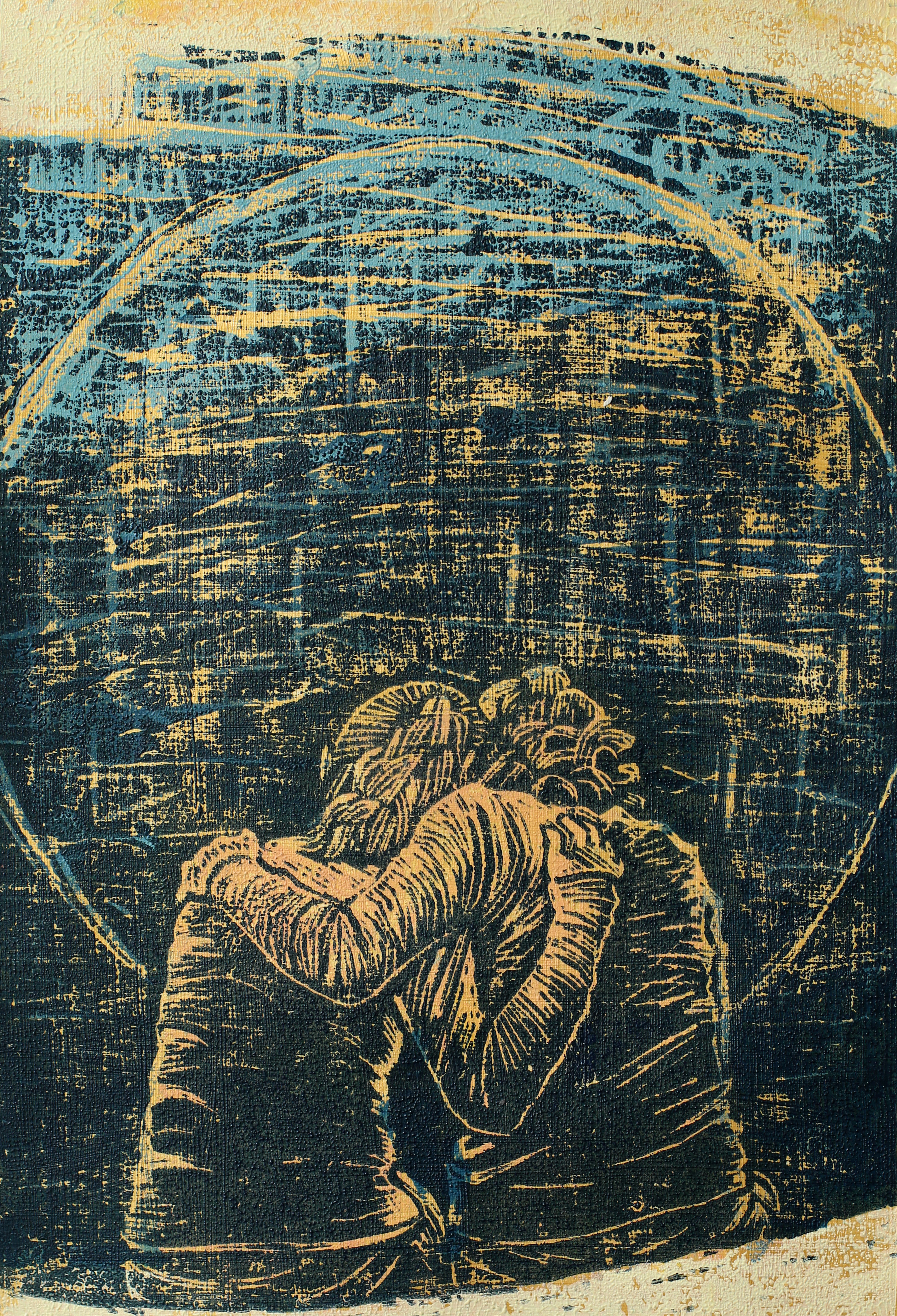
NEW ALBUM + OTHER RESOURCES: Matthew: Gospel Collection by The Soil and The Seed Project: Directed by Seth Thomas Crissman, an educator, musician, and pastor in the Mennonite Church, The Soil and The Seed Project is “a community-supported ministry of the church working for spiritual renewal—in individuals, families, and communities—through beautiful, creative resources that help us together turn towards Jesus in the ordinary moments of life.” I always look forward to their releases, the latest of which is a thirty-song “folk opera,” as they call it, based on the Gospel of Matthew, accompanied by seven commissioned linocut prints by Bethany Tobin (free for church use), seven poems by Michael Stalcup, and twenty-five “little liturgies.”

The beautiful opening track, cowritten and performed by Spectator Bird (“Won’t you tell me a story that’s true . . .”), is followed by a range of narrative-based songs (on the Dreams of Joseph, the Temptation in the Wilderness, the Calming of the Storm, the Transfiguration, the Entry into Jerusalem, the Last Supper, the Resurrection, etc.); settings of the Beatitudes, the Lord’s Prayer, and other teachings from the Sermon on the Mount, as well as cherished sayings about the greatest commandment and Jesus’s easy yoke; songs on parables such as the foolish builder, the sower, the lost sheep; and more. There are far fewer songs about Christ’s passion than I would have expected, but that may be because there’s a relative dearth in music that engages the other parts of the Gospel, or because they anticipate overlap with forthcoming Gospel Collection albums on Mark, Luke, and John. I love what they present here.

Tobin, Bethany_Mary Magdalene and Mary sit opposite the tomb
Bethany Tobin, Mary Magdalene and Mary sit opposite the tomb, 2025. Used courtesy of The Soil and The Seed Project.

>> RELEASE CONCERT: On Sunday, January 18, 2026, at 3 p.m. at First Presbyterian Church in Harrisonburg, Virginia, The Soil and The Seed Project are going to perform the entire album from start to finish, with a full band and almost all the contributing artists. Admission is free, but they ask that you consider donating some toiletry items for the local food pantry; there will be a collection box on-site. Find more info at https://www.thesoilandtheseedproject.org/matthew#release-concert.

+++

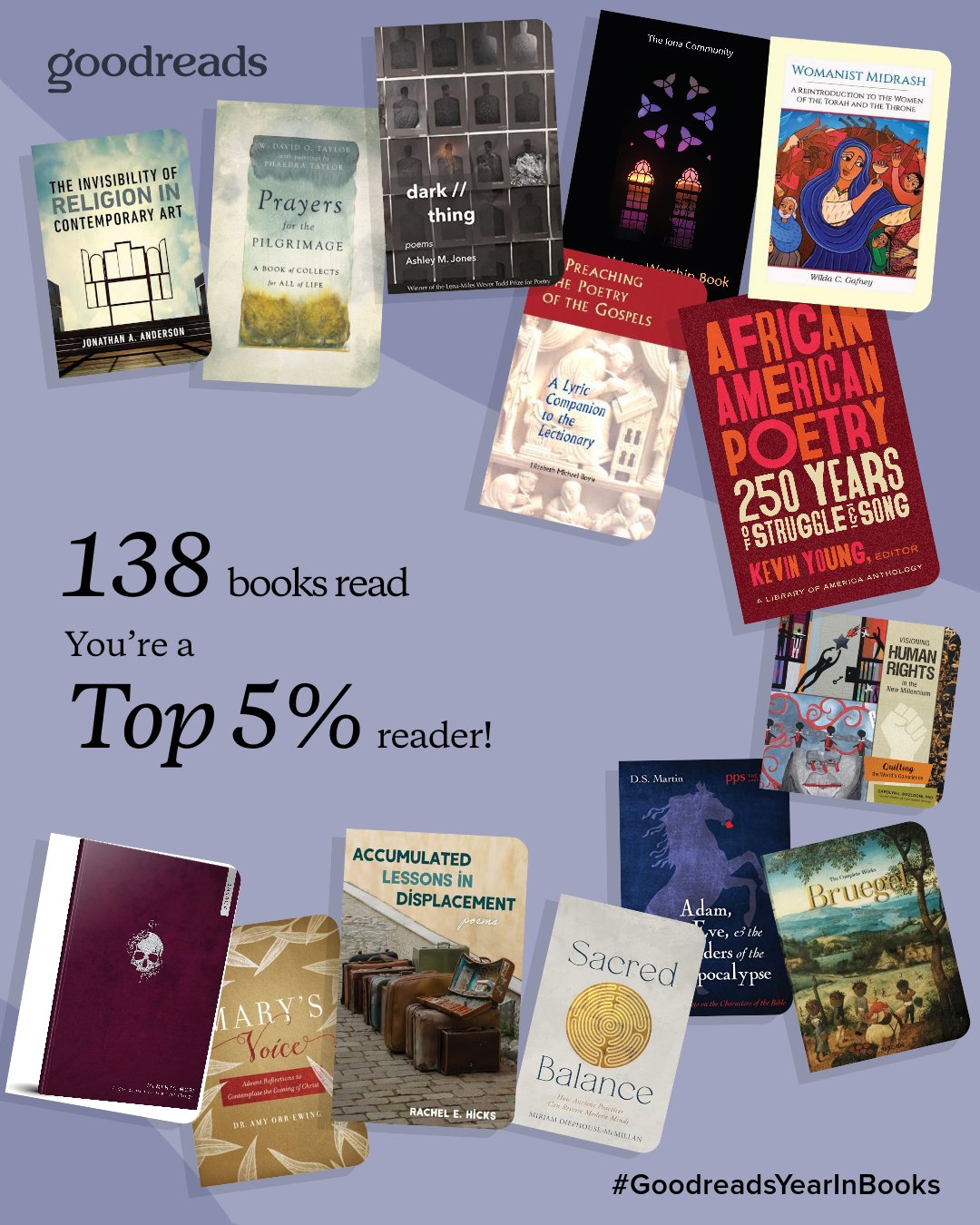
END-OF-YEAR READING STATS: My Year in Books 2025 (Goodreads): I read 138 books last year, mostly poetry. Exactly half were written by women—I’ve been more intentional about seeking out female authors, ever since someone challenged me on that. I hadn’t realized how disproportionately I was reading male authors, especially for theology. Nothing wrong with men!—but in the interest of closing the gender gap in my personal reading habits so that I can benefit from a wider swath of voices and support women writers, I commit to reading at least as many women as men each year.

My Year in Books 2025

(The book covers in this graphic are randomly generated by Goodreads from my list of read books.)

I’ve mentioned several of my favorite recent reads on the blog already (e,g., A Whole Life in Twelve Movies, An Axe for the Frozen Sea, Picturing the Apocalypse), but let me mention a few more. I wish I had time to write thoughtful reviews. I’m obliged to mention that if you make a purchase from any of the following links, I earn a small commission from Amazon.

Five-star single-author poetry collections:

Other select books I rated five stars:

  • Motherhood: A Confession by Natalie Carnes: This one’s hard to describe, but here’s the publisher’s attempt: “What if Augustine’s Confessions had been written not by a man, but by a mother? How might her tales of desire, temptation, and transformation differ from his? In this memoir, Natalie Carnes describes giving birth to a daughter and beginning a story of conversion strikingly unlike Augustine’s―even as his journey becomes a surprising companion to her own.” Despite my not being a mother, this book, which is also about embodiedness, and by a theologian I’ve met at conferences on multiple occasions, really captivated me. Thank you to a reader who purchased it for me from my wish list!
  • I really love the newish Fullness of Time series from InterVarsity Press, edited by Esau McCaulley, which celebrates the riches of the church year in seven short little volumes. It starts with Advent: The Season of Hope by Tish Harrison Warren and Christmas: The Season of Life and Light by Emily Hunter McGowan. As someone who didn’t grow up observing the liturgical calendar but who now does and gets asked about it by Christians for whom it’s unfamiliar, I find these explainers to be a helpful resource as well as personally enriching, and I look forward to reading more.
  • Bruegel: The Complete Works: This monster of a book from the art publisher Taschen, which comes in a carrier case, was a present from my husband. It’s beautifully produced, with full-color reproductions, foldouts, essays, and cataloging info. Pieter Bruegel (the Elder), a sixteenth-century Flemish artist, is known for his detailed, densely populated (sometimes a hundred-plus figures!) paintings of biblical narratives and peasant scenes, many of which were copied by his son, Pieter Bruegel the Younger. I give the text four stars but an overall five stars merely for the quality of the images (especially the inclusion of high-resolution details, which are generally not accessible online) and the value of having an authoritative catalog of all the artist’s authenticated works.

Goodreads is a social cataloging website for book lovers. I use it mainly to keep track of the books I’ve read and the ones I want to read. You can also tag books, a feature I use to group by topic or genre, though I’m not entirely consistent with the labeling. I’m a volunteer Goodreads Librarian, meaning I can edit book details and create new book records. Follow me on Goodreads.

+++

Victoria’s Book Wish List: If you would like to support Art & Theology, buying me a book from my Amazon wish list is one tangible way to do that. (Only those with a US Amazon account can do this, I believe.) The books I read influence the content I write and the artists I feature. I keep this link up-to-date year-round, and it lives permanently on this site’s Donate page (where there’s also a link to give financially through PayPal). I only include books that relate to the objectives of this blog. Thank you to those who have gifted me with surprise shipments throughout this past year! My husband says my eyes light up the brightest when I’m receiving a new book. I think it’s because I delight so much in growing my mind and spirit through wisdom and beauty.

Sometimes people ask me how I decide which books to buy versus which to get from the library. On his Astonishing Things Substack, Wes Vander Lugt shares the criteria he uses—and mine are largely the same. He writes:

  • Is it a book from a favorite writer that I will want to digest slowly, re-read, and cherish having in my home? Buy it.
  • Is it a book that piques my interest but the quality of writing and value of the content is relatively unknown? Get it from the library.
  • Is it a novel from a trusted author that I may not be able to finish in a month and/or will most likely want to re-read or at least revisit for inspiration and reflection? Buy it.
  • Is it a novel that I can reasonably finish in a month without feeling rushed? Get it from the library, along with the audiobook format if available.
  • Is it a book by a friend? Buy it!
  • Is it a book by a writer who feels like a friend, and none of the local libraries have a copy after a reasonable time following the release? Buy it.
  • Is it a book I would really love to own but my buy-it list is too long? Get it from the library first, and if it strikes a deep chord and the book budget is not maxed out, buy it.

I do get many books from the Linthicum Public Library right down the road from my house here in Maryland, which I usually visit at least once a week. I’m grateful for the service they provide, and for their partnership with Marina Interlibrary Loan, through which I can request books from other libraries in the state. I also regularly borrow movies from the library. However, books that I will take a long time to read, will reference again and again, or would want to lend to a friend—or that simply are not available through the library system in my area but that I desperately want to read and are reasonably priced—those are the kinds I’m likely to add to my wish list or purchase myself.

+++

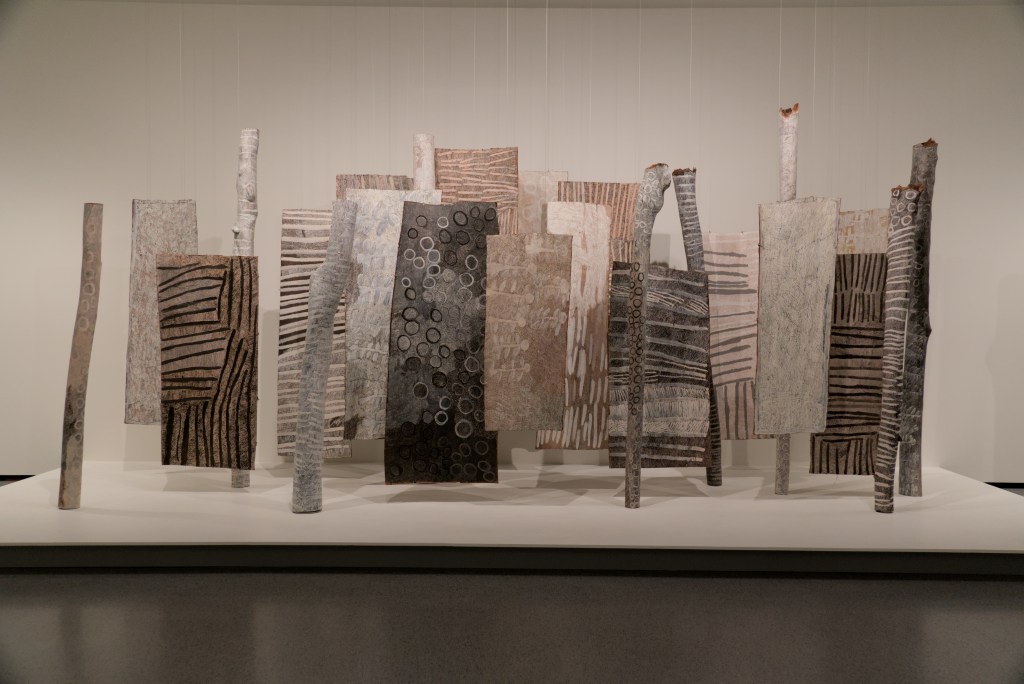
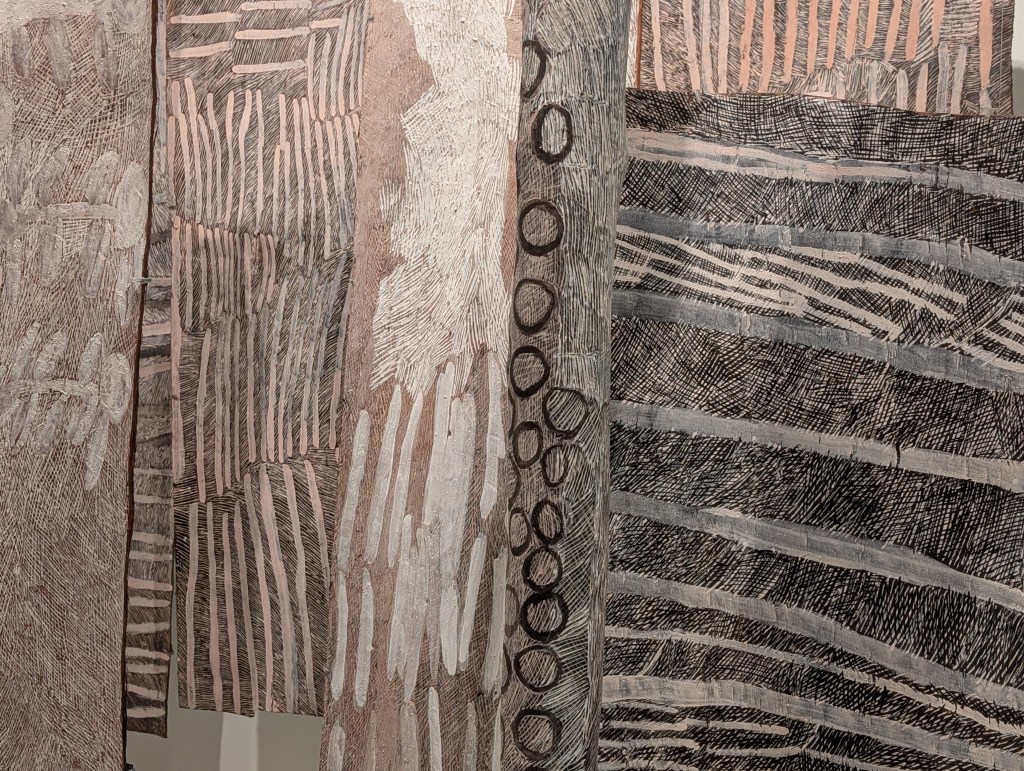
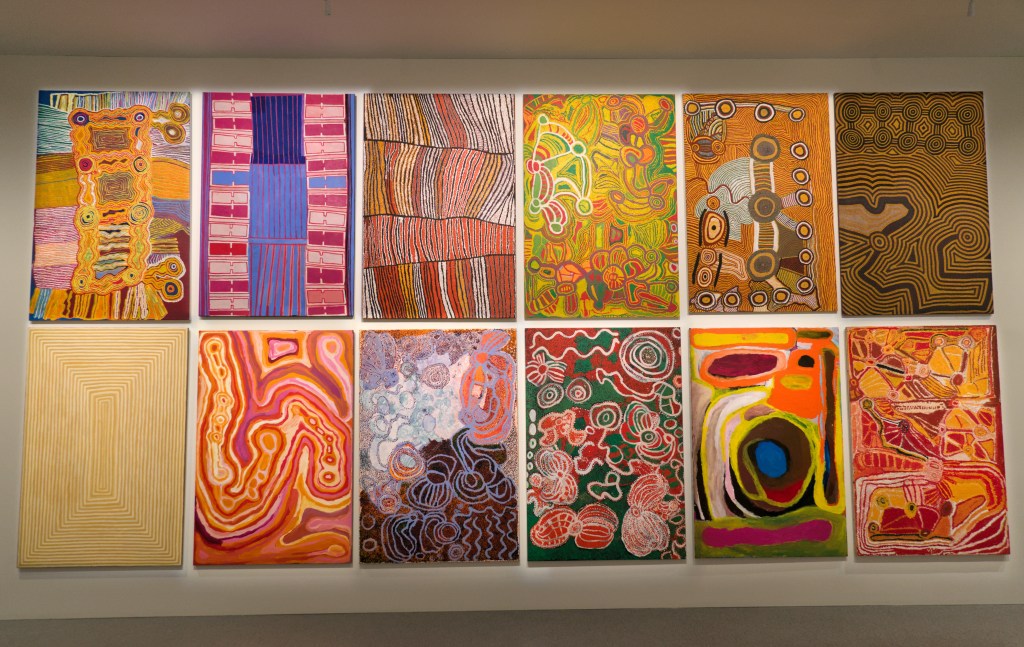
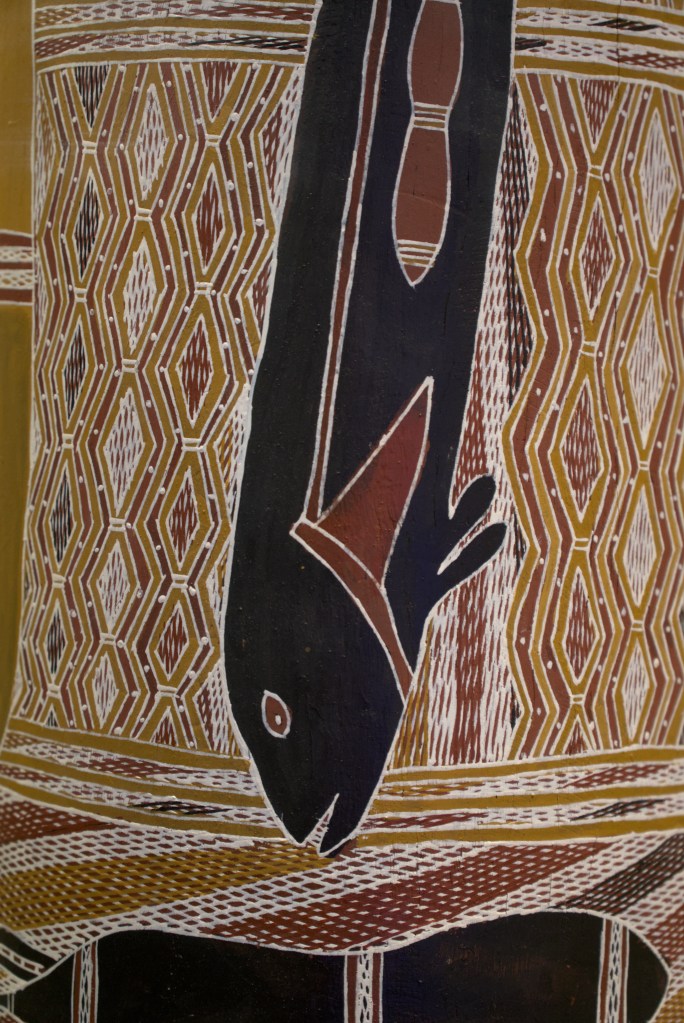
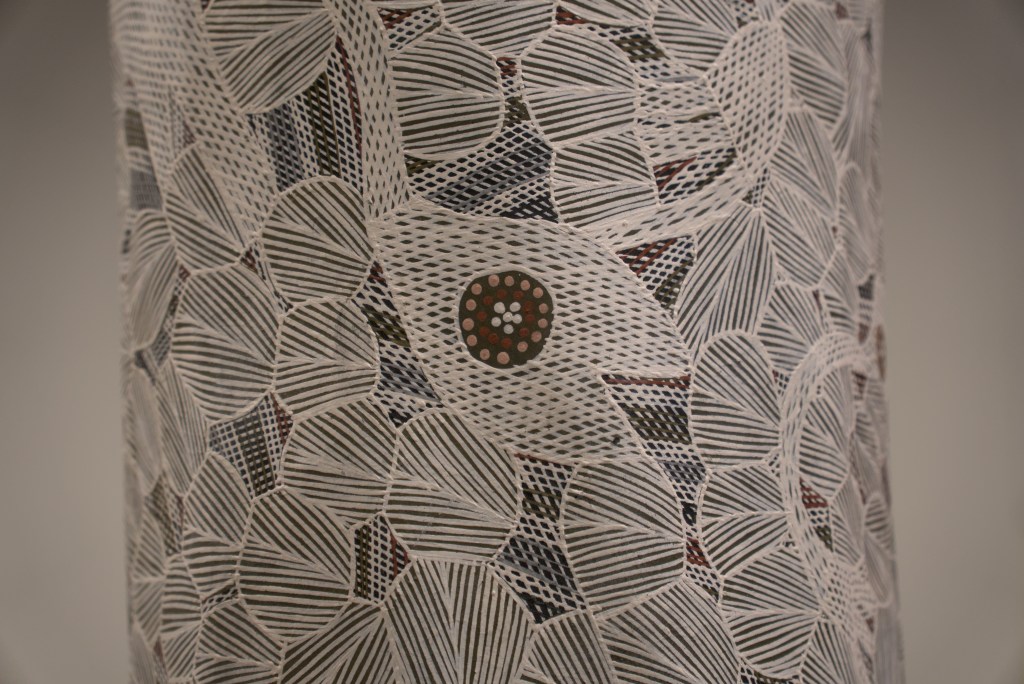
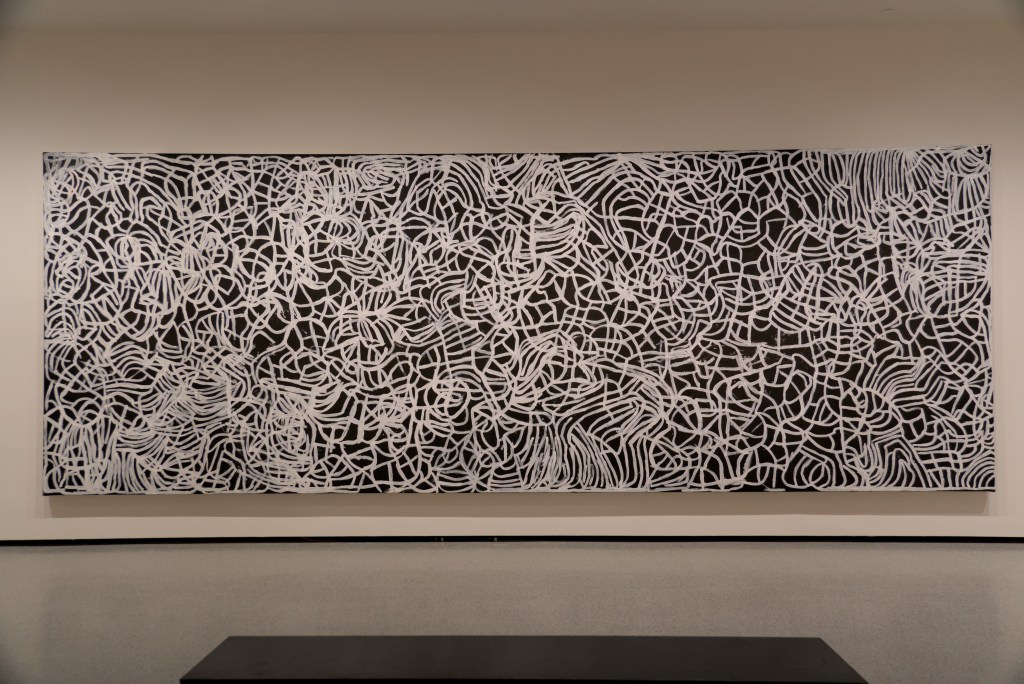
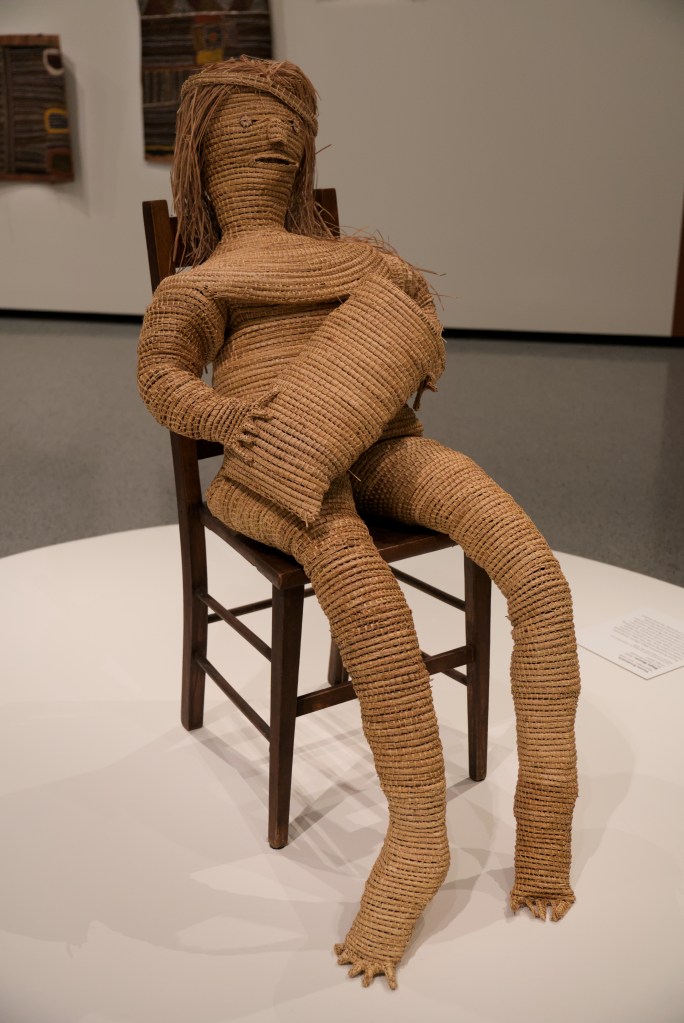
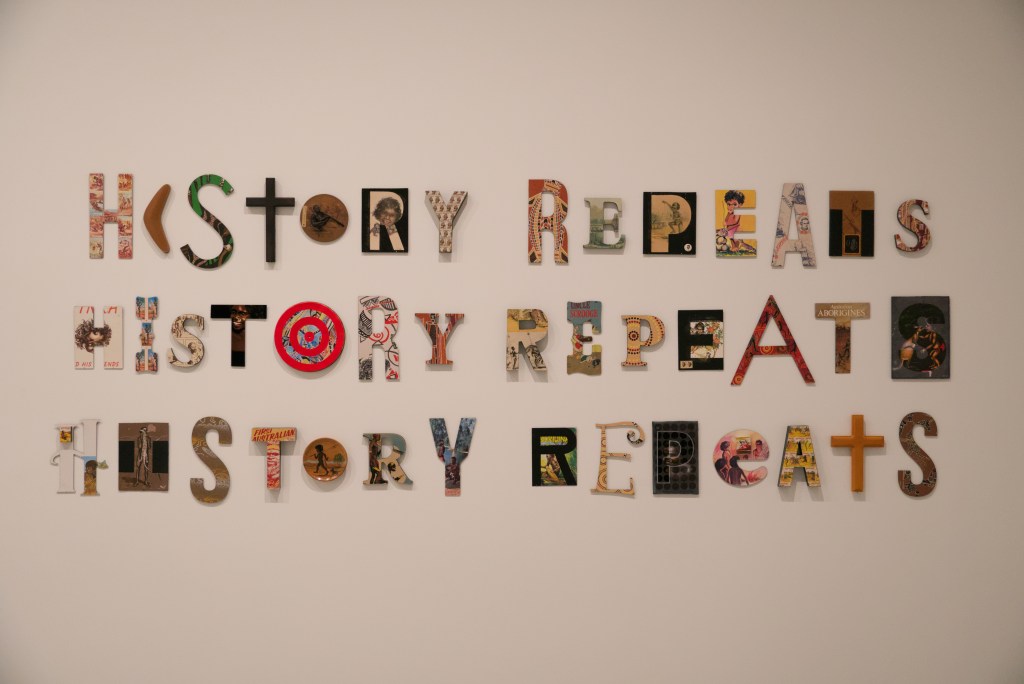
EXHIBITION: The Stars We Do Not See: Australian Indigenous Art, November 15, 2025–March 1, 2026, National Gallery of Art, Washington, DC: I saw this show last month, curated by Myles Russell-Cook from the collection of the National Gallery of Victoria in Melbourne, and it was fantastic. I recommend the free guided tour, especially if Aboriginal art is new to you. “Don’t miss this once-in-a-lifetime exhibition of Aboriginal and Torres Strait Islander art—the largest ever shown in North America. Australian Indigenous art is a visual thread connecting more than 250 nations across 65,000 years. Explore its breadth and brilliance through nearly 200 works from the late 1800s to today. You’ll find ochre paintings made on bark, maps of the Central and Western deserts (so-called ‘dot paintings’), groundbreaking works in neon, video, and photography, and more. And you’ll meet iconic artists who maintain and reinvigorate Ancestral traditions—revealing the rich, living history of creativity behind the world’s longest continuous culture.”

Here are some of the photos I took:

  • Nyapanyapa Yunupiŋu_Gäna (Self)
  • Gäna (Self) (detail)
  • Gulumbu Yunupiŋu_Garak (The Universe)
  • Garak (The Universe) (detail)
  • The Stars We Do Not See
  • Larrakitj (memorial poles)
  • Gawirriṉ Gumana_Guyamirrilil
  • Malaluba Gumana_Dhatam (Waterlilies)
  • Emily Kam Kngwarray_Anwerlarr Anganenty (Big Yam Dreaming)
  • Claudia Moodoonuthi_360 Flip on Country
  • Yvonne Koolmatri_Magic Weaver
  • Tony Albert_History Repeats

The title of the exhibition comes from the late artist Gulumbu Yunupiŋu, known affectionately as “Star Lady.” She developed “a signature style characterized by dense networks of crosses unified by fields of dots. Each cross represents a star and all that is visible within the known universe, while the dots in between symbolize everything that remains unknown.” See images 3 and 4 in the slideshow above.

After its run at the National Gallery in Washington, The Stars We Do Not See will be traveling to the Denver Art Museum in Colorado, the Portland Art Museum in Oregon, and the Peabody Essex Museum in Massachusetts.

Epiphany: Ecce advenit

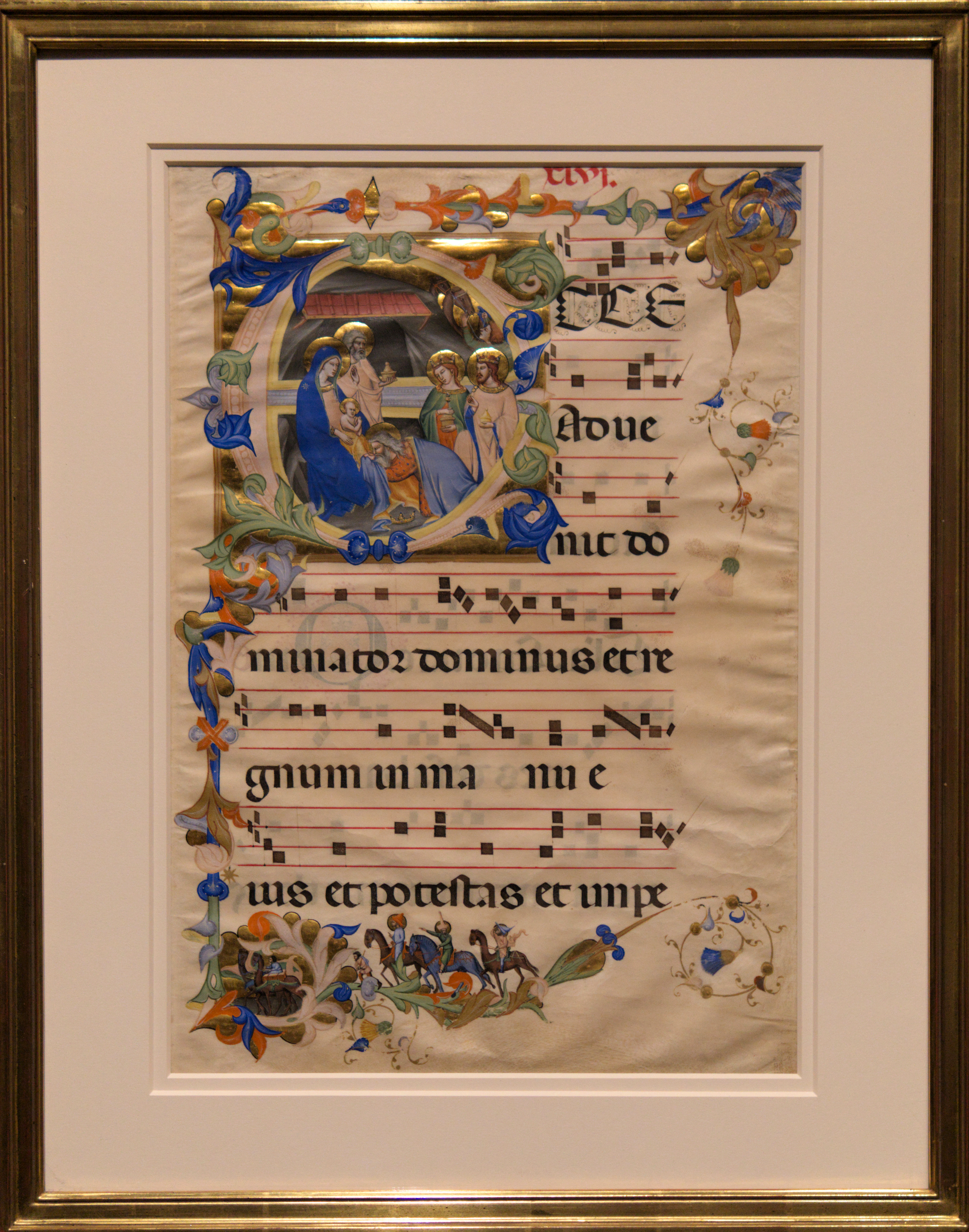
LOOK: Adoration of the Magi by Silvestro dei Gherarducci

Silvestro dei Gherarducci_Adoration of the Magi
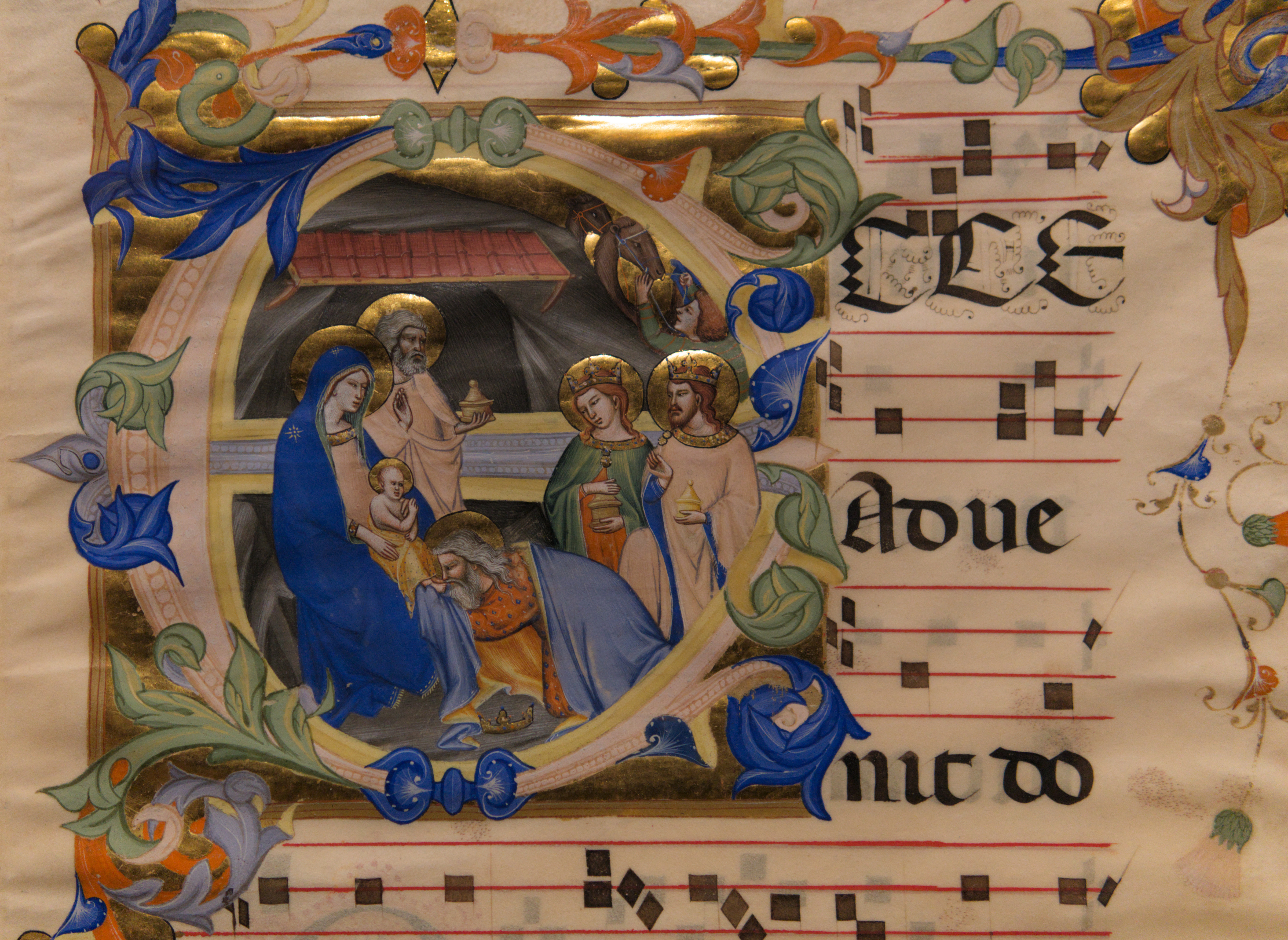
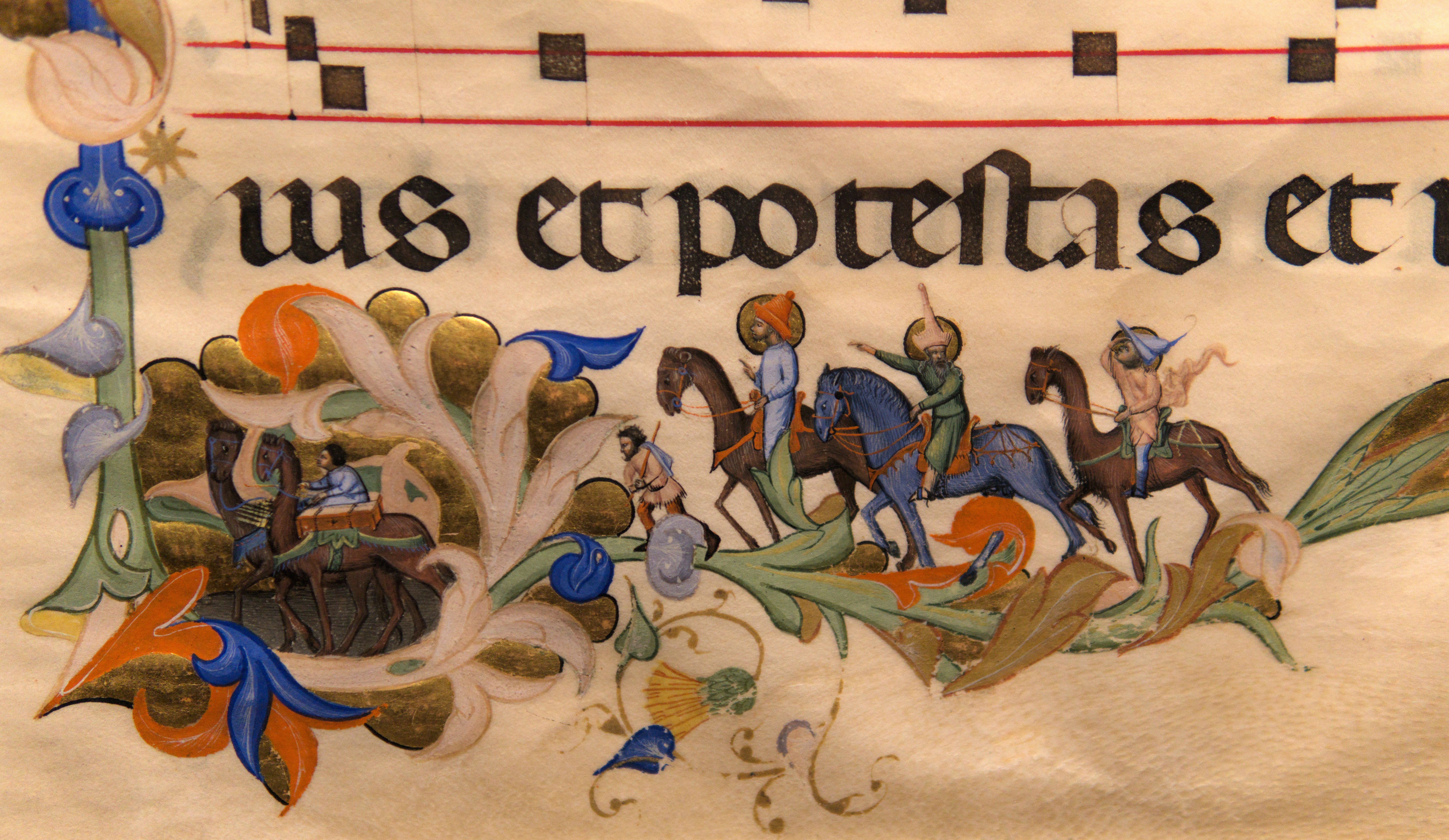
Silvestro dei Gherarducci (Italian, 1339–1399), Adoration of the Magi in an Initial E, cutting from a gradual, Florence, 1392–99. Illumination on parchment, 59 × 40 cm. Morgan Library and Museum, New York, MS M.653.5. All photos by Victoria Emily Jones. [object record]

(See commentary below.)

LISTEN: “Ecce advenit dominator Dominus” (Behold, the Sovereign Lord Is Come), introit for the Epiphany of the Lord, ca. 7th century | Performed by Floriani (men’s vocal ensemble), 2024

Ecce advenit dominator Dominus:
et regnum in manu eius
et potestas et imperium.

Deus, judicium tuum regi da,
et justitiam tuum filio regis.

Gloria patri,
et filio, et spiritui sancto,
sicut erat in principio,
et nunc, et semper,
in saecula saeculorum. Amen.
Behold, the Sovereign Lord is come, 
and in his hand the kingdom,
and power, and dominion.

Give the king your justice, O God,
and your righteousness to a king’s son.

Glory be to the Father,
and to the Son, and to the Holy Spirit,
as it was in the beginning,
is now, and ever shall be,
world without end. Amen.

In the Roman Catholic Church, the introit (sung while the priest approaches the altar for the Eucharist) for the Mass of the Epiphany is derived from three Old Testament texts: Malachi 3:1, 1 Chronicles 29:12, and Psalm 72:1. It communicates the royalty of Christ.

The church has sung this cento since as far back as the seventh century. The musical notation has been preserved in graduals (books that collect all the musical items of the Mass).

Two years ago at the Morgan Library and Museum in New York, I saw an Ecce advenit leaf from a now-dispersed medieval gradual that caught my attention with its glimmering gold. It’s one of twenty-three cuttings that the museum owns from a manuscript made at the Camaldolese monastery of Santa Maria degli Angeli in Florence, Italy, in the late fourteenth century, for the monastery of San Michele a Murano in Venice. The illuminations are by the then-prior (head) of Santa Maria, Silvestro dei Gherarducci.

The primary image on the page is an Adoration of the Magi inside a letter E (for Ecce). When a scene or figures appear inside a large decorative letter at the start of a text section, it’s called a historiated initial.

Adoration of the Magi

In the scene, the Holy Family stands at the mouth of a cave—Jesus is seated on Mary’s lap, while Joseph stands beside them holding a vessel that the elder magus handed him, a gift for the Christ child. It was typical for artists to depict the three magi as different ages: young (beardless), middle-aged, and elderly (gray-haired). The oldest of the group kneels on the ground, lays down his crown, and kisses Christ’s feet while the other two await their turn. In the background, a servant restrains two bridled camels.

Across the top and left margins of the page is a colorful vine scroll, and in the lower margin there’s a bas-de-page depicting the magi following the star. I love their fantastic hats! The elder one, astride a horse, points the way forward (the guiding star shines from the left of the page near some blue foliage); the other two follow his direction on camels. In front of the caravan are two servants, one walking on foot with a bag slung over his shoulder, and the other riding a camel beside a second camel carrying a chest that contains the treasures the magi will bestow on the newborn king they’re journeying to pay homage to.

Journey of the Magi

I like to imagine the community of Camaldolese monks in late medieval Venice singing from this choirbook on Epiphany, the lovingly wrought images of Christ-pursuing, Christ-worshipping magi enlivening their engagement with the gospel story and supplementing their own worship.

While monastic choirs have retained the monophonic style of music (that is, a single melody line sung in unison or traded off) that the church used for most of the Middle Ages—what we call Gregorian chant—over time, the church at large developed a taste for more elaborate, polyphonic music (that is, music with two or more simultaneous but relatively independent melodic lines), which came into full flower during the Renaissance and was sung in cathedrals.

To illustrate the difference between medieval monophony and Renaissance polyphony, here’s an example of the latter: the English composer William Byrd’s setting, from 1607, of the Ecce advenit. During his lifetime it was sung in Epiphany services in the Church of England as well as in the manor houses of recusant Catholic families (who were forced by law at the time to worship clandestinely).


Epiphany is no isolated and solitary act. It is a process: it is eternally typical of the Divine character. We will not merely look back over the long centuries at the manifestation that first flashed forth before the eyes of the Three Wise Men. Here and now, God is revealing Himself afresh before our very eyes. . . . For us too, clogged and choked by the dismal sand, there is a star that guides, a God who beckons. If only we would see!

—Henry Scott Holland (1847–1918) [HT]

May you see God’s light and, with curiosity and intent, follow it. Find what it illuminates.

A blessed Epiphanytide to you all.

Christmas, Day 12: Journey of the Magi

Today’s art and music selections are not a cultural match—the painting comes from the United States, bears Nigerian, Chinese, and Persian influences, and features a famous Dutch modernist in the corner, while the piano composition, written by a Hungarian based on a Romanian folk tune, comes from Central and Eastern Europe. But I find them to be a great match tonally—they’re both vibrant and spirited—not to mention the subject matter they share.

Tomorrow will be the final post in the daily Christmas series for this liturgical year.

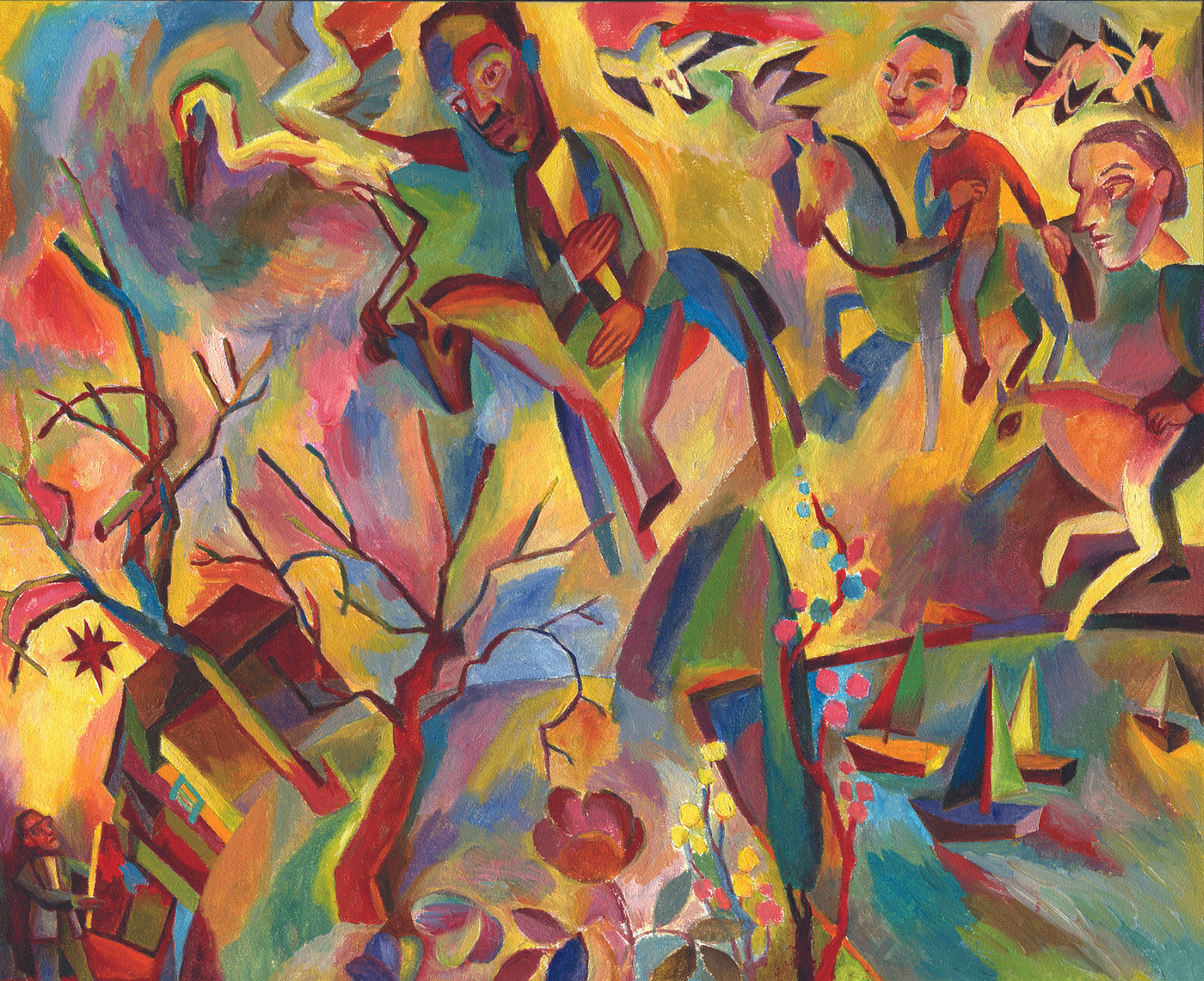
LOOK: The Magi and Mondrian by Tanja Butler

Butler, Tanja_The Magi and Mondrian
Tanja Butler (American, 1955–), The Magi and Mondrian. Oil and acrylic on Masonite, cradled with 2-inch unstained birch plywood, overall 10 × 12 in.

Artist’s statement by Tanja Butler [previously], via ArtWay: “The magi represent the cultures of the world, coming from the four corners of the earth to bring homage to the newborn King. The poses are drawn from royal Nigerian sculpture, Chinese paintings, and Persian manuscripts. The magi are forerunners of generations to come; all nations will bring the gifts of their unique cultures. In the bottom left corner Piet Mondrian offers his painting of chrysanthemums, an image reflecting natural order and creative stasis, the single-minded goal for which he sacrificed all nonessentials – a reminder of the determined search of the magi.”

LISTEN: “Trei crai de la Răsărit” (Three Kings from the East), series 1, no. 10 from Romanian Christmas Carols (Sz. 57, BB 67) by Béla Bartók, 1915 | Performed by György Sándor, 1962

“Trei crai de la Răsărit” (Three Kings from the East) is from a suite of twenty very short piano compositions in two series by the Hungarian composer Béla Bartók, which he based on Romanian colinde he had collected throughout the Transylvanian region. This one comes from the village of Rogoz in Bihor County.

Colinde (sing. colindă) are Romanian folk songs sung at Christmastime, typically by small groups of young men who after some rehearsal walk from house to house on Christmas Eve, caroling at each door. As Bartók himself noted, not all the colinde texts relate to Christmas; many regale folktales, ancient battles yarns, and pagan myths about nature and spirits. Christianity in Romania has absorbed and transformed some elements of the region’s pre-Christian past, integrating winter solstice traditions into a repertoire of Christmas song that also, of course, includes stories of Jesus’s birth.

“Trei crai de la Răsărit,” about the visit of the three wise men, is one of the explicitly Christian colinde. As the piano prances, I can picture the travelers riding with excitement toward Bethlehem.

Though I’ve found a few slow, somber Romanian songs with this same title, I’ve been unable to find the particular tune Bartók adapted for this più allegro (more lively, faster) movement that concludes the first series of his Romanian Christmas Carols. I’m curious to hear a vocal version and to know the lyrics—which Bartók had suggested be printed above the right hand in the score, an idea his publisher decided against.

To listen to the full suite as performed by Dezső Ránki and to follow along with the sheet music, see this video (“Trei crai de la Răsărit” occurs at 4:39–4:54):

Roundup: Slaviiq in Alaska, Shrine of the Three Kings in Cologne, and more

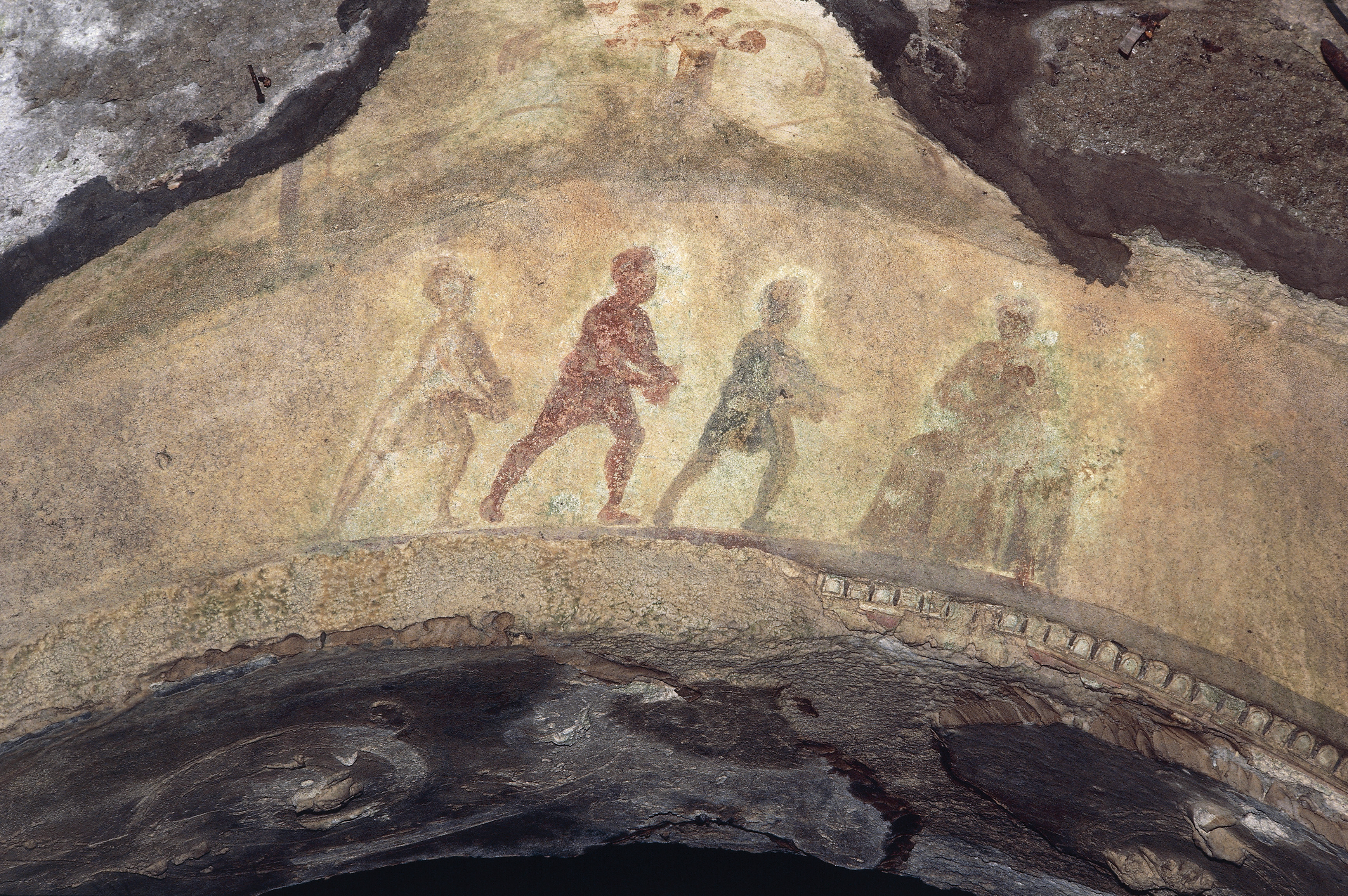
ARTICLE: “Witnessing the Divine: The Magi in Art and Literature” by Robin Jensen, Bible Review: In this 2001 article, art historian Robin Jensen traces the development of the tradition of the magi through early Christian art (catacomb frescoes, sarcophagi and funerary plaques, church mosaics) and literature.

Adoration of the Magi (catacombs)
The Adoration of the Magi, 3rd century. Fresco, Capella Graeca, Catacomb of Priscilla, Rome. Photo: Vincenzo Pirozzi.

+++

SONGS:

>> Slaviiq (“Starring”) carols in St. Paul, Alaska: In the mid-eighteenth century, Russian Orthodoxy was the first Christian denomination to take root in Alaska; Siberian trappers arrived as part of the “fur rush,” and many ended up marrying local Native women, bringing their religion into their new and growing families. Now Orthodoxy is widely practiced in Unangan (Aleut), Alutiiq (Kodiak), Yup’ik, and Tlingit communities.

Adapted from a custom originating in the Carpathian Mountains, Slaviiq (also spelled Slaviq, Slaaviq Selaviq, or Slavii), meaning “Starring,” is a multiday Native Alaskan Orthodox Christmas celebration beginning on the Feast of the Nativity of Christ on January 7. It involves processions into homes with a large decorated pinwheel star, caroling in English, Slavonic, and Native languages, traditional foods, prayers, and blessings.

The following video is a five-minute clip from a Slaviiq celebration in 2022 on Saint Paul Island, one of the homes of the Unangan people. Community members Aquilina Lestenkof and George Pletnikoff Jr. sing a few songs while a youth spins the Christmas star.

To learn more about the Slaviiq tradition, see:

>> “Bright Star,” arranged for string quartet by Ellie Consta and performed by Her Ensemble: Published in 1968, the Christmas song “Bright Star” was a collaboration between poet Janice Lovoos and composer Margaret Bonds [previously]. Her Ensemble, a UK-based women’s orchestra founded by violinist Ellie Consta to perform and promote music by female composers, encountered the song in 2021 through Lara Downes’s solo piano arrangement and decided to arrange it for strings. “We wanted to keep it as close to the original as possible because it’s just so beautiful as it is,” they write, “but we did add a couple of very subtle harmonics in the background to add a little extra Christmas charm!”

It’s an instrumental performance, but here are Lovoos’s lyrics:

Bright star, glist’ning star, shining on that holy night,
guiding shepherds in their flight to Bethlehem;

Bright star, guiding star, leading to a blessed abode,
three wise men on camels rode to Bethlehem;

Bright star, glimm’ring star, floating in your cobalt sea,
won’t you light the way for me as you did them in Bethlehem;

Sweet star, holy star, won’t you shine as bright today,
bright as when the Christ child lay
in his manger in the hay in Bethlehem, in Bethlehem.

>> “Songs of Thankfulness and Praise,” performed by Josh Bales: The Episcopal priest and singer-songwriter Josh Bales introduces an Epiphany hymn from 1862 by Christopher Wordsworth, nephew of the Romantic poet William Wordsworth. Observed annually on January 6, Epiphany (meaning “manifestation”) celebrates three events in which Jesus’s identity was made manifest: the visit of the magi, Jesus’s baptism in the Jordan, and Jesus’s first miracle at the wedding at Cana. The Western Church focuses on the magi, the Eastern Church on the baptism. Read the lyrics at Hymnary.org. The tune, SALZBURG, was composed by Jakob Hintze in 1678.

+++

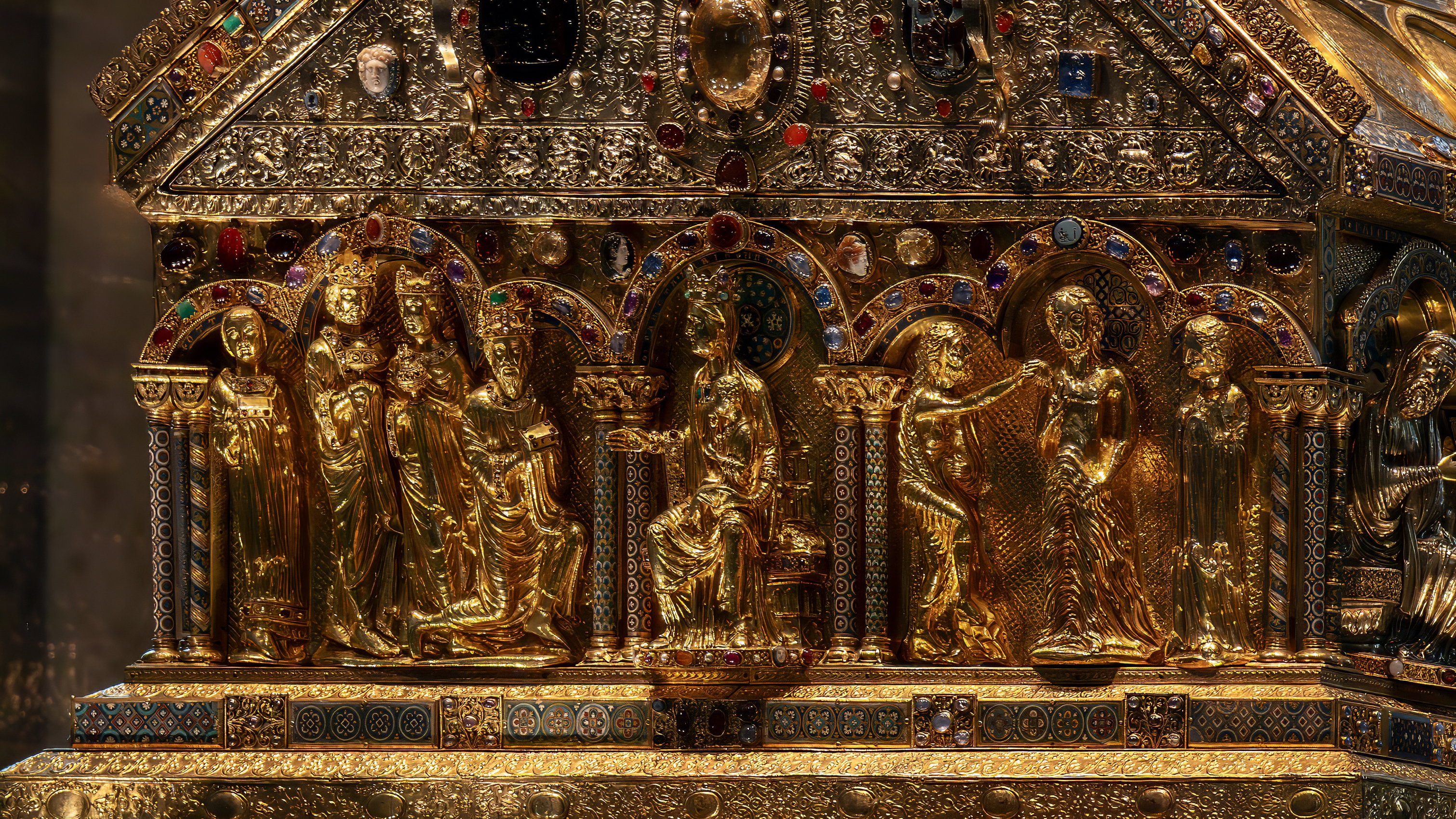
VIDEO: Nicholas of Verdun, Shrine of the Three Kings, Cologne Cathedral,” Smarthistory: I visited Cologne for the first time in fall 2025. I loved it. My only disappointment was that access to its cathedral’s most beautiful art object, the Shrine of the Three Kings, was obstructed, with the entire sanctuary and choir areas roped off, even though there was no Mass in session. I, a Protestant, was indifferent to the relics inside—the purported skulls of the magi—that have made Cologne an important pilgrimage destination since the Middle Ages. I merely wanted to see this extraordinary twelfth-century metalwork I had read about in art history books, the high point of Mosan art, from the renowned workshop of Nicholas of Verdun. If time had allowed, I could have paid for a tour that would have brought me a little closer but still at a distance. Instead, I had to resort to awkward viewing angles through metal bars.

However, a month after I returned home, Smarthistory uploaded a video that gives a closer look at the shrine, with lovely detail photographs by director Steven Zucker.  

Adoration of the Magi and Baptism (Cologne)
Nicholas of Verdun and workshop, Shrine of the Three Kings (front view), ca. 1181–1220. Oak, gold, silver gilt, copper, enamel, jewels, 155 × 112 × 224 cm. Cologne Cathedral, Germany. Photo: Steven Zucker.

The short end that faces out toward worshippers portrays, in pure gold, the Adoration of the Kings, with the three traditional sovereigns accompanied by a fourth, the Holy Roman emperor Otto IV. (He had paid for the shrine’s production—following the magi’s example, he donated a materially precious gift in homage to Christ.) To the right of this scene is the Baptism of Christ.

The figures on the sides represent prophets, apostles, and evangelists.

Christmas, Day 11: Twinkle, Twinkle

LOOK: Relief sculpture of the magi, Amiens Cathedral

The Magi Follow the Star (Amiens)
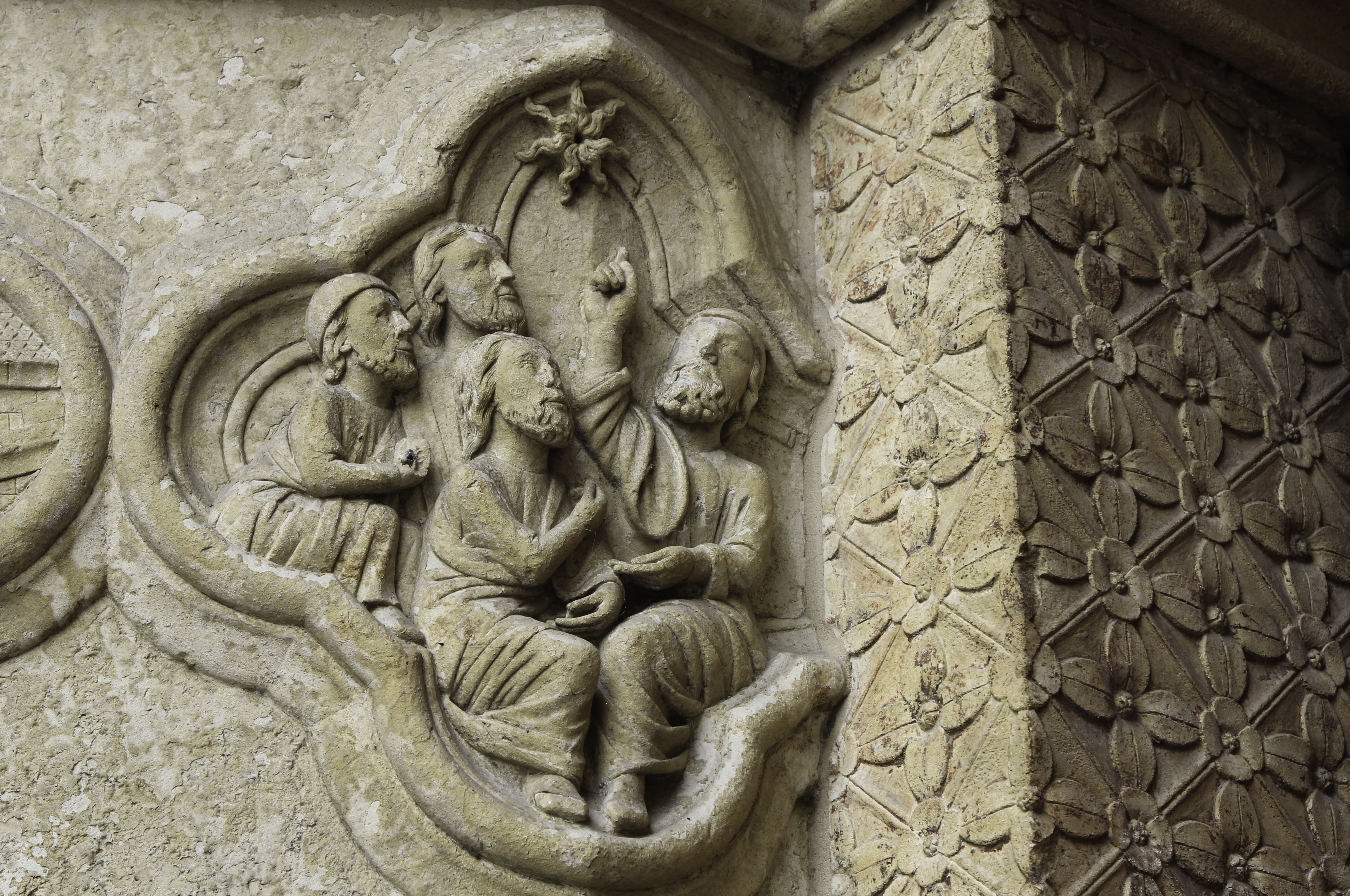
Quatrefoil relief sculpture from the south portal of Amiens Cathedral, France, 13th century. Photo: Fr. Lawrence Lew, OP.

In this sculpture, the Old Testament prophet Balaam pronounces his oracle that “a star shall come out of Jacob, and a scepter shall rise out of Israel” (Num. 24:17). The anonymous artist shows the magi, who studied celestial events, noticing the prophesied star centuries later and preparing to follow it.

To view a wider shot that includes all the adjacent bas-reliefs, see here.

(Related post: https://artandtheology.org/2023/12/15/advent-day-13-a-star-shall-rise-out-of-jacob/)

LISTEN: “Twinkle, Twinkle, Little Star” | Words by Jane Taylor, 1806 | Anonymous French pastoral tune, 1761 | Arranged and performed by God’s Children, 2023

Twinkle, twinkle, little star
How I wonder what you are
Up above the world so high
Like a diamond in the sky
Twinkle, twinkle, little star
How I wonder what you are

Christmas, Day 10: Love

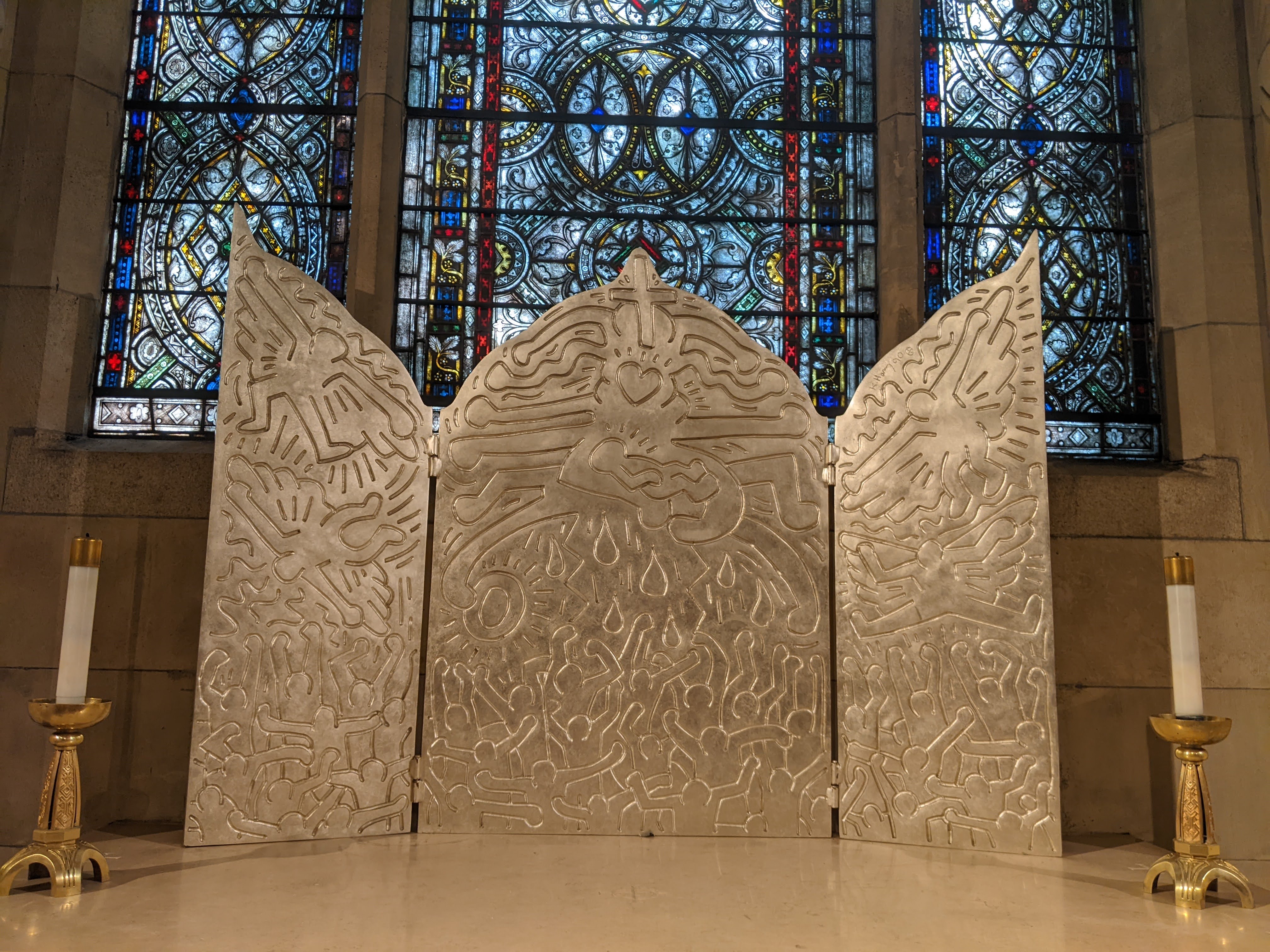
LOOK: The Life of Christ by Keith Haring

Haring, Keith_The Life of Christ
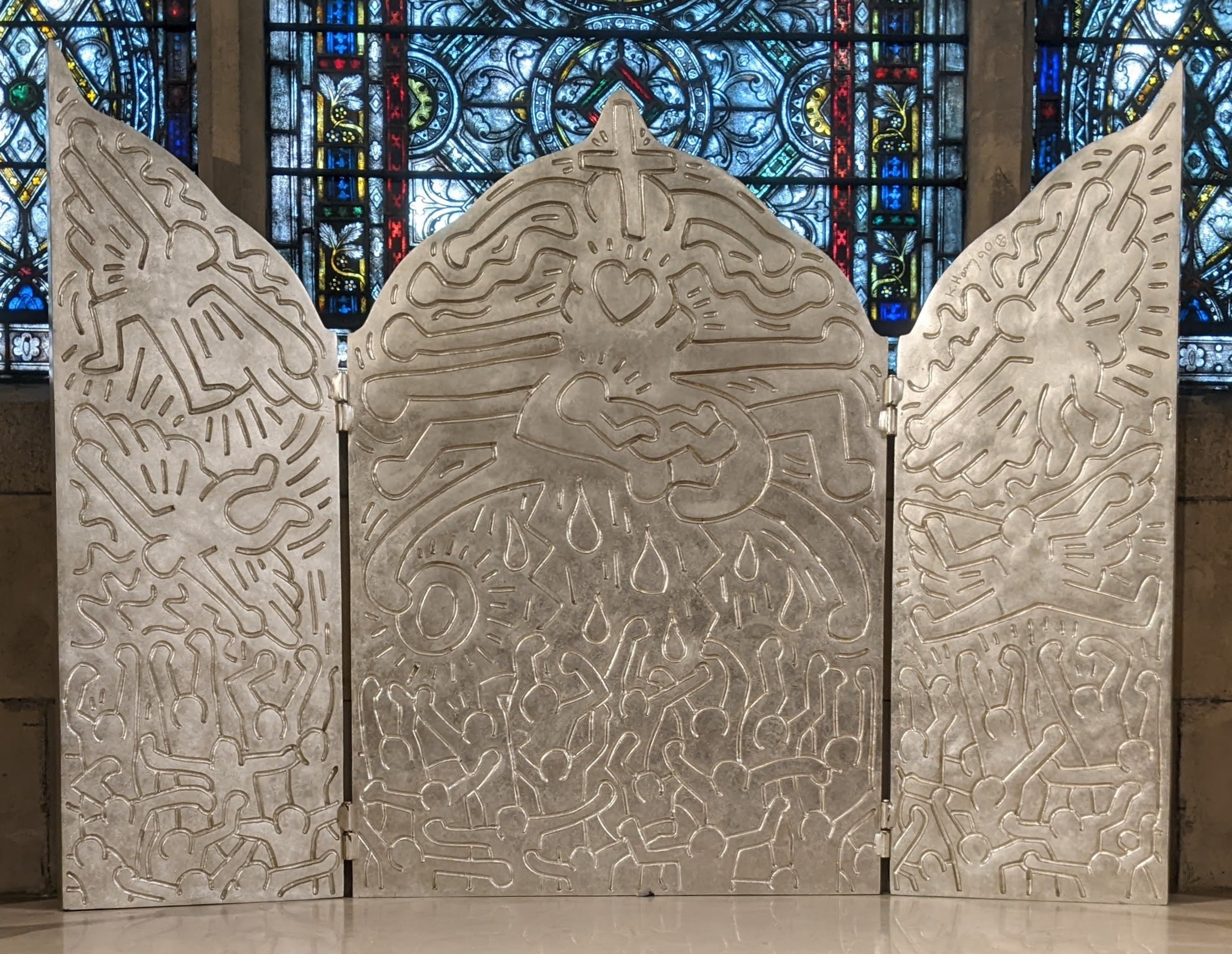
Keith Haring (American, 1958–1990), The Life of Christ, 1990. Bronze altarpiece with white gold leaf patina, 81 × 60 × 2 in. Edition of 9. Chapel of St. Columba, Cathedral of St. John the Divine, New York. All photos by Victoria Emily Jones.

Keith Haring [previously] was a popular artist and activist on the New York scene during the 1980s. Inspired by graffiti art, he started his career by filling empty poster spaces with chalk drawings in the city’s subway stations. He wanted to make art accessible to everyone and believed that it “should be something that liberates the soul, provokes the imagination, and encourages people to go further.”

His style is characterized by bold black outlines, vibrant colors, a sense of rhythm, and simple iconic figures like the Barking Dog and Radiant Baby, which recur again and again in his oeuvre.

Sadly, Haring’s career was cut short by AIDS, which he died of on February 16, 1990, at age thirty-one. The last work he completed, just weeks before his death, was a Life of Christ altarpiece, a work that conveys eternal love and loss, divine suffering and hope. Without any preliminary sketches, he cut the design into clay using a loop knife. It was posthumously cast in bronze and covered in a white gold patina, an edition of nine.

The first edition is housed in the Cathedral of St. John the Divine in New York, the world’s fourth-largest church by area, where Haring’s memorial service was held.

Chapel of St. Columba
Chapel of St. Columba, Cathedral of St. John the Divine, New York, designed by the architectural firm Heins & LaFarge, dedicated 1911. The stained glass windows are by Wilbur Burnham of Boston and Clayton & Bell of London, and the altarpiece, a later addition, is by Keith Haring.

Haring, Keith_The Life of Christ

(Related posts: “Michael Wright on Keith Haring’s ‘Jesus freak’ connection”; Felix Gonzalez-Torres, “Untitled [Portrait of Ross in L.A.]”)

Pulsating, cosmic, and somehow both mournful and joyous, the altarpiece is a triptych, meaning it has three panels. The central panel shows, at the top, a cross, below which is a multiarmed figure holding a baby. The top figure I interpret as God the Father, his arms all-embracing. Below him, at torso level, I discern a second figure (though the head is not clearly defined), who must be Mary, a shining heart over her face. Nestled in her arms is, irrefutably, her infant son Jesus.

Another possible reading is that this is the Trinity—Father, Spirit, and Son—united in an act of self-giving.

The surplus of arms (I count thirteen, plus the baby’s two) reminds me of the Thousand-Armed Avalokiteśvara in Buddhism; a bodhisattva associated with limitless compassion, his arms represent his extending aid, his reaching out to touch, heal, and uplift. One of the arms here stretches down to bestow a halo on humankind, which in Christianity symbolizes the grace/light of God.

Below this primary grouping is a crowd of people who appear to me to be dancing and celebrating, lifting their arms to receive the blessings that flow forth from the holy child. (Or are they clamoring, turning away, resisting? Without facial features and fingers, it’s hard to tell!) Drops of Jesus’s blood fall over all, bringing redemption.  

On the two side panels, angels careen down from the heavens, surfing, leaping, tumbling, one screeching to a halt.

Haring, Keith_The Life of Christ

Haring’s Life of Christ combines, as have many artworks before it, Jesus’s birth and death, collapsing his time on earth, his ministry of salvation, into a single image of incarnation and atonement. Mary holds him as a newborn, but she also holds him as a lifeless adult after his crucifixion—a traditional representation known as the Pietà. Many artists have given Mary a sad twinge in her eye at the nativity, suggesting a premonition of loss.

Haring’s figures are faceless, so we can’t look there for emotional clues, but Mary’s body language suggests both a desire to keep and protect her son, and a willingness to give him up for the greater good.

I wonder whether, when Haring incised the sacred blood drops, he was not only thinking of the “power in the blood” that Christians sing about in reference to Jesus’s redemptive sacrifice—and all the weight that bodily fluid as Christian symbol carries—but also lamenting the HIV infecting his own bloodstream, ravaging his body and stigmatizing him, and that had already killed many of his friends and his partner.

Haring’s friend Sam Havadtoy, who was present at the altar’s creation, reports that when Haring finished the piece, he stepped back and, gazing at it, said, “Man, this is really heavy.”

I think the prominence of blood must have been at least partly influenced by the destructiveness of the AIDS epidemic and the artist’s meditation on his mortality, perhaps even hope for transcendence through death. And if so, then the Radiant Baby, who, the artist’s title would lead us to assume, is Jesus, could also double as the soul of an AIDS victim being taken back up to God.

While I hesitate to ascribe prayers or intentions to others that they have not clearly voiced, I can’t help but think that this last artwork of Haring’s, executed in the final throes of his illness, its subject returning him to the Christianity of his youth, to a story that once captivated him, was in one sense a plea for (physical and spiritual?) cleansing, for deliverance.

LISTEN: “We Sing Glory” by Fred Hammond, on Fred Hammond Christmas . . . : Just Remember (2001)

Little baby boy, sent as God among us
For your plan to free all humanity
We sing glory to your name
Sing glory to your name

Tiny fragile heart
Pumped your blood to save us
For you’ve come to be a sin offering
Singing glory to the Lamb
Sing glory to the Lamb

Singing glory to the one
Who saved the whole world
Born to die but you live again
And take all our sins away

Little hands and feet
Made for nail and hammer
For the pain and grief you suffered for me
I sing glory to the Lamb
Oh, glory to the Lamb

Tiny arms and legs
Broad, strong, and sturdy
You carry the key to our victory
We sing glory to your name

We sing glory to the Child
Who will save the whole world
Born to die and then live again
To take all our sins away

Glory, glory to the one
Who was born to save the whole world
You died but you’ll rise again
So Jesus, we praise your name

Hark the herald angels sing
Glory to the newborn King
Peace on earth and mercy mild
God and sinner reconciled
Thank you, Jesus

Hark the herald angels sing
Glory to the newborn King
Peace on earth and mercy mild
God has come to save us
Yes, he has

Gloria in excelsis Deo
God has come to save us

Christmas, Day 9: Word Made Flesh

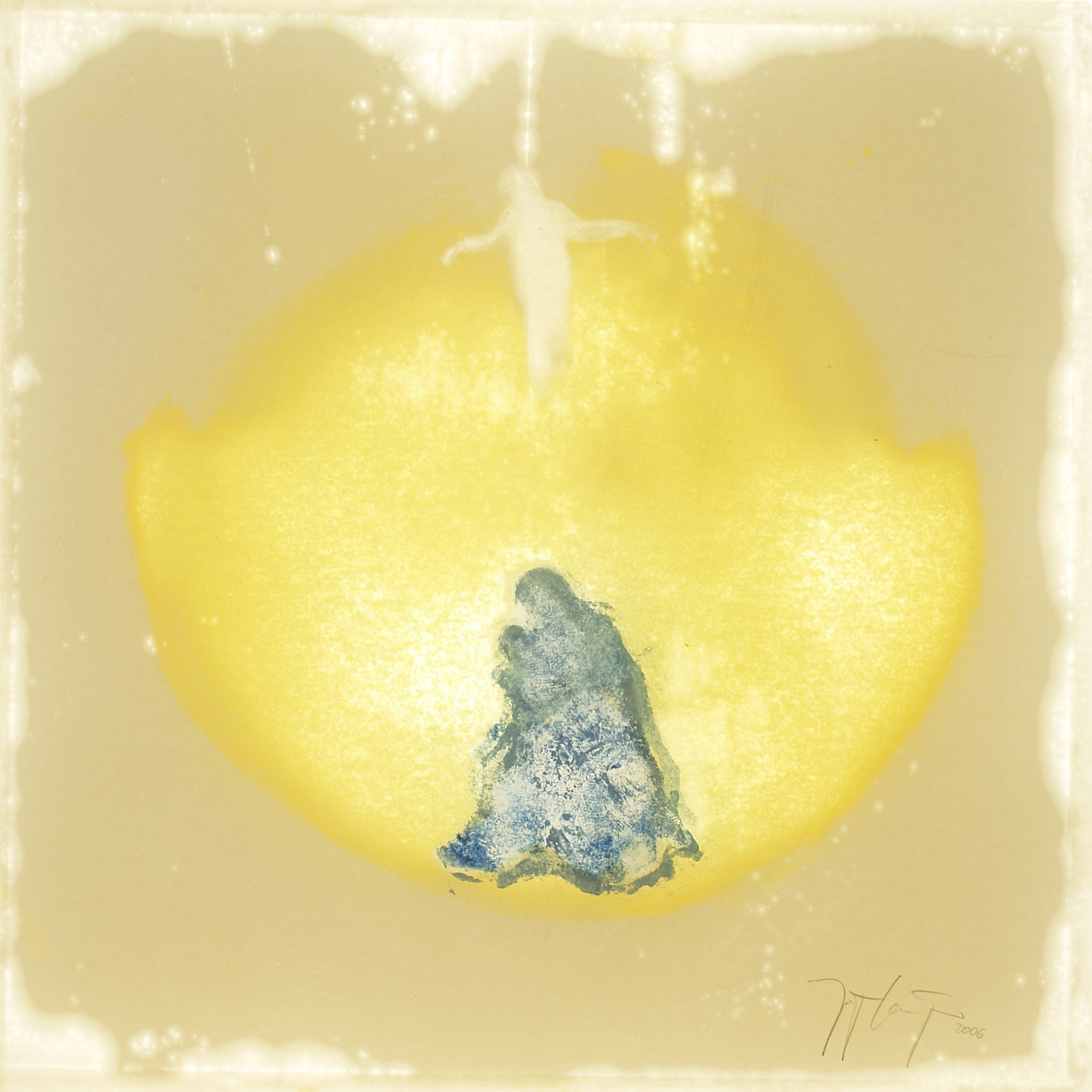
LOOK: Chr. Geb. by Jörg Länger

Länger, Jörg_Chr. Geb.
Jörg Länger (German, 1964–), Chr. Geb., 2006. Linocut, wax, oil, and graphite pencil on paper, 33 × 33 cm, cast with resin between two Optiwhite sheets of glass, 38 × 38 cm.

The contemporary German artist Jörg Länger creates extraordinary mixed-media works, many of which are in dialogue with Christian art history. In addition to earning an advanced degree in art, Länger has also done university coursework in theology and philosophy, so it’s no wonder his pieces demonstrate a keen theological awareness and spiritual sensibility.

After some fifteen years of working in photography, installation art, performance art, and conceptual art, in 1998 Länger shifted gears to focus on drawing, painting, and printmaking. He developed a series, still ongoing, that he calls “Protagonisten aus 23.000 Jahren Kulturgeschichte” (Protagonists from 23,000 Years of Cultural History), in which he takes figures from prehistoric petroglyphs and bas-reliefs, ancient Greek vases, medieval manuscripts, European Renaissance paintings, and contemporary art, simplifies them, and puts them into a new pictorial context. He copies the figure’s outline onto a linoleum block, inks and prints it to produce a sort of silhouette, and builds out from there using oil paint, pastels, wax, and/or gold leaf, while still retaining a minimalist aesthetic.

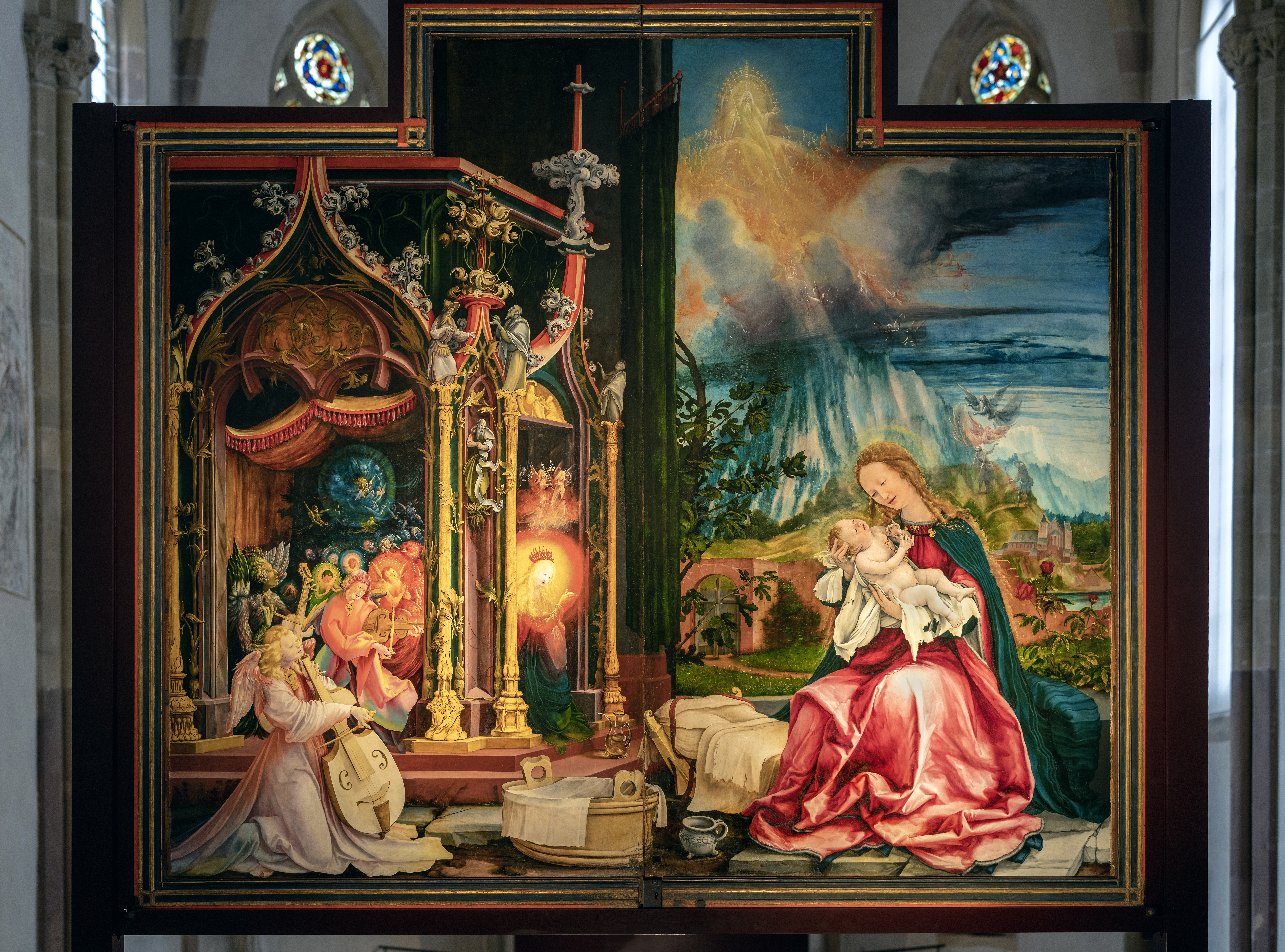
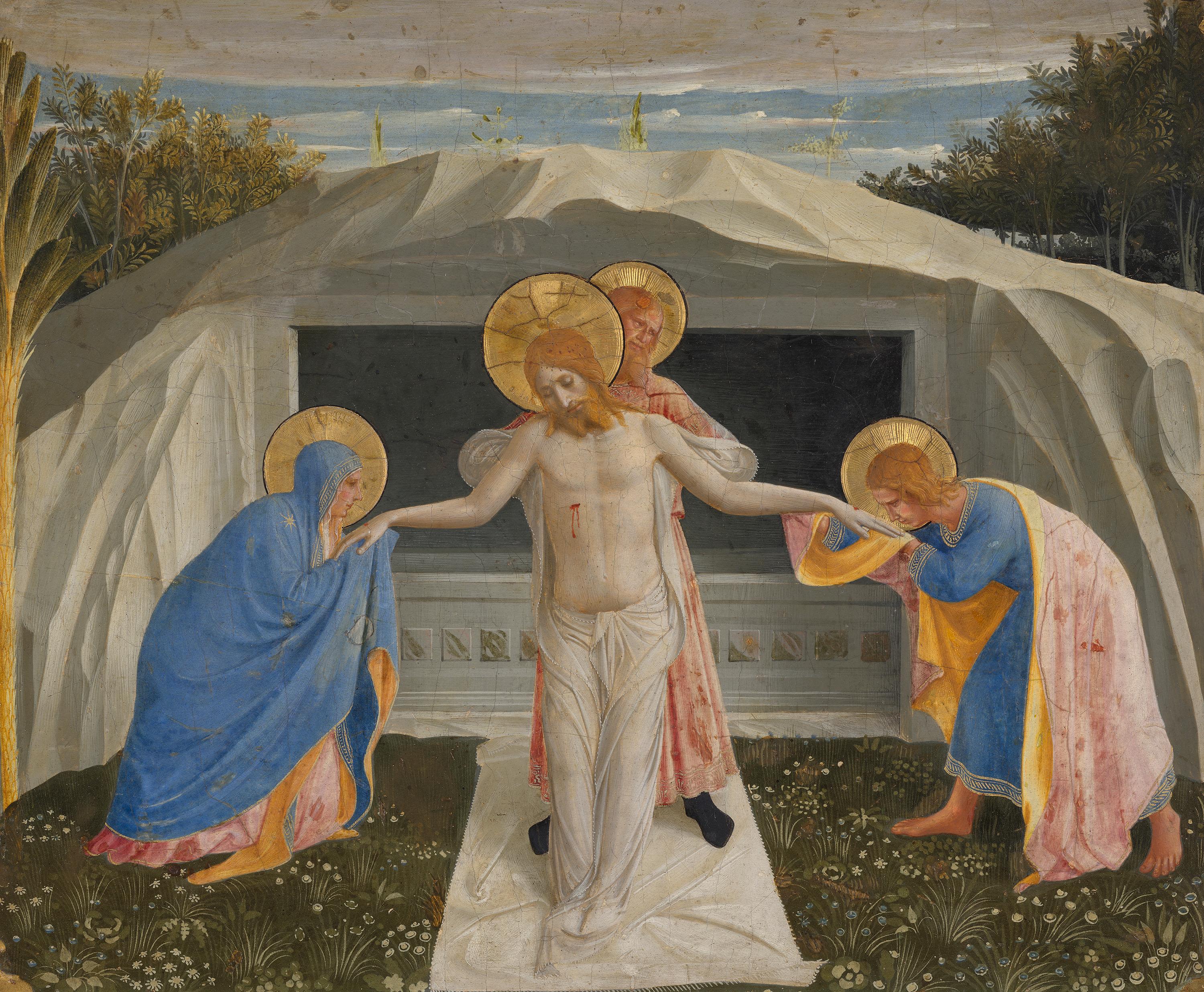
In his 2006 piece Chr. Geb. (short for Geburt Christi, “Birth of Christ”), the silhouetted figures are taken from Matthias Grünewald’s Isenheim Altarpiece and Fra Angelico’s Entombment of Christ.

Grünewald, Matthais_The Nativity
Matthais Grünewald (German, ca. 1475/80–1528), The Nativity, central panel (first open view) of the Isenheim Altarpiece, 1515. Oil on wood, 269 × 307 cm. Unterlinden Museum, Colmar, France. Photo: Steven Zucker.

Fra Angelico_Entombment of Christ
Fra Angelico (Italian, ca. 1400–1455), Entombment of Christ, 1438–40. Tempera on wood, 37.9 × 46.6 cm. Alte Pinakothek, Munich.

With the shadowy blue central pair of Mother and Child, the ghostly impression of Christ’s crucified body (being lifted into a tomb in the scene it’s excised from), the expanding puddle of gold that holds together both birth and death, and the light that presses in from the edges, the work has a mystical feel. It shows the Eternal One entering time, born of a woman, to live and die and rise and so bring humanity back to God and back to their truest selves.  

LISTEN: “O Vis Aeternitatis” by Hildegard of Bingen, ca. 1140–60 | Performed by Azam Ali, 2020

V. O vis aeternitatis
que omnia ordinasti in corde tuo,
per Verbum tuum omnia creata sunt
sicut voluisti,
et ipsum Verbum tuum
induit carnem
in formatione illa
que educta est de Adam.

R. Et sic indumenta ipsius
a maximo dolore
abstersa sunt.

V. O quam magna est benignitas Salvatoris,
qui omnia liberavit
per incarnationem suam,
quam divinitas exspiravit
sine vinculo peccati.

R. Et sic indumenta ipsius
a maximo dolore
abstersa sunt.

V. Gloria Patri et Filio
et Spiritui sancto.

R. Et sic indumenta ipsius
a maximo dolore
abstersa sunt.
V. O power within Eternity:
All things you held in order in your heart,
and through your Word were all created
according to your will.
And then your very Word
was clothed within
that form of flesh
from Adam born.

R. And so his garments
were washed and cleansed
from greatest suffering.

V. How great the Savior’s goodness is!
For he has freed all things
by his own Incarnation,
which divinity breathed forth
unchained by any sin.

R. And so his garments
were washed and cleansed
by greatest suffering.

V. Glory be to the Father and to the Son
and to the Holy Spirit.

R. And so his garments
were washed and cleansed
by greatest suffering.

Trans. Nathaniel M. Campbell

Hildegard of Bingen [previously] was a twelfth-century German nun and polymath who wrote works on theology, medicine, and natural history; hymns, antiphons, and a drama for the liturgy (all with original music); and one of the largest bodies of letters to survive from the Middle Ages. In 1136 she was unanimously elected to lead her Benedictine community as abbess, which she did until her death in 1179.

“O vis aeternitatis” is the first entry in Hildegard’s Symphonia armonie celestium revelationum (Symphony of the Harmony of Celestial Revelations), a compilation of her liturgical songs that she made during her lifetime. It is labeled a “Responsory to the Creator.” “The responsory, one of several compositional forms Hildegard used,” explains medievalist Nathaniel M. Campbell, “is a series of solo verses [marked V] alternating with choral responses [marked R] sung at the first office of the day, vigils (matins), in the monastic liturgy.” It’s basically a call-and-response song.

This responsory, Campbell continues, “contemplate[s] the Incarnation . . . as the pivotal moment in which creation reached its perfect and predestined trajectory.” He notes how the refrain meditates on the cleansing of Adam’s flesh both from suffering and by (Christ’s) suffering. God put on our humanity and redeemed it.

Here’s how the medievalist Barbara Newman translates the responsory on page 99 of the critical edition of the Symphonia published by Cornell University Press:

Strength of the everlasting!
In your heart you invented
order.
Then you spoke the word and
all that you ordered
was,
just as you wished.

And your word put on vestments
woven of flesh
cut from a woman
born of Adam
to bleach the agony out of his clothes.

The Savior is grand and kind!
From the breath of God he took flesh
unfettered
(for sin was not in it)
to set everything free
and bleach the agony out of his clothes.

Glorify the Father,
the Spirit, and the Son.

He bleached the agony out of his clothes.

In the video above, “O vis aeternitatis” is performed by Azam Ali, an internationally acclaimed singer, producer, and composer who was born in Iran and raised in India and is now based in Los Angeles. She writes in the video’s YouTube description that Hildegard is part of the canon of universal spirituality and mysticism and that she is attracted to her cosmology, especially her articulation of the ancient philosophical concept of “the music of the spheres.”

In addition to her solo work, Ali is part of the musical group Niyaz, who blend medieval Sufi poetry and ancient Middle Eastern folk songs with modern electronic and trance music.

Excerpt from Within and Without by George MacDonald (poem)

Stella, Joseph_Nativity
Joseph Stella (American, 1877–1946), Nativity, 1919–20. Oil pastel and oil on paper, 37 × 19 5/16 in. (94 × 49.1 cm). Whitney Museum of American Art, New York. Photo: Victoria Emily Jones. [object record]

Julian’s room. Christmas Day; early morn.

JULIAN. The light comes feebly, slowly, to the world
On this one day that blesses all the year,
Just as it comes on any other day:
A feeble child He came, yet not the less
Brought godlike childhood to the aged earth,
Where nothing now is common anymore.
All things hitherto proclaimed God:
The wide-spread air; the luminous mist that hid
The far horizon of the fading sea;
The low persistent music evermore
Flung down upon the sands, and at the base
Of the great rocks that hold it as a cup . . .
. . . . . . . . . . . . . . . . . . . . . . . . . . . . . . . . . . . . . .
But men heard not, they knew not God in these[.]
. . . . . . . . . . . . . . . . . . . . . . . . . . . . . . . . . . . . . . . . . . . . .
But when He came in poverty, and low,
A real man to half-unreal men,
A man whose human thoughts were all divine,
The head and upturned face of humankind—
Then God shone forth from all the lowly earth,
And men began to read their Maker there.
Now the Divine descends, pervading all.
Earth is no more a banishment from heaven,
But a lone field among the distant hills,
Well ploughed and sown, whence corn is gathered home.
Now, now we feel the holy mystery
That permeates all being: all is God’s;
And my poor life is terribly sublime.
Where’er I look, I am alone in God,
As this round world is wrapt in folding space;
Behind, before, begin and end in Him:
So all beginnings and all ends are hid;
And He is hid in me, and I in Him.
. . . . . . . . . . . . . . . . . . . . . . . . . . . . . . . .
O centre of all forms! O concord’s home!
O world alive in one condensèd world!
O face of Him, in whose heart lay concealed
The fountain thought of all this kingdom of heaven!
Lord, Thou art infinite, and I am Thine!
I sought my God; I pressed importunate;
I spoke to Him, I cried, and in my heart
It seemed He answered me. I said, “O, take
Me nigh to Thee, Thou mighty life of life!
I faint, I die; I am a child alone
’Mid the wild storm, the brooding desert night.”
“Go thou, poor child, to Him who once, like thee,
Trod the highways and deserts of the world.”
“Thou sendest me then, wretched, from Thy sight!
Thou wilt not have me—I am not worth Thy care!”
“I send thee not away; child, think not so;
From the cloud resting on the mountain peak,
I call to guide thee in the path by which
Thou mayst come soonest home unto my heart.
I, I am leading thee. Think not of Him
As He were one and I were one; in Him
Thou wilt find me, for He and I are one.
Learn thou to worship at his lowly shrine,
And see that God dwelleth in lowliness.”

This passage is excerpted from part 3, scene 10 of Within and Without: A Dramatic Poem by George MacDonald, a verse play that, in 1855, was the author’s first published work.

George MacDonald (1824–1905) was a prolific Scottish writer across the genres of adult and children’s fantasy, realistic fiction, theology, poetry, and literary essay. He was the founding father of modern fantasy literature (Phantastes, The Princess and the Goblin, At the Back of the North Wind, and Lilith and his best-known works), a mentor to fellow writer Lewis Carroll (he was a catalyst to Carroll’s publishing Alice’s Adventures in Wonderland), and a great influence on C. S. Lewis (who cites his writings as instrumental in his conversion to Christianity). MacDonald served for a few years as a Congregational minister, but his preaching about God’s universal love and the ultimate salvation of all (apokatastasis) rubbed against the staunchly Calvinist grain of his time and place; after resigning his pastoral post in Arundel, England, he continued preaching without pay as a layman, as well as weaving his theological views into his fiction.

Christmas, Day 8: Welcome

In today’s Christmas devotional, there’s a convergence of three Native cultures of Turtle Island (North America): Jemez, Dakelh, and Kwakwaka’wakw.

LOOK: Jemez Nativity by Maxine Toya

Toya, Maxine_Jemez Nativity
Maxine Toya (Jemez Pueblo, 1948–), Jemez Nativity, 2014. Polychrome pottery figures, red micaceous slip, tallest figure 8 1/2 inches high. Photo: Blair Clark, courtesy of Susan’s Christmas Shop, Santa Fe.

A granddaughter of Persingula Gachupin and a daughter of Marie Romero (both eminent Jemez Pueblo potters), Maxine Toya grew up assisting her family with pottery chores and painting. She began making her own pottery in 1974 and is one of the most renowned living potters from Jemez Pueblo, a census-designated place in Sandoval County, New Mexico. She has won numerous awards at the prestigious Santa Fe Indian Market, which every August brings together a thousand-plus Indigenous artists from more than two hundred tribal nations to exhibit and sell their work.

I learned about this artist from the wonderful book Nativities of the Southwest by Susan Topp Weber, the owner and operator of Susan’s Christmas Shop in Santa Fe. The book compiles dozens of nativities made with local clays and other materials by Pueblo Indians, Navajo Indians, and Spanish and Anglo artists of New Mexico and Arizona. Maxine Toya’s nativity appears on page 47. Weber writes,

Maxine’s donkey in this nativity has a blanket painted with a fringe similar to the one made by her mother, Marie [see page 46]. . . . She sometimes combines her figures into groups. Her standing figures all have closed eyes. The carefully painted detail distinguishes this nativity, as well as the sweet little Pueblo drummer boy with his drumstick raised in the air. The angel’s wings have a lovely feather design.

You can watch Maxine Toya give a pottery demonstration with her daughter Domnique Toya, also a potter, in this 2022 video from the Museum of Indian Arts and Culture. (I cued it up to Maxine’s first section.)

LISTEN: “Welcome Our Creator” by Cheryl Bear, from The Good Road (2007)

Gilakas’la Gikumi!

Welcome our Creator!

Cheryl Bear (DMin, The King’s University) is an award-winning singer-songwriter, speaker, and workshop leader from Nadleh Whut’en First Nation in central British Columbia, whose work explores the intersection of Christian faith and First Nations cultures. She is a founding board member of NAIITS: An Indigenous Learning Community (formerly the North American Institute for Indigenous Theological Studies), an organization that addresses biblical, theological, and ethical issues from Indigenous perspectives. She travels throughout North America telling the Great Story of Jesus both within and outside Indigenous communities, bringing to bear her Indigenous worldview and values.

Bear’s song “Welcome Our Creator” is from her sophomore album, The Good Road. It opens with a drumbeat and then her singing a series of vocables (small nonlexical “words” without semantic meaning). “The song is played to the drum beat of my people,” the Dakelh (Carrier), she writes in the liner notes. “I use the words ‘Gilakas’la Gikumi’ from the Kwakwaka’wakw Nation,” which translate to “Welcome our Creator.”

The song’s title on the CD sleeve and in online metadata does not have a comma, suggesting that the phrase, if interpreted in relation to Christmas, is an exhortation to give Jesus welcome, to gladly and hospitably receive him. But it could also be sung as a greeting to the incarnate God himself: “Welcome, our Creator!”

Outside the Christmas context, the song might be sung during an assembly as an acknowledgment of Creator’s presence.