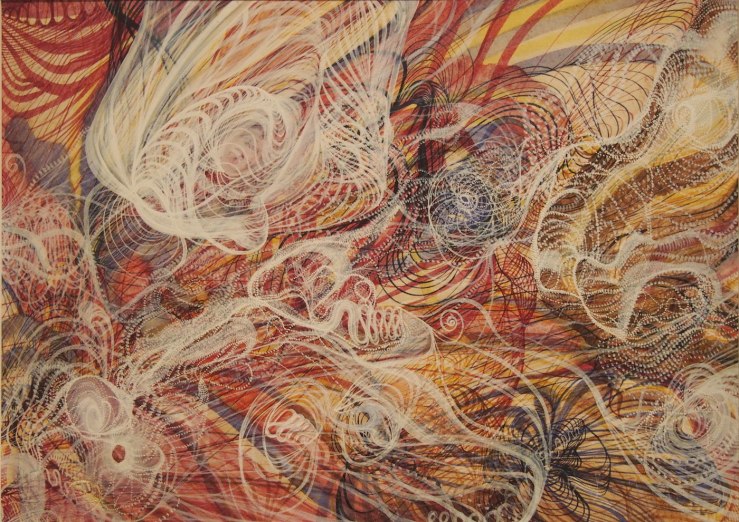
Georgiana Houghton (British, 1814–1884), The Risen Lord, 1864. Watercolor and gouache on paper laid on board with pen and ink inscription on the reverse. Photo: Jessica Freeman-Attwood/Hyperallergic.
In the first book, O Theophilus, I have dealt with all that Jesus began to do and teach, until the day when he was taken up, after he had given commands through the Holy Spirit to the apostles whom he had chosen. He presented himself alive to them after his suffering by many proofs, appearing to them during forty days and speaking about the kingdom of God.
And while staying with them he ordered them not to depart from Jerusalem, but to wait for the promise of the Father, which, he said, “you heard from me; for John baptized with water, but you will be baptized with the Holy Spirit not many days from now.”
So when they had come together, they asked him, “Lord, will you at this time restore the kingdom to Israel?” He said to them, “It is not for you to know times or seasons that the Father has fixed by his own authority. But you will receive power when the Holy Spirit has come upon you, and you will be my witnesses in Jerusalem and in all Judea and Samaria, and to the end of the earth.” And when he had said these things, as they were looking on, he was lifted up, and a cloud took him out of their sight.
—Acts 1:1–9
+++
SONG: “Coelos ascendit hodie” (Ascended today into heaven) | Words: Anonymous, 12th century | Music by Charles Villiers Stanford, ca. 1892 | Performed by the Stanford Chamber Chorale and the Choir of Trinity College, Cambridge, under the direction of Stephen M. Sano, 2007
Coelos ascendit hodie Jesus Christus Rex gloriae Sedet ad Patris dexteram Gubernat coelum et terram
Jam finem habent omnia Patris Davidis carmina Jam Dominus cum Domino Sedet in Dei solio
In hoc triumpho maximo Benedicamus Domino Laudatur Sancta Trinitas Deo dicamus gratias
English translation:
Jesus Christ, the King of Glory,
has ascended today into the heavens.
He sits at the right hand of the Father
and rules heaven and earth.
Now all the psalms of David,
our father, are fulfilled.
Now the Lord sits with the
Lord on the seat of God.
In this greatest of triumphs
let us bless the Lord.
The Holy Trinity be glorified.
Let us give thanks to God.
Stanford’s “Coelos ascendit hodie,” op. 38, no. 2, is a double-choir motet setting of a medieval Ascension hymn, the second piece in his Three Latin Motets set [previously].
+++
Consisting of “frenetic spirals of color and swirling sinuous lines” (source), The Risen Lord by Georgiana Houghton was produced in Victorian England some eighty years before abstract expressionism came onto the scene. Houghton renounced authorship of her artworks, believing herself to be a medium who channeled saints, archangels, Renaissance painters, and dead relatives to produce what she called “spirit drawings.” She was a Spiritualist, which means she believed in the possibility of contact with a spirit realm and that such communication could bring one closer to God. Ink and watercolors were, for her, a way of unveiling an invisible reality, of conveying God’s “wondrous attributes,” she said.
“On the back of most of her works, Houghton included a handwritten explanation, with illustrated annotations of the abstract forms,” Jessica Freeman-Attwood said. “In The Risen Lord Houghton writes that the lower part corresponds to the virtues and sufferings of Christ’s life on earth, whereas the upper part, dominated by arabesque white threads, represents his ascension into heaven.”
+++
Ascension Day is May 21 this year. For previous years’ devotions for the occasion, see “God Ascended” (featuring a German Renaissance painting and a clever repurposing and retuning of an eighteenth-century verse) and “Carried Up” (featuring a balletic Christ image by the late Javanese artist, dancer, and choreographer Bagong Kussudiardja, and a Romantic piano composition).
This post belongs to the weekly series Artful Devotion. If you can’t view the music player in your email or RSS reader, try opening the post in your browser.
To view all the Revised Common Lectionary scripture readings for the Ascension of the Lord, cycle A, click here.
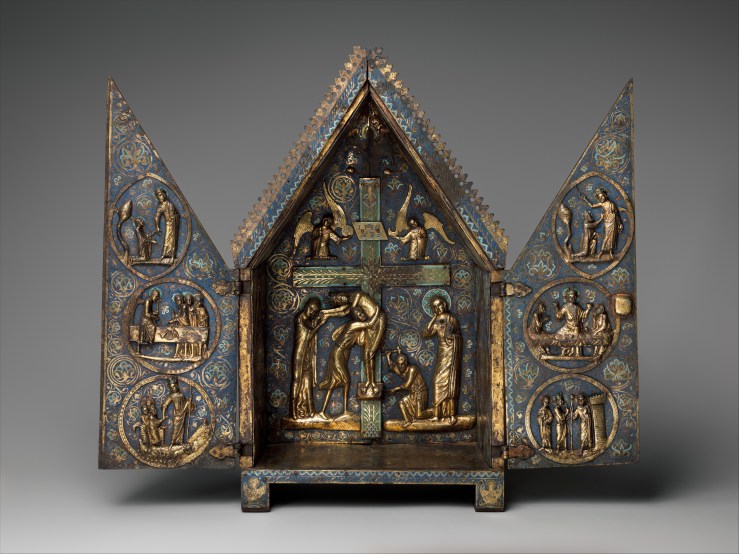
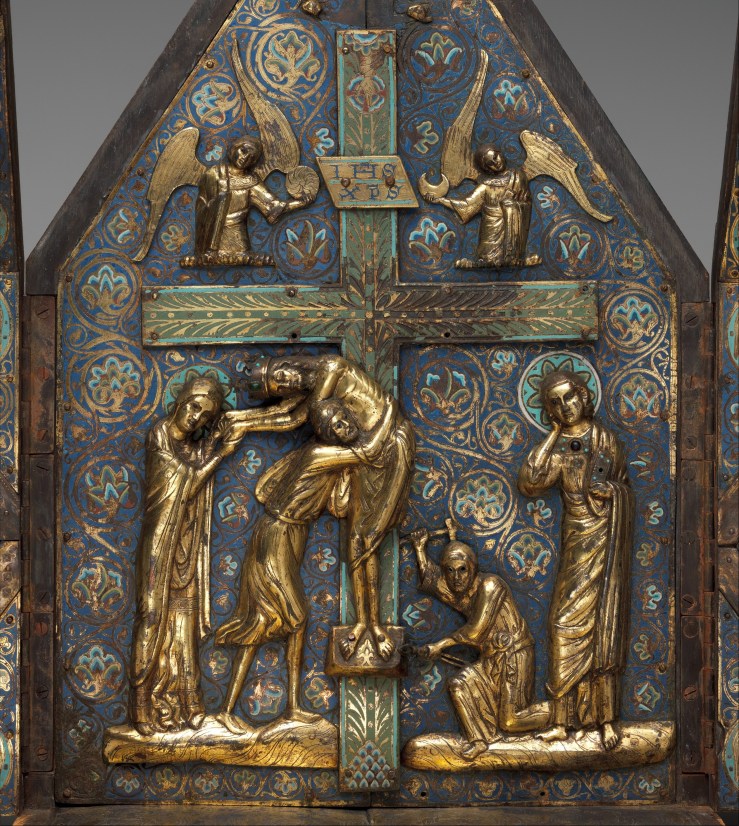
The Met Cloisters in New York City—the branch of the Metropolitan Museum of Art devoted to the art and architecture of medieval Europe—has some of the most beautiful Christian art objects I’ve seen. Here I’ll share just one of them: an elaborately decorated champlevé enamel tabernacle, that is, a cupboard where the vessels containing the “reserved Eucharist,” the already-blessed bread and wine, are kept. The primary scene represents the descent of Christ’s body from the cross, while the six medallion scenes on the interior doors (Christ’s appearance to Mary Magdalene, Thomas, and the Emmaus pilgrims; the holy women at the tomb; and the Harrowing of Hell) all have to do with the resurrection. To indicate his kingliness, Christ wears a crown. More on the iconography below.
Tabernacle of Cherves, Charente, France, ca. 1220–30. Champlevé enamel and copper, open: 33 × 37 3/4 × 10 3/4 in. (83.8 × 95.9 × 27.3 cm). Metropolitan Museum of Art, New York.
The enameled metalworks produced in twelfth- through fourteenth-century Limoges in southwestern France are renowned for their exquisite craftsmanship, which contemporary makers still marvel at. Some 7,500 such objects still survive in a variety of forms, including altar frontals, book covers, candlesticks, censers (incense burners), chrismatories (containers for chrism oil), coffers, croziers (bishop’s staffs), reliquaries (containers for relics), gemellions (handwashing basins), pyxides (small receptacles for the consecrated host), and more. The large concentration of churches and monasteries in France’s Limousin region created a large demand for decorated liturgical objects, which led to the rise of enamel workshops in the city of Limoges, located at the intersection of major trade routes. The technical and artistic mastery of these workshops’ products meant that soon orders were being placed by buyers in other regions and countries, and for a more diversified range of objects, not just those for church use.
The champlevé method of enameling, the predominant decorative technique associated with Limoges, first requires the gouging out of a prepared metal substrate (almost always copper) to create cells. Enamel powder, made from shards of colored glass, is carefully laid into these recessed cells and the object is fired, then cooled, then polished. Champlevé enamels often have appliqué figures attached to them. These are created from copper sheet that is raised from the back and then finished from the front using various specialized tools. For a detailed description of the creation process, which I find fascinating, see the essay “Techniques and Materials in Limoges Enamels” by Isabelle Biron, Pete Dandridge, and Mark T. Wypyski, in the 1996 Met exhibition catalog Enamels of Limoges, 1100–1350, available for free download from MetPublications.
The Cherves tabernacle, so named because it was discovered in the Cherves-Richemont commune near the site of a ruined priory, is one of only two enamel tabernacles that have survived from the Middle Ages. It consists of blue, turquoise, green, yellow, red, and white champlevé enamel; gilded copper figures shaped by the twin metalworking techniques of repoussé (hammering from the reverse side to create a design in low relief) and chasing (hammering on the front side, sinking the metal); and, on the inside gables, engraved copper plaques covered in gold leaf. Its wood support was fabricated after the object was excavated at Château-Chesnel, near Plumejeau, in 1896.
The following text, written by Barbara Drake Boehm, senior curator at the Met Cloisters, is reproduced from pages 299–302 of the book Enamels of Limoges, 1100–1350 by permission of the publisher. I’ve inserted one bracketed note, plus hyperlinks on references that may be unfamiliar to readers. All photos are courtesy of the museum and are linked to their source page.
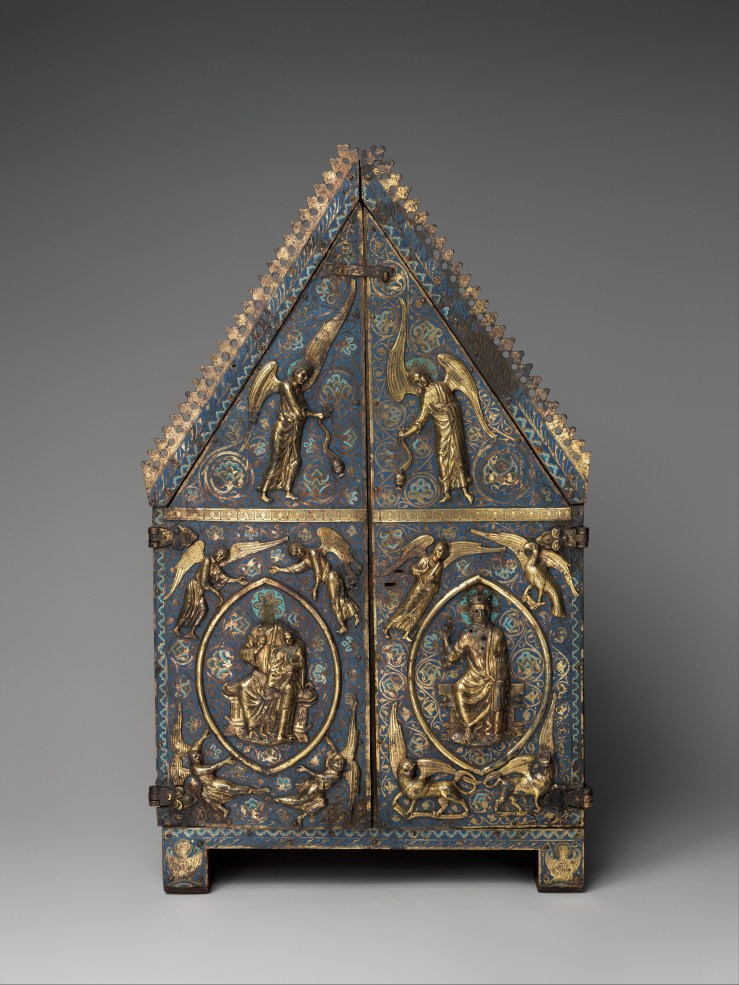
Closed view (the Virgin’s head is missing)
Standing on short legs, the tabernacle is in the form of a gabled cupboard with hinged doors. Gilded repoussé figures are applied to copper plates decorated with enameled foliate ornament. On the outside of the proper left door is the figure of Christ in Majesty, enthroned in a mandorla and surrounded by symbols of the evangelists. Opposite him on the proper right door is the Virgin with the Infant Jesus on her lap. She is framed within a mandorla and surrounded by four angels. Above them on the roof are two full-length angels, each holding a censer. Across the front runs a band of gilt copper inscribed with a decorative pattern derived from Kufic script, apparently based on the Arabic word yemen.
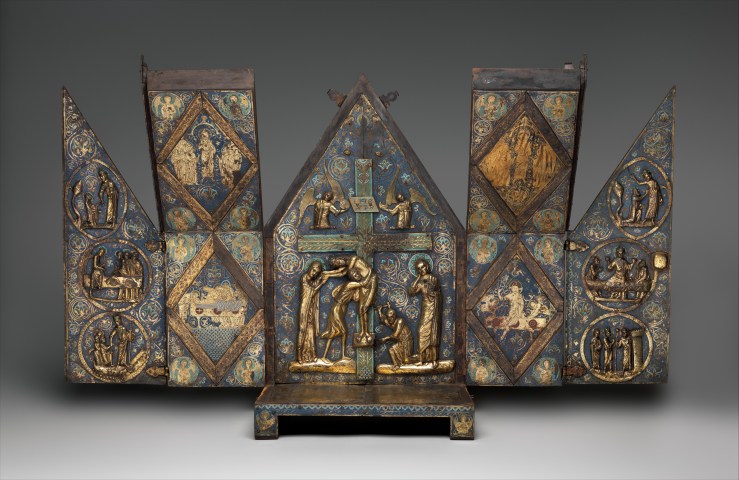
Overall, all wings completely open
At the center of the open tabernacle, against its back wall, are appliqué figures representing the Descent from the Cross. Joseph of Arimathea takes the torso of the dead Christ in the arms as Nicodemus uses pliers and a hammer to remove the nails that still hold Christ’s feet to the green-enameled cross. The Virgin takes her son’s hands in hers and gently pulls them to her cheek; Saint John looks on from the opposite side, his head resting in his hand. Above the arms of the cross, two half-length angels hold emblems of the sun and moon. The Hand of God appears at the top of the cross; another figure of an angel once stood over it.
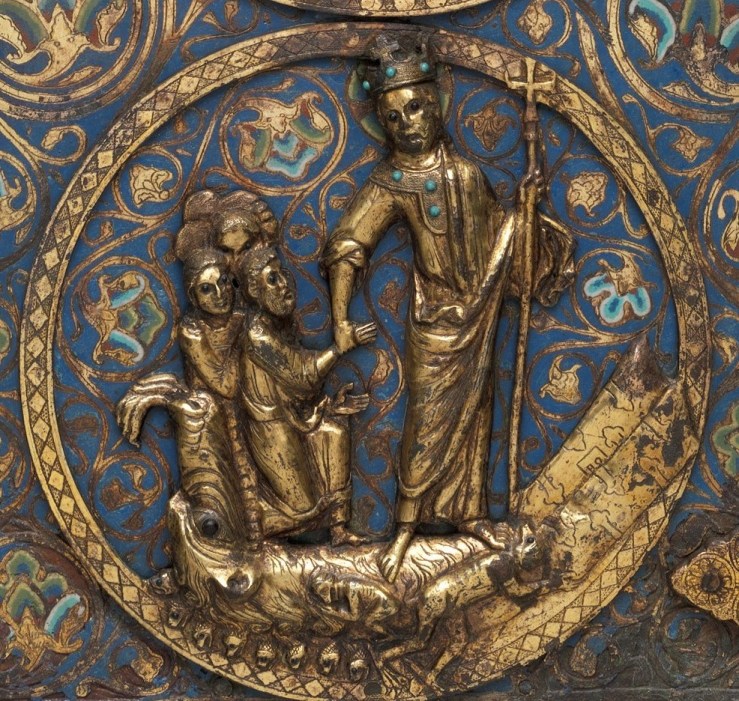
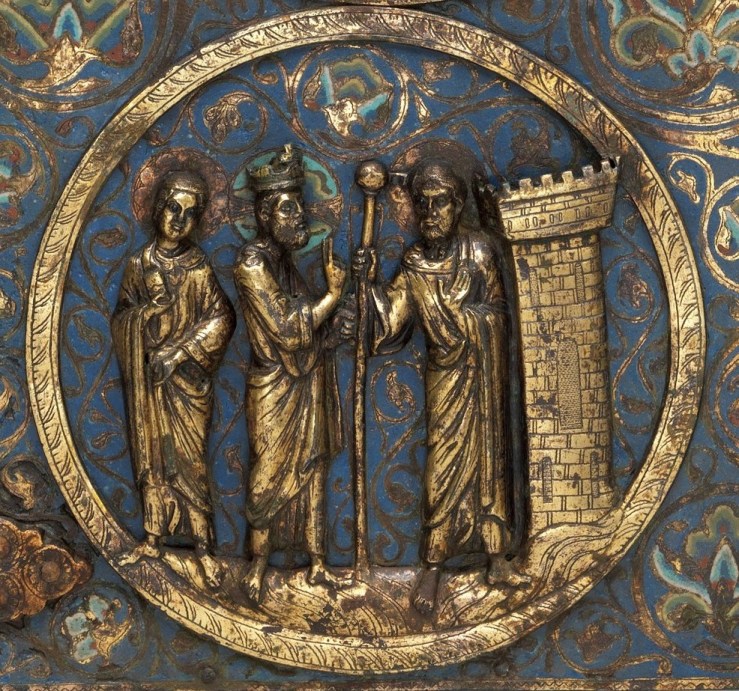
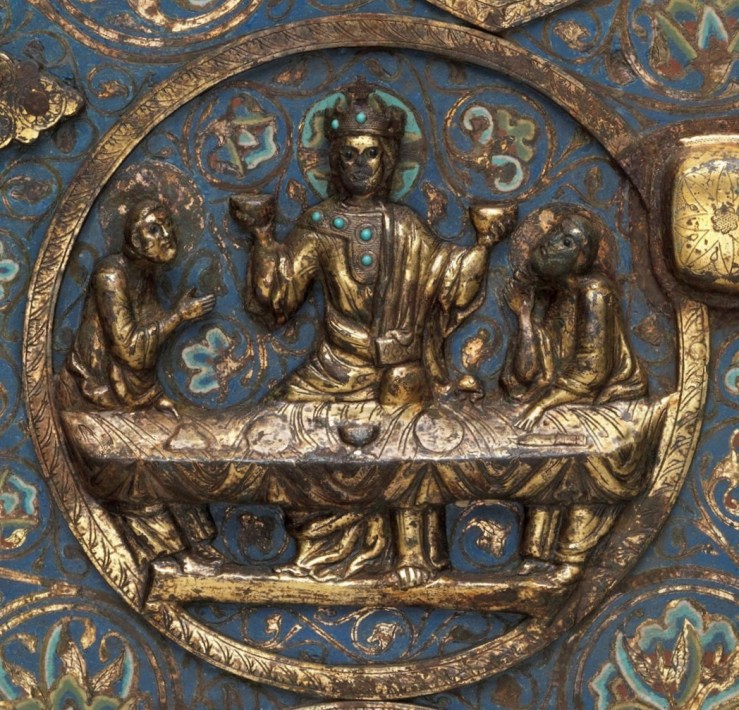
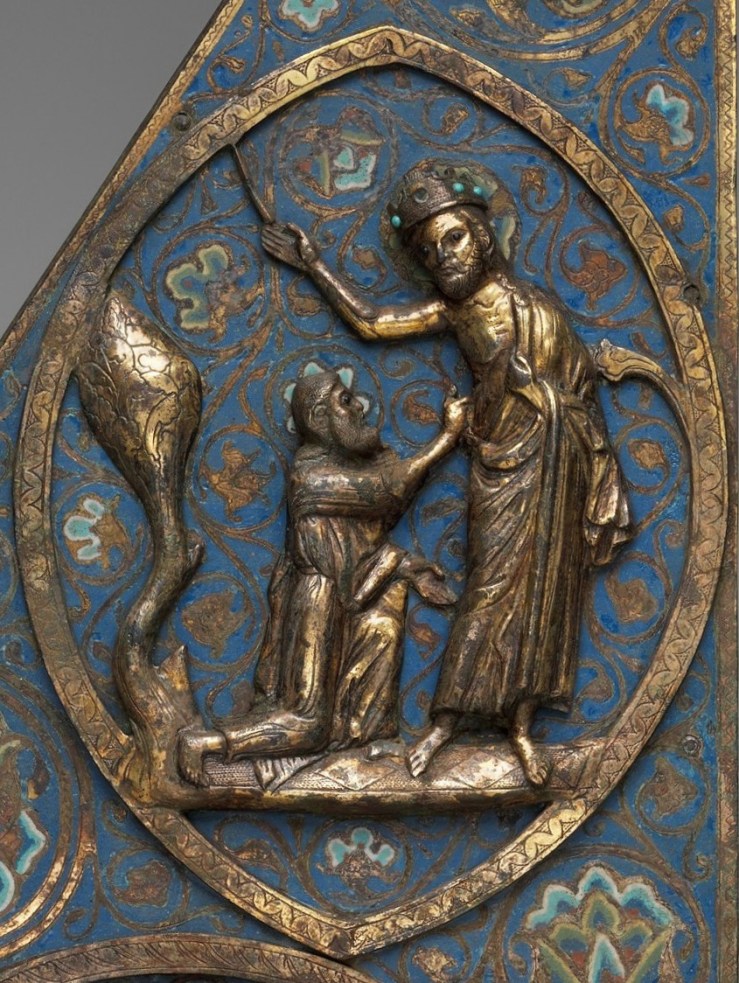
The Harrowing of HellThe Holy Women at the Tomb“Noli me tangere” (The risen Christ appears to Mary Magdalene)The Road to EmmausThe Supper at EmmausThe Incredulity of Saint Thomas
On the insides of the doors are openwork medallions recounting the events that followed the Crucifixion, reading from lower left to upper right. The first is the Descent into Limbo, a nonscriptural image of Jesus leading souls by the hand out of the mouth of Hell, which is seen as the gaping mouth of a dragonlike beast. Set above it is the scene of the Holy Women arriving at the tomb of Jesus on Easter Sunday. Following the account in the Gospel of Mark (16:1), they bear jars of unguent to anoint the body and are greeted by a man, seen here as winged, who informs them that Jesus has risen. In the almond-shaped medallion above, Mary Magdalen meets the risen Christ in the garden (Mark 16:9; John 20:14–18), where he backs away and advises her not to touch him yet. At the lower right, the apostles on the road outside the walls of Emmaus (Luke 24:13–35) are greeted by Jesus, attired as a pilgrim; in the roundel above, they dine with him at Emmaus and realize who he is when he breaks bread with them. In the oval at the upper right, Saint Thomas (Doubting Thomas) touches the wound in Jesus’ side and is convinced of his Resurrection (John 20:24–29).
The EntombmentThe ResurrectionThe Ascension
The interior side panels of the tabernacle have large lozenges with engraved figurative scenes framed at the corners by triangular enamel plaques, each depicting an angel in a roundel. At the lower left is the Entombment of Christ; at the upper left is the Ascension. At the lower right, Christ emerges from his tomb, with angels at either side. The base of the cupboard is covered with sheets of gilt copper depicting angels in roundels.
The tabernacle of Cherves is remarkable for its iconographic sophistication and for the dialogue established compositionally and visually between thematically related scenes. On the insides of the doors, Jesus guides souls out of the mouth of Hell at the lower left; at the lower right, he guides the apostles on the journey to Emmaus. On the center left roundel, the Holy Women seek Jesus’ body and find it gone; on the center right roundel, Jesus offers his body to the apostles in the sacrament of bread and wine. At the upper left, he tells the Magdalen it is too soon to touch him; at the upper right, he invites Thomas to touch his wound. In the inside lozenge at the left, Jesus is lowered into his tomb; at the right, he rises from it. At the upper left, he leaves his apostles and rises to heaven; at the upper right, the Holy Spirit descends from heaven on the apostles in a representation of Pentecost. [This latter scene is missing and has been replaced by a copy on paper or parchment of the Ascension image opposite it.]
The Descent from the Cross
The Descent from the Cross is both elegant and full of pathos, a masterpiece of Gothic relief sculpture. As such, it has rightly served as a point of comparison with works in other media, notably the ivory Descent from the Cross in the Louvre. A number of gilt-copper relief sculptures produced in the Limousin but now isolated from their original contexts can be compared with those on the Cherves tabernacle. Notable among these is the Descent from the Cross preserved in the Abegg-Stiftung, Bern, first recorded in 1870. Most of these reliefs are presumed to come from altar frontals.
The enameled ground of the Cherves tabernacle, with its strong concentric circles of reserved gilt copper enclosing full fleurons, seems to anticipate the enameled plate of the tomb effigy of John of France of after 1248.
The identification of this enameled cupboard as a tabernacle for the consecrated Host has not been confirmed: the Church of the Middle Ages had no universal custom for the reservation of the Eucharistic bread or regulations requiring a tabernacle. Nor is there a wealth of comparative medieval examples. Only one other Limoges tabernacle of this type is known; it was acquired by the cathedral of Chartes in the nineteenth century, and its earlier history is not known. The supposition that the enameled cupboard from Cherves is a Eucharistic tabernacle is based on its resemblance in form to later tabernacles, its subject matter, and even the gilt-copper base plate which would allow an enclosed pyx to slide easily in and out.
Soon after its discovery in 1896, the tabernacle was presented to the Société archéologique de la Charente by Maurice d’Hauteville, a curator at Angoulême and son-in-law of Ferdinand de Roffignac, on whose property it was unearthed. He suggested that the treasure could have come from the Benedictine monastery of Fontdouce, founded in 1117. More recently it has been supposed that the treasure at Cherves comes from the Grandmontain foundation at Gandory, of which, unfortunately, there are no remains.
Since its discovery, the tabernacle of Cherves has been recognized as a masterpiece of Limoges work in the Gothic period. Part of a larger treasure, . . . it was exhibited successively at Poitiers, Brive, and Limoges, and then at the Musée de Cluny before being sent to Great Britain.
You can explore other champlevé enamels at the Met using its website’s advanced search function. If you wish to study the topic in more depth, the book I’ve quoted from is an excellent resource, featuring essays as well as photographs and descriptions of 157 objects not only from the Met’s collection but also from the Louvre and various other European and American museums, ecclesiastical institutions, and private collections. Click on the cover image to go to the book page.
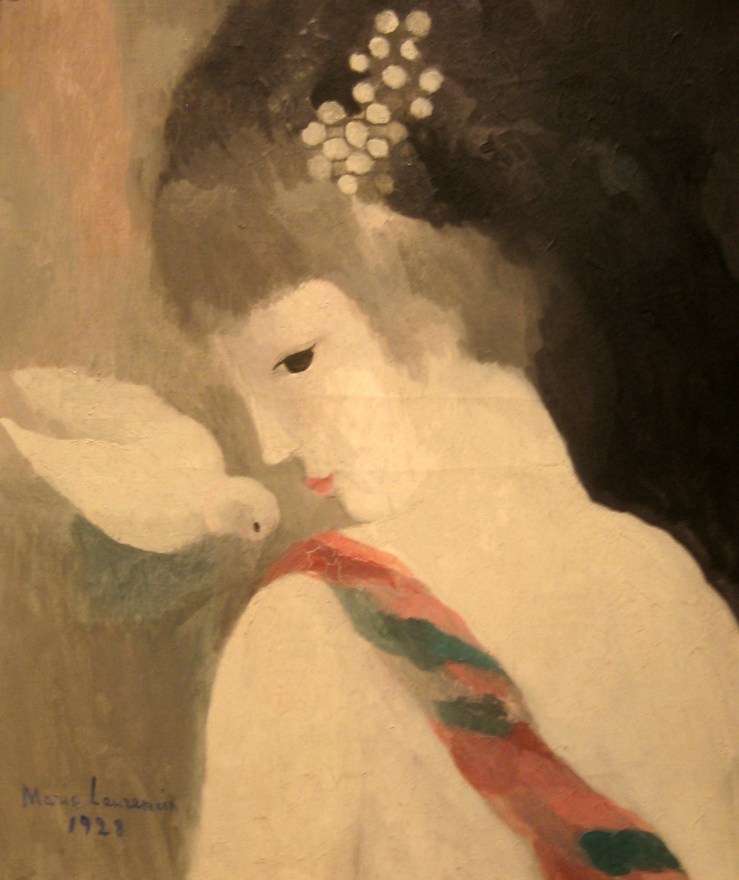
Marie Laurencin (French, 1885–1956), Girl with a Dove, 1928. Oil on linen, 46.3 × 38.4 cm (18 1/4 × 15 1/8 in.). National Gallery of Art, Washington, DC. Photo: Victoria Emily Jones.
“If you love me, you will keep my commandments. And I will ask the Father, and he will give you another Helper, to be with you forever, even the Spirit of truth, whom the world cannot receive, because it neither sees him nor knows him. You know him, for he dwells with you and will be in you.
“I will not leave you as orphans; I will come to you. Yet a little while and the world will see me no more, but you will see me. Because I live, you also will live. In that day you will know that I am in my Father, and you in me, and I in you. Whoever has my commandments and keeps them, he it is who loves me. And he who loves me will be loved by my Father, and I will love him and manifest myself to him.”
This post belongs to the weekly series Artful Devotion. If you can’t view the music player in your email or RSS reader, try opening the post in your browser.
To view all the Revised Common Lectionary scripture readings for the Sixth Sunday of Easter, cycle A, click here.
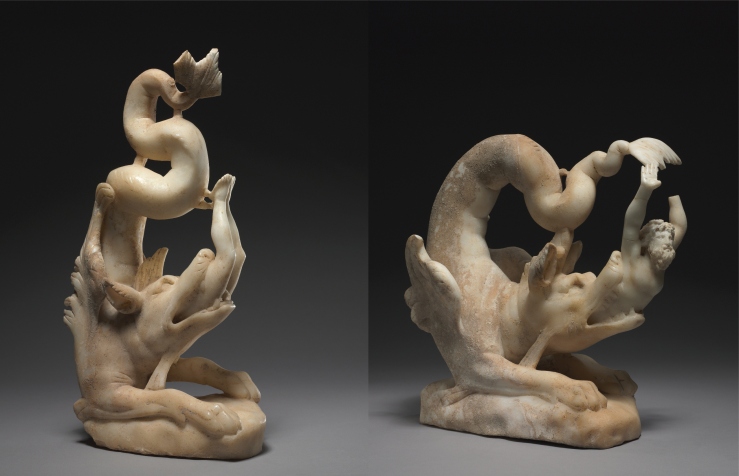
Jonah Swallowed and Jonah Cast Up, commentary by Victoria Emily Jones: My latest visual meditation for ArtWay was published Sunday—it’s on two third-century Jonah sculptures from Asia Minor that likely decorated a family fountain. Early Christians read the story allegorically (at least on one level), as pointing forward to the death and resurrection of Christ. The “great fish” is portrayed as a ketos, a sea-monster of Greek myth.
“Jonah Swallowed” and “Jonah Cast Up,” made in Asia Minor, probably Phrygia, 280–90 CE. Marble, 50.4 × 15.5 × 26.9 cm (left) and 41.5 × 36 × 18.5 cm (right). Cleveland Museum of Art, Ohio.
Run by Marleen Hengelaar-Rookmaaker, the faith-based website ArtWay has been publishing a new visual meditation every Sunday for years, as well as a lot of other content from a variety of contributors. To subscribe to the weekly email, click here. Here are just a few VMs published in the past year that I particularly enjoyed:
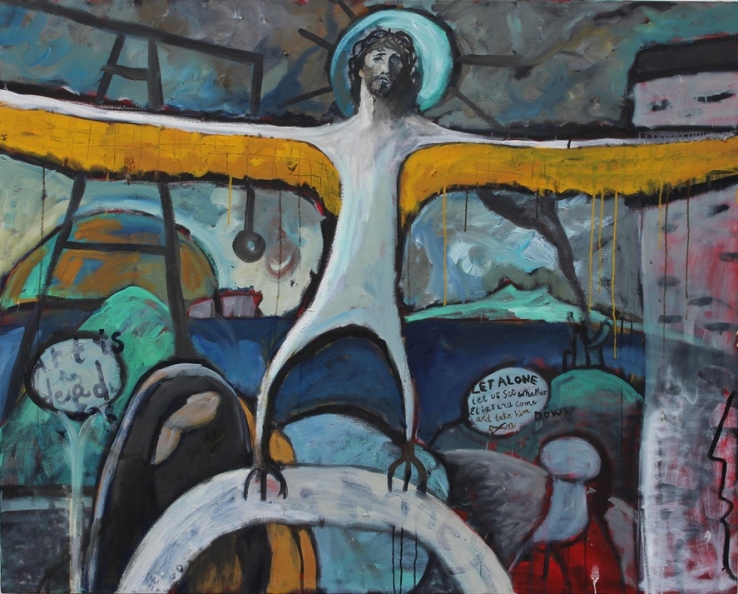
Manu-Kahu by Brett a’Court, commentary by Rod Pattenden: Pattenden begins, “This striking image of an airborne Christ is from New Zealand painter Brett a’Court. It is part of his investigations into a way of bringing together the spiritual insights of the indigenous culture of the Maori people and that of Christianity brought to New Zealand by British settlers. In cultural terms it is a hybrid image. This is something that occurs when two cultures are in a process of mutual re-assessment. That sort of conversation is full of conflict and critique but also allows for the potential for new forms to arise that express the best of both traditions. A Christ figure flying in the sky like a kite, is such a form. It is a new thing, a potential heresy or aberration, but one full of potential for new insight and spiritual refreshment.”
Brett a’Court (New Zealand, 1968–), Manu-Kahu, 2007. Oil on canvas.
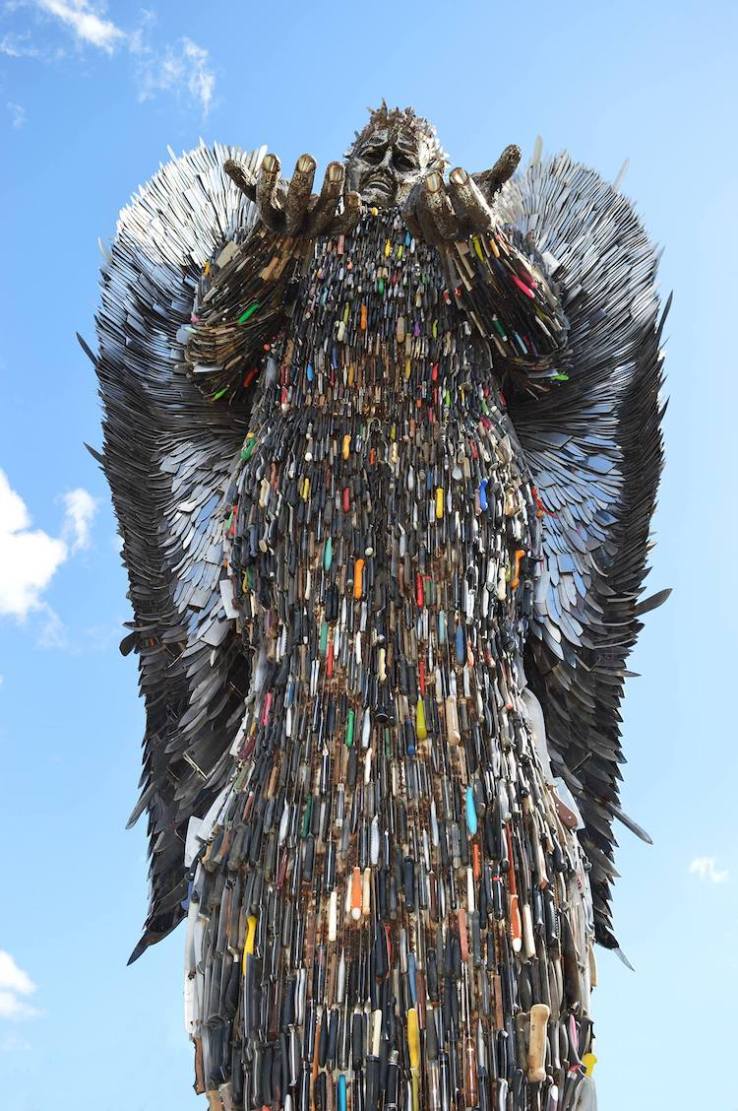
Knife Angel by Alfie Bradley, commentary by Rachel Wilkerson: This twenty-seven-foot-tall sculpture, welded from 100,000 knives collected in confiscations and amnesties around the UK, confronts the issue of knife violence. The artist cleaned and dulled the blade of each knife he received and engraved personal messages on all the wings’ “feathers,” messages sent by families affected by knife violence.
Cathedra by Barnett Newman, commentary by Grady van den Bosch: I saw this painting in Amsterdam last spring and was surprised by how it compelled me. (I don’t typically gravitate to abstract art.) After spending some time up close—I supposed this was a Newman, and Newman says his paintings need to be experienced up close—I looked at the label and saw that it has a religiously inflected title: Cathedra. The word is Latin for “seat,” and in Christianity it refers specifically to the bishop’s chair inside a church (churches that had a cathedra were called cathedrals). But Newman was of Jewish descent, and van den Bosch writes that Cathedra is meant to represent the throne of God. “And above the firmament that was over their heads was the likeness of a throne, as the appearance of a sapphire stone . . .” (Ezek. 1:26).
Barnett Newman (American, 1905–1970), Cathedra, 1951. Oil and acrylic on canvas, 243 × 543 cm. Stedelijk Museum, Amsterdam, Netherlands. Photo: Victoria Emily Jones.
As someone who loves historical Christian art, including its many Christ Pantocrators, I must nevertheless admit that there is something so right about modern artists’ often apophatic approach to evoking the Divine. While I do believe God imaged Godself in the person of Jesus Christ and is therefore representable, I understand the argument some make that abstraction is a better visual language for spiritual subject matter or encounter. I accept both/and. Whether God is shown as a rich, blue expanse that invites and envelops, or a heroic nude emerging from the jaws of death, or a Man of Sorrows head with a harrier hawk’s body, I think we can learn a little something from the diversity of representations, which are not mutually exclusive. Not all representations need be embraced, but nor do unfamiliar, difficult, or even shocking ones need be automatically dismissed.
Click on the link for more on how to read Newman’s color field paintings, including his signature “zips.”
The course aims to help Christians develop critical tools for watching television and a vocabulary that is as rich and thoughtful as the medium itself, so that we can engage it constructively. (It need not be mindless entertainment!) Callaway explores television as a technology, a narrative art form, a commodity, and a portal for our ritual lives. He’s interested in how stories are told in this episodic, audiovisual format, and what that means for the Story we tell. The course is not about what Christians should watch, but how Christians should watch, leaving ample room for individual viewers to set their own boundaries, ethical and otherwise. (Callaway acknowledges that TV can form as well as de-form us.) He discusses empathy building and access to other perspectives, knowing your sensibilities, how being offended can be useful, watching in community, seeing God in all places, being aware of how your desires and imagination are being shaped, Christians in Hollywood (and Christian characters on TV), and the culture shaping TV and TV shaping culture, among other things.
The course is fairly broad in its approach; it does not analyze particular shows or episodes, though some specific examples are mentioned in conversations, and students are encouraged to form discussion groups with friends or family members and apply what they’re learning to shows of their choice. I really appreciated the assigned PBS docuseries America in Primetime (somewhat outdated because made in 2011 but very good nonetheless), whose four episodes explore character types throughout the history of TV, from the fifties to today: “The Independent Woman,” “Man of the House,” “The Misfit,” and “The Crusader.” From taking this course I realized how many acclaimed TV shows I’ve never seen. I’ve got a lot of homework to do!
Other arts courses offered by Fuller Formation are
POEM: “My Mother’s Body” by Marie Howe, read with commentary by Pádraig Ó Tuama: As Mother’s Day is Sunday, I thought I’d share this wonderful, sad-sweet, mother-themed episode of the new Poetry Unbound podcast from On Being Studios. Pádraig Ó Tuama introduces Marie Howe’s “My Mother’s Body,” in which a middle-age woman, caring for her dying mother, thinks back to the time when her mother was just a twenty-four-year-old girl giving birth to her. The speaker in the poem is Howe.
She imagines being in her mother’s womb, experiencing the rhythm of her mother’s heartbeat. (What an exercise, to imagine yourself as your mother’s baby!) Now decades later, her mother is dying—that heart is failing, and the kidneys too. The uterus has been removed. Toggling between the two time frames, the poem is both a celebration of the strength of women’s bodies and a lament for its vulnerabilities, especially in old age. Howe marvels at how her mother’s body was capable of such a wonder as giving and sustaining life, and now to see that once-vibrant form breaking down grieves her. In some sense their roles have switched as daughter mothers mother, combing her hair, changing her soiled bedsheets.
The poem opens with “Bless my mother’s body” and ends with “Bless this body she made . . .” In the progression of pronouns in the last two lines—my, her, our—is a recognition of how our mothers always remain a physical part of us. They are in our cells. “My Mother’s Body” is a thank-you and a letting go.
ARTICLE: “5 Contemporary Poets Christians Should Read” by Mischa Willett:“There is so much good crop still being pulled from the fertile fields of theologically inflected verse,” writes poet Mischa Willett—so don’t stop short, content merely with Donne and Hopkins! This is an excellent short list of contemporary poets of faith, with summaries of key themes and recommendations for which volume(s) to start with. Willet was recently on The Ride Home with John and Kathy to discuss this topic, and he wrote a follow-up post on his blog.
+++
MUSIC VIDEO: “I Am a Poor Wayfaring Stranger”: One of the most poignant scenes in last year’s 1917 is when, after a harrowing journey across No Man’s Land, Lance Corporal William Schofield—exhausted, disoriented—reaches a wood and encounters a fellow British soldier singing the spiritual “Wayfaring Stranger” [previously] to a battalion that sits at somber attention, for they’re about to go into battle. This official music video from Sony splices together clips from the movie with studio footage of the actor and singer Jos Slovick.
Hiroshi Senju (Japanese, 1958–), Waterfall, 2016. Acrylic and fluorescent pigments on Japanese mulberry paper, 51 × 64 in. Photo courtesy of Sundaram Tagore Gallery.
With what deep murmurs through time’s silent stealth
Doth thy transparent, cool, and wat’ry wealth
                  Here flowing fall,
                  And chide, and call,
As if his liquid, loose retinue stayed
Ling’ring, and were of this steep place afraid,
                  The common pass
                  Where, clear as glass,
                  All must descend
                  Not to an end,
But quick’ned by this deep and rocky grave,
Rise to a longer course more bright and brave.

      Dear stream! dear bank! where often I
      Have sat, and pleased my pensive eye;
      Why, since each drop of thy quick store
      Runs thither, whence it flowed before,
      Should poor souls fear a shade or night,
      Who came, sure, from a sea of light?
      Or, since those drops are all sent back
      So sure to Thee, that none doth lack,
      Why should frail flesh doubt any more
      That what God takes He’ll not restore?

      O useful element and clear!
      My sacred wash and cleanser here;
      My first consigner unto those
      Fountains of life, where the Lamb goes!
      What sublime truths and wholesome themes
      Lodge in thy mystical, deep streams!
      Such as dull man can never find
      Unless that Spirit lead his mind,
      Which first upon thy face did move,
      And hatched all with his quick’ning love.
      As this loud brook’s incessant fall
      In streaming rings restagnates all,
      Which reach by course the bank, and then
      Are no more seen: just so pass men.
      O my invisible estate,
      My glorious liberty, still late!
      Thou art the channel my soul seeks,
      Not this with cataracts and creeks.
In “The Waterfall” by Henry Vaughan (1621–1695), a stream’s sudden surge and plummet over a precipice followed by a calm, continued flow is a picture of the soul’s passage into eternity—the continuation of life after death.
The speaker addresses the stream and its retinue of waters, who “murmur” and “chide”—that is, make incessant noise (in the word’s archaic sense). The waters move with increasing momentum toward the brink and hesitate just before but then take the plunge. Briefly brought under, in their “deep and rocky grave” they are “quickened,” made alive once more, as they rise back up to the surface and course smoothly onward, no longer in a state of agitation. After a momentary crash, serenity.
Vaughan represents this action visually with an alternation of groups of long lines and short lines, which give the impression of water tumbling over ledges of rock. The lines then steady out into a uniform column, signifying the water’s becoming sedate.
“Why,” the speaker wonders, “since each drop of thy quick store / Runs thither, whence it flowed before, / Should poor souls fear a shade or night, / Who came, sure, from a sea of light?” Death is benevolent, merely a drop-off along the route and then reconstitution to the whole. Just as the stream that has fallen returns to the vast ocean from whence (via the cycle of evaporation, condensation, precipitation) it came, so, too, does the soul return to God, its origin.
In the final stanza the speaker muses on water as sacrament—baptism, he says, is our “first consigner unto those / Fountains of life, where the Lamb goes” (see Rev. 7:17; cf. Isa. 49:10). In other words, our baptism gives us over to God, to the New Eden. If baptism is our first consigner, then death is our final consigner, bringing us at last to the One to whom we belong.
The profound mystical truth hidden in something as natural as a waterfall is discerned only by those whom the Spirit reveals it to—that same Spirit who hovered over the waters at Creation (Gen. 1:2) “[a]nd hatched all with his quick’ning love.”
I write this in memory of my husband Eric’s grandfather, who died Sunday. I’m consoled by the image of him as a water droplet whose plunge does not mean a cessation of being but rather a flowing into God, into “glorious liberty.” When water plunges down, it sends ripples toward the bank, Vaughan writes, but then settles into stillness and is imperceptibly carried away to a destination out of view. So Grandpa Jones is now on “a longer course more bright and brave,” flowing toward “a sea of light.”
Helen Siegl (Austrian, 1924–2009), Rejoice & Be Glad, 1974. Color woodcut, 30 × 30 cm. Edition of 50. Sacred Art Pilgrim Collection.
“Let not your hearts be troubled. Believe in God; believe also in me. In my Father’s house are many rooms. If it were not so, would I have told you that I go to prepare a place for you? And if I go and prepare a place for you, I will come again and will take you to myself, that where I am you may be also.”
—John 14:1–3
+++
SONG: “Come and Go with Me to My Father’s House” | Traditional African American | Performed under the musical direction of Dr. Markanthony Henry (on piano), with soloist Caterina Finocchi, at Iglesia Presbiteriana San Andrés (Saint Andrew’s Presbyterian Church) in Buenos Aires, Argentina, October 28, 2012
Art collector John A. Kohan has a wonderful biographical write-up about Helen Siegl on his website, Sacred Art Pilgrim—not to mention a select compilation of her art.
A devout Catholic all her life, Siegl was born in Vienna and was a teenager at the time of the Anschluss (the annexation of Austria to Nazi Germany). After the traumatic years of World War II and during the Soviet occupation of her home country, she emigrated to Canada in 1952. She got married and settled in Philadelphia, where her husband served as conservator of paintings at the Philadelphia Museum of Art. She raised eight children with him while also working as a printmaker—mostly woodcuts and linocuts. Her style blends elements of folk art and German expressionism, and her themes were often biblical.
This post belongs to the weekly series Artful Devotion. If you can’t view the music player in your email or RSS reader, try opening the post in your browser.
To view all the Revised Common Lectionary scripture readings for the Fifth Sunday of Easter, cycle A, click here.
“Maren” (Have Mercy on Us): The First Lady of Ethiopia, Zinash Tayachew, sings a new gospel song whose Amharic title, ማረን, transliterated “Maren,” means “Have mercy on us,” a plea addressed to God. “Do not abandon us during this time when the world is terrorized by bad news,” she sings. [HT: Global Christian Worship]
+++
Apocalyptic Lockdown Blues, a new EP by David Benjamin Blower: One of my favorite singer-songwriters, from Birmingham, England. “Apocalyptic Lockdown Blues is a small oral history of a global pandemic,” Blower writes. “This is folk, rootsy and ambient, with sacred longings, poetry and politics, sung out of windows and accompanied by birdsong.”
+++
“A Celtic Prayer”: Produced by Jonathan Estabrooks, this video features the choir of Fifth Avenue Presbyterian Church in New York City singing a traditional Celtic blessing set to music by Barry Peters. It begins, “May the Christ who walks on wounded feet walk with you on the road.”
+++
Virtual May Morning 2020: May Day, May 1, is a public holiday in England, and for the past five hundred-plus years it has been an Oxford tradition to kick off the celebration at dawn by having the Choir of Magdalen College sing unaccompanied in the Renaissance style from the top of the college’s bell tower. Typically a crowd of thousands gathers for May Morning along High Street and on Magdalen Bridge, but this year the event was canceled due to COVID-19. However, Magdalen College pulled off a virtual choir! The boy choristers and lay clerks recorded their parts from home, under the direction of Mark Williams, which were combined in a video that was released online at 6 a.m. local time. [HT: Joy Clarkson]
The choir sings “Hymnus Eucharisticus,” a seventeenth-century Trinitarian hymn, and “Now Is the Month of Maying,” an English ballett (a light, dancelike part song similar to a madrigal) from 1595, about lads and lasses frolicking in the grass. The prayer in the middle is led by the Rev. Dr. Andrew Bowyer, dean of divinity. The actual church bells did ring out the hour like usual, with a celebratory chime following the performance (the chimes in the video were prerecorded).
+++
“Doxology”: One of the things I miss most about communal (in-person) worship is singing the Doxology together with my church family each week. As part of his “Covers from an Empty House” series, Ben Rector has posted a contemplative rendition at the piano, which captures the sense of both mourning and hope that so characterizes this global moment. [HT: TGC Arts & Culture Newsletter]
+++
“I Know Who Holds Tomorrow”: This song was written by Ira Stanphill in 1950 following a painful divorce. It’s covered here by The Petersens, a family bluegrass group from Missouri.
+++
Scott Avett [previously] has been posting #emptylivingroomconcert videos on Instagram since the beginning of the year—just him and his guitar (or banjo) and a sixty-second time limit. Here are a few. (He’s the writer of all these songs, I’m assuming.)
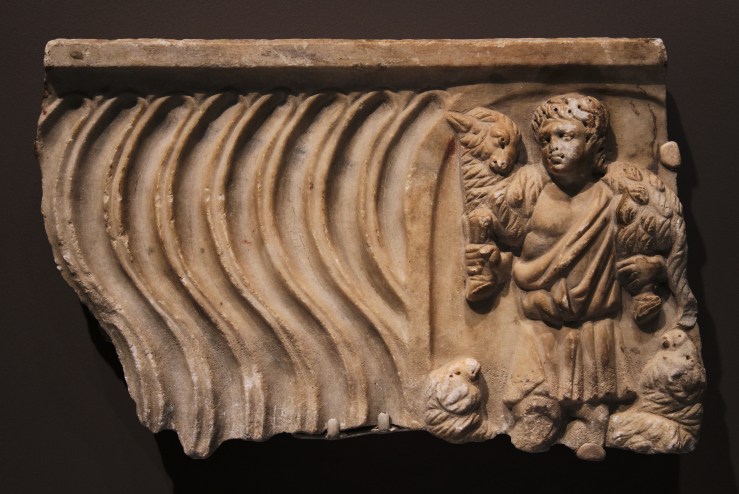
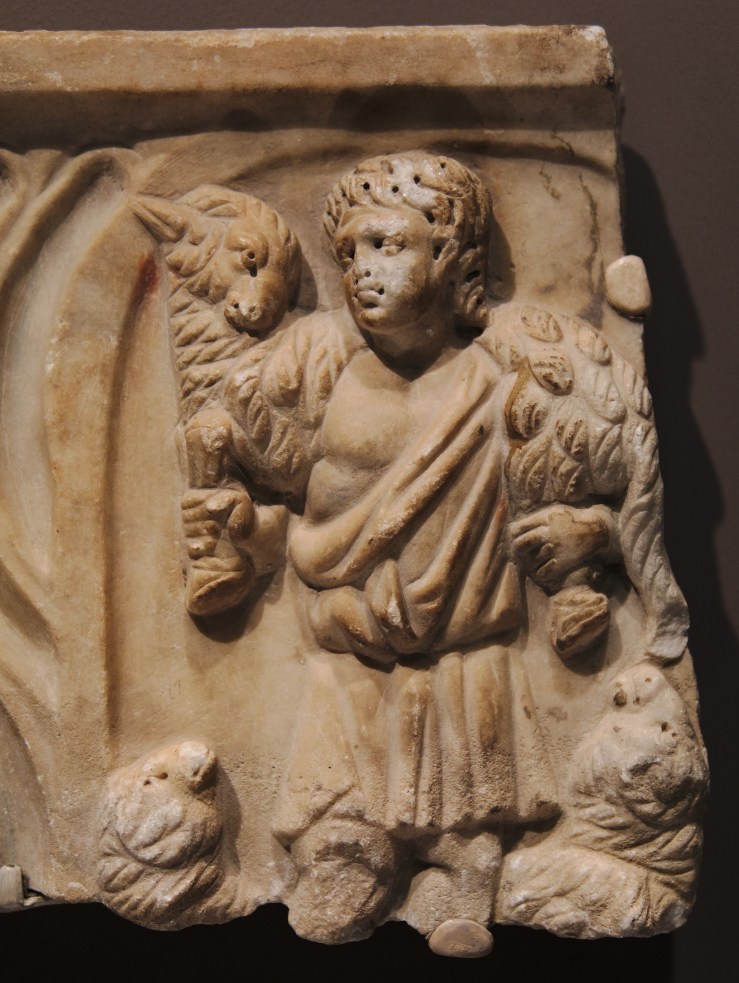
Sarcophagus Fragment with the Good Shepherd, Rome, early 4th century. Marble, 13 9/16 × 21 5/8 in. (34.5 × 55 cm). Walters Art Museum, Baltimore. Photo: Victoria Emily Jones.
God, my shepherd!
I don’t need a thing.
You have bedded me down in lush meadows,
you find me quiet pools to drink from.
True to your word,
you let me catch my breath
and send me in the right direction.
Even when the way goes through
Death Valley,
I’m not afraid
when you walk at my side.
Your trusty shepherd’s crook
makes me feel secure.
You serve me a six-course dinner
right in front of my enemies.
You revive my drooping head;
my cup brims with blessing.
Your beauty and love chase after me
every day of my life.
I’m back home in the house of God
for the rest of my life.
—Psalm 23 (MSG)
The King James Version’s translation of Psalm 23 from Hebrew into English is unsurpassable in terms of sheer poetic beauty, but since I’ve featured it here before and the words are so very familiar, I thought I’d shake things up a bit by giving Eugene Peterson’s contemporary translation.
The relief carving in this post is from a gallery of early Christian art at the Walters Art Museum in Baltimore, one of my favorite local hangouts. The museum label reads,
This fragment comes from a small Early Christian sarcophagus that was probably made for a child. At the right is a young shepherd, who carries a lamb over his shoulders as two sheep gaze up at him from below. The image of the Good Shepherd originated with the pagan Greek figure of Hermes (the gods’ messenger and ram-bearer) and was later transformed into Jesus as the Good Shepherd who watches over his flock.
SONG: “The King of Love My Shepherd Is” | Words by Sir Henry Williams Baker, 1868 | Music: Traditional Irish tune (ST. COLUMBA) | Arranged by Paul Terracini and performed by the Ars Nova Vocal Group, on Hymns of Our Forefathers, 2000
The King of love my shepherd is,
whose goodness faileth never.
I nothing lack if I am his,
and he is mine forever.
Where streams of living water flow,
my ransomed soul he leadeth;
and where the verdant pastures grow,
with food celestial feedeth.
Perverse and foolish, oft I strayed,
but yet in love he sought me;
and on his shoulder gently laid,
and home, rejoicing, brought me.
In death’s dark vale I fear no ill,
with thee, dear Lord, beside me;
thy rod and staff my comfort still,
thy cross before to guide me.
Thou spreadst a table in my sight;
thy unction grace bestoweth;
and oh, what transport of delight
from thy pure chalice floweth!
And so through all the length of days,
thy goodness faileth never;
Good Shepherd, may I sing thy praise
within thy house forever.
I chose this intricate a cappella SATB arrangement as the feature track for today, but for a solo female vocalist on acoustic guitar, see Taylor Tripodi:
Though “The King of Love” is most associated with the traditional Irish tune ST. COLUMBA, it is sometimes sung to a handful of others. Below you can hear it with a different traditional Irish tune (MCKEE), arranged by Harry T. Burleigh in 1939. Performed by Tyler Anthony (of Cereus Bright) and the musicians of Redeemer Knoxville, this peppier version appears on the 2011 Cardiphonia album Songs for the Supper:
This post belongs to the weekly series Artful Devotion. If you can’t view the music player in your email or RSS reader, try opening the post in your browser.
To view all the Revised Common Lectionary scripture readings for the Fourth Sunday of Easter, cycle A, click here.
Beneath the intricate network of noise
there’s a still more persistent tapestry
woven of whispers, murmurs and chants
It’s the heaving breath of the very earth
carrying along the prayer of all things:
trees, ants, stones, creeks and mountains alike
All giving silent thanks and remembrance
each moment, as a tug on a rosary bead
while we hurry past, heedless of the mysteries
And, yet, every secret wants to be told
every shy creature to approach and trust us
if we patiently listen, with all our senses.
“Breath” by Yahia Lababidi appears in Barely There: Short Poems (Wipf and Stock, 2013) and is used by permission of the publisher. Photograph by Don Komarechka, used with permission.
+++
Lately I’ve been delving into the writings of the Egyptian American poet, aphorist, and essayist Yahia Lababidi. I love his Barely There collection of poems on such topics as poetry / the poet, spiritual longing, virtue and vice, hope, surrender, the quiet beauty of nature, attention and gratitude, and pain as a gift. It’s such a wise and tender collection. His latest book, released last month, is Revolutions of the Heart: Literary, Cultural, and Spiritual.
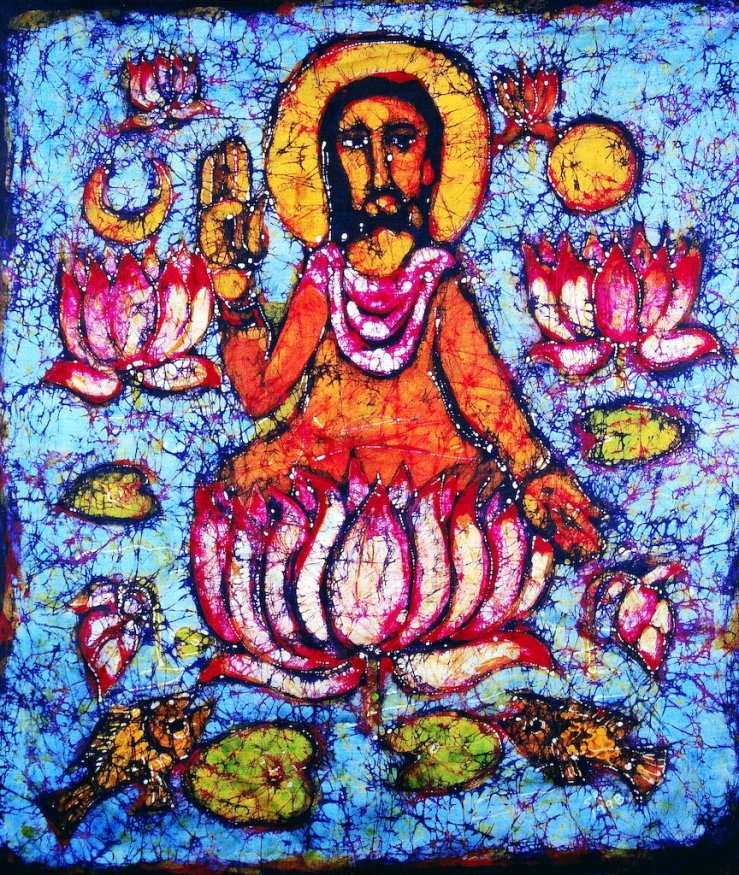
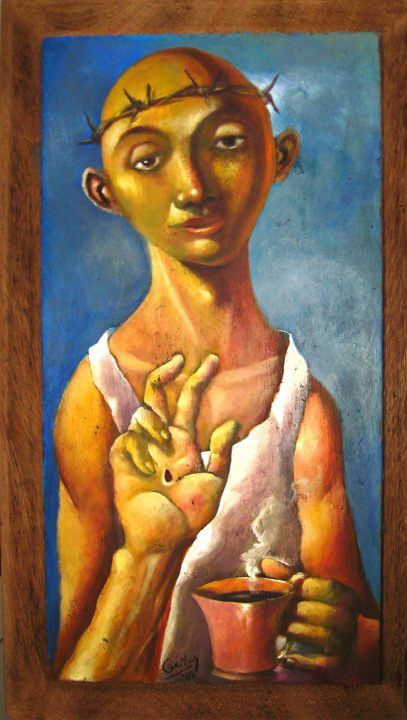
ARTICLE: “Searching for a Jesus Who Looks More Like Me” by Eric V. Copage: I was interviewed the other week for this New York Times piece on multiethnic images of Christ. I comment on paintings by Wisnu Sasongko (Indonesian), Greg Weatherby (Aboriginal Australian), Emmanuel Garibay (Filipino), and Solomon Raj (Indian), and helped select a few of the other images.
Solomon Raj (Indian, 1921–2019), Jesus on the Lotus Flower, 1998. Batik. Photo: Gudrun Löwner.Emmanuel Garibay (Filipino, 1962–), Untitled, 2007. Oil on wood. Photo via the artist.
Of those Christians who even permit images of Jesus, some hold to a strict literalism and object to images that show him as anything other than a first-century Jew from Israel-Palestine—even though these same literalists would rightly insist that no image is literally Jesus. As I hope is clear from my website, I embrace a wide range of Christological imagery, which I feel reflects the universal presence and revelation of God. (“Christ is all, and in all,” as the apostle Paul wrote in Colossians 3:11; he continues to manifest spiritually, and through his ecclesial body, all over the world.) I’m not so proud to assume that my way of picturing Jesus is the most right or authoritative; I need others to help me see Jesus more fully, more truly. Like C. S. Lewis said, “My own eyes are not enough for me, I will see through those of others.” And historical realism is not the only, or even necessarily the best (depends on context), art style to show who Jesus is.
Even though the historical Jesus never wore a full-face moko (tattoo) like the Maori, as Sofia Minson paints him, nor did he sit on a lotus flower when he taught his disciples, nor did he appear to Peter, James, and John transfigured between two Yoruba deities, these images and others like them tell us something about Jesus. At a broad level, they proclaim the Incarnation—God in flesh, dwelling among us, as us, that is, fully human. The historical Jesus existed in a specific time and place, and had ethnic particularities, but his coming was not just for the Jews but for the Gentiles too, and not just for his day, for but all time. Through symbol and metaphor and materiality, artists make this truth real.
+++
UPDATED BLOG POSTS
Occasionally if I’ve covered an art topic in the past and then come across a new image that fits that topic perfectly, I will add it as an addendum to the original post. I’ve done that with two Eastertide posts.
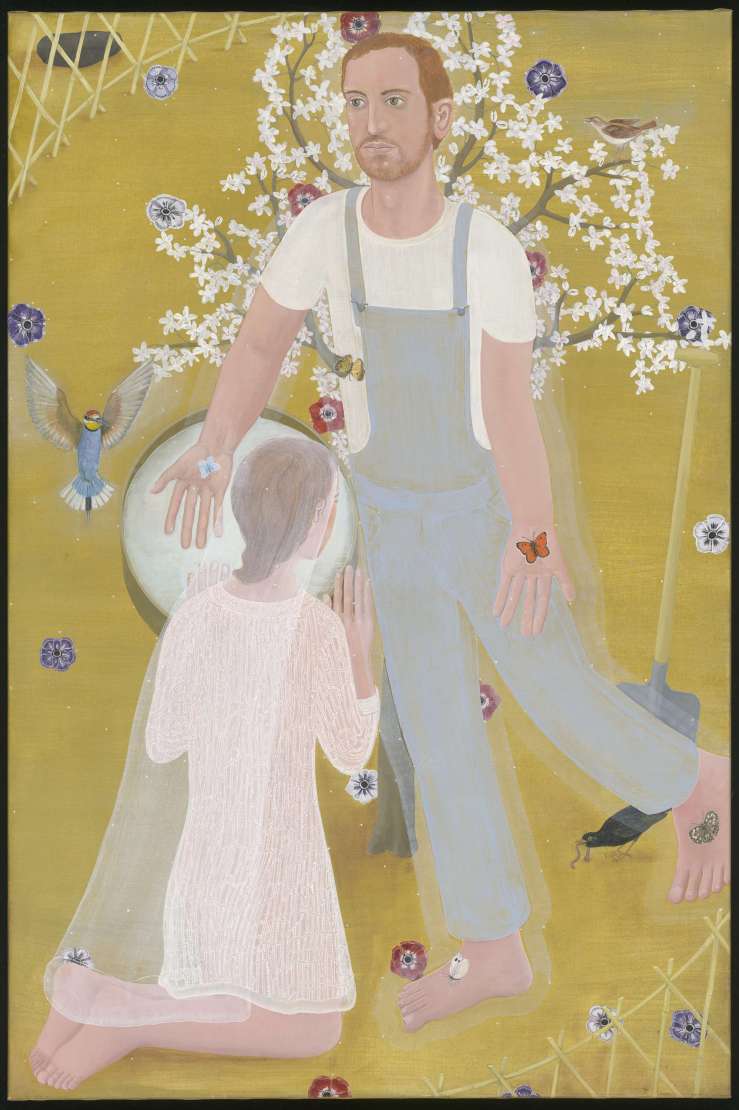
“‘She mistook him for the gardener’”: Humanity was born in a garden and reborn in a garden, as biblical scholars like N. T. Wright are keen to point out, with Easter morning marking the launch of new creation. In art history the resurrected Christ is sometimes amusingly shown carrying gardening tools when he encounters Mary Magdalene outside his tomb—to explain the case of mistaken identity that John records, perhaps, but more likely to establish a metaphor. Two of the paintings I’ve added to this post are by Janpeter Muilwijk, whose New Gardener from 2017 shows the freshly risen Christ in a white T-shirt and overalls, heading with open arms toward Mary, who is dressed like a bride to receive him. (Mary is modeled after the artist’s daughter Mattia, who died.) Butterflies alight on each of Jesus’s five wounds, marking them as sites of transformation, and the flowering branches of a tree crown him with spring glory.
Janpeter Muilwijk (Dutch, 1960–), New Gardener, 2017. Oil on canvas, 150 × 100 cm. Private collection, Netherlands.
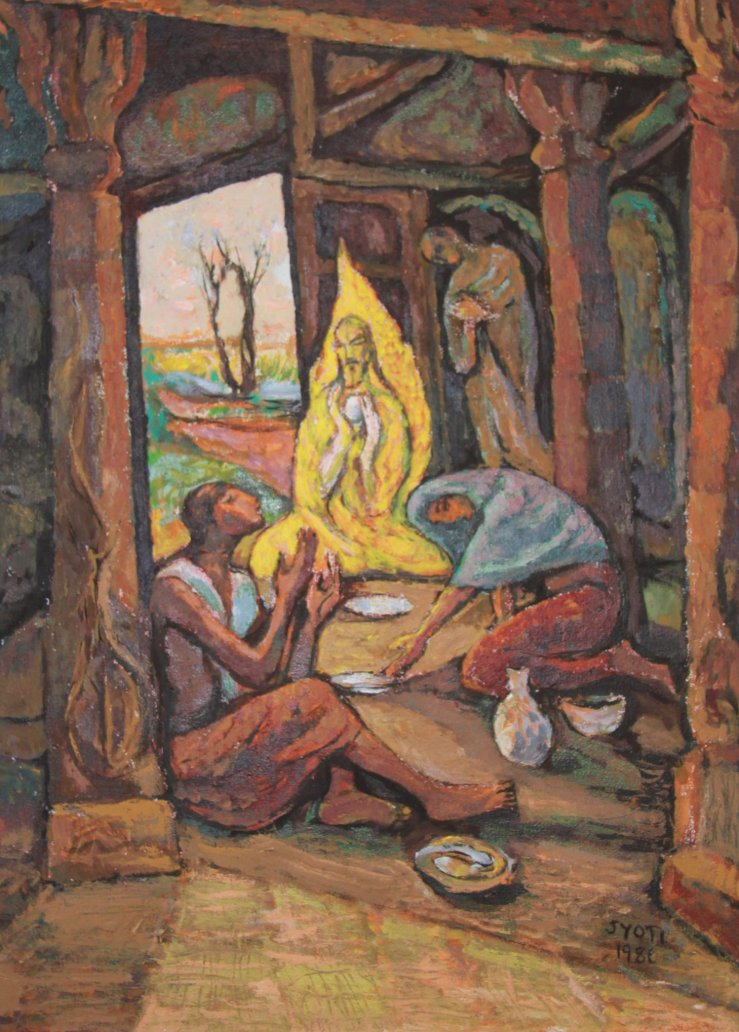
“The Unnamed Emmaus Disciple: Mary, wife of Cleopas?”: Written in 2017, this is one of Art & Theology’s most visited posts. In it I conjecture that the pilgrim who traveled with Cleopas from Jerusalem to Emmaus in the famous Easter story could have been a woman, perhaps Cleopas’s wife. Several artists have conjectured the same, and besides adding to this compilation three Emmaus paintings that the artist Maximino Cerezo Barredo sent me after the initial publication, I’ve also added one by Jyoti Sahi, which shows Jesus sitting with the two disciples—one male, one female—on the floor of a small roadside dwelling, breaking chapati (Indian flatbread) together. He is ablaze with glory, evoking his earlier revelations as I AM in the burning bush before Moses and to Peter, James, and John on Mount Tabor at the Transfiguration.
Jyoti Sahi (Indian, 1944–), The Supper at Emmaus, 1980. Mixed media on canvas. Photo courtesy of the artist.
+++
NEW SONGS
“A Bedtime Song for Anxious Children” by W. David O. Taylor and Paul Zach:David Taylor has written a new children’s song (set to music by Paul Zach), which he sings here with his daughter, Blythe. The lyrics are in the video description on YouTube.
“I’ve heard from so many parents recently that their children are struggling with anxiety, fear, frustration, sadness, anger, and restlessness,” Taylor writes, “and so I thought a little song reassuring them of God’s care at night, when they’re most vulnerable, might help their hearts. Our hope is that the melody might be simple enough for parents and children to be able to sing it when they go to bed.”
“See the Day” by Liz Vice: One of my favorite singers, Liz Vice, released a new single on April 10, called “See the Day.” Cowritten by her, Leslie Jordan, and Jonathan Day, it expresses hope for the coming day of the Lord, when justice will roll down like a mighty river, walls of division will crumble into dust, oppression will cease, and the whole world will be startled awake by love. “Precious Lord, come lead us on” to that reality.
+++
NEW ALBUM: Easter 1 by Mac Meador: Mac Meador, a singer-songwriter from Austin, Texas, released a new EP of six songs for Eastertide this April, a sort of flip side to the Lent 1 EP he released in February. I really enjoyed them both (and the same goes for his Summer of Psalms from 2018). The Easter album strikes just the right note for me right now—of a quiet hope and joy that’s not absent of pain. The songs celebrate Christ the risen king while also expressing longing for the age to come, when the kingdom will be established in full. Lean into that promise!
You can stream and purchase Meador’s music on Bandcamp. (Note: To help musicians affected by COVID-19, Bandcamp is waiving its cut of all sales made on its site on May 1.) You might also want to check out his YouTube channel, where he posts additional songs. For the past four weeks he has been releasing “Quarantine Hymn Sing” lyric videos for his church, Grace + Peace Austin, where he serves as minister of music. (He also sets Bible memory verses to music for kids!)
+++
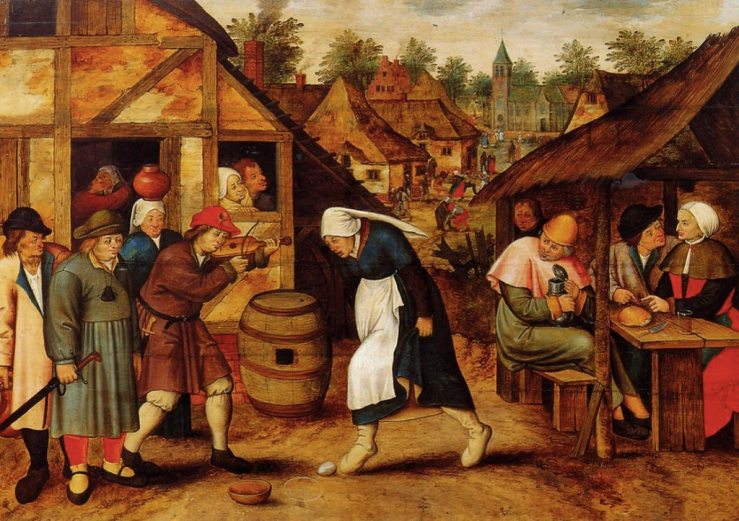
EGG DANCING: “The Egg Dance: From Peasant Village to Political Caricature”: The Public Domain Review has compiled an amusing gallery of historical paintings, drawings, and prints that show the egg dance, a traditional Easter game with several variations, most associated with western European peasantry of the sixteenth and seventeenth centuries.
Pieter Brueghel the Younger (Flemish, 1564/65–1637/38), The Egg Dance, ca. 1620. Oil on panel, 26 1/4 × 41 1/4 in. (66.7 × 104.8 cm).
+++
ART VIDEO:“500 Years of the Herrenberg Altarpiece”: I love seeing all the fun, creative resources being produced by art museums to help educate and engage the public in viewing art. Though I speak not a lick of German, this video from the Staatsgalerie Stuttgart about Jörg (Jerg) Ratgeb’s Herrenberg Altarpiece made me laugh and had me hooked for its full five minutes. (I came across it when I was prepping a Holy Week blog post that features a different painting attributed to the same artist.) Released last October for the five hundredth anniversary of the altarpiece, the video, directed by Valentin Hennig and Oleg Kauz, animates some of the birds from the painted panels and has them narrate as the camera zooms in on details (one of them quite jarring and unseemly!). They then fly through the museum hall and over the town some twenty miles southwest to the church where the piece originally stood.
To add autogenerated subtitles, click the “CC” (closed captioning) button on the bottom of the video player, then select your language using the gear icon.
Painted in 1519, this double-winged altarpiece was commissioned by the Brethren of the Common Life, a Catholic pietist community, for the high altar of the collegiate church of Herrenberg in Swabia. Closed, it shows the apostles about to set out on their mission to spread the word of God. The first open view (interior panels closed, exterior wings folded out) reveals scenes from the passion of Christ, each panel with a primary scene in the foreground and a secondary scene in the background: the Last Supper with the Agony in the Garden, the Flagellation and Crowning with Thorns with the Ecce Homo (presentation to the crowd), the Crucifixion with the Carrying of the Cross and the Entombment, and the Resurrection with the Noli me tangere (appearance to Mary Magdalene). Completely opened (its feast-day configuration), the altarpiece shows scenes from the infancy of Christ, with reference also to the life of the Virgin Mary. It used to have a central Marian statue and predella figures, but these were likely destroyed when the Protestant Reformation came to Württemberg in 1534.
The artist had already died by this time—he was executed (drawn and quartered) for treason in 1526 for his role as one of the leaders of the German Peasants’ Rebellion.