Easter, Day 8: We Walk His Way

LOOK: The Resurrection by Severino Blanco
Blanco, Severino_Resurrection
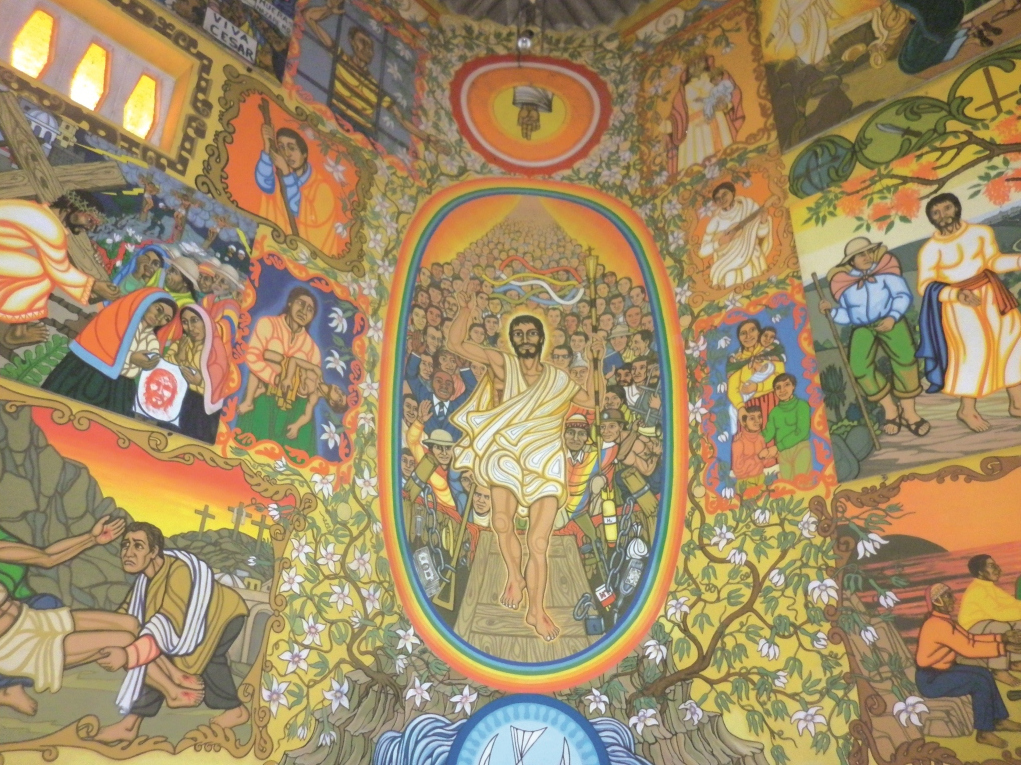
Severino Blanco (Quechua, 1951–2020), The Resurrection, ca. 1984. Mural, Casa del Catequista (CADECA) Chapel, Cochabamba, Bolivia.

Severino Blanco (1951–2020) [previously] was a Quechua Christian artist from Ayopaya, Bolivia. His magnum opus is an extensive cycle of biblical paintings inside the chapel of the Casa del Catechista (CADECA) in Cochabamba, a center for training catechists (lay Catholic missionaries) and pastoral leaders to serve the sixty villages in the city’s archdiocese.

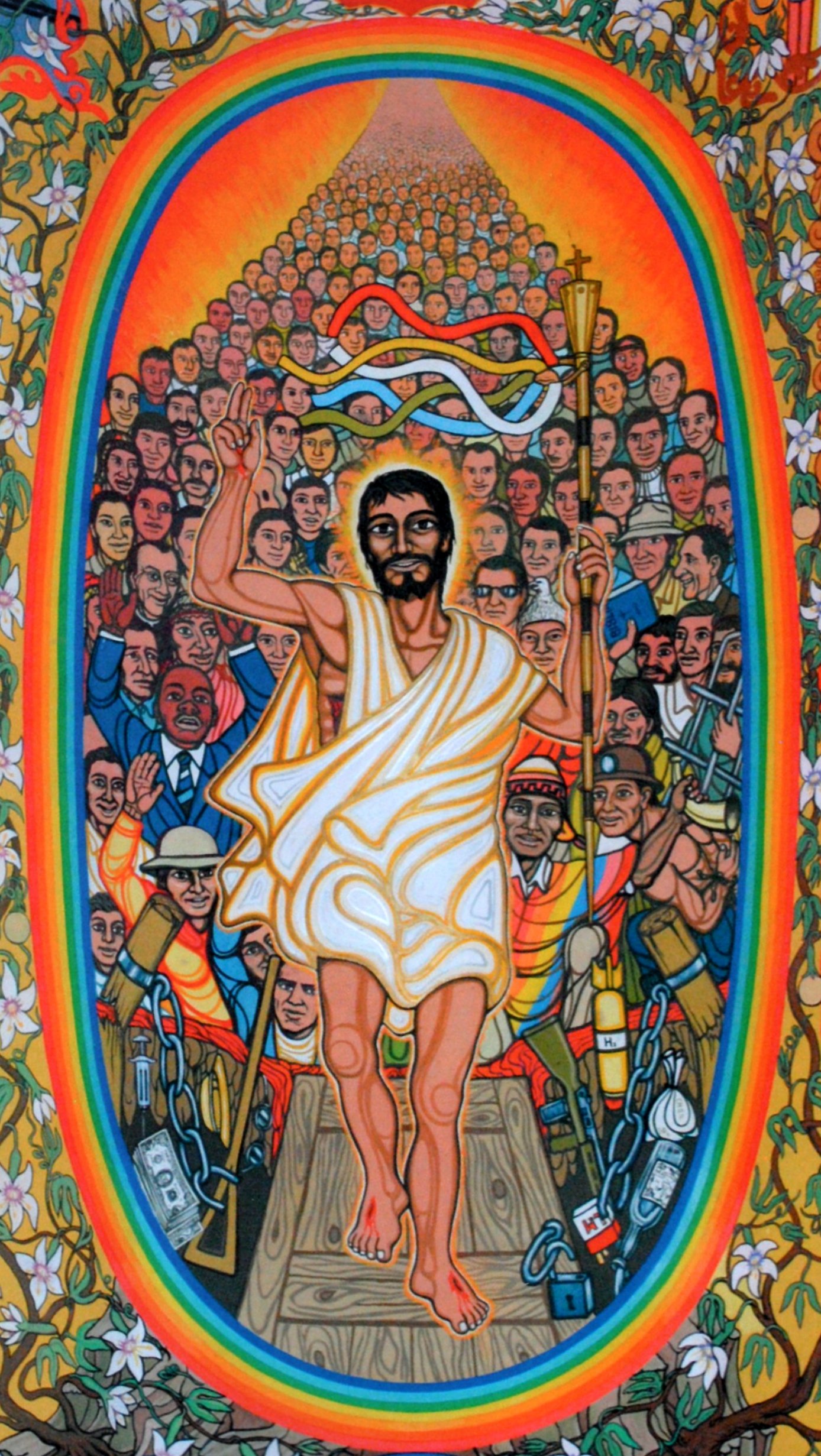
The centerpiece of the mural is an image of the risen Christ breaking through the chains of hell, trampling down its gates and leading an exodus of departed saints into new life. I can spot Rev. Dr. Martin Luther King Jr. of the United States and Archbishop Óscar Romero of El Salvador, martyrs of the faith, and I’m sure there are many other Latin American Christian preachers and activists pictured—those who walk the way of liberation.
Blanco, Severino_Resurrection
Source: Von Befreiung und Erlösung: Bilder in CADECA Cochabamba/Bolivien (Missionskreis Ayopaya, 2012), p. 156

Barefoot and glowing, Jesus bears the puncture wounds from his crucifixion, but they are now glorified, and he holds high a cacique’s (Indigenous chief’s) staff, signifying his leadership. Beneath his feet are symbols of some of the hellish obsessions or addictions from which he frees us: a rifle and a hydrogen bomb (war and violence), money (greed, materialism), a needle and a liquor bottle (substance abuse). He walks through a rainbow-rimmed portal that frames him and his followers like an aureole and that is surrounded by flowering tree branches.

Above this vignette is the blessing hand of God the Father, and below is the Holy Spirit as dove, from whom issues forth streams of living water (see John 7:37–39). The presence of these two other persons of the Trinity emphasizes the Resurrection as a Trinitarian event.

This image is used on the cover of the German-language book Von Befreiung und Erlösung: Bilder in CADECA Cochabamba/Bolivien (Of Liberation and Redemption: Pictures in CADECA Cochabamba, Bolivia) by Alois Albrecht. The book features reproductions of the mural scenes alongside relevant Bible passages and texts by Latin American theologians and other members of the church.

One of the texts reproduced in the book is a letter from a Paraguayan base community to European Christians. (The date is not provided, nor is the original Spanish.) Here’s Google’s translation from the German:

Good people, our brothers and sisters in Europe!

Here as there, we celebrate Easter these days. How do you celebrate the feast of the resurrection of our suffering Lord, his passing from death to new life?

Here, the few rich people pass by the suffering of the poor. It is said of Jesus that he did not cling to his divinity as if it were a prize. But here, the few rich people plunder everything from the poor majority: bread, land, work, wages, health, housing, security.

How is passing over to a new life, like Easter, like resurrection, possible then? Are we not all brothers and sisters, you there and we here? Easter is an international affair.

Our situation has international roots and is caused by those who make decisions in the world, carry out plans, and in doing so forget us, the little brothers and sisters of the suffering and slain Jesus.

Easter is the feast of hopeful departure, of joyful new beginnings, of enthusiastic new life. But who among us feels anything of departure, joy, new beginnings, new life? Yes, hope—we have it! Easter is a feast of expectation; for whoever is always on the way also reaches their destination.

So, brothers and sisters! Despite everything, let us go our own way, you there and we here, in the light of Christ, the Lord raised to new life, to seek together equality and freedom for all.

We Paraguayans need you there, and not just your money, but above all your sure and loud voice against the ideology that enslaves and kills us all, us poor and you rich alike.

We all live in the same danger of death. But our risen Lord has also made us all his equal brothers and sisters. Please don’t forget that!

Arnoldo and friends and family

Another text is a selection from a document of the Third General Assembly of the Latin American Episcopate in Puebla, Mexico, in 1979. Again, Google Translate:

In fulfillment of the commission he received from his Father, Jesus voluntarily offered himself up to death on the cross, which was the goal of his life’s journey. As the bringer of the freedom and joy of the kingdom of God, he wanted to become the decisive sacrifice for injustice and evil in this world. On the cross, he takes upon himself the pain of creation and offers his life as a sacrifice for all.

In this way, he is the high priest who is able to share our weaknesses with us. He is the Easter sacrifice that redeems us from our sins. He is the obedient Son who, in the face of his Father’s redeeming justice, incarnates the cry for liberation and salvation of all people. . . .

Therefore, the Father raises his Son from the dead. He exalts him in glory to his right hand, pours out upon him the life-giving power of his Spirit, appoints him as head of his body, that is, the church, and confirms him as Lord of the world and of history.

Jesus’s resurrection is a sign and guarantee of the resurrection to which we are all called, as well as of the final transformation of the whole world. Through him and in him, the Father wished to re-create what he had already created.

Amen, and amen.

LISTEN: “We Walk His Way (Ewe Thina),” a South African freedom song from the apartheid era | Translated by Anders Nyberg, Jonas Johnson, and Sven-Bernhard Fast, 1984 | Arranged by John L. Bell and performed by the Wild Goose Collective on We Walk His Way: Shorter Songs for Worship, 2008

Refrain (Xhosa):
Ewe thina, ewe thina

Sizowa nyathela amadimoni
Ewe thina, ewa thina
Sizowa nyathela amadimoni
Ewe thina, ewa thina [Refrain]

Refrain (English):
We walk his way, we walk his way

Unarmed, he faces forces of demons and death
We walk his way, we walk his way
Unarmed, he faces forces of demons and death
We walk his way, we walk his way [Refrain]

He breaks the bonds of hell, dying on the cross
We walk his way, we walk his way
He breaks the bonds of hell, dying on the cross
We walk his way, we walk his way [Refrain]

The tree of freedom blooms by his empty grave
We walk his way, we walk his way
The tree of freedom blooms by his empty grave
We walk his way, we walk his way [Refrain]
Roundup: Bolivian Christian art, Ukrainian folk carol, and more

ART SERIES: Pallay: Andean Weaving of Liturgy and Design by Daniela Améstegui: Daniela Améstegui is a graphic designer from Cochabamba, Bolivia, who holds a master’s degree in theological studies from Regent College in Vancouver, with a specialization in Christianity and the arts. Her work “revolves around exploring faith, social justice, and Christian contextualization through design” and “reflects her commitment to using design as a tool for expressing and exploring theological concepts,” she says. She currently lives in Langley, British Columbia, with her husband and two young children, working as a freelancer.

Améstegui’s final Integrative Project in the Arts and Theology for her master’s program was Pallay: Andean Weaving of Liturgy and Design, a series of seven digital illustrations, one for each of the major seasons/feasts of the liturgical year: Advent, Christmas, Epiphany, Lent, Easter, Pentecost, and Ordinary Time. The designs are inspired by Andean textile art and culture. You can view the full series at the link above from Regent College’s Dal Schindell Gallery, where the works were first exhibited in early 2022, but also listen to this wonderful online talk Améstegui gave about Pallay in 2020 for INFEMIT’s Stott-Bediako Forum, where she discusses not only her motivation and influences but also the content of each specific piece:

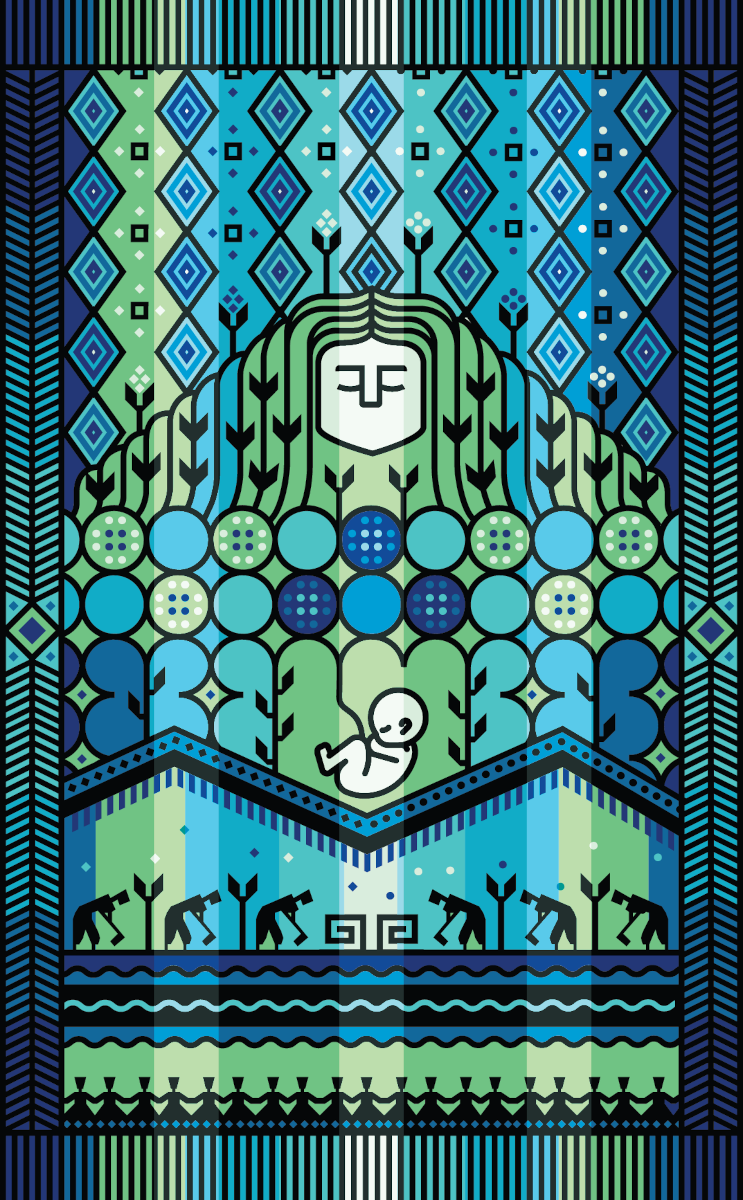
Whereas those of us in the northern hemisphere associate Advent with cold, darkness, and the onset of winter, in the southern hemisphere Advent falls in early summer, a time when the earth is most fertile and farmers plant their seeds. In her Advent design, Améstegui connects Mary carrying the seed of new life within her with Pachamama (Mother Earth).

Amestegui, Daniela_Advent
Daniela Améstegui (Bolivian, 1990–), Adviento (Advent), 2019–20, from the digital illustration series Pallay: Andean Weaving of Liturgy and Design. Used with permission.

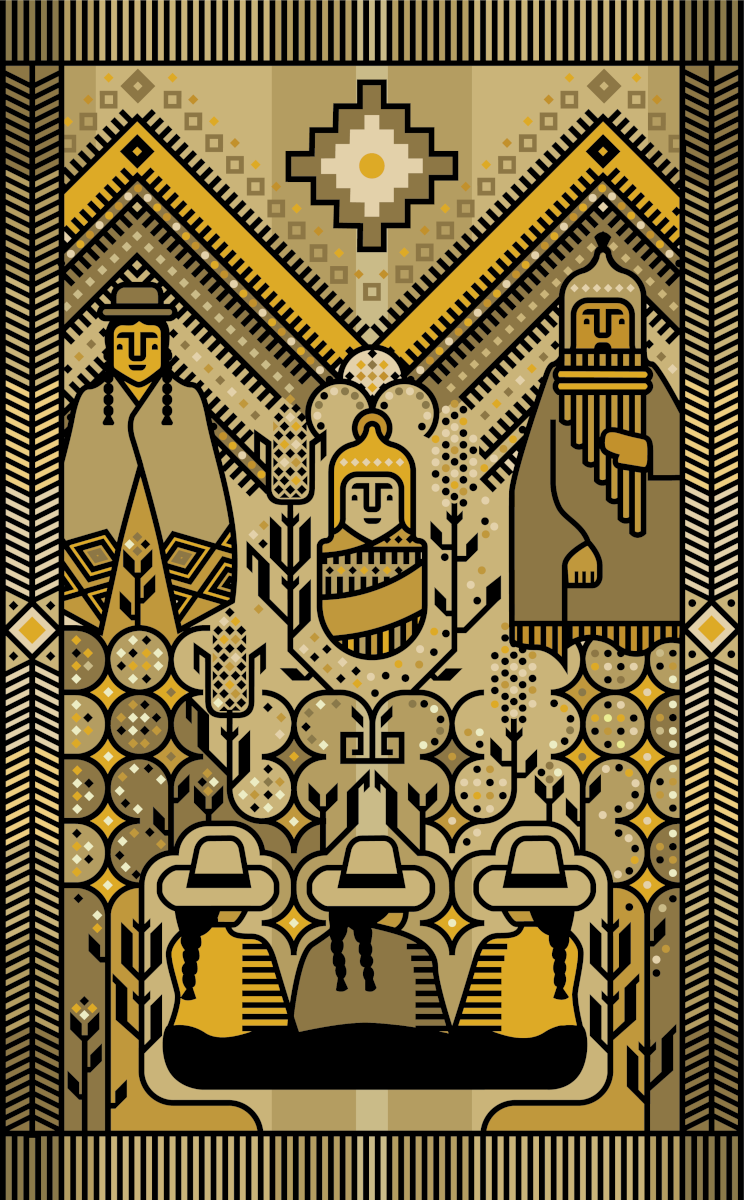
In Bolivia, Christmas takes place during a season of harvest, so in her Christmas design, Améstegui places Jesus in the center between crops of corn and quinoa, the two main agricultural foods cultivated in the country. Mary wears braids and a bowler hat and Joseph plays the zampoña (Andean panflute), and at the bottom three cholitas, Indigenous women from the Bolivian countryside, gather reverently to greet the Christ child.

Amestegui, Daniela_Christmas
Daniela Améstegui (Bolivian, 1990–), Navidad (Christmas), 2019–20, from the digital illustration series Pallay: Andean Weaving of Liturgy and Design. Used with permission.

Améstegui does not have a website just yet but tells me she plans to launch one in 2025. If you would like to purchase one or more of her Pallay pieces, you can contact her at daniela@amestegui.com.

Thank you to blog reader Nicole J. for alerting me to this striking series!

+++

VIDEO COLLECTION: Casa del Catequista (CADECA) chapel paintings: As chance would have it, the same week I learned about Daniela Améstegui’s work, a different blog reader, Mark M., emailed me a link to some videos his Langham Partnership colleague Paul Windsor took during a recent trip to Bolivia. They record the many paintings, most by the late Quechua artist Severino Blanco [previously], inside the chapel of CADECA in Cochabamba, a place where men and women are trained as Christian leaders who then go out to serve their rural communities. They portray scenes from the Old and New Testaments, the parables of Jesus, and Latin American church history, including a remarkable liberation theology–inspired Resurrection, in which Jesus breaks down the doors of death and hell, holding high a cacique’s staff and leading the people of Bolivia into their future. Here’s a 360-degree view captured by Windsor, but visit the boldface link to see additional videos that narrow in on particular portions.

Blanco, Severino_Nativity
Severino Blanco (Quechua [Bolivian], 1951–2020), Infancy of Christ painting cycle, 1985. Chapel of the Casa del Catequista (CADECA), Cochabamba, Bolivia.

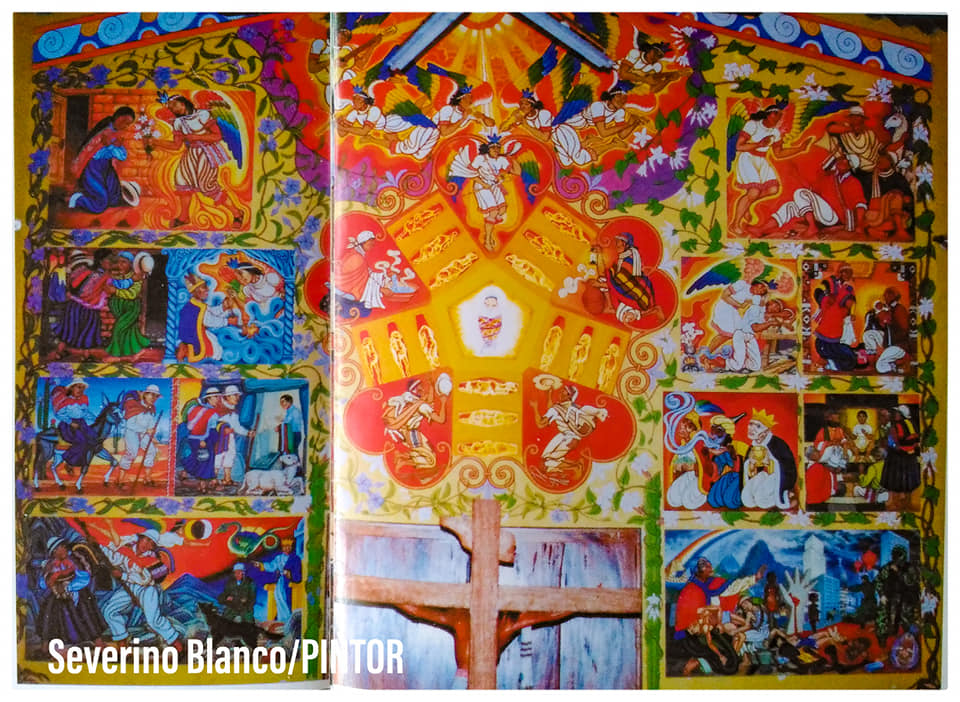
On the west end of the chapel (where people enter the space) is an Infancy of Christ cycle—reproduced here from a scan of a pamphlet, it appears. In the center is a Nativity, the Christ child painted over a pane of glass through which natural light comes gleaming in (see a closer view). The oblong shapes radiating out from the center are also glass, onto which the artist has (I think) etched lambs in various stages of prostration. On the sides, two villagers come with hot water and towels, and at the bottom two shepherds kneel before the Savior, removing their hats as a sign of respect. At the top, a host of angels with rainbow-colored wings and indigenous instruments sing Christ’s praises.

To the left of the Nativity are six scenes: (1) The Annunciation to Mary, (2) The Visitation, (3) The Annunciation to Zechariah, (4) The Journey to Bethlehem, (5) No Room at the Inn, and (6) The Flight to Egypt. To the right are (7) The Annunciation to the Shepherds, (8) The Annunciation to Joseph, (9) The Presentation in the Temple, (10) The Adoration of the Magi, (11) Jesus with the Scholars in the Temple, and (12) The Massacre of the Innocents.

+++

SONGS:

>> “Admirable Consejero” (Wonderful Counselor) by Santiago Benavides: Santiago Benavides is a Colombian singer-songwriter living in Toronto. On his Facebook page he describes his musical style as “trova-pop-bossa-carranga worship.” This song he wrote is a setting of Isaiah 9:2, 6–7 in Spanish. In the video, he’s the guitarist with the red-tinted glasses.

>> “The Word Became Flesh” by John Millea: John Millea is “a storyteller with a guitar,” singing in the tradition of Americana, folk, and gospel “about life and all of its joys, sorrows, and struggles.” He’s one of the artists I support through Patreon. This was the first song of his I encountered, and it’s one of my favorites, engaging with John 1:1–3, 14 in a wholly unique way!

In contrast to everyone and everything else in the universe, Millea explains, God had no beginning point, and all that is can in some way be traced back to him, the first link in a massive chain of cause and effect. So here Millea playfully traces his guitar all the way back to God—from the store he bought it at in Illinois, to the factory in Pennsylvania they ordered it from, to the mill in Washington that supplied the wood, to the Alaskan forests whence the tree was logged, and so on and so forth, imagining many thousands of years of fallen and dispersed tree seeds that traversed seas and continents, with an ultimate source in a tree planted in Eden by the Word of God.

When he hits on Eden, he starts moving forward again, through the story of creation, fall, and redemption in Christ, the divine beginningless One who graciously and mysteriously entered human history, born of a woman named Mary.

>> “Mary Had a Baby”: Arranged by Roland Carter, this African American spiritual is performed by the Nathaniel Dett Chorale, featuring the amazing mezzo-soprano Melissa Davis. It’s from their 2003 album An Indigo Christmas, the tracks taken from two live concerts given at the Church of St. George the Martyr in Toronto.

>> “Що то за предиво” (Shcho to za predyvo) (Behold a Miracle): This Ukrainian folk carol is performed by Trioda (Тріода), a musical group consisting of Andrii Gambal, Volodymyr Rybak, and Pavel Chervinskyi.

What is this awe-inspiring miracle?
There is great news on earth!
That the Virgin Mary gave birth to a son.
And upon birthing him, she declared,
“Jesus—my son!”

And the aging Joseph stands nearby in awe
Of Mary having given birth to a son.
And he prepares the swaddling for Jesus Christ.
And Mary swaddles him, and scoops him to her heart—
The pure Virgin Mary!

Trans. Joanna (Ivanka) Fuke [source]

My Eyes Have Seen (Artful Devotion)

Blanco, Severino_Simeon Blessing the Christ Child
Severino Blanco, Simeon Blessing the Christ Child, 1980s. Chapel of the Casa del Catequista (CADECA), Cochabamba, Bolivia. Image courtesy of Ayopaya Mission.

Now there was a man in Jerusalem, whose name was Simeon, and this man was righteous and devout, waiting for the consolation of Israel, and the Holy Spirit was upon him. And it had been revealed to him by the Holy Spirit that he would not see death before he had seen the Lord’s Christ. And he came in the Spirit into the temple, and when the parents brought in the child Jesus, to do for him according to the custom of the Law, he took him up in his arms and blessed God and said,

“Lord, now you are letting your servant depart in peace,
according to your word;
for my eyes have seen your salvation
that you have prepared in the presence of all peoples,
a light for revelation to the Gentiles,
and for glory to your people Israel.”

—Luke 2:25–32

+++

SONG: “You Send Your Servant Forth in Peace” by Steve Thorngate, on After the Longest Night: Songs for Advent, Christmas, and Epiphany (2018)

+++

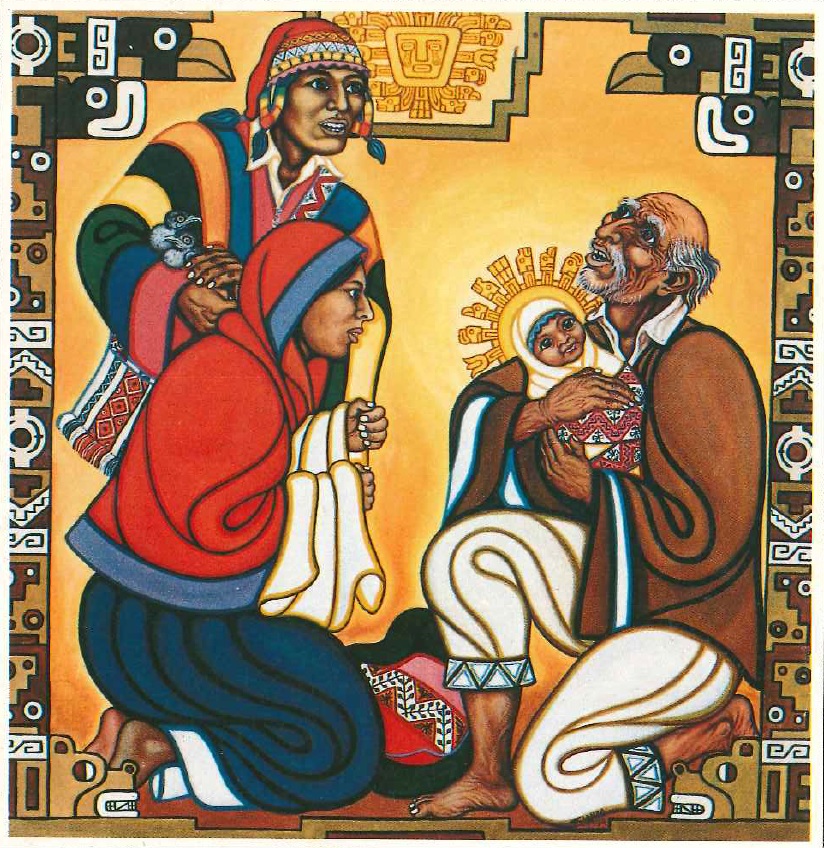
Severino Blanco is a Quechuan Christian artist from Cochabamba, Bolivia. In the early 1980s he was commissioned by Father Manfred Rauh (1932–2011), a Jesuit missionary from Germany who spent most of his priestly life in Bolivia, to create a Life of Christ painting cycle for the interior of the chapel of the Casa del Catequista (CADECA), a training center for catechists. To make the gospel story really come alive for the catechists, who are mostly Quechua and Aymara, Blanco chose to set it in an Andean context, with Jesus as an indigenous South American—fully human, fully immersed in history and culture, fully for them. The images are reproduced, with commentary, in the German-language book Von Befreiung und Erlösung: Bilder in CADECA Cochabamba/Bolivien (Of Liberation and Redemption: Pictures in CADECA Cochabamba, Bolivia). A few can also be viewed online here, here, and here. The chapel was consecrated in 1984 and is still in use.

Blanco’s Simeon Blessing the Christ Child is one of the many painted scenes inside the CADECA chapel. Joseph, dressed in poncho and chullo (knitted hat with earflaps), carries two little birds to present as an offering for his son’s dedication. Mary, barefoot, is dressed in a red hooded shawl and a long blue skirt—the colors traditionally associated with Mary in the West—and has just laid down what I’m guessing might be an aguayo, the sling she uses to transport Jesus on her back. (Or perhaps it’s Simeon’s hat, which he removed in reverence?) As for Jesus, he is swaddled in colorful, patterned, homespun wool. When Mary passes the babe to Simeon, he is elated to receive into his arms salvation incarnate. He turns his eyes upward to God the Father, whose presence is suggested by a golden sun-face, whose rays shine forth also in the halo of the Son. The designs on these terminals, and around the border of the painting, are deeply influenced by traditional Andean art.

“A light for revelation to the Gentiles,” salvation prepared for “all peoples”—these phrases from the lectionary jingle in my ears as I meditate on Blanco’s painting.

+++

Here are the Artful Devotions for Candlemas from the previous two church year cycles:


This post belongs to the weekly series Artful Devotion. If you can’t view the music player in your email or RSS reader, try opening the post in your browser.

To view all the Revised Common Lectionary scripture readings for the feast of the Presentation of the Lord, cycle A, click here.