LOOK: Jyoti Sahi (Indian, 1944–), Jesus Offering the Light (Arathi), 2004. Oil on canvas. Private collection, California, USA. For commentary by the artist, visit his blog.
LISTEN: “Within Our Darkest Night” by Jacques Berthier (Taizé community), 1991 [sheet music]
Within our darkest night You kindle the fire that never dies away That never dies away
Update, 1/12/21: I just came across the following quote in an Advent devotional (which arrived on order from my library after Advent!), and I instantly thought of this blog post.
Light comes pretty inexpensively and maybe even too conveniently to us. With batteries in flashlights and the cool-to-the-touch fluorescent glow of chemical lights, Christ might well say to us anew: “You are the fire of the world.” Fire is heat and combustion—fuel actively being consumed and transformed into energy. “Fire!” is a cry for attention, and a warning for anyone who is unprepared. That must be what Our Lord had in mind when he said, “You are the light of the world.” We have grown accustomed to Advent being a season of light, but let’s agree to make this Advent a season of fire. Be consumed by the energy that dwells and is growing within. Let it burn in you. Let God use fire to purify the cosmos through you and make ready the Way of the Lord.
For each day of the first week of Advent I will publish one art-and-song pairing as an invitation for seasonal reflection.
LOOK: Francisco Collantes (Spanish, 1599–1656), Winter Landscape with the Adoration of the Shepherds, 1630–50. Oil on canvas, 72.2 × 105.7 cm. Museo del Prado, Madrid. (Click on image to zoom in.)
O blessed Mary and dearest Joseph Allow me to journey with you To Bethlehem I am a lowly pilgrim making my way To the center of history The birth of Christ the Lord With unspeakable awe and expectant wonder I long to behold I long to behold I long to behold The promised Messiah Time will stand still forever Divided by the entry Of the Creator into his creation
For those readers who are new, welcome! I want to alert you to (and remind others of) the Art & Theology Advent Music Playlist. I released it last year on Spotify and have made some additions since then, including all six songs from Lo Sy Lo’s excellent album St Fleming of Advent, selections from recent releases by the Porter’s Gate’s, Andrew Bird, and Caroline Cobb, some Nina Simone and Jackson 5, a musical setting of an Emily Dickinson poem by Julie Lee and a Count of Monte Cristo quote by the Duke of Norfolk, the shape-note hymn “Bozrah,” and more. I’ve structured the list as a journey from the early promise of a Savior in God’s covenant with Abraham (Gen. 22:18), through Isaiah’s prophecies about a great light dawning and a shoot springing up out of a stump and valleys being lifted and swords being beaten into plowshares, to the angel’s announcement to Mary and her subsequent Magnificat and pregnant waiting, which I transition into the church’s waiting for Christ’s second coming, with warnings to keep our lamps trimmed and burning, to stay awake, to watch and pray. Sprinkled throughout are groanings from God’s people as well as expressions of joyful expectancy.
A Christmas playlist will be forthcoming in just two weeks.
+++
Bard and Ceilidh Advent Calendar: This Advent, multi-instrumentalist and melodist Mary Vanhoozer (aka Bard and Ceilidh) is offering a digital “Advent calendar” with twenty-four traditional, Celtic-infused Christmas carols played on various folk instruments. For $20, you will receive a code that unlocks a new song daily for download. Here are two of Vanhoozer’s previous releases, to give you a sense of the style she plays in. The first is her own arrangement of “I Saw Three Ships” with “Branle des Chevaux” (The Horse’s Brawl). The second, “When Icicles Hang by the Wall,” is an original setting of the winter hymn from Shakespeare’s Love’s Labours Lost, which celebrates the season of biting cold and red, runny noses and sloshy roads and singing owls and simmering crabapples and interior warmth.
+++
“Veni Emmanuel: A brief meditation on the meaning of Advent” by John B. Graeber: This short piece published last year in Curator is a great introduction to the liturgical season we’re entering into on November 29. It begins, “Advent is the hope of redemption, sung in minor key. It is the promise of resurrection, and the sorrow of that hope not yet fulfilled. In this the midnight of the liturgical year, these few weeks before we celebrate the birth of Christ, we confront a world not yet reborn and embody what Saint Paul calls the ‘hope against hope,’ a hope that endures when the world says it should not. A hope that looks back to the birth of our savior, and forward to His coming again, when all will be made new.”
+++
VIRTUAL DANCE PERFORMANCES: On December 2, Alvin Ailey American Dance Theateris launching itsfirst-ever virtual winter season—and, in the spirit of making dance accessible to all, it’s free! The season will feature the world premiere of the dance films A Jam Session for Troubling Times (choreographed by Jamar Roberts) and Testament (Matthew Rushing, Clifton Brown, and Yusha-Marie Sorzano), plus sixtieth anniversary tributes to Alvin Ailey’s Revelations, a classic that “explores the places of deepest grief and holiest joy in the soul . . . using African American spirituals, song-sermons, gospel songs, and holy blues.” The season will run through December 31. Learn more here.
+++
DRAMATIC READING AND DISCUSSION: The Book of Job: On Sunday, December 6, 4–6 p.m. ET, Theater of War Productions will be hosting a free online event where actors, including Bill Murray, will be performing Stephen Mitchell’s translation of the book of Job, adapted and directed by Bryan Doerries. “The Book of Job is an ancient Hebrew poem that timelessly explores how humans behave when faced with disaster, pestilence and injustice,” Doerries writes, and this dramatic reading aims to serve “as a catalyst for powerful, guided conversations about the impact of the COVID-19 pandemic upon individuals, families, and communities.” After the reading, four community panelists will kick off the discussion with their gut responses to what resonated with them, and then discussion will open up to the audience. RSVP here.
“Theater of War Productions works with leading film, theater, and television actors to present dramatic readings of seminal plays—from classical Greek tragedies to modern and contemporary works—followed by town hall-style discussions designed to confront social issues by drawing out raw and personal reactions to themes highlighted in the plays. The guided discussions underscore how the plays resonate with contemporary audiences and invite audience members to share their perspectives and experiences, and, helping to break down stigmas, foster empathy, compassion, and a deeper understanding of complex issues.” Their many past projects include A Streetcar Named Desire (followed by a discussion on domestic violence), scenes from King Lear (the challenges of aging and dementia), and Sophocles’s Ajax (the invisible wounds of war).
Beginning in May, the company started presenting their projects online. Because they want to cultivate “a dynamic space to participate in an ephemeral experience, in which risks can be taken, interpretations shared, and truths told,” the projects are not available afterward for on-demand views. To get an idea of the format they follow and some of the work they’ve done, see the Theater of War trailer below.
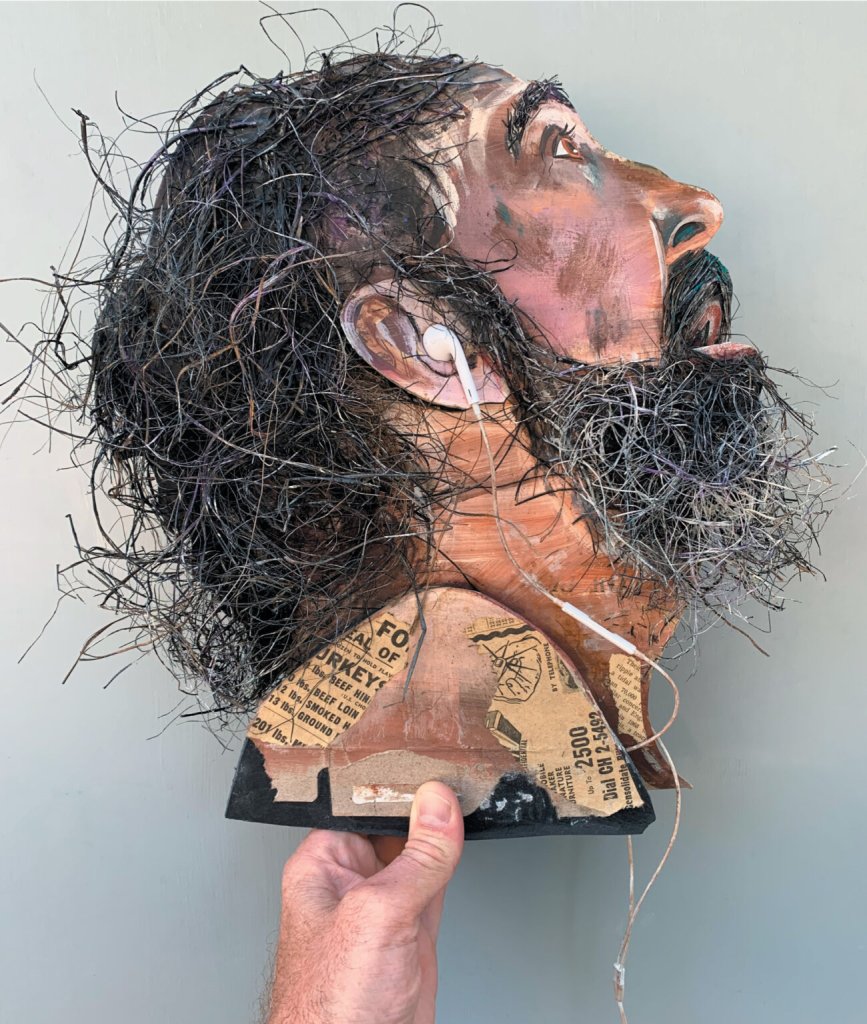
As we sit in the year 2020 and struggle to remember what normal even feels like, I’ve been wondering about people’s emotions and how I might capture the painful realities of human existence we all seem to be feeling this year. In this new work, I will explore the pain and anxiety of massive disruption and how we are changed by it. I’ve been thinking about the biblical character Job from the land of Uz. What might he look like, plucked out of the ancient text, and plopped into modern-day? This is my attempt to bring a re-imagined 21st century Job to life in a way that encapsulates not only his experience, but also our own. I’ll be using a combination of found and repurposed objects, multi-media visuals, and incorporating input from the public on multiple panels that measure 8 feet by 5 feet—my biggest project to date.
Early working prototype for 2020 Disrupted: A Re-Assembled Life by Wayne Brezinka
Next year Brezinka will be taking the completed art on tour across the country in a glass box truck. “The plan is to park at notable cathedrals or churches and community centers in each city. I want to give those who funded this project and the general public an opportunity to pause, interact with the art, and reflect on the last year—the disruptions, the beauty, and the changes it all brings.” He says the art is an invitation for people to feel their sorrow and their grief. Read the interview to find out more about his process and his hopes for the project.
+++
NEW SONG RELEASE: “O Love That Casts Out Fear”: This is my favorite track from the new sacred chamber pop EP by Bobby Krier, Jon Green, and friends, Cast Out All Our Fears. The hymn text was written by Horatius Bonar in 1861, and the music is by Bobby Krier and Justin Ruddy [previously], who collaborated often as musicians at Citylife Presbyterian Church in Boston. (Their retuned version premiered on the 2013 album Castle Island Hymns; they have since moved on from Citylife.) This rendition is sung by Molly Parden.
BLOG POST: “Jesus as Dancer: Jyoti Sahi’s ‘Lord of Creation’” by Victoria Emily Jones: I wrote a guest post for the Sojourn Arts blog about a gouache I own by Indian artist Jyoti Sahi, which shows Jesus leading the dance of new creation. On one side he pounds a drum, and on the other he emerges from a lotus. The painting brings together Jyoti’s interests in Christian and Hindu theologies and folk symbolism.
Jyoti Sahi (Indian, 1944–), Lord of Creation, 1982. Gouache on paper, 14 3/4 × 20 in. Collection of Victoria Emily Jones.
Sojourn Arts is a ministry of Sojourn Church Midtown in Louisville, Kentucky, that seeks to support artists and build up the church through the arts. They have organized and/or hosted numerous exhibitions over the years and have commissioned temporary installations for their sanctuary, as well as coordinated community art projects. Visit www.sojourn-arts.com.
+++
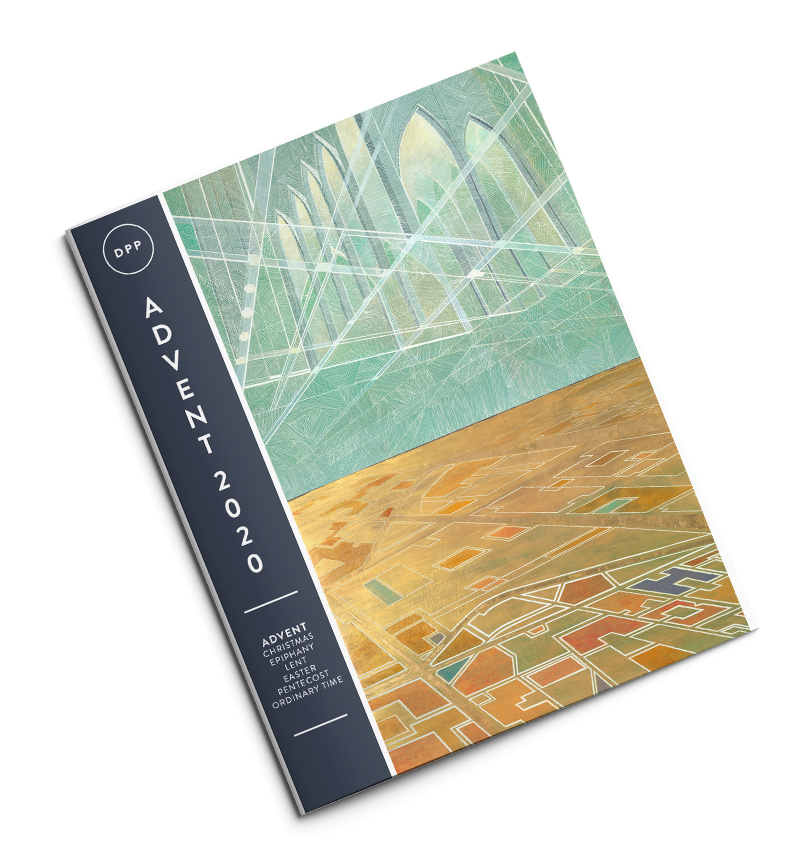
THE DAILY PRAYER PROJECT: This fall I joined the team at the Daily Prayer Project as curator of visual art. The Daily Prayer Project is a periodical that covers every season of the Christian year with robust, rooted, and cross-cultural liturgies for use in congregations, households, workplaces, small groups, or other gatherings. Released in seven editions per year, it features daily morning and evening prayer guides for the week, which include Psalm, Old Testament, and New Testament readings; short prayers sourced from around the globe and from different eras; specific prayer prompts; and songs (including lead sheets). In addition to the cover image, there is a mini-gallery of two art images inside, reproduced in full color, to serve as visual prompts for further contemplation and prayer. There is also a section called “The Practices,” with two page-long seasonal reflections by staff members or guest contributors.
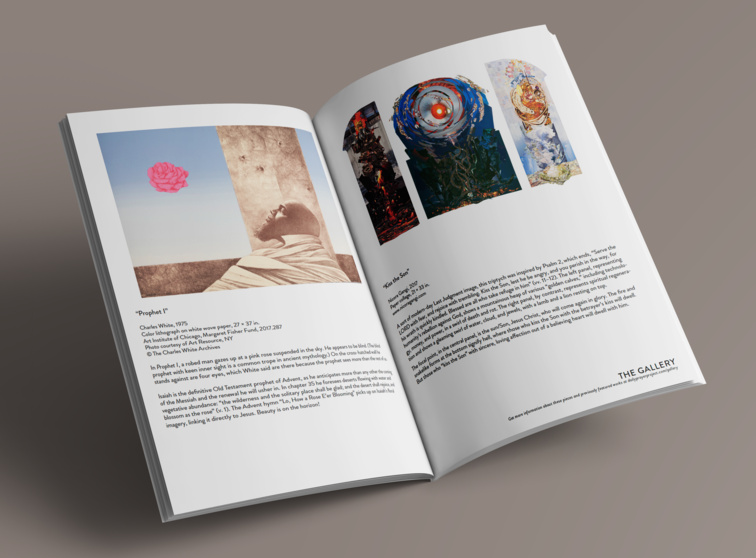
The Advent 2020 issue of the DPP, covering November 29 through December 24, was released last week. It features prayers by African American civil rights leader Fannie Lou Hamer, the tenth-century English saint Ethelwold, and others; a Hebrew folk song, a Taizé chant, and an Argentine hymn by Federico J. Pagura; a striking cover image by Hilary Siber, which shows heaven coming down to earth; Charles White’s Prophet I, which resonates with passages from Isaiah; and an apocalyptic paper collage by Nicora Gangi.
The periodical is available as a physical booklet or as a PDF download. Visit the website for more information. If you are an artist and are interested in having your work considered for publication in a future prayerbook, email team@dailyprayerproject.com.
+++
VIDEO: “Local Riches: Ethnoarts and Sumba”: A workshop for churches on the island of Sumba in Indonesia, led by Yayasan Suluh Insan Lestari in July 2019, reinforced that God is best honored, and the global body of Christ built up, when people worship God using their unique cultural and linguistic gifts, bringing their whole, authentic selves before him in praise. [HT: Global Christian Worship]
For centuries many Christian missionaries to other countries brought with them Western hymns and images, presenting them as definitive—as forms that alone are good and pleasing to God. (For example, a woman in the video mentions how she had previously thought that worship songs had to be based on Western scales and performed using certain instruments to be acceptable.) But in the last fifty or so years especially, at least from what I’ve noticed, many missionaries have recognized the falsity of this line of thinking and seek to undo negative conditioning by promoting the use of indigenous artistic expressions (sometimes called “ethnoarts”) in Christian worship, be it dance, drama, music, storytelling, carving, or what have you. I found it interesting that the interviewees seem to suggest that now it’s the forces of modernism that most threaten the survival of traditional cultures, whereas it used to be that the church was largely blamed (missionaries did undeniably play a large part, banning this and that, though in every era there were exceptions to the rule). Now the church is at the forefront of trying to preserve not only traditional languages but also traditional art forms.
“Everything we have was created by God, and we need to return to it with gratefulness because this is how God made us!” says Rev. Herlina of the Christian Church of Sumba. “With whatever we already have, we can be a blessing to our people.”
+++
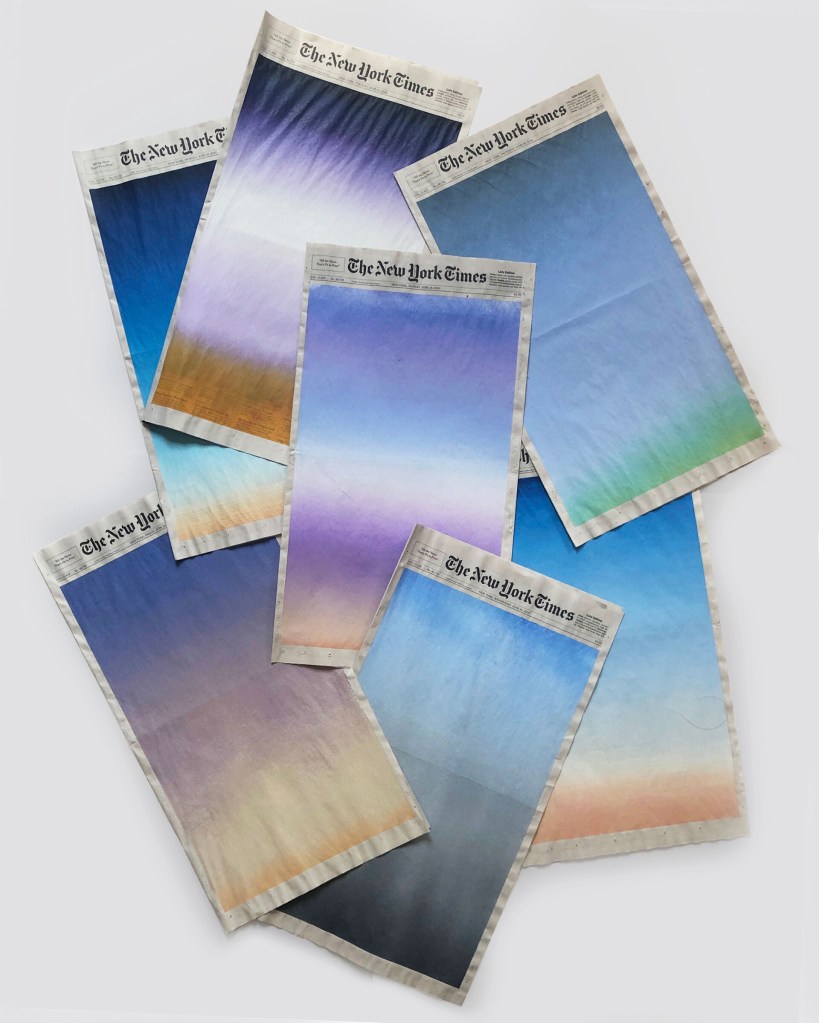
NEW ART SERIES: “Organic, Sunrise Gradients Mask Front Pages of the New York Times by Artist Sho Shibuya”: Since the lockdown started in March, Brooklyn-based artist and graphic designer Sho Shibuya has been painting color gradients in acrylic over the front pages of the New York Times, inspired by each morning’s sunrise. He calls the series “Sunrises from a Small Window.” I love how he’s able to express gratitude for a beautiful new day and to access calm amid dire news cycles. Shibuya is still reading those headlines and articles; he’s just putting them in a larger perspective. (As for myself, call me escapist, but I’ve found that actually blocking out the news—turning down the noise—for certain periods can be a helpful spiritual practice.)
Sho Shibuya, Sunrises from a Small Window, June 22–28, 2020. Acrylic on newsprint.
“I started . . . contrasting the anxiety of the news with the serenity of the sky, creating a record of my new normal,” Shibuya says. “Their front page has always been a time capsule of a day in history, so it made sense to use history as the canvas because the paintings are meant to capture a moment in time. . . . The spirit of the project is that maybe, even after the pandemic subsides, people can continue some of the generosity and peace we discovered in ourselves and that the sky reminds us of every day with a sunrise through a small window. If one thing the news has made clear, we need generosity and peace for all people now more than ever.”
+++
TWO FILMS: “Death on Netflix: I’m Thinking of Ending Things and Dick Johnson Is Dead” by Mitch Wiley: I really liked both these cinematic reflections on mortality, but they’re completely different, as this short Gospel Coalition article bears out. Dick Johnson Is Dead is the more “Christian” of the two because of its hopeful perspective—the human subject of the film is a Seventh-Day Adventist, so death for him is not a final end. After her father was diagnosed with dementia, filmmaker Kirsten Johnson asked her dad if he’d be interested in a collaborative film project where, to help them both face the inevitable, she would stage his death in inventive and comical ways. Relishing the opportunity to spend more time with his busy daughter, he enthusiastically agreed.
The documentary shows them preparing and carrying out these stunts but also interacting in other contexts—birthday parties, trick-or-treating, looking through old photo albums, cleaning out Dick’s office, Dick’s being asked to give up driving, and so on. It made me laugh and cry—films that can do both tend to rate highly on my favorites list. There’s so much love and warmth and heartache and whimsy in it as father and daughter confront death together, talking very openly about it, which I found, strange as it may seem, refreshing. Oh, and the heaven sequences just may be the best I’ve ever seen.
For a more cynical take on death, here’s the trailer to I’m Thinking of Ending Things (Charlie Kaufman isn’t for everyone, but I’m still thinking about this movie after watching it a month ago, which means it made an impression!):
Seeing and Believing, a Christ and Pop Culture podcast, covered Ending Things and Dick Johnson in episodes 264 and 266, respectively, as have most other film podcasts and reviewers, with Dick Johnson being uniformly lauded as one of the best movies of the year.
+++
SONG: “Hodu” (Give Thanks), performed by the Platt Brothers: The Platt Brothers [previously] singing scripture to me? Yes, please. The text of this song is Psalm 118:1–4, and the music is by Debbie Friedman (1951–2011), a Jewish singer-songwriter whose songs are used widely in Reform and Conservative Jewish liturgies in North America. Friedman’s “Hodu” was originally released on her 1981 album And the Youth Shall See Visions. (Find sheet music here.)
In this video from earlier this month, Henry, Jonah, and Ben Platt sing “Hodu” to a guitar accompaniment by Al Seller.
Hodu l’Adonai kitov Ki l’olam chasdo, ki l’oam chasdo Yomar na, yomar na, Yisraeil Ki l’olam chasdo, ki l’olam chasdo Yomru na, yomru na veit Aharon Ki l’olam chasdo, ki l’olam chasdo
Let all who revere G-d’s name now say Ki l’olam chasdo Give thanks to the Lord for G-d is good Ki l’olam chasdo
The first time the Platt Brothers performed in public as a trio was this April, when they appeared in a virtual Yom Ha’atzmaut celebration at the request of the Jewish Federations of North America, singing “Ahavat Olam.” Ben and Jonah are musical theater performers: Ben originated the title role in Broadway’s Dear Evan Hansen and won a Tony for it, and Jonah is best known for playing Fiyero in Wicked on Broadway from 2015 to 2016. Henry is a senior at the University of Pennsylvania, where’s he’s a member of the a cappella group Counterparts.
Laurent de La Hyre (French, 1606–1656), The Kiss of Peace and Justice, 1654. Oil on canvas, 21 5/8 × 30 in. (54.9 × 76.2 cm). Cleveland Museum of Art, Ohio, USA.
Lord, thou hast been favourable unto thy land: thou hast brought back the captivity of Jacob.
Thou hast forgiven the iniquity of thy people, thou hast covered all their sin. Selah.
Thou hast taken away all thy wrath: thou hast turned thyself from the fierceness of thine anger.
Turn us, O God of our salvation, and cause thine anger toward us to cease.
Wilt thou be angry with us for ever? wilt thou draw out thine anger to all generations?
Wilt thou not revive us again: that thy people may rejoice in thee?
Shew us thy mercy, O LORD, and grant us thy salvation.
I will hear what God the LORD will speak: for he will speak peace unto his people, and to his saints: but let them not turn again to folly.
Surely his salvation is nigh them that fear him; that glory may dwell in our land.
Mercy and truth are met together; righteousness and peace have kissed each other.
Truth shall spring out of the earth; and righteousness shall look down from heaven.
Yea, the LORD shall give that which is good; and our land shall yield her increase.
Righteousness shall go before him; and shall set us in the way of his steps.
—Psalm 85 KJV
This psalm is a community lament, probably written during the period of Israel’s return from the Babylonian exile—to a ruined city, a fallen temple, and a mourning land. The people seek forgiveness for their covenant unfaithfulness and restoration, appealing to the benevolence God has shown them in the past. The closing section expresses confidence that salvation will come.
Verse 10 personifies four of God’s virtues: mercy (lovingkindness; Heb. hesed, Lat. misericordia), truth (Heb. emeth, Lat. veritas), justice (righteousness; Heb. tsedeq; Lat. iustitia), and peace (Heb. shalom, Lat. pax). Mercy and Truth meet together, and Justice and Peace embrace with a kiss. In medieval Christian writings these virtues came to be allegorized as the “four daughters of God,” a motif developed most famously by Hugh of St. Victor and Bernard of Clairvaux.
Many churches sing Psalm 85 at Advent or Christmastime, the birth of Jesus being a time when God’s salvation came near and “glory . . . dwell[ed] in our land.” All the virtues of God kissed each other in Christ, bringing heaven to earth. Others read the psalm as prophesying Jesus’s atoning death.
I love how Eugene Peterson translates this psalm in The Message, which suggests that these virtues of God are ones that humanity should emulate, and indeed what the gospel calls us to:
Our country is home base for Glory!
Love and Truth meet in the street,
Right Living and Whole Living embrace and kiss!
Truth sprouts green from the ground,
Right Living pours down from the skies!
Oh yes! GOD gives Goodness and Beauty;
our land responds with Bounty and Blessing.
Right Living strides out before him,
and clears a path for his passage. (vv. 9b–13)
Jesus lived rightly and bound up the brokenness he encountered, bringing wholeness. His ministry announced, verbally and in tangible ways, a kingdom to come, and we are to pave the way for that kingdom by embodying its values.
+++
SONG: “O God, Will You Restore Us” by Isaac Wardell | Performed by Bifrost Arts, feat. Yolonda Coles Jones, on Lamentations, 2016
O God, will you restore us, And grant us your salvation? (×2)
I will hear what God proclaims.
The Lord our God proclaims peace.
Kindness and truth shall meet,
Justice and peace shall kiss.
O God, will you restore us, And grant us your salvation?
“Here is the fast that I choose:
To loosen the bonds of the oppressed and break their chains.
Let righteousness and justice go out before you,
Then you will call out and I will hear.”
O God, will you restore us, And grant us your salvation?
Near indeed is his salvation to those who call on him.
He will incline his ear and hear their prayers.
Truth shall spring out of the earth,
and justice will rain down from heaven.
O God, will you restore us, And grant us your salvation?
The Lord will guide you on a righteous path,
His vindication will shine down forth as the dawn.
Your people will be called repairers of broken walls,
Making straight the path to proclaim his reign!
O God, will you restore us, And grant us your salvation?
O God, will you restore us? Please grant us your salvation.
Isaac Wardell’s “O God, Will You Restore Us” cleverly integrates Psalm 85 with Isaiah 58, which both center on themes of restoration, blessing, and social responsibility, even using similar word pictures. The refrain is based on the plea of Psalm 85:6–7, the heart of the psalm.
Opening with that plea, Wardell’s first verse then moves into Psalm 85:8, 10: God proclaims shalom. Verse 2 articulates what that looks like: the bonds of wickedness loosed, the oppressed set free. This verse is derived from God’s words in Isaiah 58:6, 8–9, in which God expresses the work he wants his people to be about—namely, justice. Only when his people practice true piety—emancipating captives, feeding the hungry, sheltering the homeless—will he answer their prayers.
The third verse is drawn from Psalm 85:9, 11, an image of abundance and refreshment. And finally, verse 4 seems to be based on Isaiah 58:8, 12 and Psalm 85:13 (cf. Isa. 40:3).
Unmetered and in a minor key, the song has the feel of a Gregorian chant.
+++
“The Allegory of Justice and Peace,” or “Justice and Peace Kissing,” was a popular subject in the seventeenth and eighteenth centuries in the art of the Italian and Flemish Baroque and the French Neoclassical, including works by Giovanni Battista Tiepolo, Corrado Giaquinto, Pompeo Batoni, Artemesia Gentileschi, Theodoor van Thulden, Maerten de Vos, Jacob de Backer—and the artist featured above, Laurent de La Hyre. Although the image comes from the Hebrew Bible, where it is rooted in God’s dealings with his people, artists often used it for secular purposes, to express political peace. Some such paintings were gifted to rulers as a form of flattery.
The iconography that developed draws on classical symbolism and mythology, with both virtues being personified as women. Justice’s attributes include a crown, a sword, scales, and a fasces; Peace’s, an olive branch, an inverted torch (which burns weapons and armor), ears of wheat and/or a cornucopia (because peace leads to plenty), and a caduceus (one myth suggests that Mercury saw two serpents entwined in mortal combat and separated them with his wand, bringing about peace between them).
The Hebrew word for “kiss” in Psalm 85 refers seldom to an erotic kiss, says Sigrid Eder, but rather to a form of greeting or goodbye exchanged by near relatives or to the final phase of a peacemaking ritual. In medieval Europe, where the visual motif of Justice and Peace Kissing was first introduced, kissing was even more widespread than in the ancient Jewish world; it was common for people of equal rank, both male and female, to exchange lip-to-lip kisses. (See a compilation of medieval “kiss paintings,” showing a variety of contexts, here.) But the Baroque taste for undraped figures means that quite a few artistic renditions of Justice and Peace can be read as sexualized, as when one of the women has a bared breast, for example.
In Laurent de La Hyre’s The Kiss of Peace and Justice, the action is set within a larger landscape. An olive-wreathed Peace embraces a blue-beribboned Justice beside a fountain inscribed with Iusticia et Pax // osculatae sunt, from the Latin Vulgate. The women are surrounded by ruins—upturned roadstones, crumbled walls and detached columns, a cracked garden urn. But this is an image of hope. A lion-faced spigot emits fresh, flowing water, which sheep flock to for refreshment, and trees part to reveal a vista. After the upheaval, healing and repair are underway. Justice and Peace have harmonized.
The Cleveland Museum of Art, which owns the painting, notes that its date coincides with the end of the Fronde, a period of civil war in France during which the parlement (law courts) and the nobility sought—unsuccessfully—to limit the power of the monarchy. So it’s likely the painting is an allusion to the climate of general reconciliation between parties.
This post belongs to the weekly series Artful Devotion. If you can’t view the music player in your email or RSS reader, try opening the post in your browser.
To view all the Revised Common Lectionary scripture readings for Proper 14, cycle A, click here.
One of the most celebrated paintings of the Northern Renaissance, Jan van Eyck’s 1430s Annunciation depicts the moment of Christ’s conception in a world of forms that have weight and volume and shade and texture that was largely unprecedented in European painting at the time. The extraordinary realism of the Annunciation—its deep, rich, subtly gradated colors, varied textural details (from hard, polished gems to soft, fragile flower petals and plush velvet), and intricate play of light and shadow—were enabled by the use of oil paint, a medium that was not widely used then. van Eyck’s “virtuoso handling of the medium . . . represented a turning point in its eventual adoption as the major painting medium in Europe in the sixteenth century,” replacing egg tempera.
Jan van Eyck (Netherlandish, ca. 1390–1441), The Annunciation, 1434/36. Oil on canvas transferred from panel, 35 1/2 × 13 7/16 in. (90.2 × 34.1 cm). National Gallery of Art, Washington, DC.
This three-foot-tall painting probably originally formed the left wing of a triptych, whose other panels, now lost, may have depicted the Nativity or the Adoration of the Magi and the Visitation or the Presentation in the Temple. It likely spent its first centuries in the ducal chapel of a Carthusian monastery in Dijon, then-capital of Burgundy (van Eyck served as court painter to Philip the Good, duke of Burgundy, from 1425 to 1441), and has since passed through various other rich and powerful hands, including those of King William II of the Netherlands and Czar Nicholas I of Russia. It is now in the collection of the National Gallery of Art in Washington, DC, where it is viewed by people from all over the world.
Several iconographic elements in van Eyck’s Annunciation were already standard for the subject: the dove, the lilies, the Bible laid open to Isaiah 7:14. But van Eyck also introduced his own sophisticated program of typological imagery, which plays out in the background frescoes and the niello floor designs, connecting Old and New Testaments—in addition to other innovative touches that we will explore below.
He was also one of the first artists to locate this momentous event inside a church (as opposed to a portico or domestic space), which would become a popular choice in the Low Countries. In her 1999 Art Bulletin article “Van Eyck’s Washington Annunciation: Narrative Time and Metaphoric Tradition,” Carol J. Purtle argues that van Eyck was connecting the Lukan narrative of the Annunciation with the Golden Mass (“Missa Aurea”), a liturgical drama that was popular in the Netherlands at the time. Taking place yearly on Ember Wednesday (the Wednesday following the third Sunday of Advent), the Golden Mass featured a reenactment of the Annunciation, dove and all, by two young choirboys.
There’s much to lavish attention on in this painting, but I’d like to let three poets be our eyes: Pimone Triplett, Terri Witek, and Peter Steele, each of whom has written a poem reflecting on their encounter with the Annunciation by van Eyck. (The vivid poetic description of a work of visual art is known as ekphrasis, and it is an ancient tradition that I’ve seen explode in recent decades.) Notice what the poets notice in the painting as they pore over van Eyck’s artistic choices and their spiritual import. There is some overlap in their discoveries, but the landing point, and even the emphasis, of each poem is unique.
Starts with a stream of gold that’s ridden
      by a relentlessly linear dove,
ready to pierce a young girl’s head.

            Then, her face, her gaze looking up, out
past the easel and later, past the frame,
      eyes raised as if to ask a question. Take

the virgin robe, for instance, which van Eyck has made
      to fall luxuriously as a second chance
across the old storyline etched below her.

            And, further down, the church’s intricately
strict apse, each floorboard, painstaked as lace, showing here,
      David’s lesson in beheading, there Samson’s

tearing down the temple—that history
            interrupted by her silken, layered folds:
each blue built up from perfecting the oil.

            His favorite signature, “As best I can”
or “As I was able, but not just as I wished.”
      Imagine the endless effort: a man

in the distance, deep in the could have been,
      who sat before the easel, hours, perhaps,
past his patience for lasting regrets,

            flat refusals—the quick-drying water-based
attempts flung around a room.
      And how, alone with pigment barrels, chamber pots,

the canvasses stretched, the fire exhumed,
      he poured a stream of oil back and forth,
watching it catch the light, change a wooden bowl.

            For the sake of making the mundane
seem to marry the mysterious,
      her eyes raised—lacquered, slippery wells, caught—

her startled acceptance. Since it’s her choosing
      to be chosen that mattered, largest figure
in the frame, the virgin form layered

            with gold light, blue, her pale hands open
for the god imagined sick with thin horizon,
      and ready to enter thickness now, the body’s

blood, gristle, vertebrae, whorled fingerprint.
      The oil spread back and forth. His wrist stiffened.
“As I was able, but not just as I wished.”

            So, out to pay the right kind of attention
to detail, as if, in the lengthening
      carelessness of cracked roads leading away

from his town, beneath a matted pulp
      of the year’s leaves, he wished he could hear
silence taking shape: a weed, say, starting

            to split the surface, part vegetal
altar and example of dumb, green change.
      Or, say, through the window, a flock of geese

receding, advancing, by turns, as the sky’s gray
      sometimes meets the double strength gray of sea,
he might have looked between the shapes,

            their invisible lines blooded, some racing ahead,
others falling behind, each filling in, quickly,
      empty spaces where the wings once beat.

And still, she looks up, asking to be entered.
      So that if she turned away from shadows, wood panels,
chamber pots, winter coats lined against the wall,

            he might have looked so far into the difficult
that he finally could believe: behind her gaze,
      beneath her brow, under the layers of

shell, salt, finally skin-white, lay the mind
      of a mother giving birth to a father
and a son, the flesh—a color, an instant, spared.
Pimone Triplett’s poem explores the physicality of the oil-paint medium, focusing on van Eyck’s innovations in that area and as one who both accepts and transcends his limitations. She refers to the personal motto with which he signed several of his paintings (although not this one): Als ich chan, which means “As best I can.” Even with as advanced a painter’s toolkit as he developed and his great skill, how could he possibly succeed in depicting the holy mysteries?
The physicality of the artist’s studio, too, comments on the Incarnation. Christ came into a world of chamber pots! Triplett describes Jesus’s coming into human being, his traveling those seven thin gold rays of light into the womb of his mother, where he takes on flesh: “the god imagined sick with thin horizon, / and ready to enter thickness now, the body’s // blood, gristle, vertebrae, whorled fingerprint.”
There are also some lovely lines that touch on Mary’s agency (“it’s her choosing / to be chosen that mattered”; “she looks up, asking to be entered”) and her role as the Second Eve, whose obedience leads to the redemption of humanity (her robe “fall[s] luxuriously as a second chance” over the Old Testament story line told in the floor below her).
The two most visible floor designs depict Samson destroying the temple of Dagon, killing the Philistines inside, and David cutting off the head of Goliath. These and other Old Testament scenes are framed by stylized columbine and clover and roundels bearing signs of the zodiac.
I’m not entirely sure how to interpret the last stanza. It’s possible that “father” refers to van Eyck as the father of oil painting: his many Marian paintings in this medium cemented his reputation as such, so in that sense Mary gave birth to him as an artist, as well as, of course, to her son Jesus. Shell and salt were ground into pigments to render realistic flesh tones, and the slow drying time of oil paint enabled artists to better blend colors on the canvas, creating subtle variations, and to develop the painting gradually. But why “a color, an instant, spared”? Any thoughts?
+++
“Take a World”by Terri Witek
The Annunciation by Jan Van Eyck, 1434–36
Take a world in which each flower’s an Easter lily
and books chivvy open to the place where our names leap.
Then step into the temple where Mary,
gown belled like a Christmas tree angel’s,
speaks with a real one. Their hands negotiate:
Mary is asking why light curls to ribbony rainbow
on the angel’s back while through her own body
it shoots in stiff gold arrows. The angel nods, grins.
Nothing more gorgeous than their drapery-softened
gesticulation, the room’s blue-propped lilies
and plump ottoman. It’s enough to make us think
they’re standing in the world, two women alert
to the heft of their clothes as Mary asks,
“Who, me?”, her eyes sliding sideways to her painter,
master of distraction. She can’t see Jehovah
behind her, his one blazing window, though we can,
we see the room’s whole depth falling into light
as we wait for someone not transfixed by dilemma
who’s standing where we are. As we wait for Joseph.
Terri Witek’s poem focuses on the paradox of the Annunciation’s being both an entirely thisworldly and yet profoundly otherworldly moment. The two figures in van Eyck’s painting have bulk and heft, and their clothes hang on their bodies, subject to the laws of gravity, and yet in the scene they inhabit, everything is so carefully placed, so perfect—so divine. Witek mentions the stained glass window in the back, which shows God in a mandorla, standing underneath his fiery chariot on a globe labeled ASIA and holding an open book and a scepter; the light that comes through this window and fills the room is thus refracted through him who is all-sovereign.
(Note: The iconography in the window is very similar to the type known as Christ in Majesty, though there’s no cross-shape inside the halo; I wonder whether the figure is meant to be Jesus in his then-future exaltation. But the art historians I’ve read identify him, along with Witek, as God the Father. I think a case could be made for either.)
To the left of the stained glass window, the baby Moses is presented to Pharaoh’s daughter, while on the right, God presents Moses with a scroll bearing the words of Exodus 20:7: “You shall not take the name of the Lord your God in vain.”
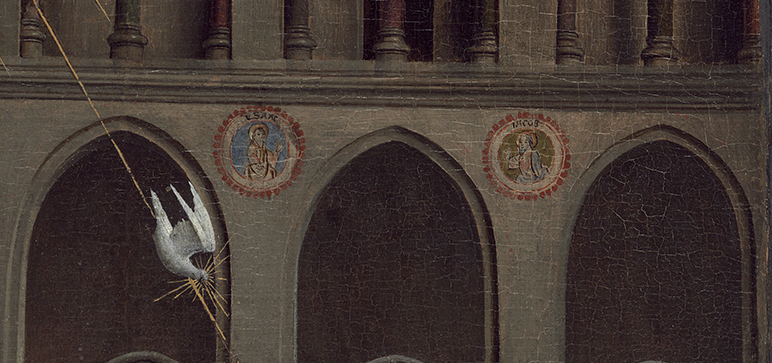
Gabriel tells Mary that Jesus “will reign over the house of Jacob forever, and of his kingdom there will be no end” (Luke 1:33). The two roundels painted on the rear wall depict Isaac blessing Jacob (Gen. 27).
I especially like how Witek points out the contrast between the pleasant, blended, colorful way light interacts with the angel’s wings and the severe, narrow manner in which it comes diving toward Mary—and humorously suggests that Mary’s expansis manibus gesture is her asking why. This observation unpeeled for me an additional layer of van Eyck’s possible meaning: how God’s coming to Mary was direct and piercing. His messenger, sure, has a soft rainbow glow, but the actual implantation of God in the womb happens with a laser focus that sears Mary in ways that will be all the more keenly felt as the years go by (see Simeon’s prophecy in Luke 2:34–35).
I got stuck on the last two lines, though: Why do we wait for Joseph? Isn’t he peripheral to the event? And was he not also “transfixed by dilemma” for a time, as he debated whether to say yes or no to God’s plan? So I asked the poet what she had in mind. She said how, standing before the painting, we, like Mary, become transported into this drama that lifts us up to a heavenly plane (I’m paraphrasing here), where we interact vicariously with Gabriel. We need someone to bring us back down to earth, so “we will be glad of Joseph, the human, the touch of the everyday real,” Witek explained to me.
The room “falling into light” describes the painted scene but also the public gallery where the painting is on display, and the name Joseph also has a double meaning, as Witek’s husband’s name is Joseph. In their museum going, his presence sometimes shakes her gently out of her reveries, reminding her that it’s time “to move on to the next painting, though it might not be as gorgeous,” she told me.
+++
“Waiting for the Revolution”by Peter Steele
If love is ‘the bright foreigner’, then here’s
      not Amour himself but still
a follower afire, his wings a blend
      of peacock and rainbow, the pearled cope
blooming to crimson on its ground of gold,
      his hair a downspill from the lock
of a coronet badged with jewels, the fingered sceptre
      a rod of crystal, and the smile
something they practise in another country.

This is not wasted on the woman who,
      her hands come up from the shell of a robe
which seems to have been steeped in ocean when
      darkness and light were still contending,
gazes now from the blaze of being at
      van Eyck, the Duke of Burgundy,
a Tsar made out of ice and marble, or
      whoever gives the alms of an hour
in minute-hungry fuming Washington.

Outside, a beat or two of an angel’s wings
      away on the Capitol is Freedom,
one of the later products of the Bronze
      Age, equipped with shield and sword,
a wreath for some earthly use or other, plumes,
      an eagle-crested helmet. She eyes
the status quo from her eminence and murmurs,
      ‘The past is prologue’, a Delphic saying
which she construes as ‘blessed are those in possession’.

I have been in and out of the world worlds,
      amphibious and double-hearted,
and still am. The shimmer of July
      speaks now for a perpetual
immobility, bronzing the will. The pavement
      beneath woman and angel shows
Goliath down and done with, Samson at grips
      with a sheltering enslaving place:
and for some want of the white bird of esprit

that plunges goldrayed into the woman’s mind,
      I’m in the middle. They say that she
has her consent to the revolution printed
      upside down for easier reading
in heaven. It may be so, but I’m guessing that
      the words in their reversal figure
a world swung round upon its axis, the all-
      clear given to those in quest
of the bright foreigner who lightens angels.
“Waiting for the Revolution” by Peter Steele appears in Plenty: Art into Poetry (Melbourne: Macmillan Art Publishing, 2003).
Peter Steele (1939–2012), a Jesuit priest from Australia, opens and closes his poem with a phrase from a 1849 journal entry by Ralph Waldo Emerson that says, “Love is the bright foreigner, the foreign self.” Steele interprets Jesus as that “bright foreigner” from heaven, Love, Amour, whose light gives angels their light. Those who search for themselves, he suggests implicitly, can find themselves in Jesus, who created them in love and calls them back into that love that is the ground of their being.
Before moving to this conclusion, Steele first relishes the painting’s fabulous details, especially the clothing: Gabriel’s elaborate, brocaded silk cope, with gold embroidery and green fringe, and Mary’s ultramarine robe trimmed in ermine. He also notes the angel’s wry and mysterious smile, an expression that draws me in every time I see this painting.
He considers how Mary’s eyes gazed out first at van Eyck the painter, then at the painting’s various owners over the centuries, and now at any visitor to or resident of Washington, DC, who stands before it in its dimly lit gallery on the National Mall.
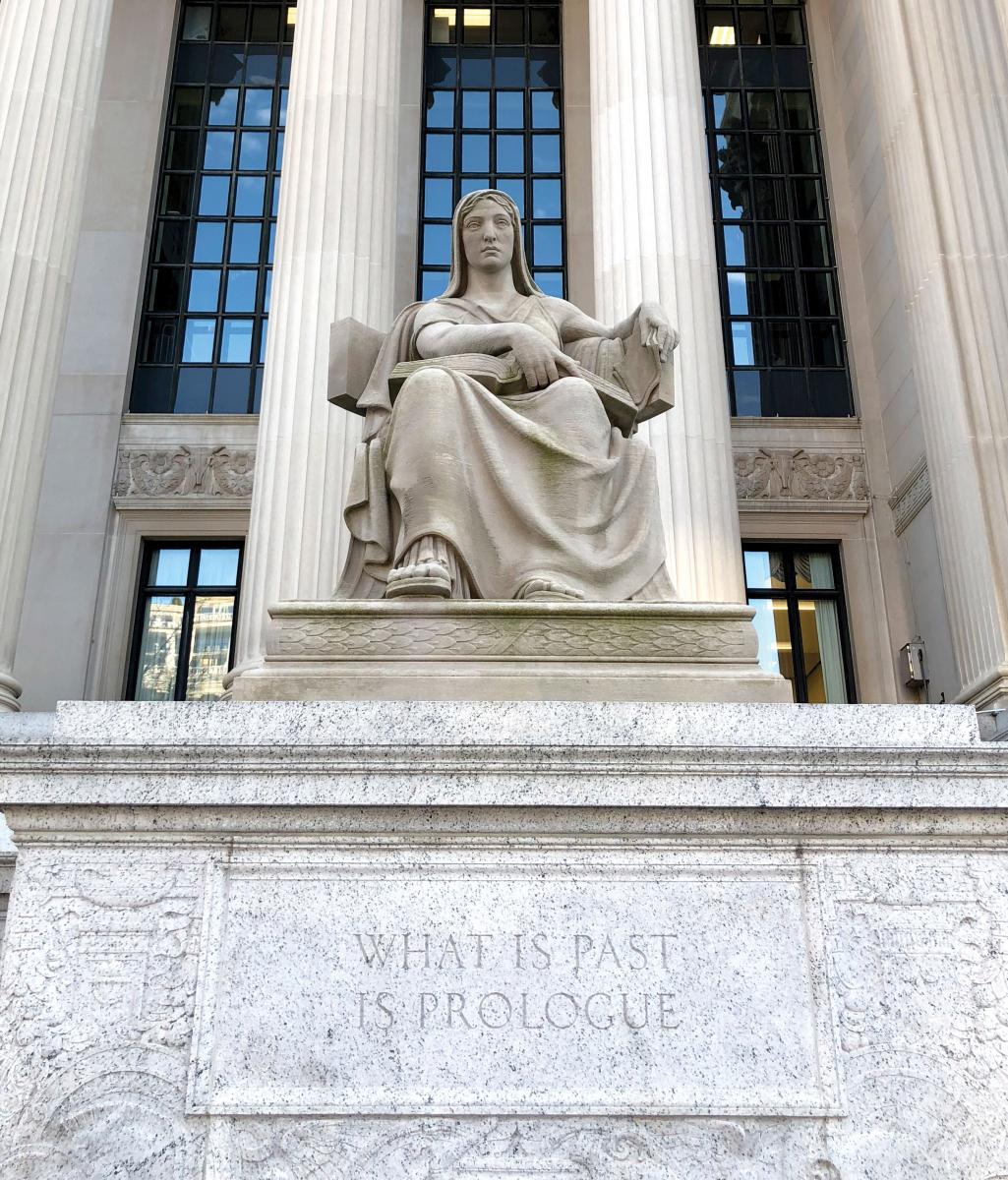
Its location in the United States capital city prompts Steele to contrast it with the nearby monument originally known as Freedom Triumphant in War and Peaceor Armed Freedom, an allegorical figure in bronze that crowns the Capitol building. He has Freedom reciting a famous line from act 2, scene 1 of Shakespeare’s The Tempest—“What’s past is prologue”—spoken by the villainous Anthony in an attempt to convince Sebastian to murder his sleeping father and thus make himself king; the idea is that his whole life up to this point was merely an introduction to the great story that will be underway if he goes through with the plan. (The line is inscribed on the base of Robert Aitken’s sculpture Future, located on the northeast corner of the National Archives Building, which shows a young woman holding an open blank book and contemplating the things to come.) Steele imagines this saying, in the mouth of Freedom, as bearing the subtext “Blessed are those in possession” (or, in its original Latin, Beati sunt possidentes), a proverb popularized by the Prussian general and military theorist Carl von Clausewitz in reference to the possession of power and force.
Thomas Crawford (American, 1814–1857), Statue of Freedom, 1863. Bronze, 19 1/2 ft. tall. Atop the dome of the US Capitol, Washington, DC.
Robert Aitken (American, 1878–1949), Future, 1935. Indiana limestone, 20 × 8 × 12 ft. (sculpture), plus 12 × 12 × 15 ft. (base). Outside the National Archives Building, Washington, DC. Photo: Rania Hassan.
The two government-commissioned artworks and two quotes Steele’s poem references ping around in my mind as I think about how they relate to the Annunciation. The picture of Freedom as a colossal helmeted woman bearing a sword differs from the smaller, quieter way “Freedom” comes to reign in the Christmas story: that is, as a babe in a manger. And the self-protecting, self-aggrandizing path commended by Clausewitz butts heads against the self-emptying ethic at the heart of Christianity. So does the motivation of the Shakespearean character—treacherous, underhanded—who was the first to say, “What’s past is prologue.” But when considered in light of Luke 1 and even the Future sculpture in DC, this “Delphic” (obscure, ambiguous) saying from the Bard can be seen as alluding to Mary’s position at the Annunciation, at the turning point of history. Mary is fated to act; the past has set the stage for her yes, and for all that will happen next. The New Testament is as yet unwritten—until her bravely submissive response to the angel’s invitation sets God’s grand redemption plan, on hold for four hundred years, into motion once again, and what we call “gospel,” good news, arrives on earth at last in the person of Christ.
In van Eyck’s Annunciation, as in many others, the words AVE GRA[TIA] PLENA (“Hail, full of grace”) stream forth from Gabriel’s mouth in gold lettering, to which Mary replies, ECCE ANCILLA D[OMI]NI (“Behold the handmaiden of the Lord” [Luke 1:38]). Amusingly, van Eyck renders her response upside-down, a device he also uses in the Ghent Altarpiece, presumably so that God can read it from heaven. Steele playfully interprets the inversion as signaling the upside-down nature of God’s incoming kingdom; the world has been turned on its head by Mary’s yes—which is why that yes is rotated 180 degrees!
One aspect of this upside-down-ness is how Mary contradicts the aforementioned adage, used in diplomacy, “Blessed are those in possession.” In scripture Mary is called blessed, but not because she seizes or owns or controls anything. Quite the opposite: because she relinquishes her right to go on living a normal, play-it-safe life. And because she is humble, God raises her up, and those like her. (She sings about this in her Magnificat.) That’s not at all to say that Mary is passive or lacks agency. She stands actively with open hands to receive grace, to receive God himself, and to gift him to the world. She “consent[s] to the revolution.”
I’m reminded of the song “Canticle of the Turning,” written by Rory Cooney in 1990 based on Mary’s Magnificat and set to the traditional Irish tune STAR OF THE COUNTY DOWN. Listen to an acoustic performance by Katherine Moore:
“The world is about to turn.”
+++
For a further in-depth look at the symbolic significance of the architecture and objects in Jan van Eyck’s Annunciation—including the wall paintings and windows in the background, the nielli in the floor, the footstool in the foreground, and the missing boards in the ceiling—see Early Netherlandish Painting: The Collections of the National Gallery of Art by John and Oliver Hand and Martha Wolff, pages 76–86: a PDF of the entire book is provided for free download by the National Gallery of Art. See also the NGA’s special webpage for this collection highlight.
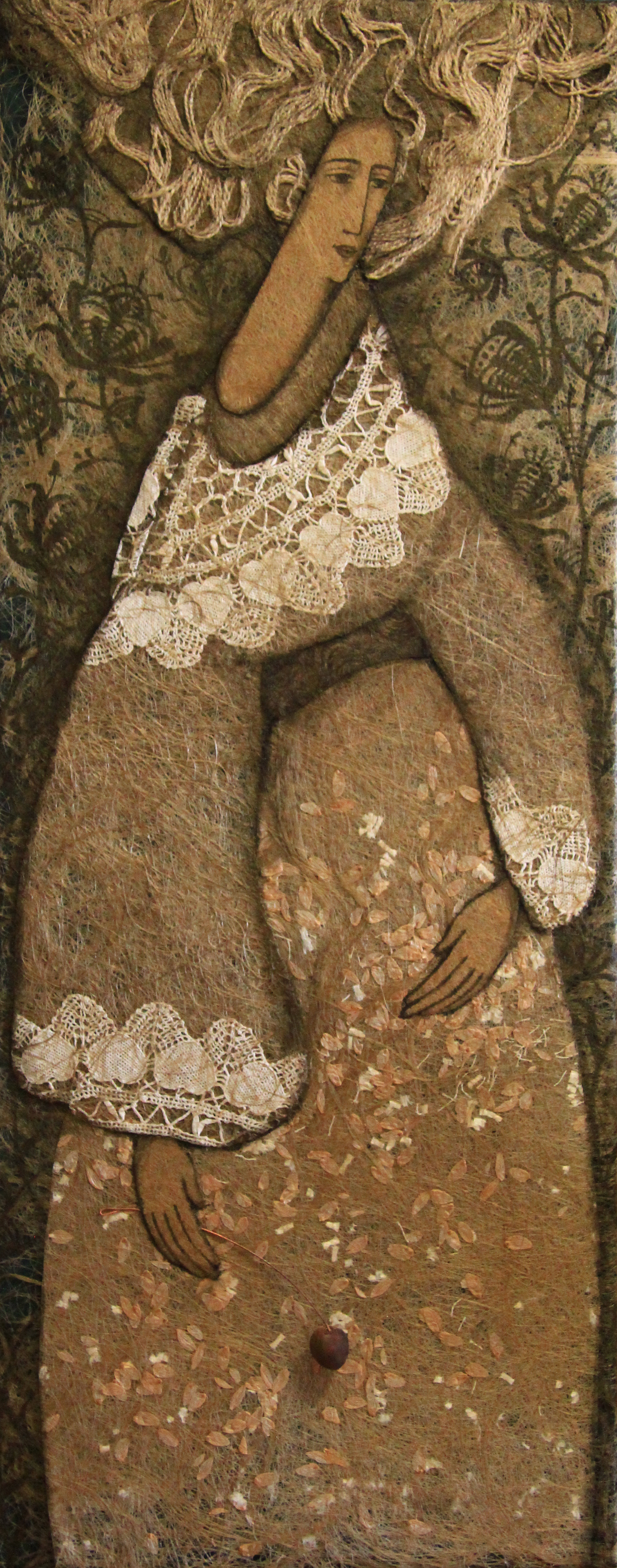
Yaroslava Tkachuk (Ukrainian, 1981–), Expectant, 2014. Linen, silk, seeds, copper, and acrylic, 100 × 40 cm. Photo courtesy of the artist. [Original for sale; click photo for more info]
Therefore the Lord himself will give you a sign. Behold, the virgin shall conceive and bear a son, and shall call his name Immanuel.
—Isaiah 7:14
+++
SONG: “Maria” by David Maloney, on A Christmas Album by Reilly & Maloney (1984, reissued 2012)
Christmas Day, it’s coming fast
Bringing joy to the world at last
Joy to the world
Maria . . .
This post belongs to the weekly series Artful Devotion. If you can’t view the music player in your email or RSS reader, try opening the post in your browser.
To view all the Revised Common Lectionary scripture readings for the Fourth Sunday of Advent, cycle A, click here.
So much to share today! Be sure not to miss “Psalm 126” by Drew Miller (a new favorite Advent song) and Matthew Milliner’s excellent presentation on the Virgin Mary in art, which opened an exhibition that’s running in Southern California—both below. (If you only have time to take in a few items from this post, those are the ones I’d recommend.)
PODCAST EPISODE:“A Time for Wanting and Waiting: An Advent Conversation with W. David O. Taylor”: In this recent episode of The Road to Now, hosts Bob Crawford and Chris Breslin interview liturgical theologian David Taylor [previously] about the season of Advent: what it is, its history and how it fits into the wider church year (see especially 43:29ff.), the canon of Advent and Christmas songs, and the gift the Psalms offers us during this season. Referencing his 2015 Washington Post article, Taylor says our picture of Christ’s coming, especially as expressed through our hymnody, tends to be unidimensional and far too sanitized:
We should permit the Nativity stories to remain as strange and bizarre and fantastical and difficult as they in fact are, rather than taming and distilling them down to this one nugget or theme of effusive joy. There is effusive joy in that—it’s simply that that’s not the only thing that characterizes these stories. Unfortunately, most of our canon of Christmas carols or hymns tends to focus on what I would argue is only 50 percent of the Nativity stories. Everything that begins with Elizabeth and Zechariah and goes all the way to, say, Anna and Simeon and the visit of the Magi and the flight to Egypt . . . it really is one whole story that is being told with these subplots.
I would love to see us create . . . new music that either retells portions that we are already telling but not the whole of it, or we need to tell parts that have not yet been told. . . . Let’s ask ourselves how God is at work in all the minor-key or difficult or dissonant parts of the Nativity stories, not absent from—those are not extraneous to God incarnating himself in Jesus Christ. Those are essential parts of it. And so how can our hymns become ways of praying ourselves into these stories so they can sink deeply into the fibers of our hearts and minds and bodies, and for us to say, “Oh, all the weird and difficult and dissonant parts of our lives are part and parcel of God’s good work,” not, again, on the margins of it, or things we should eschew.
To help deepen and expand the church’s repertoire of Christmas music, Taylor founded, along with a few others, the Christmas Songwriters Project. The Psalms are an inspiration in this task, as they express a joy that is at times quiet and at others raucous, as in the Nativity narratives, and that exists as part of a dynamic constellation of emotions and postures that praise can encompass. Most of us don’t recognize the pure, undistilled happiness that is marketed to us throughout December, Taylor says, and we shouldn’t force ourselves to try to feel it but rather should take a cue from the Psalms and also see the same emotional complexity at work at the beginning of the Gospels:
The Psalms, and I think Christian faith at its heart, can make space for joy and sorrow to exist alongside each other in a way that happiness, as we commonly understand it, cannot, or only with great difficulty. . . . What the psalms of praise do . . . is that in one movement, there’s this effusive joy or a shouting joy or a convivial joy, and then it segues to a quieter joy or a contemplative joy or a yearning, painful kind of joy. . . .
So in the season of Advent, when we look at the characters in scripture—you know, Mary and Joseph and Zechariah and Elizabeth and the shepherds and Anna and Simeon—every one of them has this moment, perhaps, of which we could say, “That sounds like joy.” . . . But immediately before or immediately after, it transitions to something else. So does that mean that joy is negated? Is joy squashed? Is joy extinguished? Or is joy able to continue to exist side by side, to subsist, with a continued experience of longing or a sudden moment of sadness?
+++
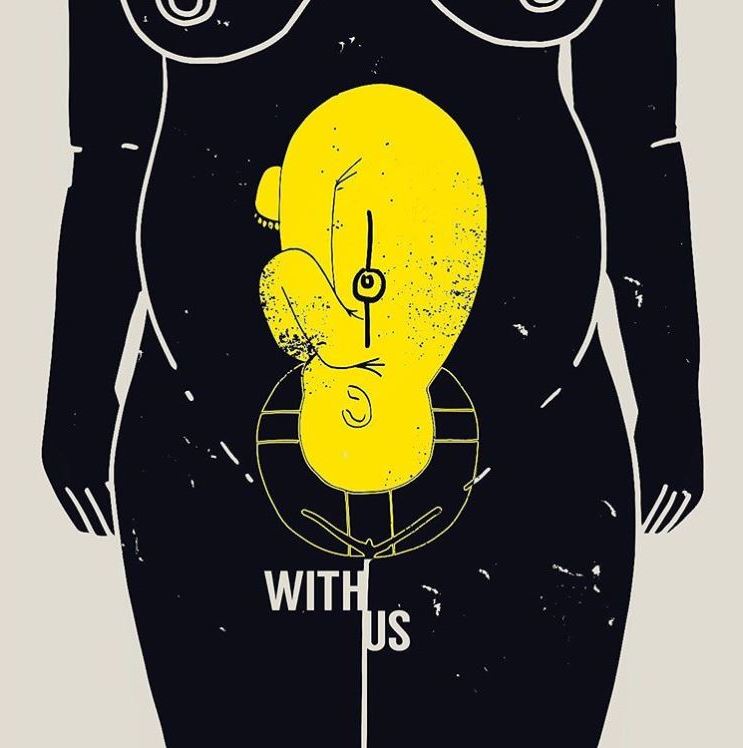
ART BY SCOTT ERICKSON: This month Portland-based artist Scott Erickson has been posting on Instagram Advent-themed images he has made, along with thoughtful meditations. Some emphasize the bodiliness of the Incarnation, which often gets overlooked, presumably out of a sense of propriety. But “grace comes to us floating in embryonic fluid . . . embedded in the uterine wall of a Middle Eastern teenage woman,” Erickson writes about With Us – With Child, to which one Instagrammer responded, “This is trajectory changing. Thank you for this. Nipples, vaginas, and Jesus CAN coexist!” Another mentioned how she had never seen Mary with a belly button and a linea nigra before. The image reminds us that Jesus was indeed “born of woman” (Gal. 4:4).
Scott Erickson (American, 1977–), With Us – With Child, 2016 [purchase as poster]Another imaginative image suggests that Christ came to set the world on fire, so to speak. God, who is of old, gives himself to earth as a Jewish babe (“Love has always been FOR GIVENESS,” Erickson writes), sparking a revolution.
LECTIONARY POEMS FOR ADVENT: This year Englewood Review of Books launched a new feature on their website: a weekly post of four to six poems that resonate with the Revised Common Lectionary readings for that week. “We will offer here a broad selection of classic and contemporary poems from diverse poets that stir our imaginations with thoughts of how the biblical text speaks to us in the twenty-first century. We hope that these poems will be fruitful not only for preachers who will be preaching these texts on the coming Sunday, but also for church members in the pews, as a way to prime our minds for encountering the biblical texts.” I’m really enjoying these stellar selections, several of which are new to me.
Andrew Wyeth (American, 1917–2009), Snow Hill, 1989. Tempera on hardboard panel, 48 × 72 in. (121.9 × 182.9 cm). Andrew and Betsy Wyeth Collection. Photo: Victoria Emily Jones (at the Brandywine River Museum of Art 2017 retrospective).
. . .
Then the eyes of the blind shall be opened,
and the ears of the deaf unstopped;
then shall the lame man leap like a deer,
and the tongue of the mute sing for joy.
. . .
And the ransomed of the Lord shall return
and come to Zion with singing;
everlasting joy shall be upon their heads;
they shall obtain gladness and joy,
and sorrow and sighing shall flee away.
—Isaiah 35:5–6a, 10
+++
SONG: “Therefore the Redeemed” by Ruth Lake, 1972 | Performed by Kim McLean, on Soul Solace, 2008
+++
Snow Hill by Andrew Wyeth [previously] is “a conscious summary of his artistic life that is both somber memoir and playful recalibration” (John Wilmerding). It shows six of his friends and neighbors, who modeled for him many times throughout his career, dancing around a beribboned Maypole in winter in Chadds Ford, Pennsylvania. Their coats, earflaps, and braids fly in the wind, as does one untouched white ribbon, which, it has been posited, could represent Christina Olson (who had a degenerative muscle disorder and could not walk), the artist’s wife Betsy, or the artist himself.
This painting, one of Wyeth’s last, was the finale of a major retrospective at the Brandywine River Museum of Art in 2017, which has been one of the most memorable art exhibitions I’ve ever attended. The wall text there read,
Painted over a two-year period, Snow Hill is both fantasy and memorial, a visual summation of the iconic places and people of Chadds Ford that occupied [Wyeth] for the previous fifty years. Wyeth looks backward and inward, bringing together many of these subjects from his past, a number of them now deceased. Depicted are Karl Kuerner (dressed in his German uniform), holding the hand of Anna Kuerner, who is in turn linked to William Loper, whose prosthetic hook is held by Helga Testorf, rounding the circle to Allan Lynch (of Winter 1946) and Adam Johnson (partially obscured). They are surrounded by a landscape that shows, left to right: the railroad tracks where Wyeth’s father, N. C. Wyeth, was killed in 1945; the Kuerner farmhouse and barn; the remains of Mother Archie’s octagonal church; the Ring family home in the distance; and Adam Johnson’s shed and haystack.
Wyeth’s models are shown holding ribbons—although one white ribbon is symbolically floating free—and dancing atop Kuerner Hill—a site at once iconic for its recurrence in Wyeth’s work and for its proximity to the site of his father’s death. . . .
I love how the dead and the living join together in this Yuletide circle dance, in which suffering is taken up into joy. Wyeth had lived through Karl Kuerner, a World War I veteran, succumbing to cancer, Allan Lynch to suicide, and Bill Loper to mental illness, as well as the early death of his father and nephew in a car accident. And while such darkness is not fully dissipated in this gray-day scene, a mood of celebration and hope and friendship does take over.
This post belongs to the weekly series Artful Devotion. If you can’t view the music player in your email or RSS reader, try opening the post in your browser.
To view all the Revised Common Lectionary scripture readings for the Third Sunday of Advent, cycle A, click here.
As the liturgical calendar was turning over into a new year this week, my husband Eric and I were at the tail end of a visit to India, staying with new friends Jyoti and Jane Sahi. Jyoti’s an artist, and Jane is a children’s educator, and together they live in the Christian village of Silvepura, north of Bangalore, where for years they ran, respectively, an art ashram and a school. It was a lot of fun getting to know them and their work, and discussing art, culture, theology, politics.
Before our flight departed in the wee hours of Sunday morning, the first day of Advent, Jane had set an oil lamp on the dinner table, decorated with flowers from the garden, and selected two poems for us to read aloud: an excerpt from the Gitanjali(Song Offerings) by Bengali poet Rabindranath Tagore [previously], and “Advent Calendar” by Rowan Williams. It was a meaningful welcoming in of the new season, and a beautiful blend of our hosts’ mixed cultural heritage: Indian and British.
All photos by Victoria Emily Jones
Gitanjali XLVby Rabindranath Tagore:
Have you not heard his silent steps? He comes, comes, ever comes.
Every moment and every age, every day and every night he comes, comes, ever comes.
Many a song have I sung in many a mood of mind, but all their notes have always proclaimed, “He comes, comes, ever comes.”
In the fragrant days of sunny April through the forest path he comes, comes, ever comes.
In the rainy gloom of July nights on the thundering chariot of clouds he comes, comes, ever comes.
In sorrow after sorrow it is his steps that press upon my heart, and it is the golden touch of his feet that makes my joy to shine.
“Advent Calendar”by Rowan Williams, published in After Silent Centuries (The Perpetua Press, 1994) and The Poems of Rowan Williams (The Perpetua Press, 2002; Carcanet Press, 2014):
He will come like last leaf’s fall.
One night when the November wind
has flayed the trees to bone, and earth
wakes choking on the mould,
the soft shroud’s folding.
He will come like frost.
One morning when the shrinking earth
opens on mist, to find itself
arrested in the net
of alien, sword-set beauty.
He will come like dark.
One evening when the bursting red
December sun draws up the sheet
and penny-masks its eye to yield
the star-snowed fields of sky.
He will come, will come,
will come like crying in the night,
like blood, like breaking,
as the earth writhes to toss him free.
He will come like child.
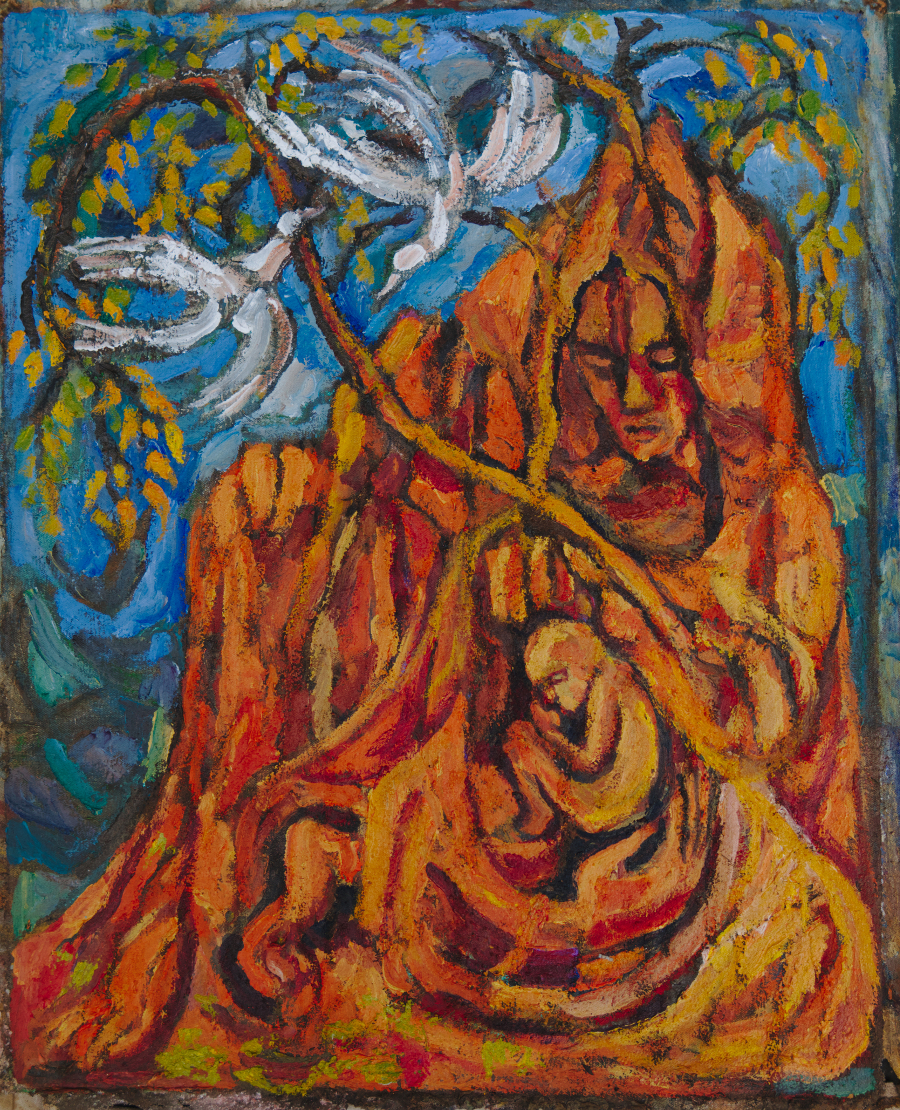
While I was at Jyoti’s, I bought three paintings of his. One of them is an Annunciation image that shows Mary in a termite mound, which are considered sacred in India—microcosms of the temple, sources of fertility, and containers of treasure. I saw these tall, hard, insect-built structures in many areas around Bangalore where I was traveling, including a few on Jyoti’s property. (Note that locals refer to termites misleadingly as “white ants,” so these are “anthills.”)
Jyoti Sahi (Indian, 1944–), Incarnation within the Anthill, 2019. Mixed media on canvas, 28 × 10 1/2 in. (71.1 × 26.7 cm). Collection of Victoria Emily Jones.
Anthill at Vishram in Silvepura with a Mary figure at the base, made of leaves and bark
According to Indian folklore, anthills are the ears of the earth, and Jyoti plays on that belief in his visualization of the moment of the Incarnation, of God’s becoming human in the person of Jesus. Mary’s womb is in the shape of an ear, which receives the Word of God. This Word is shown first at the top of the composition in the form of two hamsas (Sanskrit for “I am he,” or “I am that I am”), a mythical swan-like bird whose body resembles an AUM, the ancient threefold syllable, “the Sound that is believed to reverberate creatively through eternity,” Jyoti said. (“In the beginning was the Word . . .”)
Mary listens to the Word, becomes pregnant with the Word, which takes on flesh inside her. Christ, the primordial One, is implanted in the womb of the earth, of humanity—and a tree of life grows forth.
There’s a sixth-century hymn, known as the Akathist Hymn to the Theotokos (Mother of God), that celebrates Mary’s role as container of the Divine: “Hail! tabernacle of God and the Word. Hail! greater than the holy of holies. Hail! ark gilded by the Spirit. Hail! unfailing treasure-house of life.” Mary as temple, as holy of holies, as ark of the covenant, contains the world’s greatest Treasure: Jesus Christ, the Son of God.
You can hear Jyoti introduce the painting in the short video above, which is just a snippet of the footage Eric and I took while we were there. (More to come!)
As I traveled back home to the US with this rolled-up canvas last Sunday, I kept thinking about the words of the two poets I had just read—Tagore and Williams. I thought about how Christ came once “like child” but also how he “comes, comes, ever comes” even still today, “in sorrow after sorrow . . . press[ing] upon my heart . . . mak[ing] my joy to shine.”











 Art & Theology