They went to a place called Gethsemane, and [Jesus] said . . . “My soul is deeply grieved, even to death. . . . Abba, Father, for you all things are possible; remove this cup from me, yet not what I want but what you want.”
—Mark 14:32, 34, 36
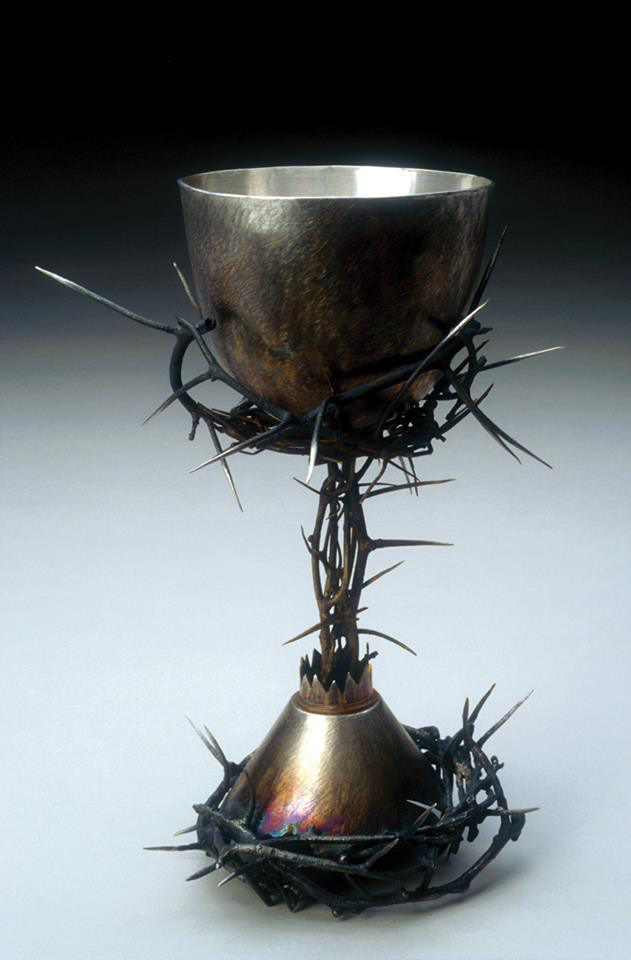
LOOK: Can you drink the cup I am about to drink? by John Kiefer
John Kiefer (American, 1944–), Can you drink the cup I am about to drink?, 1999. Sterling silver and other metals, 10 × 3 × 3 in. Bowden Collections, Chatham, Massachusetts.
Fr. John Kiefer is a Catholic priest, metalsmith, and woodworker from Indiana. His piece Can you drink the cup I am about to drink? is from the collection of Sandra and Bob Bowden in Chatham, Massachusetts, and is part of the traveling exhibition they loan out called Come! The Table Is Ready.
Can you drink is a silver chalice enwrapped ominously, cup and foot, by thorns. In the Bible, a cup often symbolizes one’s portion or destiny that comes from God. Jesus’s cup entails suffering and premature death. Deeply distraught, Jesus asks his Father, if it be possible, to remove the cup.
Request denied.
Within eighteen hours of voicing this prayer, Jesus is taken, tried, tortured, and killed—“tast[ing] death for everyone” (Heb. 2:9).
Some biblical commentators have interpreted the cup Jesus must drink as God’s wrath over sin, as that metaphor—cup as bitter-tasting divine punishment poured out—was a common one in the ancient Near East, including in the Bible. But that doesn’t make sense if we pull in what Jesus says to James and John earlier, in Matthew 20:22 (cf. Mark 10:38): “Are you able to drink the cup that I am about to drink?” They affirm yes, and Jesus corroborates: “You will indeed drink my cup . . .”
This is why the cup is best understood more generally as one of suffering. So argues Raymond E. Brown in his magisterial two-volume work The Death of the Messiah, albeit conceding that “some of the connotation of the classical cup of wrath or judgment may be preserved in Mark [14:36], not in the sense that Jesus is the object of wrath, but inasmuch as his death will take place in the apocalyptic context of the great struggle of last times when God’s kingdom overcomes evil” (1:170).
Archimandrite Seraphim Bit-Kharibi [previously] is an Assyrian Orthodox priest living in the country of Georgia. He is one of the few priests in the world who celebrates the Divine Liturgy in Aramaic, the language of Jesus. The video above shows him chanting the words Jesus prayed in the garden of Gethsemane the night before his execution.
I wasn’t able to find the full text he uses (and my email inquiry went unanswered), but I’m fairly sure the core is this:
Then Jesus went with them to a place called Gethsemane, and he said to his disciples, “Sit here while I go over there and pray.” He took with him Peter and the two sons of Zebedee and began to be grieved and agitated. Then he said to them, “My soul is deeply grieved, even to death; remain here, and stay awake with me.” And going a little farther, he threw himself on the ground and prayed, “My Father, if it is possible, let this cup pass from me, yet not what I want but what you want.”
In this artwork, the contemporary German artist Carola Faller-Barris has collaged to paper a photo cutout of a traditionally sculpted corpus of Christ from a crucifix, orienting him sideways as if he’s lying on the ground, his arms outstretched to the heavens. But he’s tangled in twine, representing the sin, hate, misunderstanding, and betrayal that have felled him, or else the oppressiveness of death, cutting holes through his hands and feet and restricting his movement. The words of the psalmist could be his:
The cords of death encompassed me; the torrents of perdition assailed me; the cords of Sheol entangled me; the snares of death confronted me. (Ps. 18:4–5)
Just prior to Gethsemane, Jesus had washed the feet of his disciples, signaled by the water bowl and draped cloth to his left. This action embodied his ethic of humble service and love. But one of the Twelve whom he washed betrayed him into the hands of his enemies. The blood-red color of the bowl is striking in this work that is otherwise just beige and gray, drawing our focus to the messianic model that God’s people, in demanding the crucifixion of the one God had sent (or abandoning him in his final hours), by and large rejected.
Christ is isolated in this work; no other figures are present, emphasizing the aloneness Christ felt in Gethsemane and on the cross. There’s not even a background—just a void that suggests the indeterminate space between life and death. By using Christ’s crucified form but titling the work Gethsemane, Faller-Barris collapses together Christ’s prayer on the Mount of Olives and his prayers at Calvary, both of which express an admixture of agony and surrender.
LISTEN: “In Passione positus Iesus” from De Passione D.N. Iesu Christi by Francisco Guerrero, 1555 | Performed by the Gesualdo Six, dir. Owain Park, 2021
In passione positus Jesus, cum pro nobis oblatus est, tremens ait: tristis est anima mea usque ad mortem vigilate mecum. Et factus est in agonia orabat dicens: Pater mi, si possibile est, transeat a me calix iste et clamans in cruce dicens:
Deus, Deus meus ut quid dereliquisti me in manus tuas Domine commendo Spiritum meum consummatum est.
English translation:
In his Passion, Jesus, when sacrificed for us, cried out, trembling: “My soul is sad unto death. Watch with me.” And in his agony, pleading, he said: “My Father, if it is possible, take this cup from me.”
“My God, my God, why hast thou forsaken me? Into thy hands, O Lord, I commend my spirit. It is finished.”
This sacred motet for five voices is by the Spanish Renaissance composer Francisco Guerrero. Written for Passiontide (the final two weeks of Lent), it quotes some of Jesus’s words from the garden of Gethsemane the night of his arrest, and then three of his seven sayings from the cross. Download the sheet music here.
When they had sung the hymn, they went out to the Mount of Olives.
Then Jesus said to [his disciples], “You will all fall away because of me this night, for it is written, ‘I will strike the shepherd, and the sheep of the flock will be scattered.’ But after I am raised up, I will go ahead of you to Galilee.”
Peter said to him, “Even if all fall away because of you, I will never fall away.”
Jesus said to him, “Truly I tell you, this very night, before the cock crows, you will deny me three times.”
Peter said to him, “Even though I must die with you, I will not deny you.” And so said all the disciples.
Then Jesus went with them to a place called Gethsemane, and he said to his disciples, “Sit here while I go over there and pray.” He took with him Peter and the two sons of Zebedee and began to be grieved and agitated. Then he said to them, “My soul is deeply grieved, even to death; remain here, and stay awake with me.” And going a little farther, he threw himself on the ground and prayed, “My Father, if it is possible, let this cup pass from me, yet not what I want but what you want.”
Then he came to the disciples and found them sleeping, and he said to Peter, “So, could you not stay awake with me one hour? Stay awake and pray that you may not come into the time of trial; the spirit indeed is willing, but the flesh is weak.”
Again he went away for the second time and prayed, “My Father, if this cannot pass unless I drink it, your will be done.” Again he came and found them sleeping, for their eyes were heavy.
So leaving them again, he went away and prayed for the third time, saying the same words. Then he came to the disciples and said to them, “Are you still sleeping and taking your rest? Now the hour is at hand, and the Son of Man is betrayed into the hands of sinners. Get up, let us be going. Look, my betrayer is at hand.”
—Matthew 26:30–46
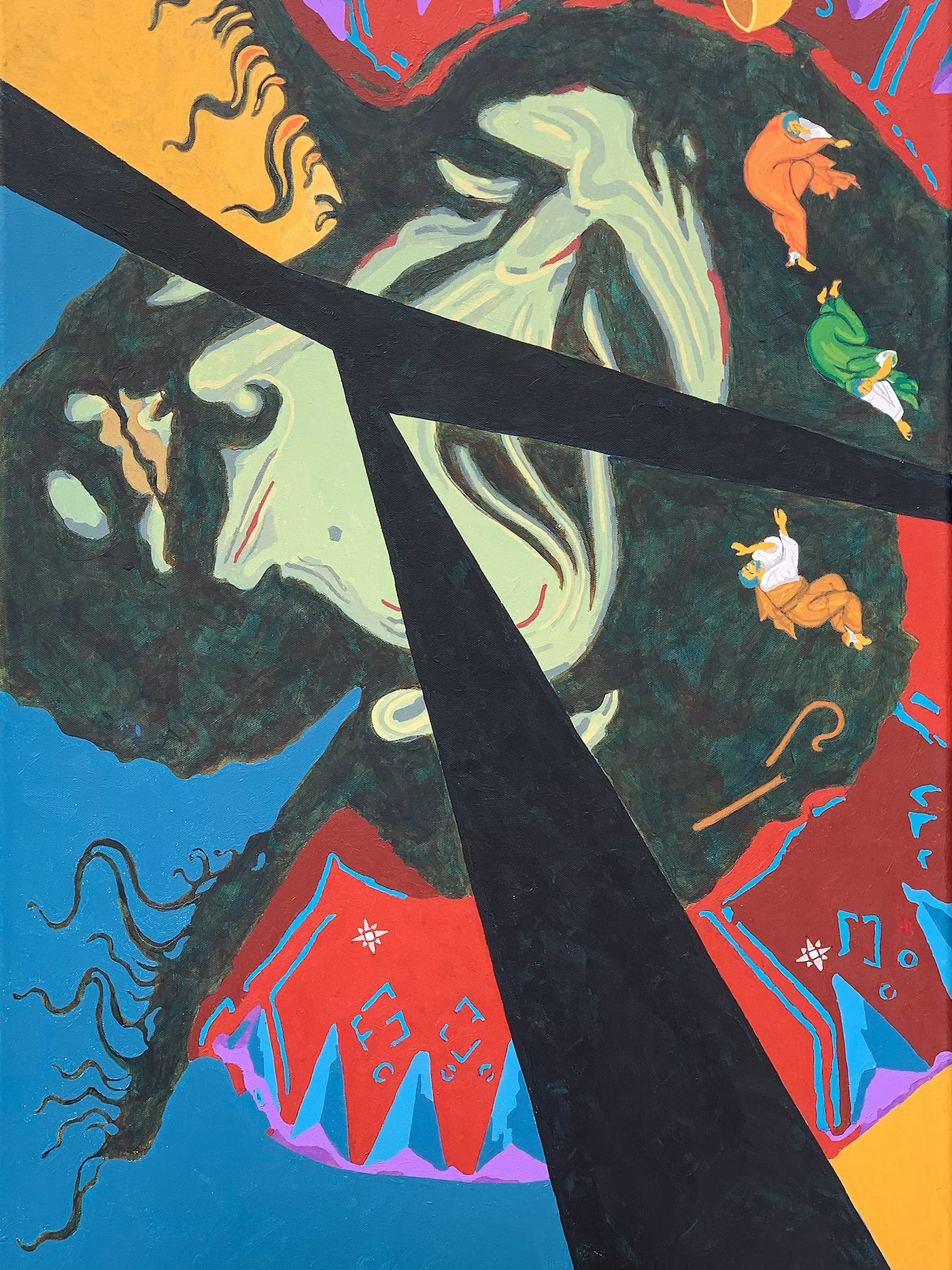
LOOK: Exceeding Sorrowful by Douglas Porter
Douglas Porter (Canadian, 1949–), Exceeding Sorrowful, 2023. Acrylic on canvas, 36 × 24 in.
Doug Porter is a painter, video artist and editor, and graphic designer from Orillia, Ontario. His painting Exceeding Sorrowful portrays the religious subject known as the Agony in the Garden. The painting’s title comes from the King James Version of Matthew 26:38, where Jesus tells his inner circle of disciples (Peter, James, and John), “My soul is exceeding sorrowful, even unto death: tarry ye here, and watch with me.”
He had just eaten the Passover seder with them and the rest of the Twelve, pronouncing some strange words at the table: “Take, eat; this is my body,” he said as he broke the bread. And as he raised the wineglass, he commanded them, “Drink from it, all of you, for this is my blood of the covenant, which is poured out for many for the forgiveness of sins . . .”
Singing a hymn and going out to the Mount of Olives, he then foretold his disciples’ desertion of him. Adapting God’s words from Zechariah 13:7, he told them that he, their shepherd, would be struck, and they, his sheep, would be scattered. They all protested, but their faithlessness would soon be revealed.
Using rich hues reminiscent of stained glass, Porter shows Christ with his eyes closed as if a wave of pain is passing over him, and his brow anxiously furrowed. (The head of Christ is based on a painted wood crucifix by Coppo di Marcovaldo of Italy, from around 1260.) He is broken, shattered; the three jagged shards of him pull away to reveal a dark void. At the top the rim of the cup of suffering is just visible, which he pleads with God to remove. But as he communes with the Father, he becomes increasingly bolstered in his resolve to carry out his mission to the very end.
On the right is a shepherd’s staff, also broken, representing Christ’s words about his being struck. Three of his “sheep” are sprawled out on the ground. The figures of Peter, James, and John are based on a fifteenth-century icon of the Transfiguration by Theophanes the Greek. These three disciples on the Mount of Olives had been privileged earlier to see their Lord gloriously transfigured on another mount: Tabor. And yet despite having received that divine vision, in Gethsemane they fall asleep, failing to support Jesus in his final hours.
In a few days, Jesus’s exceeding sorrow and pain would be transfigured. But on that Thursday and Friday, he drank that cup to its dregs.
LISTEN: “Miracle” by Dave Von Bieker, on Bridge Songs ONE by Urban Bridge Church (2007) | MP3 provided by permission of the artist
Update, 3/28/24: Von Bieker told me my interest in the song has spurred him on to remake it! Here’s his new recording from this week:
This garden grows death And it’s damp and it’s dark Your three closest friends Are asleep on the bark Of a tree that once grew tall Offering its shade But it’s dead and it’s mourning It’s black and decayed
And you search for a place That is far enough out So your voice won’t be heard When you cry and you shout Have you come here to bargain? Have you come to ask why? Is that fear or pure sorrow Buried in your eyes?
And isn’t it time To turn water into wine? To drink a different cup? To forget what’s on your mind? It seems a good time To take up Satan’s deal To leap from tall buildings Without bruising a heel
But now’s not the time for miracles Now’s not the time for trap doors and way outs Oh, now’s not the time for miracles Everything comes in its time
It’s a strange sort of prayer More a fight to the death You walk back to your watchmen There isn’t one left They’ve all slept through this spiritual Solar eclipse They don’t get it, how could they Who would have guessed this?
And you drop to your knees There’s no way out, not yet And your pores are still dripping With blood, oh, with sweat Jacob left with a limp Moses’ tongue couldn’t find An excuse, Paul be blinded Why fight him when you know it’s no use? When you know, well
That now’s not the time for miracles Now’s not the time for trap doors and way outs No, now’s not the time for miracles Everything comes in its time
You sit at her bedside And cry to the roof I don’t know why I hold on When I have no proof But there’s something in knowing You knew how this felt Yeah, there’s something in sharing This hand that we’re dealt
And isn’t it time to say, “Wake up, arise! Come on, Take up your mat! Come on And open your eyes!” Isn’t it time now? He’s sick, close to death He’s been in the grave for four days Why not yet?
But now’s not the time for miracles Now’s not the time for trap doors and way outs No, now’s not the time for miracles And everything comes in its time And everything comes in its time
Dave Von Bieker is a singer-songwriter from Edmonton, Alberta, Canada, who performs and records under the artist name “Von Bieker.” He wrote “Miracle” while part of a songwriting group connected to Urban Bridge Church, a Pentecostal Assemblies of Canada church plant in downtown Edmonton that existed from 2006 to 2015. “We [were] writing songs that dance around the edges of the sacred and songs that wade right through it,” he said. “We [were] questioning and shouting with our songs.”
Starting in 2007, each year the collective shared some of their work at a live concert event they dubbed Bridge Songs and released an album. “Miracle” is from the first such album, Bridge Songs ONE. This album is no longer available, but Von Bieker gave me permission to share this song from it, which I learned about last year as a subscriber to his newsletter, Von Bieker Backstage.
The narrator of the song observes Christ’s distress in the garden of Gethsemane and questions why he doesn’t work a miracle to avoid the cross. Then the refrain comes in—perhaps in Christ’s voice, perhaps in the voice of the concessionary narrator—saying that “now’s not the time for miracles” but suggesting that the miracle of resurrection will come in its time.
A bloody crucifixion is probably not the path to victory we would have imagined, but it’s the path God in his wisdom laid out and took and by doing so showed com-passion (literally “suffering with”) on humanity. The physical, mental, and spiritual anguish that God in Christ endured speaks to God’s awesome love, which comes alongside us in our own suffering.
In the third verse “Miracle” appears to shift to a contemporary scene of a loved one (daughter? wife? mother? friend?) lying gravely ill in bed. Why doesn’t God intervene to miraculously heal? It then moves back again in time to the story of Lazarus, who died. His sister Martha chastises Jesus for his delayed arrival to Lazarus’s bedside. Upon seeing the four-days-dead body of his friend in the tomb, “Jesus began to weep” and was “greatly disturbed” (John 11:35, 38). Then, after giving space to his grief, he calls into the dark cavern, “Lazarus, come out!”—and wouldn’t you know, Lazarus comes stumbling out alive! A delayed miracle.
I love how this song enfolds the story of Christ into our own and that of the Old and New Testament saints, who wrestled with God and stammered their doubts and had their obstinacy obliterated by blinding light, or their fervent belief validated by a brother’s sudden awakening from the grave.
In addition to writing songs, in September 2011 Von Bieker founded Bleeding Heart Art Space, a community space dedicated to exploring art, faith, and justice. He served as director, or “arts chaplain,” until June 2018. Bleeding Heart started as a ministry of Urban Bridge Church, and when that church closed, Bleeding Heart was grafted into St. Faith’s Anglican Church, under whose aegis it remains active today, organizing pop-up solo and group exhibitions and hosting ArtLucks for local artists to share what they’ve been working on.
Then Jesus went with his disciples to a place called Gethsemane, and he said to them, “Sit here while I go over there and pray.” He took Peter and the two sons of Zebedee along with him, and he began to be sorrowful and troubled. Then he said to them, “My soul is overwhelmed with sorrow to the point of death. Stay here and keep watch with me.”
Going a little farther, he fell with his face to the ground and prayed, “My Father, if it is possible, may this cup be taken from me. Yet not as I will, but as you will.”
Then he returned to his disciples and found them sleeping. “Couldn’t you men keep watch with me for one hour?” he asked Peter. “Watch and pray so that you will not fall into temptation. The spirit is willing, but the flesh is weak.”
He went away a second time and prayed, “My Father, if it is not possible for this cup to be taken away unless I drink it, may your will be done.”
When he came back, he again found them sleeping, because their eyes were heavy. So he left them and went away once more and prayed the third time, saying the same thing.
Then he returned to the disciples and said to them, “Are you still sleeping and resting? Look, the hour has come, and the Son of Man is delivered into the hands of sinners. Rise! Let us go! Here comes my betrayer!”
—Matthew 26:36–46 NIV, emphasis added
LOOK: Agony in the Garden by Fra Angelico [HT: John Skillen]
Fra Angelico (Italian, ca. 1387–1455), Agony in the Garden, ca. 1450. Fresco, 177 × 147 cm. Cell 34, Convent of San Marco, Florence.
This fresco is from one of the forty-four cells in the Dominican convent of San Marco in Florence whose walls Fra Angelico and his assistants painted with religious scenes in the mid-fifteenth century. The friars who lived at San Marco—of which the artist, whose nickname means “Angelic Brother,” was one—used these paintings for private meditation.
Here we see Jesus in the garden of Gethsemane pleading with God the Father to let the cup of suffering, held out by an angel, pass him by. As he prays in agony, his disciples James, John, and Peter nod off just a stone’s throw away. Jesus had asked them to stay awake and pray with him, but their tiredness gets the better of them. In their friend’s hour of deepest need, they fail him.
By contrast—and this is unique!—Mary and Martha, two sisters from Bethany who are also followers of Jesus, are awake and alert under an open loggia, diligently praying and studying God’s word. Perhaps Mary points, in the book in her lap, to the passage of the Suffering Servant in Isaiah 53, recognizing Christ in it, or to the book of Exodus, where the Israelites celebrate their first Passover by smearing the blood of a lamb over their doors. Perhaps Martha prays that the Father would grant Jesus discernment of his will and the strength to follow through with it—that he would sustain him all the way to the cross and beyond.
While the male disciples on the other side of the wall fall asleep, heads in hands, the women watch and wait through the night, exemplars of faithfulness. They trust the prophecies and keep vigil, supporting their Lord in his suffering.
LISTEN: “Stay with Me” by Jacques Berthier, 1984 | Performed by the Taizé Community Choir on Songs of Taizé: O Lord, Hear My Prayer & My Soul Is at Rest, 1999
Stay with me Remain here with me Watch and pray Watch and pray
The words from this Taizé chant come from Jesus’s words in Matthew 26:38, 41 (cf. Mark 14:34, 38). He and his disciples have just finished the Passover Seder, and with full bellies, three of them follow Jesus up to an olive grove, which was perhaps a favorite prayer spot. But they neglect his instruction to stay awake and pray with him.
How can we remain with Christ this Maundy Thursday?
To “keep vigil” this night is to be fully present to Christ’s suffering and spiritually awake to his will and way.
VIDEO: “Waiting with Christ: An Artful Meditation for Holy Week”: A collaboration between Duke Initiatives in Theology and the Arts in Durham, North Carolina, and City Church in Cleveland, Ohio, this half-hour video from 2021 presents a small collection of scripture readings, poems, visual art, and music for Holy Week, interspersed with reflections by theologian Jeremy Begbie. The artistic selections are a spoken word performance by Paul Turner, Malcolm Guite’s sonnet “Jesus Meets His Mother,” the Adagio movement of Schubert’s String Quintet in C Major, the painting Riven Tree by Bruce Herman, and Bifrost Arts’ “Our Song in the Night,” performed by Salina Turner, Allison Negus, and Joel Negus [previously].
+++
ARTICLE: “6 Musical ‘Passions’ Beyond Bach” by Josh Rodriguez: Composer, professor, and Deus Ex Musica cofounder Josh Rodriguez is an excellent classical music curator and guide. In this article he introduces us to six modern large-scale musical works about Jesus’s final week: The Passion of Yeshua by Richard Danielpour, La Pasión Según San Marcos by Osvaldo Golijov, The Passion of the Christ Symphony by John Debney, Johannes-Passion by Sofia Gubaidulina, Simeron by Ivan Moody, and the St. John Passion by James MacMillan. He interweaves composer biography, musical analysis, and meaning in concise ways, with nods to music history. Stylistic influences for these diverse selections range from Byzantine chant to salsa! Audio/video excerpts are provided, such as the cued-up “¿Por qué?” from Golijov’s Pasión (see below), a movement centering on the woman who anointed Jesus’s feet with perfume (Mark 14:3–9).
+++
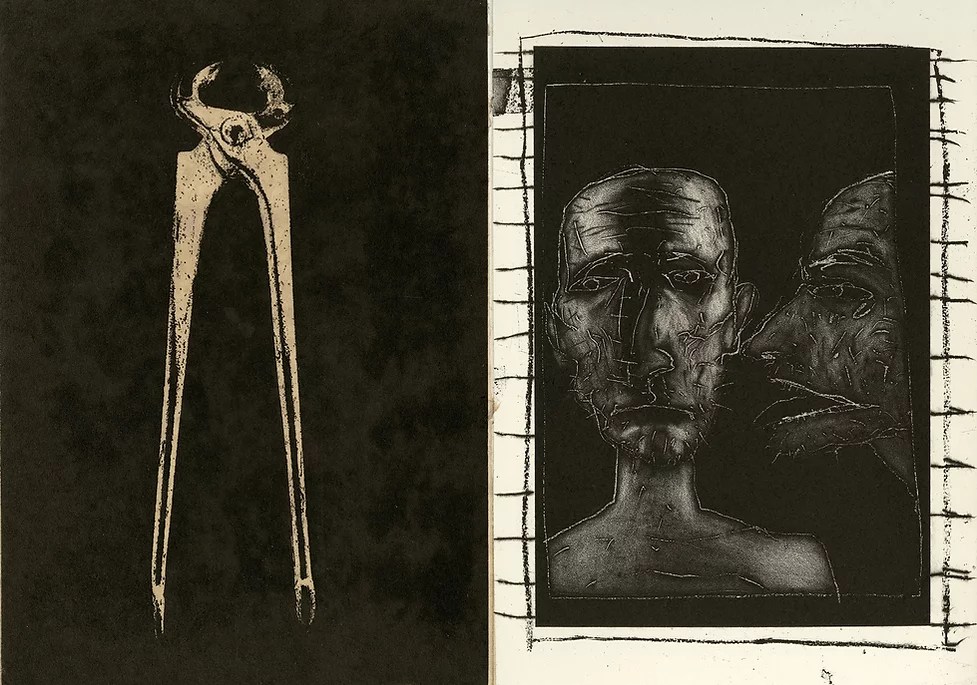
PRINT SERIES: The Passion and Its Objects (after Dürer) by Marcus Rees Roberts: “The Passion and Its Objects (after Dürer) is a series of etchings and monotypes by Marcus Rees Roberts. The images derive from fragments from Albrecht Dürer’s series of woodcuts The Small Passion (1511). Images of the Passion – and of the crucifixion in particular – are so embedded in Western consciousness that we forget that it is a depiction of betrayal, prejudice, and torture. In this version of the Passion by Dürer, one of several he made, small, everyday objects lie scattered within the images – a jug, pliers, a hammer, a coil of rope. Even five hundred years later, we recognise these objects as our own; we can identify with them. But in so doing, we enter the depicted space, and we become complicit in the cruelty. This is one reason why Dürer’s Small Passion is both so powerful and so uncomfortable.”
Marcus Rees Roberts (British, 1951–), The Passion and Its Objects (after Dürer) I, 2019. Diptych etching and aquatint with chine collé printed on Somerset Satin soft white 300gsm, each plate 29.5 × 21 cm (overall 29.5 × 42 cm). Edition of 15.
+++
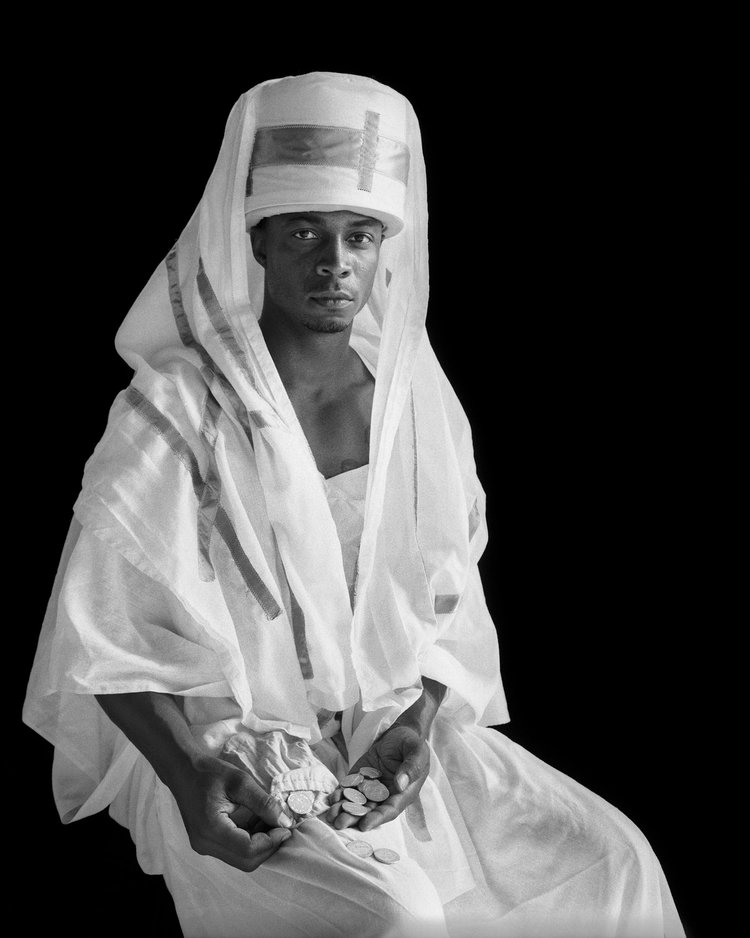
PHOTOGRAPHY SERIES: Passion Play by Deborah Luster: “There are more than 5,300 inmates at the Louisiana State Penitentiary at Angola. Nearly 4,000 of them are serving life without parole. In 2012 and 2013 the Angola Prison Drama Club staged a play unlike any other in the prison’s experience. The Life of Jesus Christ featured 70 inmates, men and women acting together for the first time—in costume, with a real camel, performing for the general public. For the untrained actors, this production held special meaning as they saw pieces of their own lives revealed in the characters they played.”
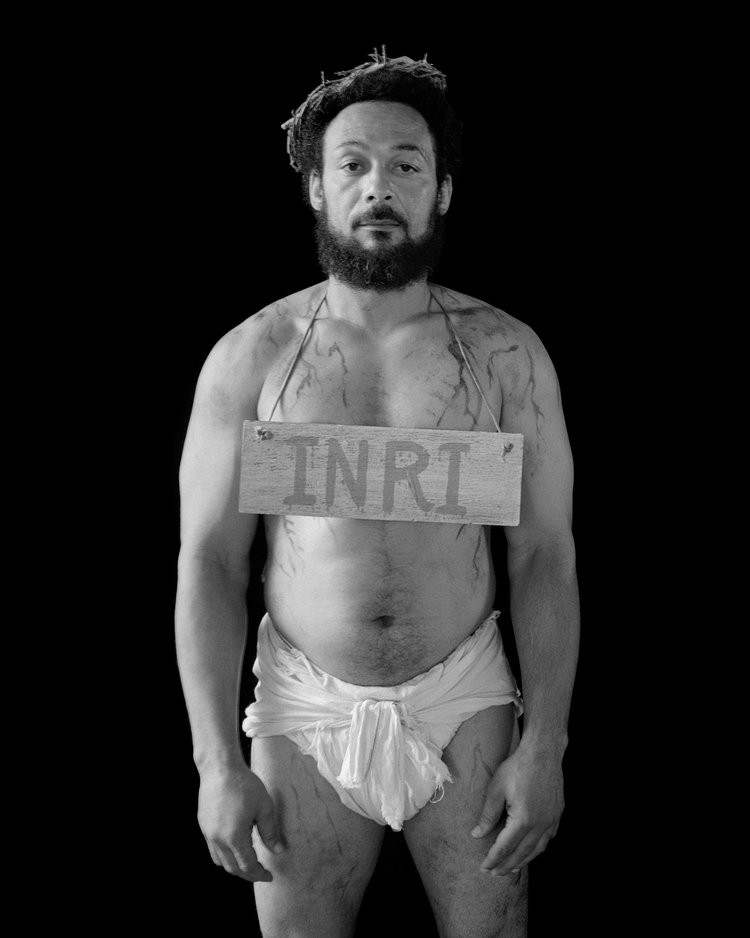
Layla “Roach” Roberts (Inquisitor), sentenced to LIFE, Angola Prison, Louisiana. Photograph by Deborah Luster, from the Passion Play series, 2013.Bobby Wallace (Jesus), Angola Prison, Louisiana. Photograph by Deborah Luster, from the Passion Play series, 2013.
+++
SONGS:
>>“May I Go with You” by January Lim: This Maundy Thursday song was written in 2020 in the voice of Jesus in Gethsemane, speaking to God the Father. In the first stanza, it seems to me that Jesus is asking to be taken up to heaven, like Elijah—just whisked away back to glory, and spared tomorrow’s cruelties and pain. But in the second stanza that same request seems to shift in meaning as Jesus expresses a desire to go with God’s plan and asks for the strength to follow through. The song was released on the EP Gathered Sighs (2021), put out by Evergreen Baptist Church of Los Angeles, where Lim serves as worship arts pastor. [HT: Global Christian Worship]
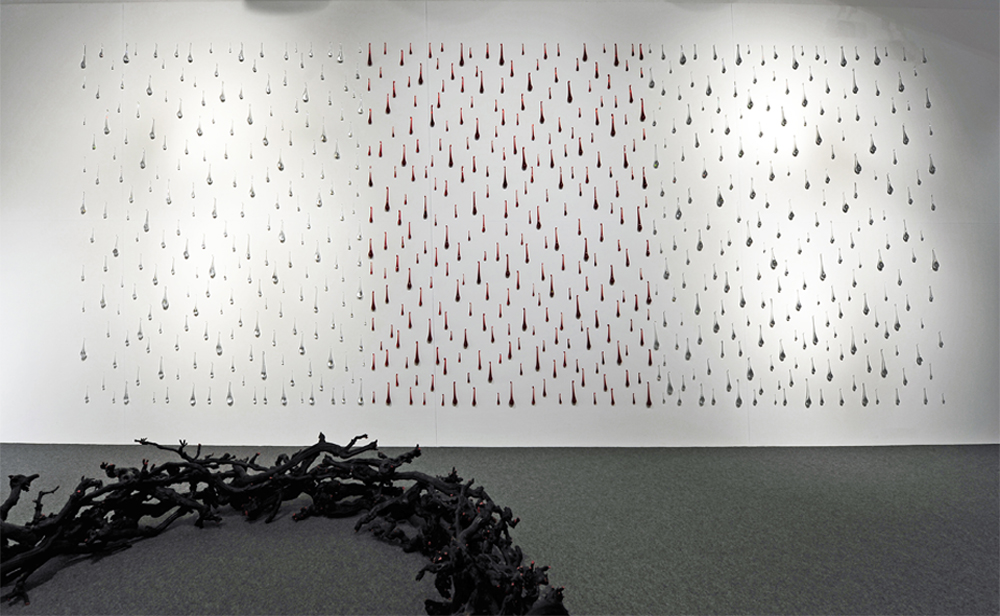
Hélène Mugot (French, 1953–), Du sang et des larmes (Blood and Tears), 2004. Triptych of 300 crystal drops and 200 red glass drops, 350 × 900 cm. Exhibition view from Icare encore at the Mandet Museum, Riom, France, October 22, 2011–January 22, 2012. (Foreground: Pour la gloire… [For the Glory…], 2011.)
When Jesus went out to the garden of Gethsemane to pray the night of his arrest, he pled with the Father to let the cup of suffering pass. Luke says he sweated drops of blood (22:44). He was in agony. He probably dreaded the physical torture he knew was coming, and maybe even more his disciples’ abandoning him. Perhaps he wept for the mother and friends he would leave behind in this next phase of ministry—or, with a mixture of grief and frustration, for the world’s failure to see who he truly was.
Hélène Mugot’s Du sang et des larmes, which translates to Blood and Tears, is an installation of glass pieces made to look like bodily fluids. They hang on the wall in the shape of a three-paneled altarpiece—blood in the center, tears on the wings. The globular forms catch the light from the room and shine.
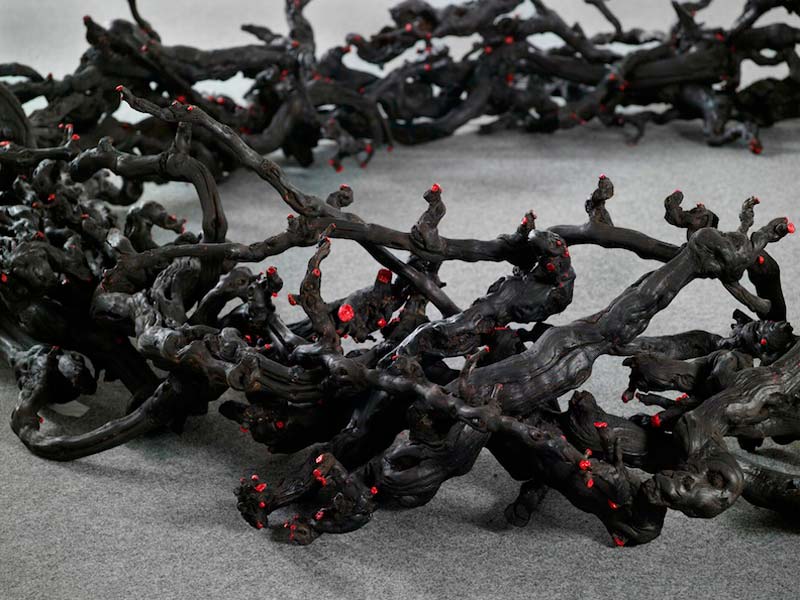
When Du sang et des larmes was exhibited at the Mandet Museum in 2011, it was part of a larger show of Mugot’s work. On the floor in front of it was her Pour la gloire… (For the Glory…), a menacingly large braided wreath of thick, knotted, blackened vines whose stumps are dotted with red wax of the type used to seal wine bottles—both bandage and wound here, Mugot says. The piece is meant to evoke Jesus’s crown of thorns.
Hélène Mugot (French, 1953–), Pour la gloire… (For the Glory…), 2011. Old vines and red sealing wax, outside diameter 275 cm, height 50 cm. Exhibited at the Mandet Museum, Riom, France, 2011. Photo: Patrick André.
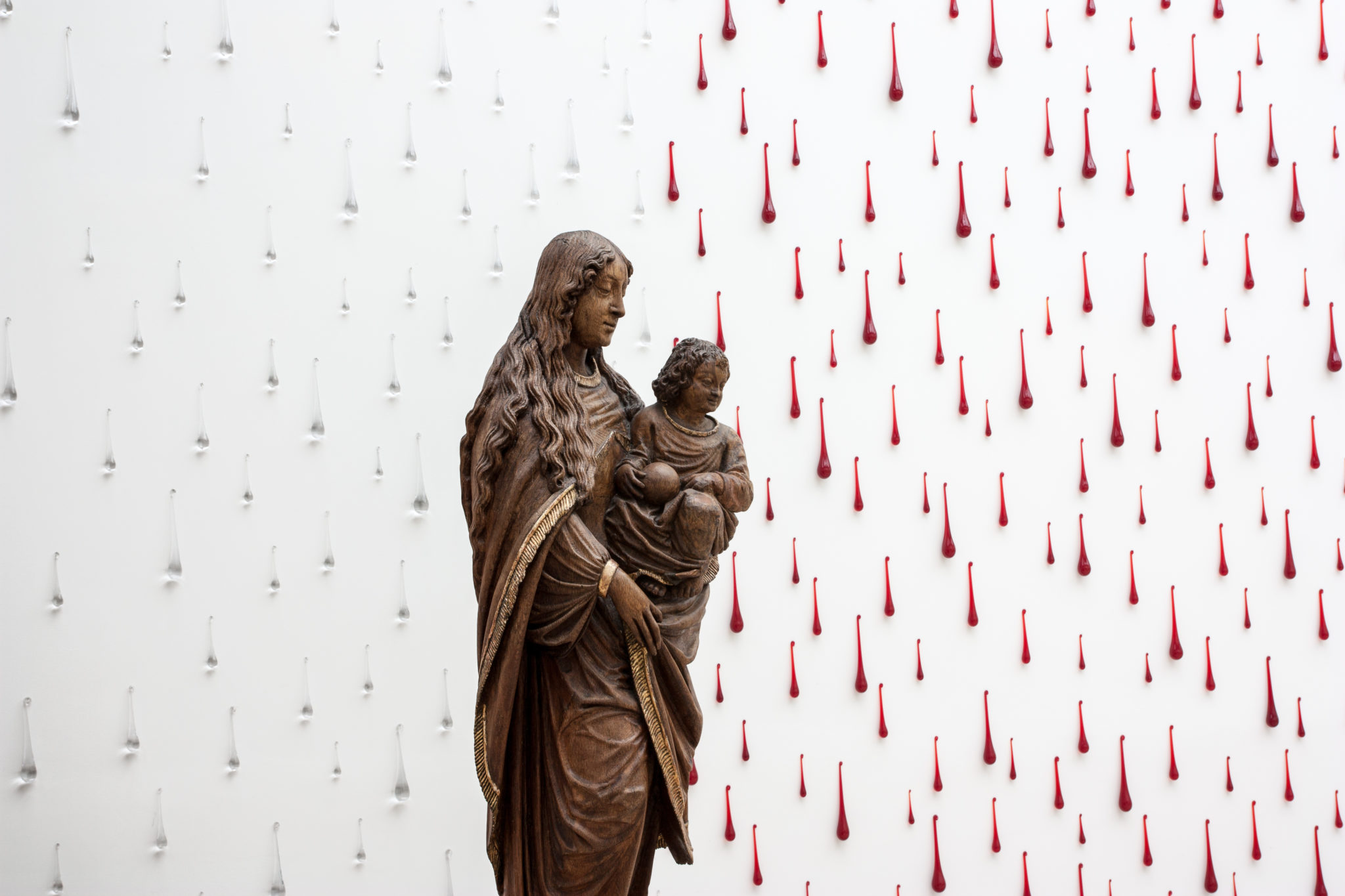
In 2013 Du sang et des larmes joined the collection of the Musée du Hiéron in Paray-le-Monial, France, a museum of Christian art from the Middle Ages to today. There it is staged as the backsplash to a seventeenth-century Virgin and Child statuette carved in wood, thus prompting us to read Christ’s infancy in light of his passion, and vice versa—the Incarnation as a total event, spanning birth to death. (Cue Simeon’s “A sword will pierce your soul . . .”)
Virgin and Child, 17th century; Du sang et des larmes by Hélène Mugot. Collection of the Musée du Hiéron, Paray-le-Monial, France. Photo: Jean-Pierre Gobillot.
To fit the space, the number of droplets and overall size changed slightly from the piece’s first few installations: at the Hiéron there are 311 crystal drops and 267 red glass drops, and the dimensions are 420 × 650 cm.
LISTEN: “Flow, My Tears”by Toivo Tulev, 2007 | Text based on a 1600 air by John Dowland and the Improperia (aka, the Reproaches), a series of antiphons and responses expressing the remonstrance of Jesus Christ with his people | Performed by the Latvian Radio Choir, dir. Kaspars Putniņš, on Tulev: Magnificat, 2018
Flow, my tears, fall from your springs, flow my tears, fall from your . . . Flow my tears, fall from your springs, fall, fall, fall, flow, flow, my tears, flow.
Down, vain lights, shine no more, no nights are dark enough, no lights, shine no more, flow no more, no more. Flow down, vain lights, shine no more, shine you no more.
I led you in a pillar of cloud but you led me to . . . I gave you saving water, but you gave me gall and you gave vinegar. My people, what have I done to you? What have I done to you? Answer me. How have I offended you, you, you? I opened the sea before you, I opened the sea, but you opened my side with a spear.
Flow, flow, flow down. Rain, drop down, cover the ground, drop down, my blood, flow, flow down, drop down, drop down, drop, flow, flow, flow, shine, flow, flow, shine! Flow, my blood, flow, flow, drop, flow down.
My blood spills from your wounds, drop, drop, drop, your wounds, flow, flow, flow down, flow, shine, drop, flow. Flow my tears, fall from your springs, flow, my blood. My blood, my blood spills from your wounds, my wounds, my blood, flow, blood, flow, flow, shine! Spills from your wounds my blood, shine! My wounds, my wounds, drop down, shine! From your, from my wounds, shine! Flow, drop down, shine! Flow, shine! My, your blood, shine!
My blood, flow, shine, flow, shine! shine! Fall, shine, fall, shine, fall from your . . . flow, fall . . . Shine! Shine! [source]
Toivo Tulev is an Estonian composer born in 1958. In this choral composition for twelve solo voices, he has combined words from a secular Renaissance lute song and the Christian Holy Week liturgy. It’s ponderous and grating, capturing well Jesus’s psychological affliction.
While in the first half the speaker, Jesus, wishes for light to “shine no more” so that he be left alone in darkness, that imperative eventually evolves into the affirmative: “Shine!” Blood: shine! Tears: shine! Tulev’s clever manipulation of his lyrical source material creates allusions to the glory, the illumination, that is to come. Paradoxically, when the sun is eclipsed from noon to three on the day of crucifixion, God’s love shines brighter than ever.
One line that stands out to me is “My blood spills from your wounds.” Who is the “your”? Earlier Jesus is talking to his people, but I interpret a shift here to God the Father as the addressee. Even though he sees through to the other side, he, too, is tremendously pained by what is unfolding—his only Son, killed. It’s as if Jesus’s wounds are his own (much like any parent would tell you, when their child is suffering). The unity of these two persons of the Godhead in the poetry of this song is really beautiful. Their heart is one.
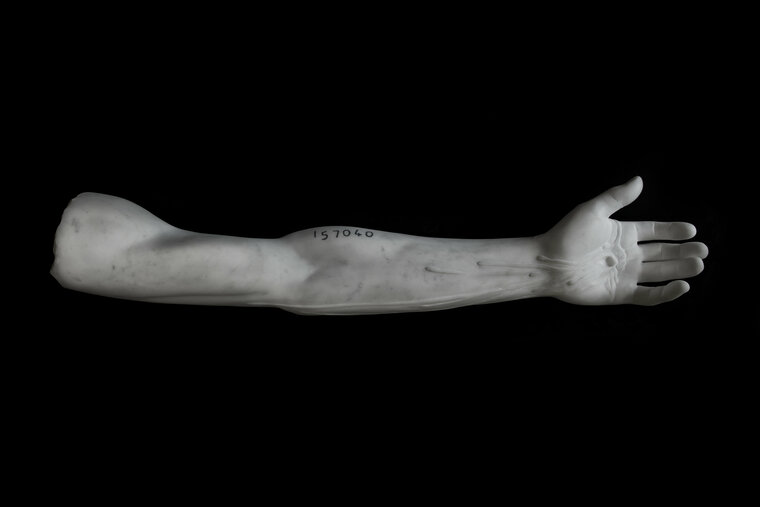
VISUAL MEDITATION: “Golgotha, Auschwitz, and the Problem of Evil” by Victoria Emily Jones: Last month for ArtWay I was asked to write about Emma Elliott’s Reconciliation, a sculpted marble arm that bears both a nail wound of Christ from his crucifixion and the number tattoo of Holocaust survivor Eliezer Goldwyn (1922–2017).
Emma Elliott (British, 1983–), Reconciliation, 2016. Carrara marble, 20 × 110 × 25 cm.
+++
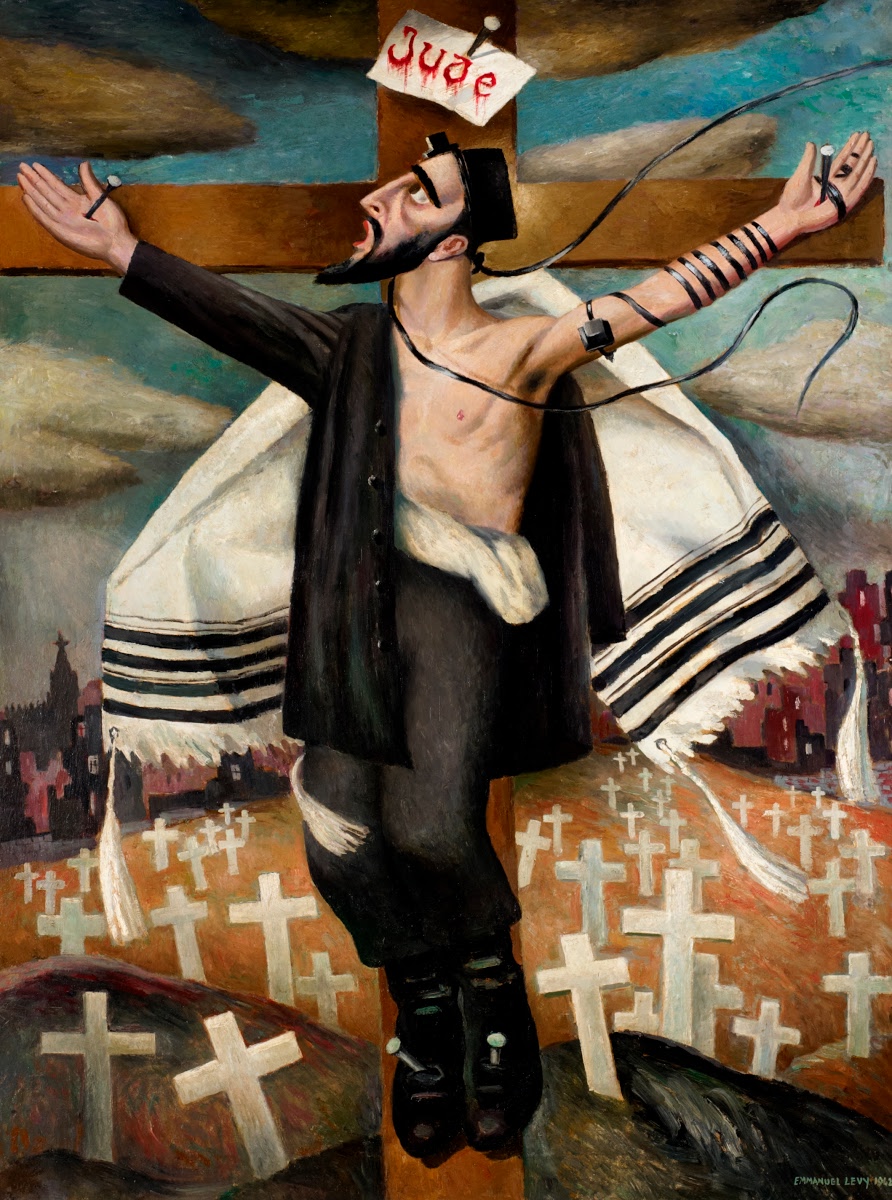
ESSAY: “The church’s reception of Jewish crucifixion imagery after the Holocaust” by Andrew Williams, AGON 48 (Winter 2015): Can Jews create Christian art? “I seek to revisit this question by examining the ways in which Jewish artists have made reference to the central symbol of the Christian faith, the crucifixion, and consider the ethical and theological horizons they open up for the church. . . . Given its place as a symbol of oppression within Judaism, and in particular its integration with the swastika during the years of Nazi power, its widespread adoption within a Jewish artistic vocabulary is remarkable.” Williams discusses “how the resulting christological imagery has been freighted with meaning connected with collective suffering, personal grief and divine abandonment.”
Emmanuel Levy (British, 1900–1986), Crucifixion, 1942. Oil on canvas, 102 × 78 cm. Ben Uri Gallery, London.
Jacob Epstein, Marc Chagall, Emmanuel Levy, RB Kitaj, Mauricio Lassansky, Abraham Rattner, Samuel Bak, Mark Rothko, Barnett Newman, Adi Nes, and Seymour Lipton are among the artists engaged in this illustrated essay. The author provides an extensive bibliography if you’d like to learn more. I also want to remind you of the excellent exhibition catalog essay “Behold the Man: Jesus in Israeli Art” that I shared back in 2017.
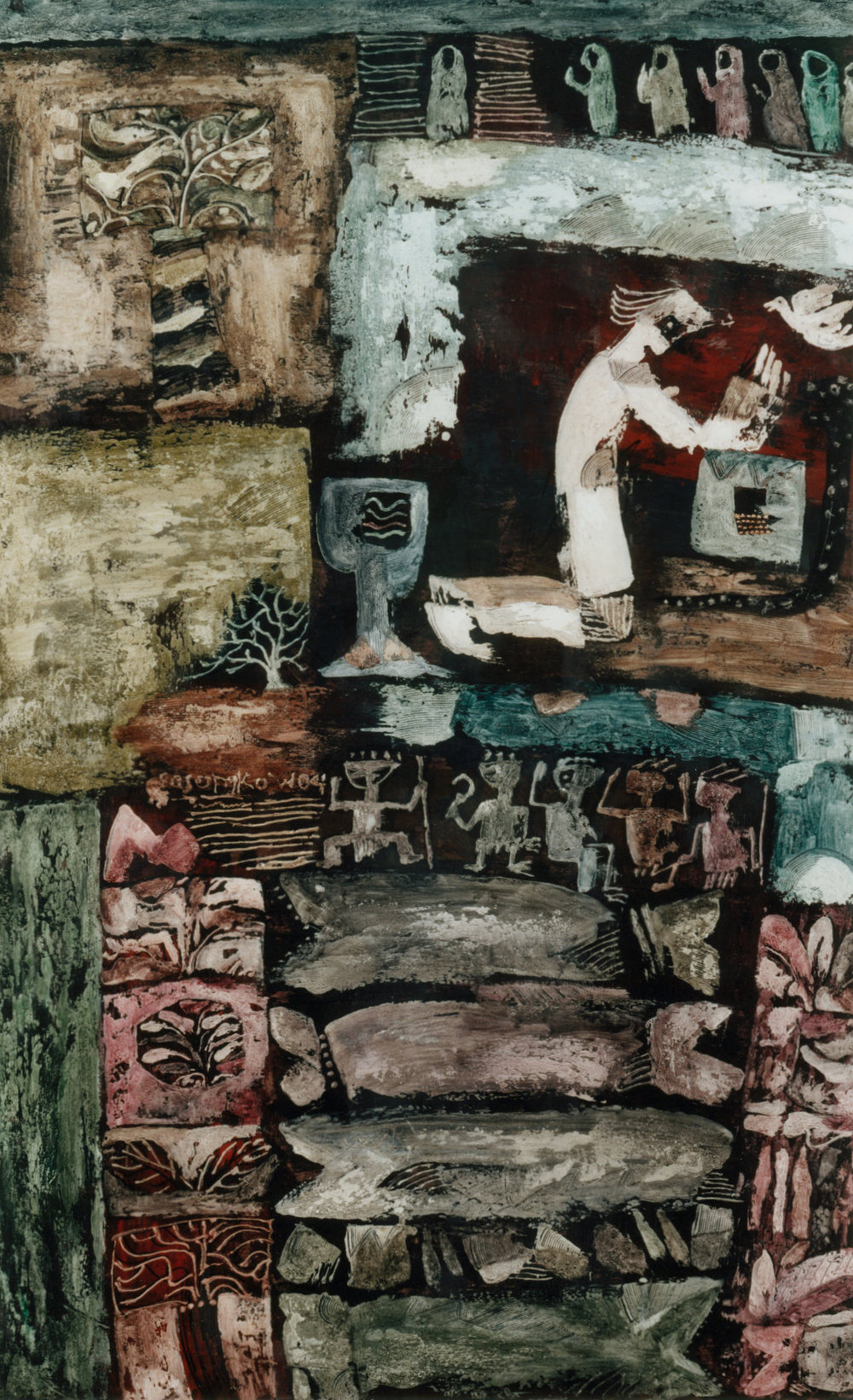
Wisnu Sasongko (Indonesian, 1975–), Last Night in Gethsemane, 2005. Acrylic on canvas, 48 × 34 in.
+++
ESSAY: “The Christian Art Scene in Yogyakarta” by Volker Küster: Published June 27, 2012, by Protestantse Theologische Universiteit (Protestant Theological University) in Kampen, Netherlands, this essay spotlights five Indonesian artists whose work culturally contextualizes the Christian story: Bagong Kussudiardja [previously], Hendarto, Hari Santosa, Dopo Yeihan, and Wisnu Sasongko. Küster provides biographical information on the artists, including their religious backgrounds (most are converts from Islam), and discusses three paintings by each, all of which are reproduced in full color.
ART VIDEO: “Caravaggio’s Taking of Christ” (Great Art Explained): In 2020 art writer and gallerist James Payne launched the YouTube video series Great Art Explained, consisting of fifteen-minute videos that each explore a single historically significant artwork. Here’s one he did on an extraordinary painting of Caravaggio’s from the collection of the National Gallery of Ireland, which shows Judas’s betrayal of Christ in Gethsemane.
Edgar G. Boevé (American, 1929–2019), Phoenix, Death, ca. 1980. Oil and acrylic on tea chest paper. Photo: Victoria Emily Jones, at the Center Art Gallery, Calvin University, Grand Rapids, Michigan, 2015.
Fat soil, full spring, sweet olive, grape of bliss, That yields, that streams, that pours, that doth distill; Untilled, undrawn, unstamped, untouched of press, Dear fruit, clear brooks, fair oil, sweet wine at will! Thus Christ prevents, unforced, in shedding blood, The whips, the thorns, the nails, the spear, and rood.
He pelican’s, he phoenix’, fate doth prove, Whom flames consume, whom streams enforce to die: How burneth blood, how bleedeth burning love? Can one in flame and stream both bathe and fry? How could he join a phoenix’ fiery pains, In fainting pelican’s still bleeding veins?
Elias once, to prove God’s sovereign power, By prayer procured a fire of wondrous force That blood and wood and water did devour, Yea stones and dust beyond all nature’s course: Such fire is love, that, fed with gory blood, Doth burn no less than in the driest wood.
O sacred fire! come, show thy force on me, That sacrifice to Christ I may return: If withered wood for fuel fittest be, If stones and dust, if flesh and blood will burn, I withered am, and stony to all good, A sack of dust, a mass of flesh and blood.
Note: I modernized the spellings of this poem for readability, but there is a beauty to the early modern English; see the original here.
Robert Southwell (ca. 1561–1595) was an English Catholic priest and poet living during the reign of Queen Elizabeth I. Educated at Jesuit colleges in France and Italy, he returned to his native England as a missionary in 1586. But he suffered persecution under the country’s Protestant regime, and had to conduct his ministry in concealment. In his early thirties he was caught celebrating the Mass and was subsequently imprisoned, tortured, and hanged for treason. None of his English poems was published in his lifetime, but many of them circulated as manuscripts. He probably wrote this one sometime during his three years in the Tower of London, awaiting execution.
“Christ’s Bloody Sweat” opens with a reflection on Christ’s agony in the garden of Gethsemane the night before the Crucifixion, when “in his anguish he prayed more earnestly, and his sweat became like great drops of blood falling down on the ground” (Luke 22:44). This bloody sweat may be a figure of speech Luke uses to convey the intensity of the moment, or it may be an actual condition called hematidrosis, in which capillary blood vessels that feed the sweat glands rupture, causing them to exude blood—something that can occur in rare cases when a person is under extreme physical or emotional stress.
In the first stanza of the poem, “Southwell introduces various fluids that represent the creative effusions of Christ’s love, with an extravagant reiteration of images that emphasises the extravagance of that love,” writes Rev. Patrick Comerford in his commentary on the poem.
Fat soil, full spring, sweet olive, grape of bliss, That yields, that streams, that pours, that doth distill; Untilled, undrawn, unstamped, untouched of press, Dear fruit, clear brooks, fair oil, sweet wine at will! Thus Christ prevents, unforced, in shedding blood, The whips, the thorns, the nails, the spear, and rood.
Southwell describes Christ as rich, fertile soil that yields sweet fruit; a spring of living water; an olive from which consecrated oil is distilled (for the anointing of the newly baptized and newly ordained); and a grape that yields fine wine. It may help you to read each phrase vertically down the first four lines: “Fat soil that yields, untilled, dear fruit”; “full spring that streams, undrawn, clear brooks”; “sweet olive that pours, unstamped, fair oil”; “grape of bliss that doth distill, untouched of press, sweet wine at will!”
“Prevent” in this context means to go before. In other words, even before Jesus is captured by the Roman soldiers, tortured, and led to Calvary to be crucified, he sheds his blood in Gethsemane. Without any physical forces acting upon him. “Rood” is an archaic word for the cross.
Stanza 2 references two birds of lore that were popular symbols of Christ: the pelican and the phoenix.
He pelican’s, he phoenix’, fate doth prove, Whom flames consume, whom streams enforce to die: How burneth blood, how bleedeth burning love? Can one in flame and stream both bathe and fry? How could he join a phoenix’ fiery pains, In fainting pelican’s still bleeding veins?
The pelican was said (by Epiphanius, Augustine, and other church fathers) to revive or feed her young with her own blood; she would peck at her breast until she died so that her little ones might have life. The phoenix is a fantastical bird from classical mythology that burns itself to ashes on a funeral pyre ignited by the sun but then rises up out of those ashes, renewed.
Southwell ponders how Christ can be both pelican and phoenix. Did he bleed to death (losing streams of blood), or did he die by burning? The image in line 10 is quite gruesome: Christ simultaneously is “bathe[d]” in blood and fries in flames. The fire is, of course, metaphoric. But it becomes here, along with the blood, an emblem of divine love. A love that bleeds and burns, and that is all-consuming.
The fire and blood imagery continues in stanza 3, where Southwell refers to the famous contest on Mount Carmel between Elijah (a prophet of Yahweh) and the prophets of Baal (see 1 Kings 18).
Elias once, to prove God’s sovereign power, By prayer procured a fire of wondrous force That blood and wood and water did devour, Yea stones and dust beyond all nature’s course: Such fire is love, that, fed with gory blood, Doth burn no less than in the driest wood.
To prove the supremacy of the God of Israel over Baal, Elijah issues a challenge. He and Baal’s prophets would each prepare a bull for sacrifice and lay it on a stone altar but light no fire. They would then pray each to their own god and see which god answers by sending fire from heaven to consume their sacrifice. The prophets of Baal accept the challenge, but no fire comes to light their altar, despite their most fervent entreaties. Elijah, to increase the stakes, even soaks his bull and the wood it lies on in water, three times over—and still fire comes from above, devouring, as Southwell writes, “blood and wood and water . . . [and] stones and dust beyond all nature’s course.”
God’s love is like that fire, Southwell says. The implication, I think, is that on the cross, the love of the Son (who gives himself as a sacrifice) and the love of the Father (who accepts the sacrifice) meet. (I know there are varying interpretations of the nature of the atonement and the role of the Father in the Crucifixion, but I’m simply trying to interpret Southwell here.)
In the poem’s final stanza, Southwell considers how he ought to respond to divine love as expressed in Christ’s passion.
O sacred fire! come, show thy force on me, That sacrifice to Christ I may return: If withered wood for fuel fittest be, If stones and dust, if flesh and blood will burn, I withered am, and stony to all good, A sack of dust, a mass of flesh and blood.
He calls on God to accept, in return, his sacrifice—of praise and thanksgiving and obedience (Heb. 13:15–16; Ps. 50:23) and of his very self (Rom. 12:1–2). He probably had his martyrdom in mind. He acknowledges that he is but a withered, soggy, stony-hearted “sack of dust” but prays that God would make him fit to receive and broadcast the fire of love from on high.
And he came out and went, as was his custom, to the Mount of Olives, and the disciples followed him. And when he came to the place, he said to them, “Pray that you may not enter into temptation.” And he withdrew from them about a stone’s throw, and knelt down and prayed, saying, “Father, if you are willing, remove this cup from me. Nevertheless, not my will, but yours, be done.” And there appeared to him an angel from heaven, strengthening him. And being in agony he prayed more earnestly; and his sweat became like great drops of blood falling down to the ground. And when he rose from prayer, he came to the disciples and found them sleeping for sorrow, and he said to them, “Why are you sleeping? Rise and pray that you may not enter into temptation.”
—Luke 22:39–46 (emphasis added)
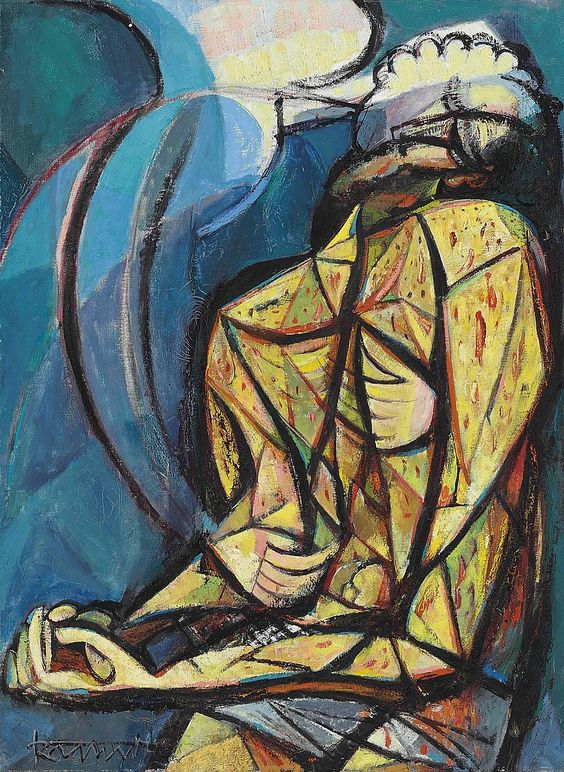
LOOK: Abraham Rattner (American, 1895–1978), Martyr, 1944. Oil on canvas, 32 × 24 in. (81.3 × 61 cm). Private collection.
Jewish artist Abraham Rattner did not specify the identity of the figure in his 1944 painting Martyr, but he painted many images of the passion of Christ during the forties, so it’s likely meant to be a part of that body of work. Because the man’s hands are clasped together, I’m assuming it represents the Agony in the Garden (as opposed to the dead Christ supported by angels).
Luke is the only Gospel writer to mention that in response to Jesus’s anguished pleas in Gethsemane, an angel came down to “strengthen” (enischýō) him. Renaissance artists almost always included an angel in the scene, but at a remove—usually hovering over the mount or peeping out of a cloud, presenting to Jesus the cup of suffering. Often Jesus is shown with a beatific glance upward.
What Rattner gives us, though, is a much more intimate interaction, made all the more so by its being tightly cropped. The angel firmly yet tenderly embraces Jesus’s slumped body, weak with exhaustion and dripping with blood and sweat; the pressure of his grip around arm and torso is palpable. Empathetic, the angel closes his eyes as if trying to absorb Jesus’s pain, to feel it along with him. The two faces appear to merge.
Physical contact between the divinely sent minister and his charge at Gethsemane is not unheard of in the Old Masters; see, for example, Veronese, Giacinto Brandi, Francesco Trevisani, Adriaen van de Velde. But I think Rattner paints it best, capturing a compassionate moment while avoiding mawkishness.
The angel’s simply being there, present to Jesus’s sorrow, doesn’t immediately soften the tension Jesus holds in his body or eliminate his fears. But it does reinvigorate his trust in the Father’s will and prepares him to accept the cup, to drink its bitterness to the dregs.
I wonder how long the angel stayed with Jesus that night. That week. Perhaps the angel strengthened him at other points during his passion too?
LISTEN: “’Tis Midnight, and on Olive’s Brow” | Words by William B. Tappan, 1822
’Tis midnight, and on Olive’s brow The star is dimmed that lately shone; ’Tis midnight in the garden now, The suff’ring Savior prays alone.
’Tis midnight, and from all removed, The Savior wrestles lone with fears— E’en that disciple whom he loved Heeds not his Master’s grief and tears.
’Tis midnight, and for others’ guilt The Man of Sorrows weeps in blood; Yet he that hath in anguish knelt Is not forsaken by his God.
’Tis midnight, and from ether plains Is borne the song that angels know; Unheard by mortals are the strains That sweetly soothe the Savior’s woe.
In this hymn the Rev. William B. Tappan of Massachusetts does not indicate the physical presence of an angel with Jesus in Gethsemane but instead imagines a faint waft of angelic song, heard only by Jesus, servicing Jesus’s spirit in his moment of intense need. A fanciful touch, but sure! The repetition of “’tis midnight” at the beginning of each stanza emphasizes the deep darkness—physical, psychological, and spiritual—of that Thursday night when Jesus was forcibly seized from prayer to be put to death on a cross.
NEW SONG RELEASE: “Conversion” by Leon Bridges: A smoky, minor-key redemption ballad closes out Leon Bridges’s [previously] latest EP, Texas Sun, a collaboration with the three-piece psychedelic funk band Khruangbin. Bridges wrote the song in 2012 in response to his conversion to Christianity, he said, but this is the first time he’s recorded it. Halfway through, following a personal testimonial about being made alive by the Holy Spirit, the song breaks into a slow R&B rendition of Isaac Watts’s “At the Cross.” Lyrics here. See also the musical and lyrical analysis Aarik Danielsen wrote over at Think Christian.
+++
STATIONS OF THE CROSS:
Contemporary Artists Interpret Stations of the Cross, St. Michael’s Episcopal Church, Arlington, Virginia, February 19–April 3, 2020: Thanks to one of my readers reaching out, I found out about this church-sponsored exhibition just south of where I live and was able to attend the opening reception, where many of the artists were present to talk about their work and answer questions. Unfortunately, the coronavirus has led to its early closure, but photos of the artworks, which are for sale, can be viewed online: see this write-up by curator Maureen Doallas. Below are the works representing station 8 (“Jesus meets the women of Jerusalem”) and station 14 (“Jesus is laid in the sepulcher”).
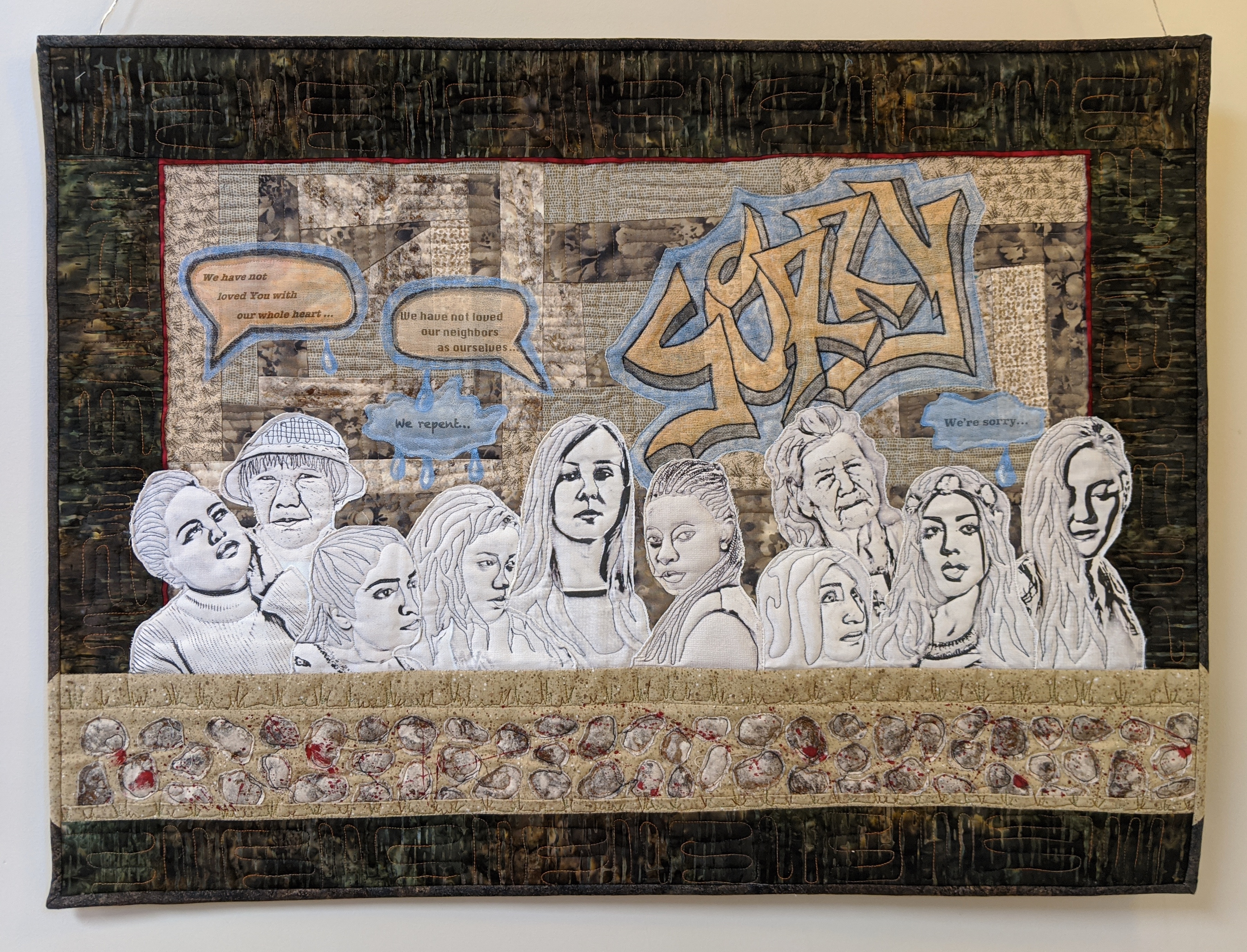
Terry Peckarsky, Still Weeping on the Via Dolorosa, 2020. Quilted commercial cotton fabrics, digitally altered photographs printed on fabric, tsukineko inks, and watercolor, 23 × 31 in. Photo: Victoria Emily Jones. Artist’s website: https://tpeckarsky.tumblr.com/
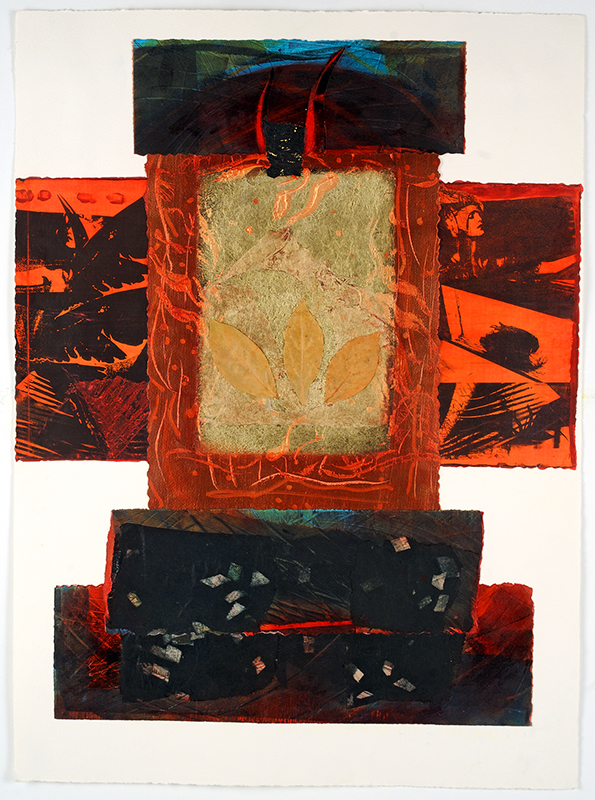
Carol Lukitsch, Sophia Icon. Mixed media collage on paper (with laurel leaves), 30 × 22 in. Photo courtesy of the artist. Artist’s website: http://carollukitsch.com/
Passion and Compassion Oxford: This self-guided tour through Oxford, released this February with a new website and supported by the “Alight: Art and the Sacred” app [previously] for Android and iOS, stops at fourteen artworks or artifacts in multiple locations across the city. Designed around the Scriptural Stations of the Cross as a pilgrimage of sorts, it comprises a mix of historical and contemporary pieces, including sculptures by Jacob Epstein and Antony Gormley, Old Master paintings by Anthony van Dyck and the studio of Andrea Mantegna, a medieval stained glass lily crucifix, Roger Wagner’s Elie Wiesel–inspired Menorah, a “celure” depicting the Pleiades in white gold, Thomas Cranmer’s prison band, and more. Each stop comes with audio commentary by a clergyperson, theologian, or artist. The tour starts at University Church Oxford, the institution that created this wonderful resource. (Note: Most of the sites on this tour are currently closed indefinitely due to the coronavirus.)
Oliver Caroe, Celure, 2012. University Church of St. Mary the Virgin, Oxford.
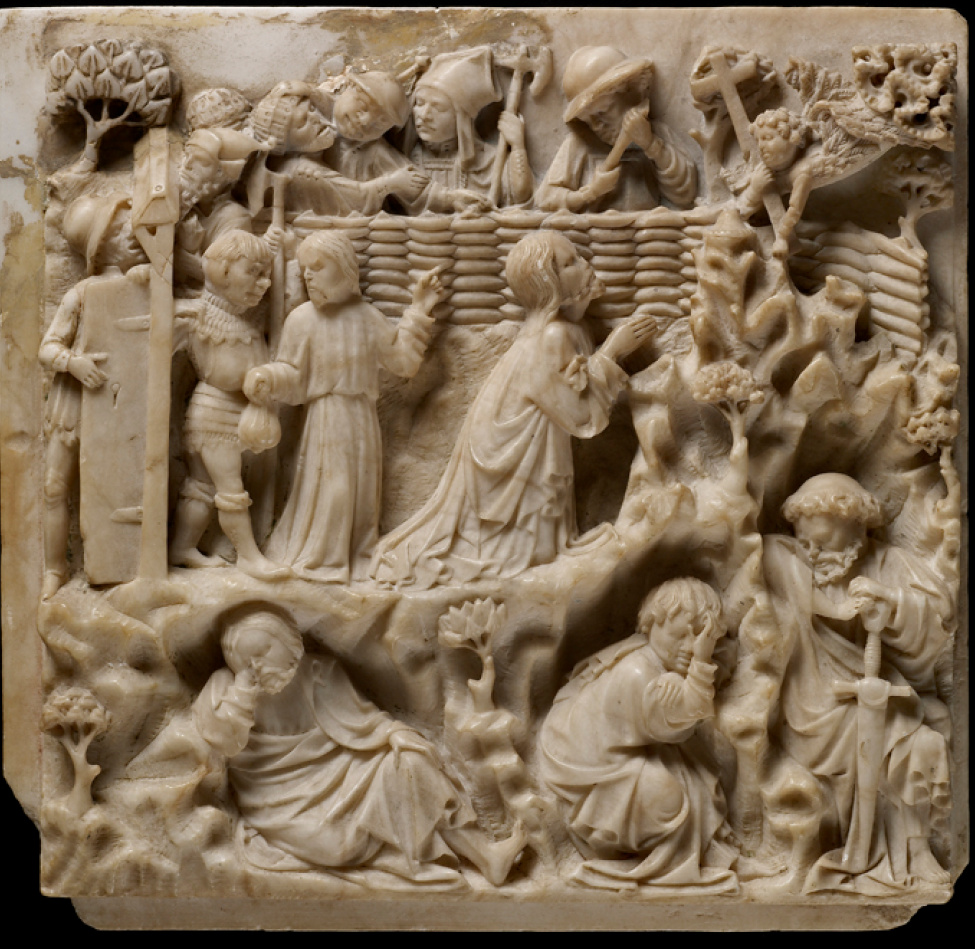
Alabaster relief by the Master of Rimini or workshop, southern Netherlands or northern France, ca. 1430–40. Ashmolean Museum of Art and Archaeology, Oxford.
+++
VIRTUAL TOUR: Single-shot walk-through of Russia’s Hermitage Museum: The State Hermitage Museum in St. Petersburg is the second-largest museum in the world (the Louvre is the largest), with over one million square feet of exhibition space extending across six historic buildings, including the Winter Palace, the former residence of the Russian tsars. Thanks to a five-and-a-half-hour advertisement by Apple showing off the iPhone 11’s battery life, people can move seamlessly through 45 of the museum’s 309 galleries from their own homes. Shot in one continuous take, the video includes close-ups of individual artworks as well as wide shots of the lavish interiors. It doesn’t cover the entire museum, but there is much western Christian art to see, starting at 1:04:41 with Hugo van der Goes’s Adoration of the Magi triptych. Among the most famous religious artworks in its collection, which you may know from Henri Nouwen’s book about it, is Rembrandt’s Return of the Prodigal Son (2:15:54). Here’s the trailer, followed by the full-length video:
It includes ballet sequences throughout and concludes with a live orchestral performance featuring Russian pianist and composer Kirill Richter.
The Hermitage Museum offers virtual tours of its entire collection, in an interactive format that uses panoramic photos, at https://www.hermitagemuseum.org/wps/portal/hermitage/panorama/. Unlike the Apple video, whose purpose is to showcase the capabilities of the new iPhone, the Hermitage-created tour inserts “info” buttons over each artwork so that you can click through to find out the artist, title, etc., if interested. But this format, in addition to requiring a brief load time for each step forward, lacks the grandiose scoring and camerawork of the new Apple video.
+++
POET FEATURE: Jeanne Murray Walker: A semirecent recent blog post by “online abbess” Christine Valters Paintner introduces the work of poet Jeanne Murray Walker, author of Helping the Morning (2014), Pilgrim, You Find the Path by Walking (2019), and eight other books. Reprinted in full are the poems “Staying Power,” about God’s pursuant nature (a modern-day “The Hound of Heaven,” if you will); “Attempt,” which opens with a quote by Traherne; and “Everywhere You Look You See Lilacs,” about being in the moment, taking cues from nature. There is also a video of Walker reading her poem “The Creation,” which muses on the beautiful quirkiness of giraffes, who “spring up like Wow . . . riff-raff of [God’s] imagination.”
+++
GOODLETTERS ESSAY: “What Does It Mean to Be a ‘Religious’ Poet?” by Brian Volck: The contemporary English theologian Nicholas Lash wrote that sadly, “the relation of human beings to the Holy One” has, by many and certainly in the popular imagination, been “reduced to knowledge of an object known as ‘God’ . . . [,] faith’s attentive presence to the entertaining of particular beliefs.” Such reductionism has led many artists to resist being labeled “religious”—“a designation that typically serves to qualify, marginalize, or dismiss creative work.”
But good poetry, Brian Volck says, “and the human sensibilities we’re taught to call religious needn’t be strangers.” There are many poets today who tread the “vast borderlands where religion, spirituality, faith, art, and mystery overlap,” and Volck briefly reviews four such collections from 2019: Anaphora by Scott Cairns, Pilgrim, You Find the Path by Walking by Jeanne Murray Walker, This Far by Kathleen O’Toole, and Long after Laudsby Jeanine Hathaway.




 Art & Theology