Kolumba and KMSKA: Medieval and contemporary art in conversation (part 2)

This a continuation of yesterday’s article. In part 1 I shared three room highlights from my visit to Kolumba museum in Cologne, Germany, run by the city’s Catholic archdiocese; in this final part I will do the same for KMSKA in Antwerp, Belgium, whose Old Masters galleries received a “contemporary injection” in an exhibition that wrapped this week. All photos are my own.

[Content warning: This article contains female nudity: a controversial Renaissance painting of the Virgin Mary, and three photographs of women who have just given birth.]

KMSKA, Antwerp

The Royal Museum of Fine Arts Antwerp, or KMSKA for short, is a world-famous museum whose collection spans seven centuries, from the Flemish Primitives to the Expressionists.

When I was there last month, the featured exhibition was Collected with Vision: Private Collections in Dialogue with the Old Masters, which ran from April 4 to October 12, 2025. Organized in conjunction with Geukens & De Vil Projects, it interwove postwar and contemporary works by internationally renowned artists from Belgian private collections with the existing museum collection, “expanding the transhistorical approach already in place. The exhibition offers a reflection on the history of art collecting and asks probing questions about social issues such as gender, power and identity. The role of museums and collectors is the focal point. Do the interventions create a harmonious dialogue with 700 years of art history, or do they give rise to challenging contrasts?” Featured artists included Cindy Sherman, Olafur Eliasson, David Claerbout, Francis Alys, Christian Boltanksi, Tracey Emin, Marlene Dumas, Luc Tuymans, and Louise Bourgeois.

The galleries of the exhibition were organized by theme: Holy, Impotence, Horizon, Image, Entertainment, Profusion, Lessons for Life, Fame, The Salon, Heroes, Evil, The Madonna, Suffering, Redemption, Prayer, Heavens, and Power.

I’ll spotlight what I consider the most successful and intriguing pairings.

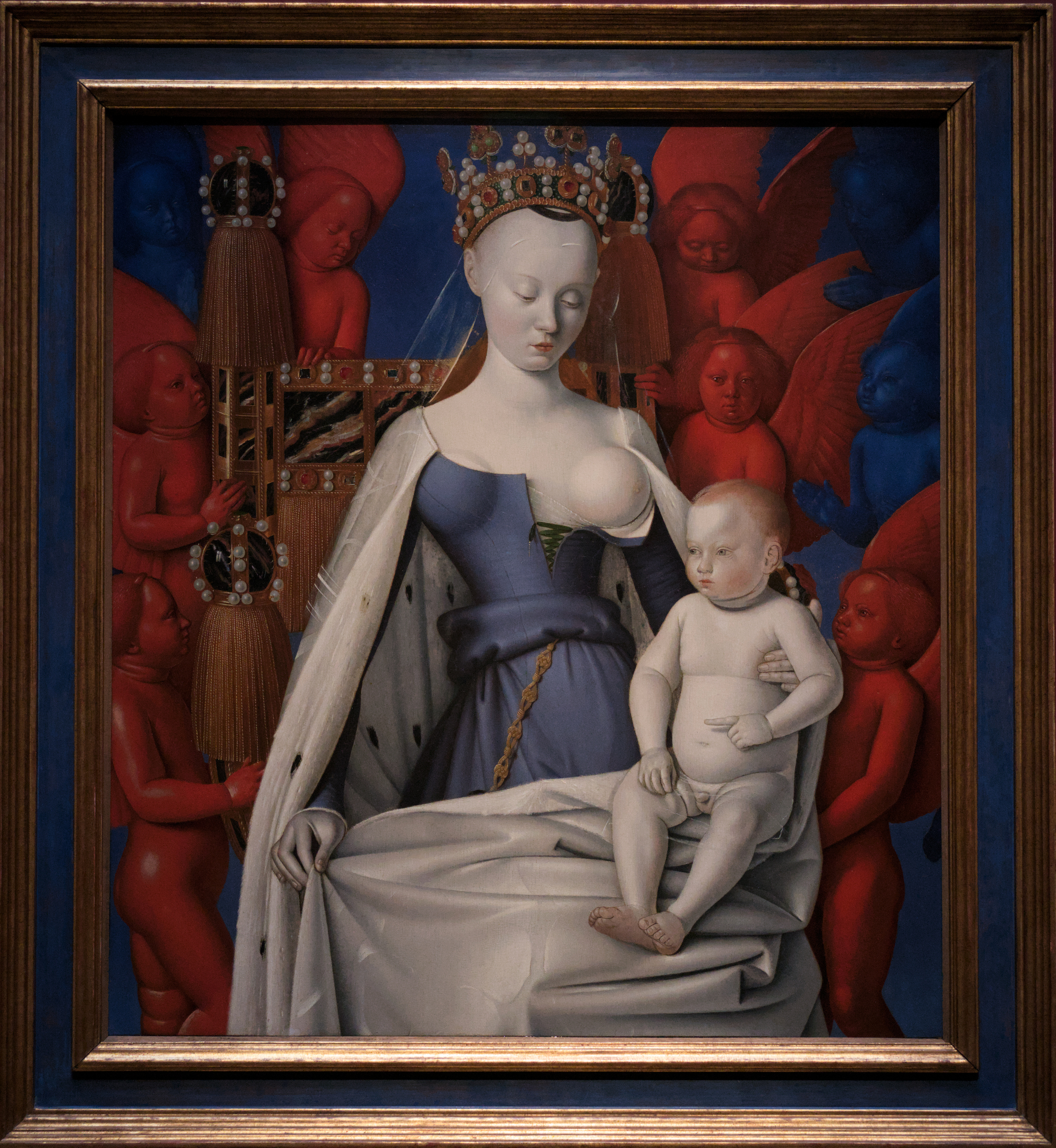
First, the “Madonna” room, anchored by the famous Madonna Surrounded by Seraphim and Cherubim by the late medieval French court painter Jean Fouquet. It’s the right wing of a diptych that originally hung above an altar at the Collegiate Church of Notre-Dame in Melun.
Fouquet, Jean_Madonna Surrounded by Seraphim and Cherubim
Jean Fouquet (French, 1410/30–1477/81), Madonna Surrounded by Seraphim and Cherubim, ca. 1450. Oil on panel, 92 × 83.5 cm. Koninklijk Museum voor Schone Kunsten Antwerpen (KMSKA, Royal Museum of Fine Arts Antwerp).

The painting is historically significant—I first encountered it in a college art history course. Commissioned by Etienne Chevalier, treasurer to King Charles VII of France, it portrays the Virgin Mary as the Queen of Heaven, baring her breast ostensibly to nourish the Christ child with her milk. She was probably modeled after Agnès Sorel, the king’s recently deceased mistress and mother of three of his daughters, considered the ideal of feminine beauty at that time in western Europe: pale-skinned, with a high forehead, and fashionable in her ermine cloak.

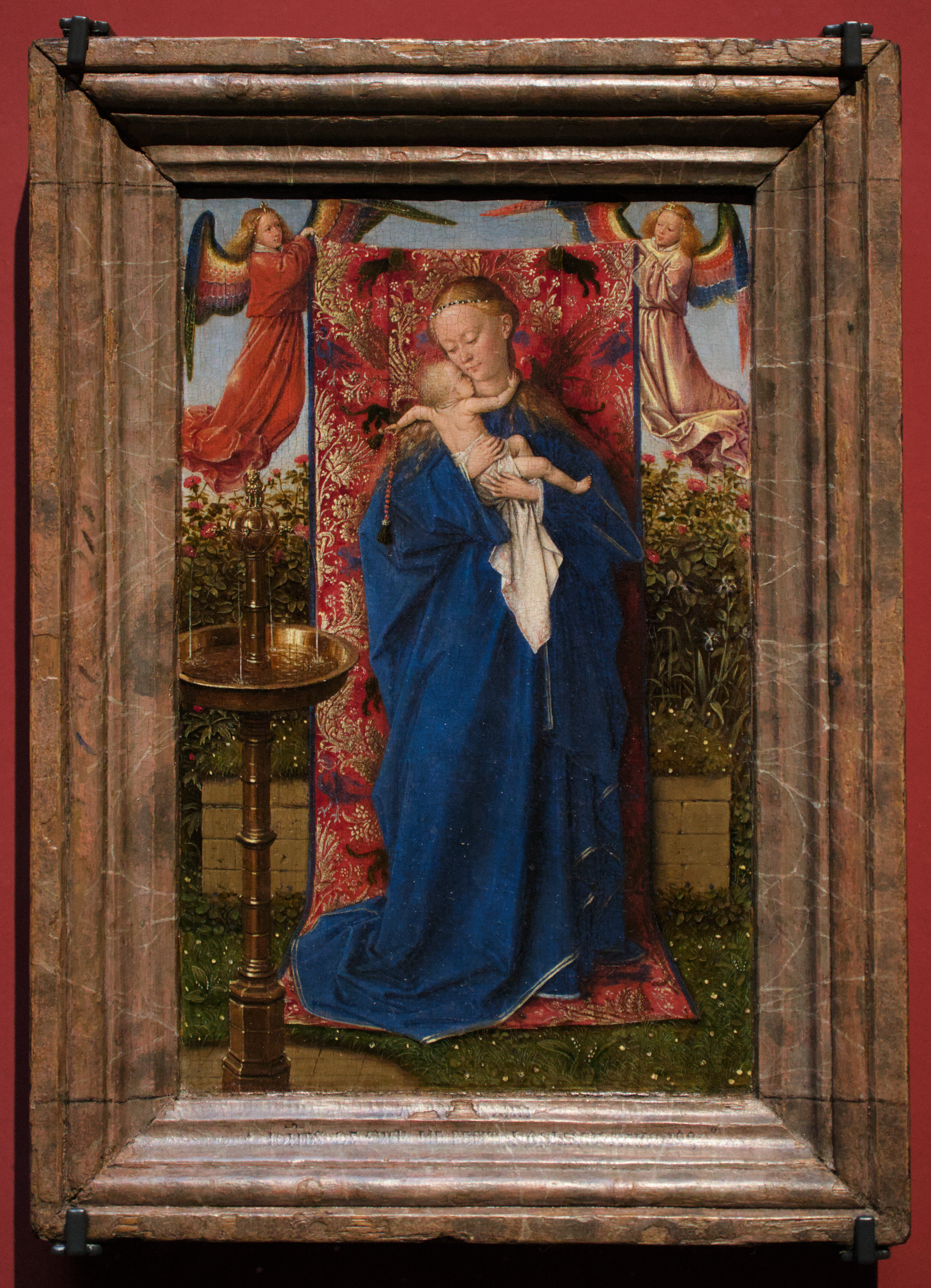
Though I can appreciate the technical excellence of this painting and the intense reds and blues of the angels, I don’t really like it. Mary seems cold, not very maternal. There’s also an eroticization of her body—not because her breast is exposed, which was common in Marian art, but because it seems to be on display for the viewer; her son’s not interested in feeding—that’s wholly inappropriate for the subject. Why you’d want to memorialize your boss’s sex partner in such a way is beyond me. I’m no prude, but I much prefer Jan van Eyck’s Madonna at the Fountain, on display in the same room:
van Eyck, Jan_Madonna at the Fountain
Jan van Eyck (Flemish, 1390/99–1441), Madonna at the Fountain, 1439. Oil on panel, 19 × 12 cm. Koninklijk Museum voor Schone Kunsten Antwerpen (KMSKA, Royal Museum of Fine Arts Antwerp).

This small painting originally hung not in a church but in someone’s house. Though there’s still an air of formality, it has all the tenderness and connection that the other one lacks. Mother and son embrace in a garden of roses, irises, and lilies of the valley, he reaching round her neck and holding a string of prayer beads, she gazing adoringly at him. They stand beside a fountain, recalling Jesus’s discussion in John 4 about the “living water” he gives to those who thirst. The original wood frame bears the artist’s motto: “As well as I can.”

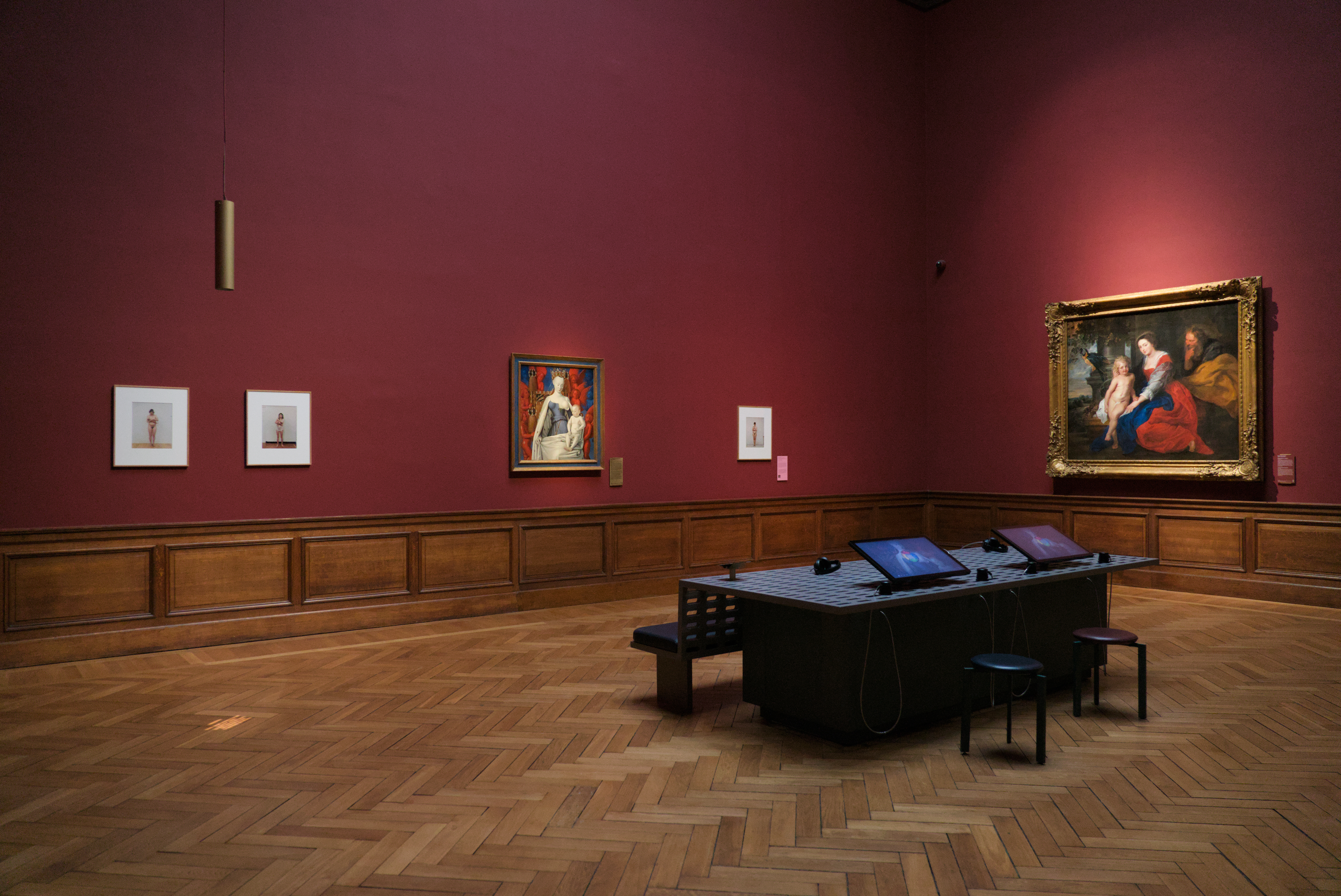
The deeply engrained portrait of motherhood embodied by the Virgin Mary is juxtaposed most potently with a series of three black-and-white portraits of new mothers by the Dutch photographer Rineke Dijkstra.
"Madonna" gallery
Gallery 2.17 (“The Madonna”) from the KMSKA exhibition Collected with Vision: Private Collections in Dialogue with the Old Masters

The accompanying text read:

Jean Fouquet portrays motherhood as something sacred. Mary as a symbol of purity and devotion is richly dressed in cool colours. Rineke Dijkstra homes in on the vulnerable reality. Her mothers are scantily clad and marked by childbirth. Both works are innovative: Fouquet may have painted his Mary for the first time from a real person, and in its day the painting was regarded as ‘modern’. Dijkstra shows motherhood in all its rawness, a taboo usually withheld from view.
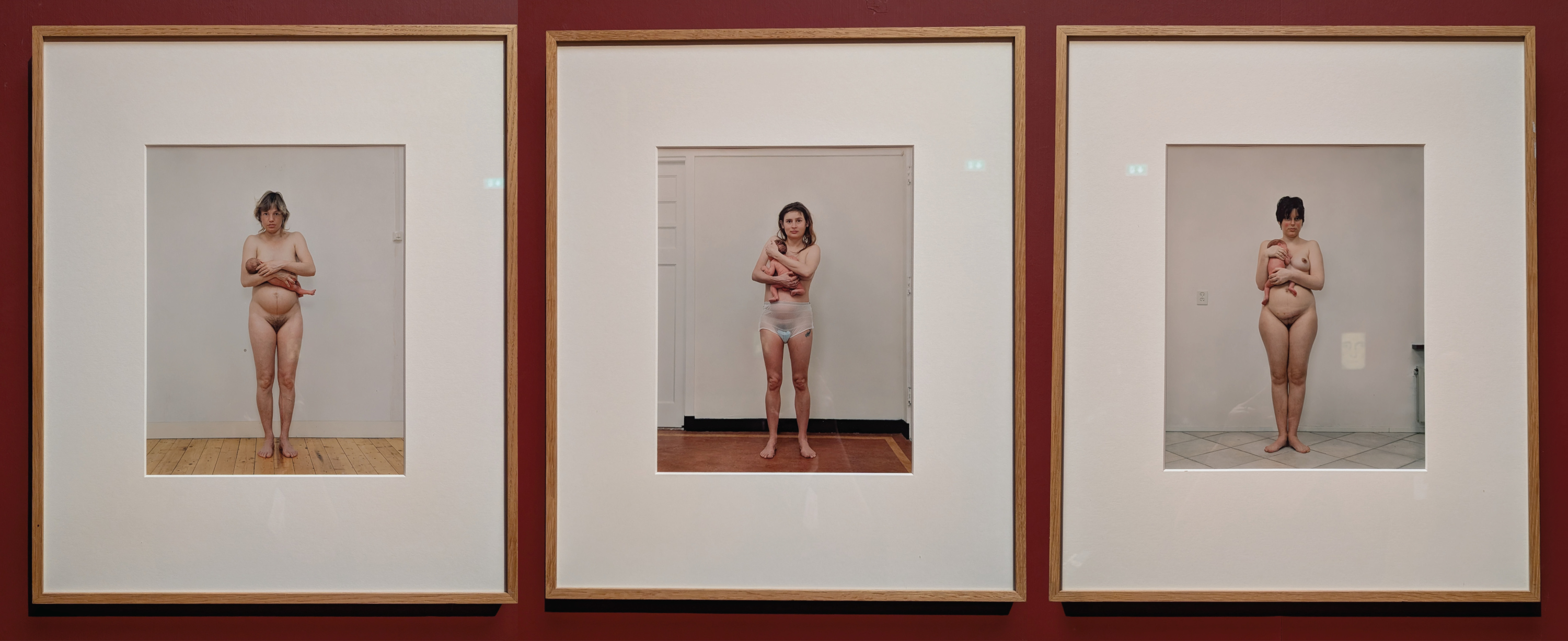
Dijkstra, Rineke_New Mothers
Rineke Dijkstra (Dutch, 1959–), Tecla (Amsterdam, The Netherlands), Julie (Den Haag, The Netherlands), and Saskia (Harderwijk, The Netherlands), 1994. Digital prints. Private collection. [Composite photo by author]

Julie wears hospital pads and mesh underwear, which women often do for several weeks after giving birth to manage postpartum bleeding and urinary incontinence. As for Tecla, blood is running down her leg. And Saskia bears a scar from her cesarean section. A linea nigra (dark line) zips down the abdomen of all three, a temporary pigmentation increase caused by increased hormone levels. I love this triptych that shows motherhood’s glorious, messy, alterative impact on the body—the real physicality of the vocation of bearing children into the world.

I wish there were more imagery of Mary like this, as it would, I think, deepen the wonder of the Incarnation and enhance women’s ability to identify with Mary and thus further enliven her story.

Also in the Madonna gallery was a unique “light poetry” installation by Nick Mattan and Angelo Tijssens—one of seventeen spread throughout the second floor, collectively titled Licht dat naar ons tast (Light that reaches for us). KMSKA had commissioned this couple to bring to life the short verses the museum’s late writer-in-residence Bernard Dewulf had written in response to the galleries’ stated themes.

“Inspired by the museum’s many reading and praying figures, as well as James Ensor’s expressive hand sketches, [Mattan and Tijssens] sought a subtle way to make [Dewulf’s] words tangible,” the museum writes. Their solution was to project them onto the gallery floors from brass cylinders suspended from the ceiling. The words shine like faint specks of light, becoming legible only when a visitor holds their hands, a sweater, or something else up to the light.

Here my husband “holds” a poem written in the voice of Mary:
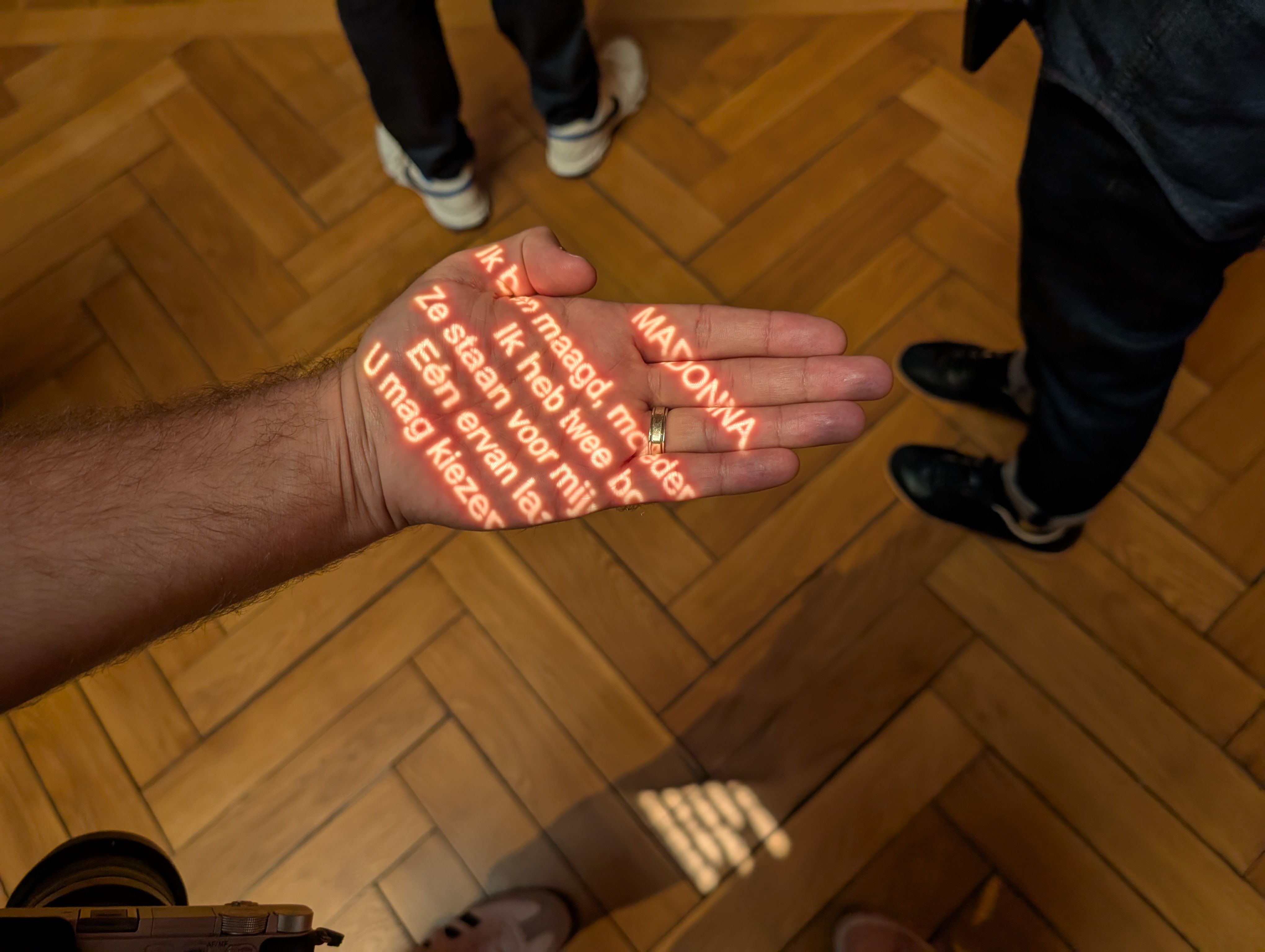
Light that reaches for us
Nick Mattan (Belgian, 1987–) and Angelo Tijssens (Belgian, 1986–), Licht dat naar ons tast (Light that reaches for us), 2023, featuring seventeen poems by Bernard Dewulf. Commissioned by and permanently installed at the Koninklijk Museum voor Schone Kunsten Antwerpen (KMSKA, Royal Museum of Fine Arts Antwerp).

“Madonna” by Bernard Dewulf

Virgin, mother, wife –
I have two breasts
that stand for my three souls.
I show you one of them,
and whose it is is yours to choose.

Translated from the original Dutch by David Colmer

Kind of cheeky! Dewulf speaks of Mary’s three identities and lets us decide if the breast she bares in Fouquet’s painting represents her naked innocence, her nurturing impulse, or her desire to please her husband. (Traditionally in art, it has always stood for the second.)

Though I can’t read Dutch and thus had to consult the KMSKA app for translations of the poems, the thrill of discovery was there in each room. View other visitor engagements with Licht dat naar ons tast on Instagram.

The next gallery I entered was themed “Suffering.”
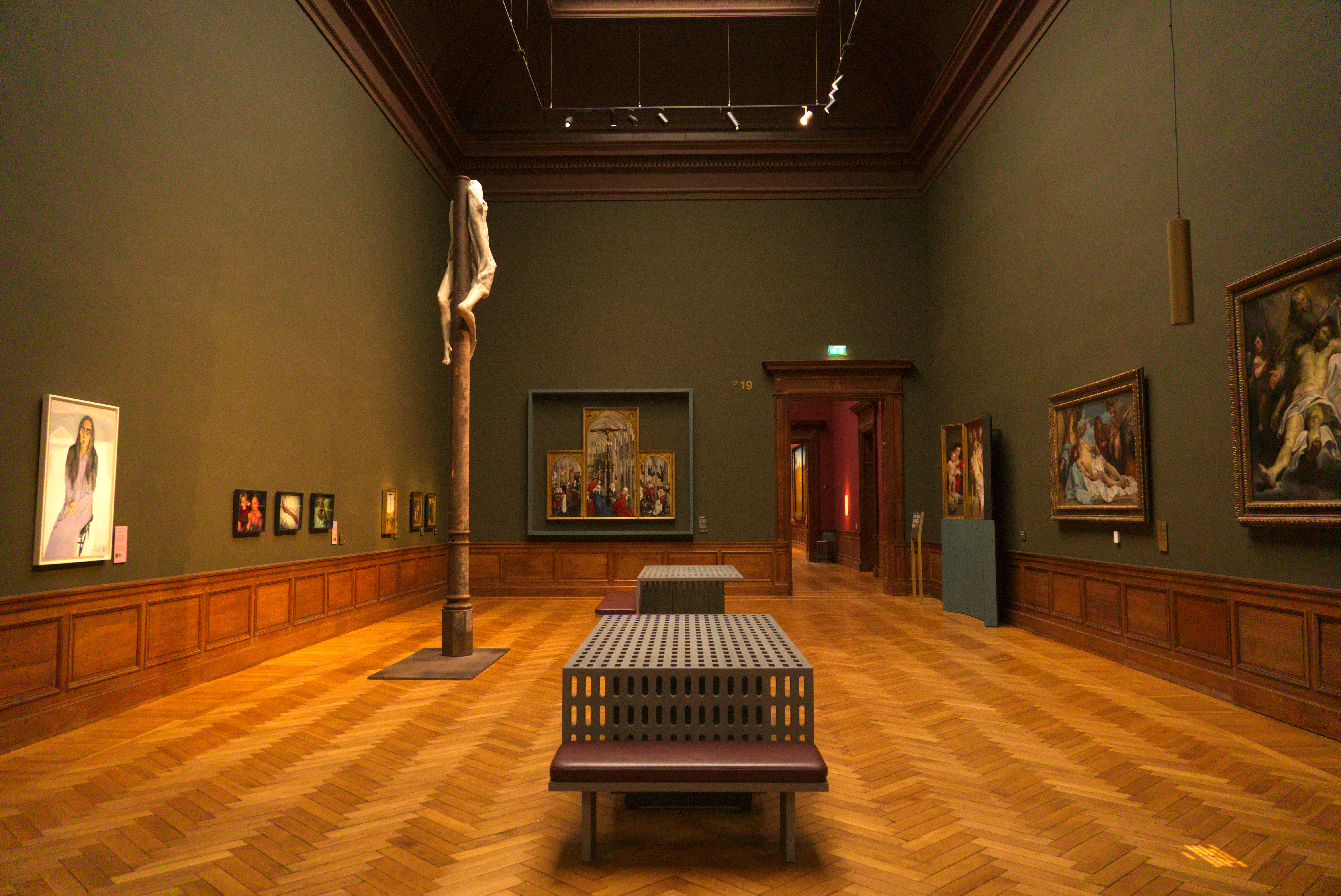
Suffering gallery
Gallery 2.19 (“Suffering”) from the KMSKA exhibition Collected with Vision: Private Collections in Dialogue with the Old Masters

As one would expect, it’s inhabited by several Old Master paintings of Christ’s passion, most notably a triptych by the Flemish Baroque artist Peter Paul Rubens.
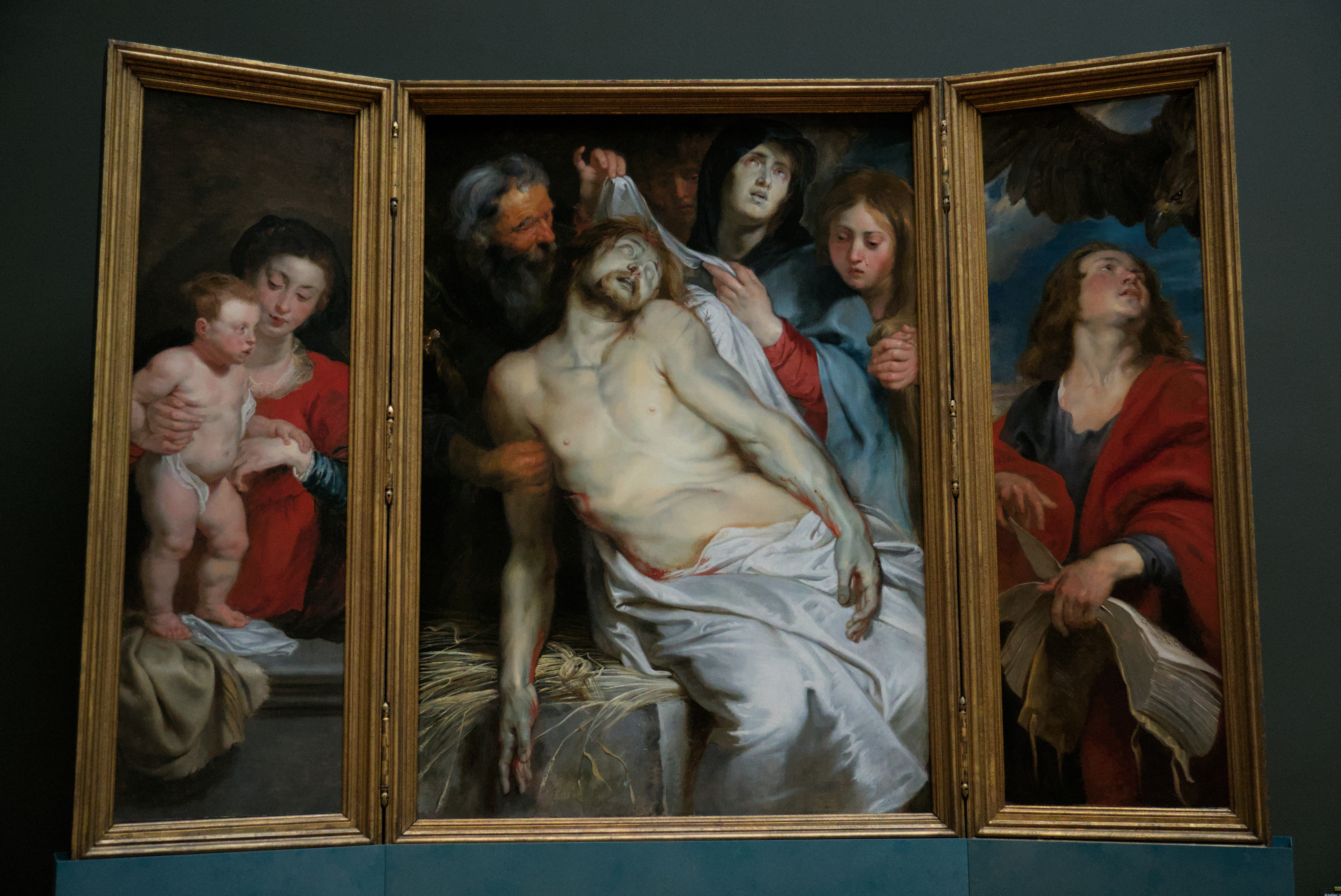
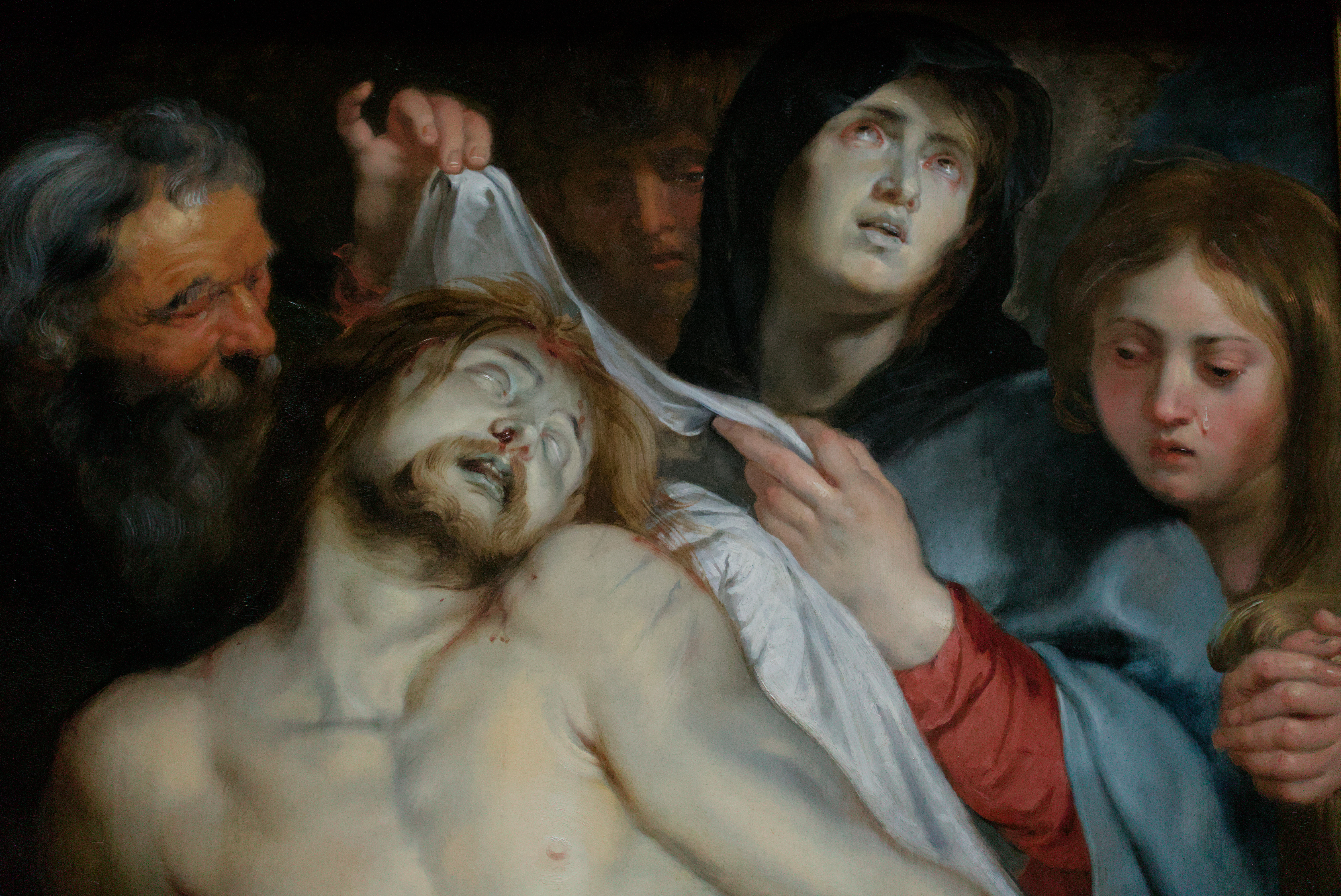
Rubens, Peter Paul_Christ on the Straw
Peter Paul Rubens (Flemish, 1577–1640), Epitaph of Jan Michielsen and His Wife Maria Maes (aka Christ on the Straw, Madonna, and Saint John), 1618. Oil on panel, 138 × 178 cm. Koninklijk Museum voor Schone Kunsten Antwerpen (KMSKA, Royal Museum of Fine Arts Antwerp).

Rubens, Peter Paul_Christ on the straw (detail)

The central panel shows the dead Christ being laid out on a marble slab and wrapped in a shroud by Joseph of Arimathea, while his mother and Mary Magdalene (and the apostle John in the background) mourn him. The left wing shows Mary supporting the pudgy little baby Jesus as he takes some of his first steps, while the right wing shows John, whose symbol is the eagle, writing his Gospel that will place Jesus’s death in the context of the larger story of his life of ministry and his resurrection.

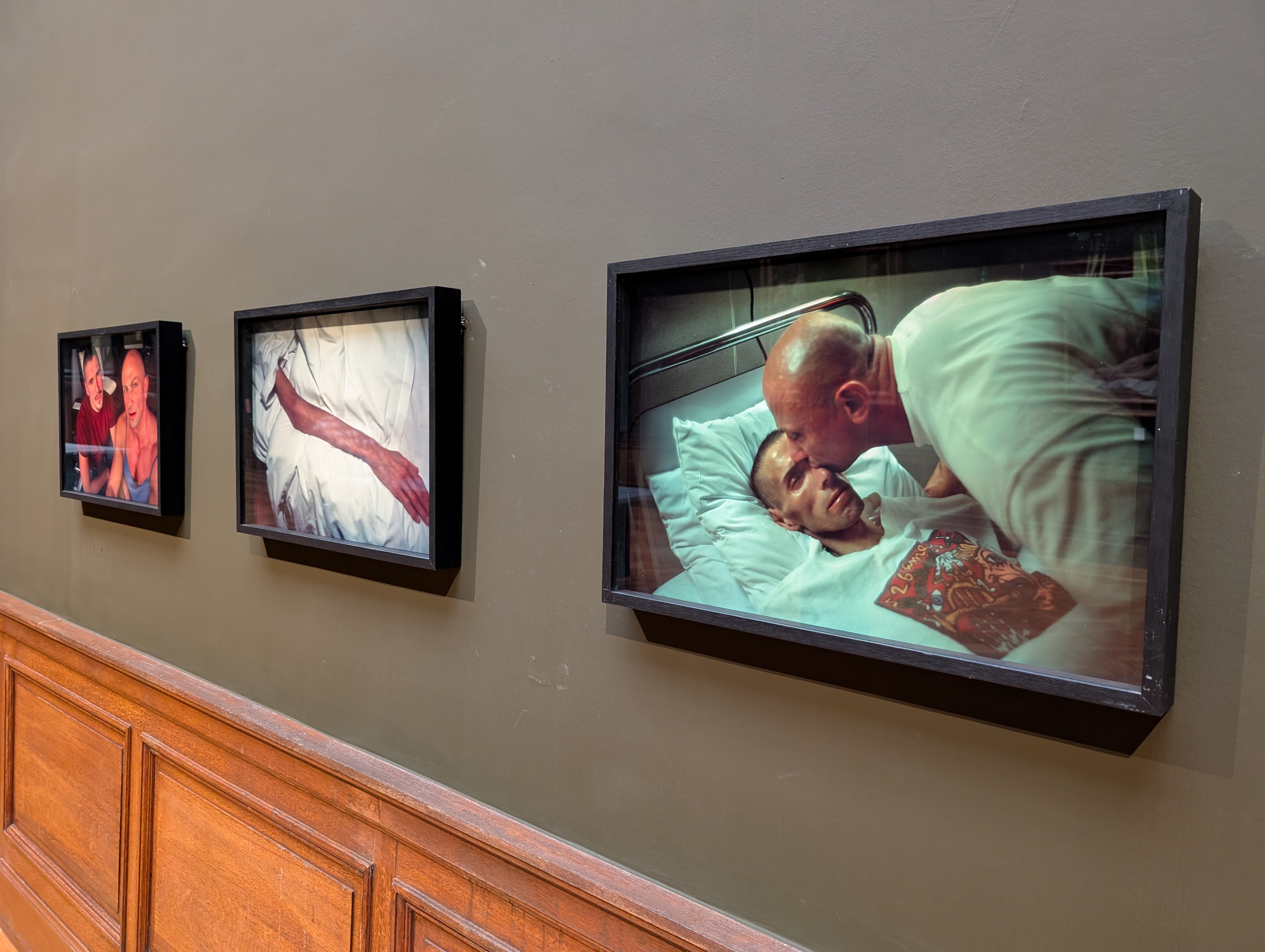
This painting, along with Anthony van Dyck’s Lamentation over the Dead Christ and The Holy Trinity by a follower of Rubens’s (which shows God the Father cradling the dead body of God the Son in an image type sometimes referred to as the Mystic Pietà), are juxtaposed with three photographs by Nan Goldin that show the impact of AIDS on her friend, the Parisian gallery owner Gilles Dusein, and his partner, the artist Gotscho.
Photos by Nan Goldin
Nan Goldin (American, 1953–), Gilles in Hospital, Gilles’ Arm, and Gotscho Kissing Gilles, 1993. C-prints. Private collection.

Dusein’s emaciated arm, resting weakly on a hospital sheet, recalls the limp arm of Christ in paintings of the Deposition and Entombment; and Gotscho’s kiss, the love and grief of Jesus’s mother and friends as they watched their loved one suffer and succumb to death.

By displaying these disparate artworks from vastly different contexts across from each other, we are encouraged to draw connections between the suffering of Christ and that of the LGBTQ+ community. While Christians in Rubens’s day would sit before images of Jesus in pain or sorrow or having died a torturous and untimely death, and deepen their empathy and love, so too might we do well to sit prayerfully, humbly, empathetically, with contemporary images of suffering, seeking to enter the stories they tell.

Calvary by Antonello da Messina (another version of which is at the National Gallery in London) also hangs in this gallery. While the crucified Christ seems at peace with his death, the other two on their crosses writhe in pain.
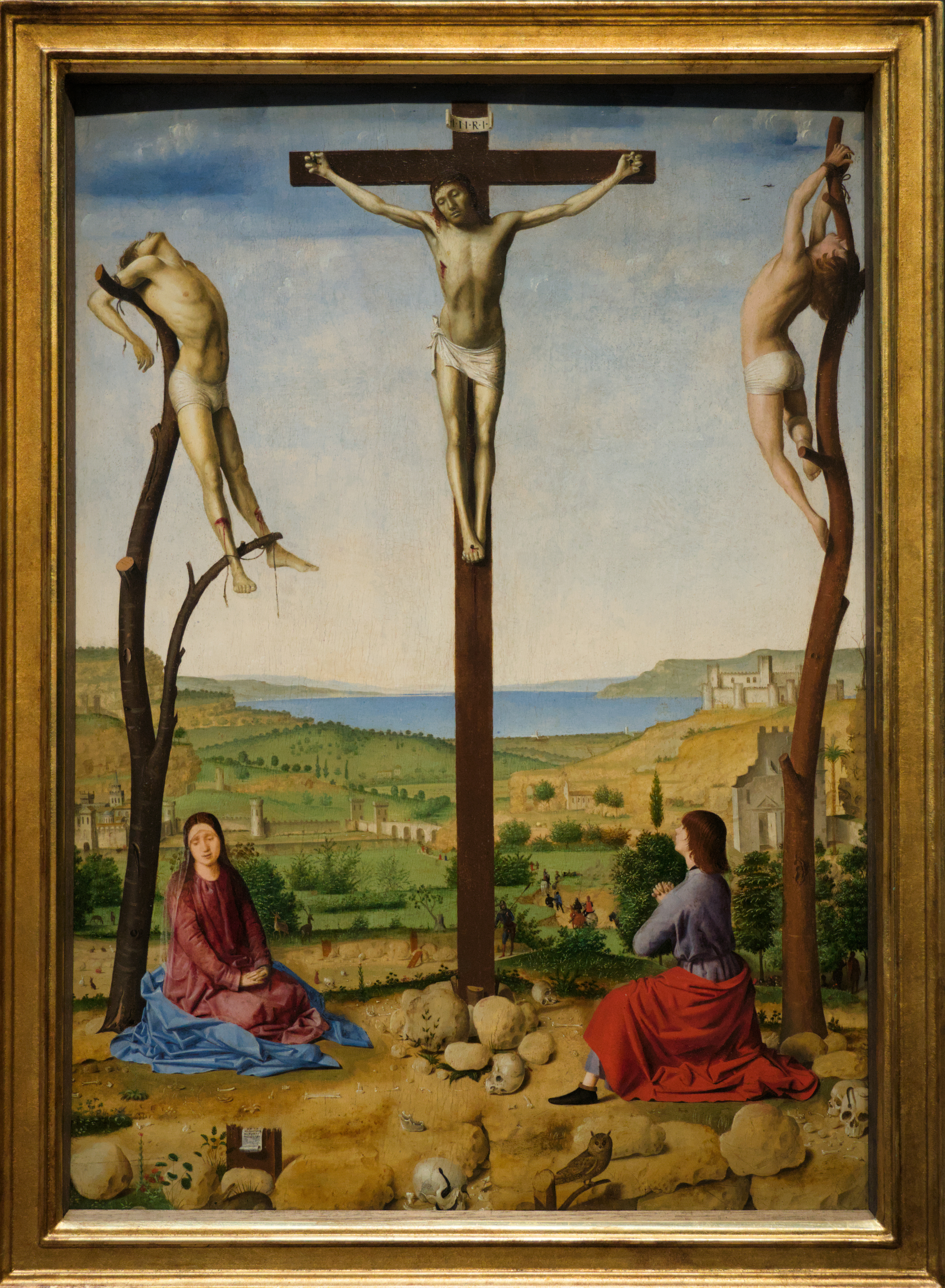
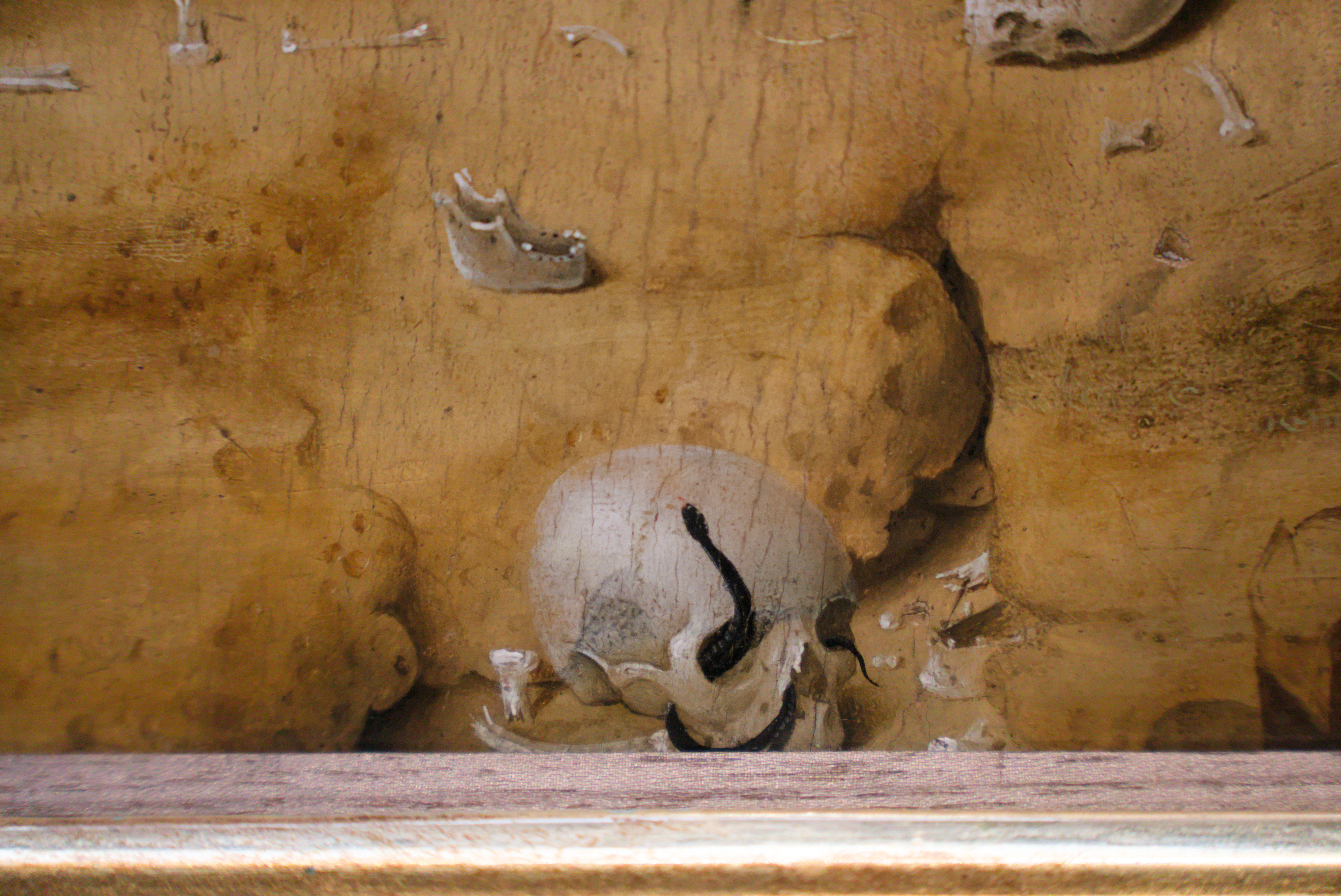
Antonello da Messina_Calvary
Antonello da Messina (Italian, 1430–1479), Calvary, 1475. Oil on panel, 52.5 × 42.5 cm. Koninklijk Museum voor Schone Kunsten Antwerpen (KMSKA, Royal Museum of Fine Arts Antwerp).

Antonello da Messina_Calvary (detail)

Compare these figures to contemporary Belgian artist Berlinde de Bruyckere’s Schmerzensmann (Man of Sorrows), on loan from the collection of David and Indré Roberts (see wide-view photo above). The piece consists of a wax and resin mold of a contorted human form, its skin stretched and broken, its legs wrapped around a tall rusty pole.

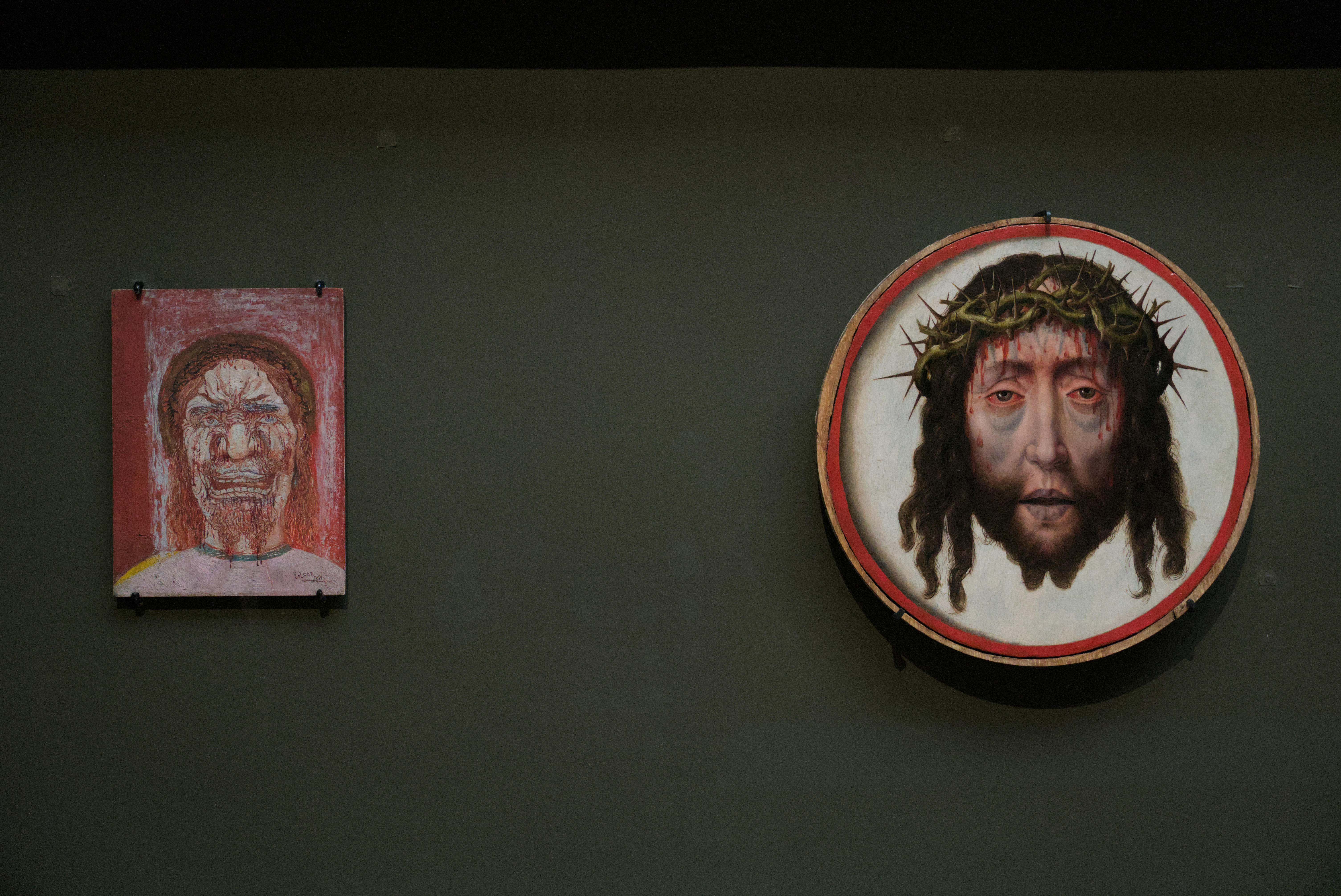
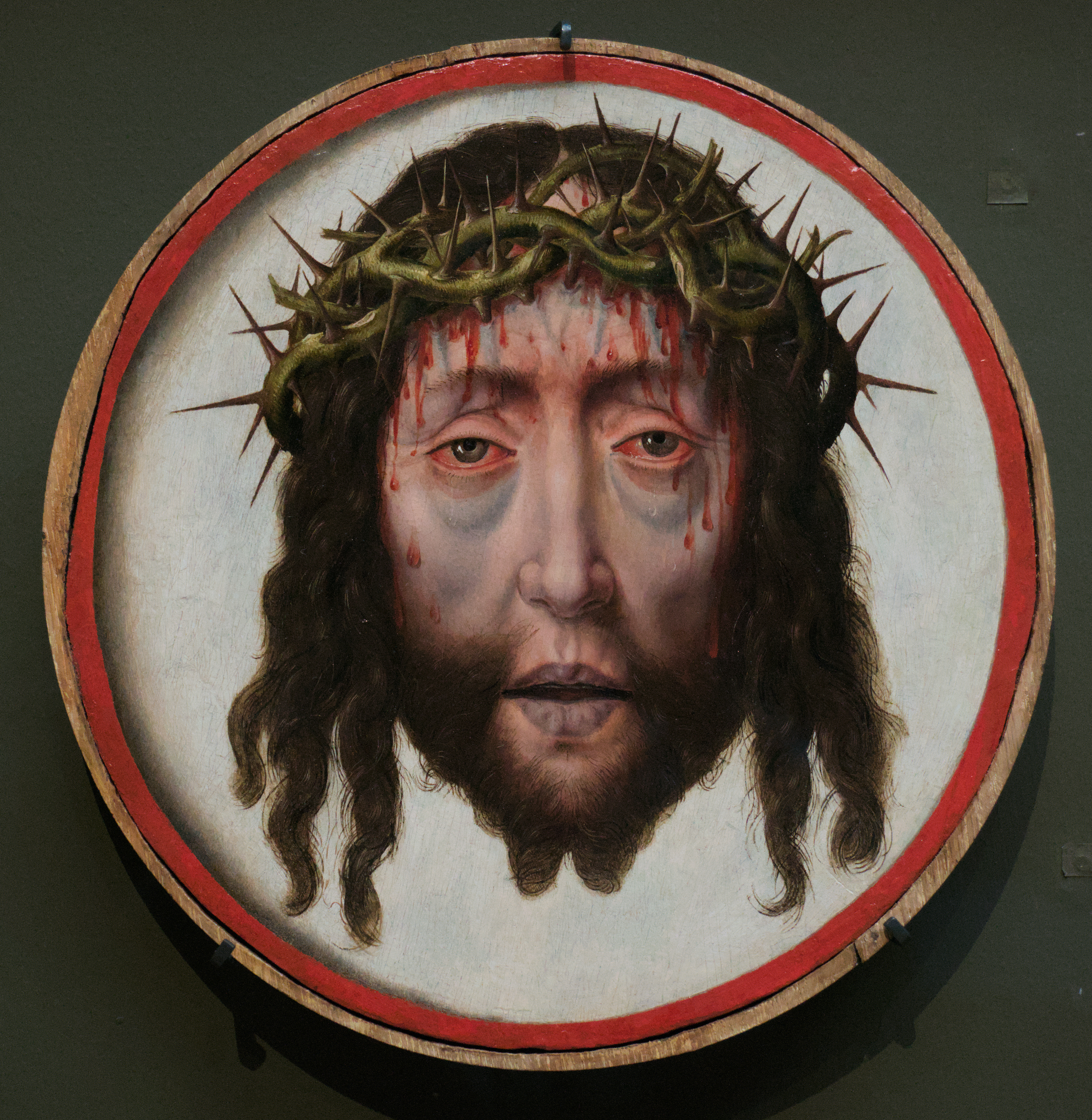
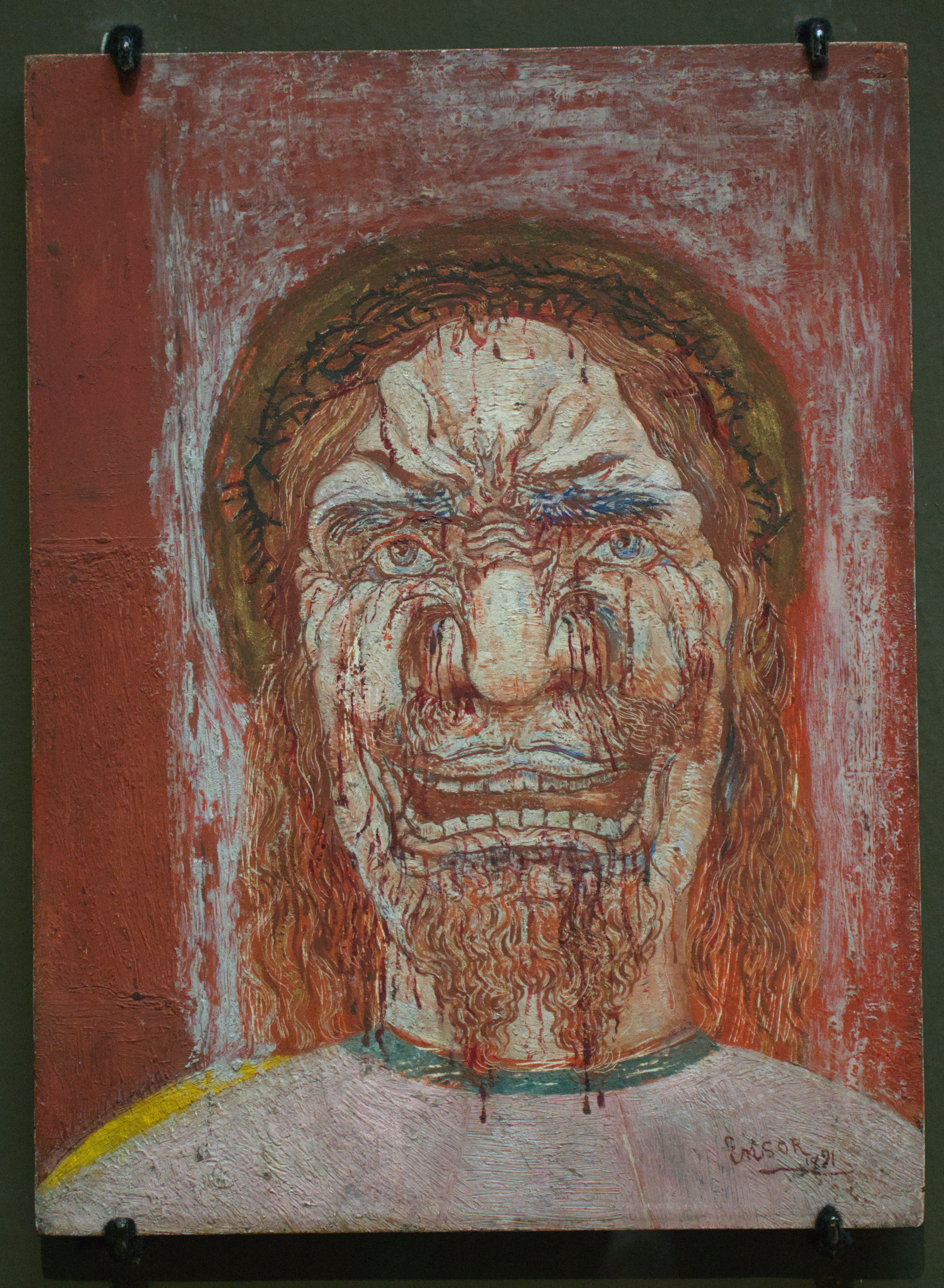
“Man of Sorrows” is also the title of an Early Netherlandish painting by Albrecht Bouts and a modern painting by James Ensor, which KMSKA displays side-by-side.
Bouts, Albrecht_Man of Sorrows
Albrecht Bouts (Flemish, 1451/55–1549), Man of Sorrows, 1500–1525. Oil on panel, diameter 29 cm. Koninklijk Museum voor Schone Kunsten Antwerpen (KMSKA, Royal Museum of Fine Arts Antwerp).

The earlier one is an incredibly moving image of pathos. Christ wears a thick, twisted, mock crown whose thorns dig holes into his forehead and draw blood. His eyes are red with tears and sunken in, and his lips are turning blue with the pallor of death. I find it quite beautiful, insofar as an image of suffering can be beautiful. (That’s a topic for another day.)
Ensor, James_Man of Sorrows
James Ensor (Belgian, 1860–1949), Man of Sorrows, 1891. Oil on panel, 20 × 15.5 cm. Koninklijk Museum voor Schone Kunsten Antwerpen (KMSKA, Royal Museum of Fine Arts Antwerp).

The Ensor painting, on the other hand, is decidedly not beautiful. In fact, I think it’s the ugliest image of Christ I’ve ever seen, with his crumpled face, scraggly hair, and bared teeth. There’s something very unsettling about his expression, and no wonder, as the curatorial text informs that Ensor drew inspiration from the masks of demon characters in Japanese theater. “His [Ensor’s] Jesus screams with rage about the injustice inflicted on him,” the label says. Is that what that expression is? To me he looks sinister. Like he’s growling at us. And I dislike his dinky crown that he wears like a headband; give me Bouts’s gnarly one instead.

I’m in favor of Christ images that show the rage he must have felt, but I don’t think Ensor is successful if that was his aim. To name a few modern artists who were: Guido Rocha (Tortured Christ, 1975) and David Mach (Die Harder, 2011), both of whom capture Jesus’s cry of dereliction on the cross.

The final themed gallery I’ll call out is “Heavens.”
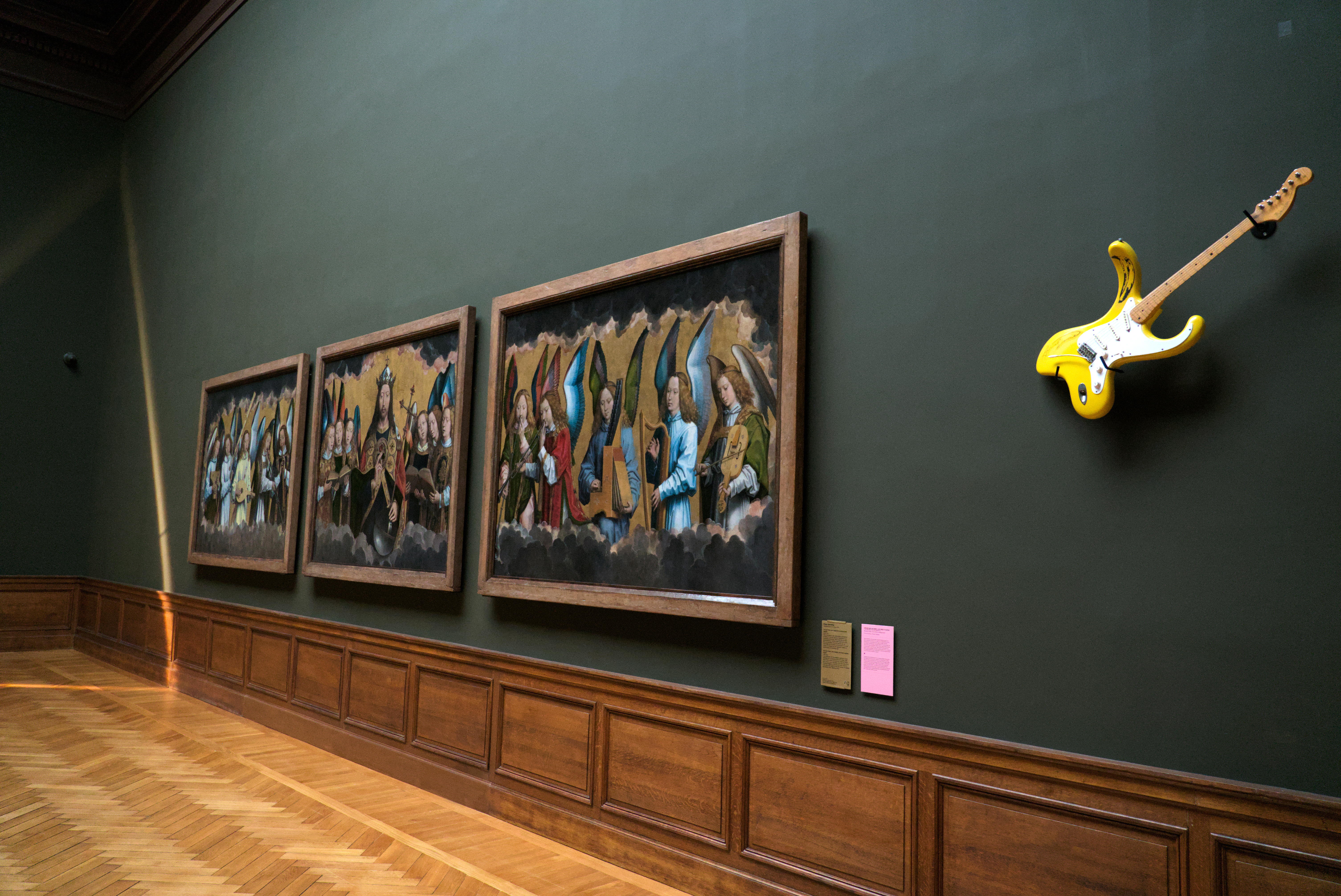
Heavens gallery
Gallery 2.22 (“Heavens”) from the KMSKA exhibition Collected with Vision: Private Collections in Dialogue with the Old Masters

The dominant Old Master work is a set of three panels from the upper tier of a colossal altarpiece that Hans Memling painted for the church at the Benedictine Abbey of Santa Maria la Real in Najera in northern Spain. All the other panels are lost.

The museum titles the central panel God the Father with Singing Angels—but I think the figure is more properly God the Son, Jesus Christ, portrayed as Salvator Mundi (Savior of the World). In his left hand he holds a cross-surmounted crystal globe, signifying his dominion over the earth, and with the other hand he gestures blessing. He wears a tiara and a red cope decorated with gold-thread embroidery, pearls, and precious stones, and his collar bears the words Agyos Otheos (Holy God).
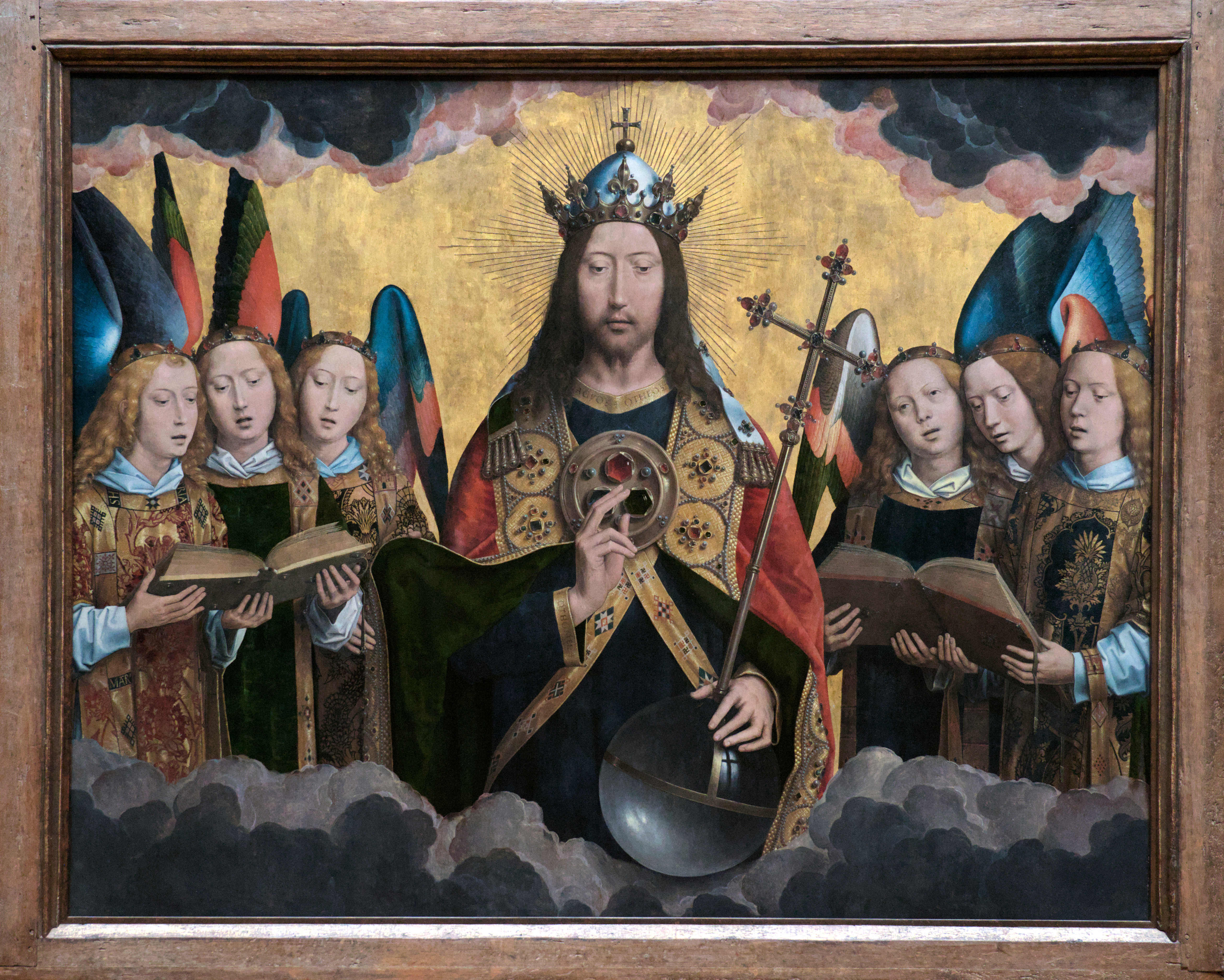
Memling, Hans_God the Father with Singing Angels
Hans Memling (German Flemish, ca. 1430–1494), God the Father with Singing Angels, 1483–94. Oil on panel, 164 × 212 cm. Koninklijk Museum voor Schone Kunsten Antwerpen (KMSKA, Royal Museum of Fine Arts Antwerp).

Surrounding him is a musical band of angels, singing his praises from songbooks and, in the flanking panels, playing a variety of wind and string instruments: (from left to right) a psaltery, a tromba marina, a lute, a trumpet, a shawm, a straight trumpet, a looped trumpet, a portative organ, a harp, and a fiddle.
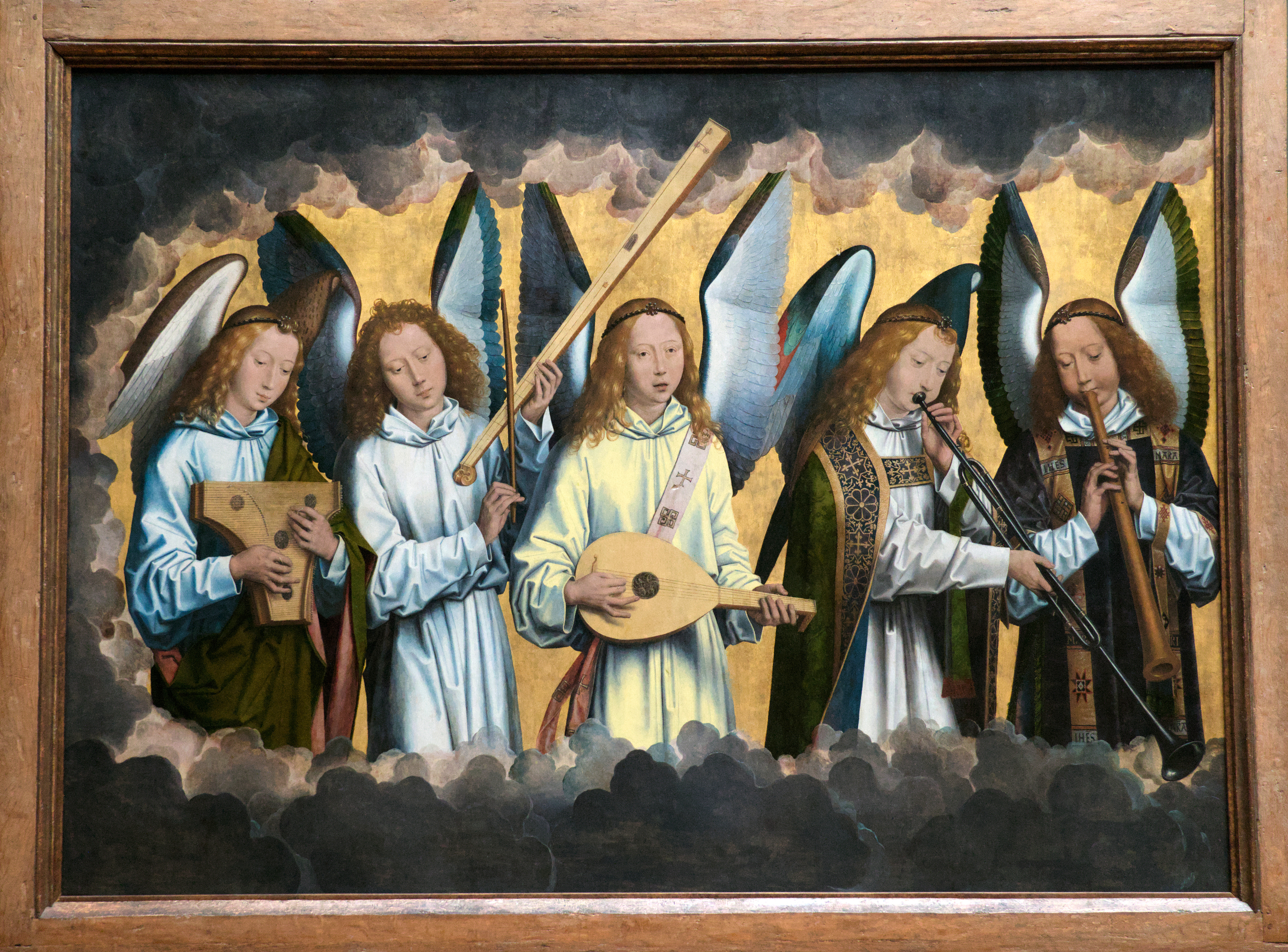
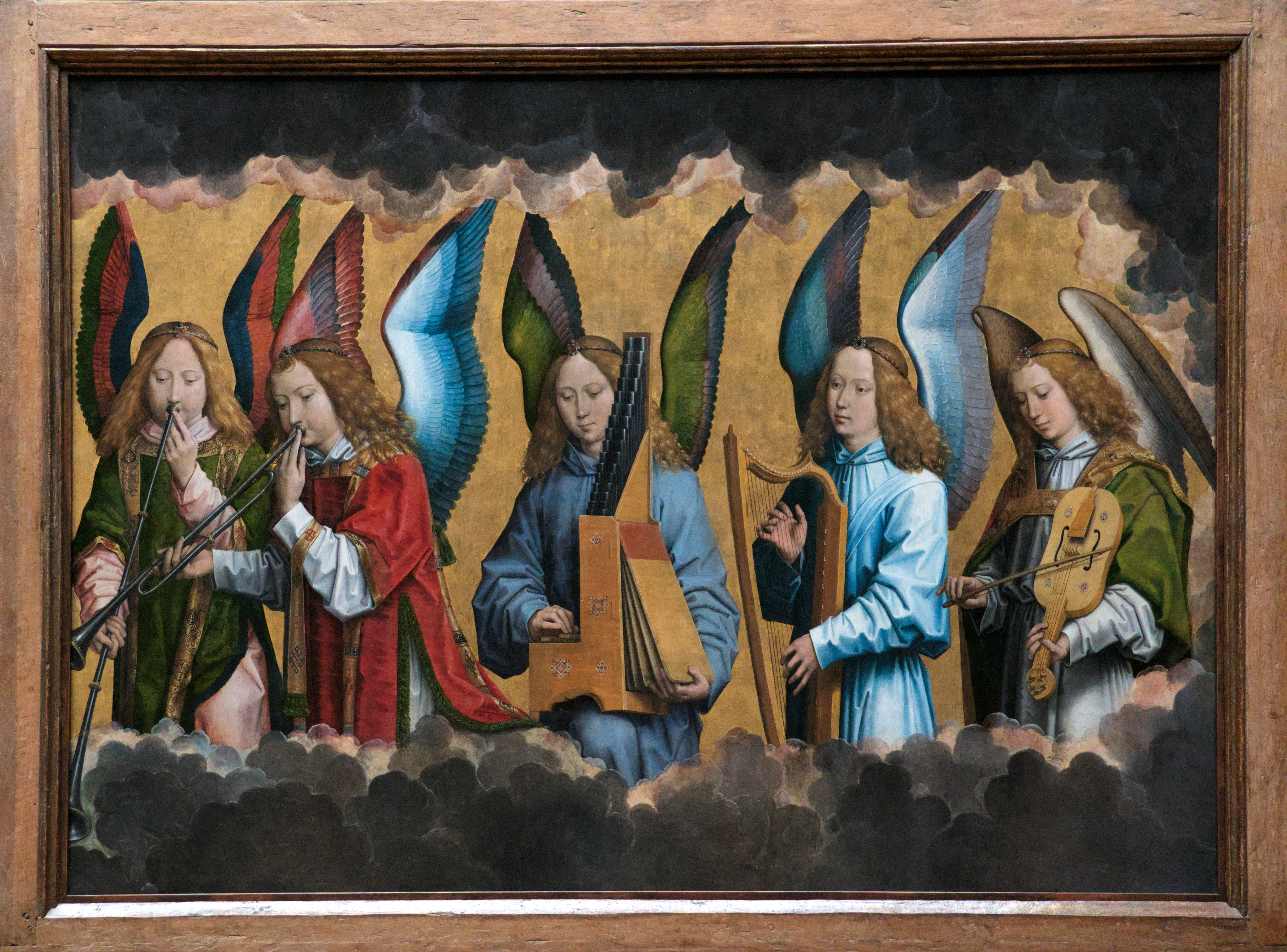
Memling, Hans_Music-Making Angels
Hans Memling (German Flemish, ca. 1430–1494), Music-Making Angels (left), 1483–94. Oil on panel, 165 × 230 cm. Koninklijk Museum voor Schone Kunsten Antwerpen (KMSKA, Royal Museum of Fine Arts Antwerp).

Memling, Hans_Music-Making Angels
Hans Memling (German Flemish, ca. 1430–1494), Music-Making Angels (right), 1483–94. Oil on panel, 165 × 230 cm. Koninklijk Museum voor Schone Kunsten Antwerpen (KMSKA, Royal Museum of Fine Arts Antwerp).

This ensemble probably evokes for you a particular sound—something like Tallis or Palestrina—soaring polyphonic vocals, a gentle yet majestic accompaniment. But instead, a different soundtrack played, audibly, in the room: songs from the 1967 debut album of the American rock band the Velvet Underground, several of which use religious language to describe the experience of doing drugs. “Heroin” opens like this:

I don’t know just where I’m going
But I’m gonna try for the kingdom, if I can
’Cause it makes me feel like I’m a man
When I put a spike into my vein

And I’ll tell you things aren’t quite the same
When I’m rushing on my run
And I feel just like Jesus’ son

This aural element was complemented, on the gallery wall, by the guitar of Lou Reed, the band’s lead singer and songwriter. It’s signed by Andy Warhol, who produced and championed the Velvet Underground & Nico album and made its banana cover art, replicated on the instrument.
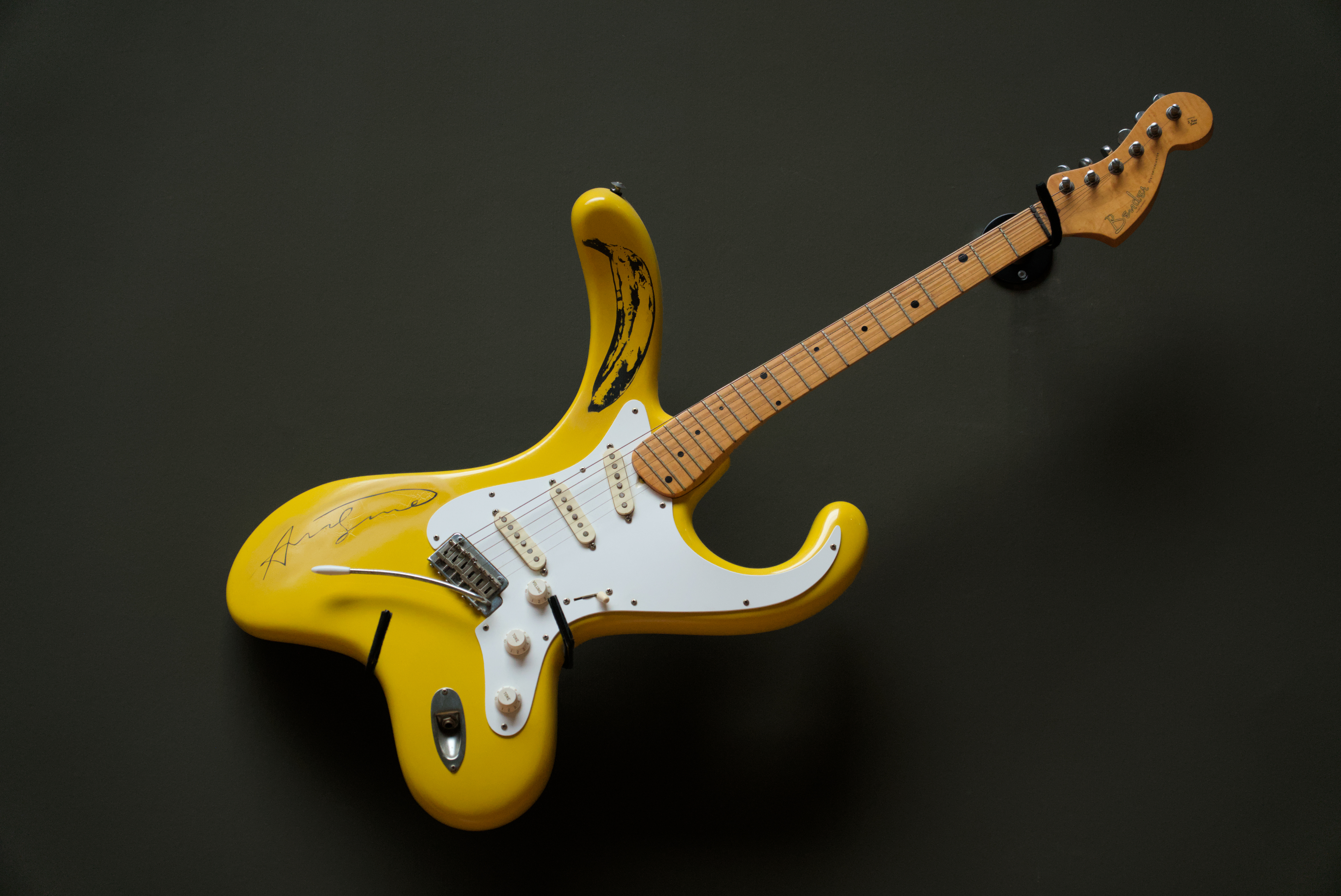
Lou Reed's guitar
Lou Reed’s “Banana Guitar,” from a private collection

Adding to the mix, in the corner of the room was an installation by the Copenhagen-born and -based artist Olafur Eliasson, called Lighthouse Lamp. “Affixed to a tripod, a lamp situated within a Fresnel lens—a compact lens which was developed for lighthouses—emits a band of white light in 360 degrees,” the artist’s website explains. In this space, the beam takes on a triangular shape.
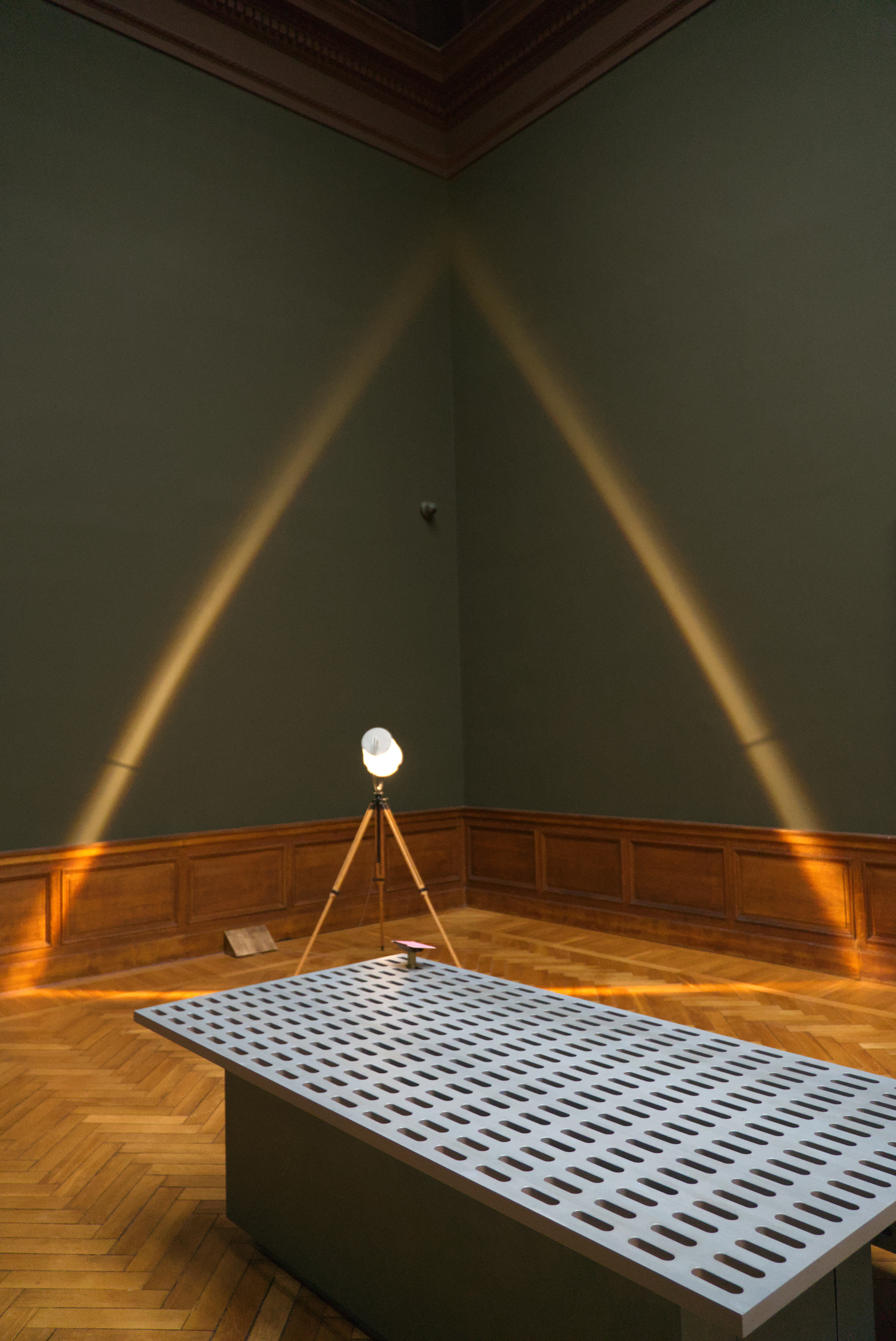
Eliasson, Olafur_Lighthouse Lamp
Olafur Eliasson (Icelandic Danish, 1967–), Lighthouse Lamp, 2004. Mixed media. Collection of Filiep and Mimi Libeert.

There was also an altarpiece of The Last Judgment and the Seven Acts of Mercy by Bernard van Orley, which references Jesus’s teaching in Matthew 25 about one’s entry into heaven being contingent on whether, in this life, you feed the hungry, give shelter to the homeless, visit the prisoner, and so on.

The “Heavens” gallery begs the question: How does one define “heaven”? Is it a physical place? A state of mind? An encounter? I think of related words like bliss, beatitude, communion, the sublime.

The celestial scene painted by Memling—and remember, it’s only partial, as the rest is missing—is beautifully rendered, but it also encapsulates what has become the popular cliché of heaven: angels on clouds, strumming harps, and a regal God swaying his scepter. Music-making, angelic beings, and the reign of God are all certainly a part of how the Bible describes heaven. But it’s also so much more. It’s a garden and a city. It’s healing and restoration. It’s the righting of wrongs. It’s all things made new. It’s jubilee. It’s a wedding—deep and lasting union between God and humanity. It’s an eternal interlocking of God’s space and ours (earth). It’s a global, transhistorical community of faith, gathered together around Christ their head, worshipping him in diverse languages, musical styles, dances, and other cultural expressions. It’s the culmination of the greatest story ever told.

Today, Memling’s vision of heaven probably fails to captivate most people, even Christians. So it’s an interesting experiment to compare it to how others conceive of the concept.

Eliasson’s Lighthouse Lamp wasn’t a commission on or explicit treatment of the theme, but the curator saw fit to place it beside Memling, because heaven is often conceived of as a light-filled space, and light can evoke the divine. For this reason, Memling painted his background gold. What’s more, the three-sidedness of Eliasson’s light beam may, for some, evoke the Trinity, the classical Christian doctrine of Father, Son, and Holy Ghost that Memling alludes to with the three precious stones on the fibula of Christ’s mantle.

Still, other folks experience what could be termed “heavenly” transcendence through the use of mind-altering substances, as did the members of the Velvet Underground, whose drug trips gave birth to their experimental music—which, in turn, has taken others to a transcendent place.


Whether in special exhibitions or displays of their permanent collections, I want to see more of this in museums: bringing old and new artworks into conversation with one another around universal themes, in the same room. (In some museums, the labels sometimes cross-reference works in other galleries, but that’s not the same.) Although there are benefits to the traditional approach of laying out art chronologically to give you discrete pictures of different historical eras and allow you to progress by time period, a thematic approach that compiles works from across time also has its benefits.

I’ve found cross-temporal art displays to be especially vitalizing, because instead of trying to tell history, they more naturally invite personal reflection and tend to be less academic in tone. Such an approach makes the art accessible to a larger number of people, especially those who don’t frequent museums. It helps us see the relevance of the Old Masters (or whatever the museum’s collection focus) for today—how the subjects they depicted often address topics or questions we still ask or wonder about or that reflect aspects of the common human experience, such as joy, suffering, family, death, betrayal, or festivity. Creating relationships between works made centuries apart, highlighting similarities and differences, can give us a broader perspective.

And for this museumgoer (pointing at myself) who is attracted to medieval and early Renaissance art and sometimes bypasses the contemporary galleries, the integrative approach is more engaging. Giving contemporary works a point of connection with the works I’m already inclined to like helps me enter into them more easily and fruitfully, and I’m more likely to spend time with them than if they were segregated.

New and old don’t have to be equally represented—Kolumba skews heavily contemporary, whereas KMSKA lets its strengths shine with the Old Masters, and yet the occasional unexpected intervention from years past or future always caused me to pause and be curious. Over the last several years I’ve been noticing other museums engaging in similar playful exchange—plopping a contemporary work into the medieval section, or vice versa, in a way that provides some kind of illumination.

This was my first and only visit to KMSKA, and as I understand, there’s not the same degree of intermixing of old and new year-round; this was a special exhibition that brought in contemporary works from outside, as the institution itself owns very few. But they did do something similar last year with the exhibition What’s the Story?, and the dangling light poems by Bernard Dewulf are a permanent fixture in the Old Masters galleries.

Have you been to a museum where works from different time periods were displayed side-by-side to create a discourse, and if so, did that choice enhance your engagement, insight, or appreciation? I’d love to hear what other museums are doing this!


This article took me some forty hours to write and to select and edit photos for. If you appreciate learning about my museum experiences and having access to high-resolution, downloadable art images, would you please consider adding to my “tip jar” (PayPal), or sponsoring a book from my Amazon wish list? Thank you!

Kolumba and KMSKA: Medieval and contemporary art in conversation (part 1)

One of the delightful surprises of my recent trip to Germany and Belgium was to find, in two of the museums I visited, an integration of the old and new in the curated galleries. Typically, art museums choose to arrange their collections chronologically, grouping together artworks from a particular era, and within each era, like styles. But in Kolumba museum in Cologne and the Koninklijk Museum voor Schone Kunsten Antwerpen (KMSKA) in Antwerp, medieval art from each museum’s collection (and in the case of KMSKA, Renaissance and Baroque art too) is displayed alongside contemporary pieces, creating a vibrant dialogue.

With the exception of the exterior shot of Kolumba, all photos in this post are my own.

Kolumba Kunstmuseum, Cologne

Originally called the Diözesanmuseum (Diocesan Museum), Kolumba was founded in 1853 by the fledgling Christlicher Kunstverein für das Erzbisthum Köln (Christian Art Association for the Archbishopric of Cologne), making it the city’s second oldest museum after the Wallraf-Richartz-Museum. Its collection focus for the majority of its history was late medieval art from Cologne and the Lower Rhine.

Kolumba’s first permanent home, just south of Cologne Cathedral, was a former sugar factory, but the building was destroyed in World War II, though much of the art had been safely evacuated beforehand. After the war, Kolumba relocated its art to a grammar school, then to rented rooms in the Gereonstraße, then to the Curia building at Roncalliplatz 2. But the limited space was an issue.

In 1989, ownership of the museum was transferred to the Archdiocese of Cologne, who decided to expand the collection to include modern and contemporary art, not only by German artists but by international artists as well. The museum shifted its approach from displaying traditional sacred works only, to placing those works in juxtaposition with newer ones by artists who aren’t necessarily Christian but whose works can converse fruitfully with their core collection. They also secured funding to construct a new permanent building.

In 2004, the museum’s name was changed to Kolumba in honor of the history of the site on which the new (and current) building would stand: atop the ruins of the medieval St. Kolumba church, destroyed in an air raid in 1943. St. Columba of Sens was a third-century virgin martyr who was born in Spain but lived mostly in France. The church dedicated to her in Cologne once housed Rogier van der Weyden’s St. Columba Altarpiece (now at the Alte Pinakothek in Munich), a triptych with scenes of the Annunciation, the Adoration of the Magi, and the Presentation in the Temple.

Kolumba museum
Kolumba museum, Cologne. Photo: HP Schaefer / Wikimedia Commons.

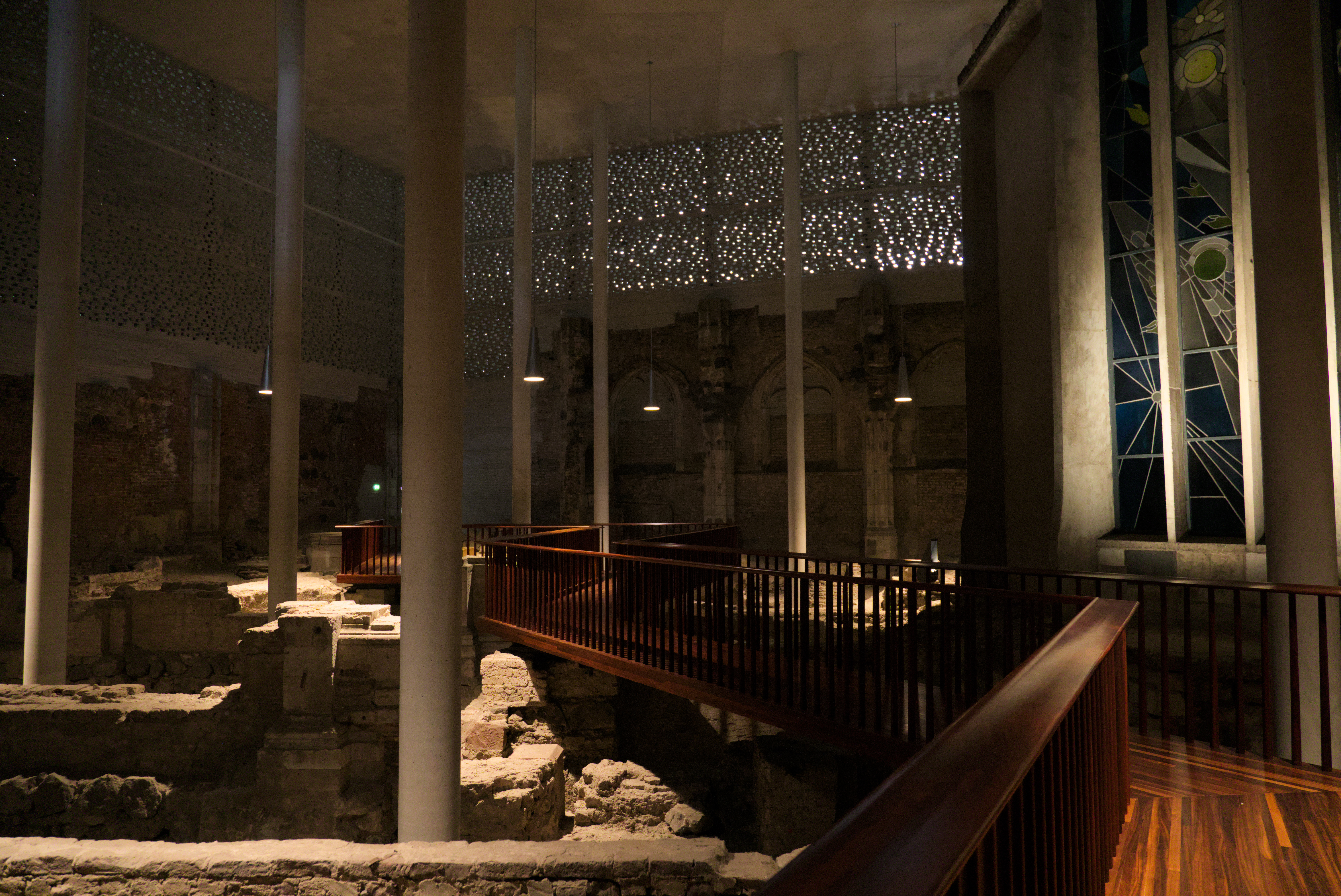
Kolumba museum’s permanent home opened in 2007 at Kolumbastraße 4. Designed by the Swiss architect Peter Zumthor (view more architectural photos here), the building encapsulates the bombed-out Gothic ruins of St. Kolumba with forty-foot-high, porous concrete walls, above which sit the floors of the museum.

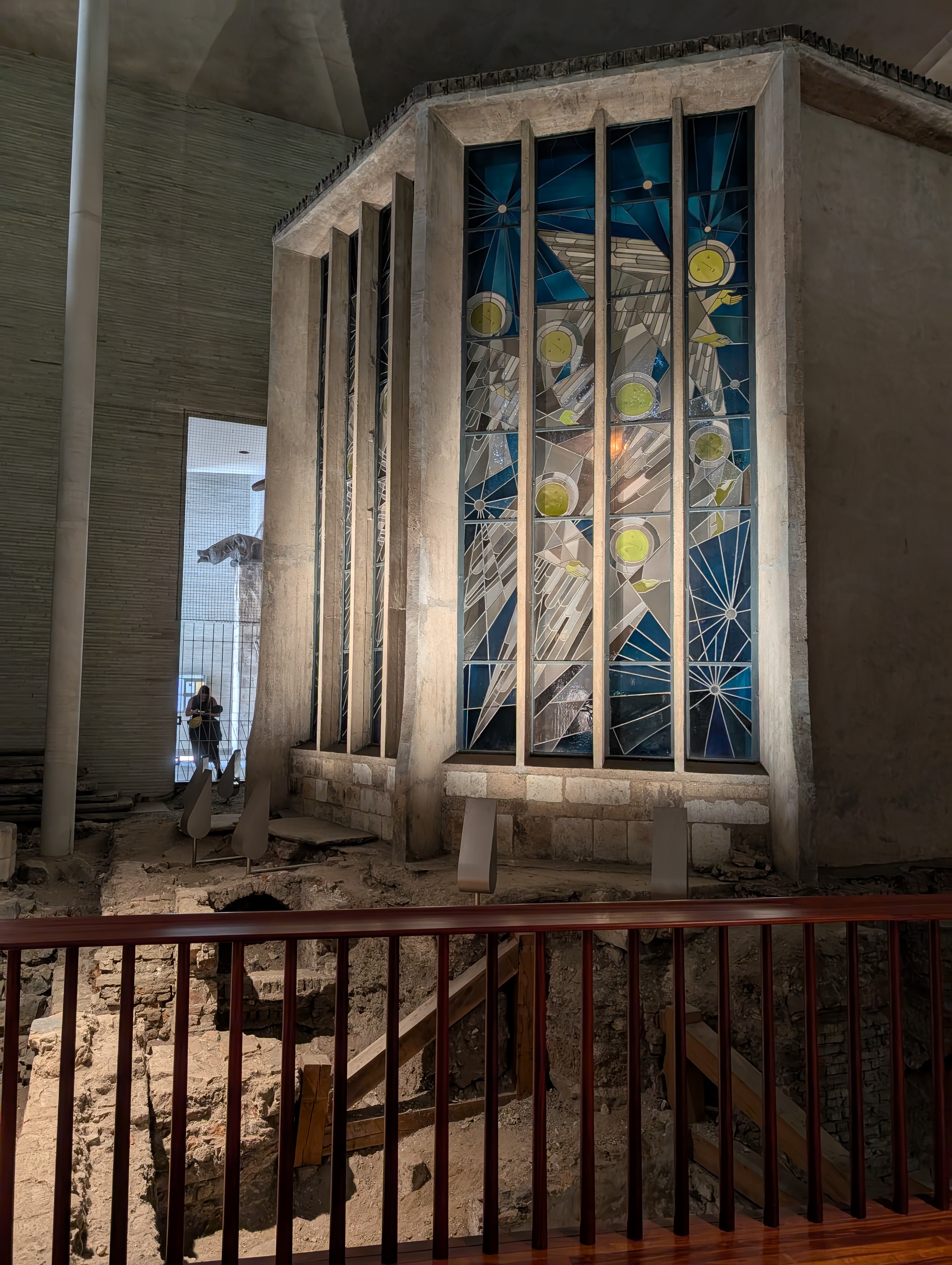
It also incorporates the Madonna in den Trümmern (Madonna in the Ruins) chapel, an octagonal tent-like structure built by Gottfried Böhm in 1947–50 to house a late Gothic statue of the Madonna and Child that miraculously survived the Allied bombings and for the liturgical use of the small Kolumba parish, which continues today.

Ruins of St. Kolumba
The ruins of St. Kolumba church, which dates back to the tenth century (with subsequent expansions and a Gothic-style rebuilding), are integrated into the architecture of Kolumba museum.

Madonna in the Ruins chapel
Exterior of the “Madonna in the Ruins” chapel, dedicated 1950, underneath Kolumba museum in Cologne, with stained glass designed by Ludwig Gies (1887–1966), installed 1954.

The postwar chapel is not accessible from inside the museum; it has its own separate entrance, which, as I found out after I had already left, is on the south side of the building, along Brückenstraße.

But I did cross over the excavation site of St. Kolumba to which the written museum guide directs visitors (it’s labeled “room 3”), and through which a walkway has been constructed. As I took in the war-wrought devastation, I wondered about the sounds I was hearing from an audio system. Turns out it was a sound installation called Pigeon Soundings by the American artist Bill Fontana. In 1994, he made a series of eight-channel sound map recordings of the pigeons that were inhabiting the St. Kolumba ruins at the time, particularly the rafters of the temporary wooden roof that had been erected. The recordings picked up not just the birds’ cooing and flapping, but also the ambient sounds outside.

Above this darkened space, Kolumba has sixteen exhibition rooms. The museum reinstalls its collection annually, each fall opening a new exhibition. I was there for the first day of “make the secrets productive!” Art in Times of Unreason, which runs from September 15, 2025, to August 14, 2026. The lack of art signage throughout is deliberate, to promote a more meditative experience; instead, visitors are given a (German-language) booklet, organized by room, that identifies the pieces on display and provides commentary for some.

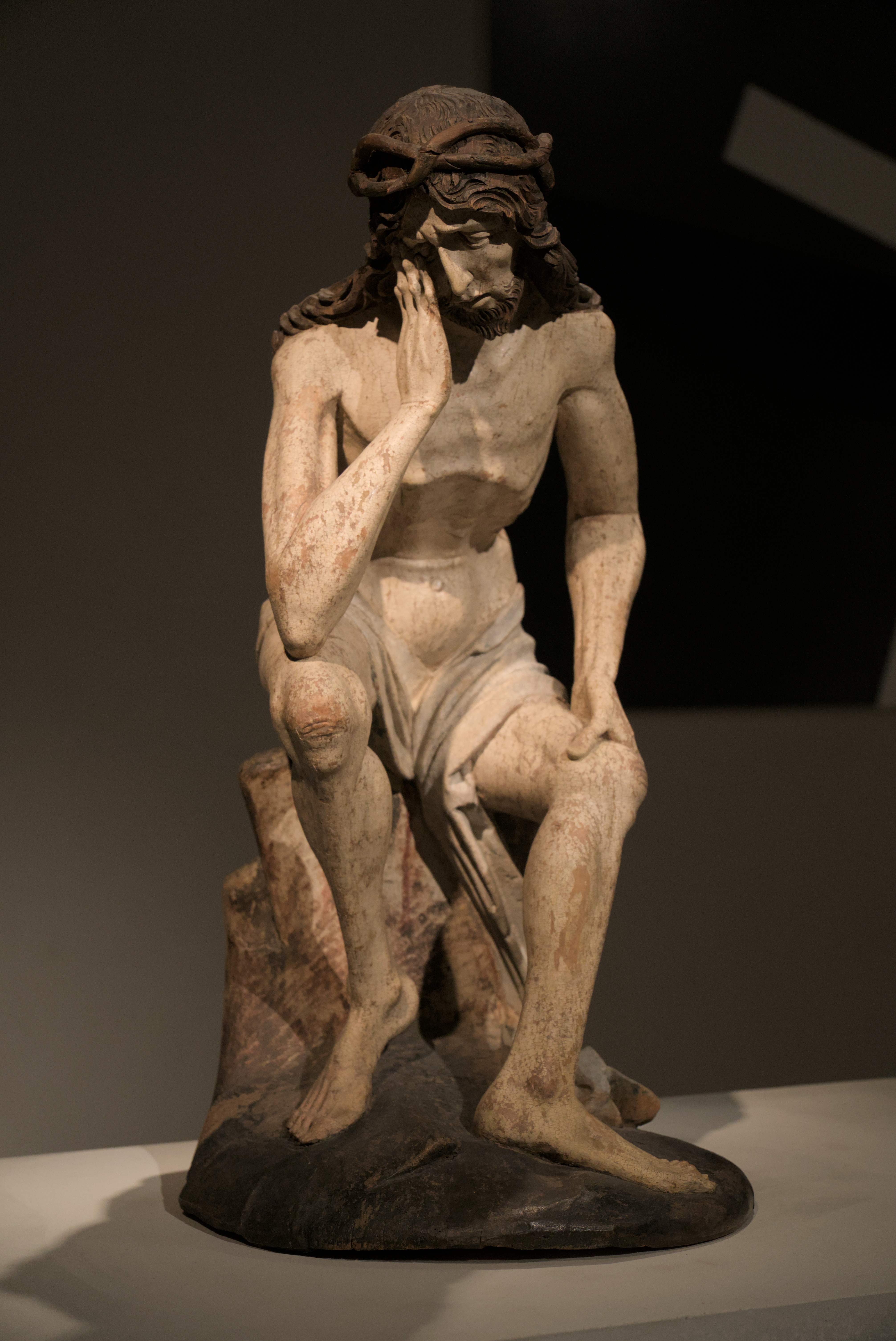
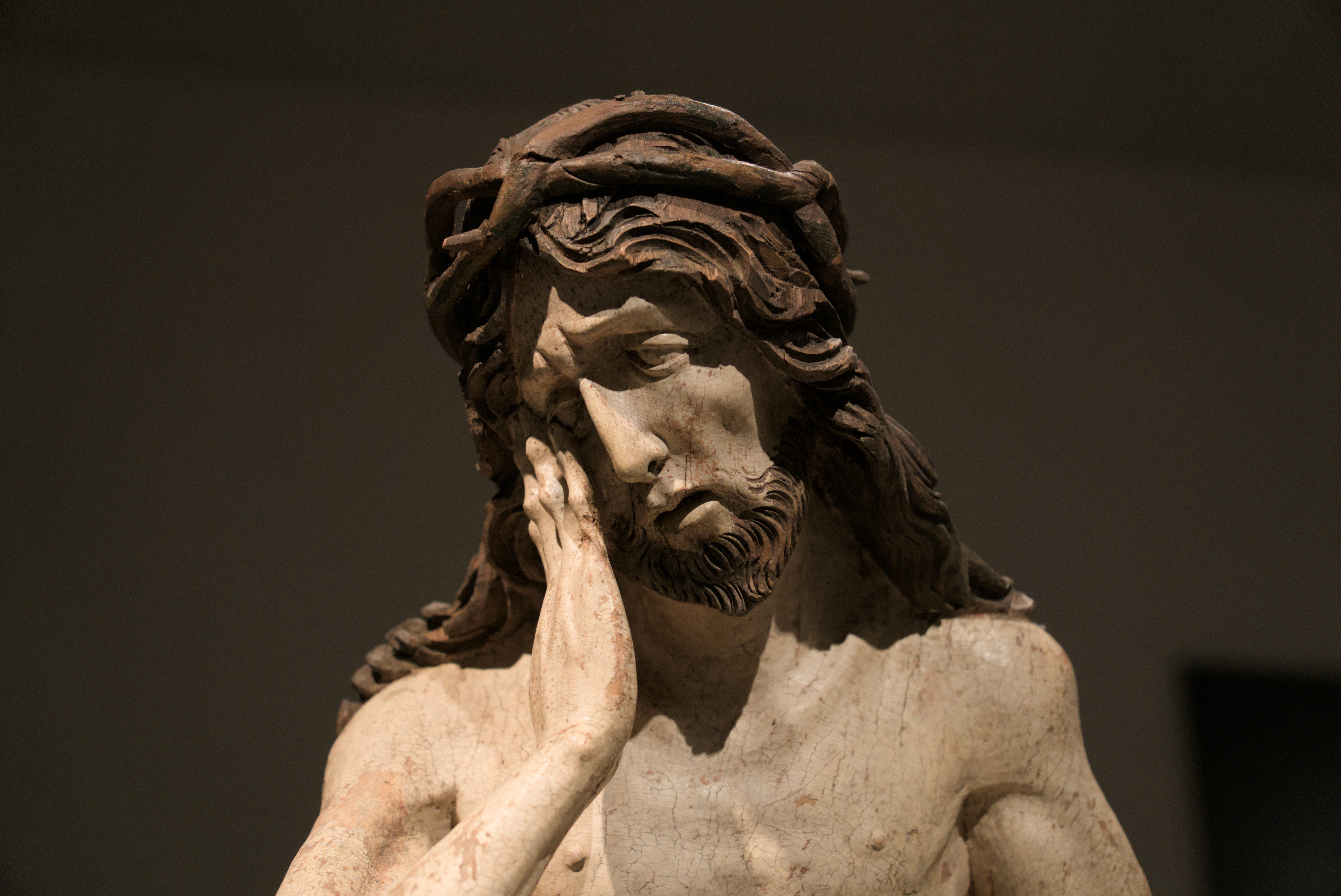
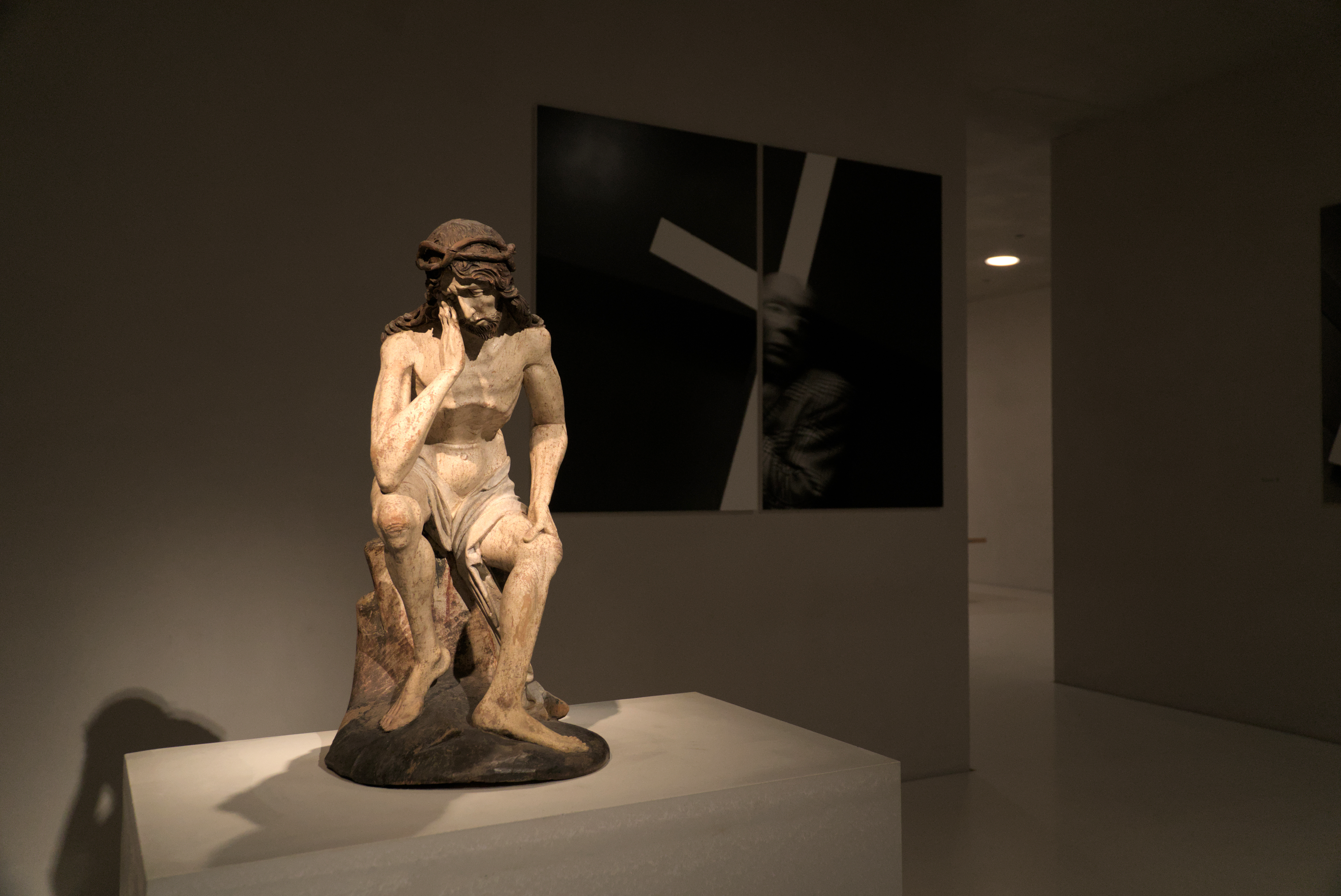
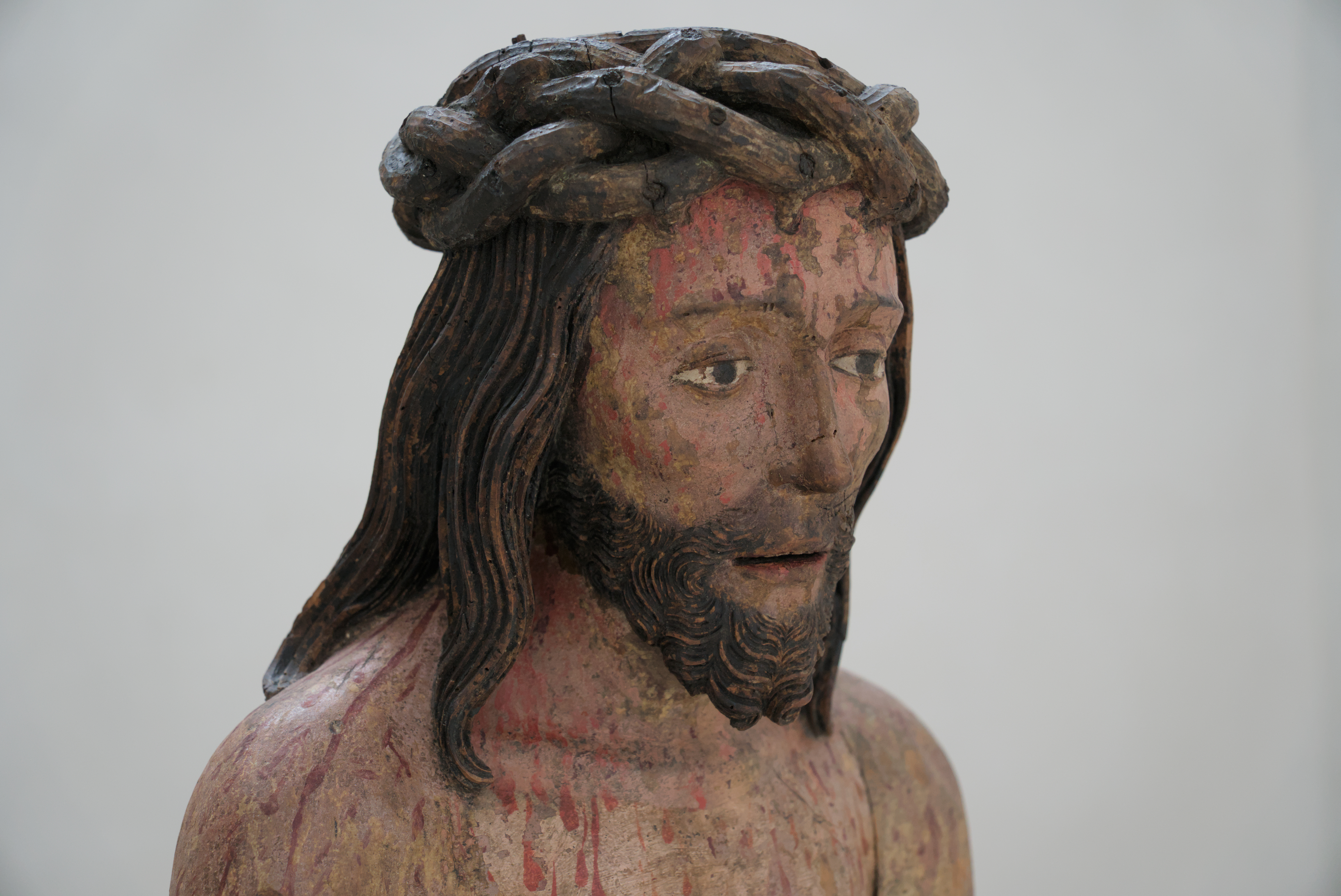
Room 8 features a fifteenth-century sculpture of Christ at Rest—“at rest” not in the sense of being at peace in mind or spirit (he is visibly troubled), but rather in a bodily state of motionlessness or inactivity. Sometimes also called Christ in Distress, Christ on the Cold Stone, or Pensive Christ, the iconography shows an interior moment during Christ’s passion in which, having just been flogged, he sits awaiting his final torture: crucifixion.

Christ at Rest (Upper Rhine)
Christus in der Rast (Christ at Rest), Upper Rhine, ca. 1480. Linden wood with visible primer and remnants of colored paint. Kolumba museum, Cologne.

Christ at Rest (detail)

Though the Gospels don’t mention a moment of seated pause in the narrative, artists were influenced by the figure of Job, an innocent sufferer who in that way prefigured Christ, and in particular the description in Job 2:8 of him sitting on a dung heap. The image of Jesus preparing to meet his death was meant to inspire feelings of pity. Isolated from the action and from all the other characters, the lone figure invites viewers to enter empathetically into the emotional anguish he suffered on his way to the cross.

At Kolumba, this sculpture is surrounded by large-scale, black-and-white photographs from the Transzendentaler Konstruktivismus (Transcendental Constructivism) series by the collaborative duo of German neo-dadaist artists Anna and Bernhard Blume. In the series the couple is threatened by white geometric objects that are unleashed on them in a blur of motion.

Christ at Rest and Transcendental Constructivism
Foreground: Christ at Rest, Upper Rhine, ca. 1480. Background: Anna Blume (1936–2020) and Bernhard Blume (1937–2011), photograph from the Transcendental Constructivism series, 1992–94.

The diptych that hangs behind the Christ sculpture appears to show a man carrying a cross, disoriented by its weight.

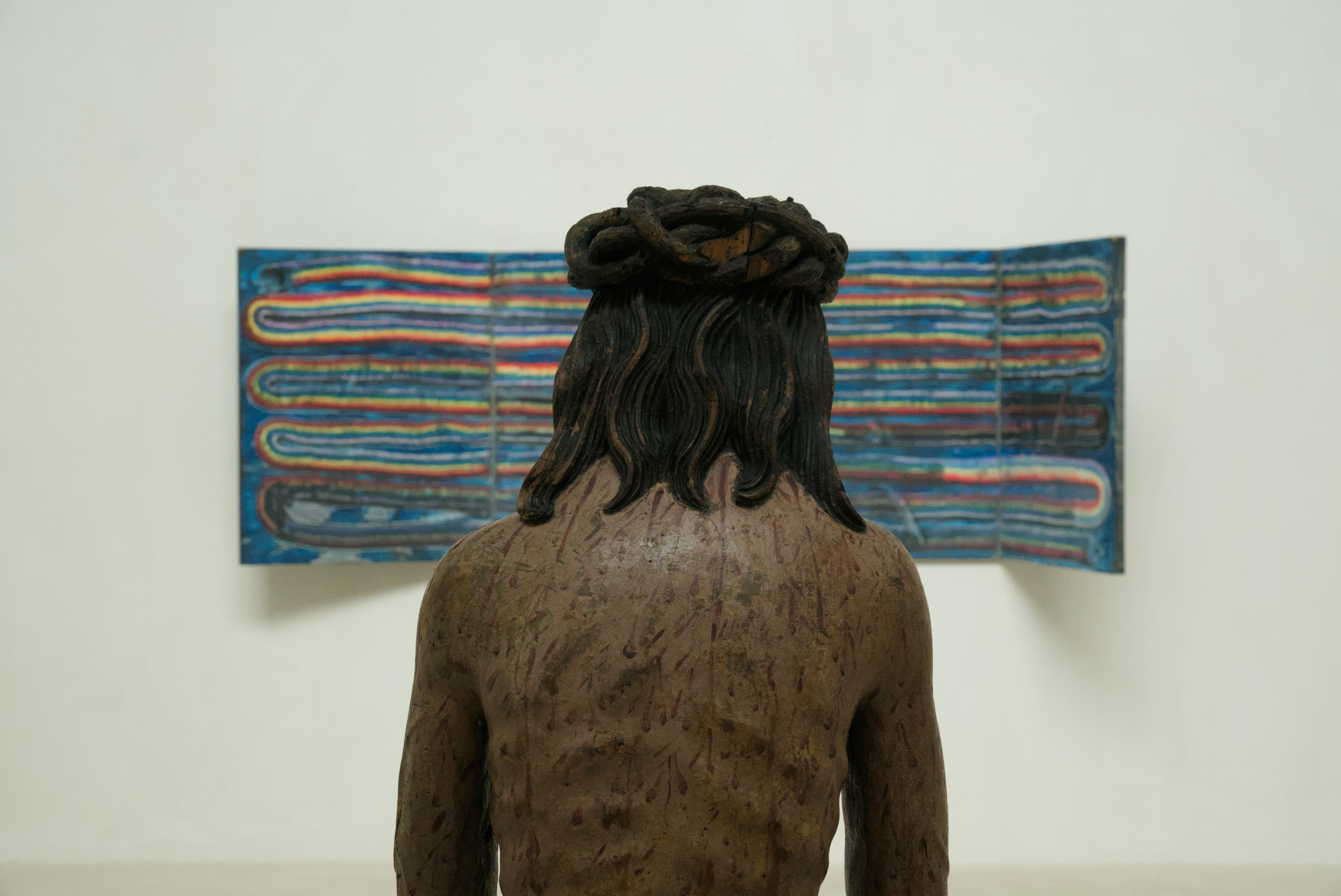
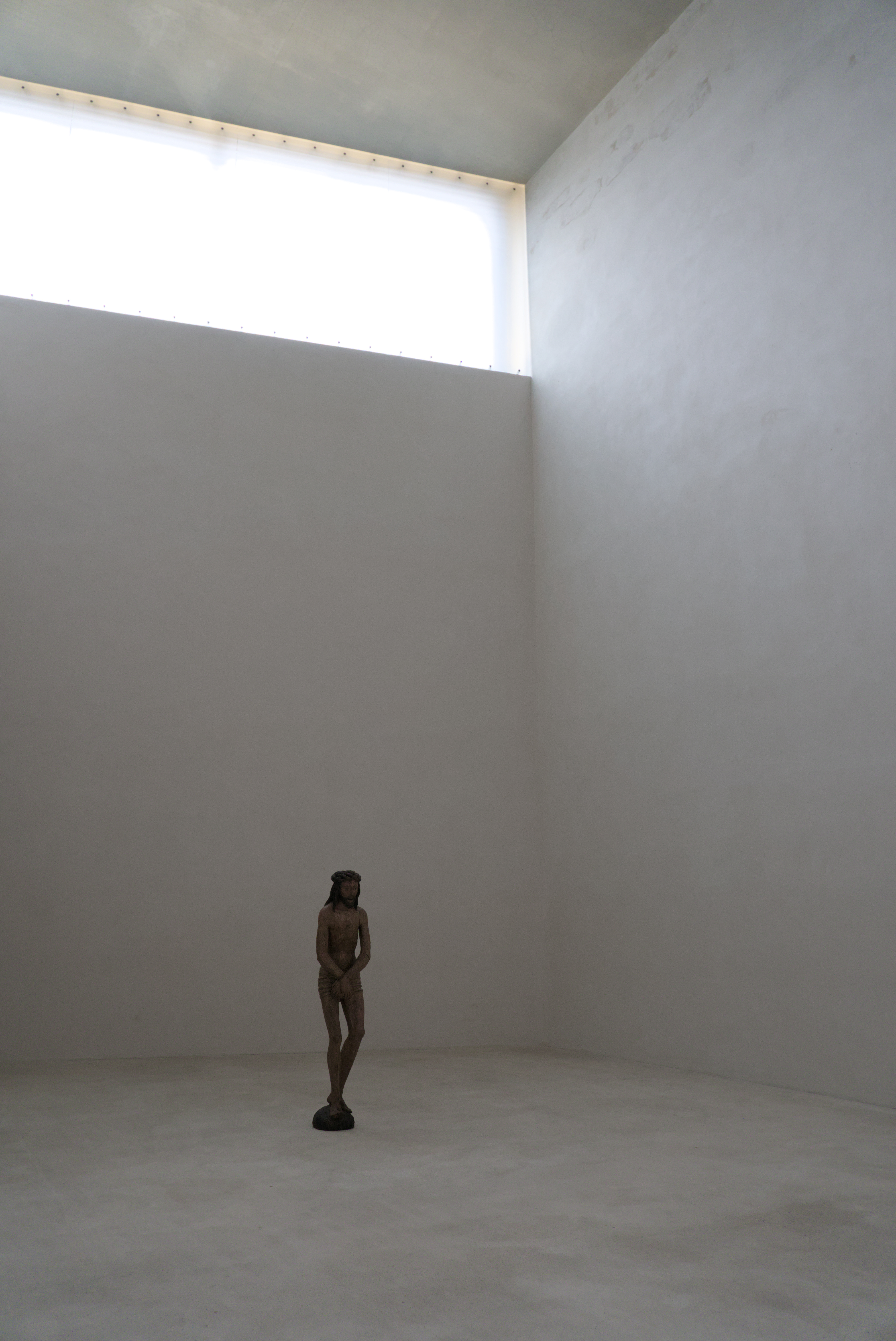
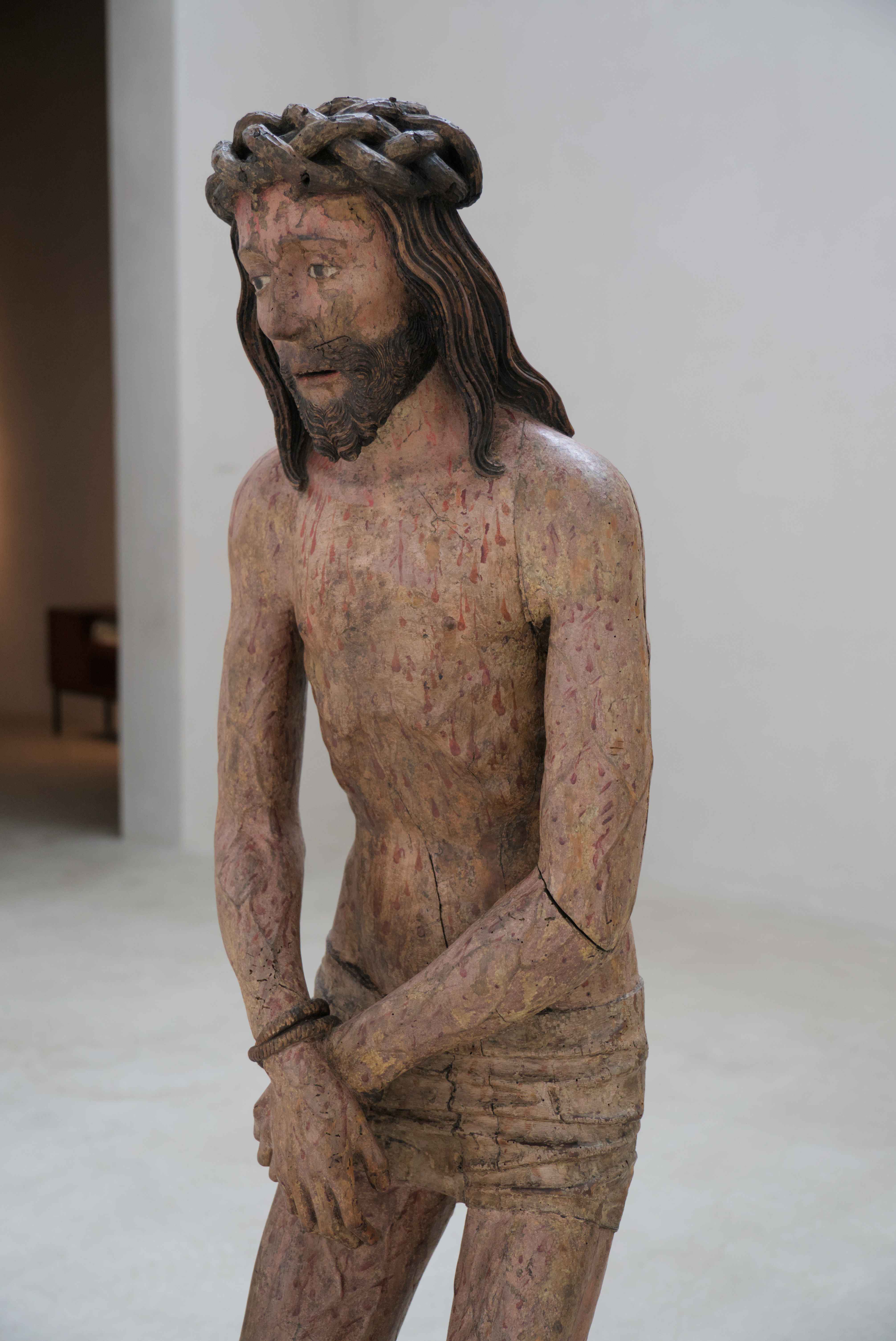
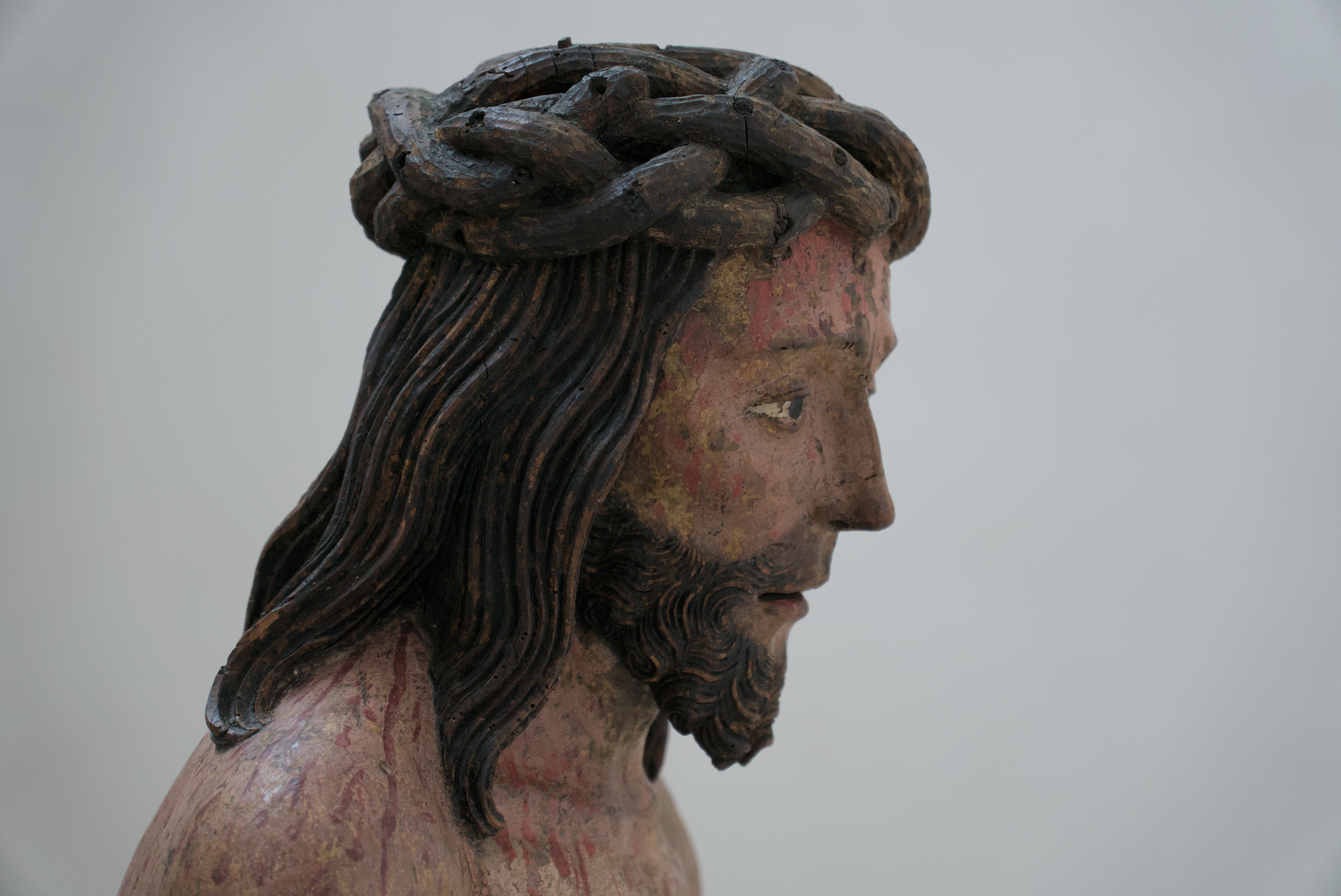
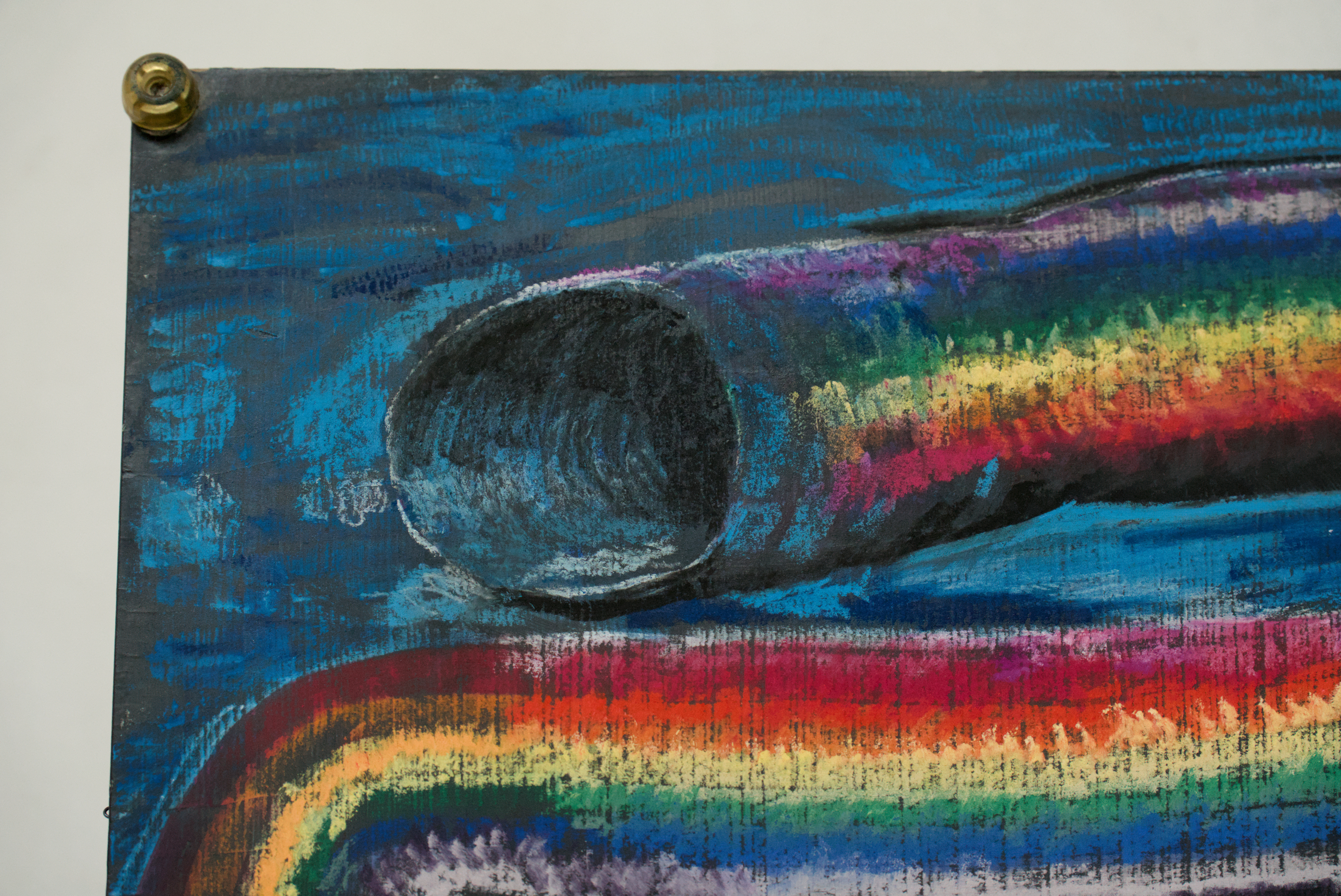
One of the other resonant pairings at Kolumba is in room 21, which stages a fifteenth-century Ecce homo sculpture across from a colored chalk drawing on a three-paneled blackboard.

Ecce Homo and Plumed Serpent

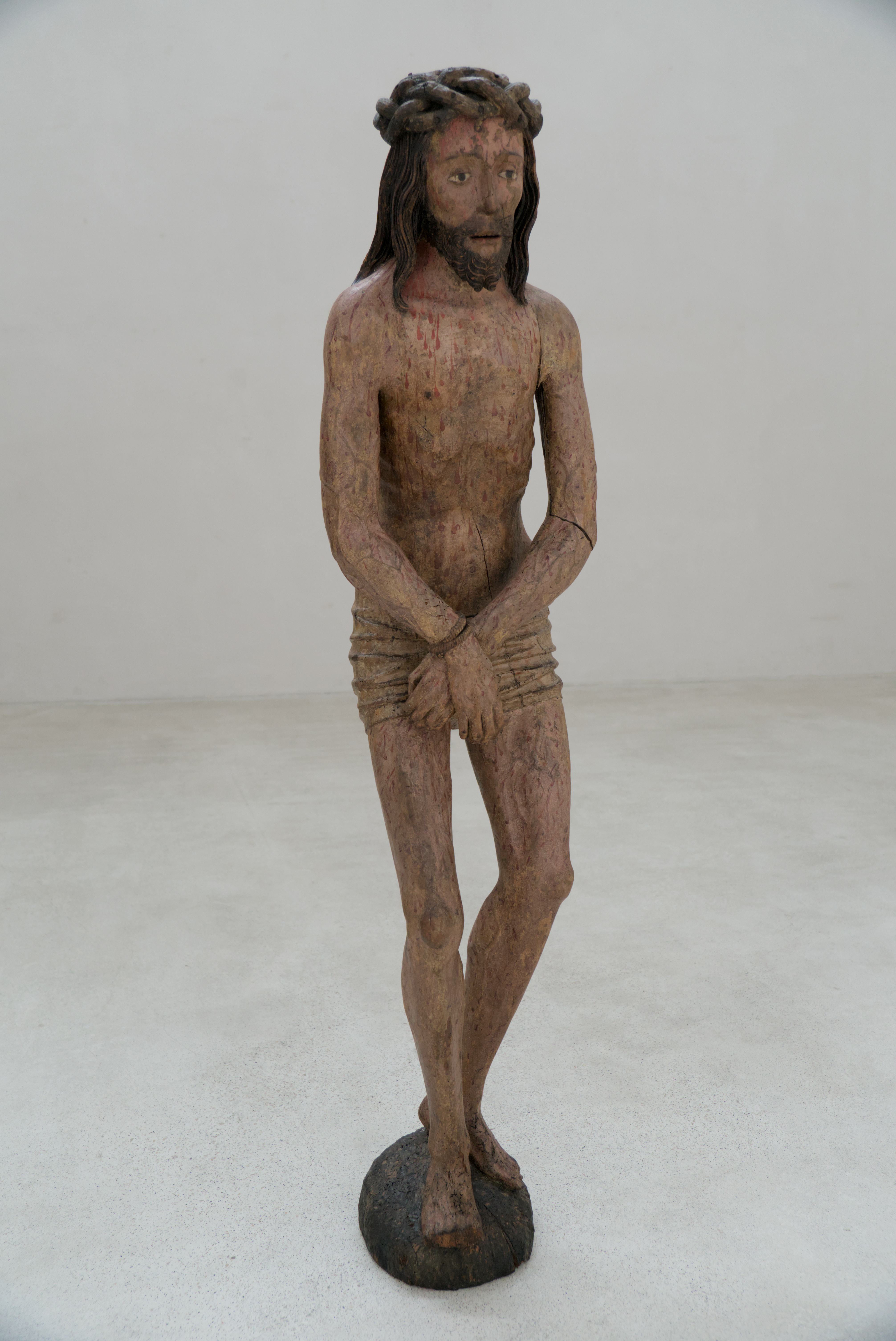
The title Ecce homo, Latin for “Behold the man,” comes from John 19:5, where the Roman governor Pilate presents a scourged, thorn-crowned Jesus to a mob that demands his execution. Like Christ on the Cold Stone, this too is a devotional image intended to stir the affections of the viewer, who is called, like the crowds on that fateful day, to gaze upon the wounded God-man. His hands are bound in front of him, evoking a sacrificial sheep tied up for slaughter. What have we done?

Ecce Homo
Ecce Homo
Ecce Homo, Cologne, ca. 1460–1500. Linden wood. Kolumba museum, Cologne.

Ecce Homo
Ecce Homo
Ecce Homo

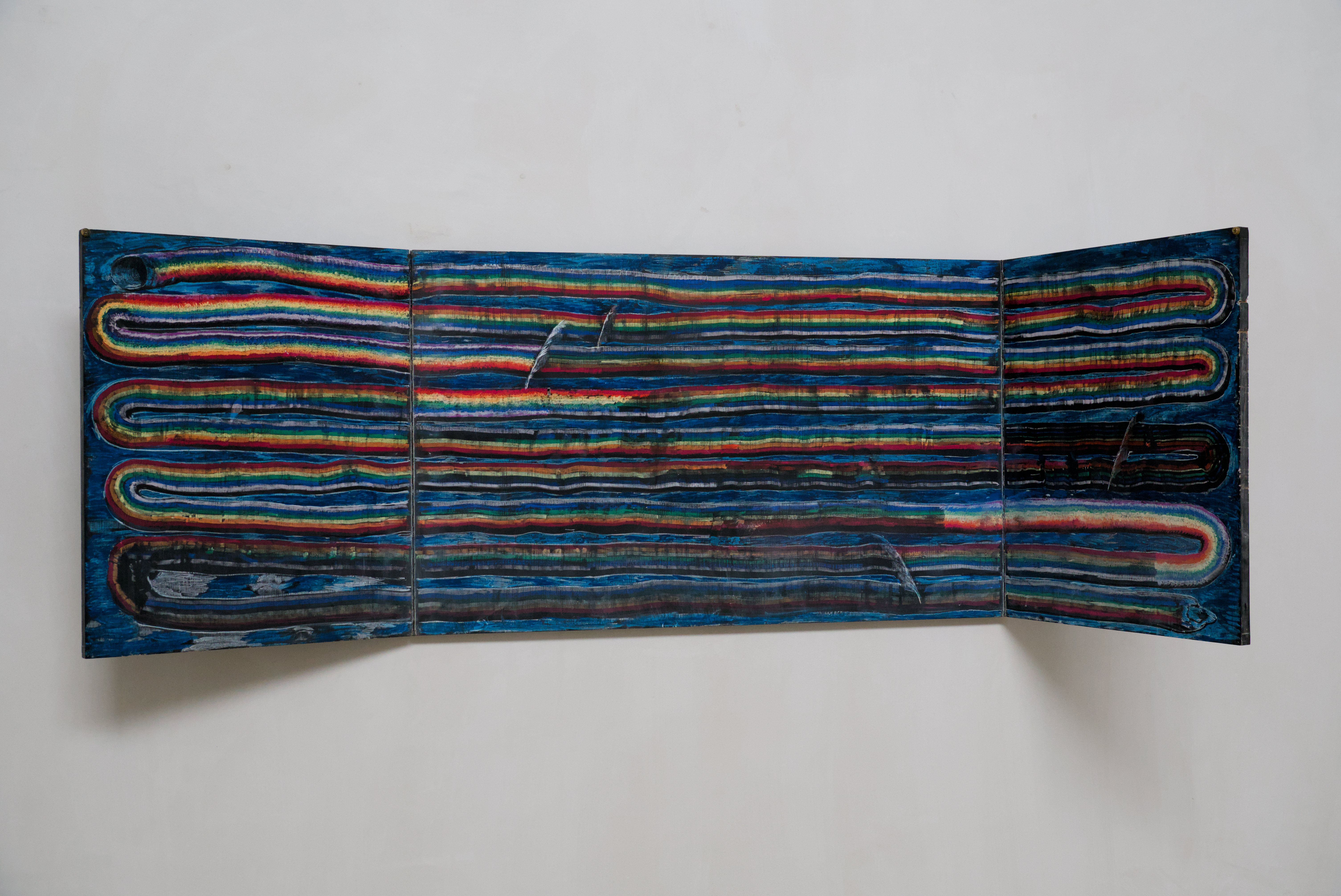
While I instantly recognized this subject, the drawing was more of a mystery.

Thek, Paul_Plumed Serpent
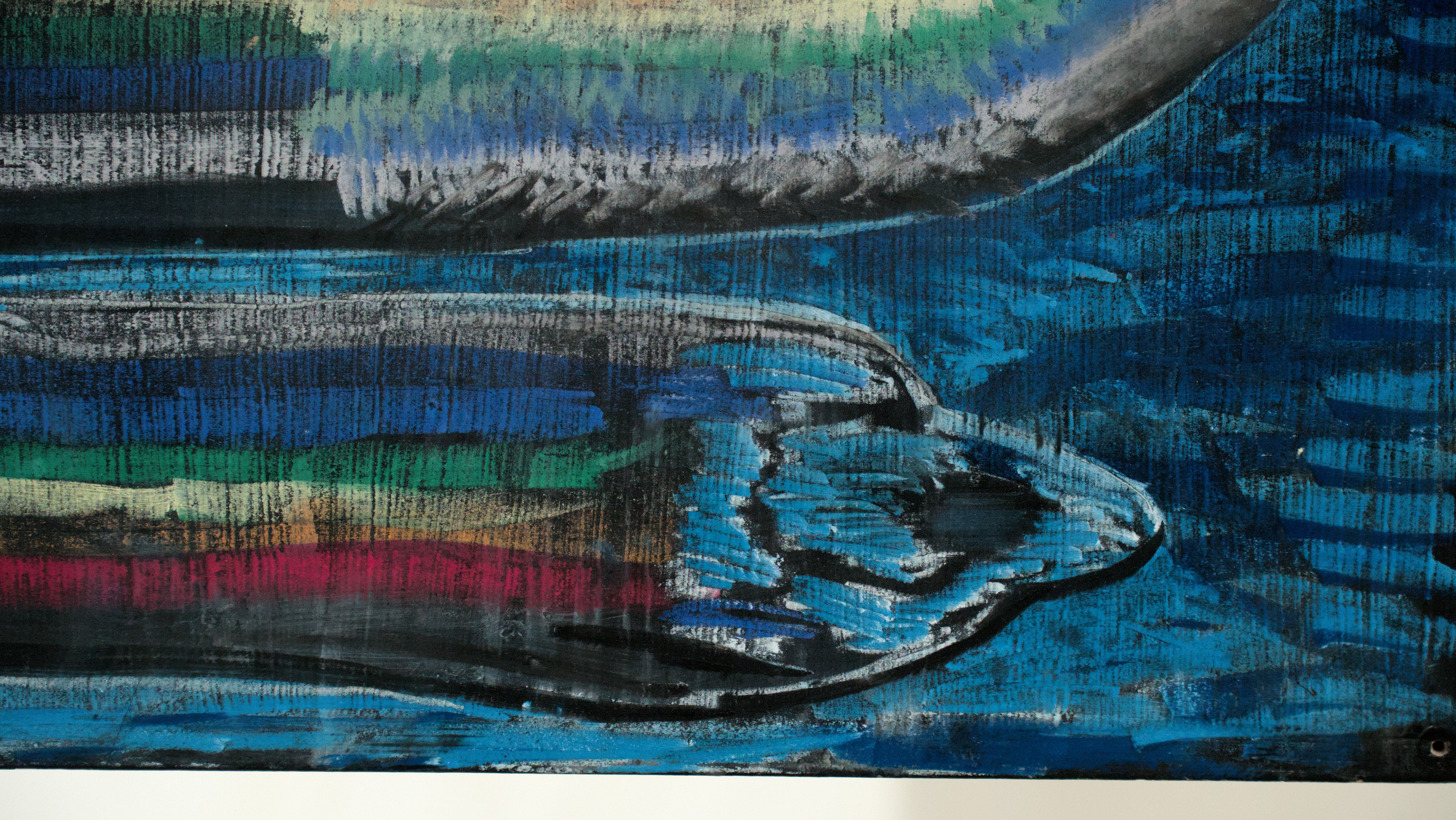
Paul Thek (American, 1933–1988), Plumed Serpent, 1969. Colored chalk on blackboard, 110 × 358 cm. Kolumba museum, Cologne.

Plumed Serpent (detail)

Not having any wall text to clue me in, I had to simply observe and intuit. I saw a winding chute, rainbow-colored, with a few white feathers sticking out of it. And is that water in the background?

I noticed, too, that it’s a triptych, a common format for altarpieces.

Water, birds, rainbows—those all play into the story of Noah’s flood, in which the rainbow signifies God’s promise to never again destroy the earth and all its inhabitants. It’s a symbol of grace and reconciliation.

There are also two prophetic texts in scripture that associate the rainbow with Christ and his glory: Ezekiel’s and John’s recorded visions of the divine throne (Ezek. 1:28; Rev. 4:3).

The curator has positioned Jesus facing the rainbow road, across a fairly large gap. Since, as the museum states, the artworks are arranged to interpret each other, at least in part, then it’s possible this room conveys Jesus following the path of promise, even as it takes dark turns. Or choosing to endure the judgment of the cross to secure a glorious inheritance for his beloveds.

After these ruminations, I looked up the work in the booklet: Plumed Serpent by Paul Thek.

Hmm. In the Christian tradition serpents are often associated with the devil. However, in Numbers 21:1–9, Moses lifts one up on his staff in the wilderness and it becomes an agent of healing and even a symbol of Christ himself, lifted up on the cross for the salvation of the world (John 3:14–15).

The description in the booklet informed me that “plumed serpent” is the English translation of the Nahuatl name Quetzalcoatl, an Aztec creator-god. I don’t know much about pre-Columbian mythologies, so I looked him up when I got home. Apparently he represents the union of earth (reptile) and sky (feathers), and he is also known as the god of the morning star. (Jesus also calls himself the bright morning star!) Although he was initially portrayed as a large snake covered in quetzal feathers, from 1200 onward, he often appeared in human form, wearing shell jewelry and a conical hat. What I find most striking about his story is that he gave new life to humankind by gathering their bones from the land of the dead, grinding them down, and mixing them with his own blood from self-inflicted wounds.

I also did some research on the artist, of whose work Kolumba has the most comprehensive holdings. Paul Thek was a devout Catholic, an identity complicated by the fact that he was also gay. He rose to fame in the 1960s with his “Technological Reliquaries,” hyperrealistic wax sculptures depicting severed body parts and chunks of flesh in vitrines, inspired by his visit to the Capuchin catacombs in Palermo. Much of his art deals with death and rebirth, divinity and decay, mystical transformation.

Feathers feature in another piece of his from the same year as Plumed Serpent: Feathered Cross. (See it against the wall in a photo from the 2021 exhibition Paul Thek: Interior/Landscape at the Watermill Center in Water Mill, New York.) The feathers’ softness, their weightlessness, seem to contradict the reality of crucifixion. But I think it’s Thek’s way of conveying the transcendent meaning of that act of self-giving. I also think of how down feathers fill pillows on which we rest. “Come to me, all you who are weary,” Christ says (Matt. 11:28); we can rest on his finished work.

But back to Plumed Serpent. Chalk is its material—its ephemerality must be a nightmare for conservators, and indeed it seems like some of the drawing has partially rubbed away. But this choice of material plays into the artist’s interest in the enduring versus the perishable, and the transitory dimensions of death.

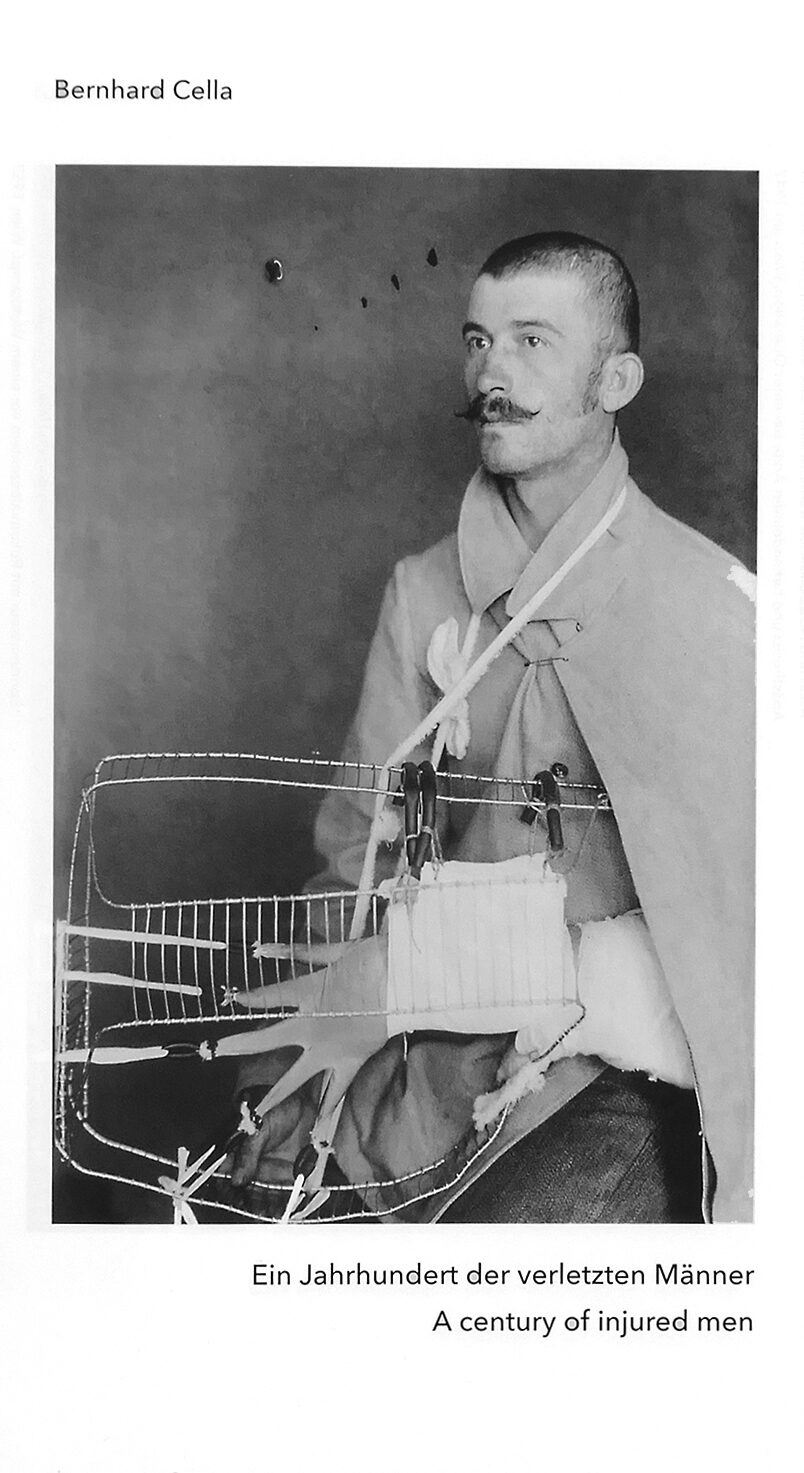
On the right side of room 21, against the wall, are three identical offset-printed artist’s books by Bernhard Cella titled Ein Jahrhundert der verletzten Männer (A Century of Injured Men). Published in 2022, the 152-page book contains photographs of convalescent men over the course of the twentieth century, questioning heroic images of masculinity. I’m assuming many of the injuries were caused by the two world wars.

I neglected to get a photo of the book, but here’s the cover image, and you can view sample pages here and here, as well as two photos of the books in situ at Kolumba on Cella’s Instagram page:

A Century of Injured Men

Vulnerability, injury, sacrifice, healing, the transmutation of pain, new life—these are the themes I gathered from this room.

The current Kolumba exhibition features much more contemporary art than medieval—there are some 175 contemporary works on display, compared to six from the Middle Ages—and I suspect that is now their modus operandi. So, the cross-temporal dialogue isn’t happening in every room, at least not explicitly.

I appreciate the uniqueness of this ecclesiastically run museum, acquiring and showing contemporary works by artists from a range of backgrounds while not shunning its own history as collectors and preservers of medieval German religious art.

As a Christian, I found myself latching on to the imagery that was familiar to me, like Jesus as the Man of Sorrows, and interpreting the surrounding works in light of that. But it seems to me the interpretive process could also move in the other direction, and I wonder how a visitor who doesn’t share my Christian vantage point would respond to the two rooms I’ve highlighted.

For two additional artworks I photographed at Kolumba, an ivory crucifix and an installation with coat, hat, and oil lamp, see my Instagram shares here and here.

Part 2, my reflections on my KMSKA visit, will be published tomorrow.

Advent, Day 3: Come Christmas

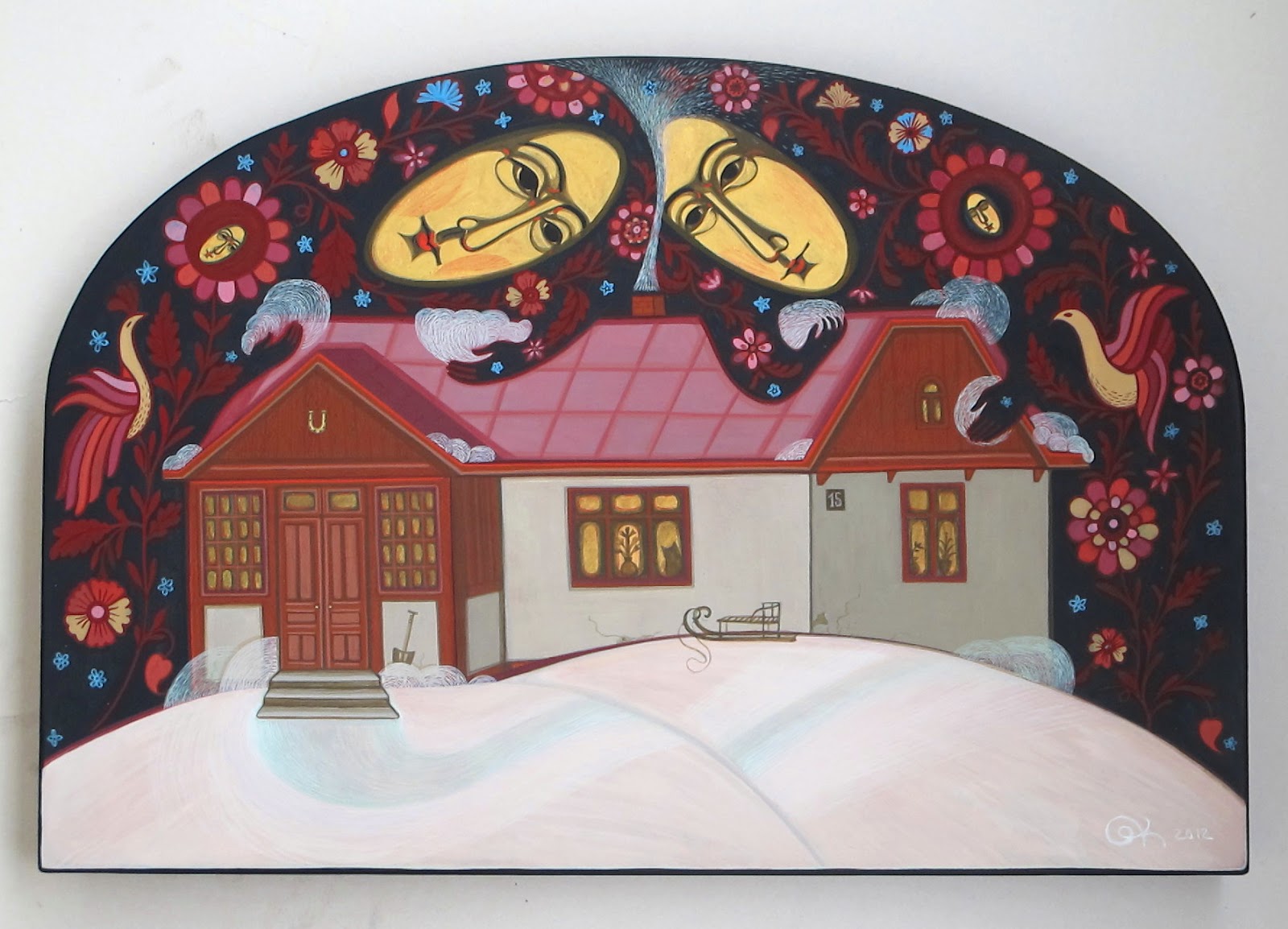
LOOK: Home by Olya Kravchenko

Kravchenko, Olya_Home
Olya Kravchenko (Ukrainian, 1985–), Home, 2012. Egg tempera on gessoed board, 29 × 39.9 cm.

This painting shows a cottage on a snowy hillside at night. Inside, a fire is lit in the hearth, casting a warm glow and sending smoke rising up the chimney. There’s a cat in the window and a sled on the lawn.

On all sides, the sky is populated by a mystical swirl of birds and flowery tendrils and angelic beings. Two of those angels, represented by large golden heads, hold wisps of snow in their hands and embrace the house, offering a protective presence.

Sadly, this cozy winter idyll is elusive for many this year, not least those in Ukraine, where this painting comes from. Many Ukrainians have had to flee their homes to evade the encroaching Russian troops. Others are dealing with the trauma of having lost family members in the war, or the fear of having loved ones on the front line.

Kravchenko told me this month that the situation in her country is “terrifying and unfathomable,” and she alerted me to a few of the recent icons she has painted in response to the war, including Air Defense, The one who protects the sky above the city, Crucifixion in War, and The Virgin of Peace and Victory. Follow her on Instagram @olyakravchenkoart.

LISTEN: “Jul, Jul, Strålande Jul” (Christmas, Christmas, Glorious Christmas) | Words by Edvard Evers, 1921 | Music by Gustaf Nordqvist, 1921 | Performed by Zero8 on A Zero8 Christmas, 2011 (YouTube: 2016)

Jul, jul, strålande jul, glans över vita skogar,
himmelens kronor med gnistrande ljus,
glimmande bågar i alla Guds hus,
psalm som är sjungen från tid till tid,
eviga längtan till ljus och frid!
Jul, jul, strålande jul, glans över vita skogar!

Kom, kom, signade jul! Sänk dina vita vingar,
över stridernas blod och larm,
över all suckan ur människobarm,
över de släkten som gå till ro,
över de ungas dagande bo!
Kom, kom, signade jul, sänk dina vita vingar!

English translation by Michael A. Lowry:

Christmas, Christmas, glorious Christmas: shine over white forests,
heavenly crowns with sparkling lights,
glimmering arcs in the houses of God,
hymns that are sung throughout the ages,
eternal longing for light and peace!
Christmas, Christmas, glorious Christmas, shine over white forests!

Come, come, blessed Christmas: lower your white wings,
over the battlefield’s blood and cry,
over the sighs from the bosoms of men,
over the loved ones who’ve gone to their rest,
over the daybreak of newborn life!
Come, come, blessed Christmas: lower your white wings!

“Jul, Jul, Strålande Jul” is one of the most widely sung Swedish Christmas songs. It personifies Christmas as a luminous winged being, asks it to descend over our wooded neighborhoods and over our songs and our longings, dispensing blessing; to extinguish our wars and raging and spread its comforts over our anxieties and losses; and to cradle the new lives that have been born this year, reminders of innocence and signs of hope for a future.

Lent, Day 19

I am my beloved’s, and my beloved’s is mine . . .

—Song of Solomon 6:3a (cf. 2:16)

He brought me to the banqueting house, and his banner over me was love.

—Song of Solomon 2:4

I will extol thee, O LORD; for thou hast lifted me up . . .

—Psalm 30:1a

Blessed be the God and Father of our Lord Jesus Christ, who hath blessed us with all spiritual blessings in heavenly places in Christ . . .

—Ephesians 1:3

LOOK: Ethiopian Angels, Debre Birhan Selassie Church

Ethiopian church ceiling
Painted wood ceiling, early 19th century, Debre Birhan Selassie Church, Gondar, Ethiopia. Photo: A. Savin.

Debre Birhan Selassie (Trinity and Mountain of Light) Church in Gondar, the imperial capital of Ethiopia from 1636 to 1855, is famous for the colorful paintings that cover every inch of the interior walls and ceiling. The south wall concentrates on the Life of Christ, while the north wall depicts various saints. The focal point—on the east wall, in front of the holy of holies—is a Crucifixion scene and an icon of the Trinity. But the most celebrated visuals inside the church are the hundred-plus winged heads painted in rows between the wooden beams of the ceiling, representing the cherubim and God’s omnipresence.

The original church, which was round, was consecrated in 1693 by Emperor Iyasu I, but lightning destroyed it in 1707. The rectangular stone church that stands on the site now likely dates to the late eighteenth century, and it is the only one of the forty-four Orthodox Tewahedo churches in Gondar to survive the 1888 sack of the city by Mahdist soldiers from Sudan. (Locals say the marauders were miraculously rerouted by a swarm of bees.)

According to Ethiopia (Bradt Travel Guide) writer Philip Briggs, “The paintings are traditionally held to be the work of the 17th-century artist Haile Meskel, but it is more likely that several artists were involved and that the majority were painted during the rule of Egwala Seyon (1801–17), who is depicted prostrating himself before the Cross on one of the murals.”

Debre Birhan Selassie is still an active church, but priests also offer tours. Here’s some video footage of the inside (you’ll see it’s very dark, and flash photography is not allowed), and some drone footage of the exterior.

The church is part of a larger imperial compound, known as Fasil Ghebbi, that has been a UNESCO World Heritage Site since 1979 and that includes palaces, monasteries, and public and private buildings.

Angels (Debra Berhan Selassie Church)
Photo: Alan Davey

LISTEN: “His Banner Over Me Is Love” by B. C. Laurelton (pseudonym of Alfred B. Smith), 1965 | Performed by Christy Nockels on Be Held: Lullabies for the Beloved, 2017 | CCLI #28579

I am my Beloved’s and He is mine—
His banner over me is love.
I am my Beloved’s and He is mine—
His banner over me is love.
I am my Beloved’s and He is mine—
His banner over me is love,
His banner over me is love.

He brought me to His banqueting table—
His banner over me is love.
He brought me to His banqueting table—
His banner over me is love.
He brought me to His banqueting table—
His banner over me is love,
His banner over me is love.

He lifted me up to the heavenly places—
His banner over me is love.
He lifted me up to the heavenly places—
His banner over me is love.
He lifted me up to the heavenly places—
His banner over me is love,
His banner over me is love.

I sang a version of this song in children’s church regularly when I was little (with hand motions!) and have carried it with me all these years, a gentle assurance that I am divinely loved and protected. I’ve quoted the scriptures it’s drawn from above. Its refrain comes from Song of Solomon 2:4: “his banner over me was love.”

The Song of Solomon, aka the Canticle of Canticles, has traditionally been read, at least on one level, as an allegory of the love between God and the human soul—or, more specifically in the Christian tradition, Christ and his church.

From the root “to cover,” the Hebrew word for “banner” in this verse refers to a military standard. It is being used figuratively here to indicate that we enlist ourselves under Love’s banner, which goes forth in triumph and protects those under its billows. We belong to love, commit ourselves to love, overcome through love. The verse is perhaps an allusion to the names of generals being inscribed on the banners of their armies. God’s name is Love (1 John 4:8).

The image is at once vigorous and gentle. The NRSV translates the phrase as “his intention toward me was love.”

The song “His Banner Over Me Is Love” was written by Alfred B. Smith (1916–2001), an itinerant song leader, songwriter, and Christian music publisher. Smith compiled and published his first songbook, Singspiration One: Gospel Songs and Choruses, while he was a student at Wheaton College in 1941, to support the evangelistic meetings he was running with his roommate, Billy Graham (yes, that Billy Graham!). Two years later he founded Singspiration Publishing Company, which published several popular series of songbooks. In 1963 he sold Singspiration to Zondervan, but he ran other publishing ventures (i.e., Better Music Publications and Encore Publications) for the remainder of his ministerial career.

According to Music in the Air: The Golden Age of Gospel Radio by Mark Ward Sr., Smith composed “His Banner Over Me Is Love” in 1965 as an impromptu offertory while serving as a visiting song leader at First Baptist Church–Laurelton in Brick, New Jersey. Afterward he received requests from the congregation for the music. His original notation read “B. C. Laurelton” (for “Baptist Church Laurelton”) to designate where he wrote the song, and it was copied as such as people shared the music with others—so when the song was later published in 1972, Smith decided to adopt “B. C. Laurelton” as a pen name.

Singer-songwriter Christy Nockels [previously] sings “His Banner over Me” on an album of lullabies to a twinkling piano accompaniment.

May this truth—that God’s banner over you is love—soothe you and give you confidence.

Advent, Day 25

You shall have the trumpet sounded throughout all your land. And you shall hallow the fiftieth year and you shall proclaim liberty throughout the land to all its inhabitants. It shall be a jubilee for you . . .

—Leviticus 25:9–10

The LORD has proclaimed
    to the end of the earth:
Say to daughter Zion,
    “See, your salvation comes . . .”

—Isaiah 62:11

Immediately after the suffering of those days

the sun will be darkened,
    and the moon will not give its light;
the stars will fall from heaven,
    and the powers of heaven will be shaken.

Then the sign of the Son of Man will appear in heaven, and then all the tribes of the earth will mourn, and they will see “the Son of Man coming on the clouds of heaven” with power and great glory. And he will send out his angels with a loud trumpet call, and they will gather his elect from the four winds, from one end of heaven to the other.

—Matthew 24:29–31

“Look, I tell you, lift up your eyes, and see that the fields are white for harvest.”

—John 4:35

LOOK: Middle Eastern manuscript illumination of a trumpeting angel

Trumpeting angel (Islamic)
Angel from a detached page of the Arabic manuscript Aja’ib al-Makhluqat wa Ghara’ib al-Mawjudat, painted in Syria, Iraq, or Egypt, 1375–1425. Opaque watercolor and gold on paper, 38.9 × 24.6 cm (full sheet). British Museum, London.

Written around 1270, Aja’ib al-Makhluqat wa Ghara’ib al-Mawjudat (The Wonders of Creation and the Oddities of Existence) by the Persian cosmographer Zakriya ibn Muhammad al-Qazwini was one of the best known and most copied texts in the medieval Islamic world. This leaf from a fourteenth-century illuminated version shows an angel blowing a long trumpet that resembles a karnay, an ancient brass instrument still used throughout Central Asia, especially Uzbekistan, to herald celebrations.

The British Museum website identifies the angel in this painting as Gabriel; however, according to the hadith (records of the traditions and sayings of the prophet Muhammad) and the verso of this page, it is the angel Israfil who will blow the horn on the Day of Resurrection. Similar representations can be found here, here, here, and here. I sent a query to the museum asking why they’ve titled the painting “The Angel Gabriel” and whether it might be a mistake, and they told me they are looking into it.

Even though the Bible never specifies Gabriel as the trumpeter of the last days, he has come to be associated with that role in Christian tradition. The Armenian church was the first to assign it to him beginning in the twelfth century, and John Milton did likewise in his seventeenth-century epic, Paradise Lost. Gabriel’s trumpet is also a familiar trope in African American spirituals.

Israfil is not mentioned in the Bible. However, because whole hosts of angels exist and so few are named in scripture, all three Abrahamic religions (Judaism, Christianity, Islam) have naturally taken to supplying some names of their own.

The unknown artist of this image has creatively imagined an angel’s wing that tapers off into what looks like an animal head!

I chose the image for its ability to evoke Christ’s return—which, FYI, Muslims are also waiting for.

LISTEN: “Days of Elijah” by Robin Mark, 1996 | Arranged by Keith Lancaster and performed by the Acappella Company on Glorious God: A Cappella Worship, 2007

These are the days of Elijah
Declaring the Word of the Lord
And these are the days of your servant Moses
Righteousness being restored
And though these are days of great trials
Of famine and darkness and sword
Still we are the voice in the desert crying
Prepare ye the way of the Lord

Behold he comes
Riding on the clouds
Shining like the sun
At the trumpet call
So lift your voice
It’s the year of Jubilee
And out of Zion’s hill
Salvation comes

And these are the days of Ezekiel
The dry bones becoming as flesh
And these are the days of your servant David
Rebuilding a temple of praise
And these are the days of the harvest
The fields are as white in the world
And we are the laborers in your vineyard
Declaring the Word of the Lord

Behold he comes
Riding on the clouds
Shining like the sun
At the trumpet call
So lift your voice
It’s the year of Jubilee
And out of Zion’s hill
Salvation comes

There’s no god like Jehovah

In the fifth century BCE God told Israel through his prophet Malachi, “See, I am sending my messenger to prepare the way before me. . . . Lo, I will send you the prophet Elijah before the great and terrible day of the LORD comes” (Mal. 3:1a; 4:5; cf. Isa. 40:3).

Four hundred years later came John the Baptist, whom Jesus referred to as Elijah (Matt. 11:14)—preparing the way, preaching the Word.

Northern Irish singer-songwriter Robin Mark invokes Elijah and, implicitly, his new-covenant counterpart, John, in the first stanza of “Days of Elijah,” comparing the ministries of these two prophets to that of the church. Just as John the Baptist prepared the way for the Messiah’s first coming, we are to prepare the way for his second.

The refrain pictures that second coming as a jubilee celebration—as freedom, rest, wholeness, the world set right—announced by a trumpet blast.

We are in the last days, the time between Christ’s two advents. And though we await the fullness of redemption, we do not do so passively. Filled with Christ’s Spirit, we labor as agents of justice and resurrection and praise, as the song suggests.

Above I featured a fairly standard (and skillful!) version of “Days of Elijah” that could be sung by your average church congregation. But here’s one to really knock your socks off: an arrangement by the South African gospel group Joyous Celebration, which they performed live in Johannesburg last month:

Four scenes from a medieval German altarpiece

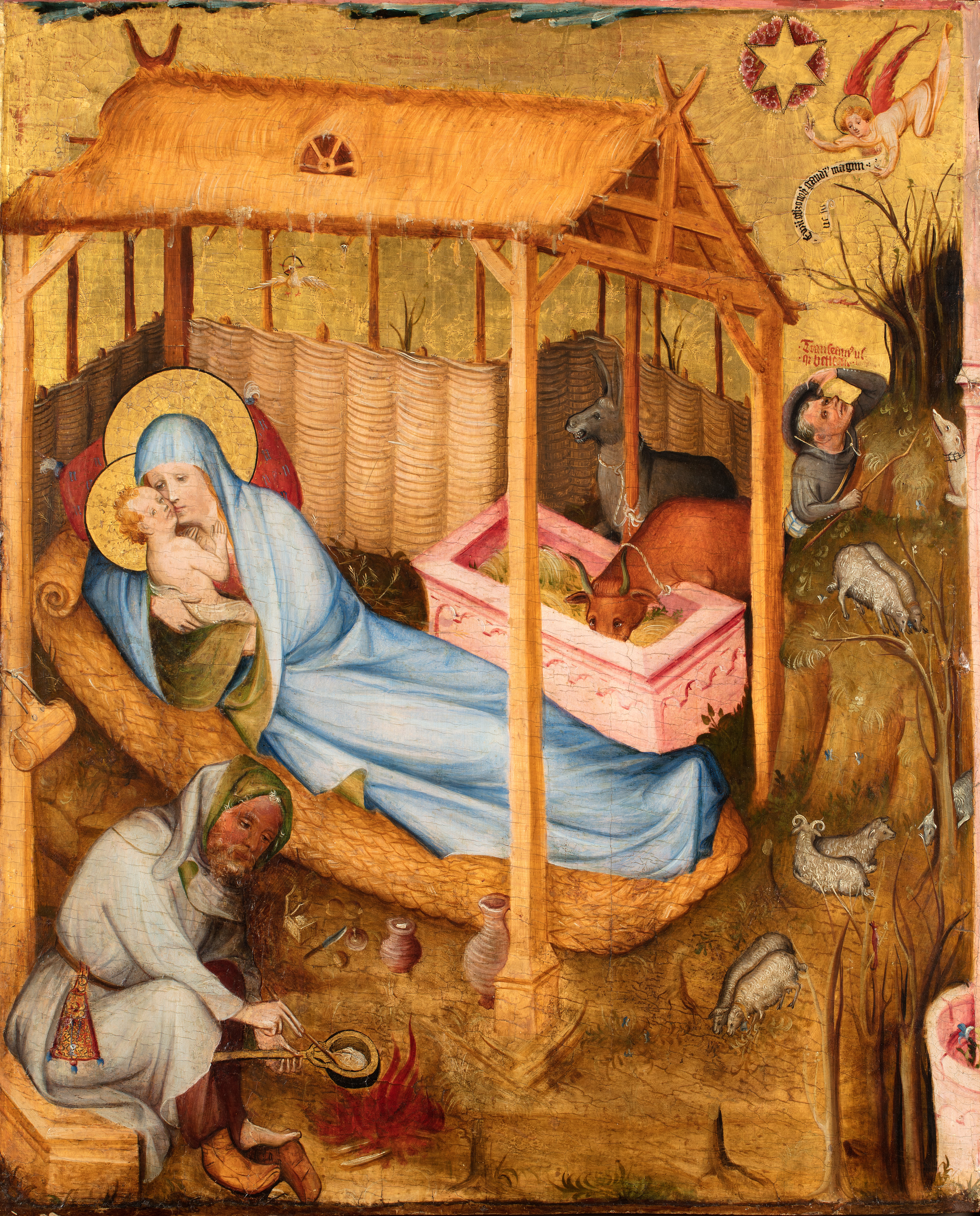
When I was at the Museum Catharijneconvent in Utrecht, Netherlands, in 2019, one of the standout pieces I saw was an early fifteenth-century altarpiece from the Middle Rhine region of Germany. The central section, which I imagine would have been a sculpted Crucifixion scene, has been lost, and the surviving panels are arranged in a modern frame.

Middle Rhine Altarpiece (Catharijneconvent)
Altarpiece from the Middle Rhine, ca. 1410. Tempera on panels. Museum Catharijneconvent, Utrecht, Netherlands. Photo: Ruben de Heer.

Ten panels depicting eight scenes from the life of the Virgin Mary decorate what would have originally been the interior wings—that is, visible when the altarpiece was open.

  1. The Annunciation (2 panels)
  2. The Visitation
  3. The Nativity
  4. The Adoration of the Magi
  5. The Resurrection
  6. The Ascension (2 panels)
  7. The Descent of the Holy Spirit
  8. The Dormition

I’ll describe the first four, as they’re my favorites.

All photos in this post are from the museum’s website, which courteously provides them in high resolution under an open-access policy, promoting scholarship and digital engagement. The Annunciation image is a composite I made from two separate photos.

The Annunciation

Annunciation (Middle Rhine Altarpiece)

In the Annunciation, Mary sits in her bedroom beside a window in front of an open pink chest (her dowry chest?), quietly reading the scriptures, when the angel Gabriel slips in through an open door, holding a banderole that bears his greeting: Ave gratia plena d[omi]n[u]s tecum (“Hail, favored one, the Lord is with you,” Luke 1:28). He then goes on to tell her that she has been chosen to bear God’s Son into the world.

What will Mary say? Four little angels look on in eager anticipation from a tower in the panel above, while in the room two angels already start rolling out the royal treatment, holding up a gilt-brocaded velvet “cloth of honor” behind the young maiden in recognition of her high calling.

A thin column divides Gabriel’s space from Mary’s, creating a sense of threshold. It marks a boundary that is about to be crossed. The separation between God and humanity will be broken down by the Incarnation.

Mary ultimately responds to the surprise invitation with acceptance: Ecce ancilla d[omi]ni fiat michi s[e]c[un]d[u]m verbu[m] t[uu]m (“Behold the handmaid of the Lord, be it unto me according to thy word,” Luke 1:38).

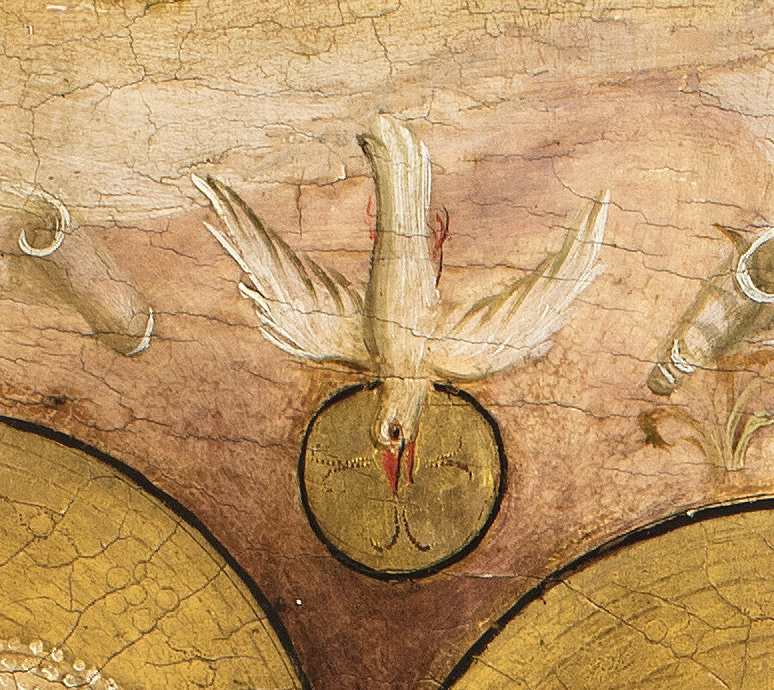
Mary’s yes triggers the release of a thick stream of light—it looks to me like a golden conveyor belt!—from the heart of God the Father, who is peering down through an upper window. Riding that stream is a haloed dove (the Holy Spirit) followed by a tiny yet fully formed infant Christ who’s holding a cross and headed straight toward Mary’s womb.

Annunciation (Middle Rhine Altarpiece, detail)
“Weeee!!!”

The homunculus (“little human”) motif in Annunciation images, though relatively rare, always makes me chuckle. It’s one way artists came up with to visualize the unvisualizable mystery of Christ’s conception, one that includes the Second Person of the Trinity as an actor in the event and shows a very literal descent. Not long after the motif started appearing in the fourteenth century, it was disapproved of by theologians, such as Antoninus of Florence and Molanus, and it was finally banned in the eighteenth century by Pope Benedict XIV as being heretical, since it suggests that Jesus did not take his body from Mary.

For brief commentary on this particular scene by Msgr. Herman Woorts, a Dutch art historian and an auxiliary bishop in the Roman Catholic Church, see this video produced by Katholiekleven.nl:

(To translate the Dutch into your language, click the “CC” button on the player, then the cog icon, and select Subtitles→Auto-translate.)

The Visitation

Visitation (Middle Rhine Altarpiece)

In the Visitation panel, Jesus and John the Baptizer are visible in their mothers’ wombs, each encased in a mandorla (almond-shaped aureole). This visual device of showing the cousins in utero was not uncommon at the time, especially in the Low Countries; art historian Matthew J. Milliner amusingly calls it “ultrasound Jesus”! Here you can actually see little John kneeling before his cousin in adoration.

Elizabeth has emerged from a door at the right, whose frame is labeled “Civitas Juda,” City of Judah (and notice the dog in the doorway! a traditional symbol of faithfulness). As she and Mary embrace each other in celebration of their miraculous pregnancies and imminent salvation, scrolls unfurl with their words from the Gospel of Luke: Et unde michi hoc q[uo]d mater d[omi]ni mei venit ad me (“And why is this granted to me that the mother of my Lord should come to me?” Luke 1:43), at right, and at left, Magnificat a[n]i[m]a mea d[omi]n[u]m. Et exultavit sp[iritu]s meus i[n] deo salutalutari (sic) meo (“My soul magnifies the Lord, and my spirit rejoices in God my Savior,” Luke 1:46–47). The scrolls provide a delicate, wing-like framing around the two women.

And at their head, in the center, an open-beaked dove descends, signifying the Holy Spirit—an extremely rare appearance in Visitation images. This is God breathing on his daughters, blessing their ministries, receiving their praise. Like the prophets of old, they are filled with God’s power and truth spills forth from their lips.

Visitation (Middle Rhine Altarpiece, detail)

At their feet flows a spring of water, a possible allusion to Isaiah 35:6b–7a: “waters shall break forth in the wilderness, / and streams in the desert; / the burning sand shall become a pool, / and the thirsty ground springs of water.” Not to mention the Living Water that is Christ (see John 4).

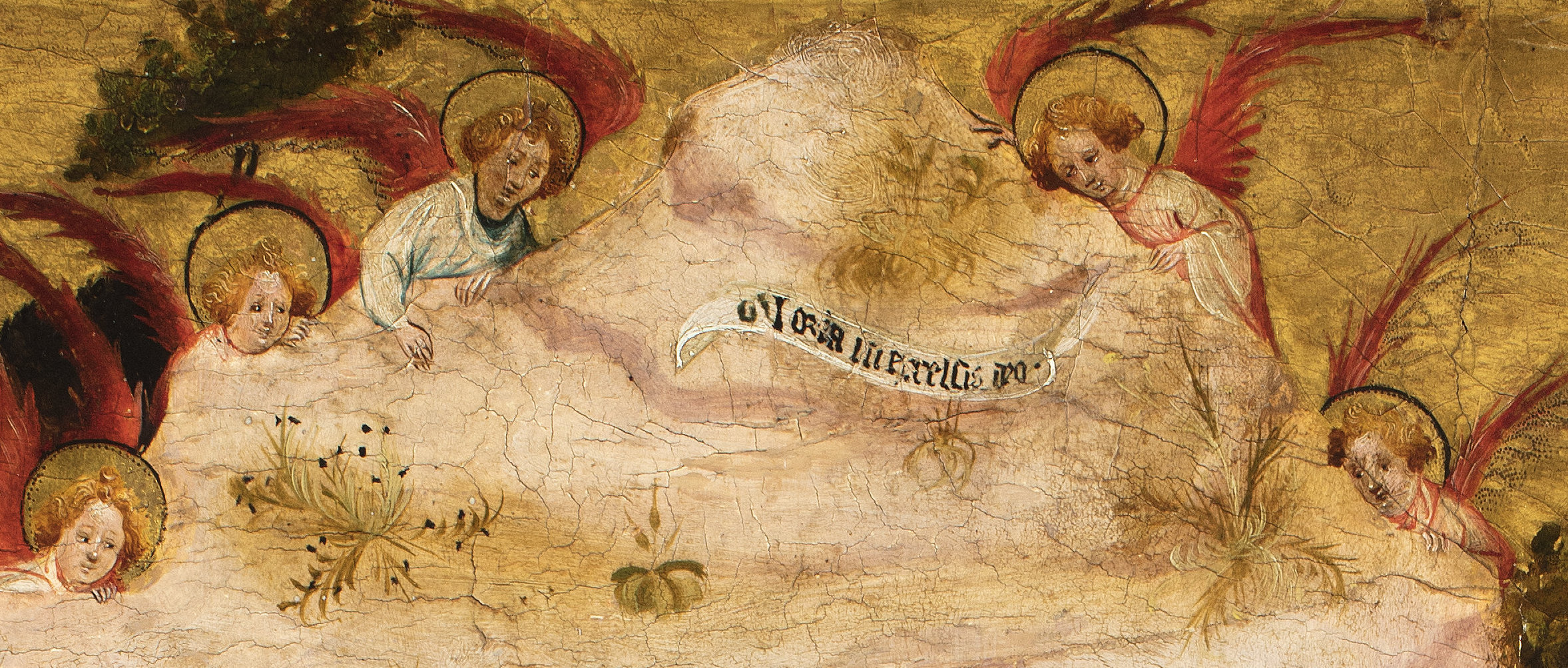
Another charming detail of this panel is the angels, with their wispy red wings, peeking in at this intimate moment from behind rocks. I’m reminded of the epistle of 1 Peter, whose author says that the mysteries of salvation are “things into which angels long to look!” (1:12). Here they seem to whisper their song that will be exclaimed at full blast on the night of Jesus’s birth: Gloria in exelsis deo (“Glory to God in the highest,” Luke 2:14).

The Nativity

Poor Joseph is often overlooked as a player in the Christmas story, and yet he, too, faithfully responded to a (quite terrifying!) divine calling: to be the adoptive father of Jesus, raising him as his own. Though he initially had doubts about Mary’s story of supernatural conception—who wouldn’t?—an angel set him straight, and he ultimately acted in love and loyalty to Mary, and to God. He was an advocate and a provider for his family, looking out for their best interests all along the way.

Nativity (Middle Rhine Altarpiece)

I mention this because the Middle Rhine Altarpiece shows an actively caring and resourceful Joseph at the Nativity, cooking porridge over an open fire to nourish his hungry and tired wife, who reclines on a rollout mat with her newborn.

Also, notice that his left foot is bare. A legend of unknown origin says that Joseph removed his stockings (German hosen) following Jesus’s birth, cutting them into strips in order to swaddle the child. This narrative detail appealed to popular imagination and was referred to in stories, poems, songs, and the visual arts from the fourteenth through sixteenth centuries in the Netherlands and the Rhineland. At the time this altarpiece was made there was even a venerated relic at Aachen Cathedral purported to be the stockings-turned-swaddling bands.

As had become standard in images of the Nativity, this one includes an ox and an ass. The canonical Gospels don’t mention any animals at the birth—though the mention of a manger in Luke 2:7 implies an animal presence. The seventh-century Gospel of Pseudo-Matthew specifically names the ox and ass, citing their supposed adoration of the Christ child as a fulfillment of an Old Testament “prophecy”: “And on the third day after the birth of our Lord Jesus Christ, the most blessed Mary went forth out of the cave, and entering a stable, placed the child in the stall, and the ox and the ass adored Him. Then was fulfilled that which was said by Isaiah the prophet, saying: The ox knows his owner, and the ass his master’s crib (Isa. 1:3).” These two domestic animals are also mentioned in the Nativity account that appears in the Golden Legend, an immensely popular text from the thirteenth century.

Here the ox is nose-deep in straw, while the ass looks up with his mouth agape. Perhaps he’s excited at having just spotted the Spirit-dove under the rafters.  

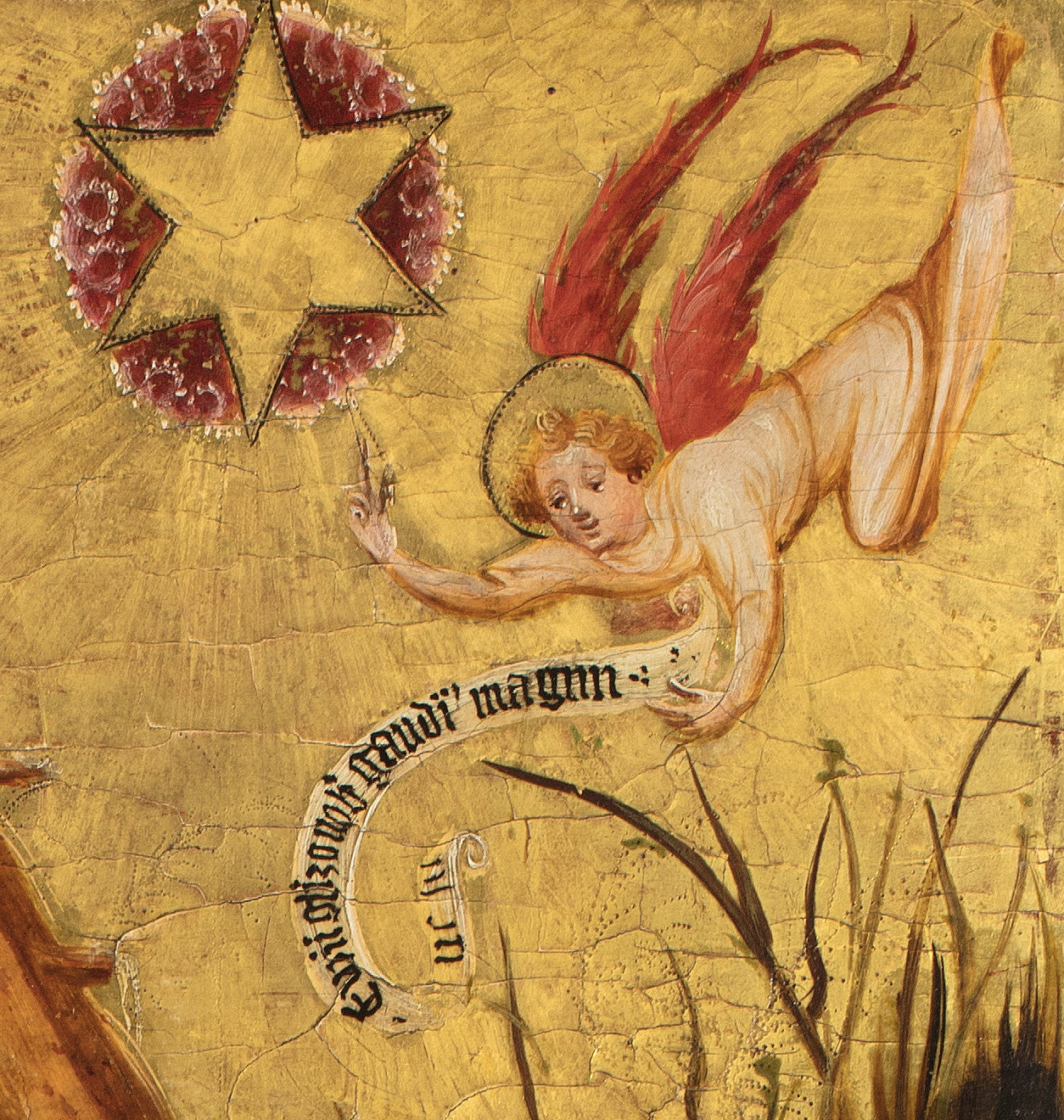
The shepherds are about to arrive at the stable, as in the right background the birth is announced to them. The scroll held by the angel reads, Evanglizo vob[is] gaudi[um] magnu[m] (“I proclaim great joy to you,” Luke 2:10), and above the shepherd is the inscription Transeamu[s] us[que] Betleem (“Let’s go to Bethlehem,” Luke 2:15).

The Adoration of the Magi

In the Adoration of the Magi panel, Mary holds the Christ child on her lap, who is nude save for a thin diaphanous drape, emphasizing his full humanity. She wears a crown, alluding to her identity (in Catholic tradition) as Queen of Heaven. As in the Annunciation, she’s backed by a cloth of honor, which Joseph pulls aside to see what new visitors have come calling. And again, the ever-present Holy Spirit hovers above!

The pointing angel at the top, with the aid of a star, has directed three magi, portrayed here as kings, from their far-off homelands to the Christ child. Ite in iudeam ubi / nascit rex iudeor[um] (“Go to Judea where the king of the Jews was born”), he says.

Having cast his crown at the child’s feet, one of the magi kneels down and kisses the hand of the King of kings. He presents a container of gold coins as tribute, which Jesus rifles through with curiosity (ooo, shiny!).

Two other magi stand behind with their gifts of frankincense and myrrh. One of them, whom tradition calls Balthazar, is African. In the eighth century the historian Bede described Balthazar as having a “black complexion,” and from around 1400 onward he came to be portrayed that way in art, reflecting the growing visibility of other races in Europe.

Exterior Panels

Just to give you a full picture of the altarpiece as a whole . . .

The exterior panels, which were visible when the altarpiece was closed, comprise ten scenes from Christ’s passion. Three, however, are missing, and several of the remaining ones are damaged.

  1. The Agony in the Garden
  2. The Arrest of Christ (lost)
  3. Christ before Pilate
  4. The Flagellation
  5. The Crowning with Thorns
  6. Christ Carrying His Cross
  7. The Deposition (lost)
  8. The Entombment
  9. Mary supported by John
  10. Longinus with the lance (lost)

So all together, the altarpiece would have told the gospel story from Christ’s conception and birth to the Crucifixion to the Resurrection and Ascension to Pentecost. And it would have served as the backdrop to the celebration of the Eucharist, spiritually forming parishioners week after week.

Art museums are full of such treasures as these. I encourage you to visit one of your local museums (or maybe take a weekend trip to one), find a piece of historical art that intrigues you, and sit with it for at least ten minutes. What do you notice? What is strange to you? What makes you smile? What was the object’s original context? What lineages is it a part of (e.g., what communities has it passed through, what iconographies or textual traditions does it draw from and develop, etc.)? What theological ideas, if any, does it express?

If you struggle to meaningfully engage with an artwork, I’m sure a docent would love to help you.

You might also take a photo of the artwork and share it on your social media. Ask your friends what stands out to them.

Holy Thursday: Mount of Olives

And he came out and went, as was his custom, to the Mount of Olives, and the disciples followed him. And when he came to the place, he said to them, “Pray that you may not enter into temptation.” And he withdrew from them about a stone’s throw, and knelt down and prayed, saying, “Father, if you are willing, remove this cup from me. Nevertheless, not my will, but yours, be done.” And there appeared to him an angel from heaven, strengthening him. And being in agony he prayed more earnestly; and his sweat became like great drops of blood falling down to the ground. And when he rose from prayer, he came to the disciples and found them sleeping for sorrow, and he said to them, “Why are you sleeping? Rise and pray that you may not enter into temptation.”

—Luke 22:39–46 (emphasis added)

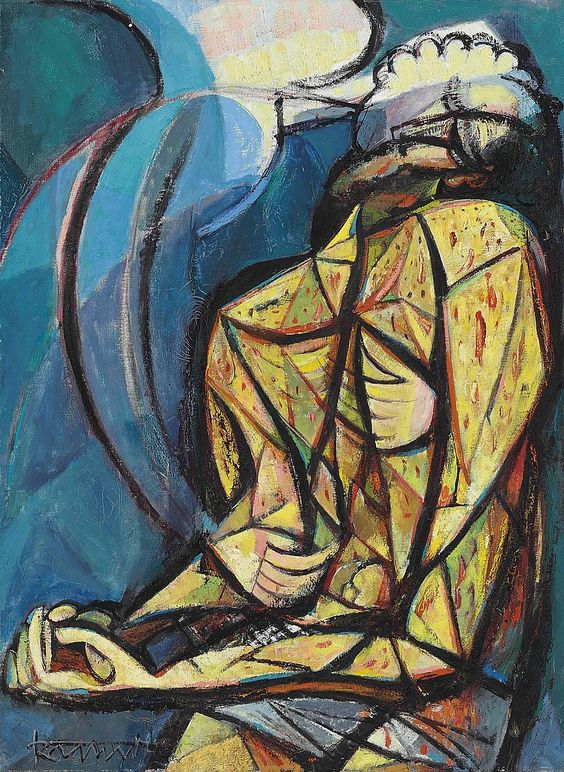
LOOK: Abraham Rattner (American, 1895–1978), Martyr, 1944. Oil on canvas, 32 × 24 in. (81.3 × 61 cm). Private collection.

Rattner, Abraham_Martyr

Jewish artist Abraham Rattner did not specify the identity of the figure in his 1944 painting Martyr, but he painted many images of the passion of Christ during the forties, so it’s likely meant to be a part of that body of work. Because the man’s hands are clasped together, I’m assuming it represents the Agony in the Garden (as opposed to the dead Christ supported by angels).

Luke is the only Gospel writer to mention that in response to Jesus’s anguished pleas in Gethsemane, an angel came down to “strengthen” (enischýō) him. Renaissance artists almost always included an angel in the scene, but at a remove—usually hovering over the mount or peeping out of a cloud, presenting to Jesus the cup of suffering. Often Jesus is shown with a beatific glance upward.

What Rattner gives us, though, is a much more intimate interaction, made all the more so by its being tightly cropped. The angel firmly yet tenderly embraces Jesus’s slumped body, weak with exhaustion and dripping with blood and sweat; the pressure of his grip around arm and torso is palpable. Empathetic, the angel closes his eyes as if trying to absorb Jesus’s pain, to feel it along with him. The two faces appear to merge.

Physical contact between the divinely sent minister and his charge at Gethsemane is not unheard of in the Old Masters; see, for example, Veronese, Giacinto Brandi, Francesco Trevisani, Adriaen van de Velde. But I think Rattner paints it best, capturing a compassionate moment while avoiding mawkishness.

The angel’s simply being there, present to Jesus’s sorrow, doesn’t immediately soften the tension Jesus holds in his body or eliminate his fears. But it does reinvigorate his trust in the Father’s will and prepares him to accept the cup, to drink its bitterness to the dregs.

I wonder how long the angel stayed with Jesus that night. That week. Perhaps the angel strengthened him at other points during his passion too?

LISTEN: “’Tis Midnight, and on Olive’s Brow” | Words by William B. Tappan, 1822

’Tis midnight, and on Olive’s brow
The star is dimmed that lately shone;
’Tis midnight in the garden now,
The suff’ring Savior prays alone.

’Tis midnight, and from all removed,
The Savior wrestles lone with fears—
E’en that disciple whom he loved
Heeds not his Master’s grief and tears.

’Tis midnight, and for others’ guilt
The Man of Sorrows weeps in blood;
Yet he that hath in anguish knelt
Is not forsaken by his God.

’Tis midnight, and from ether plains
Is borne the song that angels know;
Unheard by mortals are the strains
That sweetly soothe the Savior’s woe.

In this hymn the Rev. William B. Tappan of Massachusetts does not indicate the physical presence of an angel with Jesus in Gethsemane but instead imagines a faint waft of angelic song, heard only by Jesus, servicing Jesus’s spirit in his moment of intense need. A fanciful touch, but sure! The repetition of “’tis midnight” at the beginning of each stanza emphasizes the deep darkness—physical, psychological, and spiritual—of that Thursday night when Jesus was forcibly seized from prayer to be put to death on a cross.

I’m not a fan of the traditional tune by William B. Bradbury that’s used in hymnals for this text, though the Green Carpet Players have a fine recording of it. The hymn first came alive to me through a modern retune by The Wilders, sung with a simple banjo accompaniment. Shortly after, I discovered another compelling retune by Hymn Factory, a moody jazz waltz.

>> Music by Eve Sheldon of The Wilders, on On the Wings of a Dove (2002, re-released 2007)

>> Music by Patty Chung of Hymn Factory, on Guide Me: Treasured Hymn Verses in Melodious Pop Songs (2006)

Both these songs appear on the Art & Theology Holy Week Playlist.

Social critique in two Victorian Nativity paintings

Sometimes we rush to judgment of artworks that at first glance seem dull and conventional. We assume they have nothing to show us. But if we were to look more closely, we might find something unexpected. Even subtly subversive.

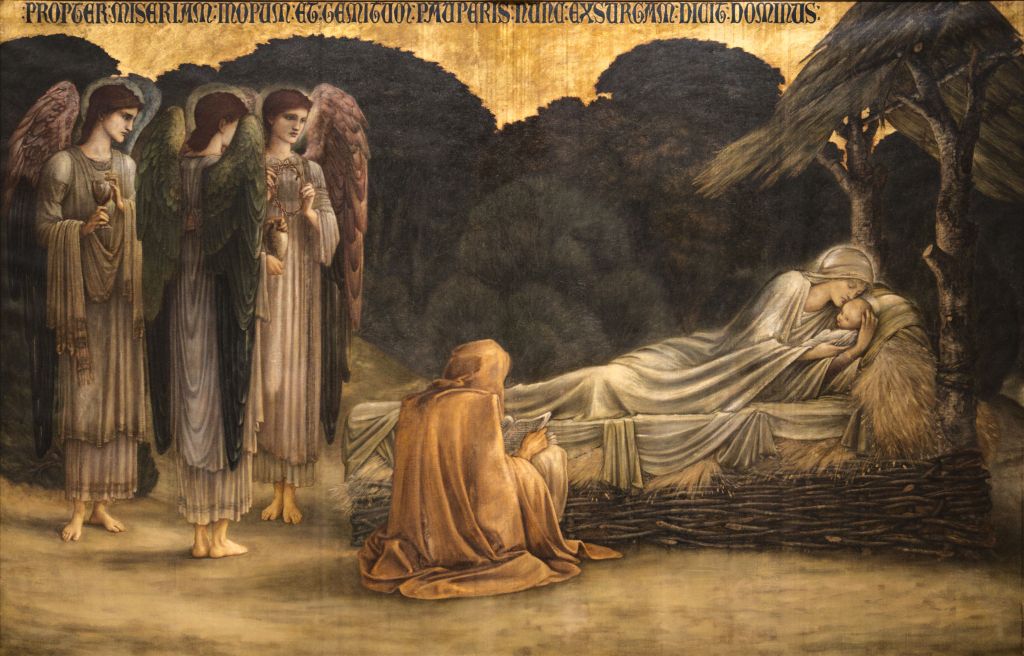
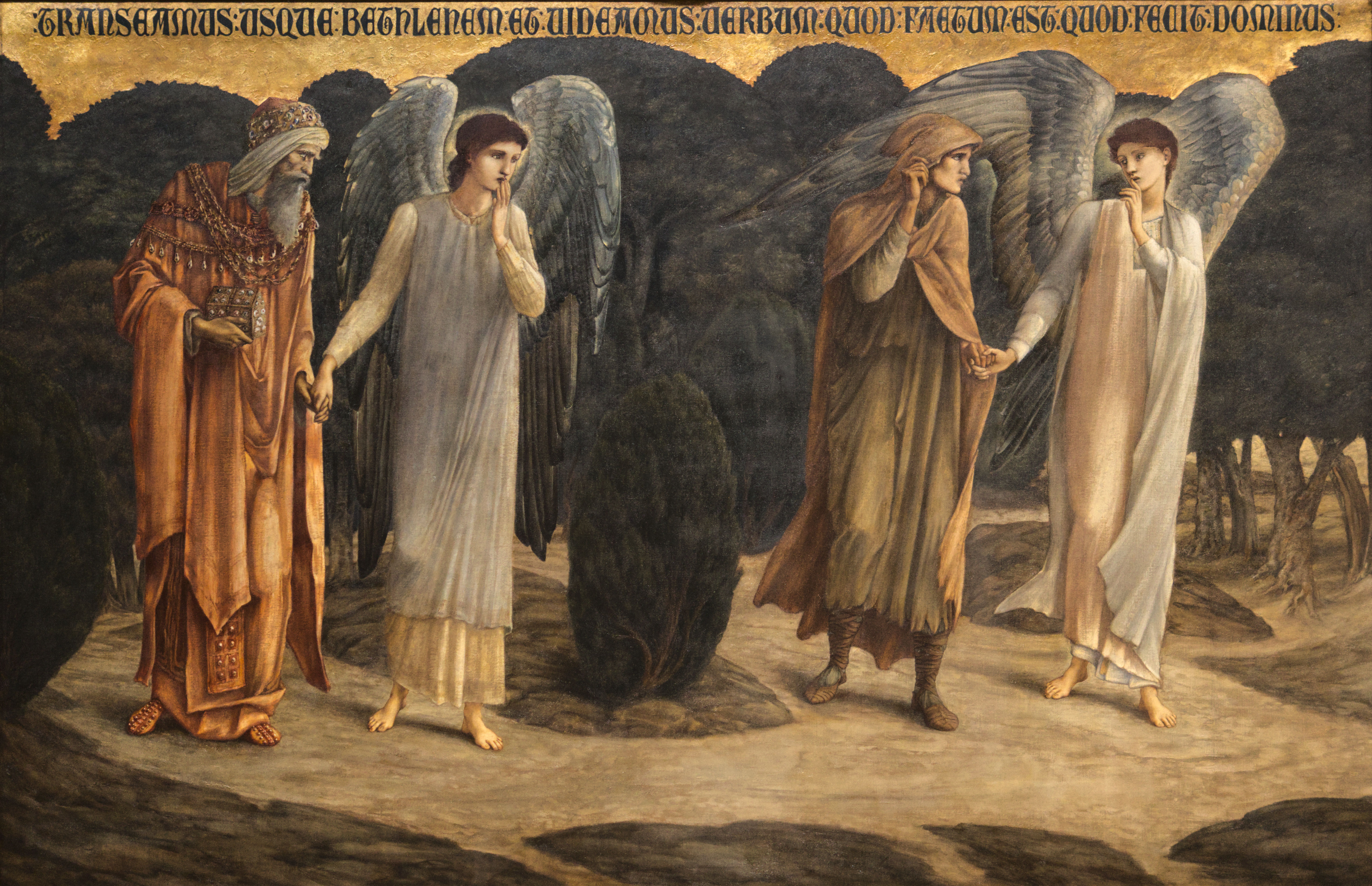
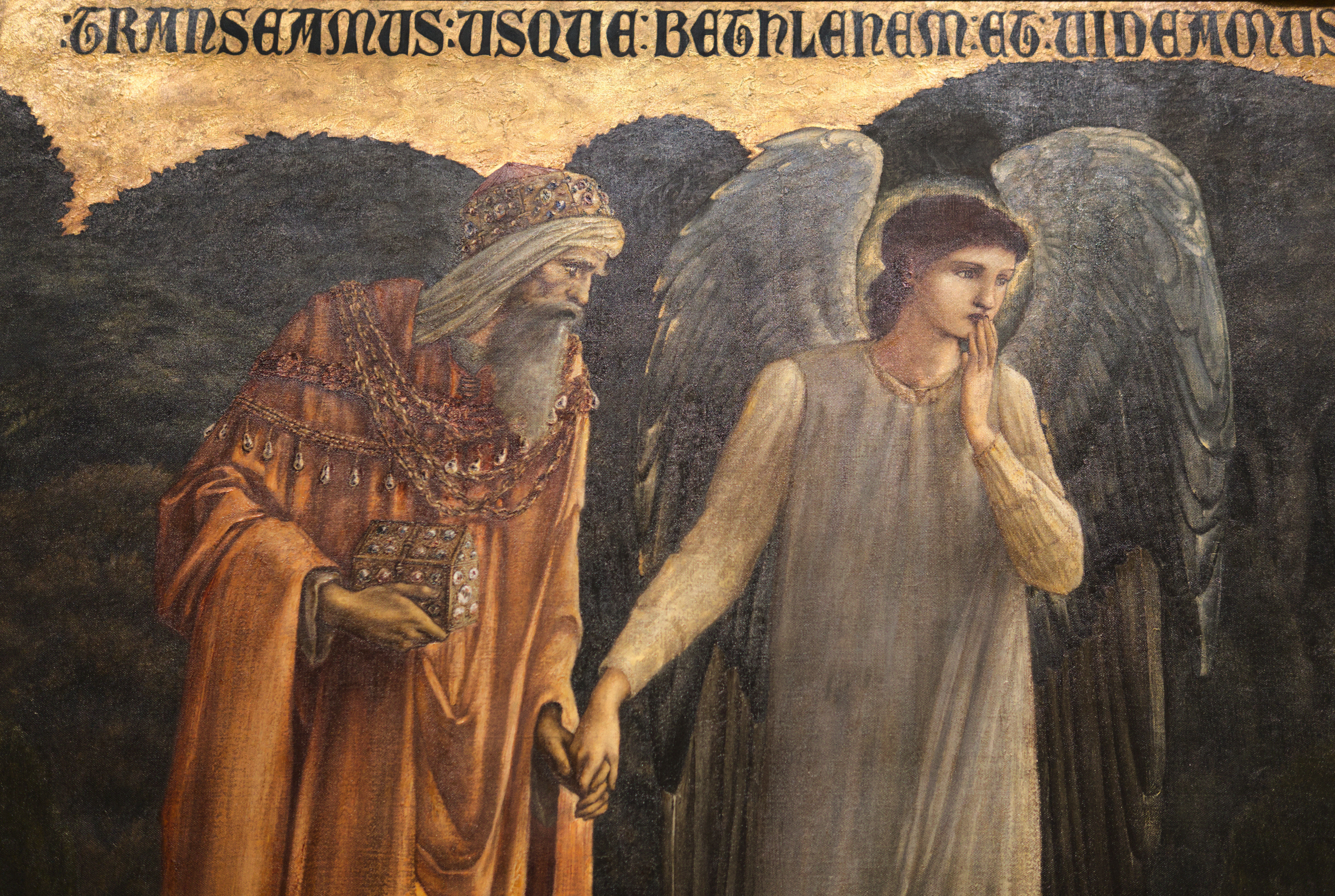
Such is the case with The Nativity and its companion piece, The King and the Shepherd, which were commissioned from the Pre-Raphaelite artist Edward Coley Burne-Jones in 1887 for the chancel of Saint John’s Church in Torquay, England. Seven by ten feet each, they hung on the north and south walls for just over a hundred years before being sold by the church in 1989 to pay for a new roof. (Copies were hung in their places.) Musical theater composer—and Victorian art collector!—Andrew Lloyd Webber bought them and, in 1997, donated them to the Carnegie Museum of Art in Pittsburgh, Pennsylvania. That’s where I saw them earlier this year.

Burne-Jones, Edward_Nativity
Sir Edward Coley Burne-Jones (British, 1833–1898), The Nativity, 1888. Oil on canvas, 81 × 124 1/2 in. (205.7 × 316.2 cm). Carnegie Museum of Art, Pittsburgh, Pennsylvania.

Burne-Jones, Edward_The King and the Shepherd
Sir Edward Coley Burne-Jones (British, 1833–1898), The King and the Shepherd, 1888. Oil on canvas, 81 1/4 × 124 1/2 in. (206.4 × 316.2 cm). Carnegie Museum of Art, Pittsburgh, Pennsylvania.

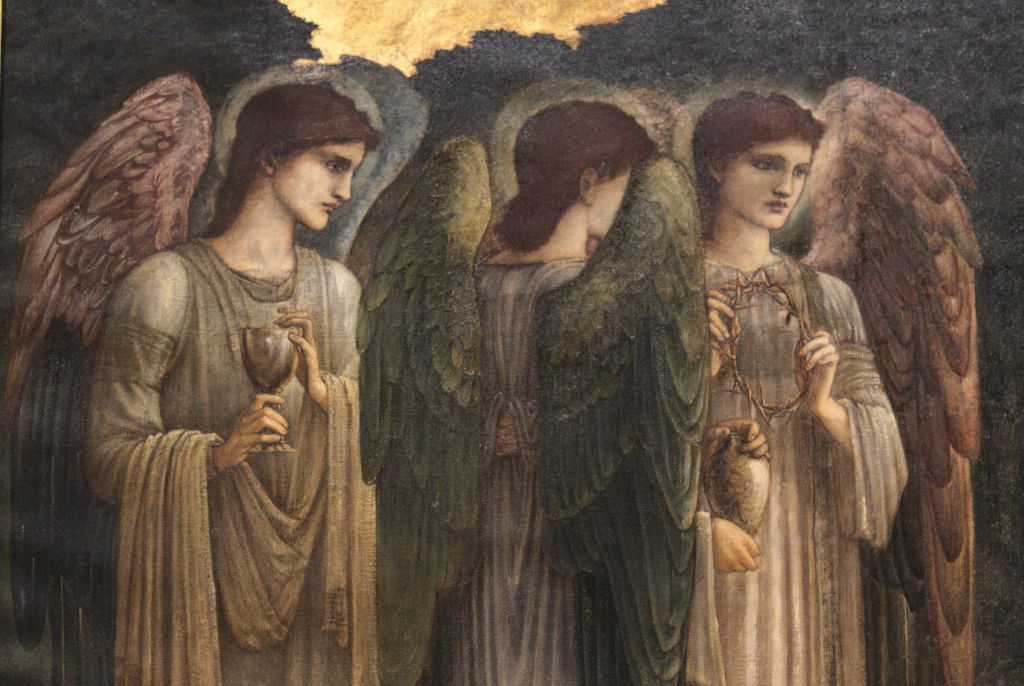
The Nativity shows Mary reclining outdoors on a rustic bed that resembles a bier with her newborn son, Jesus, both wrapped in shroud-like garments. Her partner, Joseph, who has his cloaked back to the viewer, sits on the ground reading a manuscript in Gothic script; the text is indiscernible, but I presume it’s meant to be the scriptures that prophesy the birth of a savior or his sacrificial death. Three angels stand to the side holding symbols of the passion: a crown of thorns, a chalice, and a jar of myrrh, a traditional burial spice. The painting, therefore, links the entrance of Jesus onto the world stage to his ultimate saving act on the cross.

(Related post: “Birth and death in Lavinia Fontana’s Holy Family painting”)

Burne-Jones, Edward_Nativity (pastel)
Pastel sketch for The Nativity by Sir Edward Coley Burne-Jones, 1887. The New Art Gallery Walsall, England.

Burne-Jones, Edward_Nativity (detail, angels)

This foreshadowing approach was not new in Nativity art. But in addition to gesturing toward the redemption from sin that Jesus would bring, the painting also quotes from a community lament psalm in which God’s people cry out for deliverance from those in authority who lie and manipulate. Propter miseriam inopum et gemitum pauperis nunc exsurgam dicit Dominus, the Latin inscription reads, which translates, “Because of the misery of the poor and the groaning of the needy, now will I arise, saith the LORD” (Psalm 12:5a). When God’s people are oppressed, God is aroused to action, and Burne-Jones’s choice of this atypical scripture text for a Nativity painting reminds us of the sociopolitical context of Jesus’s birth, which involved Roman occupation of Israel and a despotic ruler so obsessed with power that he mandated the extermination of Jewish male babies in Bethlehem, thinking he would quash the threat of usurpation. This is the reality into which Jesus was born. And though he didn’t deliver Israel from Rome during his lifetime, he did launch a new “kingdom” and declare a jubilee (Luke 4:16–21).

The biblical inscription speaks not only to Jesus’s day but also to contemporary times, which were marked by high unemployment and great hardship among London’s working class. It’s “a subtle allusion to the social miseries of Victorian Britain,” says Louise Lippincott, curator for the Carnegie at the time of acquisition. She speculates that Burne-Jones intended the painting “as his public statement, albeit a muted one, on 19th-century social horrors. . . . It is quite likely that he was thinking of reports of the bestial living conditions of the London poor that were appearing in the press in the early 1880s.” In 1886, 1887, and 1888, as Burne-Jones was planning and executing the painting, violent strikes and riots were going on in London to protest economic inequality. As people starved, those in power continued to fatten themselves with apparent disregard. The incorporation into this humble scene of a divine vow from the Psalms, where God states his commitment to the poor, expresses hope that God will again arise to deliver from affliction those who trust in him.

The King and the Shepherd extends this critique of the wealth gap by showing the two titular figures—one rich, the other poor—approaching the Christ child as equals. As was and still is common, Burne-Jones combines Matthew’s account of the magi with Luke’s account of the shepherds, showing both as welcome participants in the same event, but uniquely, he chooses only one figure to represent each group. (Traditionally, three magi attend the birth, along with a nonstandard number of shepherds.) An angel leads each traveler by the hand, reminding them to keep their voices low so as not to wake the sleeping infant.

Burne-Jones, Edward_The King and the Shepherd (detail, king)
Burne-Jones, Edward_The King and the Shepherd (detail, shepherd)

“The pairings visually suggest the equality, in the face of divinity, between the wealthy king and the humble peasant,” reads the museum wall text. “In the context of the enormous social inequalities rife in Victorian England, this message smacked of social and political radicalism.” The Latin inscription—Transeamus usque Bethleem et videamus hoc verbum quod factum est quod fecit Dominus [et ostendit nobis]—comes from the New Testament description of the journey of the shepherds. “Let us now go even unto Bethlehem,” they say, “and see this thing which is come to pass, which the Lord hath made known unto us” (Luke 2:15b).

God chose to reveal his Son’s birth not only to bookish scholars or, as tradition has it, royalty, but also to a bunch of blue-collar laborers. The shepherds’ and kings’ mutual presence at Christ’s bedside was only the beginning of the reconciliation across lines of division that Christ came to enact.

For further reflection on the inclusion of rich and poor in the biblical narratives of Jesus’s birth, see “Shepherds vs. Magi: Dynamics of Privilege within the Nativity Story” by Tony Kriz.

All photos, except for the pastel sketch, are by Victoria Emily Jones / ArtandTheology.org.

The Dead Christ Supported by Angels: A Thematic Survey

A type of “Man of Sorrows” image, the Dead Christ Supported by Angels is a devotional trope originating in the late Middle Ages. It typically shows a naked, half-length Christ standing up in a sarcophagus, his wounds prominently displayed so as to invite meditation on his suffering. One or more angels tend to him—they may embrace him, mourn his passing, unwrap his burial shroud (to give viewers a better look), display instruments of the passion, keep him propped up in the tomb, or, as we will see below, prepare to welcome him back to life.

(Related post: “Bill Viola’s Emergence as a Picture of the Resurrected Christ and the New Birth of Believers”)

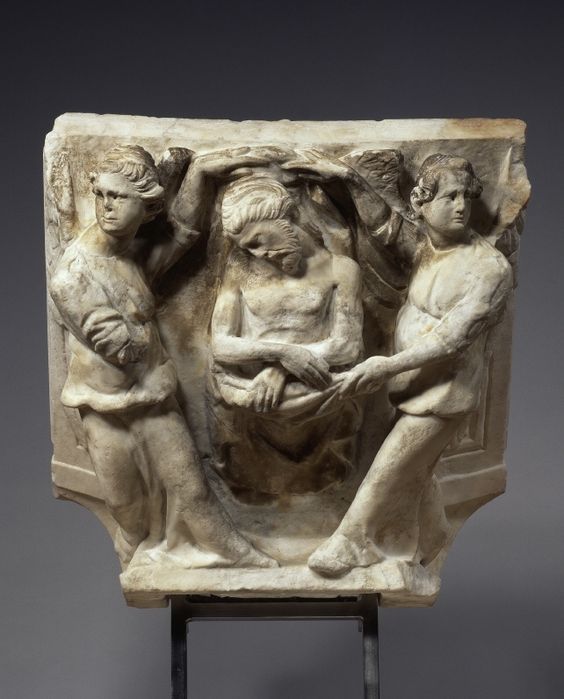
One of the earliest examples of this imagery is the marble relief at the Gemäldegalerie in Berlin. Originally a lectern adornment for the pulpit in Pisa’s cathedral, it shows two angels unveiling Christ’s body, presenting it to us like a eucharistic host. Their raised arms and slanted legs form a mandorla-like frame around him.

Angel Pieta by Giovanni Pisano
Giovanni Pisano (Italian, 1245/48–1314), Angel Pietà, 1300. Marble relief, 44 × 45 × 36 cm. Gemäldegalerie, Staatlichen Museen, Berlin, Germany.

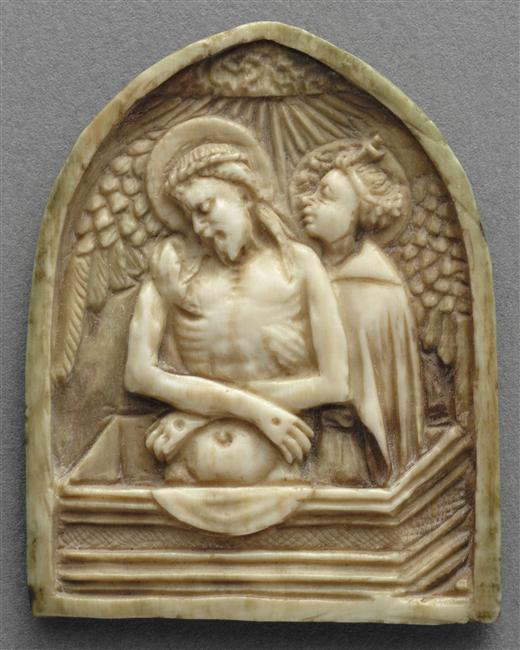
Dead Christ Supported by Angel (ivory)
Pendant: Imago pietatis. Elephant ivory. Musée du Louvre, Paris. Photo: Jean-Gilles Berizzi/RMN-Grand Palais.

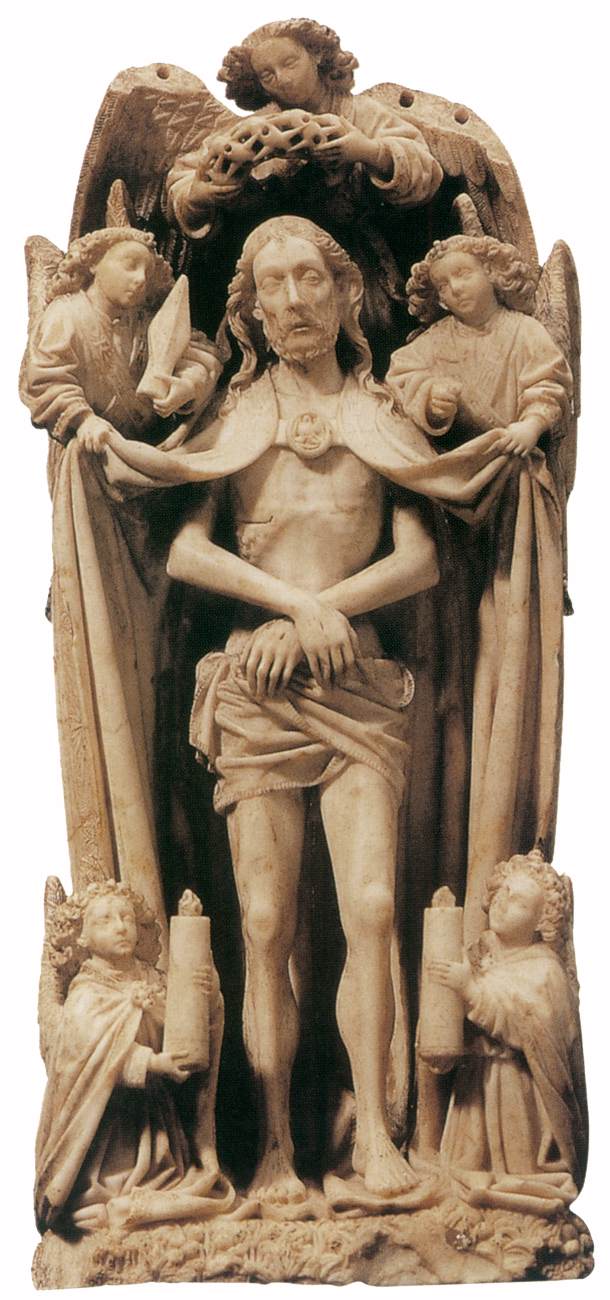
The fifteenth-century alabaster sculpture shown below was formerly partially painted, and the angels formerly wore diadems on their foreheads (one survives). “This is an immensely virtuoso carving for such a small scale,” writes art historian Kim W. Woods—notice the texture of the angels’ wings and hair, the lining of Christ’s ecclesiastical robe, and the plants at Christ’s feet. Notice, too, the intricately carved emblem on Christ’s brooch: a pelican pecking at her breast. Reputed to have fed her young with own blood, the pelican was a common medieval symbol of Christ’s sacrificial love.

Christ as Man of Sorrows (alabaster)
Christ as a Man of Sorrows, mid-15th century. Alabaster, 40 cm high. Museum Mayer van den Bergh, Antwerp, Belgium. Photo: Jean-Luc Elias/KIK-IRPA, Brussels.

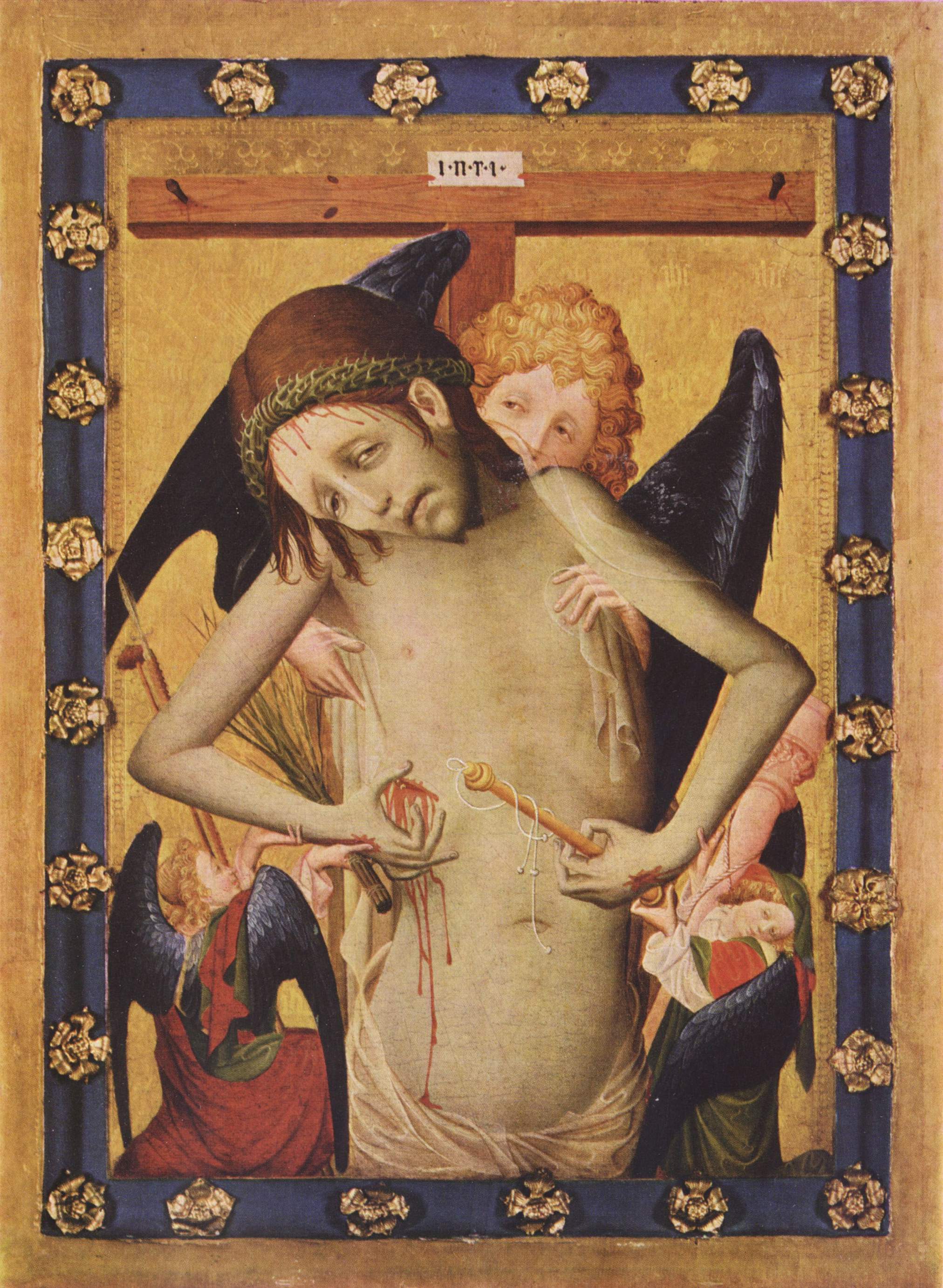
In the Leipzig Man of Sorrows by Master Francke, Christ and three angels stand in a shallow space in front of the cross. It’s unclear whether Christ is on the edge of death or has already crossed over. In his left hand he holds the scourge—or tries to (his hand is either weak and cramped with pain, if alive, or if dead, afflicted rigor mortis). His other hand gestures to his side wound, still wet with blood, as if, like Thomas, he’s about to probe it. Peeking up over Christ’s shoulder is a full-size angel, who tenderly drapes him with a diaphanous veil. At the bottom of the painting two smaller angels kneel on either side, the one holding the birch, the lance, and the sponge-topped reed, the other holding the pillar of flagellation; they both struggle to support the dead weight of Christ’s arms.

Man of Sorrows by Master Francke
Master Francke (German, 1380–1435), Man of Sorrows, ca. 1430. Tempera on oak, 42.5 × 31.3 cm. Museum der Bildenden Künste, Leipzig, Germany.

The angels at Christ’s waist in Master Francke’s Hamburg Man of Sorrows, instead of holding instruments of torture, hold a lily and a sword, symbols of the Last Judgment. (In visualizations of that event, Christ is often shown with a lily coming out of his right ear, signifying an “innocent” verdict for the faithful, and a sword coming out of his left ear, declaring guilty those who did not know him.) Three angels at the top remove the cheap, mock kingly garment the Romans had thrown on him to replace it with his due: a finely embroidered robe befitting a true king.

Man of Sorrows by Master Francke
Master Francke (German, ca. 1380–ca. 1435/40), Man of Sorrows, ca. 1435. Tempera on oakwood, 92 × 67 cm. Hamburger Kunsthalle, Hamburg, Germany.

Continue reading “The Dead Christ Supported by Angels: A Thematic Survey”