Miniature from a 15th-century French manuscript (Ms. Ludwig XI 10, fol. 2, J. Paul Getty Museum, Los Angeles).
Therefore, since we are justified by faith, we have peace with God through our Lord Jesus Christ, . . . and hope does not disappoint us, because God’s love has been poured into our hearts through the Holy Spirit that has been given to us.
Let us glorify the Lord: Father, Son, and Holy Spirit;
praise him and highly exalt him forever.
In the firmament of his power, glorify the Lord;
praise him and highly exalt him forever.
All efforts to visualize the Trinity are obviously deficient. The doctrine resists figuration. (How do you convey three distinct divine persons who share one essence?) But that hasn’t stopped artists from trying. Over the centuries, several different types evolved to represent the Three-in-One. The example above, from a late medieval French translation of Augustine’s City of God, shows the Father, Son, and Holy Spirit enthroned in heaven—the Father as an old man holding a globe, at his right hand the Son still bearing the wounds of his passion, and the Holy Spirit hovering between them in the form of a dove. The two male figures share a royal robe and jointly hold open a book, their word of truth.
The first person of the Trinity is not a human, nor even male, but in Scripture God reveals himself as father and as Ancient of Days, so anthropomorphic depictions developed, though they have always been controversial. These are meant not to be taken literally but, rather, to tell us a little something about God: that he relates to us like a father relates to his children . . . and that he’s ancient! Authority and personhood are more easily shown through figuration, and our anonymous artist here (through the single robe and single seat) conveys the idea that Father, Son, and Spirit are enthroned together as one, together vested with divinity. This is only one aspect of the rich doctrine that is the Trinity.
This post belongs to the weekly series Artful Devotion. If you can’t view the music player in your email or RSS reader, try opening the post in your browser.
To view all the Revised Common Lectionary scripture readings for Trinity Sunday, cycle C, click here.
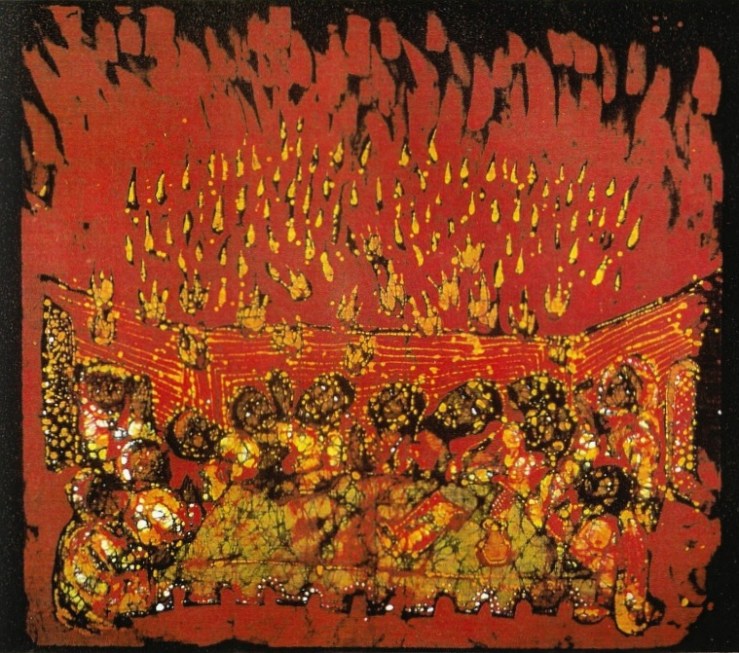
P. Solomon Raj (Indian, 1921–), Pentecost, 1980s. Batik.
. . . Then, like a wildfire, the Holy Spirit spread through their ranks, and they started speaking in a number of different languages as the Spirit prompted them. . . .
—Acts 2:3–4, The Message
+++
MUSIC: “The Elements: Fire” by Hiromi Uehara and Edmar Castaneda, on Live in Montreal (2017)
“Fire” is a collaborative composition and performance by Japanese jazz pianist Hiromi and Colombian jazz harpist Edmar Castaneda. Their virtuosity is amazing! And they have such a fun synergy on stage together.
“I was born to play the harp,” says Castaneda. “It is a gift from God, and like every gift from God, it has a purpose. The purpose of my music is to worship Him and bring his presence and unconditional love to people.”
Thanks to Global Christian Worship for introducing me to these music artists and to this piece in particular.
+++
Dr. P. Solomon Raj is a Lutheran theologian and visual artist from Andhra Pradesh, India. He works mainly in batik (a wax-resist method of dyeing cloth) and woodcut. He is ninety-eight years old.
This post belongs to the weekly series Artful Devotion. If you can’t view the music player in your email or RSS reader, try opening the post in your browser.
To view all the Revised Common Lectionary scripture readings for Pentecost, cycle C, click here.
Ivanka Demchuk (Ukrainian, 1990–), Christ in Glory, 2015. Mixed media on wood, 15 3/4 × 11 1/2 in. Collection of John A. Kohan. Photo: Victoria Emily Jones.
I am the Alpha and the Omega, the first and the last, the beginning and the end.
—Revelation 22:13
+++
SONG: “Alpha and Omega” by Erasmus Mutanbira, 2005 | Performed by Spirit & Truth, 2012
(Note: An earlier version of this post misattributed the song to Israel Houghton. Houghton popularized the song on his Alive in South Africa album, but the words and music are by Erasmus Mutanbira from Zimbabwe.)
This post belongs to the weekly series Artful Devotion. If you can’t view the music player in your email or RSS reader, try opening the post in your browser.
To view all the Revised Common Lectionary scripture readings for the Seventh Sunday of Easter, cycle C, click here.
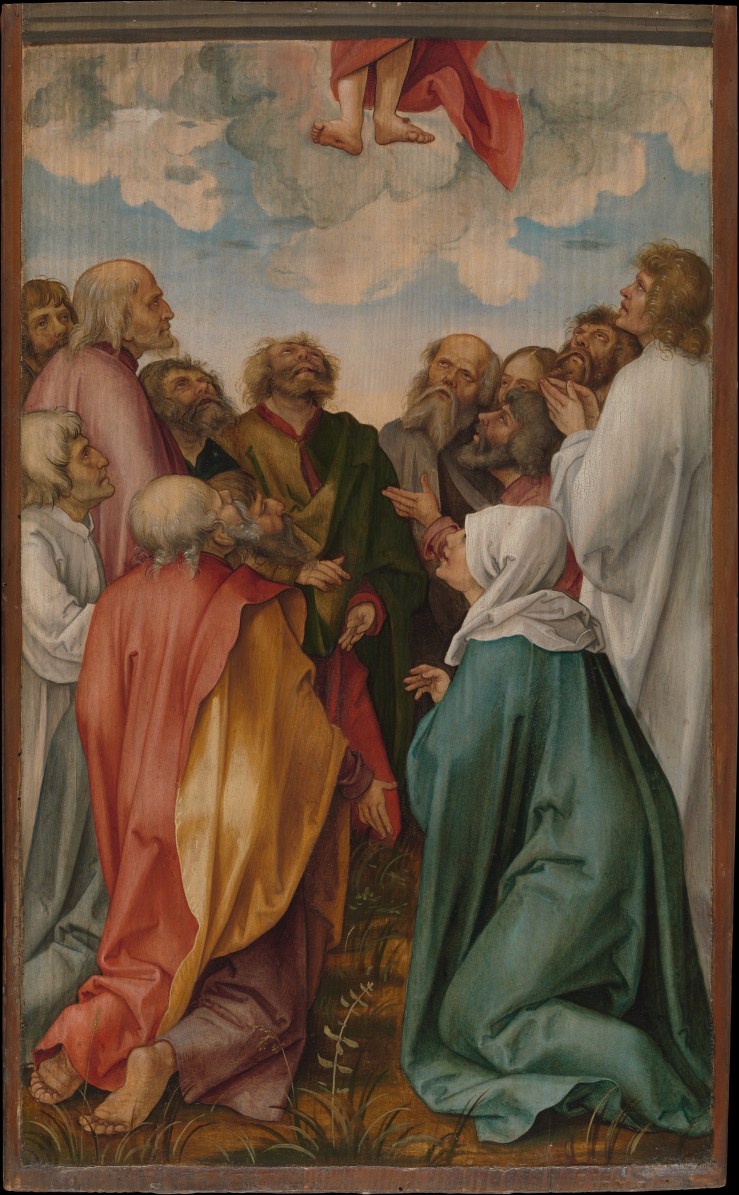
Hans Süss von Kulmbach (German, ca. 1480–1522), The Ascension of Christ, 1513. Oil on fir wood, 24 1/4 × 15 in. (61.5 × 38.1 cm). Metropolitan Museum of Art, New York.
Then he said to them, “These are my words that I spoke to you while I was still with you, that everything written about me in the Law of Moses and the Prophets and the Psalms must be fulfilled.” Then he opened their minds to understand the Scriptures, and said to them, “Thus it is written, that the Christ should suffer and on the third day rise from the dead, and that repentance for the forgiveness of sins should be proclaimed in his name to all nations, beginning from Jerusalem. You are witnesses of these things. And behold, I am sending the promise of my Father upon you. But stay in the city until you are clothed with power from on high.”
And he led them out as far as Bethany, and lifting up his hands he blessed them. While he blessed them, he parted from them and was carried up into heaven. And they worshiped him and returned to Jerusalem with great joy, and were continually in the temple blessing God.
—Luke 24:44–53
+++
SONG: “God Ascended” | Words by Joseph Hart, 1759, add. Bruce Benedict and Sarah Majorins | Music by Sarah Majorins, 2012 | Performed on Ascension Songs, a Cardiphonia compilation album
In this short SATB choral work, Sarah Majorins extracts the final verse from Joseph Hart’s “Come, Ye Sinners, Poor and Needy,” setting it to a new tune. On the one hand, Christ’s ascension is something to celebrate, tied up, as it is, in his exaltation at the right hand of God on high, where he intercedes for us; Luke even tells us that the disciples ultimately responded “with great joy.” But on the other hand, there must have been a solemnity to the occasion, as the disciples were saying goodbye to the physical presence of their friend and teacher. (We know from John’s Gospel that Mary Magdalene, for example, had to resist her desire to not part with Jesus.)
Majorins bends the tune of this song toward the latter mood and, with Bruce Benedict, has added a second verse that expresses a feeling of longing for and complete reliance on Christ’s return. Its refrain is the cry of the church that’s voiced in the penultimate verse of the Bible: “Come, Lord Jesus!” (or, in Aramaic, Maranatha!). Download the full piano score, courtesy of Liturgy Letter and by permission of the artist.
Lo! th’incarnate God, ascended,
Pleads the merit of his blood;
Venture on him, venture wholly,
Let no other trust intrude:
None but Jesus,
None but Jesus,
None but Jesus
Can do helpless sinners good.
Lo! th’incarnate God, ascended,
Enters now the heav’nly realms,
Angels singing alleluia
As they receive their Lord and King.
Maranatha,
Maranatha,
Maranatha,
Maranatha, we on earth still sing:
Come, O come, Lord Jesus, come.
This post belongs to the weekly series Artful Devotion. If you can’t view the music player in your email or RSS reader, try opening the post in your browser.
To view all the Revised Common Lectionary scripture readings for Ascension Day, cycle C, click here.
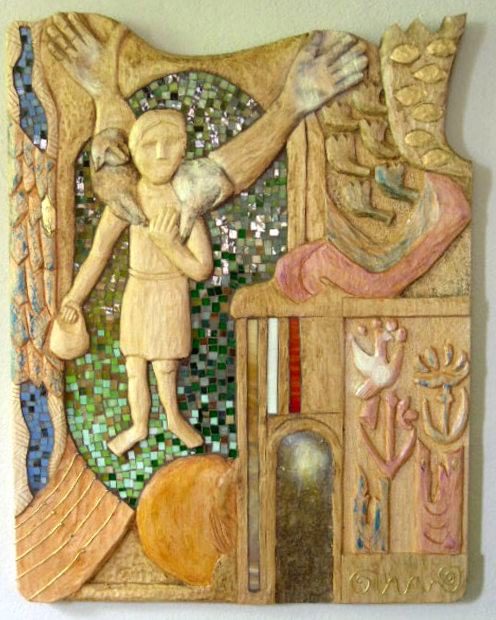
Sister Mary Ann Osborne, SSND, Paths of Peace, 2005. Linden wood, glass, brass wire, gold leaf, and paint, 36 × 27 × 1 in.
Jesus answered him, “If anyone loves me, he will keep my word, and my Father will love him, and we will come to him and make our home with him. Whoever does not love me does not keep my words. And the word that you hear is not mine but the Father’s who sent me.
“These things I have spoken to you while I am still with you. But the Helper, the Holy Spirit, whom the Father will send in my name, he will teach you all things and bring to your remembrance all that I have said to you. Peace I leave with you; my peace I give to you. Not as the world gives do I give to you. Let not your hearts be troubled, neither let them be afraid. You heard me say to you, ‘I am going away, and I will come to you.’ If you loved me, you would have rejoiced, because I am going to the Father, for the Father is greater than I. And now I have told you before it takes place, so that when it does take place you may believe.”
—John 14:23–29
+++
SONG: “I Leave You My Peace” | Music by Maxime Kovalevsky, French Orthodox Church, Paris, 1940s–50s | Arranged by Josef Gulka, Holy Cross Orthodox Church, Medford, NJ | Performed by the St. Symeon Orthodox Church Choir, Birmingham, AL, on Fire and Light (2010)
The mixed-media artwork above is by Sister Mary Ann Osborne, a Minnesota nun in the order of the School Sisters of Notre Dame. The Good Shepherd figure references a Christian fresco from the third-century catacomb of St. Callixtus in Rome, where the shepherd carries a sheep over his shoulders, securing it with one hand while carrying a milk pail in the other; it’s an image of care and protection derived from scripture. Sister Mary Ann has added two open-palmed hands rising up behind, or perhaps emerging from, the shepherd, a posture of prayer (orans) but also of benediction (see, e.g., Lev. 9:22; Luke 24:50).
Christ is pronouncing a blessing—it could be the words of peace and promise from his farewell discourse, excerpted in Sunday’s lectionary reading. We, his people, receive it. He has forged “paths of peace” for us to follow, as Sister Mary Ann’s work suggests, with road markings at the bottom left inviting us to set off where Christ has trod. And he goes with us in the Spirit.
He has called the world to a new order, signified by the shofar at the right, which announces Jubilee. As one of seven, the trump also carries connotations of the day of the Lord.
This post belongs to the weekly series Artful Devotion. If you can’t view the music player in your email or RSS reader, try opening the post in your browser.
To view all the Revised Common Lectionary scripture readings for the Sixth Sunday of Easter, cycle C, click here.
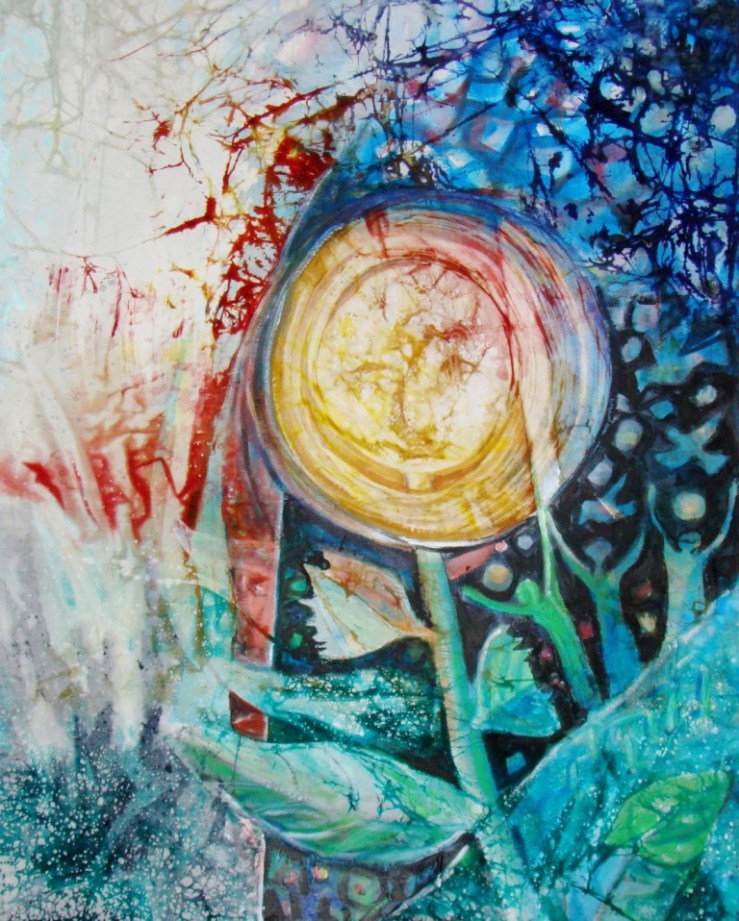
Untitled batik painting by Tony Nwachukwu (Nigerian, 1959–)
Praise the LORD!
Praise the LORD from the heavens;
praise him in the heights!
Praise him, all his angels;
praise him, all his hosts!
Praise him, sun and moon,
praise him, all you shining stars!
Praise him, you highest heavens,
and you waters above the heavens!
Let them praise the name of the LORD!
For he commanded and they were created.
And he established them forever and ever;
he gave a decree, and it shall not pass away.
Praise the LORD from the earth,
you great sea creatures and all deeps,
fire and hail, snow and mist,
stormy wind fulfilling his word!
Mountains and all hills,
fruit trees and all cedars!
Beasts and all livestock,
creeping things and flying birds!
Kings of the earth and all peoples,
princes and all rulers of the earth!
Young men and maidens together,
old men and children!
Let them praise the name of the LORD,
for his name alone is exalted;
his majesty is above earth and heaven.
He has raised up a horn for his people,
praise for all his saints,
for the people of Israel who are near to him.
Praise the LORD!
The above performance, by folk duo All Sons & Daughters (Leslie Jordan and David Leonard), was filmed in the small town of Assisi, Italy, where St. Francis penned his beautiful canticle of all creation, addressing the elements of nature as siblings—Sister Sun, Brother Moon, and so on. Almost seven hundred years later, British pastor William H. Draper paraphrased the poem (which was originally written in the Umbrian dialect) to create “All Creatures of Our God and King,” now a classic of Christian hymnody.
The constant noise in the background is, I believe, cicadas.
All creatures of our God and King,
lift up your voice and with us sing
alleluia, alleluia!
Thou burning sun with golden beam,
thou silver moon with softer gleam,
O praise him, O praise him,
alleluia, alleluia, alleluia!
Thou rushing wind that art so strong,
ye clouds that sail in heav’n along,
O praise him, alleluia!
Thou rising morn, in praise rejoice,
ye lights of evening, find a voice,
O praise him, O praise him,
alleluia, alleluia, alleluia!
Thou flowing water, pure and clear,
make music for thy Lord to hear,
alleluia, alleluia!
Thou fire so masterful and bright,
that givest man both warmth and light,
O praise him, O praise him,
alleluia, alleluia, alleluia!
And all ye men of tender heart,
forgiving others, take your part,
O sing ye, alleluia!
Ye who long pain and sorrow bear,
praise God and on him cast your care,
O praise him, O praise him,
alleluia, alleluia, alleluia!
Let all things their Creator bless,
and worship him in humbleness,
O praise him, alleluia!
Praise, praise the Father, praise the Son,
and praise the Spirit, three in one.
O praise him, O praise him,
alleluia, alleluia, alleluia!
This post belongs to the weekly series Artful Devotion. If you can’t view the music player in your email or RSS reader, try opening the post in your browser.
To view all the Revised Common Lectionary scripture readings for the Fifth Sunday of Easter, cycle C, click here.
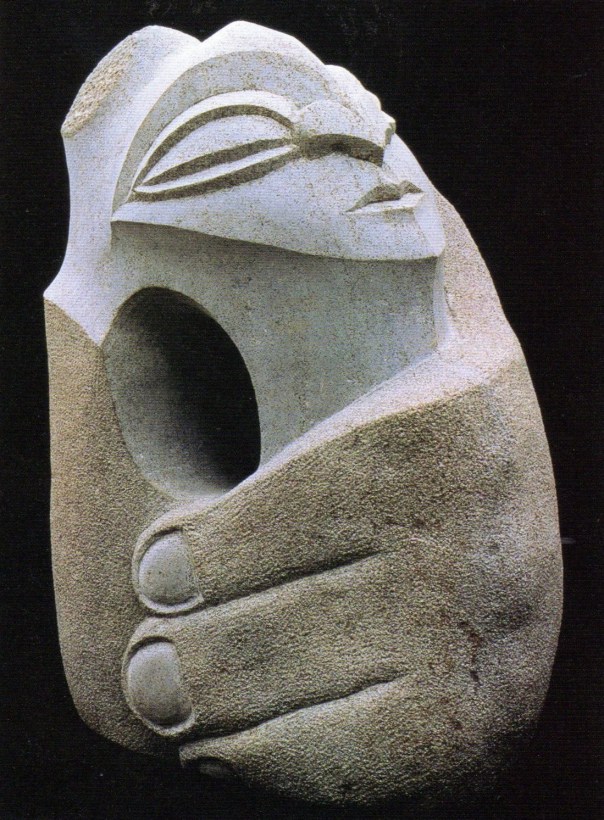
Filipe Tohi (Tongan, resident in New Zealand, 1959–), Fakaukau, 1996. Stone carving. Photo: Museum of New Zealand Te Papa Tongarewa, via Christ for All People, p. 87
I give them eternal life, and they will never perish, and no one will snatch them out of my hand. My Father, who has given them to me, is greater than all, and no one is able to snatch them out of the Father’s hand.
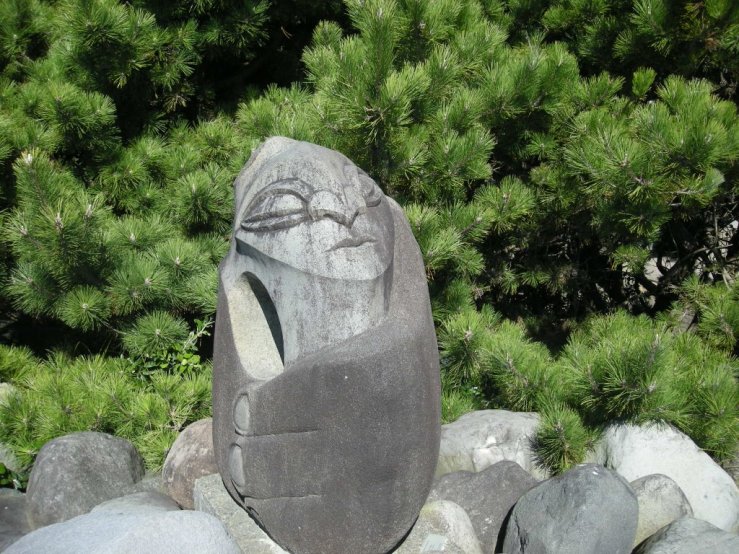
Fakaukau (“Thought”) is the title ascribed to this Tongan sculpture in the excellent book Christ for All People: Celebrating a World of Christian Art, published in 2001, which also places it in a private collection. However, photographs of a very similar—if not the same—sculpture by the same artist can be found online under the name Anchor Stone (see photos here and here), and it’s publicly accessible. Its shape is based on the anchor stone through which Tongan fishermen tie the rope of their boats. You can see the hand of God holding the fisher tenderly yet securely as the fisher rests in that grasp.
Anchor Stone by Filipe Tohi, located along the Coastal Walkway in New Plymouth, Taranaki, North Island, New Zealand. Photo courtesy of New Plymouth District Council.
Anchor Stone is located along the New Plymouth Coastal Walkway, an eight-mile path that forms an expansive sea-edge promenade stretching from Pioneer Park at Port Taranaki all the way to the eastern side of Bell Block Beach in the Taranaki region of North Island, New Zealand. More precisely, the sculpture sits at the eastern end of a bridge that crosses the Huatoki Stream, near the Wind Wand. The walkway features several other sculptures by Filipe Tohi, as well as artworks by other Pacific Islanders.
Filipe Tohi was born in Nuku’alofa, Tonga, in 1959 and moved to Taranaki, New Zealand, in 1979, where he trained as a carver with a Maori cooperative. His early sculptures were mainly in stone and wood, but more recently he has achieved recognition for large contemporary sculptures in aluminum and steel that are inspired by lalava, traditional Tongan coconut sennit lashing (used to build roofs and canoes). Tohi studied and learned this ancient art form during a return visit to his homeland in 1987 and has been responsible for revitalizing and popularizing it. See more of his work at http://www.lalava.net/index.php/ct-menu-item-17#6.
Christianity took root in Tonga in the first half of the nineteenth century when the country’s king, George Tupou I, converted and the people followed suit. It has been Tonga’s main religion ever since.
+++
I first encountered the hymn “O Love That Wilt Not Let Me Go” a few years ago through a Calvary Collective album—I was extremely moved by Madison Cunningham’s understated arrangement and vocal performance, which captures so well the weary tone of the old text and tune. Cunningham adds a four-line chorus: “You will not let me go, so I will trust in thee. You won’t let go, so I will rest. You won’t let go, so I will trust in thee. O I will rest in thee.” Here is the full original text:
O Love that wilt not let me go,
I rest my weary soul in thee;
I give thee back the life I owe,
that in thine ocean depths its flow
may richer, fuller be.
O Light that follow’st all my way,
I yield my flick’ring torch to thee;
my heart restores its borrowed ray,
that in thy sunshine’s blaze its day
may brighter, fairer be.
O Joy that seekest me through pain,
I cannot close my heart to thee;
I trace the rainbow through the rain,
and feel the promise is not vain
that morn shall tearless be.
O Cross that liftest up my head,
I dare not ask to fly from thee;
I lay in dust life’s glory dead,
and from the ground there blossoms red,
life that shall endless be.
Upon hearing this, I immediately set about looking for a piano score—come to find that the hymn is in the hymnal I grew up with! And yet I don’t recall my congregation ever singing it.
In my estimation, “O Love” is one of the most sublime hymns ever written. It taps deeply into that feeling of “I’m tired, burnt out, spent,” meeting us there with gentle hope and joy. The first verse opens with a reminder of the tenacious hold God has on us and with a soul-invitation into the “ocean depths” of God’s being. What a contrast the hymn builds between our weakness and God’s strength. We flicker; God blazes. We bow our heads in exhaustion and lie down to die; God lifts us up and brings us into his full-flowering life. I know some churches have revived “O Love” using new tunes, but those, I feel, don’t hold a candle to Albert Peace’s original. The hymn often crops up in funeral programs and works beautifully in that context, but its relevance is by no means restricted to those at the end of life or those observing a recent passing.
And here’s a great a cappella quartet arrangement by the Gaither Vocal Band:
Update, 10/19/20: Since I published this post, a video by 20schemes has been released, of Pete and Cara Bell from Hope Community Church Barlanark in Glasgow performing “O Love That Wilt Not Let Me Go” with the Peace tune I so admire. It’s a straightforward rendition with acoustic guitar, clear and beautiful singing, and lyrics onscreen, so if you’re looking to introduce the hymn to your church music team, this video would be a helpful start.
This post belongs to the weekly series Artful Devotion. If you can’t view the music player in your email or RSS reader, try opening the post in your browser.
To view all the Revised Common Lectionary scripture readings for the Fourth Sunday of Easter, cycle C, click here.
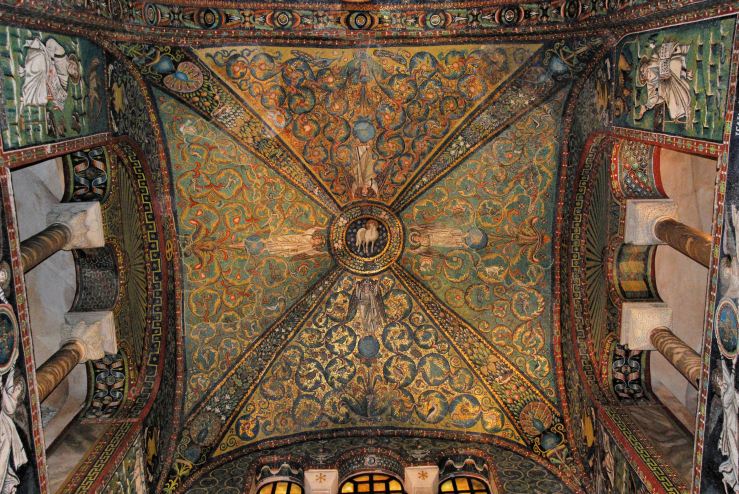
This 6th-century mosaic of the Lamb of God is on the chancel ceiling of the Basilica of San Vitale in Ravenna, Italy. The lamb is encircled by a golden orb (enclosed with stars) and a fruited laurel wreath, supported by angels. Photo: Fr. Lawrence Lew, OP.
Then I looked, and I heard around the throne and the living creatures and the elders the voice of many angels, numbering myriads of myriads and thousands of thousands, saying with a loud voice,
“Worthy is the Lamb who was slain,
to receive power and wealth and wisdom and might
and honor and glory and blessing!”
And I heard every creature in heaven and on earth and under the earth and in the sea, and all that is in them, saying,
“To him who sits on the throne and to the Lamb
be blessing and honor and glory and might forever and ever!”
And the four living creatures said, “Amen!” and the elders fell down and worshiped.
—Revelation 5:11–14
+++
SONG: “Worthy Is the Lamb / Amen” by George Frideric Handel, from Messiah (1742)
This video is a 2014 performance by the Mormon Tabernacle Choir—and you can find many more besides on YouTube. I’m partial, though, to the Oregon Bach Festival Choir and Orchestra’s performance on Easter Joy (2009), which you can stream on Spotify:
Handel was German but spent the bulk of his career in London, settling there in 1712 and becoming a naturalized British citizen in 1727. In the 1730s, he transitioned from composing Italian operas to composing English choral works, one of which is the world-famous oratorio Messiah. (Read Charles Jennens’s full libretto, a curation of scripture passages, here.)
People might assume that the so-oft-performed “Hallelujah” chorus is the finale of this majestic work, but no, that chorus concludes part two, capping off the narrative of Christ’s death, resurrection, and ascension, and the early spreading of the gospel through the known world. The “Worthy Is the Lamb” chorus, rather, serves as the Messiah’s consummation, an acclamation of Christ’s full and final victory over sin and death that follows part three’s prophecies of the day of judgment and the general resurrection. The text is taken from Revelation 5.
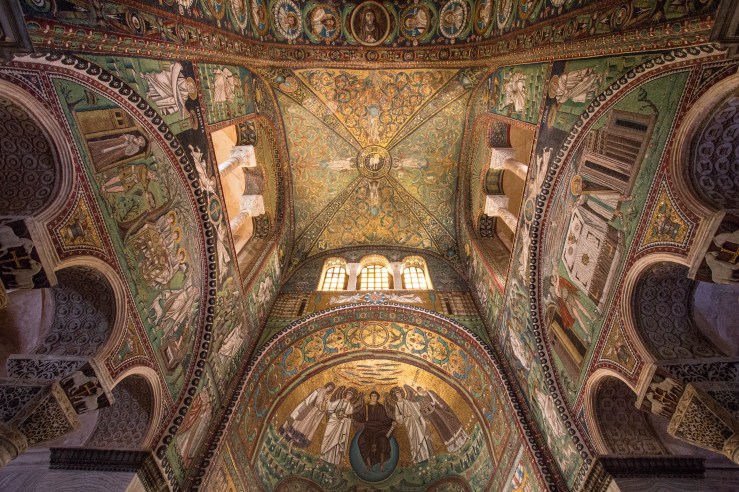
Upward view of the east end of San Vitale, Ravenna. Left lunette: The Hospitality of Abraham and The Sacrifice of Isaac. Center (apse): Christ in Majesty. Right lunette: The Offerings of Abel and Melchizedek. Photo: Fr. Lawrence Lew, OP.Photo: Jim Forest
The anonymous sixth-century mosaicists of San Vitale in Ravenna, Italy, gloriously visualized this passage in the cross-ribbed vault of the church’s chancel, just above the altar. Tens of thousands of tesserae (tiny pieces of colored glass, and clear glass sandwiching gold leaf) come together to image Christ high and lifted up as the sacrificial Lamb of God. Can you imagine worshipping in this space? It must have been so transporting for those early Christians of Ravenna: to enter and move toward their promised end in Christ. To be enfolded in this luminous vision of paradise that they enacted below in the liturgy.
To learn more about San Vitale and its mosaics, see this Smarthistory video. (Unfortunately it focuses on the two political portraits at the expense of the biblical subject matter, but nonetheless, it gives a good sense of the architectural setting of the mosaics.)
This post belongs to the weekly series Artful Devotion. If you can’t view the music player in your email or RSS reader, try opening the post in your browser.
To view all the Revised Common Lectionary scripture readings for the Third Sunday of Easter, cycle C, click here.
The Incredulity of Saint Thomas, 15th century. Tempera on wood. Avila Cathedral Museum, Avila, Spain. Photo: Fr. Lawrence Lew, OP. [view alt photo]
Now Thomas, one of the twelve, called the Twin, was not with them when Jesus came. So the other disciples told him, “We have seen the Lord.” But he said to them, “Unless I see in his hands the mark of the nails, and place my finger into the mark of the nails, and place my hand into his side, I will never believe.”
Eight days later, his disciples were inside again, and Thomas was with them. Although the doors were locked, Jesus came and stood among them and said, “Peace be with you.” Then he said to Thomas, “Put your finger here, and see my hands; and put out your hand, and place it in my side. Do not disbelieve, but believe.” Thomas answered him, “My Lord and my God!” Jesus said to him, “Have you believed because you have seen me? Blessed are those who have not seen and yet have believed.”
This song, about Jesus’s post-resurrection appearance to the apostle Thomas, is by the pioneering bluegrass artist Ralph Stanley (1927–2016). Hear him sing it with the Clinch Mountain Boys in 2012 at https://www.youtube.com/watch?v=zHQLoGpiY0o.
Bob Dylan has been a major popularizer of the song, having performed it at dozens of concerts. Here’s a performance from November 8, 1999, in Baltimore: https://www.youtube.com/watch?v=d5mTcL63ux4.
And lastly, here’s The Devil Makes Three, a California trio, performing the song right outside Paradiso concert hall in Amsterdam:
The band consists of guitarist/frontman Pete Bernhard, upright bassist Lucia Turino, and guitarist/tenor banjoist Cooper McBean. Here they’re joined by guest fiddler Spencer Swain. Their records and concerts fuse elements of blues, ragtime, country, folk, and rockabilly.
+++
The story of “doubting Thomas” has always captivated me. Here are a few posts from the blog in which the arts prompt re-engagement with the biblical narrative.
This post belongs to the weekly series Artful Devotion. If you can’t view the music player in your email or RSS reader, try opening the post in your browser.
To view all the Revised Common Lectionary scripture readings for the Second Sunday of Easter, cycle C, click here.
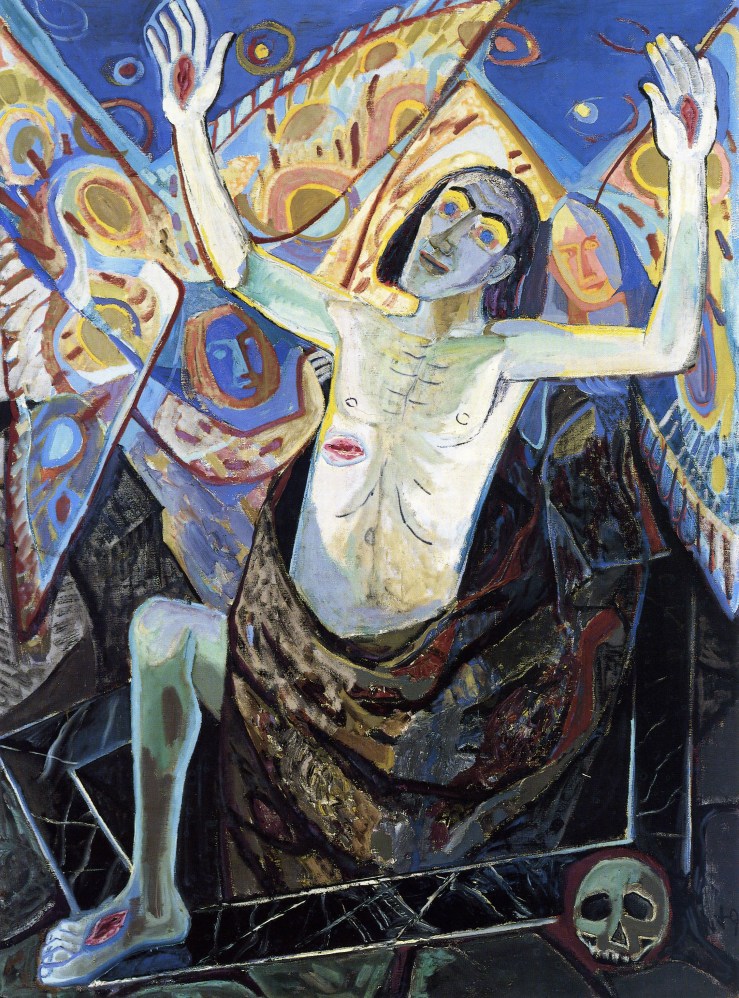
Otto Dix (German, 1891–1969), The Resurrection, 1949. Oil on canvas, 213 × 163.5 cm. Kunstmuseum Stuttgart, Germany.
He . . . has risen.
—Luke 24:6a
The Lord is my strength and my song;
he has become my salvation.
Glad songs of salvation
are in the tents of the righteous:
“The right hand of the Lord does valiantly,
the right hand of the Lord exalts,
the right hand of the Lord does valiantly!”
I shall not die, but I shall live,
and recount the deeds of the Lord.
—Psalm 118:14–17
+++
SONG: “The Strife Is O’er” | Words: Anonymous Latin poem (first compiled 1695), translated by Francis Pott, 1861 | Music: Rev. Vito Aiuto, on Precious Remedies Against Satan’s Devices by the Welcome Wagon (2012)
The strife is o’er, the battle done;
The victory of life is won;
The song of triumph has begun:
Alleluia! Alleluia!
The pow’rs of death have done their worst;
But Christ their legions hath dispersed;
Let shouts of holy joy outburst:
Alleluia! Alleluia!
The three sad days are quickly sped;
He rises glorious from the dead;
All glory to our risen Head:
Alleluia! Alleluia!
He closed the yawning gates of hell;
The bars from heav’n’s high portals fell;
Let songs of praise his triumph tell:
Alleluia! Alleluia!
Lord, by the stripes which wounded thee,
From death’s dread sting your servants free,
That we may live, and sing to thee:
Alleluia! Alleluia!
(I’ve noticed several slight variations in the English lyric translation attributed to Francis Pott. This is the version used by the Welcome Wagon.)
This post belongs to the weekly series Artful Devotion. If you can’t view the music player in your email or RSS reader, try opening the post in your browser.
To view all the Revised Common Lectionary scripture readings for Easter Sunday, cycle C, click here.





 Art & Theology