Bill Hemmerling (American, 1943–2009), Fishing for Souls. Oil on canvas, 60 × 10 in.
On one occasion, while the crowd was pressing in on him to hear the word of God, he was standing by the lake of Gennesaret, and he saw two boats by the lake, but the fishermen had gone out of them and were washing their nets.
Getting into one of the boats, which was Simon’s, he asked him to put out a little from the land. And he sat down and taught the people from the boat.
And when he had finished speaking, he said to Simon, “Put out into the deep and let down your nets for a catch.”
And Simon answered, “Master, we toiled all night and took nothing! But at your word I will let down the nets.” And when they had done this, they enclosed a large number of fish, and their nets were breaking. They signaled to their partners in the other boat to come and help them. And they came and filled both the boats, so that they began to sink.
But when Simon Peter saw it, he fell down at Jesus’ knees, saying, “Depart from me, for I am a sinful man, O Lord.” For he and all who were with him were astonished at the catch of fish that they had taken, and so also were James and John, sons of Zebedee, who were partners with Simon.
And Jesus said to Simon, “Do not be afraid; from now on you will be catching men.”
And when they had brought their boats to land, they left everything and followed him.
Rhonda Vincent and the Rage is the most awarded band in bluegrass history. This studio version of their “Fishers of Men” cover is great, but there is also a commercially available live recording on Vincent’s Sunday Mornin’ Singin’ (2012), plus several live-performance videos on YouTube. I like this one from a 2007 bluegrass festival in Miamisburg, Ohio:
The other singers are, from left to right, Mickey Harris, Kenny Ingram, and Darrell Webb.
This post belongs to the weekly series Artful Devotion. If you can’t view the music player in your email or RSS reader, try opening the post in your browser.
To view all the Revised Common Lectionary scripture readings for the Fifth Sunday after Epiphany, cycle C, click here.
Edvard Munch (Norwegian, 1863–1944), Girl with the Heart, 1899. Color woodcut, 40.4 × 33.9 cm (15 7/8 × 13 3/8 in.). National Gallery of Art, Washington, DC. Photo: Victoria Emily Jones.
If I speak in the tongues of men and of angels, but have not love, I am a noisy gong or a clanging cymbal. And if I have prophetic powers, and understand all mysteries and all knowledge, and if I have all faith, so as to remove mountains, but have not love, I am nothing. If I give away all I have, and if I deliver up my body to be burned, but have not love, I gain nothing.
—1 Corinthians 13:1–3
That’s the ESV. Here’s Eugene Peterson’s translation, from The Message:
If I speak with human eloquence and angelic ecstasy but don’t love, I’m nothing but the creaking of a rusty gate. If I speak God’s Word with power, revealing all his mysteries and making everything plain as day, and if I have faith that says to a mountain, “Jump,” and it jumps, but I don’t love, I’m nothing. If I give everything I own to the poor and even go to the stake to be burned as a martyr, but I don’t love, I’ve gotten nowhere. So, no matter what I say, what I believe, and what I do, I’m bankrupt without love.
+++
SONG: “The Gift of Love (Though I May Speak)” | Words: Hal H. Hopson, 1972 | Music: Traditional English folk melody (adapt.) | Performed by Becky Craig (vocals) and John Michniewicz (piano) | CCLI #67327
Though I may speak with bravest fire
And have the gift to all inspire
And have not love, my words are vain
As sounding brass and hopeless gain
Though I may give all I possess
And, striving so, my love profess
But not be giv’n by love within
The profit soon turns strangely thin
Come, Spirit, come, our hearts control
Our spirits long to be made whole
Let inward love guide every deed
By this we worship and are freed
This post belongs to the weekly series Artful Devotion. If you can’t view the music player in your email or RSS reader, try opening the post in your browser.
To view all the Revised Common Lectionary scripture readings for the Fourth Sunday after Epiphany, cycle C, click here.
The Presentation of Christ in the Temple, ca. 1650. Tempera on wood. Museum of Russian Icons, Clinton, Massachusetts.
Lord, now you are letting your servant depart in peace,
according to your word;
for my eyes have seen your salvation
that you have prepared in the presence of all peoples,
a light for revelation to the Gentiles,
and for glory to your people Israel.
—Luke 2:29–32
These words were sung two thousand-plus years ago by a Jewish man named Simeon upon seeing and holding the newborn Christ child at his presentation ceremony at the temple in Jerusalem. Known as the “Nunc dimittis” (from the Latin for “Now you dismiss”), the song has been used year-round in Compline, Vespers, and Evensong worship services since the fourth century. Since the seventh century, it has served as the centerpiece of the annual feast day known as Candlemas, celebrated February 2 in the West and February 15 in the East (the Western and Eastern churches count forward forty days from their celebration of Christmas Day, on December 25 and January 6, respectively).
+++
SONG: “Nunc dimittis” from All-Night Vigil, Op. 37, by Sergei Rachmaninoff (1915) | Arranged by Bob Chilcott (2016) | Performed by Katie Melua and the Gori Women’s Choir, on In Winter (2016)
Rachmaninoff’s “Nunc dimittis,” the fifth movement of his All-Night Vigil, was one of his favorite compositions of his career, and he requested that it be performed at his funeral. Its melody is based on a Kievan chant from the Russian Orthodox Vespers service but employs a few rhythmic adjustments and is carried forward by a soloist. As Vladimir Morosan notes in his essay “The Sacred Choral Works of Sergei Rachmaninoff,” “The slow rocking motion of the accompanying voices on two-note descending figures, akin to a lullaby, imparts to the piece a static and peaceful quality.”
The performance above is by Katie Melua, a Georgian singer-songwriter from the UK, who in 2016 returned to her native Georgia to record a winter-themed album with one of the country’s all-women singing troupes. The choral arrangements on In Winter, including “Nunc dimittis,” were specially commissioned from Bob Chilcott.
+++
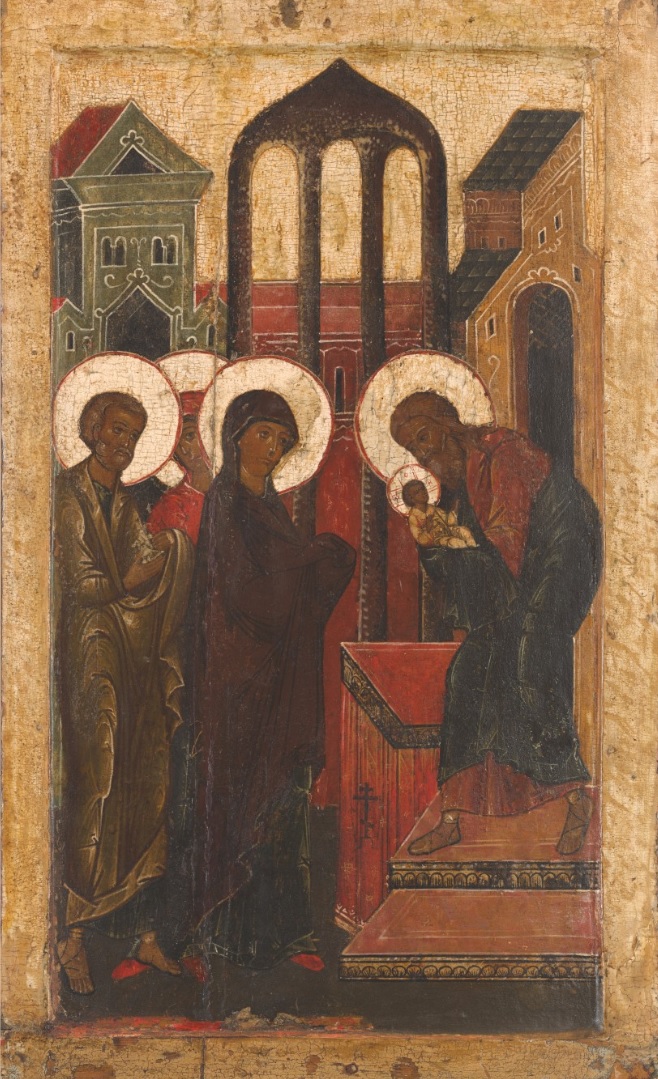
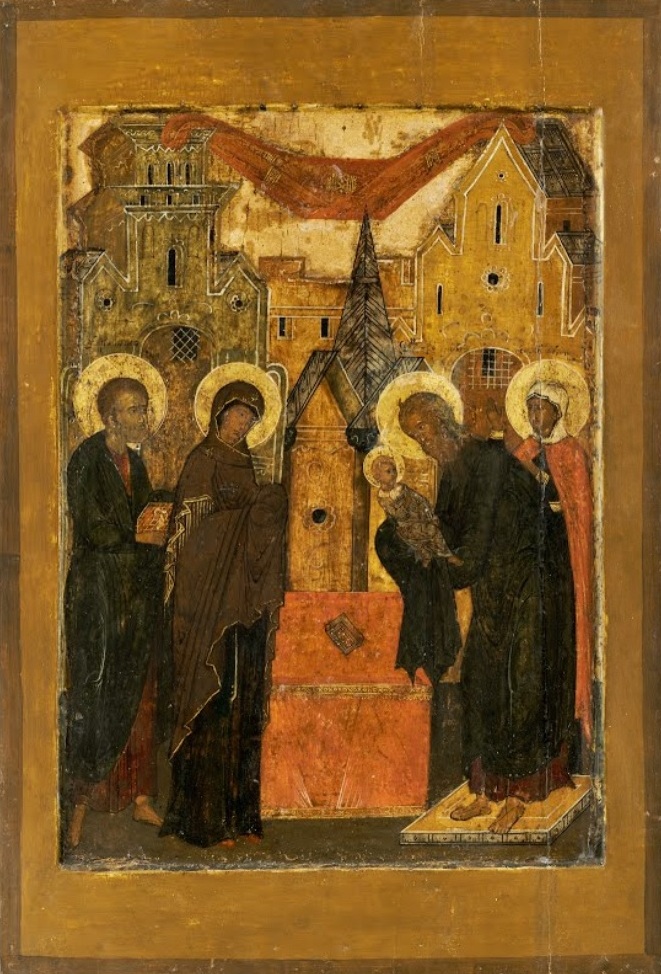
Icons are central to the devotional lives of Orthodox Christians. Here I’ve included three from the Museum of Russian Icons in Clinton, Massachusetts, which I had the pleasure of visiting about five years ago. Iconographers follow very specific guidelines in their writing of icons, which is why there has been little variation over the centuries. To learn how to read an icon of the Presentation of the Lord, see this “iconreader” blog post.
The Presentation of Christ in the Temple, 1600. Tempera on wood. Museum of Russian Icons, Clinton, Massachusetts.The Presentation of Christ in the Temple, 16th century. Tempera on wood, 24 × 16 in. Museum of Russian Icons, Clinton, Massachusetts.
This post belongs to the weekly series Artful Devotion. If you can’t view the music player in your email or RSS reader, try opening the post in your browser.
To view all the Revised Common Lectionary scripture readings for the feast of the Presentation of the Lord, cycle C, click here.
Steve A. Prince, Jubilee. Linocut, 36 × 24 in. Click on image to purchase.
And he [Jesus] came to Nazareth, where he had been brought up. And as was his custom, he went to the synagogue on the Sabbath day, and he stood up to read. And the scroll of the prophet Isaiah was given to him. He unrolled the scroll and found the place where it was written,
The Spirit of the Lord is upon me,
because he has anointed me
to proclaim good news to the poor.
He has sent me to proclaim liberty to the captives
and recovering of sight to the blind,
to set at liberty those who are oppressed,
to proclaim the year of the Lord’s favor.
And he rolled up the scroll and gave it back to the attendant and sat down. And the eyes of all in the synagogue were fixed on him. And he began to say to them, “Today this Scripture has been fulfilled in your hearing.”
—Luke 4:16–21
+++
In this passage from Sunday’s Gospel lectionary reading, Jesus enters his hometown synagogue in Nazareth and gives what is essentially his inaugural address, having recently been installed to public office by God (at his baptism) and now informing the people of his intentions as their new leader. His agenda is taken straight from Isaiah 61:1–2, and boils down to this: FREEDOM. That is his rallying cry.
“The year of the Lord’s favor,” or “the acceptable year of the Lord,” in Luke 4:19 refers to the Jubilee legislation God gave Israel, mandating that every fiftieth year, slaves were to be set free, debts canceled, and land wealth redistributed (see Leviticus 25). This ushering in of economic justice was most definitely “good news to the poor.” In his reading from the Isaiah scroll and his statement that “Today this Scripture has been fulfilled,” Jesus was calling for the celebration of the Year of Jubilee. And as we know from what follows in the Gospels, this Jubilee would be far more expansive than the one prescribed in Levitical law. Release from bondage, forgiveness of debts, restoration of what had been lost—there is, of course, still a material significance to these provisions, but there’s also a spiritual significance, in that through Christ, we are liberated from sin and ultimately brought back to the Garden in which we originally dwelt.
In ancient Israel, the semicentennial Jubilee Year was announced by the blowing of a shofar (ram’s horn) on the Day of Atonement. The Hebrew word for jubilee, yovel, actually means “ram’s horn”; in the Septuagint, yovel is translated multiple times as apheseos semasia (“trumpet blast of liberty”). The Latin form, jubilaeus, is influenced by the Latin jubilare, “to shout for joy.”
+++
Typically I make one music selection for the week’s Artful Devotion, but I couldn’t decide between these two—so you’re getting a twofer! I’d encourage you also to revisit “Jubilee” by the McIntosh County Shouters (which pairs splendidly with the Steve Prince linocut), featured in a previous roundup.
JAZZ INSTRUMENTAL: “Jubilee Stomp” by Duke Ellington, 1928
This track was recorded at Okeh studios in New York City on January 19, 1928. It features Duke Ellington on piano, Bubber Miley and Louis Metcalf on trumpet, Joe Nanton on trombone, Barney Bigard on clarinet and tenor sax, Harry Carney on alto sax and baritone sax, Fred Guy on banjo, Otto Hardwick on alto sax and bass sax, Wellman Braud on string bass, and Sonny Greer on drums.
GOSPEL-ROCK: “The Year of Jubilee” | Words by Charles Wesley, 1750 | Music by Kirk Ward, 2010
Blow ye the trumpet, blow! The gladly solemn sound
Let all the nations know, to earth’s remotest bound:
Jesus, our great high priest, has full atonement made;
You weary spirits, rest; you mournful souls, be glad.
Freedom! The year of jubilee is come; Freedom! The year of jubilee is come; Freedom! The year of jubilee is come; Freedom! The year of jubilee is come; You ransomed sinners, return, return home.
Extol the Lamb of God, the sacrificial Lamb;
Redemption through his blood throughout the world proclaim:
You slaves of sin and hell, your liberty receive;
And safe in Jesus dwell, and blessed in Jesus live.
You who have sold for naught your heritage above,
Receive it back unbought, the gift of Jesus’ love:
The gospel trumpet hear, the news of heavenly grace;
And, saved from earth, appear before your Savior’s face.
Hymnic poetry doesn’t get much better than that of Charles Wesley, and “Blow ye the trumpet, blow!” is no exception. I discovered this text through Kirk Ward, who wrote new music for it—a tune that is, in my opinion, far superior to the ca. 1782 tune by Lewis Edson that’s used in the hymnals of the United Methodist Church, the Orthodox Presbyterian Church, and others. Ward’s gospel-rock version of the hymn, which includes the addition of a chorus, is a congregational favorite at my little church in Maryland.
Describing his stylistic influences and aspirations, Ward writes:
I was thinking that the song would work well in a more 1960s style, civil rights era gospel-rock. I was thinking Sharon Jones and the Dap-Kings or Aloe Blacc, but the over-driven guitar sounds and my white boy vocals push it more toward something like Neil Young. Maybe one day, I’ll record it with horns and soul-power guitar riffs to get the sound I heard in my head. Regardless of the groove, my main goal was to get everyone shouting “FREEDOM!” at the top of their range.
As with all the songs posted on the New City Fellowship Music website, congregations are encouraged to freely use “The Year of Jubilee” in worship; an MP3 demo, lead sheet, and lyrics are provided for that purpose. I’d love to hear some full-band performances of this song online—if any exist, please post them in the comment field below. If you’re interested in making a commercial recording, contact Kirk Ward for permission.
This post belongs to the weekly series Artful Devotion. If you can’t view the music player in your email or RSS reader, try opening the post in your browser.
To view all the Revised Common Lectionary scripture readings for the Third Sunday after Epiphany, cycle C, click here.
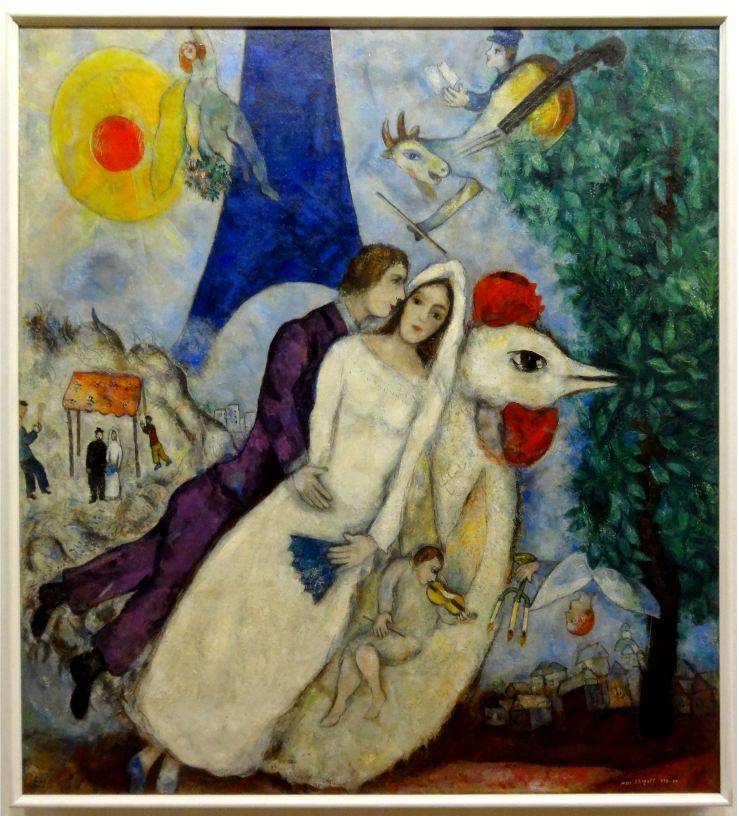
Marc Chagall (Russian French, 1887–1985), Les mariés de la tour Eiffel (The Bride and Groom of the Eiffel Tower), 1938–39. Oil on canvas, 150 × 136.5 cm. Centre Pompidou, Paris. Photo: Jim Forest.
Regarding Zion, I can’t keep my mouth shut,
regarding Jerusalem, I can’t hold my tongue,
Until her righteousness blazes down like the sun
and her salvation flames up like a torch.
Foreign countries will see your righteousness,
and world leaders your glory.
You’ll get a brand-new name
straight from the mouth of GOD.
You’ll be a stunning crown in the palm of GOD’s hand,
a jeweled gold cup held high in the hand of your GOD.
No more will anyone call you Rejected,
and your country will no more be called Ruined.
You’ll be called Hephzibah (My Delight),
and your land Beulah (Married),
Because GOD delights in you
and your land will be like a wedding celebration.
For as a young man marries his virgin bride,
so your builder marries you,
And as a bridegroom is happy in his bride,
so your GOD is happy with you.
The lyrics of “Fairland” are adapted from the poem “The Little Beach-Bird” by Richard Henry Dana (1787–1879), with the bridge referencing Jesus’s words to his disciples in John 14:1–3: “Let not your hearts be troubled. Believe in God; believe also in me. In my Father’s house are many rooms. If it were not so, would I have told you that I go to prepare a place for you? And if I go and prepare a place for you, I will come again and will take you to myself, that where I am you may be also.” These are the words of a bridegroom to his bride.
Thou little bird, thou dweller by the sea,
Why takest thou so melancholy,
And with that boding cry
Along the breaker fly?
O rather, bird, with me
Through the fair land rejoice!
Come and go with me
Back to my Father’s house
To my Father’s house
Come and go with me
+++
It is not difficult to see, . . . in his dreamlike images of adorned and beautiful Jewish brides, Chagall’s aspiration for the redeemed daughter of Zion.
This post belongs to the weekly series Artful Devotion. If you can’t view the music player in your email or RSS reader, try opening the post in your browser.
To view all the Revised Common Lectionary scripture readings for the Second Sunday after Epiphany, cycle C, click here.
Baptism of Christ, from the evangeliary of the abbess Hitda von Meschede, first half of eleventh century. Hessische Landesbibliothek, Darmstadt, Germany.
As the people were in expectation, and all were questioning in their hearts concerning John, whether he might be the Christ, John answered them all, saying, “I baptize you with water, but he who is mightier than I is coming, the strap of whose sandals I am not worthy to untie. He will baptize you with the Holy Spirit and fire. His winnowing fork is in his hand, to clear his threshing floor and to gather the wheat into his barn, but the chaff he will burn with unquenchable fire.” . . .
Now when all the people were baptized, and when Jesus also had been baptized and was praying, the heavens were opened, and the Holy Spirit descended on him in bodily form, like a dove; and a voice came from heaven, “You are my beloved Son; with you I am well pleased.”
—Luke 3:15–17, 21–22
+++
MUSIC: “Jeux d’eau” (“Play of Water” or “Fountains”) by Maurice Ravel, 1901 | Performed by Martha Argerich, 1977
+++
The Hitda Codex is an eleventh-century manuscript containing an evangeliary, a selection of passages from the Gospels, commissioned by Hitda, abbess of Meschede, in about 1020. Its illuminations are highlights of the Cologne school in the later phases of the Ottonian Renaissance. View more at https://commons.wikimedia.org/wiki/Category:Hitda-Codex.
In the Baptism of Christ painting, Jesus stands waist-deep in Jordan’s rushing waters, which spill forth from an overturned jar in the bottom right held by a personification of the Jordan River. Jesus’s hands are open to receive the Holy Spirit (Spiritus Sanctus), who jets forth from the starry heavens in the form of a dove. God the Father is, by intention, not visualized, but his presence is suggested by the half-circle at the top, which represents the divine realm where he resides.
This post belongs to the weekly series Artful Devotion. If you can’t view the music player in your email or RSS reader, try opening the post in your browser.
To view all the Revised Common Lectionary scripture readings for the feast of the Baptism of the Lord, cycle C, click here.
Christmas isn’t over yet, so I hope you’re still celebrating! As has been the case for centuries, many Christians spread their holiday festivities over twelve days, from December 25 to January 5, followed by the culminating feast of the Epiphany on January 6. Epiphany commemorates the visit of the magi to the Christ child and thus God’s physical manifestation to the Gentiles. In Spanish-speaking countries and communities, it’s commonly known as Three Kings Day. This year it just so happens to fall on a Sunday.
+++
Juan Cartagena, Los Tres Reyes Magos (The Three Kings), Puerto Rico, 19th century. Painted wooden bulto. Vidal Collection, National Museum of American History, Smithsonian Institution, Washington, DC.
Now after Jesus was born in Bethlehem of Judea in the days of Herod the king, behold, wise men from the east came to Jerusalem, saying, “Where is he who has been born king of the Jews? For we saw his star when it rose and have come to worship him.” . . .
After listening to the king, they went on their way. And behold, the star that they had seen when it rose went before them until it came to rest over the place where the child was. When they saw the star, they rejoiced exceedingly with great joy. And going into the house, they saw the child with Mary his mother, and they fell down and worshiped him. Then, opening their treasures, they offered him gifts, gold and frankincense and myrrh.
Los Jíbaros, also known as the Cuarteto Flores, were a popular and influential Puerto Rican group founded in New York in 1930 by Pedro Flores. Their name refers to the peasant farmers of Puerto Rico, who developed a style of mountain music, jibaro music, that’s rooted in music brought to the island by early settlers from Andalusia and Extremadura in southern and western Spain during the seventeenth century.
The jibaro song “Décimas de Nacimiento” is an aguinaldo (Christmas carol; literally “gift”) that comprises four décimas (ten-line stanzas) performed in dialogue. In this traditional poetic form, each line contains eight syllables and follows a rhyme scheme of ABBAABBAAB—but here the poet has adapted the scheme to ABBAACCDDC. The two singers perform to an accompaniment of three guitars and a guiro (scratch gourd).
En un pesebre nacio
A eso de la medianoche
Un niño que sin reproche
Clamaron hijo de Dios
Una estrella iluminó
El sitio donde María
Tenía en brazos al Mesías
Que acaba de nacer
Al que empezaban a ver
Al amanecer del día
Los tres magos soberanos De los reinos del Oriente Vinieron muy diligentes A ofrendar su Dios cristiano Y todo el mundo pagano Recuerda las profecías Pues sabian que nacería Pronto el hijo de Israel Y que lo iban a ver Al amanecer del día
Todas las aves cantaban Olian todas las flores Bonita luz y colores Las astros del cielo daban Los buenos sabios oraban Los réprobos se escondian En las pajas ya había Nacido el niño sonriente Se postró un mundo creyente Al amanecer del día
Y a través de las edades Recordando al soberano El universo cristiano Celebra las navidades Dice así, felicidades El humano se extasía Y aún pedimos al Mesías Hijo de María y José Que algo de su gracia nos dé Al amenecer del día
He was born in a manger
About midnight
An innocent child
Proclaimed the Son of God
A star shone upon
The place where Mary
Held our Savior in her arms
Who had just been born
They beheld him
At daybreak
The three wise men
From the Orient
Promptly came
To offer gifts to the Son of God
And all the pagan world
Remembered the prophecies
That foretold the birth
Of the Son of Israel
And they came to see him
At daybreak
All the birds were singing
All the flowers were perfumed
Stars in the sky were shedding
Beautiful light and colors
The wise men were praying
The scoundrels were hiding
Already, in the straw
The smiling child had been born
Everyone fell to their knees
At daybreak
Throughout the ages
In memory of our Sovereign
The Christian universe
Celebrates his birth
With good wishes
Humanity is ecstatic
And we still pray for the Messiah
Son of Mary and Joseph
To shed his grace upon us
At daybreak
This is one of many songs that might be heard at a parranda, a Puerto Rican caroling party that moves from house to house, lasting from around 10 p.m. to dawn on any given night of Christmas. The repertoire is a mix of sacred and secular songs, but unlike in the continental US, they are all festive and upbeat. As the carolers progress to each new stop, the head of that house invites them in for food and beverages. Parrandas are one of the leading social activities of the Christmas season on the island.
“Décimas de Nacimiento” was originally released by Columbia Records on vinyl in the 1930s. In 2004 it was reissued by Dust-to-Digital on a compilation Christmas album produced by folk music preservationist Lance Ledbetter and musicologist Dick Spottswood; there it appears alongside other rare recordings of American gospel, blues, and hillbilly music from the twenties and thirties.
Celebrated annually on January 6, El Día de los Tres Reyes Magos, or simply Three Kings Day, is one of the most important holidays on the Puerto Rican calendar—so much so that Puerto Ricans invented a verb, reyar, that means “to celebrate Three Kings Day.” On the eve of the holiday, children put a shoebox filled with straw under their beds for the animal transports, be they camels or horses, of the Three Kings, who visit their homes with presents between midnight and dawn. Children awake not only to gifts but also to a day of parades and feasting with family and friends. Old San Juan throws an annual festival at the Luis Muñoz Marín Park with live music, food and drink, and free gifts, but the highlight of the day occurs when the Three Kings come walking into town. They start from their unofficial hometown of Juana Díaz in the south and travel around the island, stopping to celebrate in various localities—but no celebration is larger than that in Old San Juan.
Los Tres Reyes Magos (The Three Kings), Puerto Rico, late 19th century. Painted wooden bulto by a member of the Rivera family. Vidal Collection, National Museum of American History, Smithsonian Institution, Washington, DC.
Not surprisingly, the Three Kings are among the most popular santos (handmade images of saints and other religious figures) in Puerto Rico. Since camels were unknown to earlier local santeros (makers of religious images), the Three Kings are typically shown riding Paso Fino horses. The gifts they bear may be the three traditional ones—gold, frankincense, and myrrh—or typical Puerto Rican gifts, such as musical instruments. In Puerto Rico, Melchior is shown with dark skin, and he is often given special prominence, especially by santeros of African descent.
The two bultos (small religious carvings) pictured above were gifted to the Smithsonian, along with 3,200-plus other objects, by Puerto Rican folk art collector Teodoro Vidal. Learn more about the Vidal Collection at https://amhistory.si.edu/vidal/. (You may remember me speaking about another bulto donated by Vidal, Señor de la Humildad y la Paciencia, in my Stations of the Cross audio guide.)
This post belongs to the weekly series Artful Devotion. If you can’t view the music player in your email or RSS reader, try opening the post in your browser.
To view all the Revised Common Lectionary scripture readings for Epiphany, cycle C, click here.
Andrey Yanev (Bulgarian, 1965–), Fraternal Forgiveness, n.d. Oil on canvas, 130 × 100 cm.
Put on then, as God’s chosen ones, holy and beloved, compassionate hearts, kindness, humility, meekness, and patience, bearing with one another and, if one has a complaint against another, forgiving each other; as the Lord has forgiven you, so you also must forgive. And above all these put on love, which binds everything together in perfect harmony.
—Colossians 3:12–14
+++
MUSIC: “The Way of Love” by Béla Fleck | Performed by Béla Fleck, V. M. Bhatt, and Jie-Bing Chen, on Tabula Rasā (2011)
Tabula Rasā is a Grammy-nominated collaborative album by three virtuoso instrumentalists: American banjoist Béla Fleck, mohan veena (Indian slide guitar) player Vishwa Mohan Bhatt, and erhu (two-string Chinese fiddle) player Jie-Bing Chen.
This post belongs to the weekly series Artful Devotion. If you can’t view the music player in your email or RSS reader, try opening the post in your browser.
To view all the Revised Common Lectionary scripture readings for the First Sunday after Christmas Day, cycle C, click here.
Salvation is created in the midst of the earth, O God, O our God. Alleluia!
A Russian composer, choral conductor, and teacher, Pavel Tchesnokov (1877–1944) wrote over four hundred sacred choral works up until 1912, when he was forced by the Soviets to focus exclusively on secular compositions; “Salvation Is Created” was his last one. It’s a communion hymn based on a synodal Kievan chant melody and Psalm 74:12: “For God is my King of old, working salvation in the midst of the earth.”
This post belongs to the weekly series Artful Devotion. If you can’t view the music player in your email or RSS reader, try opening the post in your browser.
To view all the Revised Common Lectionary scripture readings for Christmas Day, cycle C, click here.
Andrea Mantegna (Italian, ca. 1431–1506), The Infant Savior, ca. 1460. Tempera on canvas, 70.2 × 34.3 cm (27 5/8 × 13 1/2 in.). National Gallery of Art, Washington, DC.
But you, O Bethlehem Ephrathah,
who are too little to be among the clans of Judah,
from you shall come forth for me
one who is to be ruler in Israel,
whose coming forth is from of old,
from ancient days.
Therefore he shall give them up until the time
when she who is in labor has given birth;
then the rest of his brothers shall return
to the people of Israel.
And he shall stand and shepherd his flock in the strength of the LORD,
in the majesty of the name of the LORD his God.
And they shall dwell secure, for now he shall be great
to the ends of the earth.
And he shall be their peace.
—Micah 5:2–5
+++
SONG: “Come, Thou Long-Expected Jesus / Joy to the World,” adapted and arranged by Folk Angel, on Live at Green Lux: Christmas Songs, vol. 6, 2014 | Words by Charles Wesley, 1744, with refrain and bridge by Isaac Watts, 1719 | Music by Rowland Hugh Prichard, 1830, and Folk Angel
The backbone of this Folk Angel song is the Advent classic “Come, Thou Long-Expected Jesus,” but into this the band has integrated lines from “Joy to the World,” traditionally sung at Christmastime. While the verses plead, “Come!,” the chorus declares, “He has come,” holding together the cries of both seasons. He whom the nations desire is here, “born to reign in us forever.” May earth receive him.
Come, thou long-expected Jesus,
Born to set thy people free;
From our fears and sins release us,
Let us find our rest in thee.
Israel’s strength and consolation,
Hope of all the earth thou art;
Dear desire of every nation,
Joy of every longing heart.
Joy to the world! The Lord has come; Let earth receive her king. Let earth receive her king.
Born thy people to deliver,
Born a child and yet a king,
Born to reign in us forever,
Now thy gracious kingdom bring.
By thine own eternal spirit
Rule in all our hearts alone;
By thine all-sufficient merit,
Raise us to thy glorious throne.
Joy to the world!
The Lord has come;
Let earth receive her king.
Let earth receive her king.
Let every heart prepare him room,
And heaven and nature sing!
Come, thou long-expected Jesus,
Born to set thy people free.
We are free.
We are free.
We are free.
We are free.
The verse melody is, of course, that well-loved Welsh tune HYFRYDOL, composed by Rowland Hugh Prichard. The chorus and bridge, however, employ an original tune by Folk Angel, resetting key excerpts from Isaac Watts’s carol that emphasize the kingly nature of the infant Christ. This crescendos into a triumphant repeat of the song’s first two lines, and a grateful acknowledgment of God’s fulfilled purposes: a people set free from their fears and sins, granted eternal rest under the loving rule of Christ. Even so, Lord, thy kingdom come.
+++
The Infant Savior by the great Renaissance painter Andrea Mantegna brings me such delight—that little rosy, chubby-cheeked baby blessing me, blessing the world, this Christmas. You might call the painting a Christ Pantocrator, but it doesn’t fit the standard iconography, because instead of a half-length adult it shows a full-length child of about one year. Still, this is Jesus, “born a child and yet a king”: he wears a velvet robe with a golden clasp and lining, but underneath, his humble swaddling cloths are revealed, and he’s barefoot. His right hand is raised in a gesture of blessing, and in his left hand he holds, instead of a book (as is traditional in Pantocrator images), a cross-shaped scepter. A cross shape also comprises his “crown”—the three streams of light emitted from his bald little head.
Mantegna’s painting suggests that Christ’s kingship was established at his birth, and that it would be furthered by way of the cross.
This post belongs to the weekly series Artful Devotion. If you can’t view the music player in your email or RSS reader, try opening the post in your browser.
To view all the Revised Common Lectionary scripture readings for the Fourth Sunday of Advent, cycle C, click here.







 Art & Theology