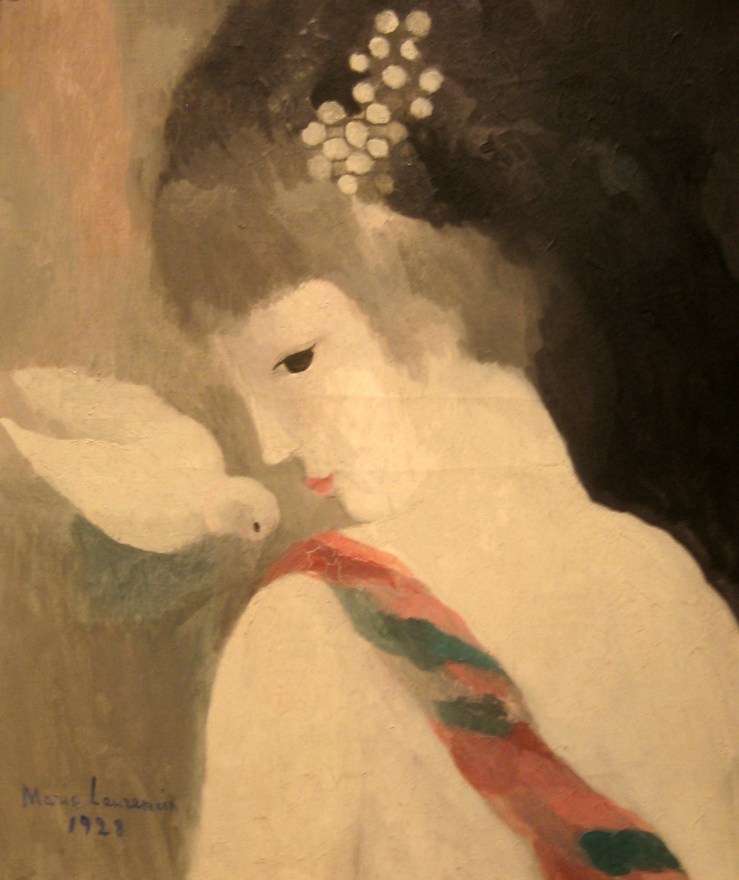
Marie Laurencin (French, 1885–1956), Girl with a Dove, 1928. Oil on linen, 46.3 × 38.4 cm (18 1/4 × 15 1/8 in.). National Gallery of Art, Washington, DC. Photo: Victoria Emily Jones.
“If you love me, you will keep my commandments. And I will ask the Father, and he will give you another Helper, to be with you forever, even the Spirit of truth, whom the world cannot receive, because it neither sees him nor knows him. You know him, for he dwells with you and will be in you.
“I will not leave you as orphans; I will come to you. Yet a little while and the world will see me no more, but you will see me. Because I live, you also will live. In that day you will know that I am in my Father, and you in me, and I in you. Whoever has my commandments and keeps them, he it is who loves me. And he who loves me will be loved by my Father, and I will love him and manifest myself to him.”
This post belongs to the weekly series Artful Devotion. If you can’t view the music player in your email or RSS reader, try opening the post in your browser.
To view all the Revised Common Lectionary scripture readings for the Sixth Sunday of Easter, cycle A, click here.
Helen Siegl (Austrian, 1924–2009), Rejoice & Be Glad, 1974. Color woodcut, 30 × 30 cm. Edition of 50. Sacred Art Pilgrim Collection.
“Let not your hearts be troubled. Believe in God; believe also in me. In my Father’s house are many rooms. If it were not so, would I have told you that I go to prepare a place for you? And if I go and prepare a place for you, I will come again and will take you to myself, that where I am you may be also.”
—John 14:1–3
+++
SONG: “Come and Go with Me to My Father’s House” | Traditional African American | Performed under the musical direction of Dr. Markanthony Henry (on piano), with soloist Caterina Finocchi, at Iglesia Presbiteriana San Andrés (Saint Andrew’s Presbyterian Church) in Buenos Aires, Argentina, October 28, 2012
Art collector John A. Kohan has a wonderful biographical write-up about Helen Siegl on his website, Sacred Art Pilgrim—not to mention a select compilation of her art.
A devout Catholic all her life, Siegl was born in Vienna and was a teenager at the time of the Anschluss (the annexation of Austria to Nazi Germany). After the traumatic years of World War II and during the Soviet occupation of her home country, she emigrated to Canada in 1952. She got married and settled in Philadelphia, where her husband served as conservator of paintings at the Philadelphia Museum of Art. She raised eight children with him while also working as a printmaker—mostly woodcuts and linocuts. Her style blends elements of folk art and German expressionism, and her themes were often biblical.
This post belongs to the weekly series Artful Devotion. If you can’t view the music player in your email or RSS reader, try opening the post in your browser.
To view all the Revised Common Lectionary scripture readings for the Fifth Sunday of Easter, cycle A, click here.
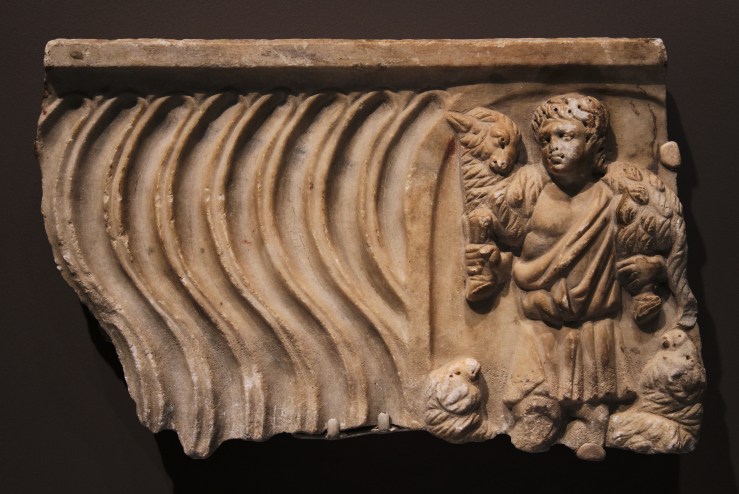
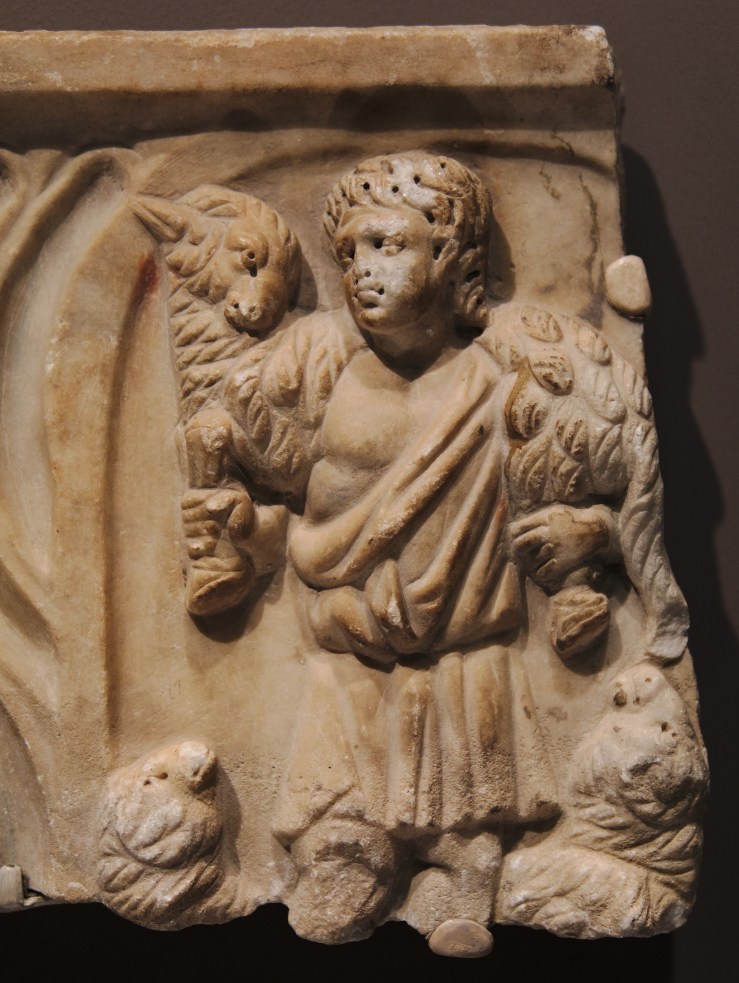
Sarcophagus Fragment with the Good Shepherd, Rome, early 4th century. Marble, 13 9/16 × 21 5/8 in. (34.5 × 55 cm). Walters Art Museum, Baltimore. Photo: Victoria Emily Jones.
God, my shepherd!
I don’t need a thing.
You have bedded me down in lush meadows,
you find me quiet pools to drink from.
True to your word,
you let me catch my breath
and send me in the right direction.
Even when the way goes through
Death Valley,
I’m not afraid
when you walk at my side.
Your trusty shepherd’s crook
makes me feel secure.
You serve me a six-course dinner
right in front of my enemies.
You revive my drooping head;
my cup brims with blessing.
Your beauty and love chase after me
every day of my life.
I’m back home in the house of God
for the rest of my life.
—Psalm 23 (MSG)
The King James Version’s translation of Psalm 23 from Hebrew into English is unsurpassable in terms of sheer poetic beauty, but since I’ve featured it here before and the words are so very familiar, I thought I’d shake things up a bit by giving Eugene Peterson’s contemporary translation.
The relief carving in this post is from a gallery of early Christian art at the Walters Art Museum in Baltimore, one of my favorite local hangouts. The museum label reads,
This fragment comes from a small Early Christian sarcophagus that was probably made for a child. At the right is a young shepherd, who carries a lamb over his shoulders as two sheep gaze up at him from below. The image of the Good Shepherd originated with the pagan Greek figure of Hermes (the gods’ messenger and ram-bearer) and was later transformed into Jesus as the Good Shepherd who watches over his flock.
SONG: “The King of Love My Shepherd Is” | Words by Sir Henry Williams Baker, 1868 | Music: Traditional Irish tune (ST. COLUMBA) | Arranged by Paul Terracini and performed by the Ars Nova Vocal Group, on Hymns of Our Forefathers, 2000
The King of love my shepherd is,
whose goodness faileth never.
I nothing lack if I am his,
and he is mine forever.
Where streams of living water flow,
my ransomed soul he leadeth;
and where the verdant pastures grow,
with food celestial feedeth.
Perverse and foolish, oft I strayed,
but yet in love he sought me;
and on his shoulder gently laid,
and home, rejoicing, brought me.
In death’s dark vale I fear no ill,
with thee, dear Lord, beside me;
thy rod and staff my comfort still,
thy cross before to guide me.
Thou spreadst a table in my sight;
thy unction grace bestoweth;
and oh, what transport of delight
from thy pure chalice floweth!
And so through all the length of days,
thy goodness faileth never;
Good Shepherd, may I sing thy praise
within thy house forever.
I chose this intricate a cappella SATB arrangement as the feature track for today, but for a solo female vocalist on acoustic guitar, see Taylor Tripodi:
Though “The King of Love” is most associated with the traditional Irish tune ST. COLUMBA, it is sometimes sung to a handful of others. Below you can hear it with a different traditional Irish tune (MCKEE), arranged by Harry T. Burleigh in 1939. Performed by Tyler Anthony (of Cereus Bright) and the musicians of Redeemer Knoxville, this peppier version appears on the 2011 Cardiphonia album Songs for the Supper:
This post belongs to the weekly series Artful Devotion. If you can’t view the music player in your email or RSS reader, try opening the post in your browser.
To view all the Revised Common Lectionary scripture readings for the Fourth Sunday of Easter, cycle A, click here.
Hubert and Jan van Eyck, Adoration of the Mystic Lamb, 1426–32. Oil on panel, 54 1/5 × 95 3/10 in. (137.7 × 242.3 cm). Lower central interior panel of the Ghent Altarpiece, St. Bavo Cathedral, Ghent, Belgium.
. . . you were ransomed . . . not with perishable things such as silver or gold, but with the precious blood of Christ, like that of a lamb without blemish or spot. He was foreknown before the foundation of the world but was made manifest in the last times for the sake of you who through him are believers in God, who raised him from the dead and gave him glory, so that your faith and hope are in God.
When I saw the cleansing fountain
Open wide for all my sin,
I obeyed the Spirit’s wooing,
When He said, “Wilt thou be clean?”
I will praise Him! I will praise Him!
Praise the Lamb for sinners slain;
Give Him glory, all ye people,
For His blood can wash away each stain.
Then God’s fire upon the altar
Of my heart was set aflame;
I shall never cease to praise Him:
Glory, glory to His Name!
I will praise Him! I will praise Him!
Praise the Lamb for sinners slain;
Give Him glory, all ye people,
For His blood can wash away each stain.
Glory, glory to His Name!
Ghent Altarpiece (open view) by Hubert and Jan van Eyck, 1432. Oil on twelve panels, 11 × 15 ft. (3.4 × 4.6 m). St. Bavo Cathedral, Ghent, Belgium.
The monumental Ghent Altarpiece by Northern Renaissance painters Hubert and Jan van Eyck [previously] is one of the world’s finest art treasures—every student who’s taken Art History 101 knows this piece, and it has been the subject of much scholarship.
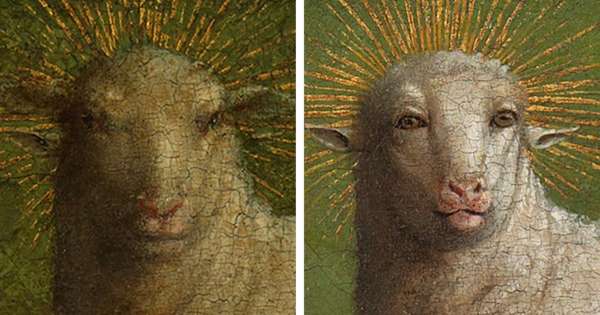
Perhaps you know it from the detail photos of the recently restored Adoration of the Mystic Lamb panel that went viral in January.
Before restoration (left) vs. after restoration (right)
Over the past three years, conservators under the leadership of Belgium’s Royal Institute for Cultural Heritage removed the overpaint that was added to the van Eyck brothers’ original in the mid-sixteenth century, revealing a strikingly humanoid face on the Agnus Dei that surprised everyone. (The rest of the painting is much more naturalistic.) Social media users made fun of the cartoonish appearance of the lamb, but Hélène Dubois, head of restoration, says this lamb has a more “intense interaction with the onlookers.”
The haloed lamb who stands on an altar and bleeds into a chalice is the focal point of the entire fifteen-foot polyptych. He is, of course, a symbol of the self-sacrificial Christ. Angels surround him holding instruments of the passion, and the Latin inscription on the antependium (altar hanging) translates to “Behold the Lamb of God, who takes away the sins of the world” (John 1:29).
You can zoom in on all the altarpiece panels and take a look at the restoration process (ongoing since 2010, with the upper interior panels to be tackled in 2021) at the Closer to Van Eyck website, which I’ve mentioned before—though the site appears not to have been updated in a while.
If you’d like to learn more, the Google Arts & Culture online exhibition Inside the Ghent Altarpiece is a great place to start, as is the altarpiece’s Wikipedia page. If you prefer to learn audiovisually, you might enjoy these two Smarthistory videos:
This post belongs to the weekly series Artful Devotion. If you can’t view the music player in your email or RSS reader, try opening the post in your browser.
To view all the Revised Common Lectionary scripture readings for the Third Sunday of Easter, cycle A, click here.
Resurrection by Arne Haugen Sørensen (Danish, 1932–)
Peter, standing with the eleven, lifted up his voice and addressed them:
“. . . Men of Israel, hear these words: Jesus of Nazareth, a man attested to you by God with mighty works and wonders and signs that God did through him in your midst, as you yourselves know—this Jesus, delivered up according to the definite plan and foreknowledge of God, you crucified and killed by the hands of lawless men. God raised him up, loosing the pangs of death, because it was not possible for him to be held by it. For David says concerning him,
“‘I saw the LORD always before me,
for he is at my right hand that I may not be shaken;
therefore my heart was glad, and my tongue rejoiced;
my flesh also will dwell in hope.
For you will not abandon my soul to Hades,
or let your Holy One see corruption.
You have made known to me the paths of life;
you will make me full of gladness with your presence.’
“Brothers, I may say to you with confidence about the patriarch David that he both died and was buried, and his tomb is with us to this day. Being therefore a prophet, and knowing that God had sworn with an oath to him that he would set one of his descendants on his throne, he foresaw and spoke about the resurrection of the Christ, that he was not abandoned to Hades, nor did his flesh see corruption. This Jesus God raised up, and of that we all are witnesses . . .”
The tender hands of God lifting Christ out of the grave is one of Arne Haugen Sørensen’s favorite motifs—he’s painted it dozens of times, often as altarpieces for Danish churches.
Arne Haugen Sørensen (Danish, 1932–), Resurrection, 1996. Acrylic on canvas, 268 × 190 cm. Ringkøbing Church, Ringkøbing, Denmark.Arne Haugen Sørensen (Danish, 1932–), Resurrection, 1997. Acrylic on canvas, 195 × 130 cm. Skelager Church, Aarhus, Denmark.Arne Haugen Sørensen (Danish, 1932–), Resurrection (triptych), 2003. Acrylic on canvas. Sankt Ansgar Kirke, Bramming, Denmark.Arne Haugen Sørensen (Danish, 1932–), Resurrection, 2011, installed 2015. Acrylic on canvas, 162 × 130 cm. Lillerød Kirke, Lillerød, Denmark. Photo: Benny Grey Schuster.Arne Haugen Sørensen (Danish, 1932–), Crucifixion and Resurrection, 1996, installed 2002, Fonnesbæk Kirke, Ikast, Denmark. Photo: Benny Grey Schuster.
This post belongs to the weekly series Artful Devotion. If you can’t view the music player in your email or RSS reader, try opening the post in your browser.
To view all the Revised Common Lectionary scripture readings for the Second Sunday of Easter, cycle A, click here.
Nikola Sarić (Serbian, 1985–), The Resurrection of Jesus, 2017. Acrylic on canvas, 90 × 90 cm.
Now after the Sabbath, toward the dawn of the first day of the week, Mary Magdalene and the other Mary went to see the tomb. And behold, there was a great earthquake, for an angel of the Lord descended from heaven and came and rolled back the stone and sat on it. His appearance was like lightning, and his clothing white as snow. And for fear of him the guards trembled and became like dead men. But the angel said to the women, “Do not be afraid, for I know that you seek Jesus who was crucified. He is not here, for he has risen, as he said. Come, see the place where he lay.”
—Matthew 28:1–6
Now on the first day of the week Mary Magdalene came to the tomb early, while it was still dark, and saw that the stone had been taken away from the tomb. So she ran and went to Simon Peter and the other disciple, the one whom Jesus loved, and said to them, “They have taken the Lord out of the tomb, and we do not know where they have laid him.” So Peter went out with the other disciple, and they were going toward the tomb. Both of them were running together, but the other disciple outran Peter and reached the tomb first. And stooping to look in, he saw the linen cloths lying there, but he did not go in. Then Simon Peter came, following him, and went into the tomb. He saw the linen cloths lying there, and the face cloth, which had been on Jesus’ head, not lying with the linen cloths but folded up in a place by itself. Then the other disciple, who had reached the tomb first, also went in, and he saw and believed . . .
—John 20:1–8
And we are witnesses of all that he did both in the country of the Jews and in Jerusalem. They put him to death by hanging him on a tree, but God raised him on the third day and made him to appear, not to all the people but to us who had been chosen by God as witnesses, who ate and drank with him after he rose from the dead.
—Acts 10:39–41
+++
SONG: “Hallelujah, Our Lord Is Risen” by the Easter Brothers | Performed by Jeff and Sheri Easter, 1992
+++
To view more paintings by Nikola Sarić, including ones from his “Cycle of Life” series, visit www.nikolasaric.de.
Music and art from previous Easter Sundays at Art & Theology include
This post belongs to the weekly series Artful Devotion. If you can’t view the music player in your email or RSS reader, try opening the post in your browser.
To view all the Revised Common Lectionary scripture readings for Easter Sunday, cycle A, click here.
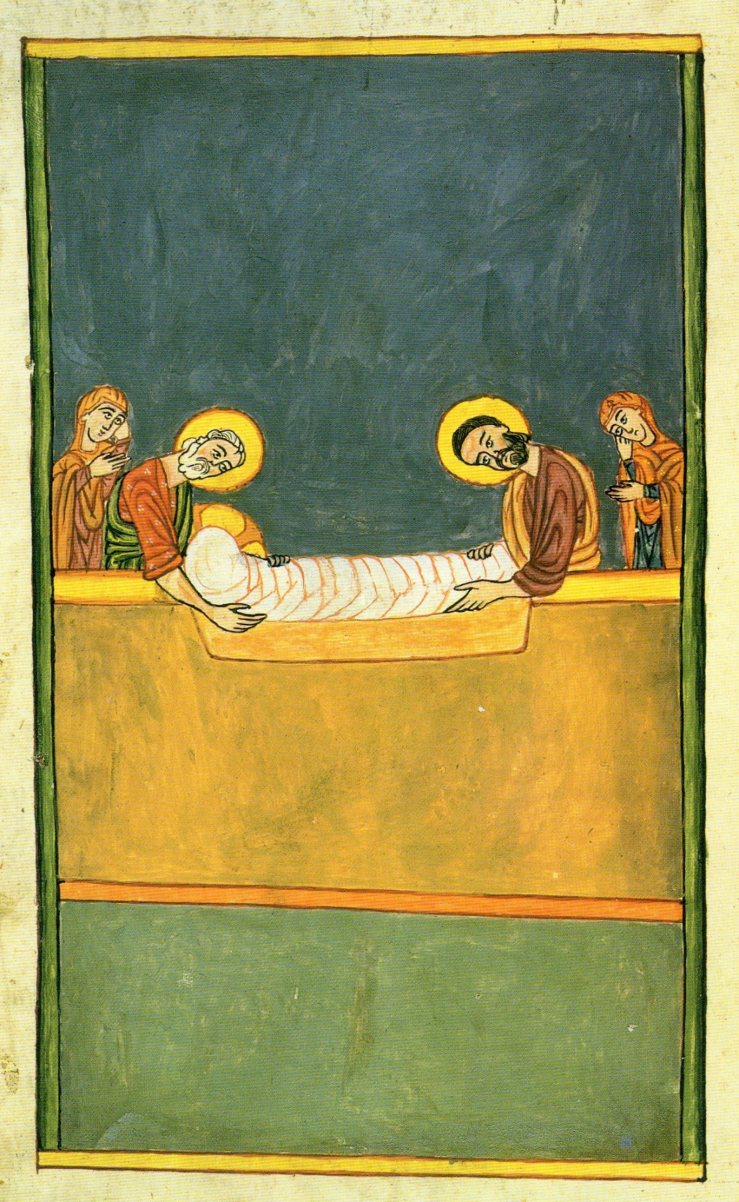
“The Entombment of Christ,” from an Armenian Gospel-book, 1437. MS Or. 2668, fol. 5v, British Library, London.
When it was evening, there came a rich man from Arimathea, named Joseph, who also was a disciple of Jesus. He went to Pilate and asked for the body of Jesus. Then Pilate ordered it to be given to him. And Joseph took the body and wrapped it in a clean linen shroud and laid it in his own new tomb, which he had cut in the rock. And he rolled a great stone to the entrance of the tomb and went away. Mary Magdalene and the other Mary were there, sitting opposite the tomb.
—Matthew 27:57–61
After these things Joseph of Arimathea, who was a disciple of Jesus, but secretly for fear of the Jews, asked Pilate that he might take away the body of Jesus, and Pilate gave him permission. So he came and took away his body. Nicodemus also, who earlier had come to Jesus by night, came bringing a mixture of myrrh and aloes, about seventy-five pounds in weight. So they took the body of Jesus and bound it in linen cloths with the spices, as is the burial custom of the Jews. Now in the place where he was crucified there was a garden, and in the garden a new tomb in which no one had yet been laid. So because of the Jewish day of Preparation, since the tomb was close at hand, they laid Jesus there.
—John 19:38–42
+++
MUSIC: “Tagh for the Funeral of the Lord” by Tigran Mansurian, 1998–2004 | Performed by Kim Kashkashian (viola) and Robyn Schulkowsky (percussion), on Neharo’t, 2009
The tagh is an ancient genre of Armenian monodic music—that is, lamentation over another’s death. “The characteristics of the tagh are its expansiveness of form and volume, its free melodic style, the existence of instrumental passages and richness of rhythm” [source].
“Tagh for the Funeral of the Lord” is the second piece in contemporary Armenian composer Tigran Mansurian’s suite “Three Medieval Taghs for Viola and Percussion” (the other two are for the Crucifixion and for the Resurrection). On YouTube you can find a January 27, 2019, performance by violist Kim Kashkashian and (different from the earlier album recording) percussionist Jonathan Hepfer as part of the Lark Musical Society’s Dilijan Chamber Music Series is Los Angeles. The funeral tagh starts at 4:23:
Note: Sometimes this piece is called Tagh “to” or “of” the Funeral of the Lord.
+++
The Entombment painting above is from a fifteenth-century Gospel-book copied and illuminated at the Monastery of St. George in Armenia by the priest Awetik. At the center, Christ’s body lies with his head tilted toward the viewer but wrapped, like the rest of him, in a white shroud. Joseph of Arimathea cradles Christ’s head and Nicodemus straightens his legs as the two situate his body in the grave. Two of the Marys stand by, grieving.
The vast swatch of dark blue across the top half of the painting indicates the deep darkness of the cave and accentuates the feeling of emptiness and loss. The figures form a middle band, below which are two more large color fields: brown and green, the colors of the earth.
The inertness is striking, as is the complete hiddenness of God the Son under his burial clothes.
This post belongs to the weekly series Artful Devotion. If you can’t view the music player in your email or RSS reader, try opening the post in your browser.
To view all the Revised Common Lectionary scripture readings for Holy Saturday, cycle A, click here.
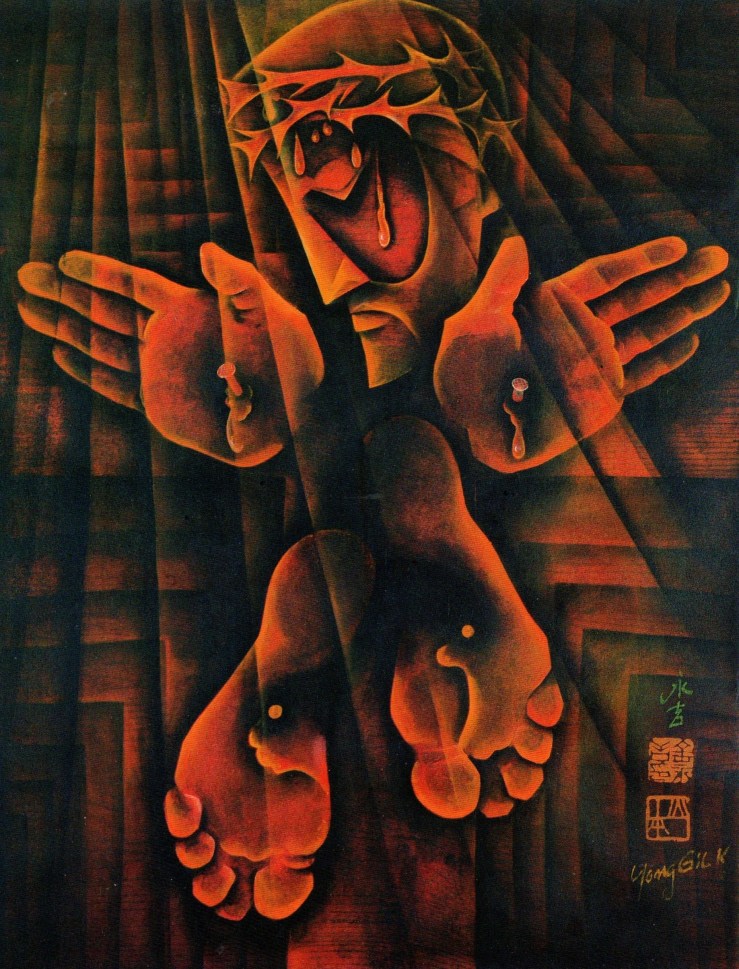
Kim Young Gil (Korean, 1940–2008), Crucifixion, before 1991. India ink and coloring on rice paper. Sourced from “The Bible Through Asian Eyes” (p. 175) and posted with permission of the artist’s estate.
Who has believed what he has heard from us?
And to whom has the arm of the LORD been revealed?
For he grew up before him like a young plant,
and like a root out of dry ground;
he had no form or majesty that we should look at him,
and no beauty that we should desire him.
He was despised and rejected by men,
a man of sorrows and acquainted with grief;
and as one from whom men hide their faces
he was despised, and we esteemed him not.
Surely he has borne our griefs
and carried our sorrows;
yet we esteemed him stricken,
smitten by God, and afflicted.
But he was pierced for our transgressions;
he was crushed for our iniquities;
upon him was the chastisement that brought us peace,
and with his wounds we are healed.
All we like sheep have gone astray;
we have turned—every one—to his own way;
and the LORD has laid on him
the iniquity of us all.
He was oppressed, and he was afflicted,
yet he opened not his mouth;
like a lamb that is led to the slaughter,
and like a sheep that before its shearers is silent,
so he opened not his mouth.
By oppression and judgment he was taken away;
and as for his generation, who considered
that he was cut off out of the land of the living,
stricken for the transgression of my people?
And they made his grave with the wicked
and with a rich man in his death,
although he had done no violence,
and there was no deceit in his mouth.
Yet it was the will of the LORD to crush him;
he has put him to grief;
when his soul makes an offering for guilt,
he shall see his offspring; he shall prolong his days;
the will of the LORD shall prosper in his hand.
Out of the anguish of his soul he shall see and be satisfied;
by his knowledge shall the righteous one, my servant,
make many to be accounted righteous,
and he shall bear their iniquities.
Therefore I will divide him a portion with the many,
and he shall divide the spoil with the strong,
because he poured out his soul to death
and was numbered with the transgressors;
yet he bore the sin of many,
and makes intercession for the transgressors.
—Isaiah 53:1–12
+++
SONG: “He Was Wounded for Our Transgressions” | Words by Thomas O. Chisholm, 1941 | Music by Merrill Dunlop, 1941 | Performed by Shane Clark, on Deep Blue Hymns, 2017 | CCLI #7068347
+++
In Kim Young Gil’s Crucifixion, the torso, arms, and legs are eliminated, focusing attention on Christ’s face and his four nailed extremities. Kim’s use of light and shade creates a compelling contrast: Christ is both illuminated, as if by a divine spotlight, and in darkness, such that even those light rays from above bear tinges of black. The bright-red color of the Passion, of blood, dominates the image.
I scanned this image from the wonderful book The Bible Through Asian Eyes, edited by Masao Takenaka and Ron O’Grady of the Asian Christian Art Association (AACA) and published by Pace in Auckland in 1991. A short write-up on the facing page describes how the painted print, made in the seventies or eighties, came to be: One day Kim, who was working as a schoolteacher in Korea, invited a self-isolating, troublemaking student to his studio. He asked him to remove his shoes and then proceeded to cover them with black ink, and had him step onto a clean sheet of paper. He did the same with the boy’s hands. Those foot- and handprints form the basis of this Crucifixion image, which, when Kim showed it to the class, led the other students to see this former bully of theirs in a new light and start warming to him, and vice versa. The student later spoke of that surprising art collaboration as a turning point in his life and the beginning of his Christian experience.
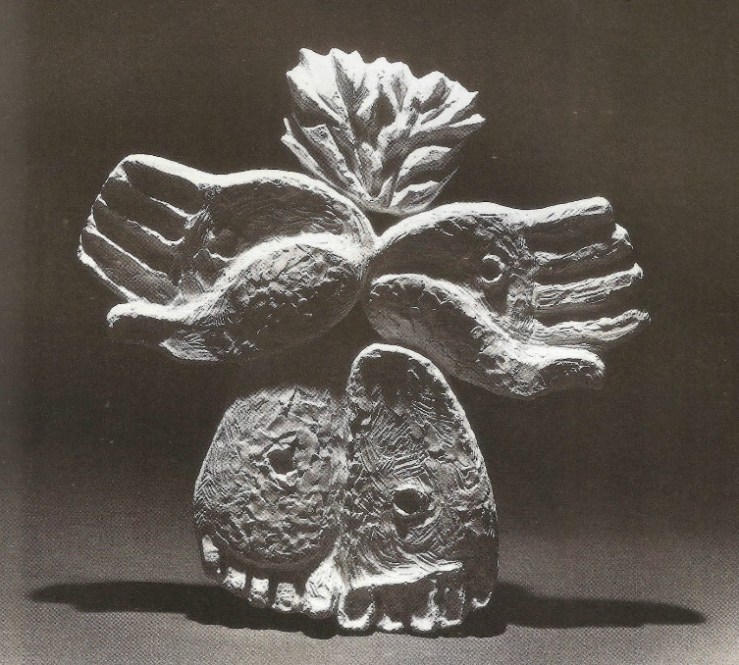
I noticed a strong similarity between this and the terracotta cross sculpture of Hyo-sook Kim that appeared on the cover of the June 1988 issue of the AACA’s Image journal. The man who manages Kim Young Gil’s website, James Yun, told me, after asking Kim’s widow, that Kim did not know this other artist, so the two either arrived at this concept independently or one was inspired by having seen an image by the other.
Hyo-sook Kim, Cross, ca. 1988. Terracotta, 50 × 45 cm.
Hyo-sook Kim wrote that she intended for the hands to look like wings, alluding to the resurrection. The lotus, which bursts upward from the wrists, can also be read as a resurrection symbol, as the plant takes root in the mud, but its stem grows up through murky waters and its flower blooms on the surface, having risen above the mire. In Buddhist iconography the lotus symbolizes purity or spiritual perfection.
This post belongs to the weekly series Artful Devotion. If you can’t view the music player in your email or RSS reader, try opening the post in your browser.
To view all the Revised Common Lectionary scripture readings for Good Friday, cycle A, click here.
Now before the Feast of the Passover, when Jesus knew that his hour had come to depart out of this world to the Father, having loved his own who were in the world, he loved them to the end. During supper, when the devil had already put it into the heart of Judas Iscariot, Simon’s son, to betray him, Jesus, knowing that the Father had given all things into his hands, and that he had come from God and was going back to God, rose from supper. He laid aside his outer garments, and taking a towel, tied it around his waist. Then he poured water into a basin and began to wash the disciples’ feet and to wipe them with the towel that was wrapped around him. He came to Simon Peter, who said to him, “Lord, do you wash my feet?” Jesus answered him, “What I am doing you do not understand now, but afterward you will understand.” Peter said to him, “You shall never wash my feet.” Jesus answered him, “If I do not wash you, you have no share with me.” Simon Peter said to him, “Lord, not my feet only but also my hands and my head!” Jesus said to him, “The one who has bathed does not need to wash, except for his feet, but is completely clean. And you are clean, but not every one of you.” For he knew who was to betray him; that was why he said, “Not all of you are clean.”
When he had washed their feet and put on his outer garments and resumed his place, he said to them, “Do you understand what I have done to you? You call me Teacher and Lord, and you are right, for so I am. If I then, your Lord and Teacher, have washed your feet, you also ought to wash one another’s feet. For I have given you an example, that you also should do just as I have done to you. Truly, truly, I say to you, a servant is not greater than his master, nor is a messenger greater than the one who sent him. If you know these things, blessed are you if you do them.”
. . .
When [Judas] had gone out, Jesus said, “Now is the Son of Man glorified, and God is glorified in him. If God is glorified in him, God will also glorify him in himself, and glorify him at once. Little children, yet a little while I am with you. You will seek me, and just as I said to the Jews, so now I also say to you, ‘Where I am going you cannot come.’ A new commandment I give to you, that you love one another: just as I have loved you, you also are to love one another. By this all people will know that you are my disciples, if you have love for one another.”
—John 13:1–17, 31b–35
The Thursday before Easter is referred to as Maundy Thursday—the Middle English word maundy being a derivation of the Old French mandé, from the Latin mandatum, “commandment.” The name refers to John 13:34, where, after the Last Supper, Jesus commands his disciples to love one another.
+++
SONG: “Ubi caritas” | Words: Traditional | Music by Ola Gjeilo, 1999 | Performed by Voces8, on Lux, 2015
“Ubi caritas” is an ancient (or early medieval—it’s disputed) Latin text that is traditionally used as an antiphon, or sung refrain, for the foot-washing ceremony on Maundy Thursday. The current Roman Catholic Missal reassigns it to the offertory procession of the Maundy Thursday Mass.
Originally the text was set to a Gregorian chant melody, but it has since been set and/or arranged by Maurice Duruflé, Ola Gjeilo, Paul Mealor, Ivo Antognini, Audrey Assad, and many others. I’ve chosen the setting by Ola Gjeilo, a Norwegian composer and pianist born in 1978 and now living in the United States.
Ubi caritas et amor, Deus ibi est. Congregavit nos in unum Christi amor. Exsultemus, et in ipso jucundemur. Timeamus, et amemus Deum vivum. Et ex corde diligamus nos sincero.
Ubi caritas et amor, Deus ibi est. Simul ergo cum in unum congregamur: Ne nos mente dividamur, caveamus. Cessent iurgia maligna, cessent lites. Et in medio nostri sit Christus Deus.
Ubi caritas et amor, Deus ibi est. Simul quoque cum beatis videamus, Glorianter vultum tuum, Christe Deus: Gaudium quod est immensum, atque probum, Saecula per infinita saeculorum. Amen.
English Translation:
Where charity and love are, there God is.
The love of Christ has gathered us into one.
Let us exult, and in Him be joyful.
Let us fear and let us love the living God.
And from a sincere heart let us love each other.
Where charity and love are, there God is.
Therefore, whensoever we are gathered as one:
Lest we in mind be divided, let us beware.
Let cease malicious quarrels, let strife give way.
And in the midst of us be Christ our God.
Where charity and love are, there God is.
Together also with the blessed may we see,
Gloriously, Thy countenance, O Christ our God:
A joy which is immense, and also approved:
Through infinite ages of ages. Amen.
+++
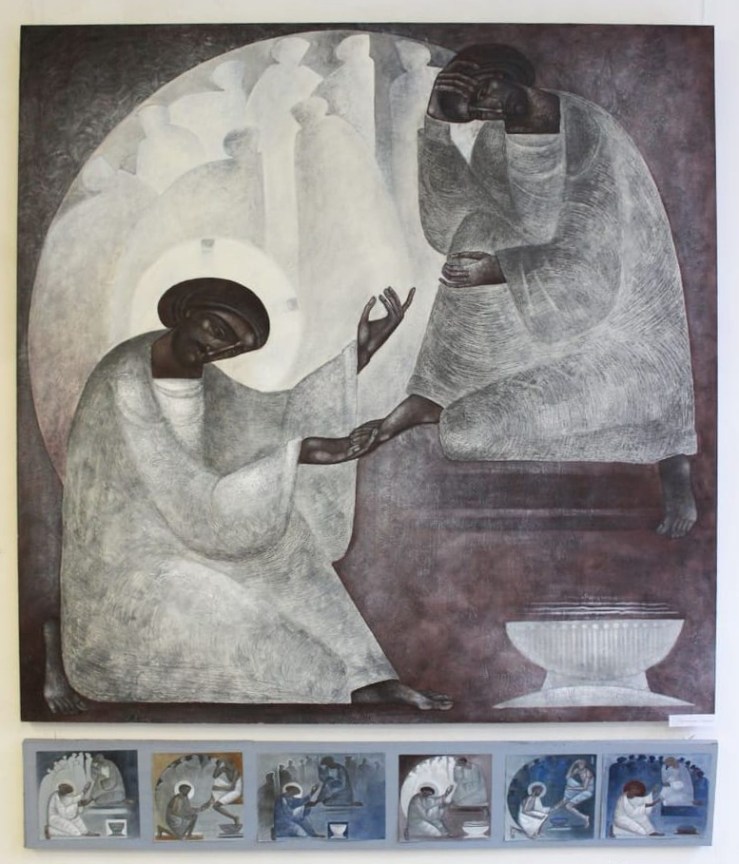
The main panel of contemporary iconographer Solomia Kazanivska’s Washing of the Feet shows Christ, whose halo bears a faint cross-shape, washing the dirt off Peter’s feet, as the other disciples, silhouetted in white, look on. At first Peter was much distraught by the notion of his superior stooping to such a menial act of servitude, and he objected. But when Jesus told Peter that Peter would have no part with him unless Peter received the foot-washing, Peter changed his tune completely: he figured that if this were true, then a full body wash would give him an even bigger part with Jesus, so he exclaimed, “Wash my hands and my head too!” That’s why icons show Peter pointing to his head (not, as might be assumed, to signal his initial discomfort, as in “Oh dear . . .”).
What strikes me most about Kazanivska’s icon is the bottom panel, which seems to show the disciples washing one another’s feet, following their teacher’s example. (It’s possible that this band is meant to show Christ washing different disciples’ feet, as the biblical text says he did, but the different clothing of the kneeling figure in each of the six tableaux inclines me toward the other interpretation.) Kazanivska is not suggesting that that’s how it literally went down that evening—the disciples immediately understanding Christ’s meaning and faithfully imitating him. Rather, I read this an aspirational and metaphoric image, of how Christians are to interact with one another: in love and humility, time after time (hence the repetition). And that’s why I chose it to complement the “Ubi caritas” hymn.
This post belongs to the weekly series Artful Devotion. If you can’t view the music player in your email or RSS reader, try opening the post in your browser.
To view all the Revised Common Lectionary scripture readings for Maundy Thursday, cycle A, click here.
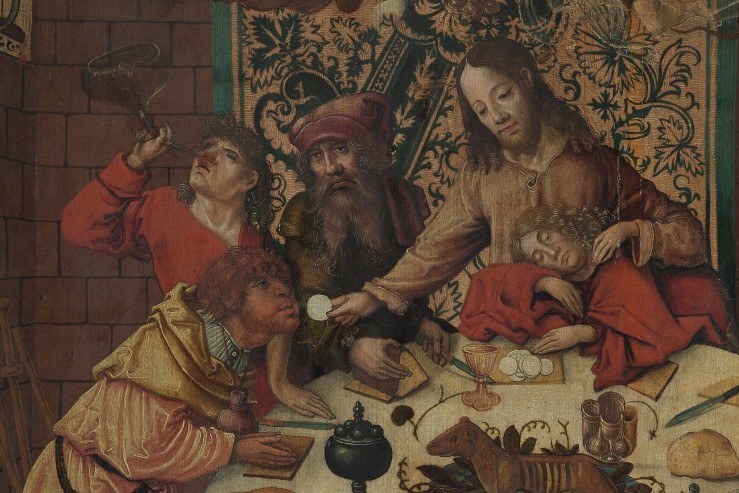
Attributed to Jörg Ratgeb (German, ca. 1480–1526), The Last Supper (detail), 1505–10. Oil on panel, 38 7/10 × 36 in. (98.5 × 91.5 cm). Boijmans van Beuningen Museum, Rotterdam, Netherlands.
Even my close friend in whom I trusted,
who ate my bread, has lifted his heel against me.
But you, O LORD, be gracious to me,
and raise me up . . .
—Psalm 41:9–10
“. . . the Scripture will be fulfilled, ‘He who ate my bread has lifted his heel against me.’ I am telling you this now, before it takes place, that when it does take place you may believe that I am he. . . .”
After saying these things, Jesus was troubled in his spirit, and testified, “Truly, truly, I say to you, one of you will betray me.” The disciples looked at one another, uncertain of whom he spoke.
One of his disciples, whom Jesus loved, was reclining at table at Jesus’ side, so Simon Peter motioned to him to ask Jesus of whom he was speaking. So that disciple, leaning back against Jesus, said to him, “Lord, who is it?”
Jesus answered, “It is he to whom I will give this morsel of bread when I have dipped it.” So when he had dipped the morsel, he gave it to Judas, the son of Simon Iscariot.
Then after he had taken the morsel, Satan entered into him. Jesus said to him, “What you are going to do, do quickly.” Now no one at the table knew why he said this to him. Some thought that, because Judas had the moneybag, Jesus was telling him, “Buy what we need for the feast,” or that he should give something to the poor.
So, after receiving the morsel of bread, he immediately went out. And it was night.
—John 13:18b–19, 21–30
+++
SONG: “Judas Song (Psalm 41:9–10)” by Matt Grimsley (words adapted from the Trinity Psalter) | Performed by the Green Carpet Players, on Morning to Evening(2014)
ORCHESTRAL REPRISE: “Judas Song, Pt. 2: The Betrayer” by Amy Porter, based on a melody by Matt Grimsley | Performed by the Green Carpet Players, on Morning to Evening(2014)
The Green Carpet Players is the recording alias of the musicians of Redeemer Church of Knoxville. Since they released this second album in 2014, chief musician Matt Grimsley, who wrote “Judas Song,” has become the founding pastor of Resurrection Presbyterian Church in Madison, Wisconsin, and Amy Porter is now worship director at Church of the Redeemer in Maryville, Tennessee.
+++
Attributed to Jörg Ratgeb (German, ca. 1480–1526), The Last Supper, 1505–10. Oil on panel, 38 7/10 × 36 in. (98.5 × 91.5 cm). Boijmans van Beuningen Museum, Rotterdam, Netherlands.
In Jörg Ratgeb’s Last Supper, the disciples have laid aside their pilgrim’s staffs and have sat down to a Passover meal of roast lamb, bread, and wine. Jesus, having just announced that one of them would betray him, looks across the table at Judas, the group’s treasurer—who wears not one but two purses! Jesus tenderly and regretfully feeds Judas an unleavened wafer, indicating that he’s the one. The others seem not to notice—groups of two discuss among themselves who the traitor might be; one disciple guzzles down more wine from a tubed bottle, while another pours more from a jug; John’s asleep to Christ’s left, and to his right Peter stares blankly into space, knife in hand (foreshadowing his cutting off the ear of one of Jesus’s arresters later that night); and one crass disciple turns his head to shoot snot out his nose.
Jesus has just washed all their feet, as indicated by the water basin and towel in the foreground—a stunning act of humility. (We will visit that episode in tomorrow’s Gospel reading.) His supremest act of humility is but a day away. It’s alluded to by the poster at the left of a snake lifted up on a staff (see John 3:14–15), as well as by the monstrance (a receptacle for the consecrated Eucharistic host) that two angels raise above Jesus’s head, proclaiming his impending sacrifice.
The sweet, generative nature of this sacrifice is underscored by the lily-of-the-valley that’s strewn all over the floor and table, as the flower is connected with the advent of spring and the promise of new life.
This post belongs to the weekly series Artful Devotion. If you can’t view the music player in your email or RSS reader, try opening the post in your browser.
To view all the Revised Common Lectionary scripture readings for Wednesday of Holy Week, cycle A, click here.








 Art & Theology