
Sheep May Safely Graze (Artful Devotion)

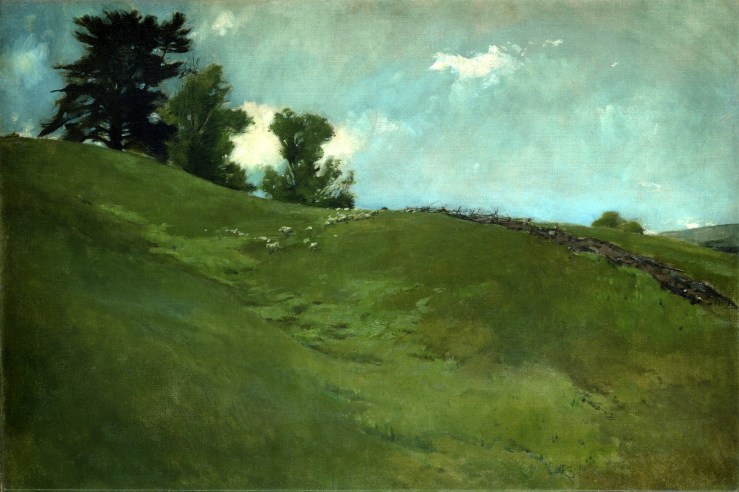
Landscape, Cornish, N.H. by John White Alexander
John White Alexander (American, 1856–1915), Landscape, Cornish, N.H., ca. 1890. Oil on canvas, 30 3/8 × 45 in. (77.2 × 114.2 cm). Smithsonian American Art Museum, Washington, DC.

The LORD is my shepherd; I shall not want.
He maketh me to lie down in green pastures:
he leadeth me beside the still waters.
He restoreth my soul . . .

Yea, though I walk through the valley of the shadow of death,
I will fear no evil:
for thou art with me;
thy rod and thy staff,
they comfort me.

—Psalm 23:1–3a, 4

+++

MUSIC: “Sheep May Safely Graze,” from BWV 208 | Composed by Johann Sebastian Bach (1713) | Performed by London Symphony Orchestra, on Night in Berlin (2001)

The aria “Schafe können sicher weiden” (Sheep May Safely Graze) comprises the ninth movement of Bach’s Was mir behagt, ist nur die muntre Jagd (The Lively Hunt Is All My Heart’s Desire)—known informally as the Hunting Cantata. Written for the thirty-first birthday of Duke Christian of Saxe-Weissenfels, the cantata was performed as a surprise at a banquet at the ducal hunting lodge, and it’s full of flattery. The text of “Sheep May Safely Graze,” written by Solomon Franck, praises Christian for his wise, protective leadership (in actuality, he was a lousy ruler):

Sheep may safely graze and pasture
In a watchful shepherd’s sight.

Those who rule, with wisdom guiding,
Bring to hearts a peace abiding,
Bless a land with joy made bright.

At 1:31 in the above recording, you can hear potential danger lurking nearby, but the attentive shepherd neutralizes the threat, keeping safe his flock.

Bach originally scored this piece for soprano with two recorders and continuo, but it has since been transcribed for orchestra and countless other combinations of instruments and is most popular without words. I enjoy playing Egon Petri’s transcription for solo piano, performed here by Alessio Bax:

Its pastoral mood, befitting Psalm 23, and its celebration of a good shepherd’s care have led it to be applied to the Good Shepherd and performed in church services. I’ve even come across some piano arrangements that interfuse it with “Savior, Like a Shepherd Lead Us” (for an intermediate arrangement of such by Cindy Berry, see Classical Hymns).

(Related post: “The evolution of ‘Jesu, Joy of Man’s Desiring'”)


This post belongs to the weekly series Artful Devotion. If you can’t view the music player in your email or RSS reader, try opening the post in your browser.

To view all the Revised Common Lectionary scripture readings for Proper 11, cycle B, click here.

The evolution of “Jesu, Joy of Man’s Desiring”

You’ve probably heard this lovely lilting Baroque piece performed as an instrumental at weddings. But the composer who popularized the tune—the inimitable J. S. Bach—originally used it for the two chorale movements, one of them the finale, of a ten-movement liturgical work celebrating the miraculous pregnancies of Mary and Elizabeth from the Gospel of Luke, and God’s subversion of the world order through the birth of Christ. “The wondrous hand of the exalted Almighty / is active in the mysteries of the earth!” the work proclaims.

Under Bach’s design, those iconic triplets (DUM-da-da DA-da-da DA-da-da . . .) gird up a choir-song of praise to Jesus Christ, Emmanuel, our joy and our strength. Even when the light, bright major chords give way to the minor in line 5, signifying the turning of life’s circumstances, the Christian’s confession remains the same: Jesus is mine; what shall I fear?

Though Bach is often cited as the melody’s originator, that credit in fact goes to Johann Schop; it was first published in 1642 with Johann Rist’s hymn text “Wach auf, mein Geist, erhebe dich” (“Wake, My Spirit, Rise”). In 1661 Martin Janus wrote a new text for the tune—of no less than nineteen stanzas!—titled “Jesu, meiner Seelen Wonne” (“Jesus, My Soul’s Bliss”). Bach took stanzas 6 and 17 of this hymn, harmonized and orchestrated them, and placed them as the closings to part 1 and part 2, respectively, of his cantata Herz und Mund und Tat und Leben (Heart and Mouth and Deed and Life) (BWV 147).

These two chorale movements, titled “Wohl mir, daß ich Jesum habe” (Blest am I, that I have Jesus) and “Jesus bleibet meine Freude” (Jesus shall remain my joy), have identical musical settings, and their English translation is as follows:

Blest am I, that I have Jesus!
O how tightly I cling to him,
so that he delights my heart
when I am sick and sad.
I have Jesus, who loves me
and gives himself to me as my own;
ah, therefore I will not let go of Jesus,
even if my heart is breaking.

Jesus shall remain my joy,
my heart’s comfort and sap;
Jesus shall fend off all sorrow.
He is the strength of my life,
the delight and sun of my eyes,
the treasure and wonder of my soul;
therefore I will not let Jesus go
out of my heart and sight. [source]

Bach wrote Herz und Mund in 1723 during his first year as the director of church music in Leipzig, basing it on an earlier cantata he had written in Weimar in 1716 for the fourth Sunday of Advent. Because Leipzig observed tempus clausum (a “closed time” of penitence) during Advent, allowing cantata music only on the first Sunday of the season, Bach could not perform the cantata for the same occasion in Leipzig, so he adapted it for the Feast of the Visitation on July 2.

Scored by Bach for four solo vocalists, a four-part choir, and an instrumental ensemble of trumpet, two oboes, violin, viola, and continuo, the chorale music was first given the title “Jesu, Joy of Man’s Desiring” in 1926 when Dame Myra Hess published a transcription for solo piano—which you can hear Benjamin Moser play in the video below.

(“Jesu” is a poetic derivation of the Latin form of the name Jesus. I most commonly hear it pronounced YAY-su, but see here.)   Continue reading “The evolution of “Jesu, Joy of Man’s Desiring”” →