Open-Access Image Archive of Middle Eastern Art, Architecture, and Archaeology

Based at the Faculty of Classics at the University of Oxford, the Manar al-Athar (“Guide to Archaeology”) digital archive provides high-resolution photographs of archaeological sites, buildings, and art from the Levant, North Africa, the Caucasus, and the Balkans, covering the time of Alexander the Great (ca. 300 BCE) through the Byzantine and early Islamic periods, with special emphasis on late antiquity. All the images are freely downloadable, made available for teaching, research, and academic publication under a Creative Commons Attribution-NonCommercial-ShareAlike 2.0 UK (CC BY-NC-SA 2.0) license.

Manar al-Athar was established in 2012 by Dr. Judith McKenzie (1957–2019) and since 2020 has been directed by Dr. Ine Jacobs. It is in continuous development. The photos are cataloged by geographical region and are labeled in both English and Arabic. They picture a range of historical structures—some intact, others in ruins; both interiors and exteriors, where applicable—including mausoleums, churches, mosques, khanqahs (Sufi lodges), hammams (public bathhouses), palace complexes, madrasas (colleges for Islamic instruction), forums, fountains, cisterns, aqueducts, civic buildings, theaters, markets, fortifications, and hostels.

Of primary interest to me is the Christian art from churches and tombs, from countries such as Egypt, Syria, Turkey, Armenia, Georgia, and Serbia, and Jewish art that pictures stories from the Hebrew Bible.

Unfortunately, the subjects of the artworks aren’t labeled and there’s no commentary or transcription/translation of inscriptions, nor are the buildings or artworks dated. Inevitably, many of the frescoes and mosaics have degraded with age, sometimes making the iconography difficult to read. There’s also no way to filter by religion; Christianity accounts for only a portion of the images, with others coming from Jewish, Islamic, or pagan traditions, and a number are from nonreligious contexts. I’d love to see a more robust tagging system and advanced searchability functions as the archive continues to evolve.

The archive is by no means comprehensive, but I hope it will encourage further scholarship and attract more digital image donations.

Below is a sampling of the hundreds of images you can find on the Manar al-Athar website.


One of the earliest surviving and best-preserved Christian cemeteries in the world, used by Christians from the third to eighth centuries, is Bagawat Necropolis in the Kharga Oasis in Egypt’s Western Desert. The Chapel of Peace is one of 263 mud-brick funerary chapels in the cemetery, celebrated for the painting of biblical, early Christian, and allegorical figures inside its dome.
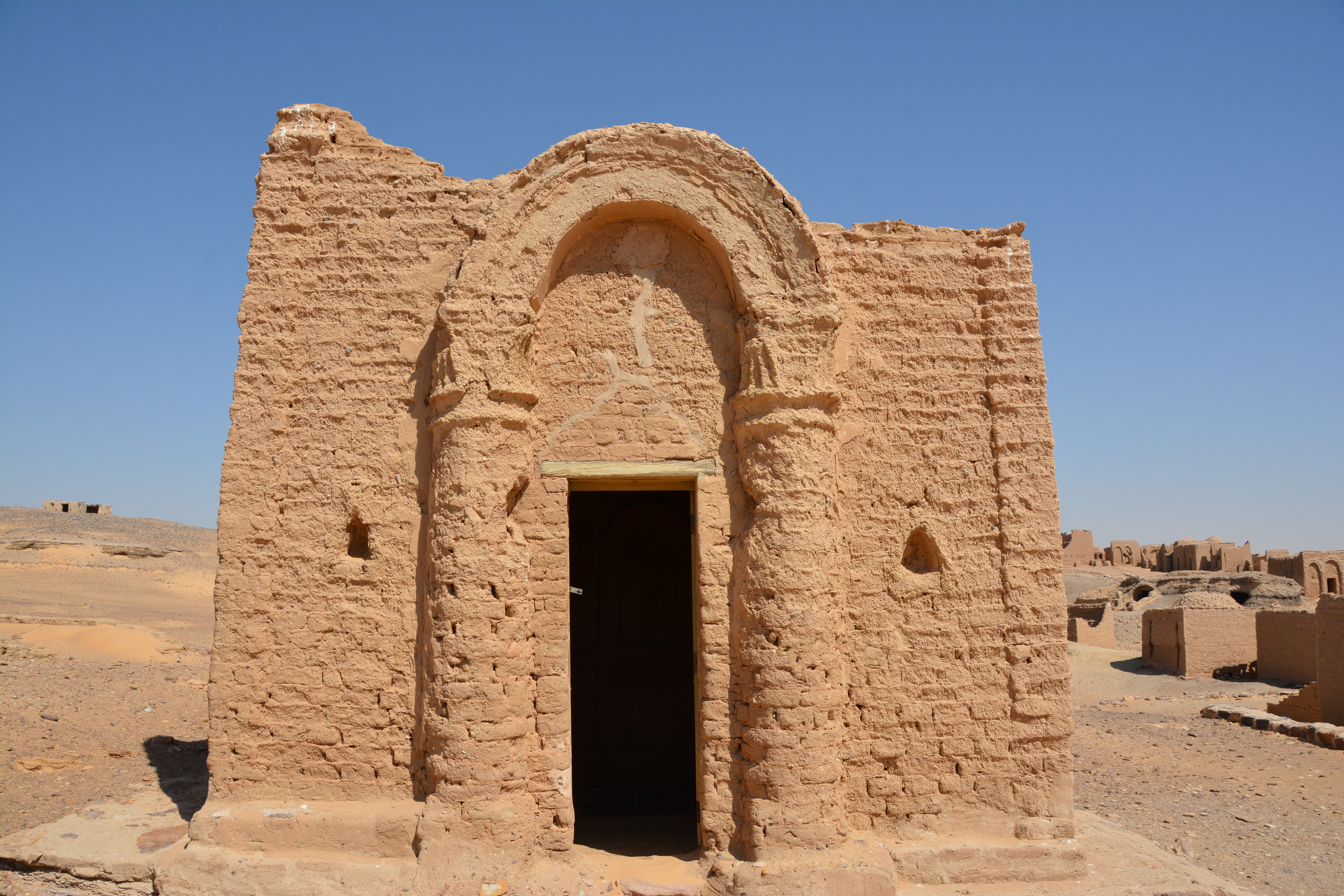
Chapel of Peace (Bagawat, Egypt)
The Chapel of Peace, a monumental Christian tomb at Bagawat Necropolis, Kharga Oasis, Egypt, built 5th or 6th century. Photo: Mohamed Kenawi / Manar al-Athar.

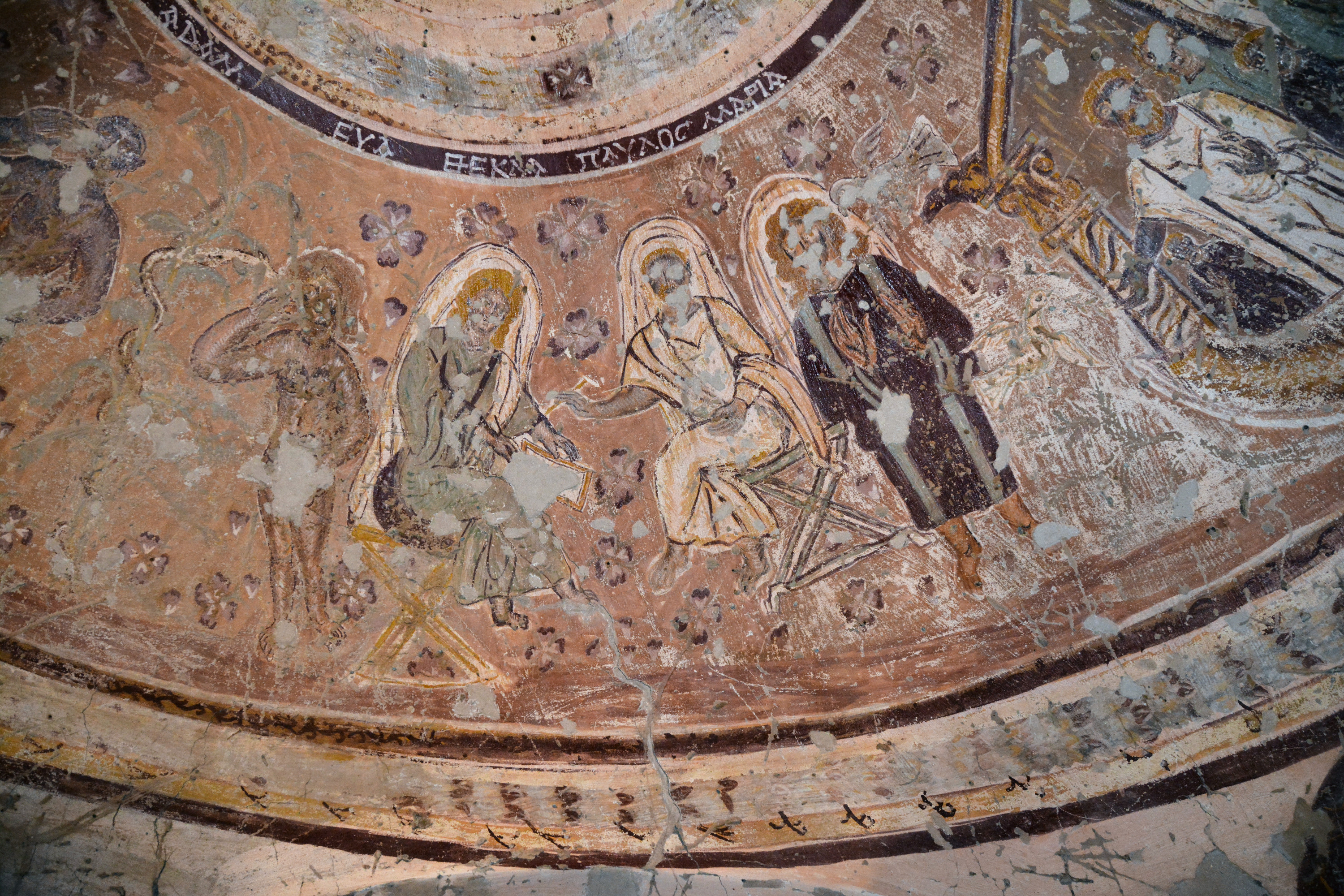
Paul and Thecla (Chapel of Peace)
Dome fresco detail from the Chapel of Peace at Bagawat Necropolis in Kharga Oasis, Egypt, 5th or 6th century. Photo: Mohamed Kenawi / Manar al-Athar.

The detail pictured above shows the female saint Thecla (Θέκλα), a first-century Christian preacher and martyr, learning from the apostle Paul (Παῦλος), as described in the ancient apocryphal Acts of Paul and Thecla. They both sit on stools, Thecla holding open a book on her lap, pen in hand, while Paul points out a particular text.

In addition to Paul and Thecla, the dome fresco also depicts, clockwise from that pair: Adam and Eve; Abraham about to sacrifice his son Isaac, with Sarah stretching out her hand (it’s unclear whether this gesture signifies her surrender to God’s will or an attempt to stop her husband’s act); Peace, holding a scepter and an ankh; Daniel in the Lions’ Den; Justice, holding a cornucopia and balance scales; Prayer; Jacob; Noah’s Ark; and the Virgin Annunciate, the New Eve, who heard the word of God and obeyed it and thus brought forth life, unlike her ancestor, who listened to the lies of the Evil One and brought forth death (the snake and dove at the women’s respective ears emphasize this contrast). View a facsimile of the full dome here.

Also in the Egyptian folder are photos of one of Byzantine Egypt’s most glorious encaustic-painted sanctuaries, that of the Red Monastery Church, a triconch (three-apse) basilica that’s part of the (Coptic Orthodox) Monastery of Apa Bishuy near Sohag.
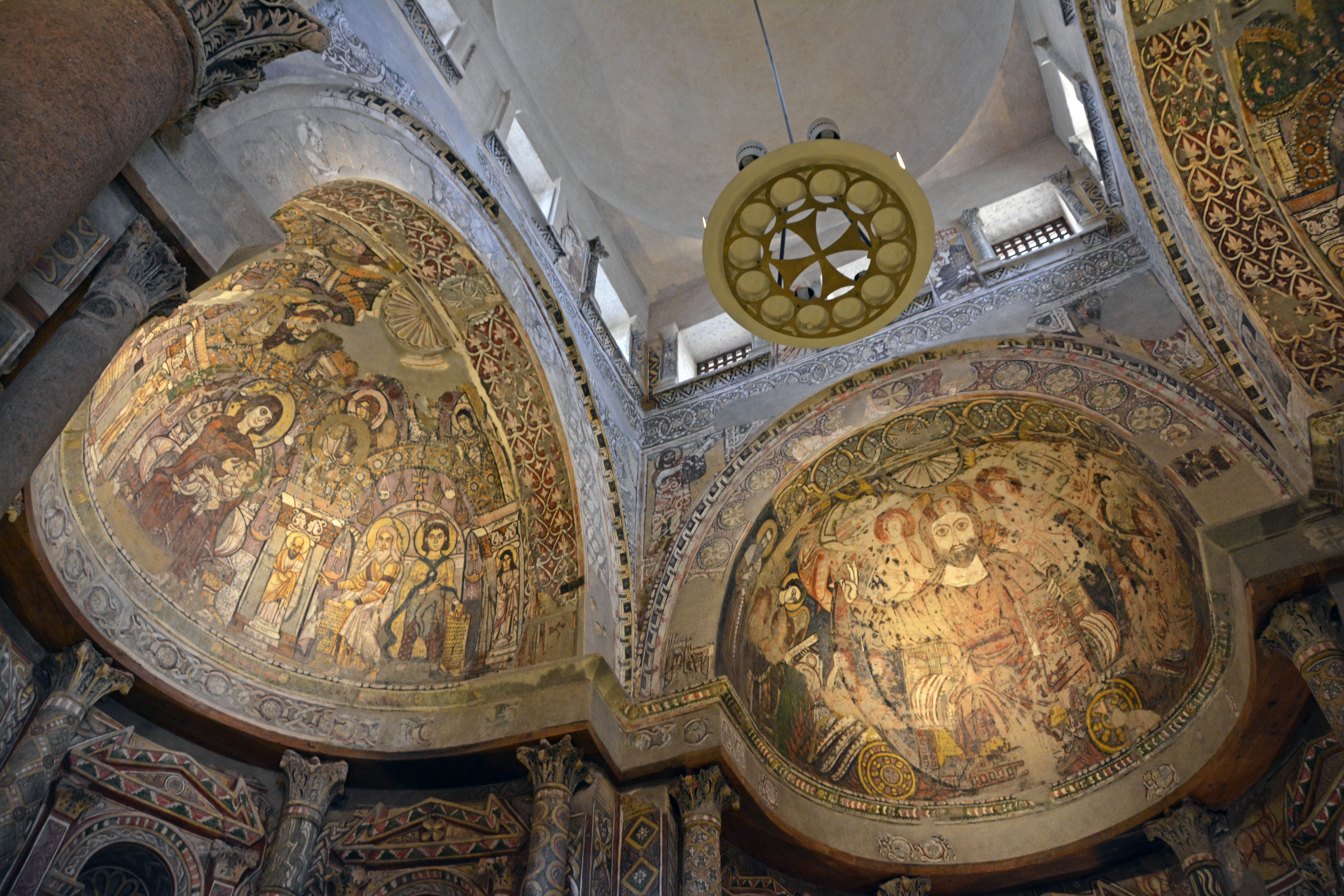
Red Monastery Church
North apse (Virgin Galaktotrophousa, aka the Nursing Madonna) and east apse (Christ Pantocrator), painted 6th–7th or 8th century, Red Monastery Church, near Sohag, Egypt. Photo: Mohamed Kenawi / Manar al-Athar.

Here’s a video that presents a 3D reconstruction and fly-through of the basilica:

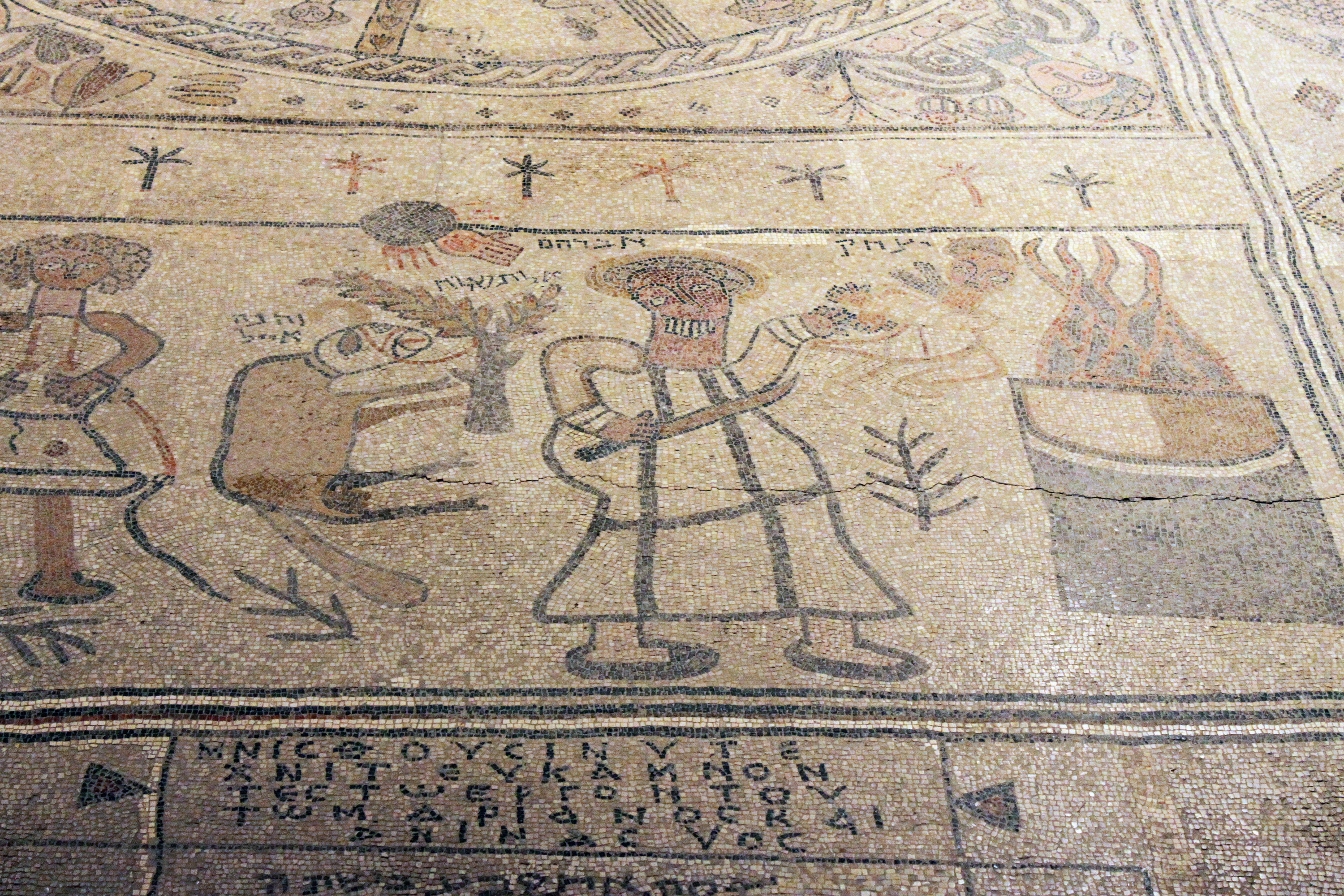
Moving northeast into Israel, we come to the sixth-century Bet Alpha (sometimes rendered as Beit Alfa) Synagogue, located in the Beit She’an Valley. The excavation of Jewish sacred sites like this one reveal that, contrary to what is popularly alleged, Judaism is not a strictly aniconic religion. Many Jewish communities have understood the prohibition against graven images in Exodus 20:3–6 and Leviticus 26:1 as a prohibition against idol worship, not figurative art (art that depicts people and animals) in general. Thus several ancient synagogues, not to mention Jewish manuscripts, portray episodes from the biblical narrative, such as the Akedah (Binding [of Isaac]), told in Genesis 22.
Sacrifice of Isaac (Bet Alpha mosaic)
The Binding of Isaac, early 6th century. Mosaic pavement, Bet Alpha (Beit Alfa) Synagogue, Heftziba, Israel. Photo: Sean Leatherbury / Manar al-Athar.

Rendered in a primitive style, this scene is one of three from the mosaic pavement in the central hall of Bet Alpha. It shows Abraham, sword in hand, about to throw his son Isaac onto a fiery altar, when God, represented by a hand from the sky, intervenes, telling him to stop; it’s then that Abraham notices a ram tangled up in a nearby thicket, which he sacrifices instead. The Hebrew inscriptions read, from right to left, “Yitzhak” (Isaac), “Avraham” (Abraham), “al tishlakh” (Do not lay [your hand on the boy]), and “v’hineh ayil” (Here is a ram). Stylized palm trees line the top of the scene.

Here is video footage of the full floor mosaic in its space, showing wide views as well as details, including of the remarkable zodiac wheel in the center:

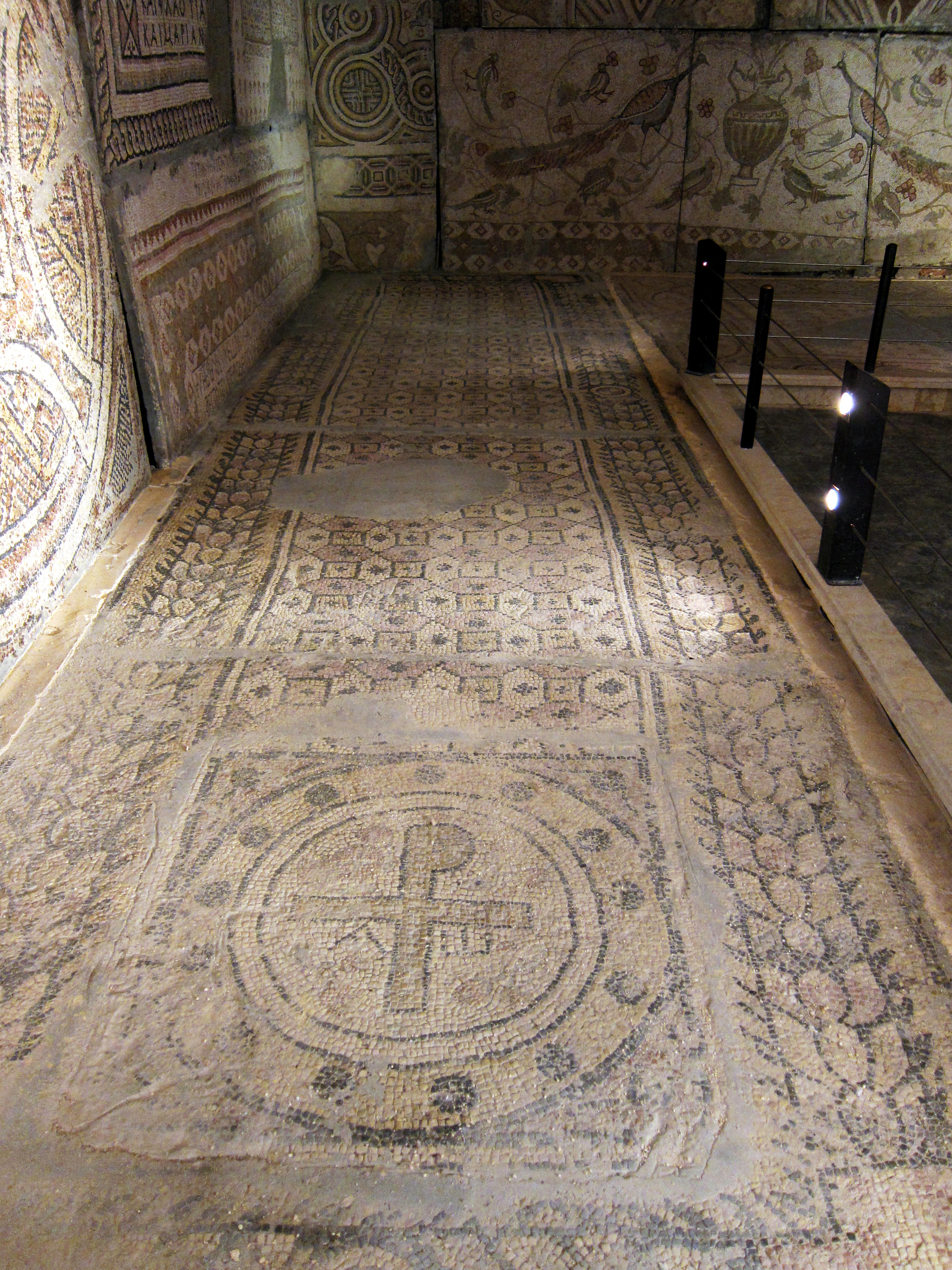
Mosaic was a common form of late antique decoration in places of worship. Here are two examples from Syria:
Tell Aar church mosaics
Mosaics from the ancient Tell Aar church, including a chi-rho monogram with an alpha and omega (foreground) and peacocks flanking an amphora (background), housed in the Maarat al-Numan Museum, Syria. Photo: Sean Leatherbury / Manar al-Athar.

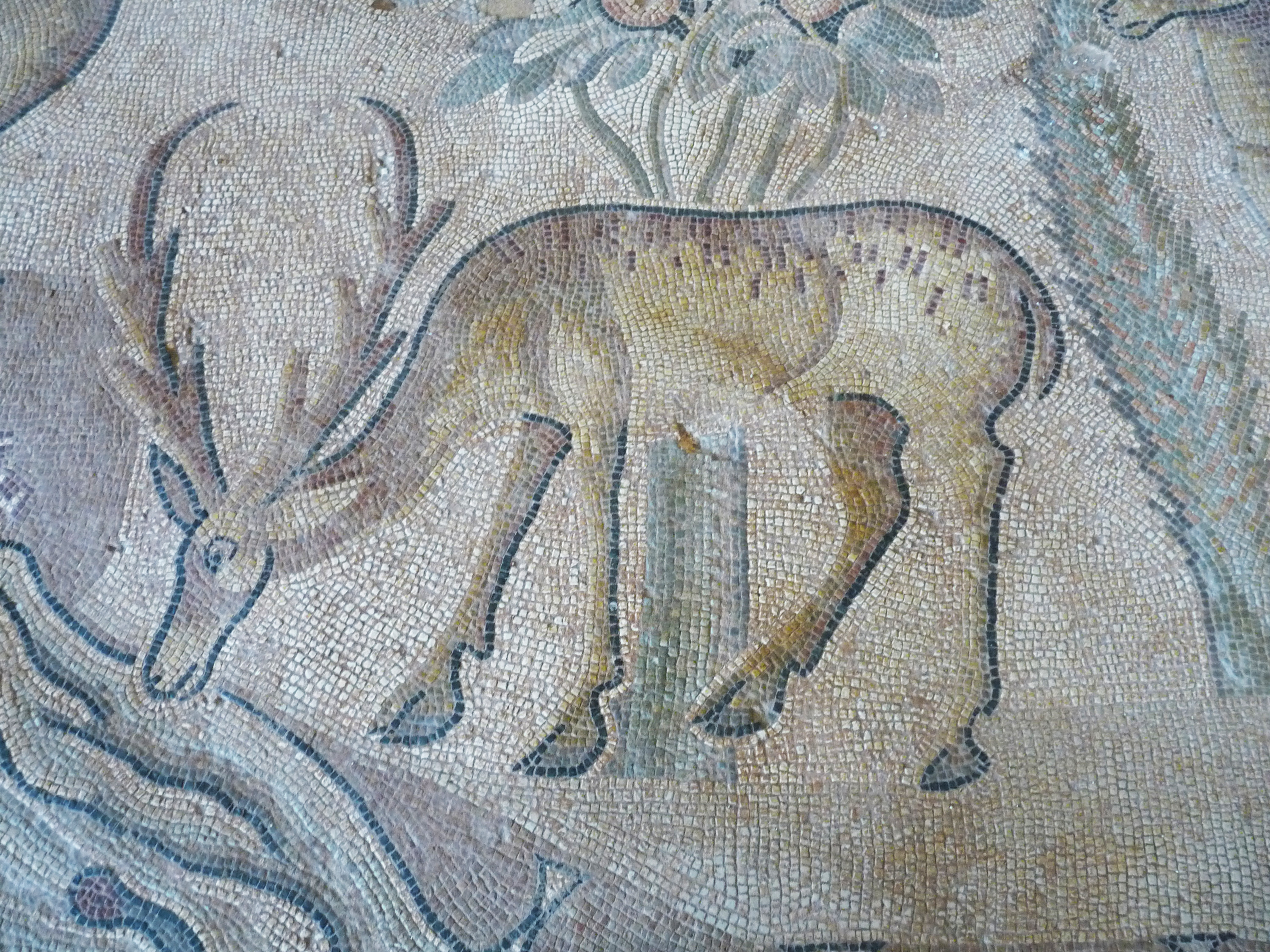
Deer drinking water
Deer drinking from a stream, 5th century. Mosaic, Church of the Martyrs, Taybat al-Imam, Syria. Photo: Jane Chick / Manar al-Athar.

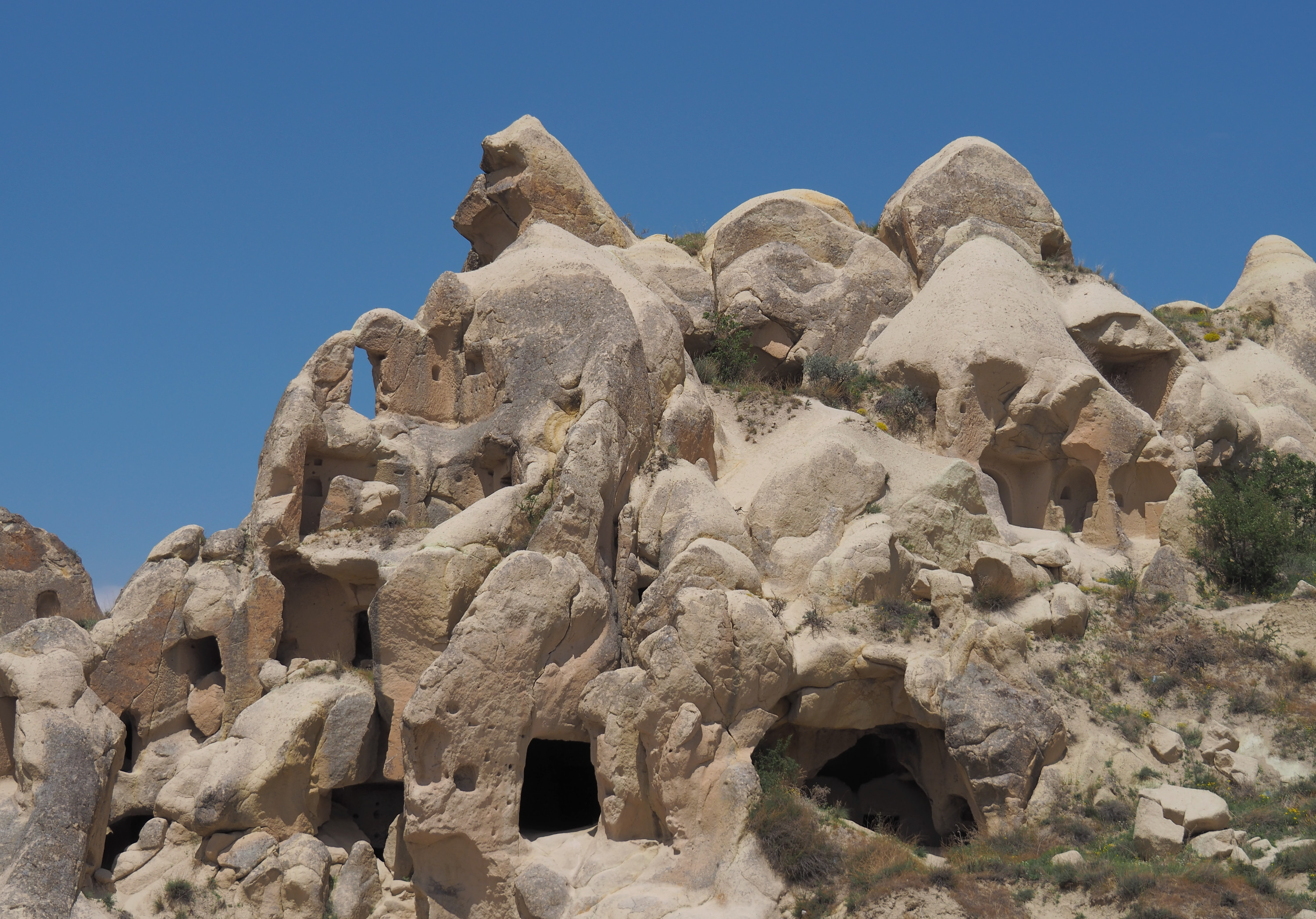
To the north of Syria in Turkey—cataloged by Manar al-Athar under “Anatolia,” the ancient name for the peninsula that comprises the majority of the country—there are the Cappadocian cave churches, hewn out of volcanic tufa. They began to be built in the fifth century, with a boom happening in the ninth through eleventh centuries, which is the period to which almost all the surviving paintings can be dated. There are over a thousand such churches, some very simple inside, and others elaborately painted. The architecture has been described as eccentric and enchanting. I like to imagine the monks, nuns, and other Christians who worshipped there all those centuries ago.
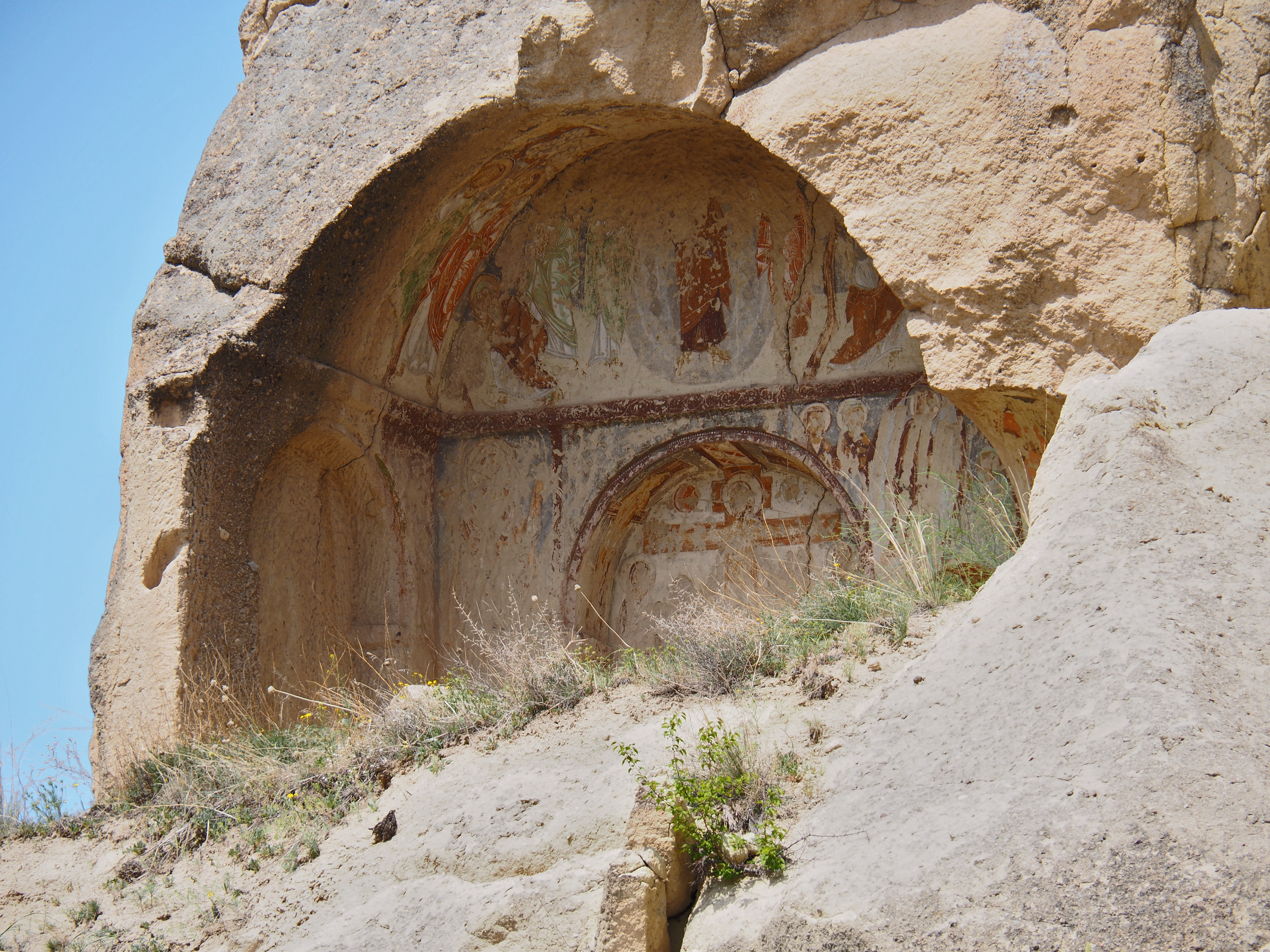
Rock-hewn chapel, Cappadocia
Middle Byzantine cave church, Göreme Open Air Museum, Cappadocia, Turkey. Photo: Marlena Whiting / Manar al-Athar.

Crucifixion and Transfiguration
Frescoes depicting the Crucifixion and the Transfiguration, from a rock-cut chapel at the Göreme Open Air Museum, Cappadocia, Turkey. Photo: Marlena Whiting / Manar al-Athar.

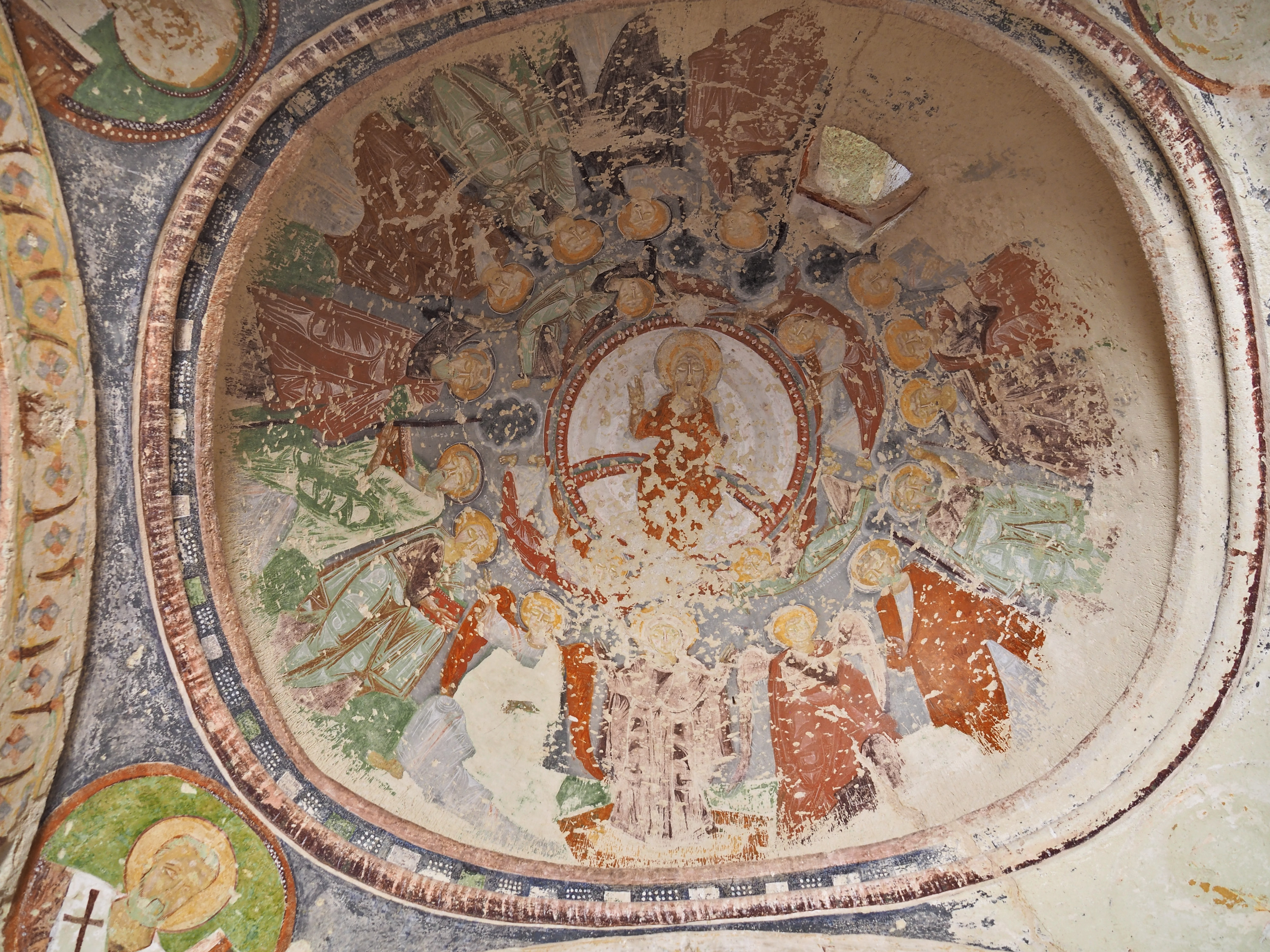
Christ in Glory (Turkey)
The Ascension of Christ, 10th century. Dome fresco, Church of the Evil Eye (El Nazar Kilise), Göreme, Cappadocia, Turkey. Photo: Marlena Whiting / Manar al-Athar.

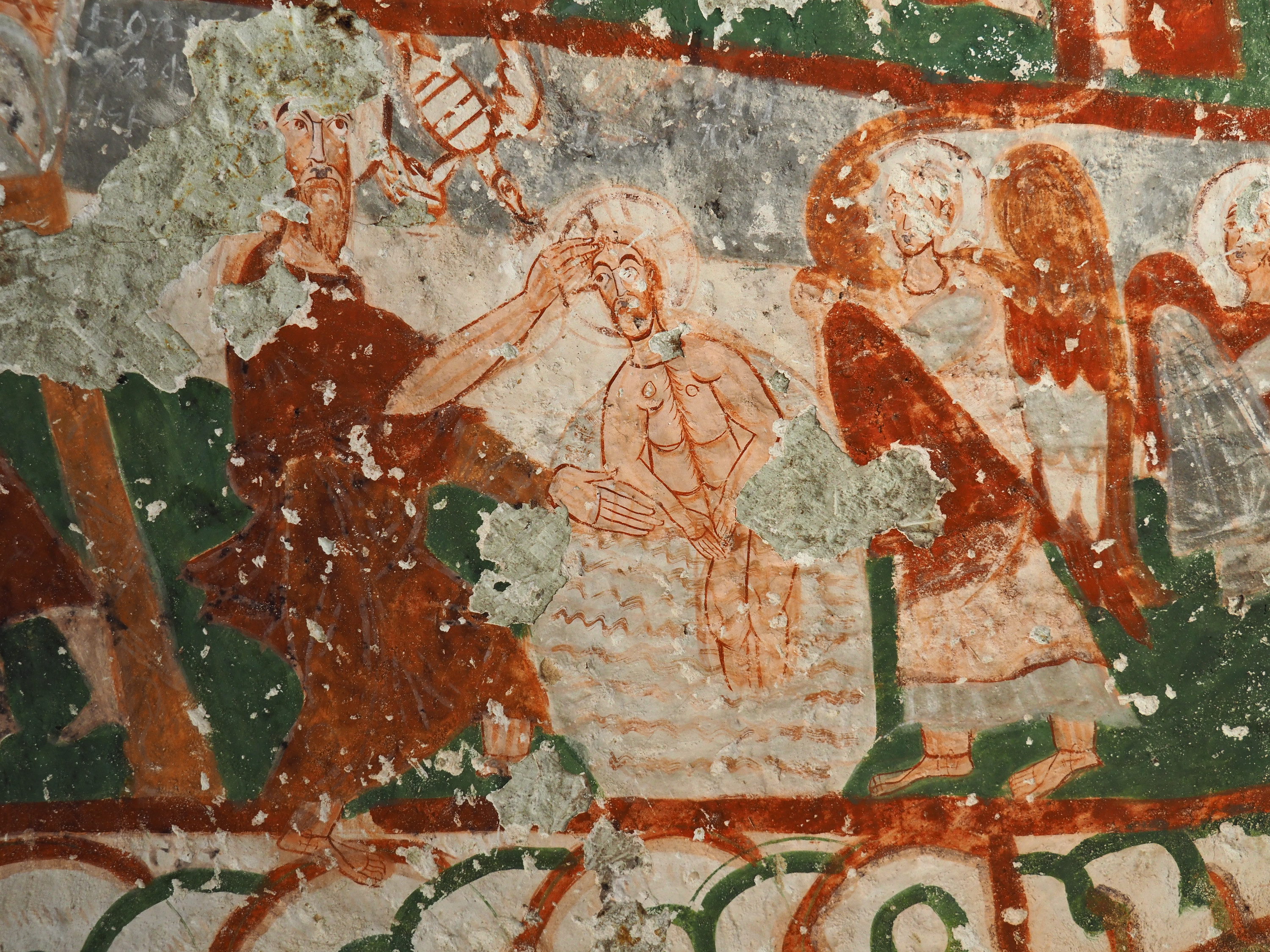
One of the cave churches in Cappadocia, part of an ancient monastic settlement, is Pancarlik Church, home to an impressive fresco cycle on the Life of Christ that’s painted mainly in rusty red and bean green.
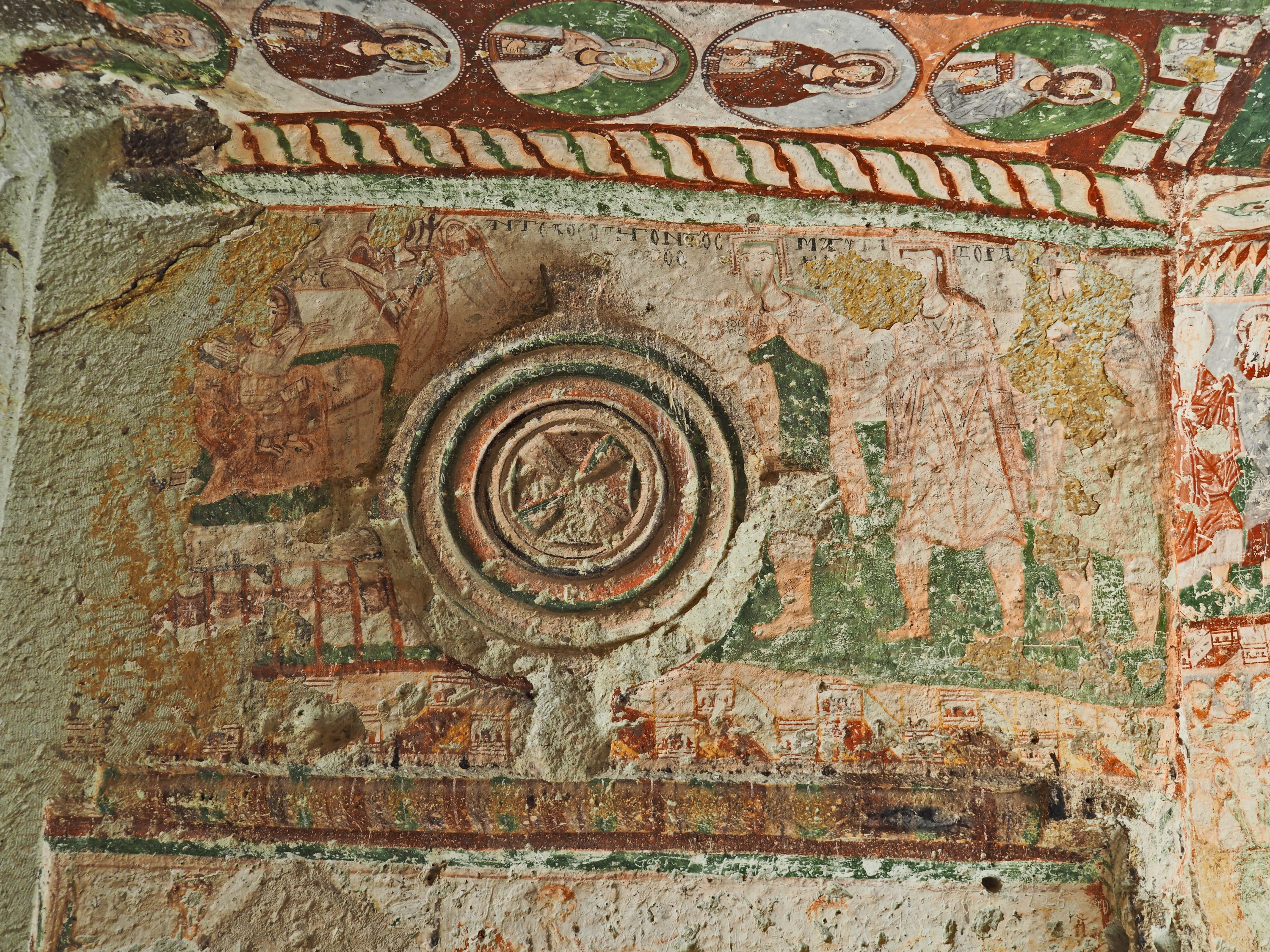
Adoration of the Magi (Turkey)
Adoration of the Magi fresco and Greek cross relief carving, probably early 11th century. Pancarlik Church, Cappadocia, Turkey. Photo: Marlena Whiting / Manar al-Athar.

Baptism of Christ (Pancarlik Church, Turkey)
The Baptism of Christ, probably early 11th century. Fresco, Pancarlik Church, Cappadocia, Turkey. Photo: Marlena Whiting / Manar al-Athar.

Beyond Cappadocia but also in Turkey is Hagia Sophia (Holy Wisdom) in Trabzon, not to be confused with the more famous Hagia Sophia in Istanbul, 650 miles away. Originally a Greek Orthodox church, it was converted into a mosque following the conquest of Trabzon (then called Trebizond) by Mehmed II in 1461. During prayer the frescoes in the nave, made by Christians who built and previously occupied the space, are covered by curtains to honor the Islamic prohibition against images—the veils are pulled aside during tourist hours—while the frescoes in the narthex remain uncovered at all times.
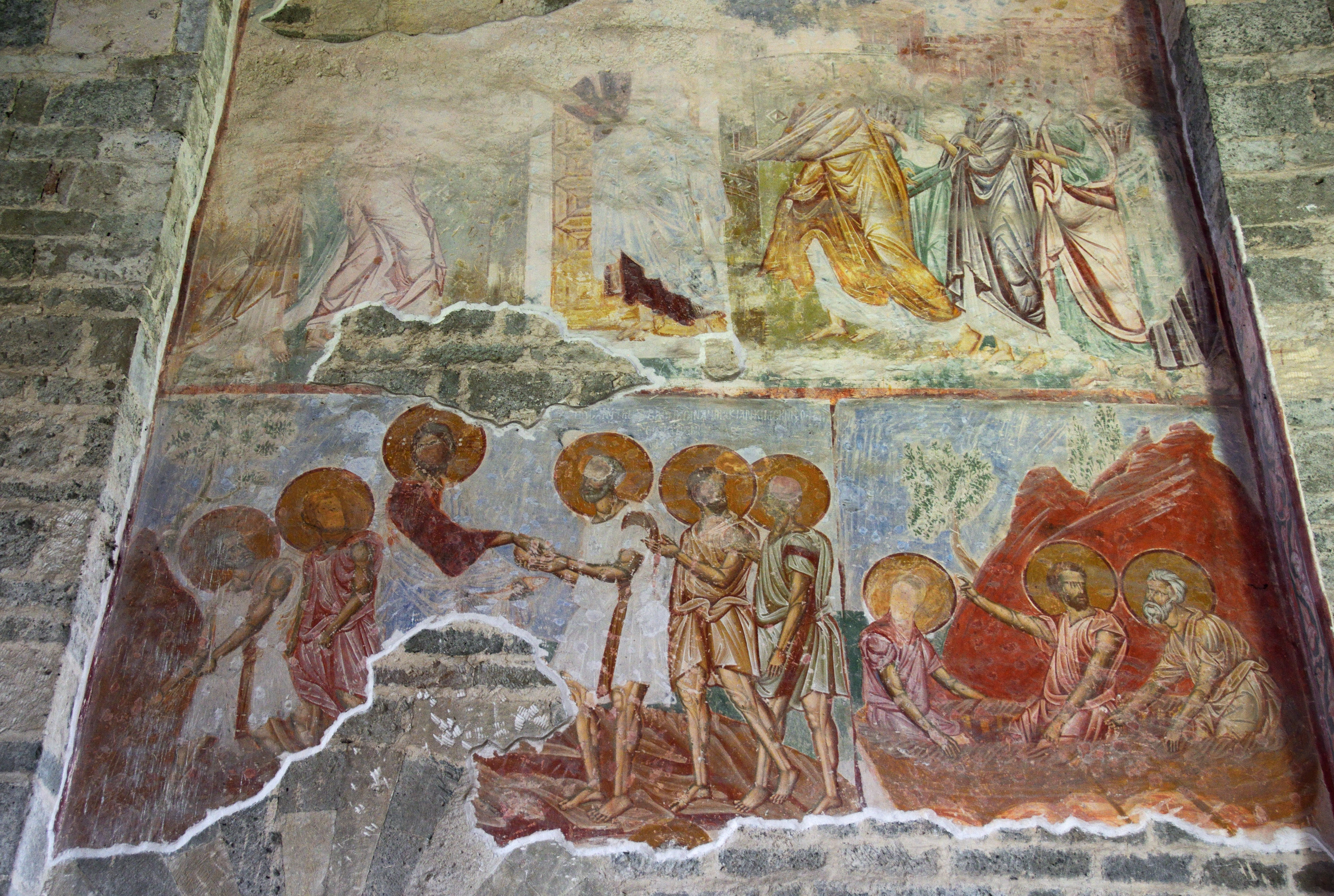
Breakfast on the Shore (Hagia Sophia, Trabzon)
The Incredulity of St. Thomas (top) and The Risen Christ Appears on the Shore (bottom), late 13th century. Frescoes, Hagia Sophia (Aya Sofya Mosque), Trabzon, Turkey. Photo courtesy of Manar al-Athar.

One of the frescoes shows Christ appearing to his disciples after his resurrection on the shore of the Sea of Galilee. He hands a fish and a loaf of bread to Peter, who stands at the front of the group, so that they can all share a joyous breakfast together after the tragic, upending events of the previous week.
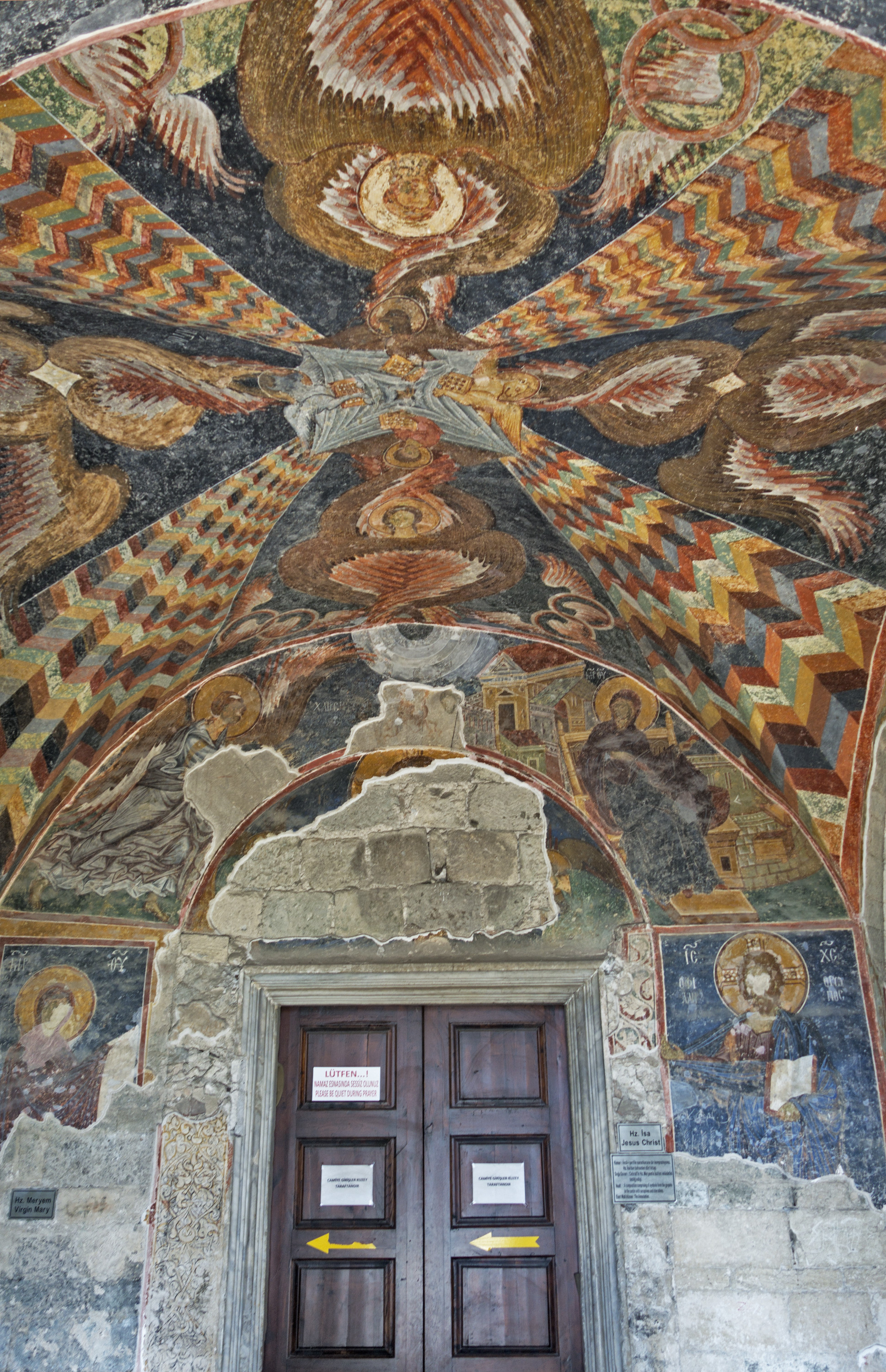
Tetramorph (Hagia Sophia, Trabzon)
Frescoed narthex, late 13th century, Hagia Sophia (Aya Sofya Mosque), Trabzon, Turkey. Photo: Matthew Kinloch / Manar al-Athar.

Another fresco, on the vaulted ceiling of the narthex, shows the four living creatures of Revelation 4—long interpreted by Christian artists as symbols of the Four Evangelists—situated along the four sides of the canopy of the heavens, each holding a golden Gospel-book and surrounded by seraphim and blazes of rainbow light.

In the Caucasus region, Armenia has a long and rich tradition of Christian art, especially relief carving and painting, as the faith took root there early on in the fourth century.
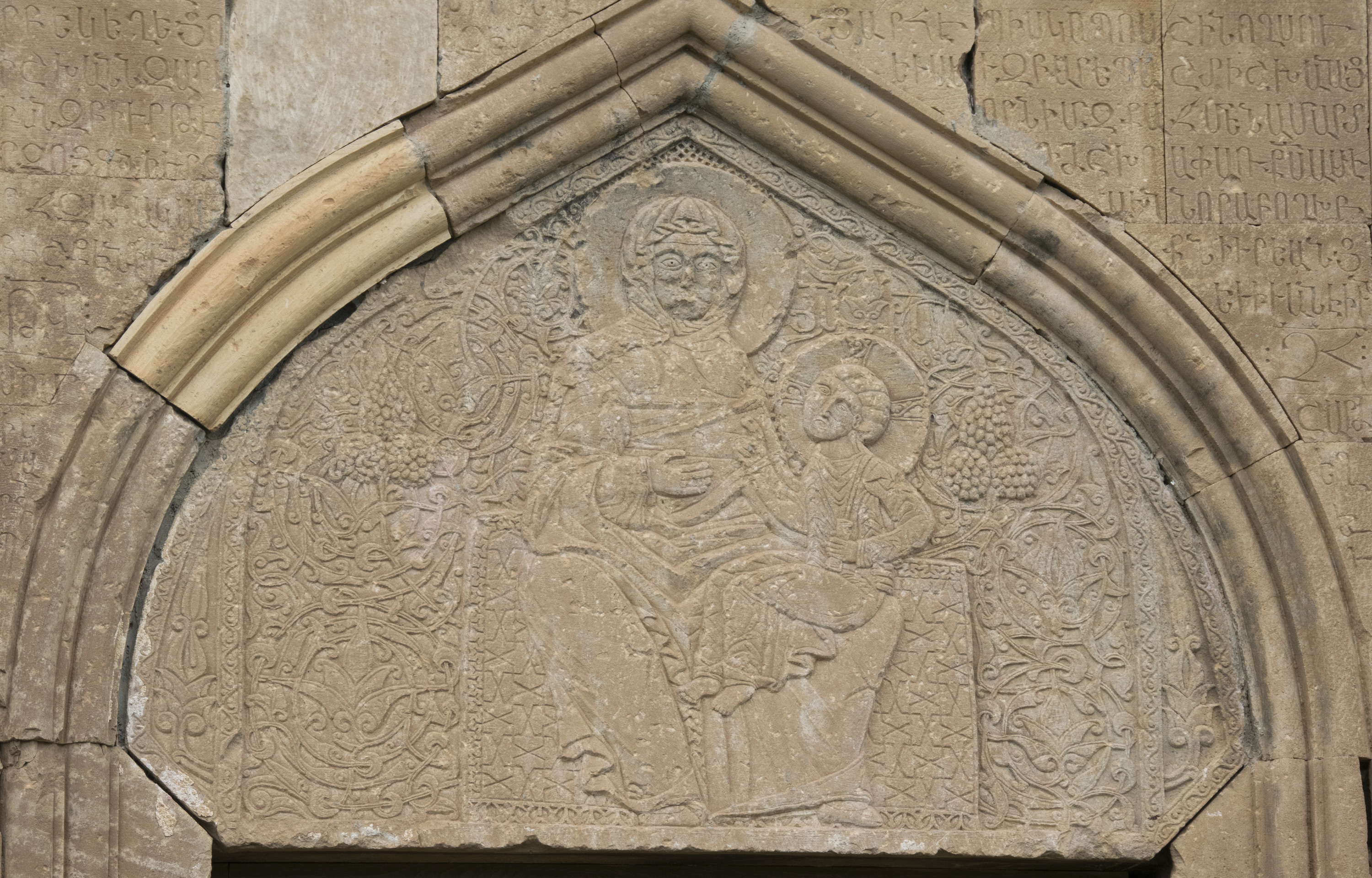
Virgin and Child
Momik Vardpet, Virgin and Child, ca. 1321. Carved tympanum, west portal, Church of St. Astvatsatsin (Holy Mother of God), Areni, Armenia. Photo courtesy of Manar al-Athar.

Overlooking the village of Areni on the eastern bank of the river Arpa is the Church of St. Astvatsatsin, which has a beautiful relief carving in the tympanum above the west portal by the Armenian architect, sculptor, and manuscript illuminator Momik Vardpet (died 1333). It depicts the Christ child seated on the lap of his mother, holding a scroll in one hand and raising the other in blessing. Decorative vines rise up behind and around the pair, suggesting verdancy.

The most distinctive Christian art form in Armenia is the khachkar, a carved memorial stele bearing a cross and often botanical motifs, and only occasionally a Christ figure. In the village of Sevanavank, at a different Church of St. Astvatsatsin, there’s a particularly striking khachkar that portrays the crucified Christ in the center, and below that, a scene of the Harrowing of Hell.
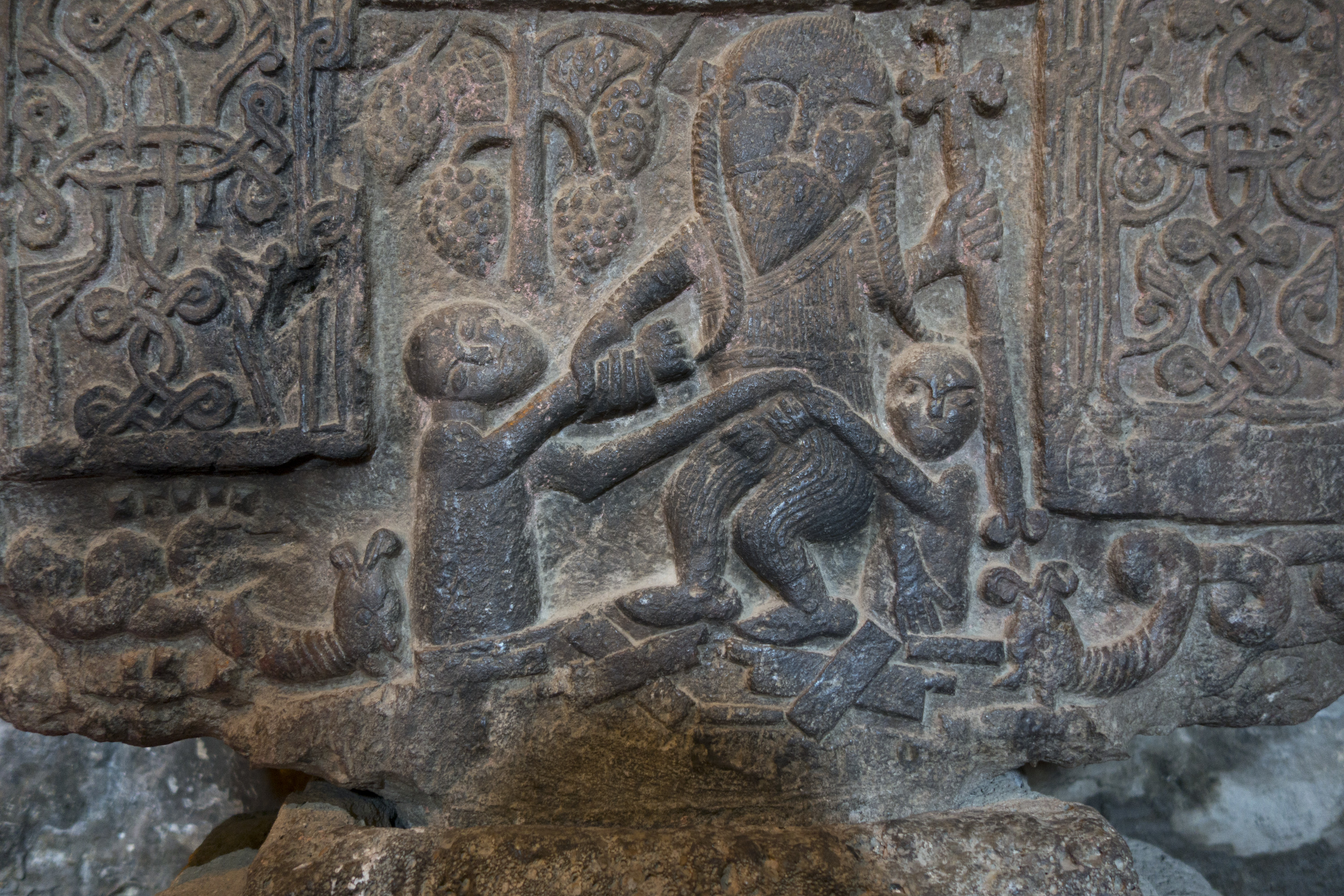
Harrowing of Hell (Armenia)
The Harrowing of Hell, detail of a khachkar from the Church of St. Astvatsatsin (Holy Mother of God) in Sevanavank, Armenia. Photo: Matthew Kinloch / Manar al-Athar. [view full khachkar]

Holding aloft his cross as a scepter, the risen Christ breaks down the gates of death and rescues Adam and Eve, representatives of redeemed humanity, while serpents hiss vainly at his heels. I’m struck by the uniqueness of Christ’s hair, which flows down in two long braided pigtails. Was this a common hairstyle for males in medieval Armenia? I have no idea.

The last artwork from Armenia that I’ll share is an icon of paradise from the Church of St. Astvatsatsin (yes, it’s a popular church name in that country!) at Akhtala Monastery.
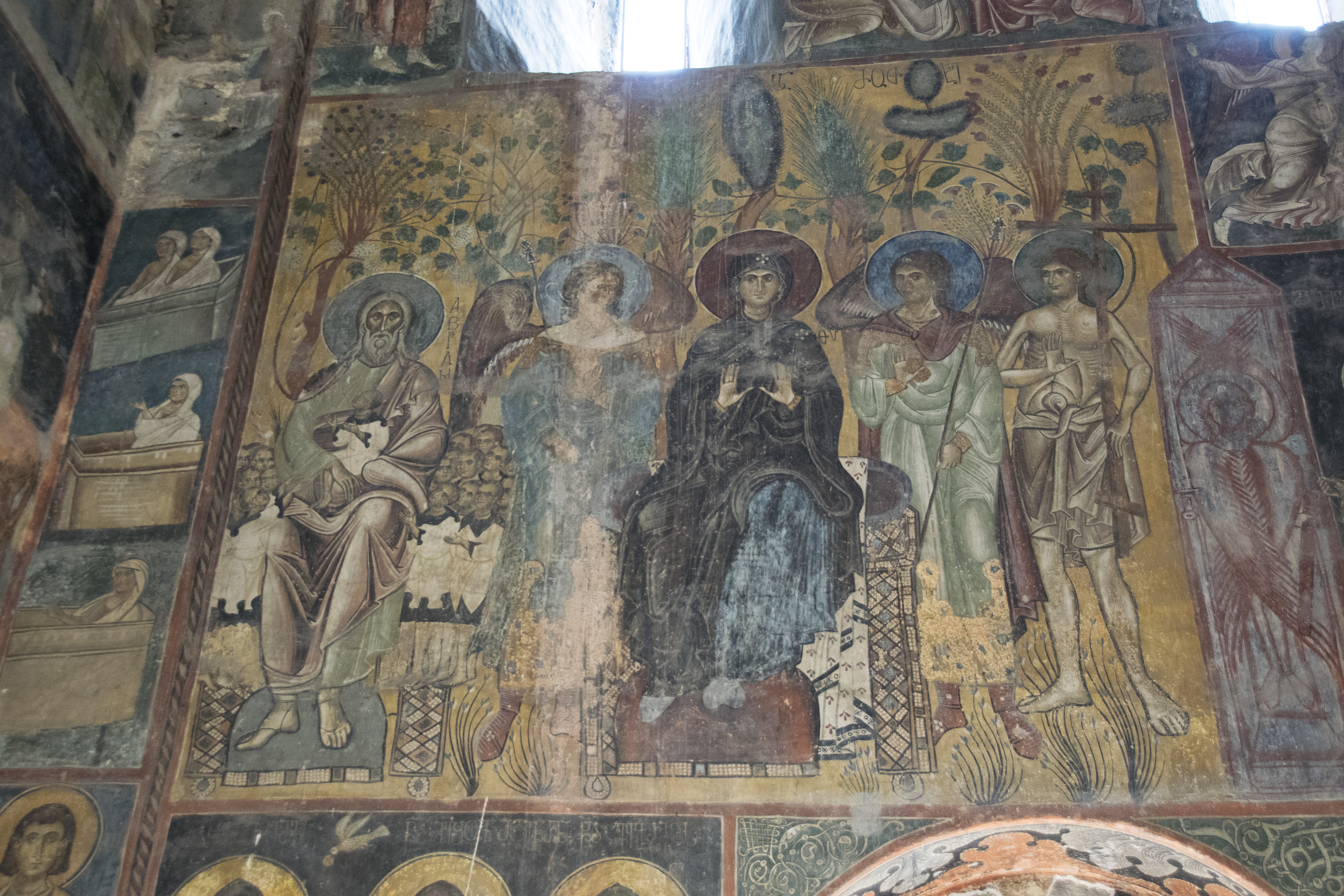
Paradise (Armenia)
Paradise, 1205–16. Fresco, west wall, Church of St. Astvatsatsin (Holy Mother of God), Akhtala Monastery, Akhtala, Armenia. Photo courtesy of Manar al-Athar.

In the center is the Mother of God flanked by two angels. On the left is Abraham with a child, representing a blessed soul, sitting on his lap (Luke 10:22 describes how the righteous dead go to “Abraham’s bosom,” a place of repose). On the right is Dismas, the “good thief” who repented on the cross of his execution, and to whom Jesus promised paradise (Luke 23:39–43); he is venerated as a saint in the Catholic and Orthodox churches.

The image is part of a larger Last Judgment scene that covers the entire west wall. A few panels above, at the very top, Christ is enthroned on a rainbow.

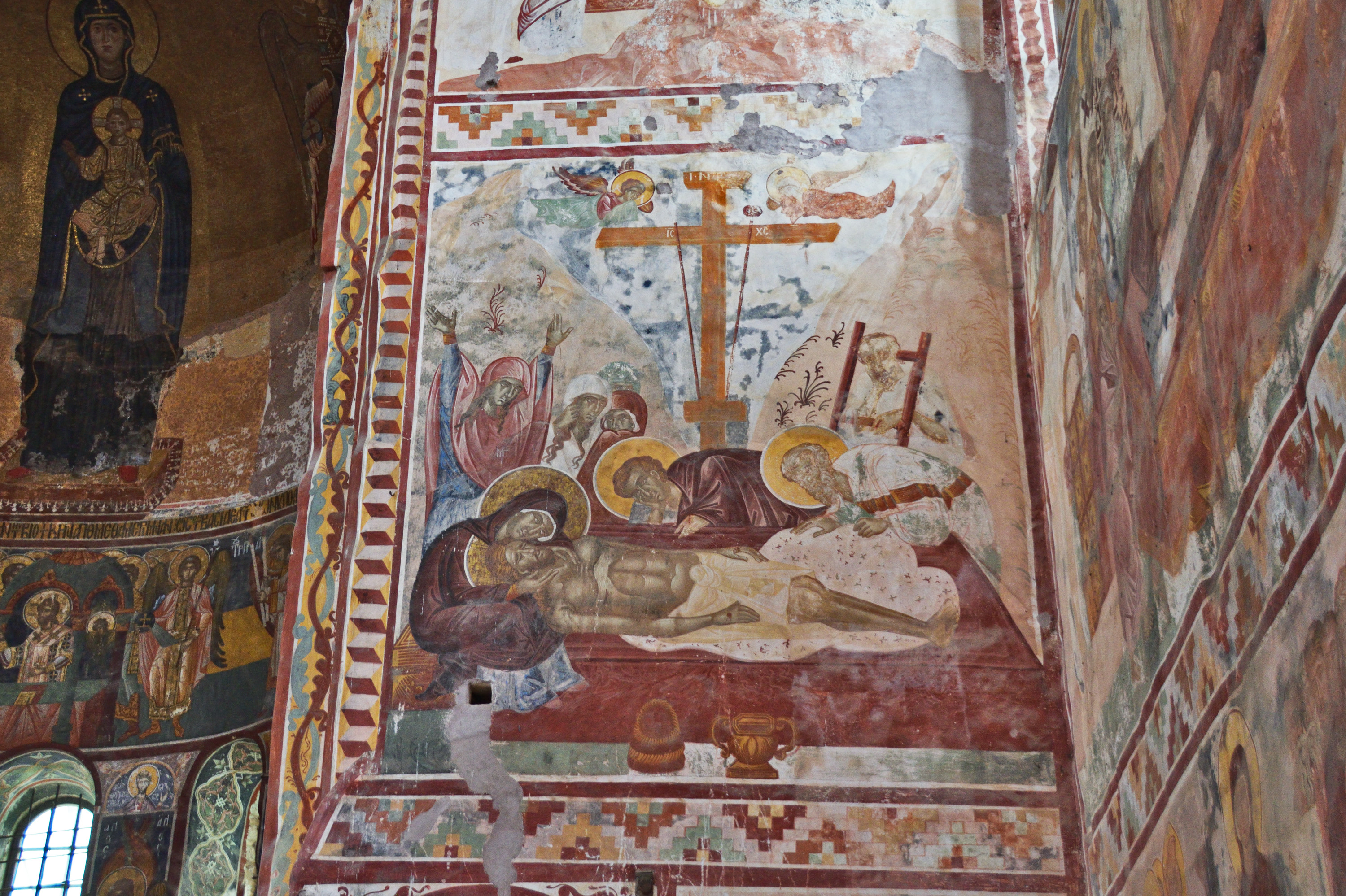
The neighboring country of Georgia has also cultivated a tradition of Christian icon painting. The main church of Gelati Monastery, founded in 1106, is richly decorated with painted murals dating from the twelfth through seventeenth centuries. One of them is the Lamentation over the Dead Christ: The Virgin Mary gently cradles the head of her son and Mary Magdalene throws her arms up in grief while the apostle John leans in close to mourn the loss and Joseph of Arimathea begins to wrap the body in a shroud.
Lamentation (Georgia)
Lamentation over the Dead Christ, fresco, Church of the Blessed Virgin, Gelati Monastery, near Kutaisi, Georgia. Photo courtesy of Manar al-Athar.

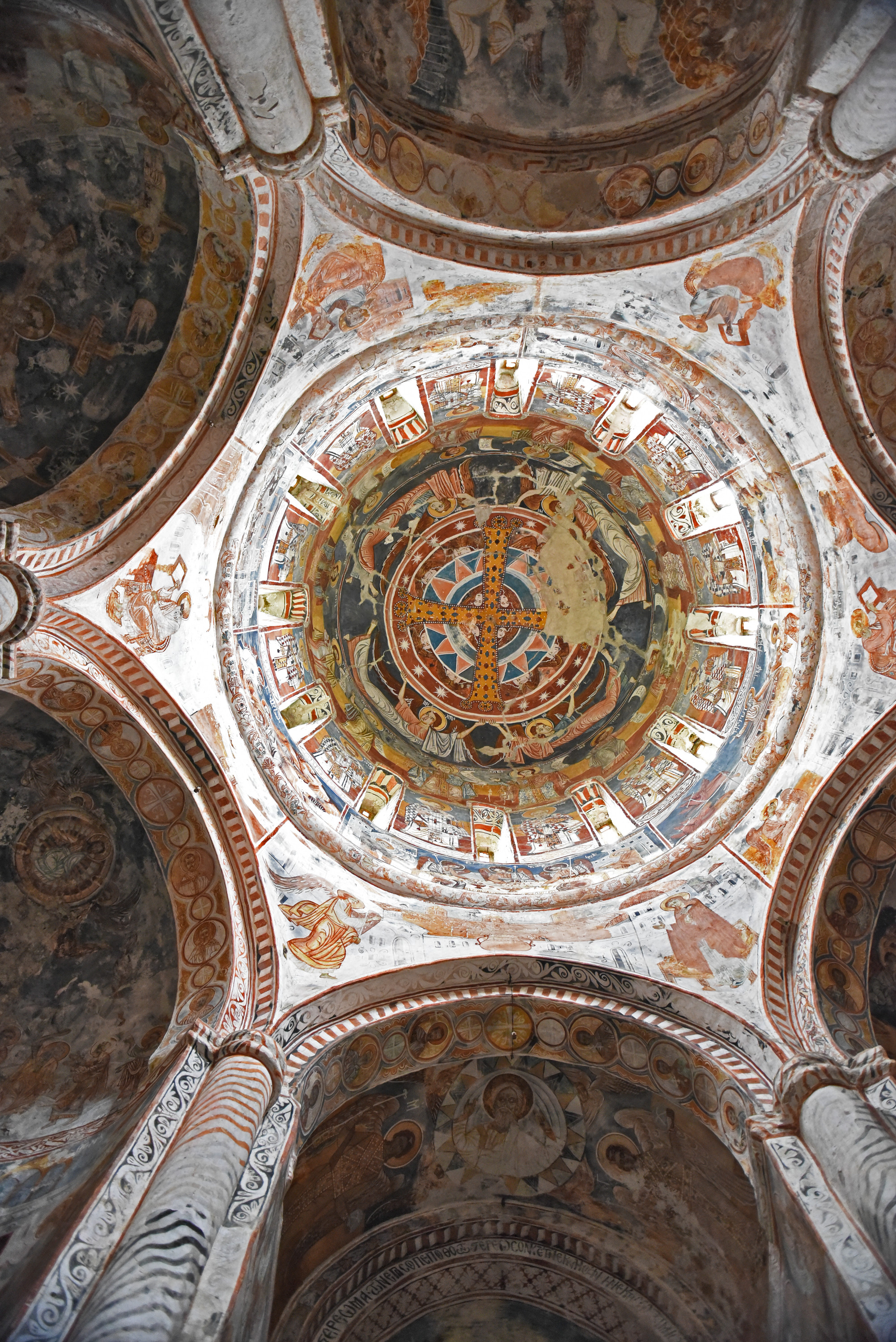
Another Georgian icon painting, from the central dome of the Church of St. Nicholas in Nikortsminda, shows angels bearing aloft a jeweled cross, surrounded by the twelve apostles.
Georgian church dome
Central dome, Church of St. Nicholas, Nikortsminda, Georgia. Photo: Ross Burns / Manar al-Athar.

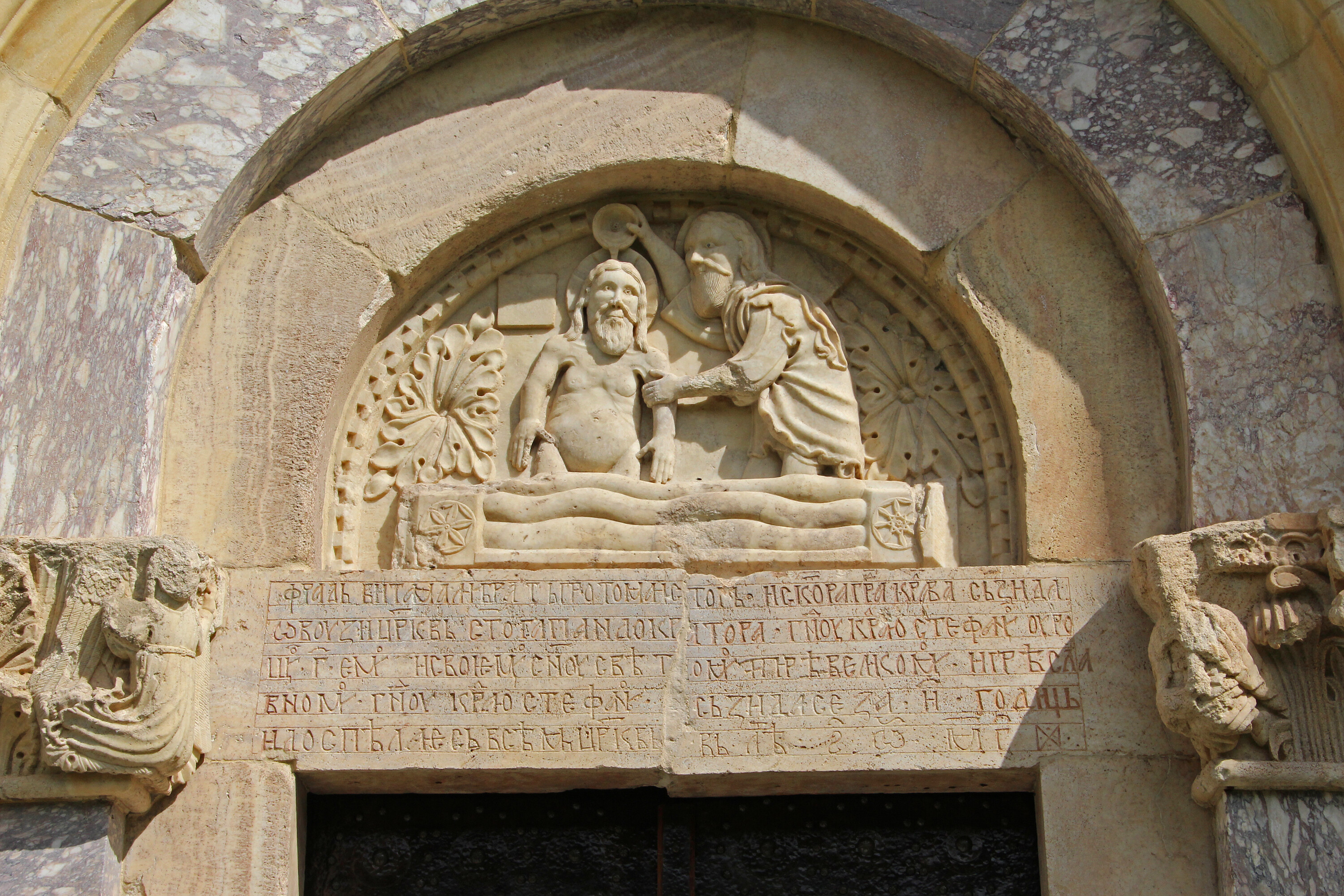
Lastly, from the Balkans, I want to point out Decani Monastery in Kosovo, a Serbian Orthodox monastery built in the fourteenth century in an architectural style that combines Byzantine and Romanesque influences. The tympana of its katholicon (main church) lean into the Romanesque. The one over the south entrance portrays John baptizing Jesus in the river Jordan, and the Serbian inscription below describes the monastery’s founding.
Baptism of Christ tympanum (Decani)
The Baptism of Christ, 1327–35. Carved tympanum, south portal, Christ Pantocrator Church, Decani Monastery, near Deçan, Kosovo. Photo: Mark Whittow / Manar al-Athar.

Decani’s katholicon is the largest and best-preserved medieval church in the Balkans and due to continuing ethnic strife in the region is under international military protection. The Blago Fund website has more and better photos of the extensive frescoes inside, from the fourteenth through seventeenth centuries.

It’s important to note that this is one of a number of churches from the Manar al-Athar archive that are still active sites of Christian worship, where communities of believers are nurtured through word, image, and sacrament.


If you are interested in volunteering with Manar al-Athar—helping with image processing, labeling, fundraising, or web building—or if you have taken any photographs that may be of interest to the curatorial team, email manar@classics.ox.ac.uk.

Website: https://www.manar-al-athar.ox.ac.uk/
Advent, Day 8: A Voice Cries Out

LOOK: Baptism by Water by John Patrick Cobb

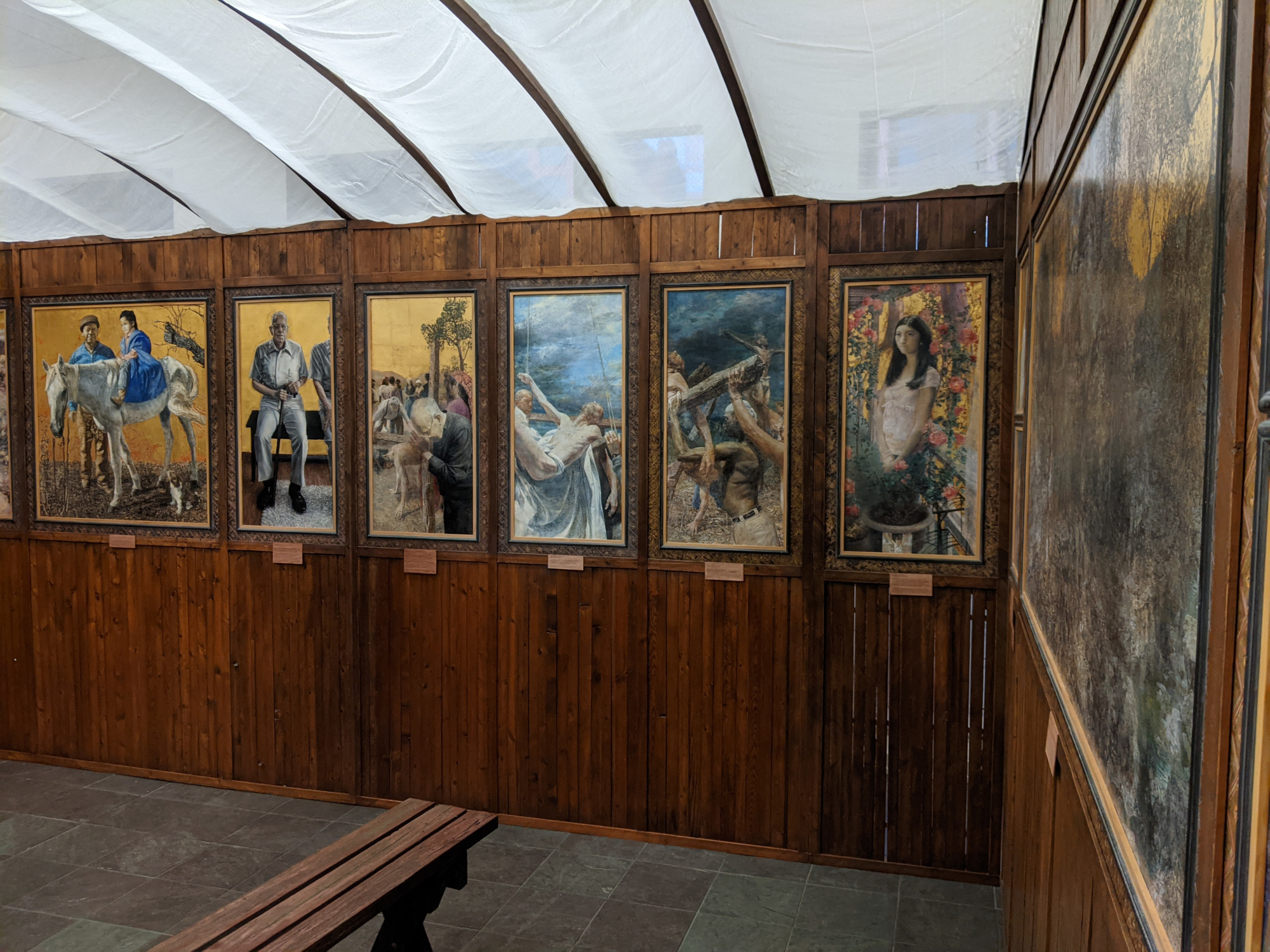
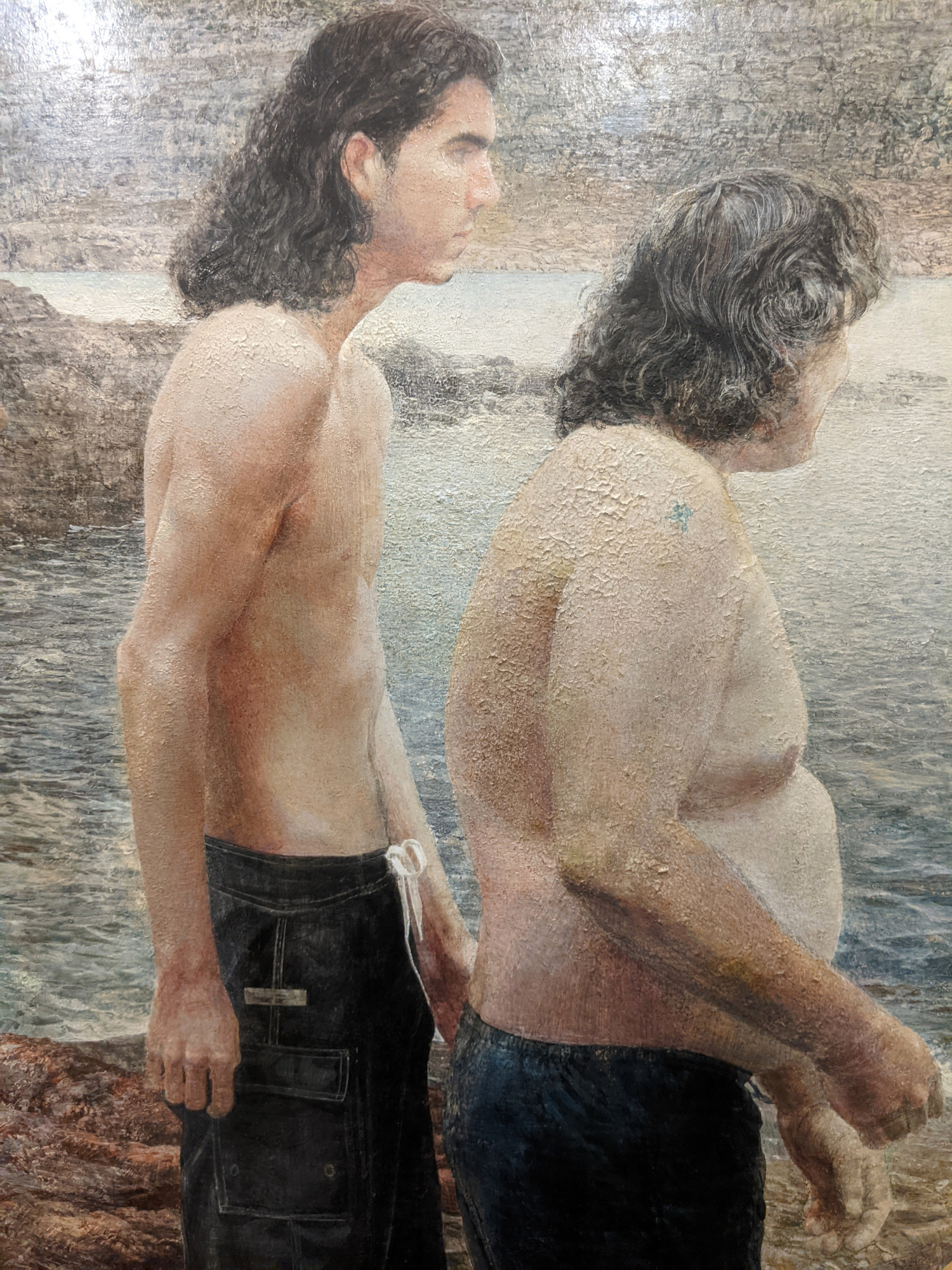
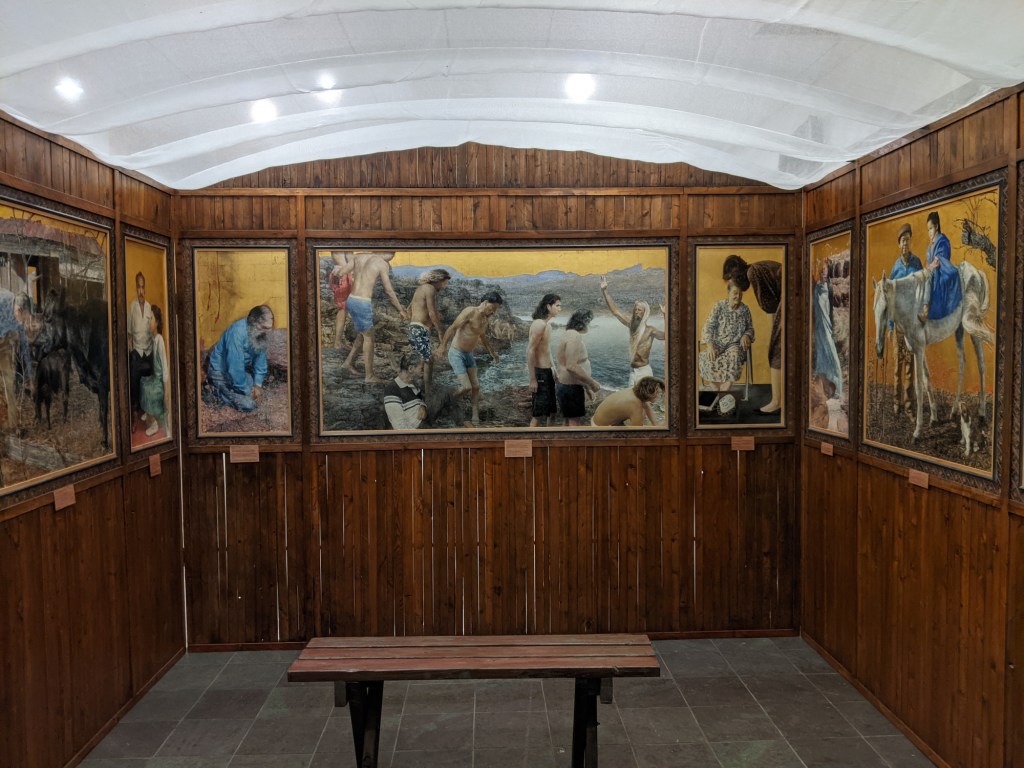
At the 2021 Christians in the Visual Arts (CIVA) conference in Austin, Texas, I got to experience local artist John Patrick Cobb’s Ikon Chapel, a traveling, custom-built wooden structure housing twenty of Cobb’s egg tempera paintings depicting his friends, family, and neighbors as saints and prophets in our modern world. The young and the elderly, farmers, water well drillers, artists, teachers, nurses, Holy Cross brothers, custodians, the unhoused, people with disability or mental illness—these are among those he honors in paint and gold leaf.

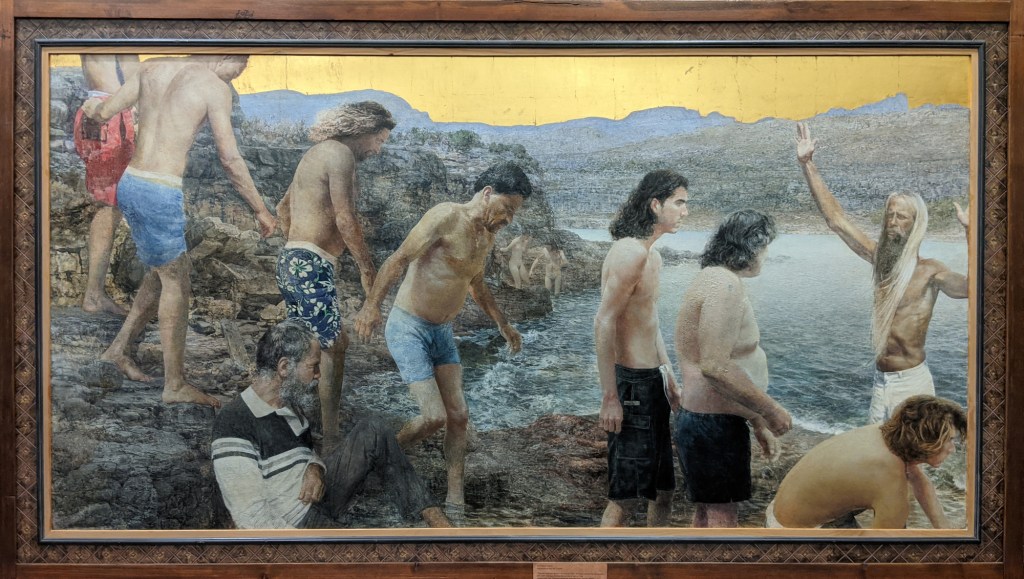
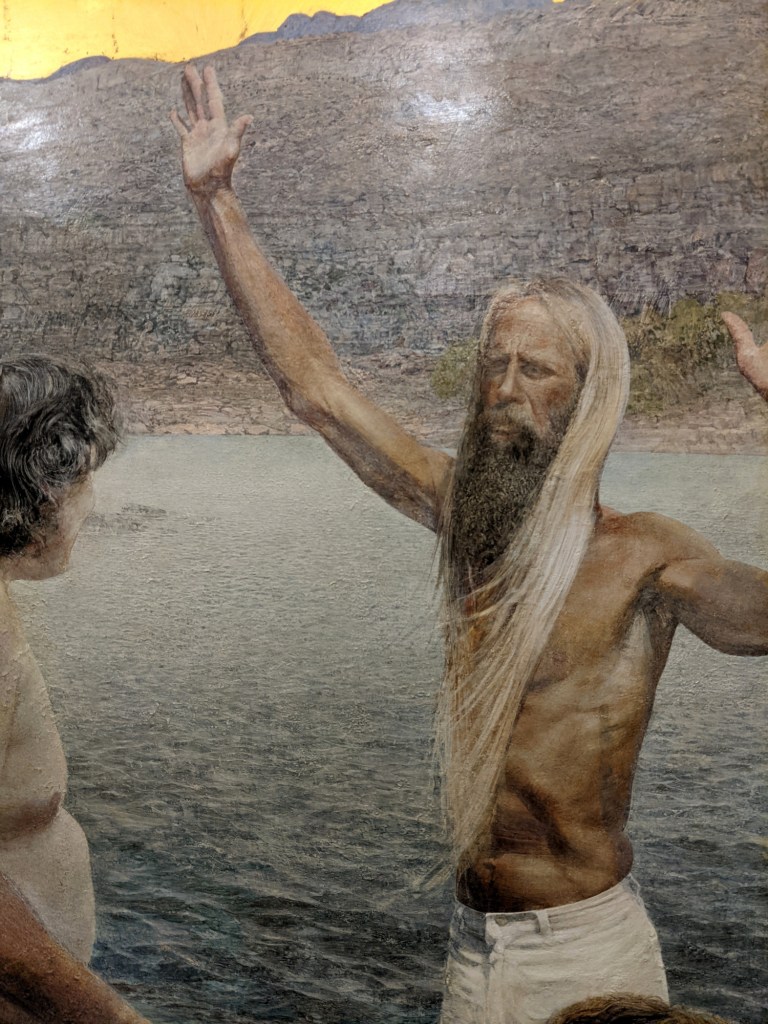
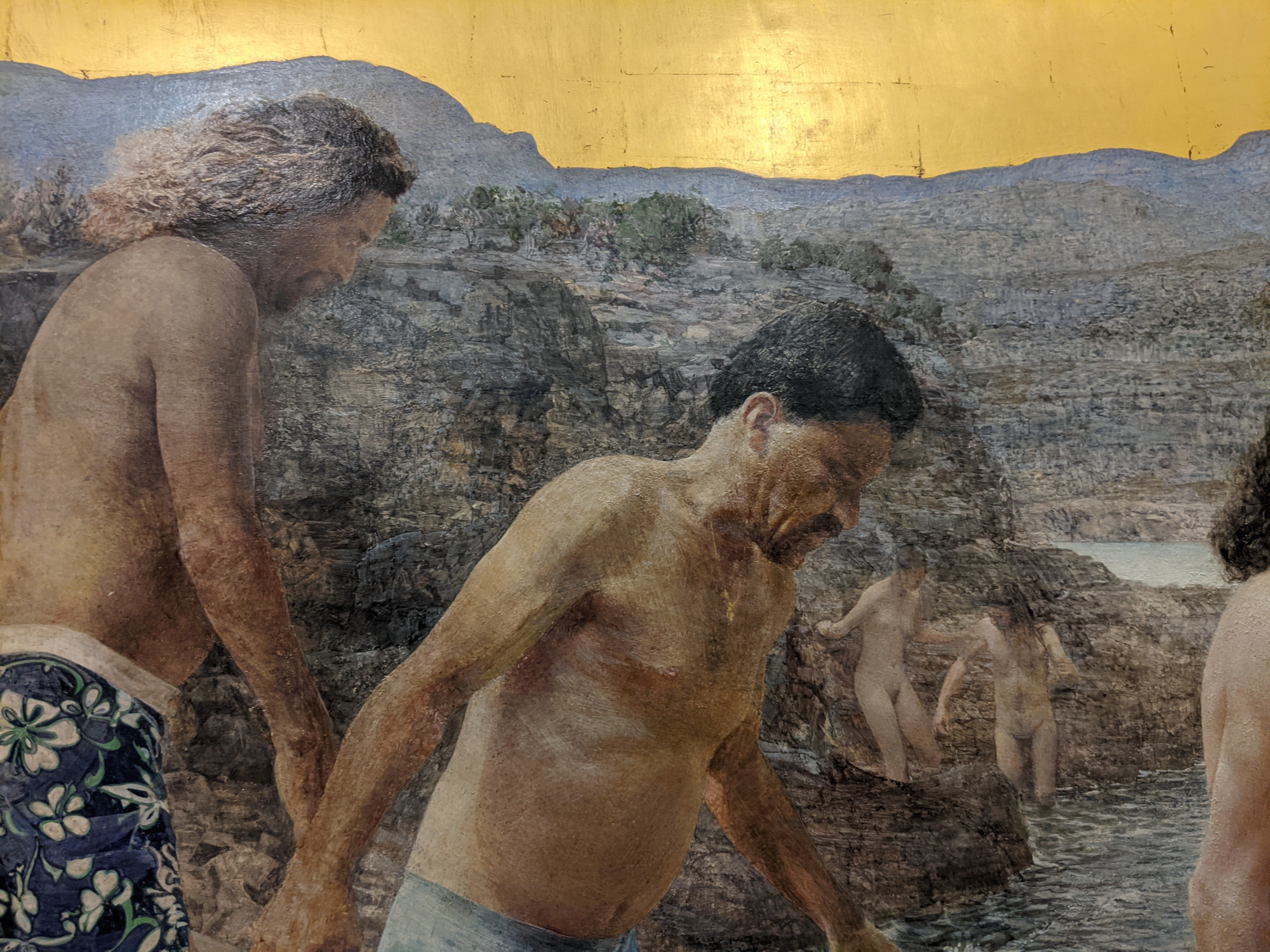
Baptism by Water is, along with its companion piece, Baptism by Fire, the largest painting in the series, at over six feet long. It is a lakeside scene portraying John the Baptist—the long-haired, bleach-blonde guy at the far right—calling folks to repentance. Several men climb down the rocky shoreline to enter the cleansing waters and be raised to new life. The models are all associated in real life with water—surfers, plumbers, fishermen. And this is a local setting: Hippie Hollow on Lake Travis in Central Texas, a famous nude swimming hole.

Jesus, says Cobb, is the young man with the black hair and black trunks. Cobb deliberately made him indistinguishable from the others to emphasize his full humanity. He looks beyond John the Baptist, perhaps mentally preparing for the solitary forty-day fast in the desert he’s about to embark on.

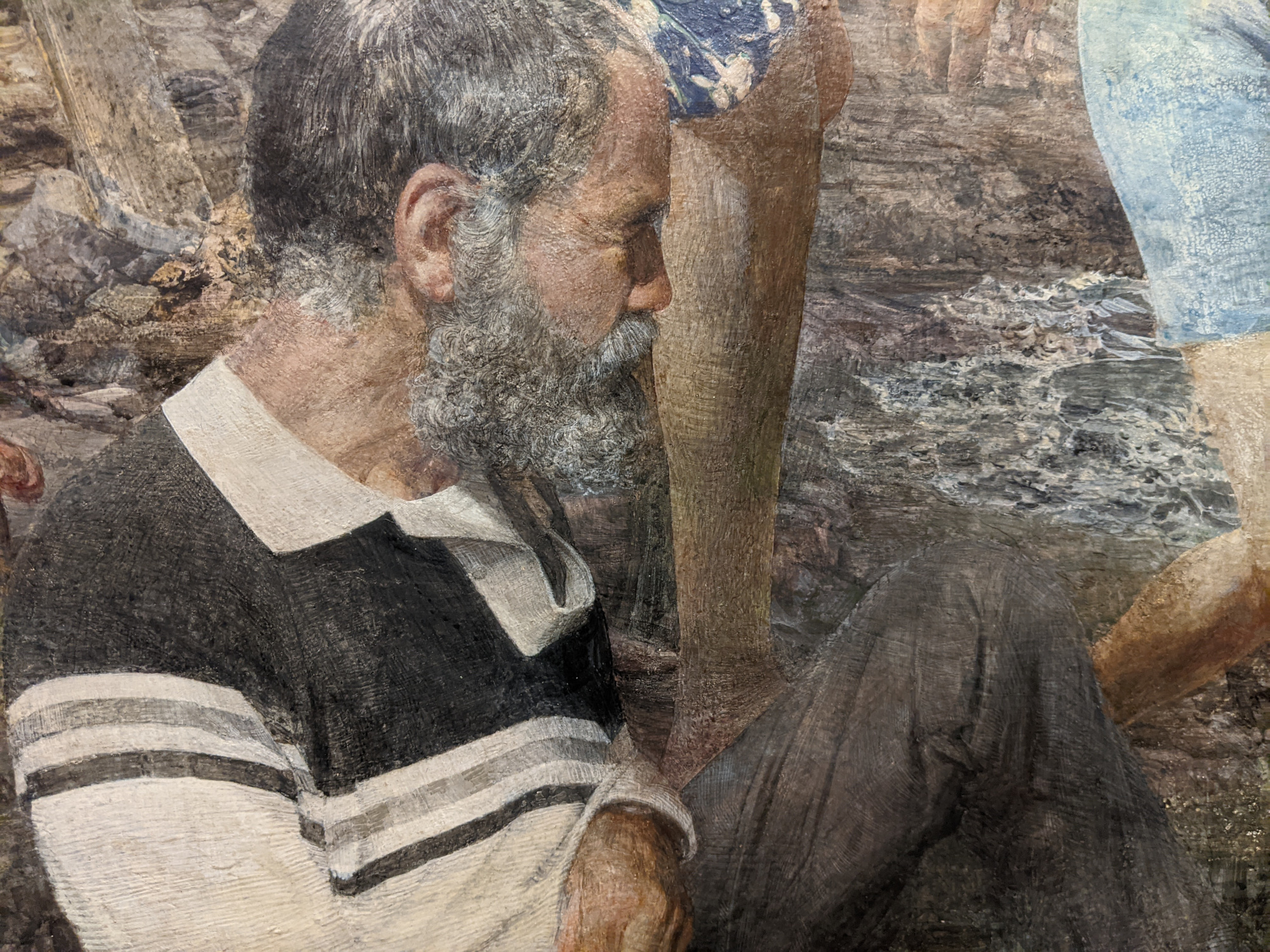
In the wall text in the Ikon Chapel, Cobb describes the seated, shirted man in the foreground as reminiscent of the Gerasene demoniac (Mark 5:1–20):

The figure in the near ground, clothed, was a man who lived in the nook of the sea wall in Galveston and slept in the nearby graveyard at 61st Street. On the worst winter days I would bring him a coffee, and finally asked him one day if I could include him in my painting. He would sometimes drink himself into a frenzy and yell and scream at the cars in horrific anger. His leg had been broken and had healed in a precarious angle. I felt as though if there were anyone who deserved the peace and the Holy Spirit, it would be him.  

At the bottom right, one of the figures twists away, rejecting John’s call. The model’s name is Jonah, so Cobb wanted to use him as a Jonah figure, resisting (at least initially) the divine plan.

In the background Adam and Eve are skinny-dipping.

Detail, John the Baptist

Detail, Jesus
Detail, Jesus (left)

Detail, Adam and Eve
Detail with Eve and Adam in background

Detail
Detail of a local unhoused man with a leg impairment and alcoholism, for whom the artist wishes God’s peace

I was fortunate enough to get to know Cobb a bit over lunch one day while I was in Austin, and then later at an outdoor gathering he and his wife, Tina, hosted on their property. At the time, he was preparing for an extended trip to Italy to restore some Renaissance frescoes in a village chapel.

To learn more about this remarkable body of work, see the book Chapel Ikons: Biblical Meditations on Living the Spiritual Life in the Modern World (Treaty Oak, 2020), which reproduces all twenty-five paintings in full color with detailed commentaries by William Y. Penn Jr. The postscript says that Cobb and Penn are looking for a permanent institutional home with resources to preserve the chapel ikons for public viewing and study and that if interested, you should contact wpenn@me.com.

I also commend to you the article “Art on Board: John Cobb’s Panel Paintings Hit the Texas Highways” by Ginger Henry Geyer from Image no. 47 (Fall 2005), and for a quick video tour of the Ikon Chapel, see the first forty seconds of this video from Austin’s Mexic-Arte Museum.

LISTEN: “A Voice Cries Out” by Nicholas Andrew Barber and Ken Canedo, based on Isaiah 40:1–11 (2020)

Refrain:
A voice cries out in the desert
Come prepare the way of the Lord
God is coming, make straight for him a highway
Come prepare the way of the Lord

Every valley shall be exalted
Every mountain shall be made low
Then shall the Word of God be known
All the earth shall proclaim
The glory of the Lord [Refrain]

Go upon the highest mountain
Zion, herald of good news
Lift your voice, cry out with all your soul
Jerusalem, proclaim
Glad tidings in the Lord [Refrain]

Have no fear, O cities of Judah
Here is your God
See, the Lord is coming now with power
Our God is here
The mighty and the strong [Refrain]

Like a shepherd, he feeds his flock
He gathers the lambs
See, he carries them gently in his arms
So tenderly
With a mother’s love [Refrain]


This post is part of a daily Advent series from December 2 to 24, 2023 (with Christmas to follow through January 6, 2024). View all the posts here, and the accompanying Spotify playlist here. “A Voice Cries Out” is not on Spotify.

Roundup: Guite-Bell live event, Sister Corita Kent, and more

FREE LIVE EVENT: “Faith and the Imagination: Poetry, Song, and Inspiration with Steve Bell and Malcolm Guite,” June 4–7, 2022, Greater Seattle area: Join hundreds of Seattle artists and ministry leaders for four days of poetry, vocal performances, and conversation about the gift of the human imagination for the flourishing of our world, hosted by Cambridge’s distinguished poet Malcolm Guite and award-winning Canadian musician Steve Bell.

Sessions are free and open to the public and will not be livestreamed (and the conversations require advance registration):

  • June 4, 7–9pm: Live Concert (Seattle, WA)
  • June 5, 9:45–11am: Worship Service (Normandy Park, WA)
  • June 5, 7–9:30pm: A Conversation on: Faith and the Arts (Seattle, WA)
  • June 6, 6:30–8:30pm: A Conversation on: Faith and Technology (Bellevue, WA)
  • June 7, 7–9pm: A Conversation on: Faith and Work (Seattle, WA)

Guite and Bell have been collaborating for years. Below are two snippets of them performing together. In the first video Guite comedically performs (to rhythmic accompaniment!) a villanelle he wrote in response to something a woman who worked at the venue of one of his poetry talks exasperatedly said to him when his hurried photocopying caused a paper jam. The second video showcases a sonnet by Guite on the baptism of Christ, from his collection Sounding the Seasons: Seventy Sonnets for the Christian Year, and the song that Bell adapted it into, released on Keening for the Dawn.

+++

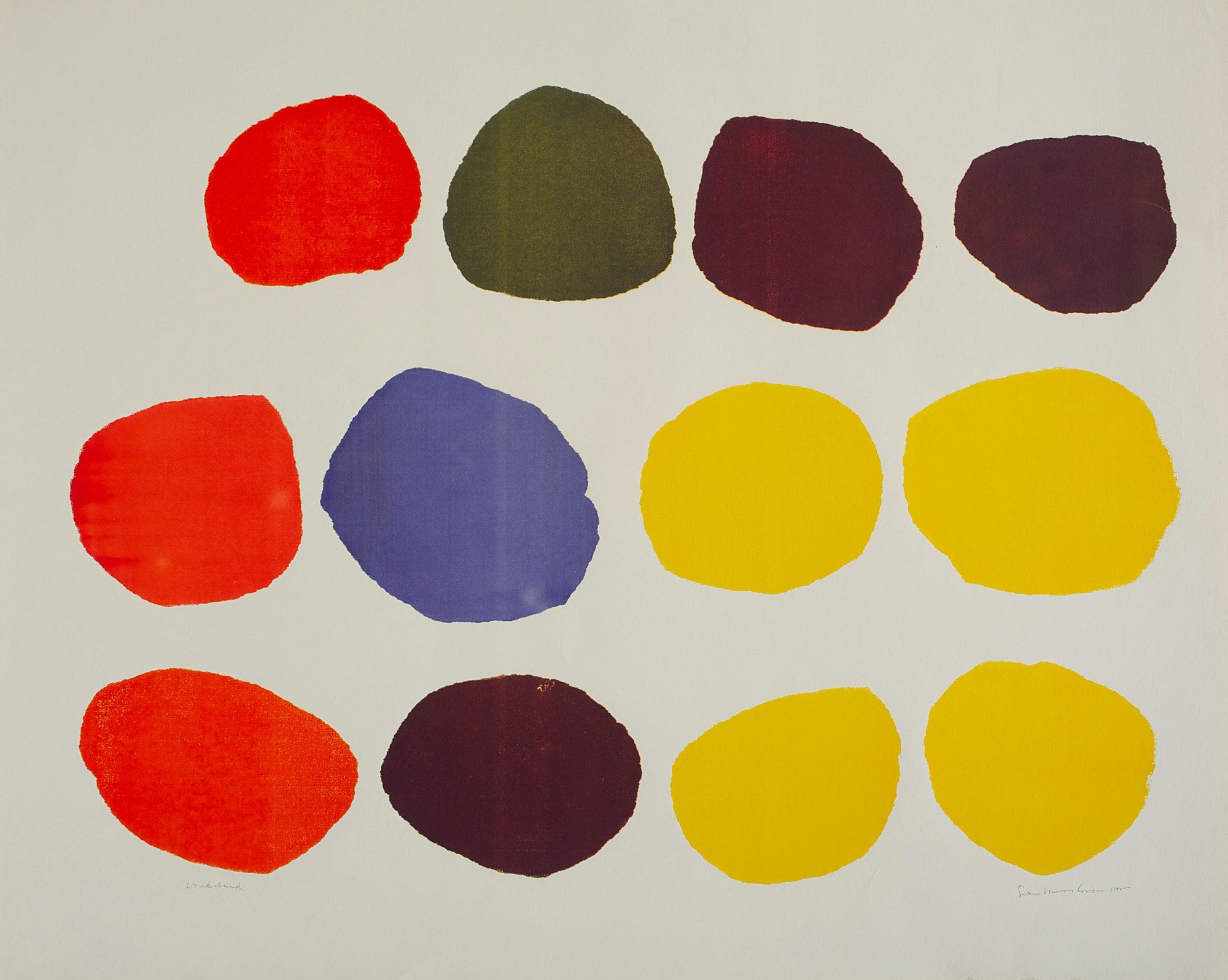
ESSAY: “The Listening Heart: Corita Kent’s Reforming Vision” by Michael Wright: Corita Kent (1918–1986) [previously] was an American pop artist who was also, for over three decades, a nun. Michael Wright writes about how “she became interested not just in depicting scenes from the Bible but answering this: what might happen if a Christian imagination engaged the world around us through the arts? That art might look less like an illustration from a children’s Bible and more like exploring seeing the stuff of life—even a bread bag—as dialogue partners with mysteries of faith.” wonderbread is one of four works he discusses—“a playful meditation on sacred time, wonder, and communion.”

Kent, Corita_wonderbread
Corita Kent (American, 1918–1986), wonderbread, 1962. Serigraph, 25 1/2 × 30 1/2 in.

While I do think even Kent’s biblical artworks push the genre of religious art forward, I appreciate how Wright challenges Christians to give a chance to her works that are less straightforwardly religious, as these are often the most imaginative and profound. And they, too, are “deeply Christian work.” Let’s not think so narrowly about what “Christian art” must look like!

+++

LIVING PRAYER PERIODICAL: Pentecost 2022: One of the organizations I work for is the Daily Prayer Project [previously], which publishes seven ecumenical Christian prayer periodicals a year, structured around the liturgical calendar. I do the curation for the Gallery section, which comprises three art images with written reflections, and the editing. Our latest edition covers June 5 (the feast of Pentecost) through August 6, and it includes prayers from India, Japan, Korea, Algeria, Italy, the Choctow Nation, and more. I’m excited to feature on the cover Corita Kent’s word picture: gift of tongues! As many of her screenprints do, it integrates image and text—in this case Acts 2:1–2a, which sprawls out through the sky and onto a billowing banner, like a sail, over a crowd of people aflame with the fire of the newly descended Spirit of God.

Pentecost LPP 2022

On the website there are options for one-time purchase or group subscription, and for digital only or print and digital.

+++

PRAYER: “The Lord’s Prayer, Extended Dance Mix” by Nadia Bolz-Weber: In March, actor Jennifer Garner asked Lutheran pastor and author Nadia Bolz-Weber if she could offer a prayer and a benediction on her InstaLive. Bolz-Weber vamped on the traditional words of the Lord’s Prayer, the text of which you can read at the boldface link.

Such a beautiful prayer.

One of the things I appreciate about Bolz-Weber’s spiritual teaching is her avoidance of clichés. She gives fresh language to the experiences of faith and life in general and to theology, which often reawakens me to the beauty of God and of Christ’s gospel. Describing why she regularly turns to prayer, she says in the Instagram video:

When I don’t have enough—like if I don’t have enough patience, if I don’t have enough compassion for myself or other people, when I don’t have enough resources—prayer is this way in which I can remind myself that there is enough. That I have a connection to my own divine source. I have a connection to God. And in the heart of God there’s enough forgiveness when I don’t have enough. In the heart of God there’s enough compassion when I don’t have enough. And so for me, it’s about reminding myself of that connection.

+++

SONG: “Dry Bones” by Gregory Porter: From Gregory Porter’s 2021 album Still Rising, this song was inspired by Ezekiel 37. The official music video features dancing skeletons in yellow cowboy boots(!), animated by L’Incroyable Studio. The song’s bridge quotes the African American spiritual “Dem Bones.”

The first verse goes,

I won’t die, won’t bury, won’t sink
’Cause love is the spirit I drink
I’ll be free in the morning light
’Cause your touch is the medicine of life
There’s a dance to this beat, let’s shake
Every move—feel my body awake
There’s a sound—you and me are one
And your hope is the rhythm I drum

Hail to the Lord’s Anointed (Artful Devotion)

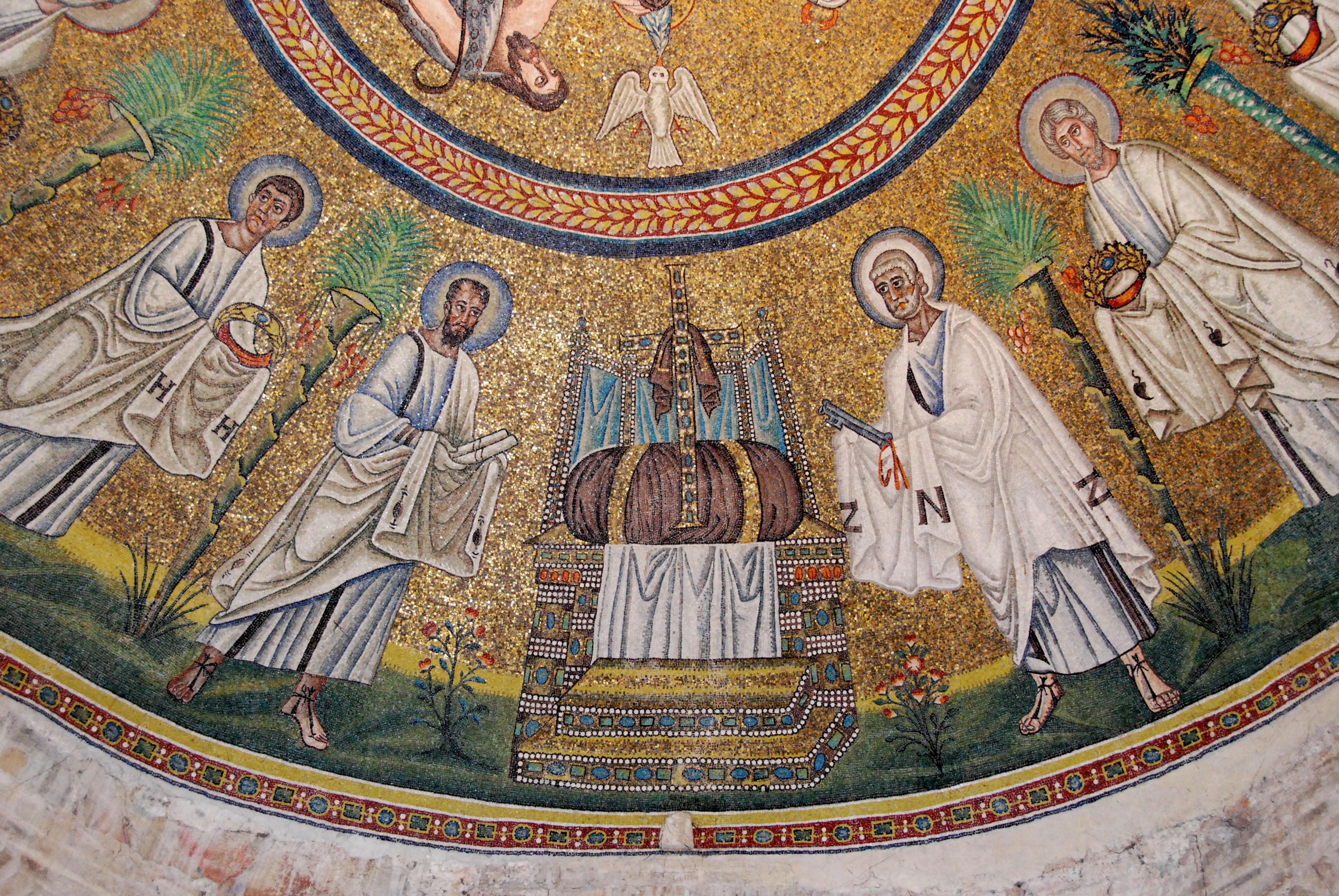
Arian Baptistery mosaic
The Baptism of Christ, early 6th century. Ceiling mosaic, Arian Baptistery, Ravenna, Italy. Photo: Jim Forest.

Behold my servant, whom I uphold,
my chosen, in whom my soul delights;
I have put my Spirit upon him;
he will bring forth justice to the nations.
He will not cry aloud or lift up his voice,
or make it heard in the street;
a bruised reed he will not break,
and a faintly burning wick he will not quench;
he will faithfully bring forth justice.
He will not grow faint or be discouraged
till he has established justice in the earth;
and the coastlands wait for his law.

Thus says God, the LORD,
who created the heavens and stretched them out,
who spread out the earth and what comes from it,
who gives breath to the people on it
and spirit to those who walk in it:
“I am the LORD; I have called you in righteousness;
I will take you by the hand and keep you;
I will give you as a covenant for the people,
a light for the nations,
to open the eyes that are blind,
to bring out the prisoners from the dungeon,
from the prison those who sit in darkness.
I am the LORD; that is my name;
my glory I give to no other,
nor my praise to carved idols.
Behold, the former things have come to pass,
and new things I now declare;
before they spring forth
I tell you of them.”

—Isaiah 42:1–9

Then Jesus came from Galilee to the Jordan to John, to be baptized by him. John would have prevented him, saying, “I need to be baptized by you, and do you come to me?” But Jesus answered him, “Let it be so now, for thus it is fitting for us to fulfill all righteousness.” Then he consented. And when Jesus was baptized, immediately he went up from the water, and behold, the heavens were opened to him, and he saw the Spirit of God descending like a dove and coming to rest on him; and behold, a voice from heaven said, “This is my beloved Son, with whom I am well pleased.”

—Matthew 3:13–17

You yourselves know what happened throughout all Judea, beginning from Galilee after the baptism that John proclaimed: how God anointed Jesus of Nazareth with the Holy Spirit and with power. He went about doing good and healing all who were oppressed by the devil, for God was with him. . . .

He is the one appointed by God to be judge of the living and the dead. To him all the prophets bear witness that everyone who believes in him receives forgiveness of sins through his name.

—Acts 10:37–38, 42–43

+++

SONG: “Hail to the Lord’s Anointed” | Words by James Montgomery, 1821 | Music by the Rev. Vito Aiuto, on Welcome to the Welcome Wagon, 2008 [previously]

https://open.spotify.com/track/6g28yW9SilEHfMZ7WoLfYc?si=YlCyMYclTpmgT6kNHWABXQ

Hail to the Lord’s Anointed,
great David’s greater Son!
Hail in the time appointed,
his reign on earth begun!
He comes to break oppression,
to set the captive free;
to take away transgression,
and rule in equity.

He comes with succor speedy
to those who suffer wrong;
to help the poor and needy,
and bid the weak be strong;
to give them songs for sighing,
their darkness turn to light,
whose souls, condemned and dying,
are precious in his sight.

He shall come down like showers
upon the fruitful earth;
love, joy, and hope, like flowers,
spring in his path to birth.
Before him on the mountains
shall peace, the herald, go,
and righteousness, in fountains,
from hill to valley flow.

To him shall prayer unceasing
and daily vows ascend;
his kingdom still increasing,
a kingdom without end.
The tide of time shall never
his covenant remove;
his name shall stand forever;
that name to us is love.

+++

Arian Baptistery
Arian Baptistery, Ravenna. Photo: Georges Jansoone.

Baptism of Christ, Arian Baptistery
Photo: Peter Milošević

Baptism of Christ, Arian Baptistery
Photo: Fr. Lawrence Lew, OP

Baptism of Christ (detail)
Photo: Jim Forest

The dome of the great sixth-century Arian Baptistery in Ravenna, Italy, shows, in glimmering mosaic, a young, beardless, fully nude Christ standing waist-deep in the waters of the Jordan as John the Baptist, dressed in leopard skin, anoints him—the archetypal event for the liturgy that used to be performed below. And actually, the anointing water in this representation comes from the beak of a dove, God the Holy Spirit.

The old man on the left is a personification of the Jordan River, whose attributes are derived from that of the Hellenistic river gods. He holds a reed in his hand and leans against a spilled jar, from whose mouth flows the river water, while from his head there sprouts a pair of red crab claws. He is clothed in the same moss that covers the rock John stands on.

Around this central scene, which is framed by a laurel wreath, is a procession of the twelve apostles, led by Peter (the gray-haired man with the key) and Paul (the dark-haired man with the scrolls). The apostles carry jeweled crowns in their veiled hands—a sign of humility—as they make their way to the empty throne of Christ’s promised return, the hetoimasia, prepared with a plush purple cushion and jeweled cross.

Hetoimasia mosaic (Ravenna)
Photo: Jim Forest

The iconography here is very similar to that of the ceiling mosaic in the even older (Orthodox) Baptistery of Neon, also in Ravenna.

I’ve featured baptistery dome art two other times on the blog: a painting of Paradise from the Padua Baptistery and a Last Judgment mosaic from the Florence Baptistery. Also related are the compilation of contemporary icons of the Baptism of Christ that I published two years ago (the ones by Jerzy Nowosielski and Ivanka Demchuk are favorites of mine) and last year’s Artful Devotion for this calendar day, featuring a Baptism of Christ from the Hitda Codex and a virtuosic piano piece.


This post belongs to the weekly series Artful Devotion. If you can’t view the music player in your email or RSS reader, try opening the post in your browser.

To view all the Revised Common Lectionary scripture readings for the feast of the Baptism of the Lord, cycle A, click here.

Baptism of Christ (Artful Devotion)

Baptism of Christ (Hitda Codex)
Baptism of Christ, from the evangeliary of the abbess Hitda von Meschede, first half of eleventh century. Hessische Landesbibliothek, Darmstadt, Germany.

As the people were in expectation, and all were questioning in their hearts concerning John, whether he might be the Christ, John answered them all, saying, “I baptize you with water, but he who is mightier than I is coming, the strap of whose sandals I am not worthy to untie. He will baptize you with the Holy Spirit and fire. His winnowing fork is in his hand, to clear his threshing floor and to gather the wheat into his barn, but the chaff he will burn with unquenchable fire.” . . .

Now when all the people were baptized, and when Jesus also had been baptized and was praying, the heavens were opened, and the Holy Spirit descended on him in bodily form, like a dove; and a voice came from heaven, “You are my beloved Son; with you I am well pleased.”

—Luke 3:15–17, 21–22

+++

MUSIC: “Jeux d’eau” (“Play of Water” or “Fountains”) by Maurice Ravel, 1901 | Performed by Martha Argerich, 1977

+++

The Hitda Codex is an eleventh-century manuscript containing an evangeliary, a selection of passages from the Gospels, commissioned by Hitda, abbess of Meschede, in about 1020. Its illuminations are highlights of the Cologne school in the later phases of the Ottonian Renaissance. View more at https://commons.wikimedia.org/wiki/Category:Hitda-Codex.

In the Baptism of Christ painting, Jesus stands waist-deep in Jordan’s rushing waters, which spill forth from an overturned jar in the bottom right held by a personification of the Jordan River. Jesus’s hands are open to receive the Holy Spirit (Spiritus Sanctus), who jets forth from the starry heavens in the form of a dove. God the Father is, by intention, not visualized, but his presence is suggested by the half-circle at the top, which represents the divine realm where he resides.


This post belongs to the weekly series Artful Devotion. If you can’t view the music player in your email or RSS reader, try opening the post in your browser.

To view all the Revised Common Lectionary scripture readings for the feast of the Baptism of the Lord, cycle C, click here.

Contemporary icons of the Baptism of Christ

Today, January 6, is the feast of Epiphany (“manifestation,” “revelation,” “shining forth”)—also referred to as Theophany (“revelation of God”), or the Feast of Lights. While the Western church commemorates the visit of the Magi on this day, focusing on God’s revelation to the world through the birth of Christ, the Eastern church commemorates Jesus’s baptism, focusing on the Father and Spirit’s affirmation of the Son’s divinity at the beginning of his public ministry. Matthew 3:13–17 gives us the account:

Then Jesus came from Galilee to the Jordan to John, to be baptized by him. John would have prevented him, saying, “I need to be baptized by you, and do you come to me?” But Jesus answered him, “Let it be so now, for thus it is fitting for us to fulfill all righteousness.” Then he consented. And when Jesus was baptized, immediately he went up from the water, and behold, the heavens were opened to him, and he saw the Spirit of God descending like a dove and coming to rest on him; and behold, a voice from heaven said, “This is my beloved Son, with whom I am well pleased.”

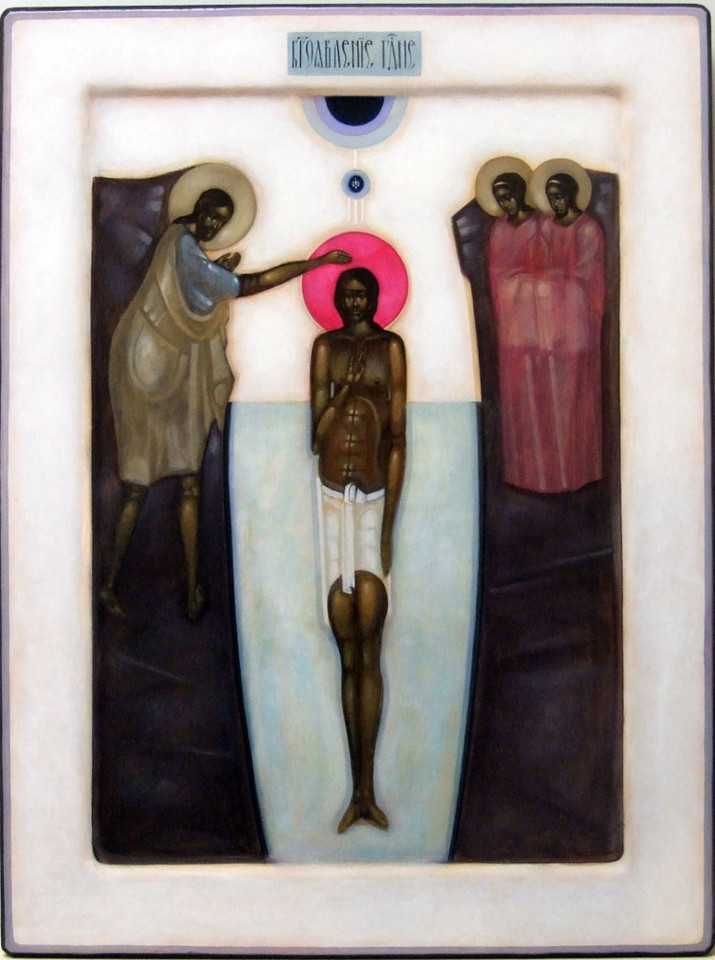
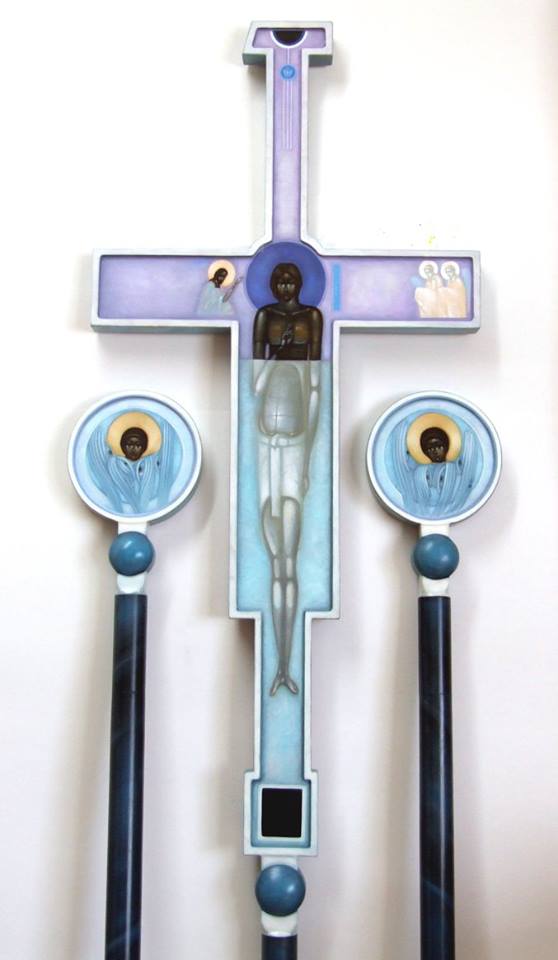
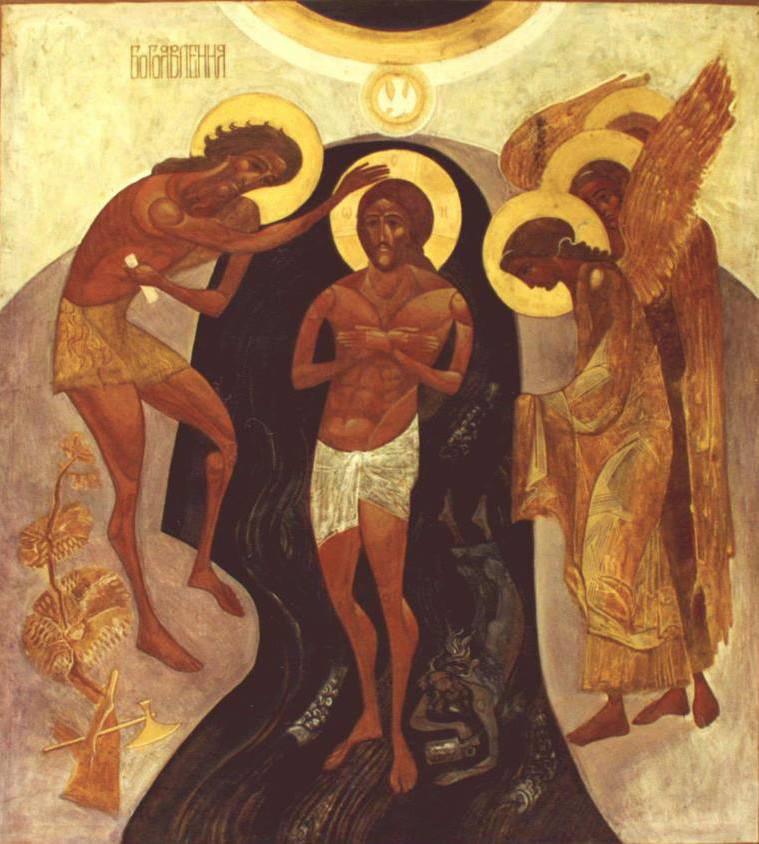
Below is a selection of contemporary Theophany icons from Ukraine, Russia, Poland, Greece, and Romania. All but one of them bear a semicircle at the top, which signifies the “opening of the heavens” and the voice of God reaching down; in Ioan and Camelia Popa’s, God’s hand is even visible. (Representation of the Father is forbidden by tradition, though a hand is generally acceptable because the Bible itself uses anthropomorphic expressions like “God’s hand” and “God’s mighty arm.”) A dove descends from this aperture, a literalization of the Gospel writers’ simile.

On the shores of the Jordan stand one or more angels at the service of their Lord. Their hands are covered by their own cloaks as a sign of reverence—or in some representations, they hold garments to drape over Christ when he emerges from the water. (Early icons of Jesus’s baptism show him completely naked, emphasizing his self-emptying; now, however, it’s more common to see him in a loincloth.)

In Lyuba Yatskiv’s and the Popas’ icons—the most traditional of this bunch—there is an allegorical figure in the river by Christ’s feet, pouring out water from a jug. This man is a personification of the Jordan River, which miraculously dried up, temporarily, to allow the ancient Israelites to cross over into the Promised Land (Joshua 3:15–17). Some icons, though none pictured here, include a second allegorical figure, (Red) Sea, who is turning away, parting (see Psalm 114:3).

In George Kordis’s icon, instead of Jordan at Christ’s feet, there’s a serpent being crushed, a reference to Psalm 74:13: “You divided the sea by your might; you broke the heads of the sea monsters on the waters.” Visually, this recalls the Eastern church’s Resurrection icon, which depicts Christ breaking down the doors of hell, flattening Satan.

Back to Yatskiv and Popa. In these two there is an axe lying next to a tree, alluding to the sermon by John the Baptist that immediately preceded this episode, in which he proclaimed, “Even now the axe is laid to the root of the trees. Every tree therefore that does not bear good fruit is cut down and thrown into the fire” (Matthew 3:10).

Epiphany calls us to worshipfully behold the shining forth of Jesus as messiah and as the second person of the Trinity. To orient yourself to the Orthodox celebration of today’s feast, here are two liturgical hymns, the Troparion and the Kontakion, that will be sung congregationally:

When Thou, O Lord, wast baptized in the Jordan, worship of the Trinity wast made manifest; for the voice of the Father bore witness to Thee, calling Thee His beloved Son. And the Spirit in the form of a dove confirmed the truth of His word. O Christ our God, Who hath appeared and enlightened the world, glory to Thee.

. . .

On this day Thou hast appeared unto the whole world, and Thy light, O Sovereign Lord, is signed on us who sing Thy praise and chant with knowledge: Thou hast now come, Thou hast appeared, O Thou Light unappproachable.

They offer a perfect lens through which to view the following icons.

Baptism of Christ by Jerzy Nowosielski
Jerzy Nowosielski (Polish, 1923–2011), The Baptism of Jesus Christ in the Jordan, 1964. Oil on canvas, 100 × 80 cm.

Baptism of Christ by Greta Leśko
Greta Leśko (Polish, 1979–), Baptism of Christ. Oil on board, 40 × 30 cm. Private collection.

Baptism of Christ by Greta Lesko
Greta Leśko (Polish, 1979–), Baptism of Christ, 2014. Oil on board, 40 × 40 cm.

Baptism of Christ by Greta Lesko
Two-sided processional cross and ripidions by Greta Leśko (Polish, 1979–), 2011. Mixed media on wood. Cross: 90 cm tall (without shaft); ripidions: 13 cm diameter. Church of the Exaltation of the Holy Cross in Górowo Iławeckie, Warmian-Masurian Voivodeship, Poland. (See reverse)

Baptism of Christ by Lyuba Yatskiv
Icon by Lyuba Yatskiv (Ukrainian, 1977–)

Baptism of Christ by Ulyana Tomkeyvch
Icon by Ulyana Tomkevych (Ukrainian, 1981–)

Baptism of Christ by Ivanka Demchuk
Ivanka Demchuk (Ukrainian, 1990–), Baptism of Christ, 2015. Mixed media on canvas and wood, 30 × 40 cm.

Continue reading “Contemporary icons of the Baptism of Christ”

John the Baptist at the National Gallery, London

The feast day of John the Baptist’s birth is coming up on June 24, and London’s National Gallery has provided a great way to immerse yourself in his story—through art! The museum has produced a ten-video series called Saint John the Baptist: From Birth to Beheading, in which Professor Ben Quash, director of the Centre for Arts and the Sacred at King’s College, joins Dr. Jennifer Sliwka, curator of art and religion at the National Gallery, for a stroll through the museum and some nearby sites to discuss various works of art in which John appears.

Quash and Sliwka teach a collaborative master’s program in Christianity and the Arts, which invites participants to

investigate how Christian scripture, beliefs and practices have found expression in art over 2,000 years; trace the idea of beauty in Western theological tradition; make use of examples in London. . . . The MA will enable students to work across disciplinary and specialism boundaries, and in particular to explore simultaneously the art-historical and theological dimensions of Christian art – approaches which are generally pursued in isolation from one another.

Their analysis of the paintings in this video series is superaccessible to those with no art background, and familiarity with Christianity isn’t assumed either.

The ten videos—about eight minutes each—are embedded below.

  1. Introduction

Artwork: Saint John the Baptist from Carlo Crivelli’s Demidoff Altarpiece

  1. Visitation

Artworks: a Visitation painting from the workshop of Goossen van der Weyden; Francesco Zaganelli’s The Baptism of Christ

  1. Birth and Naming

Artworks: scenes from Niccolò di Pietro Gerini’s Baptism Altarpiece; a predella panel by Giovanni di Paolo

  1. Infancy

Artworks: Garofolo’s The Holy Family with Saints; Bronzino’s The Madonna and Child with Saints; Leonardo da Vinci’s The Virgin of the Rocks

  1. Wilderness

Artworks: Giovanni di Paolo’s Saint John the Baptist retiring to the Desert; Saint John the Baptist by an anonymous Italian artist from about 1640–60; Moretto da Brescia’s Christ blessing Saint John the Baptist

  1. Preaching

Artworks: Raphael’s Saint John the Baptist Preaching; Pier Francesco Mola’s Saint John the Baptist preaching in the Wilderness; Parmigianino’s The Madonna and Child with Saints John the Baptist and Jerome

  1. Baptism

Artworks: the baptismal font at Salisbury Cathedral, designed by William Pye; Adam Elsheimer’s The Baptism of Christ; and the most famous painting of this subject in any collection: Piero della Francesca’s The Baptism of Christ

  1. Martyrdom

Artworks: Caravaggio’s The Beheading of Saint John the Baptist at St. John’s Co-Cathedral in Malta; Pierre-Cécile Puvis de Chavanne’s The Beheading of Saint John the Baptist

  1. The Baptist’s Head

Artworks: Caravaggio’s Salome receives the Head of John the Baptist; Ana Maria Pacheco’s Study of Head (John the Baptist III) at a private residence (includes an interview with the artist)

  1. Power and Judgment

Artworks: the anonymous English Portrait of Richard II at Westminster Abbey (John the Baptist was his patron saint); a scene above the central panel of Giovanni dal Ponte’s Ascension of Saint John the Evangelist Altarpiece depicting John the Baptist preparing souls to enter into heaven; and The Wilton Diptych, depicting John the Baptist presenting King Richard to the heavenly retinue


To engage with more art from the National Gallery, consider buying one of the two books I reviewed here.