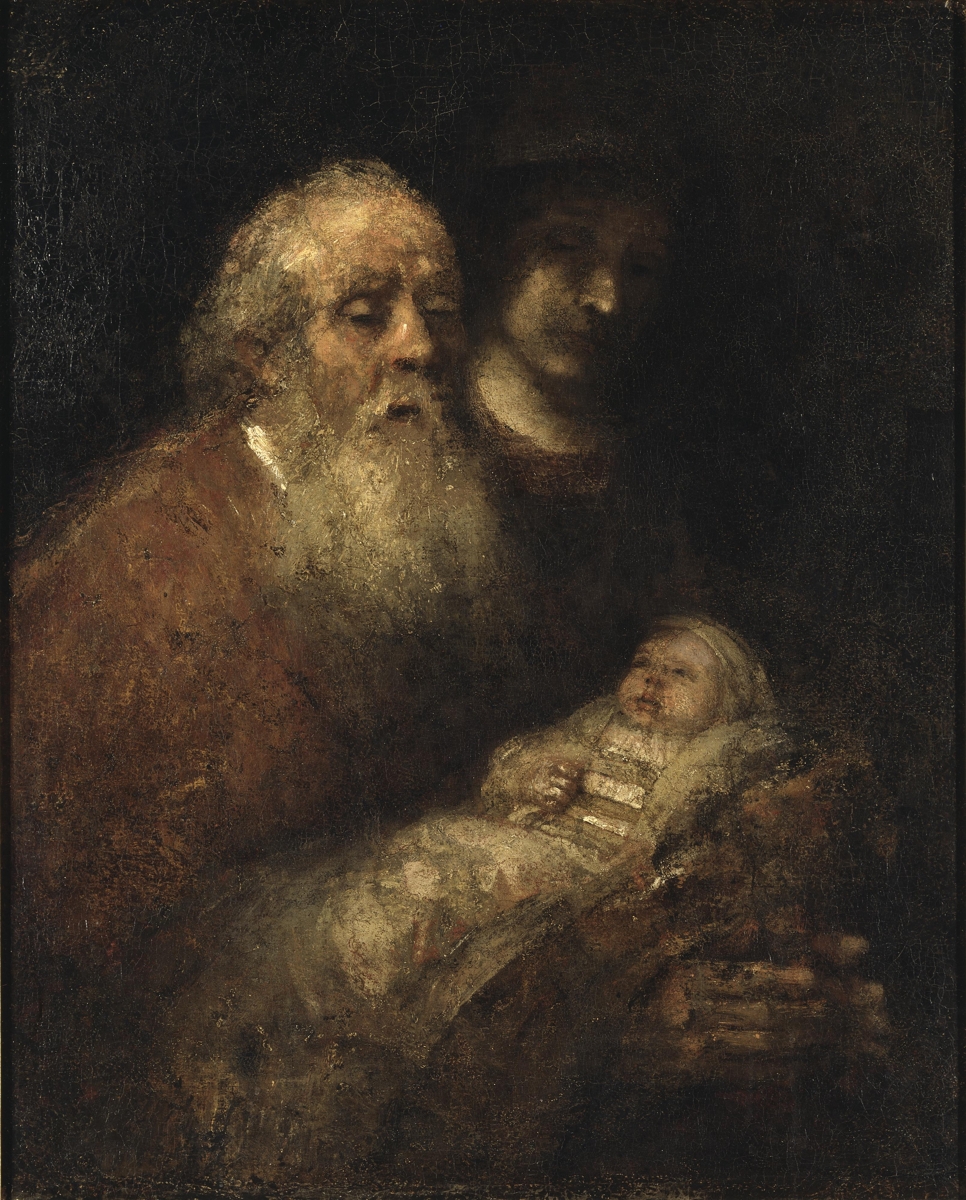
Rembrandt Harmensz. van Rijn (Dutch, 1606–1669), Simeon in the Temple, 1669. Oil on canvas, 98.5 × 79.5 cm. Nationalmuseum Stockholm, Sweden. Photo: Erik Cornelius.
after Simeon in the Temple, Rembrandt, 1669
Fingers stretch as if supplicating hands are interrupted— the answer placed in his waiting arms.
Light glistens on his temple— the mind consoled by consolation’s burden.
Death takes the prophet; takes the artist before his painting is complete; takes the one already bearing sin’s stripes.
This is the third installment of my annual “25 Poems for Christmas” series. Included too, on the front end, are poems for Advent, the four-week season of preparation, hope, and expectation leading up to Christmas.
1. “Advent (III)” by W. H. Auden, from For the Time Being: Voiced by the Chorus, who cry out from “a dreadful wood / Of conscious evil,” this is the third section of part 1 of Auden’s book-length Christmas poem in nine parts, For the Time Being—“the only direct treatment of sacred subjects I shall ever attempt,” he said. He wrote the poem in 1941–42. He had originally conceived it as the libretto of an oratorio that Benjamin Britten would write the music for, but the text turned out to be too complex, and Britten abandoned the project. The final two lines of this section set us up for the seemingly impossible feat of divine incarnation: “Nothing can save us that is possible: / We who must die demand a miracle.”
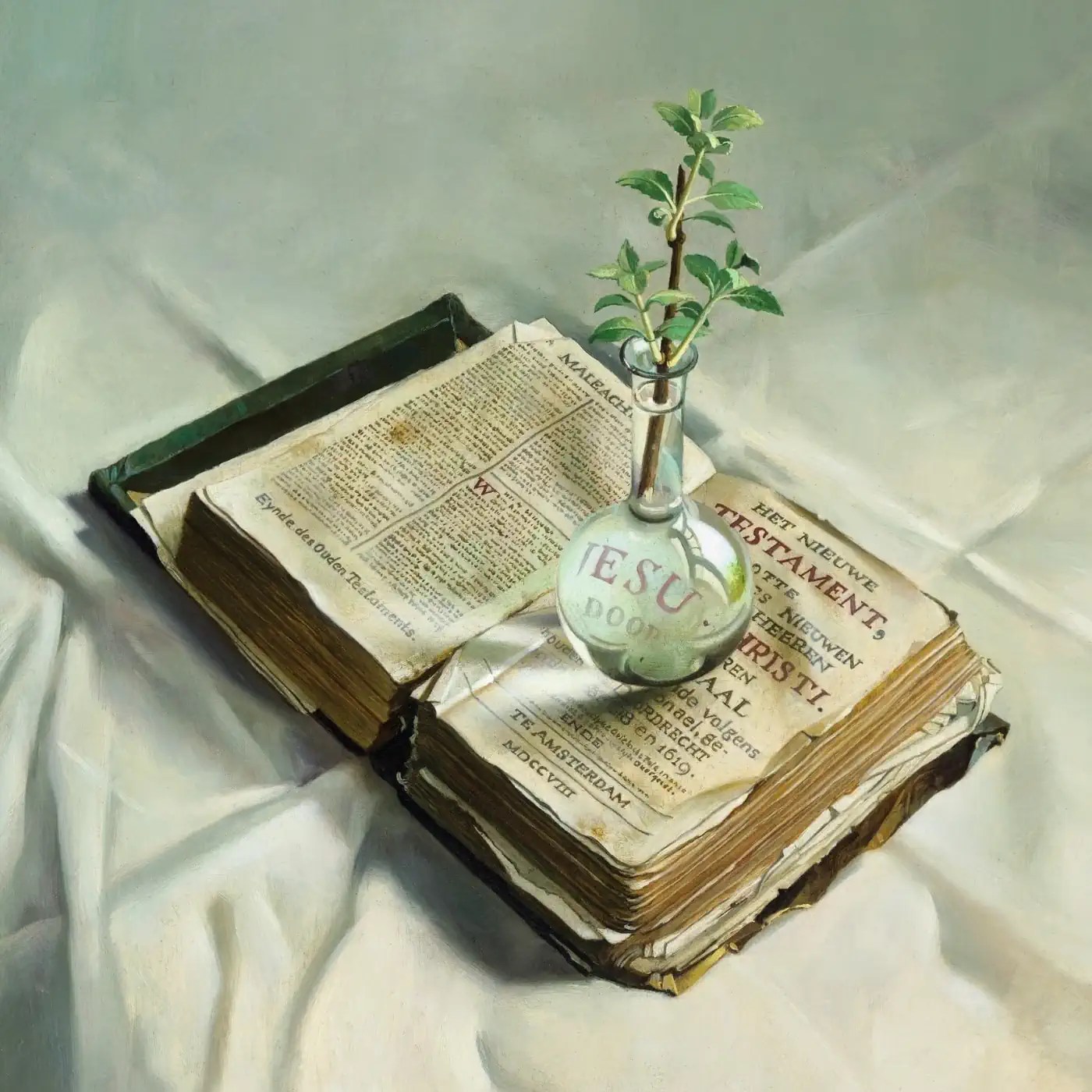
3. “O Orient Light” by James Ryman: Loosely influenced by the O Antiphons (a set of short chants used in medieval Advent liturgies), this Middle English lyric is by the fifteenth-century Franciscan friar James Ryman of Canterbury; it’s one of 166 sacred poems he published in a 1492 collection. Each stanza consists of one rhyme repeated six times, and the Latin refrain translates to “O Christ, king of the nations, / O life of the living.” The fourth stanza is a standout, connecting the salvation wrought by Christ to the healing properties of plants: “O Jesse root, most sweet and sote, / In rind and root most full of bote, / To us be bote, bound hand and foot, / O vita viventium.”
Source: Cambridge University Library, MS Ee. 1.12; compiled in The Early English Carols, ed. Richard Leighton Greene, 2nd ed., revised and enlarged (The Clarendon Press, 1977). Public Domain.
Henk Helmantel (Dutch, 1945–), Nieuw Leven II (New Life II), 1999 (after the 1972 original that was stolen). Oil on canvas, 27 × 24 cm.
4.“Merger Poem”by Judy Chicago: “Merger Poem” is an aspiration that artist Judy Chicago wrote to accompany her 1979 monumental artwork The Dinner Party, a celebration of the richness of women’s heritage, expressed as place settings around a table, that is housed at the Brooklyn Museum. Her vision in the poem is not theistic, at least not explicitly so, but she uses the language of “Eden,” and her descriptions evoke passages from Isaiah about a future harmony, a merging of heaven and earth, in which justice and equity are achieved at last—not to mention the strong eschatological tones that feasting has in Christianity. Each line begins with “And then,” cumulatively generating a longing in the reader for “then” to arrive.
5.“truth”by Gwendolyn Brooks: “And if sun comes / How shall we greet him?” the speaker asks at the opening of this poem. The sun here represents truth, revelation, illumination, which we may seek with weeping and prayer but which can be dreadful when it actually comes. It’s often more comfortable to stay asleep in the dark than to confront the stark brightness of day. But oh, what we miss when we do! Gwendolyn Brooks uses the pronoun “him” for the sun, and it’s easy to read the poem Christologically: you can read it in the sense of any of Christ’s three comings—as a baby in Bethlehem, in personal, inner ways (he reveals himself, and seeks entrance, to human hearts), or as a king and judge at the end of time. Did you catch the reference to Revelation 3:20?
Source: Annie Allen (Harper & Row, 1949); compiled in Blacks (Third World Press, 1987)
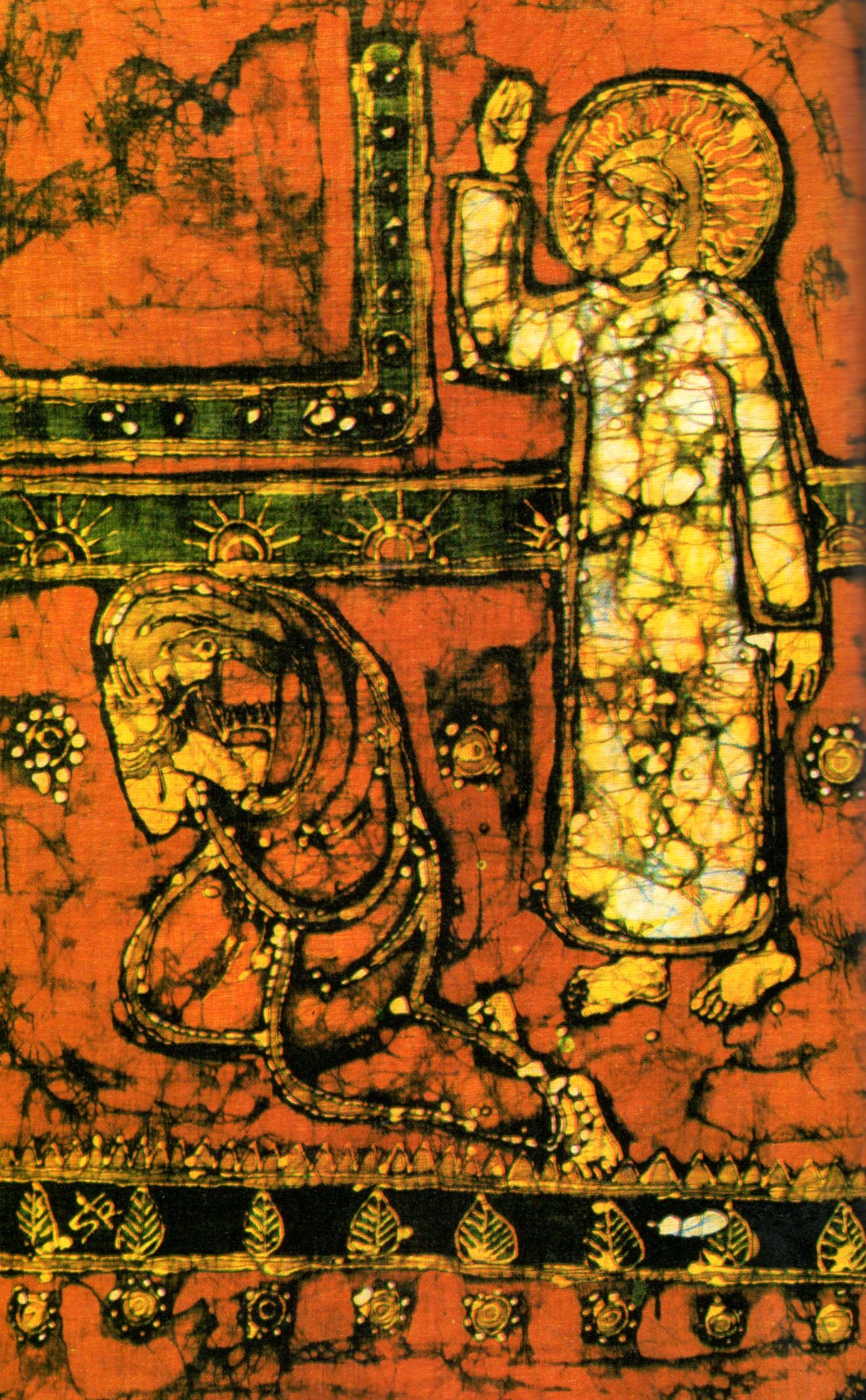
P. Solomon Raj (Indian, 1921–2019), Waiting for My Lord, batik, published in Living Flame and Springing Fountain (ISPCK, 1993)
6. “Advent” by Mary Jo Salter: In this poem a mother and daughter are building a gingerbread house when a wintry gust tears a shutter on their actual house off its hinges, the shock of the thud causing, inside, a gingerbread wall to split. I think “house,” here, could be a metaphor for a faith structure; a house of belief. Shutters are doing a lot of work in the text: one falls off in a storm, and the daughter’s Advent calendar consists of twenty-five shutters, one opened each day until Christmas to reveal a Bible verse or narrative scene.
I’m not quite sure how to interpret the poem overall, but it seems to be addressing themes of (in)stability, brokenness and repair, the desire to believe versus the impulse to shut out belief, openness (“The house cannot be closed”), (dis)enchantment, the mother-child bond, and safety and danger (the Christmas story, like faith itself, characterized by both). I can’t decide if the “blank” in the final tercet sounds hopeful or bleak: does it connote possibility or lack? And is the mother suggesting in the final line (a repurposing of the final line from stanza 15) that what’s most real to her is not Mary and the baby Jesus but herself and her own child, right there in that moment?—or is she finding a point of kinship with Mother Mary in the love she feels for her offspring?
7. “Nativity”by Li-Young Lee: “What is the world?” asks a little boy in the darkness; and again as an adult. A poem of spiritual questing, Li-Young Lee’s “Nativity” deals with existential questions, ending with a tercet that evokes Isaac Watts’s famous carol line “Let every heart prepare him room.” Within us we must make a manger, a “safe place,” to receive the wild God.
8.“Nazareth” by Drew Jackson: Ancient Nazareth, where Jesus grew up, was an insignificant village that many believed no good could come out of (see John 1:46). This poem by public theologian Drew Jackson accentuates Jesus’s origins there, his identity as a “southsider” (Nazareth is in southern Galilee). Today some urban neighborhoods on the “South Side” are disparaged, their residents dismissed as poor and lacking education and potential. God chose to incarnate in a rural neighborhood with a similar reputation, not simply dropping in and then leaving but, as the second person of the Trinity, being formed and nurtured in that environment. “Nazareth” is from Jackson’s debut poetry collection, in which he works his way through the first eight chapters of Luke’s Gospel, drawing out the theme of liberation and making contemporary connections.
9. “The Visitation”by Calvin B. LeCompte Jr.: The poet imagines the fields that Mary passes on her way to her cousin Elizabeth’s house joining in the Magnificat, praising the Savior in her womb.
10.“My Darling” by Alexandra Barylski: Mary and Joseph are cuddling in bed as she reflects on the divine interventions that brought and kept them together. The poem references the legend, originating in the second-century Protoevangelium of James and repeated in the seventh-century Gospel of Pseudo-Matthew, that Joseph was chosen to wed Mary when from his staff, submitted to the high priest along with those of other single men, there miraculously emerged a dove. Mary expresses appreciation for Joseph’s “visionary love,” patience, and courage in their relationship, his spiritual leadership and support.
Source: Reformed Journal, May 11, 2021
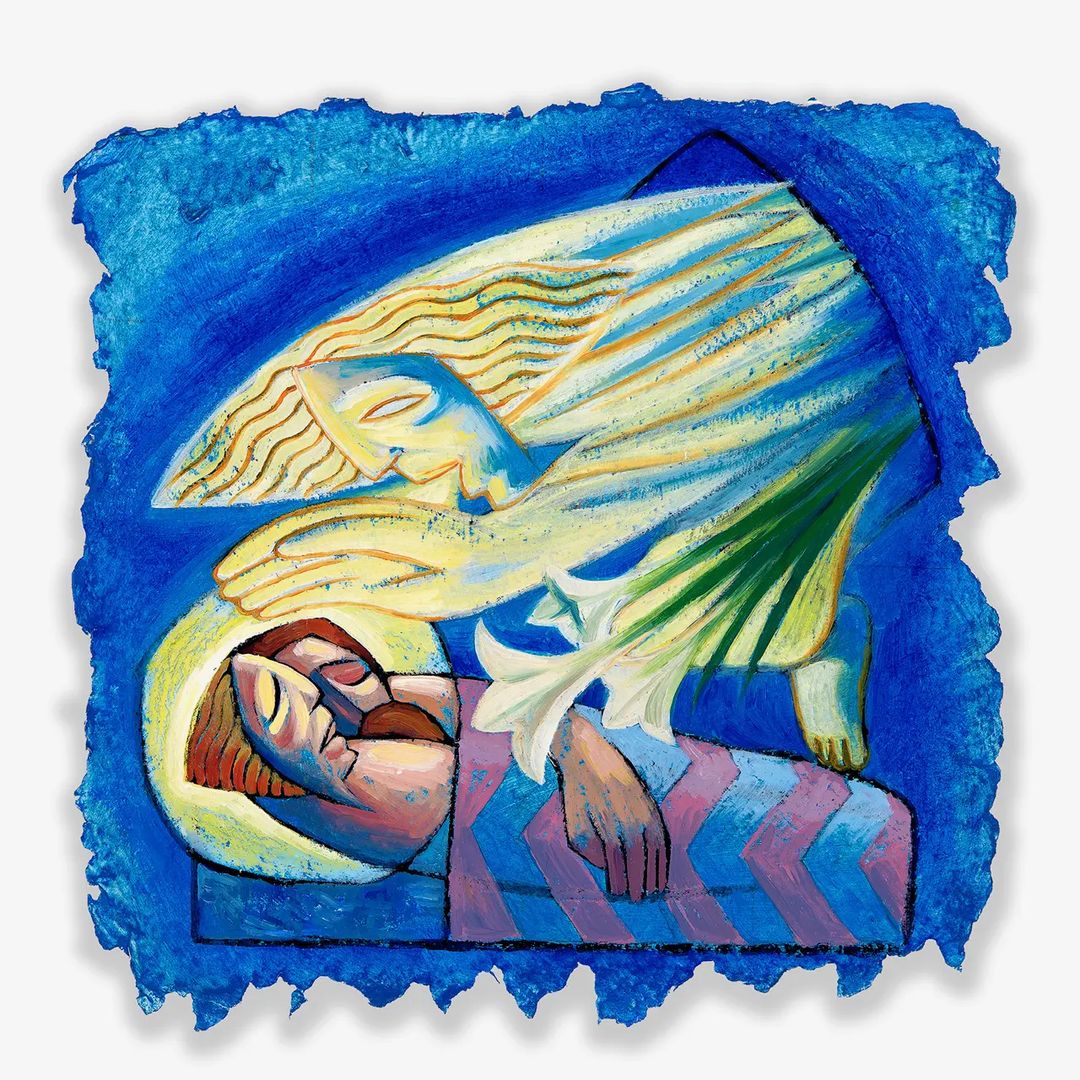
Nicholas Mynheer (British, 1958–), Annunciation, 2017. Oil on handmade paper, 20 × 20 cm.
11. “A Blessing for the New Baby” by Luci Shaw: The speakers of this poem give a lovely benediction over Christ—preincarnate and then embryonic in the first stanza, then out of the womb in the second and third.
12.“Love’s Delights” by Meister Eckhart, rendered by Jon M. Sweeney and Mark S. Burrows: The medieval German mystic Meister Eckhart didn’t write poetry, but many of his sermons have a poetic quality to them, so contemporary poet Mark S. Burrows and writer Jon M. Sweeney, working from an English translation of the Middle High German by Frank Tobin, reworked select excerpts into verse. Adapted from a sermon Meister Eckhart preached on Isaiah 60:1, this poem meditates on the downward movement of love that raises up.
13. “Word Become Flesh” by Seth Wieck: Pregnancy, childbirth, and nursing take a toll on the body. Voiced by Mary, this poem highlights the bodily realities of Jesus’s first coming—Mary swollen, bruised, cracked, and bleeding. She was wounded for our transgressions, in the sense that she endured kicks to the ribs, postpartum hemorrhoids, etc., in order to bring forth our Savior, and by these wounds, because they gave life to Jesus, our healing was made possible. The last sentence is a zinger. Mary gives (physical) birth to Jesus, and he gives (spiritual) birth to her.
14.“Prince of Peace” by Brian Volck: The poet provides his own introduction to this poem on his website: “Octavian Augustus, first emperor of Rome, was known by many titles, including Divi Filius (Son of God) and Princeps Pacis (Prince of Peace). An inscription in Asia Minor states that Augustus’s birth ‘has been for the whole world the beginning of the gospel (εύαγγέλιον) concerning him.’ How strange, then, to use the same names for a contemporaneous but obscure Palestinian Jew, whose understanding of peace, politics, and power was so radically different. How strange to have so long diluted the scandal of the gospel (good news) with accommodations to an Augustan vision of a peace built on the use or threat of lethal violence. Here’s a Christmas poem calling attention to that contrast in a conscious act against forgetting.”
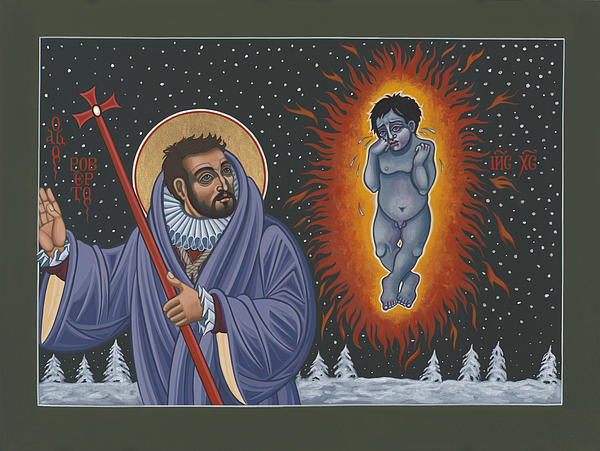
15.“The Burning Babe” by Robert Southwell: Consisting of sixteen lines in iambic heptameter, this poem by the Jesuit martyr-saint Robert Southwell [previously] relates a mystical vision of the Christ child, who appears to the narrator on a cold winter’s night, enflamed and hovering in midair. The poem develops the metaphor of the love of Christ as a fiery furnace that both warms and purifies.
Source: St Peter’s Complaint, and Other Poems (London, 1595). Public Domain.
William Hart McNichols (American, 1949–), Holy Poet-Martyr St. Robert Southwell and the Burning Babe, 2015. Acrylic on wood. [purchase reproduction]
16.“Advent 1966” by Denise Levertov: This poem is shocking in its horror. Written in 1966, it picks up Southwell’s image of the Burning Babe and transposes it to the napalmed villages of Vietnam, where children were being physically (not symbolically or ethereally, as in Southwell’s poem) set on fire by chemical weapons deployed by the US military. Denise Levertov [previously], who was an antiwar activist as well as a poet, uses repetition to strong effect, conveying a sense of the seemingly relentless carnage (the war produced an estimated two million civilian casualties, more than half the total number). Though addressing a specific historical event, this elegy for the innocent provokes us to consider where similar atrocities are happening today.
Source: To Stay Alive (New Directions, 1971); compiled in Making Peace, ed. Peggy Rosenthal (New Directions, 2006)
17.“Christmas Eve”by Christina Rossetti: The Victorian poet Christina Rossetti [previously] opens this lyric with two paradoxes that characterize Christmas—bright darkness and chilly warmth—referencing the general mood of cheer and comfort that coexists with the bleak English midwinter. Why this mirth? Because “Christmas bringeth Jesus, / Brought for us so low.” Jesus was brought down from heaven in the Incarnation, but he would be brought lower still: his spirits sunken in Gethsemane, his body buried in a grave. The second stanza evokes a wedding: dressed in a bridal gown of gauzy snow, earth receives her heavenly Bridegroom.
Source: Time Flies: A Reading Diary (London, 1885); compiled in The Complete Poems (Penguin, 2001). Public Domain.
18. “Hill Christmas” by R. S. Thomas: In a poor rural Welsh village, parishioners make their way across snowy fields, weather-beaten, on Christmas to feed their bodies and souls with a snow-white bread loaf and crimson wine. In the celebration of the Eucharist, they hear love cry “in their heart’s manger.” Then they return to the day’s chores. I think the last line refers to a wayside crucifix.
Source: Laboratories of the Spirit (Macmillan, 1975); compiled in Collected Poems, 1945–1990 (Dent, 1993)
19.“back in the day” by Carl Winderl: In a practice known as “settinglambs on,” when a baby lamb dies in birth, sheep farmers will often take a live lamb (an orphan, or a twin or triplet from another ewe) and cover it in the skin of the deceased one so that, when the grieving mother smells the familiar scent of her deceased offspring, she accepts the lamb as her own. In Carl Winderl’s poem, Mother Mary reflects on that practice and has a premonition of a dead lamb.
Source: Christian Century, December 27, 2023
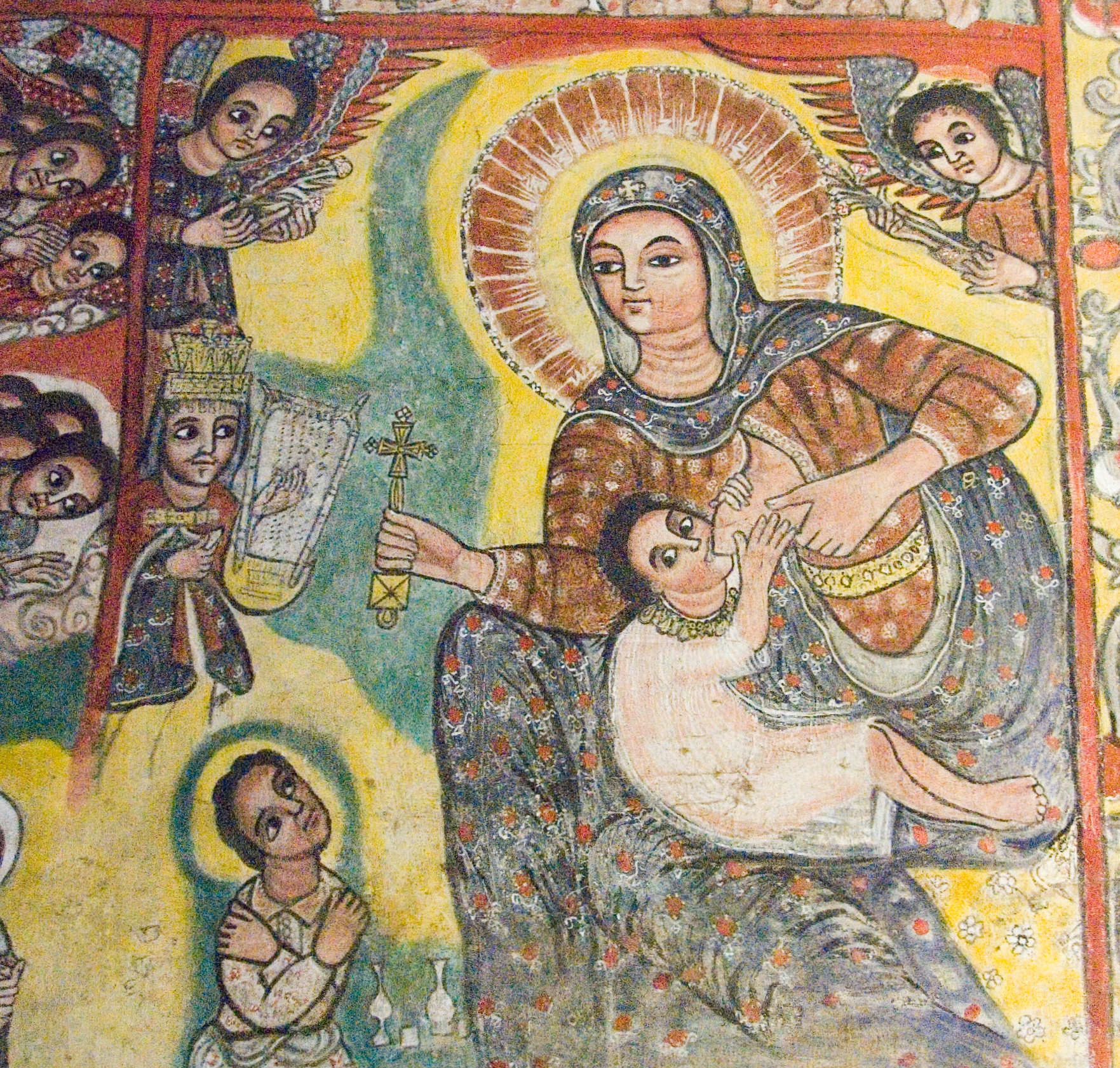
20.“Hymn 4 on the Nativity of Christ” by Ephrem the Syrian: St. Ephrem, a church father from the fourth century, wrote his theology in verse and is one of the most significant Early Christian hymnists. His Nativity hymns are my favorite; I’m particularly struck in Hymn IV by his meditation on how the Christ who suckles at Mary’s breast also gives suck to the whole world. “He is the Living Breast of living breath,” as Kathleen E. McVey translates the Syriac.
Source: Ephrem the Syrian: Hymns, trans. Kathleen E. McVey (Classics of Western Spirituality) (Paulist Press, 1989)
Maria lactans, late 18th century. Fresco, Church of Narga Selassie, Dek Island, Lake Tana, Ethiopia. Photo: Alan Davey.
21. “Nativity” by Scott Cairns: This is the first in a pair of ekphrastic poems called “Two Icons,” in which the poet, who is Greek Orthodox, describes an icon from his home prayer corner. The first three stanzas engage in constructive wordplay: Jesus is wrapped in swaddling bands by his mother, and she is rapt—enraptured, wholly absorbed—by him. She holds him in her gaze and in her hands, and is beholden to him. Icons are about just that: beholding Christ and the sacred mysteries and deepening our affection for the One who holds us in affection. In Nativity icons our gaze is directed to “the core / where all the journeys meet, appalling crux and hallowed cave and womb,” where we are beckoned, like the magi, to bow before the incarnate God.
22.“Star of the Nativity” by Joseph Brodsky: The Nobel Prize–winning Russian poet Joseph Brodsky was born into a Jewish family, but he was captivated by the story of Jesus’s birth and wrote many poems about it. The final stanza of this one gives us the unique perspective of the Star of Bethlehem, looking down—the Father’s beaming pride.
Source: Nativity Poems (Farrar, Straus and Giroux, 2001)
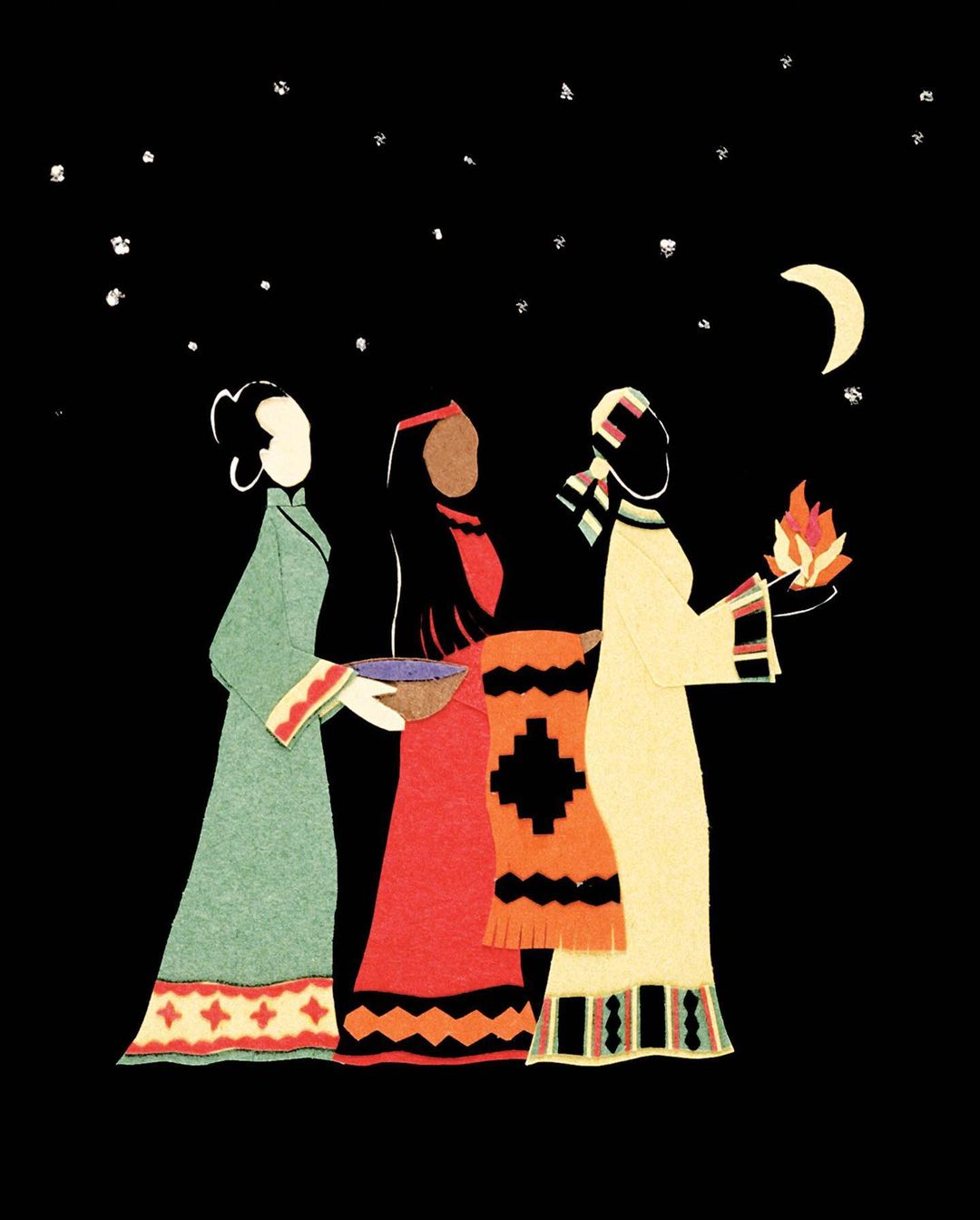
23. “Wise Women Also Came” by Jan Richardson: The Gospel of Matthew tells us that when Jesus was born, wise men came from the east to worship him. But wise women came too, Jan Richardson surmises. They came during Mary’s labor—midwives assisting with the birth. They came with lamps, fresh water, and blankets.
Jan Richardson (American, 1967–), Wise Women Also Came, 1995. Collage. [purchase reproduction]
24.“Green River Christmas” by John Shea: Theologian and storyteller John Shea reflects on how, after experiencing something scary or unpleasant (like getting a shot or a teeth cleaning), mothers often give their child a treat. Christmas is a kind of supreme treat after the penitential season of Advent, during which we confronted the state of our spiritual health and remedied any shortfalls. Think, too, of the liturgy of (somber) confession and (sweet) pardon every Sunday at church, a prelude to the feast of bread and wine. At the Lord’s Table, we are fed—the gifts of God for the people of God. The Eucharist is the subtext of the final stanza, where Shea describes the presentation of Jesus in the temple forty days after his birth. There he is received by “the long-starved arms / of Simeon and Anna.” They had hungered for salvation, endured a long period of waiting; now they are filled.
25.“Taking Down the Tree” by Jane Kenyon: “Tick, tick, the desiccated needles drop.” This poem is about the passing of time—the death of another year—and the glumness that often sets in after the holidays are over, but it’s also about the storage of memories. In many households, Christmas ornaments are a multigenerational collection of memories. As with hanging them on the tree, taking them off and packing them away is a ritual that may prompt us to revisit certain past experiences or periods in our life. After we unplug the stringed lights and wrap up the baubles for safekeeping, then what? How will we inhabit the twelve months until next Christmas?
Whereas in our present age it’s common for families to take down their Christmas decorations on Twelfth Night (January 5) or Epiphany (January 6)—and many American Christians do so even sooner—in medieval Europe they typically stayed up through Candlemas on February 2, or were removed the evening before. Yes, Christmas was celebrated for forty days in the Middle Ages! Why that span? Because forty days after his birth, the infant Christ was presented in the temple according to Jewish custom and inspired the famous song of Simeon about finally getting to see God’s salvation and glory. The feast of Candlemas commemorates this event each year, which many medieval worshipping communities regarded as the bookend of the Christmas season.
In her book Winters in the World: A Journey through the Anglo-Saxon Year, Eleanor Parker notes that Candlemas is the last feast of winter and the first feast of spring—a transitional festival that looks back to Christmas and forward to Easter (86). The date coincides with a significant point in the solar year: midway between the winter solstice and the spring equinox. Read more in an UnHerd article by Parker, “Light a candle; spring is coming.”
So as we celebrate Candlemas this Friday, we bid farewell to Christmas and prepare to welcome Lent. The Chorus of Westerly models a respectful send-off in a video they released in January 2021, combining a choral performance of the “Candlemas Eve Carol” with a recitation by James Lawson of “Now Have Good Day”—both texts from early modern England.
The text of the first carol, originally published with the title “Ceremonies for Candlemasse Eve,” is by the poet-priest Robert Herrick (1591–1674), and the tune is traditional, collected from an old church gallery book; the two appear together in The English Carol Book (Second Series) (1923), edited by Martin Shaw and Percy Dearmer. The Chorus of Westerly sings the first two stanzas and refrain:
Down with the rosemary and bays, Down with the mistletoe; Instead of holly, now upraise The greener box (for show).
The holly hitherto did sway; Let box now domineer Until the dancing Easter day, Or Easter’s eve appear.
Thus times do shift; each thing his turn does hold; New things succeed, as former things grow old.
(Update, 12/31/25: I just learned that Kate Rusby sings this text, to an original tune, on her 2008 album Sweet Bells.)
Herrick describes the English family tradition of taking down the Christmas greens—rosemary, bay, mistletoe, holly—on Candlemas Eve, replacing them with boxwood, which would stay up for the duration of Lent.
“Burning the Christmas Greens,” uncredited illustration from the January 29, 1876, edition of Harper’s Weekly
The remaining three stanzas move through the rest of the church year, associating yew with Easter, birch with Pentecost, and rushes and oak with Ordinary Time. The changing of seasonal decorations becomes for Herrick an emblem of the transience of life.
Now have good day, now have good day! I am Christmas, but now I go my way.
Here have I dwelt with more and less [i.e., everyone] From Hallowtide till Candlemas, And now I must from you hence pass; Now have good day!
I take my leave of king and knight, Earl and baron, and lady bright; To wilderness I must me dight; [I must prepare myself to go into the wilderness] Now have good day!
And of the good lord of this hall I take my leave, and of guests all; Methinks I hear that Lent doth call; Now have good day!
. . . . . . . . . . . . . . . . . . .
Another year I trust I shall Make merry in this hall, If rest and peace in our fair land may fall; Now have good day!
. . . . . . . . . . . . . . . . . . .
Now fare ye well, all in fere; [together] Now fare ye well for all this year; Yet for my sake make ye good cheer; Now have good day!
This sixteenth-century carol is compiled in the commonplace book of the London merchant Richard Hill (Oxford, Balliol College MS 354).
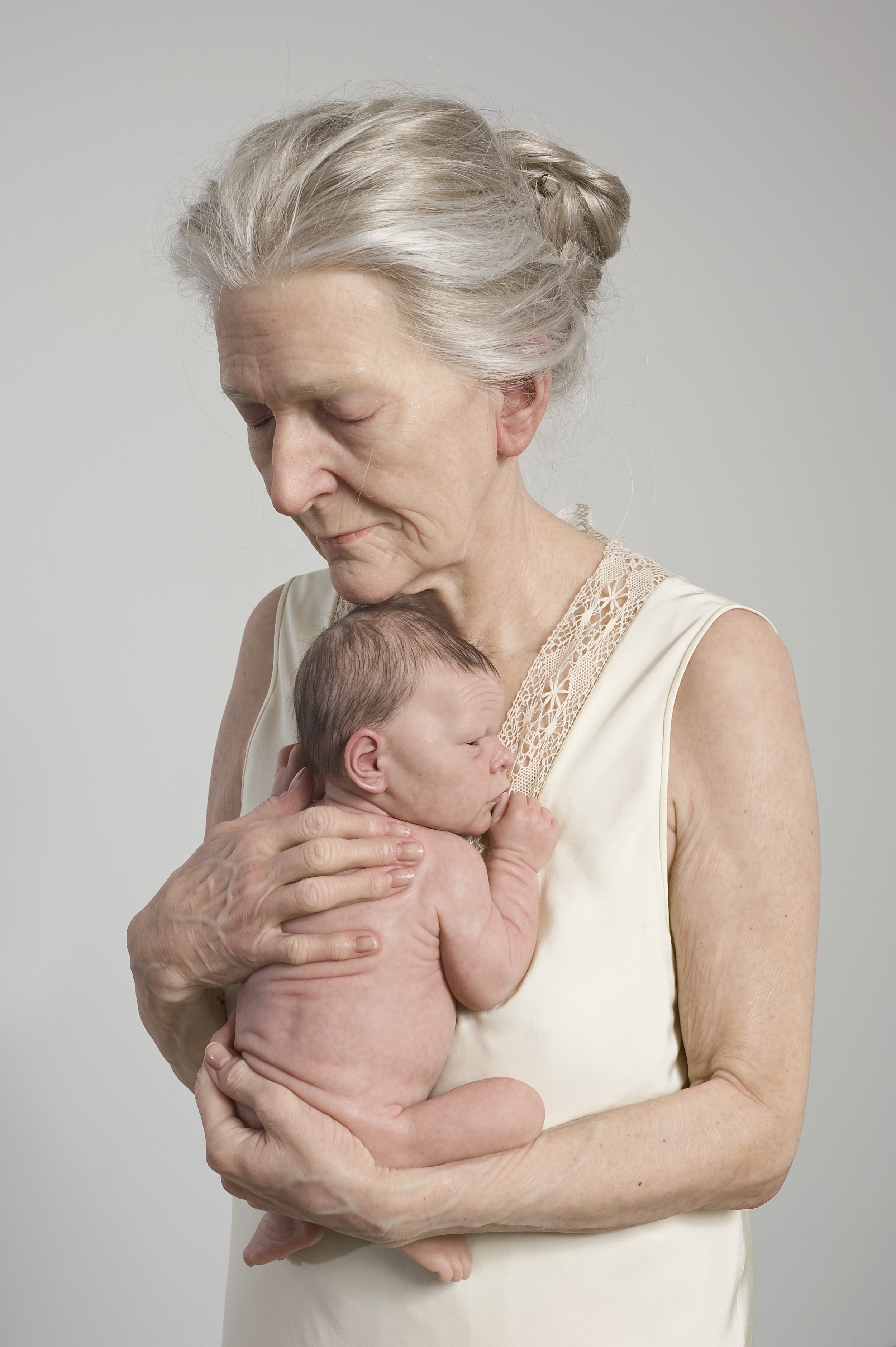
Sam Jinks (Australian, 1973–), Woman and Child, 2010. Silicone, silk, human hair, acrylic, nylon, polyurethane foam, timber, 145 × 40 × 40 cm. Shepparton Art Museum, Shepparton, Victoria, Australia.
Widows of Jerusalem, I too was once
young enough to believe my life mattered.
When I woke, the sun rose for me. I tucked lilies in my hair.
Now I am eighty years a temple dweller.

What a wonder of faith! they proclaim. Truth is,
I cry in the dark. I beg priests for bread

and pick insects from my hem. But today,
an infant came to be blessed. He curled

into the crook of my arm, and when his eyes
wandered to mine, I remembered every hope

stored in my childhood’s heart: gazelles
and henna shrubs, doves perched in the crags.

I touched his face—
that skin we were meant to wear forever.
Inspired by Luke 2:36–38, this poem appears in Tania Runyan’s first full-length poetry collection, Simple Weight (Lexington, KY: FutureCycle, 2010). Used by permission.
Tania Runyan, MA/MFA, lives in Illinois, teaching sixth-grade language arts, speaking at writing workshops, and writing poetry, much of which grapples with scripture. She is the author of five poetry collections—What Will Soon Take Place, Second Sky, A Thousand Vessels, Simple Weight, and Delicious Air—and the popular instructional guides How to Read a Poem and How to Write a Poem. Her most recent book is Making Peace with Paradise: An Autobiography of a California Girl, about her West Coast upbringing.
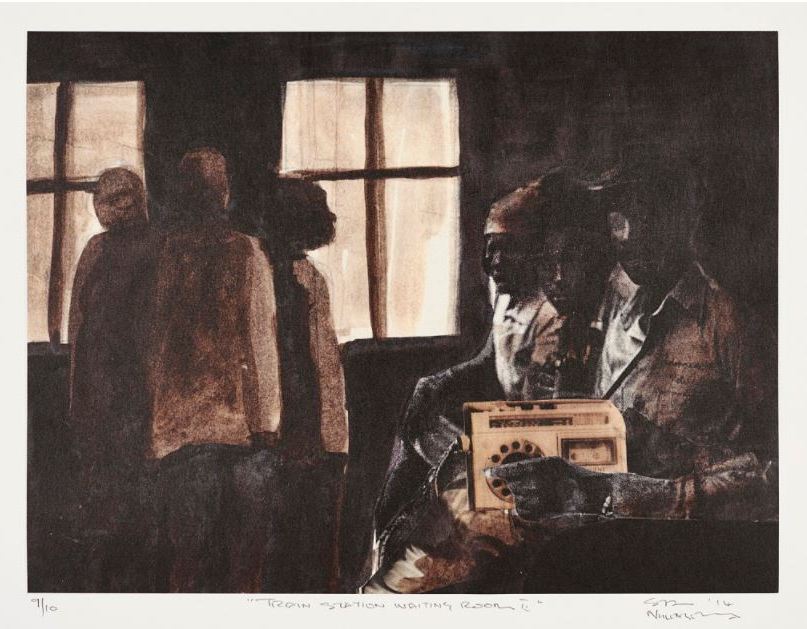
In the drab waiting-room the failed travellers, resigned, sleep on the hard benches, inured to postponement and foul coffee. Hope has given up on them.
There are also the impatient, pacing platforms, and the driven, purple with frustration, abusing their mobiles, for the hardest part of waiting is the not doing.
Truly to wait is pure dependence. But waiting too long the heart grows sclerotic. Will it still be fit to leap when the time comes? Prayer is waiting with desire.
Two aged lives incarnate century on century of waiting for God, their waiting-room his temple, waiting on his presence, marking time by practicing
the cycle of the sacrifices, ferial and festival, circling onward, spiralling towards a centre out ahead, seasons of revolving hope.
Holding out for God who cannot be given up for dead, holding him to his promises – not now, not just yet, but soon, surely, eyes will see what hearts await.
Richard Bauckham, FRSE, FBA, is a renowned English biblical scholar and theologian, whose many published works include The Theology of the Book of Revelation (1993) and Jesus and the Eyewitnesses (2006). He’s also a hobbyist poet! I’ve published this poem with his permission. It’s inspired by Luke 2:22–38, which describes two elderly Jews, “righteous and devout,” who had been “waiting for the consolation of Israel,” the Messiah, for many years and finally encountered him at the temple one day in the infant Jesus of Nazareth. This “Presentation at the Temple,” as the episode is called, is commemorated yearly by Christians on February 2, Candlemas.
Bauckham’s definition of prayer—“waiting with desire”—is the most succinct, and probably the best, I’ve ever heard. His poem enjoins us to assume the same “waiting with desire” posture as Simeon and Anna as we look fervently toward the Christ’s second coming, when God will dwell with humanity face to face once again, this time everlastingly.
(Update, December 2022: This poem now appears in Bauckham’s first volume of poetry, Tumbling into Light, published by Canterbury Press.)
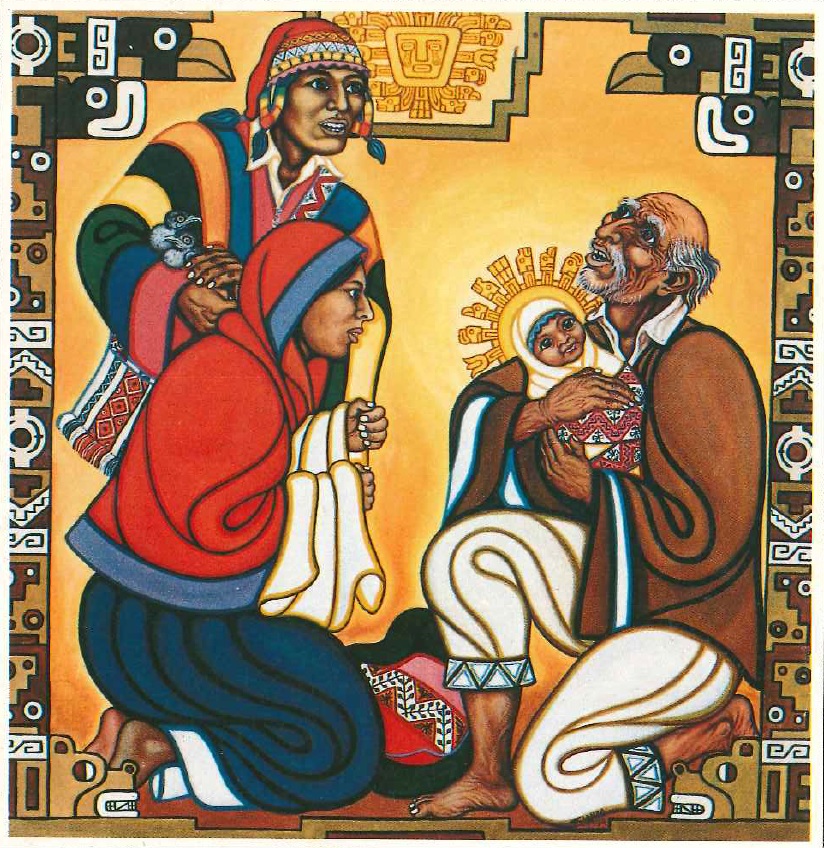
Severino Blanco, Simeon Blessing the Christ Child, 1980s. Chapel of the Casa del Catequista (CADECA), Cochabamba, Bolivia. Image courtesy of Ayopaya Mission.
Now there was a man in Jerusalem, whose name was Simeon, and this man was righteous and devout, waiting for the consolation of Israel, and the Holy Spirit was upon him. And it had been revealed to him by the Holy Spirit that he would not see death before he had seen the Lord’s Christ. And he came in the Spirit into the temple, and when the parents brought in the child Jesus, to do for him according to the custom of the Law, he took him up in his arms and blessed God and said,
“Lord, now you are letting your servant depart in peace,
according to your word;
for my eyes have seen your salvation
that you have prepared in the presence of all peoples,
a light for revelation to the Gentiles,
and for glory to your people Israel.”
Severino Blanco is a Quechuan Christian artist from Cochabamba, Bolivia. In the early 1980s he was commissioned by Father Manfred Rauh (1932–2011), a Jesuit missionary from Germany who spent most of his priestly life in Bolivia, to create a Life of Christ painting cycle for the interior of the chapel of the Casa del Catequista (CADECA), a training center for catechists. To make the gospel story really come alive for the catechists, who are mostly Quechua and Aymara, Blanco chose to set it in an Andean context, with Jesus as an indigenous South American—fully human, fully immersed in history and culture, fully for them. The images are reproduced, with commentary, in the German-language book Von Befreiung und Erlösung: Bilder in CADECA Cochabamba/Bolivien (Of Liberation and Redemption: Pictures in CADECA Cochabamba, Bolivia). A few can also be viewed online here, here, and here. The chapel was consecrated in 1984 and is still in use.
Blanco’s Simeon Blessing the Christ Child is one of the many painted scenes inside the CADECA chapel. Joseph, dressed in poncho and chullo (knitted hat with earflaps), carries two little birds to present as an offering for his son’s dedication. Mary, barefoot, is dressed in a red hooded shawl and a long blue skirt—the colors traditionally associated with Mary in the West—and has just laid down what I’m guessing might be an aguayo, the sling she uses to transport Jesus on her back. (Or perhaps it’s Simeon’s hat, which he removed in reverence?) As for Jesus, he is swaddled in colorful, patterned, homespun wool. When Mary passes the babe to Simeon, he is elated to receive into his arms salvation incarnate. He turns his eyes upward to God the Father, whose presence is suggested by a golden sun-face, whose rays shine forth also in the halo of the Son. The designs on these terminals, and around the border of the painting, are deeply influenced by traditional Andean art.
“A light for revelation to the Gentiles,” salvation prepared for “all peoples”—these phrases from the lectionary jingle in my ears as I meditate on Blanco’s painting.
+++
Here are the Artful Devotions for Candlemas from the previous two church year cycles:
This post belongs to the weekly series Artful Devotion. If you can’t view the music player in your email or RSS reader, try opening the post in your browser.
To view all the Revised Common Lectionary scripture readings for the feast of the Presentation of the Lord, cycle A, click here.
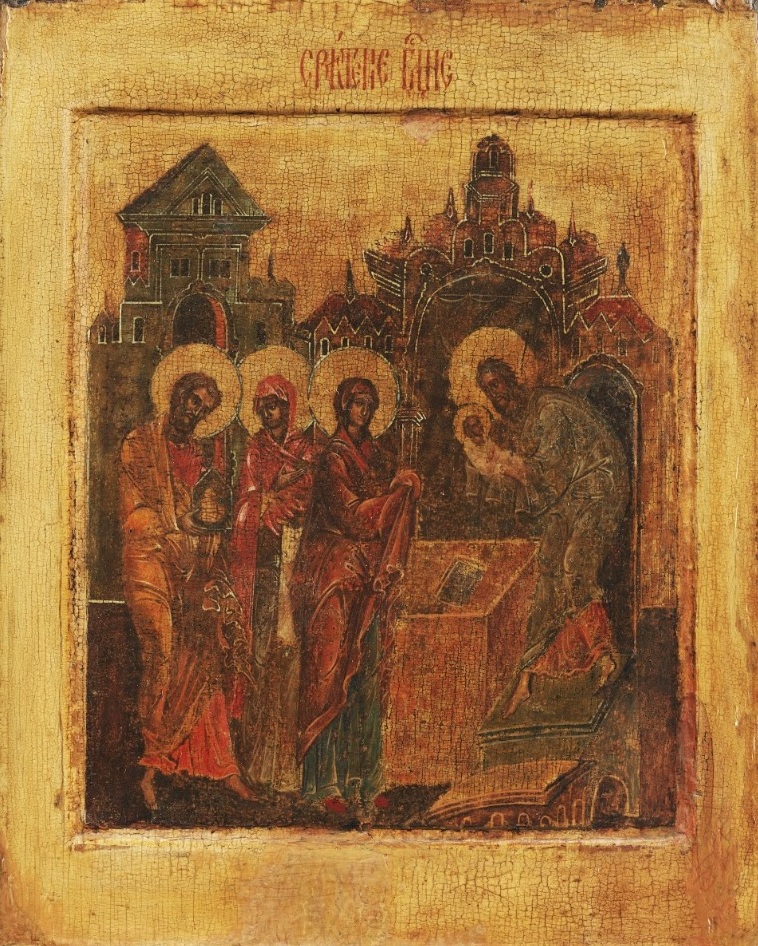
The Presentation of Christ in the Temple, ca. 1650. Tempera on wood. Museum of Russian Icons, Clinton, Massachusetts.
Lord, now you are letting your servant depart in peace,
according to your word;
for my eyes have seen your salvation
that you have prepared in the presence of all peoples,
a light for revelation to the Gentiles,
and for glory to your people Israel.
—Luke 2:29–32
These words were sung two thousand-plus years ago by a Jewish man named Simeon upon seeing and holding the newborn Christ child at his presentation ceremony at the temple in Jerusalem. Known as the “Nunc dimittis” (from the Latin for “Now you dismiss”), the song has been used year-round in Compline, Vespers, and Evensong worship services since the fourth century. Since the seventh century, it has served as the centerpiece of the annual feast day known as Candlemas, celebrated February 2 in the West and February 15 in the East (the Western and Eastern churches count forward forty days from their celebration of Christmas Day, on December 25 and January 6, respectively).
+++
SONG: “Nunc dimittis” from All-Night Vigil, Op. 37, by Sergei Rachmaninoff (1915) | Arranged by Bob Chilcott (2016) | Performed by Katie Melua and the Gori Women’s Choir, on In Winter (2016)
Rachmaninoff’s “Nunc dimittis,” the fifth movement of his All-Night Vigil, was one of his favorite compositions of his career, and he requested that it be performed at his funeral. Its melody is based on a Kievan chant from the Russian Orthodox Vespers service but employs a few rhythmic adjustments and is carried forward by a soloist. As Vladimir Morosan notes in his essay “The Sacred Choral Works of Sergei Rachmaninoff,” “The slow rocking motion of the accompanying voices on two-note descending figures, akin to a lullaby, imparts to the piece a static and peaceful quality.”
The performance above is by Katie Melua, a Georgian singer-songwriter from the UK, who in 2016 returned to her native Georgia to record a winter-themed album with one of the country’s all-women singing troupes. The choral arrangements on In Winter, including “Nunc dimittis,” were specially commissioned from Bob Chilcott.
+++
Icons are central to the devotional lives of Orthodox Christians. Here I’ve included three from the Museum of Russian Icons in Clinton, Massachusetts, which I had the pleasure of visiting about five years ago. Iconographers follow very specific guidelines in their writing of icons, which is why there has been little variation over the centuries. To learn how to read an icon of the Presentation of the Lord, see this “iconreader” blog post.
The Presentation of Christ in the Temple, 1600. Tempera on wood. Museum of Russian Icons, Clinton, Massachusetts.
The Presentation of Christ in the Temple, 16th century. Tempera on wood, 24 × 16 in. Museum of Russian Icons, Clinton, Massachusetts.
This post belongs to the weekly series Artful Devotion. If you can’t view the music player in your email or RSS reader, try opening the post in your browser.
To view all the Revised Common Lectionary scripture readings for the feast of the Presentation of the Lord, cycle C, click here.
Rembrandt van Rijn (Dutch, 1606–1669), Simeon in the Temple, 1669. Oil on canvas, 98.5 × 79.5 cm. Nationalmuseum, Stockholm, Sweden.
Candlemas, celebrated every year on February 2, commemorates the presentation of Jesus at the temple forty days after his birth, according to Jewish custom (Luke 2:22–40). While there, the Holy Family encountered Simeon, an elderly man, “righteous and devout,” who was “waiting for the consolation of Israel.” Though weak and tired with age, he was told by the Holy Spirit that he would not die before laying eyes on the messiah of his people, and he banked on that promise. When the Spirit led him to the temple that day, he beheld the baby Jesus and knew instantly that this was the One he had been waiting for—and not only him, but the whole world. He took the child in his arms and sang this canticle, known in church tradition as the “Nunc dimittis” (“Now you dismiss . . .”):
Lord, now you are letting your servant depart in peace,
according to your word;
for my eyes have seen your salvation
that you have prepared in the presence of all peoples,
a light for revelation to the Gentiles,
and for glory to your people Israel. (vv. 28–32)
+++
SONG: “Until My Dying Day Has Come” by Carl-Eric Tangen, from Incarnation Hymns (2008)
+++
Probably Rembrandt’s last painting, Simeon in the Temple was found unfinished on an easel in his studio when he died. It depicts this enlightening moment from Luke 2, in which Simeon recognizes the Christ and exults—quietly, gratefully—in his salvation. The woman in the shadows, thought to be a later addition by another’s hand, is probably the prophetess Anna, though some suppose her to be Mary.
This post belongs to the weekly series Artful Devotion. If you can’t view the music player in your email or RSS reader, try opening the post in your browser.
To view all the Revised Common Lectionary scripture readings for the feast of the Presentation of the Lord, cycle B, click here.




 Art & Theology