DIGITAL EXPERIENCE: “Holy Night: The Christmas Story and Its Imagery”: This “Digitorial”—a responsive, multimedia, educative webpage—was created as a supplement to a physical exhibition at the Liebieghaus Skulpturensammlung in Frankfurt that ran from October 12, 2016, to January 29, 2017, which brought together over one hundred paintings, sculptures, and other precious objects, mostly from medieval Germany, to tell the story of Jesus’s birth. Featured online are a magnificent Rhenish tapestry (seriously, click that link and zoom in!), an ivory relief carving, an altar, a wooden statuette of Mary with a removable flap on her belly that reveals the Christ child, a liturgical cradle and doll, a manuscript illumination, a woodcut, and more. Also included, for listening, are readings from the Revelations of Saint Bridget of Sweden (a fourteenth-century mystic whose vision of the nativity had widespread influence) and the Gospel of Pseudo-Matthew (source of the legend of the miraculous palm tree on the Holy Family’s flight to Egypt), as well as a lullaby from a medieval mystery play at Leipzig and perhaps also sung as part of the custom of Kindleinwiegen. Curator Stefan Roller introduces the exhibition in this video:
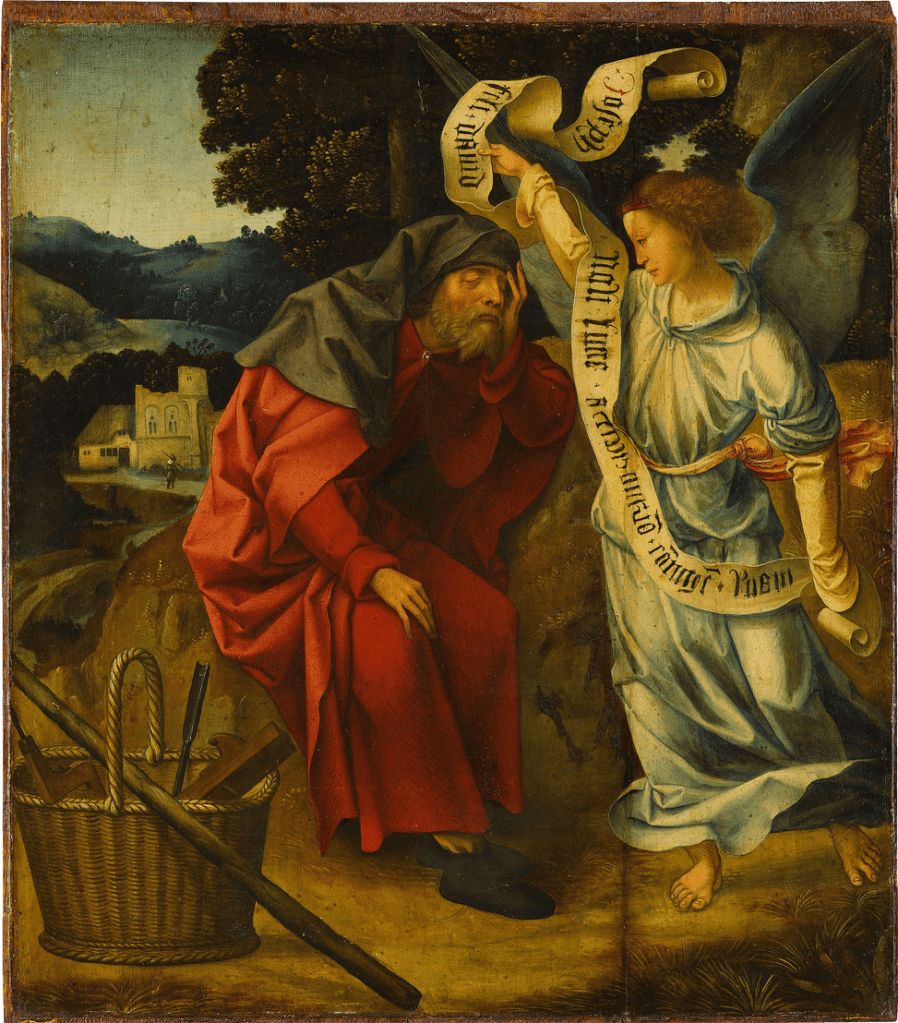
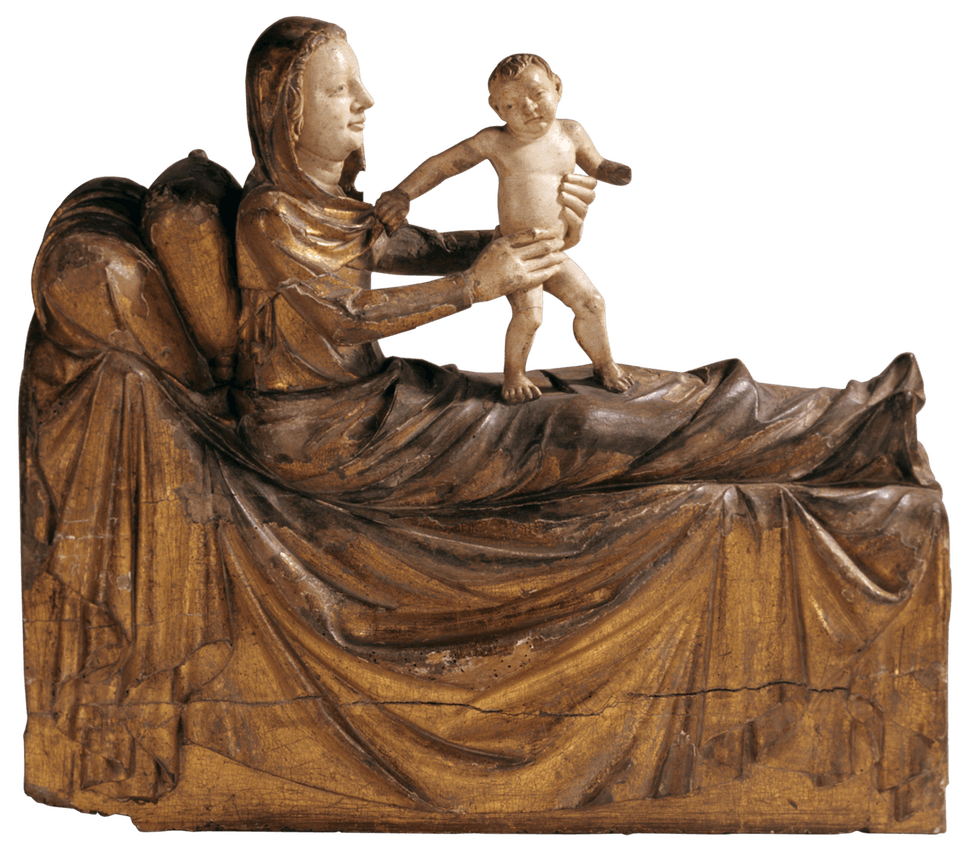
The Angel Appears to Joseph in His Dream, 1518, from the predella of the Antwerp Altarpiece in the Lady Chapel of Saint Mary’s Church, Lübeck, Germany. Mixed media on oak, 46 × 40.2 cm. Staatsgalerie Stuttgart, Germany.The Virgin Mary’s Confinement, Meuse region, ca. 1380. Walrus tooth with remains of the old coating, 51.8 × 58 × 14 cm. Badisches Landesmuseum, Karlsruhe, Germany. Photo: Thomas Goldschmidt.
The “Holy Night” Digitorial is written for a middle-grade reading level, I’d say; some of the narration seems geared toward kids. It doesn’t assume any knowledge of the Nativity story, and in addition to highlights from the biblical accounts, it mentions some apocryphal story elements, like Joseph’s backstory, the midwives at the birth, the palm tree and wheatfield miracles, and the identity of the “kings.” I appreciate how it covers the full story, including Jesus’s circumcision and the flight to Egypt. My only two wishes are that the images were provided in higher resolution and that full credits (especially the collection these objects are from) were given at the bottom.
I really love the Digitorial format! It’s engaging. If I could afford it, I would endeavor to hire web designers to help me produce products like this. This one was designed and developed by Scholz & Volkmer with funding by the Aventis Foundation. More about Digitorials: “Digitorials are short, interactive, online editorials that combine text, images and animations into a meaningful whole and enable innovative storytelling. Digitorials are not intended to replicate or replace physical exhibitions. Rather, they are a useful way of adding breadth and depth, and are usually used before or after visiting an exhibition. The format was developed by the Städel Museum, Liebieghaus Skulpturensammlung and Schirn Kunsthalle in Frankfurt and is breaking new ground in art mediation, as it uses digital technology to offer an accessible and approachable way of engaging with art. It has already been awarded the Grimme-Preis.” See other examples: https://www.staedelmuseum.de/en/digitorial; https://www.liebieghaus.de/de/angebote/digitorial; https://www.schirn.de/en/program/offerings/digitorial/.
+++
SONGS:
>>“Jeg Synger Julekvad” (In dulci jubilo): This Christmas hymn of German origin often appears in English-language hymnals as “Good Christian Men, Rejoice!” or the gender-neutral “Good Christian Friends, Rejoice!” This jazz arrangement by Heidi Skjerve, with Norwegian lyrics by Magnus Brostrup Landstad, is performed by Skjerve (she’s the vocalist on the left) and students from the Norwegian University of Science and Technology (NTNU) Department of Music [previously]. The other two vocalists are Liv Ellen Rønning and Jakob Leirvik. See the full list of musicians in the YouTube description. [HT: Global Christian Worship]
>>“Carol of the Bells,” arr. Al White, performed by the Berea College Bluegrass Ensemble: Al White, who taught Appalachian instruments at Berea College in Kentucky until retiring in May, founded the Berea College Bluegrass Ensemble in fall 1999 to give students with backgrounds or potential in bluegrass music an opportunity to play in a bluegrass band with weekly rehearsals, performances, and travel. This is one of the many arrangements he wrote—sometime around 2008. In this 2016 video, recorded inside Berea’s Danforth Chapel and outdoors, White plays mandolin and leads four other musicians: Brenna Macmillan on banjo and vocals and Theo Macmillan on fiddle (the two are siblings, now performing and recording as the Theo & Brenna Band), Matt Parsons on guitar, and Casey Papendieck on upright bass (he’s part of the Handshake Deals). As of this fall, the Berea College Bluegrass Ensemble is under the direction of Sam Gleaves. [HT: Global Christian Worship]
>>“Peace Upon the Earth” by Hillsong Worship: Since being introduced to Chopin by my piano teacher as a kid, he’s been one of my favorite composers to play—his etudes, nocturnes, waltzes, fantasias. In this 2017 song from Hillsong’s Christmas: The Peace Project, Marty Sampson wrote lyrics for Chopin’s Nocturne in E-flat major (op. 9, no. 2), which actually works really well! It’s a beautiful handling of the iconic melody. Starting at 3:44, Sampson talks about his songwriting process. He says he was inspired by “Hark! the Herald Angels Sing,” which came about when William Hayman Cummings adapted the melody of “Vaterland, in deinen Gauen,” a song from Mendelssohn’s secular Gutenberg Cantata, to fit Charles Wesley’s hymn text.
+++
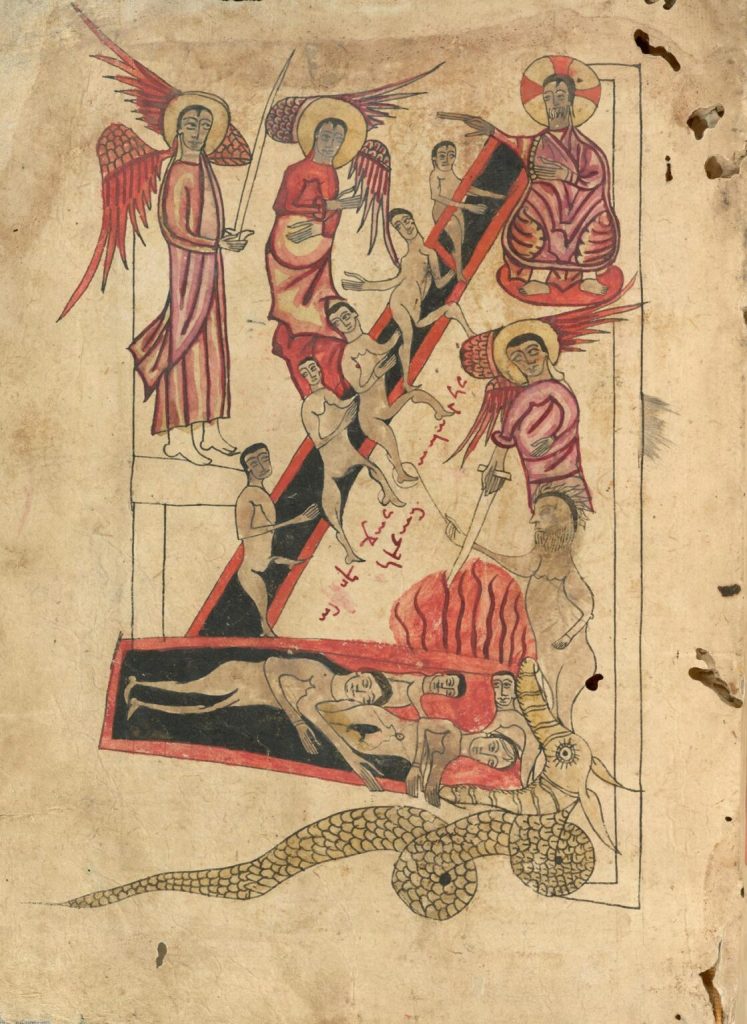
NEW ACQUISITIONS: “2 Armenian Manuscripts Join the Getty Collection”: This year the J. Paul Getty Museum in Los Angeles acquired, among other art objects, (1) a detached leaf with a full-page Nativity illumination from a seventeenth-century Armenian Gospel-book, and (2) a sixteenth-century Armenian Gospel-book illuminated by a brother and sister team, Ghoukas and Eghisabet. (A female illuminator named in an early modern manuscript—woot woot!) “Little is known about the involvement of women in the trade of manuscript illumination, but we hope that highlighting figures like Eghisabet will spark further research and understanding about their role,” write Elizabeth Morrison and Nava Streiter in this Getty blog post.
Mesrop of Khizan (Armenian, active 1605–1651), The Nativity with the Adoration of the Shepherds and Magi, from a Gospel-book made in Isfahan, Persia, 1615. Tempera, gold, and ink on parchment, 23 × 16 cm. J. Paul Getty Museum, Ms. 118 (originally from Ms. Ludwig II 7).Eghisabet (Armenian), The Way into Eternal Life, from an Armenian Gospel-book, 1583. Tempera and ink on parchment, 24.8 × 17.9 cm. J. Paul Getty Museum, Ms. 119, fol. 6v.
Ms. 119 is now the third Armenian Gospel-book in the museum’s collection, and Morrison and Streiter compare one of the illumination subjects side-by-side across all three books—in addition to providing visual comparisons with Ethiopian and Byzantine Gospel-books.
Ruth Crawford Seeger (1901–1953) was a pioneering American folk music specialist who selected, transcribed, and placed songs from the vast collections of the Lomax family and others into published works for use in primary schools and homes. Her mission was, in her own words, “to give back to the people songs that belong to them.” [1]
A conservatory-trained musician and budding modernist composer who spent a Guggenheim year in Europe, Ruth shifted her career goals in 1936 when a move to Washington, DC, brought her into proximity of the Archive of American Folk Song and ignited her passion for the homespun music of her own country. Work songs, love songs, prison songs, dance songs, hollers, chants, spirituals, blues, Cajun tunes, ballads with archaic tonal textures—all these and more were preserved on hundreds of aluminum and acetate discs or magnetic tape and wire at the initiative of traveling ethnomusicologists but at the time were mostly unknown outside the small communities of which they were a part.
Ruth’s relocation to the nation’s capital was prompted by her music scholar husband Charles Seeger’s being hired onto the Works Progress Administration’s Federal Music Project, a New Deal program to employ musicians, conductors, and composers during the Great Depression and to promote music appreciation and training. Charles’s job was to set up music recreation programs across the US—to get every American singing, playing an instrument, or both. Ruth absorbed his enthusiasm and through his work came to know the folk song collectors John A. Lomax and his son, Alan, who frequently brought folk singers from their recording sessions at the Library of Congress to evening singing sessions and instrumental jams at the Seegers’s Silver Spring, Maryland, home. [2]
Ruth began transcribing and arranging some of the music she was hearing from guests and at traditional music festivals, and John Lomax took notice, enlisting her transcription expertise for two publication projects. She spent many hours at an Ansley turntable, notating texts, melodies, and rhythms so that the musical treasures created and sung in various pockets of the country and collected by her colleagues could be available in print for children’s education and home entertainment, deepening American cultural awareness and celebration.
Ruth keenly felt an urgency to save American folk songs from extinction. Toiling deep in the archives of the Library of Congress alongside the famed father, son, and daughter musicologist team of John Avery Lomax, Alan Lomax, and Bess Lomax Hawes, she sifted through their 10,000 field recordings of native singers and transcribed songs. She helped the Lomaxes produce two sweeping surveys of “people’s music,” Our Singing Country (1941) and Best Loved American Folk Songs (1947), creating notated versions for over 300 folk songs (the second anthology with the help of both her husband Charles Seeger and her stepson Pete Seeger). Fluent in both languages of music, formal and primitive, she moved easily from avant-garde elite to New Deal populist and became the bridge between modern urban and rural traditional music. . . .
American Folk Songs for Christmas (1953) was Ruth Crawford Seeger’s third songbook in a trilogy of inspired generosity: American Folk Songs for Children (1948) and Animal Folk Songs for Children (1950), in addition to an earlier book of piano arrangements, Twenty-Two American Folk Tunes (1937). Tragically, her life was cut short when she died of cancer the very same year this Christmas anthology was published. But Ruth raised her children Mike, Peggy, Penny, and stepson Pete with such a powerful passion for and knowledge of traditional musical forms, few would dispute that the American folk revival started on her knee. [3]
Of all the contributions of Ruth Crawford Seeger, I’m perhaps most grateful for her American Folk Songs for Christmas (Doubleday, 1953; Loomis House, 2013), a book of simple piano arrangements of Christmas or Christmas-adjacent songs from the American folk tradition. Direct expressions of everyday people, these fifty-five songs—and one fiddle tune!—were not widely known until Ruth compiled and arranged them for mass publication. Thirteen of them she transcribed from traditional recordings in the Library of Congress, while the others come from folklore journals and collections, shape-note hymnals, and singers themselves. Ruth hoped this songbook would “supplement the already rich international store of traditional Christmas song,” [4] expanding schoolkids’ and families’ usual Christmas repertoire to include some of these homegrown gems.
Although at least half the selections will still be unfamiliar to the general public, several have become beloved classics, especially some of the African American spirituals, like “Go Tell It on the Mountain,” “Children, Go Where I Send Thee,” and “Rise Up, Shepherd, and Follow.” While Ruth wasn’t the only one drawing attention to these songs—the lengthy Acknowledgments section cites the publisher, society, institution, and/or individual each song was sourced from—she was certainly an important popularizer.
One of my favorites is “Baby Born Today,” a “shout” song from McIntosh County, Georgia, that was traditionally sung at Watch Night services at Black churches on Christmas Eve, the lyrics traded back and forth from leader to group. [5] Folklorist Robert W. Gordon learned it from Mary C. Mann, a deaconess in the Episcopal Church, when doing field recordings in Darien, Georgia, in 1926.
Another African American Christmas spiritual is “Sing Hallelu,” which is from St. Helena Island, South Carolina. It’s sung here by Elizabeth Mitchell and her husband, Daniel Littleton, accompanied on harp by Elizabeth Clark-Jerez.
Found on Port Royal Island, South Carolina, in 1861, where it was in current use, “Heard from Heaven Today” was reported to be sung regularly in church by the entire congregation with a swaying bodily movement, rhythmical tapping of hands and feet, head nodding, and so forth. It was first published in Slave Songs of the United States by William Francis Allen, Charles Pickard Ware, and Lucy McKim Garrison (1867). It’s in Ruth’s Christmas songbook but is on neither the Seeger Sisters’ nor the Mitchell album; here’s a nice recording by Nowell Sing We Clear:
Ruth Crawford Seeger’s transcription of “January, February (Last Month of the Year),” aka “When Was Jesus Born,” is based on a 1939 field recording of Betty May Bowman and a group of African American women prisoners from the state penitentiary in Parchman, Mississippi. (Other field recordings of the song from the late thirties and early forties are from Alabama and Georgia, so it was relatively common throughout the South.) It has since been widely covered by gospel artists, including the Fairfield Four, Sister Rosetta Tharpe, the Blind Boys of Alabama, the Staples Singers, and Liz McComb. The recording for The Sounding Joy features Amy Helm on lead vocals, as in this video:
Of course the precise date of Jesus’s birth is not known, but dating forward nine months from the Feast of the Annunciation, it came to be celebrated in the West on December 25. Out of overconcern for the song’s questionable declaration that Jesus was born “on the last month of the year . . . on the twenty-fifth day of December,” some Christians have chosen to scrap the song, which is a shame, because I see it simply as an acknowledgment of this very special event on our calendars that we commemorate each year at the same time. We need not be so literalistic.
American Folk Songs for Christmas, the songbook, contains eight shape-note, aka Sacred Harp, songs, a distinctively American brand of sacred choral music that originated in New England and was later carried on in the southern United States. These are less improvisatory, more set. The text of “Cradle Hymn” is actually by the great English hymn-writer Isaac Watts, and it appeared in William Walker’s Southern Harmony (1835) with the Kentucky folk tune RESTORATION. It’s a lullaby that contrasts the comfort and security of the speaker’s own child with the more precarious conditions into which Jesus was born.
Hush, my dear, lie still and slumber; Holy angels guard thy bed; Heav’nly blessings without number Gently falling on thy head.
How much better thou’rt tended Than the Son of God could be, When from heaven he descended, And became a child like thee.
Soft and easy is thy cradle, Coarse and hard thy Savior lay, When his birthplace was a stable, And his softest bed the hay.
Despite the book’s title, some of the songs have no direct link to Christmas and are more generically about God’s provision or shepherding or about nature (e.g., “Oh, Watch the Stars”). Some seem to me to be about death, like the lovely “In the morning when I rise, (I’m gonna) tell my Jesus howdy-o” and the widely recorded Appalachian spiritual whose first verse is “Bright morning stars are rising . . . Day is a-breaking in my soul.” “Shine Like a Star in the Morning,” too, joyfully anticipates heaven.
The songbook—both the original edition and the reissue—is illustrated by two-time Caldecott Medal winner Barbara Cooney. The illustrations are in black-and-white, and unfortunately all the figures, save for a few in a procession of children on one of the page spreads, respectfully drawn, are Anglo American, despite the collection’s strongest songs being from Black America. I don’t think this should detract from the usefulness of the resource, but I mention it for those who are sensitive to issues of representation.
On a related note, I will just add, for clarification, that these songs are from Anglo and African American traditions. There are other ethnic groups and peoples and communities in America who have been making Christmas music for a long time but are not represented in this collection, and that is largely because it is intentionally restricted to English-language songs—a sensible choice, I think, and still an immensely rich store. Keep in mind that the songbook is from 1953, and it does not claim to be comprehensive. But as America continues to become even more multicultural, I find that caveats are in order, as it’s not entirely clear from the book’s marketing.
These traditional American carols from before the commercialization of Christmas are part of a national heritage of folk song. Many have been passed down orally for generations, others had been written out, and each time they’re shared they’re reinterpreted, but they still retain their original integrity. “The most important mission of the Library of Congress is to cultivate and sustain an American Memory,” writes folklorist Carl Lindahl [6], and thanks in part to Ruth Crawford Seeger, a good number of the folk songs in its archive have been rescued from obscurity and brought back into use. These Christmas songs are still lesser known than those of European origin, but I’ve seen some integrated into playlists, hymnals, caroling excursions, concerts, and children’s pageants and am encouraged!
Notes
Ruth Crawford Seeger, American Folk Songs for Christmas (New York: Doubleday, 1953; Northfield, Minnesota: Loomis House, 2013), 7.
Natalie Merchant, from the liner notes to The Sounding Joy: Christmas Songs in and out of the Ruth Crawford Seeger Songbook by Elizabeth Mitchell and friends (Washington, DC: Smithsonian Folkway Recordings, 2013), 10–11.
Crawford Seeger, 7.
Watch Night is one of several old-time American Christmas traditions Ruth describes in her introduction to the songbook, along with mumming in Boston, fireworks in the South and West, wild-turkey shoots in Texas, and so on.
Carl Lindahl, ed. American Folktales from the Collections of the Library of Congress, 2 vols. (Armonk, New York: M. E. Sharpe, 2004), xxiii.
PANEL DISCUSSION: “Religious Art,” organized by the Forum for Philosophy: I posted about this live online event a month ago, and now that it’s passed, I want to share the video recording. Theologian Ben Quash (King’s College, London), curator Lieke Wijnia (Catharijneconvent Museum, Utrecht), and art historian Mehreen Chida-Razvi (Khalili Collections, London) discuss the relationship between art and religion, how art can function within religious practice, how to exhibit religious art in a museum, and artworks as sites of conversation across religious traditions.
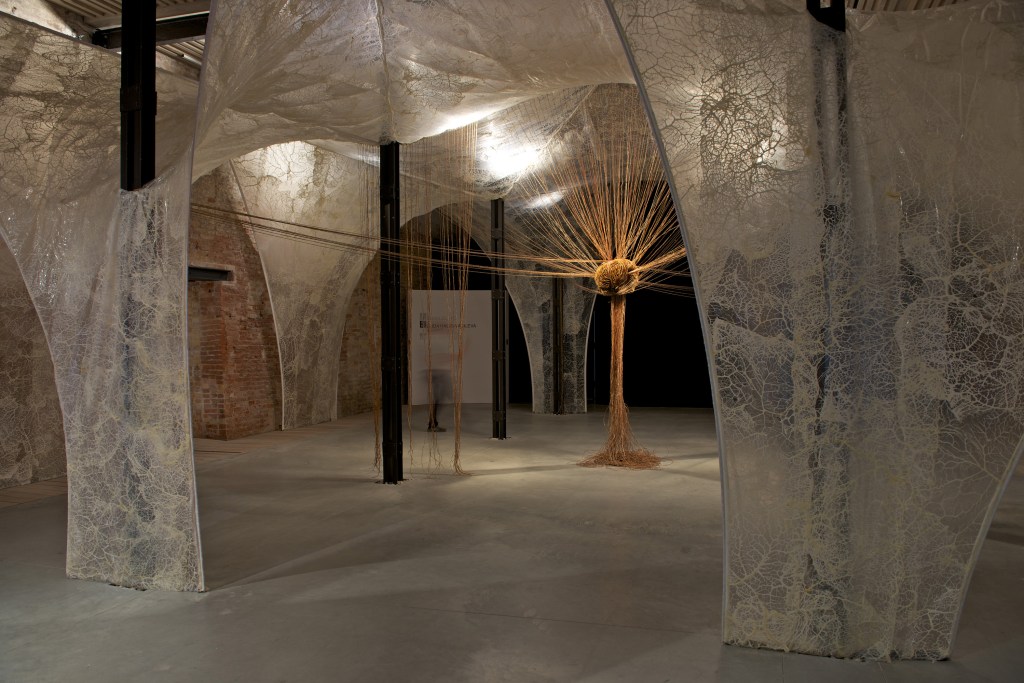
Quash opens by proposing different categories of “religious art”: art for religion, art about religion, art with religion, and art instead of religion. The three unpack those a bit, discussing the intentions of the artist or patron versus how the artwork is perceived by the viewer. Quash mentions Haruspex by Elpida Hadzi-Vasileva (a fascinating installation commissioned by the Vatican for the 2015 Venice Biennale, a contemporary artist’s response to “In the beginning . . . the word became flesh”; read Quash’s essay and an artist interview), the East Window at St Martin-in-the-Fields by Shirazeh Houshiary, the Raphael Cartoons, and Aaron Rosen’s 2016 Stations of the Cross exhibition throughout the city of London, which shows the permeability of the boundaries between sacred and secular. (I participated, as viewer/pilgrim, in a 2019 iteration of the Stations project in Amsterdam.)
Elpida Hadzi-Vasileva (Macedonian, 1971–), Haruspex, 2015. Organic materials. Installation at the Pavilion of the Holy See at the 56th Venice Biennale.
In reference to Hadzi-Vasileva’s canopy of pig’s caul fat, Quash says that challenge or provocation can be a meaningful thing to happen in a religious context:
Works that ambush you are also religiously important, because a sort of religious art that only gives you what you already expect and want quickly becomes kitsch. It’s just a reward of your expectations. And that shouldn’t be what religious art does, it seems to me. It should actually want to take you somewhere else, just as good religion should—it should be transformative, not merely confirming where you already are. So there’s a role for these sorts of artworks within religion as well as outside it.
Chida-Razvi shares slides of Islamic architectural spaces, devotional objects, and manuscript illuminations, including a Mughal painting that exemplifies the interfaith dialogue going on at the court of Akbar in Lahore, and Wijnia shares her experience curating objects people pray with for museum display and (forthcoming) an exhibition on Mary Magdalene. Such great content!
+++
ADVENT SONGS:
“He Comes,” words by Kate Bluett, music by Paul Zach: A lovely new Advent hymn, performed here by Paul Zach.
“The Heavens Shake” by Reindeer Tribe:Reindeer Tribe is a group of friends based in Los Angeles who get together each year to make a live Christmas album, a mix of originals and traditional, sometimes retuned, carols. They bring their voices, instruments, and arrangements and jam together for a long weekend in a big living room. (COVID-19 put the kibosh on this year’s gathering.) This original song, perfect for Advent, is on their 2014 album, A Great Light. “For thus says the LORD of hosts: Yet once more, in a little while, I will shake the heavens and the earth . . .” (Haggai 2:6).
+++
ARTICLE: “We don’t need to be afraid of the Christmas tree’s pagan roots” by Damian Costello, America: Dr. Damian Costello specializes in the intersection of Catholic theology, Indigenous spiritual traditions, and colonial history. In this article he considers how the Christmas tree pictures Christ as the new Yggdrasil (the giant ash tree at the center of the Norse cosmos), and the spiritual character of nature. The second half—about “the hidden agency of trees”—stretches my categories for sure, and I wonder if it’s a bit overwrought, but I’m intrigued by the links Costello draws between the Psalms, Anishinaabe spirituality, and the theology of the Catholic saint John Henry Newman. The article reminds me of Luci Shaw’s poem “Perfect Christmas Tree.”
+++
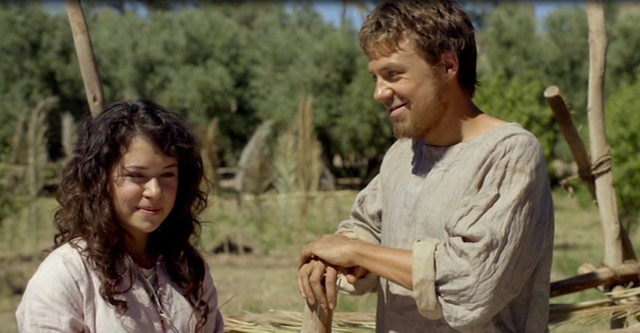
FILM: The Nativity (2010), written and directed by Tony Jordan: I’m always skeptical of film adaptations of the Bible because so many are poorly done. But I gave this four-part BBC miniseries (streaming on Amazon Prime) a shot, and, other than a really cheesy moment during the birthing scene, I thought it was quite good! Writer-director Tony Jordan is not a Christian but approaches the story with the reverent curiosity of a dramatist. He said he never connected with the nativity story until he worked on this project and started to see the very real humans beneath the auras tradition has given the “holy couple”—he saw their earthiness and complexity and began to imagine their emotional lives, especially their reactions to the disruptions they encountered. He said the relationship between Mary and Joseph was key to him. Many storytellers assume that because the marriage was arranged (or because, according to apocryphal sources, Joseph was an old man), there was no passion in their relationship, that they were bound together more by duty than by love, but Jordan, without overly romanticizing, imagines otherwise. The warmth between Mary and Joseph in the first half, which they have to work to regain after news of Mary’s pregnancy hits Joseph like a ton of bricks, is a hallmark of the movie.
Tatiana Maslany (Orphan Black) is probably my favorite Mary I’ve seen onscreen. (I also like Andrew Buchan [Broadchurch] as Joseph.) Jordan says most people see Mary as “a one-dimensional character with a halo round her head,” but actually, “she’s not saccharine. Just a nice kid—real but fallible.” He shows her as virtuous but not a goody-goody, fun-loving and confused and scared and courageous all at once, stepping into her new role by faith without seeing the full picture and even discipling Joseph into that faith. Maslany plays the part brilliantly, endearingly. The film addresses the isolation Mary felt, being rejected not only by her fiancé at first but also by the synagogue leadership and disbelieved, too, by the community she had grown up in. I’ve seen many actors portray Mary as detached, transcending all her difficult circumstances with calm, unshaken resolve. This Mary, by contrast, experiences hurt and fear and yet endures, which, I suspect, is closer to the historical reality. This in no way undermines her faith.
I was delighted by the Annunciation scene, where Gabriel comes to Mary as an ordinary man, much like the angels who visited Abraham generations earlier. He is not wearing ermine or carrying a scepter or standing on a rock above Mary with a booming voice and a heavenly glow. He’s simply a stranger who startles her, even more so when he relays his news. He speaks gently, colloquially. The moment of conception is portrayed as sudden and visceral; Mary feels Light enter her and reacts with a sort of joyful shock.
The trailer and posters, I will say, make the film seem pretty conventional. It does follow some conventions, but it’s also fresh, and while it has some flaws, I think it’s a very worthy use of two hours—it brings this ancient story to life in compelling ways.
In anticipation of the liturgical season of Christmas, I’ve created an extensive playlist of hymns, carols, and spirituals—old and new—that celebrate God’s being born in human flesh. Listen to “Christmastide: An Art & Theology Playlist” on Spotify.
The narratives of Jesus’s birth that we find in the Gospels of Matthew and Luke include both bursts of joyful exuberance, as with the angelic choir above a field of sheep, and quieter, more contemplative moments, such as when Mary pondered “all these things” in her heart (Luke 2:19). Jesus was born into darkness, so the story also involves social stigma, deprivation, military occupation, political greed, infanticide, asylum seeking—and the twinge of a future cross. So while the overall tone of this playlist is one of merriment, it does not shy away from some of the decidedly unfestive aspects of the first Christmas. And yet that God, in love, made himself vulnerable to suffering is precisely what makes the incarnation so glorious. He is not distant from human pains and woes but, rather, right in the midst of them, having experienced them firsthand.
The song selections reflect my personal taste for indie folk and newgrass, so they include, for instance, the Oh Hellos, Sufjan Stevens, Wilder Adkins, Branches, Beta Radio, the Brilliance, Lowland Hum, Penny and Sparrow, the Lower Lights, the Walking Roots Band, Folk Hymnal, Steve Thorngate, Sam P. Bush, Found Wandering, Ordinary Time, and Garrett Viggers.
Gospel songs performed by artists like Mahalia Jackson, the Staples Singers, Isaac Cates, Mariah Carey, Whitney Houston, and Liz McComb also make an appearance, as do many African American spirituals, sung by Odetta, Harry Belafonte, Elizabeth Mitchell, and others. “Go Tell It on the Mountain” is the most widely known from that repertoire.
Also from America is the eighteenth-century carol “O Sight of Anguish” by Samson Occom, a Presbyterian minister and member of the Mohegan nation. New England roots musician Tim Eriksen sings it a cappella on Every Sound Below, but in this outdoor video he plays it on bajo sexto:
(Oh how I wish Ericksen’s marvelous Star in the East album were on Spotify, which features thirteen more songs in this vein!)
The Carols for a Cure album series, made up of contributions from Broadway casts, adds some theatricality. The cast of Nine, for example, sings “Los Peces en el Río,” a traditional Spanish carol in which Mary goes about her daily tasks—combing her tangled hair, washing Jesus’s diapers—as the fish in the river swim excitedly toward the newborn Savior. It’s sung by Antonio Banderas.
In addition to this and the twelfth-century “Friendly Beasts,” another song that focuses on the animal characters at the nativity is the punchy “A Stick, a Carrot, and a String” by mewithoutYou, which sounds like it belongs on the Juno soundtrack. It’s wonderfully quirky.
Of course the Christmas playlist includes tons of classics—“Joy to the World!,” “Angels We Have Heard on High,” “Silent Night,” and so on—multiple renditions, in fact. (It’s too hard to choose just one!) There’s an upbeat swing arrangement of “O Holy Night,” but there’s also a more subdued, ethereal arrangement by Katie Melua, and several more besides. It’s fun to see how different artists interpret the same song.
The Irish folk rock band Rend Collective gives us a raucous arrangement of “Ding Dong Merrily on High,” retaining some of the archaicisms in the original lyrics but rewriting verse 3. A competing team at One Way UK’s 2017 Puppet and Creative Ministry Festival in Rugby, Warwickshire, used this song as the basis of a super-entertaining puppet performance! This made me smile.
You may be wondering, “Where’s all the choral music?!” While I do enjoy that genre, especially at Christmas, I’ve decided to exclude such songs in this list (1) to prevent it from becoming too unwieldy and (2) because I have to do a lot more searching and comparison to find the best recordings.
(Update, April 2022: I’ve decided to add several dozen choral selections to the playlist! While I considered creating a separate list of Christmas choral music, I’ve decided that I prefer an integrated approach, which is also why I scattered such songs throughout, giving some stylistic variety to those who prefer to listen to the playlist in order. My hope is that those who don’t normally go seeking out this genre will be surprised to find pieces that resonate with them.)
Merry Christmas, friends! May you rejoice in Christ with exceeding great joy, he who “comes to make his blessings flow far as the curse is found.” Amen.
PHOTO ESSAY:“Advent 2020: Comfort My People”: Community development and relief worker Kezia M’Clelland, a child protection in emergencies specialist, works in areas of disaster and conflict. Every December she compiles a set of news photographs published in The Guardian that year, pairing each with an Advent scripture. (I introduced her in a 2017 Advent roundup.) Text and image amplify each other and prompt deeper reflection on the themes of the season as well as an awakening to global crises and/or injustices. The photos in this year’s compilation include a schoolteacher bringing plastic-wrapped hugs to her quarantined students in Rio de Janeiro, flooded roadways in Honduras following Hurricane Eta, a Syrian family from Ariha breaking their Ramadan fast amid the rubble of their home, a Palestinian boy from the Khan Younis refugee camp standing on a pile of scrapped car parts, the aftermath of the Beirut port explosion in August (caused by improperly stored ammonium nitrate), a protester outside Dallas City Hall in the US insisting that all citizens’ presidential election votes be counted, and others.
Photo: Pilar Olivares / Reuters [via], set to Isaiah 40:1 by Kezia M’ClellandPhoto: Aaref Watad / AFP [via], set to Isaiah 40:4 by Kezia M’Clelland
M’Clelland adds one new photo for each day of Advent and then releases them all in video slideshow form on December 24. Here are her photo compilations from 2019 (“Good News of Great Joy”) and 2018 (“Peace on Earth”):
SONG: “He Who Made the Starry Skies”: For optimal acoustics, three Bruderhof women from the Fox Hill Community in Walden, New York, trek on over to a silo to sing a fifteenth-century processional carol written by the nuns of St. Mary’s, Chester, in England, a medieval nunnery of which nothing now survives. Both the words and music have been preserved in a ca. 1425 manuscript known as The Chester Mysteries. The original is in Latin (and is titled “Qui creavit coelum”), but singers Alina McPherson, Melinda Goodwin, and Coretta Marchant opt for an English translation. I am providing the sheet music here, courtesy of the Bruderhof Historical Archives. [HT: Tamara Hill Murphy]
He who made the starry skies (Lully, lully, lu) Sleeping in a manger lies (Lully, lully, lu) Ruler of all centuries (Lully, lully, lu)
Joseph brings the swaddling clothes (Lully, lully, lu) Mary wraps the babe so mild (Lully, lully, lu) In the manger puts the child (Lully, lully, lu)
Humbly clad, the King of kings (Lully, lully, lu) Joy of heav’n to earth now brings (Lully, lully, lu) Sweet above all earthly things (Lully, lully, lu)
Mary, ask thy little son (Lully, lully, lu) That he give us of his joy (Lully, lully, lu) Now and through eternity (Lully, lully, lu)
The Bruderhof is an Anabaptist Christian movement of more than three thousand people committed to peacemaking, common ownership, and proclamation of the gospel. They have twenty-eight settlements on four continents, made up of families and singles. Perhaps you know them through their publishing house, Plough. Their website reads, “Love your neighbor. Take care of each other. Share everything. Especially in these challenging times, we at the Bruderhof believe that another way of life is possible. We’re not perfect people, but we’re willing to venture everything to build a life where there are no rich or poor. Where everyone is cared for, everyone belongs, and everyone can contribute. We’re pooling all our income, talents, and energy to take care of one another and to reach out to others. We believe that God wants to transform our world, here and now. This takes a life of discipleship, sacrifice and commitment; but when you truly love your neighbor as yourself, peace and justice become a reality. Isn’t that what Jesus came to bring for everyone?”
+++
UPCOMING (ONLINE) CHRISTMAS CONCERTS:
“A Family Holiday Singalong with Dan and Claudia Zanes,”Tuesday, December 15, 6 p.m. EST: Presented by the Lebanon Opera House in New Hampshire, this multicultural concert will feature Christmas, Hanukkah, or New Year’s songs from France, Wales, Germany, America, Puerto Rico, Korea, Tunisia, and Haiti. You can download the set list, which includes lyrics and chords, at the registration link I’ve posted. Dan and Claudia Zanes are a musical couple from Baltimore (my neck of the woods!), and I’ve really enjoyed the daily song videos they’ve been releasing on YouTube since COVID started. Here they are in 2018 with Pauline Jean, singing “Ocho Kandelikas,” a Hanukkah song written by Flory Jagoda in the 1980s in the Judeo-Spanish language known as Ladino. (Update: Concert video available here.)
ARTICLE: “Making Space for a Multicultural Christmas” by Michelle Reyes: “How can each of us celebrate Christmas at the intersection of our faith and our culture, while welcoming differing cultural perspectives on Christ’s birth?” asks Dr. Michelle Reyes, VP of the Asian American Christian Collaborative and editorial director of Pax, in this Gospel Coalition article. She briefly discusses four different cultural traditions that highlight unique aspects of Jesus’s birth narrative: posadas in Central America, Kiahk in Egypt, parols (star-shaped lanterns) in the Philippines, and Día de los Reyes [previously] in Puerto Rico, Mexico, and other Hispanic countries.
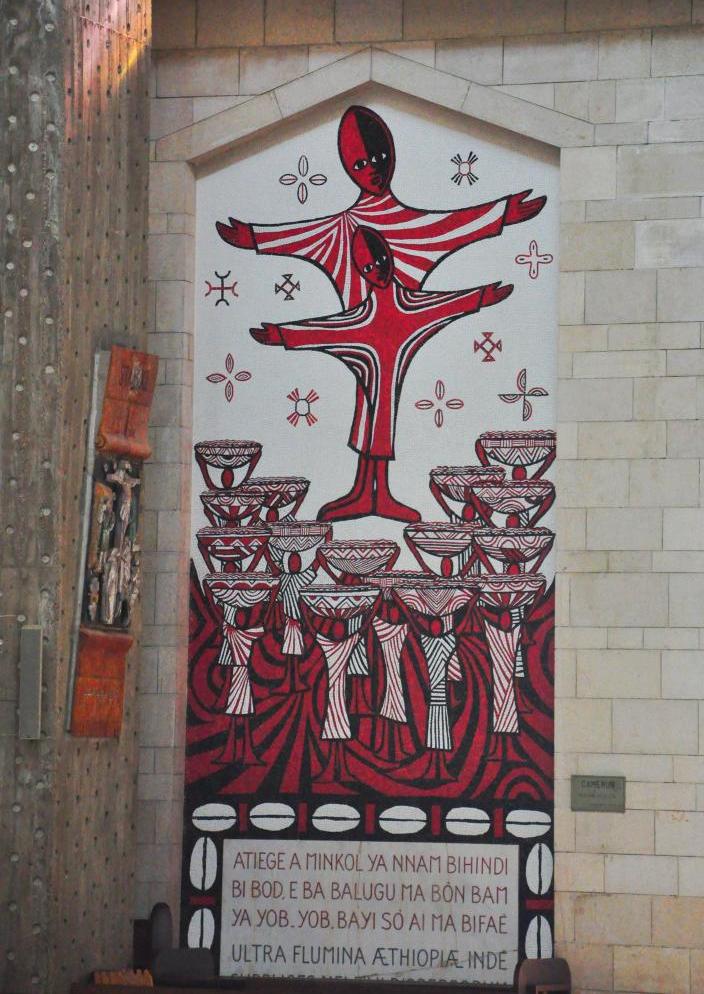
PODCAST EPISODE: “God’s Global Family,” BibleProject:BibleProject, a nonprofit ed-tech organization and animation studio, produces one of my favorite podcasts, hosted by biblical scholar Tim Mackie and Jon Collins. (I found episodes 6–11 of their recently wrapped “Character of God” series, on the wrath of God, particularly illuminating.) “Family of God” is the name of the series they’re in now. In this first episode they discuss how Christianity is the most multiethnic religious movement in history, and how our humanity cannot be fully realized without understanding, appreciating, and being connected to the identity of every other culture. I link to it here because it dovetails nicely with the Reyes article and because I want to introduce you to the podcast, if you’re not already familiar with it, but also because Mackie spends time talking about the Basilica of the Annunciation in Nazareth, with its many culturally specific portrayals of Mary and Jesus from around the world.
As you know, diversity in biblical imagery, especially images of Jesus, is important to me, so I was delighted to hear this popular podcast tip their hat to this pilgrimage site in Israel that features a range of visual interpretations of the incarnation. You can view a compilation of the church’s national mosaics at BibleWalks.com. Most of them are not of high artistic quality, but I appreciate the initiative of inviting the nations to contribute their own localized representations. Above, I posted three that I particularly like.
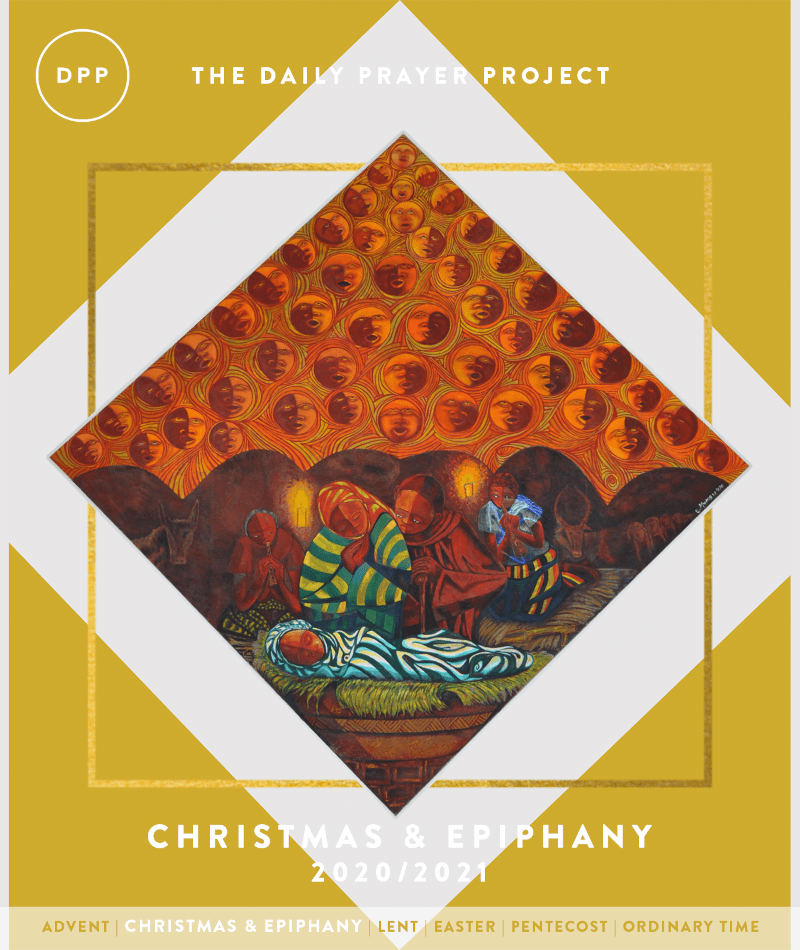
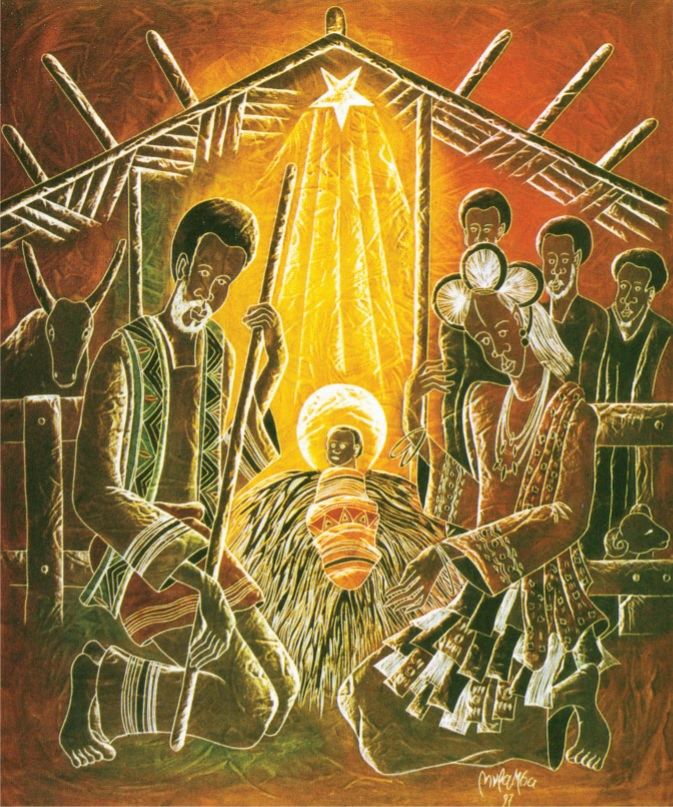
The Christmas–Epiphany 2020/21 edition of the Daily Prayer Project [previously], a publication I work for part-time, released this week! The cover image is from the sanctuary mural at Holy Angels Catholic Church in Chicago, by Cameroonian artist-priest Engelbert Mveng. (See the full mural here.) Also in this edition are images of Grace Carol Bomer’s From Strength to Strength, showing Light stepping into darkness, and the Piper-Reyntiens stained glass window in Coventry Cathedral, with its yellow sunburst amid an abstract pattern of reds, blues, and greens. We include visual art as a supplement to the prayers, scripture readings, and songs with the understanding that it, too, can promote spiritual development and a deeper communion with God.
You can purchase a digital copy (PDF) of the Christmas–Epiphany edition (December 24–February 16) through the website, and if in the future you’d like to receive hard copies, starting with Lent 2021, you can become a monthly subscriber. Part of the money goes to supporting artists.
+++
Whenever I see a Helena Sorensen [previously] byline, I perk up, because I always find myself connecting so much with her writing. She’s a regular contributor to the Rabbit Room blog. Her two most recent posts are “Things Fall Apart” and “Advent, Week One: Hope.”They’re both great.
+++
Unburden: A Virtual Interactive Exhibit, December 4, 2020–January 8, 2021: The Gallery at W83 is part of a 45,000-square-foot cultural center built by Redeemer Presbyterian Church in Manhattan’s Upper West Side as a service to the city’s artists and larger community. W83 Events and Programming Director Eva Ting has curated a virtual exhibition of photographs and stories from Kristina Libby’s Floral Heart Project, a series of living memorials to those lost to or suffering from COVID-19. Libby initiated the project in New York City in May, partnering with 1800Flowers.com to place floral heart garlands all around the city to create space for ceremony and to invite the community to process and mourn. The project has since grown nationwide.
“Many of us are carrying burdens of loss, anxiety, and uncertainty as we move towards the end of 2020,” Ting writes. “We have all been impacted in some way by the events of this year, and we bear fatigue weighed heavier by the inability to gather as a community to collectively grieve. In this interactive virtual exhibit Unburden, the Gallery at W83 invites you to participate in an unburdening of the load we carry.”
The exhibition webpage invites you to release personal burdens by writing down any grief, fears, loss, or anxiety you wish to let go of (can be submitted anonymously if desired). These words will be incorporated into a new floral heart laying on December 20 at Fort Tryon Park, an event that will be livestreamed. You can also ask for prayer, and members of the W83 team will pray for your requests. “Through these individual and collective acts of unburdening, may we imagine what it would look like to truly let go of these burdens.”
Photo by Erica Reade
+++
I enjoyed attending the virtual “Songs of Hope: A TGC Advent Concert,” featuring music and spoken-word performances from a variety of artists (see YouTube description), interspersed with Advent readings. It was a truly meaningful worship experience.
I’m sure there are many more virtual Advent/Christmas concerts and other online events coming up. What ones are you most looking forward to?
One that I’ll probably be tuning in to is “We Three Queens Holiday Show” by Pegasis, a sister trio, on December 17, 8:30 p.m. EST (7:30 p.m. CST). It will be live on Facebook and and Instagram. (Update, 12/17/20: View the performance here. My favorite two songs are probably “Poncho Andino” at 19:04 and “Mary Had a Baby” at 45:24—such a unique arrangement!)
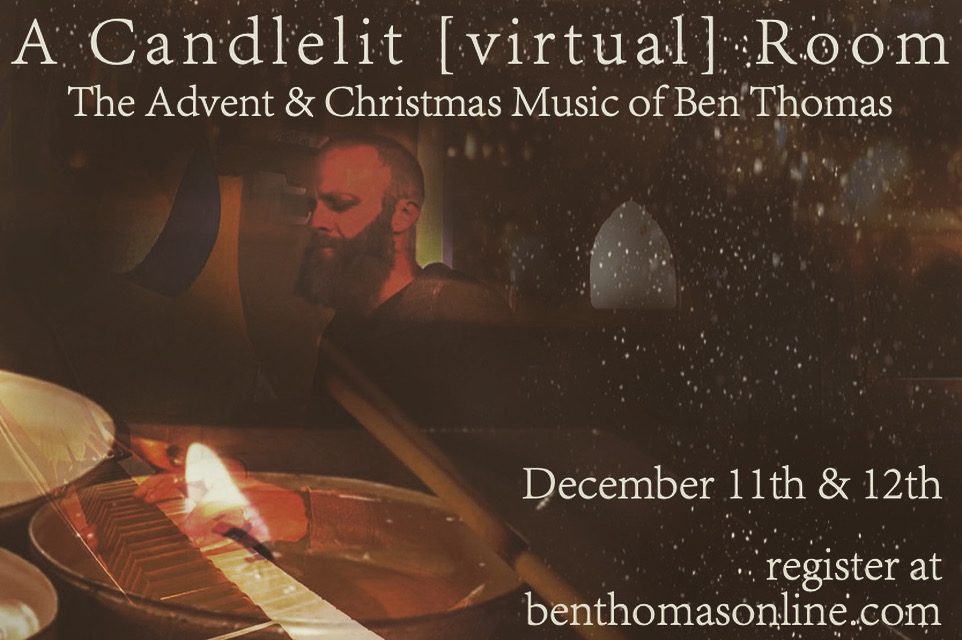
There’s also “A Candlelit (Virtual) Room: The Advent Christmas Music of Ben Thomas” on December 11 and 12 (10 p.m. EST and 8 p.m. EST, respectively), two private Zoom concerts open to the first twenty-five registrants each. He’ll be performing original songs from his albums The Bewildering Light, The Wilderness Voice, and Peace Here, all of which I recommend. My favorite tracks: “Justice Will Sprout from the Ground,” “Zechariah and the Least Expected Places,” and “Shepherds and Angels.” (The latter two were recorded under the name So Elated.)
POEM: “Harlem” by Langston Hughes: This is a brilliant poem—its sensory images, its rhythm, its rhyme, its multivalence (especially the last line). I loved it so much when I first read it in ninth grade that I memorized it unbidden. When writer and podcaster Joy Clarkson posted a reflection on the poem for her Patreon community in October, resulting in a lively conversation thread in the comments section, it reignited my enthusiasm for and got me thinking more deeply about “Harlem.” She opened by quoting Proverbs 13:12: “Hope deferred makes the heart sick, / But desire fulfilled is a tree of life.”
“What happens to a dream deferred? // Does it dry up / like a raisin in the sun?” Written in 1951 as part of a sequence of poems exploring black life in Harlem, “Harlem” is inextricably tied to the civic discourse of the contemporary American moment, writes Scott Challener in Poetry Foundation’s guide to the poem. The “dream” he refers to is the American Dream, unattainable for so many due to racial inequalities and oppression. (Also assigned in ninth-grade English curricula in the US is Lorraine Hansberry’s A Raisin in the Sun, which takes its title from and addresses the questions of “Harlem.”)
While not wishing to strip the poem of its specific context, I have been thinking about all the dreams that have been deferred this year—put on hold, or even irretrievably lost, because of COVID-19. Hughes posits a string of descriptive similes for a deferred dream: a dried-up raisin, a festering sore, rotting meat, a crusted-over sweet, a sagging load. One commenter on Joy’s Patreon observed how a raisin can’t turn back into a grape, rotten meat can’t be made fresh again, and an overcooked dessert can’t be cooked back down, but a sore can heal and a load can be lifted.
The final suggestion—“or does it explode?”—can be read in myriad ways. In one respect it could refer to the explosion of cultural output, of creativity, that results from deferred dreams—i.e., the Harlem Renaissance. I’ve definitely seen this happen this year, as people, in the face of crushing personal and professional disappointments, have found unique ways to come together and produce and share works of beauty within the restrictiveness of health and safety protocols. One example—speaking of Harlem—is the Dance Theatre of Harlem, a groundbreaking neoclassical ballet company founded at the height of the civil rights movement in 1969 and still active today. Bans on gatherings of certain numbers have meant that dancers and other performers have had to find alternative ways of reaching their audiences, so DTH artists Derek Brockington and Alexandra Hutchinson created “Dancing Through Harlem,” taking choreography from Robert Garland’s “New Bach” out into the streets and capturing it on video for people to enjoy from home. To help support the DTH during this time, you can donate easily through the fundraising sidebar on the video’s YouTube page or through the company’s website.
+++
SONG: “400 Years” by Sarah Sparks: This original song, sung with Kate Lab, appears on Sarah Sparks’s new album, Advent, Pt. One. It’s about how the centuries-long silence of God between the ministry of Malachi (ca. 420 BCE) and the appearance of John the Baptist in the early first century CE was broken with the birth of Jesus—the Word made flesh. Its refrain, “For the first time, not a silent night,” cleverly turns on its head the sweet, familiar carol “Silent Night.” Through the incarnation, God spoke to all who would listen.
LOOK:Elena Markova (Russian, 1967–), Christmas Dreams, ca. 2010. Acrylic on canvas, 27 9/16 × 35 3/8 in.
Born in Kargopol, Russia, and now living in Oregon in the western US, artist Elena Markova is inspired by the spiritual traditions of her homeland and its vibrant folk art. Her lyrical paintings reflect her love of folk tales, myths, religious narrative, and the magic of the natural world.
I prefer the King’s College performance above, but you’ll need a Spotify account to listen. For an Oxford Choir performance from 2014, see SoundCloud:
Let the coming of the One who arranges Orion and the Pleiades begin in darkness. Let the night be cold, with drifts of snow. Let there be one lily blooming, and whispered messages, and kneeling.
The fierce earth spins in expectation beneath the long night’s moon, Advent moon. Like the restless fox crossing frosted meadows, the silvered owl in focused, silent flight, each of us is hungry. In rooms of untold longing, we sing our seasoned carols, watch, and wait.
Let the coming of the One who kindles fires of hope, whose faithfulness runs far beyond our sight, be like the coming of a child. Let there be milk, forgiveness, quiet arms. Come quickly, Love, our dearest deep and sweetest dawning. Come, fill us with your light.
This choral anthem was a collaboration between lyricist and composer, commissioned by Bruton Parish Episcopal Church in Williamsburg, Virginia, where Angier Brock lives. (Cecilia McDowall lives in London.) It premiered at the church on December 1, 2013, sung by the Choirs of Bruton Parish. I’m blown away by the beauty of Brock’s text. The Creator of the constellations, descended from heaven to dwell with us—light in our darkness, food for our hunger, warmth in the cold. Reminds me a bit of Rowan Williams’s poem “Advent Calendar.” I will definitely be returning to this one each Advent!
For each day of the first week of Advent I am publishing one art-and-song pairing as an invitation for seasonal reflection.
Clementine Hunter (American, 1886/87–1988), The Annunciation and the Adoration of the Wise Men, 1957. Oil on board, 48 × 78 in. Photo courtesy of Neal Auction Company.
Arise, shine, for your light has come,
and the glory of the LORD has risen upon you.
—Isaiah 60:1
May the kings of Tarshish and of the coastlands
render him tribute;
may the kings of Sheba and Seba
bring gifts!
May all kings fall down before him,
all nations serve him!
—Psalm 72:10–11
Now after Jesus was born in Bethlehem of Judea in the days of Herod the king, behold, wise men from the east came to Jerusalem, saying, “Where is he who has been born king of the Jews? For we saw his star when it rose and have come to worship him.” When Herod the king heard this, he was troubled, and all Jerusalem with him; and assembling all the chief priests and scribes of the people, he inquired of them where the Christ was to be born. They told him, “In Bethlehem of Judea, for so it is written by the prophet:
‘And you, O Bethlehem, in the land of Judah,
are by no means least among the rulers of Judah;
for from you shall come a ruler
who will shepherd my people Israel.’”
Then Herod summoned the wise men secretly and ascertained from them what time the star had appeared. And he sent them to Bethlehem, saying, “Go and search diligently for the child, and when you have found him, bring me word, that I too may come and worship him.” After listening to the king, they went on their way. And behold, the star that they had seen when it rose went before them until it came to rest over the place where the child was. When they saw the star, they rejoiced exceedingly with great joy. And going into the house, they saw the child with Mary his mother, and they fell down and worshiped him. Then, opening their treasures, they offered him gifts, gold and frankincense and myrrh. And being warned in a dream not to return to Herod, they departed to their own country by another way.
—Matthew 2:1–12
+++
SONG: “Behold That Star” or “Behold the Star” | African American spiritual | Performed by various artists (see below)
I first heard this song years ago on Pete Seeger’s Traditional Christmas Carols (1967; reissued 1989), one of my favorite Christmas albums.
William L. Dawson’s choral arrangement, recorded by the St. Olaf Choir in 1997, has become the standard for choirs all over the country. The recording features, as soloist, African American operatic soprano Marvis Martin:
For a gospel version, check out Fred Waring and the Pennsylvanians’ album Christmas Time (1955, reissued 2015), which combines the song with “Carol of the Bells”:
Or the version by James Cleveland with the Angelic Choir and the Cleveland Singers on Merry Christmas (1969, reissued 1987):
One of the most upbeat gospel renditions is by the Patterson Singers from 1963:
There’s also a much slower R&B rendition from Black Nativity: A Gospel Christmas Musical Experience, a musical produced by Dominion Entertainment Group in Atlanta and adapted from the 1961 song play by Langston Hughes. (“Behold That Star” is not in the Hughes original.) I couldn’t find who arranged this version, but the performers are Lawrence Flowers, Benjamin Moore, and Brandin Jay. Oddly (and perhaps under the influence of the song “Rise Up, Shepherd, and Follow”), this production has the song being sung by shepherds rather than wise men:
You can also find numerous recordings of “Behold That Star” being performed by children’s choirs, its simplicity making it accessible to young ages. It was one of several spirituals and other classics the kiddos at my church sang in our 2018 Christmas play (see video below). I’m at the piano playing from the African American Heritage Hymnal, no. 216, transposed down three half-steps to D; the arrangement is by Nolan Williams Jr. (I’m still woefully lacking in the ability to embellish in a gospel style, I’m afraid!)
+++
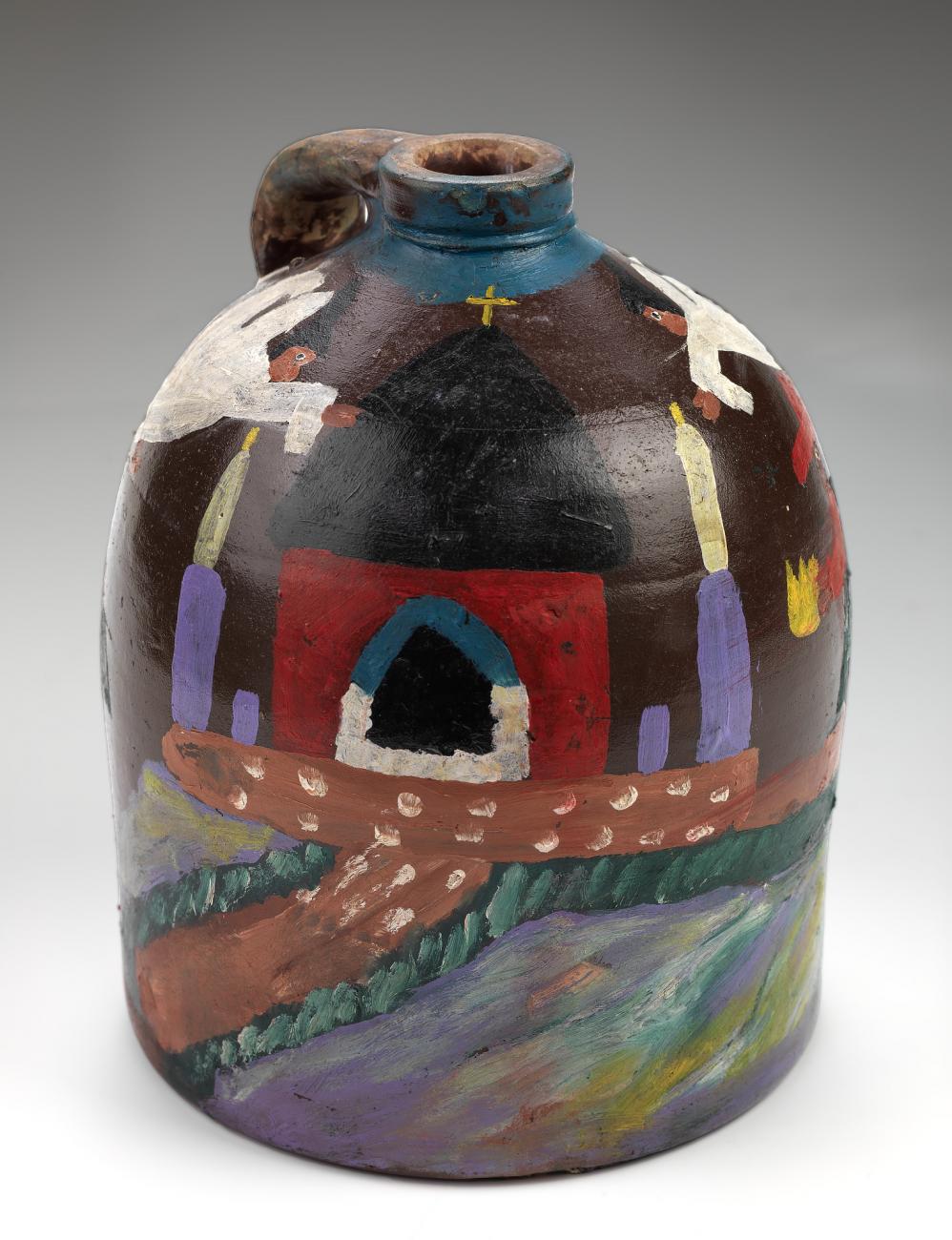
Clementine (pronounced KLEH-mehn-teen) Hunter was a self-taught Afro-Creole artist known for depicting life in the Cane River region of central Louisiana, especially in and around Melrose Plantation, where she worked as a farm laborer for most of her life, even into old age. She didn’t begin painting until she was in her fifties, and she would do it at night on whatever surfaces she could find—window shades, jugs, bottles, gourds, snuff boxes, iron pots.
During her early art career she would sell her paintings at the local drugstore for a dollar or less, but by the time of her death, her paintings were selling to dealers for thousands. She received significant recognition during her lifetime, including from US presidents. Today her work can be found in the collections of the Smithsonian, the Los Angeles County Museum of Art, the Minneapolis Institute of Art, and other prestigious institutions.
In the Christmas-/Epiphanytide painting reproduced above, Christ is born on Melrose Plantation in the southern US, surrounded by sheep and chickens and horses and palm trees. On the left a black angel leads a pregnant black Mary down a footpath to a farmhouse, while on the other side Mary sits on a stool with the newborn Jesus in her lap and Joseph behind her, as three men in wide-brimmed hats come bearing gourds as gifts. Above the scene is the giant yellow star that led these men to the spot, and two white-clad angels (with a scattered choir of others) trumpeting the good news of the Savior’s birth.
The magi were a subject Hunter turned to in many of her paintings. Here’s another fine example:
Clementine Hunter (American, 1886/87–1988), Untitled (Magi Bearing Gifts), ca. 1970–80. Paint on an albany slip whiskey jug, approx. 10 in. (25.4 cm) high. Smithsonian American Art Museum, Washington, DC.
I love how Hunter was able to see the sacred in the everyday—God’s grand story unfolding in her immediate environs. It reminds me of a poem by Wendell Berry from A Timbered Choir that begins,
Remembering that it happened once,
We cannot turn away the thought,
As we go out, cold, to our barns
Toward the long night’s end, that we
Ourselves are living in the world
It happened in when it first happened,
That we ourselves, opening a stall
(A latch thrown open countless times
Before), might find them breathing there,
Foreknown: the Child bedded in straw,
The mother kneeling over Him,
The husband standing in belief
He scarcely can believe . . .
This post belongs to the weekly series Artful Devotion. If you can’t view the music players in your email or RSS reader, try opening the post in your browser.
To view all the Revised Common Lectionary scripture readings for Epiphany, cycle A, click here.
Written in 1941 by Katherine Kennicott Davis, “Carol of the Drum,” later retitled “The Little Drummer Boy,” tells the story of a poor boy who cannot afford to bring any material gifts to the newborn Christ child, so instead he brings a heartfelt drum song.
Come, they told me Pa rum pum pum pum
A newborn king to see Pa rum pum pum pum
Our finest gifts we bring Pa rum pum pum pum
To lay before the king Pa rum pum pum pum Rum pum pum pum Rum pum pum pum
So to honor him Pa rum pum pum pum
When we come
Little baby Pa rum pum pum pum
I am a poor boy too Pa rum pum pum pum
I have no gift to bring Pa rum pum pum pum
That’s fit to give a king Pa rum pum pum pum Rum pum pum pum Rum pum pum pum
Shall I play for you Pa rum pum pum pum
On my drum
Mary nodded Pa rum pum pum pum
The ox and lamb kept time Pa rum pum pum pum
I played my drum for him Pa rum pum pum pum
I played my best for him Pa rum pum pum pum Rum pum pum pum Rum pum pum pum
Then he smiled at me Pa rum pum pum pum
Me and my drum
The song has been recorded hundreds of times, even serving as the basis of an animated children’s movie, and yet it often makes the top of “most hated Christmas carols” lists. It’s far too sentimental, people say, or just plain annoying. Some Christians get in a huff about the invented drummer boy character; “there was no such boy at the birth!” they insist.
But I must admit, I rather like the song. Like the story of the widow’s mite, “The Little Drummer Boy” affirms that no gift offered in love is insignificant. The child has no gold, frankincense, or myrrh to offer to God, but he offers his very self, which is no meager thing. He brings his love and devotion. This idea of bringing a sacrificeof praise for the Savior’s birthday is found in other carols too, such as “In the Bleak Midwinter” and “What Can I Give” (Mahalia Jackson).
From top to bottom: Alex Boyé, Cassius Khan [source], unidentified bongo player [source], Henriette KolsetHere I’d like to call out four global renditions of “The Little Drummer Boy.” I know the song has been performed in many languages and countries, but these four have distinct cultural flavors that make them unique among the many covers of the carol over the years.
Nigeria: Alex Boyé, feat. Genesis Choir, 2015
Alex Boyé is a British-born singer, dancer, and actor of Nigerian descent. He became a Mormon in 1986 at age sixteen, moved to Salt Lake City in 2000, and became a US citizen in 2012. He is known for his uplifting African-infused pop music, much of it of a religious nature.
In 2015 Boyé created a music video for an “African tribal version” of “The Little Drummer Boy,” which starts with a mother and her two daughters being evicted from their home. A neighbor lets them stay in his RV, but they are obviously dejected. Over this introductory narrative, Boyé sings “Nearer, My God, to Thee”:
Nearer, my God, to thee,
Nearer to thee!
E’en though it be a cross
That raiseth me.
Then a knock comes at the door of the camper. It’s a bright-eyed little African drummer boy, come to cheer up the family. The mom dismisses him, but another knock brings her to the door once more. This time it’s the whole neighborhood, bearing a song, a dance, and gifts.
Oluwa! Olodumare! Olorun! Boyé exclaims before he and his troupe break out into their syncopated number. These are Yoruba names for God, so this is a way, I’d imagine, of marking the song as one of worship, suggesting that the love of neighbor expressed through the characters’ gift giving is an extension of their love of God.
India: Terry McDade and the McDades, feat. Cassius Khan, 2004
The McDades are siblings Shannon Johnson (fiddle, vocals), Solon McDade (upright bass, vocals), and Jeremiah McDade (woodwinds, vocals, etc.), hailing from Canada. Their music is multicultural to begin with, blending Celtic, jazz, Canadian folk, and worldbeat influences. It’s hard to categorize, and that’s one of the things I like about it.
They sometimes perform with their dad, harpist Terry McDade, as on the album Noël. For their mostly instrumental rendition of “The Little Drummer Boy,” they also collaborated with classical Indian musician Cassius Khan, who plays the tabla (drum) and tanpura (drone) on the track, as well as sings the opening vocals.
Shannon plays the violin and Jeremiah plays the bansuri (Indian bamboo flute).
Because of the group’s improvisatory approach to music making (and a change in guest percussionist), the studio recording sounds quite different from the live stage performance from 2016, which features Eric Breton on frame drum (in place of Khan on tabla), Andrew Hillhouse on acoustic guitar, Solon McDade on upright bass, Terry McDade on harp, and a chamber orchestra:
There are no Indian musicians in this performance, so it doesn’t have as strong of an Indian feel, and in fact the drum has a smaller role overall, giving way in parts to a full orchestral sound. Also, Khan’s classical Indian singing at the beginning of the song on the album is replaced here by Jeremiah McDade’s Tuvan throat singing!
“El Pequeño Cantor (Little Drummer Boy)” appears on the 2009 compilation album Natale a Cuba [Spotify], whose metadata credits “Tania Tania” as the singer and Luis Ríos (born 1963) as the arranger. I wasn’t able to find any information about the singer, whom I suspect goes by just the first name Tania, or when the song was originally recorded. And I don’t know enough about Cuban music to identify the genre. But I really like this fun, danceable arrangement.
Norway:Eva Holm Foosnæs (arr.) and theNTNU Department of Music, 2016
OK, so Norway is not known for its drumming as are Africa, South Asia, and Latin America, so this arrangement, by Eva Holm Foosnæs, is not as rhythmic as the others, nor is there anything particularly “Norwegian” about the music that I can tell, other than that it’s performed by singers and instrumentalists from Norwegian University of Science and Technology (NTNU) in Trondheim. But the gorgeous regional landscapes in which the music video was shot—over snowy mountain paths, through evergreen forests—give the song a magical, wintry, dark, folklorish feel that I associate with Scandinavia.
This feel comes across too in the dramatic swells and minor chords of the music.
The singers are Magnus Fremstad, Sivert Jullumstrø, Thale Jørstad, Torunn Kroknes, Eline Kolstad, Trygve Misvær, Fredrick Skjeldal, and Frida Skotte. The strings players are Björn Guo, Astri C. Hoffman, Anders Holmås, Anders H. Rove, and Carl N. Wika. And the percussionist is Henriette Kolset (a drummer girl—nice!).
+++
Are there any culturally specific renditions of “The Little Drummer Boy” that you know of and enjoy? I was hoping to find one from Japan, as I love listening to taiko drumming, but had no luck.
Noel, Noel
Yesu me kwisa ku zinga ti beto
Noel, noel
Yesu me kwisa ku zinga ti beto
Kana nge zola ku zaba mwana
Nge fwiti kwisa ku fukama
Kana nge zola ku zaba mwana
Nge fwiti kwisa ku fukama
English translation:
Noel, Noel
Jesus has come to live with us
Noel, Noel
Jesus has come to live with us
If you want to know the Child
You have to come kneel
If you want to know the Child
You have to come kneel
Kituba is the official language of the Democratic Republic of the Congo, where singer-songwriter Todd Smith grew up, from 1978 to 1986, as a missionary kid. (The country was then known as Zaire.) Smith is one of three members of the award-winning band Selah, which helped initiate a hymn revival in Christian music that is still thriving today.
+++
See the Artful Devotions for the last two Christmases:
This post belongs to the weekly series Artful Devotion. If you can’t view the music player in your email or RSS reader, try opening the post in your browser.
To view all the Revised Common Lectionary scripture readings for Christmas Day, cycle A, click here.











 Art & Theology