Easter Sunday (Artful Devotion)

Saric, Nikola_Resurrection
Nikola Sarić (Serbian, 1985–), The Resurrection of Jesus, 2017. Acrylic on canvas, 90 × 90 cm.

Now after the Sabbath, toward the dawn of the first day of the week, Mary Magdalene and the other Mary went to see the tomb. And behold, there was a great earthquake, for an angel of the Lord descended from heaven and came and rolled back the stone and sat on it. His appearance was like lightning, and his clothing white as snow. And for fear of him the guards trembled and became like dead men. But the angel said to the women, “Do not be afraid, for I know that you seek Jesus who was crucified. He is not here, for he has risen, as he said. Come, see the place where he lay.”

—Matthew 28:1–6

Now on the first day of the week Mary Magdalene came to the tomb early, while it was still dark, and saw that the stone had been taken away from the tomb. So she ran and went to Simon Peter and the other disciple, the one whom Jesus loved, and said to them, “They have taken the Lord out of the tomb, and we do not know where they have laid him.” So Peter went out with the other disciple, and they were going toward the tomb. Both of them were running together, but the other disciple outran Peter and reached the tomb first. And stooping to look in, he saw the linen cloths lying there, but he did not go in. Then Simon Peter came, following him, and went into the tomb. He saw the linen cloths lying there, and the face cloth, which had been on Jesus’ head, not lying with the linen cloths but folded up in a place by itself. Then the other disciple, who had reached the tomb first, also went in, and he saw and believed . . .

—John 20:1–8

And we are witnesses of all that he did both in the country of the Jews and in Jerusalem. They put him to death by hanging him on a tree, but God raised him on the third day and made him to appear, not to all the people but to us who had been chosen by God as witnesses, who ate and drank with him after he rose from the dead.

—Acts 10:39–41

+++

SONG: “Hallelujah, Our Lord Is Risen” by the Easter Brothers | Performed by Jeff and Sheri Easter, 1992

+++

To view more paintings by Nikola Sarić, including ones from his “Cycle of Life” series, visit www.nikolasaric.de.

Music and art from previous Easter Sundays at Art & Theology include


This post belongs to the weekly series Artful Devotion. If you can’t view the music player in your email or RSS reader, try opening the post in your browser.

To view all the Revised Common Lectionary scripture readings for Easter Sunday, cycle A, click here.

Roundup: Colorado trip; Maori hymn; Dutch tulip fields by aerial video; the magic of childhood; and more

I returned this week from a wonderful arts conference/retreat in the Colorado mountains, a much-needed time to unplug from work and engage with nature, to meet and worship with other Christians from around the country, and to reaffirm my sense of calling to online arts ministry. Eric came with me, so we took a few extra days there for scenic walks and drives, which included the Peak-to-Peak Scenic Byway, the Flatirons, the Rocky Mountain Arsenal National Wildlife Refuge, Pikes Peak, and Garden of the Gods. So much beauty! Here’s a charming little stone church we spotted outside Estes Park, built in 1939.

Chapel on the Rock (Colorado)
Chapel on the Rock (Saint Catherine of Siena Roman Catholic Chapel), Saint Malo Retreat Center, Allenspark, Colorado. Photo: Victoria Emily Jones.

We also visited the Cadet Chapel at the United States Air Force Academy, which I will share about in a separate post.

And as is my practice whenever I visit a new city, I spent time at a local art museum: the Colorado Springs Fine Arts Center at Colorado College. The size and quality of its collection exceeded my expectations, with many fine works of Native American (Pueblo, Plains, Plateau, and Great Basin), Hispanic and Spanish colonial, and twentieth-century American art. I particularly loved the santos galleries, which feature religious folk art of the Southwest, including two monumental altarpieces. Below is a retablo (panel painting) and a bulto (sculpture) from the santos tradition.

Aragon, Jose Rafael_Cristo (Crucifixion)
José Rafael Aragón (New Mexican, ca. 1796–1867), Cristo (Crucifixion), ca. 1820–35. Tempera on gessoed pine, 19 × 11 in. Colorado Springs Fine Arts Center at Colorado College. Photo: Victoria Emily Jones.

Barela, Patrocinio_Announcement of the Birth of Jesus
Patrociño Barela (New Mexican, 1902–1964), Anuncio de la Nacimiento de Jesus (Announcement of the Birth of Jesus), 1942. Cedar wood. Colorado Springs Fine Arts Center at Colorado College. Photo: Victoria Emily Jones.

José Rafael Aragón is the most highly regarded classic santero from early New Mexico, so I was already familiar with his work (note the visual influences on contemporary santero Vicente Telles, one of whose Crucifixion retablos I own). The chandeliers in Aragón’s painting are like those found in the chancels of New Mexico churches, and the vertical branches that fill the spaces between the figures are also standard elements of church decoration.

Patrociño Barela I was not previously familiar with, and I found myself so captivated by his work. (If you are too, be sure to check out this online solo show of his.) I’m not sure whether to interpret his Anuncio de la Nacimiento de Jesus as an Annunciation image, with Gabriel announcing Christ’s conception to Mary, or a Nativity image, seeing as the babe appears to be ex utero—in which case the top figure could be either an angel or God the Father. I can’t identify the object Mary is holding. (A piece of fruit?)

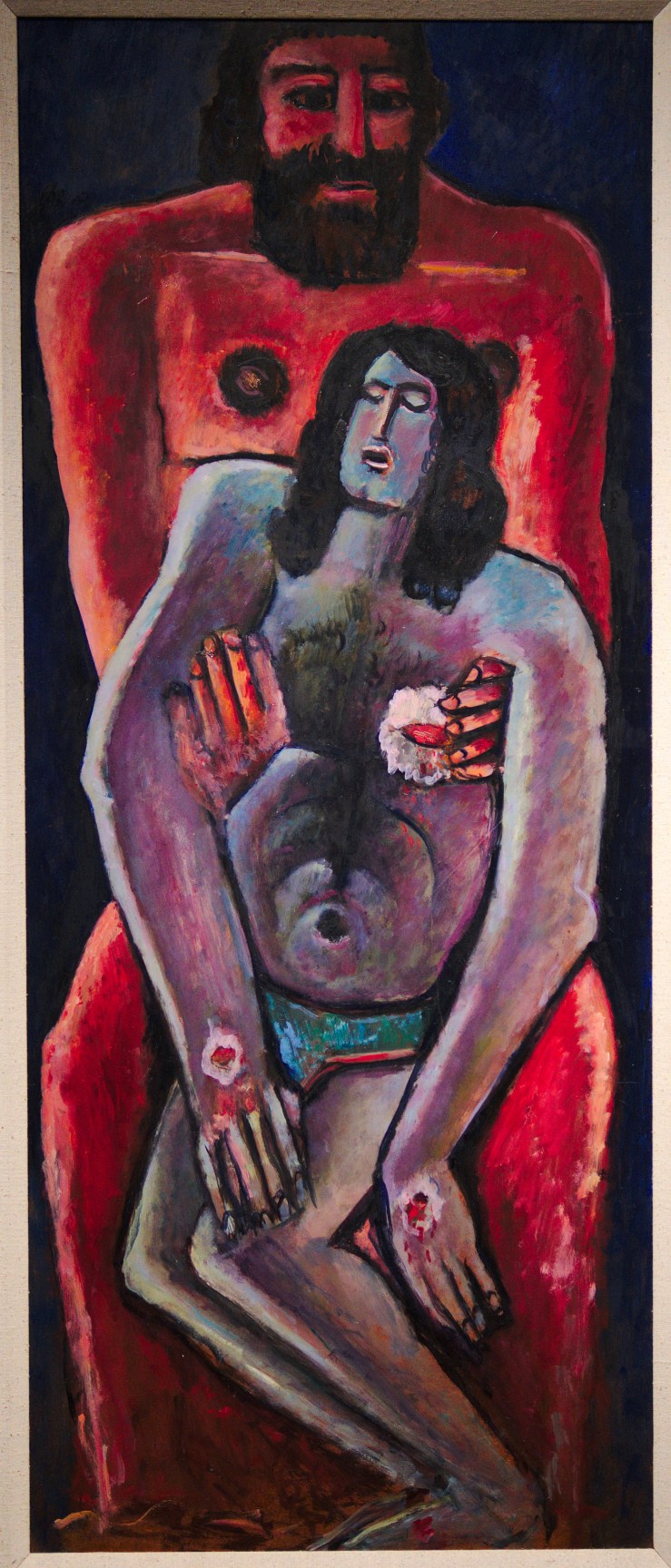
Lastly, here’s a unique Pietà image by the modernist painter Marsden Hartley. Could that be God the Father supporting Christ deposed from the cross? Maybe it’s Nicodemus or Joseph of Arimathea, but I rather like the thought that the Father held his Son in love during this time of his immense suffering and death.

Hartley, Marsden_Christ Evicted
Marsden Hartley (American, 1877–1943), Christ Evicted, 1941–43. Oil on board, 47 × 20 in. Colorado Springs Fine Arts Center at Colorado College. Photo: Victoria Emily Jones.

+++

EVENING DISCUSSION: “Idols and Taboos: Modern and Contemporary Art and Theology Today”: This free public event, consisting of two lectures and a panel discussion, will take place May 23, 2019, at 6 p.m. at the School of the Art Institute of Chicago. The presenters are James Elkins, who will be discussing the distance between avowedly religious art and the disciplines of art history, art criticism, art theory, and studio pedagogy, and Thomas Crow, who will be discussing “the generally inverse relationship between grandiosity in a work of art and its intrinsic theological import,” as well as art’s susceptibility to idolatry. A panel discussion will follow, moderated by Professor Ben Quash, and all are invited to gather afterward in the Lobby Bar of the historic Palmer House (across the street) for further socializing and conversation.

+++

SONG: “O Death”: This Easter, CCLI released a video of Kaden Slay, Melanie Tierce-Slay, and Ryan Kennedy of People & Songs performing Stephen Marti’s “O Death,” written in 2017. Those three-part a cappella harmonies are so sweet.

+++

SONG: “How Great Thou Art / Whakaaria Mai”: On March 23, the Grammy Award–winning singer-songwriter John Mayer began an extensive world tour at Spark Arena in Auckland, New Zealand. He opened the show quite unexpectedly with “How Great Thou Art,” a tribute to those killed and injured during a terrorist attack on two mosques in Christchurch, New Zealand, on March 15. [HT: Global Christian Worship]

Standing center stage for the opening was Te Wehi Haka, a Maori performing arts troupe who, to begin with, quivered their hands; known as wiri, this important Maori movement represents the world around us, from the shimmering of water on sunny days to heat waves rising from the ground to wind rustling the leaves of trees.  Continue reading “Roundup: Colorado trip; Maori hymn; Dutch tulip fields by aerial video; the magic of childhood; and more”

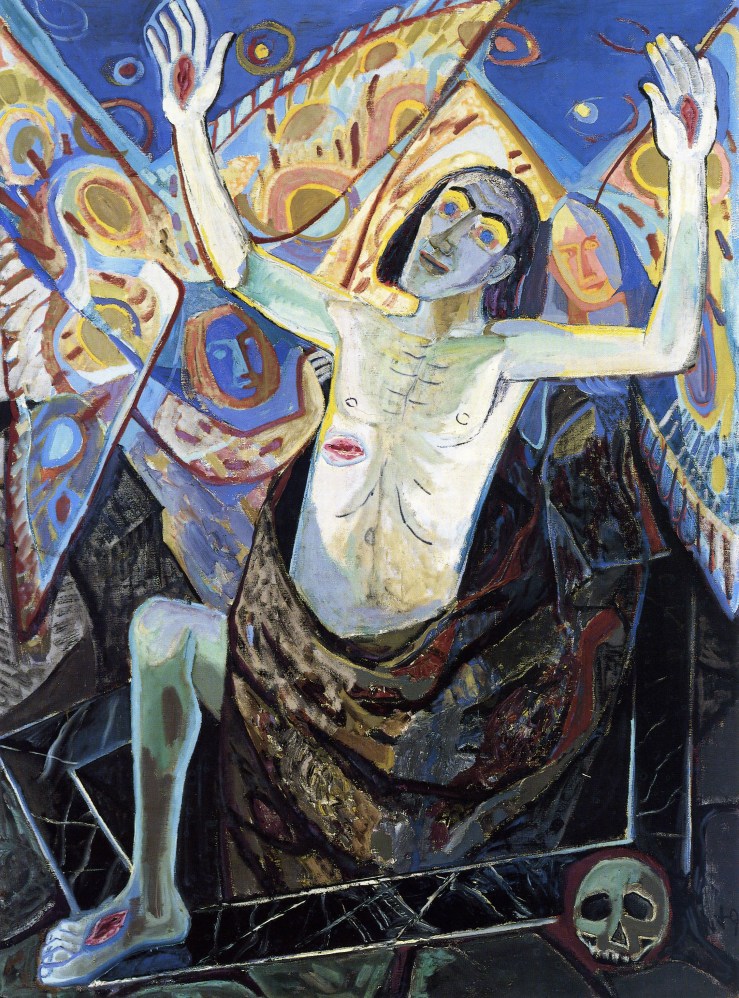
The Strife Is Over (Artful Devotion)

Resurrection by Otto Dix
Otto Dix (German, 1891–1969), The Resurrection, 1949. Oil on canvas, 213 × 163.5 cm. Kunstmuseum Stuttgart, Germany.

He . . . has risen.

—Luke 24:6a

The Lord is my strength and my song;
he has become my salvation.
Glad songs of salvation
are in the tents of the righteous:
“The right hand of the Lord does valiantly,
the right hand of the Lord exalts,
the right hand of the Lord does valiantly!”

I shall not die, but I shall live,
and recount the deeds of the Lord.

—Psalm 118:14–17

+++

SONG: “The Strife Is O’er” | Words: Anonymous Latin poem (first compiled 1695), translated by Francis Pott, 1861 | Music: Rev. Vito Aiuto, on Precious Remedies Against Satan’s Devices by the Welcome Wagon (2012)

The strife is o’er, the battle done;
The victory of life is won;
The song of triumph has begun:
Alleluia! Alleluia!

The pow’rs of death have done their worst;
But Christ their legions hath dispersed;
Let shouts of holy joy outburst:
Alleluia! Alleluia!

The three sad days are quickly sped;
He rises glorious from the dead;
All glory to our risen Head:
Alleluia! Alleluia!

He closed the yawning gates of hell;
The bars from heav’n’s high portals fell;
Let songs of praise his triumph tell:
Alleluia! Alleluia!

Lord, by the stripes which wounded thee,
From death’s dread sting your servants free,
That we may live, and sing to thee:
Alleluia! Alleluia!

(I’ve noticed several slight variations in the English lyric translation attributed to Francis Pott. This is the version used by the Welcome Wagon.)


This post belongs to the weekly series Artful Devotion. If you can’t view the music player in your email or RSS reader, try opening the post in your browser.

To view all the Revised Common Lectionary scripture readings for Easter Sunday, cycle C, click here.

Death Is Ended! (Artful Devotion)

Resurrection by Marko Rupnik
Marko Ivan Rupnik (Slovenian, 1954–), Resurrection of Christ (detail), 2006. Mosaic, St. Stanislaus College Chapel, Ljubljana, Slovenia.

And he will destroy on this mountain the shroud that is cast over all peoples, the sheet that is spread over all nations; he will swallow up death forever. . . . This is the LORD for whom we have waited; let us be glad and rejoice in his salvation.

—Isaiah 25:7, 9b

Kristus je vstal! Zares je vstal! (Slovenian) | Christ is risen! He is risen indeed!

—traditional Easter Acclamation

+++

SONG: “Death Is Ended” by James Ward, on I’ll Be More like Jesus: The Choral Music of James Ward and New City Fellowship (2006)

My church is a part of the New City Network; we have several favorite James Ward songs, and this is one of them. I can’t wait to sing it together as a congregation this morning!

+++

Let no one fear death,
for the death of our Savior has set us free.
He has destroyed it by enduring it.
He destroyed hell when he descended into it.
He put it into an uproar even as it tasted of his flesh. . . .
Hell grasped a corpse, and met God.
It seized earth, and encountered heaven.
It took what it saw, and was overcome by what it did not see.
O Death, where is thy sting?
O Hell, where is thy victory?
Christ is risen and you are cast down! . . .
Christ is risen and life is set free!

—John Chrysostom, 4th century

+++

For a description of the mosaic pictured above, read the final entry in last year’s “Journey to the Cross: Artists Visualize Christ’s Passion.” To see more of Rupnik’s mosaics, visit www.centroaletti.com.


This post belongs to the weekly series Artful Devotion. If you can’t view the music player in your email or RSS reader, try opening the post in your browser.

To view all the Revised Common Lectionary scripture readings for Easter (Resurrection of the Lord) Sunday, cycle B, click here.

Egg Sketches by Autumn Brown

Happy Bright Week!

We’re currently in the Octave of Easter, the first week of the church’s most festal season of the year. It may be that your church celebrates only one day of Easter (last Sunday). But those that follow the liturgical calendar extend the celebration for fifty days, all the way to Pentecost Sunday! The stores have already moved on, rushing us ahead to Mother’s Day, but counterculturally, we linger at the Resurrection, dwelling with its mystery and joy over a longer span.

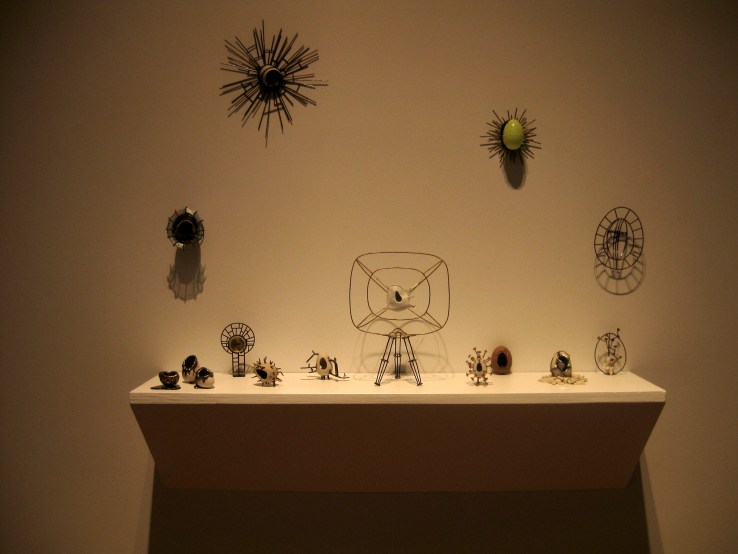
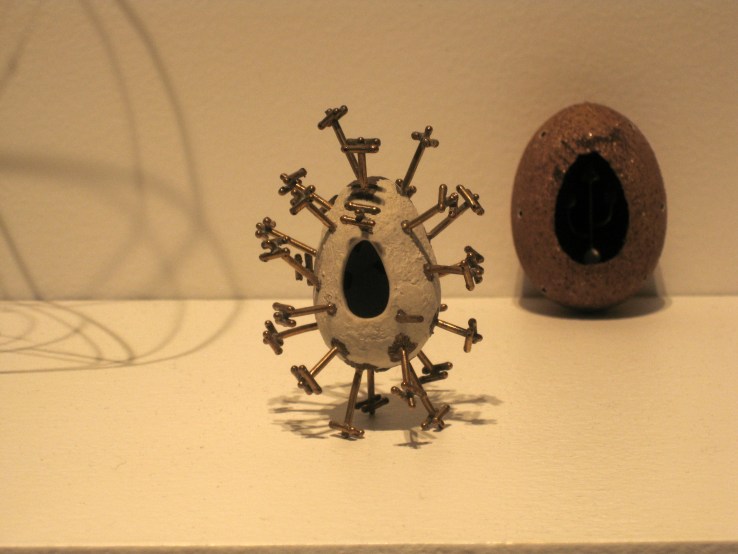
Last summer I visited the Grand Rapids Art Museum in Michigan for the first time. One of the pieces that has stayed in my mind is Egg Sketches by contemporary small metals artist Autumn Brown. It’s an installation of thirteen mixed-media egg vignettes—bursting, melting, sprouting, stretching—arranged on a shelf and wall. The artist said these sketches were inspired by the work of Peter Carl Fabergé, whose egg-shaped objets d’art, commissioned annually as Easter gifts for the Russian empress between 1885 and 1916, contained surprises inside, and Hieronymus Bosch, who used the egg in some, shall we say, abnormal ways.

I immediately thought of the Resurrection when I saw it.

Egg Sketches by Autumn Brown
Autumn Brown (American, 1982–), Egg Sketches, 2010. Porcelain, enamel, copper, silver, bronze, eggshells, plastic, steel, and found object. Collection of the artist. Photographed at Grand Rapids Art Museum, Grand Rapids, Michigan, 2016, by Victoria Emily Jones.

(See better photo, via ArtPrize, at bottom of post. The elements are arranged in a slightly different way.)

The egg as a symbol of fertility and rebirth predates Christianity, having been used in the ancient cultures of Egypt, Mesopotamia (the Near East), and Crete. For the early Christians, it had obvious crossover appeal: the extrusion of a living creature from a shell, after its vital principle has lain dormant or seemingly extinct, became a picture of the incubation of Christ in the tomb and his subsequent “hatching,” his being risen to new life. Traditions of egg dyeing, eating, and game playing emerged in Christian communities in connection to Easter, an extension of religious celebration. As you hard-boil eggs, paint them, display them in baskets, crack them together with friends, and snack on them, you are, the church taught, reinforcing the precious gospel truth that Christ has cracked open the shell of death that encased him—and us—making eternal life possible.

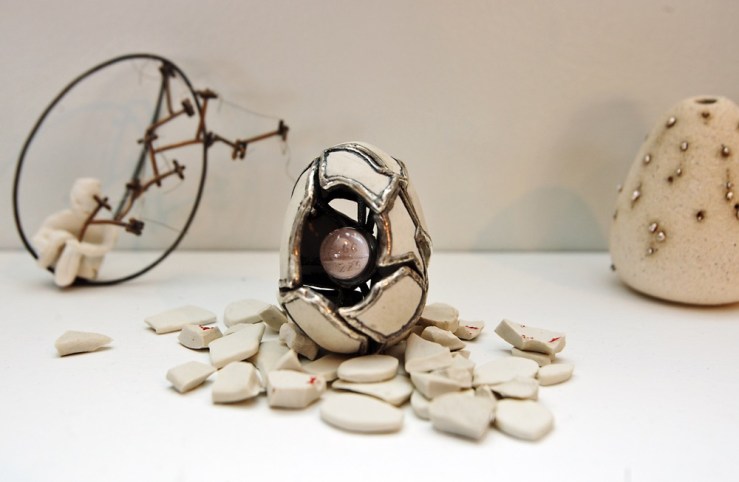
The first of Brown’s egg sketches that attracted me was the tomb-like one on the right. Its cracks lined with silver, it is reminiscent of kintsugi, the Japanese art of repairing broken pottery using gold, silver, or platinum. The front of this egg has a large aperture, which reveals a glass-encased pill. The egg sits atop a pile of stones—or is it the broken ceramic shell pieces?

Egg Sketches (detail) by Autumn Brown
Photo via ArtPrize

Several constituent pieces of Brown’s Egg Sketches make use of cross-forms. One egg is pierced all around by them. But a hole provides a way out, from darkness into light.

Egg Sketches (detail) by Autumn Brown
Photo: Victoria Emily Jones

Another egg is formed in outline only—a metal frame, arcing underneath a kneeling human figure who holds what appears to be a broken network of crosses (resembling telephone poles). The wire that once presumably held them together is snapped in multiple places, twisting every which way, as the crosses come tumbling down. The posture of the figure recalls Christ in Gethsemane, pleading with God to let the impending suffering pass him by. Life and death play together in this sketch, two elements of one story.   Continue reading “Egg Sketches by Autumn Brown”

A string octet for Easter Sunday

Hallelujah, Christ is risen!

I first heard Felix Mendelssohn’s Octet in E-flat Major, Op. 20, when a shortened form of its first movement was performed as a postlude several years ago at an Easter Sunday church service by the talented musicians at Citylife Presbyterian in Boston. Ever since then, I have associated it with Easter.

Having scoured the web, I’ve determined that the following recording, brought to you by Avrotros Klassiek, is the best of all those available for free listening:

The performance took place at the TivoliVredenburg in Utrecht, the Netherlands, during the International Chamber Music Festival on June 25, 2014. It features Boris Brovtsyn, Julian Rachlin, Julia-Maria Kretz, and Vilde Frang on violin; Amihai Grosz and Lawrence Power on viola; Jens Peter Maintz on cello; and Rick Stotijn on double bass (replacing the second cello in Mendelssohn’s original score).

Mendelssohn composed his Octet in E-flat Major in 1825 when he was just sixteen and with it opened up brand-new possibilities for the eight-piece string ensemble. Whereas his contemporary Louis (born Ludwig) Spohr, who also composed string octets, simply had two quartets operate as independent units, Mendelssohn took a much more integrated approach, using all eight instruments in multiple interactive permutations throughout the entire work.

Music critic Conrad Wilson notes of the piece that “its youthful verve, brilliance and perfection make it one of the miracles of nineteenth-century music”—its first movement especially, which is one of four but lasts twice as long as any other, through 13:54 of the video above. Played Allegro moderato ma con fuoco (“moderately fast but with fire”), it evokes for me Resurrection joy and vitality.

Resurrection by Stephen A. Wilson
Stephen A. Wilson (American, 1952–), Resurrection, 2008. Stained glass clerestory window, 10 × 40 ft. St. Agnes Catholic Church, Shepherdstown, West Virginia. Click on the image to read the artist’s description.

Christ is risen indeed!