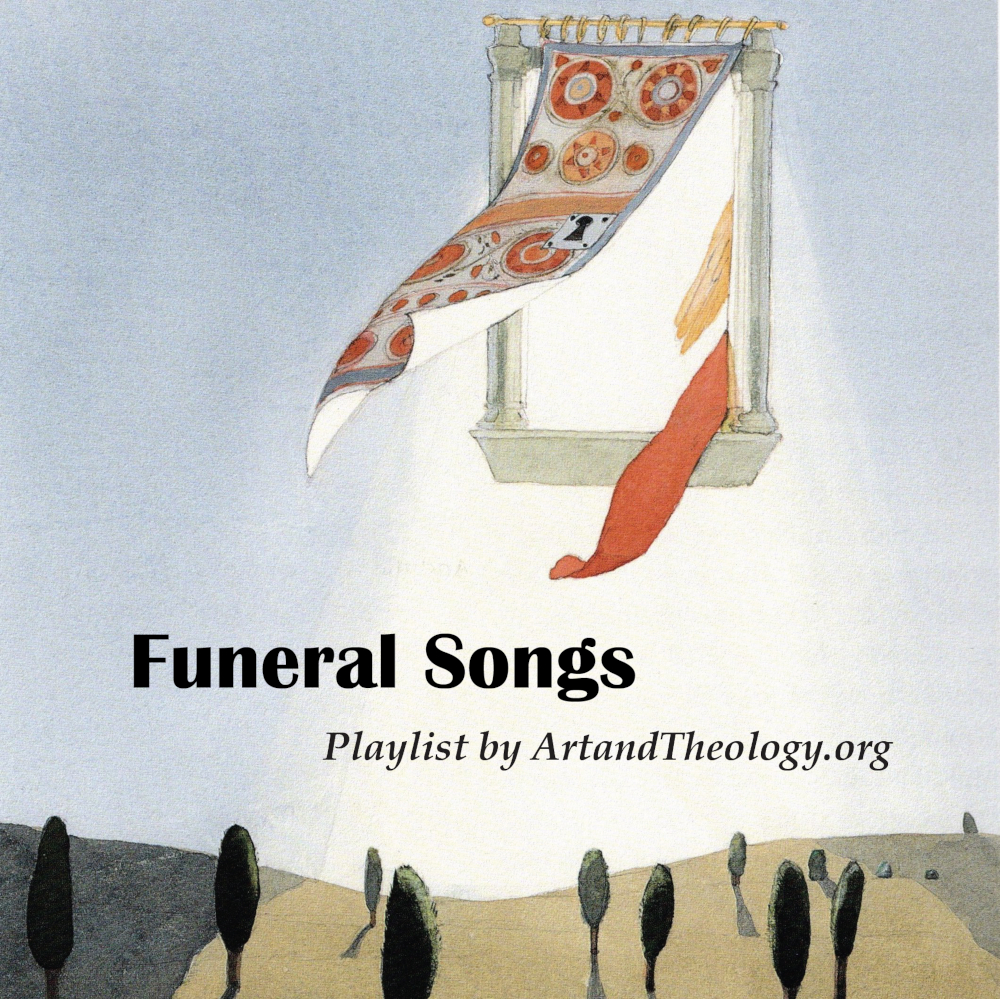
Death is hard. No matter your religion and its consolations, whether you’re the one dying or you’re saying goodbye to someone who is or has, it’s often a painful ordeal.
For the Christian, death holds a tension. It’s something to grieve, as Jesus did at the grave of his friend Lazarus; it was not part of God’s original design and so in that sense is not “natural,” even though it’s inevitable. We can and should mourn its power to (at least temporarily) sever. But death can also be something to celebrate if the deceased was in Christ, since as the apostle Paul wrote, “to be absent from the body [is] to be at home with the Lord” (2 Cor. 5:8), in a state of blissful rest.
Christians regard death as an entrance to the dwelling-place of God that we call heaven or paradise. Contrary to popular conception, that heaven is not our eternal home—not really. It’s a temporary holding place for the souls of the Christian departed, who await the general resurrection, at which time our souls will be reunited with our bodies and heaven will be remade and brought down to a new earth, where we will dwell forever, as whole, embodied persons, vibrant and active, with God. That, as the New Testament scholar and theologian N. T. Wright has been reiterating for decades, is our ultimate hope: not an ethereal existence in the skies, but physical resurrection, cosmic renewal, and God making his forever home with us here. The joining of heaven and earth—God’s space and ours—in a lasting embrace.
When my paternal grandpa passed away in May 2017, I began building a private Spotify playlist of songs about death to help me move through that loss. I’ve been adding to it for the past nine years, and now I want to make it public.
I hesitated for a while on whether to share the list, because I worry that overall, it does promote a lopsided hope, a truncated view of what eternal life looks like. Wright’s Surprised by Hope: Rethinking Heaven, the Resurrection, and the Mission of the Church was paradigm-shifting for me, and I’ve wrestled with its implications on the theologies we articulate, including through song, at funerals. Wright decries how Platonism, with its degrading of bodies and of the created order in general, has infected whole swaths of Christian thinking, misleading people into supposing that Christians are meant to devalue this present world and our material selves; that our goal is to escape them both.
The early Christian hope was not, Wright declares, to be rescued from this world, but to be rescued with and for it: that is, that the world itself, people included, would be liberated from its present state of corruption and decay. They centered this hope firmly on the resurrection. They talked very little about “going to heaven” when they died; instead, they emphasized the promise of the dead being raised on the last day to image God in a new bodily existence in a newly remade world. If they did refer to heaven as a postmortem destination, Wright says, those early Christians seemed to regard it as a temporary stage on the way to the eventual resurrection of the body.
Wright laments that so many Christian songs look forward chiefly to “life after death” (the intermediate state, entered immediately after one’s death, in which one’s soul resides in heaven while one’s body remains “asleep” in the grave) instead of “life after life after death” (the eschaton; the resurrection; the descent of the New Jerusalem; the new heavens and new earth), which is God’s whole telos. This glut of songs that focus on the prelude to eternal life as the biblical authors envisioned it has contributed to many Christians’ ignorance of the two-step narrative of life after death, with step two being what we should really be singing about.
I get what Wright is saying. But I think he sometimes overstates his points. He hates the phrase “going to heaven,” preferring instead “heaven coming to earth”—and yet “going to heaven” does accurately describe what the Christian soul does at the moment of bodily death. He also disparages lyrical expressions like “way beyond the blue,” “a faraway strand,” “up over yonder,” “the great beyond,” anything that suggests otherworldly distance . . . but again, if what is being described is that interim place of souls where God’s throne currently is, which is outside the space-time continuum but for which the Bible uses directional “up” language, such descriptions seem to me to be appropriate.
And the word heaven, I feel, can also encompass the final reality: the marriage of heaven and earth. I see the word as shorthand for “where God is.” Of course, Wright is correct that heaven-as-stopover (out there and we as incorporeal) and heaven-as-new-creation (right here and we gloriously corporeal) often get muddled in our songs, and that greater theological precision might be warranted. But we also have to consider the limits of sung verse—especially particular forms, like the spiritual, which is meant to be simple and repetitive so as to be transmitted orally—to convey nuanced ideas or to express all aspects of a given theme.
Wright also eschews the “just passing through” spirituality that infuses much hymnody, folksong, and preaching—the idea that earth is not our home; heaven is. That idea, he claims, treats the world as irrelevant at best and evil at worst, when in fact, God loves the world and wants to and indeed will redeem it, not evacuate us from it. This earth will be transformed one day into our eternal habitation.
I do agree that there’s a dangerous strand of escapist theology that has arisen in Christianity, which nurtures aspirations to flee the world, to regard is as mere dross and so to care nothing for its welfare. But I also don’t automatically dismiss hymns that describe this present life as “night,” for example, or that mention “earth’s vain shadows”—Wright negatively references both in Surprised by Hope. This present world is incomplete. It’s groaning for redemption, and we in it. We see through a glass darkly. We often stumble. We’re tempted to pursue pleasures or glories that are ultimately empty. Pain, toil, and fragmentation are part of the human experience. I think it’s right that we don’t feel entirely at home here, even as we anticipate God’s future purposes for the world—healing, transforming—through concrete actions, living as new-creation people. The apostle Paul says we’re citizens of heaven (Phil. 3:20), which is in part where the concept of “our heavenly home” comes from. The kingdom of heaven is the place from which Christ reigns. And yes, one day that will be earth, but right now, it’s not.
In the grand scheme of things, our mortal existence is short—so the idea of us being transient between this life and the next is not, I think, out of step with the biblical view, many passages of which comment on life’s brevity and the fleetingness of the flesh, which fades like grass.
While Wright stresses the continuity between earth as it is now and earth as it will be, there is also—and he does concede this—discontinuity. The earth will be itself and yet radically new when God re-creates it. It will be somehow both familiar and other. The same is true of our bodies, which—hallelujah!—God redeems along with our souls. (We are saved not as souls but as wholes, Wright quips.) These bodies we have now are good, yes, but they also break down and can be burdensome—hence why so many Christian songs of death express a yearning to cast off the body. Even the apostle Paul, in Romans 7:24, bemoans, “Who will deliver me from this body of death?” Like Wright, though, I do wish there were more songs that coupled that desire with the anticipation of a renewed body, as Paul does, instead of suggesting that a bodiless existence is the consummate state. As Wright argues, a focus on the soul’s immortality, on leaving the body behind, is a distraction from the supreme hope of the resurrection.
The funeral song that theologians, both professional and armchair, love to hate on most for its supposed Gnosticism is the Southern gospel classic “I’ll Fly Away” by Albert E. Brumley. They object to its anti-this-worldly stance that celebrates the soul’s breaking free “like a bird from prison bars has flown” (“no more cold iron shackles at my feet”), which implies that this world or this body, or both, is a prison keeping our true self captive. But is that sentiment not in some ways consonant with Romans 8:19–21, which says that “the creation waits with eager longing . . . [to] be set free from its bondage to decay and . . . obtain the freedom of the glory of the children of God”?
I see how the metaphor of the body as a prison can be problematic, but imagine it from the perspective of a person in advanced age, losing their vision, hearing, speech, reason, memory, strength, dexterity, mobility, bowel control, appetite, and so on. Or someone with chronic illness, or a debilitating disease, or on life support. That’s not at all to say such people should just die, or that they bear God’s image any less—but for them, life in the body is an immense struggle, and if they long to leave it to be with God, that’s not sinful or misguided. Many faithful Christians throughout history have prayed that God would take them or their loved one out of this life, out of their suffering.
The refrain “I’ll fly away” is actually mentioned in two biblical psalms:
My heart is in anguish within me;
the terrors of death have fallen upon me.Fear and trembling come upon me,
and horror overwhelms me.And I say, “O that I had wings like a dove!
I would fly away and be at rest;truly, I would flee far away;
I would lodge in the wilderness; SelahI would hurry to find a shelter for myself
from the raging wind and tempest.”—Psalm 55:4–8
For all our days pass away under your wrath;
our years come to an end like a sigh.
The days of our life are seventy years
or perhaps eighty, if we are strong;
even then their span is only toil and trouble;
they are soon gone, and we fly away.—Psalm 90:9–10
I wouldn’t program “I’ll Fly Away” for a Sunday morning worship service, but I happen to think it’s a great funeral song—I’ve included three different versions on my playlist, first from the movie soundtrack that in 2000 popularized it for a new generation—expressing an exuberant sense of release from suffering and joy in meeting God. I’d leave it to the preacher, and a fuller song set, to place it in context of the greater Christian hope of the resurrection of the body and the renewal of this world.
SONGWRITERS: To you I extend the challenge of expanding the repertoire of Christian music about last things, composing songs that capture the grander biblical vision of God’s intent for what he’s made. Give us new songs that anticipate the merging of heaven and earth! That trace the line of new creation from Jesus’s resurrection to our own. That celebrate not so much our going to live with Jesus when we die as Jesus’s coming to live with us when he brings his kingdom project to full fruition. Help us to see the goodness of our bodies and the world and to treasure God’s promise to redeem both; enlarge our concern about final destinies to encompass the whole cosmos, reorienting our hope around being raised to life in God’s new heaven and new earth. Remind us that our labor on earth is not in vain but will last into God’s future. Draw together Genesis 1–2, Isaiah 65, Romans 8, 1 Corinthians 15, 2 Peter 3:13, and Revelation 21–22.
In his engagement with Wright’s Surprised by Hope and what it means for funeral reform, John L. Drury suggests “we can still talk about grandpa going to heaven and being with Jesus. We just need to also talk about grandpa coming back with Jesus to reign with us in the new heavens and the new earth.” He advises that “one must also transform the language describing the present state of the person to express its interim character. We can still say they have gone to a better place, but we must then immediately modify this by saying that they will one day enter the best place of all, the new creation. We can still say they have entered into rest, but we must then immediately modify this by saying they are resting in the sense of waiting, waiting for the final act in God’s story.”
Why have I spent so long discussing Wright in this article that is supposed to be introducing a playlist of funeral songs? Because his teachings on eschatology, which includes the subject of heaven, have been vastly influential, not just for me but within Protestantism at large.
No doubt he will object to some of the entries on my “Funeral Songs” playlist. In building it, I eliminated some egregious offenders, but I feel comfortable putting forward these remaining songs. Even if some refer primarily to the deceased’s temporary residence “on high” or temporarily immaterial state—rather than their final, physical state in restored creation, i.e., the new heavens and the new earth—there’s still value in celebrating this initial phase of postmortem life they’ve entered. At funerals, it’s good and right to look forward to the consummation of all things, but it’s also good to assure those who grieve that their late beloved is presently in a place of rest, joy, and refreshment. It’s “home” insofar as home is where God is.
Consider the different metaphors for death represented in the playlist: Crossing the Jordan River into the promised land. Summiting a mountain. Culminating a pilgrimage. Laying down a burden. A valley. A sunset, to be followed by dawn. Death as a mode of transport, by train, chariot, or even airplane! The safe arrival of one’s ship, after a turbulent journey, into harbor. Death is conceptualized in terms of homegoing, meeting Jesus face-to-face, reunion with family, freedom, happiness, repose, healing, inheritance, victory, glory. It’s a threshold into an indescribable new reality.
Some songs incorporate descriptions of heaven or the New Jerusalem drawn from scripture, which have unfortunately become hackneyed: pearly gates and gold-paved roads (Rev. 21:21), mansions (John 14:1–3), harps (Rev. 5:8; 15:2), angelic choirs, white robes (Rev. 7:9–14) and gleaming crowns (Rev. 2:10). Concentrated mainly in the book of Revelation, these details were the writer John’s attempts to convey something of the beauty, purity, perfection, and grandeur he saw in his heavenly visions.
The playlist opens and closes with “I Bid You Goodnight,” aka “The Christian’s Good Night” or “Sleep On, Beloved,” a hymn for the lowering down of caskets written in 1871 by Sarah Doudney, with music, in 1884, by Ira David Sankey. (View the sheet music.) It was sung at the funeral of the preacher Charles Spurgeon in 1892. It later made its way to the Bahamas, where it was adapted and recorded in 1958 and 1965 by Joseph Spence and the Pinder Family. Spence’s sister, Edith Pinder, sings lead, ad-libbing a number of calls in the latter half, such as “One of these mornings, bright, early, and soon,” “Walkin’ through the valley of the shadow of death,” “His rod and staff shall comfort me,” “Goodness and mercy shall follow me on,” “John Divine said, ‘I saw the sign,’” and “Gonna walk in Jerusalem just like John.”
The Spence-Pinder recordings became the basis of subsequent folk versions in the US, such as the one that the Grateful Dead often closed their concerts with, and my two favorites: by Kent Gustavson (below) and Sweet Honey in the Rock. These all utilize only the first verse of Doudney’s original seven.
Lay down, my dear brother [sister, mother, father], lay down and take your rest
Won’t you lay your head down upon your Savior’s breast
I love you, but Jesus loves you the best
I bid you goodnight, goodnight, goodnight
The hymn wishes the departed a pleasant sleep before their eternal waking at the resurrection.
Since I shared one of my mom’s funeral picks above (“I’ll Fly Away”), now let me share one of my dad’s: “Peace in the Valley,” written by the Black gospel songwriter and musician Thomas A. Dorsey. Watching reruns of The Ed Sullivan Show, my dad would call me and my brother to the TV whenever Elvis’s performance of this song came on from the January 6, 1957, episode. As he would regale us every time: “The producers didn’t want him to sing a gospel song on national television. They just wanted his rock and roll. But he insisted. It was his mom’s favorite song. He said he wouldn’t do the show if they didn’t let him sing it.”
The Ed Sullivan performance leaves out the second verse, likely for time—it’s included in Elvis’s studio recording released a few months later—but its imagery provides a fuller picture of peace, drawing on the description of the messianic kingdom in Isaiah 11:
Well, the bear will be gentle, and the wolves will be tame
And the lion shall lie down by the lamb, oh yes
And the beasts from the wild shall be led by a child
And I’ll be changed, changed from this creature that I am, oh yes
Dorsey wrote the song as world tensions were mounting in the late 1930s, just prior to World War II. Traveling by train through Indiana, he observed horses, cows, and sheep grazing together in a small valley and wondered why humans across nations couldn’t live peaceably with one another, as these animal species were, sharing the grass. This was also a time of racial terror in America, of lynchings and other acts of anti-Black violence. “Peace in the Valley” asserts that the violence of the world will one day be undone, when creation is made new.
I like the Lower Lights’ rendition.
Another famous gospel song by Dorsey is “Precious Lord, Take My Hand.” Hearing it makes me emotional because a dear elderly friend from my church, who has since passed away, often requested it in worship. Here’s a gorgeous arrangement by Arnold Sevier, performed by the Aeolians of Oakwood University:
The genres of gospel, blues, and spirituals are heavily represented in the playlist, all birthed out of the African American experience.
The spiritual “Trouble of the World,” or “Soon-a Will Be Done,” is another song that sounded from my family television set many a time in my childhood, during my dad’s at least once-yearly watch of the 1959 film Imitation of Life. The funeral scene, which features Mahalia Jackson singing this solemn yet triumphant song that originated on Southern plantations during the era of slavery, always got him weeping:
While songs like this convey weariness, others burst with jubilation, like “Joy” by Ruthie Foster, from her 2002 album Runaway Soul:
“When I Get Home,” a traditional revival hymn performed by Elizabeth Mitchell with Dan Zanes, is more gently joyous. They based their version on a 1958 recording by Elizabeth Cotten, who recalled the song from her youth in North Carolina:
For a Christocentric song, consider Andy Zipf’s rendition of “Immanuel’s Land,” aka “The Sands of Time Are Sinking.” The hymn was written by Anne Cousins in 1854 and is traditionally sung to the tune RUTHERFORD, composed by Chrétien Urhan in 1834. Zipf sings three of its nineteen stanzas.
Oh! Christ, he is the fountain,
The deep sweet well of love!
The streams on earth I’ve tasted,
More deep I’ll drink above:
There, to an ocean fullness,
His mercy doth expand,
And glory—glory dwelleth
In Immanuel’s land.Oh! I am my Belovèd’s,
And my Belovèd’s mine!
He brings a poor, vile sinner
Into his house of wine:
I stand upon his merit,
I know no other stand,
Not e’en where glory dwelleth
In Immanuel’s land.The bride eyes not her garment,
But her dear bridegroom’s face;
I will not gaze at glory,
But on my King of grace;
Not at the crown he giveth,
But on his piercèd hand:
The Lamb is all the glory
Of Immanuel’s land.
There are also a few choral pieces on the playlist, including “Goin’ Home,” an adaptation of the English horn melody from the second (Largo) movement of Antonín Dvořák’s New World Symphony by one of Dvořák’s students in America, William Arms Fisher, who also added lyrics. Though Fisher says the composition was inspired by African American spirituals, it’s not Christian-specific, but it is compatible with Christian belief, its speaker “just goin’ home . . . through an open door,” to where friends and family are waiting; “nothin’ lost, all’s gain. . . . Real life’s just begun.” The arrangement sung by VOCES8 in the following video is by Jim Clements.
The Silkroad Ensemble, renowned for its unique cross-cultural collaborations, recorded the song in Mandarin and English, featuring Abigail Washburn on lead vocals and banjo, Wu Tong on backing vocals and sheng, Yo-Yo Ma on cello, Johnny Gandelsman on violin, and Kinan Azmeh on clarinet.
As for songs of the end that consider the natural world, I recommend “Over the River” by Jon Foreman, the lead vocalist of Switchfoot. It’s from his 2008 solo album Limbs and Branches:
Hush, hush, hush, hush
Hush, hush, hush, hushI heard a sound come from the ground
All of the trees are a-buzz
Talking in tongues, talking with lungs
Talking of freedomAll of the earth is soon to give birth
Look at the mountains alive
Birds and the bees, insects and leaves
All of us longing, longing for home
Home, home is somewhere I’ve never knownRefrain:
Over the river
Over the river
I’ve set my hope
Over the river
Over the river
I’ll find my hope in You, YouDeath, where is your sting?
Your signet ring?
Where is your power?
Why all this war?
Death to the score
Nations are fadingKingdom of light, setting us right
Finally human
Give me a tongue
It will be done
Inside I’m longing, longing for love
Love, love is something I’ve never known
Thoughtful lyrics are also a hallmark of the folk trio Ordinary Time, who have several songs on the playlist, two with original words and one that sets a passage, lightly adapted, from the final chapter of Augustine’s City of God, titled “All Shall Be Amen Alleluia.”
All shall be Amen, Alleluia
We shall rest and we shall see
All shall be Amen, Alleluia
We shall see and we shall know
We shall know and we shall love
We shall love and we shall praise
All shall be Amen, Alleluia
Behold our end which is no end
For songs on the playlist that I’ve previously featured on the blog, see:
- “Balm in Gilead”
- “Fairland”
- “Jesus Lives and So Shall I”
- “Jesus, Savior, Pilot Me”
- “Let Jesus Lead You”
- “No Hard Feelings”
- “O Love That Wilt Not Let Me Go”
- “The River and the Tree of Life”
- “Shine Like a Star”
- “Swing Low, Sweet Chariot”
- “To My Father’s House”
- “Wayfaring Stranger”
- “We Will Rise Again”
Moreover, there are many hymns that build to a final stanza about death, heaven, or resurrection, several of which are funeral classics:
- “Amazing Grace”
- “It Is Well with My Soul”
- “Be Still, My Soul”
- “Rock of Ages”
- “Love Divine, All Loves Excelling”
- “What Wondrous Love Is This”
- “Hold to God’s Unchanging Hand”
- “I Am Thine, O Lord”
- “How Great Thou Art”
- “Be Thou My Vision”
This is just a sampling of the nearly two hundred songs on the “Funeral Songs” playlist. Note that even though I’ve subtitled the list “The Christian Hope of Life After Death,” I mean that to include both the first and final phase of that life, both the soul’s immediate ascent to heaven and its ultimate reuniting with the raised body on a renewed earth—though as I’ve mentioned, existing catalogs skew heavily toward the former, and we’re in need of better balance that reflects Christians’ central hope of resurrection.
What songs have brought you comfort after the death of a loved one or are helping you face your own death? Is there a particular one you want sung at your funeral?