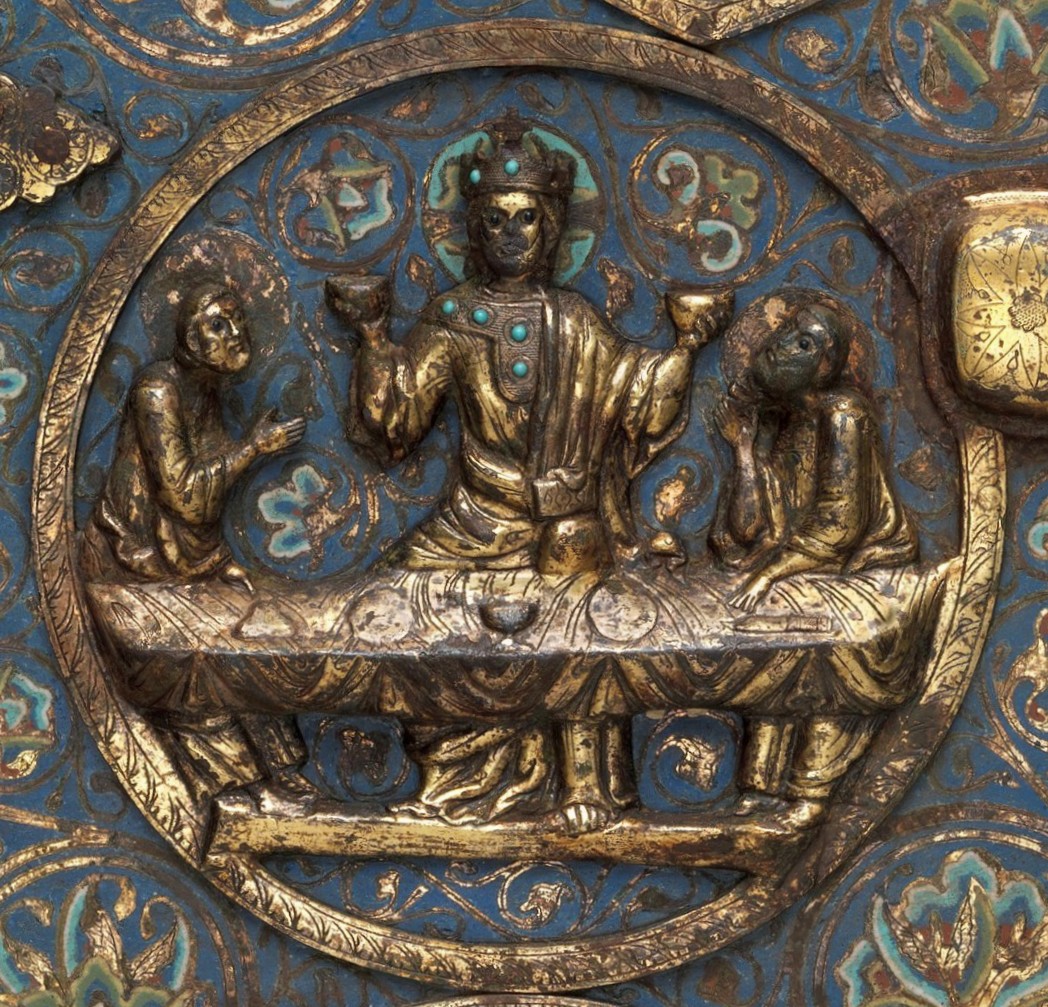
LOOK: Supper at Emmaus medallion from the Tabernacle of Cherves
Detail of The Supper at Emmaus from the Tabernacle of Cherves, Charente, France, ca. 1220–30. Champlevé enamel and copper, overall 33 × 37 3/4 × 10 3/4 in. (83.8 × 95.9 × 27.3 cm). Metropolitan Museum of Art, New York.
He is born There’s a reason now to carry on Toot your horns Write another song Love is here Seated at your table now Not livin’ in a stable now Love is king
So let us sing Let us sing Love is king Love is king (Repeat)
He is born There’s a reason now to carry on Toot your horns Write another song Love is here Seated at your table now Not livin’ in a stable now Love is king
Angels sing About the king Let it ring Love is king
So let us sing Let us sing Love is king Love is king
This post is part of a daily Christmas series that goes through January 6. View all the posts here, and the accompanying Spotify playlist here.
Emilie Mediz-Pelikan (Austrian, 1861–1908), Blooming Chestnut Trees, 1900. Oil on canvas, 132 × 124 cm. Belvedere, Vienna.
Because I love
        The sun pours out its rays of living gold,
        Pours out its gold and silver on the sea.

Because I love
        The earth upon her astral spindle winds
        Her ecstasy-producing dance.

Because I love
        Clouds travel on the winds through wide skies,
        Skies wide and beautiful, blue and deep.

Because I love
        Wind blows white sails,
        The wind blows over flowers, the sweet wind blows.

Because I love
        The ferns grow green, and green the grass, and green
        The transparent sunlit trees.

Because I love
        Larks rise up from the grass
        And all the leaves are full of singing birds.

Because I love
        The summer air quivers with a thousand wings,
        Myriads of jewelled eyes burn in the light.

Because I love
        The iridescent shells upon the sand
        Take forms as fine and intricate as thought.

Because I love
        There is an invisible way across the sky,
        Birds travel by that way, the sun and moon
        And all the stars travel that path by night.

Because I love
        There is a river flowing all night long.

Because I love
        All night the river flows into my sleep,
        Ten thousand living things are sleeping in my arms,
        And sleeping wake, and flowing are at rest.
“Amo Ergo Sum” (Latin for “I Love, Therefore I Am”) by Kathleen Raine is from The Year One (London: Hamish Hamilton, 1952) and is compiled in The Collected Poems of Kathleen Raine (Ipswich: Golgonooza Press, 2000).
Kathleen Raine (1908–2003) was a British poet and William Blake scholar who fervently promoted spiritual values in an age marked by secular materialism. She was born in Ilford, Essex, and raised in a Methodist household (her father was a lay minister), converting to Catholicism in the 1940s, but, following her interests in Jungian psychology, Neoplatonism, and sacred symbols, she came to embrace the perennial philosophy, which views religious traditions as sharing a single metaphysical truth. With Keith Critchlow, Brian Keeble, and Philip Sherrard and the patronage of then Prince Charles of Wales, Raine founded the Temenos Academy of Integral Studies in 1990, a London charity that offers education in philosophy and the arts in “the light of the sacred traditions of East and West.” Raine authored more than thirty books, both poetry and prose, and her honors and awards include the CBE (Commander of the Order of the British Empire) and the Queen’s Gold Medal for Poetry.
He brought me to the banqueting house, and his banner over me was love.
—Song of Solomon 2:4
I will extol thee, O LORD; for thou hast lifted me up . . .
—Psalm 30:1a
Blessed be the God and Father of our Lord Jesus Christ, who hath blessed us with all spiritual blessings in heavenly places in Christ . . .
—Ephesians 1:3
LOOK: Ethiopian Angels, Debre Birhan Selassie Church
Painted wood ceiling, early 19th century, Debre Birhan Selassie Church, Gondar, Ethiopia. Photo: A. Savin.
Debre Birhan Selassie (Trinity and Mountain of Light) Church in Gondar, the imperial capital of Ethiopia from 1636 to 1855, is famous for the colorful paintings that cover every inch of the interior walls and ceiling. The south wall concentrates on the Life of Christ, while the north wall depicts various saints. The focal point—on the east wall, in front of the holy of holies—is a Crucifixion scene and an icon of the Trinity. But the most celebrated visuals inside the church are the hundred-plus winged heads painted in rows between the wooden beams of the ceiling, representing the cherubim and God’s omnipresence.
The original church, which was round, was consecrated in 1693 by Emperor Iyasu I, but lightning destroyed it in 1707. The rectangular stone church that stands on the site now likely dates to the late eighteenth century, and it is the only one of the forty-four Orthodox Tewahedo churches in Gondar to survive the 1888 sack of the city by Mahdist soldiers from Sudan. (Locals say the marauders were miraculously rerouted by a swarm of bees.)
According to Ethiopia (Bradt Travel Guide) writer Philip Briggs, “The paintings are traditionally held to be the work of the 17th-century artist Haile Meskel, but it is more likely that several artists were involved and that the majority were painted during the rule of Egwala Seyon (1801–17), who is depicted prostrating himself before the Cross on one of the murals.”
The church is part of a larger imperial compound, known as Fasil Ghebbi, that has been a UNESCO World Heritage Site since 1979 and that includes palaces, monasteries, and public and private buildings.
Photo: Alan Davey
LISTEN: “His Banner Over Me Is Love” by B. C. Laurelton (pseudonym of Alfred B. Smith), 1965 | Performed by Christy Nockels on Be Held: Lullabies for the Beloved, 2017 | CCLI #28579
I am my Beloved’s and He is mine— His banner over me is love. I am my Beloved’s and He is mine— His banner over me is love. I am my Beloved’s and He is mine— His banner over me is love, His banner over me is love.
He brought me to His banqueting table— His banner over me is love. He brought me to His banqueting table— His banner over me is love. He brought me to His banqueting table— His banner over me is love, His banner over me is love.
He lifted me up to the heavenly places— His banner over me is love. He lifted me up to the heavenly places— His banner over me is love. He lifted me up to the heavenly places— His banner over me is love, His banner over me is love.
I sang a version of this song in children’s church regularly when I was little (with hand motions!) and have carried it with me all these years, a gentle assurance that I am divinely loved and protected. I’ve quoted the scriptures it’s drawn from above. Its refrain comes from Song of Solomon 2:4: “his banner over me was love.”
The Song of Solomon, aka the Canticle of Canticles, has traditionally been read, at least on one level, as an allegory of the love between God and the human soul—or, more specifically in the Christian tradition, Christ and his church.
From the root “to cover,” the Hebrew word for “banner” in this verse refers to a military standard. It is being used figuratively here to indicate that we enlist ourselves under Love’s banner, which goes forth in triumph and protects those under its billows. We belong to love, commit ourselves to love, overcome through love. The verse is perhaps an allusion to the names of generals being inscribed on the banners of their armies. God’s name is Love (1 John 4:8).
The image is at once vigorous and gentle. The NRSV translates the phrase as “his intention toward me was love.”
The song “His Banner Over Me Is Love” was written by Alfred B. Smith (1916–2001), an itinerant song leader, songwriter, and Christian music publisher. Smith compiled and published his first songbook, Singspiration One: Gospel Songs and Choruses, while he was a student at Wheaton College in 1941, to support the evangelistic meetings he was running with his roommate, Billy Graham (yes, that Billy Graham!). Two years later he founded Singspiration Publishing Company, which published several popular series of songbooks. In 1963 he sold Singspiration to Zondervan, but he ran other publishing ventures (i.e., Better Music Publications and Encore Publications) for the remainder of his ministerial career.
According to Music in the Air: The Golden Age of Gospel Radio by Mark Ward Sr., Smith composed “His Banner Over Me Is Love” in 1965 as an impromptu offertory while serving as a visiting song leader at First Baptist Church–Laurelton in Brick, New Jersey. Afterward he received requests from the congregation for the music. His original notation read “B. C. Laurelton” (for “Baptist Church Laurelton”) to designate where he wrote the song, and it was copied as such as people shared the music with others—so when the song was later published in 1972, Smith decided to adopt “B. C. Laurelton” as a pen name.
Singer-songwriter Christy Nockels [previously] sings “His Banner over Me” on an album of lullabies to a twinkling piano accompaniment.
May this truth—that God’s banner over you is love—soothe you and give you confidence.
For another devotion featuring a song from this album, see “Now I’ve Seen It All,” centered on Simeon’s encounter with the Christ child. And for one featuring a different painting by Piriankov, see “Radiant.”



.jpg)
 Art & Theology