Advent, Day 11: Waiting Bride

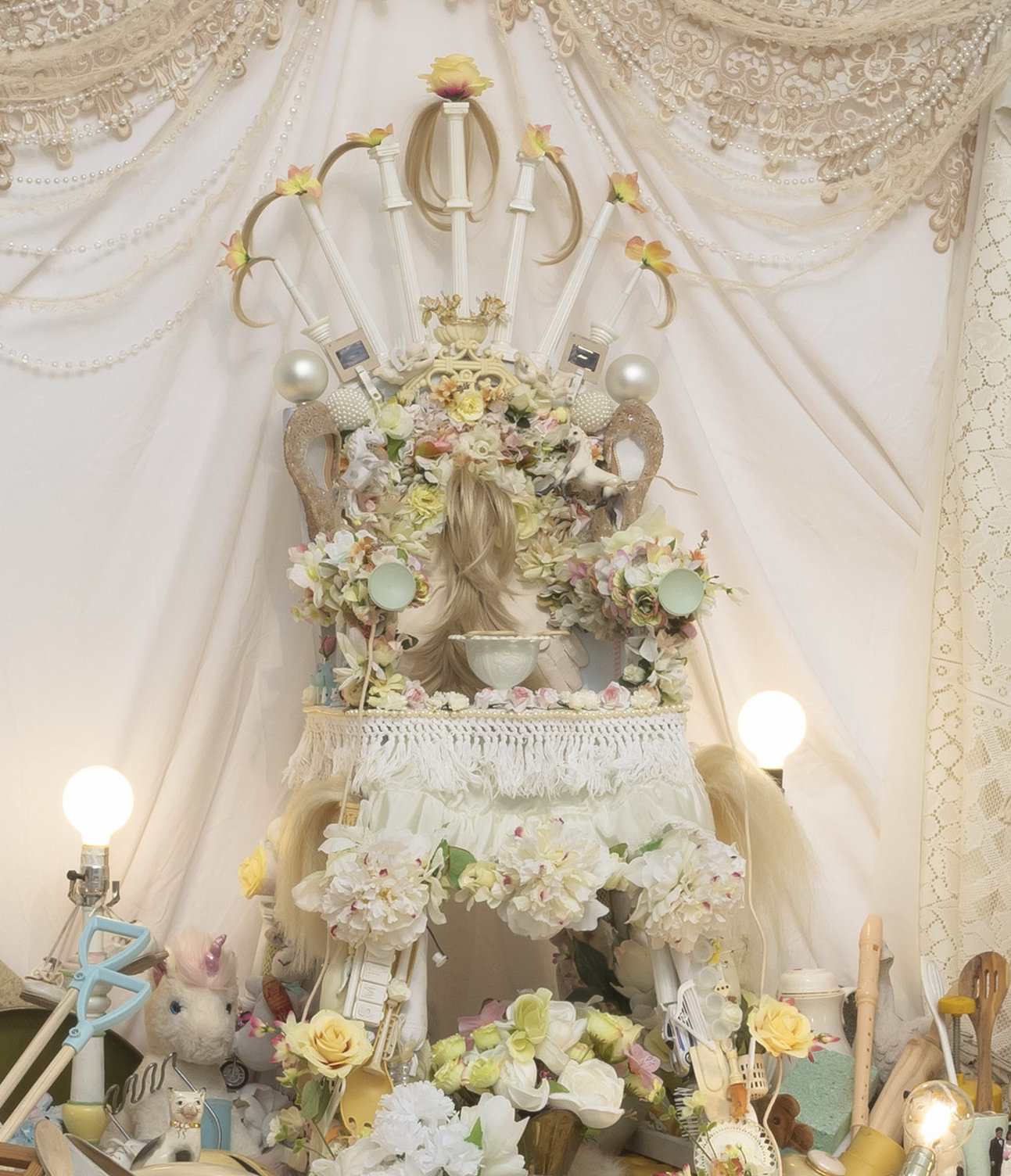
LOOK: Dim Gold (Feast of Brides) by Mandy Cano Villalobos

Cano Villalobos, Mandy_Dim Gold (Feast of Brides)
Mandy Cano Villalobos (American, 1979–), Dim Gold (Feast of Brides), 2022. Miscellaneous found objects, dimensions variable. Installation at Bridge Projects, Los Angeles. Photo courtesy of the artist.

Mandy Cano Villalobos is an interdisciplinary artist whose projects span installation, painting, drawing, performance, sculpture, and video. She lives in Grand Rapids, Michigan.

Drawing on the archetype of the waiting bride, the found-object installation Dim Gold (Feast of Brides) was commissioned by Bridge Projects for Here After, an exhibition exploring humanity’s hope for paradise. The artist writes,

Dim Gold is an allegory of marital covenant, bodily death, and the hope of love’s consummation in afterlife. The throne heap consists of discarded clothing, broken appliances, old lamps, unwanted toys, bruised furniture, fake flowers, stained curtains, human and synthetic hair, scratched glasses, deflated soccer balls, faded photographs, worn shoes, chipped figurines, kitchen utensils, costume jewelry, yellowed wedding decorations, cracked dishes, Christmas ornaments, mildewed books, and bathtub plugs.

From baby bottles and children’s playthings to a cane and a pillbox, the pile contains a life. (In fact, Cano Villalobos said she acquired most of the items from an old woman’s estate sale.) It’s a full life, but one of brokenness and decay. There is no permanence in this world. The otherworld—the new heaven, the new earth (a transfigured thisworld)—is what endures.
Cano Villalobos, Mandy_Dim Gold (detail)

The Dim Gold construction is throne-like, all its components leaning in toward a central chair topped by seven white, ribbed shafts that fan out and that are suggestive, with the flame-colored flowers at the terminals, of a menorah. Lace, silk, and draped strings of pearls form the throne’s backing. With its dressed but empty seat that calls forth a presence, the piece evokes the hetoimasia (prepared throne of the second coming) of Eastern Orthodox icons.

The scattered, lit bulbs on shadeless lampstands allude to the burning oil lamps in Jesus’s parable of the ten bridesmaids (Matt. 25:1–13), which signify readiness for the Bridegroom’s return.

Cano Villalobos combines earthly and heavenly imagery in Dim Gold, an Advent ensemble that pictures the church-as-bride’s waiting with lights on, amid the ephemera of this life, for her groom to come take her home, where an eternal feast is spread in bright, delicious glory, and the two of them will become one at last.

LISTEN: “When the Bridegroom Comes” | Words by David Omer Bearden, 1973 | Music by Judee Sill, 1973 | Performed by Judee Sill on Heart Food, 1973

See the bride and the Spirit are one.
Then won’t you who are thirsty invite him to come?
With your door open wide,
Won’t you listen in the dark for the midnight cry?
And see, when your light is on, that the Bridegroom comes.

Into cold outer darkness are gone
Guests who would not their own wedding garment put on.
Though the chosen are few,
Won’t you tarry by your lamp till he calls for you?
And pray that your love endure till the Bridegroom comes.

When the halt and the lame meet the Son,
And he sees for the blind and he speaks for the dumb,
Let their poor hearts’ complaint,
Like the leper turned around who has kissed the saint,
Lift like a trumpet shout, and the Bridegroom come.

See the builders despising the stone,
See the pearl of great price and the dry desert bones.
By the Pharisees cursed,
Be exultant with the rose when the last are first,
And see how his mercy shines as the Bridegroom comes.

Hear the bride and the Spirit say, “Come!”
Then won’t you who are weary invite in the Son?
When your heart’s love is high,
Won’t you hasten to the place where the hour is nigh?
And see that your light is on, for the Bridegroom comes.
See that your light is on, for the Bridegroom comes.

Judee Sill (1944–1979) was an American singer-songwriter whose genre of music Rolling Stone refers to as “mystic Christian folk.” Themes of temptation, rapture, redemption, and the search for higher meaning permeate her work.

Sill survived ongoing physical and verbal abuse in childhood from her mother and stepfather. As a teenager, she committed a series of armed robberies that landed her in reform school, where she learned to play the organ for church and became interested in gospel music. Upon her release, after briefly attending a junior college and working in a piano bar, she got caught up in the California drug culture, developing a crippling heroin addiction and resorting to prostitution and check forgery to fund it.

While she was serving a prison sentence for narcotics and forgery offenses, her only sibling, Dennis, died of an illness, and she was devastated. But this seems to have given her the impetus to pursue a career in songwriting and performing. She gigged in clubs around Los Angeles while living in a Cadillac, and she was eventually signed by the new Asylum Records. Graham Nash (of Crosby, Stills, Nash & Young) produced her first single, “Jesus Was a Cross Maker.” Her two albums, Judee Sill (1971) and Heart Food (1973), received some acclaim but failed to chart. Discouraged, and suffering back pain from a car accident and later a fall, she returned to hard drugs. She died of a cocaine and codeine overdose at age thirty-five.

Why do I rehearse Sill’s turbulent biography? Because songs don’t come out of a vacuum. The longing in “When the Bridegroom Comes”—those piano chords, that voice—is real. Her thirst, her questing, her waiting and hoping. Though she herself didn’t write the lyrics (David Omer Bearden, her romantic partner at the time, did, though she likely gave input), she sings them with fervency, makes them her prayer.

The song melds together the parable of the ten bridesmaids from Matthew 25 with the bridal theology of Revelation. In one, which has more of an individual focus, we are put in the place of the bride’s attendants and warned to be prepared for the imminent wedding celebration, lest we get locked out in the dark; in the other, Christ’s church as a collective is likened to the bride herself, eagerly anticipating the arrival of her groom and the sweet union that will follow.

The song’s primary referent is Revelation 22:17, from the final chapter of the Bible:

The Spirit and the bride say, “Come.”
And let everyone who hears say, “Come.”
And let everyone who is thirsty come.
Let anyone who wishes take the water of life as a gift.

In this verse, the voice of the bride (the church) through whom the Spirit speaks calls out, “Come.” Because of the interchange of speakers and subjects in the broader passage, it’s unclear whether the addressee of this imperative is Christ or the masses. The church could be crying out for Jesus’s return, as they do in verse 20, or they could be inviting people far and wide to the gospel feast, bidding them come and eat. I think the latter, which would make it continuous with the third and fourth lines, but it could really go either way. Because as sure as there’s the final coming of Christ to the world, there’s also the coming of the world to Christ. He comes to us, and we come to him.

Sill’s whole song is full of biblical references—Jesus’s healing ministry, Jesus as the rejected cornerstone (Matt. 21:42), Jesus as the pearl of great price (Matt. 13:45–46), the Spirit breathing life into dry bones (Ezek. 37:1–14), Jesus’s upside-down kingdom in which the last are first and the first are last (Matt. 19:30). It celebrates divine mercy and grace and encourages us to respond in the affirmative to Christ’s wedding invitation, and to persevere in love while he tarries.
Roundup: Empty chair, how to read a Last Judgment icon, and more

ARTWAY VISUAL MEDITATIONS:

ArtWay.eu is an online hub of resources related to faith and the visual arts. Every Sunday a new “visual meditation” is released on a selected artwork, written by one of a diverse range of volunteers from across the globe. (I contributed last week’s, on Eduardo Kingman, and another of mine, on a Flight to Egypt painting by Pranas Domsaitis, will be forthcoming.) Sign up here to receive the free weekly meditation in your inbox. Here are two examples from the past year, with Advent vibes, that I’ve found particularly meaningful.

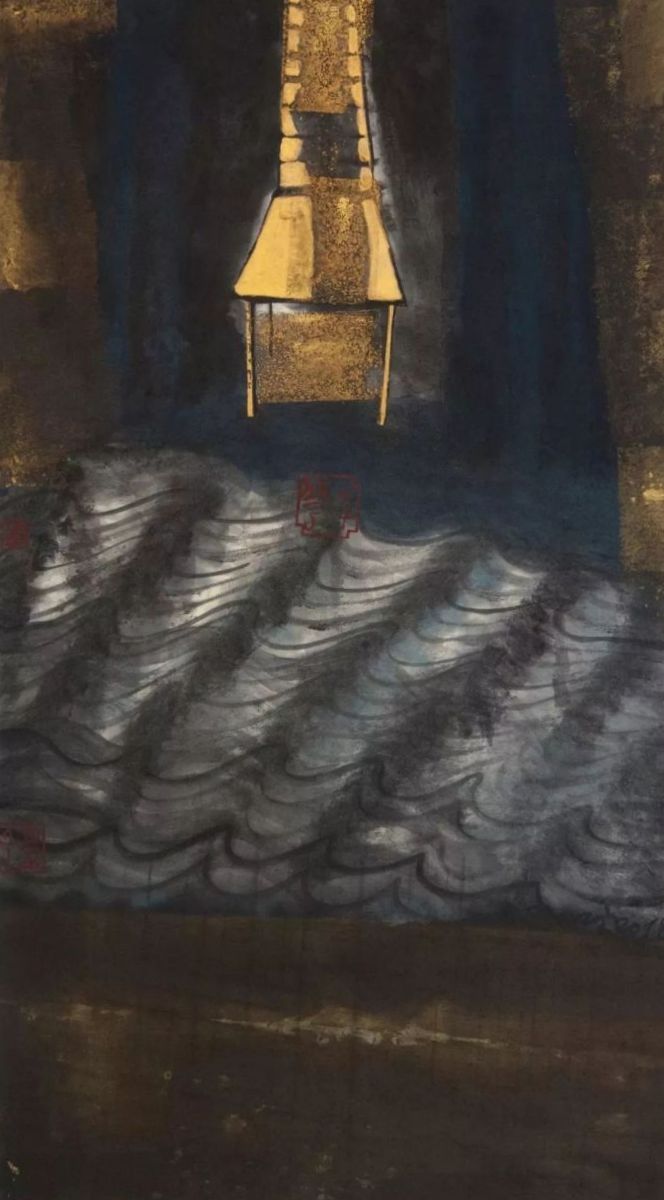
>> “The Empty Chair in a Season of Waiting” by Rachel Hostetter Smith: Last year, in the midst of the COVID-19 pandemic, art history professor Rachel Hostetter Smith wrote about a series of Chinese ink wash paintings by Daozi. They’re a tribute to his friend, the Chinese human rights activist Liu Xiabo (1955–2017), who was unable to accept his 2010 Nobel Peace Prize in person because he was in prison, so he was represented at the ceremony by an empty chair. Smith brings this image of an empty chair into conversation with all the uncertainty and absence in this current time of pandemic; the Jewish Passover Seder liturgy and its setting a place at the table for the prophet Elijah; Franciscan priest Richard Rohr on the liminal space between the old world and the world to come; and John the Revelator’s eschatological vision of a throne descending from heaven (Rev. 21).

Daozi_The Empty Chair on the Sea Ridge
Daozi (aka Wang Min) (Chinese, 1956–), The Empty Chair on the Sea Ridge, 2018. Ink and color on paper, 97 × 54 cm.

This and fifty-four other contemporary artworks are part of the international traveling exhibition Matter + Spirit: A Chinese/American Exhibition, which Smith curated (click the link to explore the art—it’s very compelling!). The exhibition is a product of a gathering of North American and Chinese art professors in June 2018 in Beijing, Nanjing, and Shanghai, sponsored by the Nagel Institute for the Study of World Christianity.

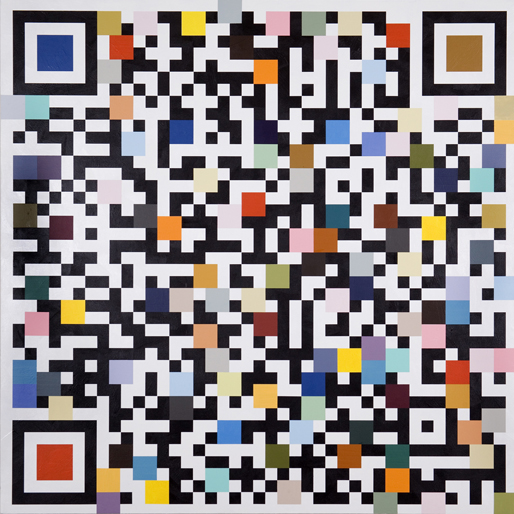
>> “Waiting for the Lord” by Mary McCampbell: Mary McCampbell [previously] writes about a painting by Douglas Coupland, best known for his work as a novelist and for popularizing the term Generation X. “In I wait and I wait and I wait for God to appear (2011), the artist has painted a colorful QR (Quick Response) code, defamiliarizing a familiar symbol of daily life. . . . Like most QR codes, if a viewer holds up her camera to the graphic image, a message is decoded via smart phone. A contrast to the hard geometric edges of the painting, the message that magically appears is soft and human: ‘I wait and I wait and I wait for God to appear.’ . . . The painting reflects a longing for the real God to manifest himself, no longer merely an idea, a doctrine, a rhetorical position. Where is God in the intricate, detailed, yet seemingly random pattern of life? How can we discern WHO He is? . . . This atypical reminder to ‘Wait for the Lord; be strong and take heart and wait for the Lord’ (Psalm 27:14) discloses the curious, humble faith of a non-believer, one hoping and waiting for eyes to see the ‘appearance’ of the Lord.”

Coupland, Douglas_Waiting for the Lord
Douglas Coupland (German, 1961–), I wait and I wait and I wait for God to appear, 2011. Acrylic and latex on canvas, 182.9 × 182.9 cm. Queen’s University, Kingston, Ontario, Canada.

+++

LECTURE: “Understanding the Last Judgment” by Jonathan Pageau: “The traditional icon of the Last Judgment is a very complex image which is both the synthesis of Christian typology as well as an image of the eschatological finality of all things.” In this talk given at St. John Chrysostom Byzantine Catholic Church in Seattle, Jonathan Pageau breaks down Last Judgment iconography, explaining how to read it scene by scene.

Elements include:

  • The Deësis, a representation of Christ enthroned between Mary and John the Baptist
  • The hetoimasia, or prepared throne, which awaits the return of Christ
  • The psychostasis, or weighing of souls
  • The ladder of divine ascent, representing the struggle to reach illumination
  • Paradise, with the “good thief,” Abraham’s bosom, and the Mother of God
  • The last trump and the resurrection of the dead, with beasts regurgitating their human prey
  • The river of fire, per Daniel 7:10, with the damned being swallowed by the mouth of Hades

Why am I sharing this now? Because Advent is eschatological and future-oriented in nature, and, though it tends to be underemphasized in our era, judgment is a major theme—which Fleming Rutledge does a great job unpacking in her book Advent: The Once and Future Coming of Jesus Christ.

+++

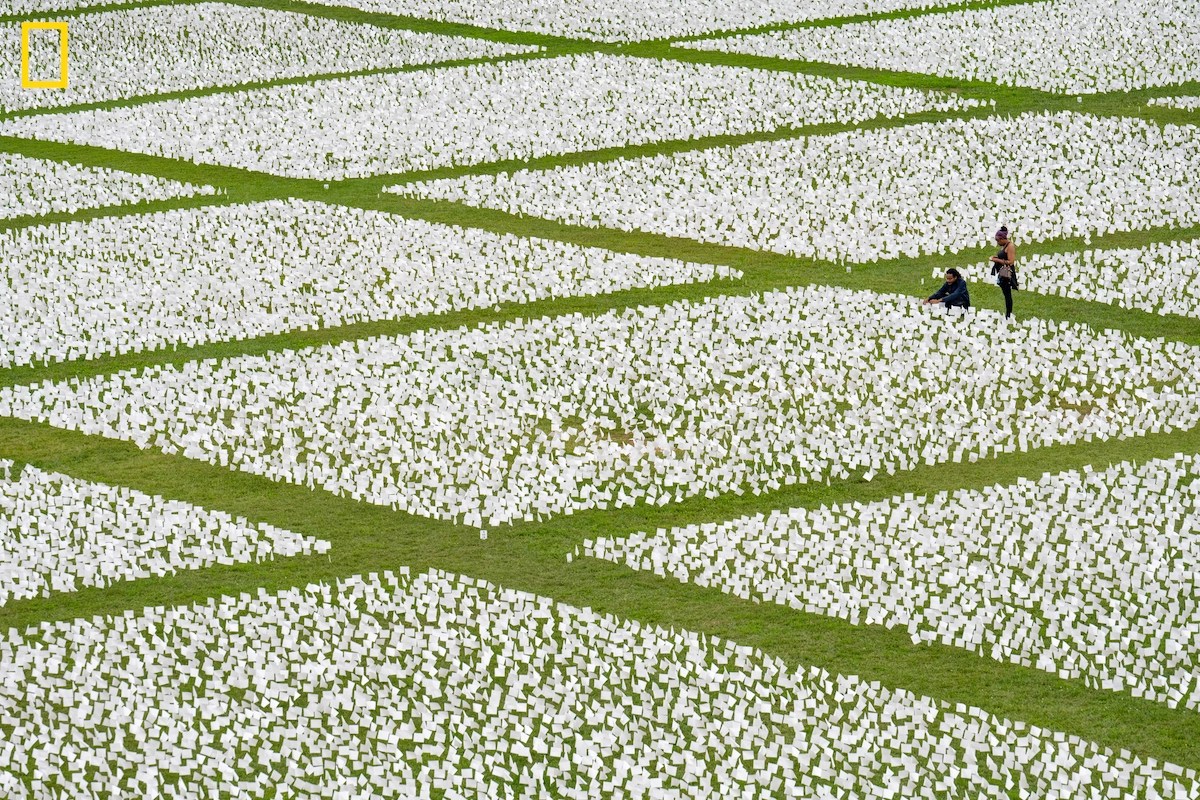
COVID MEMORIAL: From September 17 to October 3, 2021, the National Mall in Washington, DC, was blanketed with some 670,000 white flags, each one representing an American life lost to COVID-19. Titled In America: Remember, the installation was conceived by artist Suzanne Brennan Firstenberg as a way to visualize the magnitude of loss the country has suffered over the past two years in relation to the pandemic, and to invite mourning. Visitors were invited to personalize flags for someone they lost.

Stephen Wilkes’s photos of the memorial undid me. The enormity of suffering represented is difficult to fathom. Every single flag is a devastation. And since the installation was put up this fall, there have been another 100,000-plus COVID deaths in the US, while the global death toll has surpassed 5.2 million.

In America: Remember (detail)
Photo: Stephen Wilkes / National Geographic

In America: Remember (detail)
Photo: Stephen Wilkes / National Geographic

In America: Remember (photo by Stephen Wilkes)
In America: Remember, September 17–October 3, 2021, an installation of 670,000+ white flags on the National Mall, conceived by Suzanne Brennan Firstenberg. Photo: Stephen Wilkes / National Geographic.

+++

ART COMPETITION: “Macierzyństwo Maryi” (The Motherhood of Mary): The results are in for Poland’s first annual Ogólnopolski Konkurs Sztuki Sakralnej (National Competition of Sacred Art, or OKSSa for short), organized by the Fundacji Maria i Marta (Mary and Martha Foundation). The theme was Mary’s motherhood.

First place, with a prize of 15,000 zł (about USD $3,600), went to Błażej Guza for Macierzyństwo Maryi, which shows Mary drawing a hopscotch board on the pavement, its shape portending her boy’s fate. Jesus is not visible in frame, save for his shadow, which reveals simply an innocent child ready to play.

This piece and thirty-four others from among the many entries were exhibited at Concordia Design Wrocław November 25–30, 2021, and this month a few of them will be shown at the National Museum in Wrocław. You can view the top three winners as well as four honorable mentions at the boldface link above, or on the foundation’s Facebook page. And here’s an exhibition view.

The Fundacji Maria i Marta aims to promote the development of contemporary Christian art in Poland by organizing competitions, exhibitions, and workshops and by providing artistic consultation for churches.

Guza, Blazej_The Motherhood of Mary
Błażej Guza, Macierzyństwo Maryi (The Motherhood of Mary), 2021. Acrylic and chalk, 90 × 60 cm.

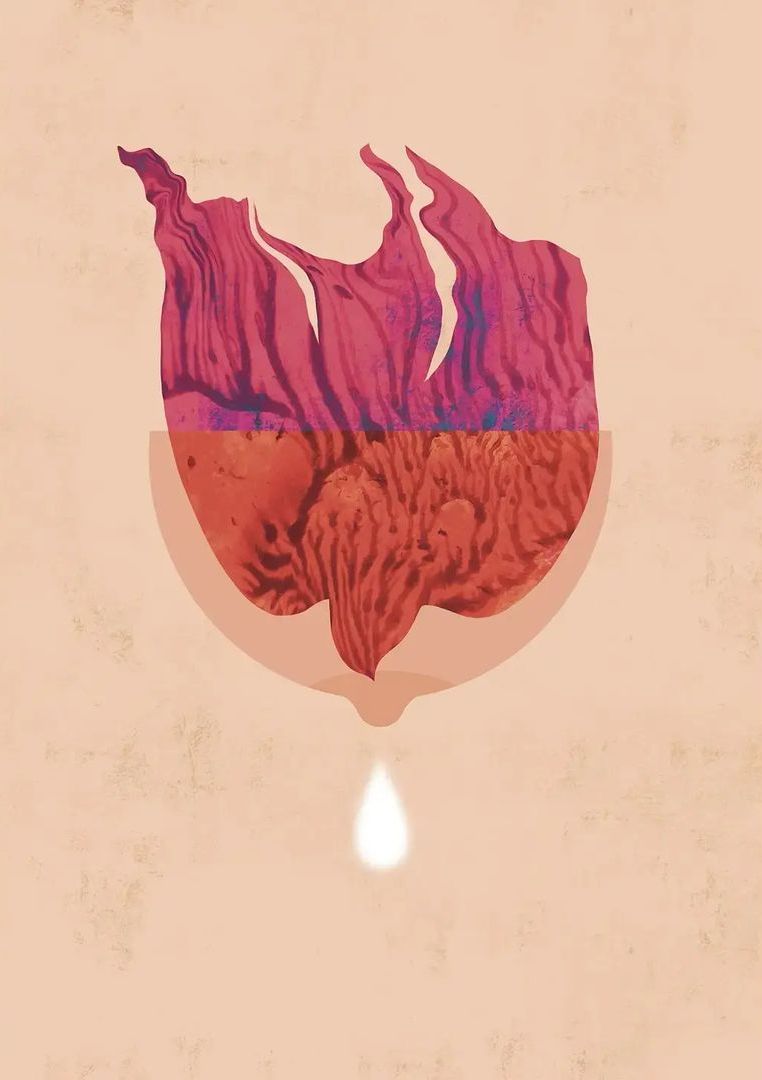
Kowalewska-Tylka, Beata_Fullness of Spirit
Beata Kowalewska-Tylka, Pełnia ducha (Fullness of Spirit), 2021. Digital painting, 70 × 50 cm. The OKSSa jury commented on how this piece shows “the interpenetration of the spiritual and human dimensions of Mary’s motherhood,” the shape of the fiery red cloth evoking the Holy Spirit as dove, and the breast that gives milk signifying Mary’s physical nourishment of her son from her own body.

Hail to the Lord’s Anointed (Artful Devotion)

Arian Baptistery mosaic
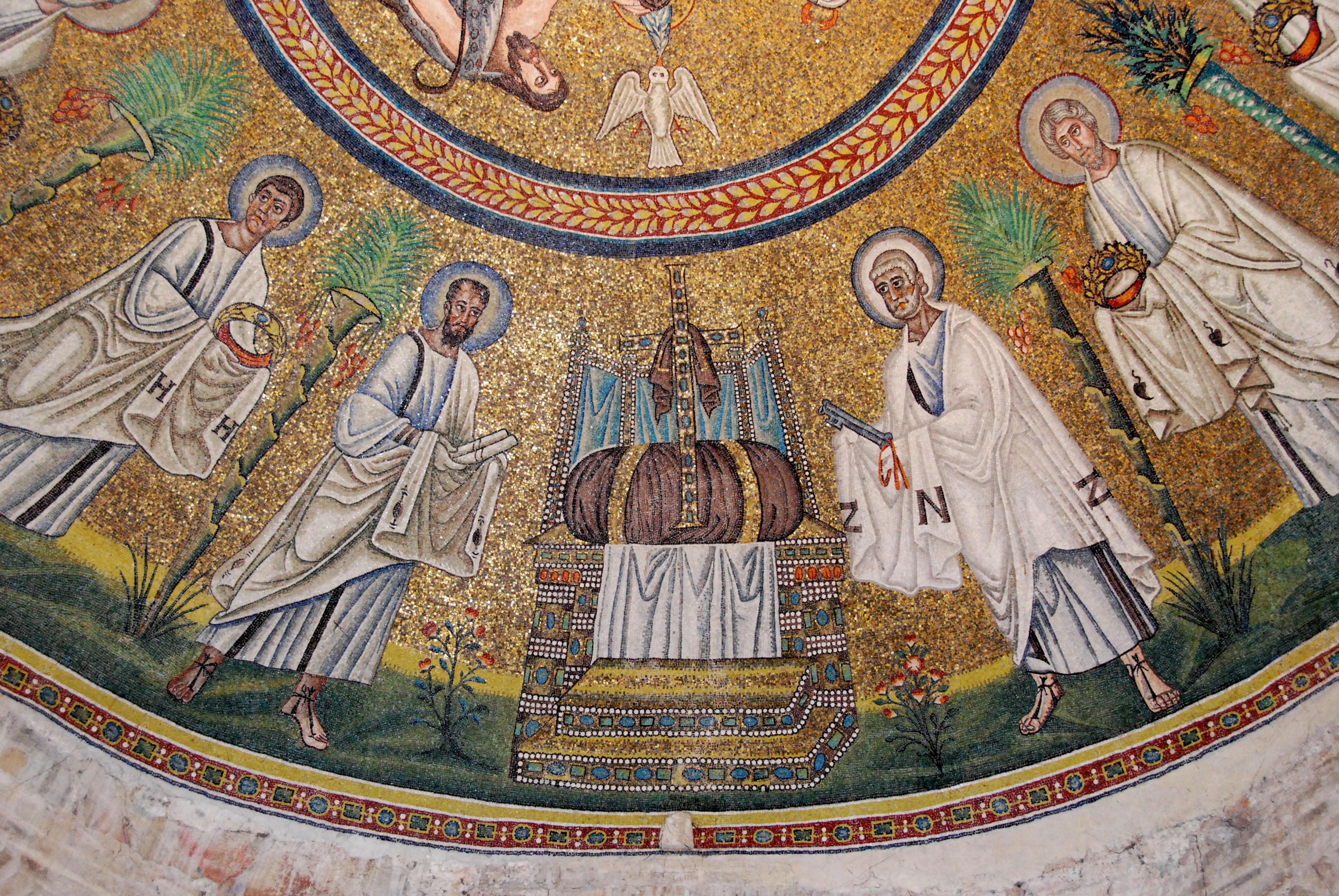
The Baptism of Christ, early 6th century. Ceiling mosaic, Arian Baptistery, Ravenna, Italy. Photo: Jim Forest.

Behold my servant, whom I uphold,
my chosen, in whom my soul delights;
I have put my Spirit upon him;
he will bring forth justice to the nations.
He will not cry aloud or lift up his voice,
or make it heard in the street;
a bruised reed he will not break,
and a faintly burning wick he will not quench;
he will faithfully bring forth justice.
He will not grow faint or be discouraged
till he has established justice in the earth;
and the coastlands wait for his law.

Thus says God, the LORD,
who created the heavens and stretched them out,
who spread out the earth and what comes from it,
who gives breath to the people on it
and spirit to those who walk in it:
“I am the LORD; I have called you in righteousness;
I will take you by the hand and keep you;
I will give you as a covenant for the people,
a light for the nations,
to open the eyes that are blind,
to bring out the prisoners from the dungeon,
from the prison those who sit in darkness.
I am the LORD; that is my name;
my glory I give to no other,
nor my praise to carved idols.
Behold, the former things have come to pass,
and new things I now declare;
before they spring forth
I tell you of them.”

—Isaiah 42:1–9

Then Jesus came from Galilee to the Jordan to John, to be baptized by him. John would have prevented him, saying, “I need to be baptized by you, and do you come to me?” But Jesus answered him, “Let it be so now, for thus it is fitting for us to fulfill all righteousness.” Then he consented. And when Jesus was baptized, immediately he went up from the water, and behold, the heavens were opened to him, and he saw the Spirit of God descending like a dove and coming to rest on him; and behold, a voice from heaven said, “This is my beloved Son, with whom I am well pleased.”

—Matthew 3:13–17

You yourselves know what happened throughout all Judea, beginning from Galilee after the baptism that John proclaimed: how God anointed Jesus of Nazareth with the Holy Spirit and with power. He went about doing good and healing all who were oppressed by the devil, for God was with him. . . .

He is the one appointed by God to be judge of the living and the dead. To him all the prophets bear witness that everyone who believes in him receives forgiveness of sins through his name.

—Acts 10:37–38, 42–43

+++

SONG: “Hail to the Lord’s Anointed” | Words by James Montgomery, 1821 | Music by the Rev. Vito Aiuto, on Welcome to the Welcome Wagon, 2008 [previously]

https://open.spotify.com/track/6g28yW9SilEHfMZ7WoLfYc?si=YlCyMYclTpmgT6kNHWABXQ

Hail to the Lord’s Anointed,
great David’s greater Son!
Hail in the time appointed,
his reign on earth begun!
He comes to break oppression,
to set the captive free;
to take away transgression,
and rule in equity.

He comes with succor speedy
to those who suffer wrong;
to help the poor and needy,
and bid the weak be strong;
to give them songs for sighing,
their darkness turn to light,
whose souls, condemned and dying,
are precious in his sight.

He shall come down like showers
upon the fruitful earth;
love, joy, and hope, like flowers,
spring in his path to birth.
Before him on the mountains
shall peace, the herald, go,
and righteousness, in fountains,
from hill to valley flow.

To him shall prayer unceasing
and daily vows ascend;
his kingdom still increasing,
a kingdom without end.
The tide of time shall never
his covenant remove;
his name shall stand forever;
that name to us is love.

+++

Arian Baptistery
Arian Baptistery, Ravenna. Photo: Georges Jansoone.

Baptism of Christ, Arian Baptistery
Photo: Peter Milošević

Baptism of Christ, Arian Baptistery
Photo: Fr. Lawrence Lew, OP

Baptism of Christ (detail)
Photo: Jim Forest

The dome of the great sixth-century Arian Baptistery in Ravenna, Italy, shows, in glimmering mosaic, a young, beardless, fully nude Christ standing waist-deep in the waters of the Jordan as John the Baptist, dressed in leopard skin, anoints him—the archetypal event for the liturgy that used to be performed below. And actually, the anointing water in this representation comes from the beak of a dove, God the Holy Spirit.

The old man on the left is a personification of the Jordan River, whose attributes are derived from that of the Hellenistic river gods. He holds a reed in his hand and leans against a spilled jar, from whose mouth flows the river water, while from his head there sprouts a pair of red crab claws. He is clothed in the same moss that covers the rock John stands on.

Around this central scene, which is framed by a laurel wreath, is a procession of the twelve apostles, led by Peter (the gray-haired man with the key) and Paul (the dark-haired man with the scrolls). The apostles carry jeweled crowns in their veiled hands—a sign of humility—as they make their way to the empty throne of Christ’s promised return, the hetoimasia, prepared with a plush purple cushion and jeweled cross.

Hetoimasia mosaic (Ravenna)
Photo: Jim Forest

The iconography here is very similar to that of the ceiling mosaic in the even older (Orthodox) Baptistery of Neon, also in Ravenna.

I’ve featured baptistery dome art two other times on the blog: a painting of Paradise from the Padua Baptistery and a Last Judgment mosaic from the Florence Baptistery. Also related are the compilation of contemporary icons of the Baptism of Christ that I published two years ago (the ones by Jerzy Nowosielski and Ivanka Demchuk are favorites of mine) and last year’s Artful Devotion for this calendar day, featuring a Baptism of Christ from the Hitda Codex and a virtuosic piano piece.


This post belongs to the weekly series Artful Devotion. If you can’t view the music player in your email or RSS reader, try opening the post in your browser.

To view all the Revised Common Lectionary scripture readings for the feast of the Baptism of the Lord, cycle A, click here.