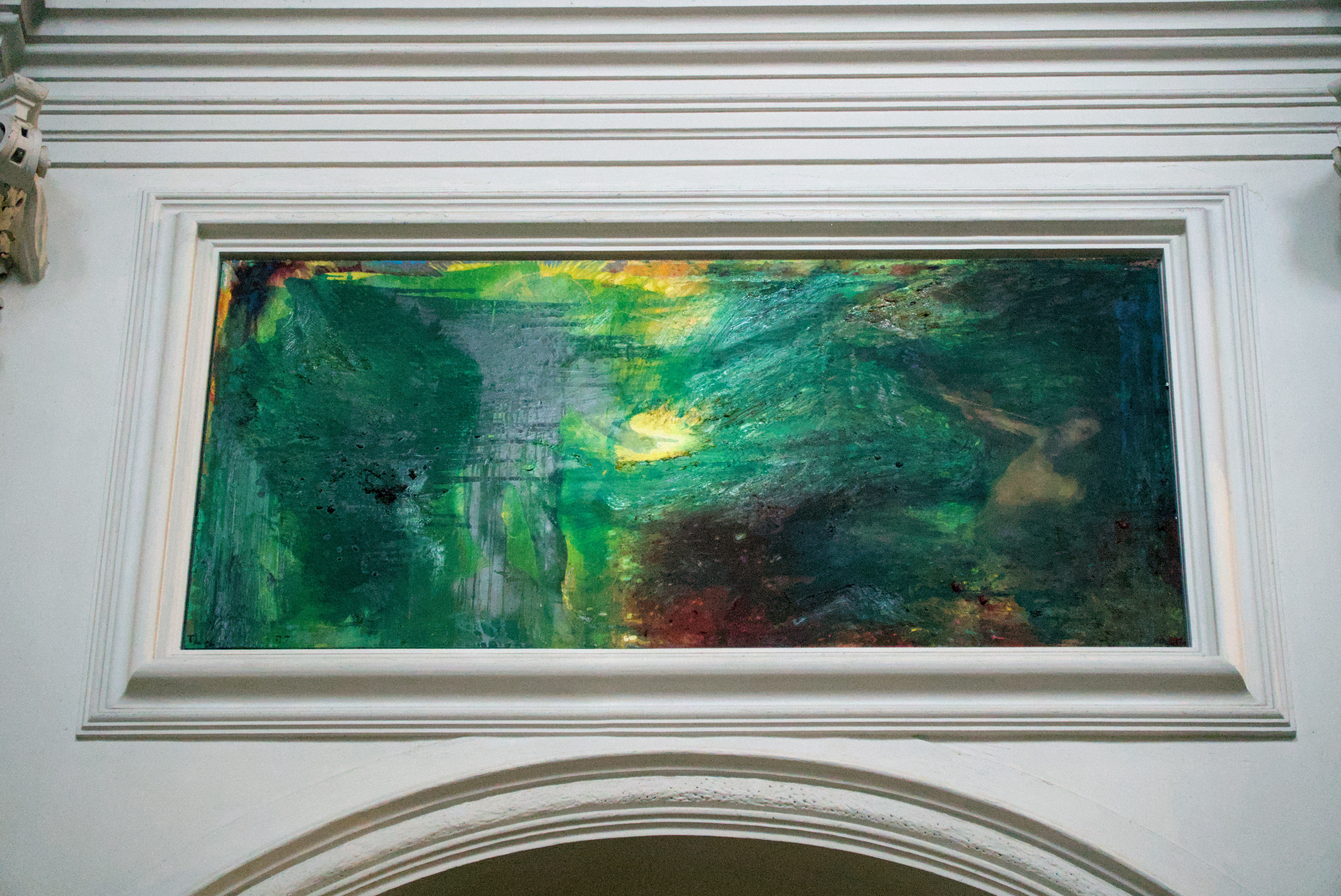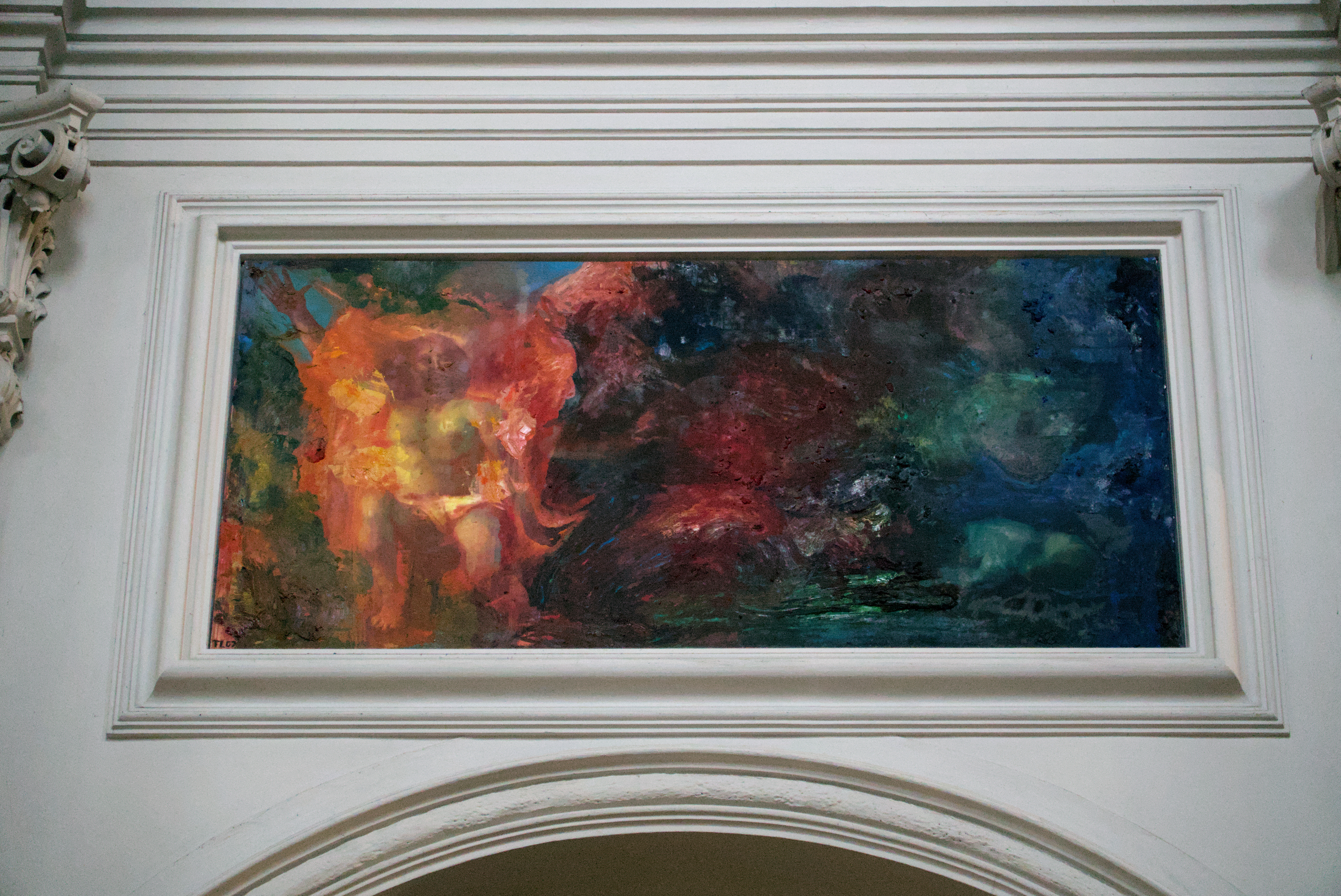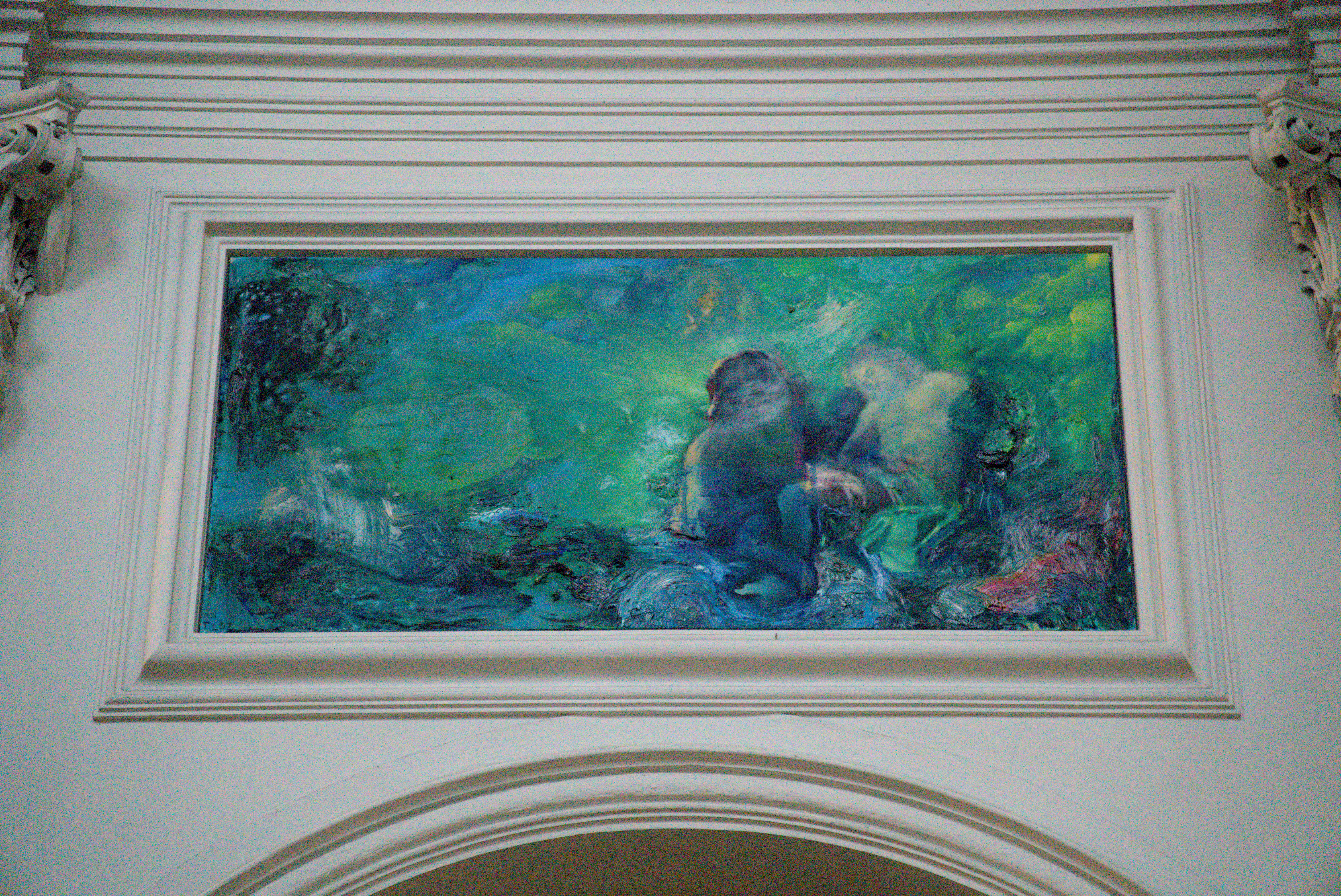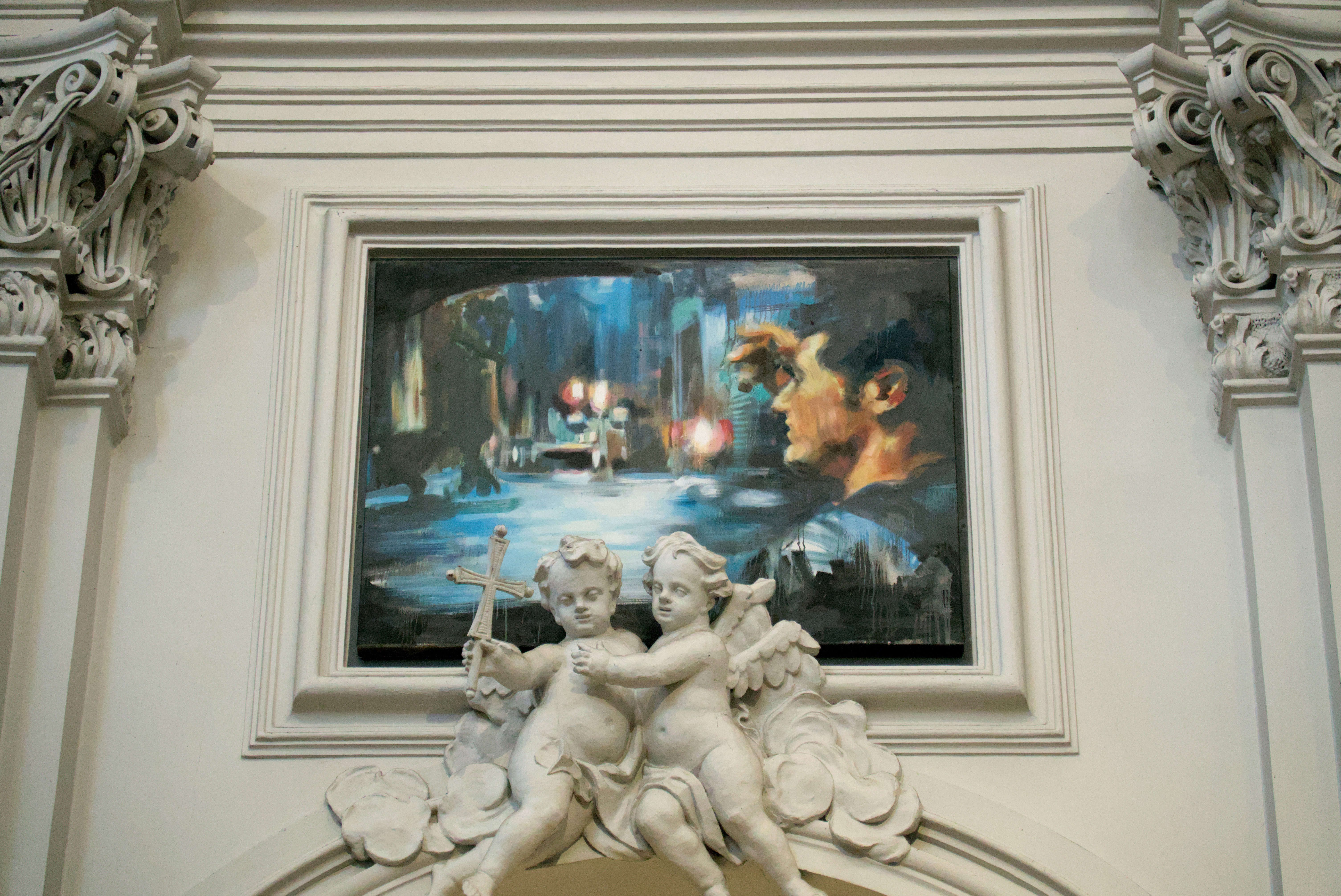
All photos in this post are my own.
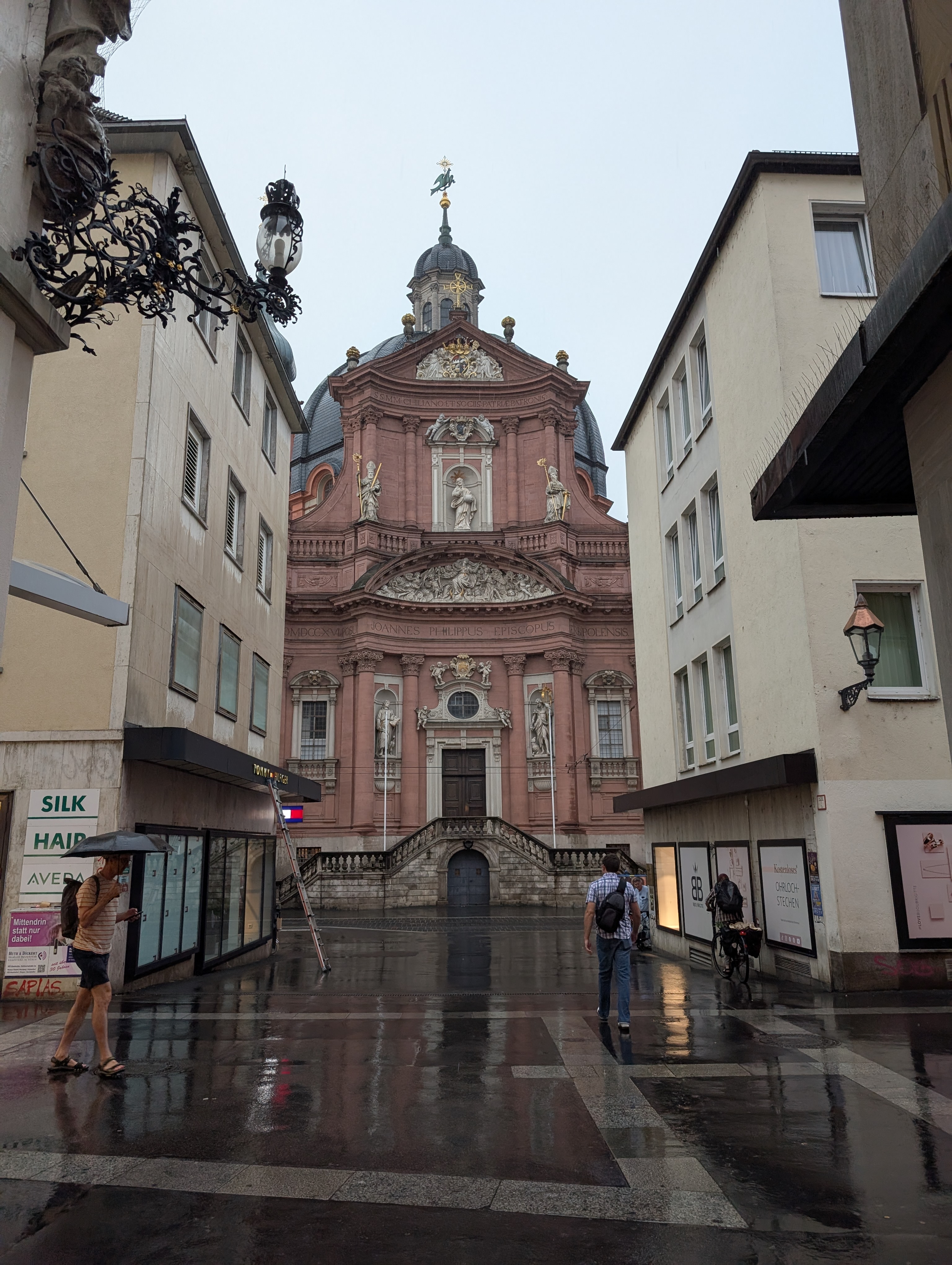
In the Bavarian city of Würzburg, after visiting the Marienkapelle (part 1) and Neumünster (part 2), my husband Eric and I stepped over to the adjacent St. Kilian’s Cathedral, also referred to simply as Würzburg Cathedral (or Würzburger Dom in German).
Its namesake, Kilian, was a seventh-century Irish missionary bishop to the Germanic tribes of Franconia who was beheaded by Duchess Geilana after he denounced her marriage to Duke Gozbert, her late husband’s brother.
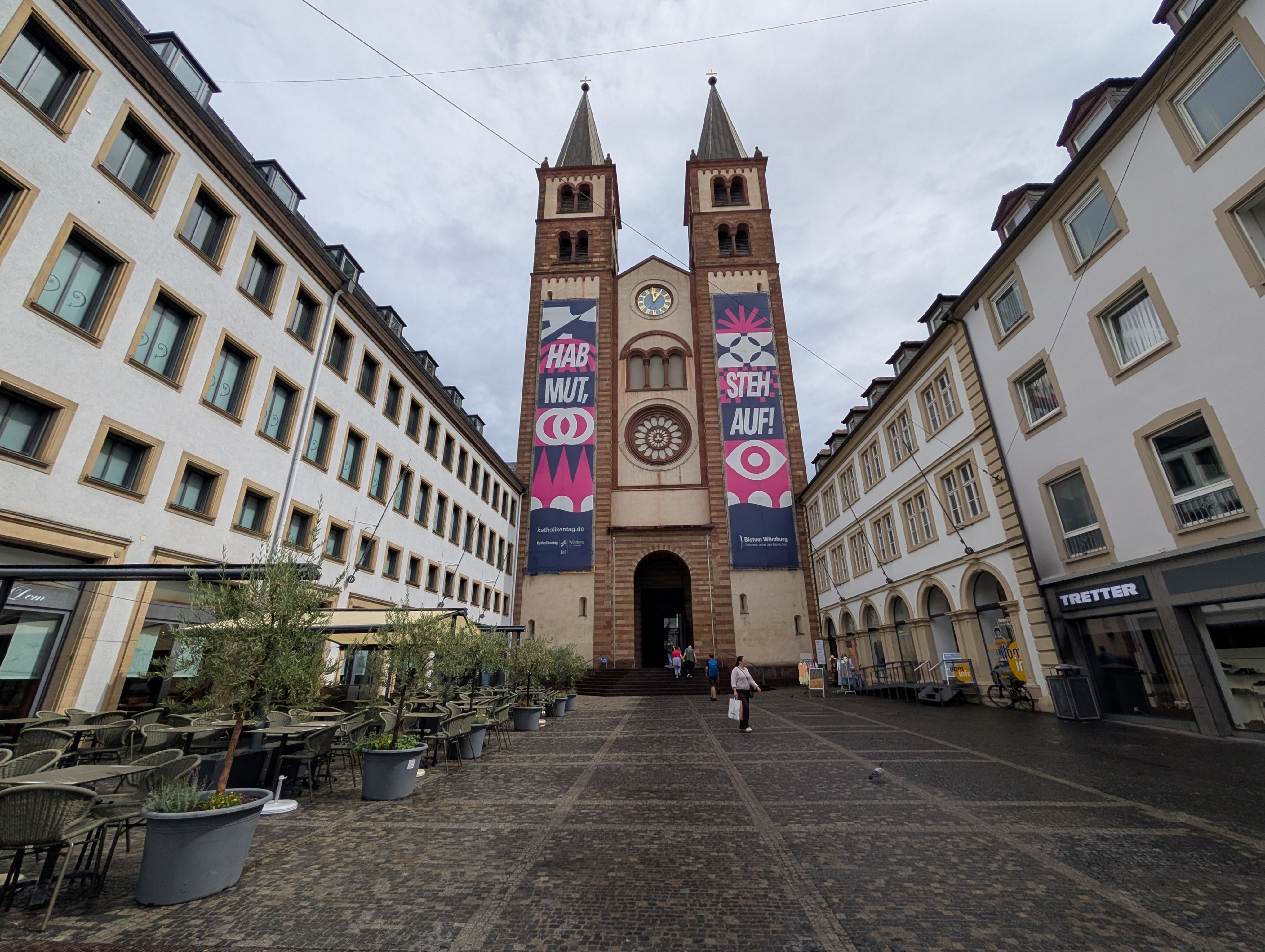
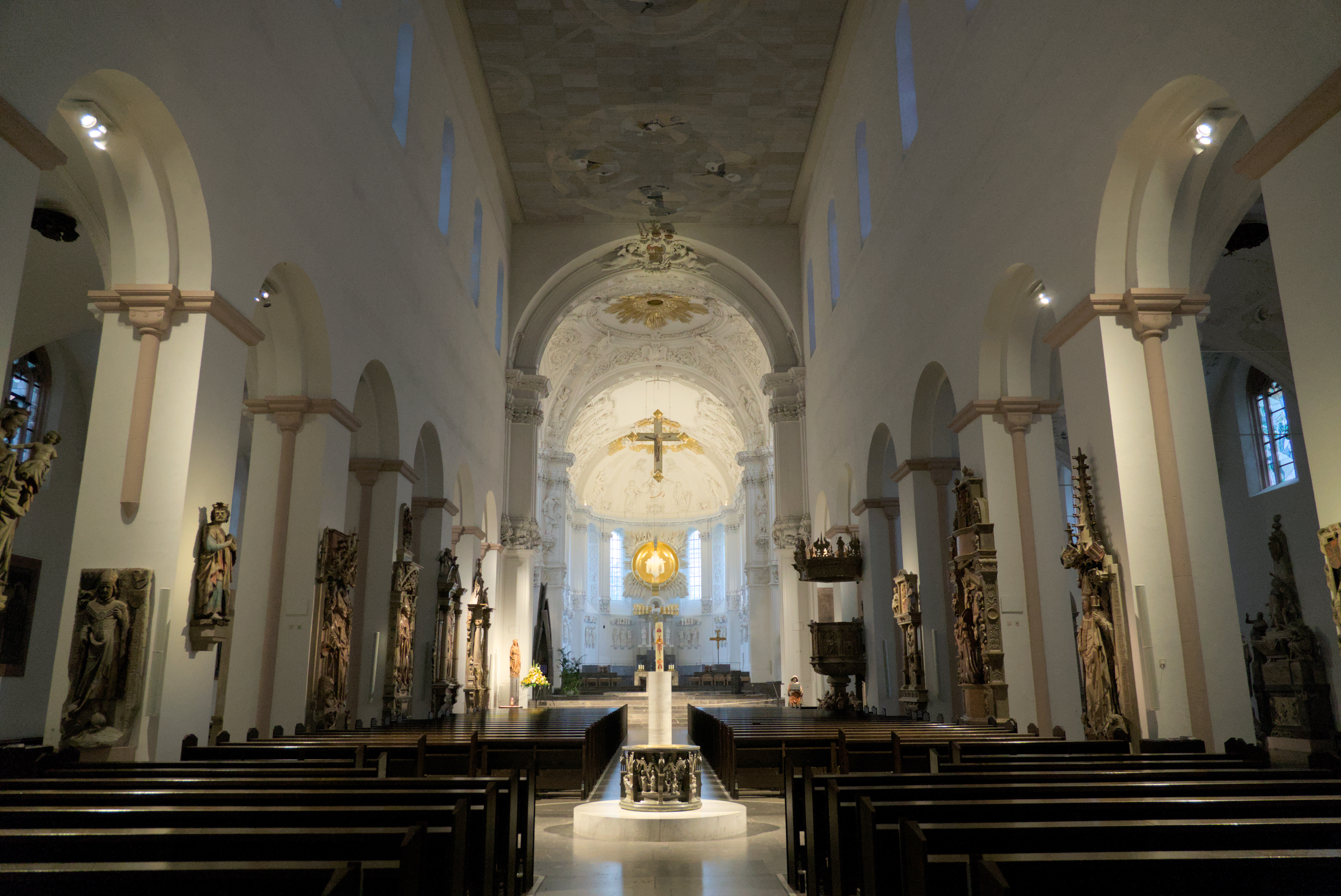
Because the cathedral tours are given only in German, I couldn’t take advantage, but the front desk helpfully offers a free brochure, available in multiple languages, that provides a brief construction history timeline, a map, and a partial list of artworks. I had no idea—though, given the heavy damage Würzburg sustained in World War II, I should have guessed—there would be so many modern and contemporary artworks inside!
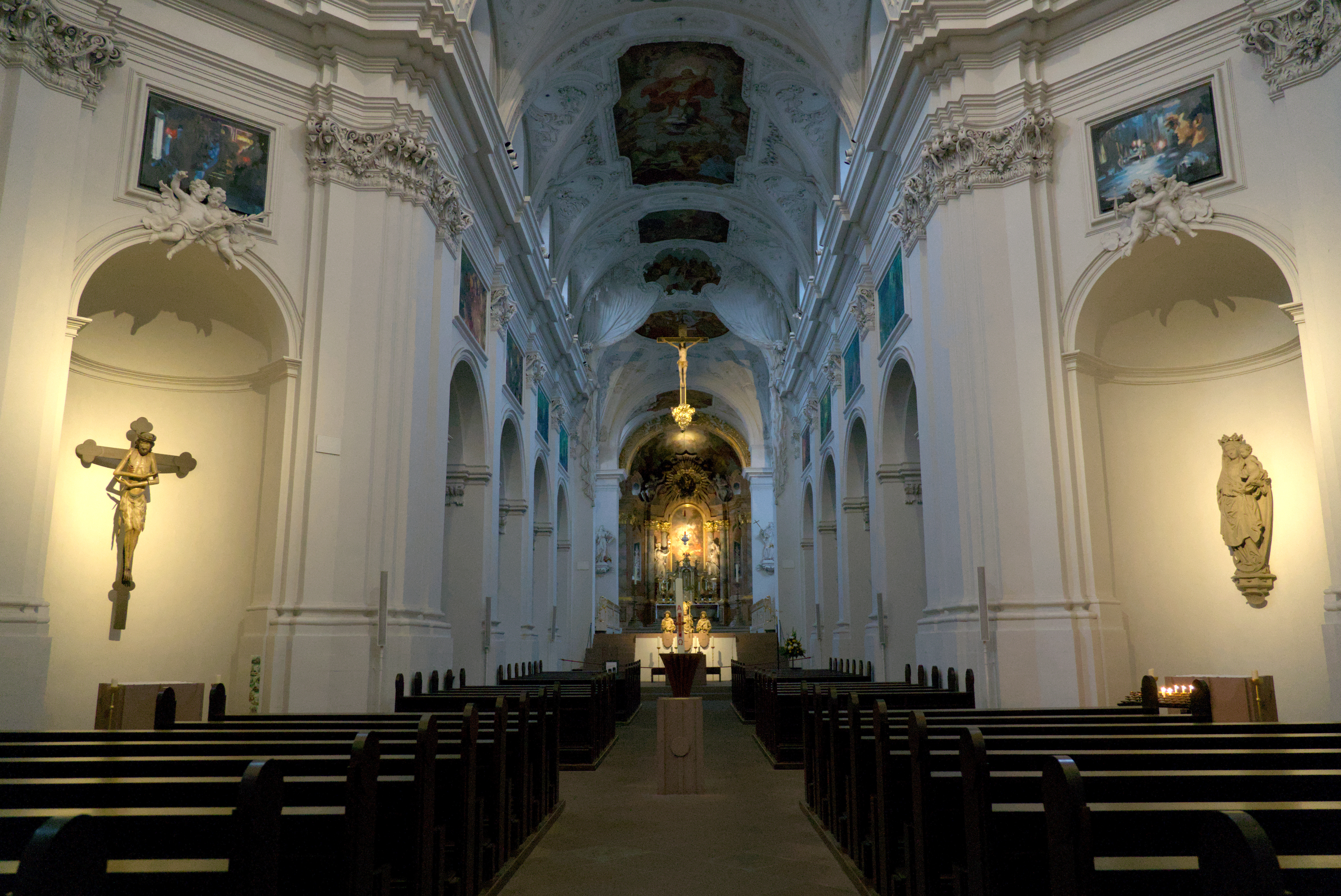
The present cathedral, with its Romanesque cruciform layout, was built starting in 1042 and was consecrated in 1187. It underwent subsequent remodels (late Gothic, then Baroque) and then a major reconstruction following the collapse of its nave in a 1945 air raid, reopening in 1967.
The following is by no means a comprehensive accounting of the art inside, but rather a selection of works that stood out to me. You may notice my general disinterest in relics, tombs, and Baroque ornamentation.
I regret I didn’t get a photo of the bronze door designed by sculptor Fritz Koenig in 1964–67 for the main, west portal, featuring creation motifs! When church doors are propped open, they’re easy to miss.
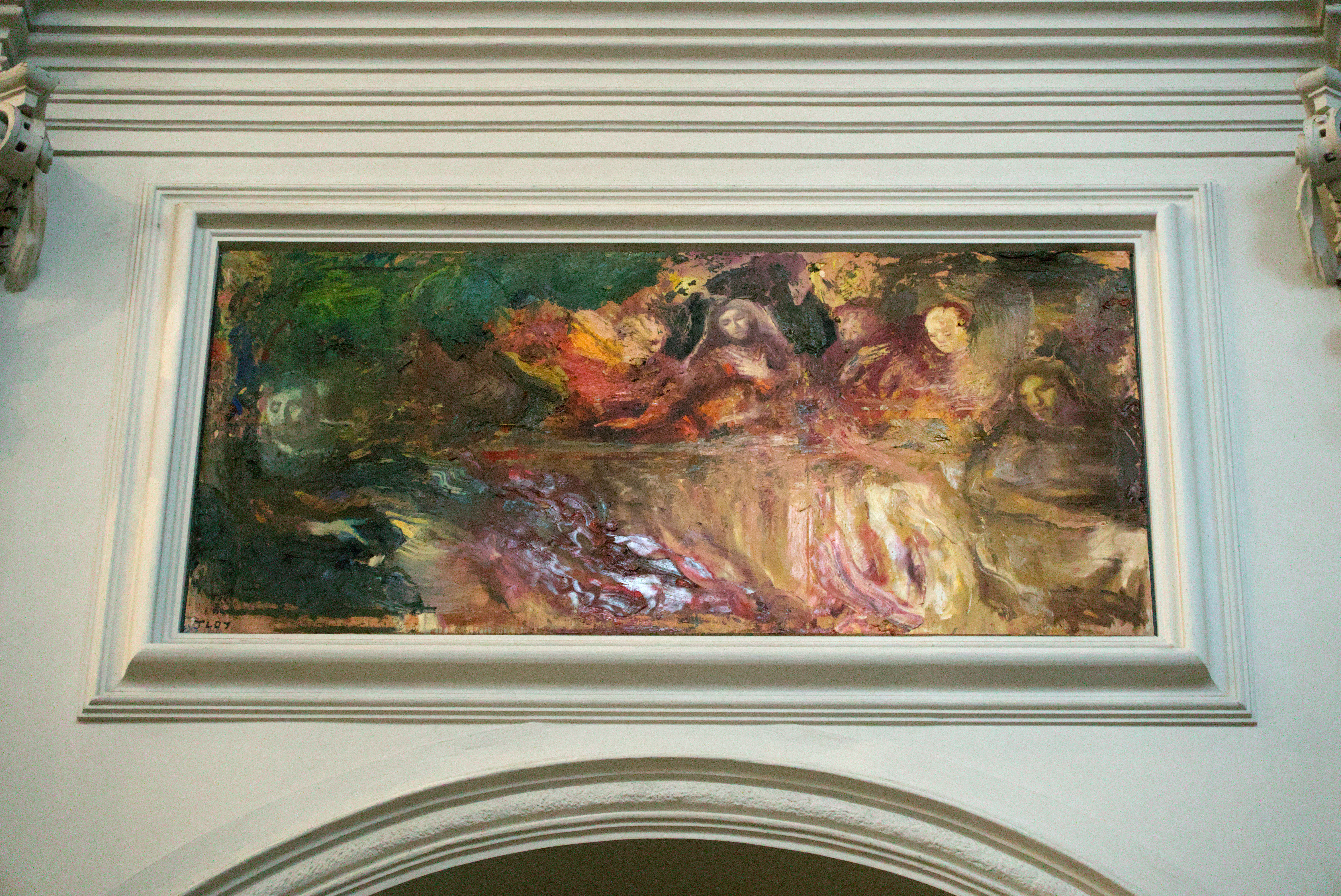
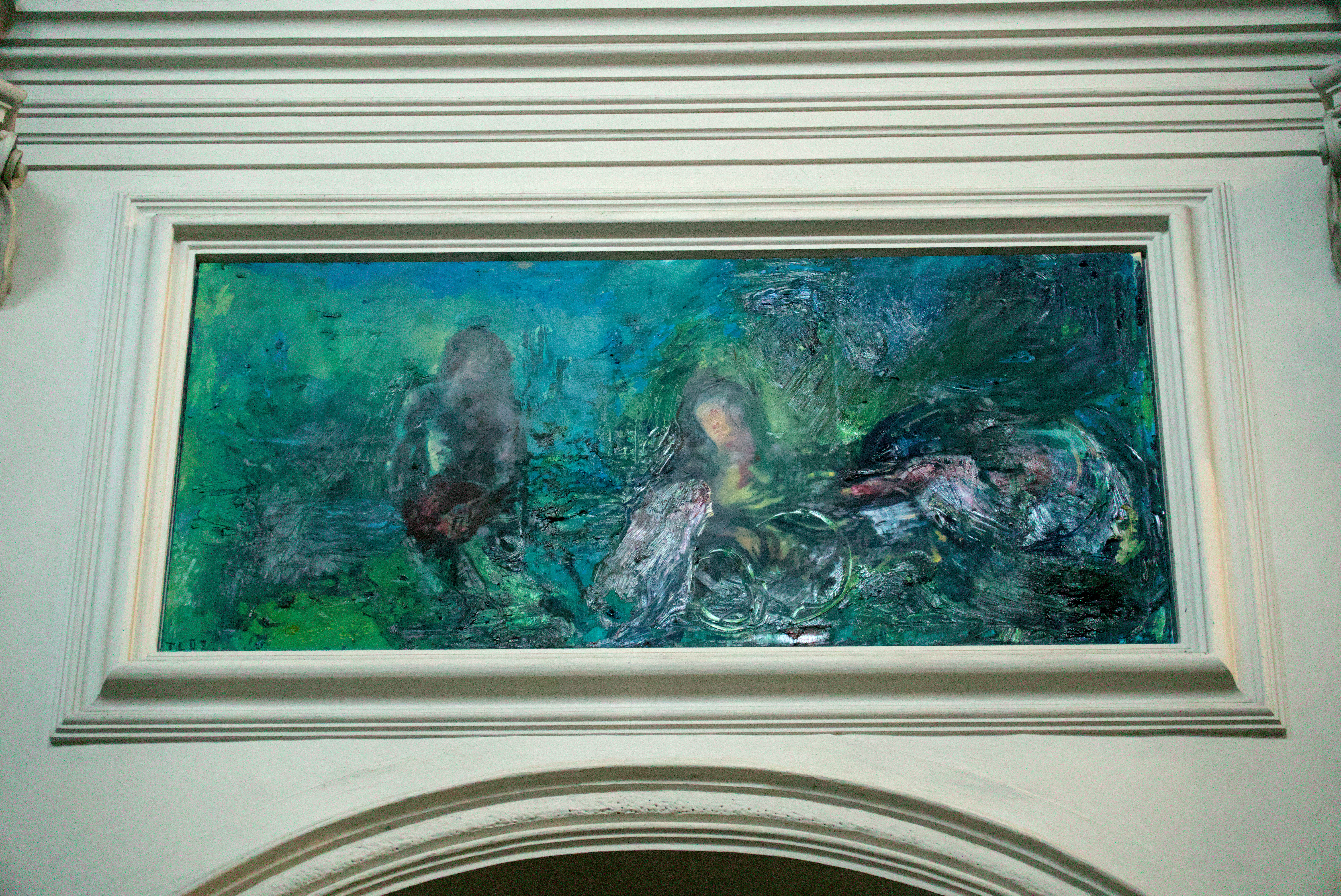
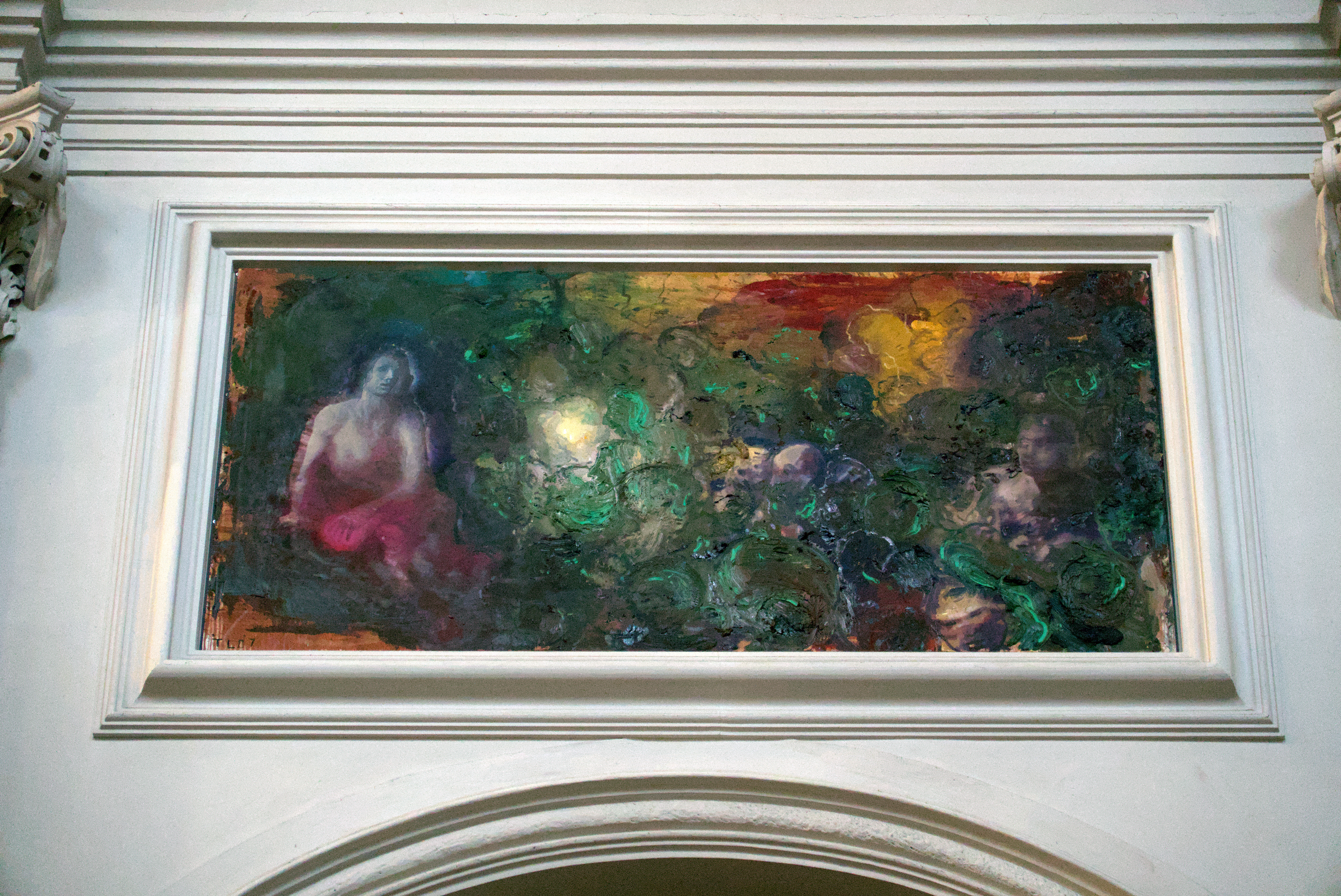
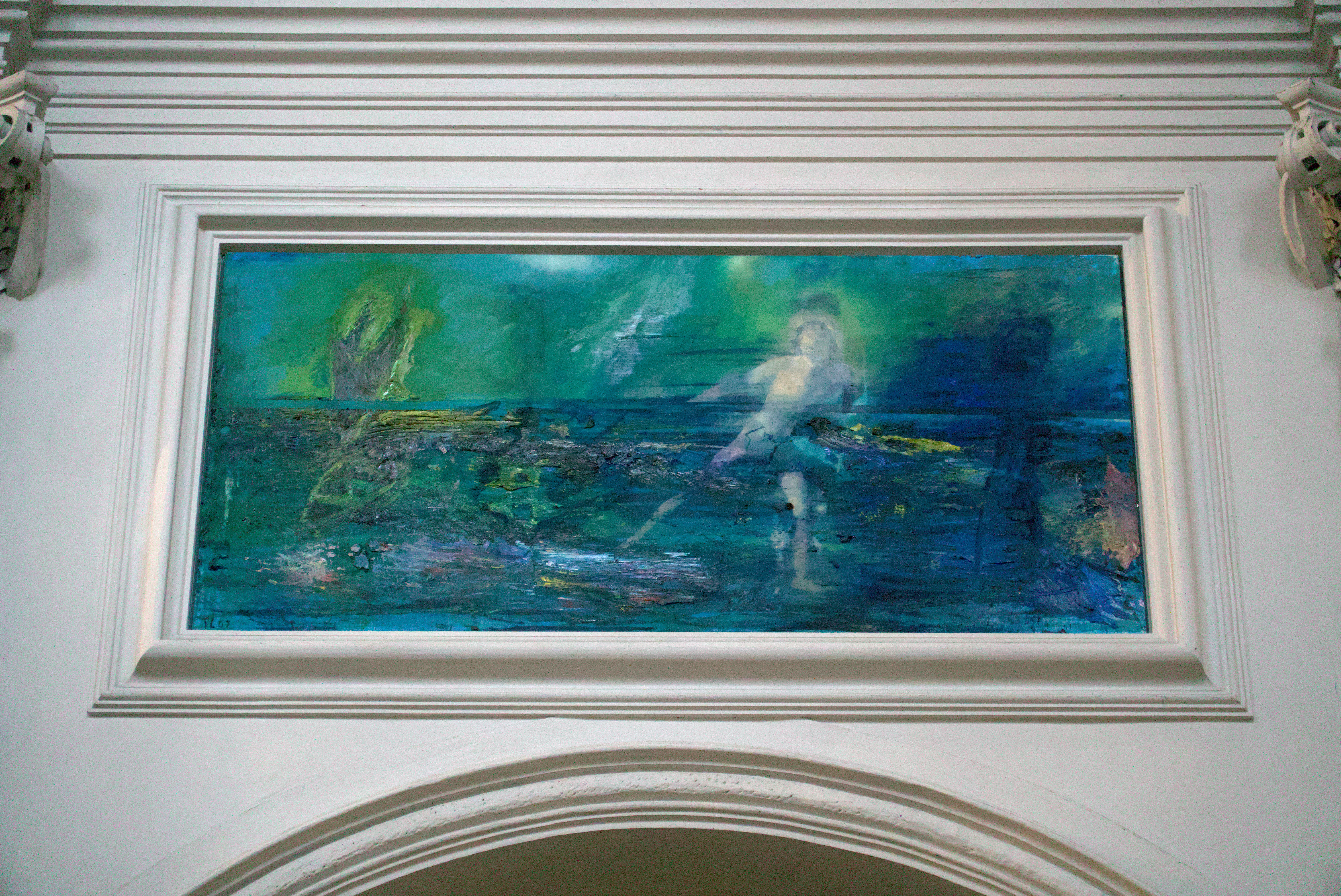
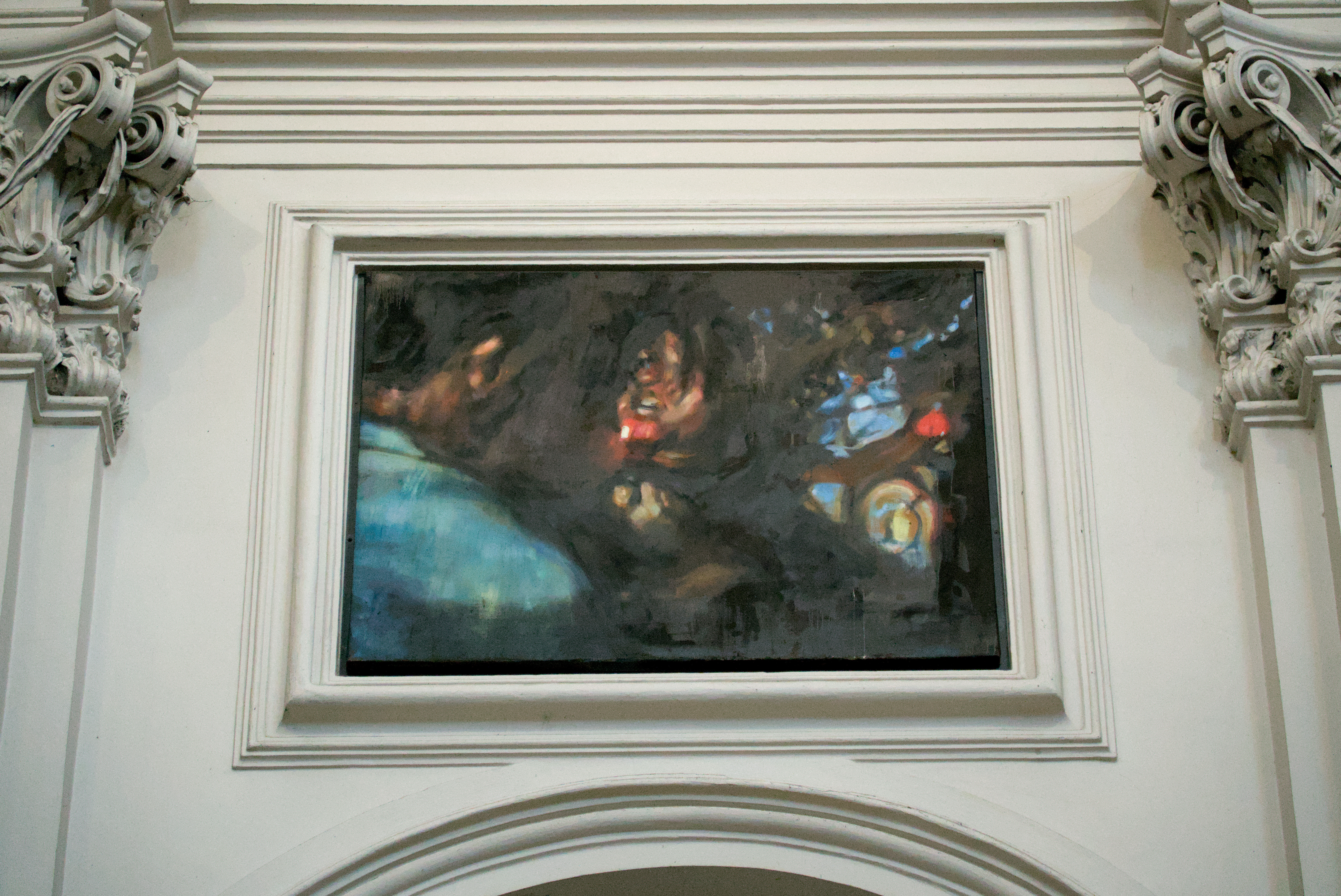
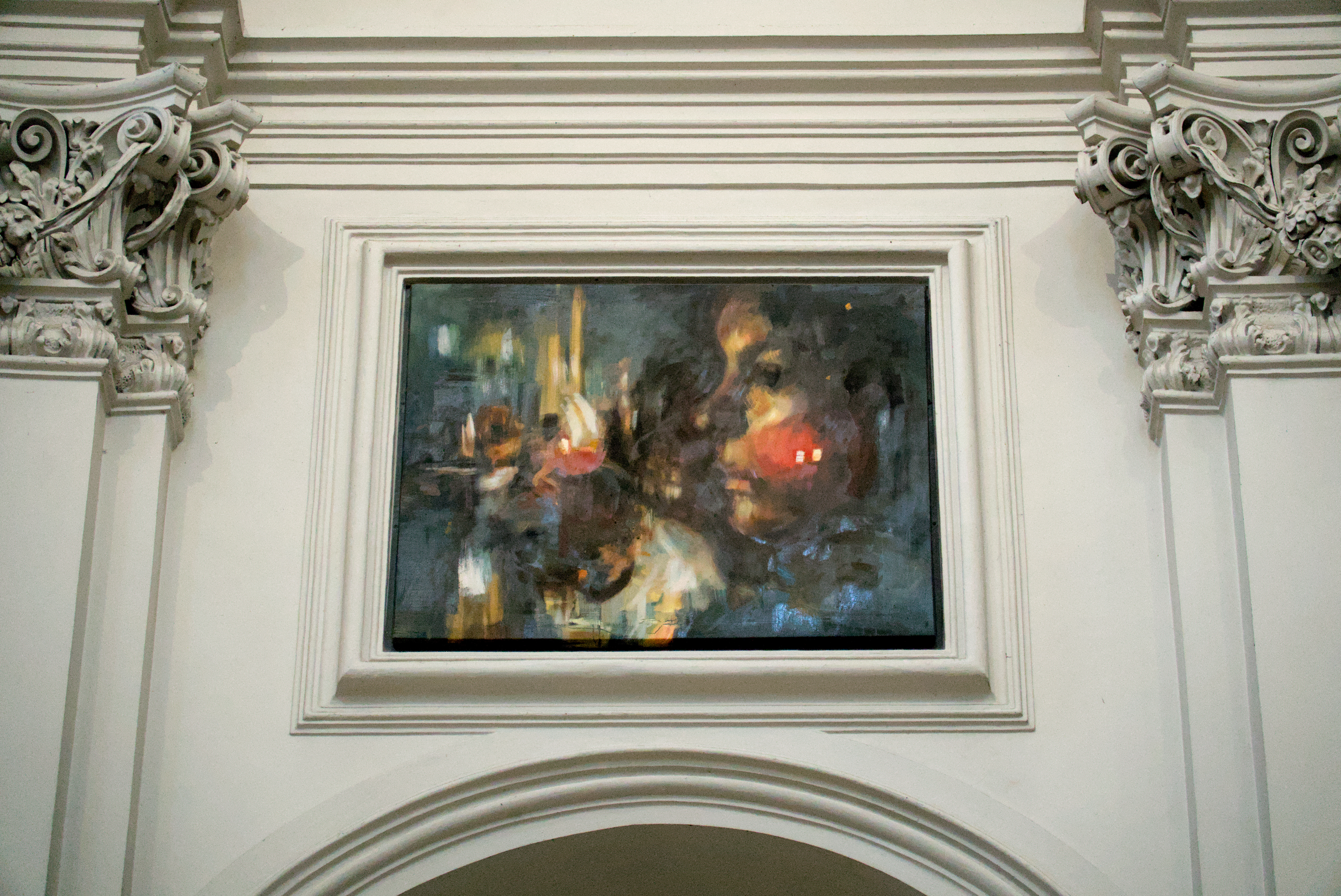
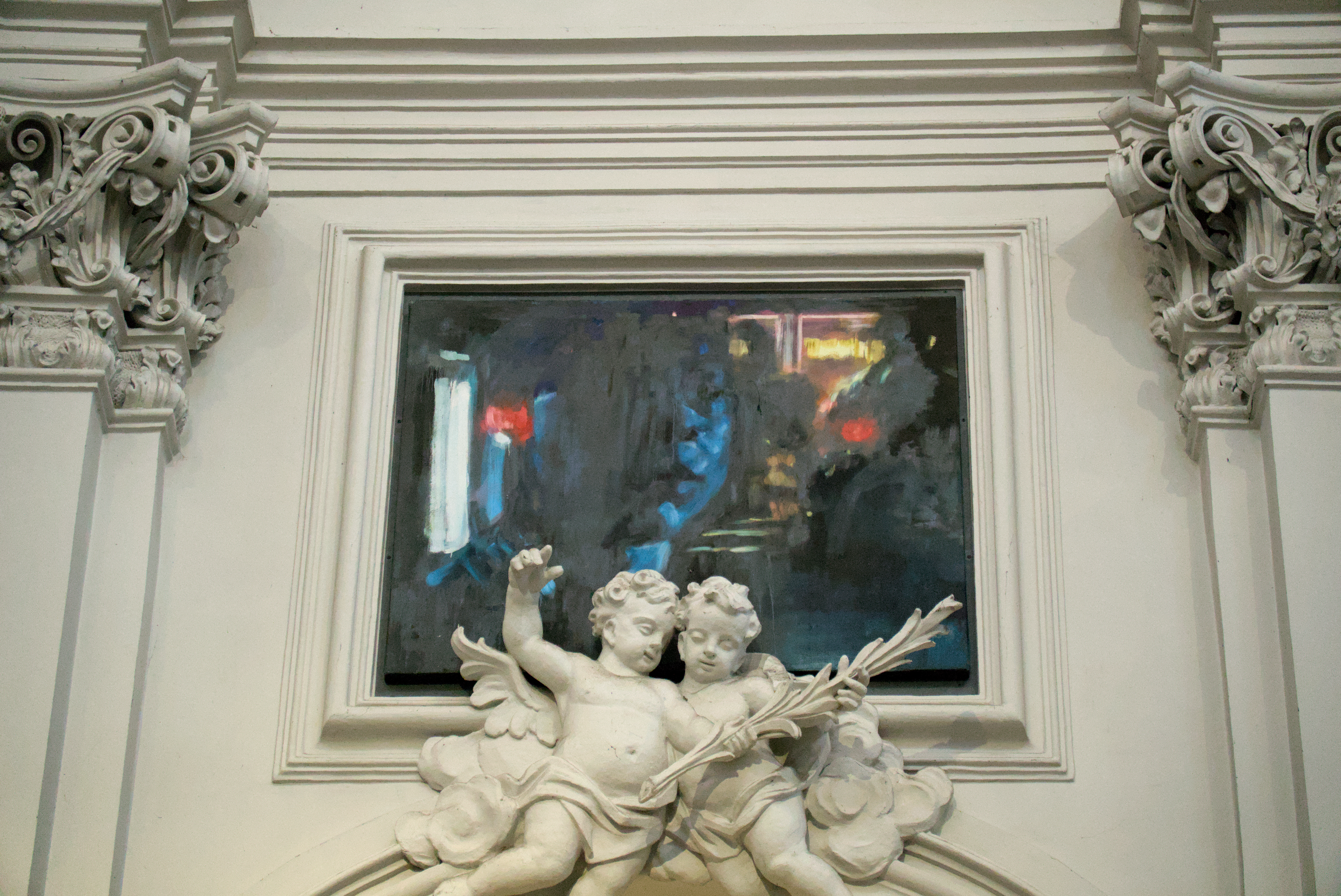
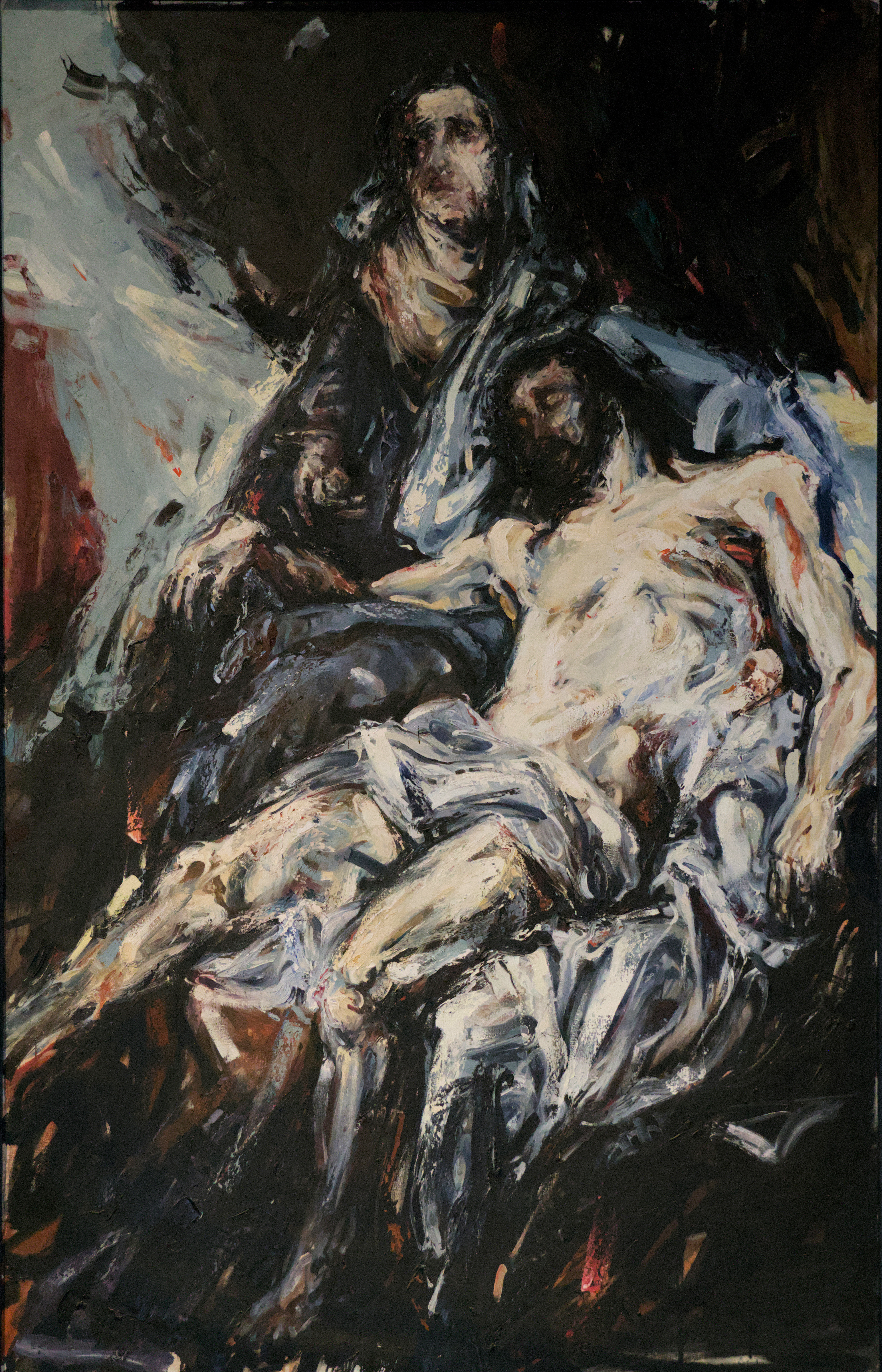
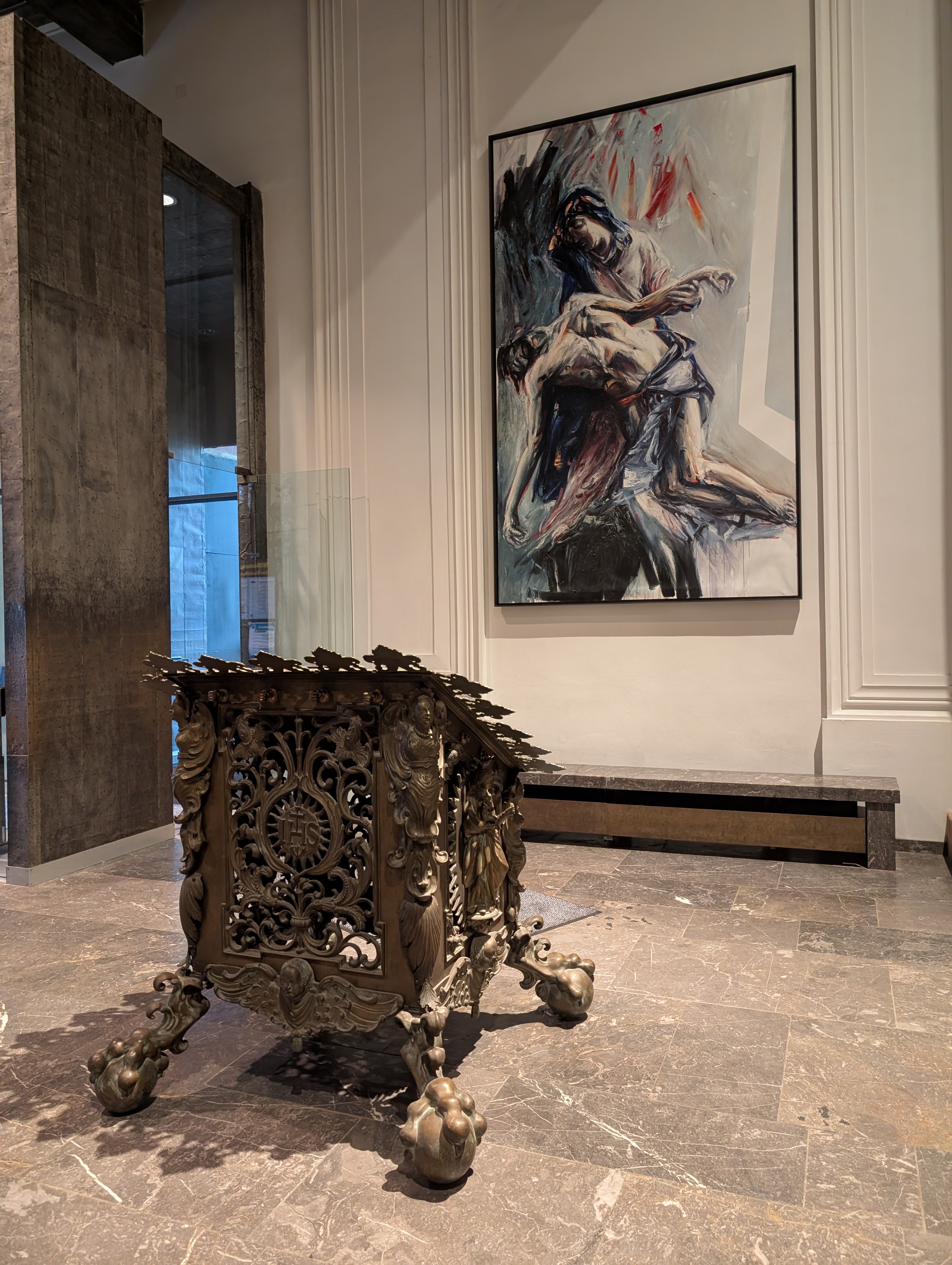
The narthex of Würzburg Cathedral displays two neo-expressionist paintings of the Pietà by Peter Vogt, an artist associated with the southern German Neue Wilde movement of the late 1970s and ’80s.
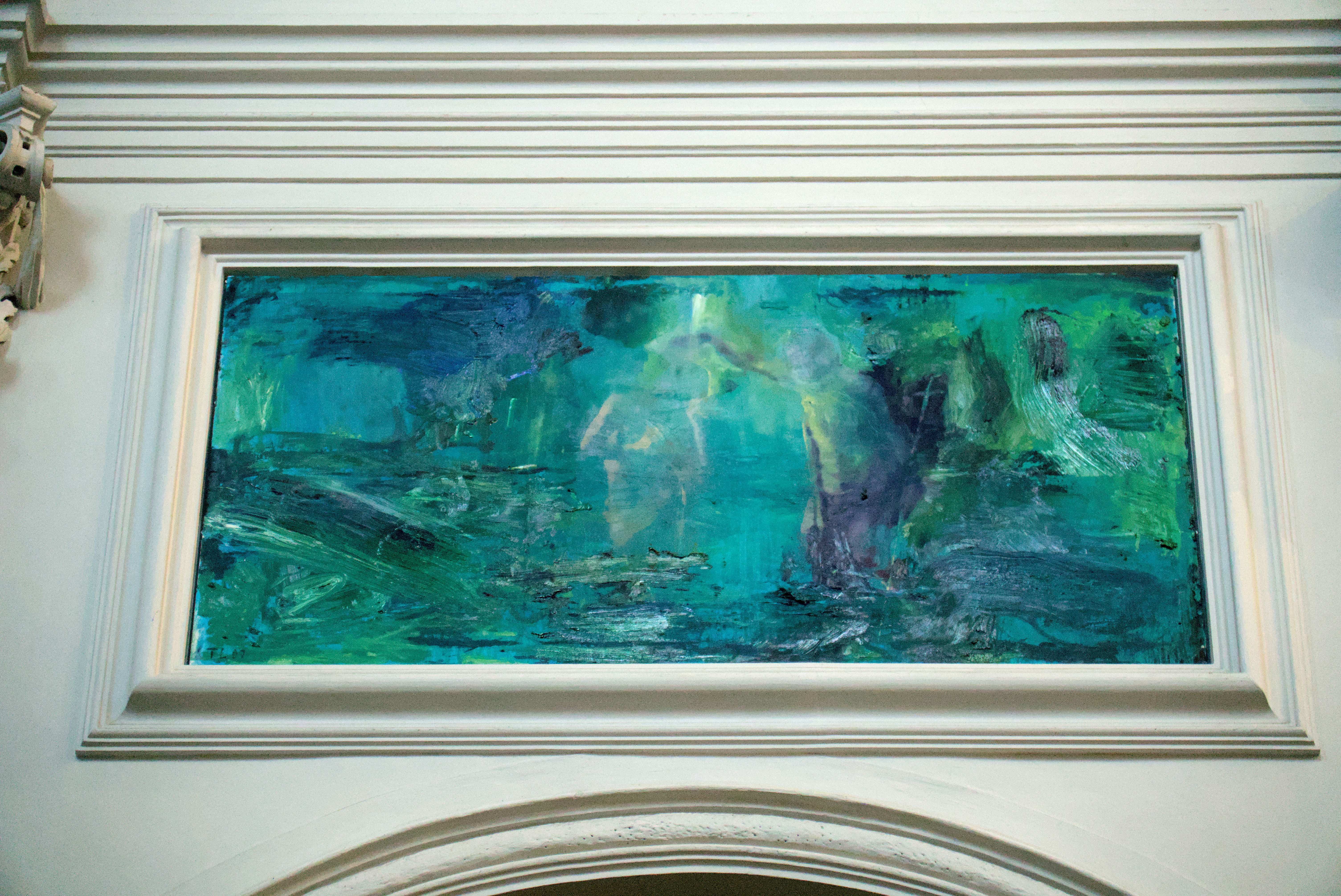
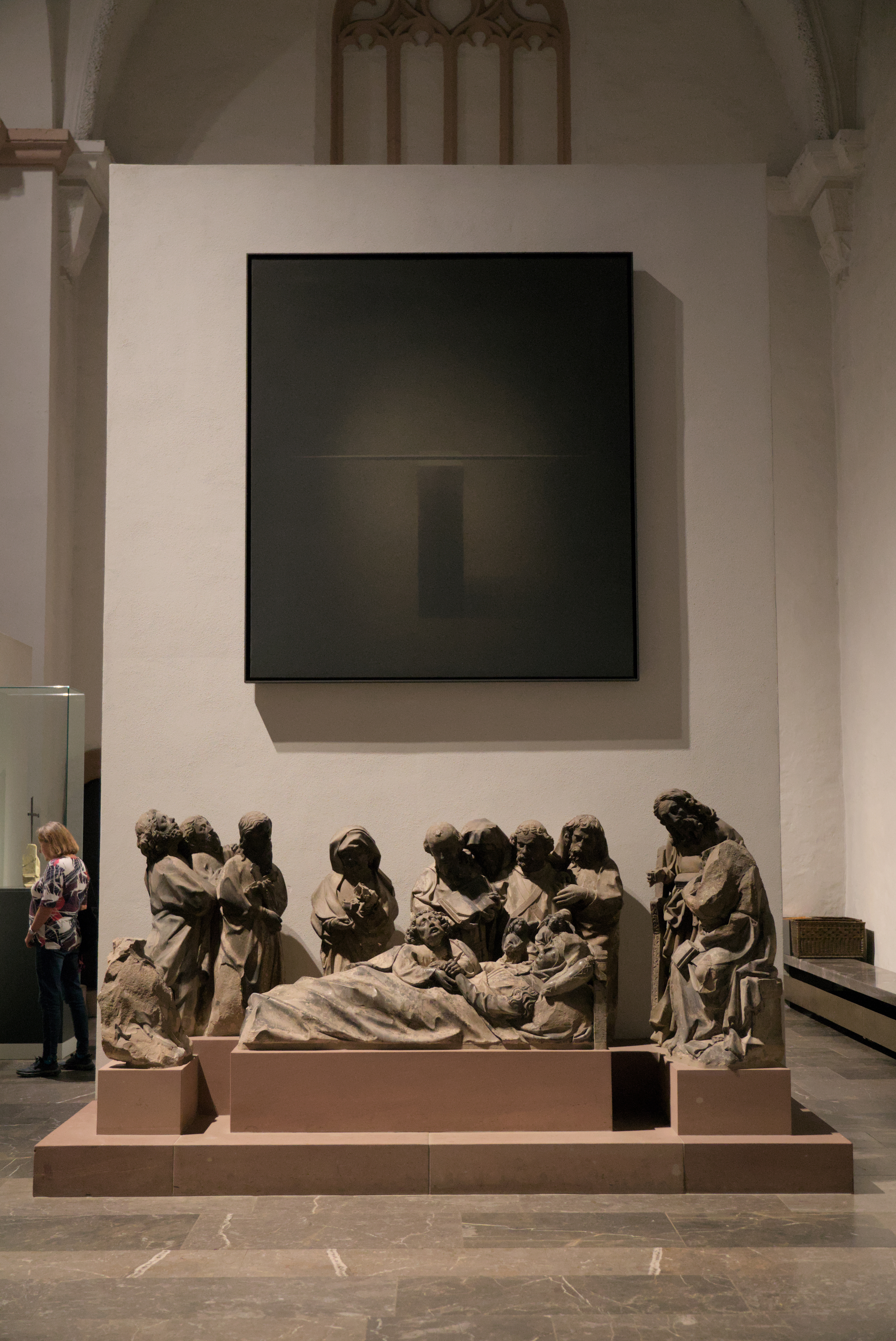
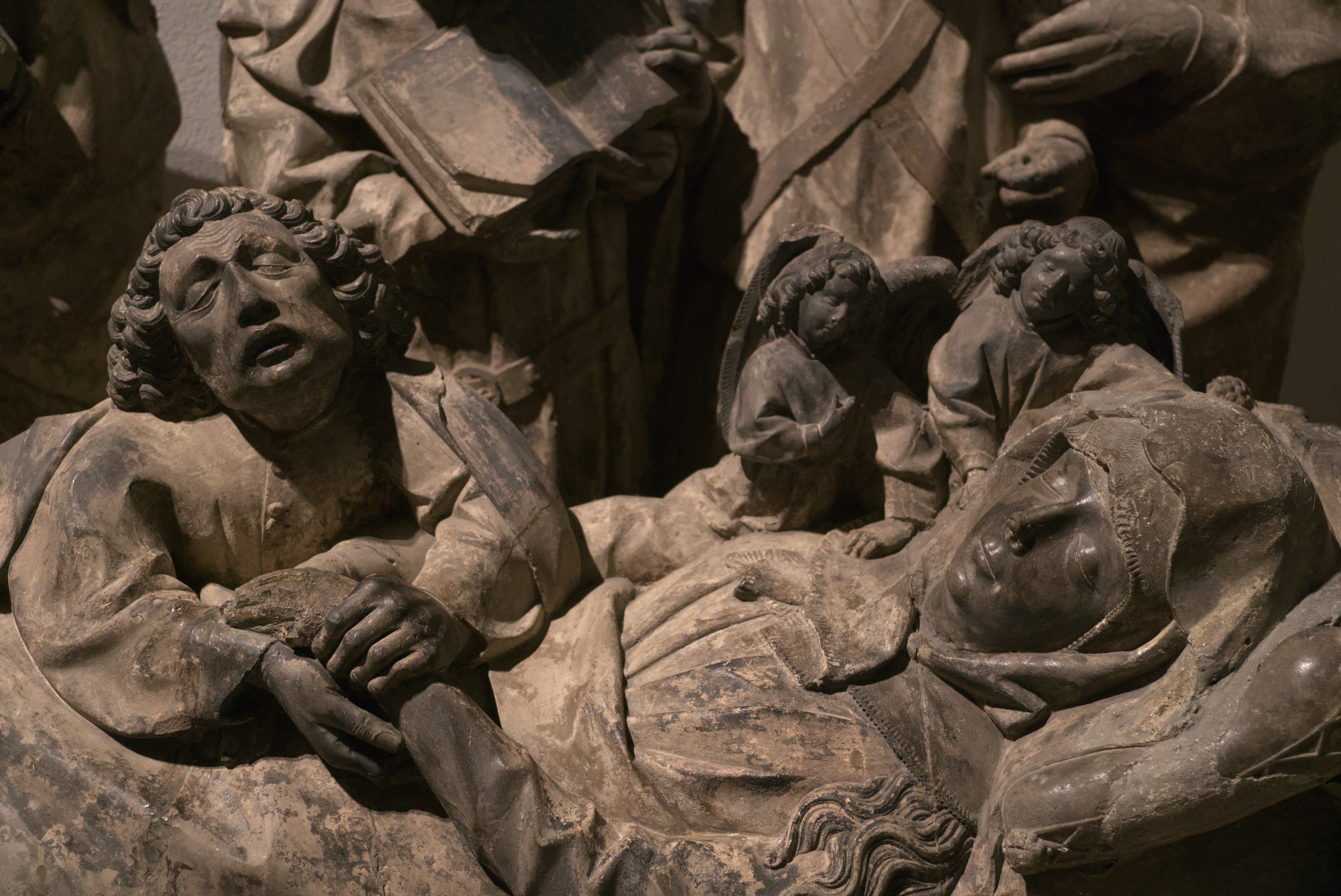
To your left when you enter, there’s a medieval sculpture group depicting the Dormition (the “falling sleep,” or death, of Mary) underneath an untitled contemporary painting by Marco Tirelli, a key member of the San Lorenzo School of painting and sculpture that formed in Rome in the 1980s. Tirelli is known for a “minimalist, atmospheric style . . . characterised by the use of geometric shapes, monochrome surfaces and subtle plays of light and shadow . . . often evok[ing] a sense of mystery and contemplation, inviting the viewer to reflect on the nature of perception and space.” His painting in Würzburg Cathedral shows some kind of linear object balancing on a pedestal. Created specifically for this location, it could suggest a body in repose.
Behind this wall is a semienclosed space designated for private prayer. According to an on-site sign, in the days following the destruction of Würzburg in 1945, the dead were gathered at this spot, where relatives would come to say their final goodbyes before burial. Appropriately, then, the focal point is a late Gothic wood sculpture of the Pietà, where Mary mourns the death of her son. These figures are seated atop a raised metal throne connected to a multitiered votive candle stand that shines with the prayers of the faithful.
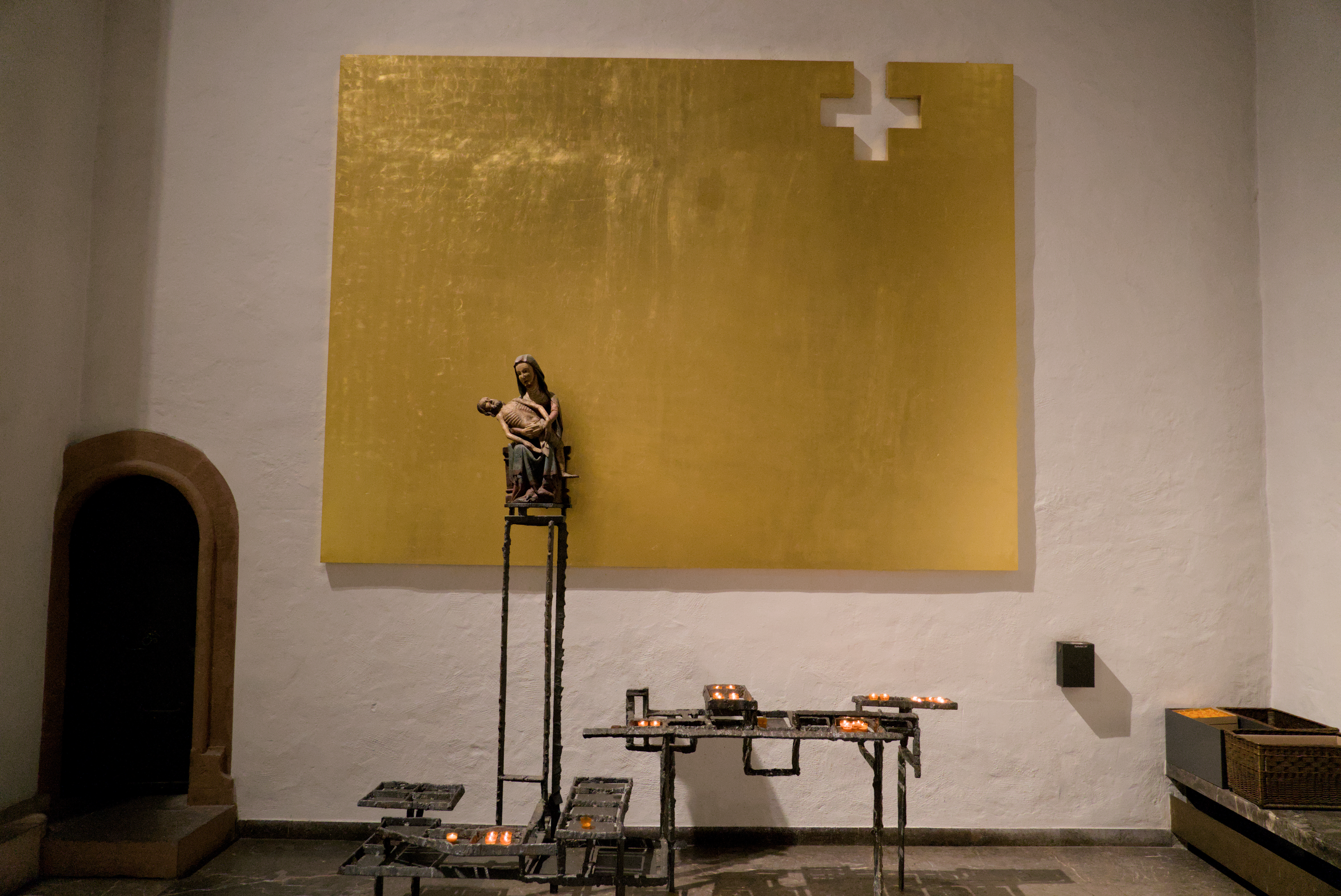
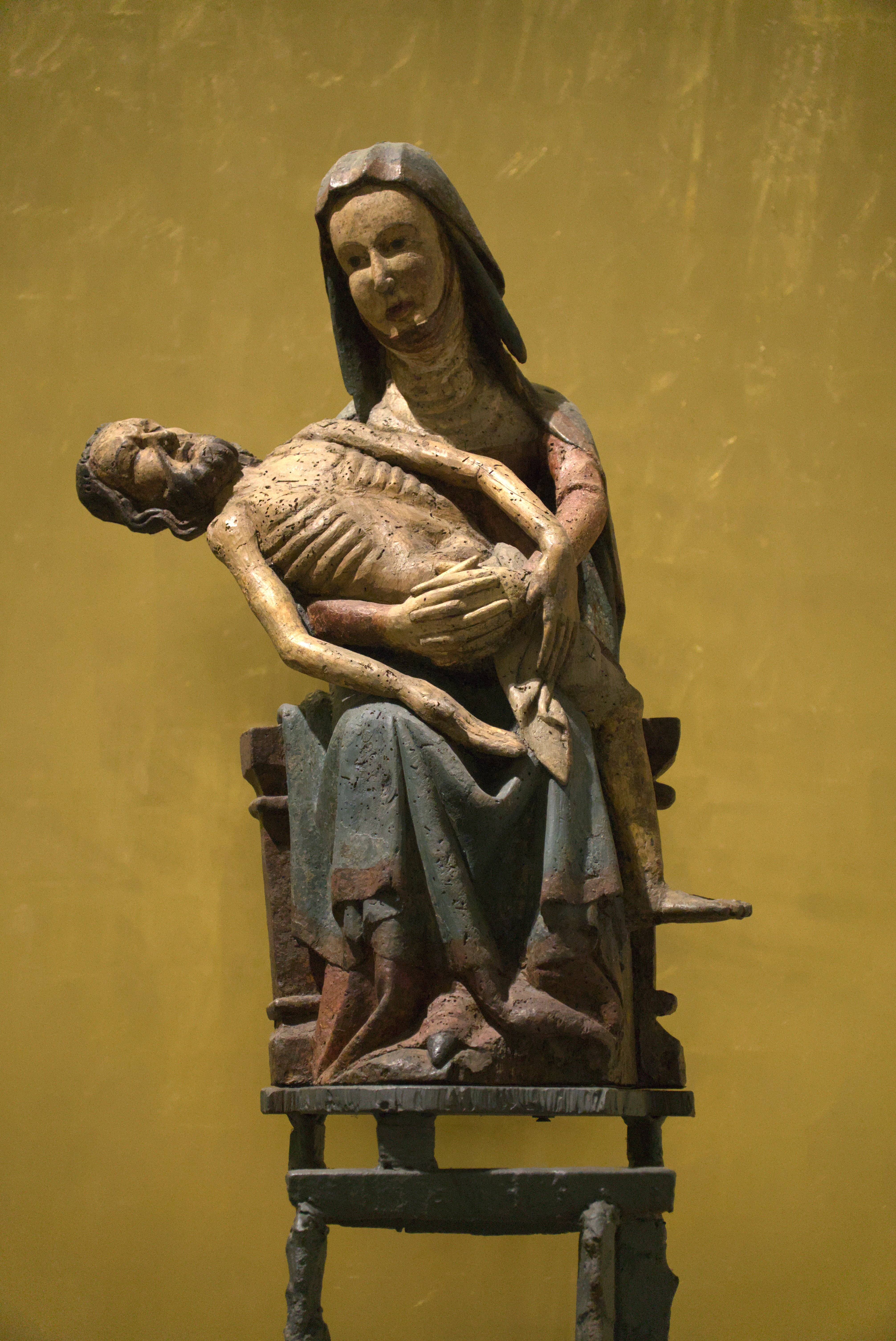
The sculpture is foregrounded by a gilded wall panel designed by Dr. Jürgen Lenssen, who, in addition to serving as cathedral canon, was the art director for the Diocese of Würzburg from 1992 until his retirement in 2017. The wall plates in this space were part of the interior redesign carried out in 2011–12. I really like Lenssen’s interventions, which we will see more of in the crypt—highlighting historic works of art by adding dramatic backing, visual framing, and/or platforms.
Opposite the Pietà is a Russian icon of the Virgin Eleusa (Virgin of Tenderness), showing Mary affectionately holding the Christ child, who nestles into her cheek. It, too, is enhanced by a gold-leafed wall plate, one that frames it and extends the length of the row of chairs below, creating a sort of frieze.
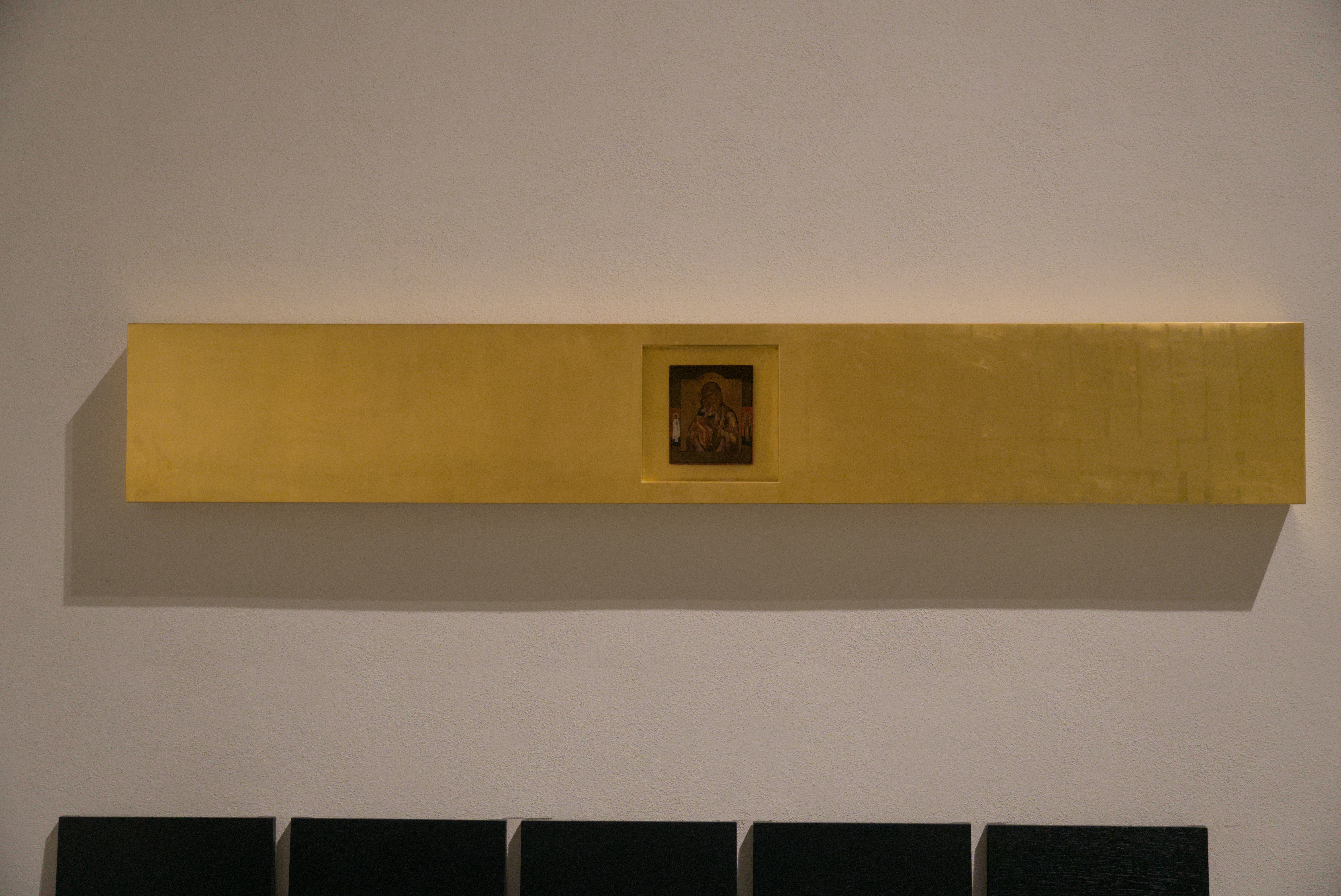
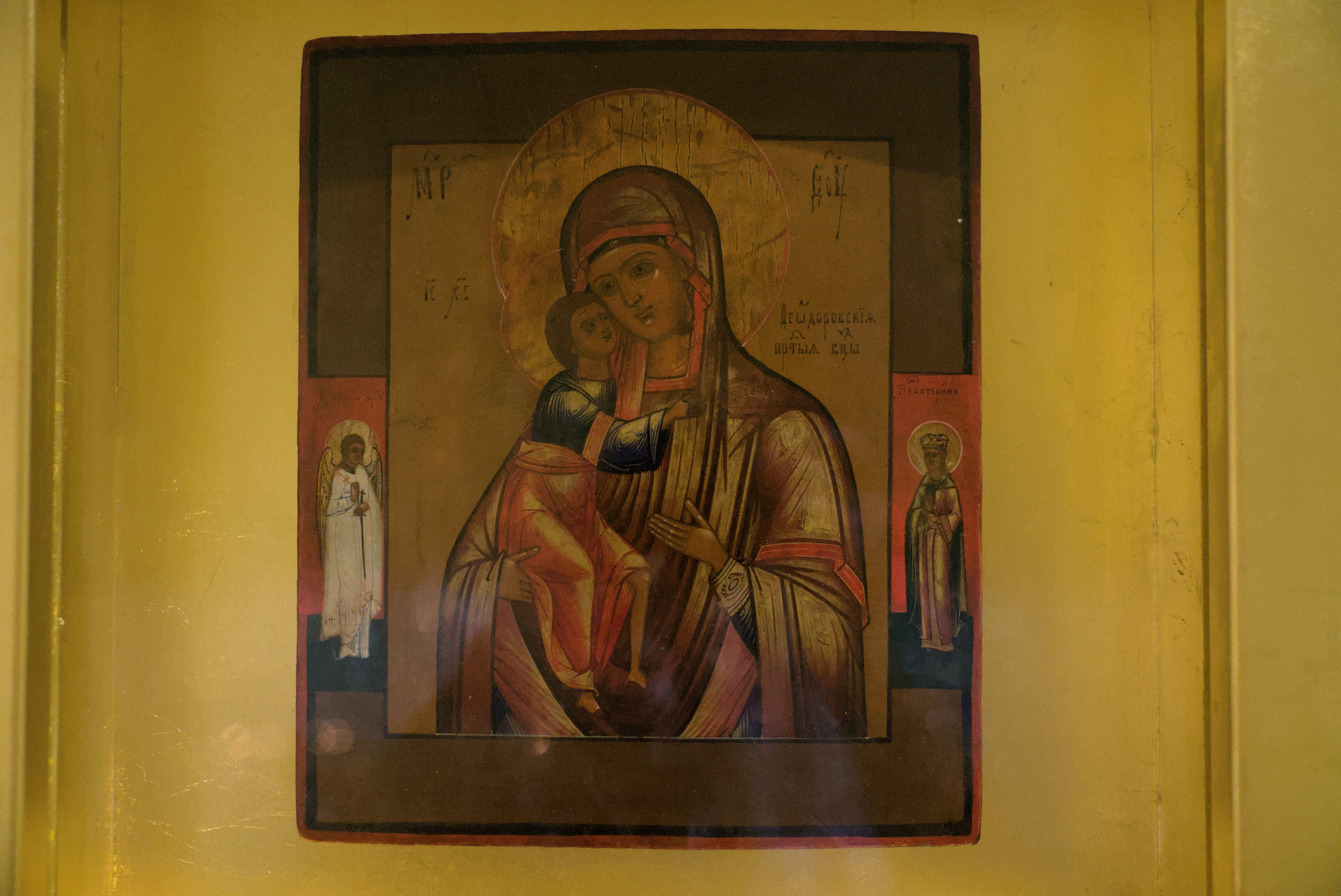
In art objects and sacred spaces, Pietà images are often juxtaposed with images of the Virgin and Child, as the very natural mother-infant pose gains additional poignancy when placed in conversation with the horrifically unnatural pose of a mother cradling her dead child.
Also in this prayer room is a cross made of three medieval roof-truss nails salvaged from the rubble of Coventry Cathedral in England, destroyed by German bombs on November 14, 1940. It is set into a remnant of a gravestone from Würzburg Cathedral.
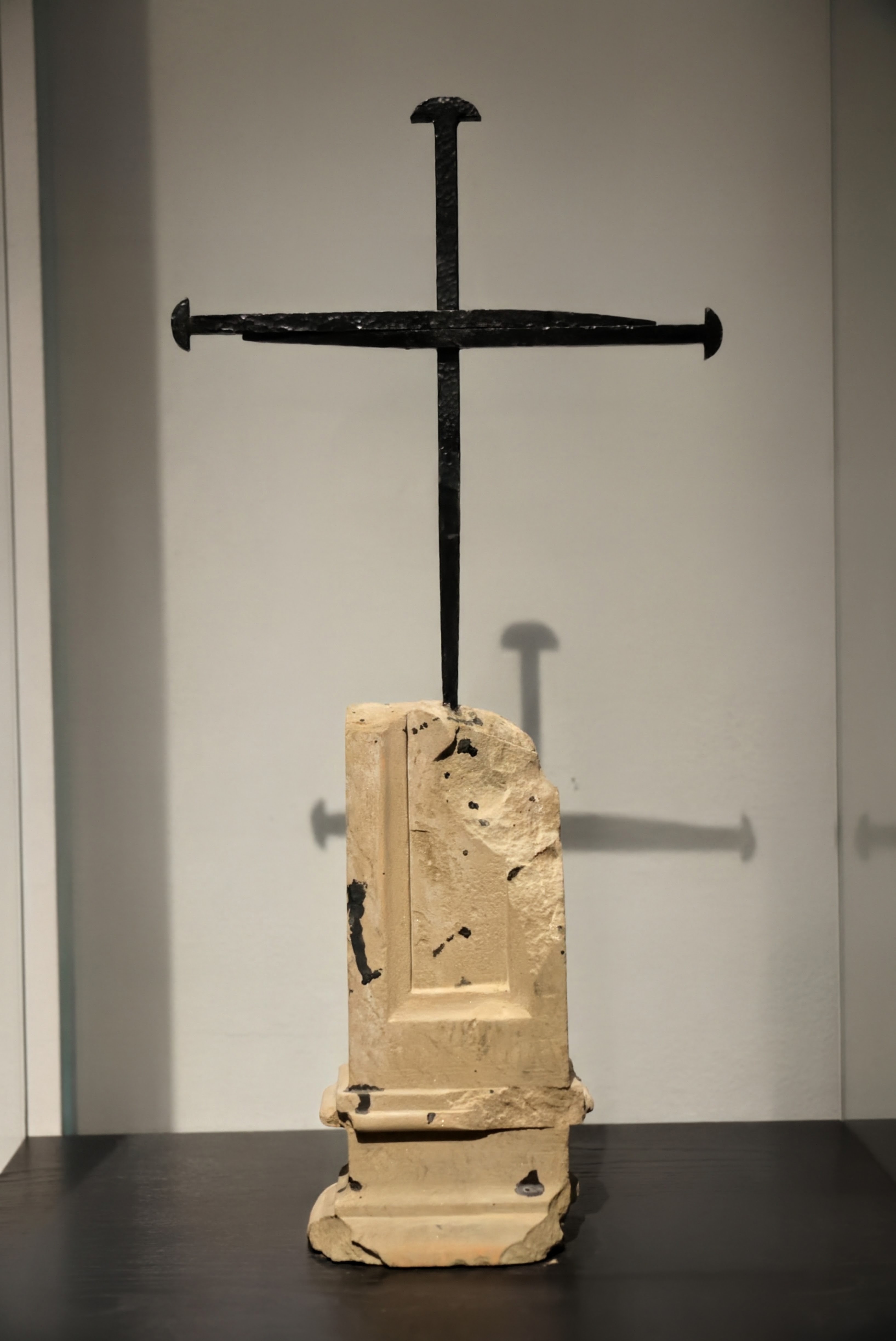
The original Cross of Nails was made by Rev. Arthur Philip Wales of Coventry the morning after the Coventry Blitz, the nails bound together with wire. In the postwar years, following Wales’s concept, other recovered nails and roof spikes were welded together, plated with silver, and sent as a gift to cities in Germany that also suffered badly from World War II bombings—at the hands of the British—a gesture of reconciliation.
There are now nearly three hundred churches and organizations worldwide that own a Cross of Nails, either made with authentic hand-forged nails from the ruins of Coventry Cathedral or a replica, together forming a network dedicated to global peace and forgiveness. The Cross of Nails in Würzburg Cathedral is a replica, presented to the cathedral in 2015. (Two others, from 2001, are permanently housed in the city’s town hall and Marienkapelle, and a third travels to a new host location in the city each year.)
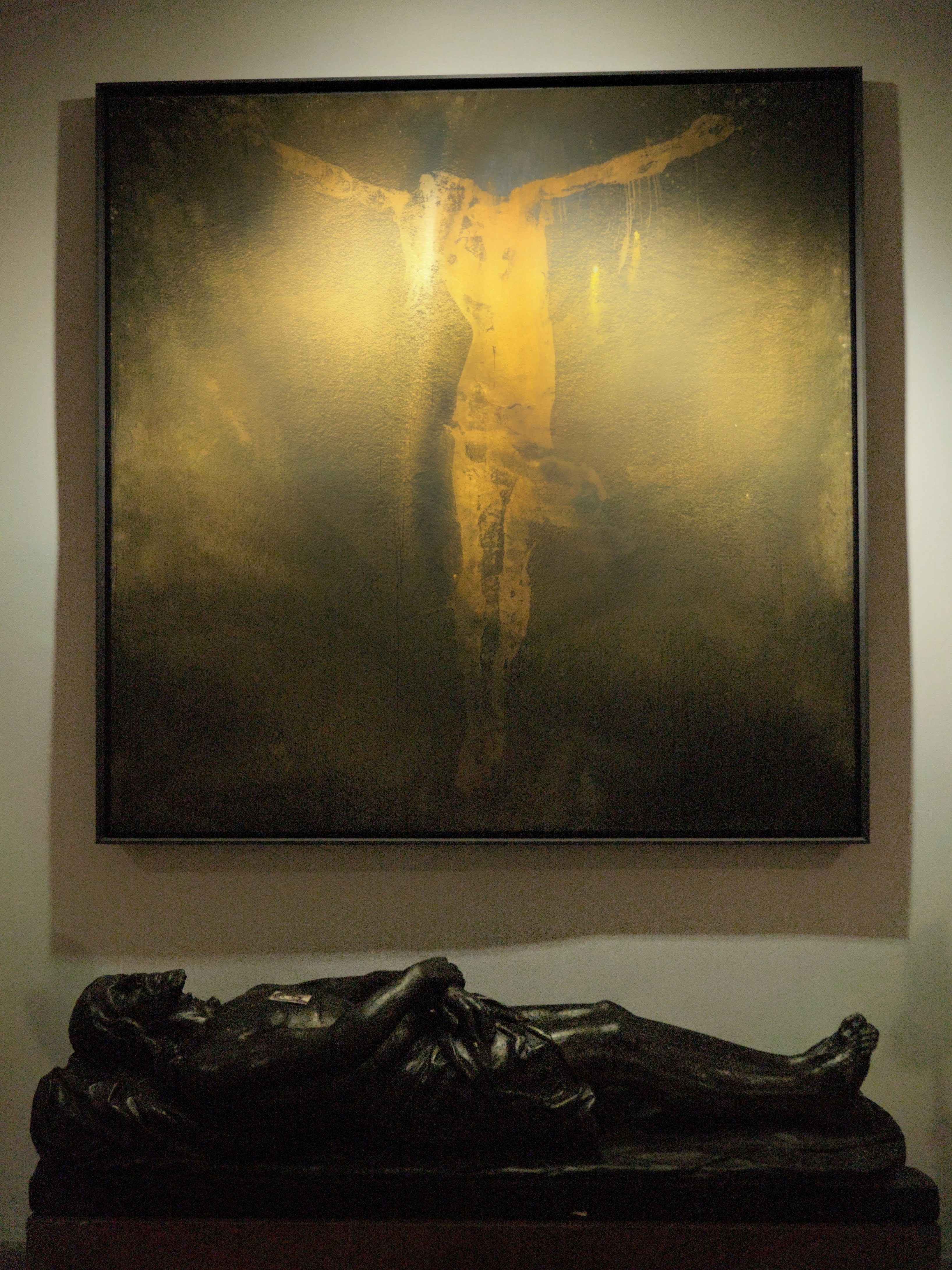
In the north (that is, left) aisle is a Crucifixion painting by Mimmo Paladino, a leading figure of the Transavanguardia (Transavantgarde) movement that swept through Italy in the late 1970s and ’80s, reviving figurative art.
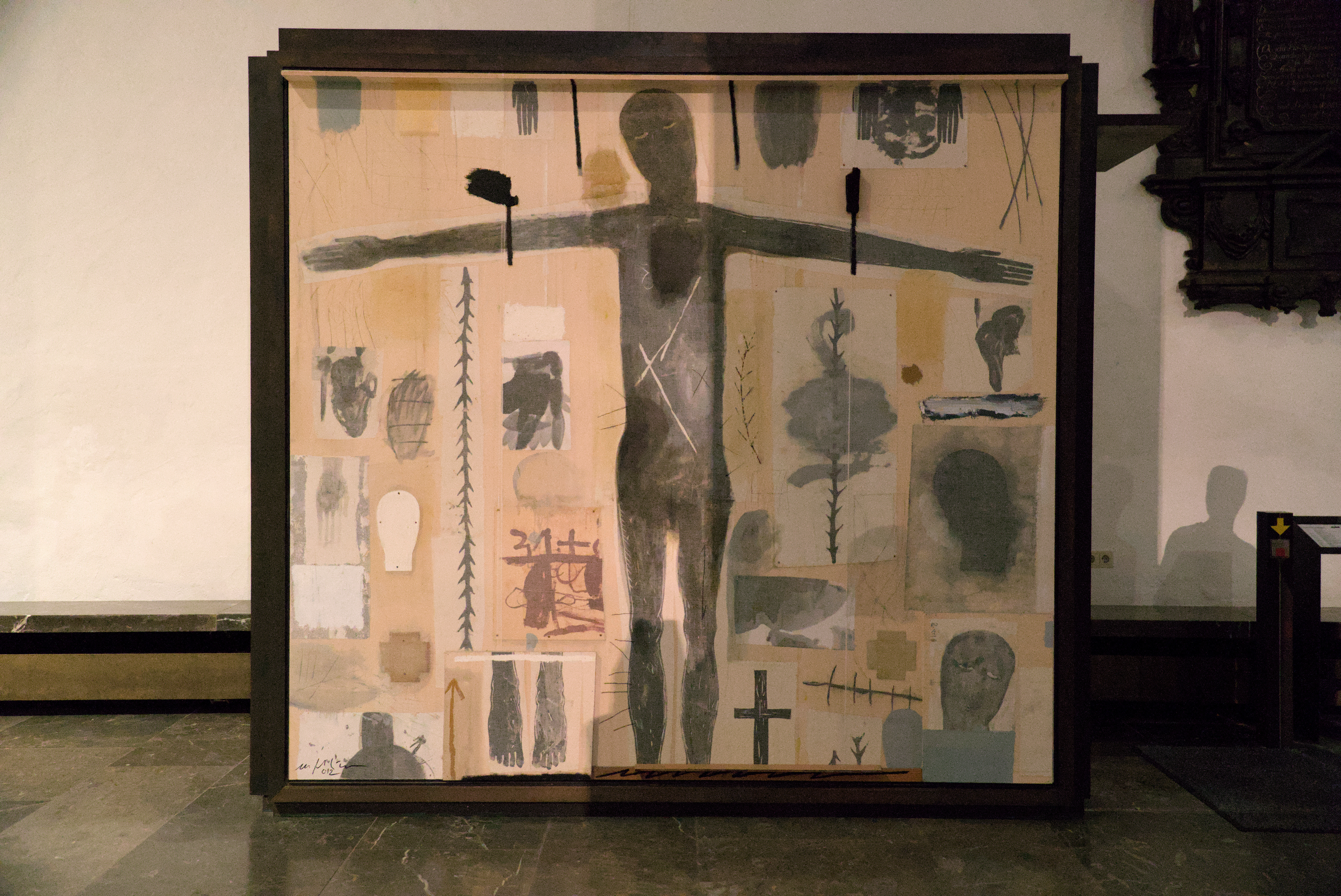
Executed in pale grays and yellows, this work portrays the crucified Christ without a cross, although he’s tied down near the elbows. He’s shadowy but appears bruised and scarred, his eyes half closed as he expires. In the background are pinned pages of thorny vines, disembodied parts (hands, feet, a face, a heart), and indistinguishable forms. This Crucifixion is similar to another one of Paladino’s, a triptych from 2010.
The painting projects out from the wall and appears to be the front face of a storage closet or a confessional—I couldn’t tell.
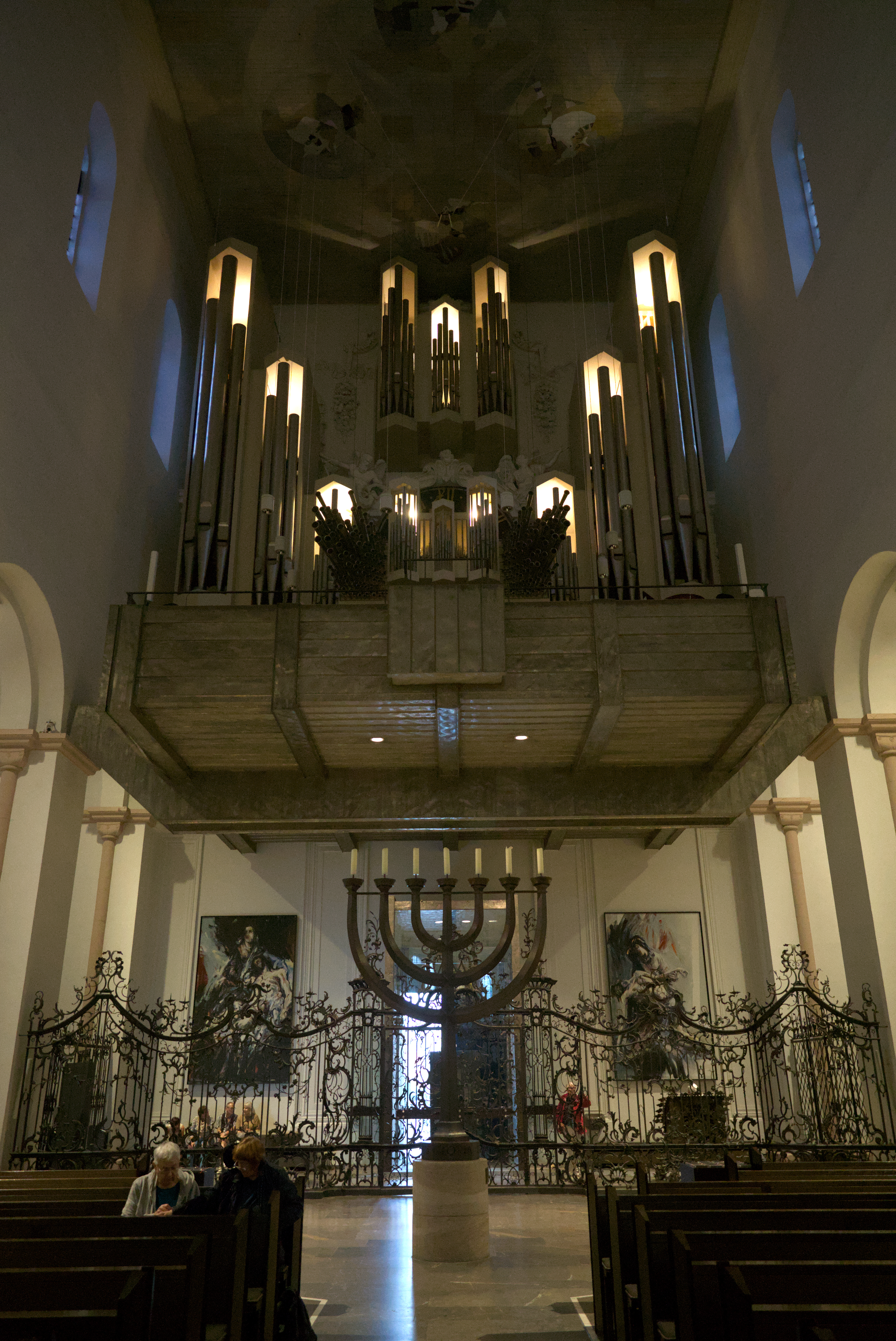
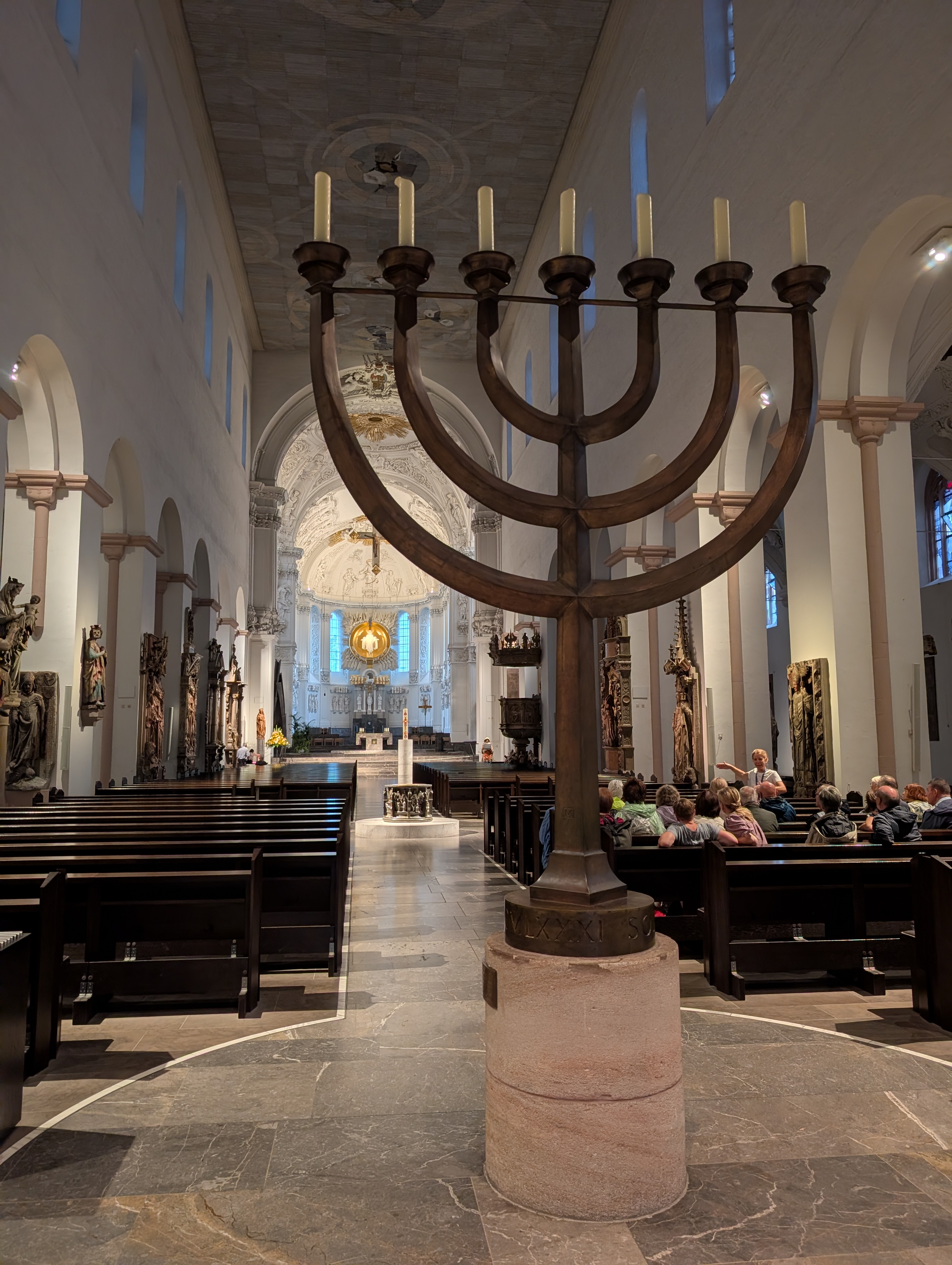
At the entrance to the nave, in the central aisle, is a monumental bronze menorah designed by the German metalsmith Andreas Moritz. It was commissioned to honor the Jewish roots of the Christian faith. “It reminds us that God planted the Torah like a tree of life for humankind,” Fr. Burkhard Hose said in a Lenten sermon at the cathedral in 2007. It was not lit when I was there—I wonder when or even if it ever is.
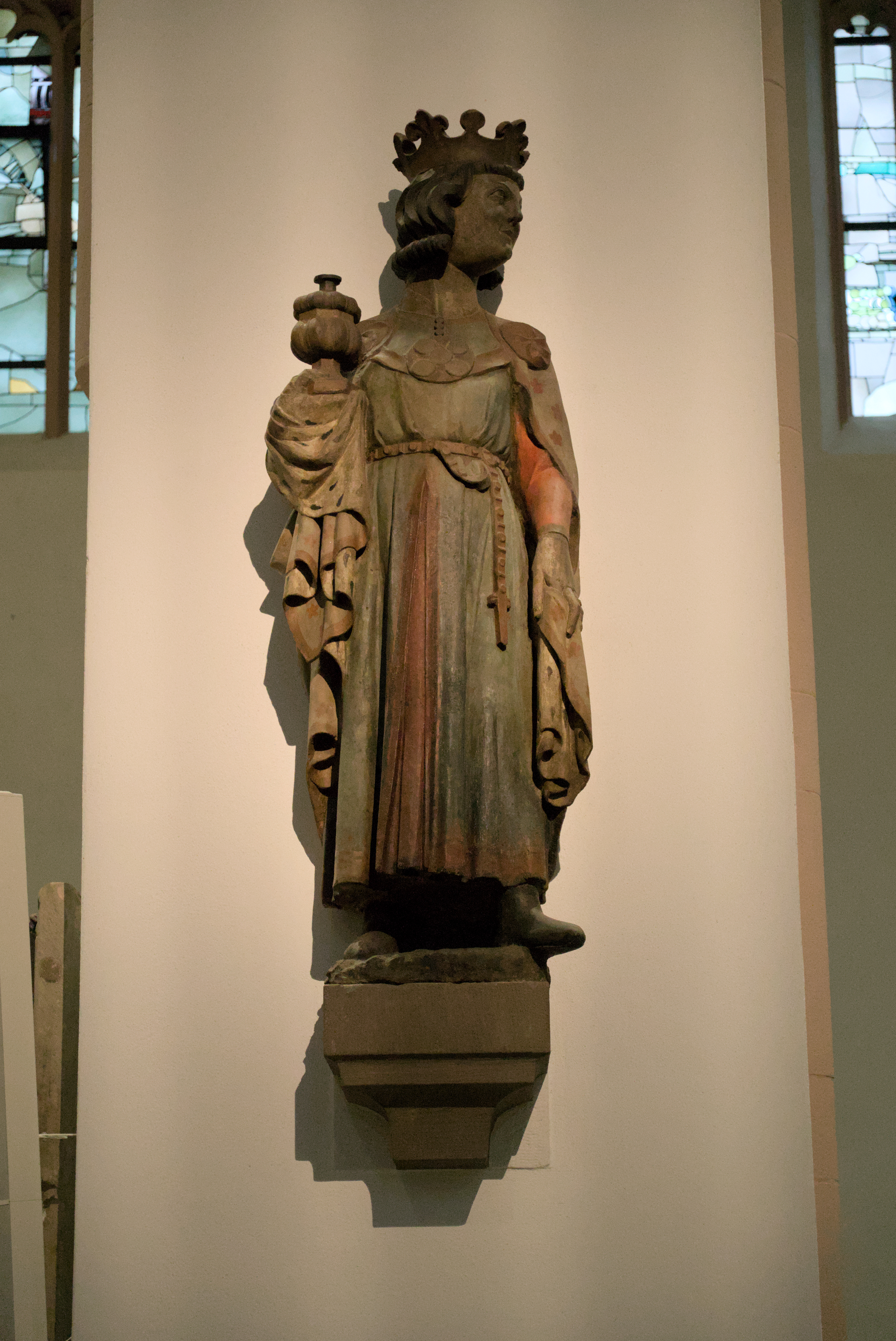
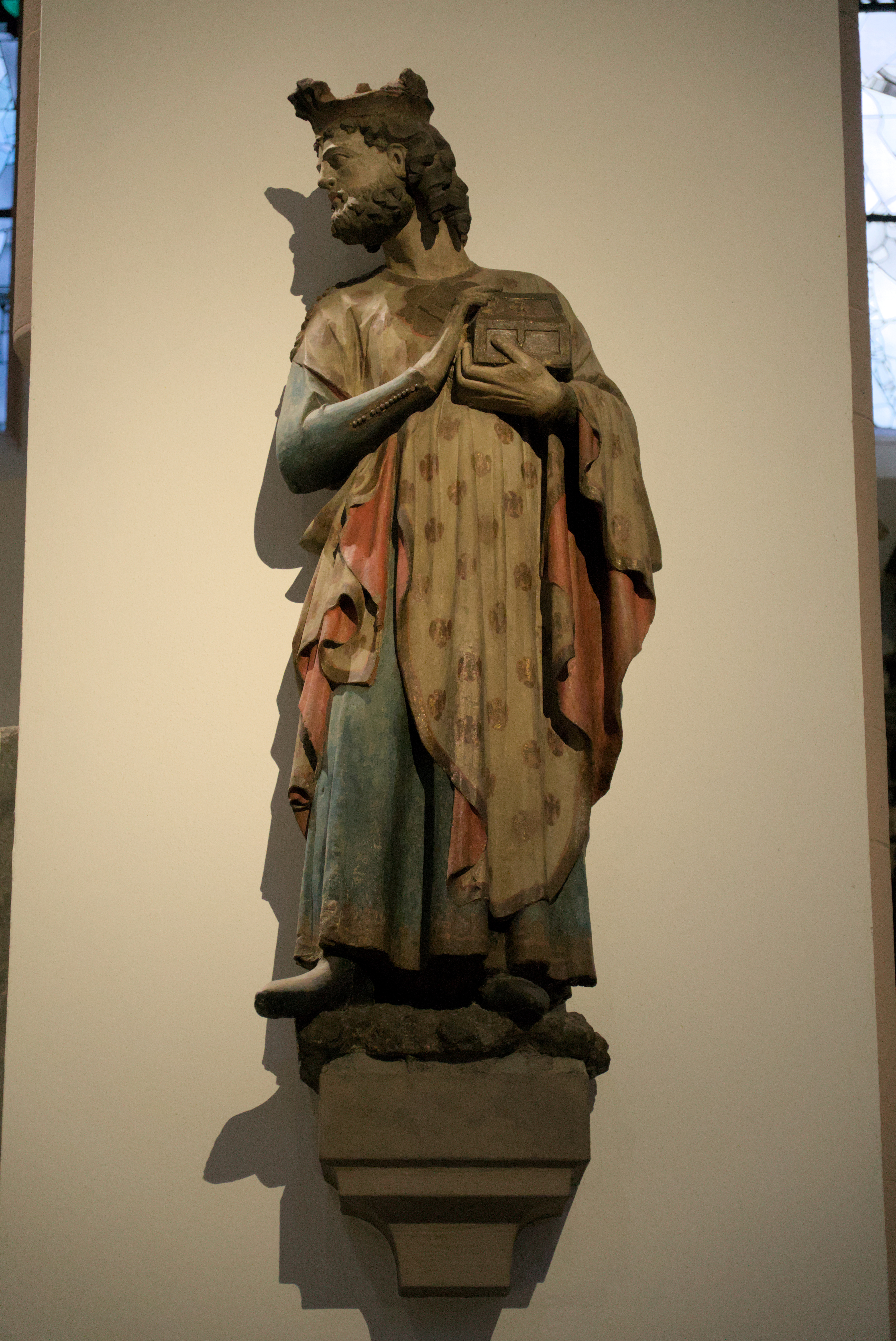
On the north side of the nave, the nations come to Christ in a medieval Adoration of the Magi sculpture group that’s distributed across three pillars. Cathedral guide Rüdiger Seyler told me in an email, in response to my inquiry, that they were carved around 1300 in Germany and demonstrate French influence.
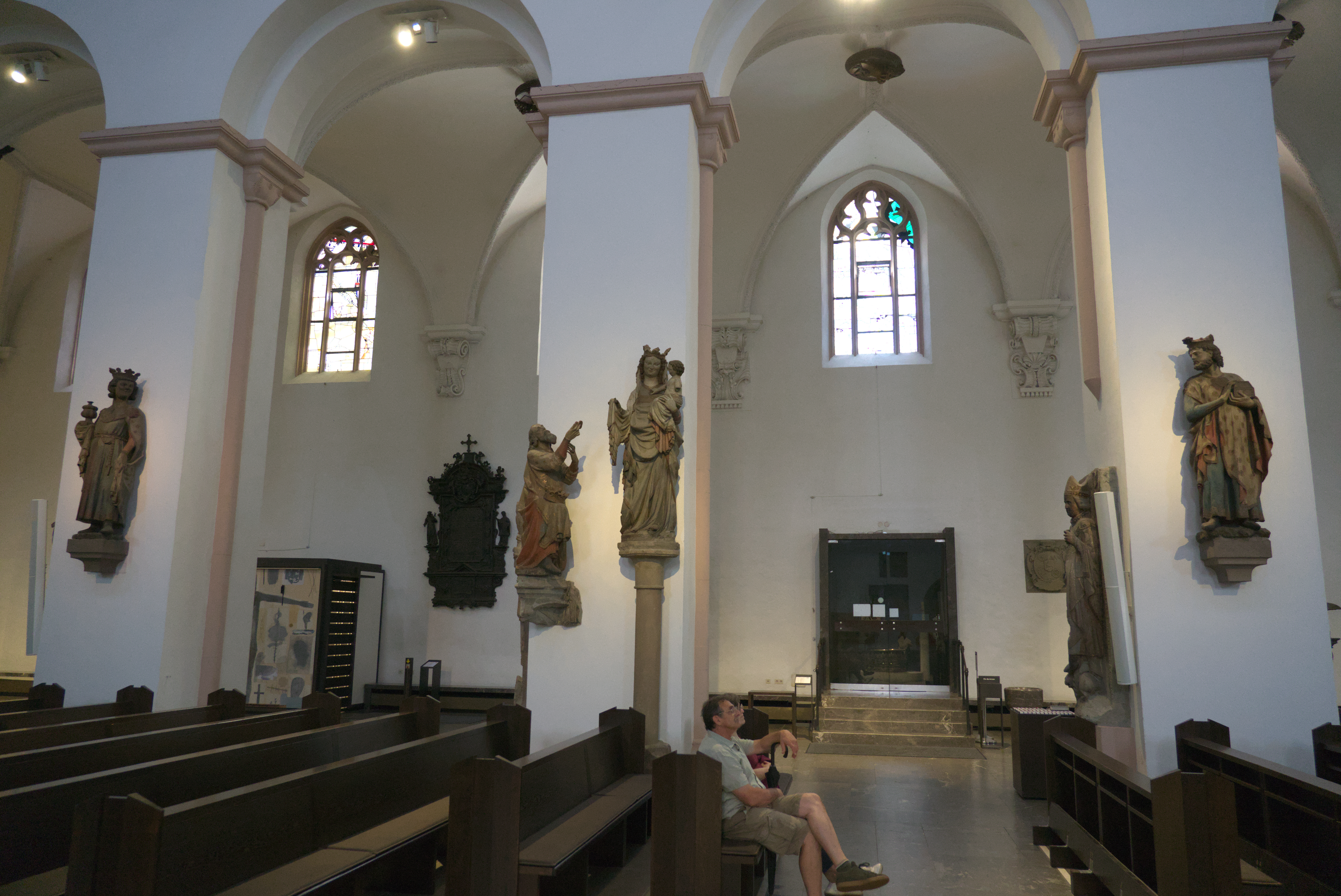
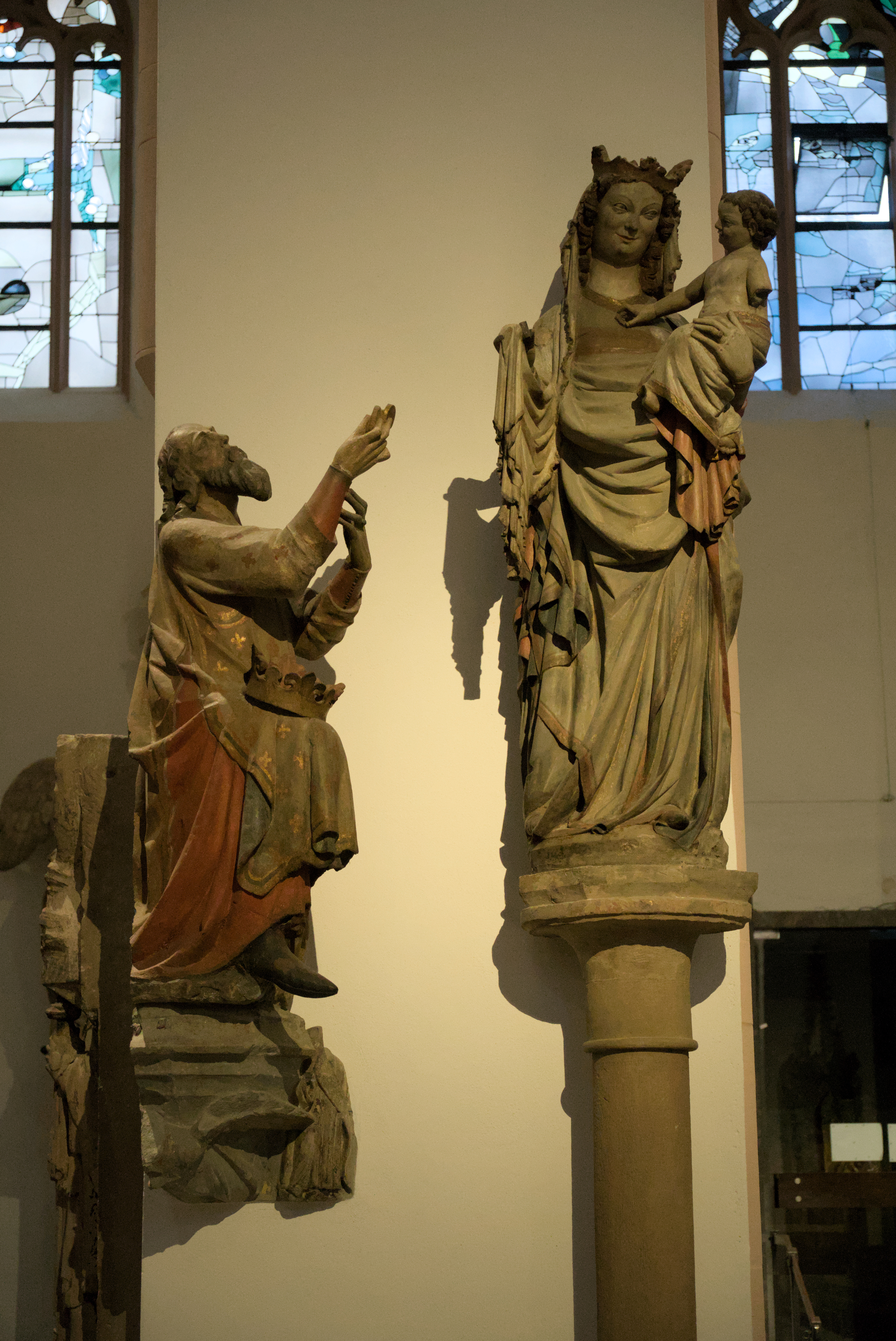
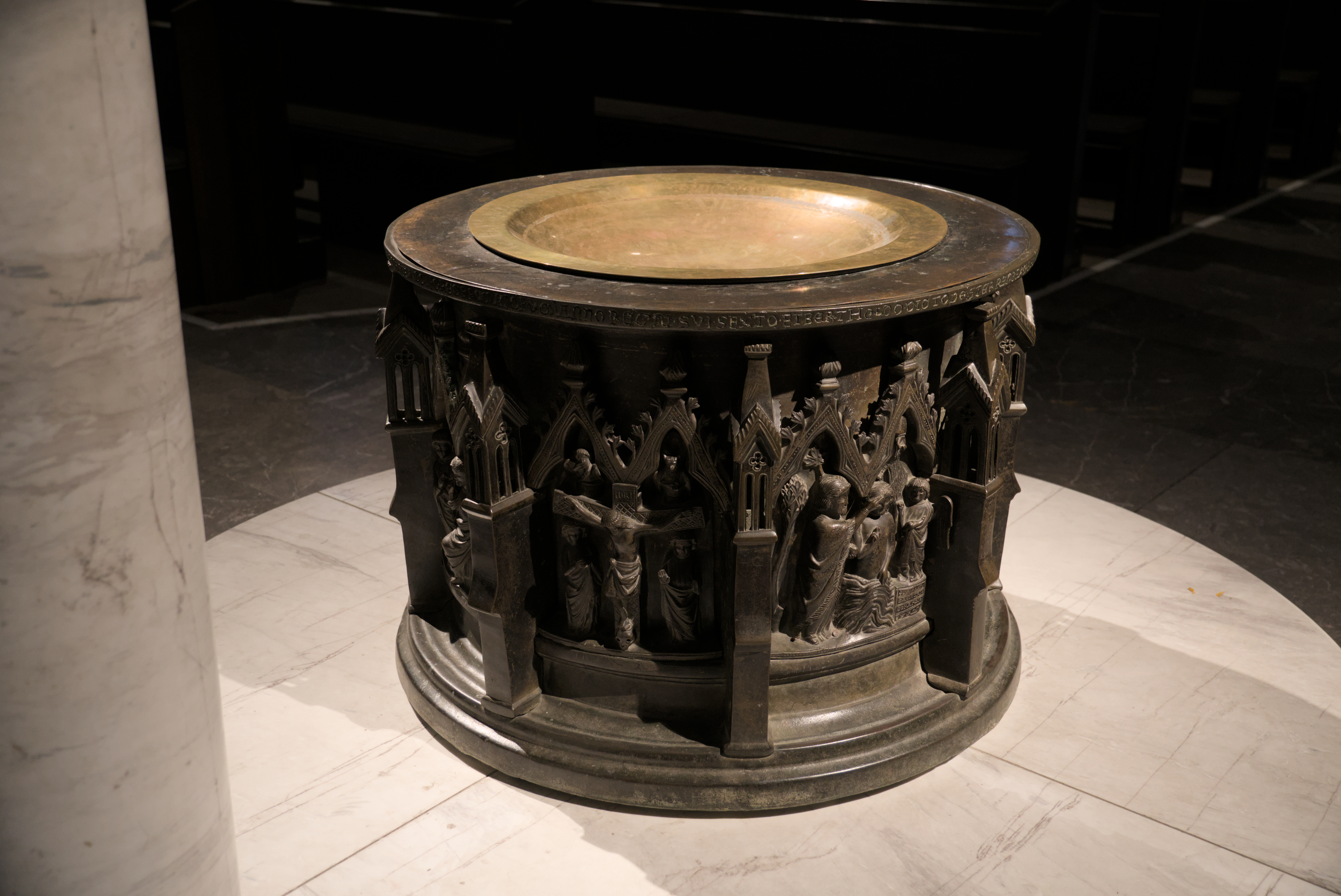
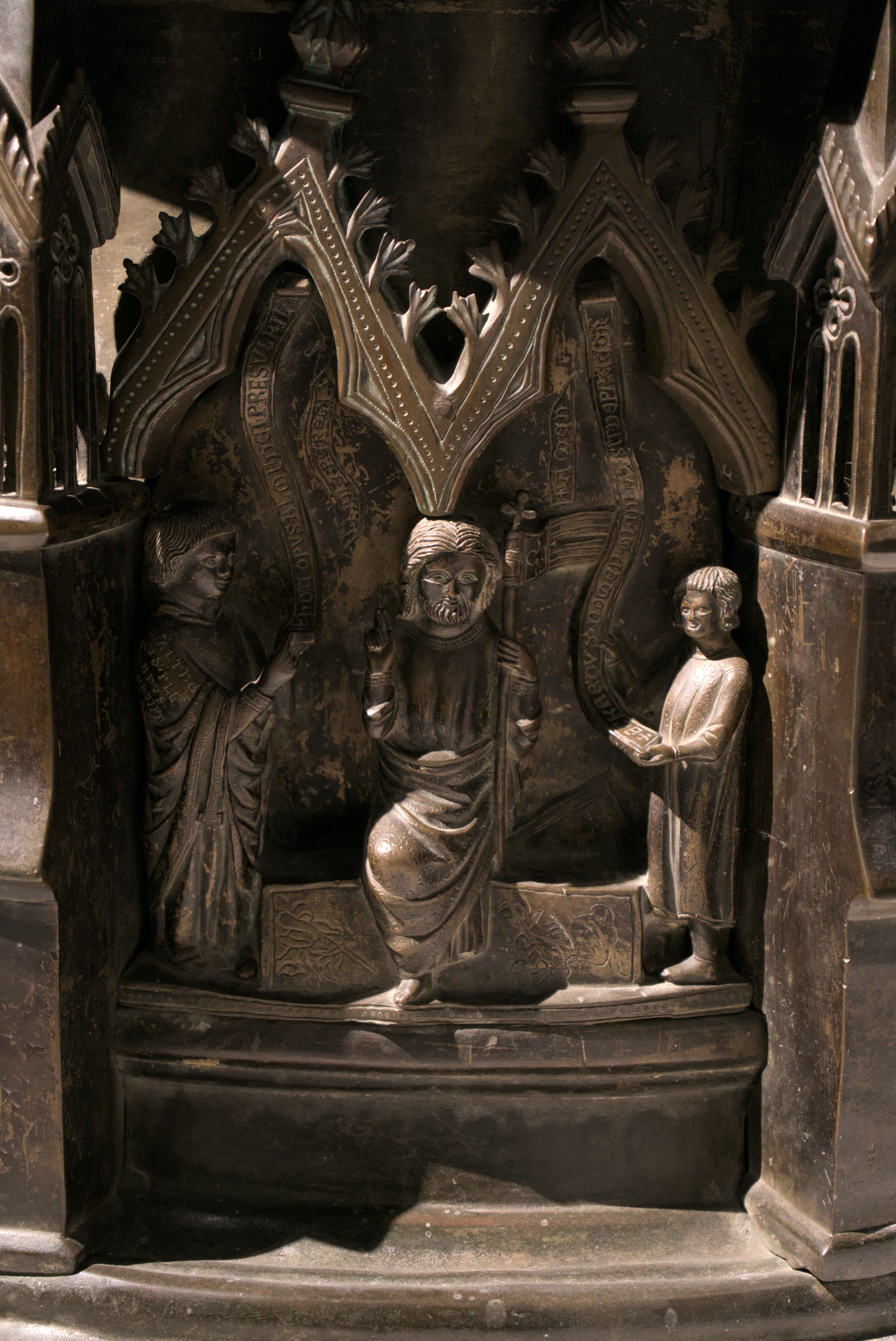
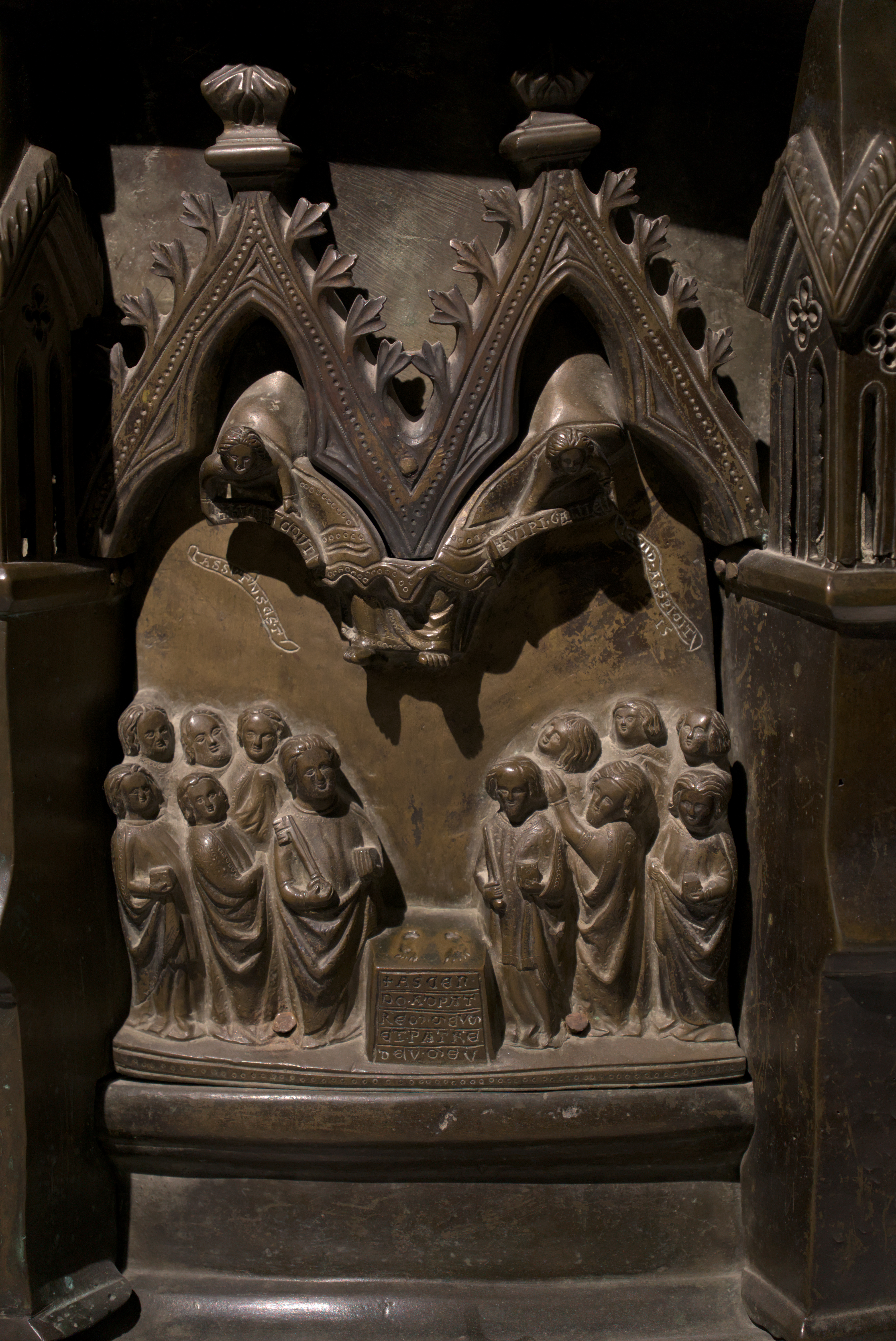
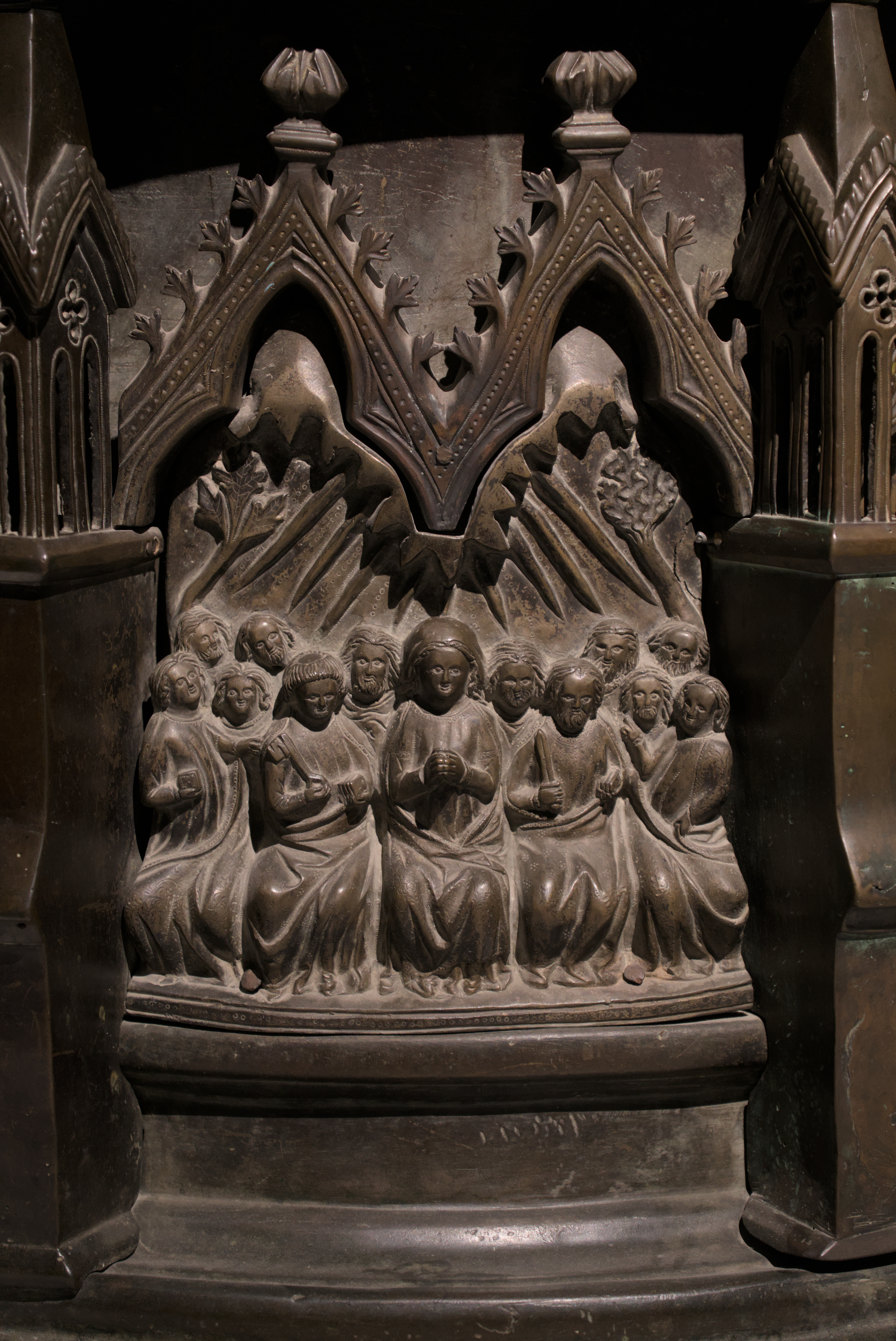
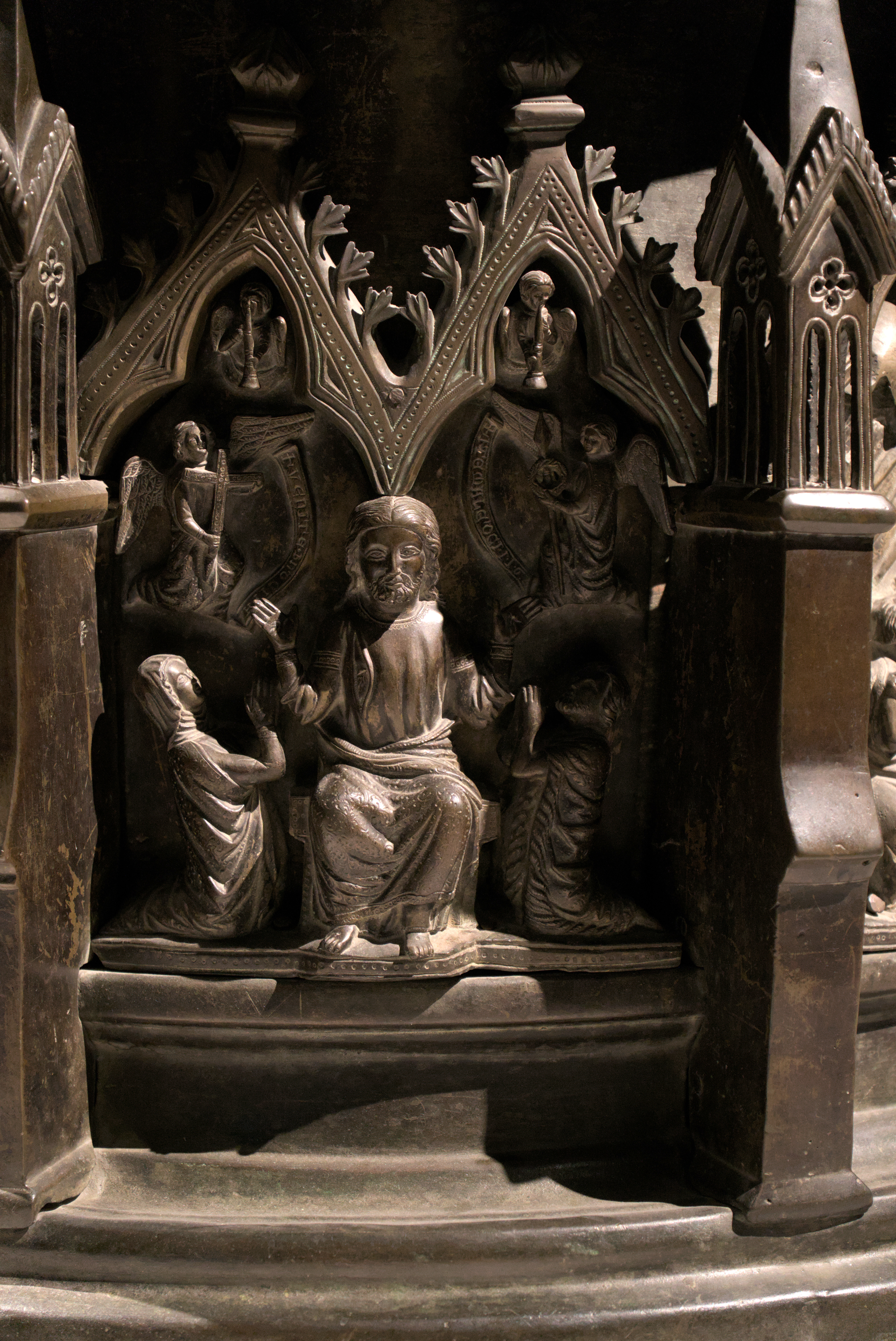
Across from Mary, Christ, and the eldest magus, in the center of the nave, is a bronze baptismal font made by Master Eckard of Worms in 1279. One of the cathedral’s most celebrated medieval treasures, it features eight scenes from the life of Christ, rendered in intricate relief.
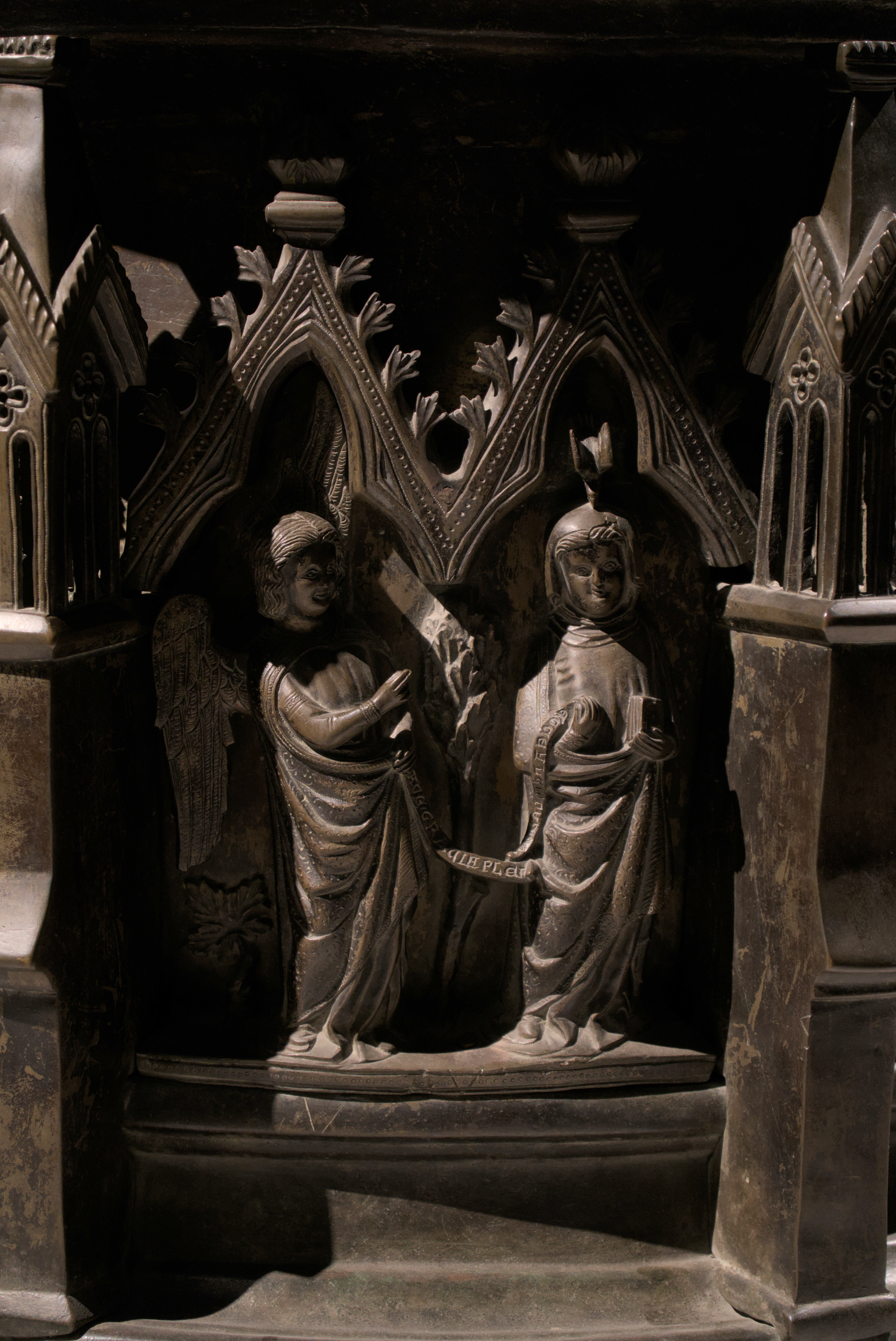
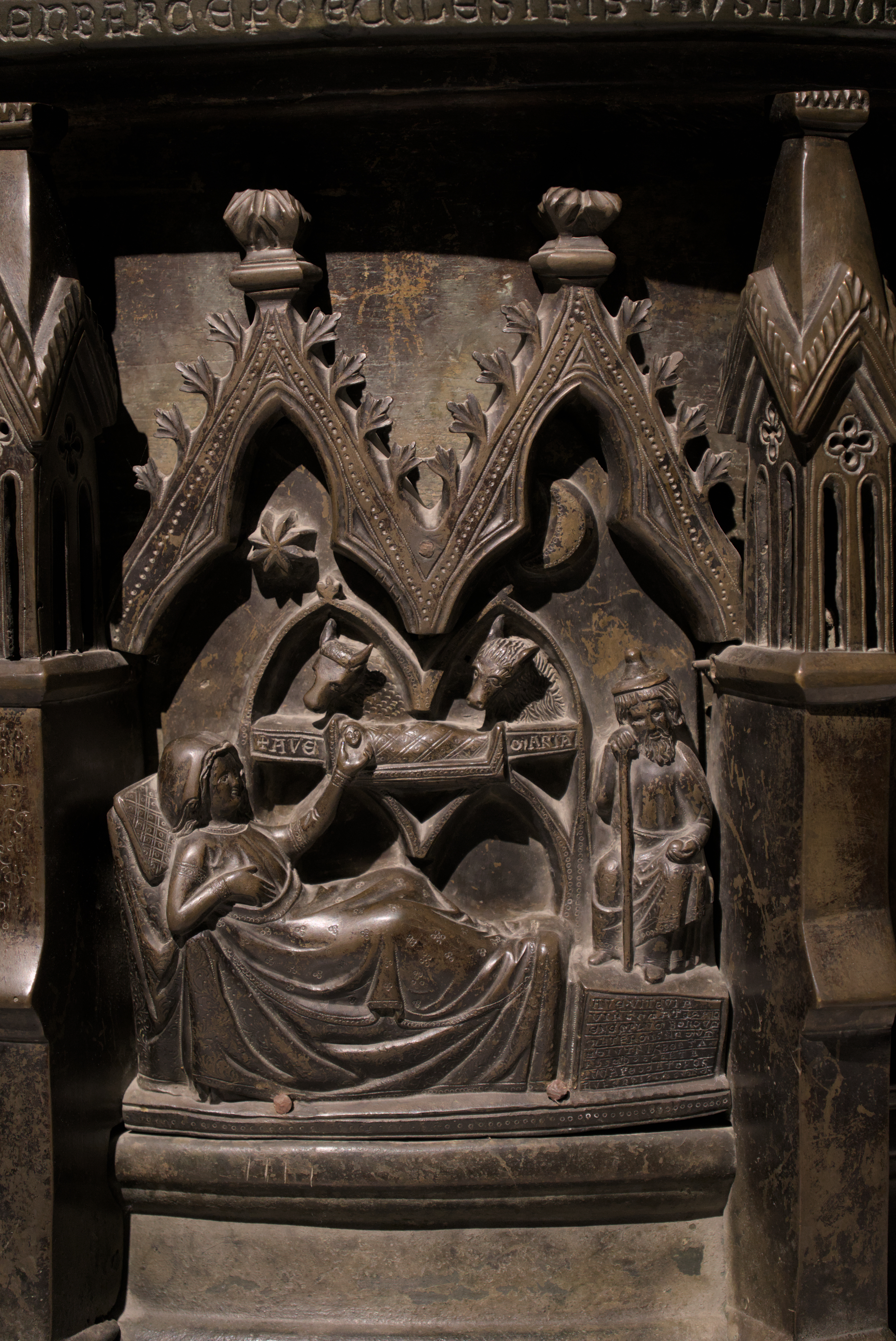
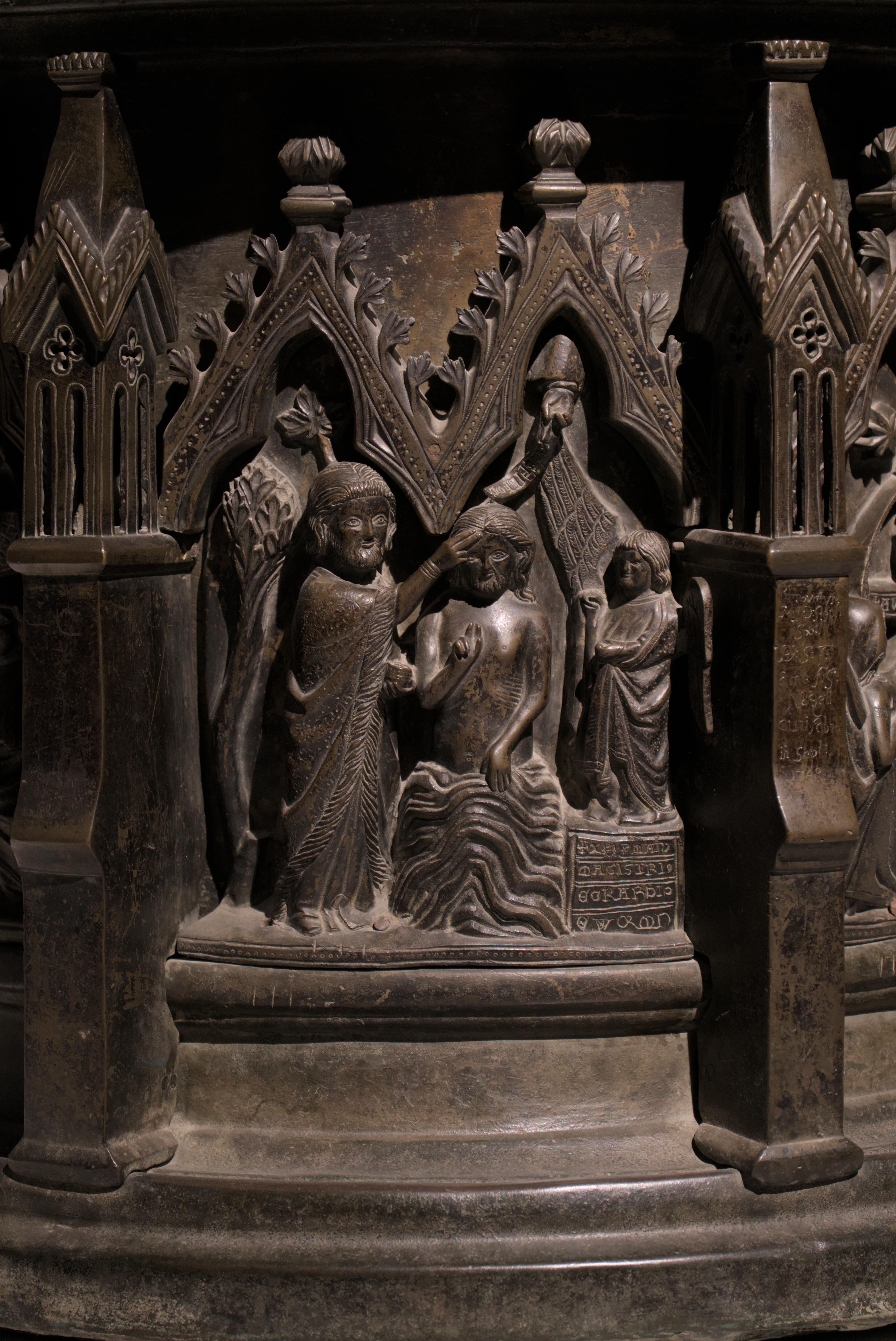
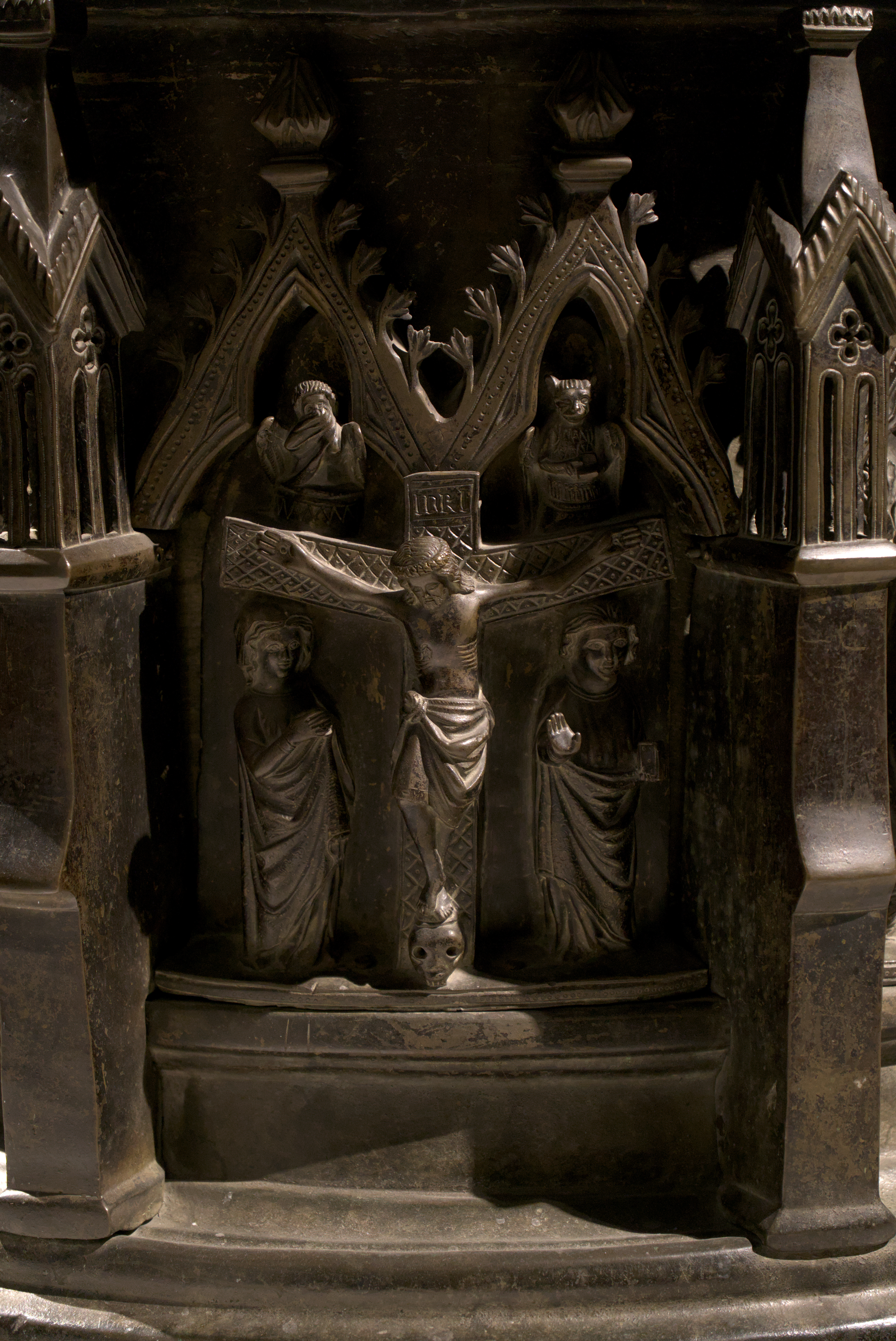
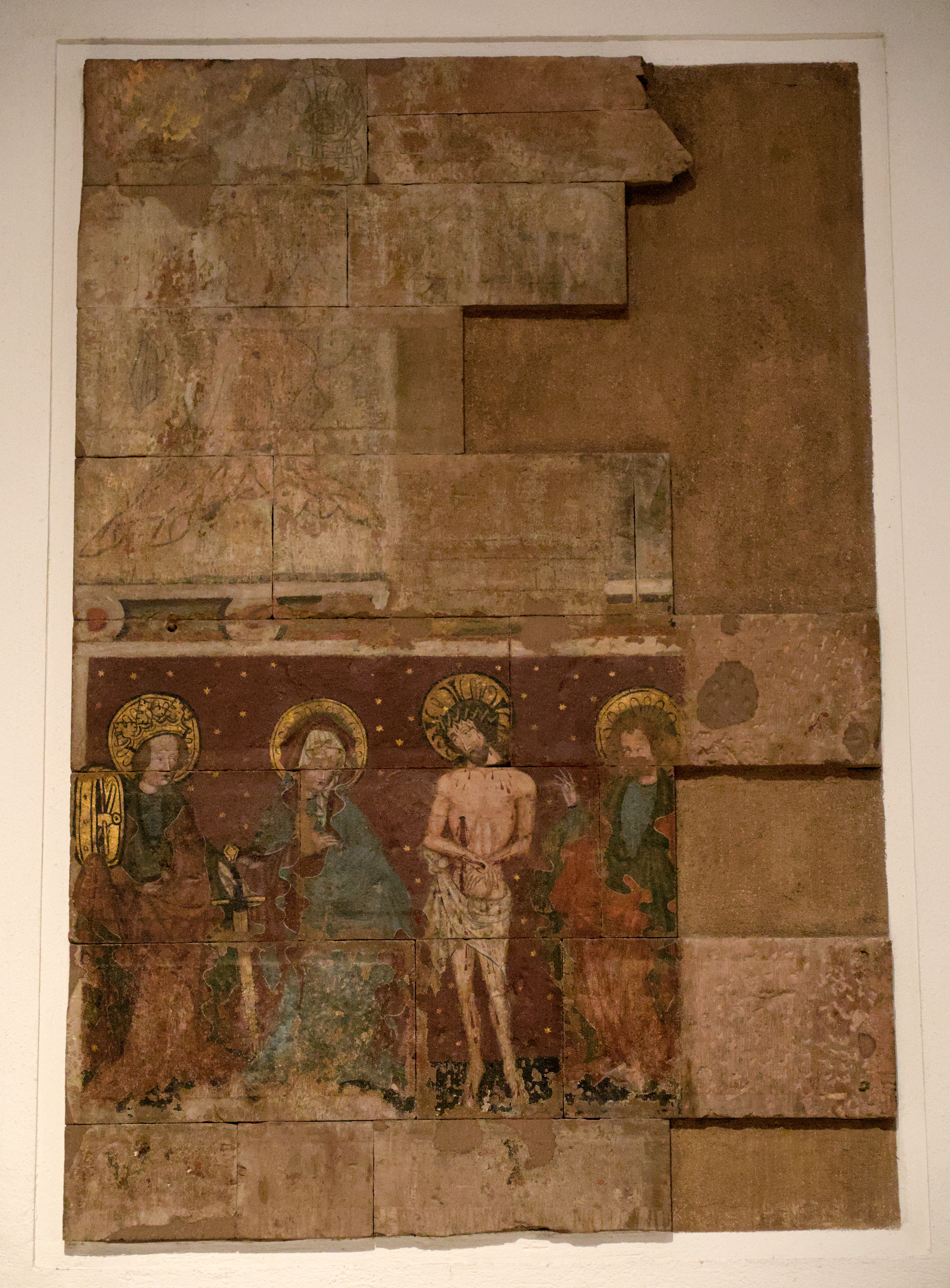
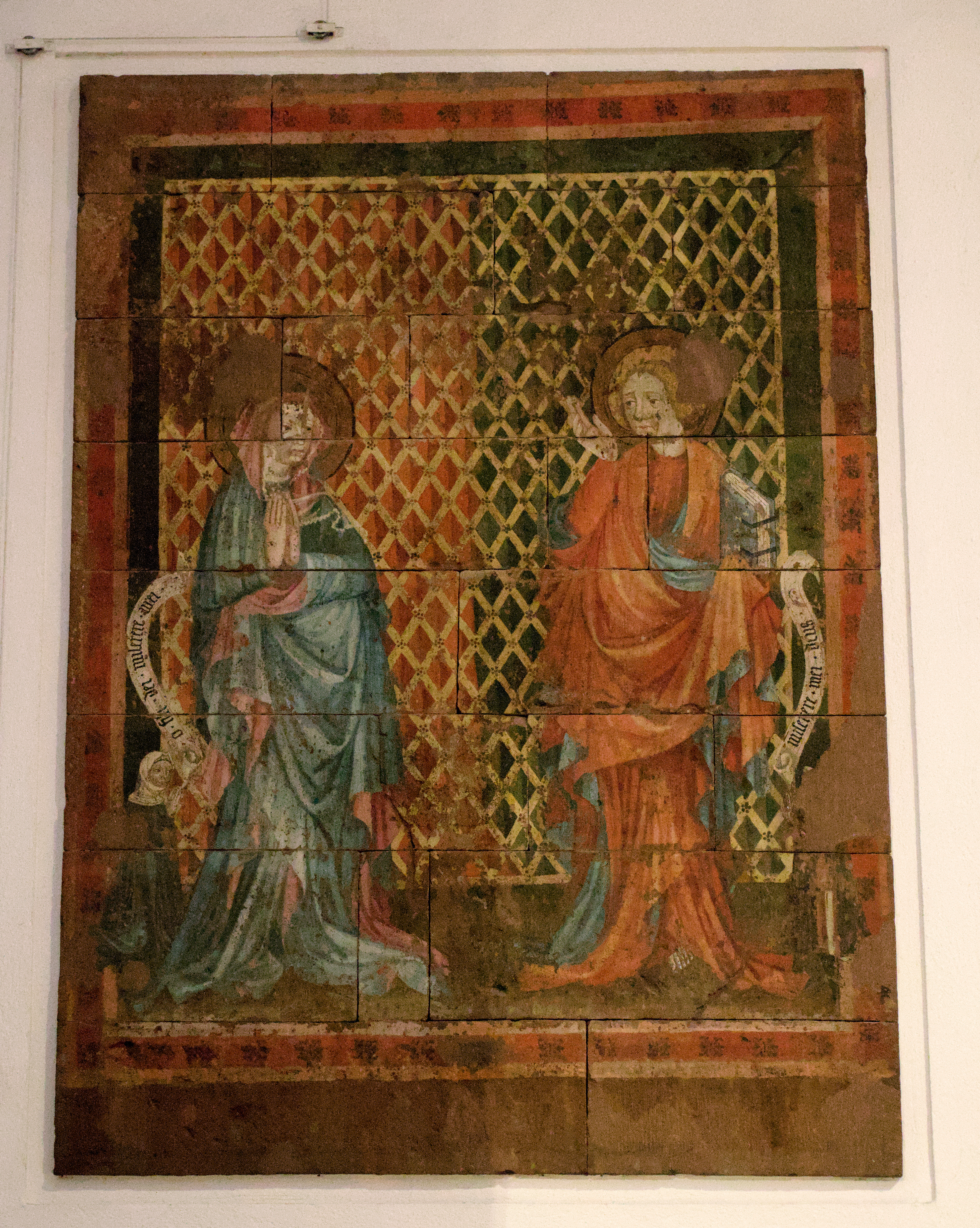
In the south (that is, right) aisle are two detached frescoes from the late fourteenth and early fifteenth centuries. One shows Mary and John the Evangelist as intercessors. On a smaller scale beside them are two donors (the one on the right is rubbed out) holding scrolls with Latin inscriptions appealing to Christ. “O fili dei miserere mei” (O Son of God, have mercy on me), the woman prays. “Miserere mei deus,” the man similarly beseeches.
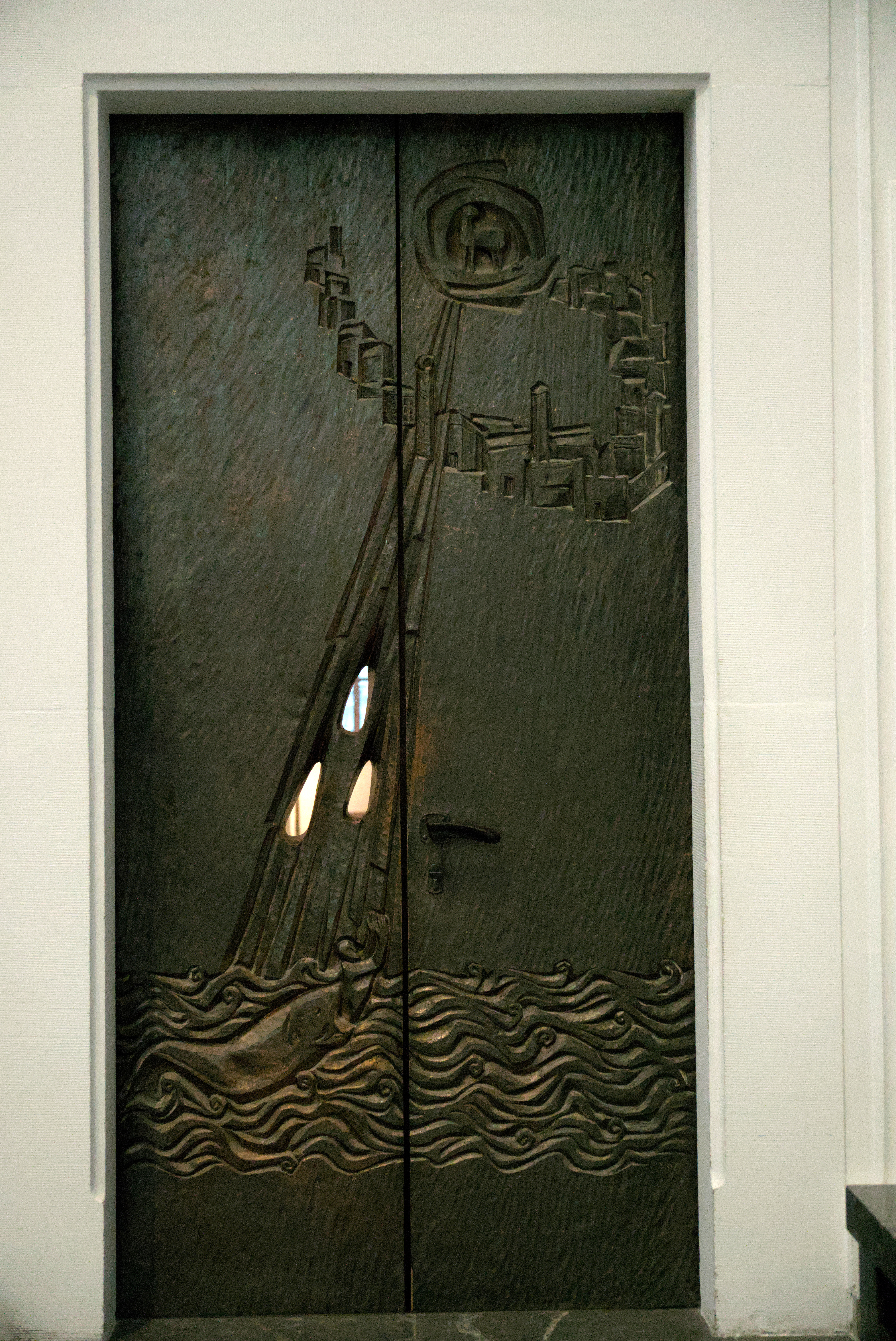
There’s also a modern wood door depicting, in low relief, the Lamb of God in a cityscape in the top right corner (the cathedral guide says it’s the heavenly Jerusalem, but I wonder if it could be Nineveh), and in the lower left, the prophet Jonah being disgorged from the mouth of the whale.
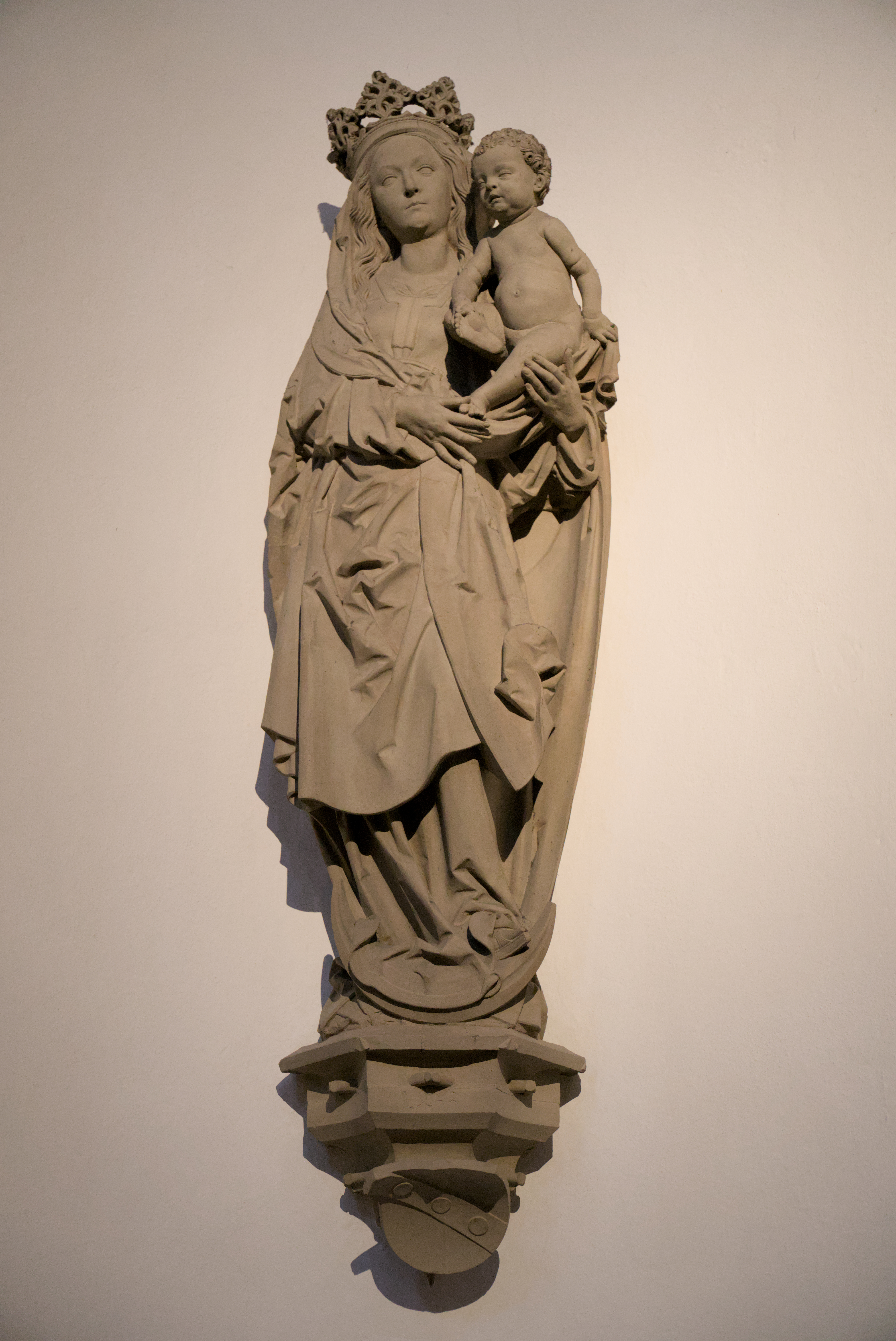
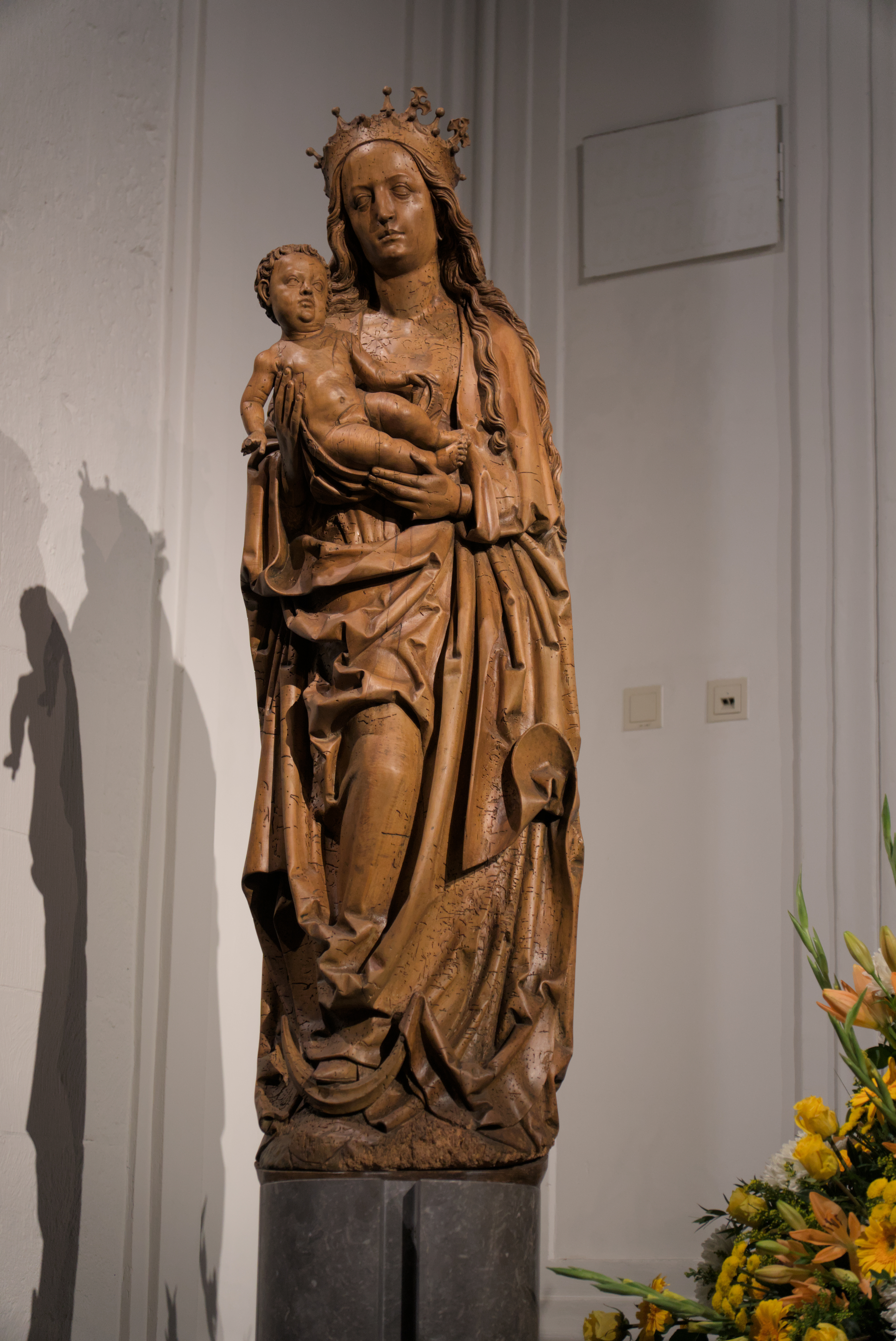
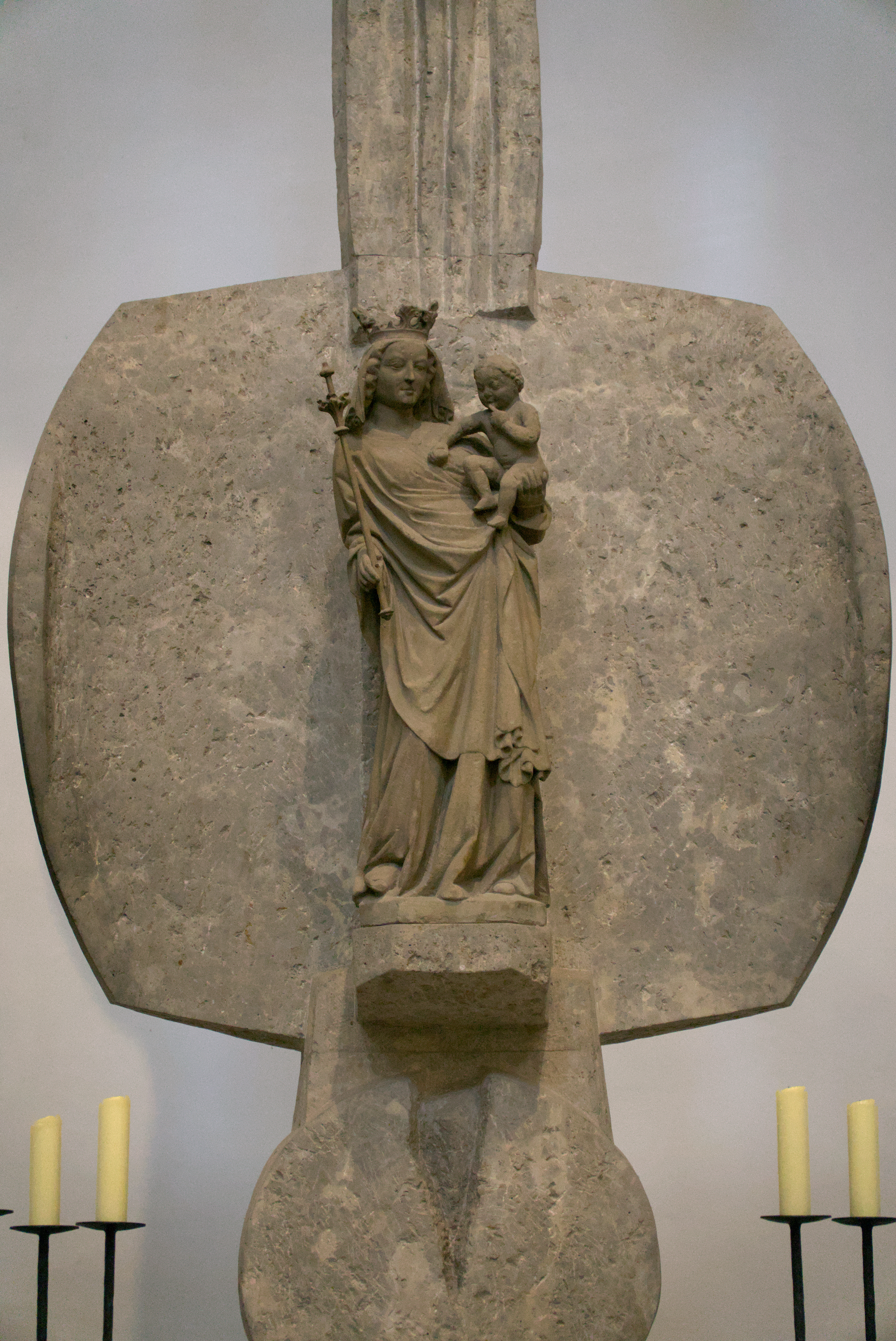
Near the transept, to the left, is a wood sculpture of the Virgin and Child from the workshop of Tilman Riemenschneider. Mary is crowned and stepping on a crescent moon, associating her with the Woman of the Apocalypse in Revelation 12.
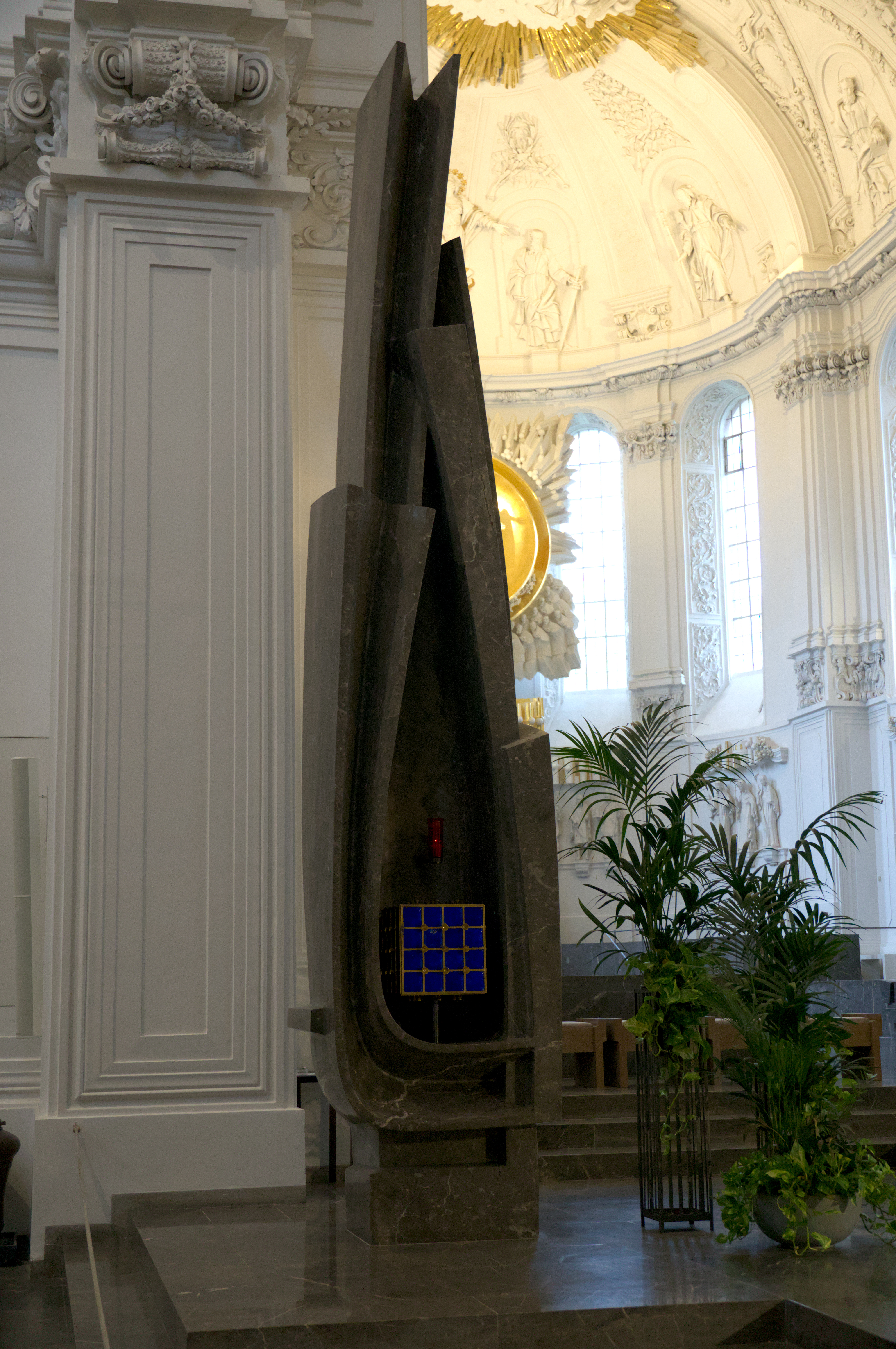
To the left of the high altar is a modern tabernacle, a fixed, locked receptacle in which consecrated hosts left over from the Eucharist are reserved. For me, the stone casing evokes the pillar of fire from the Old Testament, a symbol of God’s presence among his people.
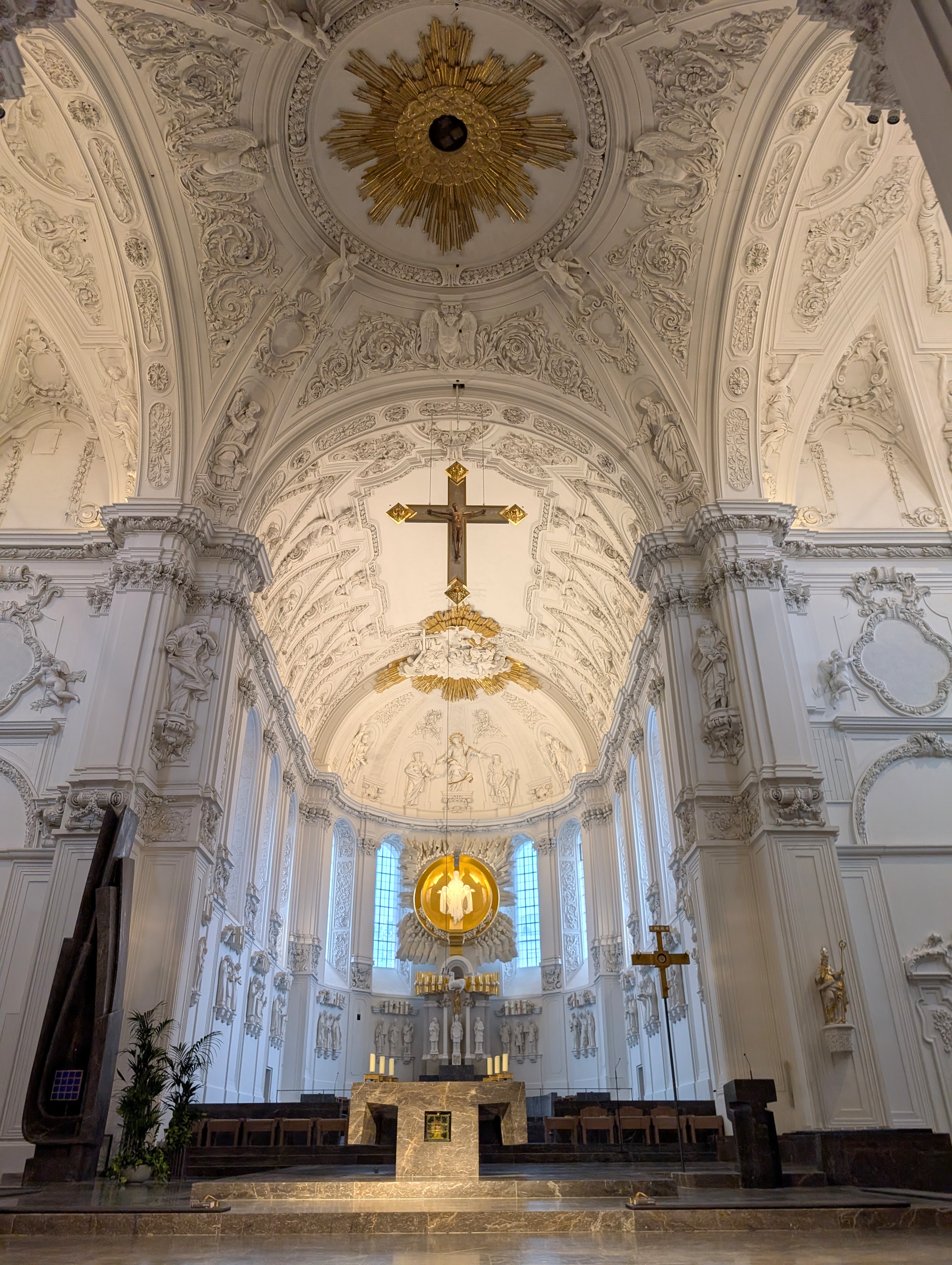
At the east end of the cathedral, the chancel area, designed by Hubert Elsässer in 1987–88, combines Baroque and modern elements in a representation of the New Jerusalem. It is anchored by a prominent stele by Elsässer that pictures the risen Christ in the middle of a gilded circle, its bottom circumference hugged by the tree of life. He is surrounded by angels and the twenty-four elders, and below him is the apocalyptic Lamb of God standing, “as if it had been slaughtered” (Rev. 5:6), before the twelve gates to the city, each bearing a giant pearl.
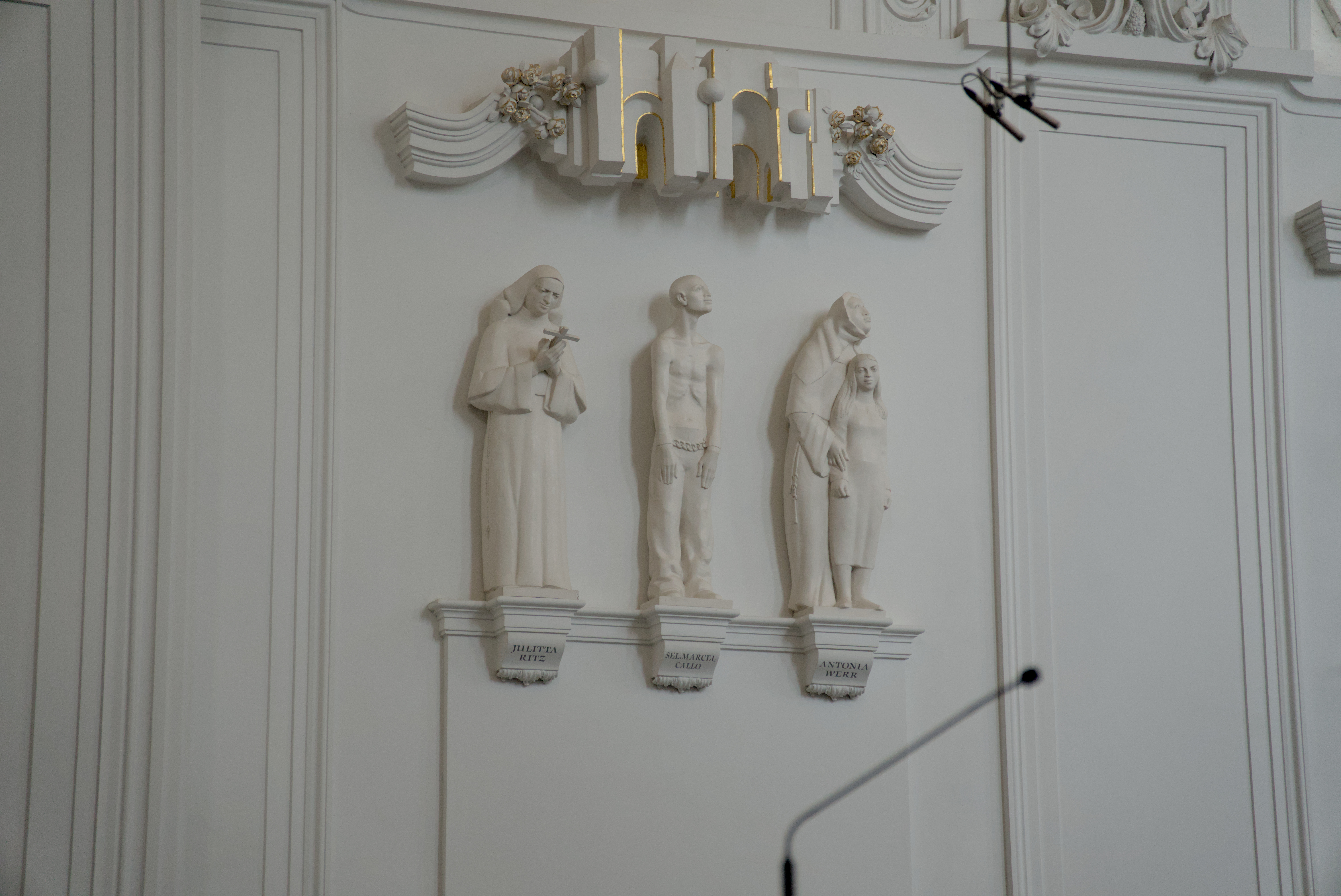
On the walls of the chancel are several trios of Frankish faith witnesses from the seventh to twentieth centuries, sculpted by Hubert Elsässer, Willi Grimm, Tilmar Hornung, Ernst Singer, and Lothar Forster. One group on the left depicts Sister Maria Julitta Ritz (1882–1966), a German Catholic nun, teacher, mystic, and spiritual adviser belonging to the Congregation of the Sisters of the Divine Redeemer in Würzburg; Blessed Marcel Callo (1921–1945), a French Catholic member of the Young Christian Workers who was deported to Germany in 1943 and died two years later in the Mauthausen concentration camp; and Sister Antonia Werr (1813–1868), founder of the Holy Childhood Sisters in Oberzell and a pioneer of the reintegration of women released from prison.
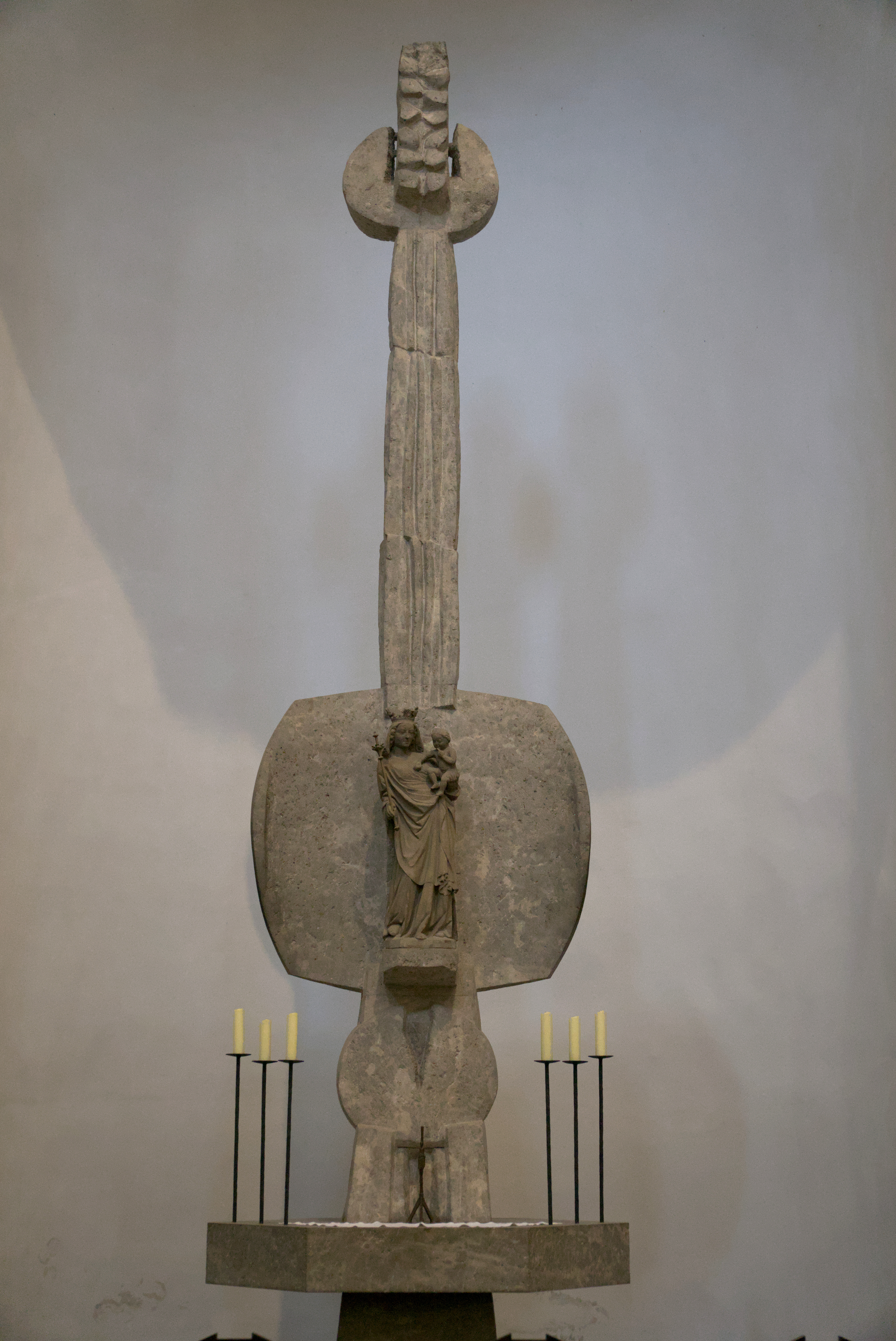
Elsässer also carved the stone, lute-shaped Altar of Mary in the north transept, which centers, in the “soundboard,” a medieval sculpture of the Virgin and Child. What an evocative combination! Conceptually, it reminds me of a charming little quatrain by the seventeenth-century German Christian mystic Angelus Silesius:
Ein Herze das zu Grund
Gott still ist, wie er will,
Wird gern von ihm berührt—
Es ist sein Lautenspiel.
In other words, a heart that is still and hushed readily welcomes the touch of God, like a lute that invites music making. Once God touches the heart, it sings.
The Indian mystic Kabir, who didn’t belong to a particular religious tradition, wrote something similar in the fourteenth century:
My friend, this body is His lute. He tightens the strings and plays its songs.
If the strings break and the pegs work loose, this lute, made of dust, returns to dust.
Kabir says: Nobody else can wake from it that heavenly music.
(trans. Stephen Mitchell, The Enlightened Heart: An Anthology of Sacred Poetry)
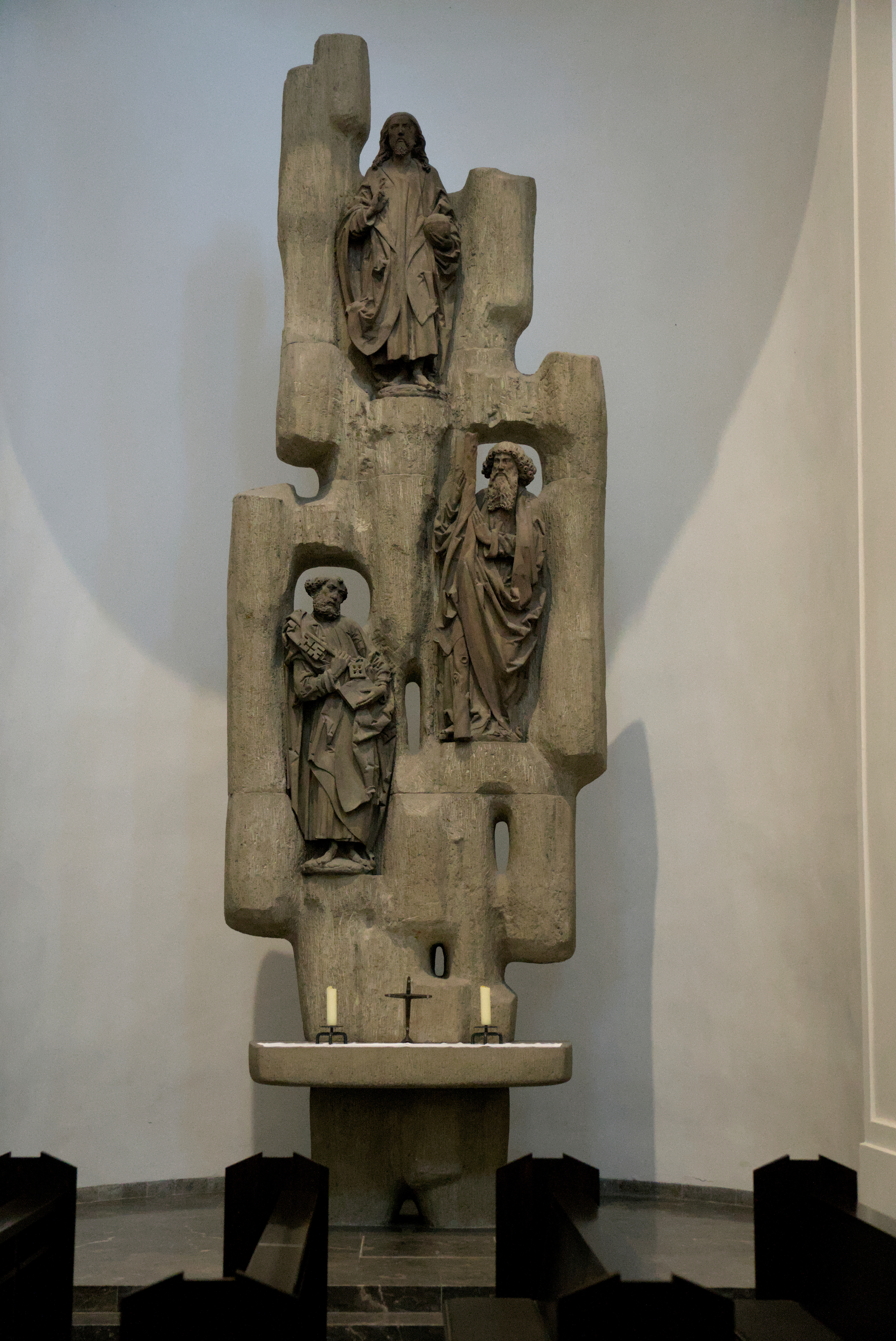
In the equivalent spot in the south transept is the Apostle Altar by Helmut Weber, a thick, vertical stone framework that houses, cave-like, late medieval sculptures by Tilman Riemenschneider depicting Christ holding an orb that represents the world, Andrew holding a fragment of the X-shaped cross he was martyred on, and Peter holding a key (a reference to Matt. 16:19).
Unfortunately, there is an extension off the south transept that I missed: the Sepulture, a Gothic burial hall. (The door was closed, and I didn’t realize it could be opened; or perhaps the space was temporarily closed to visitors.) It contains, most notably, a 1956 stained glass cycle by Georg Meistermann depicting the seasons and holidays of the church year.
But back to the main body of the cathedral. Overhead, running down the length of the church, is a modern ceiling painting by Franz Nagel depicting the apocalyptic throne chariot vision that the prophet Ezekiel saw while living in exile in Babylon. The vision features bizarre cosmic imagery—wind and fire, a wheeled throne of God, four-faced hybrid creatures with wings, flashes of lightning, a shining crystal dome, eyes all over.
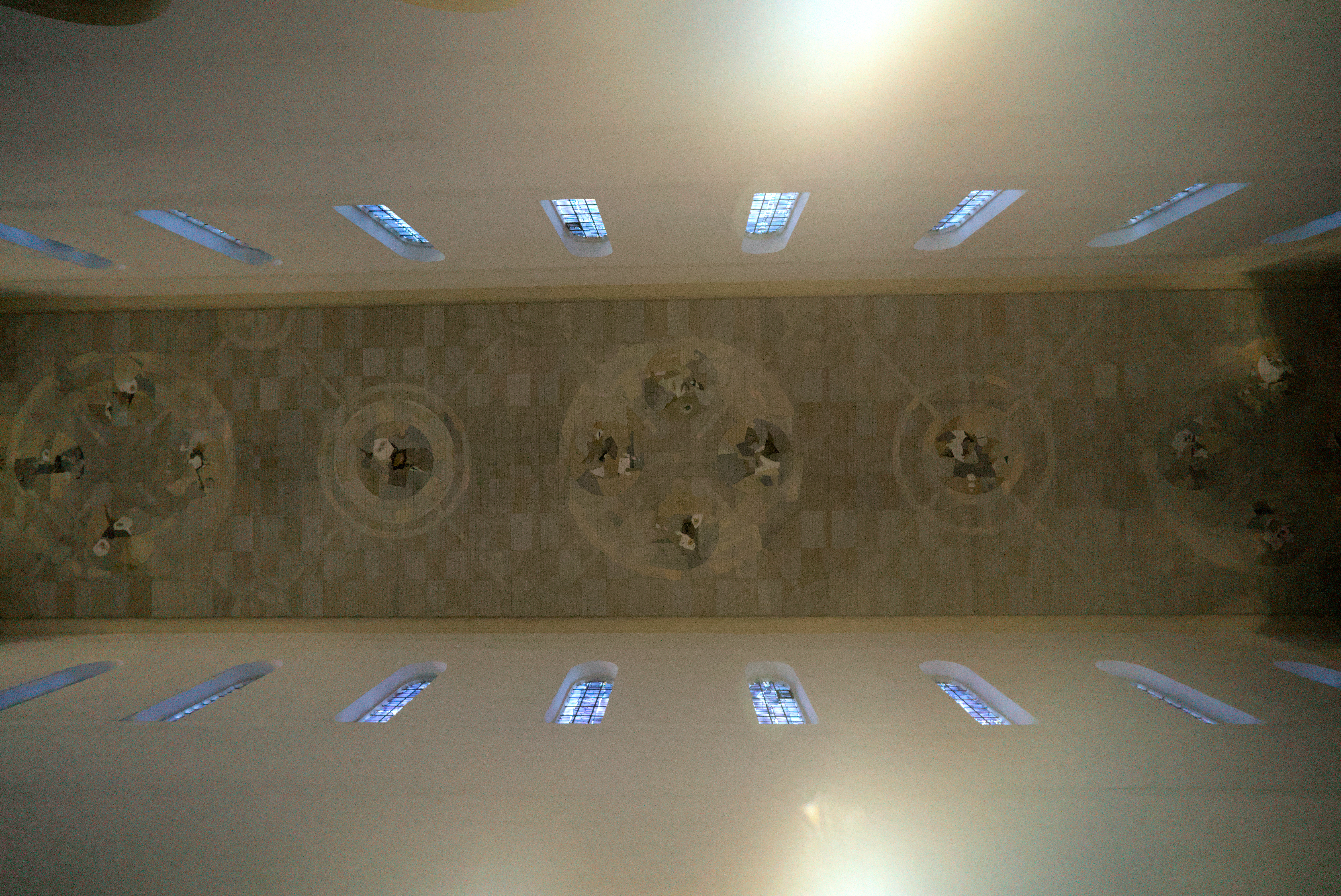
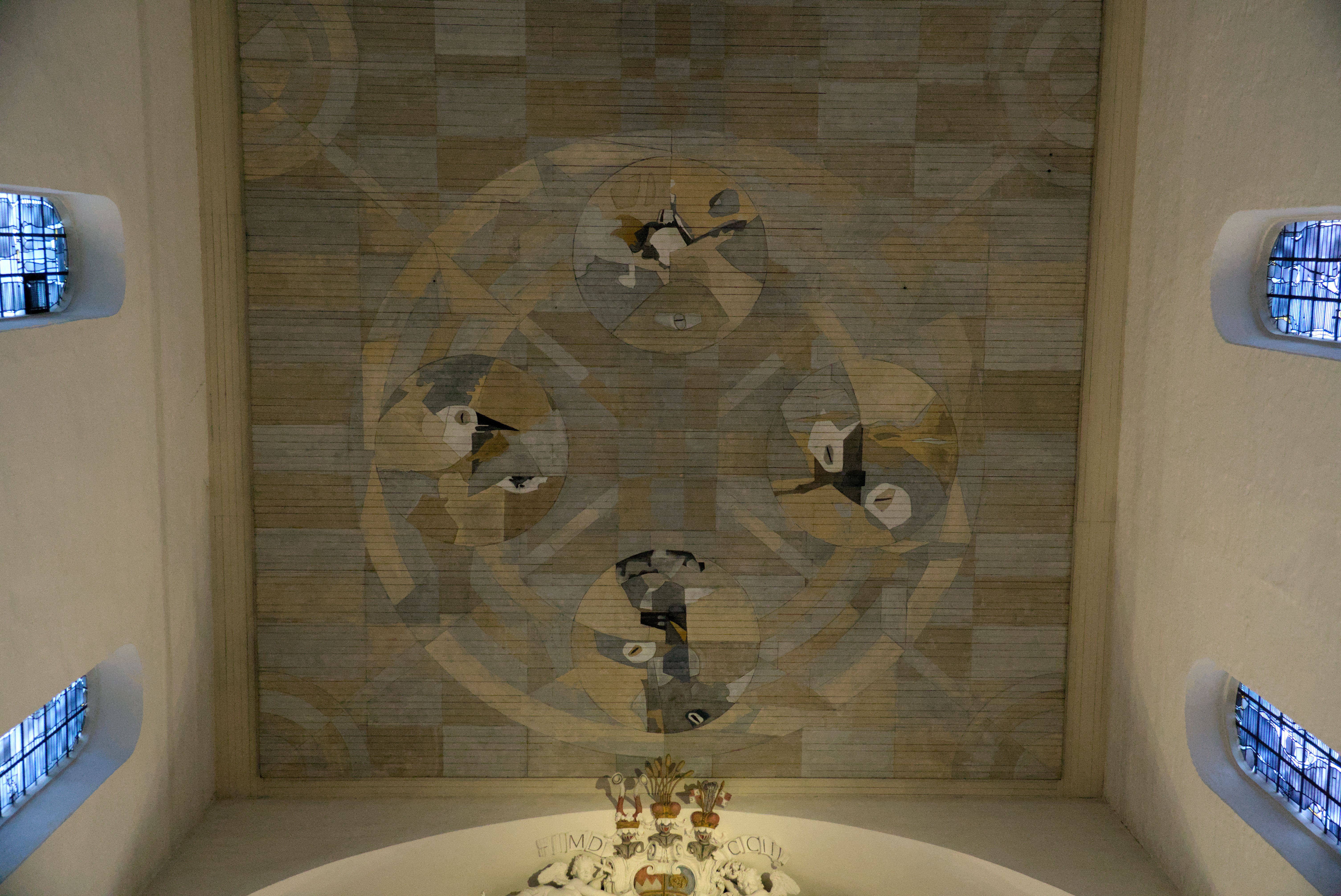
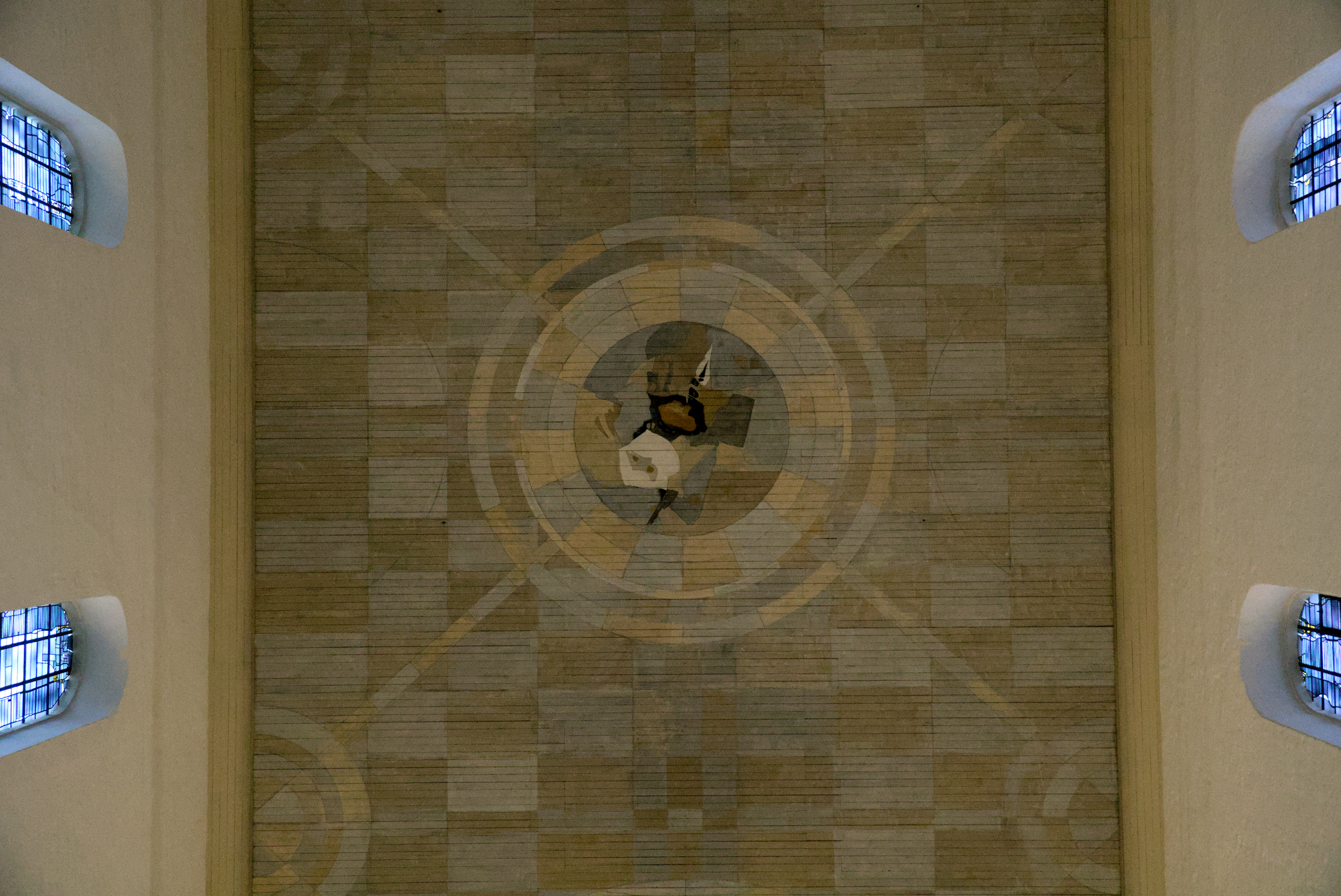
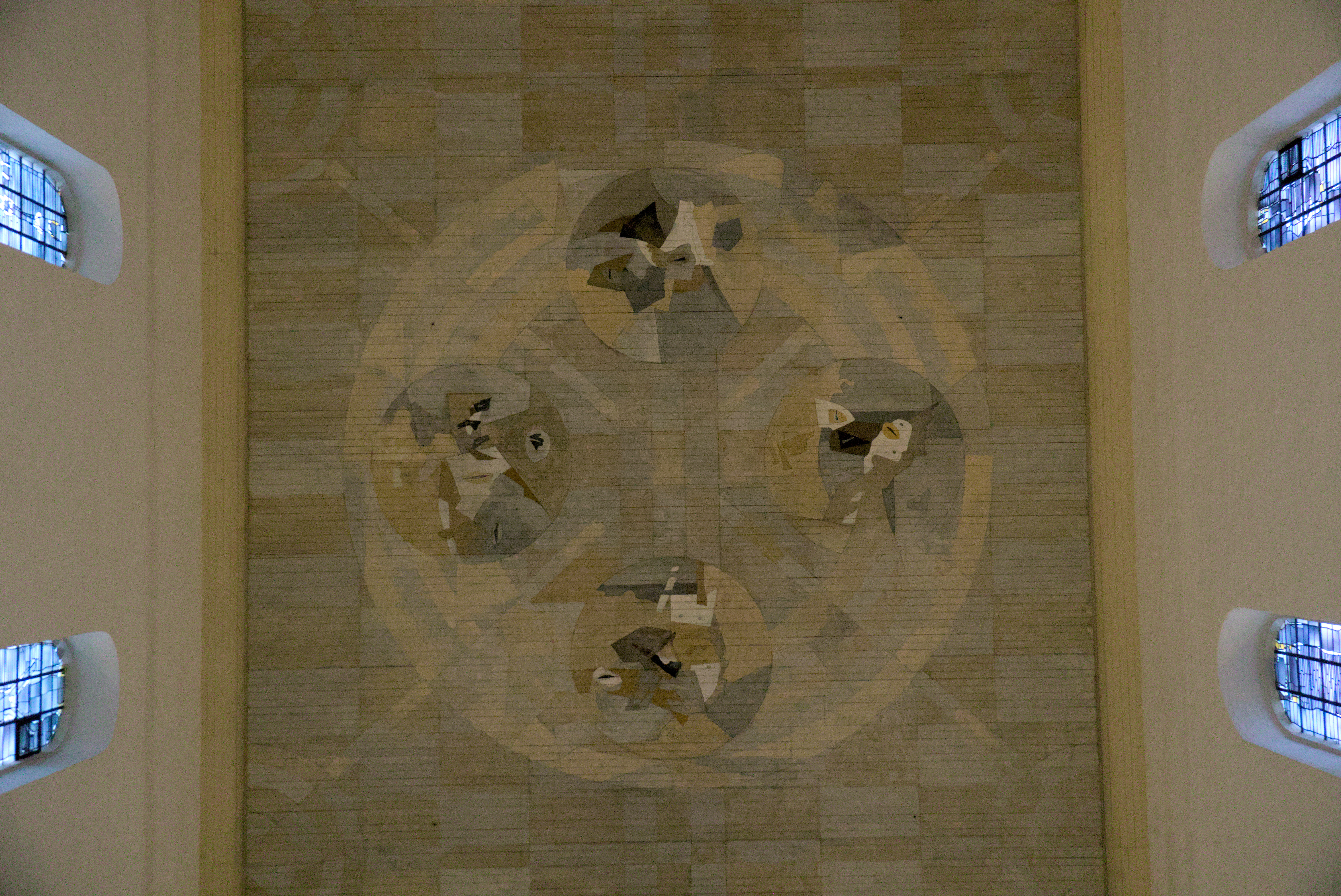
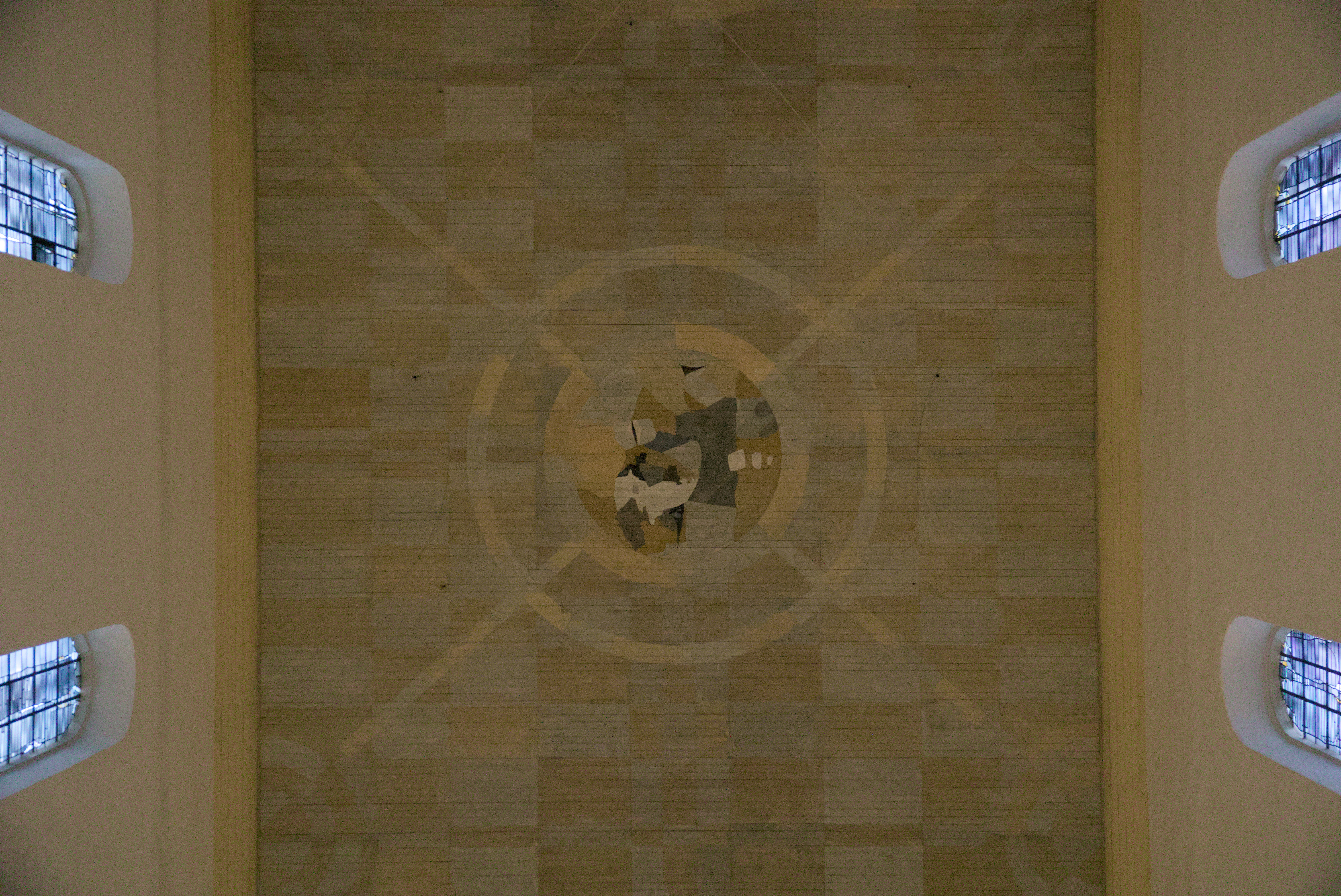
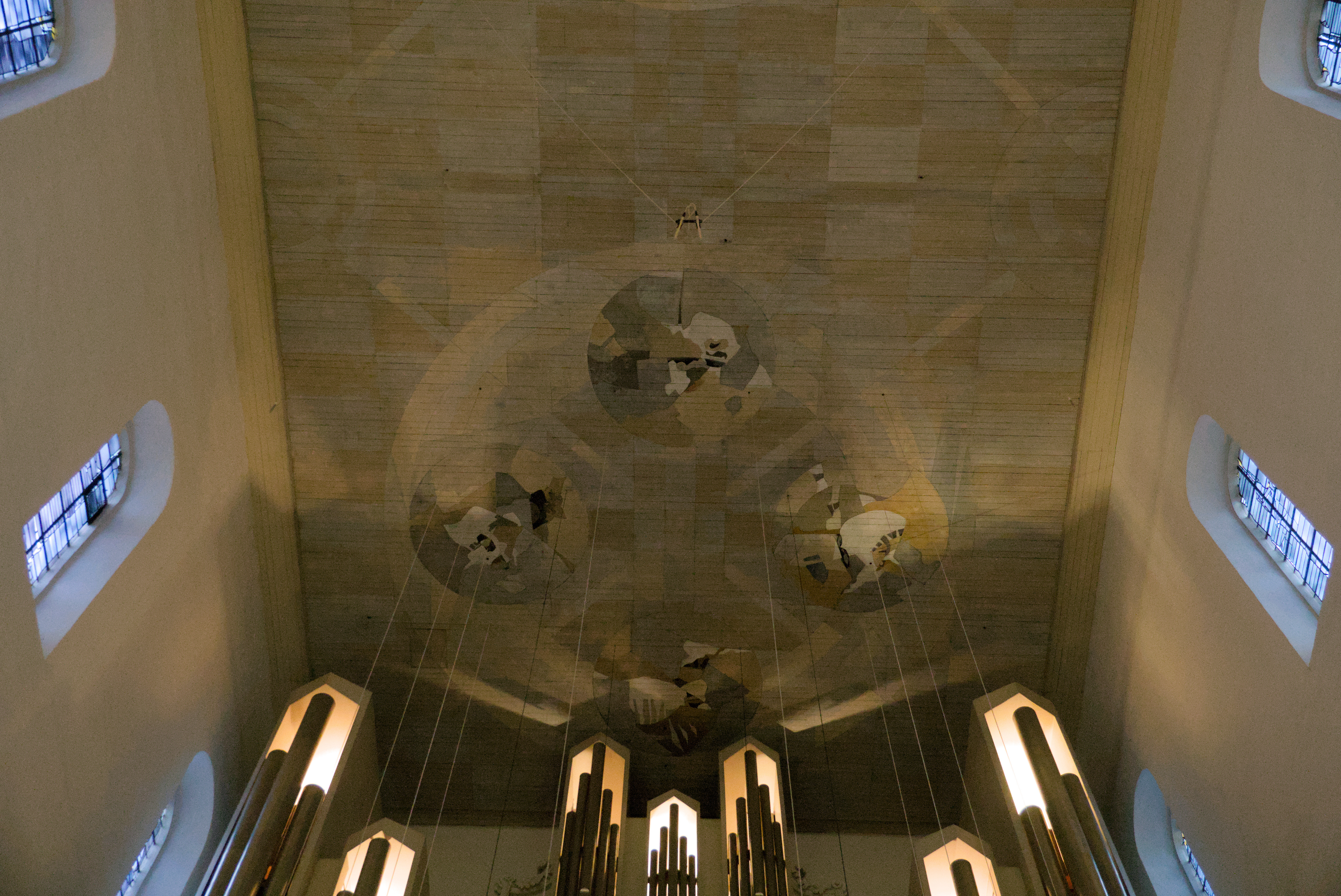
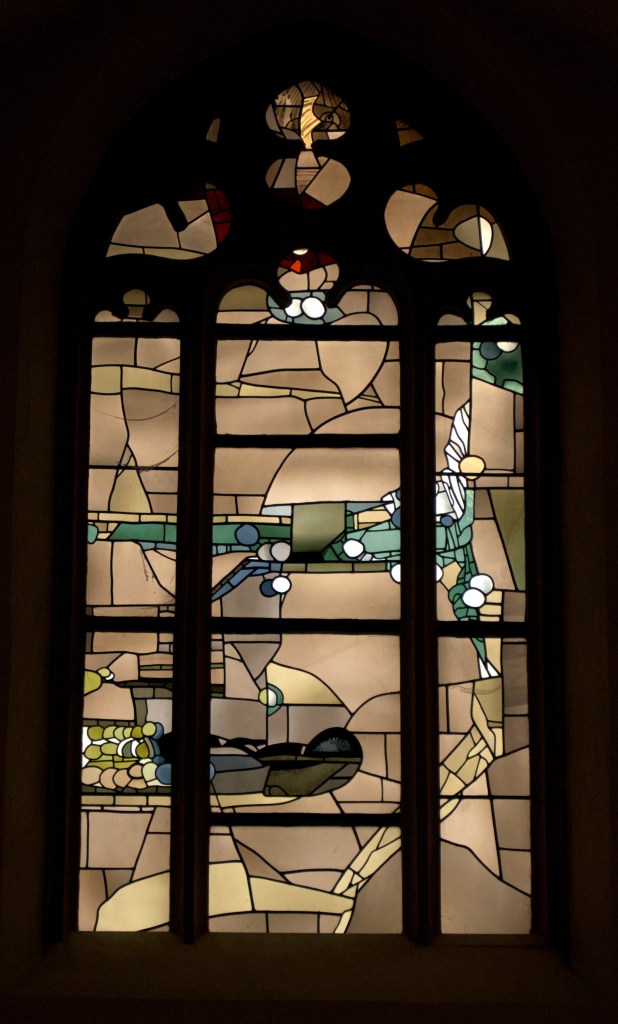
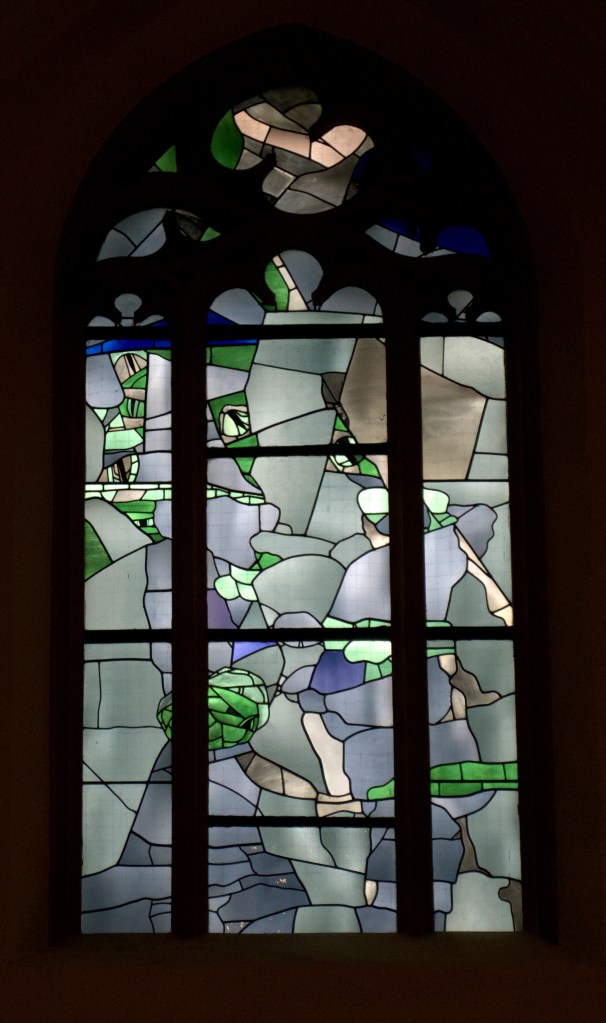
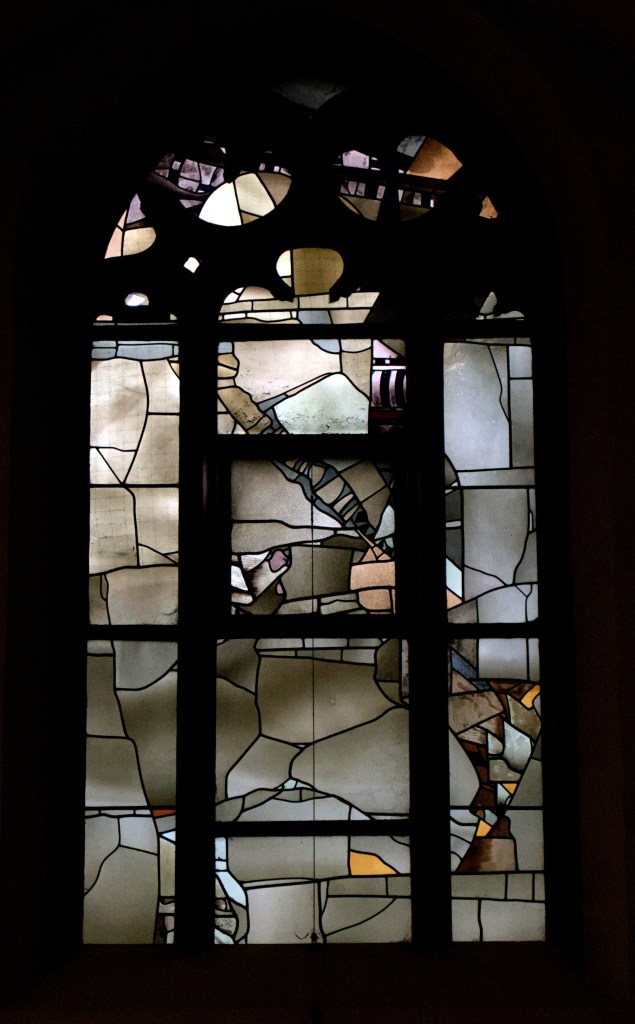
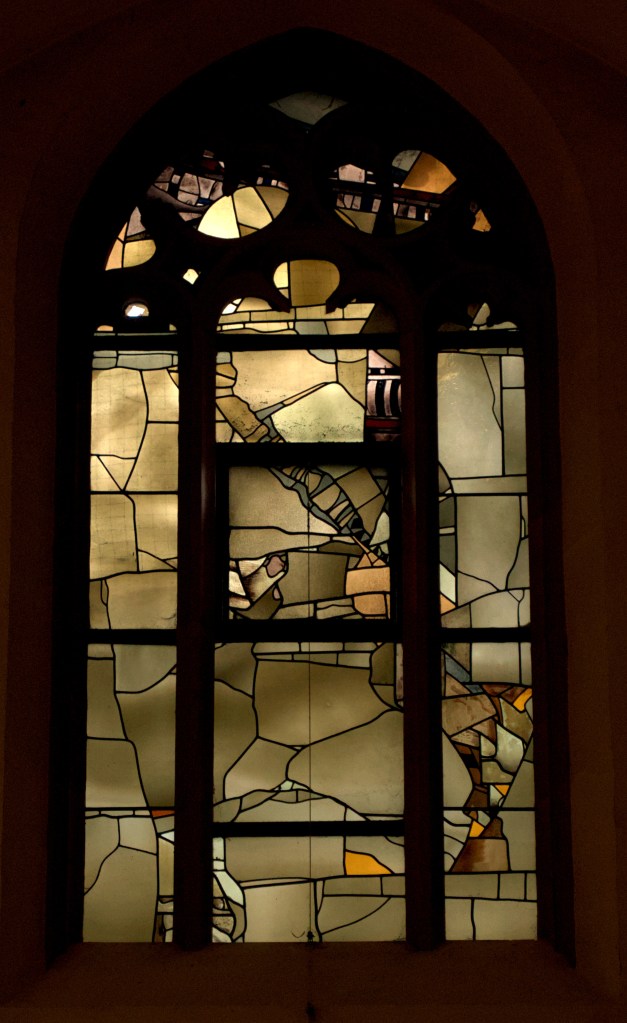
Nagel also created the eighteen stained glass windows along the two side aisles, the cathedral guide told me—in a similarly abstract style.
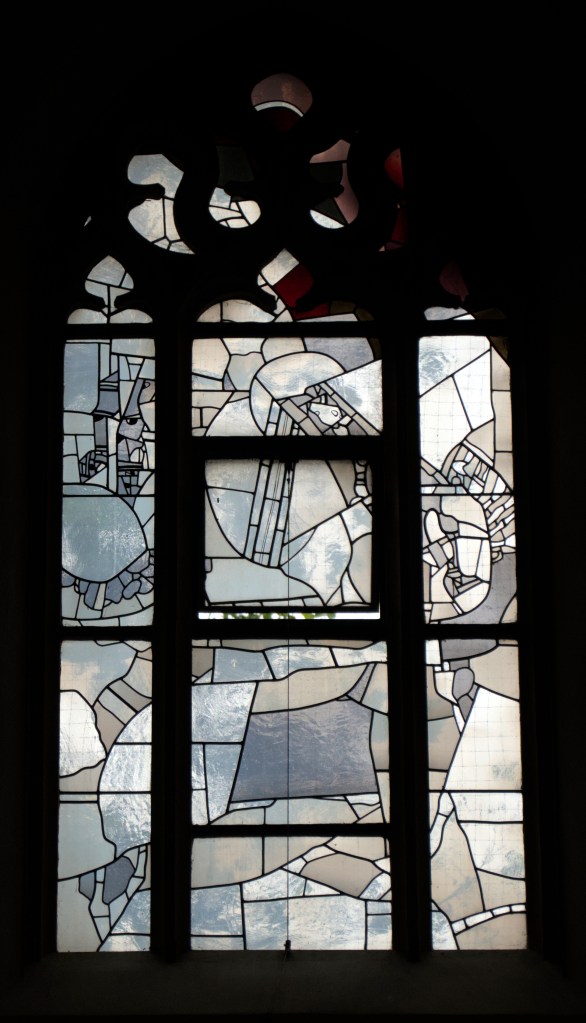
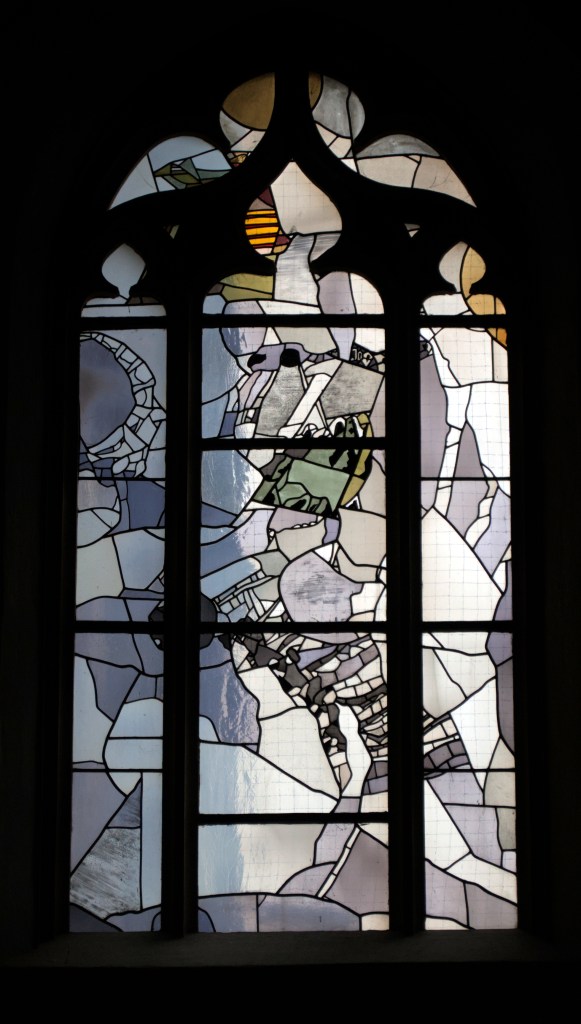
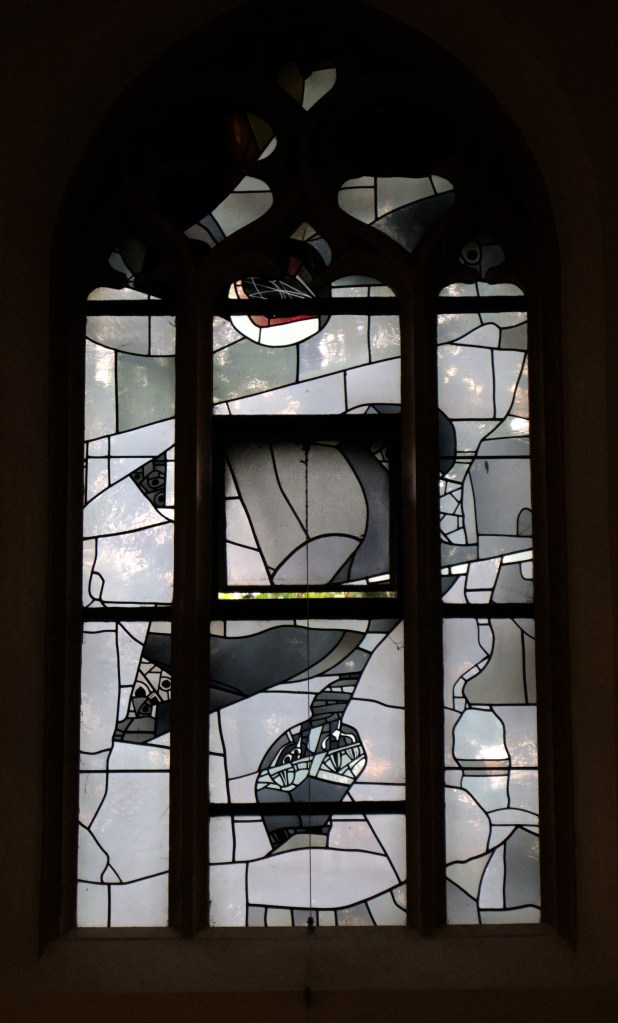
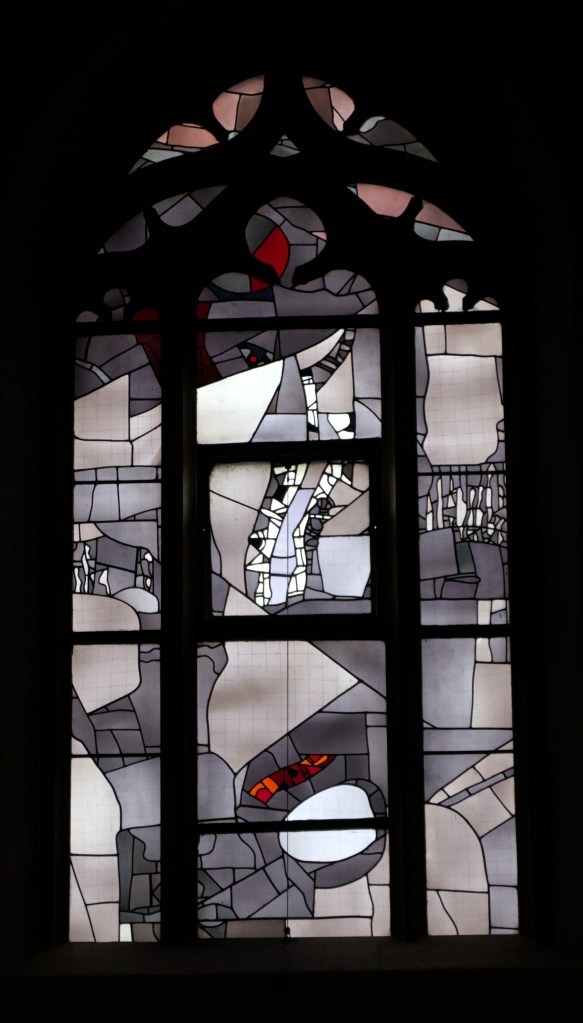
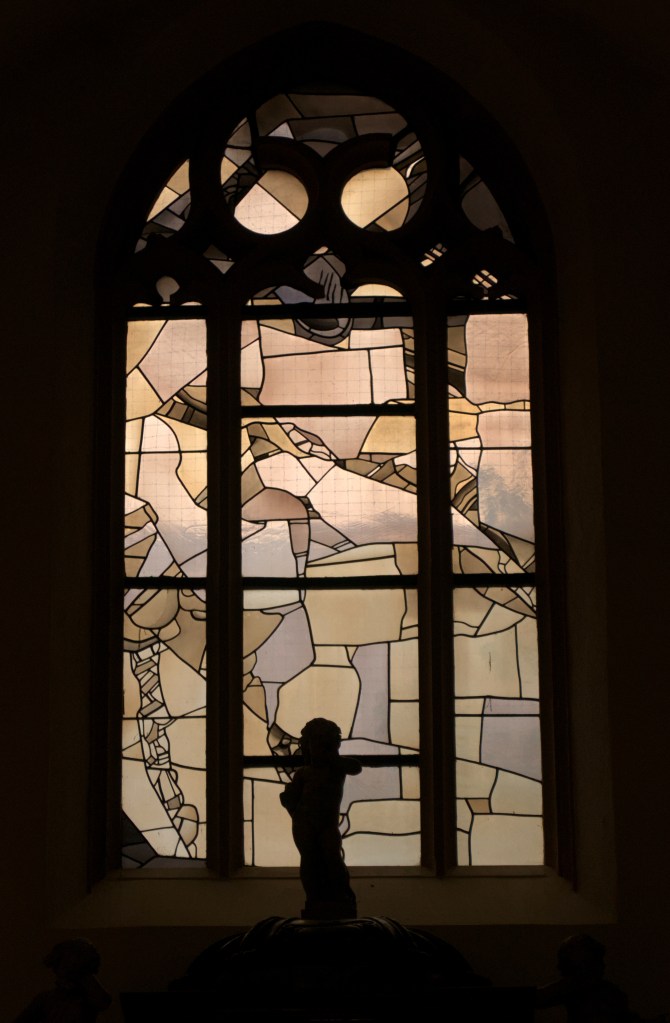
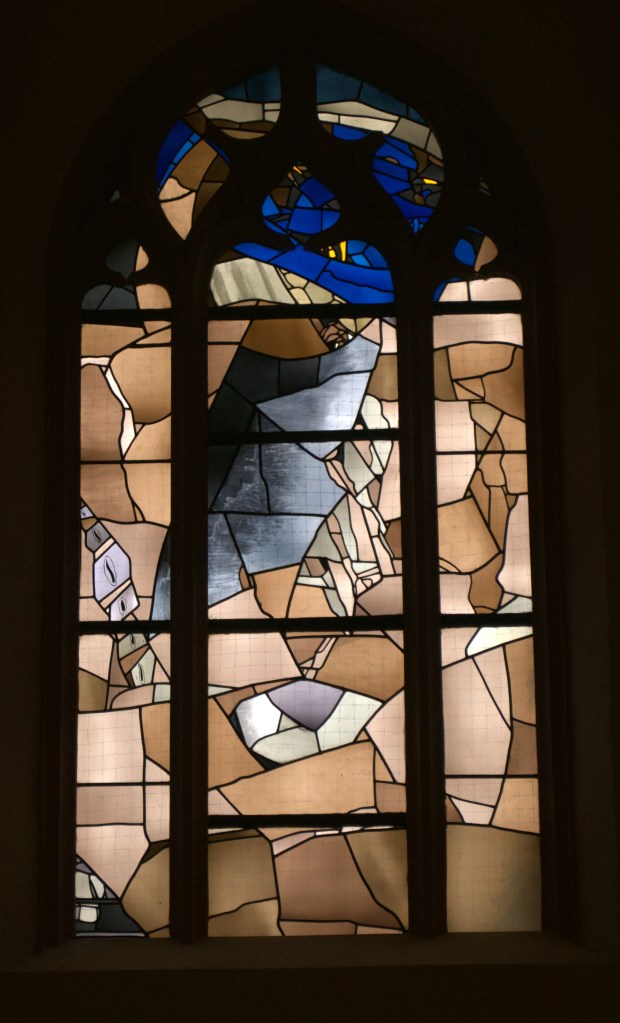
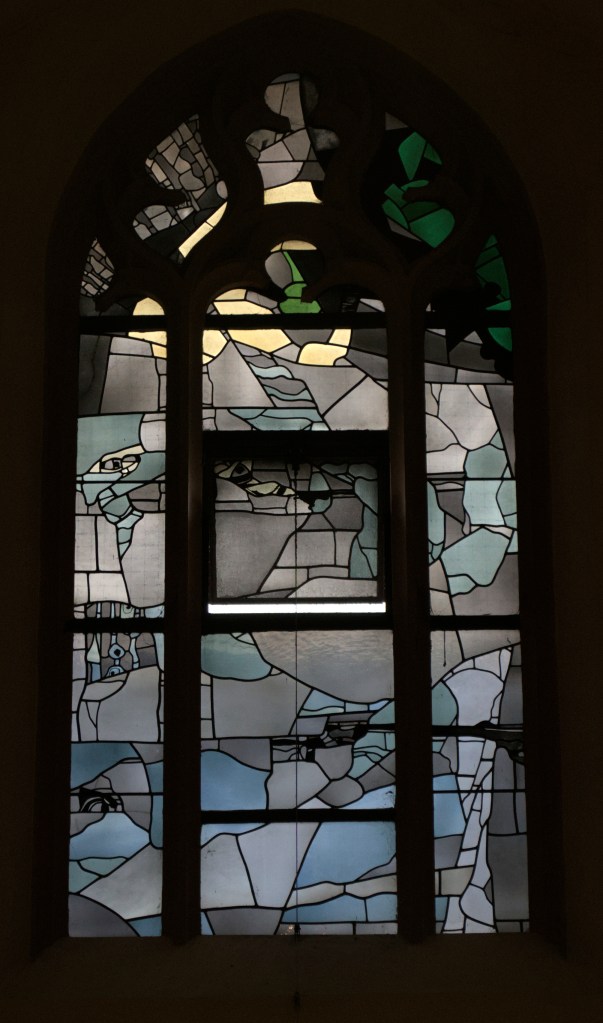
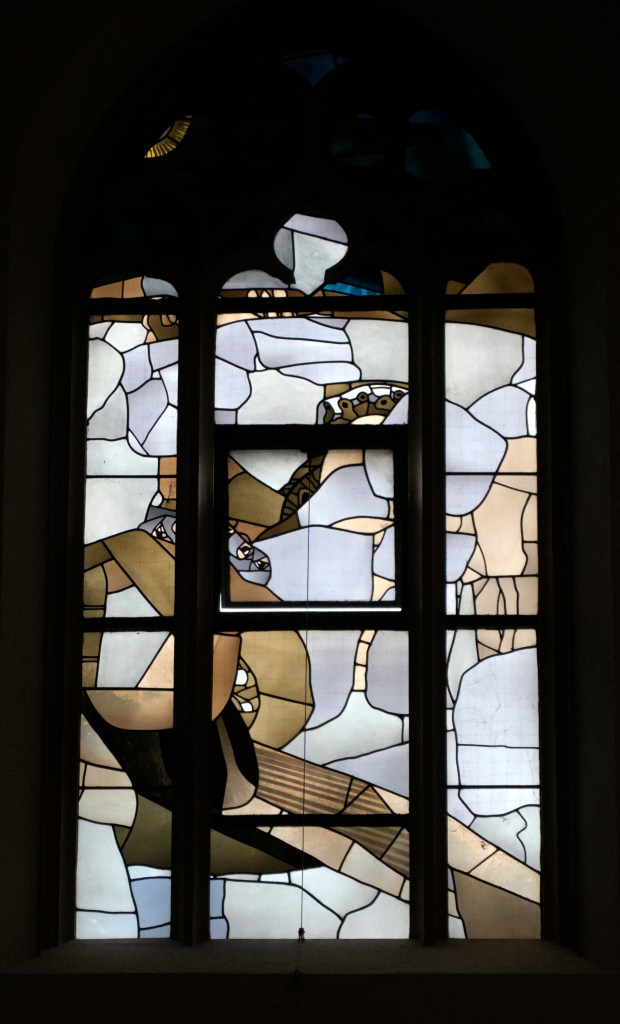
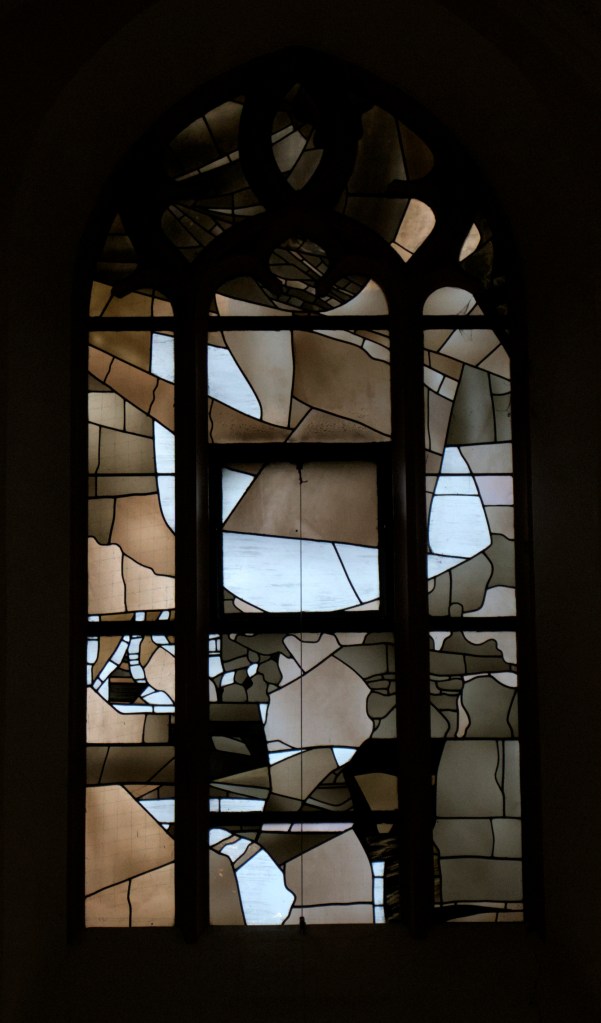
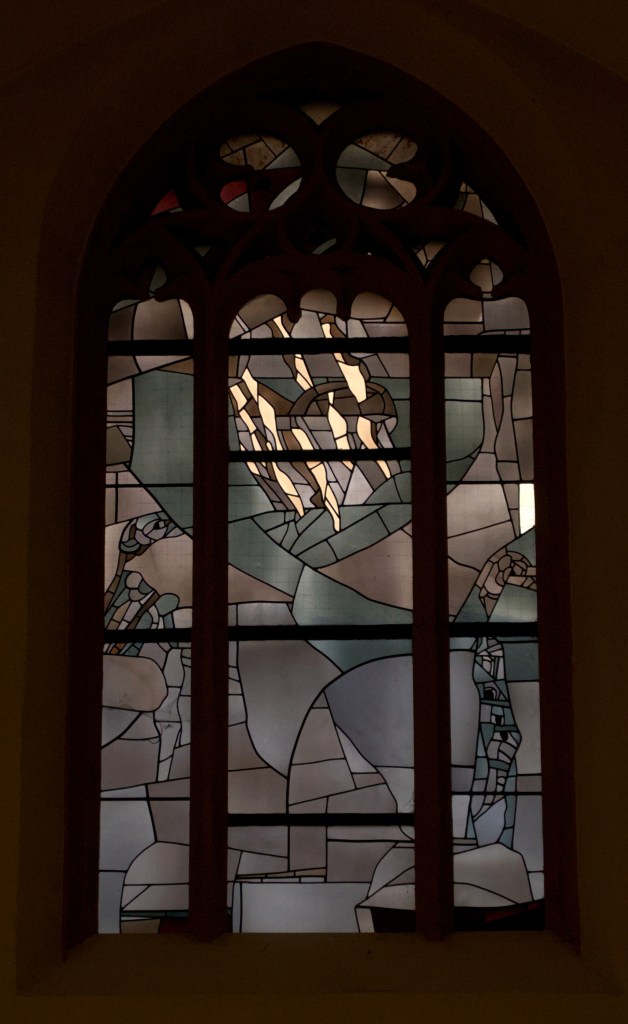
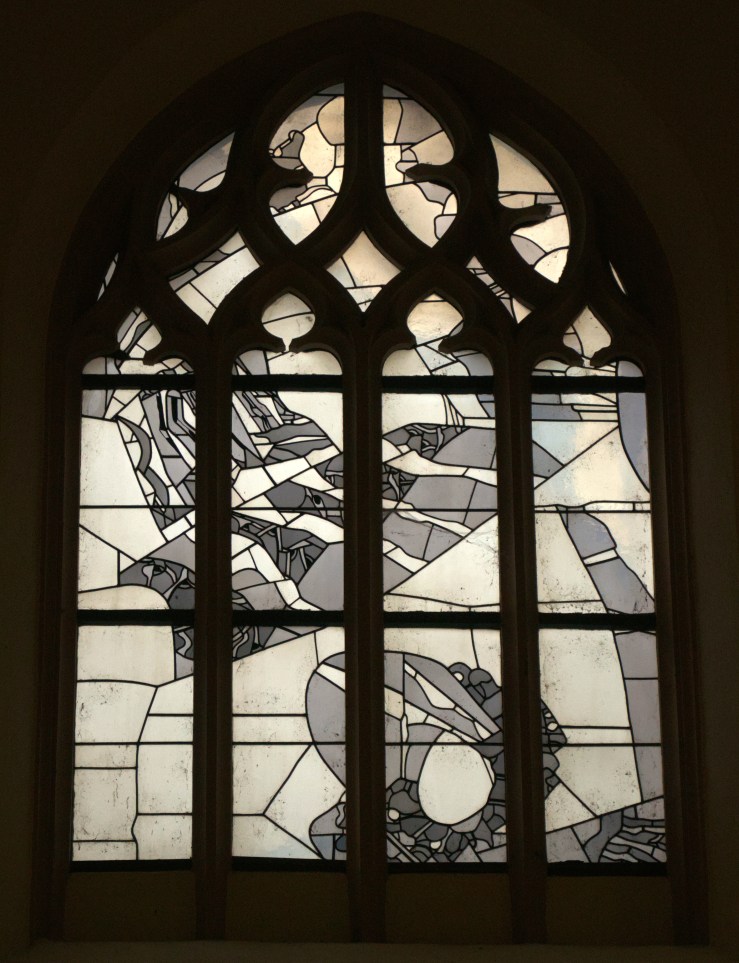
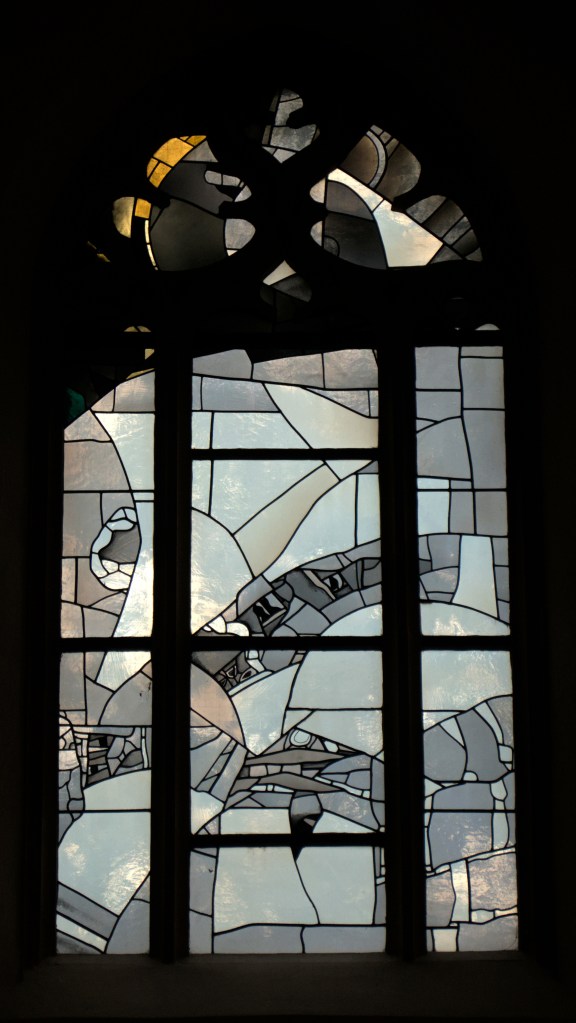
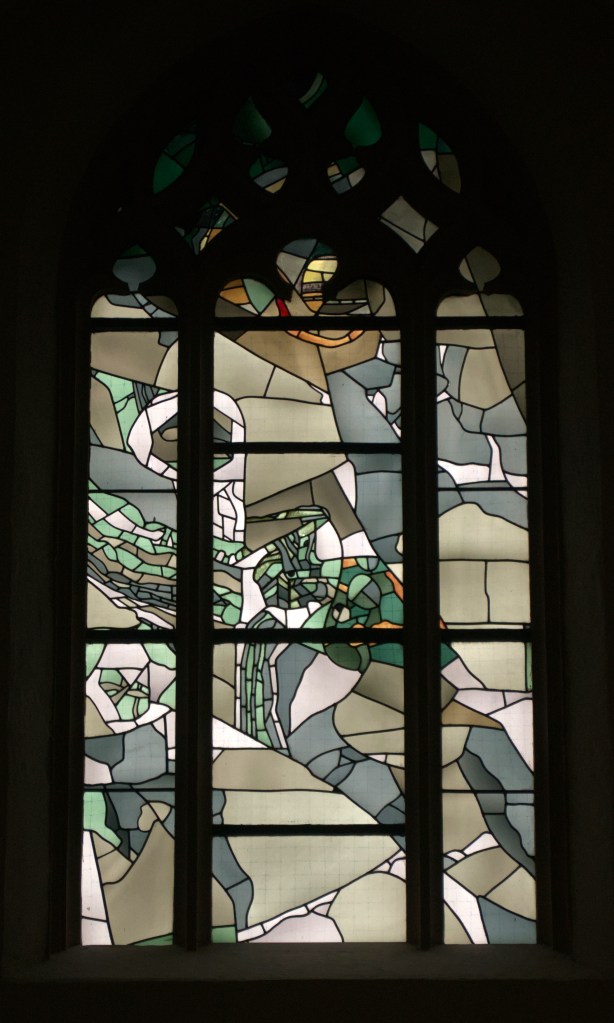
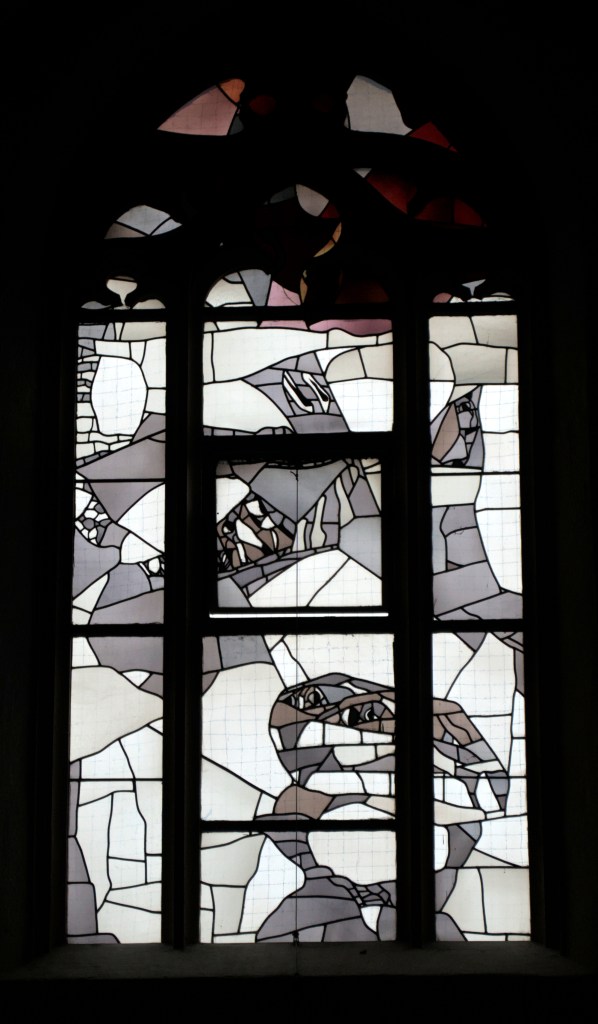
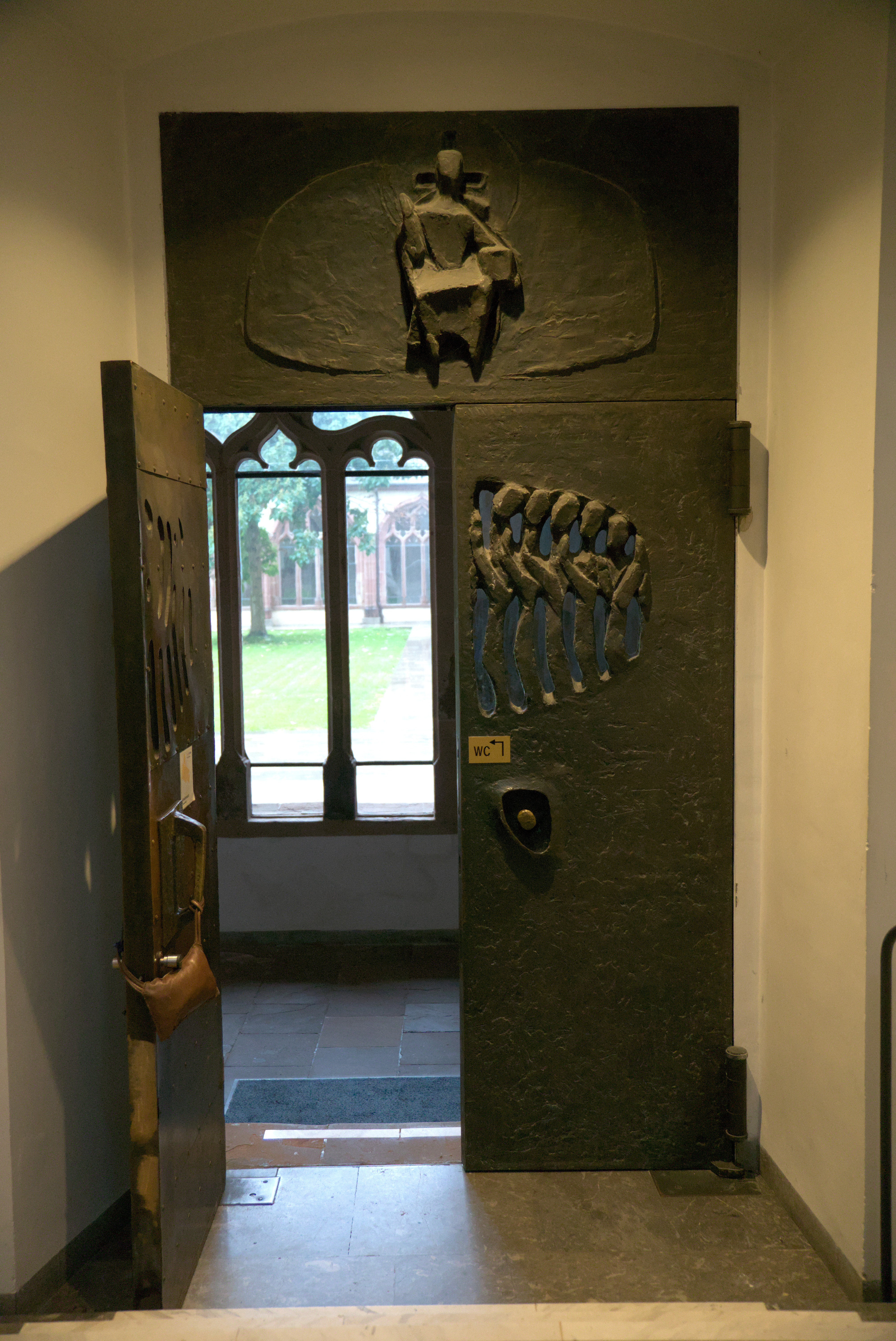
Heading out to cloister, I passed through a bronze door by Heinrich Söller depicting the parable of the wise and foolish virgins.
The cloister contains several contemporary sculptures, including a bronze by Maria Lehnen.
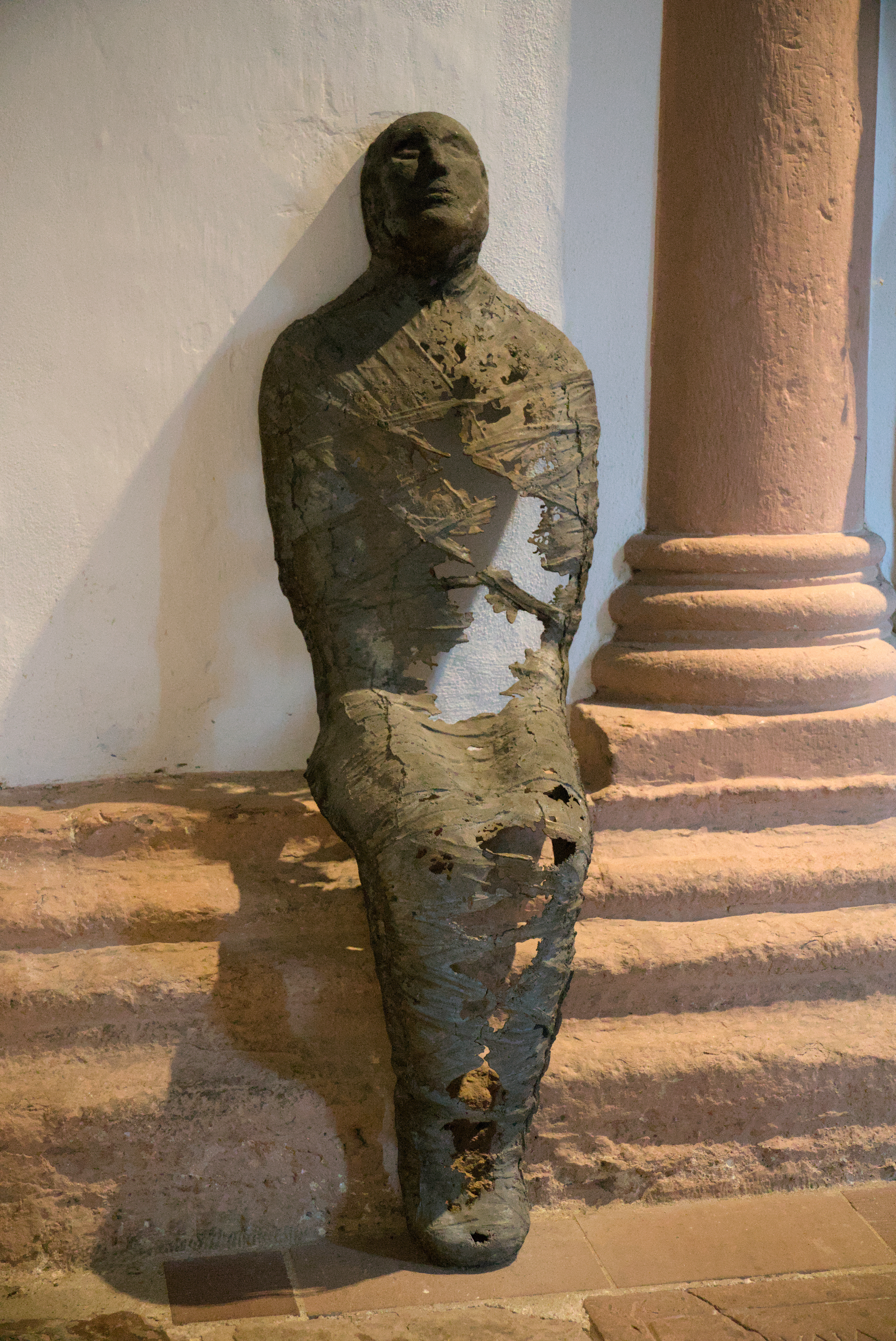
Many of Lehnen’s works depict a human figure tightly bound in linen, rope, or bandages but in a state of growth and becoming, alluding to the often arduous process of transformation. Dissolution is no different. It shows the old self inside a cocoon, breaking down to make way for the new. The man lifts his eyes to the hills, whence cometh his help, his life. (I’ve seen photos of a similar sculpture by Lehnen from 2004, Großer Sitzender [Large Seated Man], aka Der Gefesselte [The Bound Man], seated on the steps outside the cathedral, but it wasn’t there when I was.)
Another striking work in the cloister is Andreas Kuhnlein’s oakwood Risen Christ.
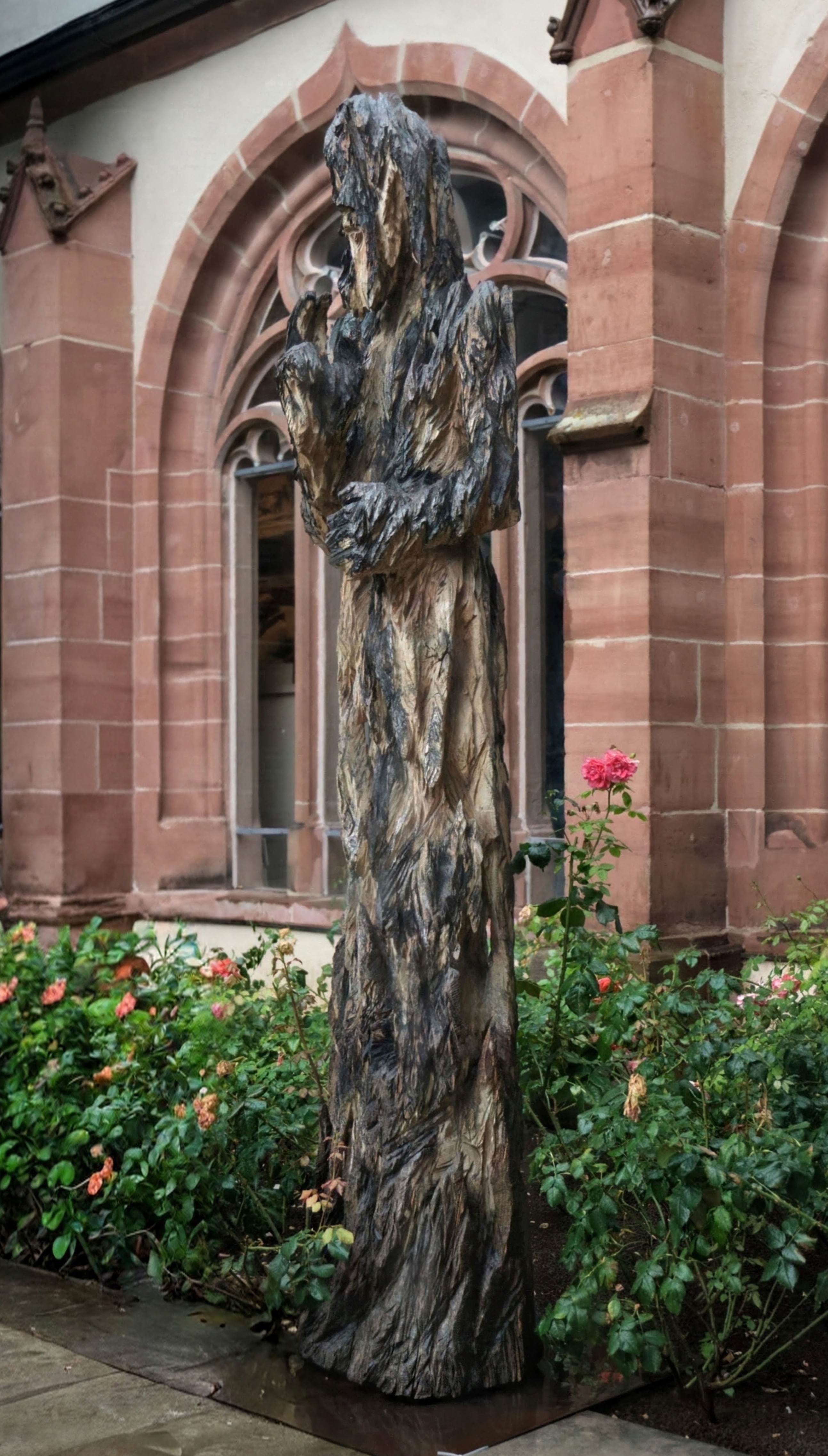
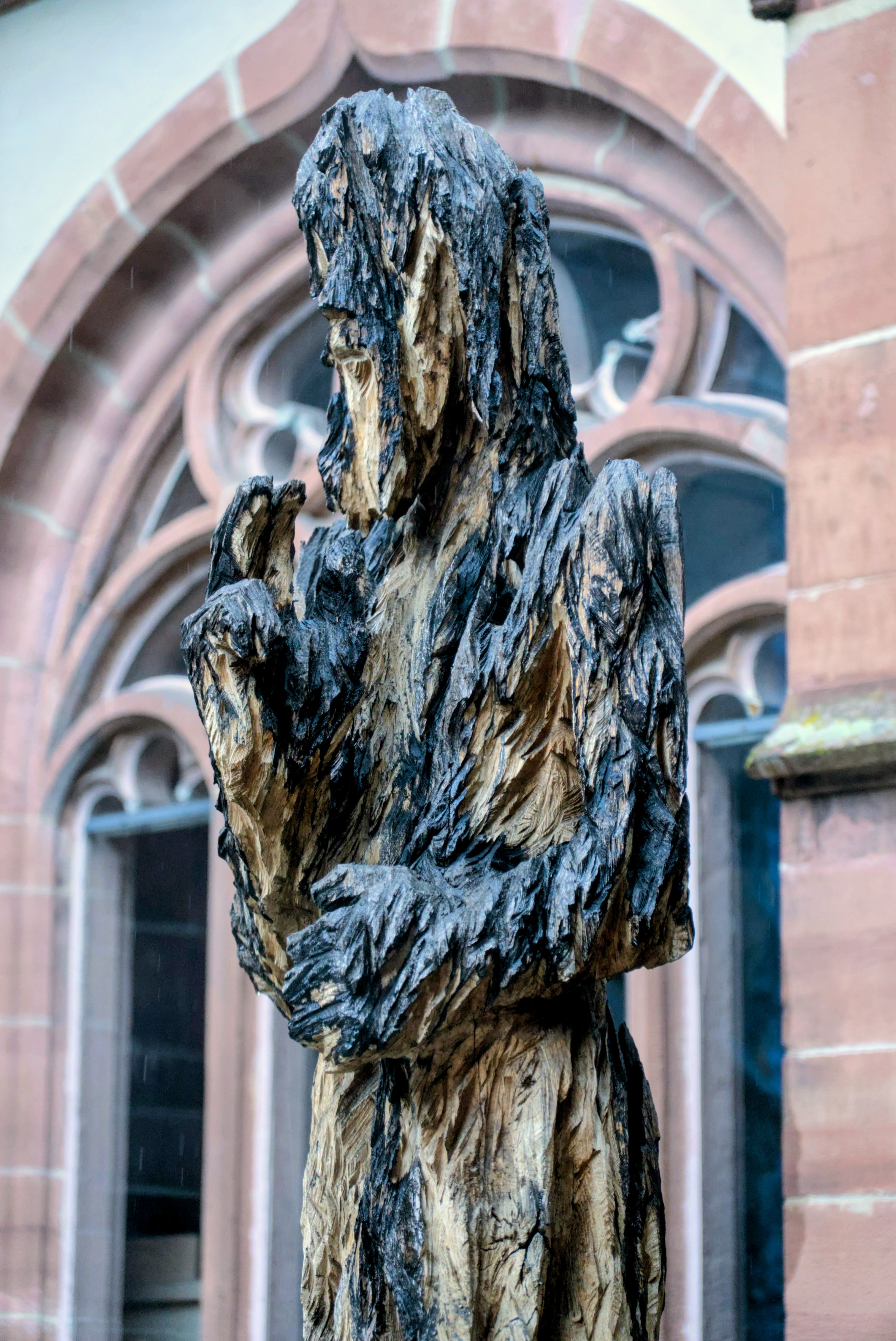
Kuhnlein uses a chainsaw to create rugged, life-size, figurative sculptures from uprooted, decaying trees, bringing the dead trunks to “life” by highlighting the protrusions, cuts, fractures, or grain patterns in the hardwood. At the blessing ceremony for the redesigned cloister in 2014, Bishop Dr. Friedhelm Hofmann said that the rough-hewn Risen Christ, bearing scorch marks from Kuhnlein’s aggressive motorized slicing, reminds him of the burning bush in which God revealed himself to Moses.
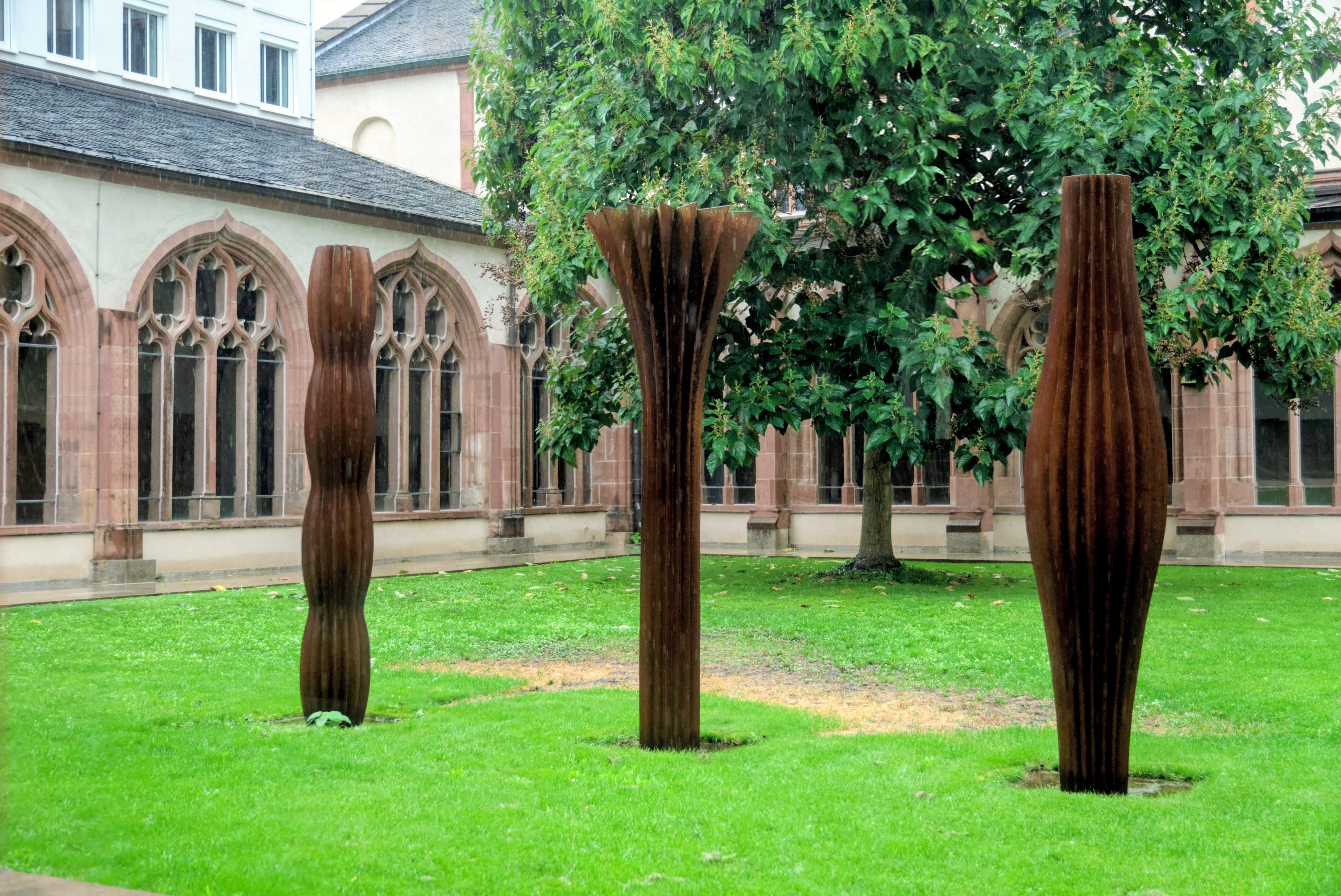
In the center of the courtyard (which, from what I could tell, does not admit entry) is a trio of biomorphic forms in Corten steel.
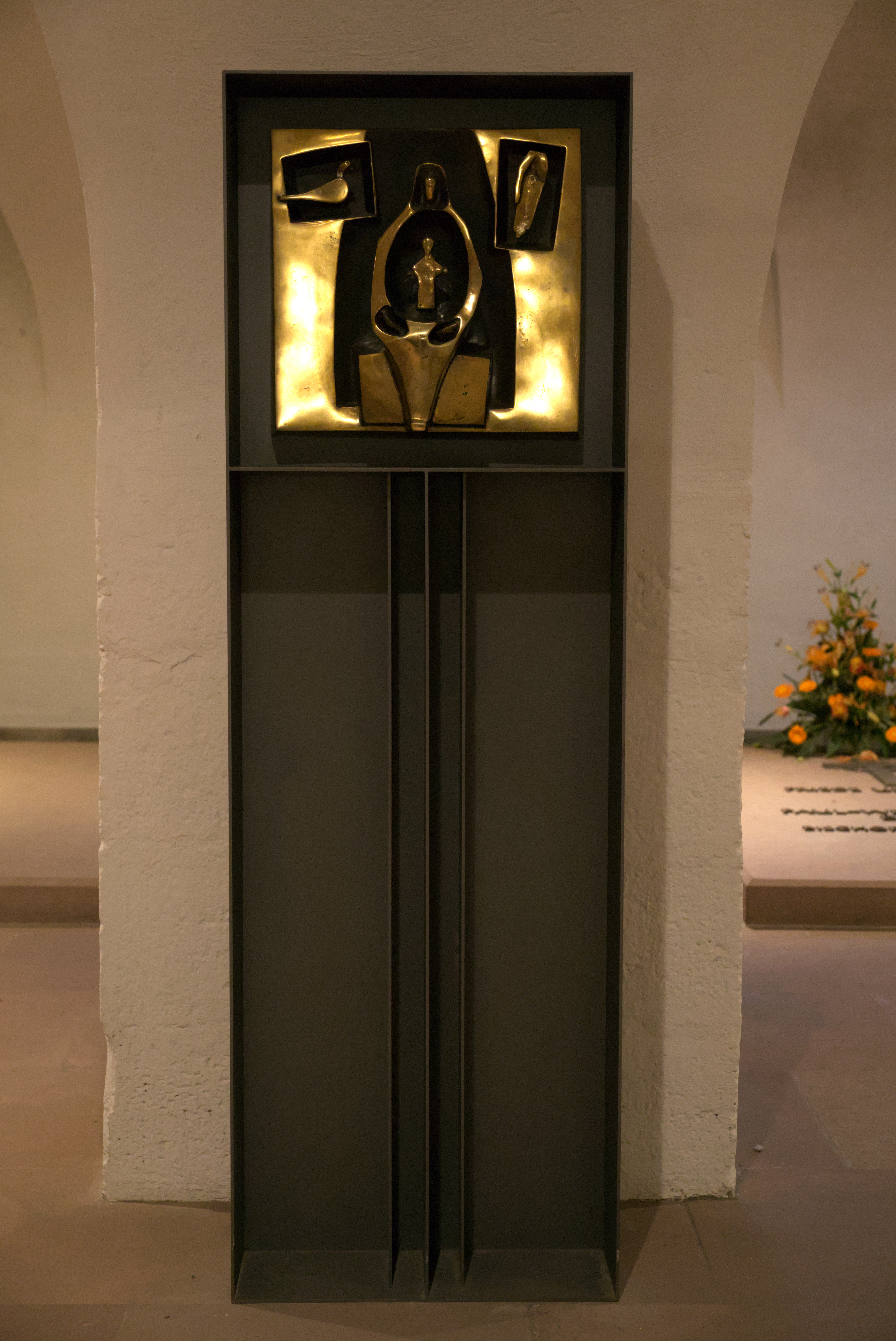
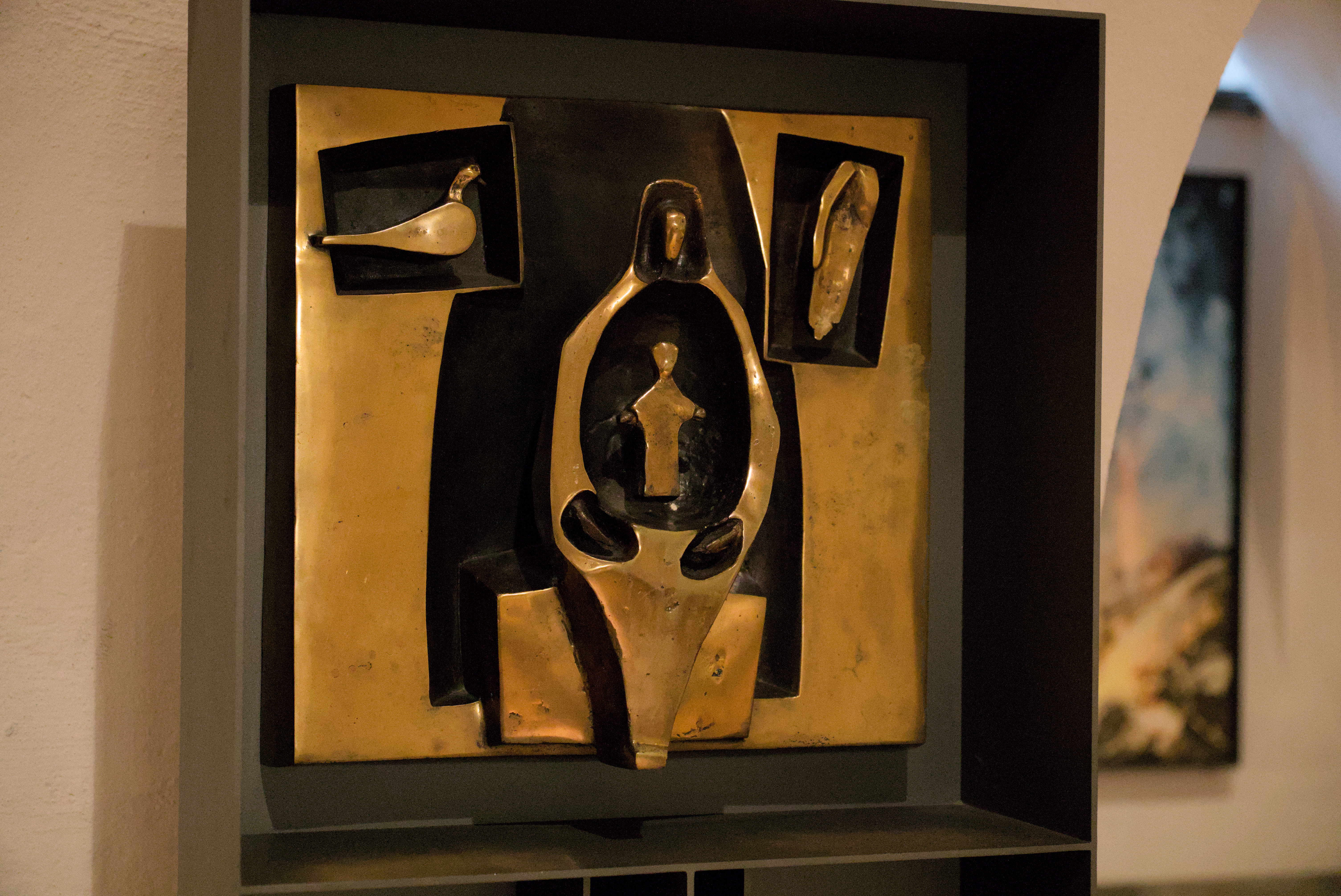
The final section of the cathedral that I visited was the crypt below, divided into four rooms. In one side room there’s a small, square bronze relief of the Trinity, elevated in a simple, black wooden structure: the Father represented as a benevolent hand reaching down from the heavens; the Son as the incarnate Word, the infant Christ, seated in the lap of the woman who bore him into the world, and from whom he took his flesh; and the Holy Spirit as a dove.
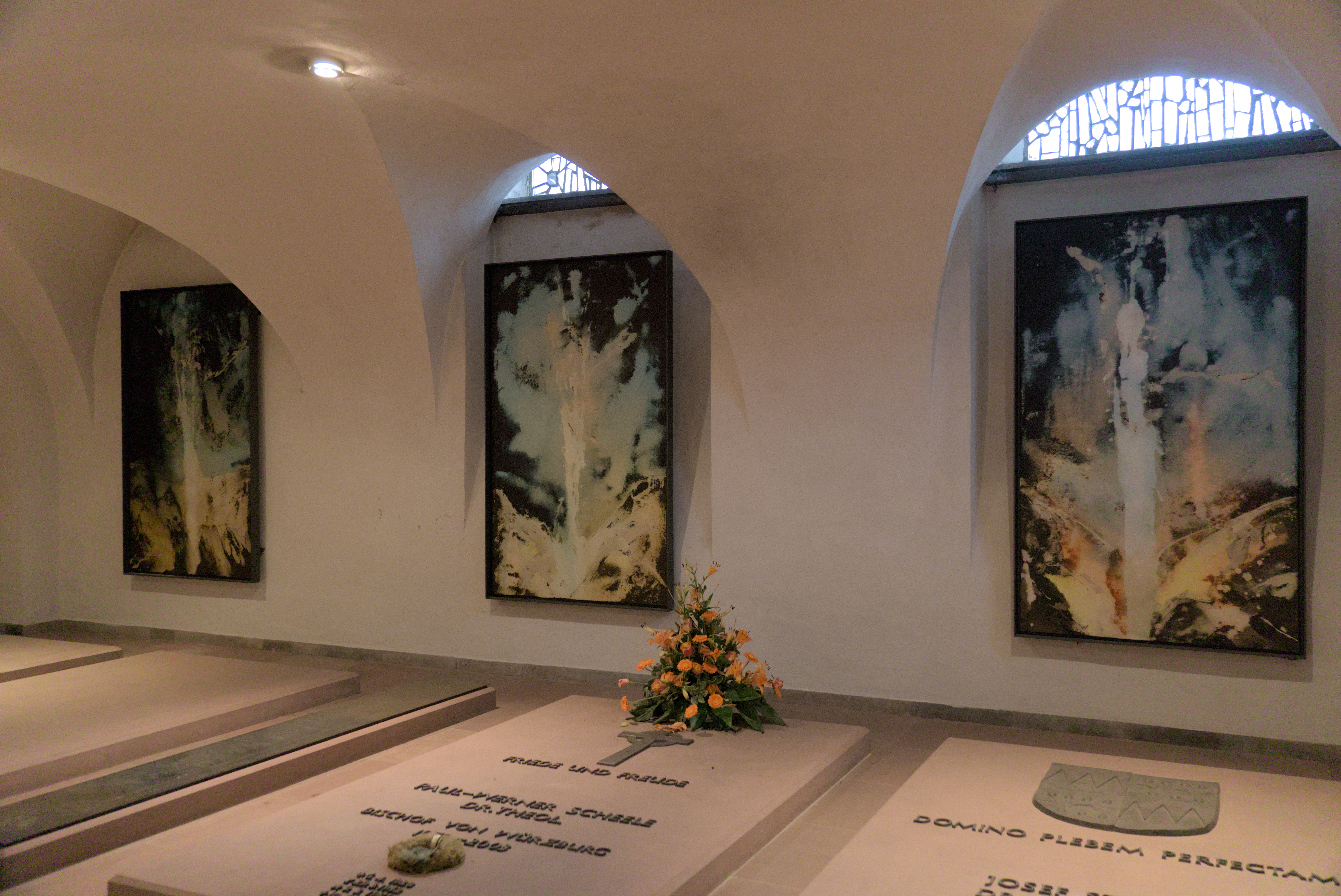
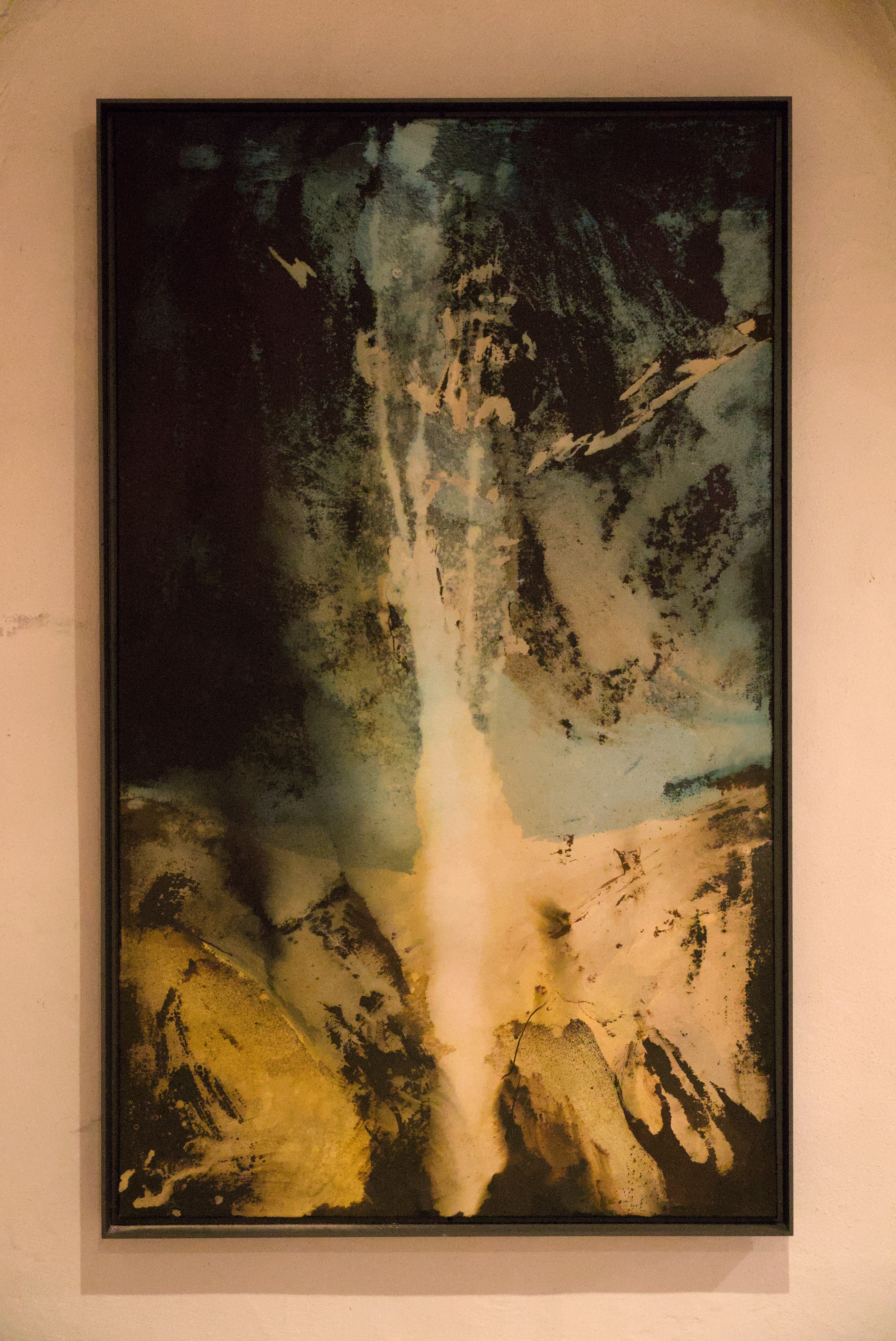
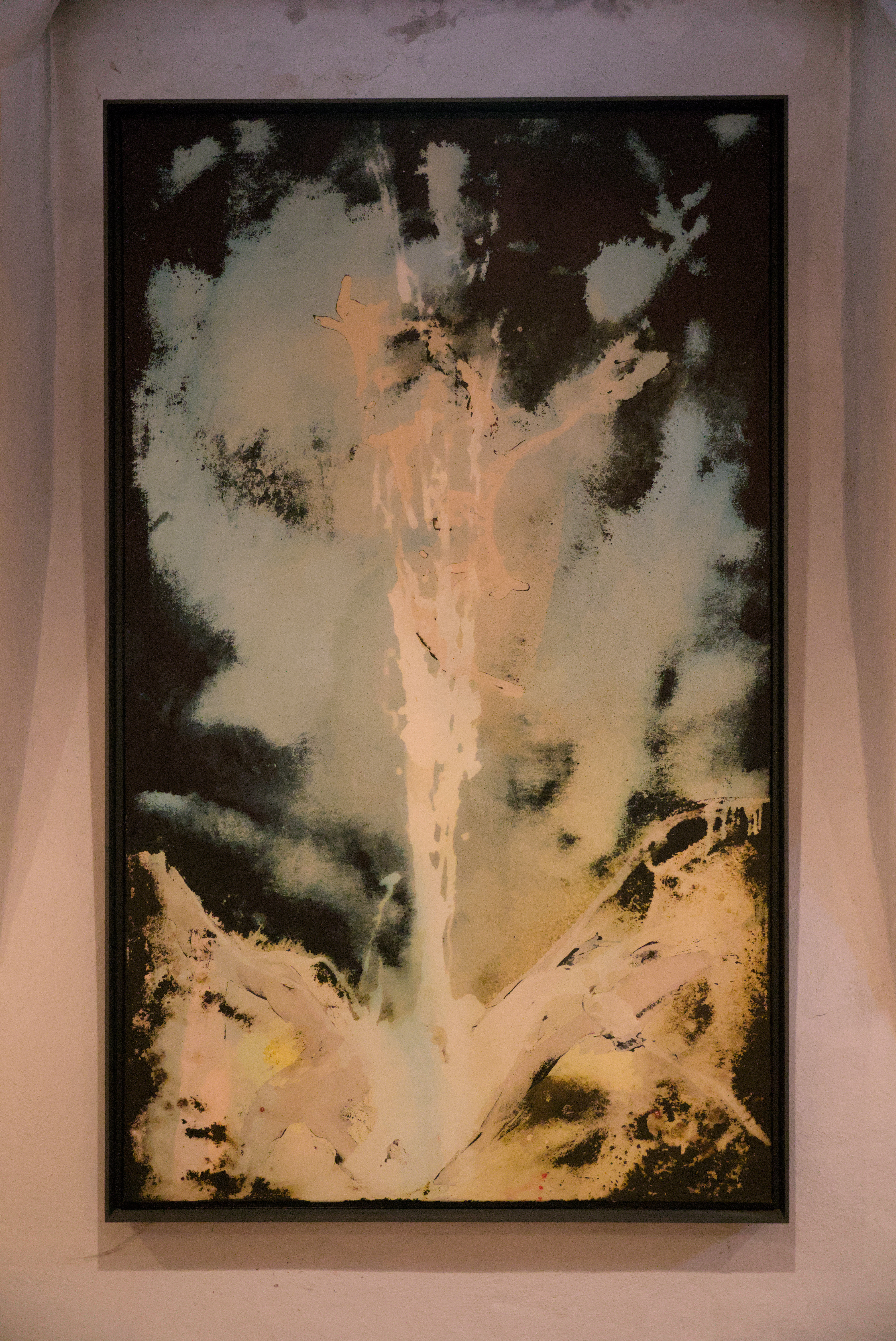
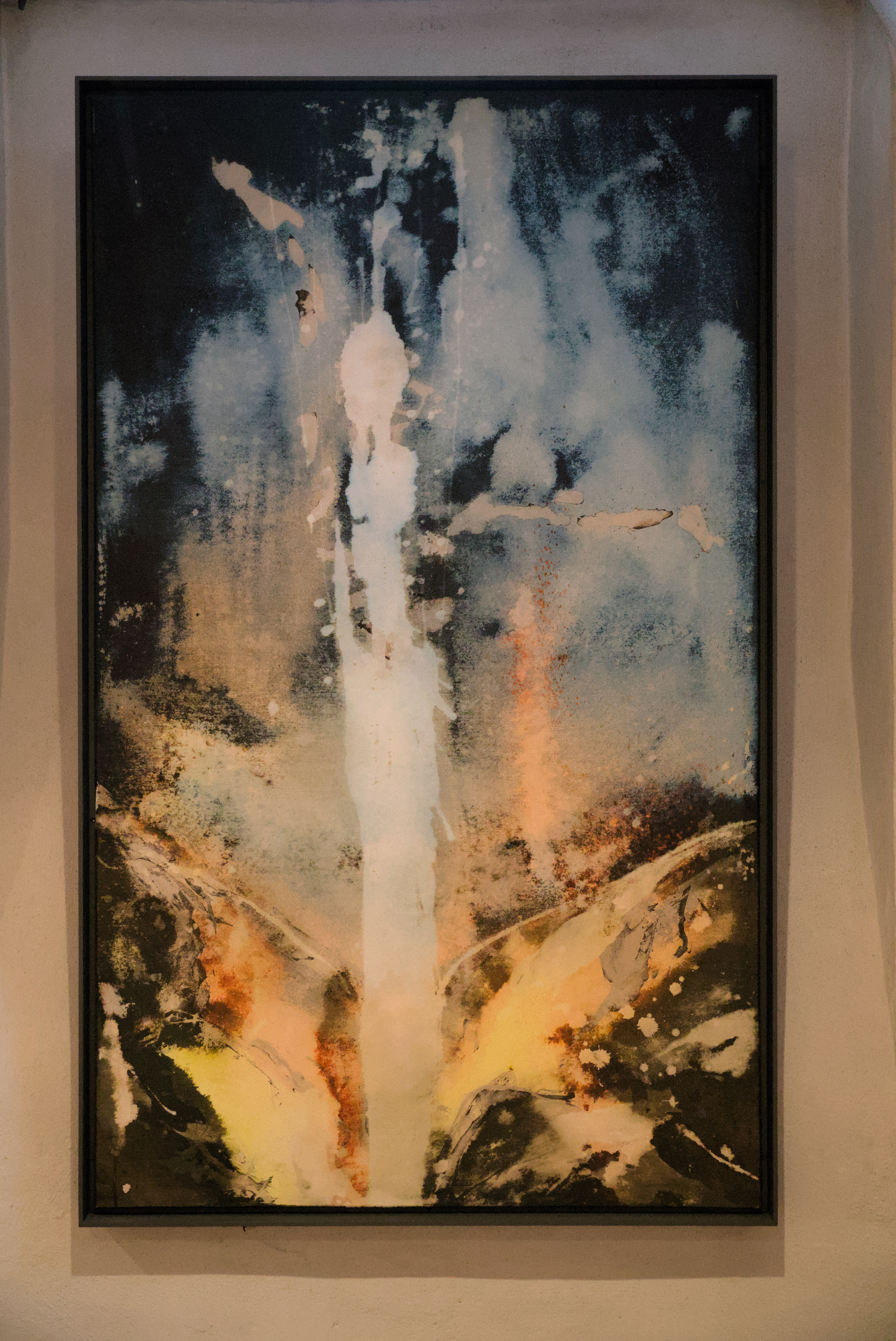
Against the wall are three large gestural paintings—inks on canvas—by Jacques Gassmann, on the theme of resurrection. In each, a pillar of light bursts up out of the ground, pushing aside the darkness.
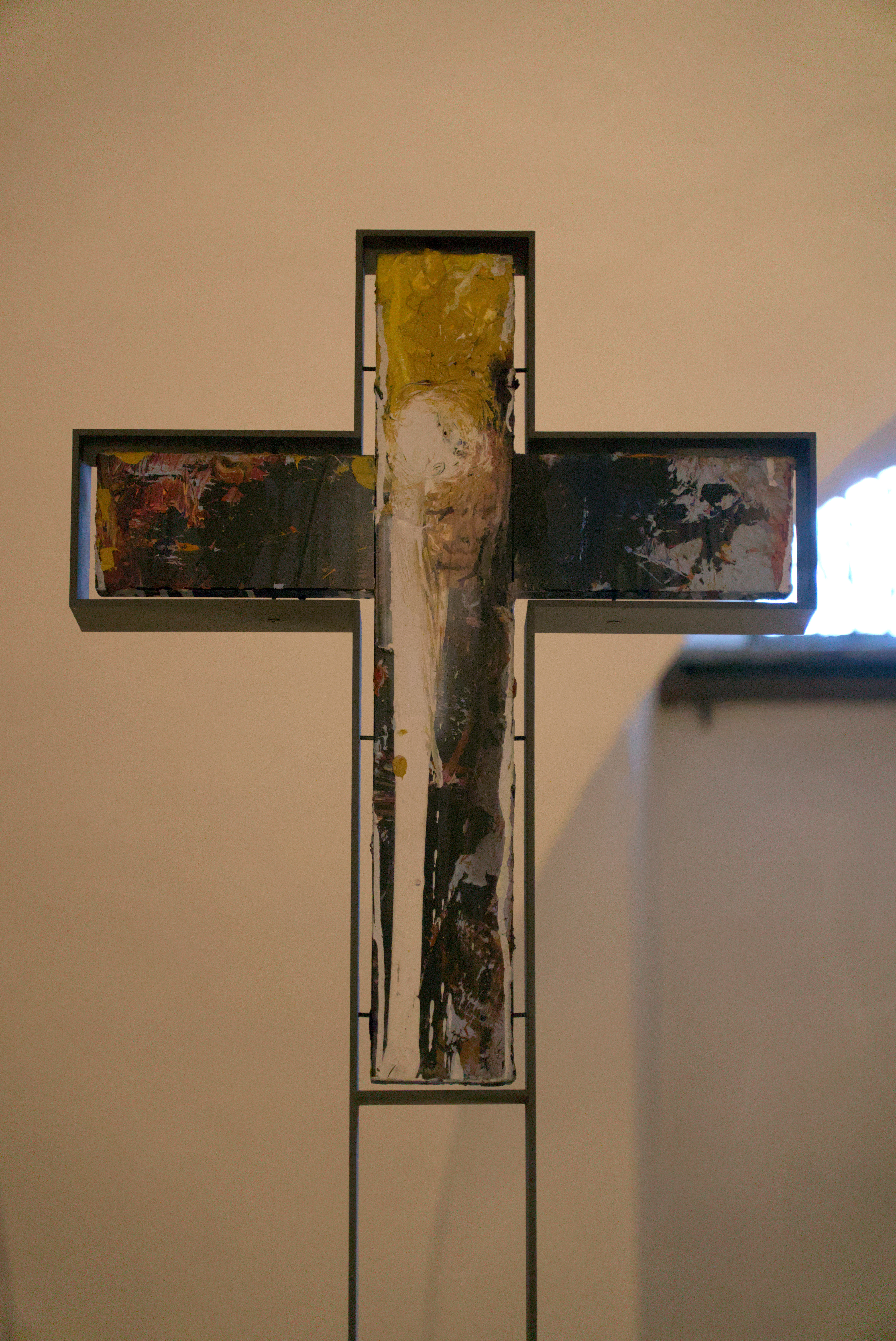
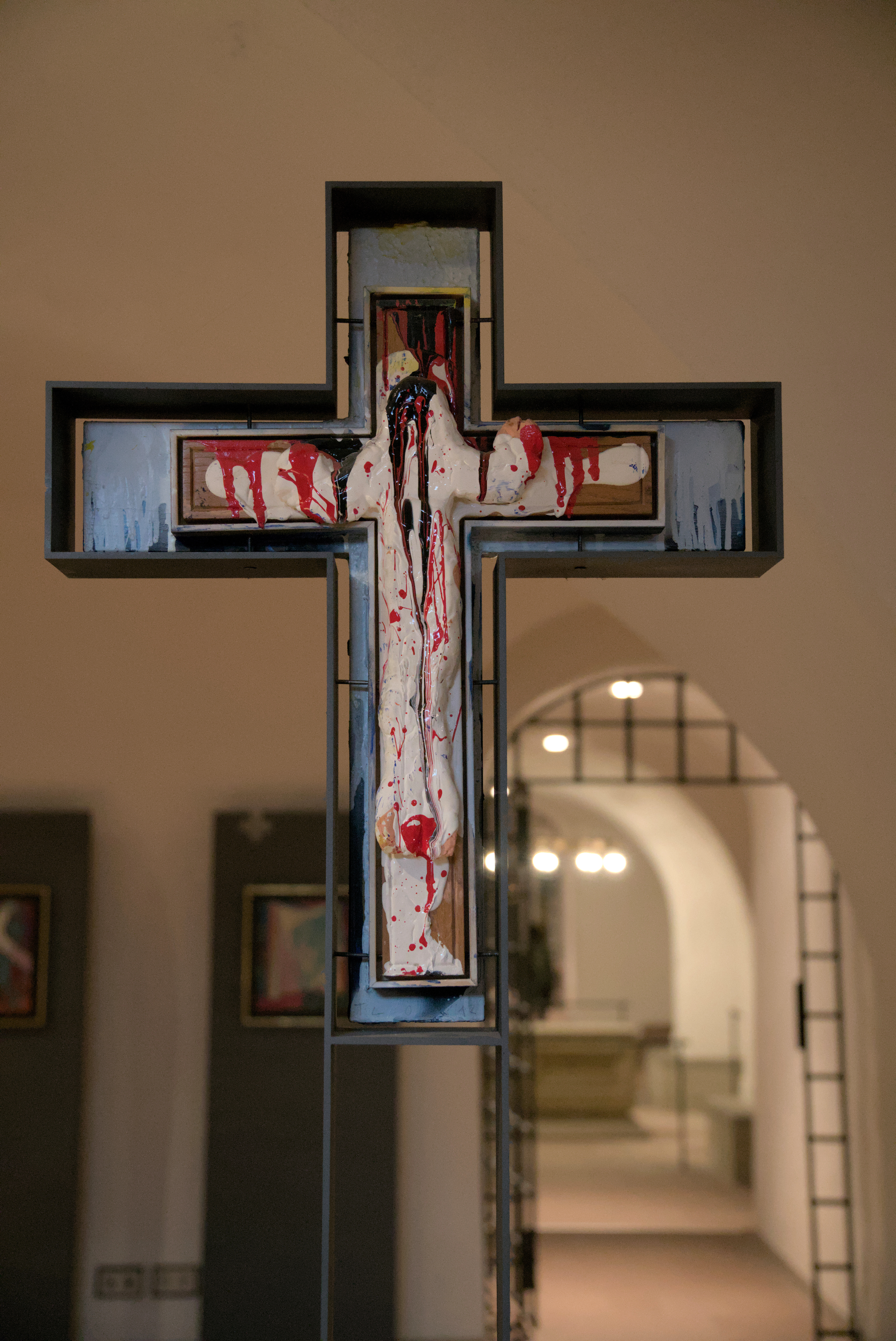
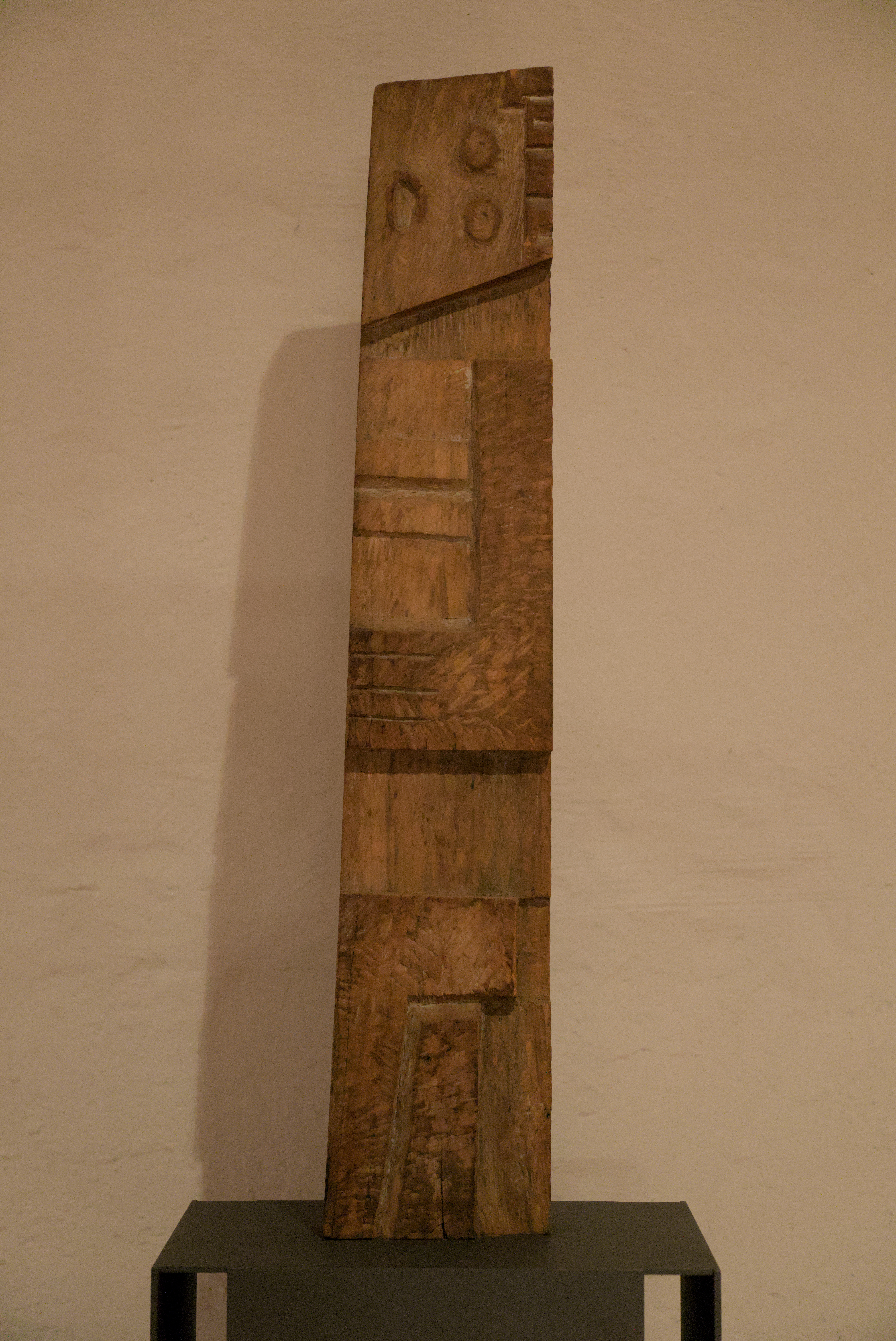
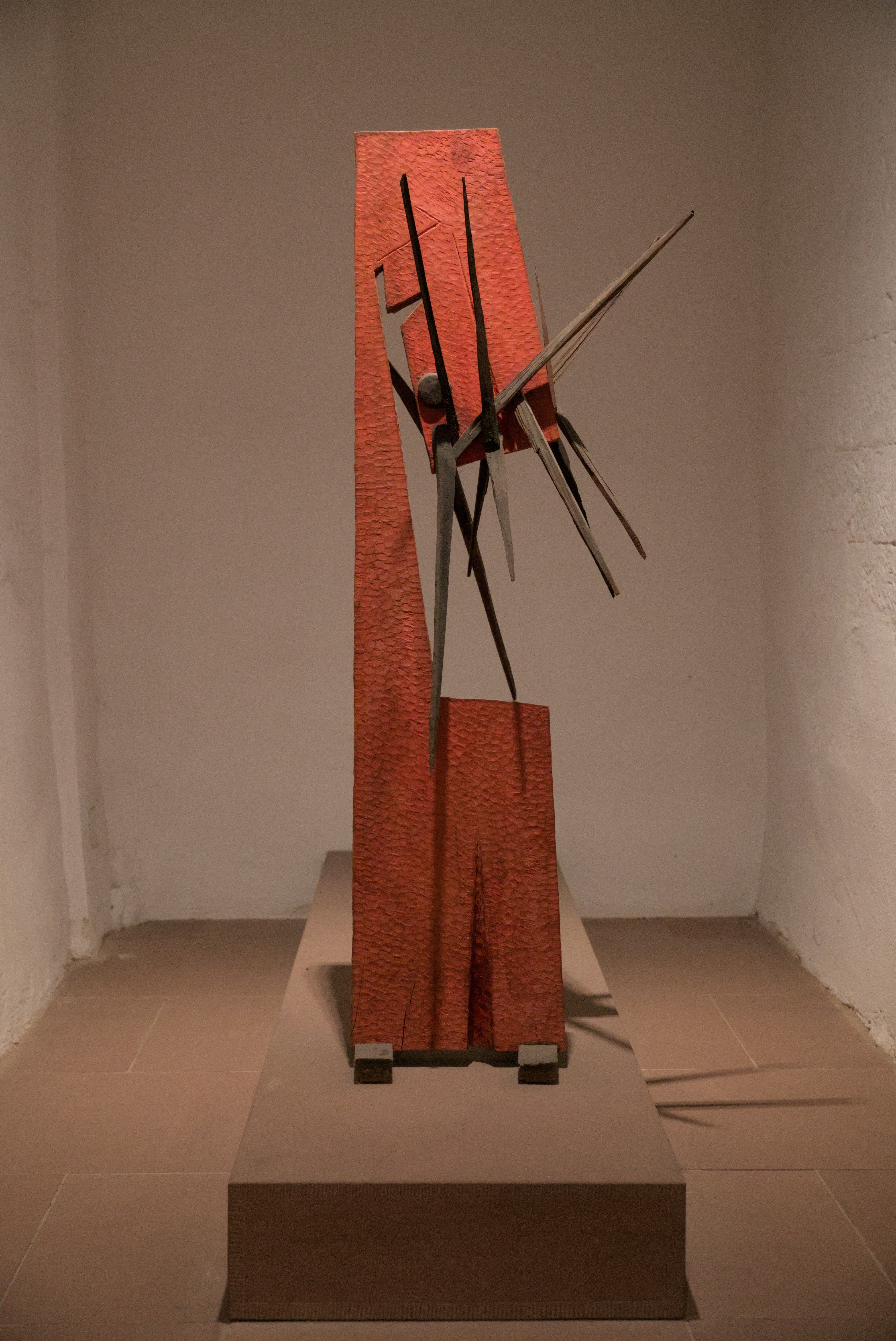
The other side room contains a set of Stations of the Cross paintings by Karl Clobes, plus a double-sided stand cross and a Picasso-esque wooden column carved with the likeness of Christ as the Man of Sorrows.
In a niche just outside is another Man of Sorrows sculpture by the same artist, this one in steel. Christ’s form is abstract and distorted. He bows his head, pierced by enormous thorns, at an impossible angle.
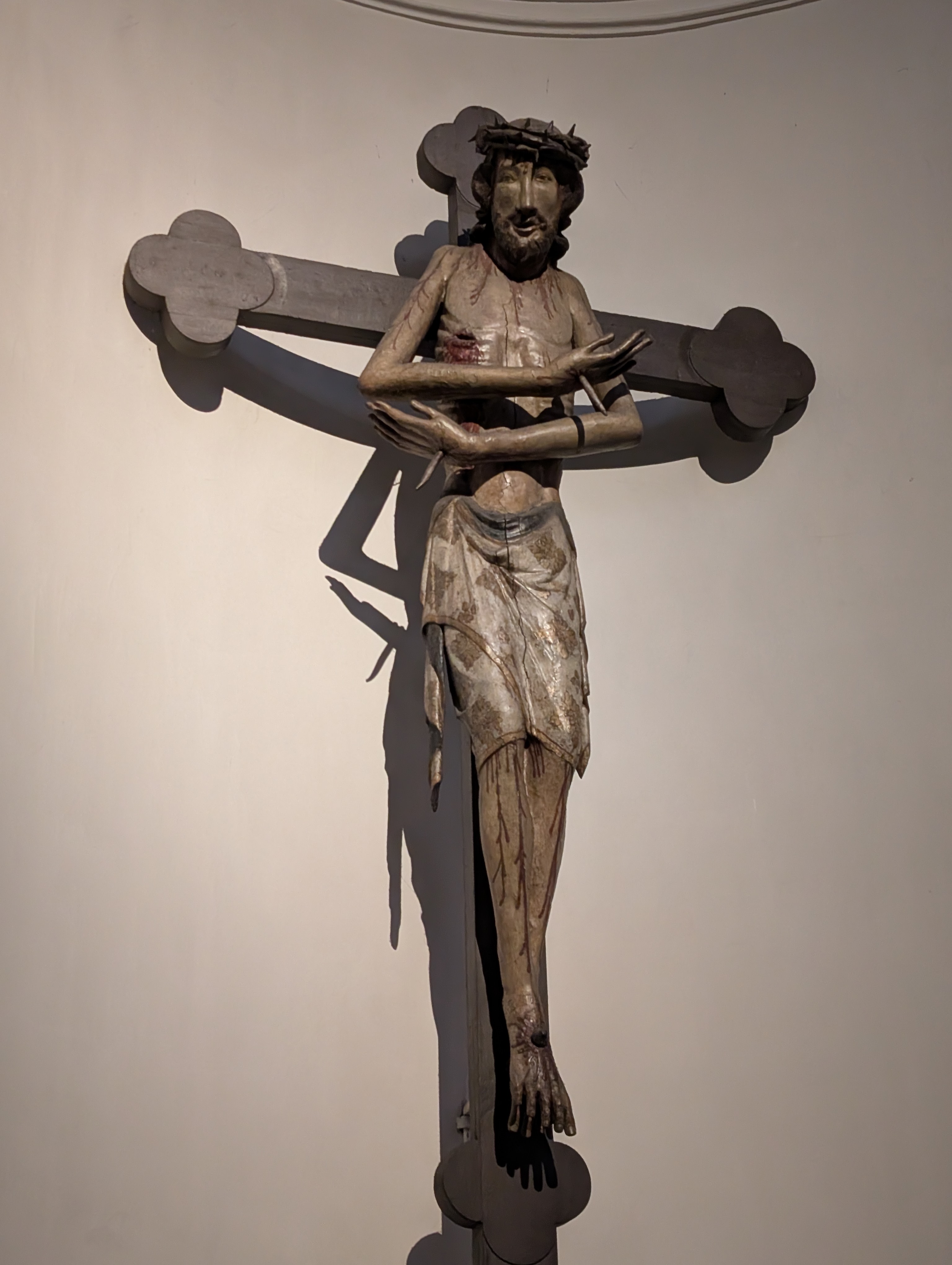
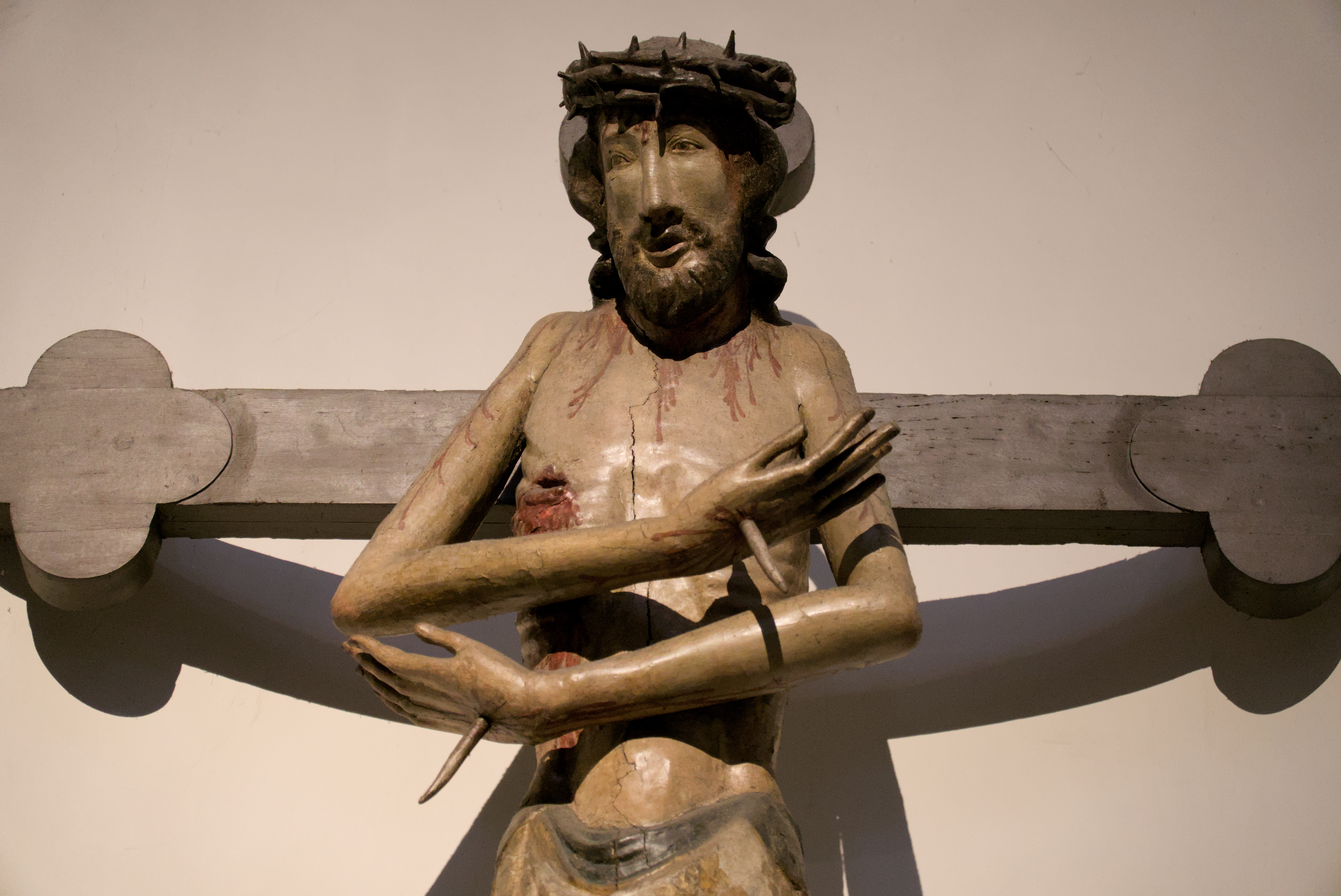
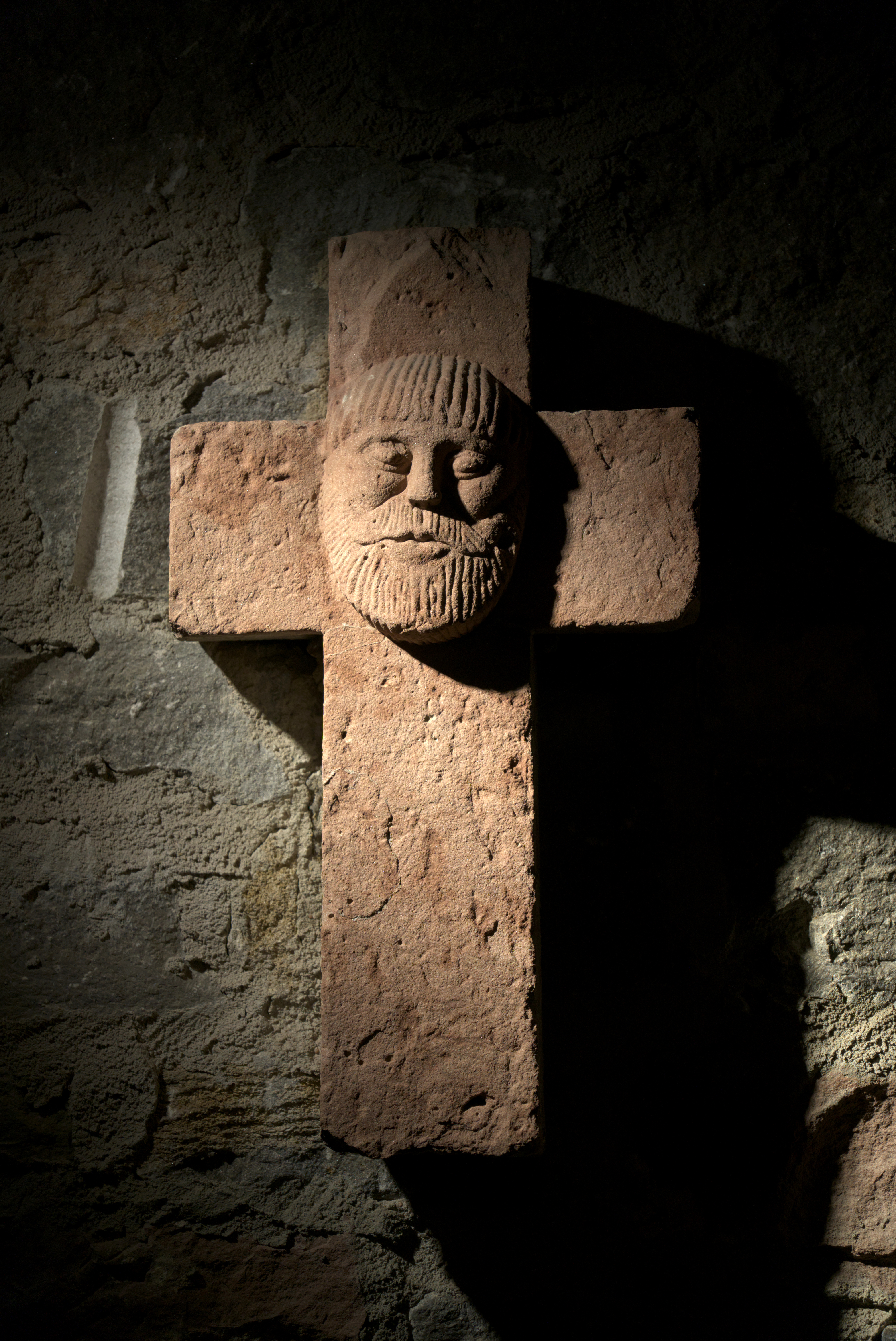
The western crypt contains the oldest artwork in the cathedral: a stone cross with a head of Christ in the center, wearing, the brochure interprets, a faint smile. It was previously supposed to be Merovingian or Carolingian, but more recent studies date it later to around the year 1000, making it Ottonian.
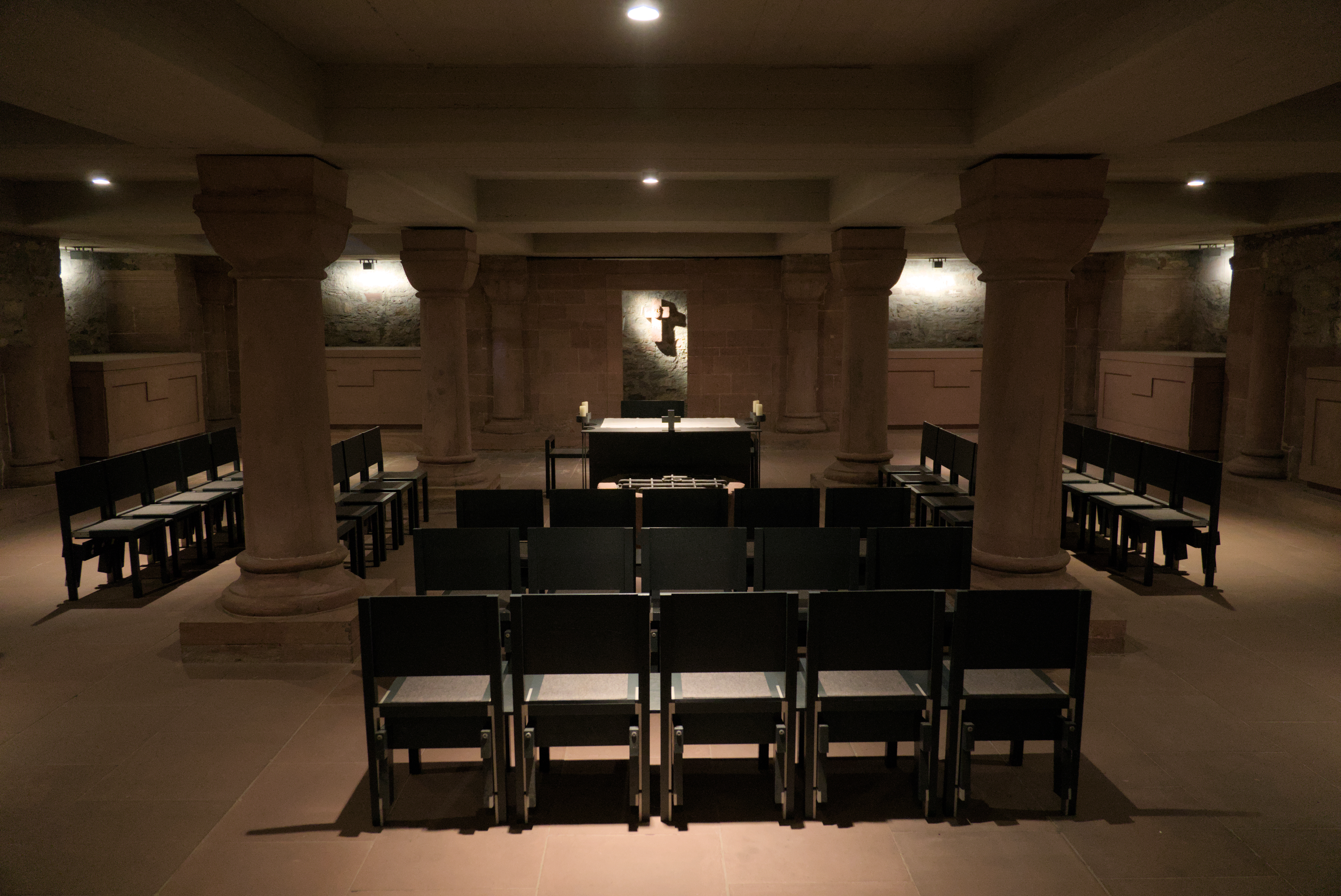
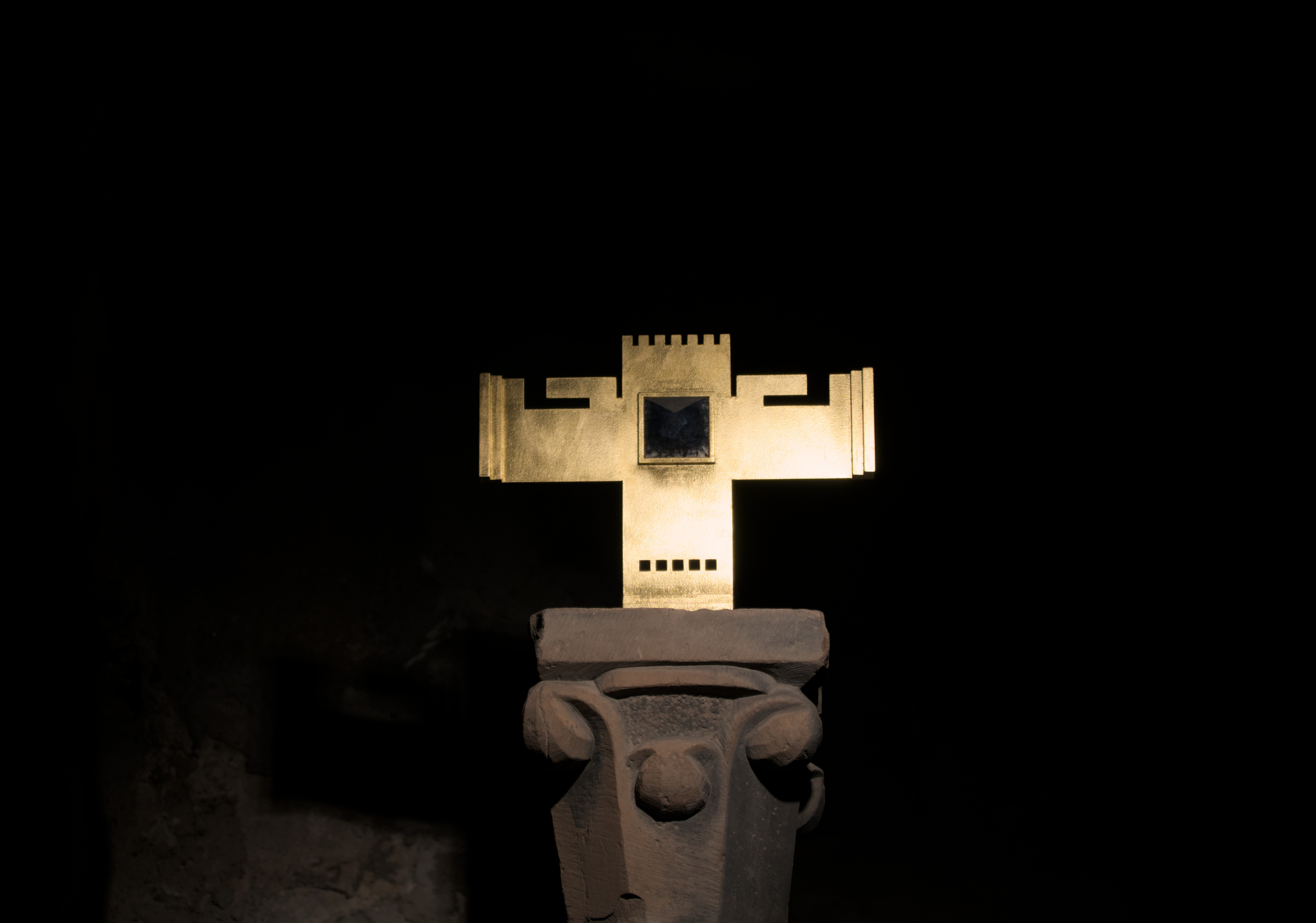
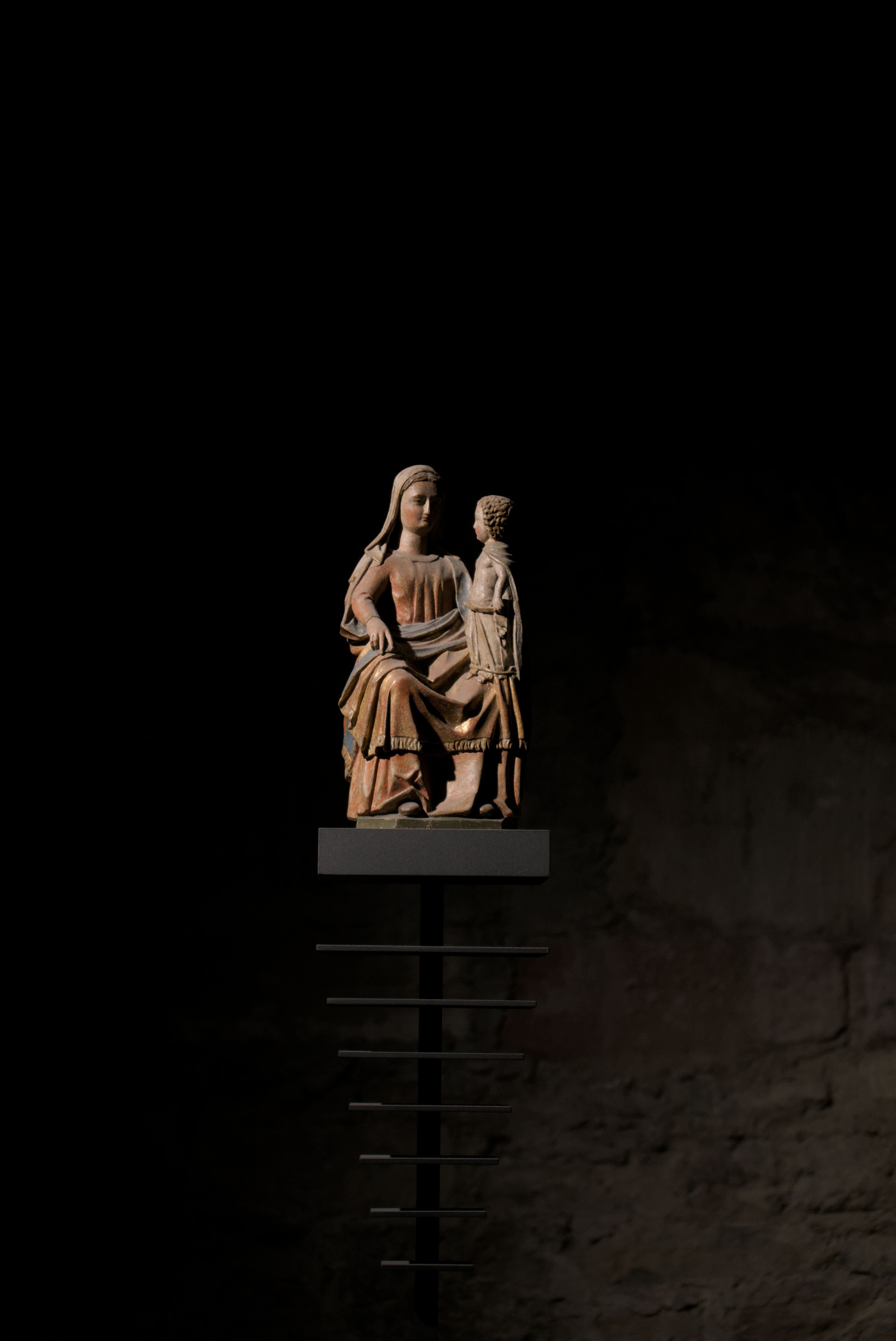
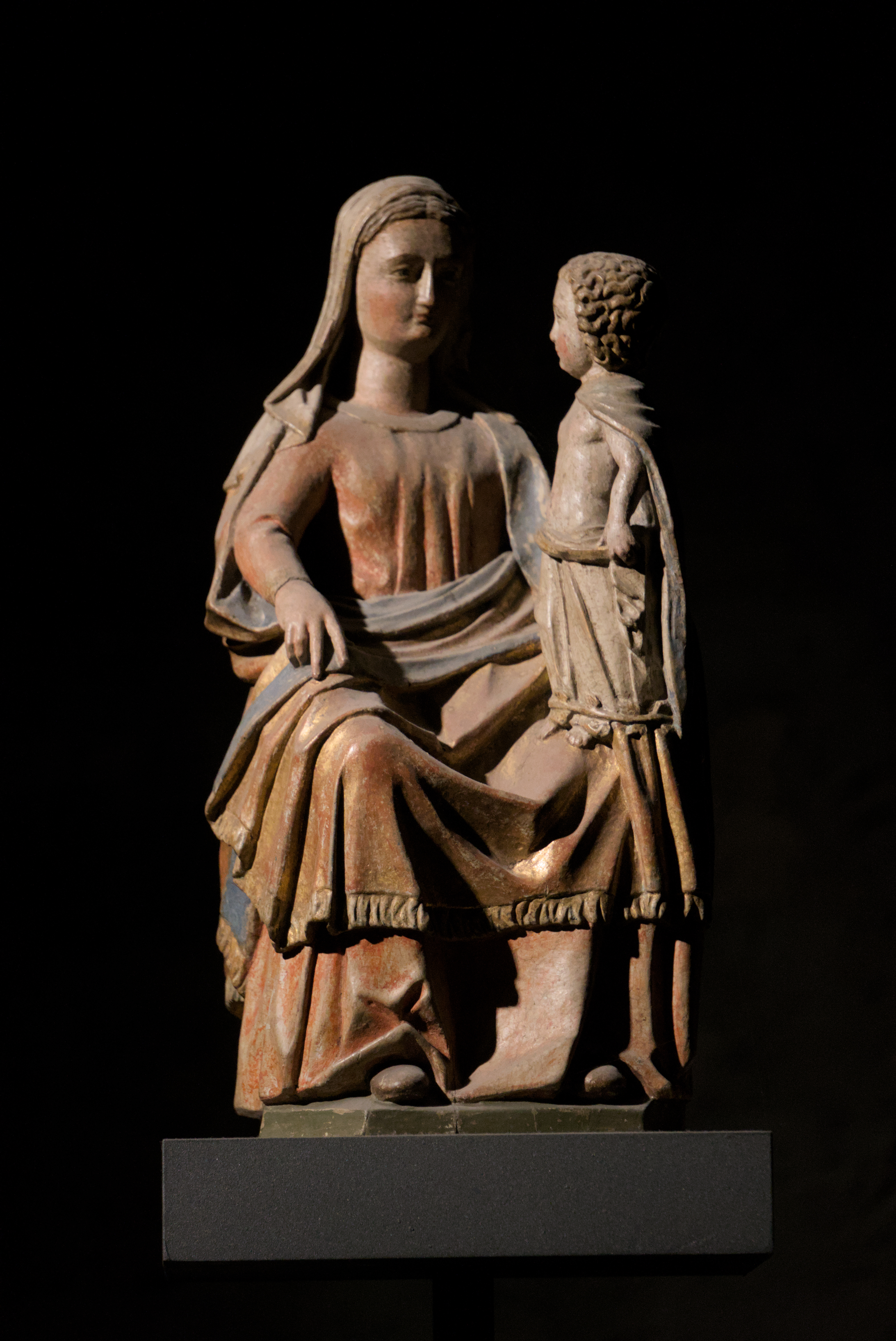
Niches at the left and right entrance of this chapel combine old and new. At the left, a stylized, gold-plated cross by Jürgen Lenssen, contemporary but resembling a pre-Columbian artifact, sits atop a Romanesque stele preserved from the prebombed cathedral. And at the right, a sixteenth-century Italian Madonna and Child are perched on the top tier of a distinctively modern stele, also by Lenssen.
At one point while Eric and I were wandering about the cathedral, people were taking seats in the pews, and a man came out and gave some remarks in German. He was dressed nicely but not in liturgical vestments, so I figured it wasn’t a Mass. Since it was pouring rain outside, I was in no rush to reach my final Würzburg destination, so I decided to take a seat as well. When the speaker sat down, sonorous musical tones started issuing forth from the loft behind me. It turns out we were being treated to a lovely fifteen-minute organ concert. Here’s a snippet:
The Museum am Dom (Cathedral Museum) next door was closed for renovations when I was in Würzburg; it will reopen in summer 2028. The Domschatz (Cathedral Treasury), located inside the cathedral, was also closed to individuals, which was a shame.
Even so, Würzburg Cathedral offers many sights worth seeing—and at no cost! Having seen a photo only of the high altar prior to visiting, I was pleasantly surprised by the great variety of works inside.