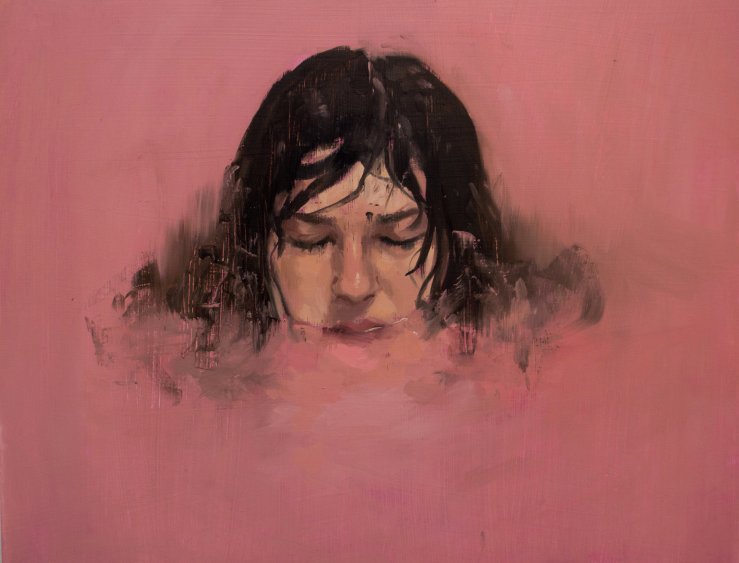
Catherine Graffam (American, 1993–), Head High, Tears Dry, 2015. Oil on wood, 27.9 × 35.5 cm.
Save me, O God!
For the waters have come up to my neck.
I sink in deep mire,
where there is no foothold;
I have come into deep waters,
and the flood sweeps over me.
I am weary with my crying out;
my throat is parched.
My eyes grow dim
with waiting for my God.
. . .
My prayer is to you, O LORD.
At an acceptable time, O God,
in the abundance of your steadfast love answer me in your saving faithfulness.
Deliver me
from sinking in the mire;
let me be delivered from my enemies
and from the deep waters.
Let not the flood sweep over me,
or the deep swallow me up,
or the pit close its mouth over me.
Answer me, O LORD, for your steadfast love is good;
according to your abundant mercy, turn to me.
Hide not your face from your servant,
for I am in distress; make haste to answer me.
This post belongs to the weekly series Artful Devotion. If you can’t view the music player in your email or RSS reader, try opening the post in your browser.
To view all the Revised Common Lectionary scripture readings for Proper 7, cycle A, click here.
INTERVIEW:“Singing the Songs of Injustice” with David M. Bailey and W. David O. Taylor: David Bailey is the director of the reconciliation ministry Arrabon and founder of its music-making and liturgical resource arm, Urban Doxology, and David Taylor is an assistant professor of theology and culture at Fuller Theological Seminary. In this conversation the two men discuss how “biblical, angry, congregational worship can help transform our hearts and churches.” “God has given us the psalms to be an ‘anger school’ for us and I’ve discovered that when we skip class, we aren’t emotionally equipped to deal with difficult stuff we’re experiencing now,” Taylor says. “The extraordinary gift of the psalms is that they show us how to pray angry prayers without being overcome by our anger, how to hate without sinning (to borrow from Saint Paul’s language), or, as Eugene Peterson once put it, how to ‘cuss without cussing.’”
Bailey and Taylor talk about the constant simmer of race relations in America, faithful versus unfaithful expressions of anger, the language of “enemy” in the Psalms, the importance of lament in Sunday gatherings and the need for language that expresses the horizontal aspects of what it means to be a Christian, and leading without moderation during turbulent times.
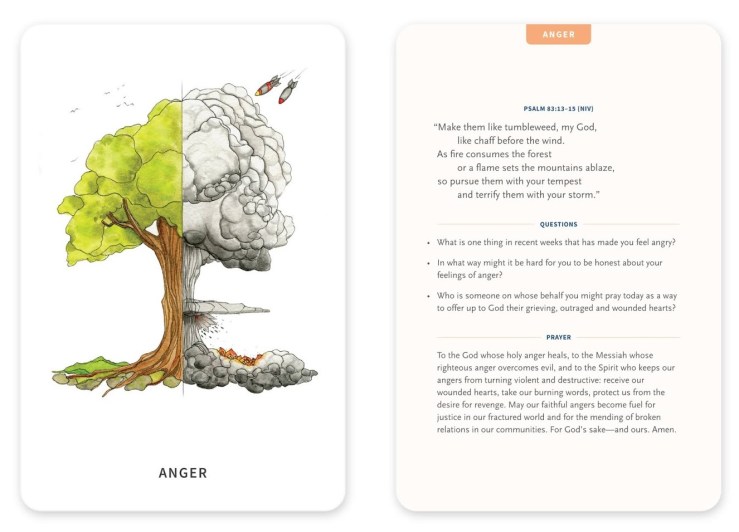
The Psalms of Anger: Prayer Card (illustration by Phaedra Taylor)
Taylor’s latest book, Open and Unafraid: The Psalms as a Guide to Life, contains a chapter on “The Psalms of Anger.” Read an excerpt here, or view this video talk. To coincide with the release in March, he and his wife Phaedra created a set of fifteen prayer cards. His prayer on the “Anger” card reads, “To the God whose holy anger heals, to the Messiah whose righteous anger overcomes evil, and to the Spirit who keeps our angers from turning violent and destructive: receive our wounded hearts, take our burning words, protect us from the desire for revenge. May our faithful angers become fuel for justice in our fractured world and for the mending of broken relations in our communities. For God’s sake—and ours. Amen.”
“I Just Wanna Live” by Johnnetta Bryant, performed by Keedron Bryant: Twelve-year-old gospel singer Keedron Bryant posted a video on Instagram last week of himself singing a song his mom wrote in response to the killing of George Floyd. “God gave me those lyrics” for Keedron, she said in a joint interview on Today. Keedron said he prayed the song, meditated with it, then hit record. It’s a heart-baring, heartbreaking lament, a plea for divine protection in a world that is especially dangerous for young black males.
“It Is Enough!” by R. DeAndre Johnson: R. DeAndre Johnson is the pastor of music and worship life at Christ Church Sugar Land outside Houston. He wrote the lyrics for “It Is Enough!” in July 2016 following the deaths of Alton Sterling and Philando Castile but hadn’t set them to music until now. The nine verses bear the refrain “Kyrie eleison” (Lord, have mercy!), or “Christe eleison” (Christ, have mercy!), a common cry of lament. “There are no words that can contain / The depth of sorrow, grief, and pain / That mothers, sons, and all exclaim: / Kyrie eleison!” Johnson sang the song for his church’s livestreamed service on May 31. A lead sheet is available on his Facebook page. [HT: Global Christian Worship]
“I Want Jesus to Walk with Me”: Sharon Irving is a singer-songwriter, spoken-word artist, and worship leader from Chicago who was also a semifinalist on season 10 of America’s Got Talent. In this video from 2015 she sings a spiritual that expresses deep sorrow—“When my strength is failing,” “When my heart is aching,” “When my life feels like a burden”—but also trust in the companionship of Christ, who walks with us through valleys of death. Having likely originated as an improvisation, the song has several lyrical variations and can be easily adapted to voice a range of feelings: “In my rage,” “In my frustration,” “In my exhaustion,” “In my confusion,” etc.
“O This Night Is Dark” by Tom Wuest: Last Sunday my congregation sang Isaac’s Wardell’s setting of Psalm 126 [previously], whose refrain is “Although we are weeping, Lord, help us keep sowing the seeds of your kingdom . . .” Seeds of love, truth, justice, hope. I just learned that Wardell’s song was inspired by Tom Wuest’s “O This Night Is Dark,” released in 2008 on Rain Down Heaven. In addition to Psalm 126, Wuest’s song also references 1 Corinthians 15, Isaiah 2, Amos 9, and Isaiah 65.
And this week as I was listening to the song, the following image by Scott Erickson showed up on my Instagram feed, with the caption “If one part suffers, all the parts suffer with it” (1 Cor. 12:26).
Scott Erickson (American, 1977–), The Sorrowful Saint, 2016
Erickson painted the image in July 2016 in response to the fatal shootings of Sterling and Castile. It suggests that tears of grief can be generative, that new life can rise out of death. That’s not at all to say that death is good because it catalyzes a movement of change, but that our mourning the evils of racism and murder, our publicly crying out “Enough!,” is not fruitless, though it often seems so. Growth will come.
+++
VIDEO ART: Weight by André Daughtry: “Weight is an attempt to visualize societal projections on the black male body,” writes André Daughtry, a Brooklyn-based interdisciplinary photography and media artist, writer, and performer. The piece is from 2014, and last year PBS’s AllArts station commissioned Daughtry to restage it in New York City as part of a larger video work. [HT: ImageUpdate]
Daughtry has a master’s degree in theology and the arts from Union Theological Seminary and serves as community minister of the arts at Judson Memorial Church, which has a long history of nurturing artists. “We believe that artists have the potential to serve as our modern-day prophets,” the church website reads. “They show us where we’ve been, who we are, and what we can become.”
+++
PODCAST EPISODE: “The SPU Conversation About Spike Lee Films,”North by Pacific Northwest: In this Seattle Pacific University conversation released April 11, 2019, two cinephiles, Jeffrey Overstreet and Josh Hornbeck, discuss some of the films of writer-director Spike Lee, “the boldest and brashest auteur in American film” (Guardian). The first several minutes, though, are spent decrying the then recent Oscar win of Green Book, which popular audiences loved but critics were generally sour on because it perpetuates the simplistic and ultimately false notion that to solve racism, white people just need to realize that “we’re all the same” and find a black friend.
Best known for Do the Right Thing (1989), Lee is one of several filmmakers they cite who deals with race in more complex ways, and while some people dismiss him as an “angry black man,” many celebrate him for forcing audiences to reckon with the problem of racism. “I think there should be rage inside of every conscious human being in the world, because there’s stuff that’s just not right,” he said in a 2000 interview. “Anger can be constructive.” Lee’s films are heavy-handed, in-your-face; they shout and unsettle. Heavy-handedness usually makes for bad art, but Overstreet and Hornbeck show how the approach works for Lee.
Starting at 16:44, they focus on the satirical comedy-drama Bamboozled (2000), which joined the prestigious Criterion Collection just this March. (It’s also been the subject of much scholarly study across fields, one instance I’ve come across being an essay by art theorist W. J. T. Mitchell, titled “Living Color: Race, Stereotype, and Animation in Spike Lee’s Bamboozled,” in What Do Pictures Want? The Lives and Loves of Images.) “Under pressure to help revive his network’s low rating, television writer Pierre Delacroix (Damon Wayans) hits on an explosively offensive idea: bringing back blackface with The New Millennium Minstrel Show. The white network executives love it, and so do audiences, forcing Pierre and his collaborators to confront their public’s insatiable appetite for dehumanizing stereotypes.”
From 25:54 onward, Overstreet and Hornbeck discuss more generally their passion for cinema and the importance of revisiting films.
People have been expressing frustration that The Help, a civil rights era drama that sidelines the perspectives of its black characters, is the number one most-streamed movie on Netflix right now. Film critic Alissa Wilkinson gives a list of fifteen movies to watch instead on racial injustice and being black in America. A mix of dramas and documentaries by such filmmakers as Barry Jenkins, Ava DuVernay, Spike Lee, and others, these are black-centered stories that help illuminate where we’re at right now. All are available for online streaming, and Wilkinson provides links to her reviews.
From March 28 onward, Melbourne-based creative nonfiction writer, oral storyteller, and arts educator Julie Perrin has been writing and publishing collects (short prayers, pronounced KÄ-lekts) for anyone to freely use and republish (with credit) in this time of pandemic. I’m so grateful for her giving us this language to voice our anxieties, sadness, and pleas to God, and for reminding us of who God is. (And thanks to Art/s and Theology Australia for alerting me to this collect series.)
The photographs, posted here with permission, are by Ian Ferguson, a minister at Brunswick Uniting Church in Melbourne. They were taken in East Gippsland in February and March, following the Australian bushfires.
God of those who are numbed,
stunned by loss,
enfold us in a gentle darkness,
a hidden sleep, a long stillness.
Re-member us to ourselves,
awaken the courage we’d forgotten we had. [source]
God who knows chaos,
Who creates in darkness,
makes life from mud.
Give us back to ourselves
dissolved and helpless
may we feel ourselves forming
know our own shape. [source]
Fierce Lover of life,
give strength to our arms and our resolve.
Critical is this time for cleaning, swabbing, scrubbing
and washing our hands again.
And again, and again.
Let us join ourselves to the task
with readiness, steadiness, clarity.
Because we too love life,
our own and our neighbour’s. [source]
Brooding God,
Who hovers over the waters,
Remain with us, for we are stranded on tiny islands of fear.
Draw a circle around our solitude,
hold us back from bringing danger to ourselves and others.
And where touch can no longer reach,
let love spin light across dark waters,
a thread of sweetness for small songs we might sing. [source]
God who speaks the word ‘Beloved,’
Keep watch on those who give voice to care,
Who speak trenchant truths,
explaining, instructing and chiding without blame.
Let us hear the warmth and strength in voices that stir response
and nourish hope in thoughtful action.
Give us ears to listen without fear. [source]
God of the frail in body and mind,
be a companion in loneliness,
a consolation in absence,
a balm in mystified sorrow.
When doors, through dire necessity, must stay shut,
Let love arise in memory of gesture and embrace. [source]
God of Shadows,
give shelter to hollow, shaken humans
bewildered by sudden closure.
Sturdy structures shattered, hopeful trade ended,
meaningful work gone.
In the shocking silence where nothing can be said,
let birdsong be heard. [source]
Holy One who fears no fracture,
Lend your clarity to us for we are full of fear.
Already the abyss appears
Cracks in the earth, shifts in the ground we took for granted,
Now there is rupture
We do not trust our capacity to live.
That which is holy, divine, beyond us
frightens and allures us.
Call us to the mystery of the holy. [source]
God of the despondent,
Who sees our tiredness at futile effort,
Who knows that fear breeds phantoms,
help us we pray.
We are weary, and everywhere we turn
another impediment rises.
Our shoulders sag, the breath goes out of us.
In this stripped-back bareness, give us breath,
May we delight in human kindness, meet holiness anew. [source]
God of the harried,
Help us in the tension of these days,
for we are crushed by too many tasks,
nervous of new skills and tools in the too-much of this moment.
May we give heed without collapse,
restore our trust in longer spans of time – beyond the urgency of now. [source]
Lover of all, Who watches through the night,
draw close to those who are dying,
and to those who mourn.
Calm our terror of abandonment.
Let us hold faith with one another
that love reaches beyond death. [source]
God who weeps,
comfort those who are dying,
may they die without fear.
And while they are yet living
give us courage to tell our love and trust in yours. [source]
This final prayer is not strictly a collect but rather a litany of things to love:
Great God who calls us to belonging,
Who delights in curiosity, invention, ingenuity:
Praise be for minds that bend and flex despite restriction,
for bodies that signal love by staying apart.
Praise be for neighbours talking across fences,
calling from balconies, waving through windows,
for greetings that cross the space between us.
Praise be for strangers, careful on footpaths,
for children asking their questions,
for truth tellers who earn our trust and speak to our fear.
Praise be for friends who warn and chide and encourage,
for human warmth in time of distance.
Praise be. [source]
You can follow Julie Perrin through her blog, Telling Words.
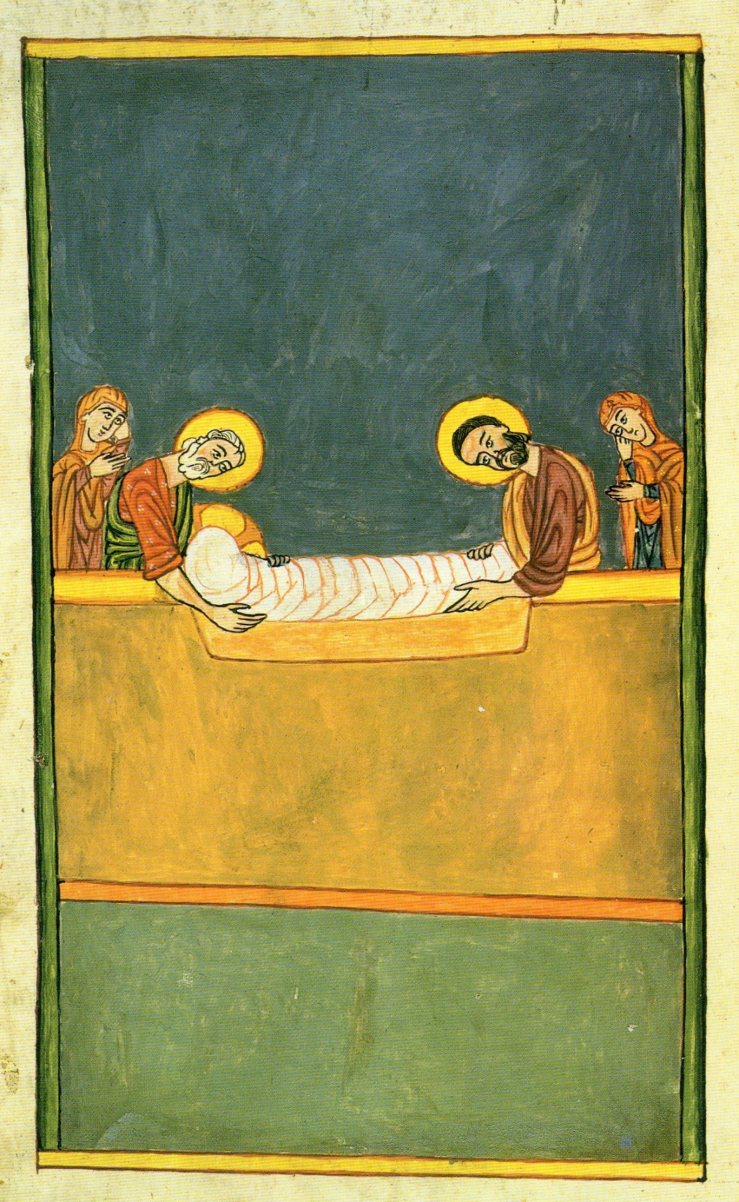
“The Entombment of Christ,” from an Armenian Gospel-book, 1437. MS Or. 2668, fol. 5v, British Library, London.
When it was evening, there came a rich man from Arimathea, named Joseph, who also was a disciple of Jesus. He went to Pilate and asked for the body of Jesus. Then Pilate ordered it to be given to him. And Joseph took the body and wrapped it in a clean linen shroud and laid it in his own new tomb, which he had cut in the rock. And he rolled a great stone to the entrance of the tomb and went away. Mary Magdalene and the other Mary were there, sitting opposite the tomb.
—Matthew 27:57–61
After these things Joseph of Arimathea, who was a disciple of Jesus, but secretly for fear of the Jews, asked Pilate that he might take away the body of Jesus, and Pilate gave him permission. So he came and took away his body. Nicodemus also, who earlier had come to Jesus by night, came bringing a mixture of myrrh and aloes, about seventy-five pounds in weight. So they took the body of Jesus and bound it in linen cloths with the spices, as is the burial custom of the Jews. Now in the place where he was crucified there was a garden, and in the garden a new tomb in which no one had yet been laid. So because of the Jewish day of Preparation, since the tomb was close at hand, they laid Jesus there.
—John 19:38–42
+++
MUSIC: “Tagh for the Funeral of the Lord” by Tigran Mansurian, 1998–2004 | Performed by Kim Kashkashian (viola) and Robyn Schulkowsky (percussion), on Neharo’t, 2009
The tagh is an ancient genre of Armenian monodic music—that is, lamentation over another’s death. “The characteristics of the tagh are its expansiveness of form and volume, its free melodic style, the existence of instrumental passages and richness of rhythm” [source].
“Tagh for the Funeral of the Lord” is the second piece in contemporary Armenian composer Tigran Mansurian’s suite “Three Medieval Taghs for Viola and Percussion” (the other two are for the Crucifixion and for the Resurrection). On YouTube you can find a January 27, 2019, performance by violist Kim Kashkashian and (different from the earlier album recording) percussionist Jonathan Hepfer as part of the Lark Musical Society’s Dilijan Chamber Music Series is Los Angeles. The funeral tagh starts at 4:23:
Note: Sometimes this piece is called Tagh “to” or “of” the Funeral of the Lord.
+++
The Entombment painting above is from a fifteenth-century Gospel-book copied and illuminated at the Monastery of St. George in Armenia by the priest Awetik. At the center, Christ’s body lies with his head tilted toward the viewer but wrapped, like the rest of him, in a white shroud. Joseph of Arimathea cradles Christ’s head and Nicodemus straightens his legs as the two situate his body in the grave. Two of the Marys stand by, grieving.
The vast swatch of dark blue across the top half of the painting indicates the deep darkness of the cave and accentuates the feeling of emptiness and loss. The figures form a middle band, below which are two more large color fields: brown and green, the colors of the earth.
The inertness is striking, as is the complete hiddenness of God the Son under his burial clothes.
This post belongs to the weekly series Artful Devotion. If you can’t view the music player in your email or RSS reader, try opening the post in your browser.
To view all the Revised Common Lectionary scripture readings for Holy Saturday, cycle A, click here.
William-Adolphe Bouguereau (French, 1825–1905), The First Mourning, 1888. Oil on canvas, 79 9/10 × 98 2/5 in. (203 × 250 cm). Museo Nacional de Bellas Artes, Buenos Aires.
“After the Fig Leaves, Eve Cuts Her Hair”
So when they bury Abel, there is no veil
between her grief and her love. And there he stands,
so like his father, his cities yet unbuilt.
His father cuts open earth with bare hands,
leaving plough and shovel, the sharp edges
and the heavy handles, apart in furrowed field.
She calls each animal he resembles: mole, badger, fox.
He named them, once, and now she names him:
father unfathered, sonless, one son less. The sun hangs
round and clear, apple-red, above the dark tree line.
Once, when Cain was the only child in the world,
their fields withered and arrows flew fruitless.
Dull-eyed by the empty fire, beside the windless cedars,
he wailed at the dry breast. Much later,
after thunder dumbed the stars,
they faced the barren, muddied vale together. Adam said,
God made paradise, and we made this—
this is all we have to give him. He struck his staff
upon the seedless ground. Cain made two tiny fists.
Abel she cannot unsee as a splintered spear
of red lightning, reduced to kindling
on the perfumed grass, the churned earth
weeping red mud. Loss escapes her in a hiss
of distant fear: this time, the choice
for death has been made for her,
despite that it was life she’d sent into the world.
Her voiceless throat swells tight, dry as scales.
Her hair is short and stiff and gray. The world is young.
There will yet be other sons, and daughters more;
the seed of man must multiply. But this grief is older
than she knows, its gaze fixed far ahead
on what, someday, must be done. The wind’s voice
keens a long lament, a parent loss,
the form of sons’ deaths yet to come.
“After the Fig Leaves, Eve Cuts Her Hair” by LeighAnna Schesser was originally published in Presence: A Journal of Catholic Poetry 2018 and is used here by permission of the author. The poem will appear in Schesser’s first full-length poetry collection, Struck Dumb with Singing, to be published by Lambing Press in May 2020.
+++
LeighAnna Schesser’s poem “After the Fig Leaves, Eve Cuts Her Hair” explores parental grief following the death of a child—in particular, that of our primordial parents, Adam and Eve, who mourn the loss of their second-born son, Abel. Genesis 4:1–16 recounts how Abel was murdered by his older brother, Cain, in a fit of jealousy. This is the first human death in the Bible, and it was the direct result of sin.
The poem starts with the title, which flows with unbroken syntax into the first line: “After the fig leaves, Eve cuts her hair so when they bury Abel, there is no veil between her grief and her love.” The cutting of hair in response to death in the immediate family is a ritual practiced by women in many Native American tribes and Aboriginal people groups, where the act of severing, and the subsequent absence of, a cherished part of your self serves as a stark physical reminder of your loss. Similarly, after 9/11, many non-Native women in the US cut their hair as a sign of shock and sadness at the immense loss of life; one woman said, “I felt so different internally, I wanted something to express it externally.” Schesser imagines Eve taking part in some form of this ancient mourning ritual, wanting to leave her crying face exposed.
This is “after the fig leaves,” euphemistic shorthand for that landmark event earlier in her life in which she stole fruit from an off-limits tree and then, feeling shame for the first time, went to cover her nakedness with the first available foliage. The title/opening line, between that prepositional phrase and the first clause, skips over quite a long period of time—from the Genesis account, it sounds like at least two decades passed between Adam and Eve’s expulsion from Eden and the murder of Abel. But these two events are life-defining for Eve, so the chronology is collapsed.
“And there he stands / [. . .] his cities yet unbuilt.” The “he” here refers to Cain, who, after being confronted by God, went into exile “east of Eden,” to the land of Nod (Gen. 4:17). In his later life he built up the world’s first city, Enoch.
Like the burrowing species of animals he named, Adam digs into the earth with his bare hands—elemental. For this, the making of his son’s grave, he leaves aside plow and shovel as a sort of penance: he wants to feel directly the hard dirt, his body’s full labor and sweat, the effects of the curse he brought upon the world, which he feels implicates him in his son’s death. As he digs, the sun hangs above him “round and clear, apple-red,” a taunting reminder of his former trespass.
In the third stanza the speaker goes back to the time that’s elided in the poem’s opening, back to when Adam and Eve left God’s teeming garden and entered a dead world. They struggled to secure food for themselves. Eve gave birth to a baby boy, but soon her breast milk dried up. It was then that they resolved to get down to business and fight for a life in this inhospitable land. Even baby Cain expressed defiance against the odds with little fists as Adam broke new ground.
Snapping back to the present, Eve observes Abel’s limp body, bloody and broken and reddening the earth. “The churned earth / weep[s] red mud”—an arresting poetic image to match God’s in Genesis 4:11: “The ground . . . has opened its mouth to receive your brother’s blood from your hand,” he tells Cain. We are taken back again to the Fall through more figurative language, this time evoking the snake: fear “hiss[es]” in the distance; Eve’s throat is “dry as scales.” Eve, God’s child, chose death in the Garden, and now her child, the one to whom she gave life, has chosen death too. She now has a taste of the horror, disappointment, and sadness God must have felt.
“Though the world is young,” the poem continues, “this grief is older / than she knows.” Older, even, than God’s grief at the Fall. For another son, God’s “only begotten” (John 3:16), was destined to die millennia later—“the Lamb slain from the foundation of the world” (Rev. 13:8). In his foreknowledge God saw this death and mourned it immensely. His is the oldest grief.
+++
William-Adolphe Bouguereau’s painting The First Mourning shows the lifeless body of Abel sprawled out over Adam’s lap, and he and Eve ridden with grief. Adam clutches his broken heart, and Eve buries her face in her hands, sobbing uncontrollably. The only color in the bleak landscape is from the puddle of blood on the ground. In the background, smoke rises from an altar, mixing with the storm clouds in the sky; this is the remnant of Abel’s offering going up to God, the cause of Cain’s resentment that led him to commit murder.
By the time Bouguereau painted this scene in 1888, three of his five children had died of illness. (A fourth child of his would also die within his lifetime—twelve years later, at age thirty-two.) He knew the sorrow that accompanies such a traumatic event as seeing your kids leave this world before you do.
The iconography he uses is closely related to that of the Pietà, an image type that shows a grieving Virgin Mary holding her dead son, Jesus, on her lap following his crucifixion. The connection is intentional, as death—which Abel was the first person to experience—will ultimately be undone by the death and resurrection of Jesus. The writer of Hebrews says that “the sprinkled blood [of Jesus] speaks a better word than the blood of Abel” (Heb. 12:24), because Christ’s blood is redemptive, bringing us back to the Garden that we lost through sin.
Call to artists: I’d love to see you interpret Schesser’s poem visually: Eve shorn inside and out (her hair “short and stiff and gray”), wearing her grief openly; Adam animalistic, digging a grave by hand; Cain looking on; and the wind bearing their lament forward to the cross. If you pursue this suggestion, do let me know!
+++
LeighAnna Schesser is a Catholic writer and a homeschooling mom of four from Kansas, whose forthcoming book of poetry, Struck Dumb with Singing (out in May), “meditates on family, devotion, divine mysteries, and their rootedness in place.” Visit Schesser at her website, https://acanticleforhomestead.com/, where you will find, among other things, links to some of her other published poems and articles.
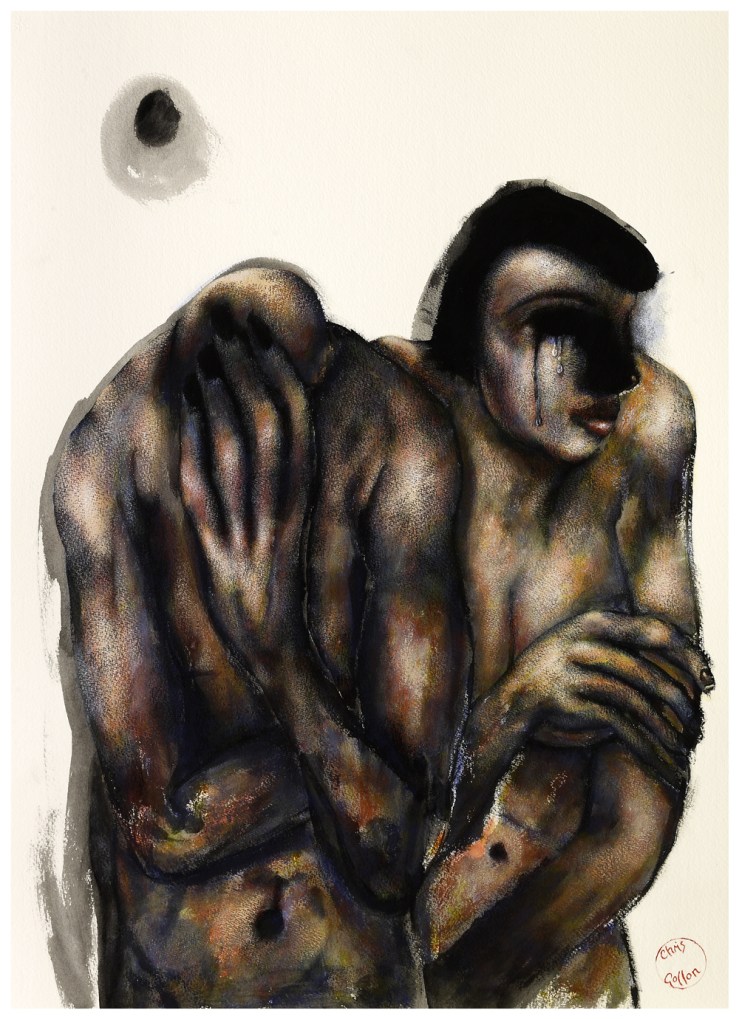
Chris Gollon (British, 1953–2017), Expulsion from Paradise, 2013. Acrylic on paper, 30 × 22 in. (76 × 56 cm).
So when the woman saw that the tree was good for food, and that it was a delight to the eyes, and that the tree was to be desired to make one wise, she took of its fruit and ate, and she also gave some to her husband who was with her, and he ate. Then the eyes of both were opened . . .
The fall, the fall, oh God, the fall of man
The fruit is found in every eye and every hand
Nothing, there is nothing yet, in truest form
We walk like ghosts upon the earth; the ground, it groans
How long, how long will you wait?
How long, how long till you save us all, save us all?
Turn your face to me, turn your face to me
Turn your face to me, turn your face to me
The light, the light, the morning light is gone
And all that’s left is fragile breath and failing lungs
The night, the night, the guiding night has come
Uniting lover with his bride, more precious than the dawn
How long, how long must we wait?
Turn your face to me, turn your face to me
Turn your face to me, turn your face to me
Because of the music behind “Turn your face to me”—soft and smooth, consonant, calm not frantic like the rest—I read this refrain as being spoken by God. The humans lament their fall, asking how long they must wait for salvation, and God gently responds: it’s available now, just turn your face to me.
The idea of “ghosts upon the earth” is inspired by C. S. Lewis’s allegorical novel The Great Divorce, in which a group of travelers from a “grey town” are taken by bus to heaven, a land that proves to be far more solid, more real, than even the travelers’ own bodies. “Sometimes it seems like the most real thing is what we can see and experience with our senses around us—this life, the tangible,” Michael Gungor said. “Ideas like love, like God, these things sometimes feel more disconnected and ethereal, like that’s the ghostly realm. But what if that’s wrong and God and love is actually what is most real, and we are more like ghosts walking upon the earth, hoping to become more real?”
To watch a live performance of Gungor’s “The Fall” from 2012, click here.
This post belongs to the weekly series Artful Devotion. If you can’t view the music player in your email or RSS reader, try opening the post in your browser.
To view all the Revised Common Lectionary scripture readings for the First Sunday of Lent, cycle A, click here.
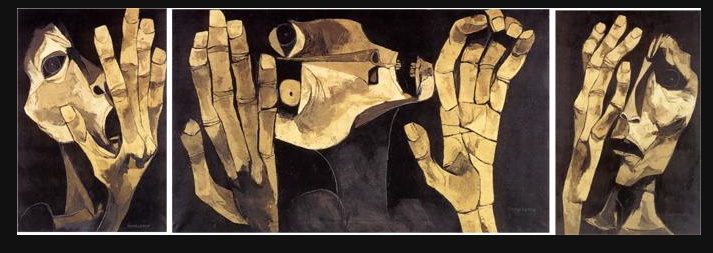
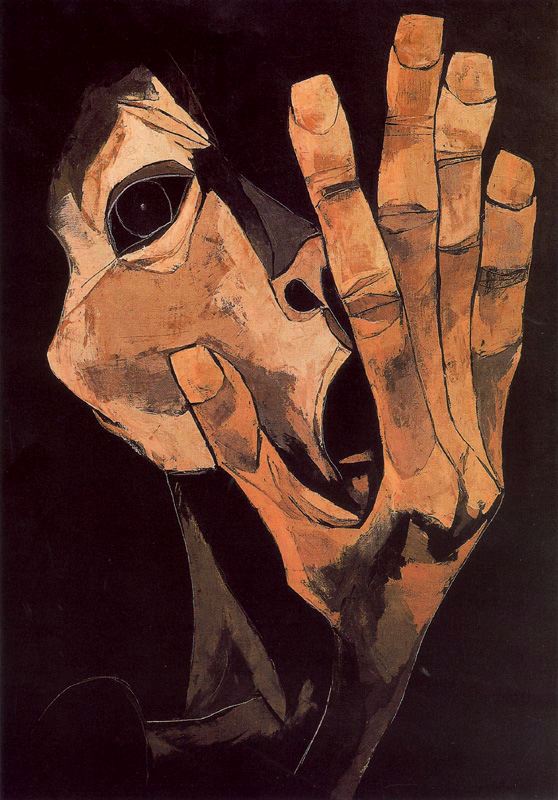
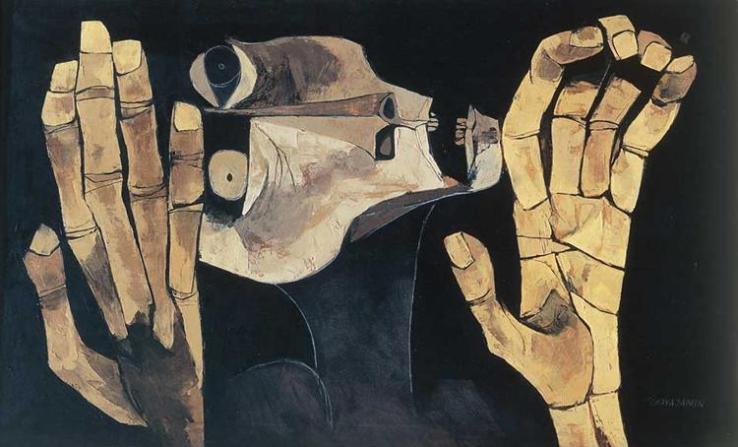
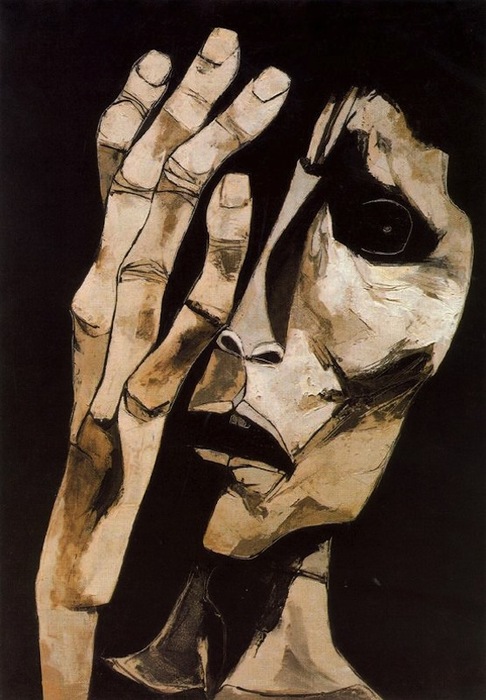
Oswaldo Guayasamín (Ecuadorian, 1919–1999), El Grito [The Cry], 1983. Oil on three canvases. Fundación Guayasamín, Quito, Ecuador.
O Lord, how long shall I cry for help,
and you will not hear?
Or cry to you “Violence!”
and you will not save?
Why do you make me see iniquity,
and why do you idly look at wrong?
Destruction and violence are before me;
strife and contention arise.
So the law is paralyzed,
and justice never goes forth.
For the wicked surround the righteous;
so justice goes forth perverted.
I haven’t really known what to say about the violence in our nation and around the world. There are specific events that I’m grieving, and then there’s just the toll of senseless violence stacked on senseless violence. I’m exhausted, and I’m not even a member of any of the affected communities. Lord have mercy. This lament just kind of poured out of me last week. How long O Lord?
Justin Ruddy is the founding pastor of Resurrection Church in East Boston, which just launched this fall. As a former minister at Citylife Boston, where I attended for five years, he has been influential in shaping my faith—especially my appreciation of liturgy and my practice of lament. When he wasn’t preaching or singing/playing music in worship, he often served as “presider” over the service, connecting together the various liturgical elements, weaving a narrative through line that illuminated the gospel for me week after week. When he spoke theology, he did so in such thoughtful and relevant ways. He also occasionally led us in responding to national or global tragedies or crises. His prayers in the wake of such events, such as the Boston Marathon bombings in 2013, have taught me a way to pray through suffering. His song “How Long, O Lord?” exemplifies his approach—a biblical one—of bringing pain, grief, anger, exasperation fully before God.
+++
A theology that has no place for lament is left only with thin, inadequate murmurings. The covenantal relationship is reduced to a mere shell, maneuvered about with smoke and mirrors rather than serious and faithful engagement. . . . A theology which takes our covenantal relationship with God seriously must then also take the laments seriously. One cannot happen without the other.
—Logan C. Jones, The Psalms of Lament and the Transformation of Sorrow
Oswaldo Guayasamín, El Grito IOswaldo Guayasamín, El Grito IIOswaldo Guyasamín, El Grito III
This post belongs to the weekly series Artful Devotion. If you can’t view the music player in your email or RSS reader, try opening the post in your browser.
To view all the Revised Common Lectionary scripture readings for Proper 26, cycle C, click here.
Ephraim Moshe Lilien (Austrian, 1874–1925), On the Rivers of Babylon, 1910. Etching and aquatint, 28 × 55 cm.
By the waters of Babylon,
there we sat down and wept,
when we remembered Zion.
On the willows there
we hung up our lyres.
For there our captors
required of us songs,
and our tormentors, mirth, saying,
“Sing us one of the songs of Zion!”
How shall we sing the LORD’s song
in a foreign land?
If I forget you, O Jerusalem,
let my right hand forget its skill!
Let my tongue stick to the roof of my mouth,
if I do not remember you,
if I do not set Jerusalem
above my highest joy!
Remember, O LORD, against the Edomites
the day of Jerusalem,
how they said, “Lay it bare, lay it bare,
down to its foundations!”
O daughter of Babylon, doomed to be destroyed,
blessed shall he be who repays you
with what you have done to us!
Blessed shall he be who takes your little ones
and dashes them against the rock!
—Psalm 137
+++
SONG: “Rivers of Babylon” | Words and music by Brent Dowe and Trevor McNaughton of The Melodians, 1970 | Covered by Linda Ronstadt, on Hasten Down the Wind (1976)
In Psalm 137, a communal lament, Israel remembers with sadness the Babylonian captivity and, in the infamous final line (v. 9), wishes violence against her captors’ children. The Kingston, Jamaica–based reggae group The Melodians set Psalm 137:1–4, along with Psalm 19:14, to music in 1970 as “Rivers of Babylon.” (Unsurprisingly, the controversial imprecation is excluded.) The song became a sort of anthem for Rastafarianism, an Afrocentric religious movement that laments the exile of Africans to the West Indies and the Americas—“Babylon”—through slavery and expresses longing for the homeland, Africa, “Zion.” Boney M.’s 1978 disco cover popularized the song in Europe. I’m not a fan of this famous rendition, because the bright, bouncy style doesn’t fit the tone of the lyrics. In fact, I even prefer Linda Ronstadt’s California folk cover to the original Melodians recording. She sings it a cappella with Andrew Gold and Kenny Edwards:
+++
The etching above is by Ephraim Moshe (Moses) Lilien, an Austro-Hungarian art nouveau illustrator and a member of the Zionist movement. He helped found the Bezalel Art School in Jerusalem. Click here to see other religious-themed prints by the artist.
I first encountered this image in a challenging blog post by theologian W. David O. Taylor, who, addressing the oft-expunged vindictive sentiments of Psalm 137’s third stanza and citing Miroslav Volf, claims that our rage belongs before God liturgically. Taylor has contributed a very fine trio of visual commentaries on Psalm 137 to the Visual Commentary on Scripture project, where he discusses an English Romanesque manuscript illumination, a mosaic by Marc Chagall, and an Abu Ghraib prison series triptych by Fernando Botero in light of the psalm.
This post belongs to the weekly series Artful Devotion. If you can’t view the music player in your email or RSS reader, try opening the post in your browser.
To view all the Revised Common Lectionary scripture readings for Proper 22, cycle C, click here.
Joseph Hirsch (American, 1910–1981), Lynch Family, 1946. Oil on canvas, 35 × 33 in. (88.9 × 83.8 cm). Nelson-Atkins Museum of Art, Kansas City, Missouri. [zoom in]
My joy is gone; grief is upon me;
my heart is sick within me.
Behold, the cry of the daughter of my people
from the length and breadth of the land:
“Is the Lord not in Zion?
Is her King not in her?”
. . . . . . . . . . . . . . . . . . . .
“The harvest is past, the summer is ended,
and we are not saved.”
For the wound of the daughter of my people is my heart wounded;
I mourn, and dismay has taken hold on me.
Is there no balm in Gilead?
Is there no physician there?
Why then has the health of the daughter of my people
not been restored?
—Jeremiah 8:18–22
+++
SONG: “There Is a Balm in Gilead” | Negro spiritual | Arranged and performed by Archie Shepp (tenor sax), feat. Jeanne Lee, on Blasé (1969, reissued 2009)
+++
In this coming Sunday’s lectionary reading from the Prophets, Jeremiah grieves over the suffering of his people. “Is there no balm in Gilead?” he cries. Gilead was a region in ancient Palestine, east of the Jordan River. Now it is known primarily as the fictional locale of two famous contemporary novels, but back then it was known for the soothing, aromatic plant resins produced there, which were used medicinally. In Israel’s desolation, though, they could feel no balm—not even in the place where it was said to abound.
The anonymous enslaved writer(s) of the song featured above knew communal suffering well. They tap into Jeremiah’s poetic grief, extracting the “balm in Gilead” expression but bending it toward hope. There is a balm, the song attests, albeit wearily, through tears. And this balm makes the wounded whole. Archie Shepp’s soulful arrangement, with vocals by Jeanne Lee, express that woundedness and yearning for deliverance so poignantly.
As a visual point of focus, I’ve chosen Joseph Hirsch’s Lynch Family, a forward extension of the history of African American oppression. The gallery label for the painting reads,
Joseph Hirsch painted Lynch Family as a response to racial disturbances in the South in 1946. That year the number of lynchings rose from an all-time low in January to a fevered pitch by August. Citizens across the country urged President Truman and Congress to end the horrors. To capture the tragedy of Lynch Family, Hirsch presented a mother with her baby, presumably survivors of a lynching victim, in abstracted surroundings. The painting focuses on the mother’s intense yet restrained hold on her defiant child while she turns to hide her anguish. The blue background floats around the figures. It both highlights their pain and contrasts with the sheer beauty of Hirsch’s painterly technique.
Though painted in the 1940s, this work bears strong relevance for today. The figures could be any black mother and child left to grieve the loss of husband and father—to prison, or to death by shooting, choking, or any other form of brutality.
This post belongs to the weekly series Artful Devotion. If you can’t view the music player in your email or RSS reader, try opening the post in your browser.
To view all the Revised Common Lectionary scripture readings for Proper 20, cycle C, click here.
In a recent conversation, poet and novelist Joy Kogawa said, “We need to see each other’s eyes, and see each other through each other’s eyes.” Art, from all disciplines, can help us do that. Art can awaken our social conscience and breed empathy and understanding. It can serve as a vehicle for lament, a practice of voicing suffering before God. It can also widen our imaginations—that is, in part, our ability to think up creative solutions to problems both big and small. Here are just a few recent justice-oriented art projects that inspire me.
+++
CLASSIC SONG REVISED: Earlier this month Liz Vice, Paul Zach, and Orlando Palmer took Woody Guthrie’s folk classic “This Land Is Your Land” and, gathering at Trinity Church in Charlottesville, Virginia, revised the lyrics and tone to project lament over some of America’s more troubling legacies. The lyrical turn happens in the fourth line: where we would expect “To the New York islands,” we get “To the Texas border,” turning our mind from the country’s beauty to its broken systems that prevent us from sharing abundance with our southern neighbors fleeing violence. The song continues to plot a path through various places of historical and present-day suffering in the US, the three stanzas compactly addressing immigration; slavery, the “New Jim Crow,” and police brutality against black people; and the forcible expulsion of Native Americans from their ancestral territories, as well as massacres and other forms of colonialist violence.
This land is your land
This land is my land
From California
To the Texas border
Through the Juarez mountains
With the migrant caravans
This land was made for you and me
This land is your land
This land is my land
From the piers of Charleston
To the fields of cotton
From the crowded prisons
To the streets of Ferguson
This land was made for you and me
This land is your land
This land is my land
From the Jamestown landing
To Lakota Badlands
From the Trail of Tears to
The reservations
This land was made for you and me
Most people don’t know it, but Guthrie actually wrote “This Land Is Your Land” as a protest against the vast income inequalities in the US. Two of its original verses, the radical ones, were nixed when it came time to record (it was the McCarthy era, after all); these referenced breadlines and tall walls with “No Trespassing” signs. In its original form, the song celebrated America as a place of natural abundance—forests and streams and wheat fields under “endless skyways”—while lamenting the scarcity that many Americans experience. The refrain, therefore, was more loaded. Learn more about the song’s history at https://www.npr.org/2000/07/03/1076186/this-land-is-your-land.
+++
An interactive art installation by Rael San Fratello on July 27, 2019, fostered cross-border interactions between residents of Sunland Park, New Mexico, and Colonia Anapra, Mexico.
SEESAWS AT THE BORDER: On July 27, Oakland-based creative duo Ronald Rael and Virginia San Fratello installed three bright pink teeter-totters through the slats of a section of the US-Mexico border wall that separates the neighboring communities of Sunland Park, New Mexico and Colonia Anapra, Mexico. Citizens on both sides were invited to ride this playground essential with a cross-border partner—a whimsical way to engage the other. As the creators said, it enabled people to literally feel the weight of humanity on the other side, using the wall as a fulcrum. The installation lasted forty minutes before it was dismantled (without incident).
I love this idea of play as protest—teeter-tottering as an act of creative defiance. What was enacted July 27 at the wall was a theater of the absurd, something that Rael, an architect, is especially drawn to in his practice. He actually conceived of Teeter-Totter Wall ten years ago, publishing a conceptual drawing in the book Borderwall as Architecture (University of California Press, 2009), along with other outlandish design possibilities for turning the wall into something that brings together rather than divides—these include its use as a massive xylophone played with weapons of mass percussion, a bookshelf feature inside a binational library, and more. Through these humorous proposals, Rael “reimagin[es] design as both an undermining and reparative measure,” as Dr. Marilyn Gates put it.
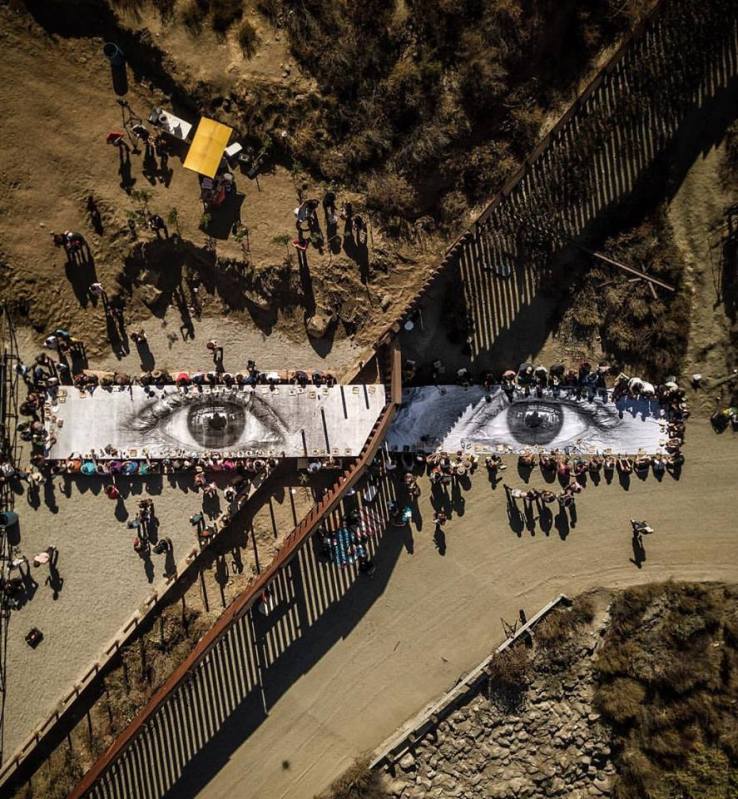
In his 2018 TED Talk, Rael discusses how the wall, meant to separate, has actually served to unite people in some instances. He mentions, for example, games of Wall y Ball, a variation on volleyball that was established at the wall in 1979, and binational yoga classes. I’ve heard of the Eucharist being celebrated jointly through the slats, and picnics hosted—such as the one organized in Tecate by the French artist JR on October 8, 2017: families passed plates of food between the bars, and musicians on both sides played the same songs.
A picnic at the US-Mexico border on October 8, 2017, organized by the elusive street artist JR
This picnic was the capstone of a month-long installation by JR featuring a monumental photograph of a Mexican toddler named Kikito, peering over the border wall into California from Tecate. (The photograph was held up with scaffolding.)
In early September 2017, street artist JR created a massive art installation on the Mexican side of the US border wall in Tecate showing a child, Kikito, peering over.
Shared play, shared food, shared music, shared sacrament—these are such breathtakingly beautiful countermeasures to separatism. The world needs more imaginative acts like these.
+++
POEM: Timothy E.G. Bartel has just published a new poem, “Status Check,” over at Curator. It’s only five lines, seven questions. A must-read. It’s not about immigration policy per se (it’s open-ended), but it took me back to another poem by Bartel that I featured back in 2017 as part of a blog post entitled “One sonnet vs. shouted prose: Lady Liberty, Emma Lazarus, and Trump.” Bartel has since published a freely downloadable chapbook (a compilation of Sapphic stanzas he wrote this year during National Poetry Month) and a traditionally published collection with Kelsay Books, Aflame but Unconsumed, which I just ordered and am excited about.
+++
VIRTUAL REALITY INSTALLATION: This was in DC last year and I missed it! A VR experience directed by the multi-Academy-Award-winning Alejandro G. Iñárritu, known for the films Birdman, The Revenant, Biutiful, and Babel, and shot by (also multiple-award-winning) cinematographer Emmanuel Lubezki. “Carne y Arenais a six-and-a-half-minute solo experience that employs state-of-the-art technology to create a multi-narrative space with human characters. . . . Based on true accounts from Central American and Mexican refugees, [it] blurs and binds together the superficial lines between subject and bystander, allowing individuals to walk in a vast space and live a fragment of a refugee’s personal journey.”