Landmark exhibition “Ethiopia at the Crossroads” explores cross-cultural influences on Ethiopian art

All photos in this post, except for the last one (of the processional icon), are my own.

(Note: WordPress seems to have disabled the feature that allows you to expand an image upon clicking, but if you’re reading on a computer, you can right-click an image and open it in a new tab to view it in full resolution; if you’re reading on a phone, you can pinch to zoom.)

Located in the Horn of Africa and with access to the Red Sea, Nile River, Mediterranean Sea, and Indian Ocean, Ethiopia stands at the nexus of historical travel, trade, and pilgrimage routes that brought it into contact with surrounding cultures and influenced its artistic development. Coptic Egypt, Nubia, South Arabia, Byzantium, Armenia, Italy, India, and the greater African continent were among those influencers. But Ethiopia not only absorbed influences; it transmitted them too.

A major art exhibition is centering Ethiopia’s artistic traditions in a global context. For Ethiopia at the Crossroads at the Walters Art Museum in Baltimore (running through March 3), curator Christine Sciacca has brought together more than 220 objects from the Walters’ own extraordinary Ethiopian art collection and private and institutional lenders both domestic and international. Icons, wall paintings, processional crosses and hand crosses, illuminated Gospel books and psalters, sensuls (chain manuscripts), healing scrolls, and more are on display throughout the galleries, whose walls have been painted bright green, yellow, and red—the colors of the Ethiopian flag. To round off the exhibition, guest curator Tsedaye Makonnen, an Ethiopian American multidisciplinary artist, was tasked with curating a few works from contemporary artists of the Ethiopian diaspora.

Ethiopia at the Crossroads exhibition view

The majority of objects are Christian, made for liturgical or private devotional use. Ethiopia is one of the world’s oldest Christian nations: in the early fourth century, persuaded by a missionary from Syria, King Ezana of Aksum embraced Christianity, and it has been the dominant religion of Ethiopia ever since. But the exhibition does also include some Islamic and Jewish objects.

One of the first works you’ll encounter is a mural that would have originally been mounted on the outer wall of an Ethiopian Orthodox church sanctuary (mäqdäs), portraying the Nativity, the Presentation of Christ in the Temple, and the Adoration of the Magi.

Nativity, Presentation of Christ in the Temple, and Adoration of the Magi, Ethiopia, 18th century. Glue tempera on overlapping canvas pieces mounted to a new stretched canvas, 49 3/16 × 66 15/16 in. (124.9 × 170 cm). Walters Art Museum, Baltimore. [object record]

Remarkably, at the Nativity, there is a feast taking place, and Jesus is feeding his mother with what looks like a Communion wafer! As the theologian Lester Ruth has said, “The sound from most baby beds is a cry to be fed. But the cry from the manger is an offer to feed on his body born into this world.”

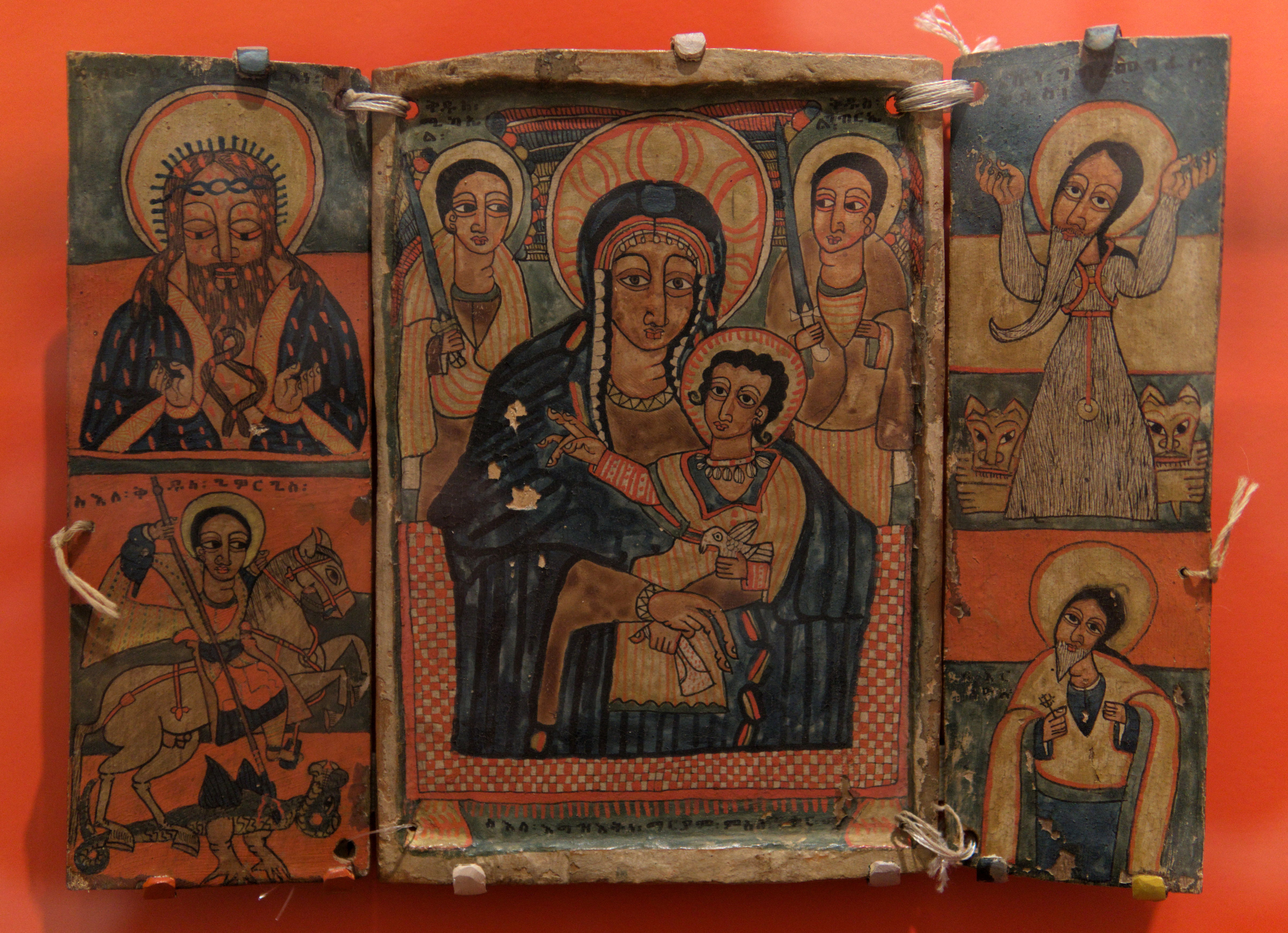
One of history’s most famous Ethiopian painters is Fre Seyon, who worked at the court of Emperor Zara Yaqob (r. 1434–1468) and was of the first generation of Ethiopian artists who painted icons on wood panels. He was also a monk. He likely introduced one of the characteristic features of Ethiopian icons of the Virgin and Child: the archangels Michael and Gabriel flanking them with drawn swords, acting as a kind of honor guard.
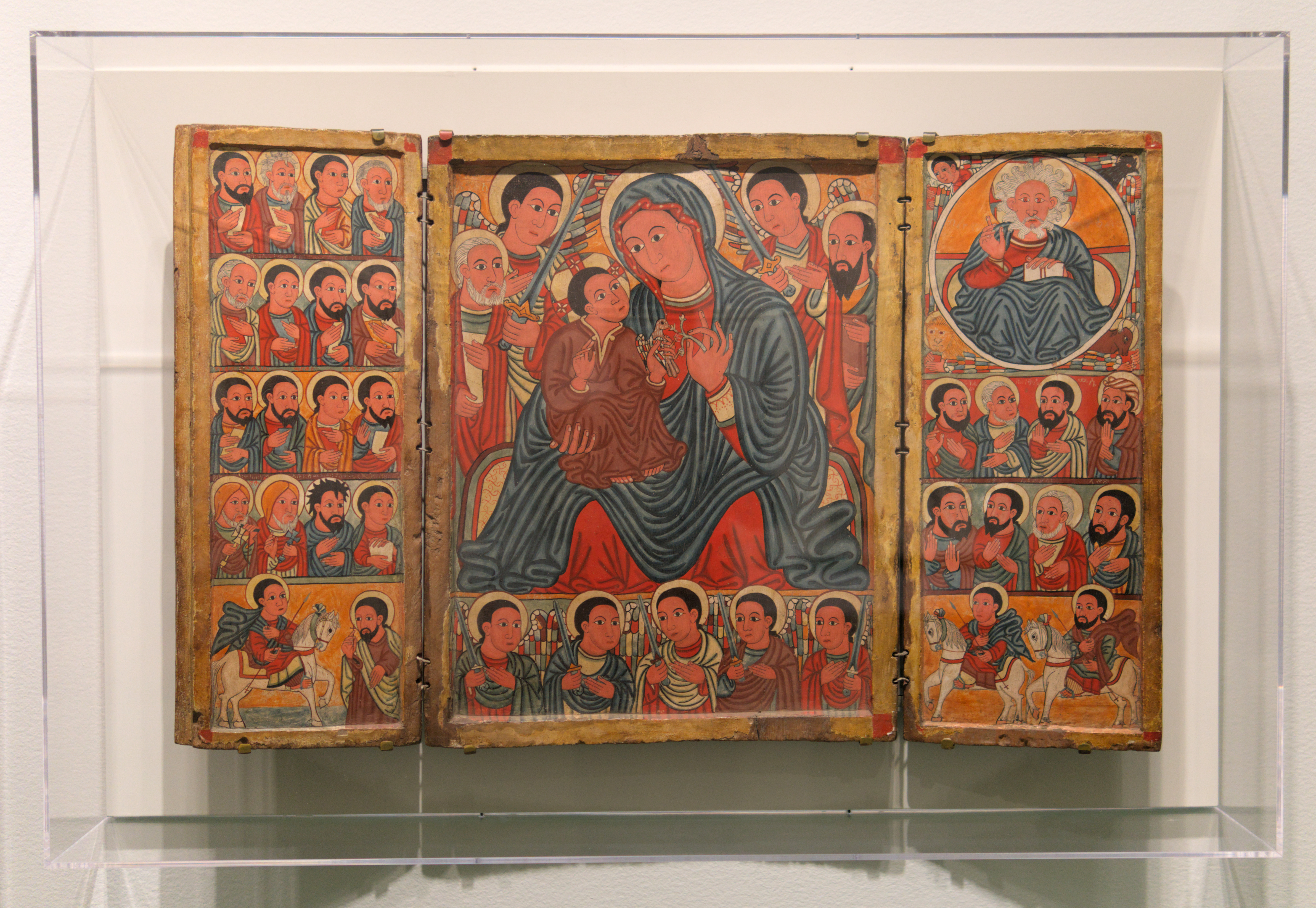
Fre Seyon triptych
Fre Seyon (Ethiopian, active 1445–1480), Triptych Icon with the Virgin Mary and Christ Child Flanked by Archangels and Saints (center), Twelve Apostles and Saints (left), and Prophets and Saints (right), mid- to late 15th century. Tempera on gesso-primed wood. Institute of Ethiopian Studies, Addis Ababa University, acc. no. IESMus4186.

My two favorite details of this triptych by Fre Seyon are (on the right wing) the image of the Ancient of Days surrounded by the tetramorph, his wild gray locks being blown about, and in the center, the bird that Christ holds, its feet grasping at a three-branched twig. On a literal level, the bird is a plaything for the boy that charmingly emphasizes his humanity (in the late Middle Ages, at least in Europe—I’m not sure about in Ethiopia—it was common for young children to keep tame birds as pets). On another level, the bird may be symbolic. In traditional Western art, Jesus sometimes holds a goldfinch, a bird with distinctive red markings that’s fond of eating thistle seeds and gathering thistle down and thus came to be read as a prefiguration of Christ’s thorny, blood-spilt passion. I’m not sure whether Fre Seyon intended a symbolic significance for this bird.

The Ancient of Days, enthroned in the tetramorph

Here’s another triptych from the exhibition, this one from a century and a half later:

Virgin and Child triptych
Triptych Icon with the Virgin Mary and Christ Child Flanked by Archangels, Scenes from the Life of Christ, Saint George, and Saints Honorius, Täklä Haymanot, and Ewostatewos, Ethiopia (Tigray), early 17th century. Glue tempera on panel, 16 3/4 × 22 5/16 in. (42.5 × 56.7 cm). Walters Art Museum, Baltimore. [object record]

The composition of the Virgin and Child is based on prints of a painted icon from Santa Maria Maggiore in Rome brought to Ethiopia by Portuguese Jesuit missionaries—but it innovates. As the wall text notes, “Mary’s cloak stretch[es] out in either direction to embrace the scene of Christ Teaching the Apostles below. Umbrella-like, Mary appears as both the protector and personification of the church.”
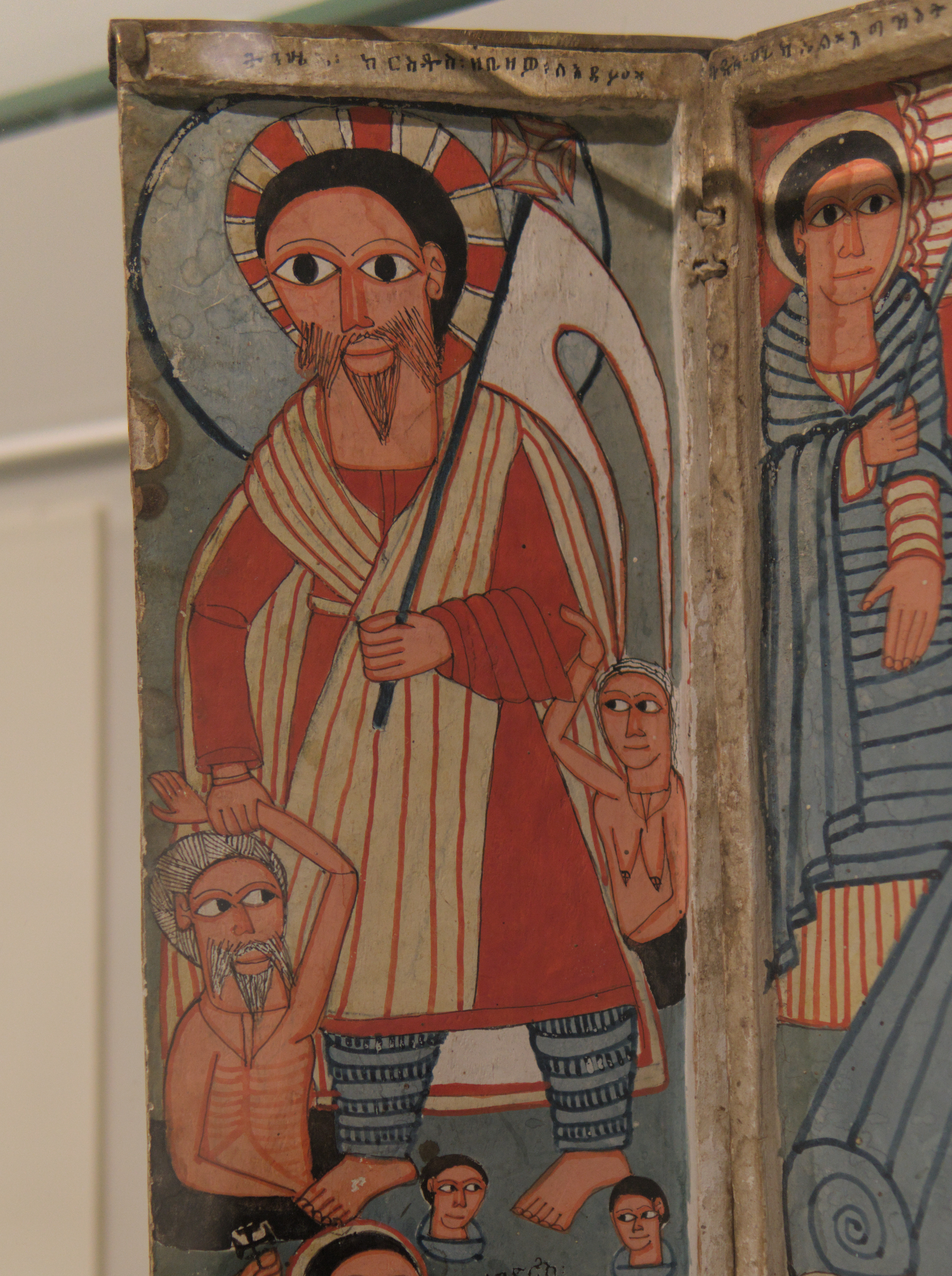
Harrowing of Hell

On the right wing, angels hold up chalices to collect the blood that flows from Jesus’s wounds on the cross, while below that, Joseph of Arimathea and Nicodemus carry Jesus’s wrapped corpse to the tomb. On the left wing is one of my favorite traditional religious scenes: the Harrowing of Hell, or Christ’s Descent into Limbo, in which, on Holy Saturday, Jesus enters the realm of his dead to take back those whom Death has held captive, first of which are our foreparents Adam and Eve. Below that scene is an image of the dragon-slaying Saint George, a late third-century figure from the Levant or Cappadocia who is the patron saint of Ethiopia.

At the bottom center is a scene of Christ teaching the twelve apostles, plus two Ethiopian saints. They all hold hand crosses, like those carried by Ethiopian priests and monks.
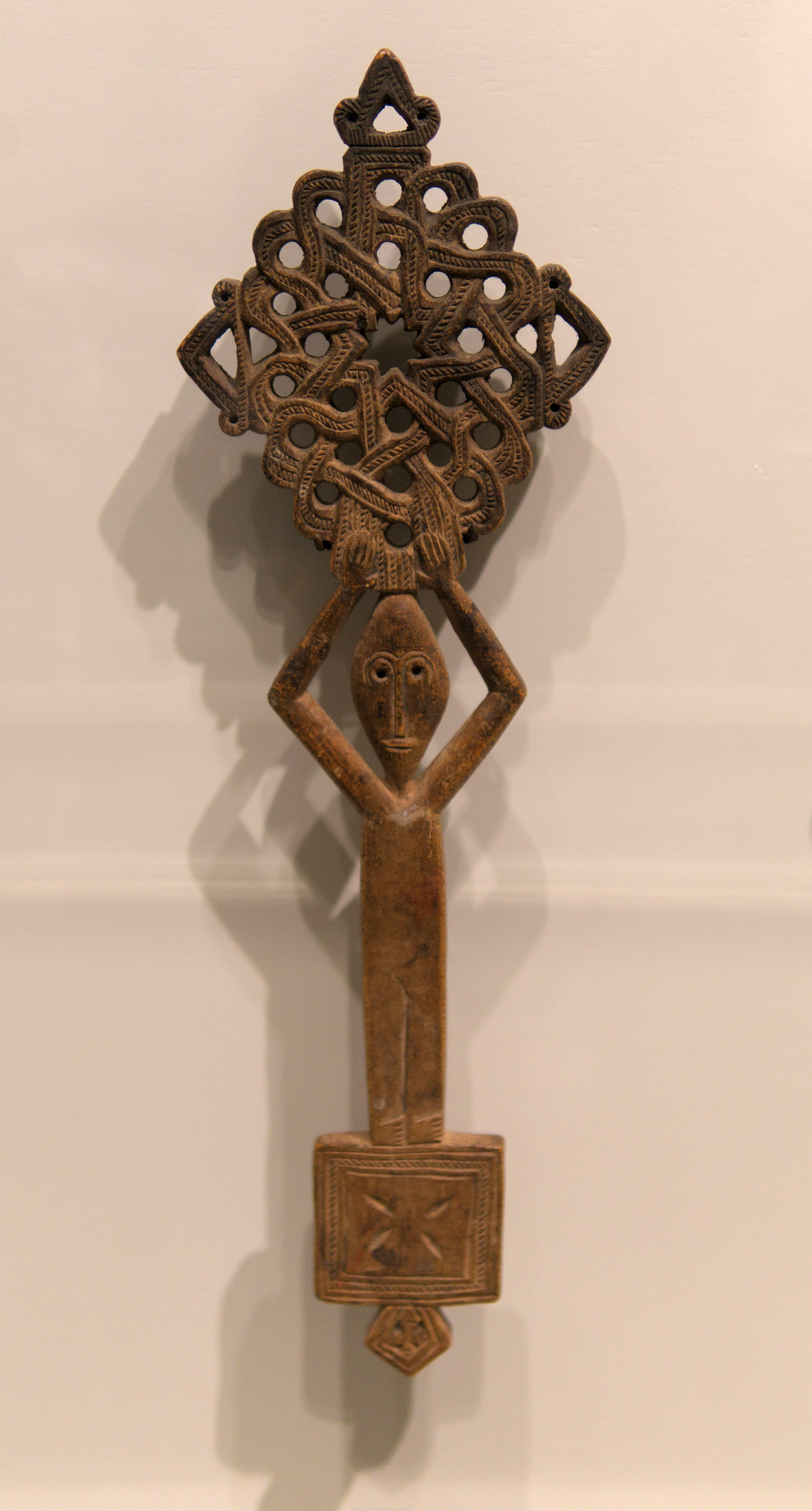
Hand Cross with Figure
Hand Cross with Figure, Ethiopia, probably 18th–19th century. Wood, 13 3/8 × 4 3/16 × 9/16 in. (34 x 10.7 × 1.4 cm). Walters Art Museum, Baltimore. [object record]

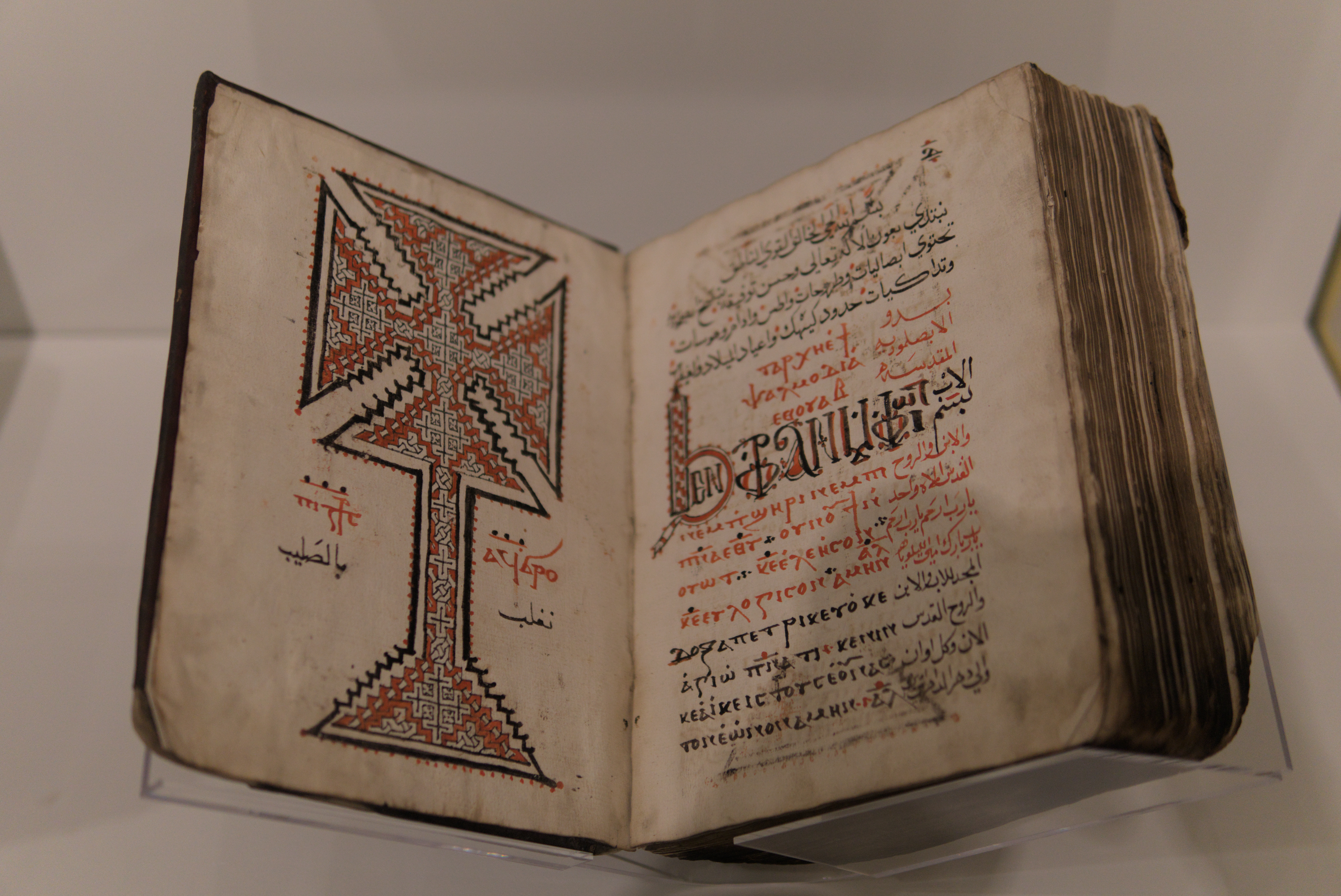
Coptic-Arabic Book of Prayer
Coptic-Arabic Book of Prayer, Egypt, 18th century. Tempera and ink on parchment, 11 3/4 × 9 in. (29.8 × 22.8 cm). Melikian Collection. [object record]

One of the hallmarks of the exhibition is its multisensory nature: attendees are immersed not only in the sights of Ethiopia but also in the sounds and smells. Scratch-and-sniff cards invite people to take a whiff of frankincense, which would have filled the censer on display. Or to smell berbere, a hot spice blend that would have been stored in the woven baskets nearby.

Frankincense

This olfactory element was produced by the Institute for Digital Archaeology, which, as part of its efforts to record and preserve ephemeral culture, has launched an ambitious program to preserve the heritage of smells. “The aim is to provide the technical means for documenting the aromas of today for the benefit of future generations – and to find new methods and opportunities for experiencing the odors of the past.”

Also in the exhibition there are screens where you can watch videos of Ethiopian Orthodox worship, including music and liturgies, where you will see some of the objects in use. You can also listen to interviews with members of the local Ethiopian diaspora community. (The Washington metropolitan area has the largest Ethiopian population outside Ethiopia.)
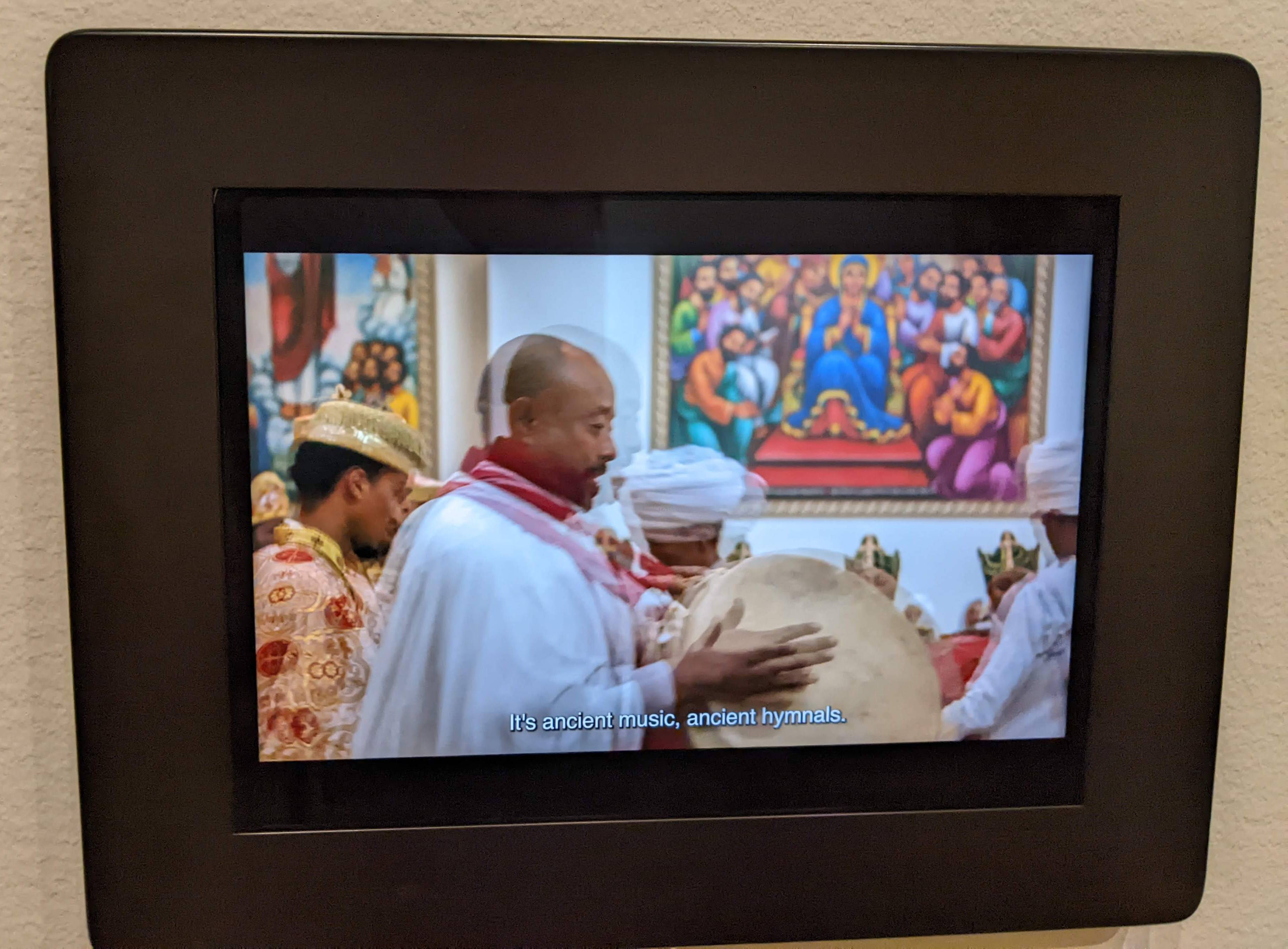
Further contextualizing the objects and enhancing the sense of place, pasted onto the wall is a blow-up photograph of a Christian holy-day celebration wending through the streets. This serves as a backdrop to two physical artifacts present in the room: a qämis (dress) and a debab (umbrella).

Dress and umbrella
Left: Dress (qämis), Ethiopia, 20th century(?), cotton, Peabody Essex Museum, E72559. Right: Umbrella (debab), Ethiopia, 20th century, silk and velvet, Peabody Essex Museum, E68713.

The inscriptions on many of the Ethiopian icons and manuscript illuminations, which identify the figures and scenes, are in Ge‘ez (aka classical Ethiopic), an ancient South Semitic language that originated over two thousand years ago in what is now northern Ethiopia and Eritrea. It’s no longer spoken in daily life, but it is still used as the language of the Ethiopian Orthodox Church and taught to boys in Sunday school. I really wish I could read it, as it would be a great help in interpreting the Ethiopian images I come across in my studies!

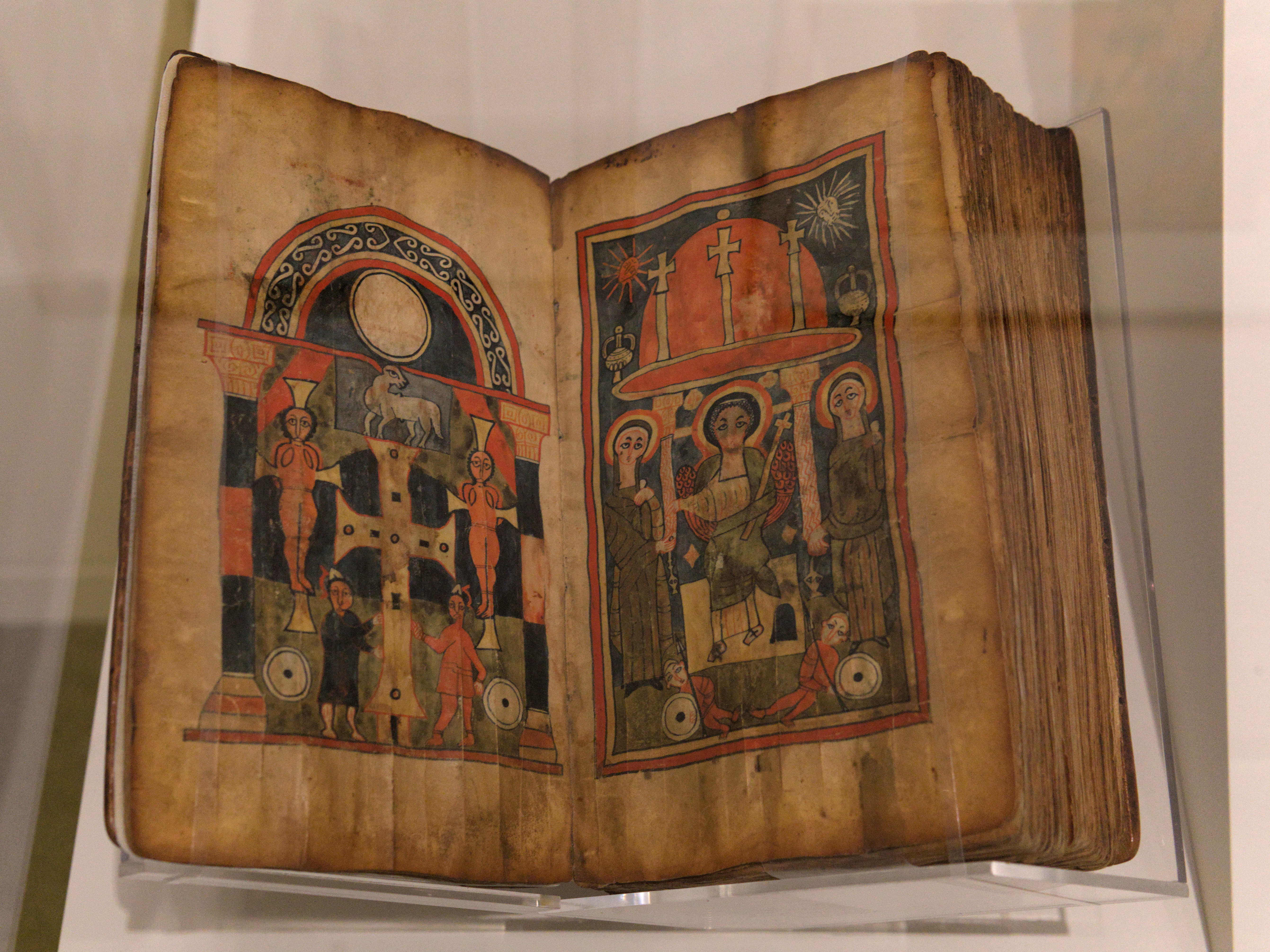
Contrary to what some may assume, Ethiopians in the medieval era were not an isolated people. They traveled—to Rome, to Jerusalem, and so forth. Evidence of Holy Land pilgrimage is suggested by an early fourteenth-century Gospel book that includes the domed Church of the Holy Sepulcher as the backdrop for Christ’s resurrection:
Crucifixion and Resurrection
Gospel Book with the Crucifixion and Christ’s Resurrection, Ethiopia (Tigray), early 14th century. Ink and paint on parchment, 10 1/2 × 6 11/16 in. (26.7 × 17 cm). Walters Art Museum, Baltimore, W.8.36, fols. 6v–7r. [object record]

This is an extraordinary book, one of the oldest surviving Ethiopian manuscripts and the oldest in North America. Ethiopian artists weren’t yet depicting Jesus on the cross, so to represent the Crucifixion, this artist has painted a living lamb surmounting a bejeweled cross, with the two thieves crucified on either side.

Also from the fourteenth century, a manuscript opened to a page spread of Christ’s Entry into Jerusalem:

Triumphal Entry
Christ’s Entry into Jerusalem, folios added from an earlier Gospel book to a Ta’ammera Maryam manuscript, Ethiopia, 14th century. Tempera and ink on parchment. Private collection.

I like how the scene extends across both pages, creating a sense of forward progression, and the two onlookers above the city gate.

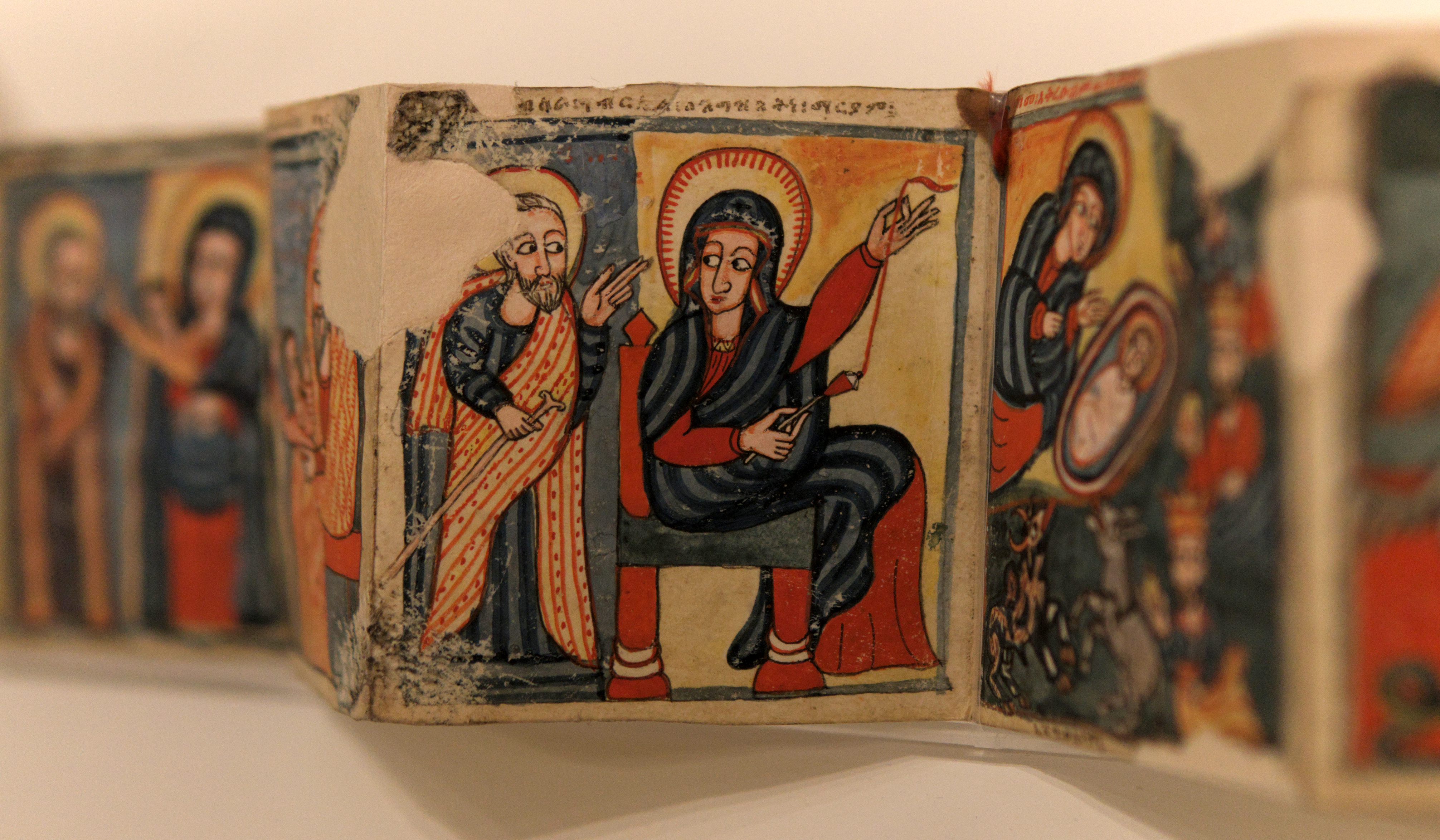
One of my favorite objects from the exhibition is a sensul from Gondar depicting ten scenes from the life of Mary. A sensul is an Ethiopian chain manuscript, in this case pocket-size, created out of a single folded strip of parchment attached to heavy hide boards at each end, which creates a small book when folded shut. Here’s a detail showing the Annunciation:
Annunciation (from a sensul)
Annunciation, from a Gondarine sensul (chained manuscript), Ethiopia (Gondar), late 17th century. Ink and paint on parchment, each panel 3 5/8 × 3 1/8 in. (9.2 × 9 cm). Walters Art Museum, Baltimore. [object record] [GIF]

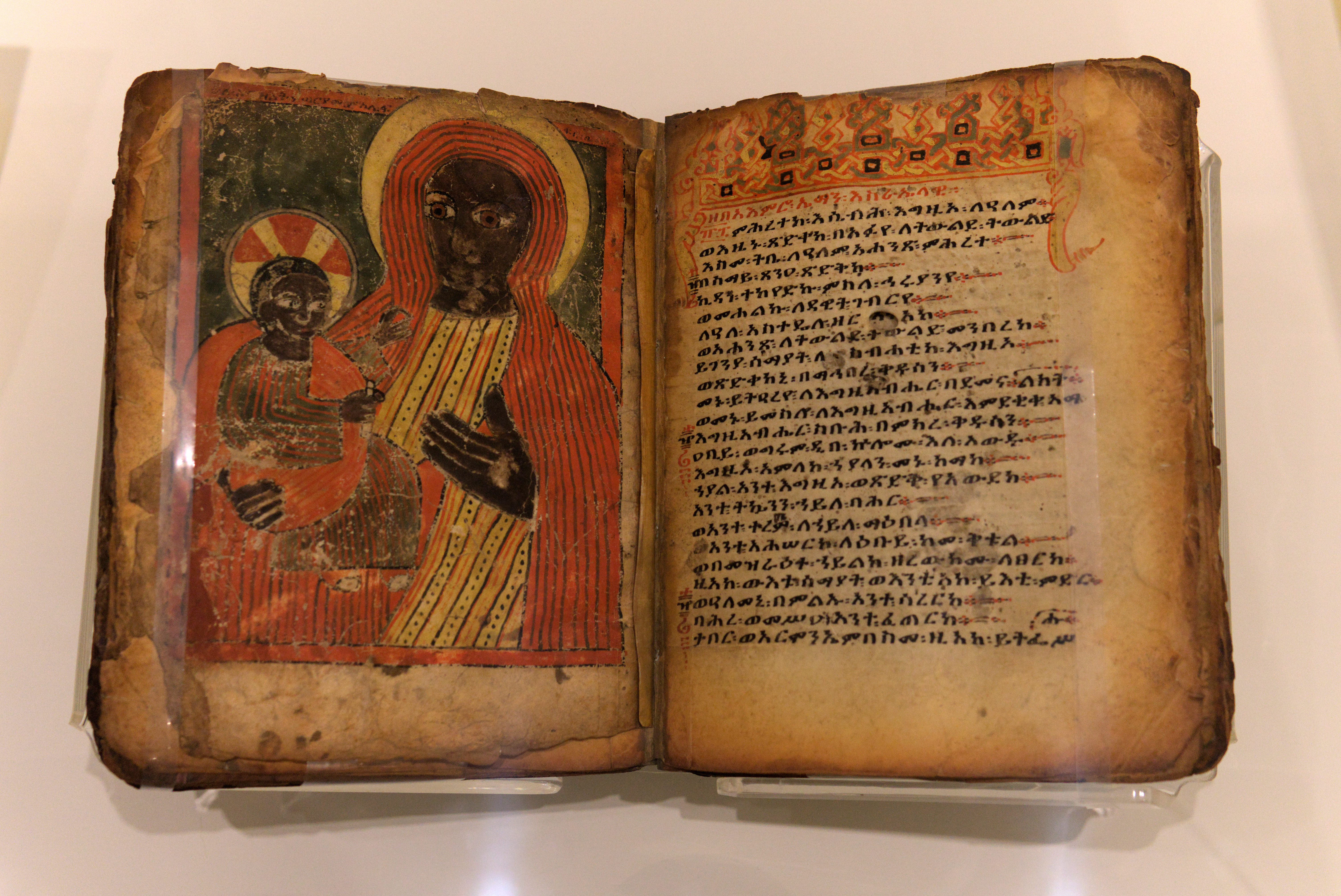
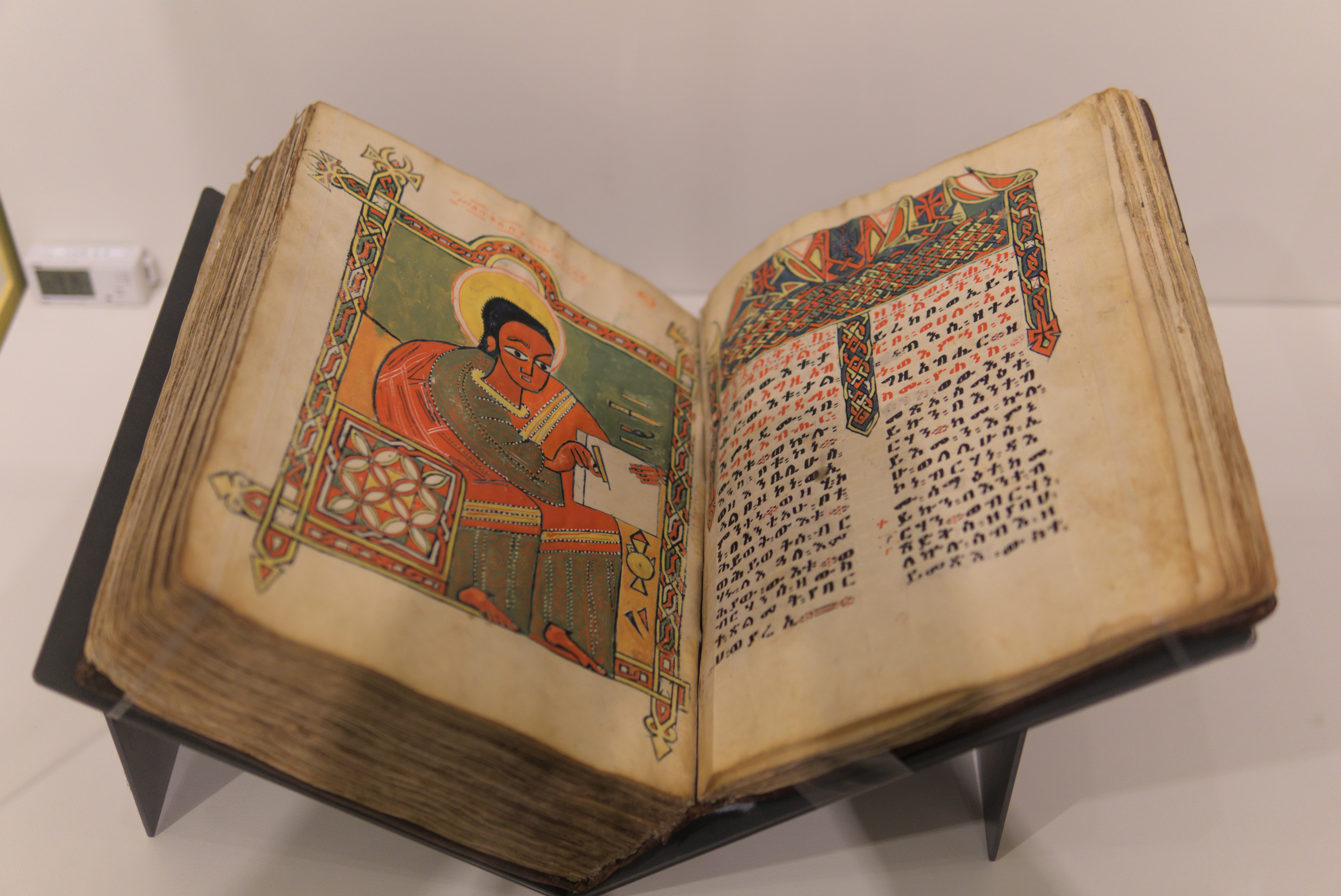
It’s a common misconception that Ethiopians have always depicted biblical figures as dark-skinned to reflect the local population. Such treatment didn’t become normative until the eighteenth century, although some earlier artists did choose black complexions for holy persons:
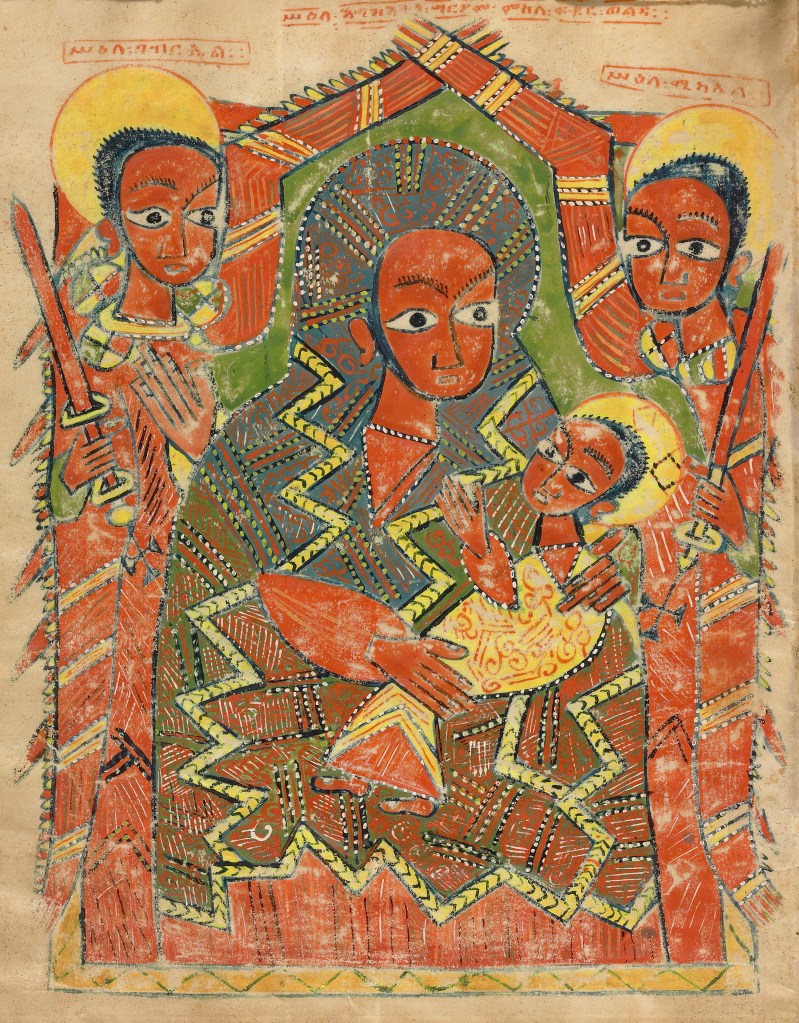
Virgin and Child
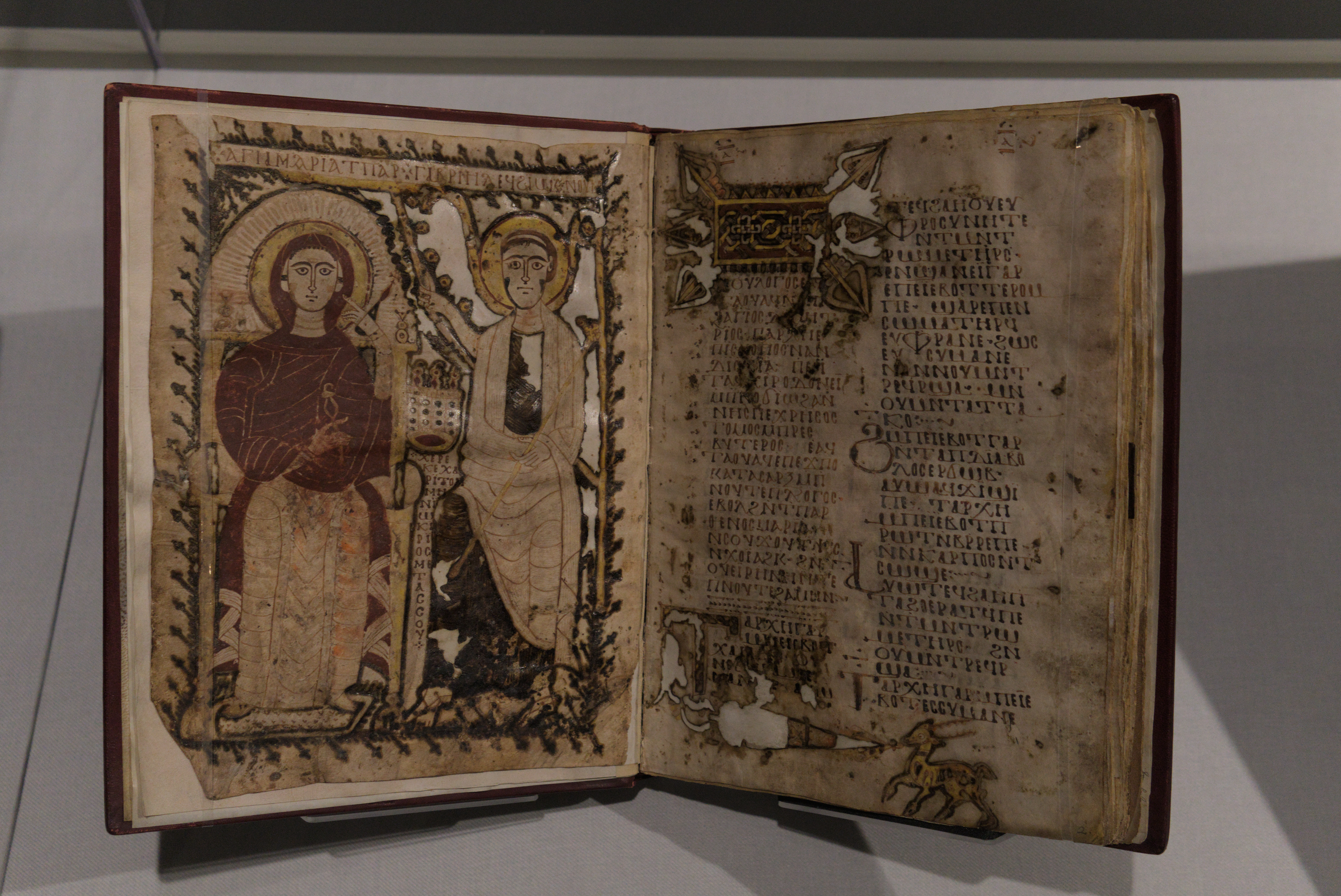
Virgin and Child, from a Psalter with the Wəddase Maryam (Praise of Mary) and Mähalǝyä Näbiyyat (Canticles of the Prophets), Ethiopia, 15th century. Ink and pigments on parchment with wooden boards, open: 8 7/8 × 6 11/16 × 3 15/16 in. (22.5 × 17 × 10 cm). Toledo Museum of Art, Ohio. [object record]

Portrait of John the Evangelist
The Opening of the Gospel of John, from a Gospel book, Ethiopia, ca. 1504–5. Tempera on parchment, 13 9/16 × 10 7/16 in. (34.5 × 26.5 cm). J. Paul Getty Museum, Los Angeles, Ms. 102, fols. 215v–216r. [object record]

Virgin and Child triptych
Triptych Icon with the Virgin Mary and Christ Child Flanked by Archangels (center), the Kwer‘atä re’esu (Man of Sorrows) and Saint George (left), and Saint Gäbrä Mänfäs Qeddus and Abba Arsanyos (right), Ethiopia (Gondar), late 17th–early 18th century. Tempera on gesso-primed wood. Institute of Ethiopian Studies, Addis Ababa University, acc. no. IESMus3492.

In the triptych shown above, not only is the infant Jesus depicted as Black, but he also wears a necklace made of cowrie shells, which are traditionally given to Ethiopian children for protection!

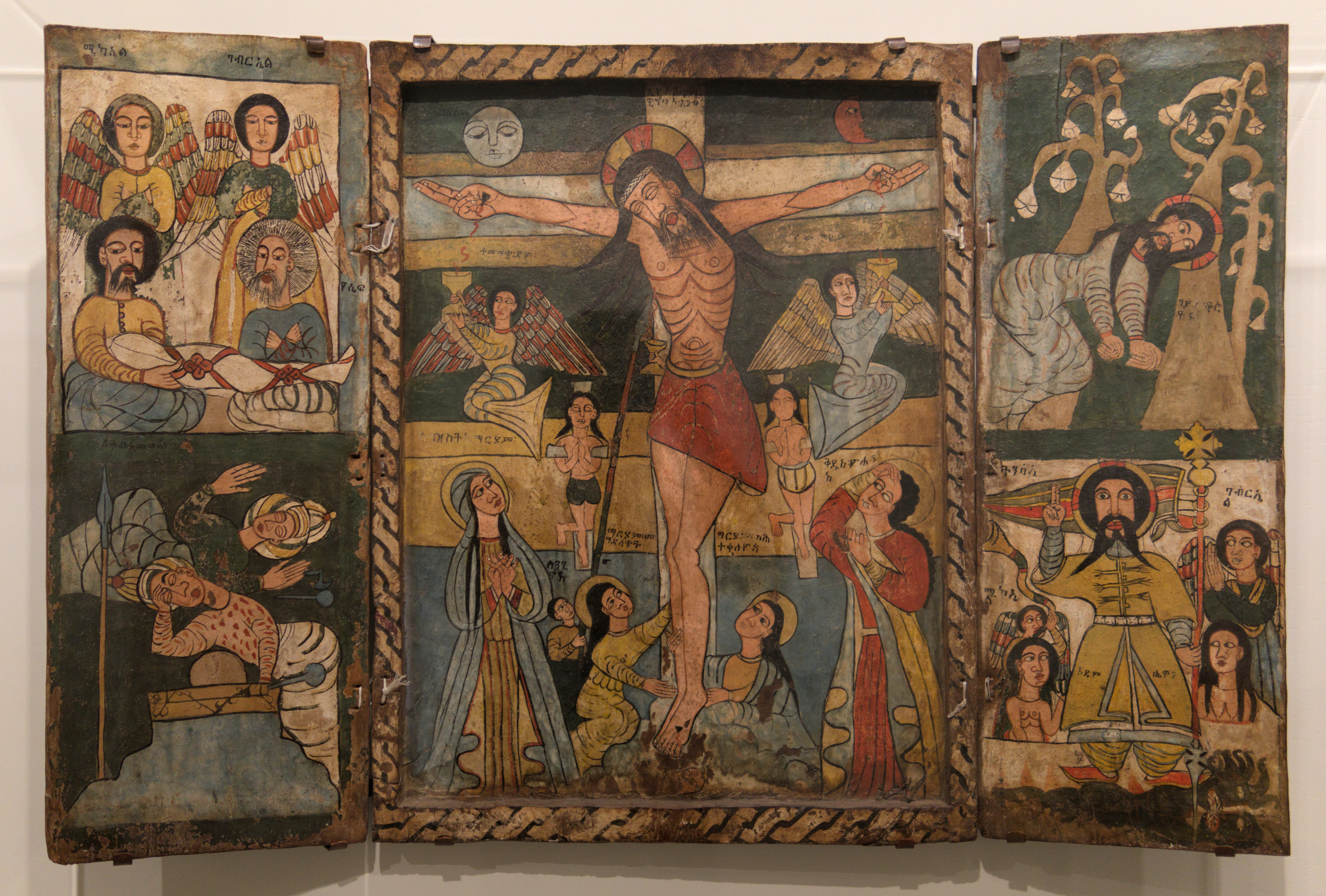
My favorite artwork from the exhibition is probably this triptych:
Crucifixion triptych
Triptych Icon with the Crucifixion (center), Entombment and Guards at the Tomb (left), and Temptation in the Wilderness and the Resurrection of Christ (right), Ethiopia, late 16th century. Tempera on gesso-primed wood. Institute of Ethiopian Studies, Addis Ababa University, acc. no. IESMus4126.

Its central panel depicts the Crucifixion, Christ’s head bowed in death and his fingers gesturing blessing, even as his palms are nailed. At the top, the sun and the moon mourn his passing. As we saw before, angels catch the blood that drips from his body (notice the cute little hand sticking out from behind his torso!). At the base, the two larger-scale figures are the Virgin Mary and St. John, while next to Mary on a smaller scale is Longinus, the centurion who pierces Christ’s side with a spear.

The left wing shows the Entombment of Christ, with two guards, wearing pointed turbans, sleeping at their post. The right wing shows a scene that the label identifies as “Temptation in the Wilderness” (presumably a translation of the inscription on the tree) but that looks to me more like an Agony in the Garden. Below that is the Resurrection, with Christ holding a victory banner, standing atop Hades. An angel blows a shofar and the dead rise up out of their graves, following Christ, the firstfruits of the resurrection (1 Cor. 15:20–22). Christ wears a short-sleeved, knee-length jacket with frog closures, and bunched sleeves and trousers, both of which reflect clothing from regions east of Africa.

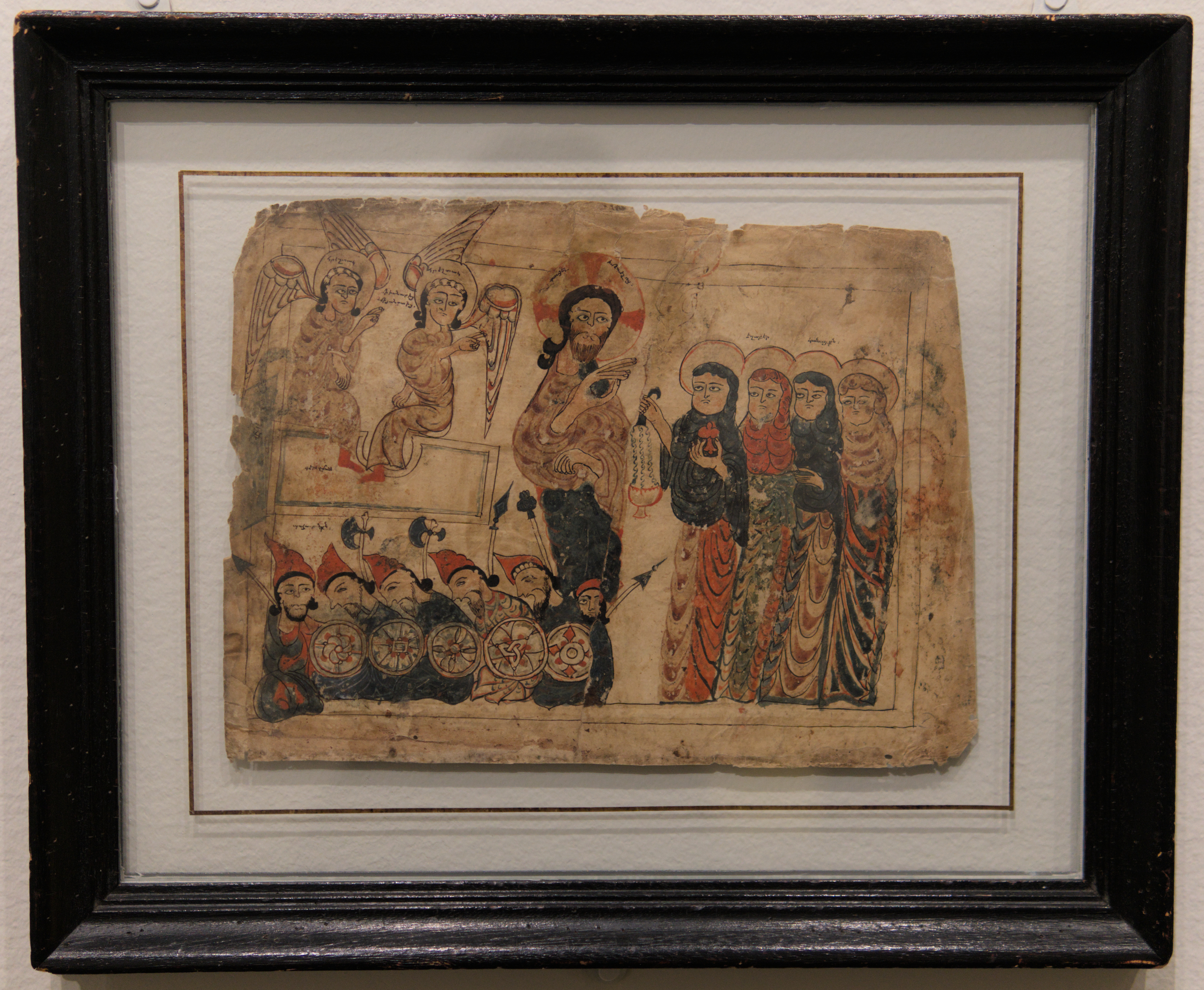
The wall text notes the fine, wavy lines used to render the figures’ draperies, perhaps influenced by Armenian artists from the Lake Van region.
Armenian Resurrection
Yovsian of Vaspurakan (Armenian), Leaf from a Gospel book with the Resurrection of Christ and Visit of the Women to the Tomb of Christ, ca. 1350. Tempera on cotton paper. Private collection.

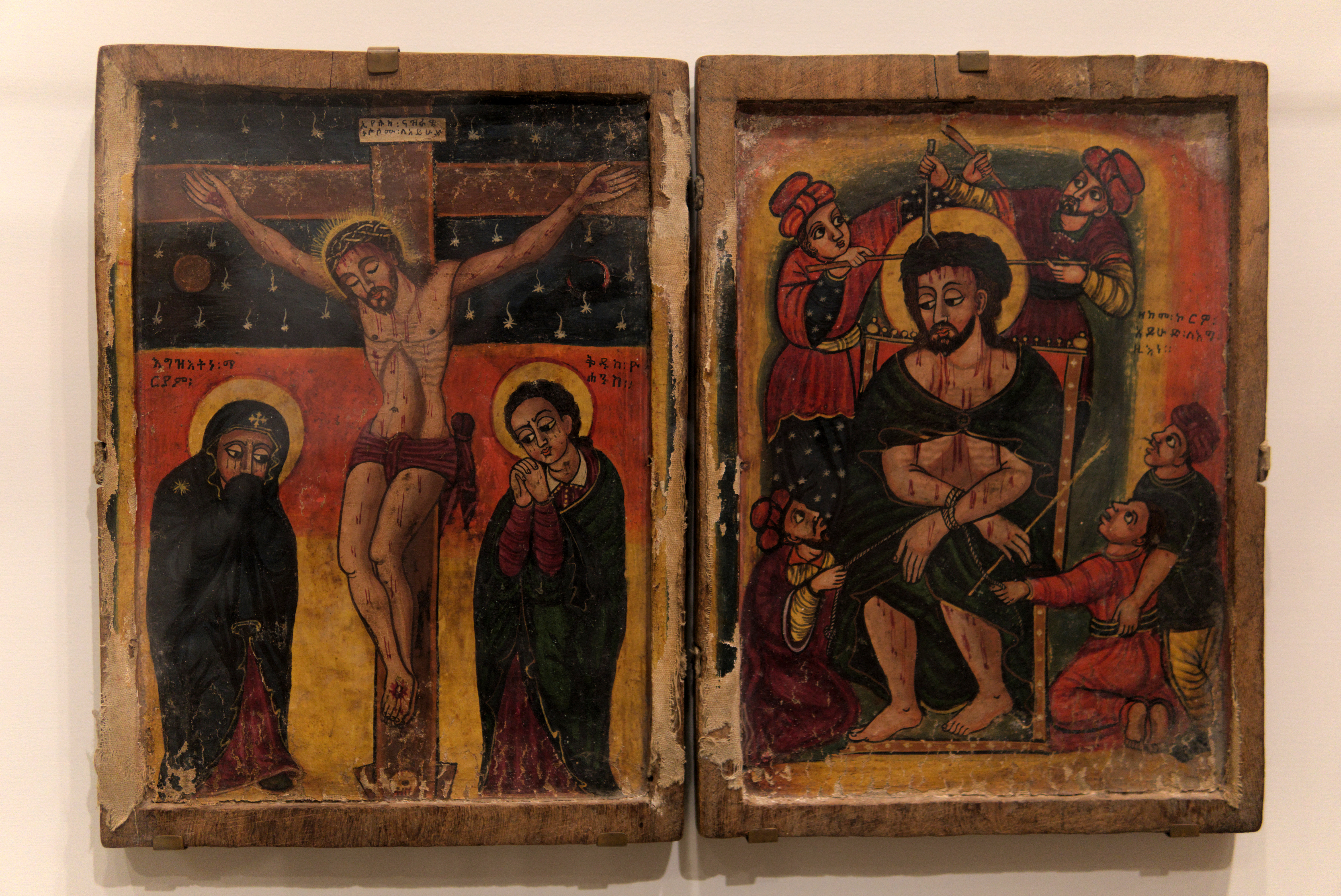
Here’s another Crucifixion, this one painted in what’s called the Second Gondarine style, characterized by smoothly modeled figures, often with darker skin tones, and wide horizontal bands of red, yellow, and green filling the background:
Crucifixion-Mocking diptych
Diptych Icon with the Crucifixion (left) and the Mocking of Christ (right), Ethiopia, late 17th–early 18th century. Wood, polychrome, 13 1/2 × 9 7/8 in. (34.3 × 25.1 cm). Virginia Museum of Fine Arts, Richmond. [object record]

The squiggles behind Christ at the top left may simply be a decorative motif, but to me they look like falling stars, an apocalyptic sign, and as if the sky is weeping.

The right panel of the diptych shows Christ being cruelly fitted with a crown of thorns.

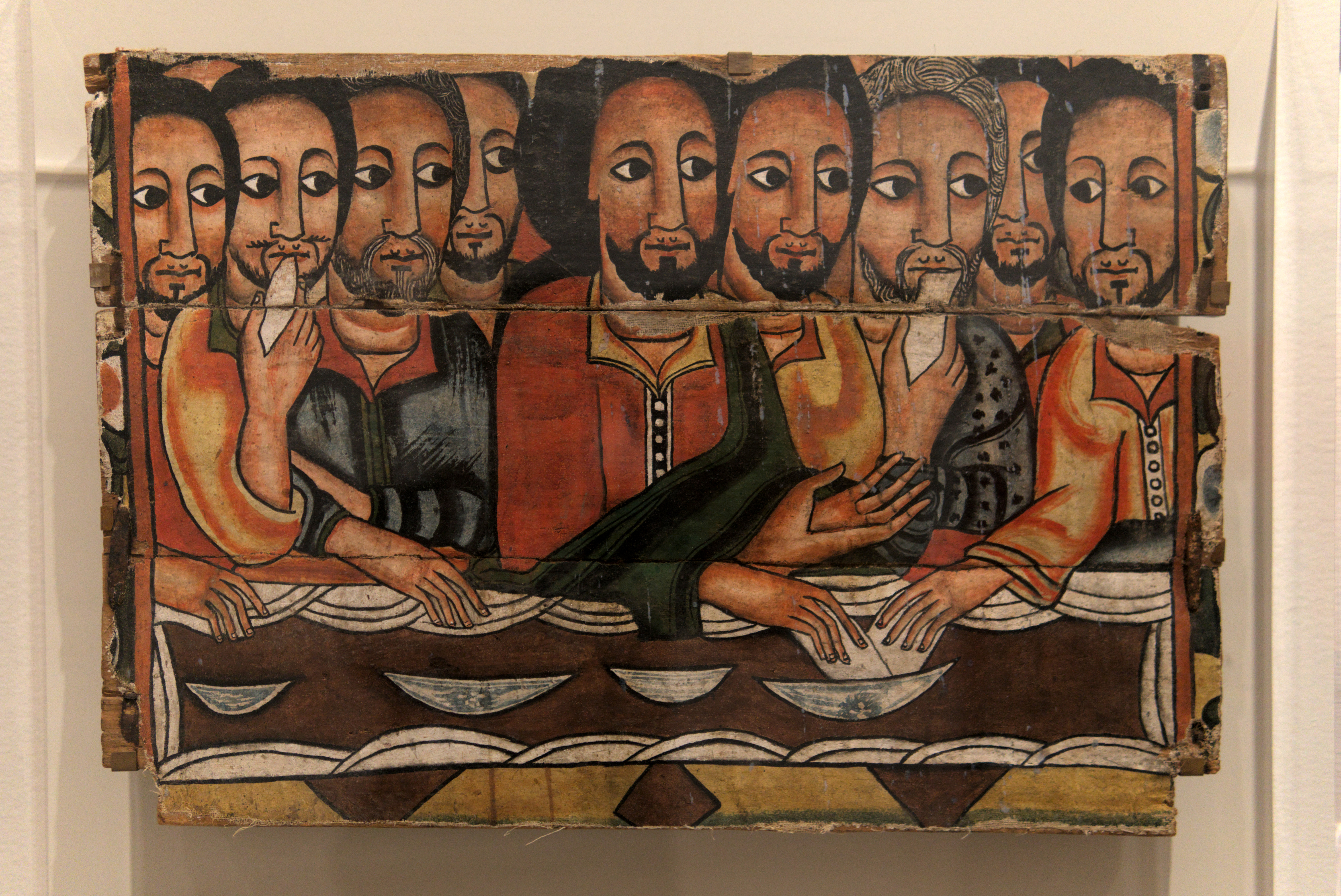
Two other passion images I want to share are a Last Supper wall painting and an Entombment from a disbound album.
Last Supper
Last Supper, Ethiopia, 18th century. Tempera on linen, mounted on panel, 16 3/4 × 24 in. (42.6 × 61 cm). Virginia Museum of Fine Arts, Richmond. [object record]

Entombment
Album Leaf with the Entombment of Christ, Ethiopia (Sawa?), late 17th century. Pigments on vellum. Minneapolis Institute of Art, 2009.39.3y. [object record]

In the Last Supper, Jesus and Judas both dip their bread (injera!) into the same bowl and exchange a knowing glance.

In the Entombment, Jesus, wrapped in white linen, is lowered into the ground, mourned by several of his women followers. The portrayal of his mother Mary’s weeping, her hands covering her eyes and her face stained with tears, is particularly poignant. This leaf is from a set of forty-four, now matted separately but originally arranged in series and likely painted on several long sheets of parchment that were sewn together and folded accordion-style to form a sensul.

One of the most extraordinary objects on display is a rare folding processional icon that adopts the form of a fan, from the late fifteenth century:

Processional icon (Ethiopia)
Folding Processional Icon in the Shape of a Fan, Ethiopia, late 15th century (Stephanite). Ink and paint on parchment, thread, extended: 24 1/4 × 154 1/8 × 4 3/4 in. (61.6 × 391.4 × 12 cm). Walters Art Museum, Baltimore. Photo courtesy of the museum. [object record]

Thirty-eight identically sized figures span the surface of this elongated parchment: the early Christian martyrs Julitta (Juliet) and Cyricus, St. George, St. John the Baptist, the archangel Michael, the Virgin Mary, the archangel Raphael, St. Paul, the Ethiopian artist-priest Afnin, and unidentified Old Testament patriarchs and prophets. There would have been a wooden handle attached to either end that, when pulled together, created a double handle for a giant wheel to be displayed during liturgical processions and church services (see here). As the museum website notes, “The Virgin Mary, whose hands are raised in a gesture of prayer, is then at the top of the wheel. By depicting Mary in the company of saints and angels, the icon powerfully evokes the celestial community of the church.”

This is just a sampling of all the wonderful art objects that are a part of the Ethiopia at the Crossroads exhibition. I’ll share more photos on Instagram (@art_and_theology) in the coming weeks.

I strongly encourage you to go see this! I think it would be enjoyable for children as well, especially Christian children, who will be able to identify many of the painted stories. For Christians, it’s an opportunity to connect with our artistic heritage and with African church history. If you can’t catch the exhibition at the Walters in Baltimore before it closes March 3, it will be traveling to the Peabody Essex Museum in Salem, Massachusetts (April 13–July 7, 2024), and the Toledo Museum of Art in Ohio (August 17–November 10, 2024).

Also, a catalog is coming out in April, where you will find photos of all the artworks in addition to illuminating essays.

Roundup: “Africa & Byzantium,” “Ethiopia at the Crossroads,” and more

ART EXHIBITIONS:

Two major exhibitions of African art are currently running in Manhattan and Baltimore, containing many Christian objects, some of them never before seen in the US. I attended both, and they’re excellent. I want to write a full-on review for each, but because I don’t know that I’ll have time to do so before they close, I wanted to at least make you aware of them in this abbreviated form in the hopes that you’ll have a chance to go see them. I will share more photos soon.

>> Africa & Byzantium, Metropolitan Museum of Art, New York City, November 19, 2023–March 3, 2024: Curated by Dr. Andrea Myers Achi. “Art history has long emphasized the glories of the Byzantine Empire (circa 330–1453), but less known are the profound artistic contributions of North Africa, Egypt, Nubia, Ethiopia, and other powerful African kingdoms whose pivotal interactions with Byzantium had a lasting impact on the Mediterranean world. Bringing together a range of masterworks—from mosaic, sculpture, pottery, and metalwork to luxury objects, paintings, and religious manuscripts—this exhibition recounts Africa’s central role in international networks of trade and cultural exchange. With artworks rarely or never before seen in public, Africa & Byzantium sheds new light on the staggering artistic achievements of medieval Africa. This long-overdue exhibition highlights how the continent contributed to the development of the premodern world and offers a more complete history of the vibrant multiethnic societies of north and east Africa that shaped the artistic, economic, and cultural life of Byzantium and beyond.”

Annunciation (Egypt)
The Annunciation, from a miscellany, Egypt, Fayyum Oasis, 913–14. Ink on parchment, 10 9/16 × 13 13/16 in. (26.8 × 35.1 cm). Collection of the Morgan Library and Museum, New York. Photo: Victoria Emily Jones.

_DSC8288
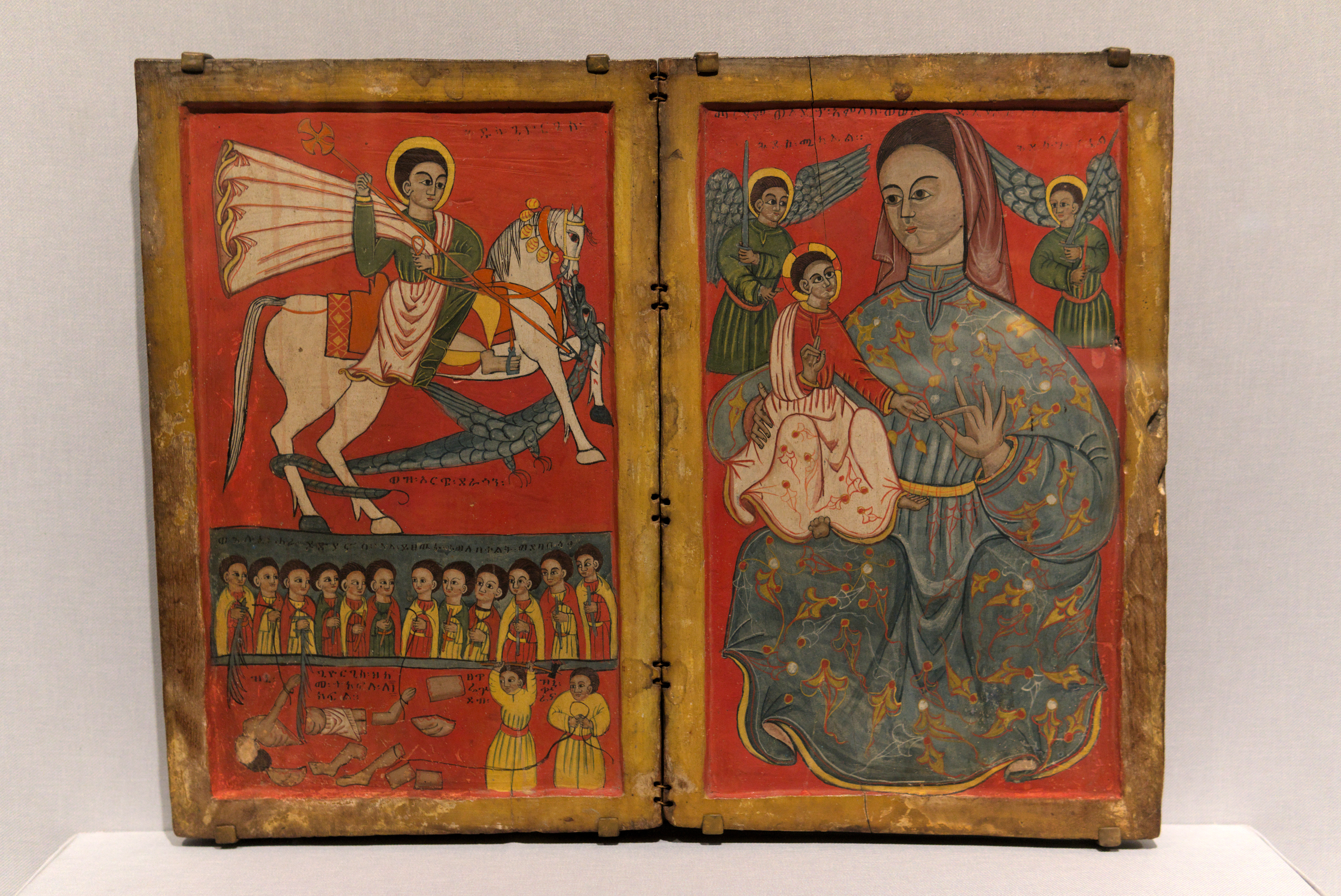
Diptych with Saint George and the Virgin and Child, Ethiopia, late 15th–early 16th century. Paint on wood, 20 1/2 × 26 5/16 × 1 3/16 in. (52 × 66.8 × 3 cm). Collection of the National Museum of African Art, Smithsonian Institution, Washington, DC. Photo: Victoria Emily Jones.

Exhibition tour:

Smarthistory video of one of the extraordinary early icons on display, borrowed from St. Catherine’s Monastery in Mount Sinai, Egypt:

>> Ethiopia at the Crossroads, Walters Art Museum, Baltimore, December 3, 2023–March 3, 2024: Curated by Dr. Christine Sciacca. “Ethiopia at the Crossroads is the first major art exhibition in America to examine an array of Ethiopian cultural and artistic traditions from their origins to the present day and to chart the ways in which engaging with surrounding cultures manifested in Ethiopian artistic practices. Featuring more than 220 objects drawn from the Walters’ world-renowned collection of Ethiopian art and augmented with loans from American, European, and Ethiopian lenders, the exhibition spans 1,750 years of Ethiopia’s proud artistic, cultural, and religious history.

“Seated in the Horn of Africa between Europe and the Middle East, Ethiopia is an intersection of diverse climates, religions, and cultures. Home to over 80 different ethnicities and religious groups, a large portion of the historic artistic production in Ethiopia supported one of the three Abrahamic faiths (Judaism, Christianity, and Islam), all of which have early roots in Ethiopia. As one of the oldest Christian kingdoms, Ethiopian artists produced icons, wall paintings, crosses of various scales, and illuminated manuscripts to support this religious tradition and its liturgy. . . .”

The exhibition will travel to the Peabody Essex Museum in Salem, Massachusetts, April 13–July 7, 2024, and to the Toledo Museum of Art in Ohio August 17–November 10, 2024.

Ethiopian sensul
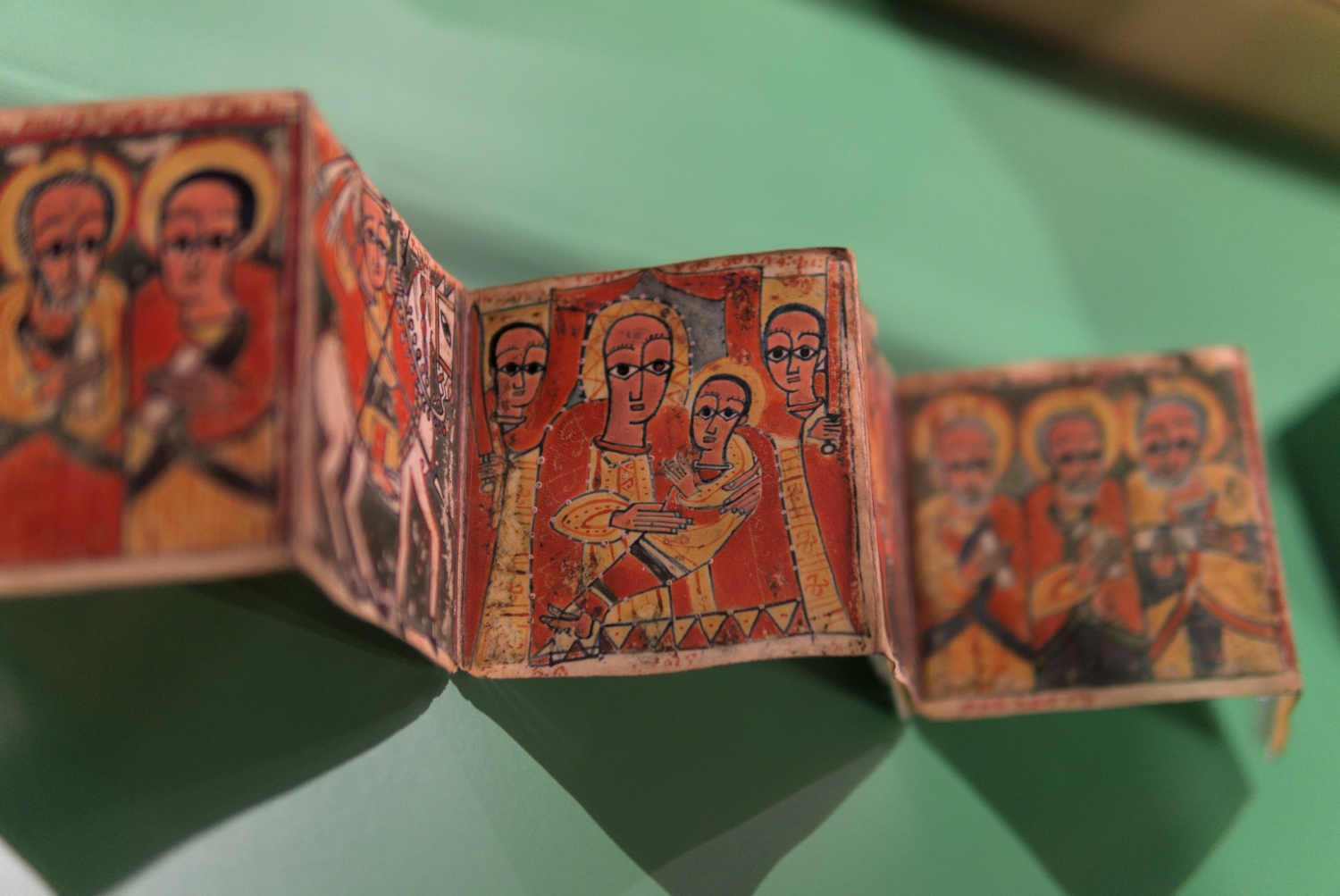
Detail of a sensul (chained manuscript), Ethiopia, 15th–early 16th century. Parchment, ink, paint, and leather. Collection of the Peabody Essex Museum, Salem, Massachusetts. Photo: Victoria Emily Jones.

Mänbärä Tabot Icon
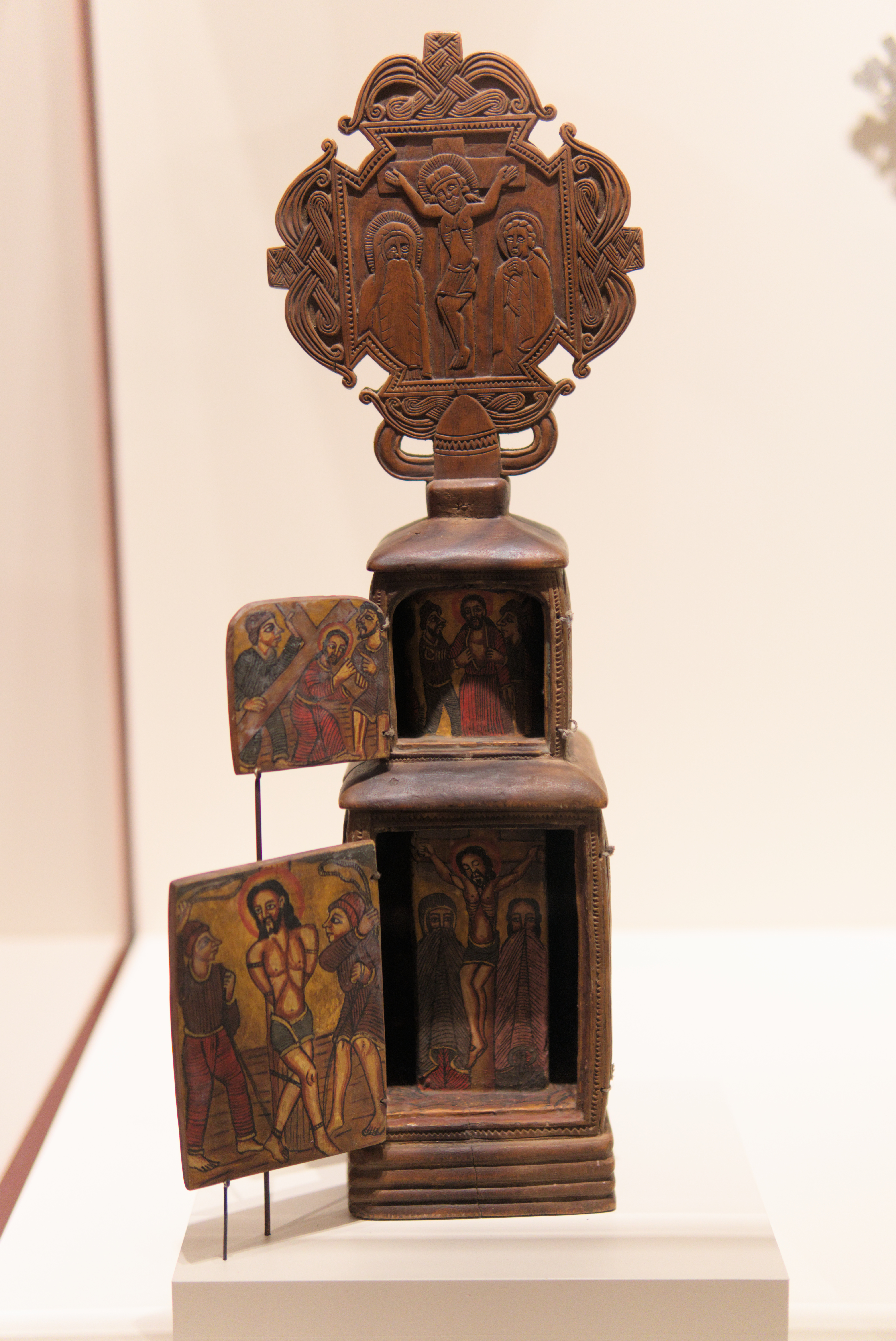
Mänbärä Tabot Icon with Eight Panels and Painted Scenes, Ethiopia, ca. 1850. Carved wood and glue tempera. Private collection, United States. Photo: Victoria Emily Jones.

+++

SPOTIFY PLAYLIST: February 2024 (Art & Theology): An assortment of psalms, hymns, and spiritual songs, old and new.

Also, as Lent starts on February 14, don’t forget about my Lent playlist! Since its original publication in 2021, I’ve added songs to the bottom.

+++

BLOG POST: “The True Purpose of Theology” by W. David O. Taylor: Professor Taylor shares seven things about theology that he opens his first theology class lecture with each term at Fuller. So important. I hope I reflect these on my blog.

+++

HYMN: “O Love That Wilt Not Let Me Go” by George Matheson: I first shared this hymn at Art & Theology back in 2019; it’s one of my favorites. Here are two more videos of the song that are worth checking out.

>> Sung by Kristyn Getty and Dana Masters: Keith and Kristyn Getty, a powerhouse couple in the Christian music industry, have chosen “O Love That Wilt Not Let Me Go” as their Family Hymn of the Month for February, providing some background on the writer, a free sheet music download of their arrangement, and a video performance from 2021 with guest vocalist Dana Masters. The Gettys’ large platform among evangelicals is sure to get this lesser-known hymn into many homes!

>> Sung by Westminster Chorus: Here Westminster Chorus (from Westminster, California) performs David Phelps’s a cappella arrangement of the hymn in Petrikirche in Dortmund, Germany. I previously shared a video of Phelps singing this version with three of his fellow Gaither Vocal Band members, which is itself moving, but with a thirty-four-person choir, the effect is tremendous.

+++

VIDEO: The Greeter’s Guild Goes to Times Square: Ryan Pemberton, director of community cultivation for Image journal, introduced me to “the moustachioed motivator of the high street,” Troy Hawke, in the January 18 installment of ImageUpdate. His videos are so delightful! Pemberton writes,

Call me quaint, but at the start of a presidential election year, what I’m most looking for in books, film, and certainly in public life is kindness. Under the circumstances, I can’t stop recommending Troy Hawke to friends. A character created by British comedian Milo McCabe, Hawke is a 1930s throwback, eloquent in speech and dapper in dress. His go-to wardrobe includes a smoking jacket worn over loose-fitting linen pants and Oxford dress shoes. As founder (and only member) of the Greeters Guild, he offers hyper-specific and articulate compliments to strangers—guests entering a Waitrose, commuters at a public transit hub, or those stopping at an EV charging station. After being invited to “try that in New York,” Hawke has been spotted offering compliments to passersby in Central Park. His intentional and attentive praise is a refreshing contrast to so much vitriol pouring its way through my screens and speakers. These public encounters call to mind Kierkegaard’s Works of Love, in which he notes that the work of love is to see and name the love already present in others, and, in so doing, to catalyze that love’s growth into its fullest expression (all while refusing to take credit—it was there the whole time). In this way, Hawke is both prophetic and timely. Fred Rogers, in an interview offered toward the end of his life (captured in the 2018 documentary Won’t You Be My Neighbor), shared that the most pressing work facing our species in this millennium is “making goodness attractive.” To that end: Thank you, Mr. Hawke; I can’t look away.

Christmas, Day 8: They named him Jesus

LOOK: Virgin and Child from the Rabbula Gospels

Virgin and Child (Rabbula Gospels)
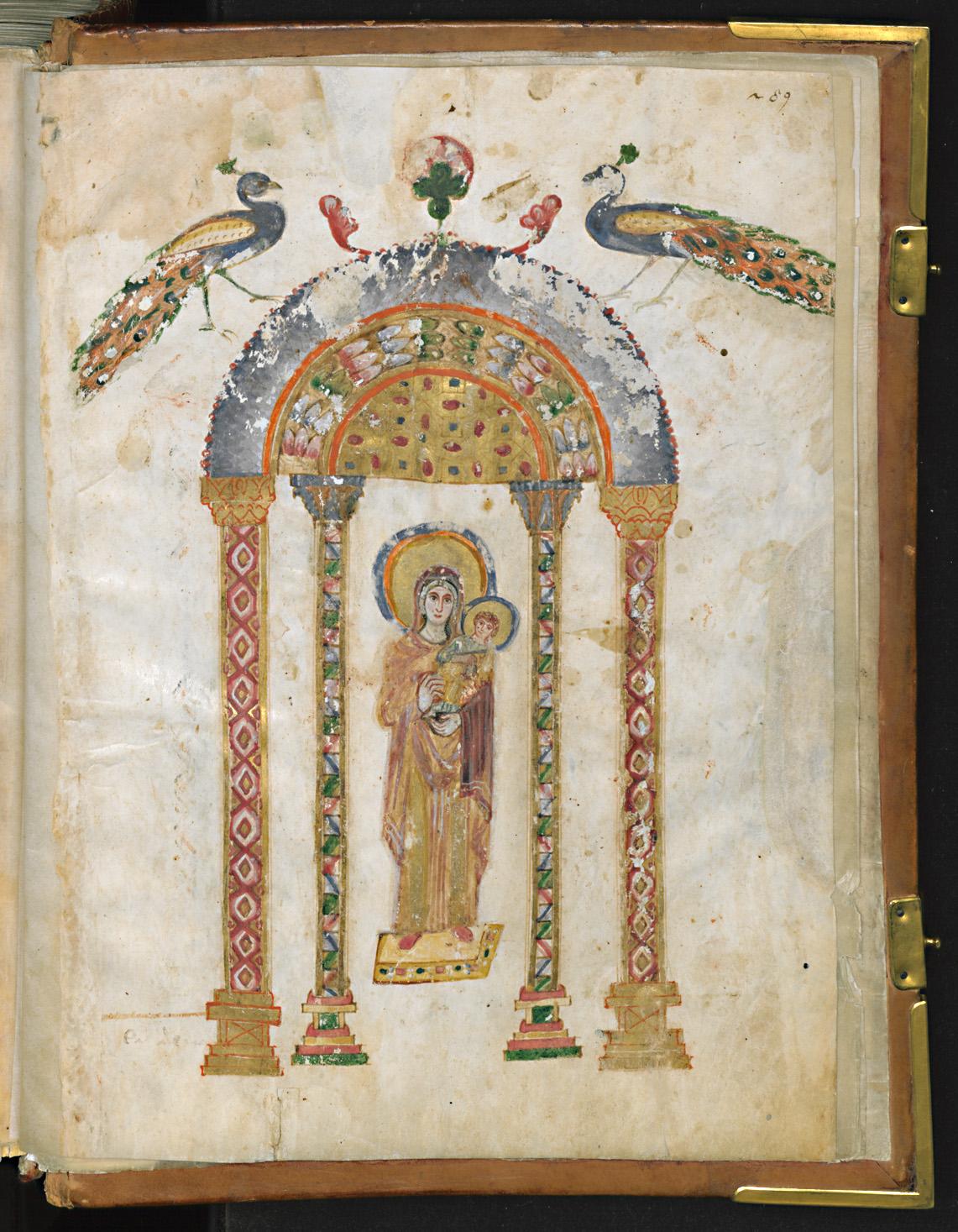
Virgin and Child, from the Rabbula Gospels, Syria, 586 CE. Biblioteca Medicea Laurenziana, Florence (Plut.1.56, fol. 1v).

Among the earliest works of Byzantine iconography, this painting is from a sixth-century manuscript of the Gospels in Syriac (Peshitta version), completed at the Bēṯ Zaḡbā Monastery in northern Syria. It shows the Virgin Mary standing under a colorfully patterned aedicule, holding her son Jesus, who faces us. Perched on the roof are two peacocks, a symbol of resurrection and eternal life.

For a blog post on one of the Rabbula Gospels’ other full-page miniatures, see here.

LISTEN: “Jesus” by Glen Woodward, arr. Valeria A. Foster, 2000 | © 2000 GIA Publications, Inc. | Performed by choral students from Western Michigan and Calvin Christian High Schools and Calvin University, dir. James Abbington, with Brandon A. Boyd on piano, February 9, 2023

Jesus
Jesus
Jesus, Jesus
Jesus

I worship you
I worship you
Jesus, Jesus
Jesus

I love you, Lord
I love you, Lord
Jesus, Jesus
Jesus

Eight days after his birth, Jesus was circumcised as the Jewish law stipulates (Lev. 12:1–3) and given his name: “When the eighth day came, it was time to circumcise the child, and he was called Jesus, the name given by the angel before he was conceived in the womb” (Luke 2:21). Thus many churches celebrate January 1 as the Feast of the Holy Name of Jesus.

The name Jesus—or Yeshua (יֵשׁוּעַ), as he would have been known to his fellow Aramaic speakers (“Jesus” is the Greek transliteration)—means “Yahweh saves.”


This post is part of a daily Christmas series that goes through January 6. View all the posts here, and the accompanying Spotify playlist here.

Roundup: Nativity art from Asia, the Christ Hymn in Thai, and more

ARTICLES:

>> “How Asian Artists Picture Jesus’ Birth from 1240 to Today” by Victoria Emily Jones, December 18, 2023, Christianity Today: My first CT article was published this week! I was asked to curate and introduce a sampling of Nativity art from across Asia. By representing Jesus as Japanese, Indonesian, or what have you, these artists convey a sense of God’s immanence, his “with-us–ness,” for their own communities—and for everyone else, the universality of Christ’s birth.

Turun, I Wayan_In Bethlehem
I Wayan Turun (Indonesian, 1935–1986), In Bethlehem, 1958. Acrylic on canvas, 46 × 64 cm. Collection of Stichting Zendingserfgoed (Missionary Heritage Foundation), Zuidland, Netherlands.

>> “The Story of Christ in Chinese Art: Scholars at Peking University Make a Christmas Portfolio for LIFE,” Life, December 22, 1941, pp. 40–49: In doing research for my Christianity Today article, I found this old article from Life magazine that features eight Chinese watercolors on silk from the collection of Dr. William Bacon Pettus (1880–1959), an American educator and president of the California College of Chinese Studies in Peking (Beijing) in the 1920s and ’30s, which were being exhibited at New York’s American Bible Society at the time. With the ordination of six Chinese bishops by Pope Pius XI in 1926, the Chinese Catholic Church was transitioning from a mission church to an indigenous local church, and Chinese-style religious art—much of it coming out of the art department of the new Catholic University of Peking (Beiping Furen Daxue)—was part of that localization. Productivity seems to have continued at Furen during the Japanese occupation, as this article attests. Many of the students and faculty were recent converts to Christianity, though the article reports that non-Christians also enrolled and taught in the art program.

Lu Hongnian_Nativity
Lu Hongnian (Lu Hung-nien) ( 陸鴻年) (Chinese, 1914–1989), The Birth of Jesus, ca. 1941. Chinese watercolor on silk.

Here is one of the paintings by Lu Hongnian, who sometime after this article was published, in part through his having engaged the New Testament as inspiration for his paintings, became a Christian and took the name John. It shows the Holy Family in a mountainside cave, Mary gazing adoringly at her newborn son as Joseph brings more straw to cushion him. Beside them, an angel holds up a lantern for light, while two shepherd children approach from the entrance, eager to meet their Savior.

+++

SONGS:

>> “Philippians 2:511” by HARK Music: This song takes a traditional Thai melody, arranged by Tirasip Kraitirangul, and puts it to a Thai translation of the famous Christ Hymn from Philippians 2. It’s performed by the HARK Duriya Tasana Singers (feat. Somchairak Sriket and Damrongsak Monprasit) and Dancers, filmed on location at Chaloem Kanchanaphisek Park in Bangkok. The song is from HARK’s Thai Hymns Album (2014), which can be downloaded for free at https://harkpublications.com/?product=thai-hymns-album-2. The two-stringed bowed instrument you see at 3:21 is a saw u.

The Duriya Tasana (“Curators of the Arts”) ensemble was formed in 2012 under the commission of the Thai-Psalms Project, an endeavor to create Thai traditional and classical music settings for the psalms of the Bible. Many of the members are affiliated with the Bunditpatanasilpa Institute of Fine Arts in Bangkok. Thanks to my friend Janet, whose sister is preparing a move to Thailand, for alerting me to this group!

>> “Jesus You Come” by Tenielle Neda, performed with Jon Guerra: This song by the Australian singer-songwriter Tenielle Neda [previously], which she sings with Jon Guerra, makes a nice complement to the Thai song above. The performance is from “Songs for Hope: A TGC Advent Concert” on December 6, 2020.

+++

MIDDLE ENGLISH LULLABY: “As I lay upon a night”: Medievalist Eleanor Parker introduces a charming Christmas lullaby from fourteenth-century England, a dialogue between Mary and the Christ child, and provides a modern English translation of its thirty-seven stanzas. In the Middle Ages, says Rosemary Woolf, the subject matter of lullabies was often a prophecy of the baby’s future—presumably a romantic promise of great and happy achievements. But here it is the child who relates the future to his mother, thus providing the material for his own lullaby.

+++

ART VIDEO: “Third Sunday of Advent: Ethiopian Art: Gospel Book” by James Romaine: Every December, my friend James Romaine, an art historian who teaches at Lander University, publishes four videos on his Seeing Art History YouTube channel related to the themes of the season, part of his annual Art for Advent series. This year he’s chosen to focus on Ethiopian art, covering illuminations from two different manuscripts, a diptych icon, and a rock-hewn church.

In this video Romaine discusses the formal qualities of two paintings from a sixteenth-century Ethiopian Gospel-book, the identity of the figures, and the liturgical context of the book, including the use of the red veil that’s attached at the top, which, Romaine says, “both protects and sanctifies the icon,” creating a sense of anticipation for the Orthodox believer who, in faith, lifts the veil to see what is revealed.

Advent, Day 16: Et incarnatus est

LOOK: Yoruba Madonna and Child

Madonna and Child (Nigerian)
Wood scuplture of the Madonna and Child, Yorubaland, Nigeria, mid-20th century. Photo: Lee Boltin.

This sculpture by a Yoruba artist from Nigeria shows the Christ child seated on the lap of his mother, Mary, who wears a traditional Yoruba hairstyle and dress. If I had to guess, I’d say it’s probably by George Bandele Areogun (1908–1995), as it is commensurate in quality and style with his other work.

The image appears as figure 27 in the 1974 book The Faces of Jesus by Frederick Buechner (which contains an excellent selection of full-color art from around the globe!) with the vague caption “Madonna and Child, wood, Africa, contemporary.” At the time of publication, the sculpture was in the private collection of Maurice Lavanoux (1894–1974), a specialist in church art living in New York, but I don’t know its current whereabouts.

It probably came out of the Oye-Ekiti workshop, established by the Society of African Missions (a Roman Catholic organization) and active from 1947 to 1954. If not, it is indebted to that initiative, which was key in establishing a Yoruba Christian style of art and cultivating patrons for such art. For more on the Oye-Ekiti workshop, see my review of the 2014 exhibition Africanizing Christian Art. For a more recent article, see “The Oye-Ekiti Christian Art Workshop and the Fusion of the European Catholic Tradition and Nigerian Indigenous Art in Three Lagos Churches” by Chinyere Ndubuisi, from Art in Translation 14, no. 3 (2022): 230–54.

LISTEN: “Et incarnatus est” (And was incarnate) by J. S. Bach, from his Mass in B minor, BWV 232, completed 1749 | Performed by Robin Johannsen, Marie-Claude Chappuis, Helena Rasker, Sebastian Kohlhepp, Christian Immler, and the Akademie für Alte Musik Berlin, dir. René Jacobs, 2022

Et incarnatus est de Spiritu Sancto,
ex Maria virgine; et homo factus est.

English translation:
And [he] was incarnate by the Holy Spirit,
of the Virgin Mary; and was made man.

Comprising twenty-seven movements in four parts, Bach’s B minor setting of the Latin Mass is widely regarded as one of the highest achievements of classical music. “Et incarnatus est” is the fourth movement of part 2, “Symbolum Nicenum” (Nicene Creed).


This post is part of a daily Advent series from December 2 to 24, 2023 (with Christmas to follow through January 6, 2024). View all the posts here, and the accompanying Spotify playlist here.

Advent, Day 13: A star shall rise out of Jacob

LOOK: Virgin and Child with a Prophet catacomb fresco

Mary breastfeeding (Catacomb of Priscilla)
Virgin and Child with a Prophet, 3rd century. Fresco in the Catacomb of Priscilla on the Via Saleria, Rome. Photo: Scala / Art Resource. [view wider shot]

Deep in the Catacomb of Priscilla in Rome, one of the early Christian underground burial places (named after the donor of the land), is an arched ceiling fresco of a woman breastfeeding her child under an apple tree. Beside her a man points up to a star that’s resting over their heads among the fruit.

Dating to the third century, this image is the earliest known depiction of the Virgin Mary, and one of the oldest of Christ. The identity of the third figure is less sure, but it’s most likely the Gentile prophet Balaam, who, in the power of God’s Spirit, prophesied to King Balak of Moab that “a star shall come out of Jacob, and a scepter shall rise out of Israel” (Num. 24:17).

Although this prophecy had a more immediate fulfillment in King David, it has also been interpreted in a messianic sense since as early as Justin Martyr (ca. 100–165), who wrote, “And that he [Christ] should arise like a star from the seed of Abraham, Moses showed beforehand when he said, ‘A star shall arise from Jacob, and a leader from Israel’” (Dialogue with Trypho, chap. 106).

Irenaeus (ca. 130–200) wrote that the star the magi followed to seek out the newborn Christ was the one prophesied by Balaam (Against Heresies, bk. 3, chap. 9.2), and Origen (ca. 185–254) maintained that Numbers 24:17 was the Hebrew Bible verse the magi found that instigated their journey (Against Celsus, bk. 1, chap. 60).

Priscilla Catacomb arch
Arched ceiling detail from Gallery 3 of the Catacomb of Priscilla, Rome. The central image, in stucco, portrays a shepherd and two sheep, while at the far right, oriented in a different direction, is a fresco of the Virgin and Child. The artworks are damaged by age.

Other suggestions put forward as to the identity of the pointing figure in this catacomb fresco have been a magus; the Hebrew prophet Isaiah, who declared that “a virgin shall conceive” (Isa. 7:14) and enjoined his people to “arise, shine; for thy light is come, and the glory of the Lord is risen upon thee” (Isa. 60:1); and, from Hans-Ruedi Weber, John the Baptist, who “came as a witness to testify to the light, so that all might believe. . . . The true light, which enlightens everyone, was coming into the world” (John 1:6–9).

To explore more of the Catacomb of Priscilla, see the following Smarthistory video by Beth Harris and Steven Zucker. Today’s featured image is introduced at 3:35:

LISTEN: “There Shall a Star from Jacob Come Forth” (original title: “Es wird ein Stern aus Jacob aufgeh’n”), from Christus, Op. 97 | Original German text compiled by Christian Charles Josias von Bunsen, 1846, from Numbers 24:17 and the hymn “Wie schön leuchtet der Morgenstern” by Philipp Nicolai, 1599; English translation of lines 4–10 by Catherine Winkworth, 1863 | Music by Felix Mendelssohn, 1846–47, based on Nicolai’s hymn tune | Performed by the St. Olaf Choir, the St. Olaf Cantorei, the St. Olaf Chapel Choir, the Manitou Singers, Viking Chorus, and the St. Olaf Orchestra, dir. Robert Scholz, on Love Divine, Illumine Our Darkness: Christmas at St. Olaf, 2002

There shall a star from Jacob rise up,
And a sceptre from Israel come forth,
To dash in pieces princes and nations.

How brightly beams the morning star!
With sudden radiance from afar,
With light and comfort glowing!
Thy word, Jesus, inly feeds us,
Rightly leads us,
Life bestowing.
Praise, oh praise such love o’erflowing.

The musical work “Es wird ein Stern aus Jacob aufgeh’n” (There Shall a Star from Jacob Come Forth) is from an unfinished oratorio by Felix Mendelssohn (1809–1847), which the composer’s brother Paul gave the name Christus and published posthumously as Opus 97. The first performance took place in 1852.

The first three lines are taken from Numbers 24:17, while the latter portion is from the Lutheran hymn “Wie schön leuchtet der Morgenstern” (How Brightly Beams the Morning Star) by Philipp Nicolai, written in 1597 and first published in 1599 with the title “Ein geistlich Brautlied der gläubigen Seelen von Jesu Christo ihrem himmlischen Bräutigam, gestellet über den 45. Psalm des Propheten David” (A spiritual wedding song of the faithful soul about Jesus Christ, her heavenly groom, made over the 45th psalm of the Prophet David). The tune it was published with was adapted by Nicolai, it appears, from an older tune found in the Strasbourg Psalter of 1538—which is further adapted here by Mendelssohn.

In Mendelssohn’s piece, the first two lines about an emerging luminary from the lineage of Jacob are lovely and lofty, repeated in different and overlapping voices over the course of a minute-plus. But then the third line cuts in with emphatic force: “To dash in pieces princes and nations.” Its violence is jarring, very far from the peaceful sentiments we’re used to associating with this time of year! Even as it adds drama and interest to the composition, its militant language is unsettling.

But it does honor the larger context of Balaam’s prophecy:

So he [Balaam] uttered his oracle, saying,

“The oracle of Balaam son of Beor,
    the oracle of the man whose eye is clear,
the oracle of one who hears the words of God
    and knows the knowledge of the Most High,
who sees the vision of the Almighty,
    who falls down but with eyes uncovered:
I see him but not now;
    I behold him but not near—
a star shall come out of Jacob,
    and a scepter shall rise out of Israel;
it shall crush the foreheads of Moab
    and the heads of all the Shethites [a Moabite tribe].
Edom will become a possession,
    Seir [an alternative name for Edom] a possession of its enemies,
    while Israel does valiantly.
One out of Jacob shall rule
    and destroy the survivors of Ir [‘City’].”

(Num. 24:15–19)

The mercenary prophet Balaam had been hired by Balak, king of Moab, to curse Israel. See, the Israelites had escaped slavery in Egypt some forty years prior and were looking for land to settle. Having been refused passage through, they had just conquered Amorite country, which used to belong to Moab, and Balak feared Moab would be next.

Despite being a non-Israelite, Balaam heard words from Yahweh, Israel’s God. Balak recognized Balaam as an authority, as did others, and thought he might be persuaded for a fee to issue a prophecy in Moab’s favor. But Balaam told him he would speak only the words of Yahweh.

The passage above is the fourth and final oracle Balaam pronounced on this mission to Moab. In it he says that Moab and Edom would be conquered—a prophecy that came to pass with King David (2 Sam. 8:2–12; cf. Ps. 60:8).

Christians, as we have seen, often extract verses from longer Old Testament passages, prophetic or otherwise, and read into them messianic significance—pointers to Jesus Christ. Even the New Testament authors, and Jesus himself, did this. Did the Old Testament authors intend such meanings? Probably not in most places, not to the extent that premodern Christian interpreters suggested. (That’s not to say Jesus didn’t fulfill biblical prophecies. Quite the contrary!)

But many Christian biblical scholars acknowledge what’s been called the sensus plenior, or “fuller sense,” of scripture—a term popularized by Raymond E. Brown in his book The Sensus Plenior of Sacred Scripture (1955). Sensus plenior, Brown writes, is “that additional, deeper meaning, intended by God but not clearly intended by the human author, which is seen to exist in the words of a biblical text (or group of texts, or even a whole book) when they are studied in the light of further revelation or development in the understanding of revelation.”

Some people consider this kind of reading to be distortive. But others, including myself, consider it creative. Rabbinical literature often does the same thing: finds meaning in and beyond a scripture passage’s strict historical context that the original authors likely did not intend but that open up the text in new ways. Sensus plenior says that studying a book of the Bible only in its historical and immediate textual context and for what it would have meant to its original audience is limiting, incomplete. Of course, the opposite approach, which does run rampant in many Christian communities, is also problematic: divesting scripture passages of their contexts, reflexively backfilling all the Old Testament with “Jesus” at the expense of understanding the texts on their own terms.

I think the application of “To dash in pieces princes and nations” (a paraphrase from Balaam’s prophecy) to Jesus’s birth is confusing, as Jesus was nonviolent, rejecting conquest. Perhaps you could say that Christ’s rule would (rhetorically) dash Herod’s kingdom to pieces, as it challenged the modus operandi of empire. There’s a new caesar in town, a new king on the throne, and his law of love, his gospel of peace, trumps the laws and proclamations of all earthly rulers.

The last six lines of Mendelssohn’s song return to the sweet, gentle tones of the song’s opening, exulting in the radiant glory of Christ, the Morning Star (Rev. 22:16), who shines forth from the pages of God’s word.


This post is part of a daily Advent series from December 2 to 24, 2023 (with Christmas to follow through January 6, 2024). View all the posts here, and the accompanying Spotify playlist here

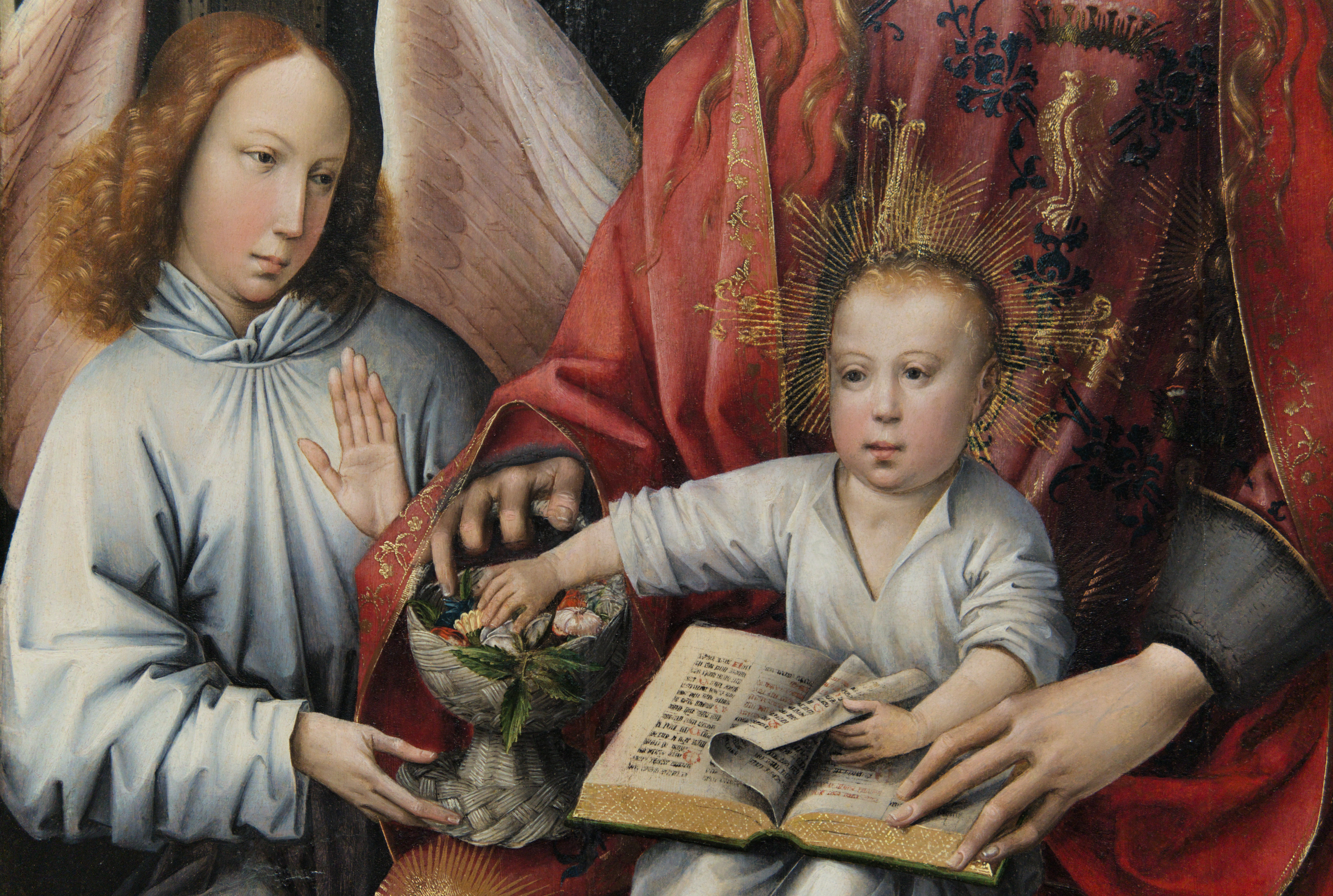
Baby Jesus playing with potpourri

Isn’t this such a charming detail?—the infant Christ sticking his chubby little hand into a footed wicker bowl of flowers (potpourri?). I suppose the angel who holds it out to him wishes him to delight in the fragrance, this wee one whose senses are still so new. But what is its symbolic significance? Northern Renaissance painters often imbued ordinary objects with religious meaning. Perhaps it simply gestures to the aroma of Christ himself, his sweet, invigorating nature? At first I thought of myrrh, one of the gifts of the magi, traditionally interpreted as a foreshadowing of Christ’s death, as it was used to anoint his body in burial (John 19:39)—but myrrh is a yellow sap-like resin, and the bowl’s contents are neither that nor extracted oils. I don’t know; what do you think?

Compare this to the painting known as The Holy Family of Francis I (after the name of its original owner) by Raphael of Italy, which shows an angel providing a scented cover of flowers over the young mother and child.

Colijn de Coter_Virgin and Child
Colijn de Coter (Netherlandish, active ca. 1480–1525), Virgin and Child Crowned by Angels, 1490–95. Oil on panel, 151.9 × 88.6 cm (59 13/16 × 34 7/8 in.). Art Institute of Chicago. Photo: Victoria Emily Jones. [object record]

The larger context of the Netherlandish painting is Christ sitting on his mother’s lap in a contemporary bourgeois interior as she is being crowned Queen of Heaven, royal by association with the newborn king. (The embroidered inscription on the hem of her mantle reads, “ORA PRO NOBIS / AVE REGINA / CELOR[U]M MATER REGIS ANG[E]LORUM,” which translates to, “Pray for us. Hail, queen of heaven, mother of the king of angels.”) He’s reading the scriptures—so devout!—but seems momentarily distracted by something out of frame. His expression is serene. (Sidebar: Is it just me who’s anxious by how sloppily he’s turning that page? Not the creases! I mean, I know he’s just a baby, but . . .)

I believe the text is pseudo-Hebrew—both here, and in the scroll on the floor. European Christian artists sometimes imitated Hebrew script in their paintings to reference Jesus’s Jewishness; they were not learned in the language and had no direct textual models in front of them, so the best they could do was make marks that evoke that linguistic heritage.

It’s possible that the scroll is meant to represent Mary’s Magnificat, but it’s hard to say. It lies unrolled beside a neck-handled pewter vase filled with three blue lilies and bearing bosses of what look to me like a Virgin and Child and the prophets.

And look at the golden embroidery of the two turtledoves perched in one of the folds of Mary’s garment! (It recurs in a few places.) This is a reference to the animal offering she brought to the temple for her postpartum purification, a ritual prescribed by ancient Jewish ceremonial law (Luke 2:22–24; cf. Lev. 12:1–8).

The textures in this painting are fabulous. The realistic, detailed rendering of surface textures—of fur, feathers, hair, paper, foodstuffs, metals, jewels, wood, wool, velvet—is one of the hallmarks of Northern Renaissance art—that is, art from fifteenth- and sixteenth-century Holland and Flanders, regions north of Italy. This greater illusionism was made possible by the use of oil paint, which also enabled richer, denser color than its precursor, egg tempera.

Northern Renaissance art is what made me fall in love with art history as a late teen. I had never encountered this painting before in my studies, so it was such a joy to stumble upon it earlier this year on a visit to the Art Institute of Chicago.

Roundup: “El Shaddai” (new song), everyday Black life in pictures, and more

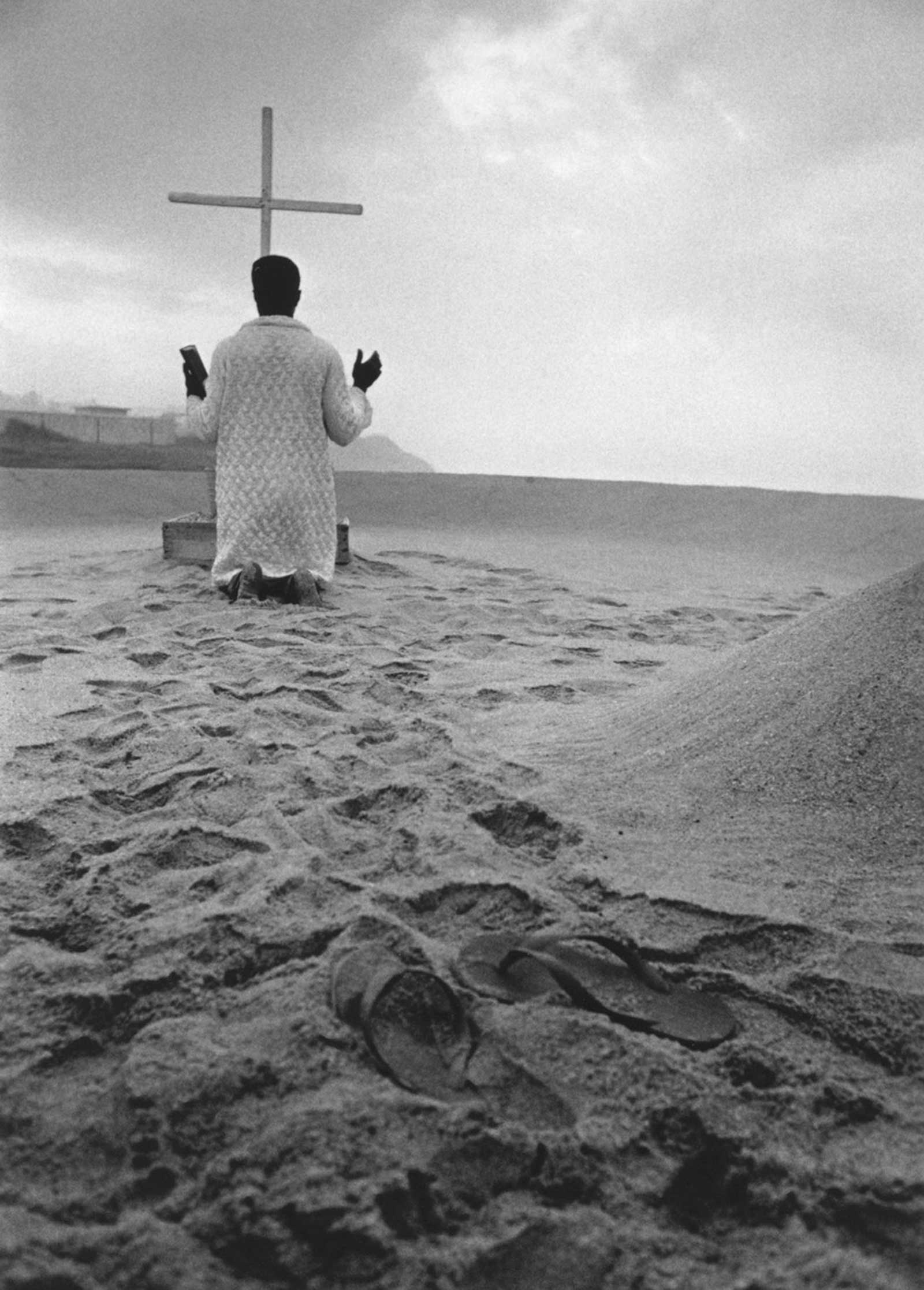
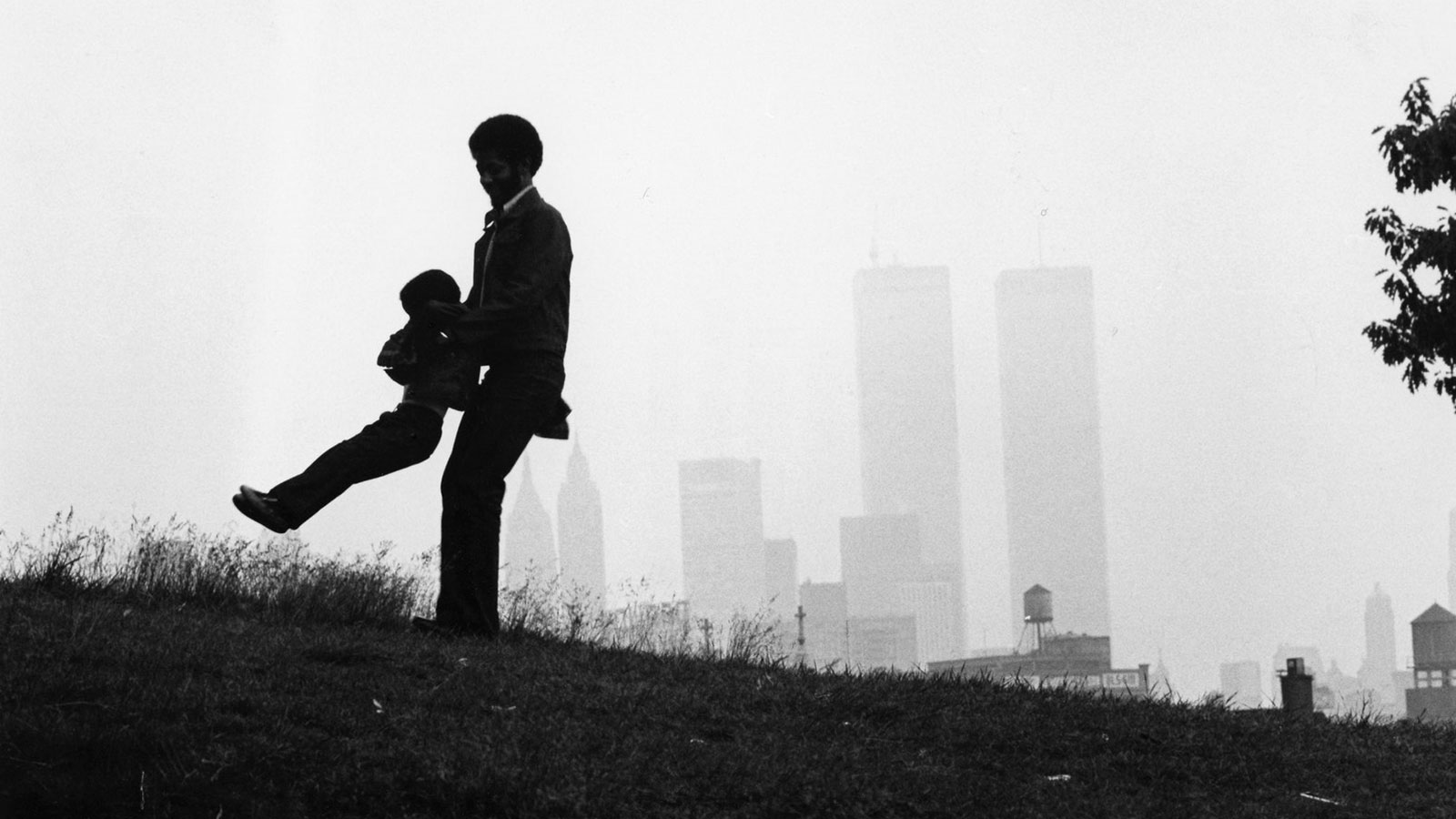
PHOTO COMPILATION: “Chester Higgins’s Life in Pictures”: Chester Higgins Jr. (b. 1946) is an American photographer whose work focuses on everyday Black life; “it is inside simple moments where I look for windows into larger meaning,” he says. He was a staff photographer for the New York Times for more than four decades, and his work is in the permanent collection of the Museum of Modern Art. This heavily illustrated New Yorker article is a good introduction to his oeuvre, in which religious belief and practice feature prominently. I found out about him through the photography compilation book Standing in the Need of Prayer: A Celebration of Black Prayer.

Higgins, Chester_Sunrise Prayer
Chester Higgins (American, 1946–), Sunrise Prayer on Osu Beach, Accra, Ghana, 1973

Higgins, Chester_Father Swinging Son, Brooklyn
Chester Higgins (American, 1946–), Father Swinging Son, Brooklyn, 1972

+++

SONGS:

>> “El Shaddai” by Victory: On January 27 singer-songwriter Victory Boyd, who goes professionally by the mononym Victory, released her latest single, “El Shaddai.” El Shaddai is an ancient Hebrew name for God whose original meaning is unclear but which is often translated into English as “God Almighty”—although “God of the Mountains,” “the Full-Breasted God” (referring to God’s nourishment of God’s children), or “the All-Sufficient One” have also been posited. Its first appearance in the Bible is in Genesis 17:1, where God tells Abram, “’I am El Shaddai; walk before me, and be blameless.”

Read the lyrics in the YouTube video description.

>> “Come Unto Me” by Take 6: A friend recently introduced me to the American a cappella gospel sextet Take 6. Formed in 1980 on the campus of Oakwood College in Huntsville, Alabama, and still active, they incorporate sophisticated jazz harmonies into the tradition of Black gospel “quartet” singing. They are featured on Spike Lee’s Do the Right Thing soundtrack and have won ten Grammys.

This 1988 performance for a Heritage USA TV spot features the group’s six original vocalists: Claude V. McKnight III, Mark Kibble, Mervyn Warren, David Thomas, Cedric Dent, and Alvin Chea.

>> “He’s Got the Whole World in His Hands” by Peter Collins: I love what Peter Collins does with this African American spiritual! This video was his submission to Tyler Perry’s #HesGotTheWholeWorldChallenge from 2020 (which I featured here). It didn’t make the final cut, but I’m so glad it’s out there.

+++

LITERARY EXCERPT from The Color Purple by Alice Walker: This short passage from Alice Walker’s 1982 Pulitzer Prize–winning novel is taken from a conversation between the protagonist, Celie, and her friend Shug, about pleasure, gratitude, and grace. Shug refers to God as “it” (“God ain’t a he or a she”), and her statement about the necessity of enjoying God’s good creation and being open to surprise provides the source of the title.

I’m embarrassed to say that although I saw and really liked the 1985 Steven Spielberg film adaptation of The Color Purple, I’ve never read the book! I plan to rectify that before December, when another film adaptation—of the 2005 stage musical based on Walker’s novel—is coming out, directed by Blitz Bazawule. It stars Fantasia, H.E.R., Colman Domingo (Euphoria), Taraji P. Henson (Hidden Figures), Danielle Brooks (Orange Is the New Black), Jon Batiste, and more.

+++

VIDEO: “Ethiopian Gospel Book”: In this six-minute instructional video, Dr. Beth Harris, executive director of Smarthistory, and Kelin Michael, a graduate curatorial intern of manuscripts at the Getty Museum, explore an early sixteenth-century Gospel book from Ethiopia. They discuss the book’s historical context and the formal qualities of its paintings, including the flatness of the figures and the colorful interlacing. They focus on a full-page illumination at the front of the Virgin and Child enthroned between two archangels, but they also touch on the book’s canon tables and its portrait of Saint John the Evangelist.

Virgin and Child (Ethiopian MS, Getty)
The Virgin and Child with the Archangels Michael and Gabriel, Ethiopia, ca. 1504–5. Tempera on parchment, 13 9/16 × 10 7/16 in. (34.5 × 26.5 cm). J. Paul Getty Museum, Los Angeles, Ms. 102, fol. 19v.

Christmas, Day 11: Hodie

LOOK: Virgin and Child from Chora Church

Chora dome
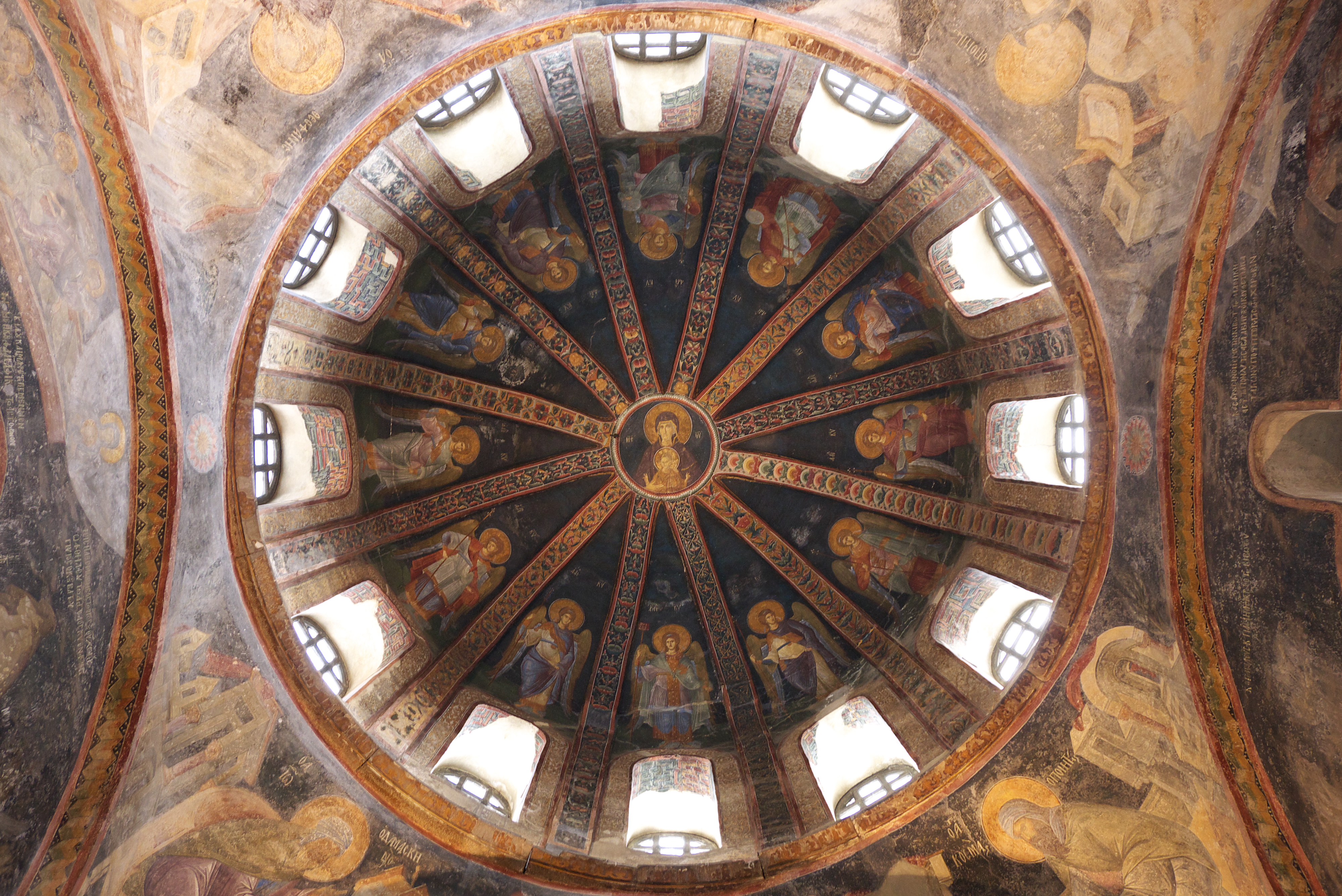
The Virgin and Child surrounded by angels, 14th century, frescoed dome of the parecclesion (side chapel) of the Church of the Holy Saviour in Chora, Istanbul.

Virgin and Child (Chora Church)
Chora dome, detail

LISTEN: “Hodie,” early monastic chant from the Celtic Church in Ireland | Performed by Mary McLaughlin on Sacred Days, Mythic Ways: Ancient Irish Sacred Songs from Mythology to Monasteries (2012)

Refrain:
Hodie Christus natus est
hodie Salvator apparuit:
hodie in terra canunt angeli,
laetantur archangeli:
hodie exsultant justi, dicentes:
Gloria in excelsis Deo. Alleluia!

Benedictus qui venit in nomine Domini.
Deus dominus, et illuxit nobis. [Refrain]

Gloria Patri, et Filio, et Spiritui Sancto:
sicut erat in principio, et nunc, et semper,
et in sæcula sæculorum. Amen. [Refrain]

English translation:

Today Christ is born;
today the Savior has appeared;
today the angels sing,
the archangels rejoice;
today the righteous rejoice, saying:
Glory to God in the highest. Alleluia!

Blessed is he who comes in the name of the Lord!
The Lord is God, and he has made his light to shine upon us.

Glory be to the Father, and to the Son, and to the Holy Spirit,
as it was in the beginning, is now, and ever shall be, world without end.
Amen.

The texts that make up this Christmas chant are from the Latin Mass. The verses are the parts known as the Benedictus (Psalm 118[117]:26a, 27a) and the Gloria, which are sung at every Mass, and the refrain is the antiphon to the Magnificat that is sung at Vespers on Christmas Day.

The plainchant melody is from early medieval Ireland.

Christmas, Day 6: Black-Haired Boy

LOOK: Madonna and Child by Gracie Morbitzer

Morbitzer, Gracie_Madonna and Child
Gracie Morbitzer (American, 1997–), Madonna and Child, 2018. Acrylic on repurposed wood, 14 × 12 in. Private collection.

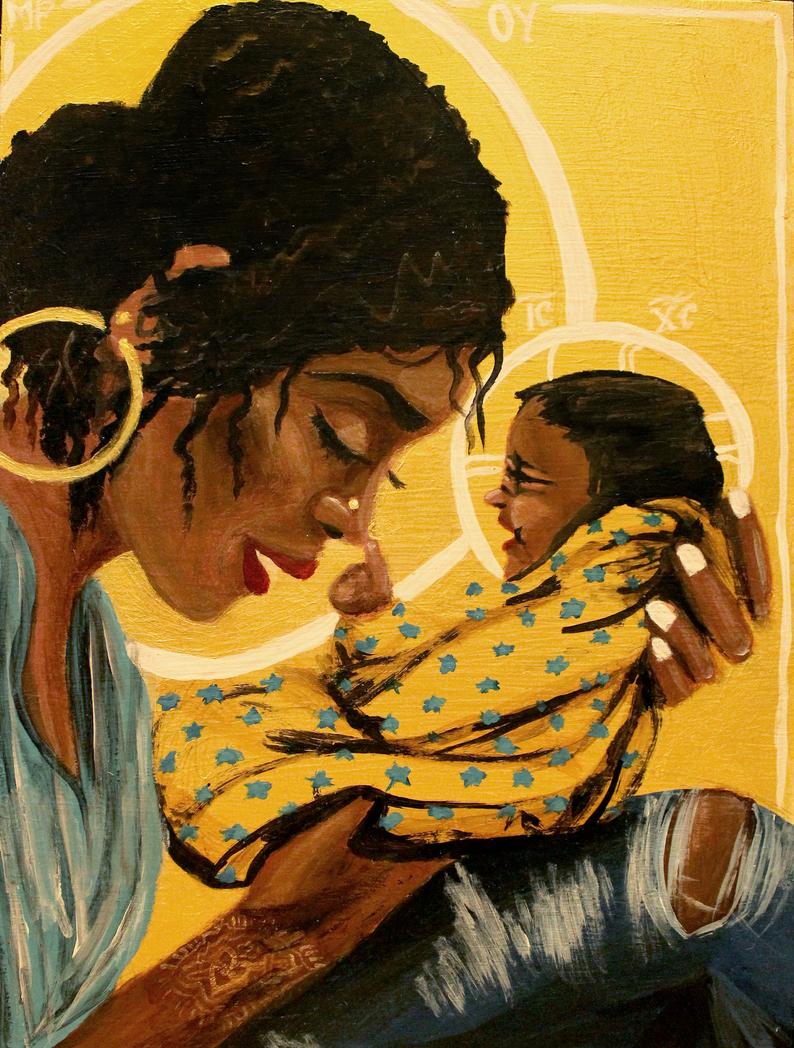
Gracie Morbitzer is a Catholic artist from Columbus, Ohio, who paints biblical and extrabiblical saints as modern, everyday people in a range of skin tones, forgoing the hieratic style of traditional icons in favor of a more relatable, this-worldly look that enables the individuals’ distinctive personalities to shine through. She uses discarded or thrifted pieces of wood as her substrate, welcoming cracks and imperfections as only further reiterating how the extraordinary shines through the ordinary.

In her Madonna and Child, Mary props up her newborn on her knees, basking in her new role as mother. She wears frayed jeans, a loose blouse, gold hoop earrings, and a nose stud. On her wrist is a henna tattoo of her Immaculate Heart—a burning, bloodied heart pierced with a sword and banded with roses, representing the intensity and purity of her love and the suffering that Simeon prophesies.

Jesus, wrapped in a starry blanket and donning a cruciform halo, playfully touches Mom’s nose, crinkling his face as he giggles with delight.

The yellow acrylic background recalls the gold leafing of icons, used to suggest the transfiguring light of God. Morbitzer also uses the traditional Greek abbreviations for the Mother of God (MP OY) and Jesus Christ (IC XC).

This image can be purchased as a 5 × 7-inch print at The Modern Saints Etsy shop.

LISTEN: “Mary’s Lullaby (Black Haired Boy)” | Words by Kate Bluett | Music by Paul Zach | Sung by Liz Vice on Advent Songs by The Porter’s Gate (2021)

Oh, black-haired boy, your eyes are dark
as midnight lit by shining stars
and bright as love that filled my heart
when first I looked at you.
Your skin is brown as pilgrim roads,
laid straight through fragrant olive woods,
as brown as mine, and I’m in awe
each time I look at you.

You made the ox and lamb, my love,
and shaped the wings of turtledoves.
You wrote the hidden secrets of
the world I’ll show to you.
Within my body you took form
and wailed aloud when you were born—
the moment that my heart was torn
with love I’ll show to you.

You wove these wonders through the earth;
you made them all and gave them worth,
and now you join them in your birth,
and I’ll give them to you.
I’ll show you skies filled up with stars
and teach you words for light and dark,
for all the wondrous things there are:
I’ll give them all to you.

I’ll hold you closely as I can
and watch you grow into a man.
As long as I can hold your hand,
I’ll walk the world with you.
And you’ll lead me to God’s own heart,
where all these wonders have their start.
But here within the stable dark,
I’ll be the world for you.

Since the Middle Ages, Christians have written lullabies in the voice of Mary, imagining her rocking her infant son to sleep, sharing with him her most tender feelings and wishes. This contemporary one by frequent songwriting collaborators Kate Bluett and Paul Zach—so poignantly sung by Liz Vice—is among my favorites.

In the first stanza Mary dotes poetically on Jesus’s features—his eyes dark and bright as star-studded midnight skies, his skin brown as the footpaths to Zion. In the remaining stanzas she marvels at how the Creator of the universe lies as a babe in her arms, and how she will get to experience its many wonders with him at her side, discover its secrets together. Jesus made the world in which she lives and moves and has her being, but now, while he is small, vulnerable, and dependent, she’ll be a whole world to him, as mothers are to their children.