Gracie Morbitzer (American, 1997–), Madonna and Child, 2018. Acrylic on repurposed wood, 14 × 12 in. Private collection.
Gracie Morbitzer is a Catholic artist from Columbus, Ohio, who paints biblical and extrabiblical saints as modern, everyday people in a range of skin tones, forgoing the hieratic style of traditional icons in favor of a more relatable, this-worldly look that enables the individuals’ distinctive personalities to shine through. She uses discarded or thrifted pieces of wood as her substrate, welcoming cracks and imperfections as only further reiterating how the extraordinary shines through the ordinary.
In her Madonna and Child, Mary props up her newborn on her knees, basking in her new role as mother. She wears frayed jeans, a loose blouse, gold hoop earrings, and a nose stud. On her wrist is a henna tattoo of her Immaculate Heart—a burning, bloodied heart pierced with a sword and banded with roses, representing the intensity and purity of her love and the suffering that Simeon prophesies.
Jesus, wrapped in a starry blanket and donning a cruciform halo, playfully touches Mom’s nose, crinkling his face as he giggles with delight.
The yellow acrylic background recalls the gold leafing of icons, used to suggest the transfiguring light of God. Morbitzer also uses the traditional Greek abbreviations for the Mother of God (MP OY) and Jesus Christ (IC XC).
LISTEN: “Mary’s Lullaby (Black Haired Boy)” | Words by Kate Bluett | Music by Paul Zach | Sung by Liz Vice on Advent Songs by The Porter’s Gate (2021)
Oh, black-haired boy, your eyes are dark as midnight lit by shining stars and bright as love that filled my heart when first I looked at you. Your skin is brown as pilgrim roads, laid straight through fragrant olive woods, as brown as mine, and I’m in awe each time I look at you.
You made the ox and lamb, my love, and shaped the wings of turtledoves. You wrote the hidden secrets of the world I’ll show to you. Within my body you took form and wailed aloud when you were born— the moment that my heart was torn with love I’ll show to you.
You wove these wonders through the earth; you made them all and gave them worth, and now you join them in your birth, and I’ll give them to you. I’ll show you skies filled up with stars and teach you words for light and dark, for all the wondrous things there are: I’ll give them all to you.
I’ll hold you closely as I can and watch you grow into a man. As long as I can hold your hand, I’ll walk the world with you. And you’ll lead me to God’s own heart, where all these wonders have their start. But here within the stable dark, I’ll be the world for you.
Since the Middle Ages, Christians have written lullabies in the voice of Mary, imagining her rocking her infant son to sleep, sharing with him her most tender feelings and wishes. This contemporary one by frequent songwriting collaborators Kate Bluett and Paul Zach—so poignantly sung by Liz Vice—is among my favorites.
In the first stanza Mary dotes poetically on Jesus’s features—his eyes dark and bright as star-studded midnight skies, his skin brown as the footpaths to Zion. In the remaining stanzas she marvels at how the Creator of the universe lies as a babe in her arms, and how she will get to experience its many wonders with him at her side, discover its secrets together. Jesus made the world in which she lives and moves and has her being, but now, while he is small, vulnerable, and dependent, she’ll be a whole world to him, as mothers are to their children.
UKRAINIAN MADONNAS: Since Russia invaded Ukraine on February 24 and even still continues to aggress, artists have taken up their art to address the war—several drawing on iconography of the Madonna and Child, particularly the Maria lactans (breastfeeding Mary) type. Two Ukrainian artists were inspired by different news photos of young mothers protecting their infants from the shelling in Kyiv in March—one of whom was photographed in a hospital being treated for wounds she sustained from fallen glass while shielding her daughter with her body, and the other hiding from the blasts in a subway station.
These images show the vulnerability of Christ, who is with us in our suffering, and indict those who cause such suffering.
In his response to the war in Ukraine, Serbian artist Michael Galovic, who lives in Australia, also uses Christian iconography: the Theotokos Kyriotissa (Mother of God enthroned with Christ); Archangel Michael, the patron saint of Kyiv, fighting a dragon (Rev. 12:7–8) in an ethereal rendering of a scene from the Très Riches Heures du Duc de Berry, a fifteenth-century French book of hours; and a hellmouth from the twelfth-century Winchester Psalter. These three medieval images are superimposed on Picasso’s masterwork Guernica, named after the Spanish town bombed by Nazis in 1937 and representative of the horrors of war.
Michael Galovic (Serbian Australian, 1949–), Ukraine Response, 2022. Egg tempera and gold leaf on linen on board, 170 × 80 cm. Collection of the Australian Centre for Christianity and Culture, Canberra, Australia.
Whereas Frirean’s and Solomennykova’s paintings are more intimate, Galovic takes a more cosmic approach, showing wails of lament from abstracted forms intercut with epic battles between good and evil—but at the calm center, Christ is on the throne, holding the scroll of his good word. History is going somewhere. Hate will be damned. Love will triumph.
>> “Galoba (The Prayer),” performed by Trio Mandili: A sung performance of a poem written in 1858 by the Georgian poet and statesman Ilia Chavchavadze (1837–1907). An English translation follows.
Our Father, who art in heaven, With tenderness I stand before thee on my knees. I ask for neither wealth nor glory; I won’t debase my holy prayer with such matters. I desire instead for my soul to be enlightened by heaven, My heart to be radiant with thy love. Even if my enemies pierce me in the heart, I beg thee: “Forgive them, Lord, for they know not what they do!” Even if my enemies pierce me in the heart, I beg thee: “Forgive them, Lord, for they know not what they do!” [source, adapt.]
>> “Peace All Over the World” by Robert Bradley: Written and performed by Detroit musician Robert Bradley, this song originally appeared on the film Playing for Change: A Cinematic Discovery of Street Music (2005). To celebrate their twentieth anniversary, Playing for Change [previously] has remastered it and added new footage from Ukraine.
>> “Du som gick före oss” (You Who Went Before Us) |Words by Olov Hartman, 1968 | Music by Sven-Erik Bäck, 1959 | Performed by VOCES8, 2022: The melody uses all twelve semitones of the octave! I’ve provided a literal English translation of the Swedish below with the help of Google Translate; for a looser but more poetic translation by Fred Kaan, from 1976, see here. Note: The video identifies the song parenthetically as Psalm 74, not because it’s a setting of Psalm 74 from the Bible, but because it is no. 74 in Den svenska Psalmboken, the official hymnal of the Church of Sweden.
Du som gick före oss
längst in i ångesten,
hjälp oss att finna dig,
Herre, i mörkret.

Du som bar all vår skuld
in i förlåtelsen,
du är vårt hjärtas fred,
Jesus, för evigt.

Du som med livets bröd
går genom tid och rum,
giv oss för varje dag,
Kristus, det brödet.

Du som går före oss
ut i en trasig värld,
sänd oss med fred och bröd,
Herre, i världen.
You who went before us
in the depths of anxiety,
help us to find you,
Lord, in the dark.

You who bore all our guilt
into forgiveness,
you are the peace of our hearts,
Jesus, forever.

You who are the living bread
offered abundantly through all the earth,
give us each day,
dear Christ, that bread.

You who go before us
out into a broken world,
send us out likewise, Lord,
with peace and bread.
Andrea Mantegna (Italian, 1431–1506), Madonna with Sleeping Child, ca. 1465. Tempera on canvas, 16 1/2 × 12 1/2 in. (42 × 32 cm). Gemäldegalerie, Berlin.
She took it all in: the shepherds and the royal and learned
men with their prophecies and proclamations. Resting among
common beasts, nipples sore and womb-ached, she smiled at
their praise—but her awe had begun with the angel’s decree.
At the mysterious life-pulse deep inside her. When flicker-
kicks strengthened to rolls and turns, elbows and heels in her
ribs. As buttocks bounced on her bladder.

The brightest star above them—a wondrous sign, but no
more miraculous than when, far from her mother and the
other village women, the flesh of her depth awakened and she
willed the baby from contentment into a harsh night. His cry
pierced the darkness, then quieted as, pressed to her breast,
he found her heartbeat again.
“After Luke 2:19” by Michelle Ortega, reproduced here by the author’s permission, was written for the 2021–22 exhibition Mary, Mary: Contemporary Poets and Artists Consider Mary at St. Michael’s Episcopal Church in Arlington, Virginia. Ortega is the author of the chapbooks Don’t Ask Why (Seven Kitchens Press, 2020) and Tissue Memory (Porkbelly Press, forthcoming).
Wayne Forte (Filipino American, 1950–), Jesus, Light of the World, 2009. Oil and acrylic on canvas, 30 × 24 in.
LISTEN: “Jesus, Light of the World” | Words by Charles Wesley (stanzas), 1739, and George D. Elderkin (refrain), 1890 | Music by George D. Elderkin, 1890 | Performed by Isaac Cates and Ordained on Carol of the Bells, 2014 (soloists: Margaret Rainey and Kami Woodard)
Hark! the herald angels sing. Jesus, the light of the world. Glory to the newborn King, Jesus, the light of the world.
We’ll walk in the light, beautiful light. Come where the dewdrops of mercy shine bright. Oh, shine all around us by day and by night. Jesus, the light of the world.
Joyful, all you nations, rise. Jesus, the light of the world. Join the triumph of the skies. Jesus, the light of the world.
Christ, by highest heav’n adored. Jesus, the light of the world. Christ, the everlasting Lord, Jesus, the light of the world.
Hail the heav’n-born Prince of Peace. Jesus, the light of the world. Hail the Sun of righteousness! Jesus, the light of the world.
In 1890 Chicago publisher George D. Elderkin adapted Charles Wesley’s beloved Christmas hymn text “Hark! the Herald Angels Sing,” using the first two lines of Wesley’s stanzas 1, 2, 3, and 5 and adding a refrain that’s based on a Fanny Crosby text from 1880. For the music, he wrote a gospel waltz. Although Elderkin was not African American, this hymn has become especially well loved in Black churches. Read a more detailed history of the hymn’s composition at the UMC Discipleship website.
Isaac Cates’s 2014 arrangement and recording is my favorite. Cates is a gospel vocalist, arranger, and pianist who performs with his choir, Ordained.
ONLINE EXHIBITION: A Global Icon: Mary in Context, created by the National Museum of Women in the Arts: Curated by Virginia Treanor, this digital resource was created as an expansion of the in-person exhibition Picturing Mary: Woman, Mother, Idea (see catalog), which ran from December 5, 2014, to April 12, 2015. Click through the pages to experience art images with descriptions, videos, and other content having to do with representations of Mary from across the world. The first video in the series is posted below, and here’s a playlist of all seven.
INTERVIEW (+ upcoming virtual conversation): “A God Who Wails and Dances: A Conversation with Yvonne Adhiambo Owuor”: This interview by Erika Kloss, which appears in the current issue of Image journal (no. 109), is so. good. Kenyan writer Yvonne Adhiambo Owuor is the author of the novels Dust and The Dragonfly Seaand award-winning short stories such as “The Weight of Whispers,” as well as the executive director of the Zanzibar International Film Festival. Here she talks about fiction, faith, coffee, and calling colonialism to account. To engage further, you can register for the Image-sponsored online event “The Art of Fiction: A God Who Wails and Dances with Yvonne Adhiambo Owuor,”which takes place September 23 at 3 p.m. ET.
Here’s just a snippet from her conversation with Kloss, where she describes what she would say to those who want nothing to do with Christianity because of all the evil that has been done in its name:
Dare to rescue God as Emmanuel from the dense debris of hubris, and from the weight and stench of whited sepulchers. For it is true, an excess of ghouls have appropriated for themselves the meaning and potency of the revolutionary One who dares to pronounce to humanity, “Love your enemies . . . Do good to those who hate you.”
Why should young people let themselves be revulsed by a legion who never fully entered into the depths of the subversive, seductive, paradigm-dissolving, drinking-and-hanging-out-with-sinners, beautiful, and heroic man-God? Why wouldn’t young people set out to experience for themselves the grand and compelling epic of a creator God in love, who loses his children and the earth to a defiant and rebellious once-beloved prince of light, and who struggles long and hard to regain the humanity he had loved and lost? So passionate and desperate is the creator in this endeavor that he will enter into humanity to try to court and secure these cherished children, even at the risk of his own murder—and even that does not stop the love. A love stronger than death? Don’t we all write anthems, in one form or another, yearning for this?
Let the next generation of seekers . . . visit old worlds that contain the spirit of the faith, not just in the Middle East, but also northern Africa, northern Sudan, Egypt, and Ethiopia, all those rubbed-out places (that colonialists presumed to suggest they were ‘civilizing’) from which Christianity entered into and transformed Europe and the world. . . . An historical quest for meaning at sites of origins might inspire young people to look again at the call to adventure and transcendent idealism that is the Way.
+++
VIDEO SERIES: How to Read the Bible by BibleProject: “Reading the Bible wisely requires that we learn about the ancient literary styles used by the biblical authors. . . . While the Bible is one unified story, it cannot all be read in the same way. The How to Read the Bible series walks through each literary style found in the Bible to show how each uniquely contributes to the overall story of Scripture.”
Led by Dr. Tim Mackie and Jon Collins, BibleProject is a crowdfunded animation studio that creates videos, podcasts, and small-group curricula. From 2017 to 2020 they executed a series called How to Read the Bible, which is nineteen episodes total. In it they examine the three major literary styles that comprise the Bible: narrative (chronicles, biographies, parables), poetry (celebratory, reflective, erotic, politically resistant, apocalyptic), and prose discourse (laws, sermons, letters). Each style lives by its own rules and structure, and we get into trouble, for example, when we don’t properly understand how metaphor works, or when we don’t recognize that Paul’s epistles were situated in a particular historical context. Here’s one of the videos in the series, on design patterns in biblical narrative:
MAVCORJournal is an open-access, peer-reviewed digital publication published by the Center for the Study of Material and Visual Cultures of Religion at Yale University. Its “Object Narrative” division is for explicating religious images, objects, monuments, buildings, spaces, performances, or sounds in 1500 words or less.
Visual culture encompasses not just “art” but also ephemera and what we might call “kitsch.” Because my field is art, I gravitate more to research in that vein, which is reflected in the five object narratives I’ve selected to highlight below. In addition to describing the object’s content, each writer also addresses, if applicable, its liturgical or devotional uses and includes relevant historical or cultural context. Click on the links to read more, and spend some time perusing the other offerings on MAVCOR’S website, https://mavcor.yale.edu.
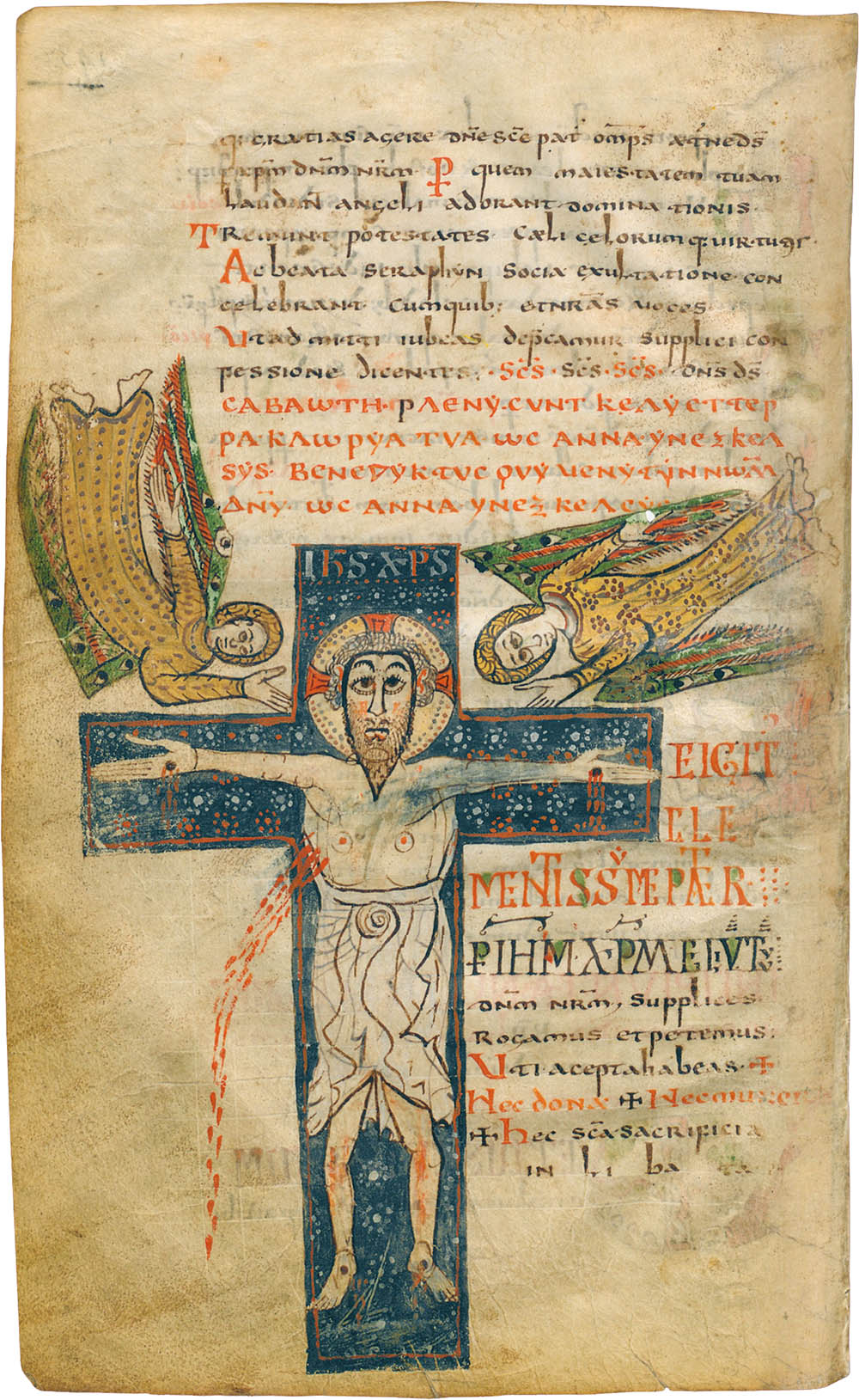
“Christ Crucified in the Gellone Sacramentary” by Lawrence Nees: This eighth-century manuscript illumination from the Frankish kingdom of Charlemagne is one of the earliest surviving images of Jesus on the cross, its viewership restricted to clergy. “He is . . . shown as if nailed to a cross, but this is no wooden cross and indeed no cross at all. It is colored deep blue, studded with white and red flower-like shapes suggesting stars, and indeed it actually is the letter T of the opening words of the Canon of the Mass, the consecration of bread and wine as the body and blood of Christ, in the Latin version here ‘Te igitur clementissime Pater . . . rogamus’ (‘Therefore we beseech Thee, most merciful Father’) . . .”
Crucifixion from the Gellone Sacramentary (Latin 12048, fol. 143v), made in France, ca. 790. Housed at the Bibliothèque nationale de France, Paris.
+++
“Kongo Triple Crucifix” by Cécile Fromont: The west central African kingdom of Kongo, which emerged in the fourteenth century, declared Christianity its official religion in 1509. Kongo participated in the commercial, political, and religious networks of the early modern Atlantic world, and its artists reformulated Christian figures from Europe into objects that are distinctly African—including the many brass crucifixes produced from the sixteenth through nineteenth centuries. (Read more in Fromont’s 2014 book The Art of Conversion: Christian Visual Culture in the Kingdom of Kongo, which I reviewed here.)
Triple Crucifix, central figure 16th–17th century; top and bottom figures 18th–19th century. Brass, iron nails, copper, wood, ultramarine pigment, 10 1/4 × 5 3/4 × 1 in. (26 × 14.5 × 2.5 cm). Metropolitan Museum of Art, New York.
+++
“Death Cart (La Muerte en su Carreta)” by Miguel de Baca: “Death carts” were instruments of penance used by the Penitente brotherhood of northern New Mexico and southern Colorado in the second half of the nineteenth century and the first half of the twentieth; this is the earliest known one. They were built in the style of an old oxcart, and seated inside was Doña Sebastiana, an allegorical figure of Death, wielding her bow and arrow. Each Good Friday, “an elected brother attached the heavy chassis to his torso with a horsehair rope and dragged it from the morada (meetinghouse) along the path to the calvario (Calvary site), inflicting abrasions upon his body as a demonstration of his faith and desire for closer union with God.” I must say, this skeletal figure with the close-set eyes and large forehead (and is that human hair and teeth?) terrifies me!
Nasario López, Death Cart (La Muerte en su Carreta), ca. 1860. Gesso, leather, cottonwood, pine, 51 × 24 × 32 in. (129.5 × 61 × 81.3 cm). Colorado Springs Fine Arts Center, Colorado Springs, Colorado.
“Georgia O’Keeffe, Black Cross with Stars and Blue”by Jeffrey Richmond-Moll: During a four-month stay in Taos, New Mexico, in the summer of 1929—her first visit to the Southwest—Georgia O’Keeffe painted four canvases of Penitente crosses with Taos Mountain visible in the distance. The Penitentes were a lay Catholic brotherhood whose rituals centered on the remembrance of Christ’s passion. They erected crosses all over the region, outside their moradas (meetinghouses) and along roadsides, which they picked up and carried on holy days.
Georgia O’Keeffe (American, 1887–1986), Black Cross with Stars and Blue, 1929. Oil on canvas, 40 × 30 in. (101.6 × 76.2 cm). Private collection.
+++
“James Latimer Allen, Madonna and Child” by Camara Dia Holloway: “Allen operated a studio in Harlem between 1926 and 1943, producing artistic and commercial photographs. . . . By contributing to the development of a new racial iconography, Allen’s Madonna and Child and other black Madonnas offered positive visual and material rejoinders to widely reproduced images that represented black women’s failure to parent their own children. The Mammy stereotype, the legend of Margaret Garner (known as the Black Medea), and portraits of white children held by their black nannies belong to this latter and negative set of portrayals.” This is a religious icon by and for African Americans, Latimer writes—one that reflects and affirms their own self-image.
James L. Allen (American, 1907–1977), Madonna and Child, 1930s. Photograph, 24.4 × 18.7 cm. New York Public Library.
ONLINE LECTURES, organized by Bridge Projects: This Los Angeles gallery is offering a series of free online events to complement A Composite Leviathan, an exhibition of emerging Chinese artists that runs through February 27, 2021. Here are two I RSVPed for. (Both will be presented in English and Chinese.)
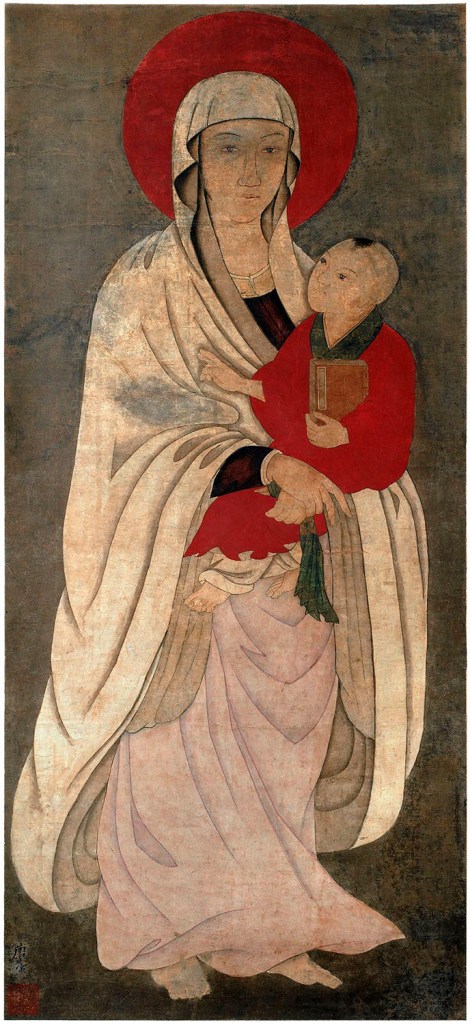
“The Virgin Mother, Her Majesty, Our Lady: Globalism, All-Under-Heaven, and Madonna In-Between” by Dong Lihui, January 12, 8–9:30 p.m. EST: Dong Lihui (PhD, art history), whose research centers on art exchange between East and West, is the author of Chinese Translation of Western Images: Christian Art in China in the 16th and 17th century. In this talk she will discuss the hybridization of European globalism and the Chinese “all-under-heaven” worldview as observed in Chinese Madonna icons made between the sixteenth and twentieth centuries.
Madonna and Child, China, 15th–17th century. Painting on silk, 8 feet high. Field Museum of Natural History, Chicago. Photo: John Weinstein.
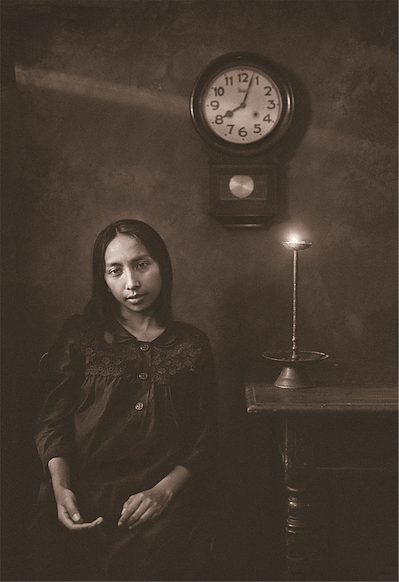
“Counterculture: Chinese Contemporary Christian Art and the Bible” by Clover Xuesong Zhou, January 26,8–9:30 p.m. EST: “The advent of modernity brought with it enmity between Christian traditions and a newly liberated art world. Similarly, contemporary artists in China found themselves at odds with the government beginning in the 1980s. All the while, Christianity has had a torrid relationship with Chinese government and culture. Thus, Chinese artists who are also practicing Christians work within these complex intersections.” Art writer and art theologian Clover Xuesong Zhou will be discussing some such artists, including photographer Stanley Fung (Feng Junlan), video artist Li Ran, and installation artist Gao Lei.
Stanley Fung (Chinese, 1961–), The Lord’s Handmaiden, 2012
+++
SONG: “O Holy Night” by Ben Caplan and friends: An absolutely stunning minor-key rendition by Canadian singer-songwriter Ben Caplan (who is often compared to Leonard Cohen) and a team of others, combining gypsy jazz, classical, and Jewish folksong influences. Caplan, who is Jewish, didn’t grow up listening to much Christmas music. “I have to admit that I find a lot of that music a bit corny. Where is that minor fall? Where is the major lift? Where is the bafflement?” He continues, “I have a deep felt belief that if you don’t like something, you should do something about it. It’s not enough to complain from the sidelines! There are some truly beautiful songs and carols out there, and I wanted to make something that tip-toes towards the sublime rather than shopping-mall-easy-listening.” Arcade Fire’s “My Body Is a Cage” was one of his reference points. (“I wanted to try to recreate that gradual build, and the sublime surrender to an enormous scale of sound.”) There are a few intentional semitone clashes to generate dissonance.
Filmed last year inside Halifax’s Fort Massey United Church and released in November, this recording was in the making for four years and is the result of much collaboration. The left-handed violinist in the video, Donald MacLennan (see, e.g., 1:34), reharmonized the carol, and he, Caplan, upright bass player Anna Ruddick, drummer Jamie Kronick, and vocalist Taryn Kawaja worked out an arrangement for their band, which they performed at a Christmas concert in 2016. Peter-Anthony Togni, who plays organ for the song, was brought in later to arrange the song for string quartet, pipe organ, and bass clarinet. Caplan chose the instrumentation and aesthetic shape. He recounts the process in detail and names all the people involved on his Bandcamp page. “I want to dispel the myth of the lone genius,” he says. “It took a lot of people with a lot of talent to pull this off. I am just the lead singer, and the guy who was stubborn enough to bring all the people together and spend an outlandish amount of money trying to achieve this vision.” Purchase on Bandcamp, and/or stream on Spotify.
I am truly moved by this atmospheric take on an old classic, which perfectly brings together the darkness and light of the Christmas season. “Original, and righteous—hymn for the COVID time,” says one YouTube user. “You’ve found things in this old carol that I never knew existed,” says another. And another: “A sensory feast. So deeply piercing.”
PHOTO ESSAY:“Advent 2020: Comfort My People”: Community development and relief worker Kezia M’Clelland, a child protection in emergencies specialist, works in areas of disaster and conflict. Every December she compiles a set of news photographs published in The Guardian that year, pairing each with an Advent scripture. (I introduced her in a 2017 Advent roundup.) Text and image amplify each other and prompt deeper reflection on the themes of the season as well as an awakening to global crises and/or injustices. The photos in this year’s compilation include a schoolteacher bringing plastic-wrapped hugs to her quarantined students in Rio de Janeiro, flooded roadways in Honduras following Hurricane Eta, a Syrian family from Ariha breaking their Ramadan fast amid the rubble of their home, a Palestinian boy from the Khan Younis refugee camp standing on a pile of scrapped car parts, the aftermath of the Beirut port explosion in August (caused by improperly stored ammonium nitrate), a protester outside Dallas City Hall in the US insisting that all citizens’ presidential election votes be counted, and others.
Photo: Pilar Olivares / Reuters [via], set to Isaiah 40:1 by Kezia M’ClellandPhoto: Aaref Watad / AFP [via], set to Isaiah 40:4 by Kezia M’Clelland
M’Clelland adds one new photo for each day of Advent and then releases them all in video slideshow form on December 24. Here are her photo compilations from 2019 (“Good News of Great Joy”) and 2018 (“Peace on Earth”):
SONG: “He Who Made the Starry Skies”: For optimal acoustics, three Bruderhof women from the Fox Hill Community in Walden, New York, trek on over to a silo to sing a fifteenth-century processional carol written by the nuns of St. Mary’s, Chester, in England, a medieval nunnery of which nothing now survives. Both the words and music have been preserved in a ca. 1425 manuscript known as The Chester Mysteries. The original is in Latin (and is titled “Qui creavit coelum”), but singers Alina McPherson, Melinda Goodwin, and Coretta Marchant opt for an English translation. I am providing the sheet music here, courtesy of the Bruderhof Historical Archives. [HT: Tamara Hill Murphy]
He who made the starry skies (Lully, lully, lu) Sleeping in a manger lies (Lully, lully, lu) Ruler of all centuries (Lully, lully, lu)
Joseph brings the swaddling clothes (Lully, lully, lu) Mary wraps the babe so mild (Lully, lully, lu) In the manger puts the child (Lully, lully, lu)
Humbly clad, the King of kings (Lully, lully, lu) Joy of heav’n to earth now brings (Lully, lully, lu) Sweet above all earthly things (Lully, lully, lu)
Mary, ask thy little son (Lully, lully, lu) That he give us of his joy (Lully, lully, lu) Now and through eternity (Lully, lully, lu)
The Bruderhof is an Anabaptist Christian movement of more than three thousand people committed to peacemaking, common ownership, and proclamation of the gospel. They have twenty-eight settlements on four continents, made up of families and singles. Perhaps you know them through their publishing house, Plough. Their website reads, “Love your neighbor. Take care of each other. Share everything. Especially in these challenging times, we at the Bruderhof believe that another way of life is possible. We’re not perfect people, but we’re willing to venture everything to build a life where there are no rich or poor. Where everyone is cared for, everyone belongs, and everyone can contribute. We’re pooling all our income, talents, and energy to take care of one another and to reach out to others. We believe that God wants to transform our world, here and now. This takes a life of discipleship, sacrifice and commitment; but when you truly love your neighbor as yourself, peace and justice become a reality. Isn’t that what Jesus came to bring for everyone?”
+++
UPCOMING (ONLINE) CHRISTMAS CONCERTS:
“A Family Holiday Singalong with Dan and Claudia Zanes,”Tuesday, December 15, 6 p.m. EST: Presented by the Lebanon Opera House in New Hampshire, this multicultural concert will feature Christmas, Hanukkah, or New Year’s songs from France, Wales, Germany, America, Puerto Rico, Korea, Tunisia, and Haiti. You can download the set list, which includes lyrics and chords, at the registration link I’ve posted. Dan and Claudia Zanes are a musical couple from Baltimore (my neck of the woods!), and I’ve really enjoyed the daily song videos they’ve been releasing on YouTube since COVID started. Here they are in 2018 with Pauline Jean, singing “Ocho Kandelikas,” a Hanukkah song written by Flory Jagoda in the 1980s in the Judeo-Spanish language known as Ladino. (Update: Concert video available here.)
ARTICLE: “Making Space for a Multicultural Christmas” by Michelle Reyes: “How can each of us celebrate Christmas at the intersection of our faith and our culture, while welcoming differing cultural perspectives on Christ’s birth?” asks Dr. Michelle Reyes, VP of the Asian American Christian Collaborative and editorial director of Pax, in this Gospel Coalition article. She briefly discusses four different cultural traditions that highlight unique aspects of Jesus’s birth narrative: posadas in Central America, Kiahk in Egypt, parols (star-shaped lanterns) in the Philippines, and Día de los Reyes [previously] in Puerto Rico, Mexico, and other Hispanic countries.
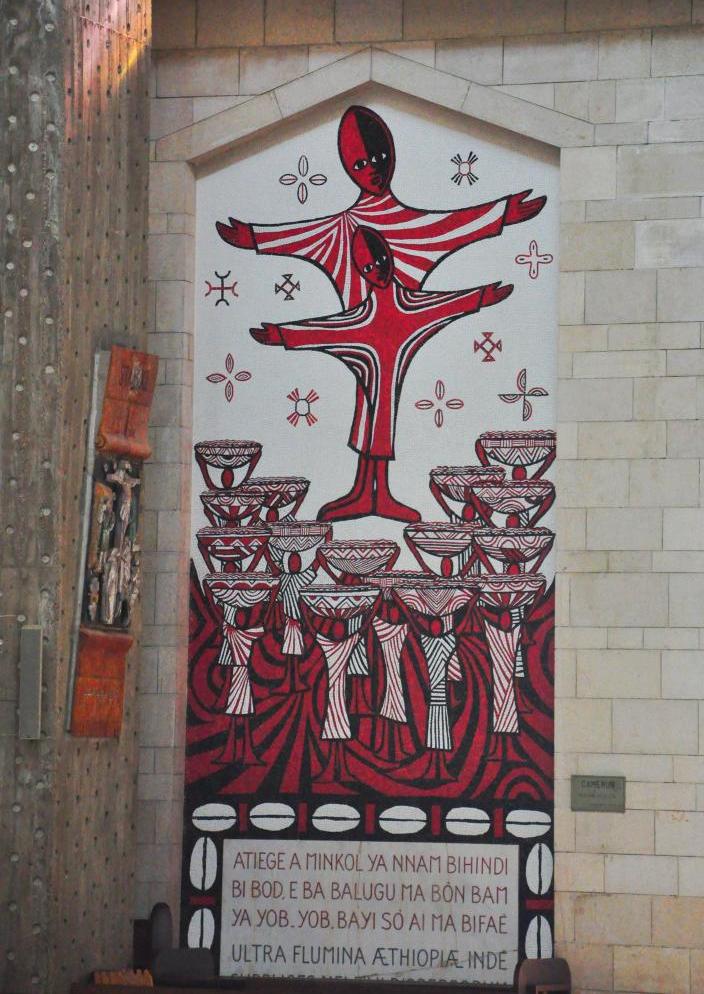
PODCAST EPISODE: “God’s Global Family,” BibleProject:BibleProject, a nonprofit ed-tech organization and animation studio, produces one of my favorite podcasts, hosted by biblical scholar Tim Mackie and Jon Collins. (I found episodes 6–11 of their recently wrapped “Character of God” series, on the wrath of God, particularly illuminating.) “Family of God” is the name of the series they’re in now. In this first episode they discuss how Christianity is the most multiethnic religious movement in history, and how our humanity cannot be fully realized without understanding, appreciating, and being connected to the identity of every other culture. I link to it here because it dovetails nicely with the Reyes article and because I want to introduce you to the podcast, if you’re not already familiar with it, but also because Mackie spends time talking about the Basilica of the Annunciation in Nazareth, with its many culturally specific portrayals of Mary and Jesus from around the world.
As you know, diversity in biblical imagery, especially images of Jesus, is important to me, so I was delighted to hear this popular podcast tip their hat to this pilgrimage site in Israel that features a range of visual interpretations of the incarnation. You can view a compilation of the church’s national mosaics at BibleWalks.com. Most of them are not of high artistic quality, but I appreciate the initiative of inviting the nations to contribute their own localized representations. Above, I posted three that I particularly like.
Warning: This post contains distressing photographs, including one of an emaciated child and one of a wounded (but bandaged) infant.
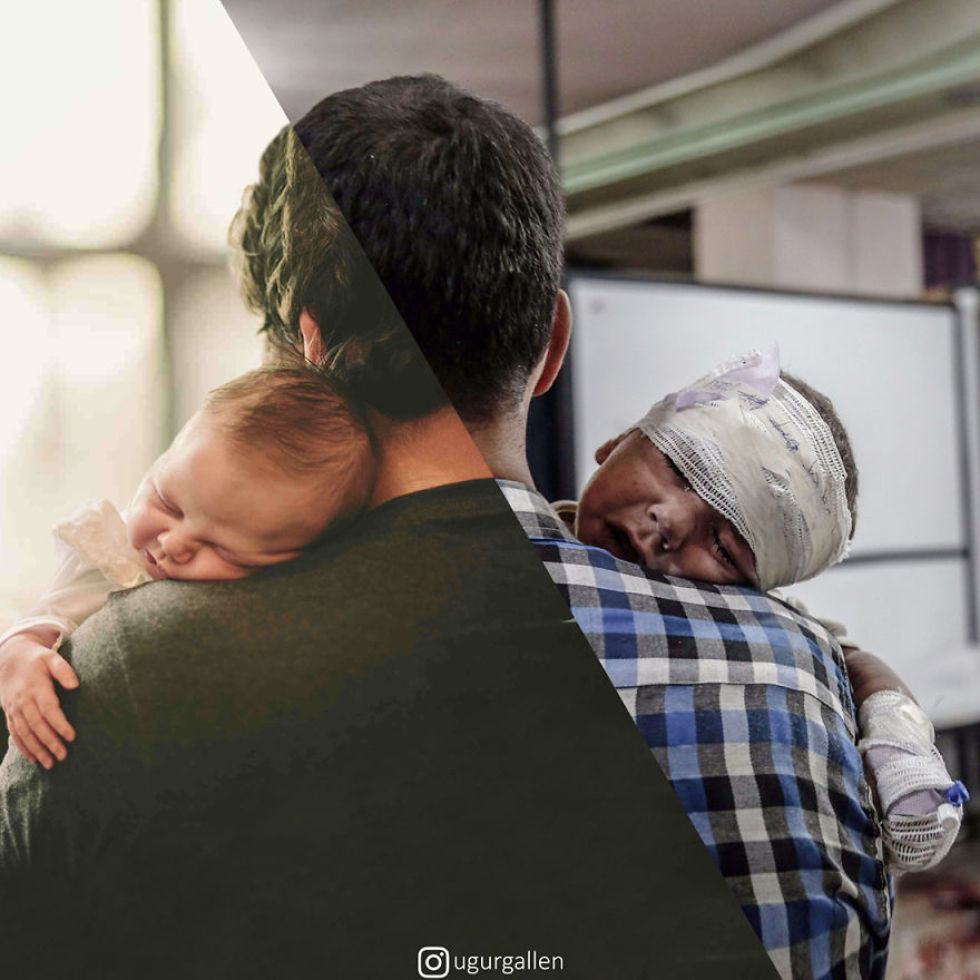
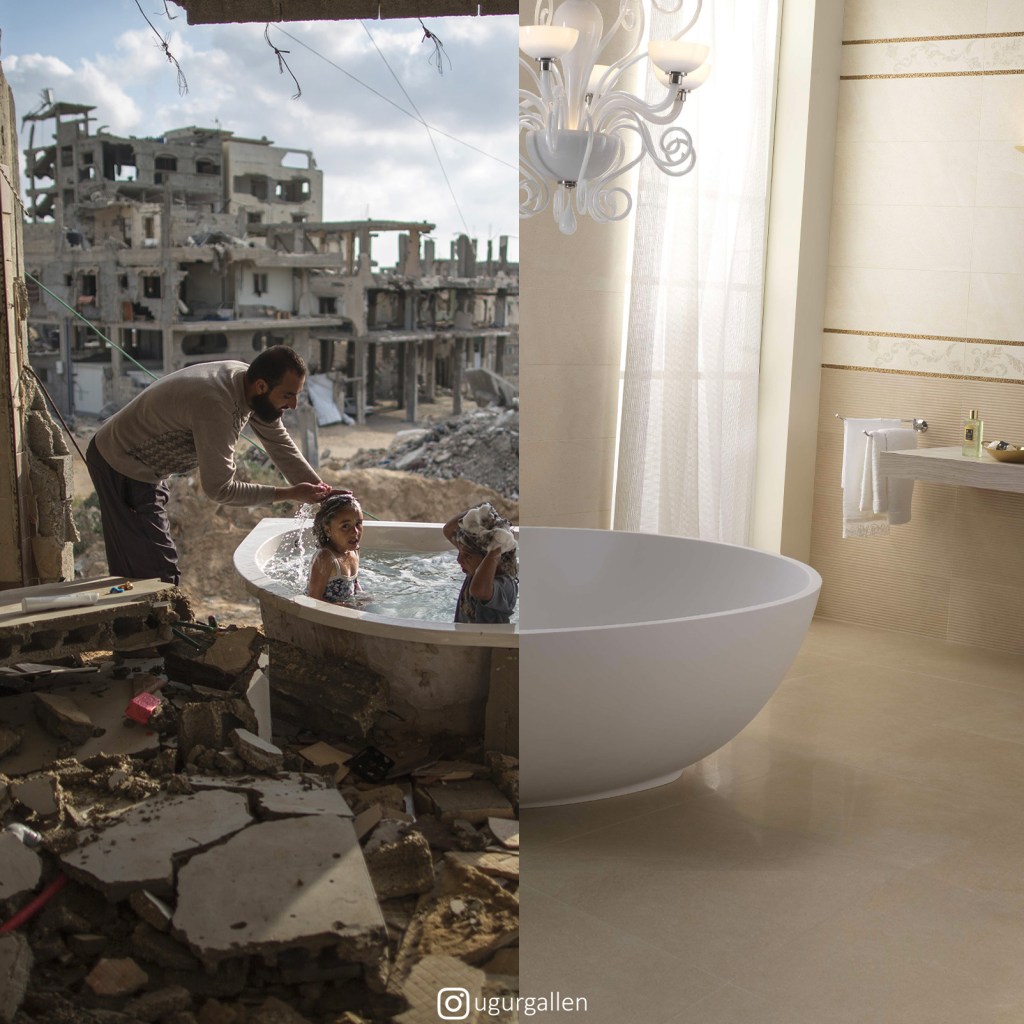
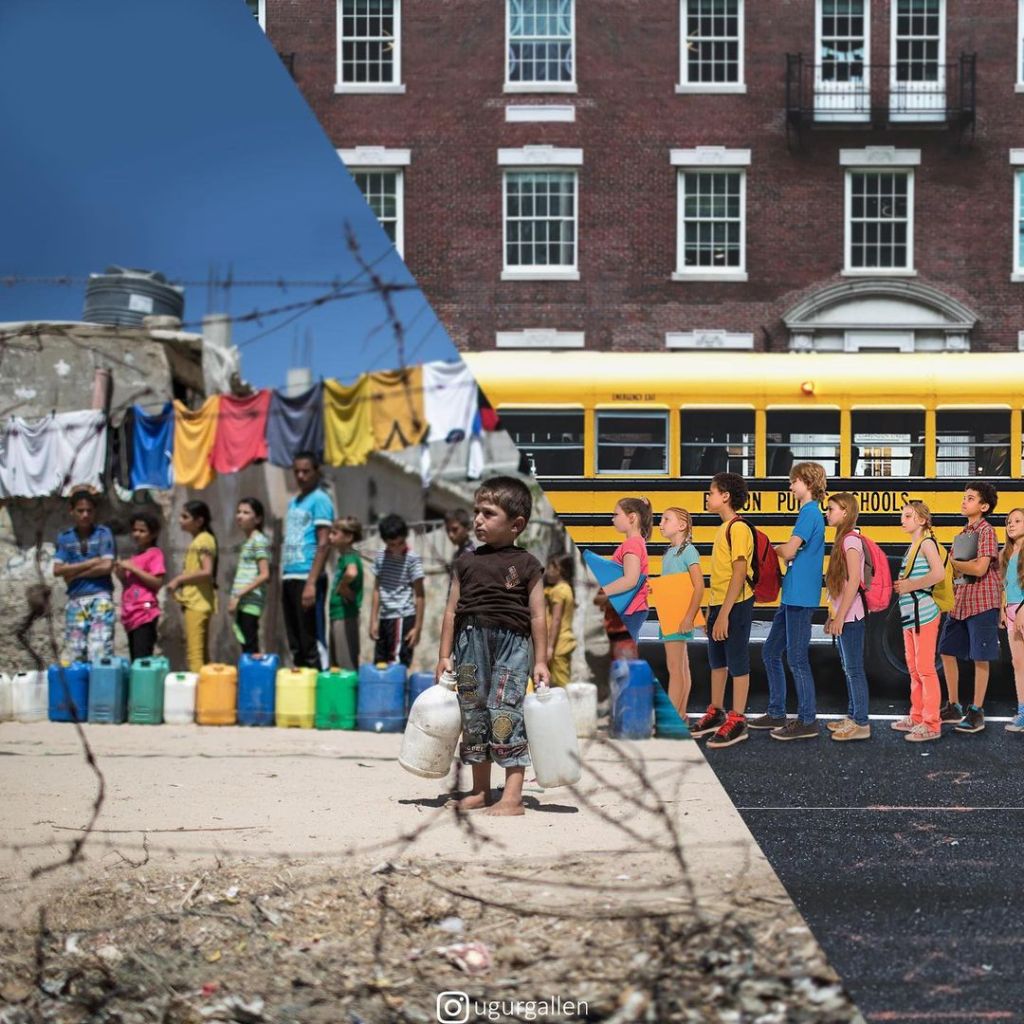
Uğur Gallenkuş (Turkish, 1990–) is an Istanbul-based artist whose digital photomontages address the widening global divide between the privileged and the oppressed. By combining photojournalistic images and stock photos with similar compositional elements, he juxtaposes the relative safety, stability, comfort, and flourishing experienced by middle- and upper-class Westerners with the violence, terror, trauma, and hardship experienced by victims of poverty, war, and displacement. Because Gallenkuş lives in the Middle East, he focuses on that geographic region.
Releasing November 20 in honor of World Children’s Day, Parallel Universes of Children brings together fifty of Gallenkuş’s sobering mash-ups, integrating facts of children’s lived realities around the world. It is $60 plus shipping, available only through the artist’s website. (For US buyers, there’s stock warehoused in New Jersey, so you won’t be paying to ship it from Turkey.)
“I aim to create awareness and inspire action to remember and to ask ourselves every day what we have done to safeguard children’s rights, both near home and across the globe,” Gallenkuş says. He wants not only to alert the well-off to the suffering they often shield themselves from, shaking them out of their complacency, but also to remind those in underdeveloped countries that they deserve better government and education, the right to thrive.
I’ve linked each image to its source on Instagram, where you can find out more information about it—when and where the photograph was taken and by whom (Gallenkuş does not take the photos himself), context, stats, etc. Some of the links will take you to a revised (updated) form of the image; in those instances, the originals I found at Juxtapoze.
The stark contrast between the two component photos of each montage is jolting, intentionally so. Reflecting socioeconomic and political disparities, they tell drastically different stories about childhood. My existence must look like a fairy tale to those who have grown up in war zones or refugee camps.
One of Gallenkuş’s montages shows a lavish bathroom with a chandelier, pristine tiles, and freshly pressed towels next to the remnants of a bathroom whose walls were blown out by an Israeli airstrike, where a father bathes his daughter and niece.
Another one shows a line of American schoolchildren waiting to board a bus, which transforms into a line of Palestinian children waiting to fill jerrycans and bottles with drinking water from public taps at the Deir al-Balah refugee camp in central Gaza Strip. (Many fall sick from the water, whose source is polluted with human waste.)
Consider, too, the differences in play. A child at an IDP camp plays with a toy grenade launcher, while his counterpart plays doctor. A Syrian boy has fun balancing on the barrel of a tank in a pile of wreckage, while opposite him, in a green park, a boy rides a harmless seesaw. The imaginations of children are shaped by what surrounds them, whether that be violence or possibility.
Because May is Mary’s month, I thought I’d share some photos I took of various artworks of the Virgin that were on display during my last visit to the Dumbarton Oaks Museum. Dumbarton Oaks is a historic estate, fifty-four acres, in the Georgetown neighborhood of Washington, DC, the former residence and gardens of Robert and Mildred Bliss. In 1940 the Blisses bequeathed the estate, and their extensive collections of Byzantine and pre-Columbian art, to Harvard University, who runs it as a museum, research institute, and library. In addition to housing a stellar permanent collection, the museum also hosts special exhibitions throughout the year, including by contemporary artists. (When I was there I saw the wonderful Outside/IN by Martha Jackson Jarvis.)
The six Marian artworks featured below include paintings, sculptures, and a tapestry, and each originated in a different geographic region: present-day Turkey, Italy, Germany, France, Belgium, and Spain. All but the first are from the House Collection, on display in the beautifully designed Renaissance-style Music Room.
+++
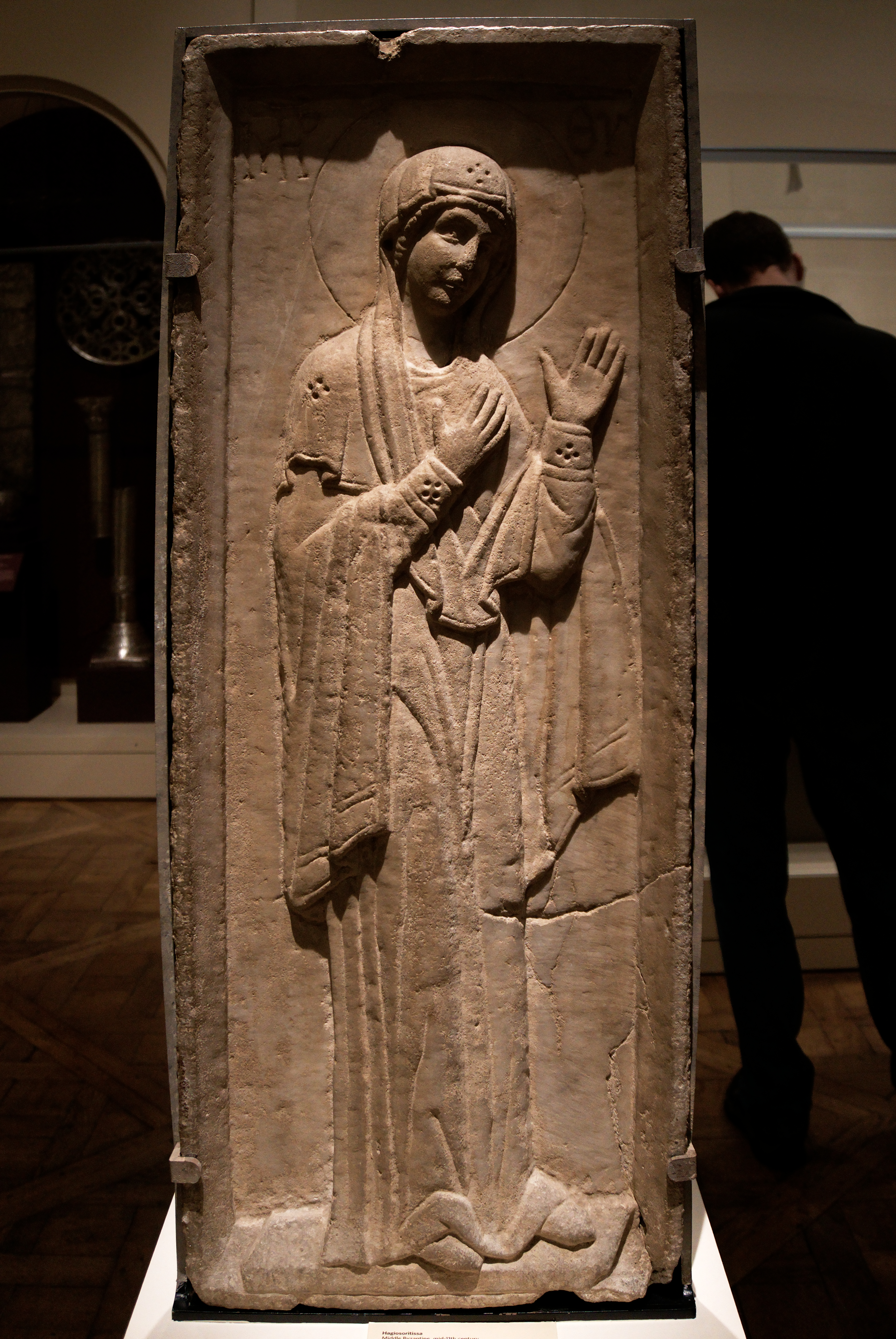
Stone carving is an uncommon medium for Byzantine icons. While sculpture in the round was typically avoided by the church in the East, at least for devotional use, relief carving, with its closeness to two-dimensionality, was more acceptable, though still much rarer than painted wooden panels.
In this carved icon Mary raises her hands in prayer on behalf of humanity, a type known as the Virgin Hagiosoritissa (Gk. “Intercessor”). Made before the development of the iconostasis, it was probably originally placed inside a church on the left pillar of the bema, or sanctuary, while an image of John the Baptist occupied the right pillar, with Christ at the top center, forming a group known as the Deesis (“Supplication”). These two individuals are traditionally shown as primary intercessors, flanking an enthroned Christ like courtiers, because they were the first to recognize Jesus’s saving role: Mary in her “yes” to Gabriel, John in his in utero jump for joy.
The Greek inscription at the top of the icon, ΜΡ ΘΥ, is shorthand for “Mother of God.”
Bernardo Daddi (Italian, ca. 1280–1348), Madonna and Child with Saints and Angels, 1337. Tempera and gilding on poplar panel, 87.6 × 44.5 × 8.9 cm (34 1/2 × 17 1/2 × 3 1/2 in.). Dumbarton Oaks, Washington, DC. Photo: Victoria Emily Jones.
Bernardo Daddi was the preeminent Florentine painter after Giotto, who had pioneered a new naturalism and may have been Daddi’s teacher. Daddi operated a large and busy workshop, specializing in small-scale paintings and altarpieces commissioned by the well-to-do for their private devotions. While in this panel he uses the traditional Byzantine gold ground, representing the radiance of heaven, he moves toward the Renaissance with individualized facial expressions and depth in space. I love the tenderness of Mary who cuddles her son’s foot as he looks up at her admiringly, climbing over her lap and clutching at her collar.
“This panel was originally the central unit of a triptych, the wings of which are now missing,” writes James N. Carder. “The Virgin Mary holding the Christ Child sits in the center on a high-backed throne. To the left stand Saint Peter, grasping two keys, and Saint Dominic, who wears a Dominican habit and holds a lily. To the right stand Saint James the Great, holding a staff from which hangs a small red purse, and Saint Paul, holding a knife. Behind each group of saints are two angels, and in the gable is a roundel with the bust of Christ making a blessing gesture.”
Tilman Riemenschneider (German, ca. 1460–1531), Virgin and Child on the Crescent Moon, ca. 1521–22. Lindenwood, 95.3 × 35 × 21 cm (37 1/2 × 13 4/5 × 8 3/10 in.). Dumbarton Oaks Museum, Washington, DC. Photo: Victoria Emily Jones.
This similarly tender Madonna and Child image was made two centuries later by the German Late Gothic artist Tilman Riemenschneider, who ran the largest sculpture workshop in Würzburg, producing an enormous number of religious images for churches. Jesus reaches his hand up to cradle his mother’s chin, his shirt swept back in a breeze, and she holds him with great fondness while also confronting the viewer with a contemplative air. She stands on a crescent moon, probably meant to associate her with the Woman of the Apocalypse described in Revelation 12, who gives birth to a male ruler whom the dragon seeks to devour.
Riemenschneider was “highly regarded in Europe for his technical virtuosity in wood and stone and for his sensitive blending of religious subject matter with a deeply felt appreciation for humanity.” He was one of the first sculptors to abandon polychromy (the application of color to sculpture) on selected works, emphasizing the simple beauty of the sculpted material, which in his case was usually lindenwood (aka limewood), alabaster, or sandstone. A wealthy, respected, landowning member of Würzburg society, Riemenschneider served on the municipal council. His high status and artistic career came to an abrupt halt, however, during the German Peasants’ War of 1525, in which he refused to obey an order to fight the revolting peasants and was imprisoned as a result.
From the French Late Gothic, the Music Room has this beautiful little broken Pietà. A Pietà (Ital. “pity, compassion”) is a representation of the dead Christ on the lap of his mourning mother, but here the figure of Christ is no longer intact. At first I assumed this was Mary in prayer or contemplation, but upon looking up the object on the printed key and finding it to be a Passion image, I can now see that the expression she bears is an elegiac one.
Virgin from a Pietà, made in France, last quarter of 15th century. Limestone with polychromy, 50.8 × 22.9 × 27.9 cm (20 × 9 × 11 in.). Dumbarton Oaks Museum, Washington, DC. Photo: Victoria Emily Jones.
Many Christian images throughout history are contextualized to the time and place in which they were made, and this one is no exception. “The Virgin is clothed in a manner contemporary to the portraiture of fifteenth-century noblewomen, with a simple gown tightly fitted above the waist,” writes Kristen Gonzalez. “A mantle is drawn up over her head, underneath which a veil and barbeile partially obscure her head and lower neck. . . . The Virgin’s gown and mantle appear to have been painted blue and edged with gilding,” as the polychrome traces suggest.
“Small-scale tapestries with devotional subject matter were produced during the early modern period and were prized for this purpose throughout Europe, particularly among the elite circle of monarchs, princes, dukes, and the highest ecclesiastic echelons,” writes Elizabeth Cleland. “Part of the appeal of the scale of these devotional tapestries must have been their portability. They could easily be rolled up or folded and transported with other court paraphernalia from one location to another, thereby accompanying their often itinerant royal owners.”
Furthermore, unlike the monumental tapestries that were often part of a cycle and that were more decorative in nature, these smaller ones were intended to function individually, as single works, and in more intimate ways, for personal prayer and reflection. Dumbarton Oaks’ Christ and the Virgin, three feet square, may have hung in a private oratory (prayer room).
Tapestry of Christ and the Virgin, Flemish, probably Brussels, late 15th–early 16th century. Wool, silk, and silver and gold thread on wool, 96.5 × 96.5 cm (38 × 38 in.). Dumbarton Oaks Museum, Washington, DC. Photo: Victoria Emily Jones.
James N. Carder describes the image: “Side-by-side are seen the bust-length figures of Christ as Savior (Salvator Mundi), holding a cruciform orb and making a blessing gesture, and the Virgin Mary crowned as Queen of Heaven and with her hands together in prayer before an open book on the ledge. The lower field of the foreground is profusely ornamented with floral (millefleurs) motifs, and above the arches are a row of Gothic ornaments and a cloisonné-like geometric band that are reminiscent of the tops of French enamel reliquaries.”
Lastly, a painting by one of my favorite artists, the Greek-born Spanish Renaissance painter known as El Greco. The Visitation is a common subject in art that refers to the meeting of the pregnant Virgin Mary (shown at the right by El Greco) and her cousin Elizabeth, who was pregnant with John the Baptist. El Greco’s Visitation was intended for the Chapel of Isabel de Oballe inside the Church of San Vicente in Toledo, but it’s uncertain whether it was ever installed. Originally the canvas had a circular outline, but at some unknown date it was cut down on all sides.
El Greco (Doménikos Theotokópoulos) (Greek Spanish, 1541–1614), The Visitation, ca. 1610–14. Oil on canvas, 96.5 × 71.4 cm (38 × 28 1/8 in.). Dumbarton Oaks Museum, Washington, DC. Photo: Victoria Emily Jones.
El Greco’s initial art training was in Byzantine icon painting on the island of what today is Crete, where he was born and which was then under Venetian rule. At age twenty-six he moved to Venice and learned the Italian Mannerist style, and ten years later he left for Spain, where he spent the rest of his life. Characterized by a spiritual fervor and a sort of proto-expressionism, his works were new and unusual and much sought after. The Visitation demonstrates his preference for boldly attenuated figures caught in strong highlighting, abstractions that “emphasize the ethereal and timeless nature of the biblical world,” says Carder.



#/media/File:Andrea_Mantegna_108.jpg)