Kolumba and KMSKA: Medieval and contemporary art in conversation (part 2)

This a continuation of yesterday’s article. In part 1 I shared three room highlights from my visit to Kolumba museum in Cologne, Germany, run by the city’s Catholic archdiocese; in this final part I will do the same for KMSKA in Antwerp, Belgium, whose Old Masters galleries received a “contemporary injection” in an exhibition that wrapped this week. All photos are my own.

[Content warning: This article contains female nudity: a controversial Renaissance painting of the Virgin Mary, and three photographs of women who have just given birth.]

KMSKA, Antwerp

The Royal Museum of Fine Arts Antwerp, or KMSKA for short, is a world-famous museum whose collection spans seven centuries, from the Flemish Primitives to the Expressionists.

When I was there last month, the featured exhibition was Collected with Vision: Private Collections in Dialogue with the Old Masters, which ran from April 4 to October 12, 2025. Organized in conjunction with Geukens & De Vil Projects, it interwove postwar and contemporary works by internationally renowned artists from Belgian private collections with the existing museum collection, “expanding the transhistorical approach already in place. The exhibition offers a reflection on the history of art collecting and asks probing questions about social issues such as gender, power and identity. The role of museums and collectors is the focal point. Do the interventions create a harmonious dialogue with 700 years of art history, or do they give rise to challenging contrasts?” Featured artists included Cindy Sherman, Olafur Eliasson, David Claerbout, Francis Alys, Christian Boltanksi, Tracey Emin, Marlene Dumas, Luc Tuymans, and Louise Bourgeois.

The galleries of the exhibition were organized by theme: Holy, Impotence, Horizon, Image, Entertainment, Profusion, Lessons for Life, Fame, The Salon, Heroes, Evil, The Madonna, Suffering, Redemption, Prayer, Heavens, and Power.

I’ll spotlight what I consider the most successful and intriguing pairings.

First, the “Madonna” room, anchored by the famous Madonna Surrounded by Seraphim and Cherubim by the late medieval French court painter Jean Fouquet. It’s the right wing of a diptych that originally hung above an altar at the Collegiate Church of Notre-Dame in Melun.
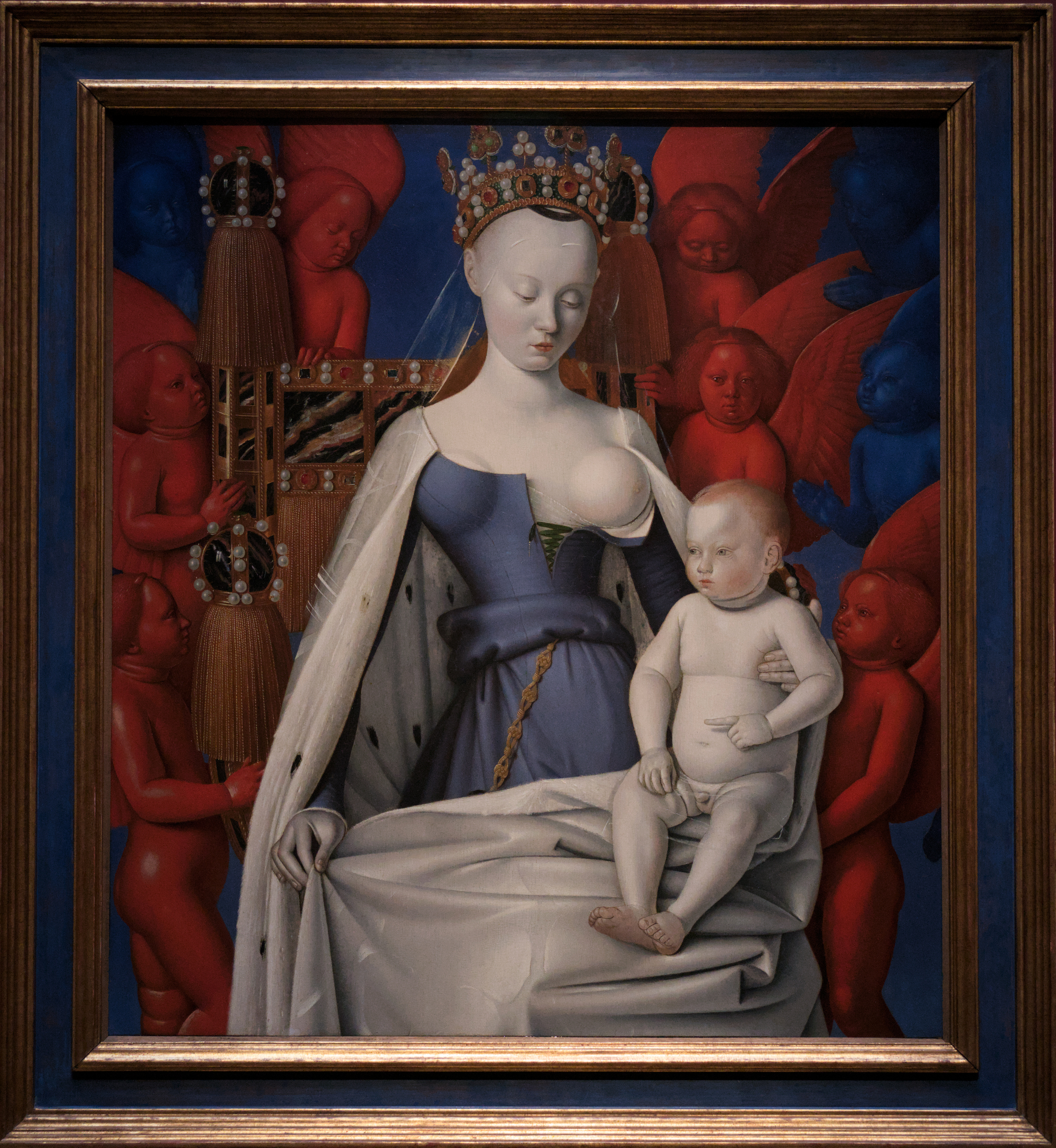
Fouquet, Jean_Madonna Surrounded by Seraphim and Cherubim
Jean Fouquet (French, 1410/30–1477/81), Madonna Surrounded by Seraphim and Cherubim, ca. 1450. Oil on panel, 92 × 83.5 cm. Koninklijk Museum voor Schone Kunsten Antwerpen (KMSKA, Royal Museum of Fine Arts Antwerp).

The painting is historically significant—I first encountered it in a college art history course. Commissioned by Etienne Chevalier, treasurer to King Charles VII of France, it portrays the Virgin Mary as the Queen of Heaven, baring her breast ostensibly to nourish the Christ child with her milk. She was probably modeled after Agnès Sorel, the king’s recently deceased mistress and mother of three of his daughters, considered the ideal of feminine beauty at that time in western Europe: pale-skinned, with a high forehead, and fashionable in her ermine cloak.

Though I can appreciate the technical excellence of this painting and the intense reds and blues of the angels, I don’t really like it. Mary seems cold, not very maternal. There’s also an eroticization of her body—not because her breast is exposed, which was common in Marian art, but because it seems to be on display for the viewer; her son’s not interested in feeding—that’s wholly inappropriate for the subject. Why you’d want to memorialize your boss’s sex partner in such a way is beyond me. I’m no prude, but I much prefer Jan van Eyck’s Madonna at the Fountain, on display in the same room:
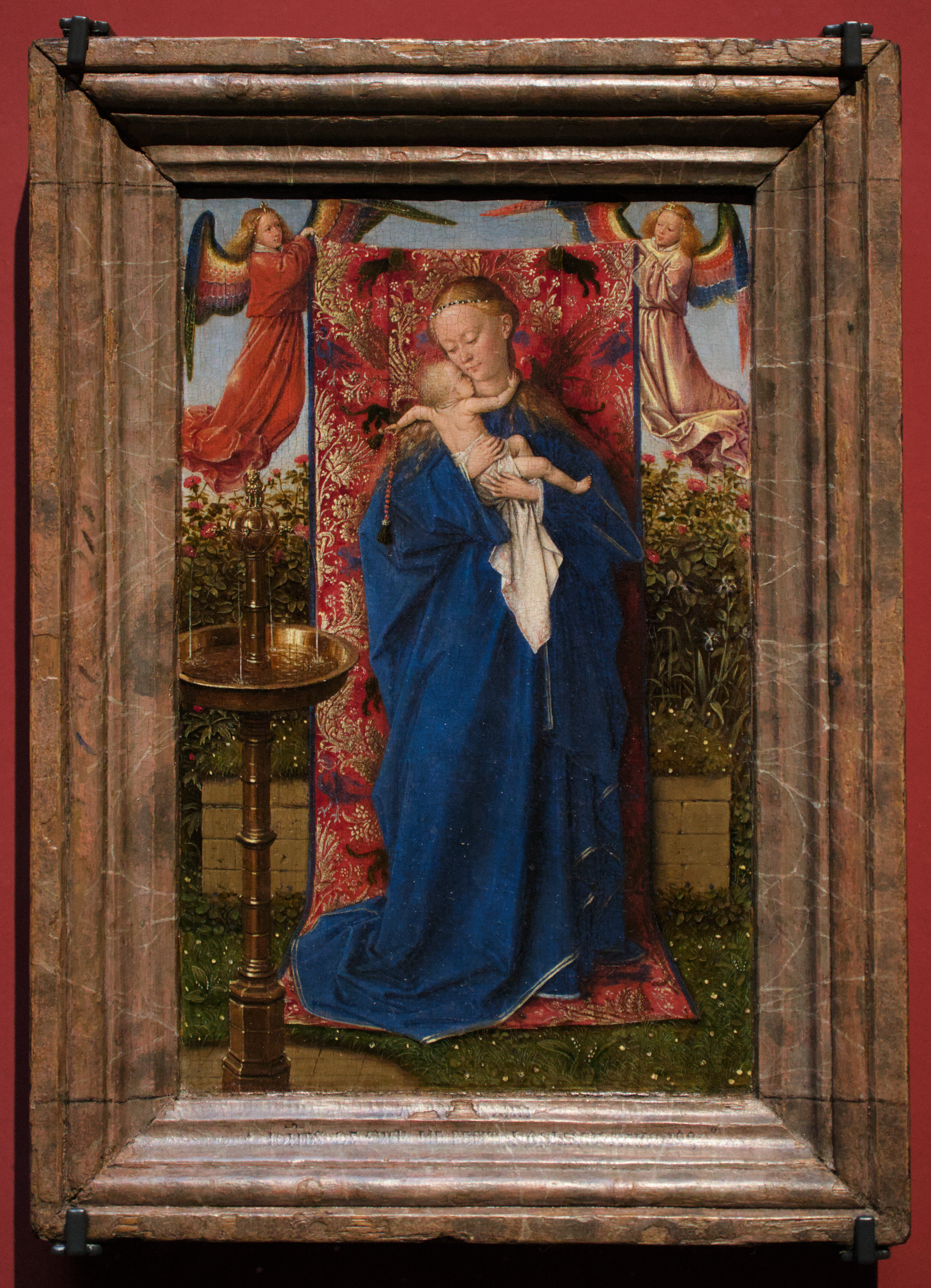
van Eyck, Jan_Madonna at the Fountain
Jan van Eyck (Flemish, 1390/99–1441), Madonna at the Fountain, 1439. Oil on panel, 19 × 12 cm. Koninklijk Museum voor Schone Kunsten Antwerpen (KMSKA, Royal Museum of Fine Arts Antwerp).

This small painting originally hung not in a church but in someone’s house. Though there’s still an air of formality, it has all the tenderness and connection that the other one lacks. Mother and son embrace in a garden of roses, irises, and lilies of the valley, he reaching round her neck and holding a string of prayer beads, she gazing adoringly at him. They stand beside a fountain, recalling Jesus’s discussion in John 4 about the “living water” he gives to those who thirst. The original wood frame bears the artist’s motto: “As well as I can.”

The deeply engrained portrait of motherhood embodied by the Virgin Mary is juxtaposed most potently with a series of three black-and-white portraits of new mothers by the Dutch photographer Rineke Dijkstra.
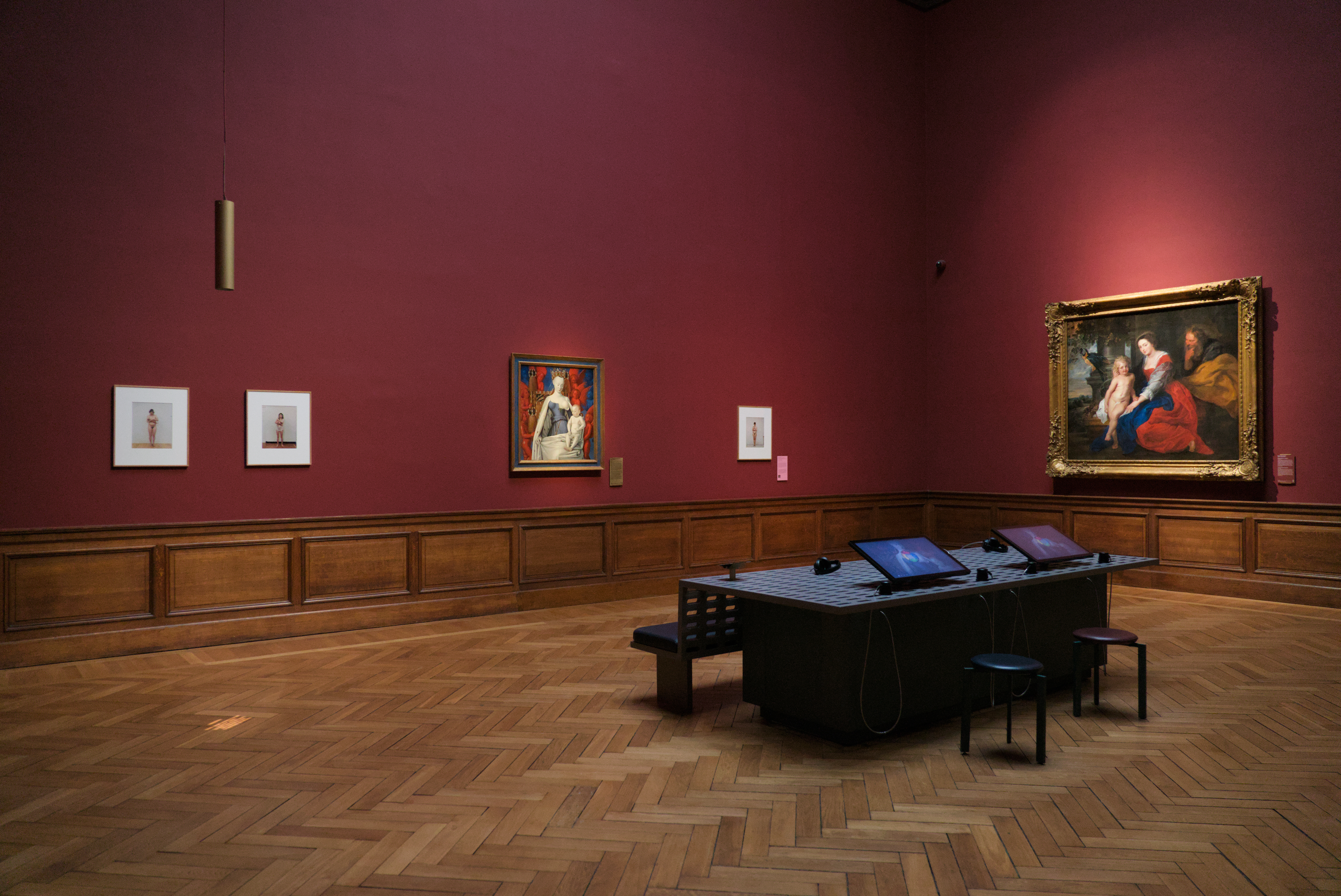
"Madonna" gallery
Gallery 2.17 (“The Madonna”) from the KMSKA exhibition Collected with Vision: Private Collections in Dialogue with the Old Masters

The accompanying text read:

Jean Fouquet portrays motherhood as something sacred. Mary as a symbol of purity and devotion is richly dressed in cool colours. Rineke Dijkstra homes in on the vulnerable reality. Her mothers are scantily clad and marked by childbirth. Both works are innovative: Fouquet may have painted his Mary for the first time from a real person, and in its day the painting was regarded as ‘modern’. Dijkstra shows motherhood in all its rawness, a taboo usually withheld from view.
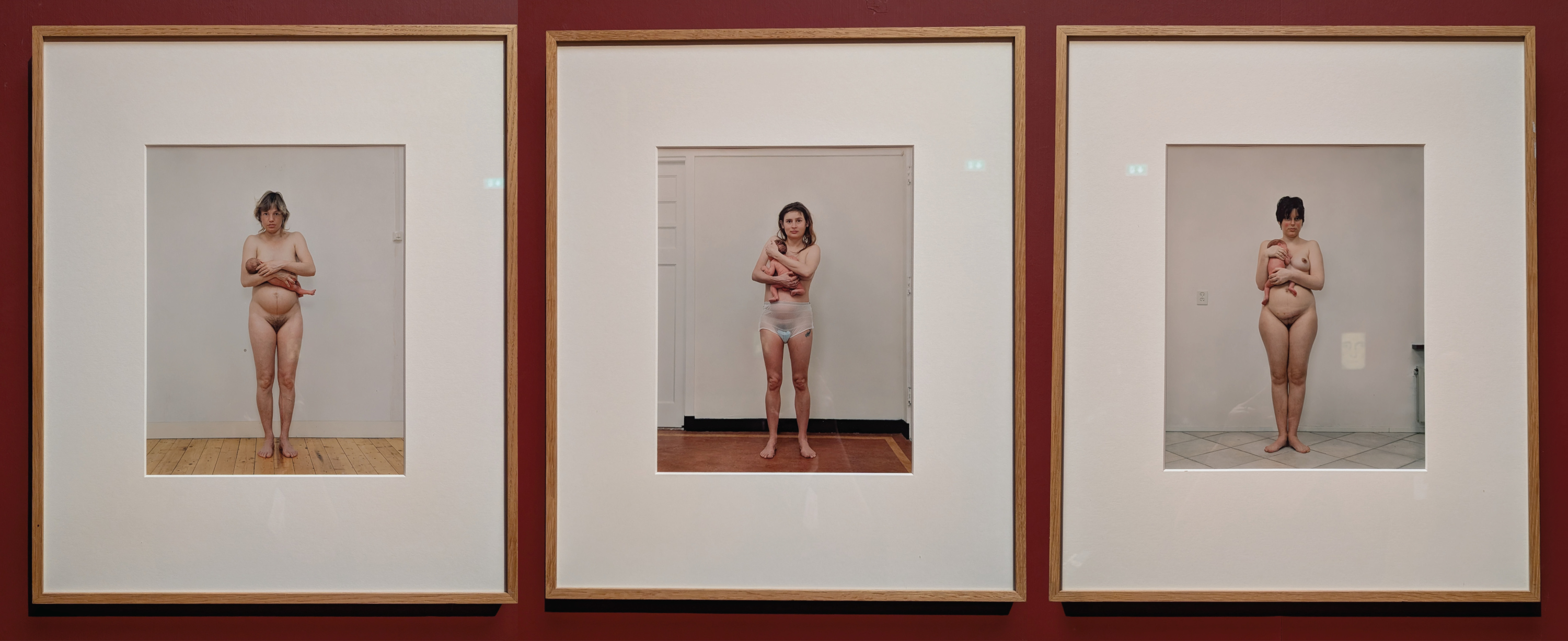
Dijkstra, Rineke_New Mothers
Rineke Dijkstra (Dutch, 1959–), Tecla (Amsterdam, The Netherlands), Julie (Den Haag, The Netherlands), and Saskia (Harderwijk, The Netherlands), 1994. Digital prints. Private collection. [Composite photo by author]

Julie wears hospital pads and mesh underwear, which women often do for several weeks after giving birth to manage postpartum bleeding and urinary incontinence. As for Tecla, blood is running down her leg. And Saskia bears a scar from her cesarean section. A linea nigra (dark line) zips down the abdomen of all three, a temporary pigmentation increase caused by increased hormone levels. I love this triptych that shows motherhood’s glorious, messy, alterative impact on the body—the real physicality of the vocation of bearing children into the world.

I wish there were more imagery of Mary like this, as it would, I think, deepen the wonder of the Incarnation and enhance women’s ability to identify with Mary and thus further enliven her story.

Also in the Madonna gallery was a unique “light poetry” installation by Nick Mattan and Angelo Tijssens—one of seventeen spread throughout the second floor, collectively titled Licht dat naar ons tast (Light that reaches for us). KMSKA had commissioned this couple to bring to life the short verses the museum’s late writer-in-residence Bernard Dewulf had written in response to the galleries’ stated themes.

“Inspired by the museum’s many reading and praying figures, as well as James Ensor’s expressive hand sketches, [Mattan and Tijssens] sought a subtle way to make [Dewulf’s] words tangible,” the museum writes. Their solution was to project them onto the gallery floors from brass cylinders suspended from the ceiling. The words shine like faint specks of light, becoming legible only when a visitor holds their hands, a sweater, or something else up to the light.

Here my husband “holds” a poem written in the voice of Mary:
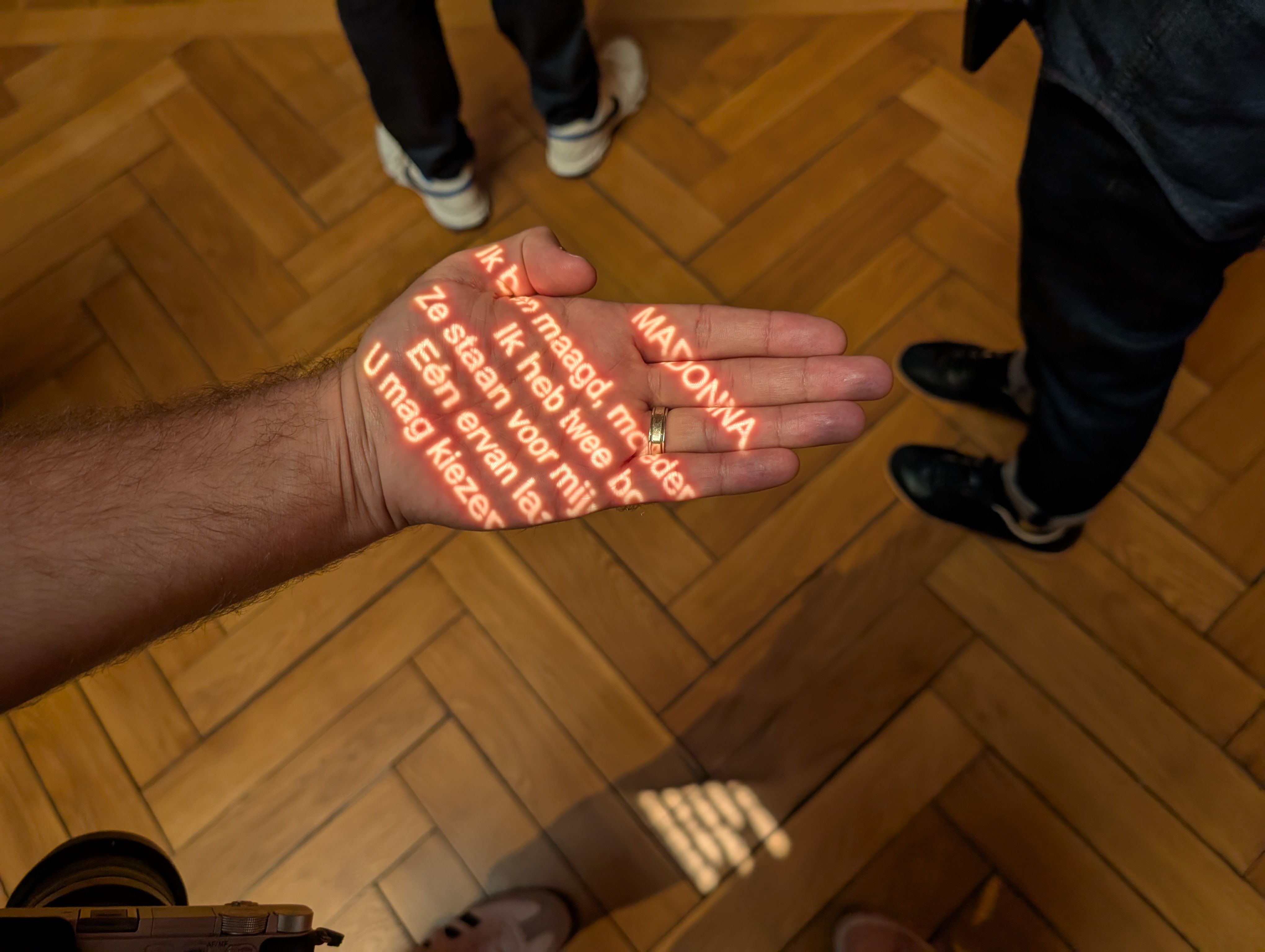
Light that reaches for us
Nick Mattan (Belgian, 1987–) and Angelo Tijssens (Belgian, 1986–), Licht dat naar ons tast (Light that reaches for us), 2023, featuring seventeen poems by Bernard Dewulf. Commissioned by and permanently installed at the Koninklijk Museum voor Schone Kunsten Antwerpen (KMSKA, Royal Museum of Fine Arts Antwerp).

“Madonna” by Bernard Dewulf

Virgin, mother, wife –
I have two breasts
that stand for my three souls.
I show you one of them,
and whose it is is yours to choose.

Translated from the original Dutch by David Colmer

Kind of cheeky! Dewulf speaks of Mary’s three identities and lets us decide if the breast she bares in Fouquet’s painting represents her naked innocence, her nurturing impulse, or her desire to please her husband. (Traditionally in art, it has always stood for the second.)

Though I can’t read Dutch and thus had to consult the KMSKA app for translations of the poems, the thrill of discovery was there in each room. View other visitor engagements with Licht dat naar ons tast on Instagram.

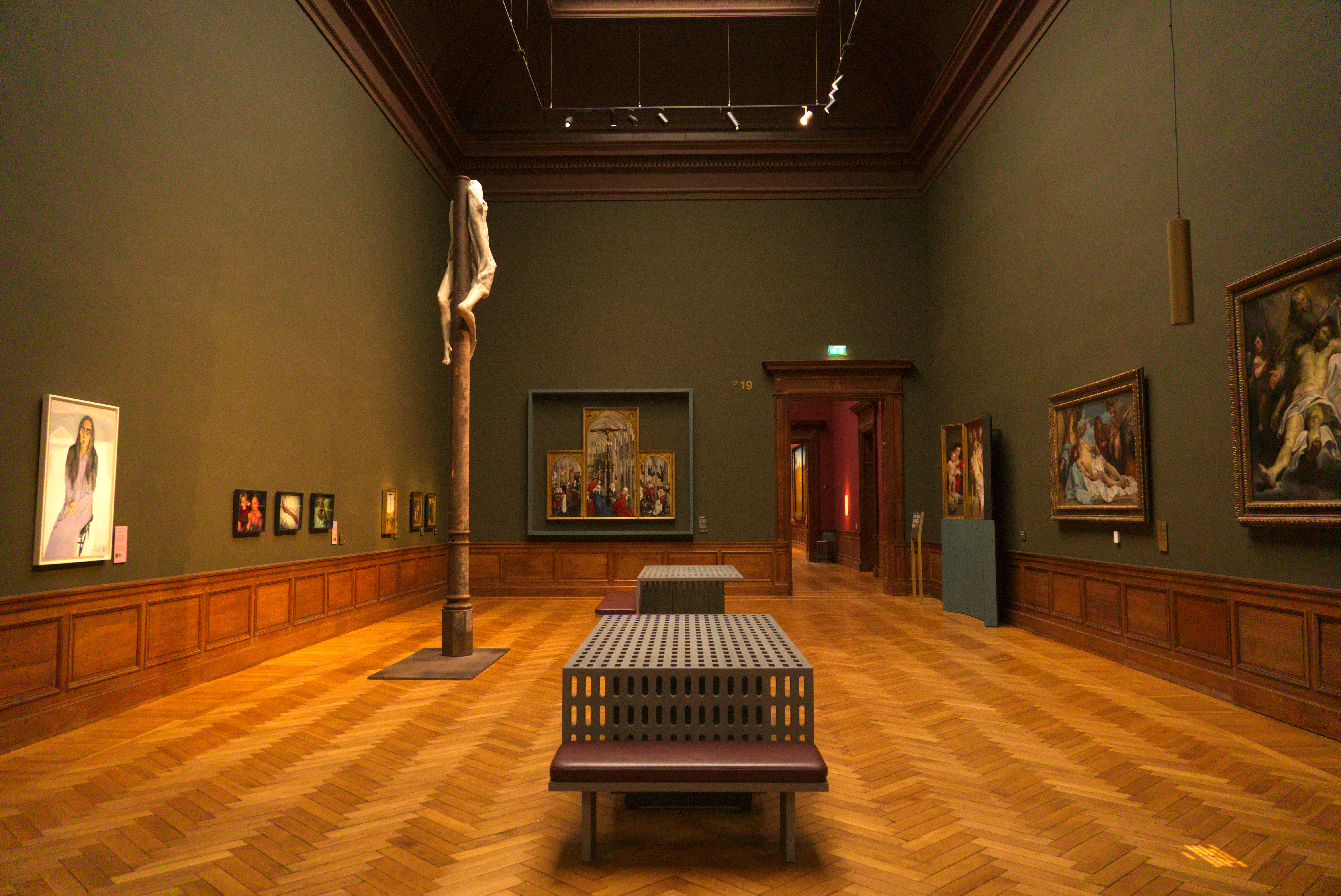
The next gallery I entered was themed “Suffering.”
Suffering gallery
Gallery 2.19 (“Suffering”) from the KMSKA exhibition Collected with Vision: Private Collections in Dialogue with the Old Masters

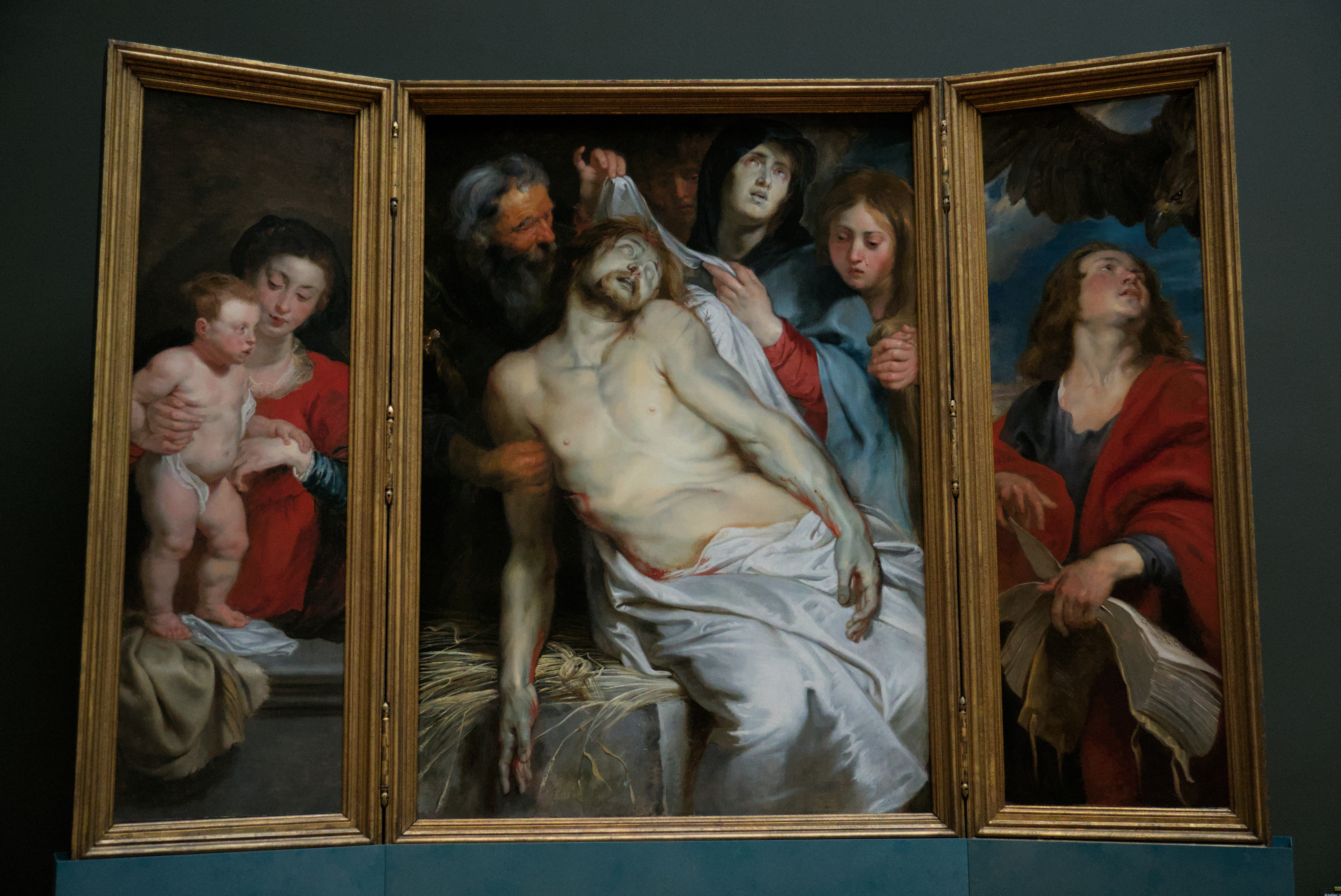
As one would expect, it’s inhabited by several Old Master paintings of Christ’s passion, most notably a triptych by the Flemish Baroque artist Peter Paul Rubens.
Rubens, Peter Paul_Christ on the Straw
Peter Paul Rubens (Flemish, 1577–1640), Epitaph of Jan Michielsen and His Wife Maria Maes (aka Christ on the Straw, Madonna, and Saint John), 1618. Oil on panel, 138 × 178 cm. Koninklijk Museum voor Schone Kunsten Antwerpen (KMSKA, Royal Museum of Fine Arts Antwerp).

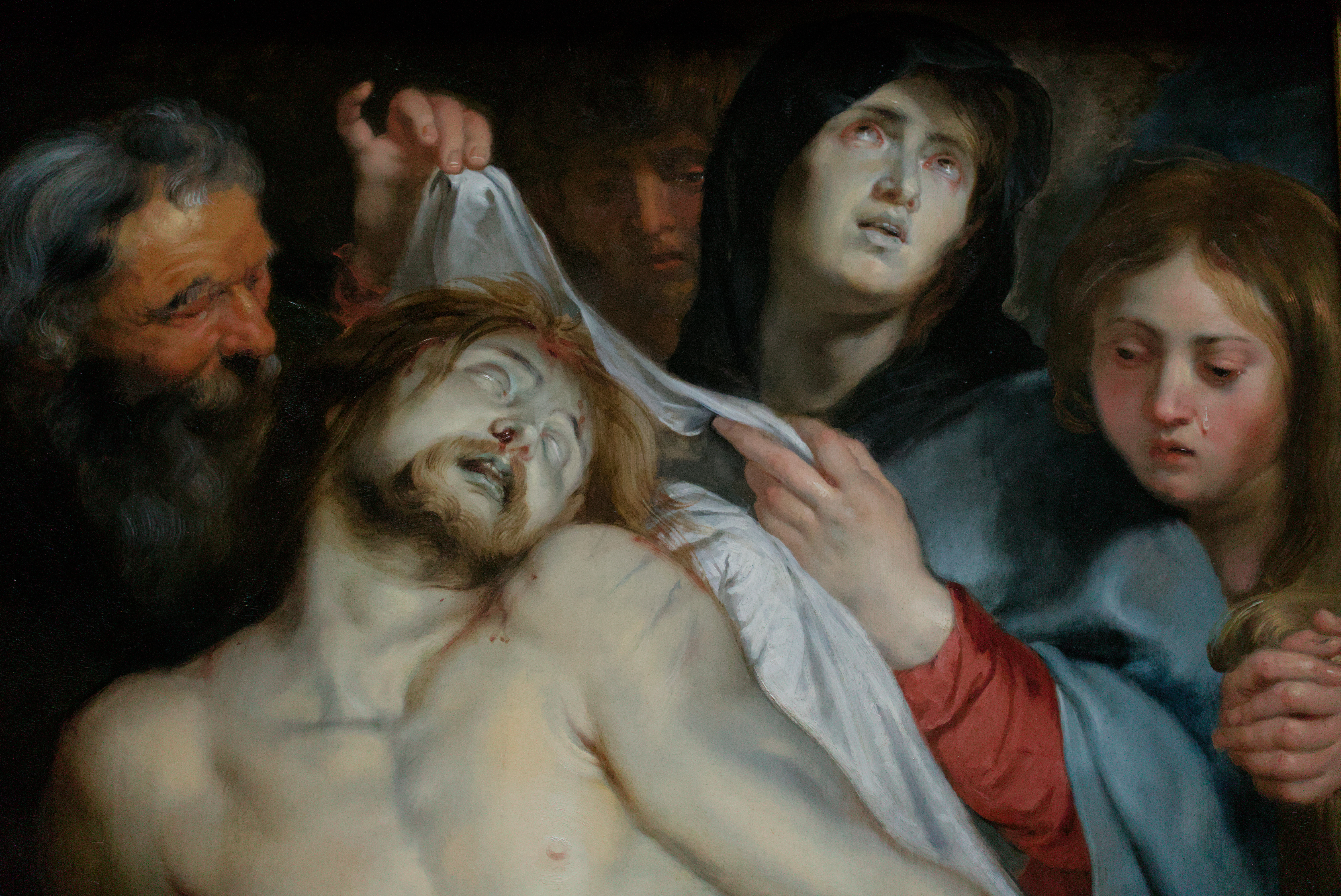
Rubens, Peter Paul_Christ on the straw (detail)

The central panel shows the dead Christ being laid out on a marble slab and wrapped in a shroud by Joseph of Arimathea, while his mother and Mary Magdalene (and the apostle John in the background) mourn him. The left wing shows Mary supporting the pudgy little baby Jesus as he takes some of his first steps, while the right wing shows John, whose symbol is the eagle, writing his Gospel that will place Jesus’s death in the context of the larger story of his life of ministry and his resurrection.

This painting, along with Anthony van Dyck’s Lamentation over the Dead Christ and The Holy Trinity by a follower of Rubens’s (which shows God the Father cradling the dead body of God the Son in an image type sometimes referred to as the Mystic Pietà), are juxtaposed with three photographs by Nan Goldin that show the impact of AIDS on her friend, the Parisian gallery owner Gilles Dusein, and his partner, the artist Gotscho.
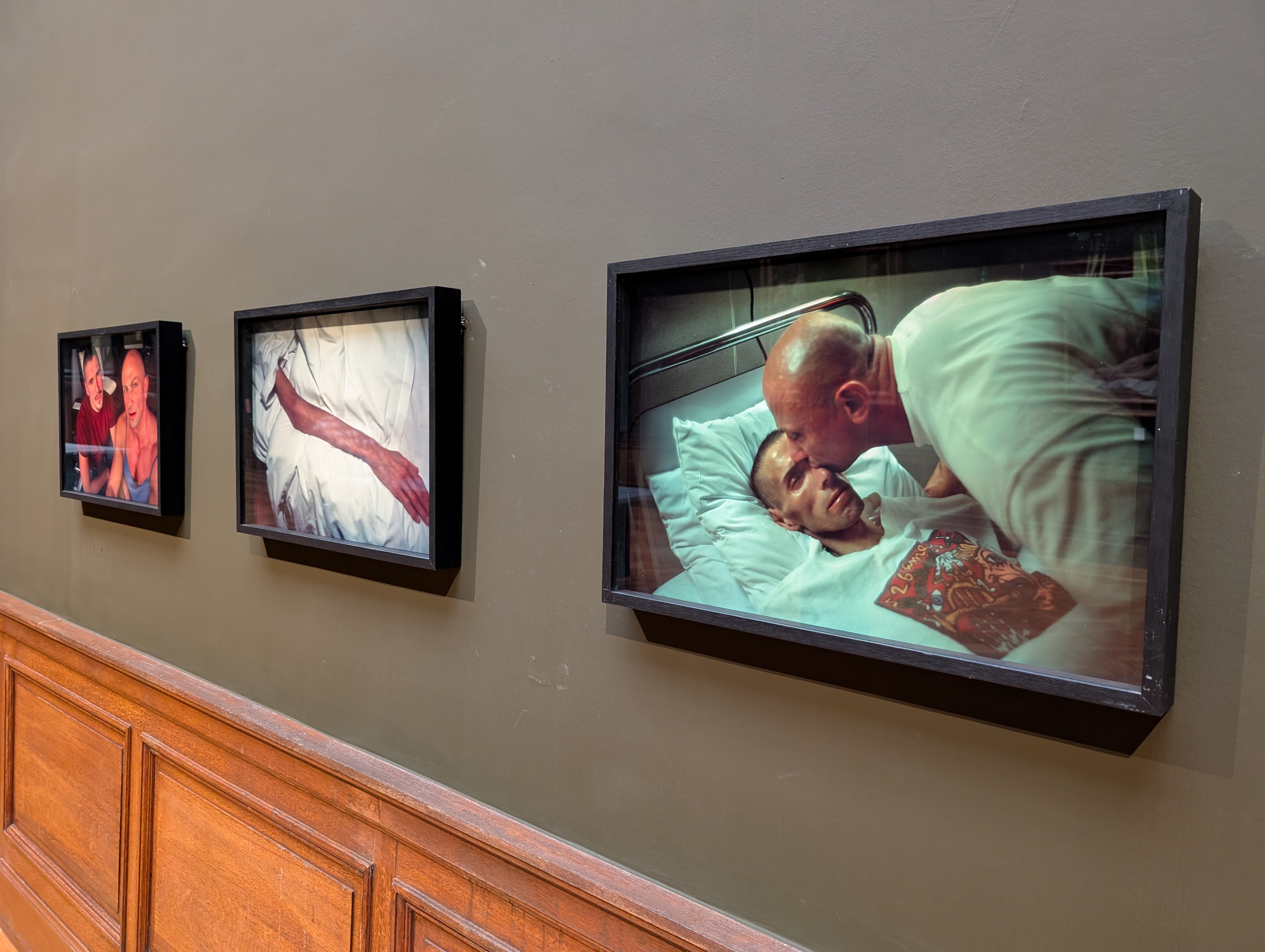
Photos by Nan Goldin
Nan Goldin (American, 1953–), Gilles in Hospital, Gilles’ Arm, and Gotscho Kissing Gilles, 1993. C-prints. Private collection.

Dusein’s emaciated arm, resting weakly on a hospital sheet, recalls the limp arm of Christ in paintings of the Deposition and Entombment; and Gotscho’s kiss, the love and grief of Jesus’s mother and friends as they watched their loved one suffer and succumb to death.

By displaying these disparate artworks from vastly different contexts across from each other, we are encouraged to draw connections between the suffering of Christ and that of the LGBTQ+ community. While Christians in Rubens’s day would sit before images of Jesus in pain or sorrow or having died a torturous and untimely death, and deepen their empathy and love, so too might we do well to sit prayerfully, humbly, empathetically, with contemporary images of suffering, seeking to enter the stories they tell.

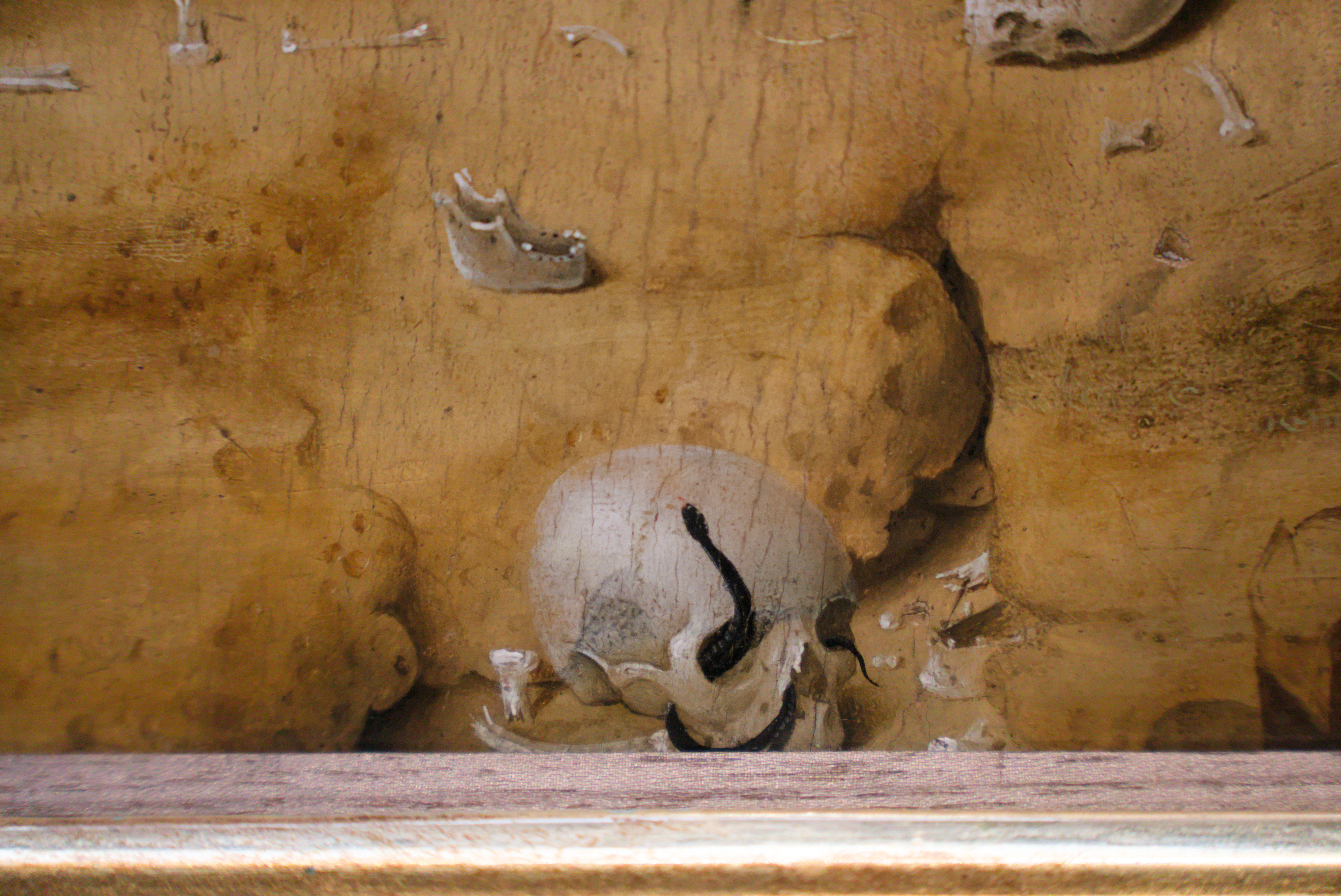
Calvary by Antonello da Messina (another version of which is at the National Gallery in London) also hangs in this gallery. While the crucified Christ seems at peace with his death, the other two on their crosses writhe in pain.
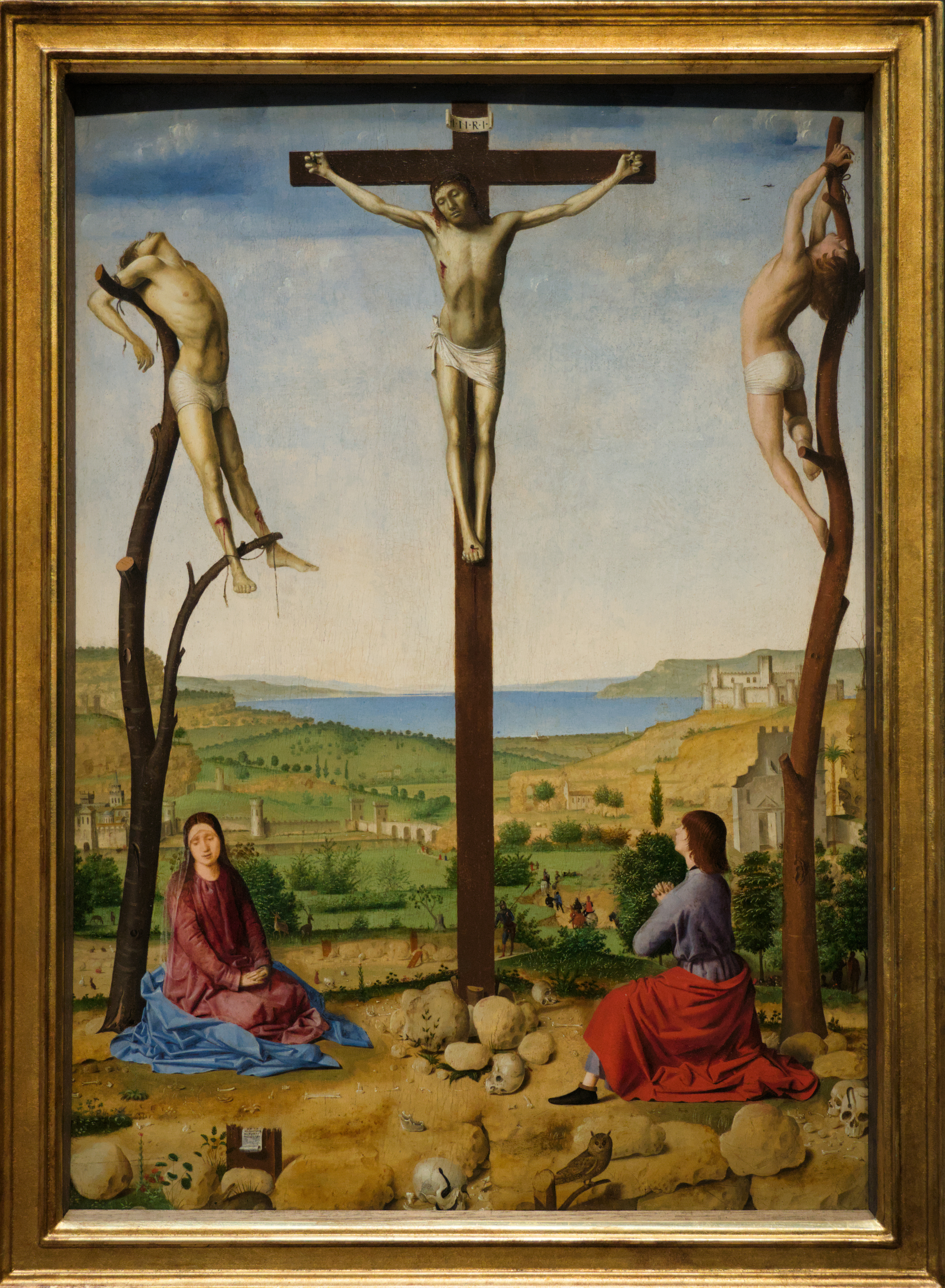
Antonello da Messina_Calvary
Antonello da Messina (Italian, 1430–1479), Calvary, 1475. Oil on panel, 52.5 × 42.5 cm. Koninklijk Museum voor Schone Kunsten Antwerpen (KMSKA, Royal Museum of Fine Arts Antwerp).

Antonello da Messina_Calvary (detail)

Compare these figures to contemporary Belgian artist Berlinde de Bruyckere’s Schmerzensmann (Man of Sorrows), on loan from the collection of David and Indré Roberts (see wide-view photo above). The piece consists of a wax and resin mold of a contorted human form, its skin stretched and broken, its legs wrapped around a tall rusty pole.

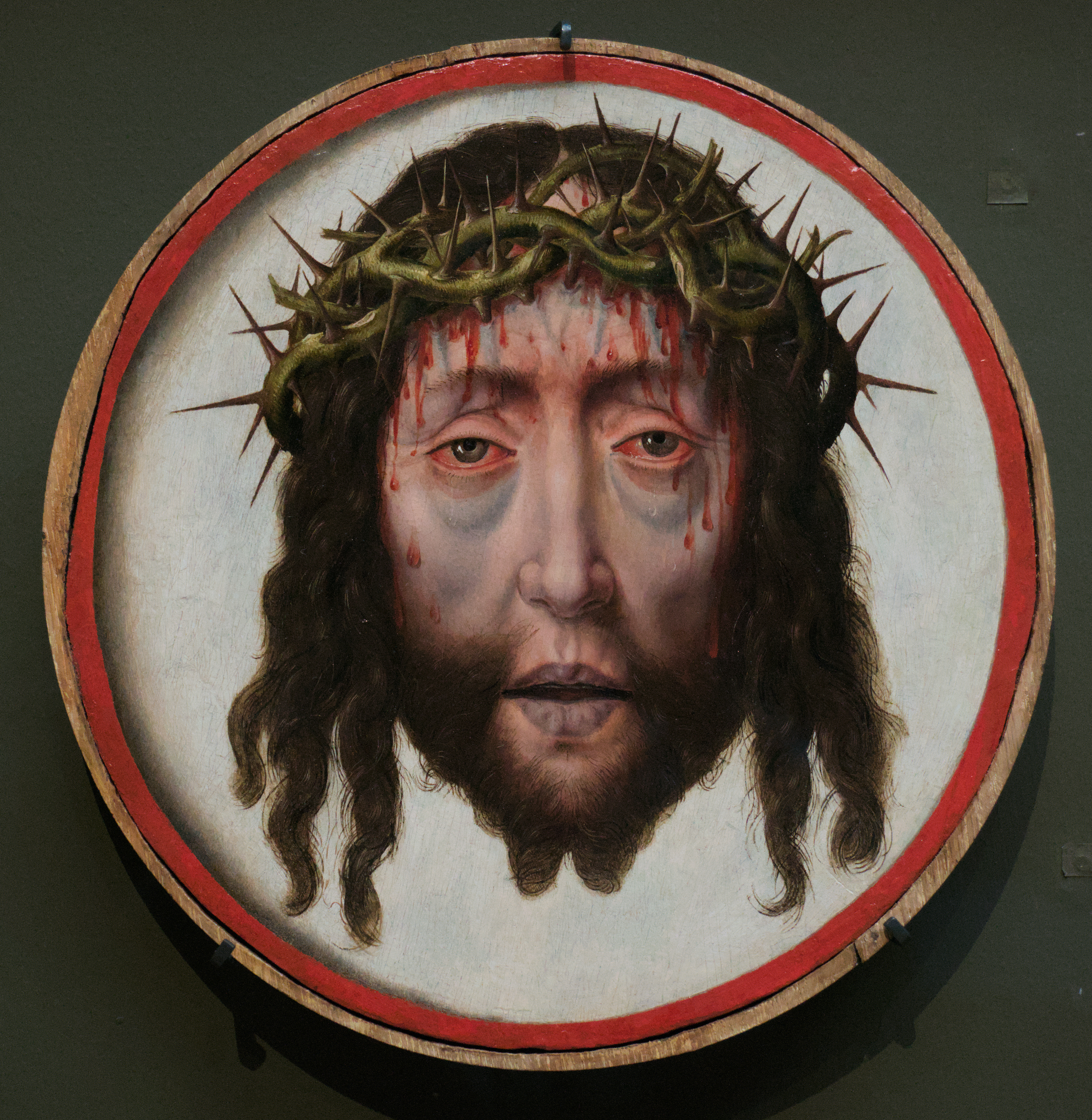
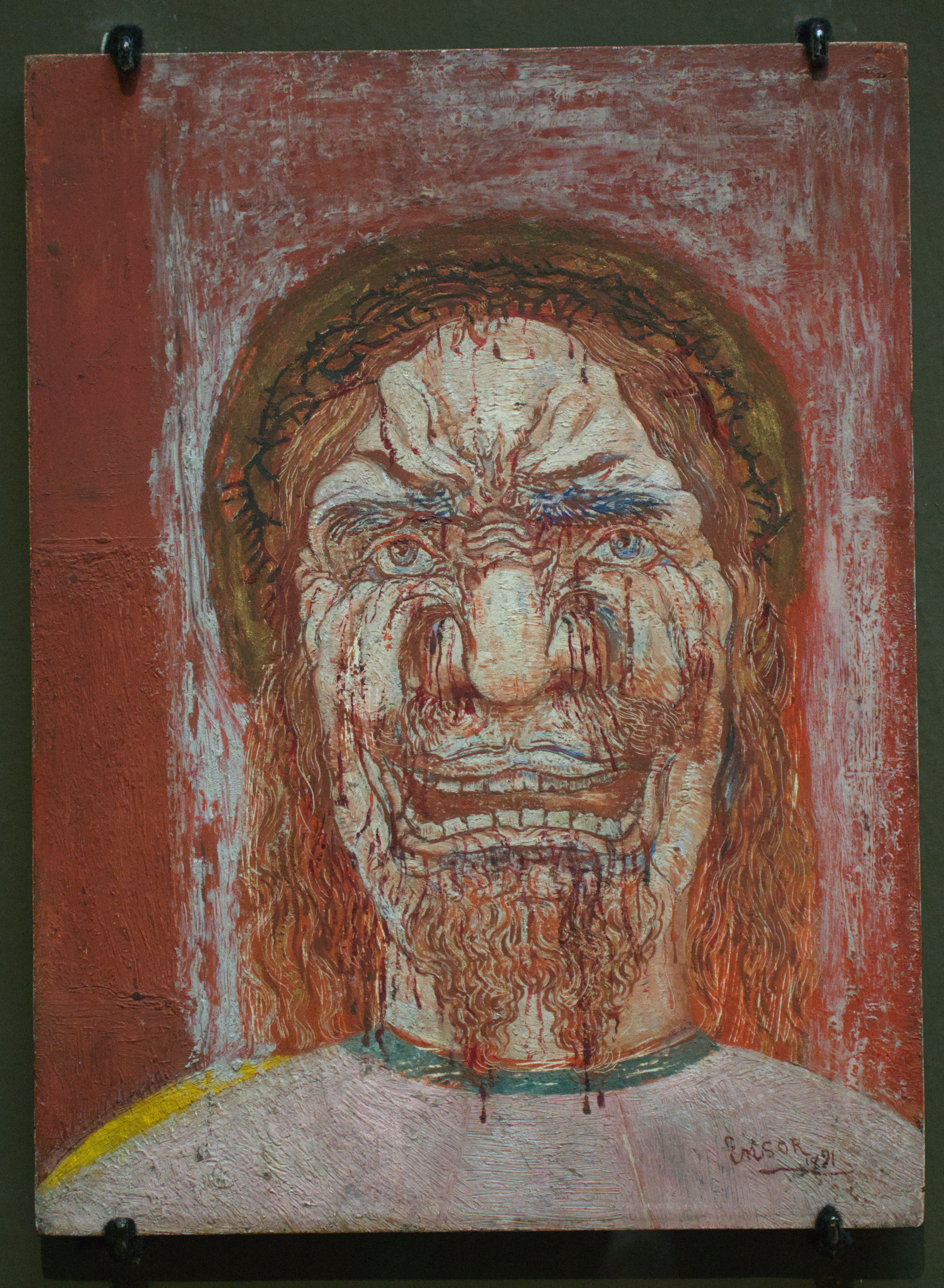
“Man of Sorrows” is also the title of an Early Netherlandish painting by Albrecht Bouts and a modern painting by James Ensor, which KMSKA displays side-by-side.
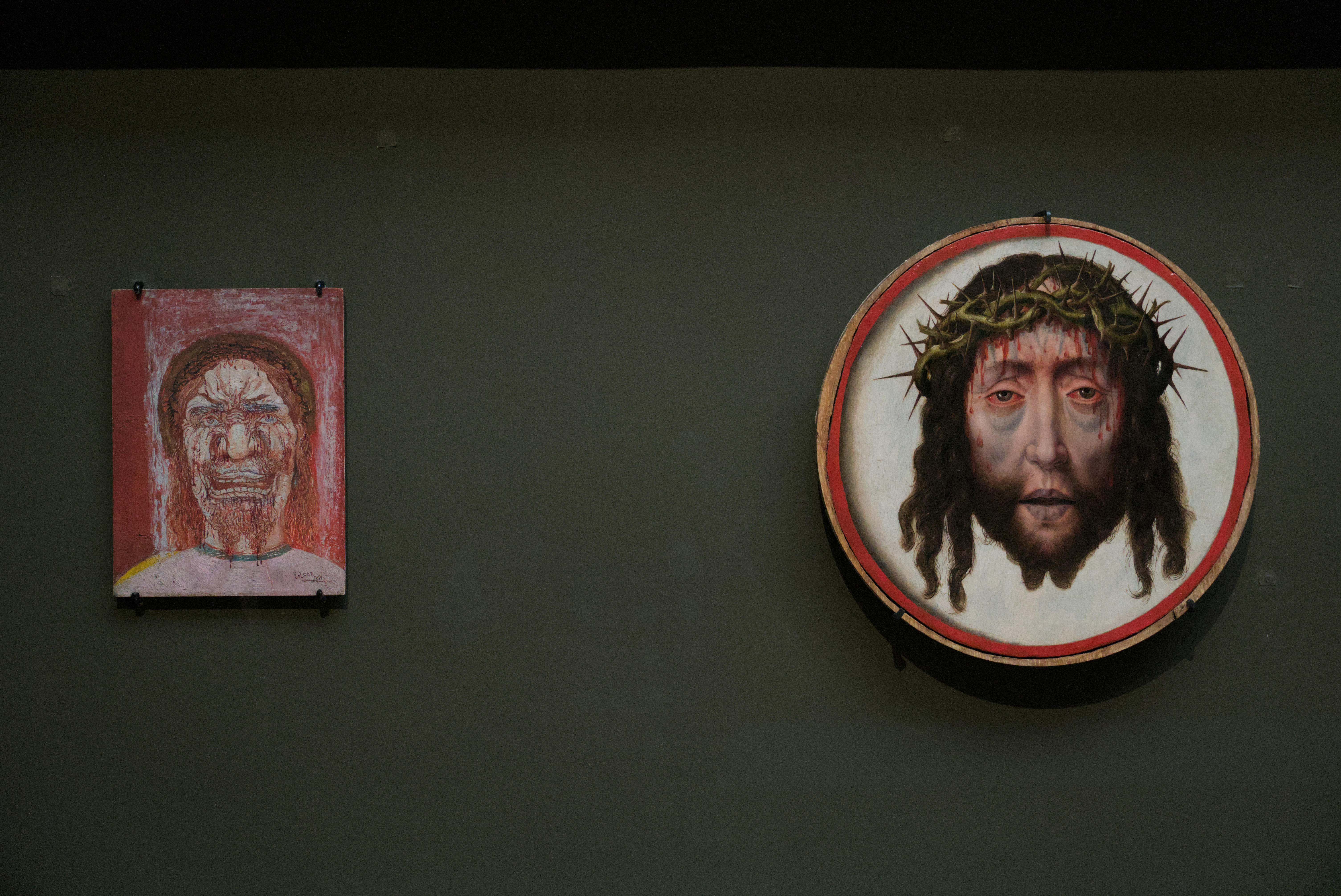
Bouts, Albrecht_Man of Sorrows
Albrecht Bouts (Flemish, 1451/55–1549), Man of Sorrows, 1500–1525. Oil on panel, diameter 29 cm. Koninklijk Museum voor Schone Kunsten Antwerpen (KMSKA, Royal Museum of Fine Arts Antwerp).

The earlier one is an incredibly moving image of pathos. Christ wears a thick, twisted, mock crown whose thorns dig holes into his forehead and draw blood. His eyes are red with tears and sunken in, and his lips are turning blue with the pallor of death. I find it quite beautiful, insofar as an image of suffering can be beautiful. (That’s a topic for another day.)
Ensor, James_Man of Sorrows
James Ensor (Belgian, 1860–1949), Man of Sorrows, 1891. Oil on panel, 20 × 15.5 cm. Koninklijk Museum voor Schone Kunsten Antwerpen (KMSKA, Royal Museum of Fine Arts Antwerp).

The Ensor painting, on the other hand, is decidedly not beautiful. In fact, I think it’s the ugliest image of Christ I’ve ever seen, with his crumpled face, scraggly hair, and bared teeth. There’s something very unsettling about his expression, and no wonder, as the curatorial text informs that Ensor drew inspiration from the masks of demon characters in Japanese theater. “His [Ensor’s] Jesus screams with rage about the injustice inflicted on him,” the label says. Is that what that expression is? To me he looks sinister. Like he’s growling at us. And I dislike his dinky crown that he wears like a headband; give me Bouts’s gnarly one instead.

I’m in favor of Christ images that show the rage he must have felt, but I don’t think Ensor is successful if that was his aim. To name a few modern artists who were: Guido Rocha (Tortured Christ, 1975) and David Mach (Die Harder, 2011), both of whom capture Jesus’s cry of dereliction on the cross.

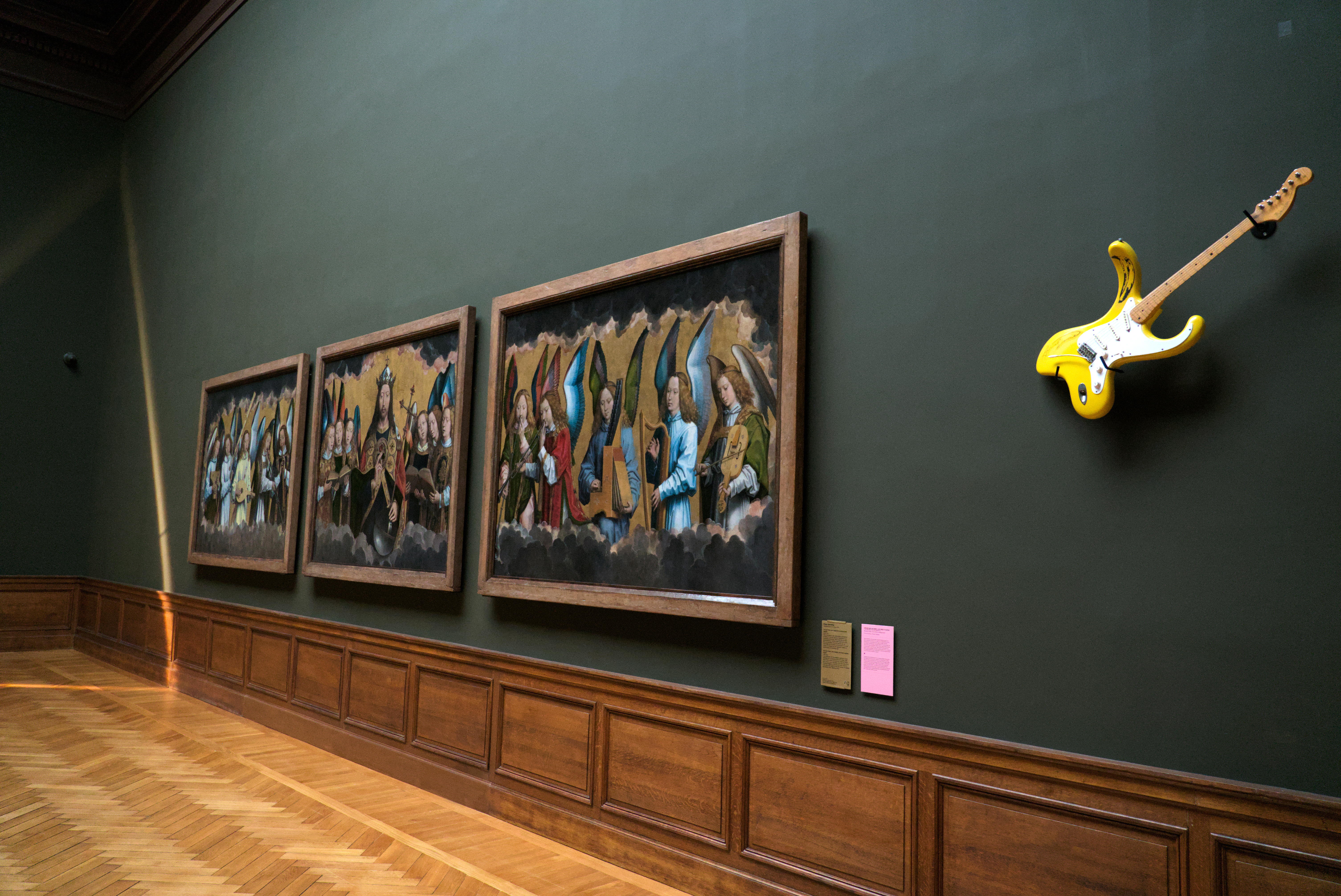
The final themed gallery I’ll call out is “Heavens.”
Heavens gallery
Gallery 2.22 (“Heavens”) from the KMSKA exhibition Collected with Vision: Private Collections in Dialogue with the Old Masters

The dominant Old Master work is a set of three panels from the upper tier of a colossal altarpiece that Hans Memling painted for the church at the Benedictine Abbey of Santa Maria la Real in Najera in northern Spain. All the other panels are lost.

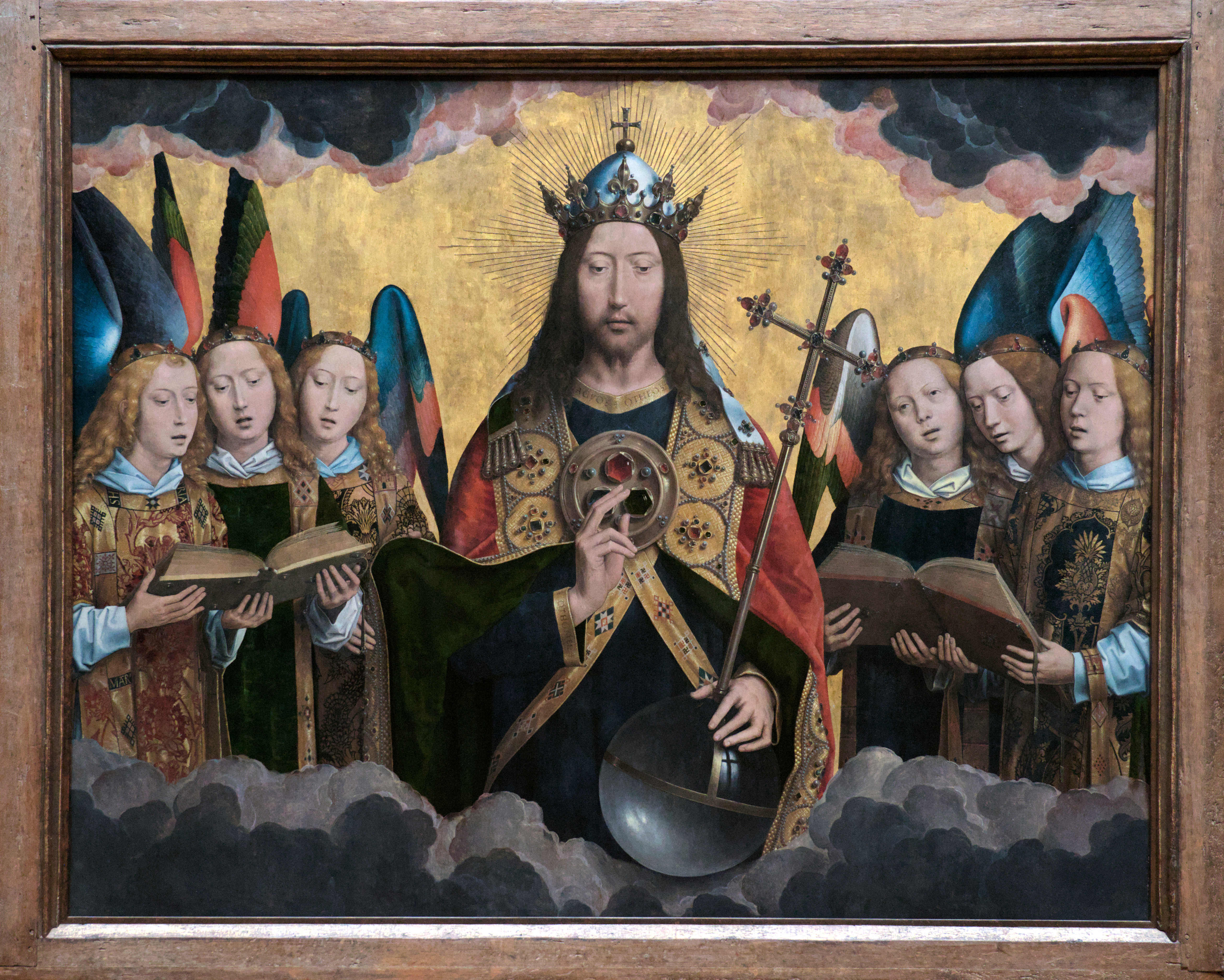
The museum titles the central panel God the Father with Singing Angels—but I think the figure is more properly God the Son, Jesus Christ, portrayed as Salvator Mundi (Savior of the World). In his left hand he holds a cross-surmounted crystal globe, signifying his dominion over the earth, and with the other hand he gestures blessing. He wears a tiara and a red cope decorated with gold-thread embroidery, pearls, and precious stones, and his collar bears the words Agyos Otheos (Holy God).
Memling, Hans_God the Father with Singing Angels
Hans Memling (German Flemish, ca. 1430–1494), God the Father with Singing Angels, 1483–94. Oil on panel, 164 × 212 cm. Koninklijk Museum voor Schone Kunsten Antwerpen (KMSKA, Royal Museum of Fine Arts Antwerp).

Surrounding him is a musical band of angels, singing his praises from songbooks and, in the flanking panels, playing a variety of wind and string instruments: (from left to right) a psaltery, a tromba marina, a lute, a trumpet, a shawm, a straight trumpet, a looped trumpet, a portative organ, a harp, and a fiddle.
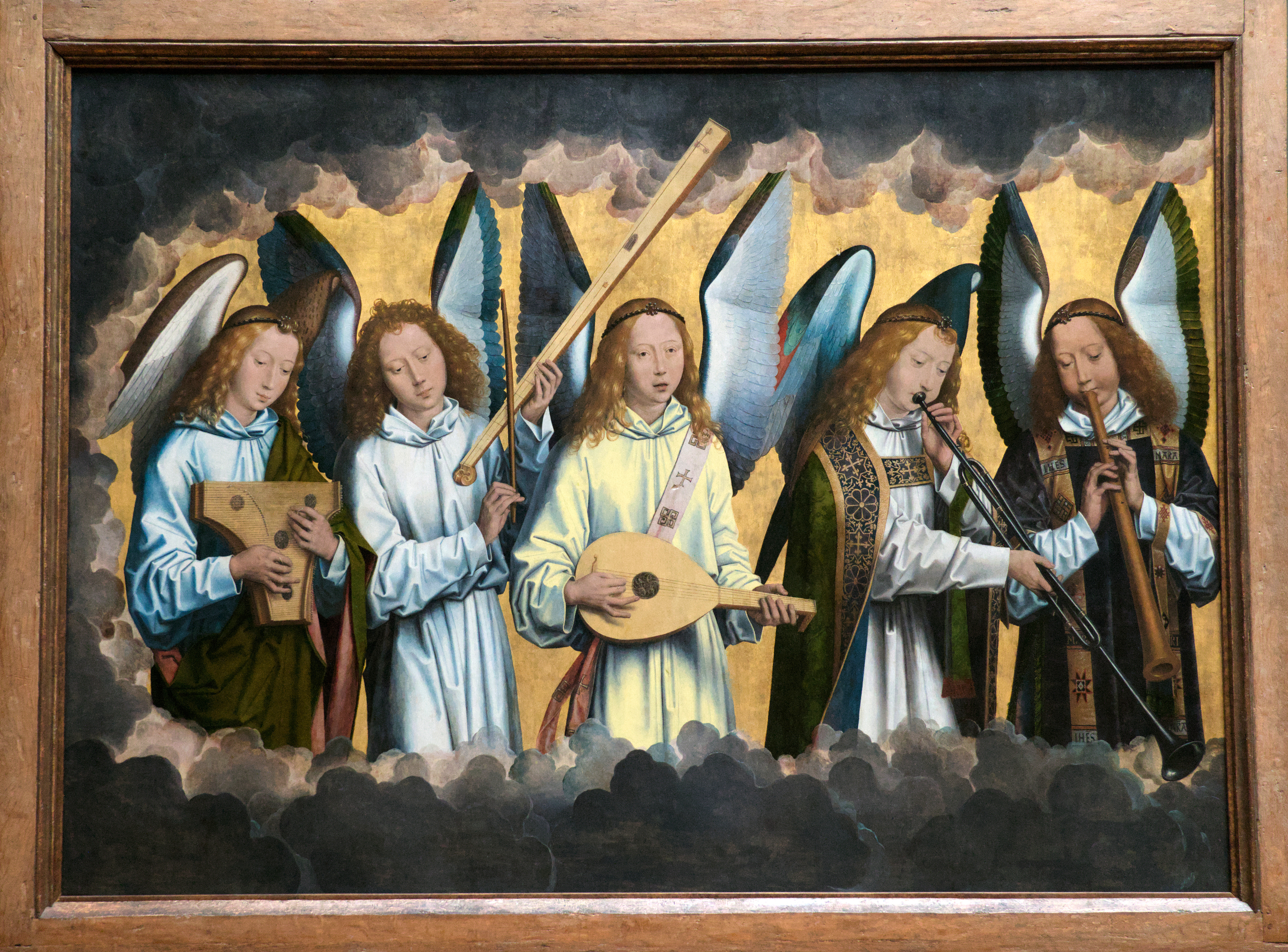
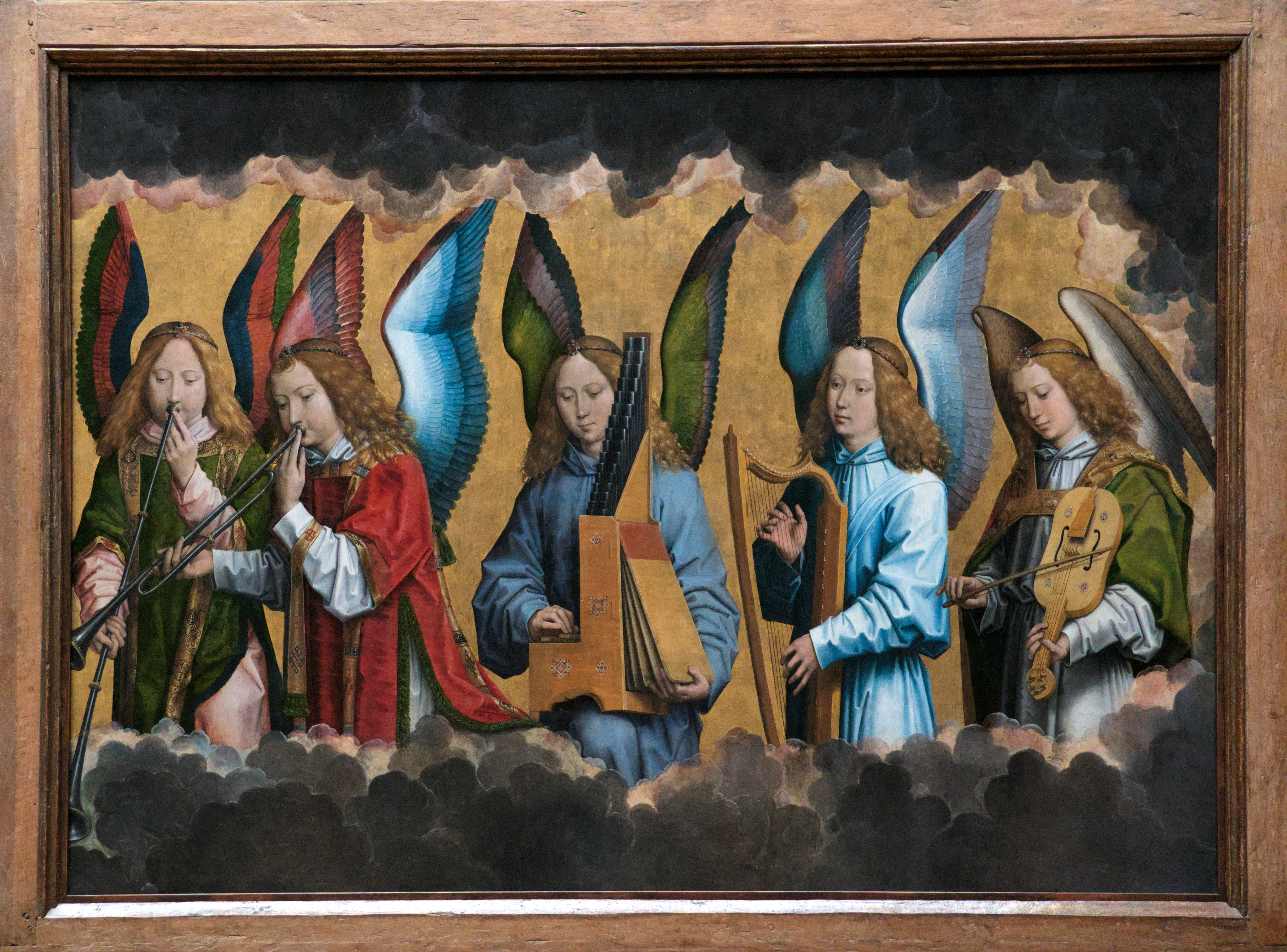
Memling, Hans_Music-Making Angels
Hans Memling (German Flemish, ca. 1430–1494), Music-Making Angels (left), 1483–94. Oil on panel, 165 × 230 cm. Koninklijk Museum voor Schone Kunsten Antwerpen (KMSKA, Royal Museum of Fine Arts Antwerp).

Memling, Hans_Music-Making Angels
Hans Memling (German Flemish, ca. 1430–1494), Music-Making Angels (right), 1483–94. Oil on panel, 165 × 230 cm. Koninklijk Museum voor Schone Kunsten Antwerpen (KMSKA, Royal Museum of Fine Arts Antwerp).

This ensemble probably evokes for you a particular sound—something like Tallis or Palestrina—soaring polyphonic vocals, a gentle yet majestic accompaniment. But instead, a different soundtrack played, audibly, in the room: songs from the 1967 debut album of the American rock band the Velvet Underground, several of which use religious language to describe the experience of doing drugs. “Heroin” opens like this:

I don’t know just where I’m going
But I’m gonna try for the kingdom, if I can
’Cause it makes me feel like I’m a man
When I put a spike into my vein

And I’ll tell you things aren’t quite the same
When I’m rushing on my run
And I feel just like Jesus’ son

This aural element was complemented, on the gallery wall, by the guitar of Lou Reed, the band’s lead singer and songwriter. It’s signed by Andy Warhol, who produced and championed the Velvet Underground & Nico album and made its banana cover art, replicated on the instrument.
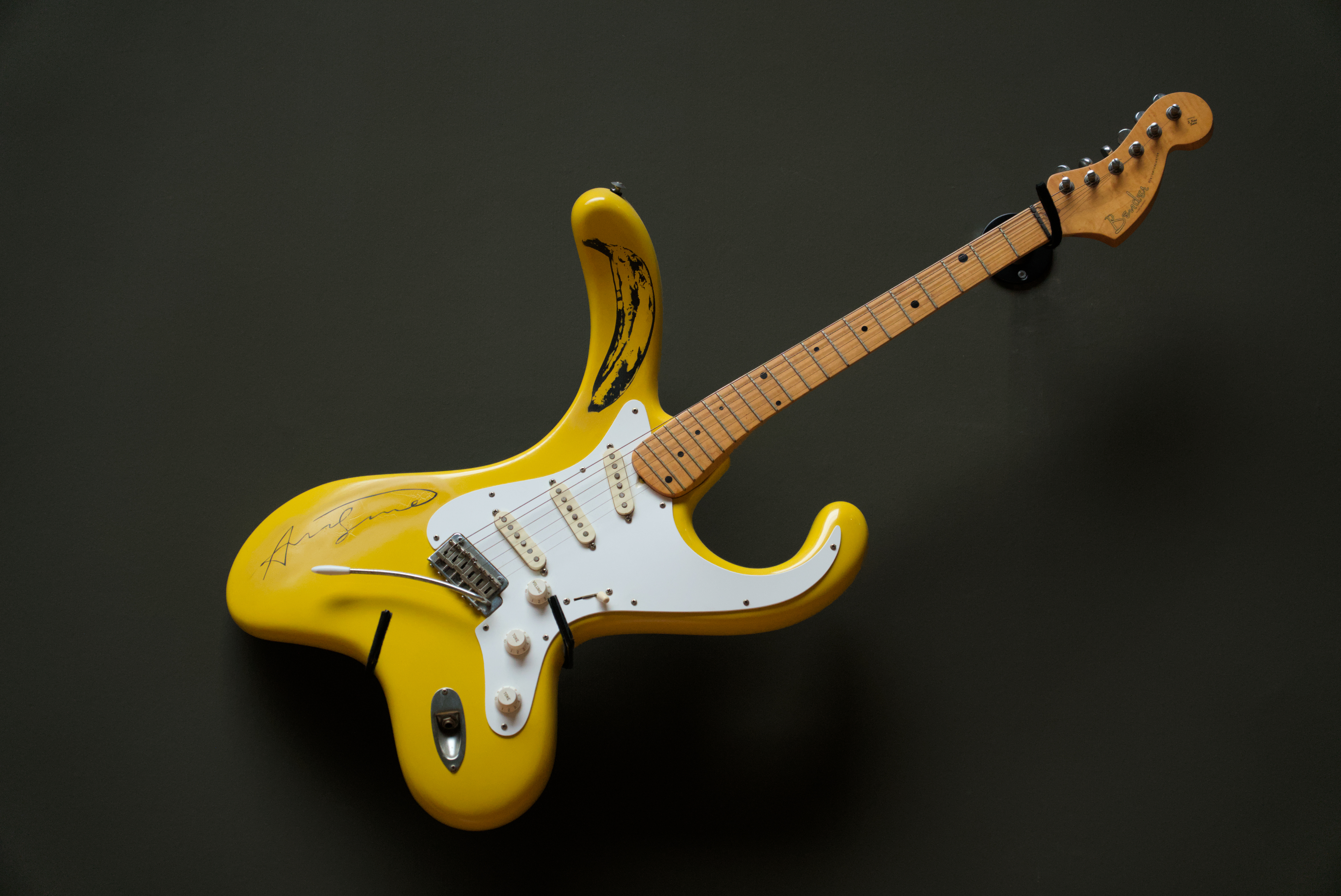
Lou Reed's guitar
Lou Reed’s “Banana Guitar,” from a private collection

Adding to the mix, in the corner of the room was an installation by the Copenhagen-born and -based artist Olafur Eliasson, called Lighthouse Lamp. “Affixed to a tripod, a lamp situated within a Fresnel lens—a compact lens which was developed for lighthouses—emits a band of white light in 360 degrees,” the artist’s website explains. In this space, the beam takes on a triangular shape.
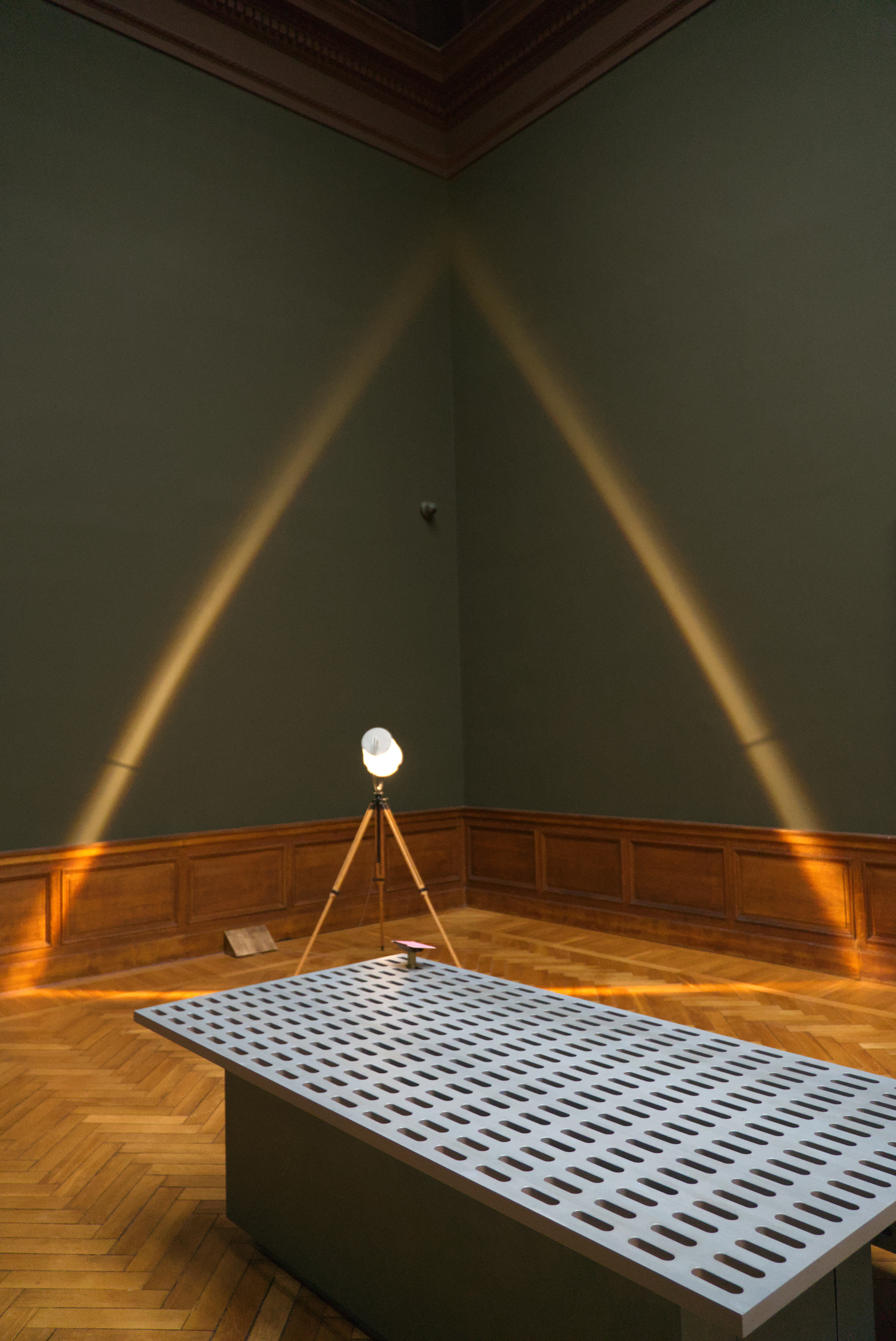
Eliasson, Olafur_Lighthouse Lamp
Olafur Eliasson (Icelandic Danish, 1967–), Lighthouse Lamp, 2004. Mixed media. Collection of Filiep and Mimi Libeert.

There was also an altarpiece of The Last Judgment and the Seven Acts of Mercy by Bernard van Orley, which references Jesus’s teaching in Matthew 25 about one’s entry into heaven being contingent on whether, in this life, you feed the hungry, give shelter to the homeless, visit the prisoner, and so on.

The “Heavens” gallery begs the question: How does one define “heaven”? Is it a physical place? A state of mind? An encounter? I think of related words like bliss, beatitude, communion, the sublime.

The celestial scene painted by Memling—and remember, it’s only partial, as the rest is missing—is beautifully rendered, but it also encapsulates what has become the popular cliché of heaven: angels on clouds, strumming harps, and a regal God swaying his scepter. Music-making, angelic beings, and the reign of God are all certainly a part of how the Bible describes heaven. But it’s also so much more. It’s a garden and a city. It’s healing and restoration. It’s the righting of wrongs. It’s all things made new. It’s jubilee. It’s a wedding—deep and lasting union between God and humanity. It’s an eternal interlocking of God’s space and ours (earth). It’s a global, transhistorical community of faith, gathered together around Christ their head, worshipping him in diverse languages, musical styles, dances, and other cultural expressions. It’s the culmination of the greatest story ever told.

Today, Memling’s vision of heaven probably fails to captivate most people, even Christians. So it’s an interesting experiment to compare it to how others conceive of the concept.

Eliasson’s Lighthouse Lamp wasn’t a commission on or explicit treatment of the theme, but the curator saw fit to place it beside Memling, because heaven is often conceived of as a light-filled space, and light can evoke the divine. For this reason, Memling painted his background gold. What’s more, the three-sidedness of Eliasson’s light beam may, for some, evoke the Trinity, the classical Christian doctrine of Father, Son, and Holy Ghost that Memling alludes to with the three precious stones on the fibula of Christ’s mantle.

Still, other folks experience what could be termed “heavenly” transcendence through the use of mind-altering substances, as did the members of the Velvet Underground, whose drug trips gave birth to their experimental music—which, in turn, has taken others to a transcendent place.


Whether in special exhibitions or displays of their permanent collections, I want to see more of this in museums: bringing old and new artworks into conversation with one another around universal themes, in the same room. (In some museums, the labels sometimes cross-reference works in other galleries, but that’s not the same.) Although there are benefits to the traditional approach of laying out art chronologically to give you discrete pictures of different historical eras and allow you to progress by time period, a thematic approach that compiles works from across time also has its benefits.

I’ve found cross-temporal art displays to be especially vitalizing, because instead of trying to tell history, they more naturally invite personal reflection and tend to be less academic in tone. Such an approach makes the art accessible to a larger number of people, especially those who don’t frequent museums. It helps us see the relevance of the Old Masters (or whatever the museum’s collection focus) for today—how the subjects they depicted often address topics or questions we still ask or wonder about or that reflect aspects of the common human experience, such as joy, suffering, family, death, betrayal, or festivity. Creating relationships between works made centuries apart, highlighting similarities and differences, can give us a broader perspective.

And for this museumgoer (pointing at myself) who is attracted to medieval and early Renaissance art and sometimes bypasses the contemporary galleries, the integrative approach is more engaging. Giving contemporary works a point of connection with the works I’m already inclined to like helps me enter into them more easily and fruitfully, and I’m more likely to spend time with them than if they were segregated.

New and old don’t have to be equally represented—Kolumba skews heavily contemporary, whereas KMSKA lets its strengths shine with the Old Masters, and yet the occasional unexpected intervention from years past or future always caused me to pause and be curious. Over the last several years I’ve been noticing other museums engaging in similar playful exchange—plopping a contemporary work into the medieval section, or vice versa, in a way that provides some kind of illumination.

This was my first and only visit to KMSKA, and as I understand, there’s not the same degree of intermixing of old and new year-round; this was a special exhibition that brought in contemporary works from outside, as the institution itself owns very few. But they did do something similar last year with the exhibition What’s the Story?, and the dangling light poems by Bernard Dewulf are a permanent fixture in the Old Masters galleries.

Have you been to a museum where works from different time periods were displayed side-by-side to create a discourse, and if so, did that choice enhance your engagement, insight, or appreciation? I’d love to hear what other museums are doing this!


This article took me some forty hours to write and to select and edit photos for. If you appreciate learning about my museum experiences and having access to high-resolution, downloadable art images, would you please consider adding to my “tip jar” (PayPal), or sponsoring a book from my Amazon wish list? Thank you!

Kolumba and KMSKA: Medieval and contemporary art in conversation (part 1)

One of the delightful surprises of my recent trip to Germany and Belgium was to find, in two of the museums I visited, an integration of the old and new in the curated galleries. Typically, art museums choose to arrange their collections chronologically, grouping together artworks from a particular era, and within each era, like styles. But in Kolumba museum in Cologne and the Koninklijk Museum voor Schone Kunsten Antwerpen (KMSKA) in Antwerp, medieval art from each museum’s collection (and in the case of KMSKA, Renaissance and Baroque art too) is displayed alongside contemporary pieces, creating a vibrant dialogue.

With the exception of the exterior shot of Kolumba, all photos in this post are my own.

Kolumba Kunstmuseum, Cologne

Originally called the Diözesanmuseum (Diocesan Museum), Kolumba was founded in 1853 by the fledgling Christlicher Kunstverein für das Erzbisthum Köln (Christian Art Association for the Archbishopric of Cologne), making it the city’s second oldest museum after the Wallraf-Richartz-Museum. Its collection focus for the majority of its history was late medieval art from Cologne and the Lower Rhine.

Kolumba’s first permanent home, just south of Cologne Cathedral, was a former sugar factory, but the building was destroyed in World War II, though much of the art had been safely evacuated beforehand. After the war, Kolumba relocated its art to a grammar school, then to rented rooms in the Gereonstraße, then to the Curia building at Roncalliplatz 2. But the limited space was an issue.

In 1989, ownership of the museum was transferred to the Archdiocese of Cologne, who decided to expand the collection to include modern and contemporary art, not only by German artists but by international artists as well. The museum shifted its approach from displaying traditional sacred works only, to placing those works in juxtaposition with newer ones by artists who aren’t necessarily Christian but whose works can converse fruitfully with their core collection. They also secured funding to construct a new permanent building.

In 2004, the museum’s name was changed to Kolumba in honor of the history of the site on which the new (and current) building would stand: atop the ruins of the medieval St. Kolumba church, destroyed in an air raid in 1943. St. Columba of Sens was a third-century virgin martyr who was born in Spain but lived mostly in France. The church dedicated to her in Cologne once housed Rogier van der Weyden’s St. Columba Altarpiece (now at the Alte Pinakothek in Munich), a triptych with scenes of the Annunciation, the Adoration of the Magi, and the Presentation in the Temple.

Kolumba museum
Kolumba museum, Cologne. Photo: HP Schaefer / Wikimedia Commons.

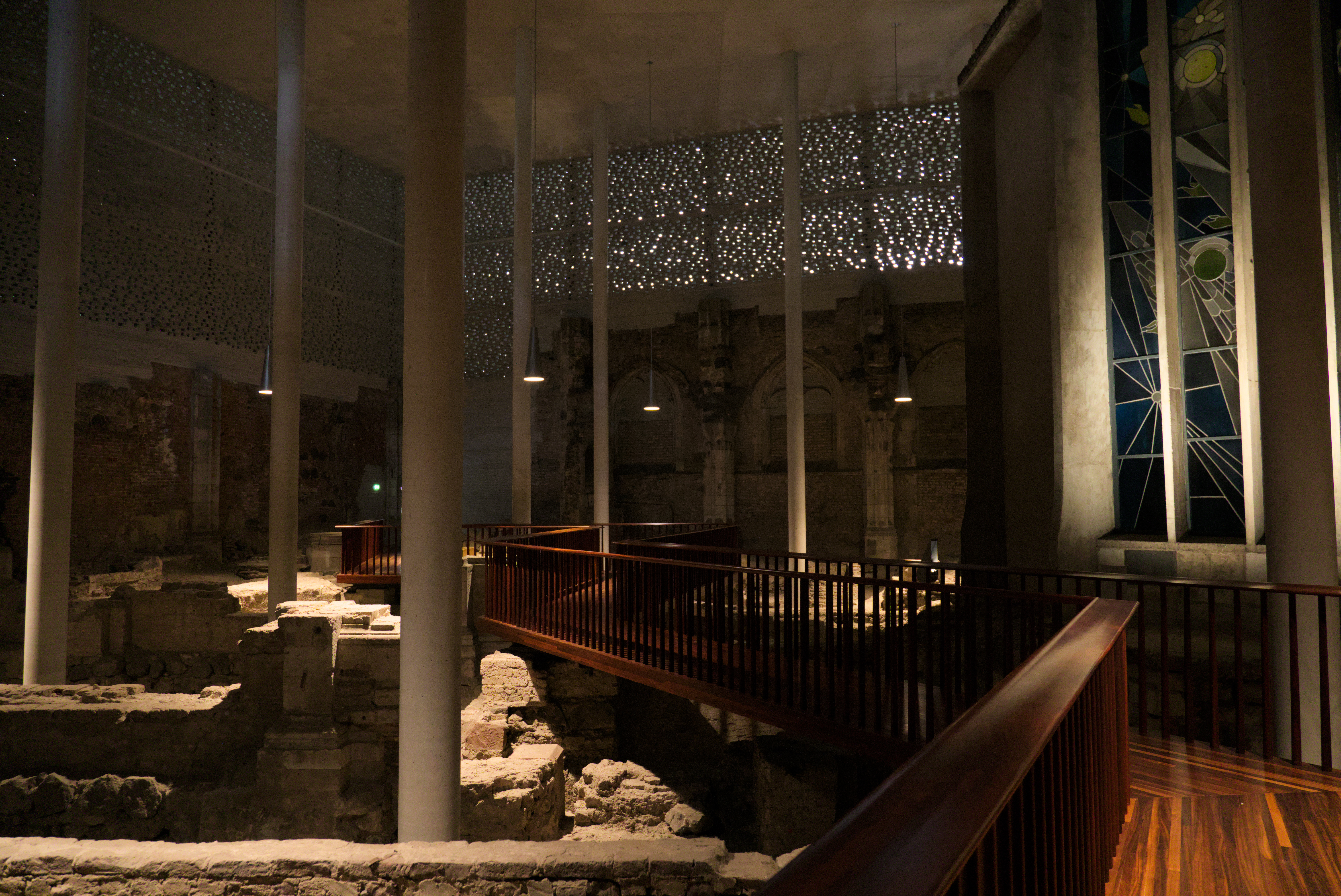
Kolumba museum’s permanent home opened in 2007 at Kolumbastraße 4. Designed by the Swiss architect Peter Zumthor (view more architectural photos here), the building encapsulates the bombed-out Gothic ruins of St. Kolumba with forty-foot-high, porous concrete walls, above which sit the floors of the museum.

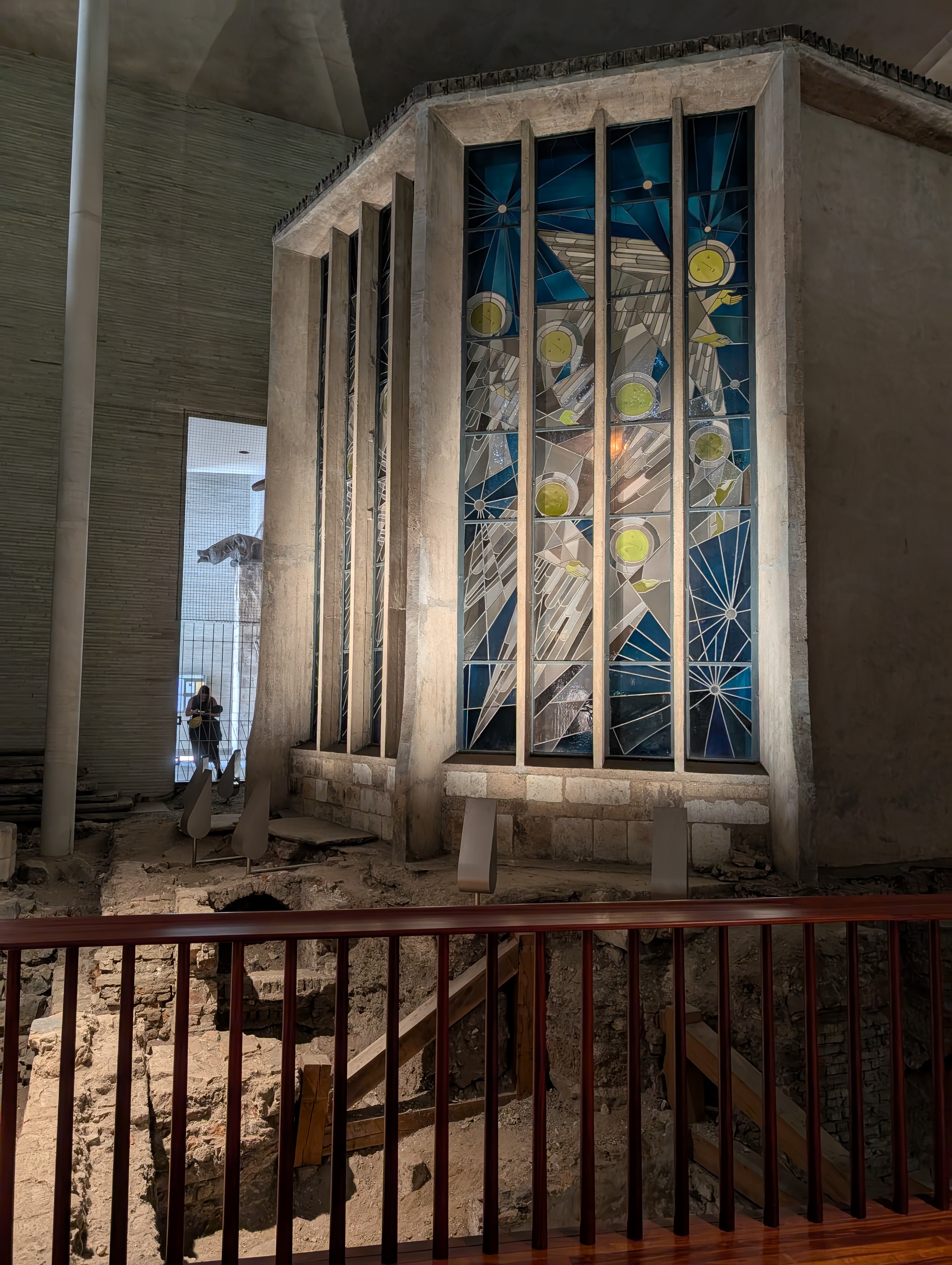
It also incorporates the Madonna in den Trümmern (Madonna in the Ruins) chapel, an octagonal tent-like structure built by Gottfried Böhm in 1947–50 to house a late Gothic statue of the Madonna and Child that miraculously survived the Allied bombings and for the liturgical use of the small Kolumba parish, which continues today.

Ruins of St. Kolumba
The ruins of St. Kolumba church, which dates back to the tenth century (with subsequent expansions and a Gothic-style rebuilding), are integrated into the architecture of Kolumba museum.

Madonna in the Ruins chapel
Exterior of the “Madonna in the Ruins” chapel, dedicated 1950, underneath Kolumba museum in Cologne, with stained glass designed by Ludwig Gies (1887–1966), installed 1954.

The postwar chapel is not accessible from inside the museum; it has its own separate entrance, which, as I found out after I had already left, is on the south side of the building, along Brückenstraße.

But I did cross over the excavation site of St. Kolumba to which the written museum guide directs visitors (it’s labeled “room 3”), and through which a walkway has been constructed. As I took in the war-wrought devastation, I wondered about the sounds I was hearing from an audio system. Turns out it was a sound installation called Pigeon Soundings by the American artist Bill Fontana. In 1994, he made a series of eight-channel sound map recordings of the pigeons that were inhabiting the St. Kolumba ruins at the time, particularly the rafters of the temporary wooden roof that had been erected. The recordings picked up not just the birds’ cooing and flapping, but also the ambient sounds outside.

Above this darkened space, Kolumba has sixteen exhibition rooms. The museum reinstalls its collection annually, each fall opening a new exhibition. I was there for the first day of “make the secrets productive!” Art in Times of Unreason, which runs from September 15, 2025, to August 14, 2026. The lack of art signage throughout is deliberate, to promote a more meditative experience; instead, visitors are given a (German-language) booklet, organized by room, that identifies the pieces on display and provides commentary for some.

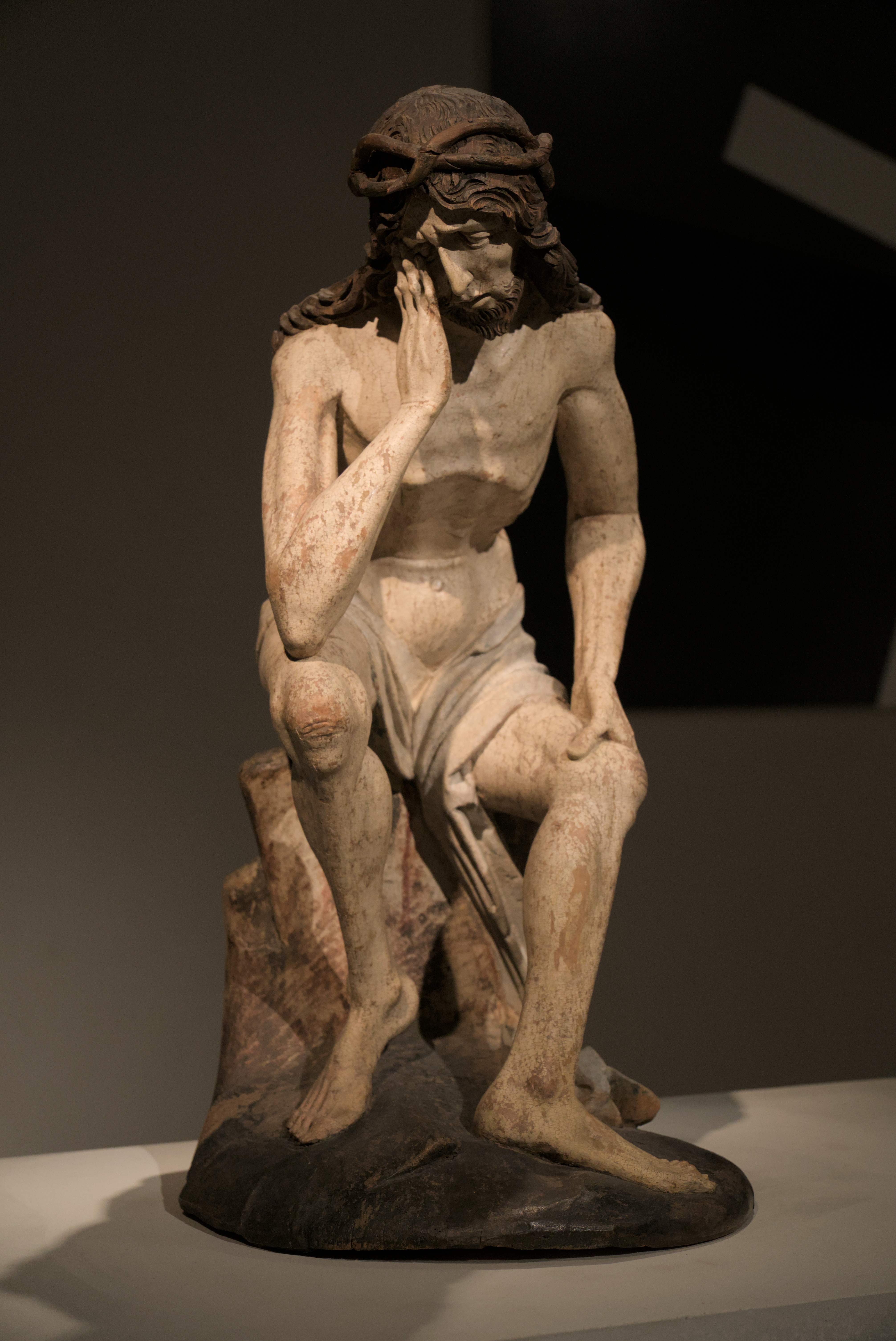
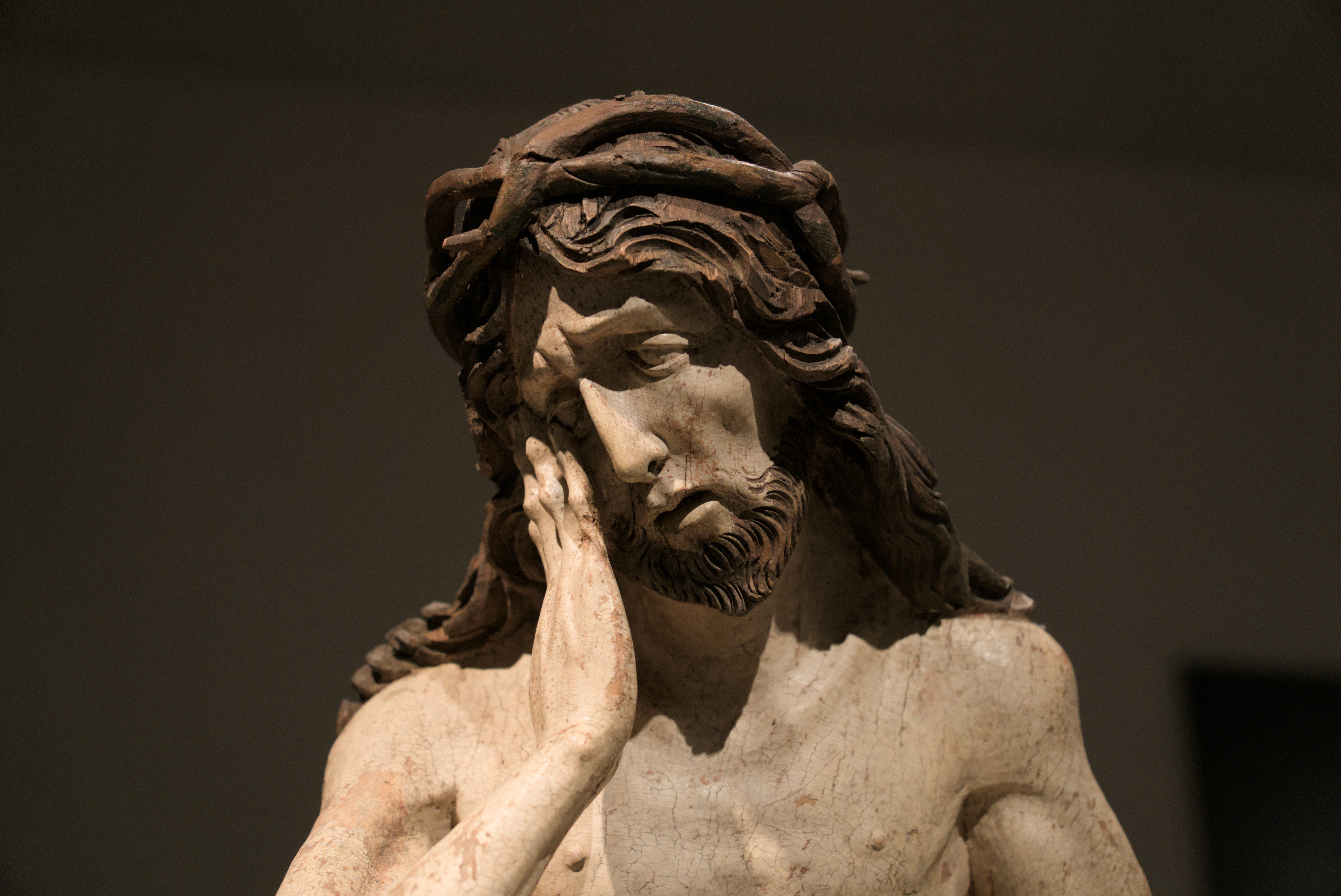
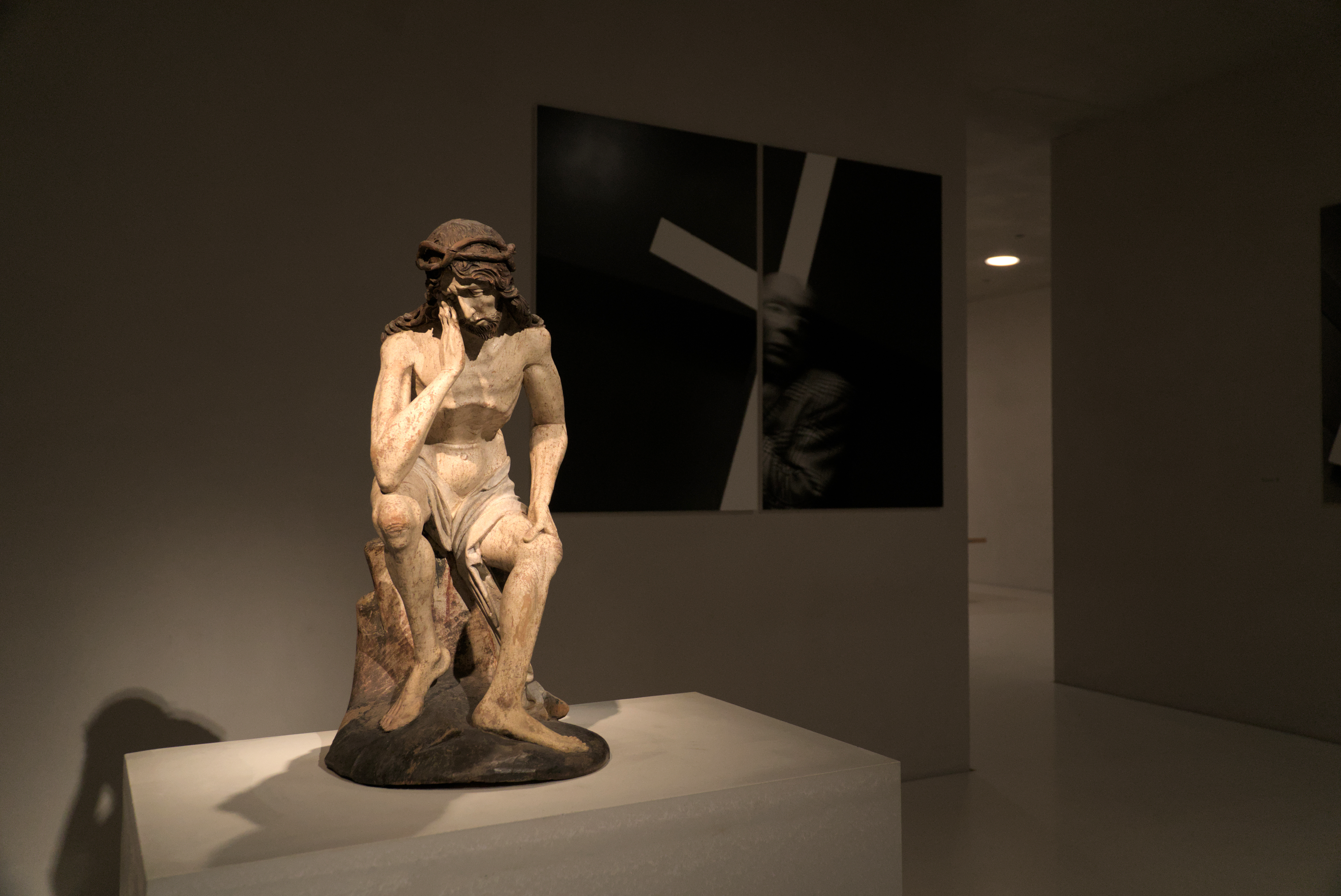
Room 8 features a fifteenth-century sculpture of Christ at Rest—“at rest” not in the sense of being at peace in mind or spirit (he is visibly troubled), but rather in a bodily state of motionlessness or inactivity. Sometimes also called Christ in Distress, Christ on the Cold Stone, or Pensive Christ, the iconography shows an interior moment during Christ’s passion in which, having just been flogged, he sits awaiting his final torture: crucifixion.

Christ at Rest (Upper Rhine)
Christus in der Rast (Christ at Rest), Upper Rhine, ca. 1480. Linden wood with visible primer and remnants of colored paint. Kolumba museum, Cologne.

Christ at Rest (detail)

Though the Gospels don’t mention a moment of seated pause in the narrative, artists were influenced by the figure of Job, an innocent sufferer who in that way prefigured Christ, and in particular the description in Job 2:8 of him sitting on a dung heap. The image of Jesus preparing to meet his death was meant to inspire feelings of pity. Isolated from the action and from all the other characters, the lone figure invites viewers to enter empathetically into the emotional anguish he suffered on his way to the cross.

At Kolumba, this sculpture is surrounded by large-scale, black-and-white photographs from the Transzendentaler Konstruktivismus (Transcendental Constructivism) series by the collaborative duo of German neo-dadaist artists Anna and Bernhard Blume. In the series the couple is threatened by white geometric objects that are unleashed on them in a blur of motion.

Christ at Rest and Transcendental Constructivism
Foreground: Christ at Rest, Upper Rhine, ca. 1480. Background: Anna Blume (1936–2020) and Bernhard Blume (1937–2011), photograph from the Transcendental Constructivism series, 1992–94.

The diptych that hangs behind the Christ sculpture appears to show a man carrying a cross, disoriented by its weight.

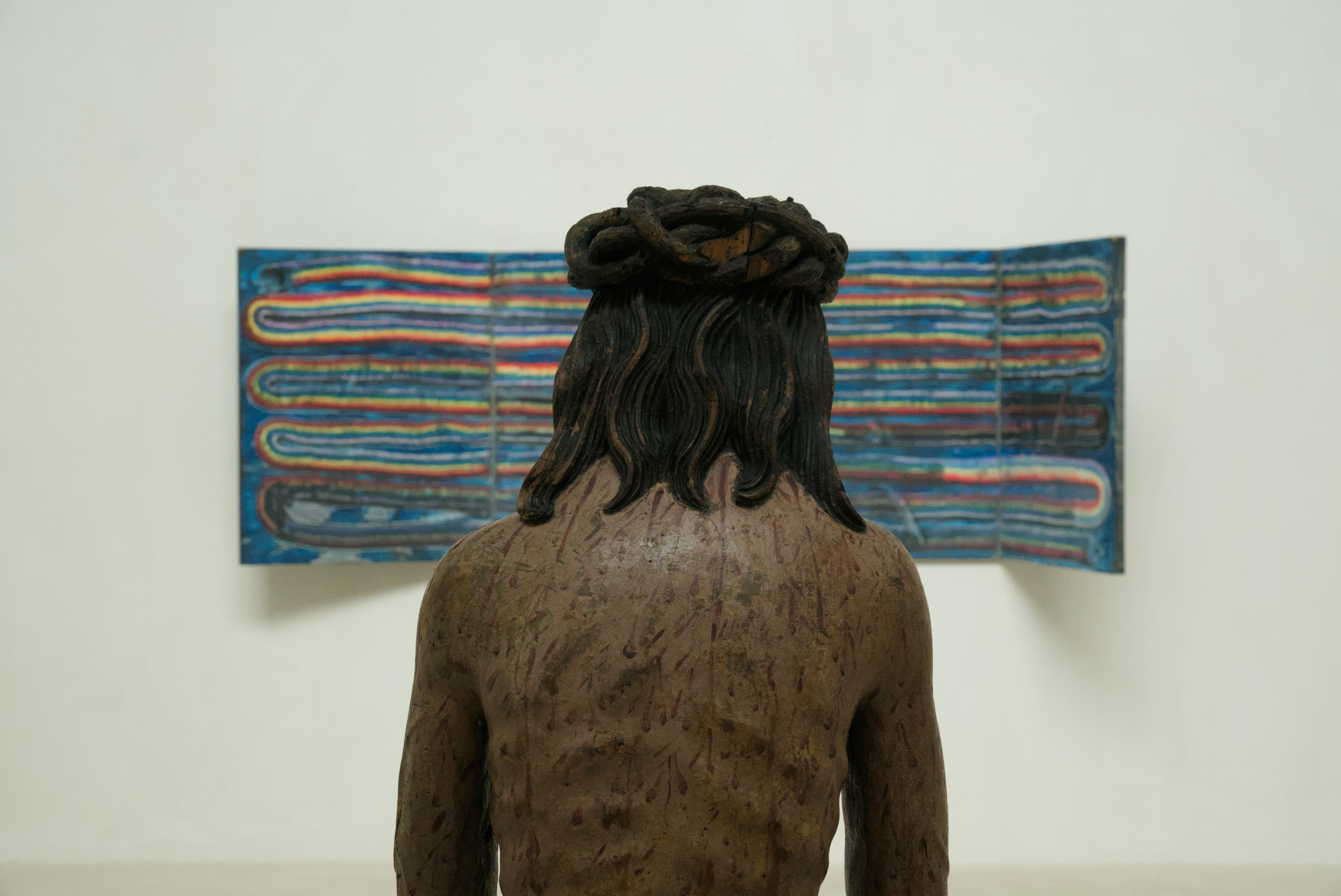
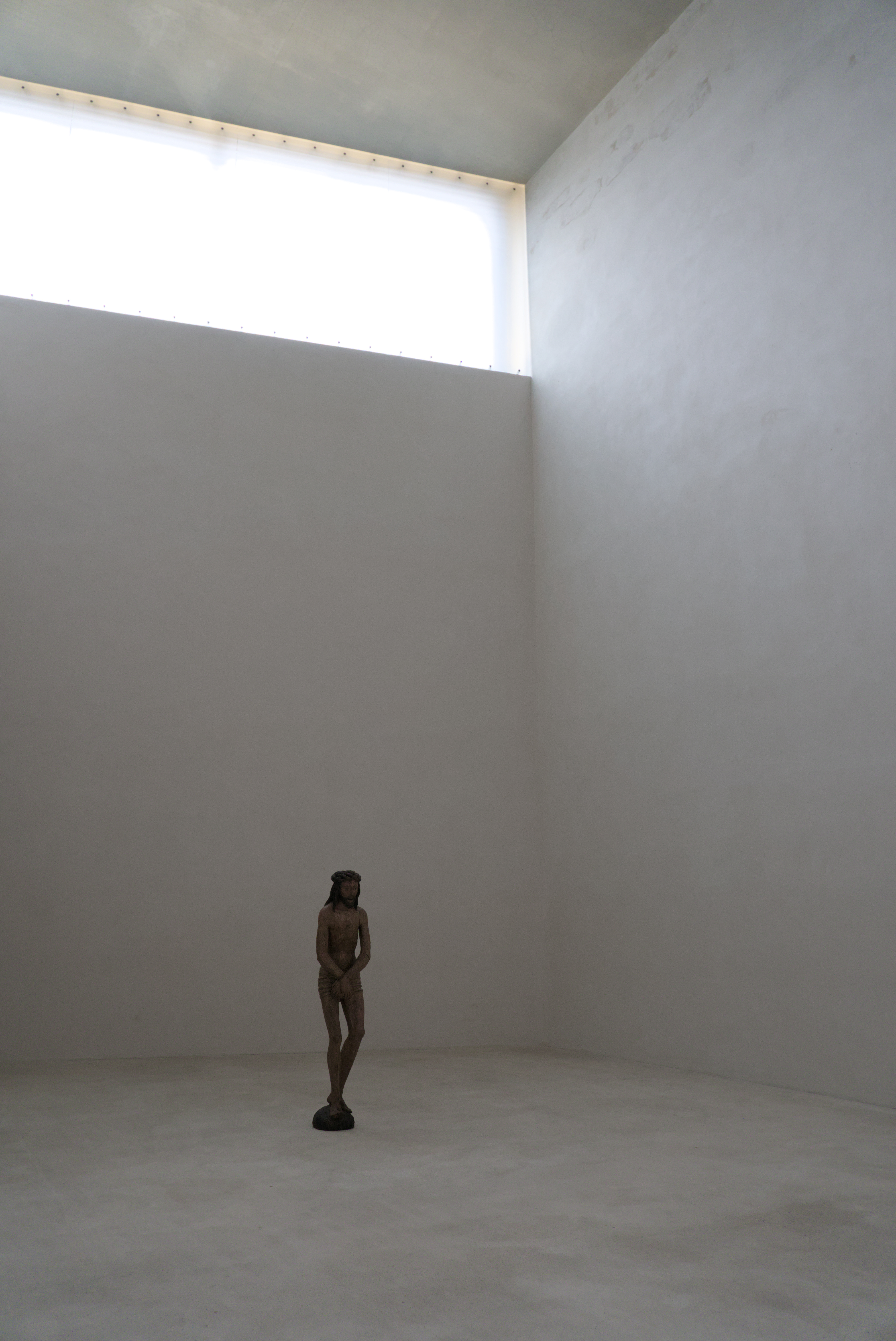
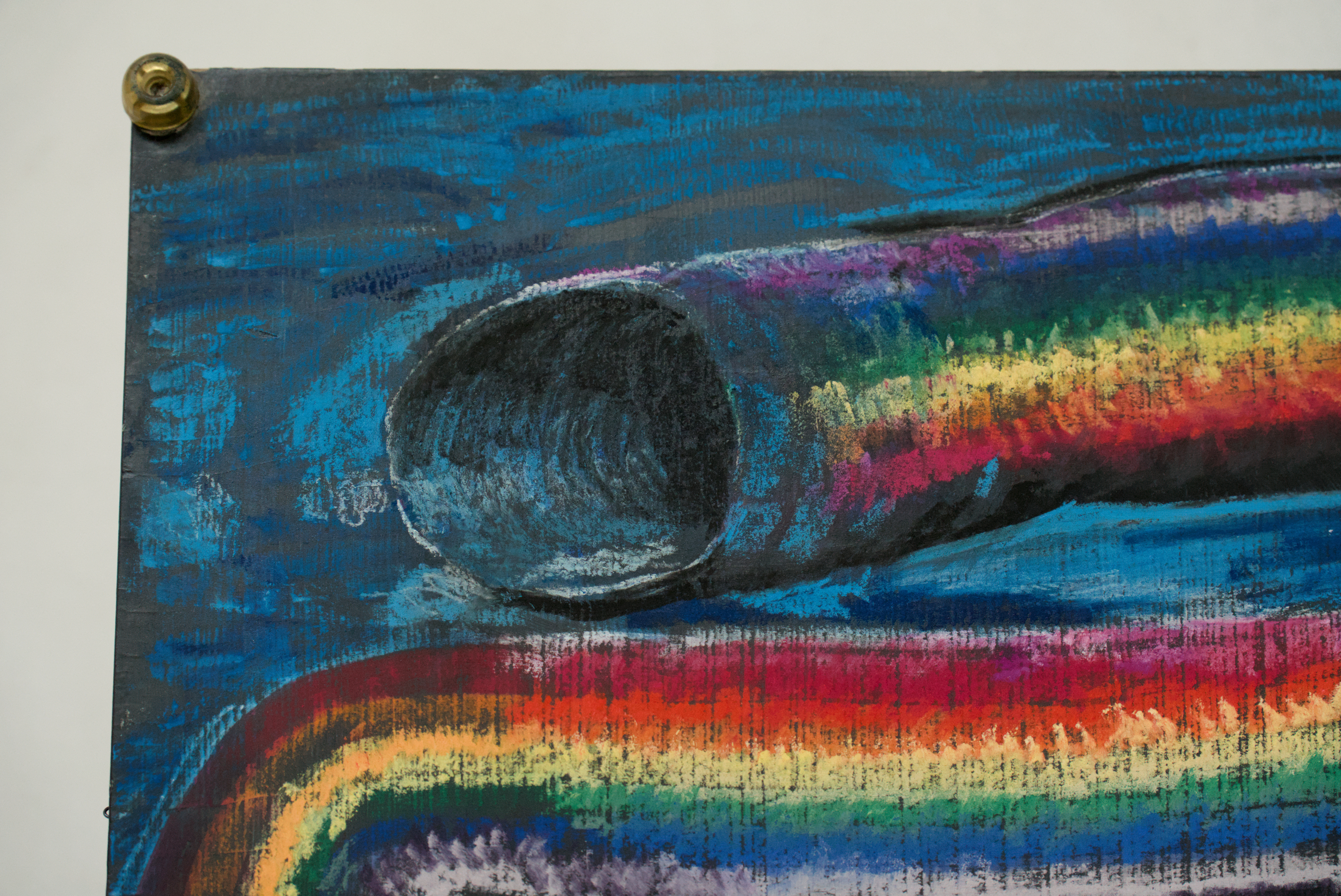
One of the other resonant pairings at Kolumba is in room 21, which stages a fifteenth-century Ecce homo sculpture across from a colored chalk drawing on a three-paneled blackboard.

Ecce Homo and Plumed Serpent

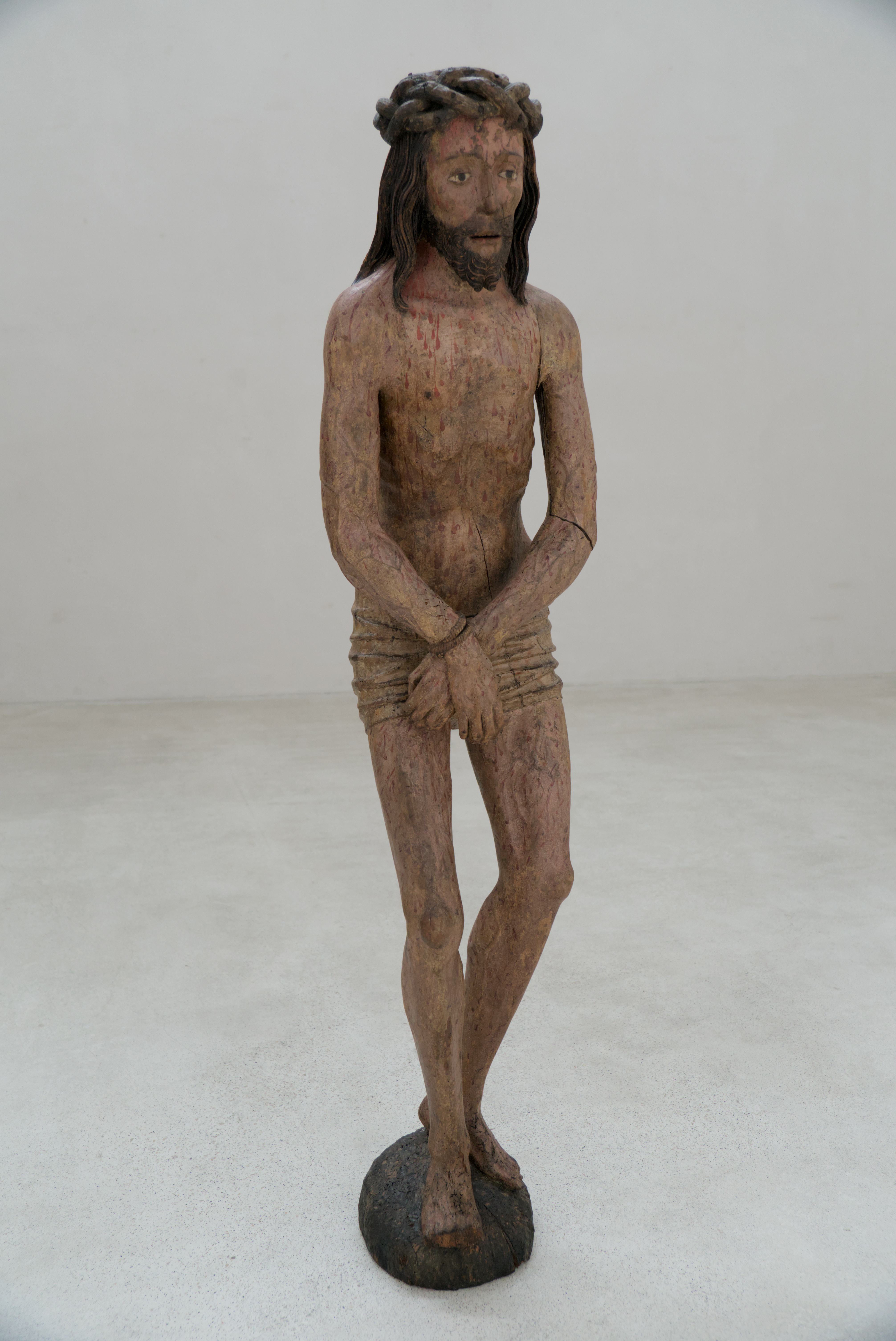
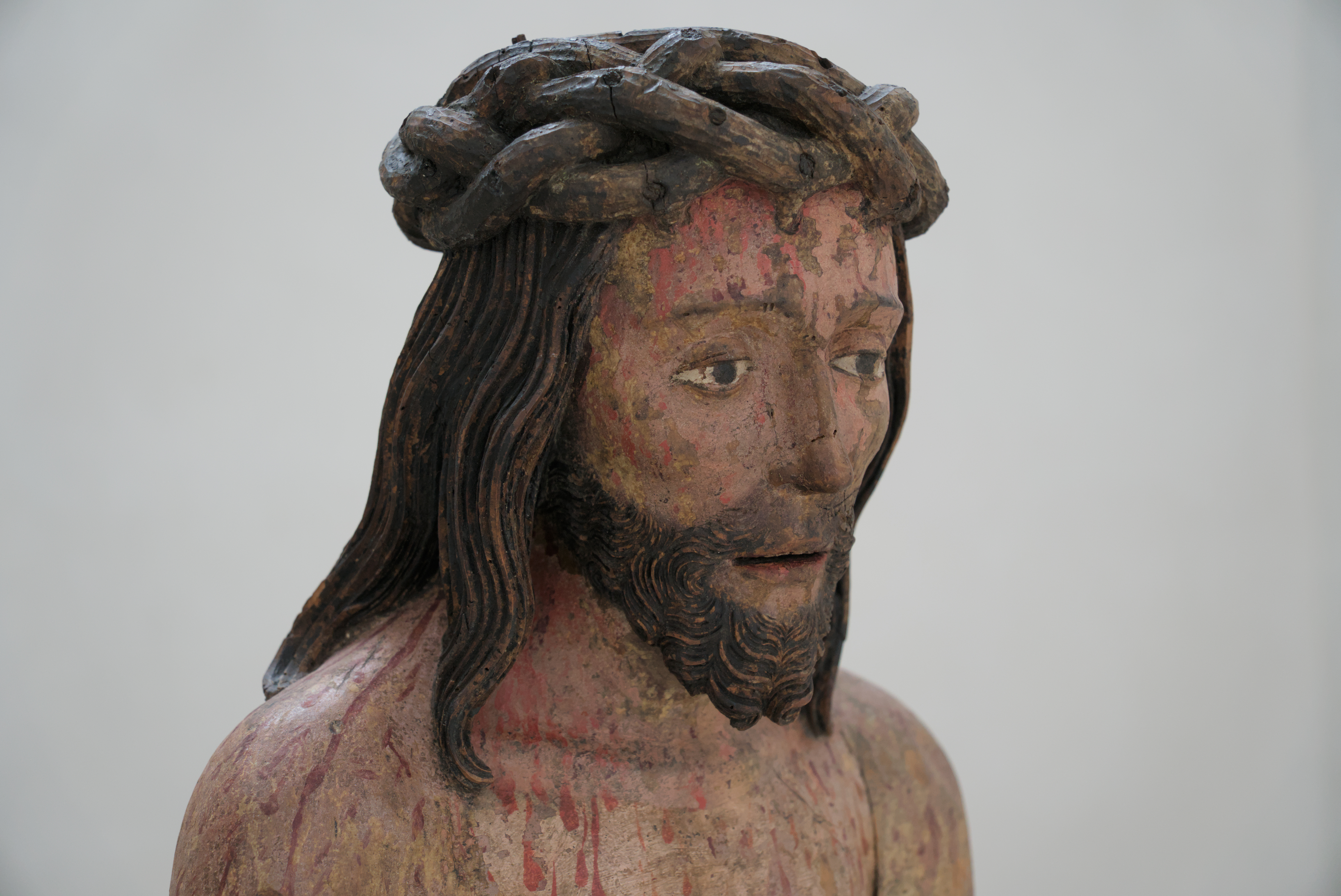
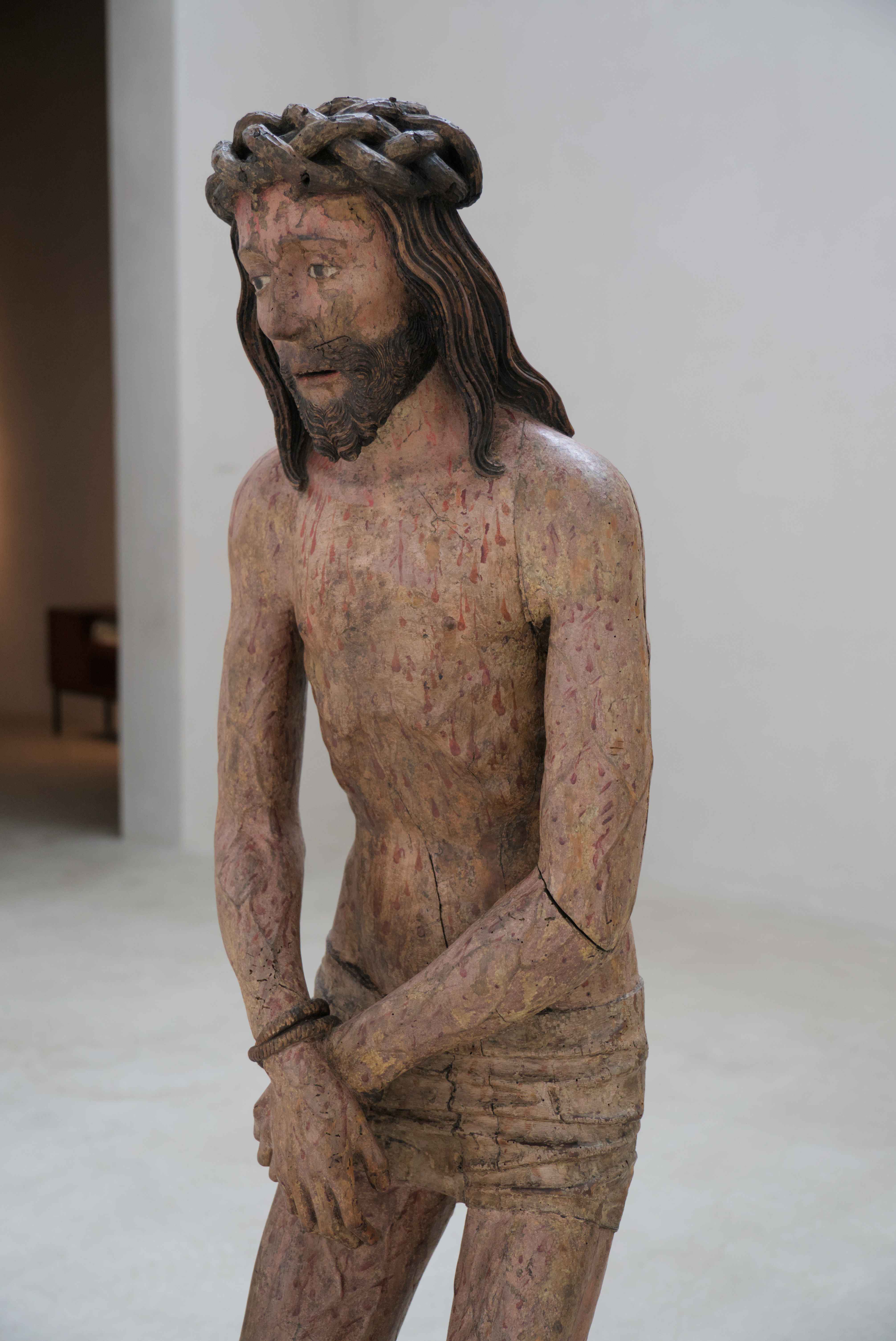
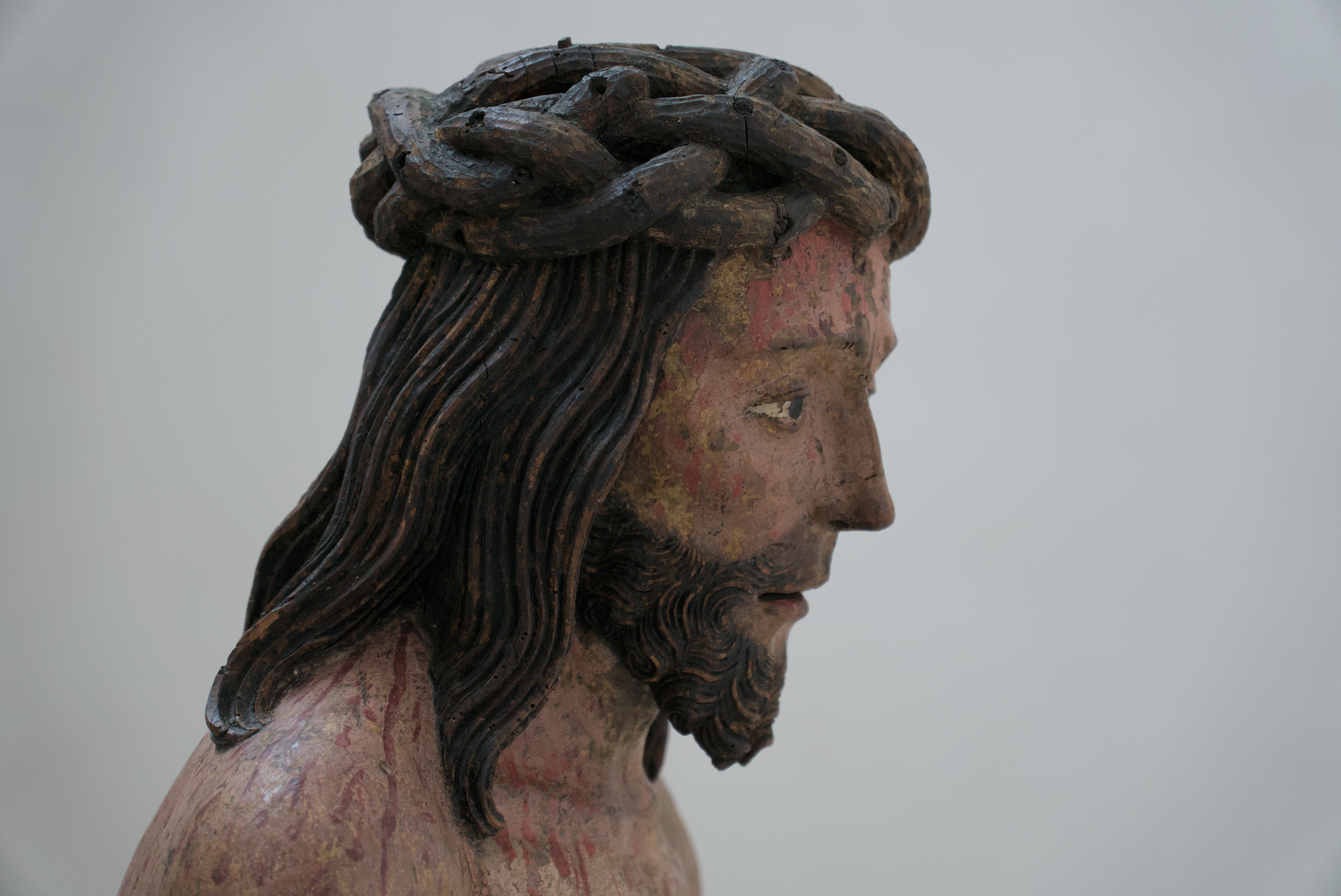
The title Ecce homo, Latin for “Behold the man,” comes from John 19:5, where the Roman governor Pilate presents a scourged, thorn-crowned Jesus to a mob that demands his execution. Like Christ on the Cold Stone, this too is a devotional image intended to stir the affections of the viewer, who is called, like the crowds on that fateful day, to gaze upon the wounded God-man. His hands are bound in front of him, evoking a sacrificial sheep tied up for slaughter. What have we done?

Ecce Homo
Ecce Homo
Ecce Homo, Cologne, ca. 1460–1500. Linden wood. Kolumba museum, Cologne.

Ecce Homo
Ecce Homo
Ecce Homo

While I instantly recognized this subject, the drawing was more of a mystery.

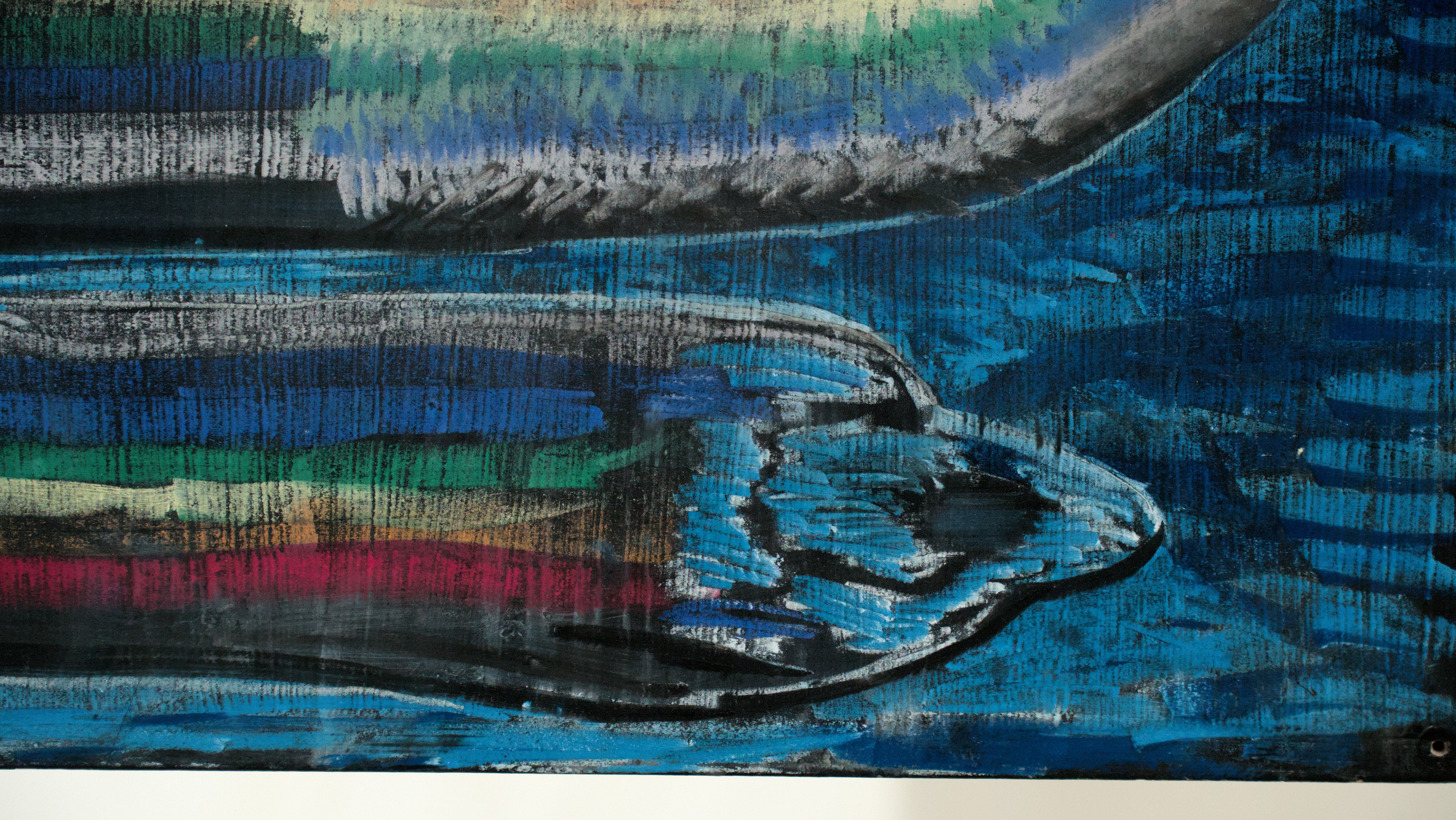
Thek, Paul_Plumed Serpent
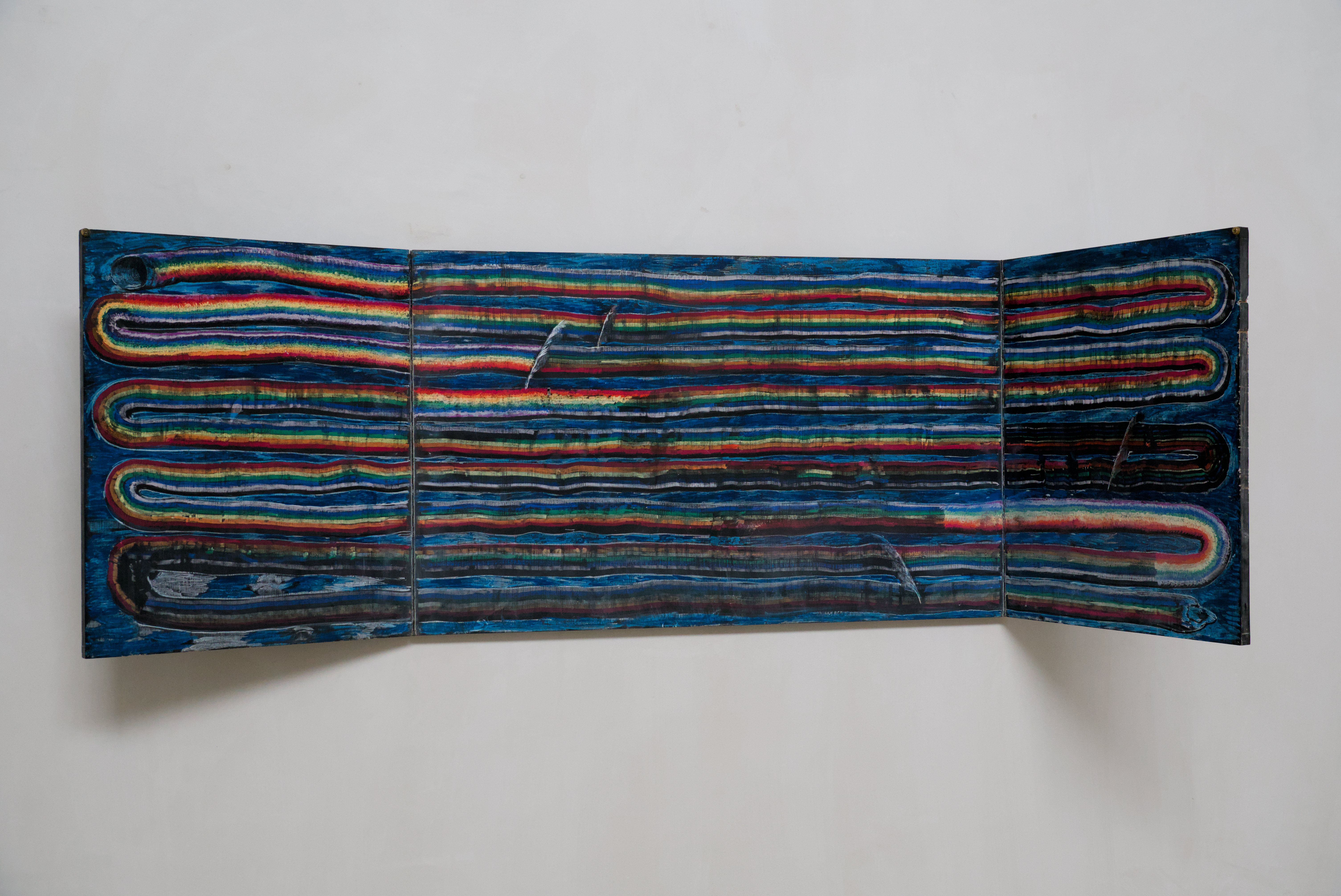
Paul Thek (American, 1933–1988), Plumed Serpent, 1969. Colored chalk on blackboard, 110 × 358 cm. Kolumba museum, Cologne.

Plumed Serpent (detail)

Not having any wall text to clue me in, I had to simply observe and intuit. I saw a winding chute, rainbow-colored, with a few white feathers sticking out of it. And is that water in the background?

I noticed, too, that it’s a triptych, a common format for altarpieces.

Water, birds, rainbows—those all play into the story of Noah’s flood, in which the rainbow signifies God’s promise to never again destroy the earth and all its inhabitants. It’s a symbol of grace and reconciliation.

There are also two prophetic texts in scripture that associate the rainbow with Christ and his glory: Ezekiel’s and John’s recorded visions of the divine throne (Ezek. 1:28; Rev. 4:3).

The curator has positioned Jesus facing the rainbow road, across a fairly large gap. Since, as the museum states, the artworks are arranged to interpret each other, at least in part, then it’s possible this room conveys Jesus following the path of promise, even as it takes dark turns. Or choosing to endure the judgment of the cross to secure a glorious inheritance for his beloveds.

After these ruminations, I looked up the work in the booklet: Plumed Serpent by Paul Thek.

Hmm. In the Christian tradition serpents are often associated with the devil. However, in Numbers 21:1–9, Moses lifts one up on his staff in the wilderness and it becomes an agent of healing and even a symbol of Christ himself, lifted up on the cross for the salvation of the world (John 3:14–15).

The description in the booklet informed me that “plumed serpent” is the English translation of the Nahuatl name Quetzalcoatl, an Aztec creator-god. I don’t know much about pre-Columbian mythologies, so I looked him up when I got home. Apparently he represents the union of earth (reptile) and sky (feathers), and he is also known as the god of the morning star. (Jesus also calls himself the bright morning star!) Although he was initially portrayed as a large snake covered in quetzal feathers, from 1200 onward, he often appeared in human form, wearing shell jewelry and a conical hat. What I find most striking about his story is that he gave new life to humankind by gathering their bones from the land of the dead, grinding them down, and mixing them with his own blood from self-inflicted wounds.

I also did some research on the artist, of whose work Kolumba has the most comprehensive holdings. Paul Thek was a devout Catholic, an identity complicated by the fact that he was also gay. He rose to fame in the 1960s with his “Technological Reliquaries,” hyperrealistic wax sculptures depicting severed body parts and chunks of flesh in vitrines, inspired by his visit to the Capuchin catacombs in Palermo. Much of his art deals with death and rebirth, divinity and decay, mystical transformation.

Feathers feature in another piece of his from the same year as Plumed Serpent: Feathered Cross. (See it against the wall in a photo from the 2021 exhibition Paul Thek: Interior/Landscape at the Watermill Center in Water Mill, New York.) The feathers’ softness, their weightlessness, seem to contradict the reality of crucifixion. But I think it’s Thek’s way of conveying the transcendent meaning of that act of self-giving. I also think of how down feathers fill pillows on which we rest. “Come to me, all you who are weary,” Christ says (Matt. 11:28); we can rest on his finished work.

But back to Plumed Serpent. Chalk is its material—its ephemerality must be a nightmare for conservators, and indeed it seems like some of the drawing has partially rubbed away. But this choice of material plays into the artist’s interest in the enduring versus the perishable, and the transitory dimensions of death.

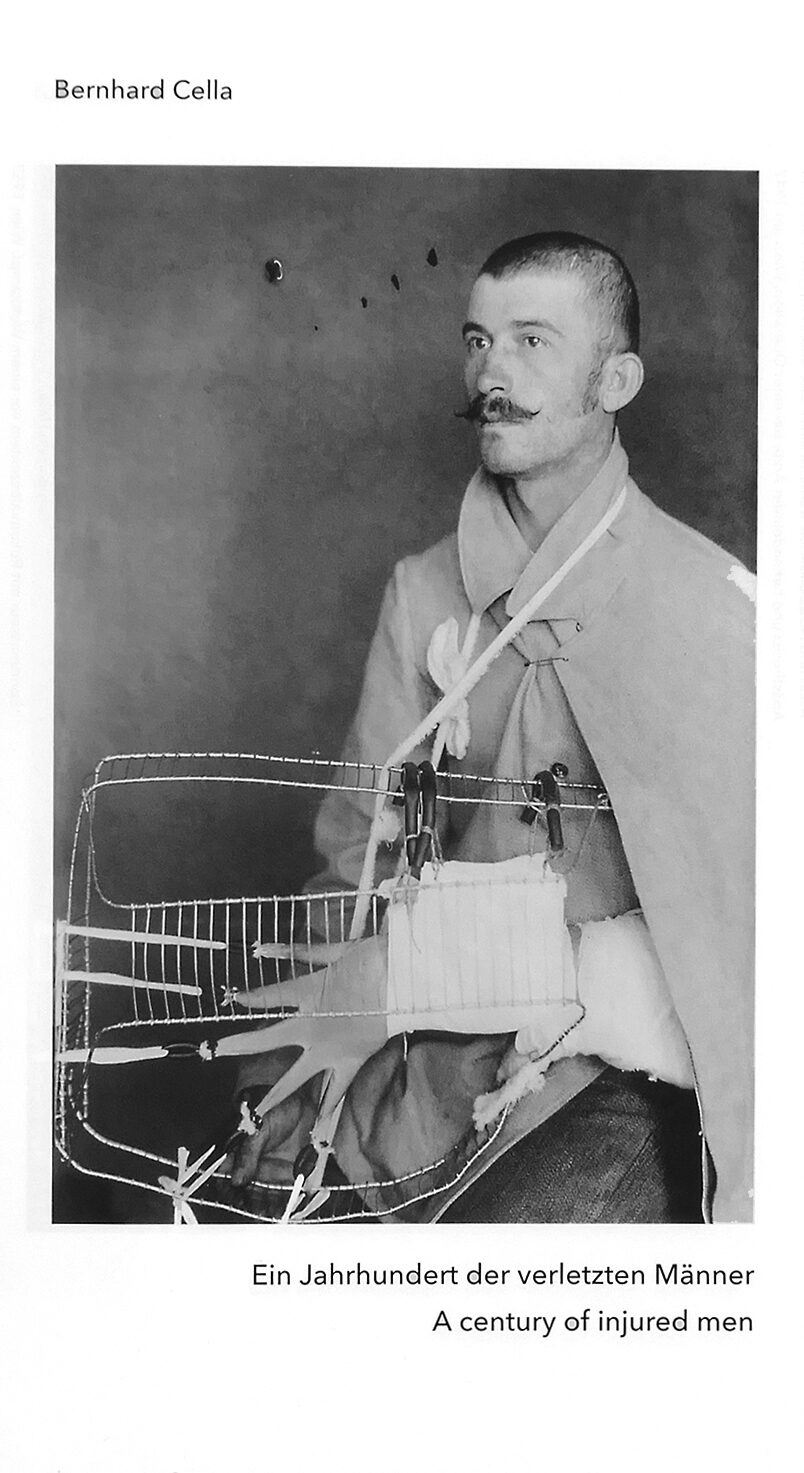
On the right side of room 21, against the wall, are three identical offset-printed artist’s books by Bernhard Cella titled Ein Jahrhundert der verletzten Männer (A Century of Injured Men). Published in 2022, the 152-page book contains photographs of convalescent men over the course of the twentieth century, questioning heroic images of masculinity. I’m assuming many of the injuries were caused by the two world wars.

I neglected to get a photo of the book, but here’s the cover image, and you can view sample pages here and here, as well as two photos of the books in situ at Kolumba on Cella’s Instagram page:

A Century of Injured Men

Vulnerability, injury, sacrifice, healing, the transmutation of pain, new life—these are the themes I gathered from this room.

The current Kolumba exhibition features much more contemporary art than medieval—there are some 175 contemporary works on display, compared to six from the Middle Ages—and I suspect that is now their modus operandi. So, the cross-temporal dialogue isn’t happening in every room, at least not explicitly.

I appreciate the uniqueness of this ecclesiastically run museum, acquiring and showing contemporary works by artists from a range of backgrounds while not shunning its own history as collectors and preservers of medieval German religious art.

As a Christian, I found myself latching on to the imagery that was familiar to me, like Jesus as the Man of Sorrows, and interpreting the surrounding works in light of that. But it seems to me the interpretive process could also move in the other direction, and I wonder how a visitor who doesn’t share my Christian vantage point would respond to the two rooms I’ve highlighted.

For two additional artworks I photographed at Kolumba, an ivory crucifix and an installation with coat, hat, and oil lamp, see my Instagram shares here and here.

Part 2, my reflections on my KMSKA visit, will be published tomorrow.

The Reproaches: A divine lament for Good Friday

O my people, what have I done to you?
In what have I wearied you? Answer me!

—Micah 6:3

The Reproaches (Latin: Improperia), also known by the first phrase of their refrain, “Popule meus” (O My People), are a series of antiphons and responses used in Good Friday liturgies across all three branches of Christianity. The text contrasts Old Testament stories of God’s goodness with humanity’s enactment of evil against God’s Son. Whereas God graciously delivered his people from death time and again throughout history, they delivered his Son to death—death on a cross. Thus God reproaches us, his beloved ones, for our fatal rejection of Christ, his greatest gift, lamenting that we have spurned his love.

The lyrics are reproduced below (the side-by-side formatting with English translation on the right is best viewed on a computer screen), followed by four musical settings, chosen from among dozens. In the present Roman Rite, the roman-style text is sung by a cantor and the italicized text by a choir, and the lines of the Trisagion (“Thrice Holy”), the ancient hymn that follows the first improperium, are sung by two halves of a choir in alternation—the first singing in Greek, the second in Latin. Composers working outside that context, however, may assign the sections differently.

(Related post: “Blood and Tears”)

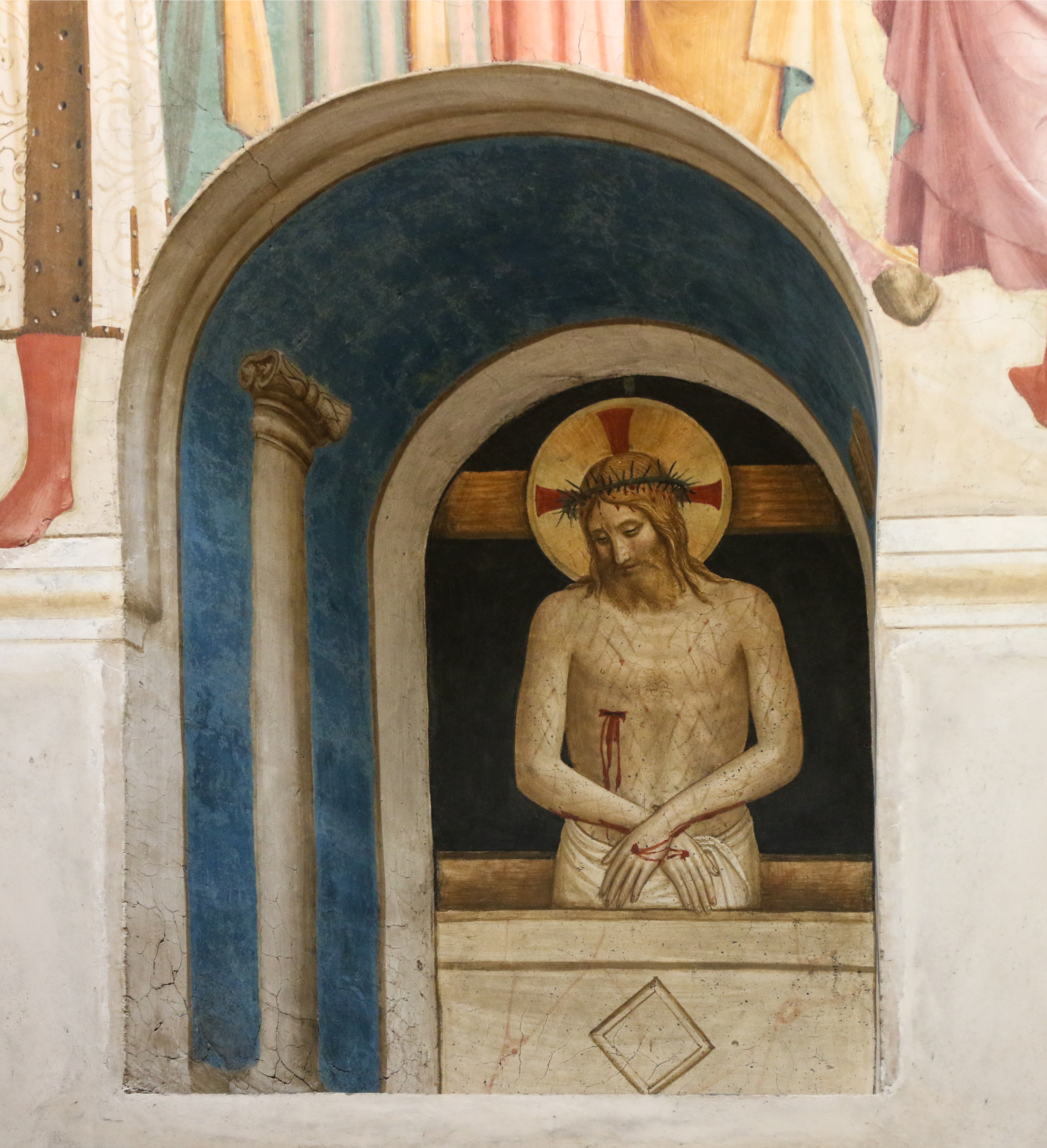
Fra Angelico_Man of Sorrows
Fra Angelico (Italian, ca. 1395–1455), Man of Sorrows, ca. 1440. Fresco, Cell 39, Convent of San Marco, Florence. Photo: Fr. Lawrence Lew, OP.

Popule meus, quid feci tibi?
Aut in quo contristavi te?
Responde mihi.

Quia eduxi te de terra Aegypti:
parasti Crucem Salvatori tuo.

   Hagios o Theos.
      Sanctus Deus.
   Hagios Ischyros.
      Sanctus fortis.
   Hagios Athanatos, eleison himas.
      Sanctus immortalis, miserere nobis.

Quia eduxi te per desertum quadraginta annis:
et manna cibavi te, et introduxi te in terram satis bonam:
parasti Crucem Salvatori tuo.
Hagios . . .

Quid ultra debui facere tibi, et non feci?
Ego quidem plantavi te vineam meam speciosissimam:
et tu facta es mihi nimis amara:
aceto namque sitim meam potasti:
et lancea perforasti latus Salvatori tuo.
Hagios . . .

Ego propter te flagellavi Aegyptum cum primogenitis suis:
et tu me flagellatum tradidisti.
Popule meus . . .

Ego te eduxi de Aegypto, demerso Pharone in mare Rubrum:
et tu me tradidisti principibus sacerdotum.
Popule meus . . .

Ego ante te aperui mare:
et tu aperuisti lancea latus meum.
Popule meus . . .

Ego ante te praeivi in columna nubis:
et tu me duxisti ad praetorium Pilati.
Popule meus . . .

Ego te pavi manna in desertum:
et tu me cedisti alapis et flagellis.
Popule meus . . .

Ego te potavi aqua salutis de petra:
et tu me potasti felle et aceto.
Popule meus . . .

Ego propter te Chananeorum reges percussi:
et tu percussisti arundine caput meum.
Popule meus . . .

Ego dedi tibi sceptrum regale:
et tu dedisti capiti meo spineam coronam.
Popule meus . . .

Ego te exaltavi magna virtute:
et tu me suspendisti in patibulo crucis.
Popule meus . . .
O my people, what have I done to thee?
Or how have I offended thee?
Answer me.

Because I led thee out of the land of Egypt:
thou hast prepared a cross for thy Savior.

O holy God!
O holy God!
O holy strong One!
O holy strong One!
O holy and immortal, have mercy upon us.

Because I led thee through the desert for forty years:
and fed thee with manna, and brought thee into a land exceeding good:
thou hast prepared a cross for thy Savior.
O holy God! . . .

What more ought I to have done for thee, that I have not done?
I planted thee, indeed, my most beautiful vineyard:
and thou hast become exceeding bitter to me:
for in my thirst thou gavest me vinegar to drink:
and with a spear thou hast pierced the side of thy Savior.
O holy God! . . .

For thy sake I scourged the firstborn of Egypt:
Thou hast given me up to be scourged.
O my people . . .

I led thee out of Egypt, having drowned Pharaoh in the Red Sea:
and thou hast delivered me to the chief priests.
O my people . . .

I opened the sea before thee:
and thou hast opened my side with a spear.
O my people . . .

I went before thee in a pillar of cloud:
and thou hast led me to the judgment hall of Pilate.
O my people . . .

I fed thee with manna in the desert:
and thou hast assaulted me with blows and scourges.
O my people . . .

I gave thee the water of salvation from the rock:
and thou hast given me gall and vinegar to drink.
O my people . . .

For thy sake I struck the kings of the Canaanites:
and thou hast struck my head with a reed.
O my people . . .

I gave thee a royal scepter:
and thou hast given a crown of thorns for my head.
O my people . . .

I exalted thee with great strength:
and thou hast hanged me on the gibbet of the cross.
O my people . . .

1. “Popule meus” by Tomás Luis de Victoria (1585)

First up, a traditional setting of the Latin by the Spanish Renaissance composer Tomás Luis de Victoria (ca. 1548–1611) [previously], performed by Ensemble Invocatio under the direction of Daniel Knaggs in 2022 at Seminary Church in Warsaw, Poland. The soloist is Łukasz Dziuba. This four-part motet is the most widely performed setting of the Reproaches.

2. “The Reproaches” by John Sanders (1984)

This setting in English by the British composer John Sanders (1933–2003) has become standard repertoire for many English cathedral and church choirs. Sanders first wrote it in 1984 for a Good Friday service at Gloucester Cathedral, where he served as organist, but it wasn’t published until 1993. It’s performed here by the Ely Cathedral Choir, conducted by Sarah MacDonald, from 2018. Whereas Victoria scored his setting for four voices (SATB), Sanders scored his for eight (SSAATTBB), creating more complex harmonies, including dissonance.

3. “Popule meus” by Filipe Faria and Sérgio Peixoto (2015)

In 1999 Portuguese composers Filipe Faria (b. 1976) and Sérgio Peixoto (b. 1974) founded Sete Lágrimas ECMC (Early and Contemporary Music Consort) to create dialogues between medieval, Renaissance, and early Baroque music on the one hand and contemporary music on the other. Their “Popule meus,” which includes just the opening refrain, is from their Missa Mínima, a minimalistic setting for two voices and recorder of the five parts of the Catholic Mass, along with other important liturgical texts. They began composing it in 1999, put it on the back burner for a while, and returned to it later, completing it in 2015. In this 2016 recording, the singers are Faria and Peixoto. The melodic embellishment on the syllable -sta in contristavi (literally “saddened” but more often translated in this song as “offended” or “distressed”) creates a tense quivering effect, a climax before the languid return to the title phrase and a petering off with “Responde mihi.”

4. “The Reproaches” by Paul Zach (2021)

American singer-songwriter Paul Zach wrote this condensed version of the Reproaches with frequent collaborator Kate Bluett [previously], which puts the words in the voice of the people, who assume and repent of their responsibility for Jesus’s death—for no matter our temporal or geographical proximity to the event, it was our sin that led him to and held him on the cross. Transferring the speaker from God to the Christian for the whole duration helps make the song more suitable for congregational singing, as it can then function as a corporate confession.

You delivered us from Pharaoh;
We delivered you to death.
You gave manna in the desert;
We gave a crown of thorns for your head.

You brought us out of slavery
Into the promised land;
We brought you up to Calvary
And pierced your feet and hands.

Holy God, Holy Mighty One,
Holy Immortal One,
Have mercy, mercy,
Have mercy on us.

You opened up the Red Sea;
We opened up your side.
“Come down, come down,” we mocked you;
“My God, my God,” you cried.

Holy God, Holy Mighty One,
Holy Immortal One,
Have mercy, mercy,
Have mercy on us.

Zach told me he’s not fully satisfied with the song and is working on a rewrite that he may release in 2024. Nonetheless, I really like what he and Bluett have created here! And I appreciate how it brings the Reproaches into an indie-folk idiom, making that long-standing sung portion of the global church’s Good Friday liturgy accessible to those who find it difficult to connect with choral music or chant.

Addendum, 3/21/23: Rev. Bill Combs from Greensboro, Georgia, has just reminded me of a contemporary adaptation of the text of the Reproaches by Janet Morley, a liturgist from the UK. It’s from her wonderful collection All Desires Known, a resource for public worship and private devotion, and can be read here. Combs’s church, Episcopal Church of the Redeemer, chants this text as part of their annual Good Friday service using Tone II.1.

“Undo thy door, my spouse dear” (Middle English lyric)

Bouts, Aelbert_Man of Sorrows
Aelbert Bouts (Netherlandish, ca. 1451/54–1549), Man of Sorrows, mid-1490s. Oil on oak wood, 14 15/16 × 10 7/16 in. (37.9 × 26.5 cm). Harvard Art Museums / Fogg Museum, Cambridge, Massachusetts.

ORIGINAL MIDDLE ENGLISH:

Vndo þi dore, my spuse dere,
Allas! wy stond i loken out here?
     fre am i þi make.
Loke mi lokkes & ek myn heued
& al my bodi with blod be-weued
     For þi sake.

Allas! allas! heuel haue i sped,
For senne iesu is fro me fled,
     Mi trewe fere.
With-outen my gate he stant alone,
Sorfuliche he maket his mone
     On his manere.

Lord, for senne i sike sore,
Forʒef & i ne wil no more,
With al my mith senne i forsake,
& opne myn herte þe inne to take.
For þin herte is clouen oure loue to kecchen,
Þi loue is chosen vs alle to fecchen;
Mine herte it þerlede ʒef i wer kende,
Þi suete loue to hauen in mende.
Perce myn herte with þi louengge,
Þat in þe i haue my duellingge. 
Amen.
MODERN ENGLISH TRANSLATION:

“Undo thy door, my spouse dear,
Alas! why stand I locked out here?
     For I am thy mate.
Look, my locks and also my head
And all my body with blood bedewed,
     For thy sake.”

“Alas! alas! evil have I sped,
For sin Jesus is from me fled,
     My true companion.
Without my gate he standeth alone,
Sorrowfully he maketh his moan
     In his manner.”

Lord, for sin I sigh sore,
Forgive, and I’ll do so no more,
With all my might I forsake my sin,
And open my heart to take thee in.
For thy heart is cleft our love to catch,
Thy love has chosen us all to fetch;
My heart it pierced if I were kind,
Thy sweet love to have in mind.
Pierce my heart with thy loving,
That in thee I may have my dwelling. 
Amen.

This poem appears in the 1372 “commonplace book” of the Franciscan friar John of Grimestone, who lived in Norfolk, England. Commonplace books were notebooks used to gather quotations and literary excerpts, with entries typically organized under subject headings. Preachers often kept them for homiletic purposes, gathering potential material for sermons. Grimestone’s is remarkable because it includes, in addition to much Latin material, 239 poems in Middle English. (English friars at the time regularly used vernacular religious verse in their sermons.) It is unknown whether Grimestone composed these verses himself or merely compiled them; likely, it is some combination. The first two stanzas of this particular poem are found, transposed, in another manuscript from almost a century earlier. Grimestone revised them slightly and added the third stanza.

Belonging to the Christ-as-lover tradition, “Undo thy door” is based primarily on Song of Solomon 5:2, cited in Grimestone’s manuscript: “I sleep, but my heart waketh: it is the voice of my beloved that knocketh, saying, Open to me, my sister, my love, my dove, my undefiled: for my head is filled with dew, and my locks with the drops of the night.” In a clever interpretation of the Old Testament source, the poet imagines the dewdrops on the Beloved’s brow as blood, thus identifying him with the thorn-crowned Christ. His bride is the human soul. Revelation 3:20 is provided as a further gloss by Grimestone: Jesus says, “Behold, I stand at the door, and knock: if any man hear my voice, and open the door, I will come in to him, and will sup with him, and he with me.”

So in the poem, the speaker is keeping company with sin and has locked out her true lover, Christ. Christ stands at the gate of her heart and implores her with great ardor to let him in and to send sin packing. Wet with the wounds of sacrifice, tokens of his love, he is persistent in his longing for her.

Christ’s entreaties provide the impetus for the speaker’s repentance, expressed in the final stanza, which changes awkwardly in form and meter. His love has pierced her to the core, undoing her resistance. She resolves to break the sin-lock—to turn away from wrongful deeds—and answer Christ’s call so that they can enjoy sweet union together, dwelling in one another’s love. It was his heart that opened first—it was cleft by the centurion’s spear as he hung on the cross—and she is compelled to respond with similar openness, receiving what he has given, requiting his desire.


SOURCES:

This poem is #6108 in the Digital Index of Middle English Verse. It is preserved in Edinburgh, National Library of Scotland, Adv.MS.18.7.21, fol. 121v. A shorter, earlier version, from the late thirteenth century, appears in London, Lambeth Palace Library 557, fol. 185v.

Middle English transcription: Carleton Brown, ed., Religious Lyrics of the XIVth Century (Oxford: Clarendon Press, 1924), 86

Modern English translation: David C. Fowler, The Bible in Middle English Literature (Seattle: University of Washington Press, 1984), 85–86

For further reading, see chapters 4–5 of Siegfried Wenzel, Preachers, Poets, and the Early English Lyric (Princeton, NJ: Princeton University Press, 1986), especially pages 140–41; and chapter 7, “The Theme of Christ the Lover-Knight in Medieval English Literature,” in Rosemary Woolf, Art and Doctrine: Essays on Medieval English Literature (London: The Hambledon Press, 1986), especially pages 109–10.

Roundup: Christian Imagery in Painting Now, “Antelope,” and more

This roundup is a bit longer than usual, but I’ve found that these six items I’ve gathered over the last month complement each other well, so I’m sharing them all at once. The Art in America and Hyperallergic articles raise interesting points about sacred art—what it is, how it functions, what its relevance is to contemporary life—and this is a topic I discuss in a podcast episode that was released earlier this month. Tammy Nguyen and Wes Campbell are two artists whose work I am glad to have just learned about and plan to explore more of. And there’s always something going on in London’s art scene to remark on as relates to theology or Christian history—this time a National Gallery–sponsored virtual exhibition on the fruits of the spirit, and the latest winning entry for the Fourth Plinth competition, which honors a Baptist pastor and freedom fighter from Malawi.

ARTICLE: “Seeing and Believing: Christian Imagery in Painting Now,” a roundtable conversation with four artists moderated by Emily Watlington: Religion is the theme of the December 2022 issue of the influential contemporary art magazine Art in America, and its cover story is a conversation with painters Frieda Toranzo Jaeger, Tammy Nguyen, Alina Perez, and Jannis Marwitz on their “bold reinventions of traditional Christian iconography.” They discuss the generativity of Christian imagery, the power of sacred images, their favorite Christian paintings, the function of metal leaf in illuminated manuscripts, Jesus as recognizable not by his specific likeness but by body language and symbol, “revisiting and repurposing history” as “a core practice of decolonization,” and the role of storytelling and transcendence in art.

I especially appreciated being introduced to Nguyen’s work and hearing her thoughtful and nuanced perspectives. She mentions her Stations of the Cross series, inspired by her visit to the island of Pulau Galang in Indonesia to connect with her Vietnamese parents’ history as refugees on nearby Kuku Island following the Vietnam War. In the decommissioned Galang Refugee Camp, now a tourist site, fourteen golden Stations of the Cross statues are preserved in the forest, which served as devotional aids for the many Vietnamese Catholic refugees—but they are now overgrown by nature. Nguyen was struck by this tropical takeover, and her resultant body of work setting Christ’s passion in the jungle explores not only environmental agency but also legacies of colonialism and the important role of faith in circumstances of trauma and grief. Hear her discuss the series in this five-minute video that the gallery Lehmann Maupin put out:

Nguyen, Tammy_Man of Sorrow
Tammy Nguyen (American, 1984–), Man of Sorrow, 2022. Watercolor, pastel, vinyl paint, and metal leaf on paper stretched over wood panel, 84 × 60 in. (213.4 × 152.4 cm).

I regret that besides Nguyen’s, all the other featured contemporary paintings in the Art in America article have only a very tenuous, sometimes indiscernible, connection to Christianity. Toranzo Jaeger’s End of Capitalism, the Future, a “queer utopia,” is based on Lucas Cranach’s Fountain of Youth—but Cranach’s subject (elderly women entering a pool to become young again) is not Christian, it’s mythological. And Marwitz’s The Raid supposedly references Caravaggio’s Madonna of Loreto, but I don’t see it at all, compositionally or otherwise. Perez mentions growing up Catholic in Miami, but that influence isn’t apparent in It Never Heals, unless we’re meant to read it in the painting’s flair for violence and drama. So the article’s subtitle, “Christian Imagery in Painting Now,” is a bit of a misnomer.

With the criteria of currently active painters consciously engaging with Christian imagery in ways that are not merely illustrative, I might have chosen to interview, for example, Jyoti Sahi (India), Daozi (China), Emmanuel Garibay (Philippines), Wisnu Sasongko (Indonesia), Marc Padeu (Cameroon), Harmonia Rosales (US), Stephen Towns (US), Rodríguez Calero (US), Trung Pham (US), Laura Lasworth (US), Patty Wickman (US), James B. Janknegt (US), Mark Doox (US), Sergii Radkevych (Ukraine), Ivanka Demchuk (Ukraine), Natalya Rusetska (Ukraine), Paul Martin (England), Filippo Rossi (Italy), Michael Triegel (Germany), Janpeter Muilwijk (Netherlands), Arne Haugen Sørensen (Denmark), Brett a’Court (Australia), or Julie Dowling (Australia).

I’m also disappointed that, from what I can tell from the interview, none of the four artists approaches their subjects from a place of Christian belief. I absolutely welcome non-Christians to engage with Christian stories and symbols—to play with them, reinterpret them, question them, or even use them as tools of critique or subversion. I just wish that in a conversation about ways that Christian imagery is being used today, the editors had thought to invite a Christian to the table, who could have provided a different viewpoint. But, kudos to Art in America for at least broaching the topic of religion in contemporary art!

+++

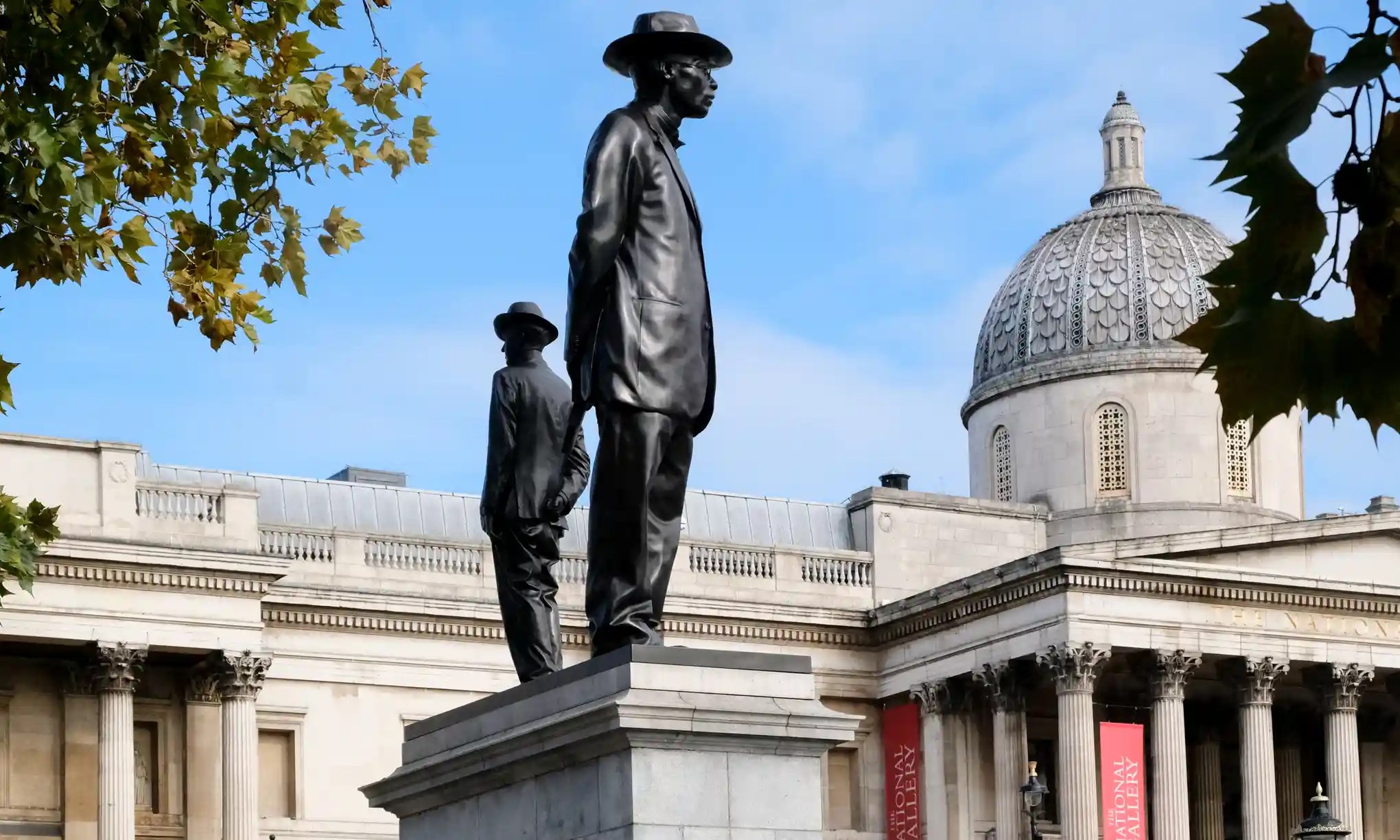
NEW STATUE: Antelope by Samson Kambalu: The fourth plinth in London’s Trafalgar Square is the prestigious site of rotating contemporary art installations, and from September 2022 to September 2024, it is home to Antelope by Malawian-born artist Samson Kambalu. This two-man bronze sculpture group reimagines a photograph of the pastor, educator, and revolutionary John Chilembwe (1871–1915) of Nyasaland (now Malawi) standing next to his friend John Chorley, a British missionary. Posing at the entrance of his newly built church, Chilembwe proudly wears a brimmed hat, flouting the law that Africans were not allowed to wear hats in the presence of their then colonial rulers. (Read more from Inno Chanza on Facebook, and from Harvard Magazine.) Kambalu’s sculpture shows the men facing away from each other instead of side-by-side, and he’s made Chilembwe almost twice as large as Chorley, elevating an underrepresented figure in the history of the British Empire in Africa.

Kambalu, Samson_Antelope
Samson Kambalu (Malawian, 1975–), Antelope, 2022. Bronze, resin, 18 ft. high. Photo: Future Publishing / Getty Images.

John Chilembwe and John Chorley
Pastor John Chilembwe and John Chorley at the dedication of Chilembwe’s New Jerusalem Baptist Church in Mbombwe village in what is today southern Malawi, January 24, 1914. The British colonial government demolished the church the next year and imprisoned or executed most of its leaders following an unsuccessful uprising against forced labor, racial discrimination, and conscription led by Chilembwe.

After years of agitating peacefully against British colonial rule to no avail, Chilembwe led an uprising in 1915, which resulted in his death but which laid the seeds for Malawian independence. John Chilembwe Day is observed annually on January 15 in Malawi.

+++

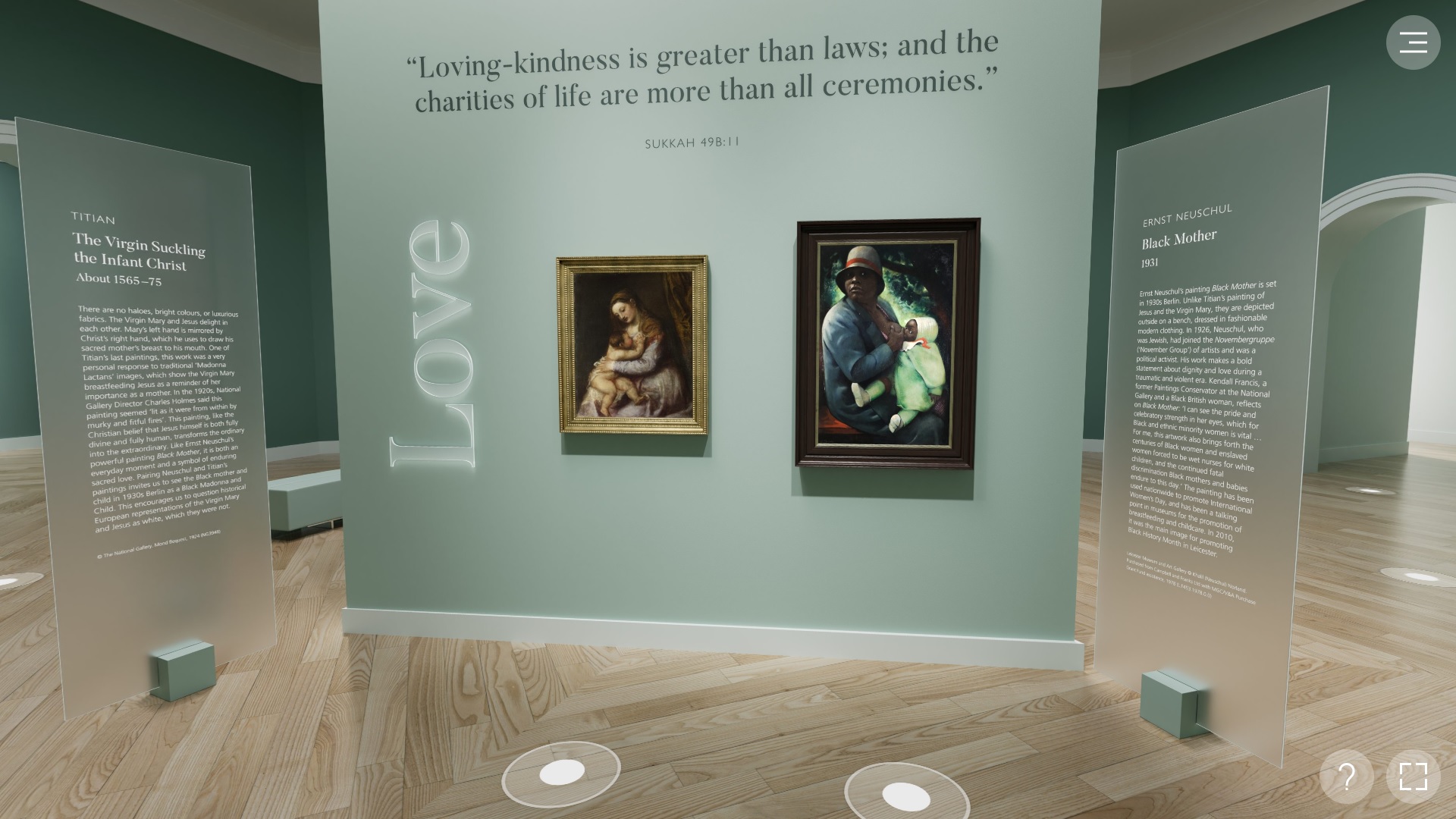
VIRTUAL EXHIBITION: Fruits of the Spirit: Art from the Heart: Curated by the Rev. Dr. Ayla Lepine as part of the National Gallery’s Art and Religion research strand, this new virtual exhibition was inspired by a passage from the apostle Paul’s letter to the Galatians, where he writes, “The fruit of the Spirit is love, joy, peace, patience, kindness, generosity, faithfulness, gentleness, and self-control. There is no law against such things” (5:22–23). The exhibition pairs nine artworks from the National Gallery’s collection with nine from UK partner institutions that represent these spiritual fruits, these virtues, which are held in common across faith traditions. The Renaissance through contemporary eras are represented. [HT: Jonathan Evens]

Fruits of the Spirit exhibition (Love)
Screen capture from the online exhibition experience Fruits of the Spirit. This fictitious space consists of seven side galleries and two central displays, which can be navigated with your keyboard.

Accompanying the exhibition is a web-based catalog (with contributions by theologians, activists, novelists, artists), an audio guide, and a series of in-person and online events from November 2022 through April 2023. Next up is a free online talk by the curator on January 30 at 1 p.m. GMT (8 a.m. EST).

+++

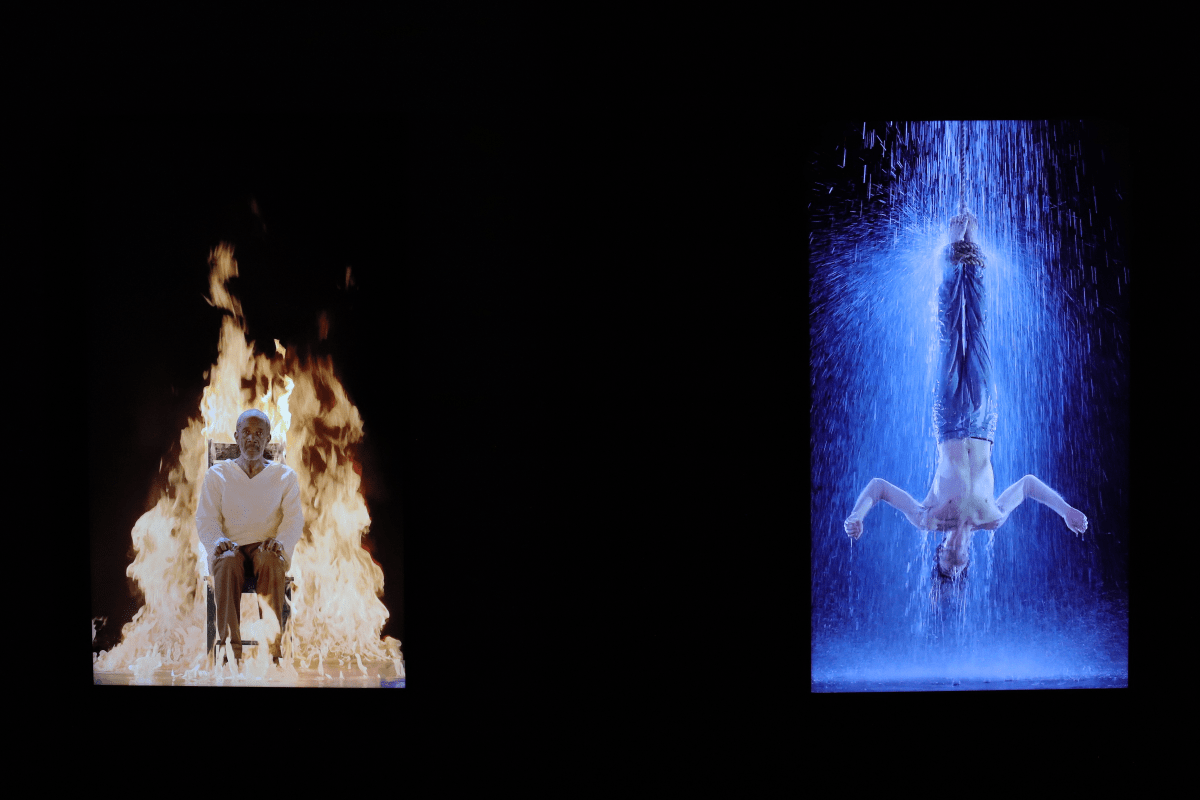
ARTICLE: “The Church of Secular Art” by David Carrier: “Bill Viola’s installation at a Naples church misses the spiritual mark,” reads the deck to this Hyperallergic article, a critic’s response to the Ritorno alla Vita (Return to Life) exhibition that ran from September 2, 2022, to January 8, 2023, at the Church of Carminiello in Toledo. The exhibition was organized by Vanitas Club, a Milan-based organization that throws artistic and cultural events in underutilized historic spaces, in collaboration with Bill Viola Studio.

Viola, Bill_Fire Martyr and Water Martyr
Bill Viola, left: Fire Martyr (2014); right, Water Martyr (2014). Photo courtesy of Vanitas Club.

I didn’t see the exhibition, but I’m familiar with Viola’s work [previously], and I don’t agree with Carrier’s assertions, if my understanding of them is correct. It sounds to me like he’s saying that when a sacred artwork—say, a medieval altarpiece—is transplanted to a museum, the work becomes secular, and that when a secular artwork is shown in a sacred space, rather than the space sacralizing the work, the work secularizes and thus undermines the space. It seems that he’s saying that art made in a contemporary idiom, like Viola’s video art, does not belong in churches, because it does not and cannot function as religious art. Art museums and churches have fundamentally different goals that are irreconcilable.

“The paintings and sculptures in Neapolitan churches are meant to support and strengthen the spiritual lives of believers; representations of St. Gennaro and other saints are intended to reinforce faith. The videos in Ritorno alla Vita call for a fundamentally different response. The exhibition website notes that these videos ‘exemplify the human capacity to transform and to bear extreme suffering and even death in order to come back to life through action, fortitude, perseverance, endurance, and sacrifice.’ These are important ideals, but they can apply equally to secular and nonsecular contexts.” The description Carrier quotes does seem to water down the art’s Christian content/messaging in an attempt to make the art more widely accessible. I’ve noticed that fault with some other displays of contemporary art in churches—where the curator, seeing their role primarily as one of hospitality to the wider (unchurched) community, underinterprets the art’s Christian angle. Though it can be difficult, there is a way to honor a work’s particularity and universality in the exhibition text.

I think we need to let art function differently for different viewers. Cannot a contemporary artwork, regardless of the artist’s intentions or where the art is placed, cultivate my affection for Christ as much as a traditional artwork? How I as a Christian read and experience Viola will differ from how an atheist does, and that’s OK. The same is true for a religious painting hanging in a national gallery—it may elicit prayer in me, boredom or contempt in another, emotional identification in another, purely aesthetic contemplation in another, and historical curiosity in yet another. I don’t think an image loses or gains its sacredness by its location, though I don’t underestimate the power of the staged environment to enable that sacredness to best shine through. I think that if the viewer receives a work as sacred, then it is.

That Viola does not depict specific historical saints in his Martyr panels—originally commissioned as a quadriptych by St. Paul’s Cathedral in London—does widen their interpretive horizon, but it doesn’t make them less “Christian.” I see the work as a memorial to all the unknown martyrs. I think of all the contemporary Christian martyrs around the world whose names I do not know, who have died with Christ’s name on their lips and his Spirit within them, and am prompted to intercede immediately for believers suffering religious persecution in their countries, who worship Jesus under threat of imprisonment or execution.

+++

ARTICLE: “Openness to the world: Wes Campbell and his disturbing illusions of peace” by Jason Goroncy: In December 2022 theology professor Jason Goroncy spoke at the opening of a retrospective of the paintings of the Rev. Dr. Wes Campbell, hosted by Habitat Uniting Church in Melbourne. That talk is adapted here on the Australian Broadcasting Corporation’s Religion and Ethics web portal. Campbell is a retired Minister of the Word in the Uniting Church of Australia with experience in parish ministry, university chaplaincy, UCA synod and assembly roles, and a sustained commitment to peace, justice, and social responsibility. His roughly three decades of art making was integrally connected to these roles, as through his paintings he expounds a faith-fueled poetics of hope, “bearing witness to the trauma of creaturely existence alongside a refusal to abandon the world to its violence, nihilism, and despair.”

Campbell, Wes_Transfiguration of Christ
Wes Campbell (Australian, 1948–), Transfiguration of Christ, n.d. Acrylic on canvas, 59 × 23 5/8 in. (150 × 60 cm).

“Wes’s art . . . does not shy away from the risky boundaries where hope is threatened, sustained, lost, and birthed,” Goroncy says. “It, therefore, embraces the tragic and the ugly, as well as joy and beauty. Whether his subject matter is the human condition, or explicitly religious stories (such as the nativity or the transfiguration), or the Earth itself, Wes’s work is replete with this kind of fidelity to the contradictions that mark our lived experience. . . . It embodies the conviction that the arts can unmoor us, disrupt the worlds we assume, facilitate our lament, and open up possibilities for futures we hardly dare imagine.”

+++

PODCAST EPISODE: “Victoria Emily Jones: Art & Theology”: In early December I spoke with Luminous podcast host Peter Bouteneff, a systematic theology professor and the founding director of the Institute of Sacred Arts at St. Vladimir’s Orthodox Theological Seminary, about my work at Art & Theology. We discuss how I got into this cross-disciplinary field, definitions of “sacred art,” and more.

Bouteneff earned his DPhil in theology from Oxford University under the supervision of Metropolitan Kallistos Ware. Besides theology, he also has an academic background in music, having studied jazz and ethnomusicology at the New England Conservatory. He has written two books on the music of Estonian composer Arvo Pärt.

I’ve been following the podcast since its inception in 2021. My favorite episodes are the ones with poet Scott Cairns; artist Bruce Herman; art historian Lisa DeBoer, author of Visual Arts in the Worshiping Church; curator Gary Vikan, a specialist in Byzantine art and the director of the Walters Art Museum from 1994 to 2013; and historian Christina Maranci, an expert on the development of Armenian art and architecture. Browse all the episodes here.

Lent, Day 17

LOOK: Head of Christ by Fernando Botero

Botero, Fernando_Head of Christ
Fernando Botero (Colombian, 1932–), Cabeza de Cristo (Head of Christ), 1976. Oil on canvas, 185 × 179 cm. Museo de Antioquia, Medellín, Colombia.

Colombian painter and sculptor Fernando Botero is South America’s best-known artist. He is influenced by the Old Masters, which he studied in his twenties in Madrid, Paris, and Florence, and by the Mexican muralists. But his style—marked by plump, often childlike figures—is distinctively his own and has even been given the name “Boterismo.”

Throughout his career he has remained adamant that he does not paint “fat people” or “chubbies.” What he paints, he insists, is exaggerated volumes that highlight the body’s natural shape and the “sensuality of form.” In addition to religious subjects, he also paints Latin American street scenes, domestic life, nudes, and political portraits.

At age eighty-nine, Botero continues to be active as an artist, living and working between Paris, New York, and Tuscany.

LISTEN: “Legend (The Crown of Roses),” Op. 54, No. 5, by Pyotr Ilyich Tchaikovsky, 1883/89 | Based on a text by Richard Henry Stoddard, 1856 | Performed by the University of Pretoria Camerata, dir. Michael Barrett, on Written in the Stars, 2021

When Jesus Christ was yet a child
He had a garden small and wild,
Wherein he cherished roses fair,
And wove them into garlands there.

Now once, as summer-time drew nigh,
There came a troop of children by,
And seeing roses on the tree,
With shouts they plucked them merrily.

“Do you bind roses in your hair?”
They cried, in scorn, to Jesus there.
The Boy said humbly: “Take, I pray,
All but the naked thorns away.”

Then of the thorns they made a crown,
And with rough fingers pressed it down.
Till on his forehead fair and young
Red drops of blood like roses sprung.

In 1877 Tchaikovsky found a Russian poem by Aleksey Pleshcheyev published in a journal; it was a translation of the English-language poem “Roses and Thorns” (1856) by American poet Richard Henry Stoddard, an allegory of the Crucifixion. It’s about the boy Jesus who tends a rose garden and dreamily weaves together crowns from the branches’ yield. One day a bunch of rowdy children comes by and carelessly yanks the flowers off the bushes, scoffing at Jesus for being soft, a flower lover. In a spirit of gentleness, he tells them they may have the flowers, but to leave the thorns. Continuing their derision, the children bend the bare, thorny stems into a crown and press it into Jesus’s head. From his flesh then bloom “roses” of blood.

Tchaikovsky first set the Russian poem to music in 1883, arranging it for solo voice and piano and publishing it as part of his Sixteen Songs for Children, Opus 54. In 1884 he arranged it for solo voice and orchestra, and in 1889 for unaccompanied choir.

When English-language choirs sing the song, instead of using Stoddard’s original text, they typically use a 1913 adaptation by British poet Geoffrey Dearmer—which I believe is the superior version. See a side-by-side presentation of the song’s textual history.

Analysis of “The Feast” by Henry Vaughan (poem) and The Eucharistic Man of Sorrows by Friedrich Herlin (painting)

O come away,
Make no delay,
Come while my heart is clean and steady!
While faith and grace
Adorn the place,
Making dust and ashes ready!

No bliss here lent
Is permanent,
Such triumphs poor flesh cannot merit;
Short sips and sights
Endear delights:
Who seeks for more, he would inherit.

Come then, True Bread,
Quick’ning the dead,
Whose eater shall not, cannot die!
Come, antedate
On me that state
Which brings poor dust the victory.

Ay! victory,
Which from Thine eye
Breaks as the day doth from the East;
When the spilt dew
Like tears doth shew
The sad world wept to be released.

Spring up, O wine,
And springing shine
With some glad message from His heart,
Who did, when slain,
These means ordain
For me to have in Him a part.

Such a sure part
In His blest heart,
The Well where living waters spring,
That with it fed,
Poor dust, though dead,
Shall rise again, and live, and sing.

O drink and bread,
Which strikes Death dead,
The food of man’s immortal being!
Under veils here
Thou art my cheer,
Present and sure without my seeing.

How dost thou fly
And search and pry
Through all my parts, and, like a quick
And knowing lamp,
Hunt out each damp,
Whose shadow makes me sad or sick!

O what high joys!
The turtle’s voice
And songs I hear! O quick’ning showers
Of my Lord’s blood,
You make rocks bud,
And crown dry hills with wells and flowers!

For this true ease,
This healing peace,
For this taste of living glory,
My soul and all
Kneel down and fall,
And sing His sad victorious story!

O thorny crown,
More soft than down!
O painful cross, my bed of rest!
O spear, the key
Opening the way!
O Thy worst state, my only best!

Oh! all Thy griefs
Are my reliefs,
And all my sins Thy sorrows were!
And what can I
To this reply?
What—O God!—but a silent tear?

Some toil and sow
That wealth may flow,
And dress this Earth for next year’s meat:
But let me heed
Why Thou didst bleed
And what in the next world to eat.

Henry Vaughan (1621–1695) [previously] was a Welsh metaphysical poet, translator, and physician, known chiefly for his religious poetry in English. For info on his life and times, as well as his literary importance, see https://www.poetryfoundation.org/poets/henry-vaughan.

Vaughan’s “The Feast” was originally published in 1655 in the expanded edition of his celebrated collection Silex Scintillans (1650). (The book’s title is Latin for “The Fiery Flint,” referring to the stony hardness of man’s heart, from which divine steel strikes fire.) The poem consists of thirteen sestets (six-line stanzas), each following the syllable pattern 4-4-8-4-4-8, with a few cheats. More specifically: the first two lines of each stanza are in iambic dimeter, and the third is in iambic tetrameter, repeat. Which is simply the technical way of saying that the rhythm sounds like da-DUM, da-DUM—unstressed syllable, stressed syllable. The rhyme scheme is aabccb. I mention these details because it’s important to see the structure of a poem.

Now let’s walk through it piece by piece.

O come away,
Make no delay,
Come while my heart is clean and steady!
While faith and grace
Adorn the place,
Making dust and ashes ready!

No bliss here lent
Is permanent,
Such triumphs poor flesh cannot merit;
Short sips and sights
Endear delights:
Who seeks for more, he would inherit.

The speaker starts out by beseeching Christ’s return. He’s saying that he, who is mere dust, has put the affairs of his heart in order and is ready for the next life. He has come to realize that earthly pleasures are but “short sips,” quick delights, and he wants a long, slow drink, one that infinitely satisfies. Like the Samaritan woman at the well in John 4:13–14, to whom Jesus said, “Everyone who drinks of this [physical] water will be thirsty again, but whoever drinks of the water that I will give him will never be thirsty again. The water that I will give him will become in him a spring of water welling up to eternal life.”

Those who truly seek for more than what this world has to offer will find it.

[Related post: “Lent, Day 3”]

Come then, True Bread,
Quick’ning the dead,
Whose eater shall not, cannot die!
Come, antedate
On me that state
Which brings poor dust the victory.

“Come then, True Bread,” the speaker exclaims, addressing Christ in biblical metaphor. John 6 is a major reference point for Vaughan throughout this poem, which is where Jesus addresses the crowds whom he had just fed the day before with miraculously multiplied loaves and fishes:

“Do not work for the food that perishes, but for the food that endures to eternal life, which the Son of Man will give to you. For on him God the Father has set his seal.” Then they said to him, “What must we do, to be doing the works of God?” Jesus answered them, “This is the work of God, that you believe in him whom he has sent.” So they said to him, “Then what sign do you do, that we may see and believe you? What work do you perform? Our fathers ate the manna in the wilderness; as it is written, ‘He gave them bread from heaven to eat.’” Jesus then said to them, “Truly, truly, I say to you, it was not Moses who gave you the bread from heaven, but my Father gives you the true bread from heaven. For the bread of God is he who comes down from heaven and gives life to the world.” They said to him, “Sir, give us this bread always.”

Jesus said to them, “I am the bread of life; whoever comes to me shall not hunger, and whoever believes in me shall never thirst. . . .

“Your fathers ate the manna in the wilderness, and they died. This is the bread that comes down from heaven, so that one may eat of it and not die. I am the living bread that came down from heaven. If anyone eats of this bread, he will live forever. And the bread that I will give for the life of the world is my flesh.”

Jesus is the bread of life, whose flesh we eat at the Communion table, taking his self into our selves. Those who feed on Christ are strengthened in their union with him in both his crucifixion and resurrection. As the apostle Paul writes in 1 Corinthians 10:16, “The cup of blessing that we bless, is it not a participation in the blood of Christ? The bread that we break, is it not a participation in the body of Christ?”

“Come,” the poem’s speaker continues, “antedate / On me that state / Which brings poor dust the victory.” He, as one who has already lost battle after battle against sin, asks that Christ grant him the victory post-factum, rendering his past losses of no account. In other words: “Christ, have mercy.”

Continue reading “Analysis of “The Feast” by Henry Vaughan (poem) and The Eucharistic Man of Sorrows by Friedrich Herlin (painting)”

Walking the Via Dolorosa through Amsterdam (Part 3)

This is the final part of my commentary on Art Stations of the Cross: Troubled Waters, a multisite exhibition in Amsterdam running from March 6 to April 22. (Read parts one and two.) Unless otherwise noted, all photos are by Eric James Jones/ArtandTheology.org.

+++

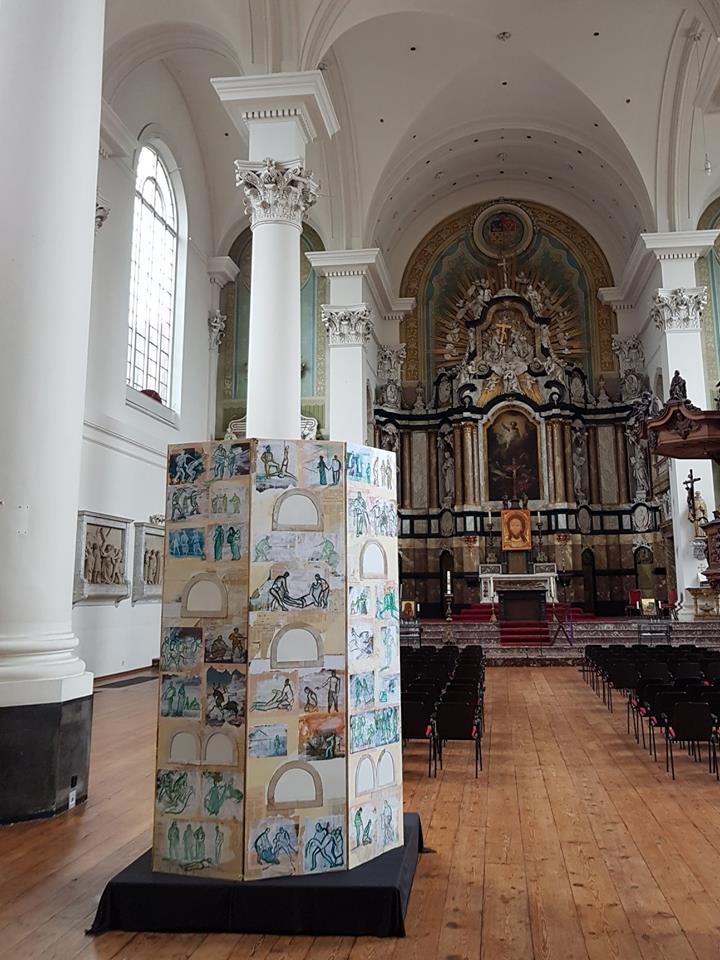
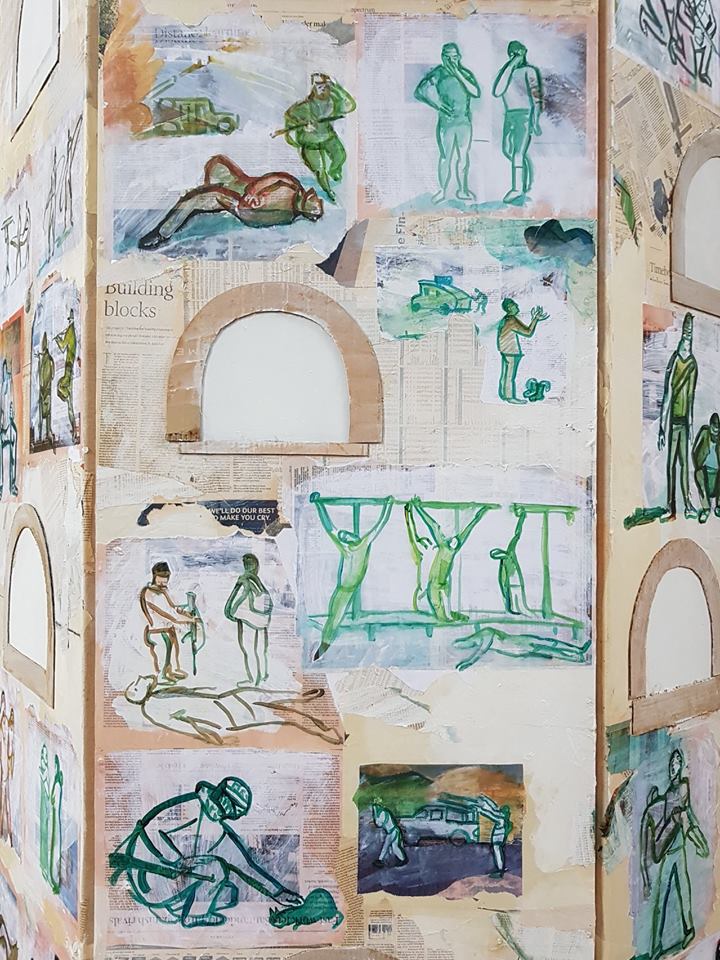
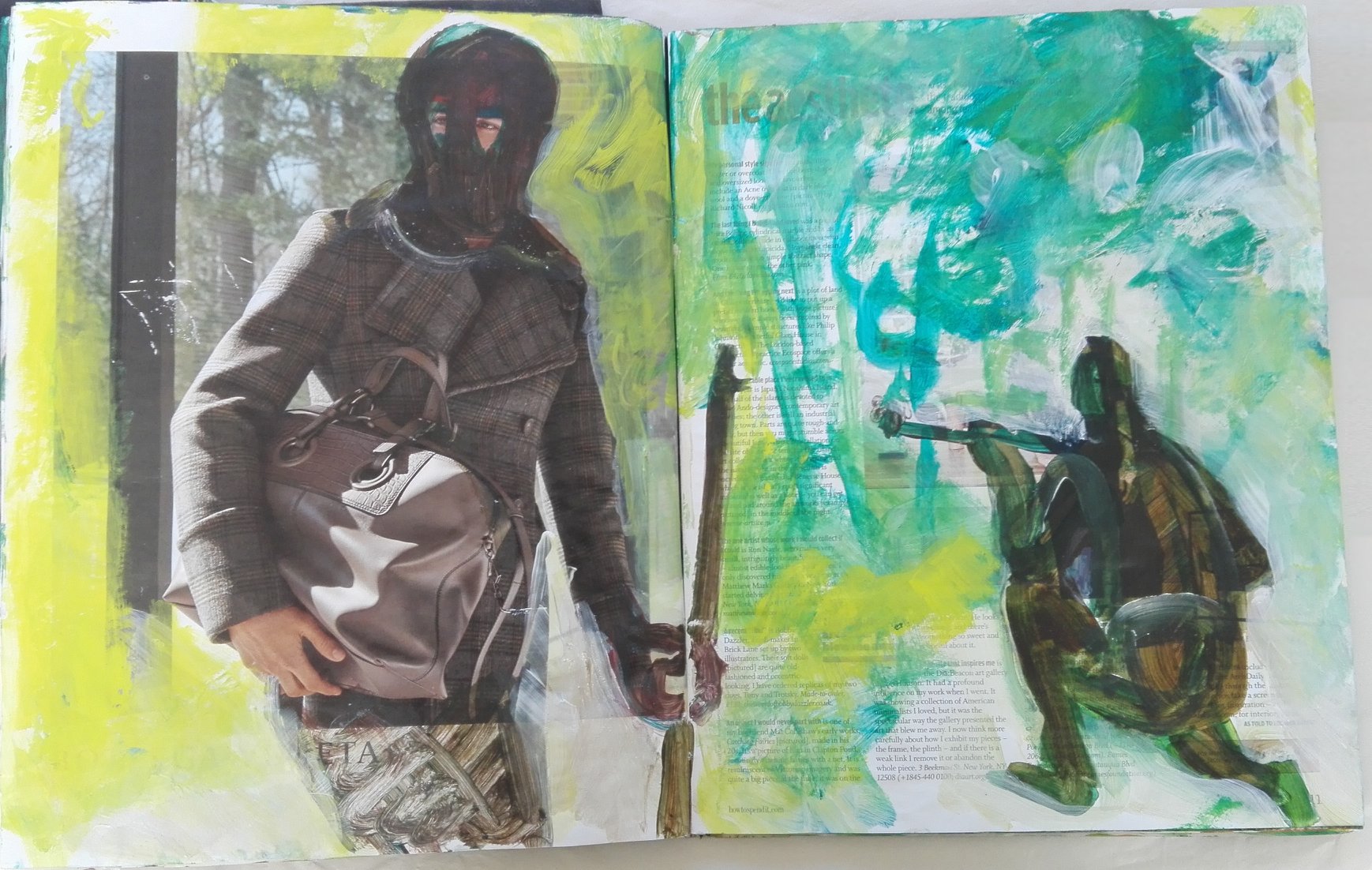
STATION 10. This is the one station I did not get a chance to see, due to its more limited opening hours. Anywhere, Anytime by Masha Trebukova is a temporary installation in the Mozes en Aäronkerk (Church of Moses and Aaron) in Amsterdam’s Waterlooplein neighborhood. It consists of a nine-foot-tall octagonal structure (a “columbarium”) covered with paintings on newspaper, as well as six large-format “books” of paintings on glossy magazine pages.

Columbarium by Masha Trebukova
Masha Trebukova (Russian, 1962–), Anywhere, Anytime, 2019. Temporary installation at the Moses and Aaron Church, Amsterdam, consisting of an eight-paneled “columbarium” with paintings on newsprint, each panel 60 × 290 cm, and “How to spend it,” six painted-over magazines. Photo courtesy of Sant’Egidio Nederland.

A columbarium is a room, building, or freestanding structure with niches for the public storage of funerary urns (which hold the ashes of the deceased). Ancient Romans decorated theirs with frescoes, often of peaceful scenes of the hereafter. Trebukova, on the other hand, has painted this columbarium with images of war and violence, exposing the savagery that causes death. This is not a celebration of paradise gained; it’s a lament for paradise lost.

Hear the artist briefly introduce the piece:

Columbarium (detail) by Masha Trebukova
Masha Trebukova, Anywhere, Anytime (detail). Photo courtesy of Sant’Egidio Nederland.

Trebukova used as her painting surface pages from newspapers and magazines, the headlines often creating consonance with the images while the ads create dissonance. The sleek photos selling vacations and luxury goods, enticing you to treat yourself, contrast starkly with Trebukova’s slashes and smears of color that depict masked gunmen terrorizing families, mass executions, refugees on the run, and individuals huddled over the corpses of loved ones. This contrast urges viewers to consider how our own self-absorption might be restricting our view of what’s going on in the larger world. What incinerations are being carried out as we casually engage in our leisure reading and other entertainments? The vaults in Anywhere, Anytime are fictive, but they prompt us to imagine the many bodies and places being turned to ash as armed conflict and acts of terrorism persist globally. [Images below sourced from the artist’s website]


The books are too fragile to be handled by visitors, so they are displayed open in glass cases, laid flat on a black-clothed table, and a video screen nearby loops through all the images in succession. Here is an excerpt from the video, a showcase of book five:

The book appears to have originally been a dance magazine, but Trebukova subverts the elegance associated with controlled bodily movement by recontextualizing these found images of dancers. A woman walking down a rustic road in pointe shoes is given a heavy burden on her back—a child—and a head scarf, recasting her as one of the many mothers fleeing violence in the Middle East. On the following page spread, another dancer’s graceful backbend is re-envisioned as an involuntary response to his having been shot; unlike on stage, this movement will end with a fall.

The Moses and Aaron Church is home to the Amsterdam chapter of the Community of Sant’Egidio, a Catholic lay association committed to prayer, the poor, and peace. Existing in over seventy countries, Sant’Egidio seeks especially to serve the sick, the homeless (including displaced persons), the elderly, and the imprisoned. “War is the mother of every poverty,” they say, and they have been key players in peace initiatives in Mozambique, Algeria, the Balkans, the Democratic Republic of Congo, and other areas.

Trebukova, Masha_Columbarium (detail3)
Masha Trebukova, page spread from “How to spend it.” Photo courtesy of Sant’Egidio Nederland.

+++

STATION 11. Erica Grimm’s Salt Water Skin Boats, a collaboration with artist and arborist Tracie Stewart and soundscape specialist Sheinagh Anderson, is an installation of five sculptural coracles made of interwoven willow, dogwood, fig, and cedar branches; animal skin and gut; cheesecloth; and bathymetric ocean maps imprinted with scientific measurements of things like glacial melt, sea-level rise, and ocean acidification. These are suspended from the ceiling along the nave of the Waalse Kerk and are lit from inside, and they are accompanied by an ambient soundscape that viewers activate by scanning a QR code.

Salt Water Skin Boats by Erica Grimm
Erica L. Grimm (Canadian, 1959–), Salt Water Skin Boats, 2018. Willow, dogwood, fig, and cedar branches; cheesecloth; animal skin and gut; bathymetric ocean maps; layers of wax; earbuds; LED lights. Installation view at Waalse Kerk, Amsterdam, in March 2019, part of Art Stations of the Cross.

Small lightweight boats without rudder, anchor, or keel, coracles are unstable watercraft, easily carried by currents and wind. Back in the day, Celtic Christian pilgrims would set sail in them, not having any destination in mind but rather trusting that God would steer their little boats to wherever he saw fit. In a sense, we are all “skin boats” afloat on a vast ocean, not knowing where we’ll end up. But Grimm’s incorporation of numerical data that highlight the dangerous warming, acidifying, and expanding of the world’s oceans pushes this metaphor in a new direction; the work “proposes an analogy,” writes curator Marleen Hengelaar-Rookmaaker, “between our bodies and the vast ecology of the global ocean: between the life-sustaining, precariously balanced ocean chemistry and the chemistry of our own salt-water-filled bodies.”  Continue reading “Walking the Via Dolorosa through Amsterdam (Part 3)”

Roundup: Sheku Kanneh-Mason, Hanukkah lamps, building walls, and more

NEW MUSICAL ARRANGEMENTS FOR ADVENT/CHRISTMAS

For cello and piano: “In the Bleak Midwinter,” arr. Sheku Kanneh-Mason: Sheku Kanneh-Mason is a multi-award-winning cellist from England who, since being named 2016 BBC Young Musician of the Year, has gone on to release, this January with Decca, his first full-length album (a chart topper), to perform as a soloist at the marriage ceremony of Prince Harry and Meghan Markle, and to serve, for the 2018–19 season, as a Young Artist in Residence at the Royal Liverpool Philharmonic. Time magazine recently listed him as one of 25 Most Influential Teens of 2018. He’s nineteen years old.

Stream on Spotify | Purchase on iTunes

In a recent recording session at Abbey Road Studios, Sheku performed one of his own arrangements with his sister Isata Kanneh-Mason, a pianist who, like him, is on scholarship at the Royal Academy of Music. Sheku is the third of seven siblings, and all of them are musical. They competed together in 2015 on Britain’s Got Talent and regularly perform together. See the CBS Sunday Morning featurette “The family that plays together.”

This piece is, in the truest sense of the word, awesome. Gustav Holst’s melody, which the duo plays straightforwardly for the first verse, is already beautiful; Sheku’s creative coloring of each subsequent verse, utilizing different playing techniques, elevates the song’s beauty even more. I could listen to this on repeat all day long. Oh wait. I have.

For jazz trio and voice: “Love Came Down” and “Comfort Ye,” arr. Deanna Witkowski: This fall, jazz pianist and composer Deanna Witkowski released recordings of two of her arrangements of Advent/Christmas classics: Christina Rosetti’s “Love Came Down at Christmas” and, just last month, “Comfort Ye,” whose seventeenth-century text (based on Isaiah 40:1–8) is by Johann Olearius, with a later English translation by Catherine Winkworth. Witkowski is on piano, Daniel Foose is on bass, and Scott Latzky is on drums, making up the Deanna Witkowski Trio. Sarah Kervin is the vocalist.

“Love Came Down” (gospel/funk) – Purchase track on Bandcamp | Purchase piano/vocal score

“Comfort Ye” (gospel/R&B) – Purchase track on Bandcamp | Purchase choral (SAT) / piano score

+++

ART EXHIBITION: “Accumulations: Hanukkah Lamps,” Jewish Museum, New York City, October 12, 2018–February 9, 2020: This year’s Hanukkah celebrations have just passed (December 2–10), but the Jewish Museum in New York is still running, for quite a while, its exhibition of eighty-one Hanukkah lamps from its collection of nearly 1,050—the largest collection of Hanukkah lamps in the world. The lamps in the current show represent four continents, six centuries, and a range of materials. I’m most drawn to the modern ones, which rethink traditional ideas about the ritual object.

Hanukkah lamp (Belarus)
Hanukkah lamp from Stolin (Belarus), ca. 1885. Cast lead and tin, each 2 7/8 × 1 × 15/16 in. (7.3 × 2.5 × 2.4 cm). Jewish Museum, New York.

Kagan, Larry_Menorah Memories
Larry Kagan (American, 1946–), Menorah Memories, 1981–82. Welded steel scraps, 21 1/4 × 19 × 4 1/2 in. (54 × 48.3 × 11.4 cm). Jewish Museum, New York.

Erte_Tree of Life (menorah)
Erté (Romain De Tirtoff) (French, 1892–1990), Tree of Life, 1987. Polished bronze, 15 1/2 × 12 1/2 × 7 9/16 in. (39.4 × 31.8 × 19.2 cm). Jewish Museum, New York.

+++

ART ACQUISITION: Christ as the Man of Sorrows by Quentin Metsys: On November 27 the J. Paul Getty Museum announced its acquisition of Christ as the Man of Sorrows by Quentin Metsys (alternatively spelled Massys), one of the leading painters in sixteenth-century Antwerp, known for his delicate modeling and crisp details. For centuries, the painting has been in a private collection, previously unknown to art historians; the Getty purchased it in a private sale. Its discovery and attribution expands Metsys’s oeuvre and is already attracting much attention from scholars. After a short period of conservation and technical study, it will go on view in spring 2019, exhibited to the public for the first time in modern history. It is the first work by Metsys in the Getty’s collection.

Christ as the Man of Sorrows by Quentin Metsys
Quentin Metsys (Netherlandish, 1466–1530), Christ as the Man of Sorrows, ca. 1520–30. Oil on panel, 19 1/2 × 14 1/2 in. J. Paul Getty Museum, Los Angeles. [pre-conservation]

+++

SONG: “Why We Build the Wall” by Anaïs Mitchell: Hadestown is a 2016 stage-musical adaptation of a 2010 folk-opera concept album of the same name, both by singer-songwriter Anaïs Mitchell. It invites audiences on an epic journey to the underworld and back, following two intertwining love stories—that of Orpheus and Eurydice and of Hades and Persephone. I was struck by the current US political resonances of the song “Why We Build the Wall,” which Mitchell says she wrote in 2006. In this A Prairie Home Companion broadcast, Mitchell sings as Hades, king of the underworld, leading her minions in an anthem that celebrates the importance of a nonporous border. She is joined by Chris Thile on mandolin and vocals and by the First-Call Radio Players. The song starts at 1:07.

+++

VISUAL MEDITATION: Mother and Child by Gilly Szego: In a recent contribution to ArtWay, Anglican vicar Jonathan Evens reflects on a work by UK artist Gilly Szego, the wife of a Hungarian refugee. Szego painted Mother and Child in response to the expulsion of South Asians from Uganda in 1972 following a wave of Indophobia. St.-Martin-in-the-Fields, one of London’s most prominent churches, displayed the painting that year, helping to raise awareness of these refugees’ plight and that of others around the world. The figures could easily be read as the Virgin Mary and Jesus, who were themselves displaced from their homeland.

Mother and Child by Gilly Szego
Gilly Szego (British, 1932–), Mother and Child, 1972. Oil on canvas with wood frame and barbed wire, 52 × 48 in.

Evens shares some words from Rev. Dr. Sam Wells, St. Martin’s current vicar:

Jesus is a displaced person in three senses. Fundamentally, he is the heavenly one who sojourned on earth. And it didn’t go well: as John’s Gospel puts it, ‘He came to what was his own, and his own people did not accept him’ (John 1:11). Then he finds himself a refugee in Egypt, his parents fleeing Herod’s persecution. Third, he spends his ministry as an itinerant preacher and healer, with nowhere to lay his head.

Meanwhile the story of Israel is one of migration from beginning to end. Adam and Eve leave the Garden; Noah and family sail away from destruction; Abraham follows God’s call; Joseph and family head down to Egypt; Moses leads the people back; Judah is taken into exile in Babylon; Ezra and Nehemiah tell of the return. None of these people were going on a package holiday: they were refugees, asylum seekers or trafficked persons. There is precisely one verse commanding the children of Israel, ‘You shall love your neighbour as yourself’; there are no less than 36 verses saying ‘love the stranger.’ Care of the alien is how Israel remembers its history with gratitude.

The Dead Christ Supported by Angels: A Thematic Survey

A type of “Man of Sorrows” image, the Dead Christ Supported by Angels is a devotional trope originating in the late Middle Ages. It typically shows a naked, half-length Christ standing up in a sarcophagus, his wounds prominently displayed so as to invite meditation on his suffering. One or more angels tend to him—they may embrace him, mourn his passing, unwrap his burial shroud (to give viewers a better look), display instruments of the passion, keep him propped up in the tomb, or, as we will see below, prepare to welcome him back to life.

(Related post: “Bill Viola’s Emergence as a Picture of the Resurrected Christ and the New Birth of Believers”)

One of the earliest examples of this imagery is the marble relief at the Gemäldegalerie in Berlin. Originally a lectern adornment for the pulpit in Pisa’s cathedral, it shows two angels unveiling Christ’s body, presenting it to us like a eucharistic host. Their raised arms and slanted legs form a mandorla-like frame around him.

Angel Pieta by Giovanni Pisano
Giovanni Pisano (Italian, 1245/48–1314), Angel Pietà, 1300. Marble relief, 44 × 45 × 36 cm. Gemäldegalerie, Staatlichen Museen, Berlin, Germany.

Dead Christ Supported by Angel (ivory)
Pendant: Imago pietatis. Elephant ivory. Musée du Louvre, Paris. Photo: Jean-Gilles Berizzi/RMN-Grand Palais.

The fifteenth-century alabaster sculpture shown below was formerly partially painted, and the angels formerly wore diadems on their foreheads (one survives). “This is an immensely virtuoso carving for such a small scale,” writes art historian Kim W. Woods—notice the texture of the angels’ wings and hair, the lining of Christ’s ecclesiastical robe, and the plants at Christ’s feet. Notice, too, the intricately carved emblem on Christ’s brooch: a pelican pecking at her breast. Reputed to have fed her young with own blood, the pelican was a common medieval symbol of Christ’s sacrificial love.

Christ as Man of Sorrows (alabaster)
Christ as a Man of Sorrows, mid-15th century. Alabaster, 40 cm high. Museum Mayer van den Bergh, Antwerp, Belgium. Photo: Jean-Luc Elias/KIK-IRPA, Brussels.

In the Leipzig Man of Sorrows by Master Francke, Christ and three angels stand in a shallow space in front of the cross. It’s unclear whether Christ is on the edge of death or has already crossed over. In his left hand he holds the scourge—or tries to (his hand is either weak and cramped with pain, if alive, or if dead, afflicted rigor mortis). His other hand gestures to his side wound, still wet with blood, as if, like Thomas, he’s about to probe it. Peeking up over Christ’s shoulder is a full-size angel, who tenderly drapes him with a diaphanous veil. At the bottom of the painting two smaller angels kneel on either side, the one holding the birch, the lance, and the sponge-topped reed, the other holding the pillar of flagellation; they both struggle to support the dead weight of Christ’s arms.

Man of Sorrows by Master Francke
Master Francke (German, 1380–1435), Man of Sorrows, ca. 1430. Tempera on oak, 42.5 × 31.3 cm. Museum der Bildenden Künste, Leipzig, Germany.

The angels at Christ’s waist in Master Francke’s Hamburg Man of Sorrows, instead of holding instruments of torture, hold a lily and a sword, symbols of the Last Judgment. (In visualizations of that event, Christ is often shown with a lily coming out of his right ear, signifying an “innocent” verdict for the faithful, and a sword coming out of his left ear, declaring guilty those who did not know him.) Three angels at the top remove the cheap, mock kingly garment the Romans had thrown on him to replace it with his due: a finely embroidered robe befitting a true king.

Man of Sorrows by Master Francke
Master Francke (German, ca. 1380–ca. 1435/40), Man of Sorrows, ca. 1435. Tempera on oakwood, 92 × 67 cm. Hamburger Kunsthalle, Hamburg, Germany.

Continue reading “The Dead Christ Supported by Angels: A Thematic Survey”