The Dead Christ Supported by Angels: A Thematic Survey

A type of “Man of Sorrows” image, the Dead Christ Supported by Angels is a devotional trope originating in the late Middle Ages. It typically shows a naked, half-length Christ standing up in a sarcophagus, his wounds prominently displayed so as to invite meditation on his suffering. One or more angels tend to him—they may embrace him, mourn his passing, unwrap his burial shroud (to give viewers a better look), display instruments of the passion, keep him propped up in the tomb, or, as we will see below, prepare to welcome him back to life.

(Related post: “Bill Viola’s Emergence as a Picture of the Resurrected Christ and the New Birth of Believers”)

One of the earliest examples of this imagery is the marble relief at the Gemäldegalerie in Berlin. Originally a lectern adornment for the pulpit in Pisa’s cathedral, it shows two angels unveiling Christ’s body, presenting it to us like a eucharistic host. Their raised arms and slanted legs form a mandorla-like frame around him.
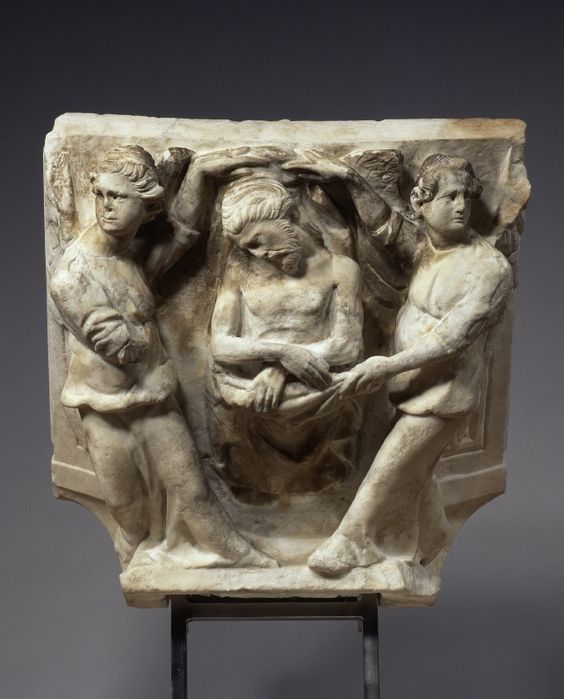
Angel Pieta by Giovanni Pisano
Giovanni Pisano (Italian, 1245/48–1314), Angel Pietà, 1300. Marble relief, 44 × 45 × 36 cm. Gemäldegalerie, Staatlichen Museen, Berlin, Germany.
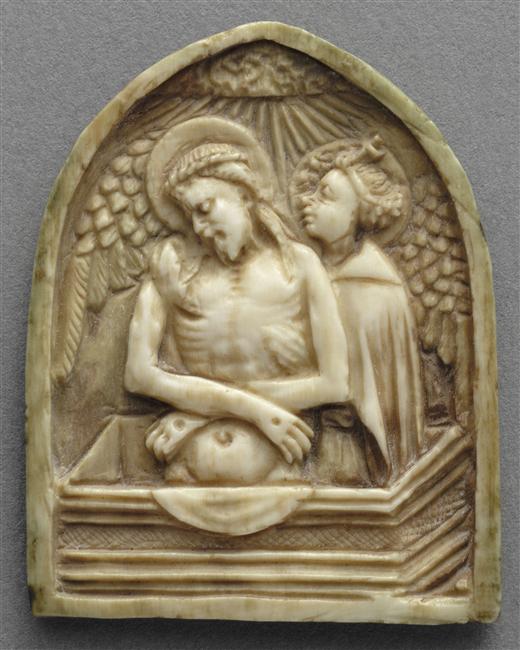
Dead Christ Supported by Angel (ivory)
Pendant: Imago pietatis. Elephant ivory. Musée du Louvre, Paris. Photo: Jean-Gilles Berizzi/RMN-Grand Palais.

The fifteenth-century alabaster sculpture shown below was formerly partially painted, and the angels formerly wore diadems on their foreheads (one survives). “This is an immensely virtuoso carving for such a small scale,” writes art historian Kim W. Woods—notice the texture of the angels’ wings and hair, the lining of Christ’s ecclesiastical robe, and the plants at Christ’s feet. Notice, too, the intricately carved emblem on Christ’s brooch: a pelican pecking at her breast. Reputed to have fed her young with own blood, the pelican was a common medieval symbol of Christ’s sacrificial love.
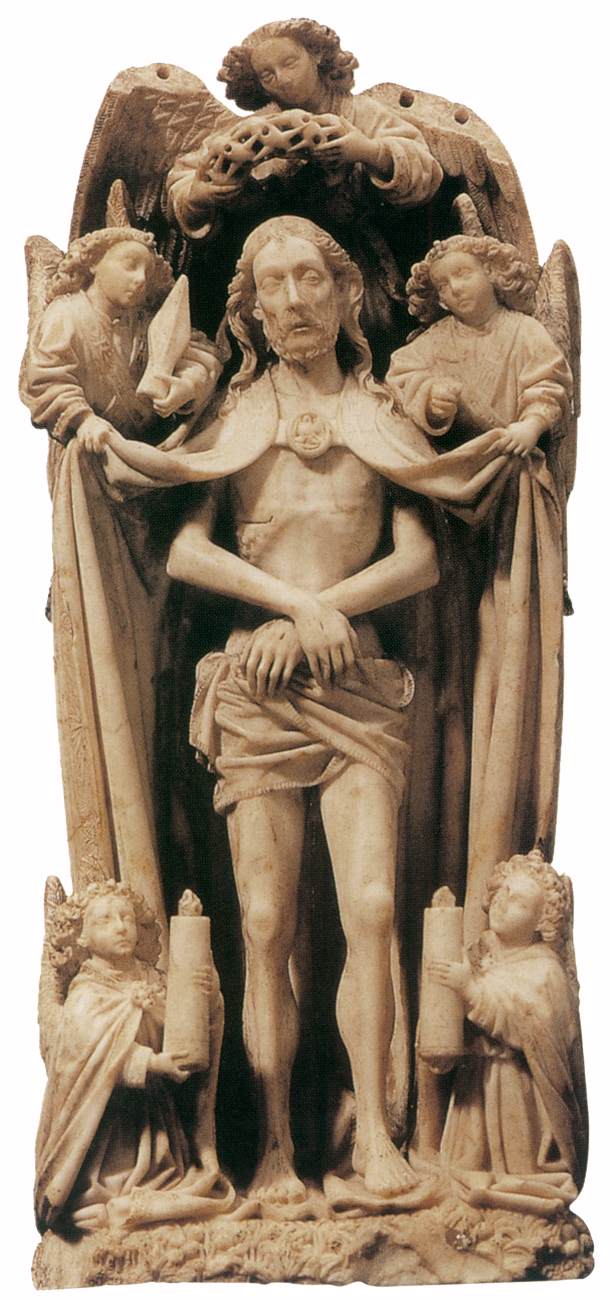
Christ as Man of Sorrows (alabaster)
Christ as a Man of Sorrows, mid-15th century. Alabaster, 40 cm high. Museum Mayer van den Bergh, Antwerp, Belgium. Photo: Jean-Luc Elias/KIK-IRPA, Brussels.

In the Leipzig Man of Sorrows by Master Francke, Christ and three angels stand in a shallow space in front of the cross. It’s unclear whether Christ is on the edge of death or has already crossed over. In his left hand he holds the scourge—or tries to (his hand is either weak and cramped with pain, if alive, or if dead, afflicted rigor mortis). His other hand gestures to his side wound, still wet with blood, as if, like Thomas, he’s about to probe it. Peeking up over Christ’s shoulder is a full-size angel, who tenderly drapes him with a diaphanous veil. At the bottom of the painting two smaller angels kneel on either side, the one holding the birch, the lance, and the sponge-topped reed, the other holding the pillar of flagellation; they both struggle to support the dead weight of Christ’s arms.
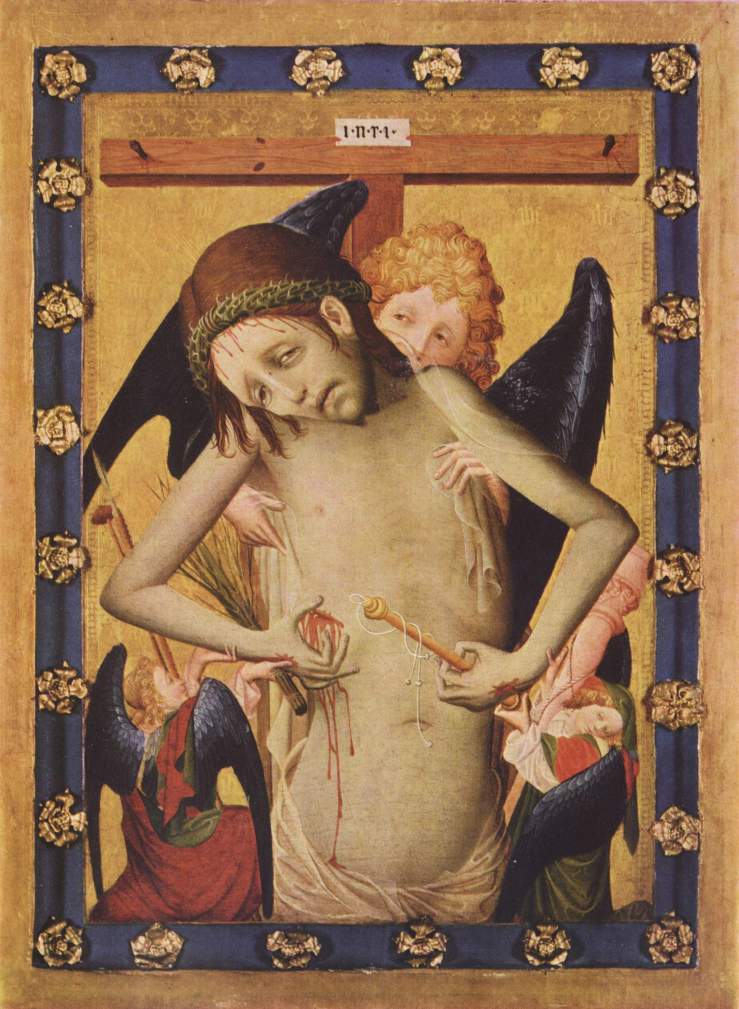
Man of Sorrows by Master Francke
Master Francke (German, 1380–1435), Man of Sorrows, ca. 1430. Tempera on oak, 42.5 × 31.3 cm. Museum der Bildenden Künste, Leipzig, Germany.

The angels at Christ’s waist in Master Francke’s Hamburg Man of Sorrows, instead of holding instruments of torture, hold a lily and a sword, symbols of the Last Judgment. (In visualizations of that event, Christ is often shown with a lily coming out of his right ear, signifying an “innocent” verdict for the faithful, and a sword coming out of his left ear, declaring guilty those who did not know him.) Three angels at the top remove the cheap, mock kingly garment the Romans had thrown on him to replace it with his due: a finely embroidered robe befitting a true king.

Man of Sorrows by Master Francke
Master Francke (German, ca. 1380–ca. 1435/40), Man of Sorrows, ca. 1435. Tempera on oakwood, 92 × 67 cm. Hamburger Kunsthalle, Hamburg, Germany.

Continue reading “The Dead Christ Supported by Angels: A Thematic Survey” →
Passion prints by Alena Antonova

Alena Antonova was born in Czechoslovakia in 1930. From 1949 to 1955 she studied graphic arts at the College of Applied Arts in Prague under the acclaimed Cubist painter Emil Filla. Since then she has specialized in printmaking. The primary technique she uses is drypoint, which involves incising a picture with a needle onto a metal plate, then inking it and pressing it onto paper, but she has also done etchings, woodcuts, and linocuts. The female figure is a common theme in her work.

In 1997 Antonova created a series of very small drypoints based on New Testament episodes. Here is a selection of Passion-themed ones from the Sacred Art Pilgrim Collection.

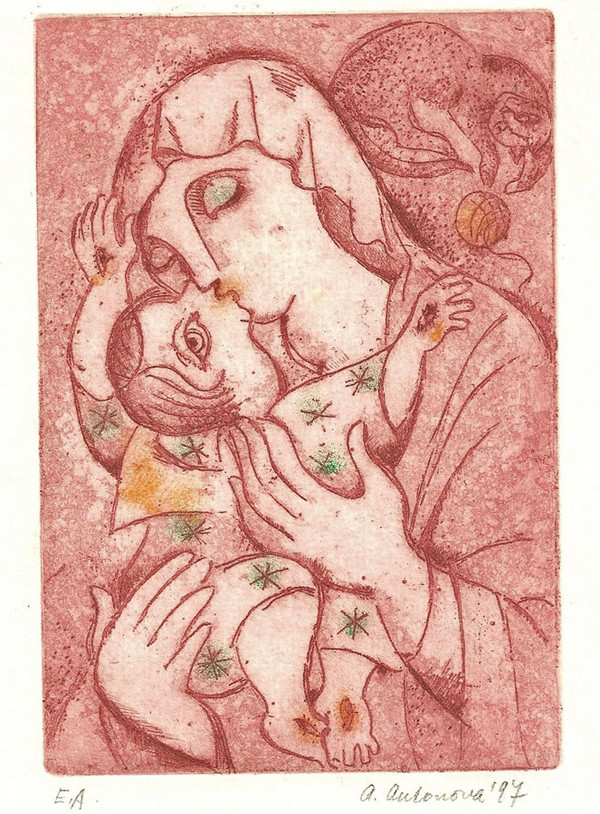
Madonna and Child by Alena Antonova
Alena Antonova (Czech, 1930–), Madonna and Child, 1997. Tinted drypoint, 14.5 × 10 cm.

First, a Madonna and Child. This subject—Mary holding the baby Jesus—is obviously not set during Holy Week, but in her interpretation Antonova alludes to the Crucifixion by giving the infant Christ nail prints in his hands and feet. While it’s not uncommon for artists to foreshadow Jesus’s early death in Madonna and Child images by making him appear corpse-like, the overt display of wounds is something I’ve never seen before. I’ve also never seen Mary kissing baby Jesus on the lips—such a tender expression of mother love; she closes her eyes, as if to shut out the formidable omen Simeon had spoken to her at the temple. I’m not sure whether the cat playing with a ball of yarn in the background has a symbolic significance or serves only to domesticate the scene. I guess you could see it as an allusion to Jesus’s future unraveling in Gethsemane, his coming undone.

Last Supper by Alena Antonova
Alena Antonova (Czech, 1930–), The Last Supper, 1997. Tinted drypoint, 14 × 10 cm.

Fast-forward to that day, and we’re at the Last Supper. In traditional fashion, Antonova’s print shows Jesus at the head of the table, with John leaning on his shoulder. Judas is on the other end with his head in hand, stressing out about whether to go through with the betrayal; a moneybag is tied to his waist. I’m not sure where the twelfth disciple is in the picture. Maybe he’s getting drink refills.   Continue reading “Passion prints by Alena Antonova” →