
Holy Week: The Mocking

They will mock him and spit upon him and flog him and kill him . . .

—Mark 10:34

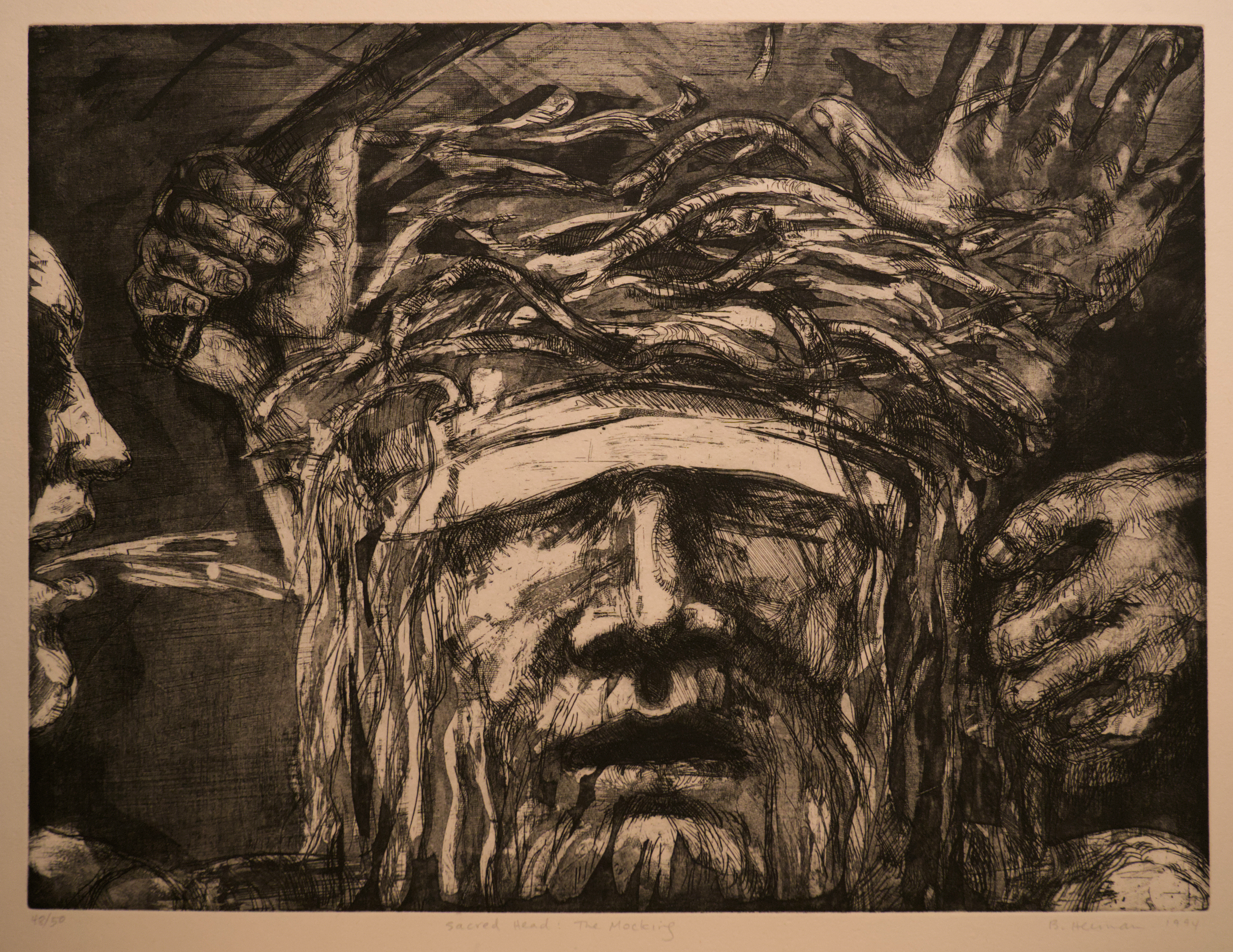
LOOK: Sacred Head II: The Mocking by Bruce Herman
Herman, Bruce_Sacred Head II
Bruce Herman (American, 1953–), Sacred Head II: The Mocking, from the Florence Portfolio, 1994. Intaglio, edition 48/50, sheet 21 1/2 × 30 1/8 in., image 17 3/4 × 23 5/8 in. Collection of Victoria Emily Jones.

The Florence Portfolio is a suite of twenty intaglio prints based on the biblical theme of sacrifice, made by six artists from Christians in the Visual Arts (CIVA) who lived and worked together for a month in Florence, Italy. I purchased two limited-edition portfolio prints—this one, and Wayne Forte’s Deposition—from the CIVA store shortly before the organization closed its operations in 2023.

A tightly cropped image of Christ’s blindfolded face, Bruce Herman’s Sacred Head II: The Mocking conveys disorientation. Hands slapping, shoving, pounding. Spittle on the cheek, in the ear. A nest of thorns piercing the scalp. Taunting epithets and derisive laughter. A cracking scourge. This is only a fraction of the violence and humiliation Christ suffered in the hours before his death.

LISTEN: “Crucify Him” by Sarah Wilcox, on Crucify Him (2023)

Pilate took Jesus and flogged him
Soldiers, they twisted a crown of thorns
And put it on his head
And arrayed him in a purple robe

Hail, King of the Jews!

And they struck him with their hands
And when they had mocked him
They stripped him of the purple robe
And put on his own clothes
And they led him away
To crucify him
Good Friday, Part 1: Stripped

Then the soldiers of the governor took Jesus into the governor’s headquarters, and they gathered the whole battalion before him. And they stripped him . . .

And when they had crucified him, they divided his garments among them by casting lots.

—Matthew 27:27–28, 35

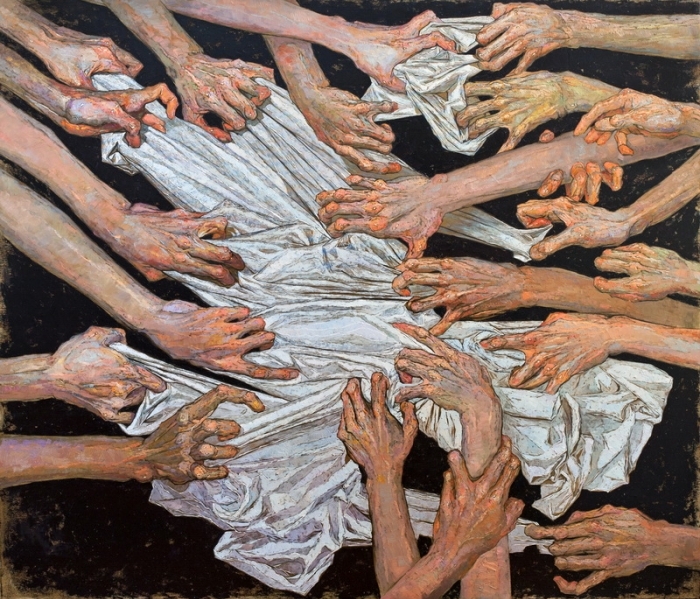
LOOK: Denis Sarazhin (Ukrainian, 1982–), Pantomime 6, 2015. Oil on canvas, 130 × 150 cm.

Sarazhin, Denis_Pantomime 6

LISTEN: “They have stripped me of my garments,” Byzantine hymn in plagal second tone, chanted by Vassilis Hadjinicolaou [HT: Global Christian Worship]

This doxastikon (a type of hymn) is sung during the Orthros (Matins) of Great and Holy Friday, which is prayed on the night of Holy Thursday. Note that because they follow the Julian calendar rather than the Gregorian, Orthodox Christians celebrate Good Friday on April 30 this year (and Easter on May 2).

If you’re wondering where the (for me, uncomfortably) violent image in the last line comes from, it’s from Psalm 2:9 (cf. Rev. 19:15). Its insertion into the episode of Christ’s being mocked seems to me an odd choice, seeing as the whole passion narrative is about God the Son absorbing violence rather than enacting it, and we know from his issuance of forgiveness from the cross that he did not have a vengeful attitude toward his tormenters. I speak from outside the Orthodox tradition, though.

Otherwise I find this hymn very moving. Its first line is what inspired the image I chose—of numerous hands clawing at cloth. Nakedness is one of the many indignities Jesus faced on Good Friday; he was stripped, dressed parodically in purple, reclothed with his personal garments, and then stripped again before being crucified. As he hung dying, exposed to the public, the Roman soldiers gambled for his clothing, souvenirs from the high-profile execution. Again, the soldiers’ bestiality is reflected in Sarazhin’s painting.

For more songs for Holy Week, see the Art & Theology Holy Week Playlist.