“Mused Mary in Old Age” by George M. P. Baird (poem)

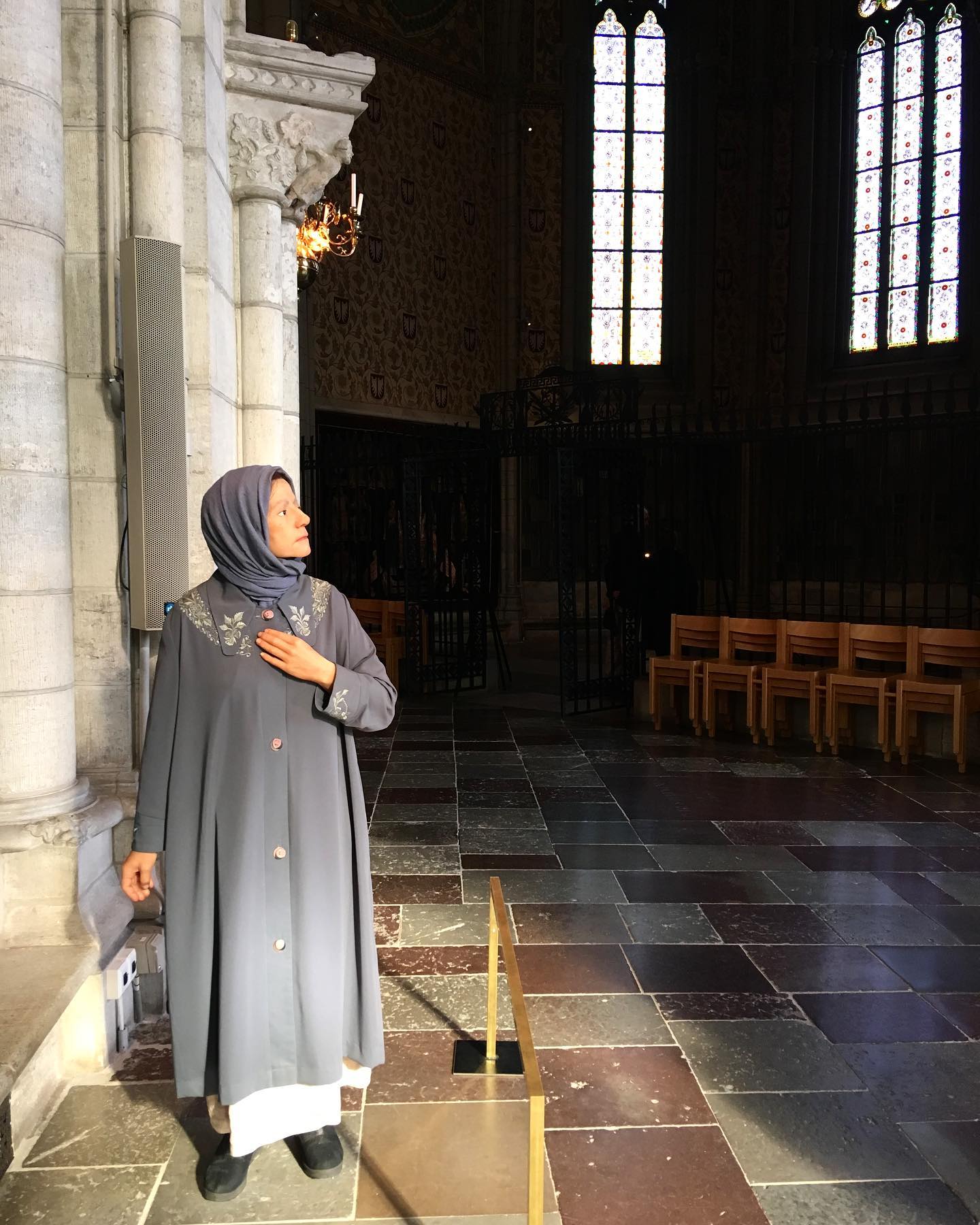
Widoff, Anders_Maria (The Return)
Anders Widoff (Swedish, 1953–), Maria (The Return), 2005. Polyester, silicone, fabric, glass, hair, and oils. Uppsala Cathedral, Sweden. Photo: Lieke Wijnia.

The lengthening shadows of the cedar trees
Have blended into twilight, and the sun
Has plunged in glorious gold precipitance
Beyond the dim crest of the western hills,
Bearing with it the day’s disquietudes;
And now the stars, that lamp the feet of God,
Are lighted, and night’s purple silences
Steal gently round me fraught with memories.

’Twas such an hour as this—long, long ago
Yet seeming yesterday—he came to me,
My little son, in joyous travail born
Out there across the hills in Bethlehem,
Where we who journeyed southward to be taxed—
Strangers in our own father’s land—had found
No shelter in the crowded khan, and shared,
Perforce, a grotto with the stabled kine.

Ah, how it all comes back again to me!
The courtyard, in the flickering torchlight, filled
With huddled trav’lers sleeping ’neath the sky,
The kneeling camels of a caravan,
The patient asses dozing by the wall,
A smell of roasting meat at little fires,
The shouts of melon-sellers, the low drone
Of reverend elders bending at their prayers,
Barking of street-dogs, porters’ blasphemies,
The laughter of a girl, the mellow flute
Of some rapt lover, and the tinkling tune
Of sheep-bells forward moving through the dark.
And then the hour supreme, wherein my soul
Clomb the dark pinnacles of pain, and death
Grappled with life through whirling aeoned years,
But fled at length and left the Miracle.

They laid him there beside me on the hay,
A wee pink being in his world’s first sleep;
My arm was round about him and his breath
Was warm with life on my exultant breast,
And they whose winged watch is set to keep
Ward in the valley lands of heaven looked down,
Not up, that night to find their paradise.
All weak with labor and soul’s happiness,
I lay beneath the sapphire tent of skies,
And in my heart I made a little prayer
Of thanks that flew up to the throne of God
On swift dove pinions of unuttered song;
And as I prayed, lo, upon loops of stars
Night’s velvet curtainings were lifted up,
A wondrous light turned all the world to rose,
And down the skies swept singing seraphim
In mighty echoes of my little prayer.

Oh, can it be that threescore years have marched
In troubled caravan across the waste
Of desert life since then, and can it be
That I, who sit here in mine eventide,
White with the snows of sorrow and of time,
Was once a bright tressed girl who heard the choirs
Of heaven rejoice that she had borne a son?
Why, I can feel that little heart beat still
Close to my own, the touch of little hands
Warm and caressing on this withered breast;
Still I can hear the first low wail that marked
His woe’s beginning and the tortured path
That he should tread in mighty gentleness,
With pain and anguish, ’til his love supreme
And terrible meekness, overcoming death,
Should lead him conqueror to sit with God,
Pleading for sinful men in paradise.

Today I stole into the synagogue
And heard a rabbi read the sacred scroll:
How that my lord, Isaiah, said of old,
Thy Maker is thy husband, he hath called thee
As a forsaken woman, spirit grieved;
God, for a little moment, hides his face
From thee, but with his loving kindness soon
And tender mercies shall he gather thee.
Then was I comforted, and peace displaced
The turmoil in my heart, and minded me
Of that great promise Gabriel bore from God
And the immeasurable fruitage of his word,
The life and death and glory of my son.

So in the shades of life and night I sit,
Under the sheltering arbor of the dark
That curves above, vined o’er with trellised stars,
Waiting my spirit bridegroom, and the sound
Of that loved voice—long silent save in dreams—
Calling across the vibrant firmament,
O Mary, Mother Mary, come to Me.

This poem is from ’Prentice Songs (Pittsburgh: Aldine Press, 1913) and is in the public domain.
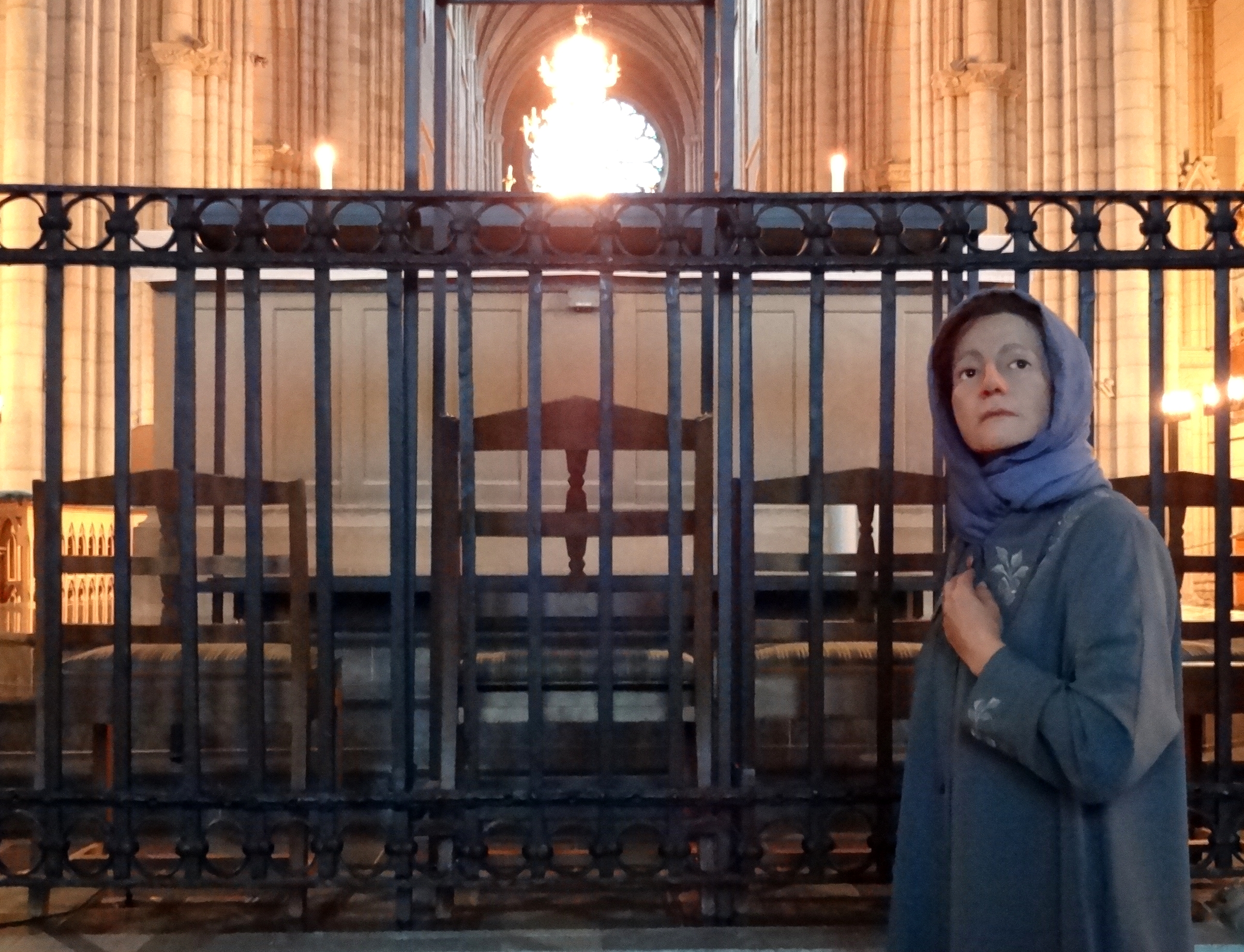
Widoff, Anders_Maria (The Return)

George Mahaffey Patterson (M. P.) Baird (1887–1970) was a lifelong resident of Pittsburgh, Pennsylvania, who worked in theater and city government. He graduated from the University of Pittsburgh in 1909 and then taught in the Department of English as a professor of theater history and production. He formed the student group the Pitt Players, financing, writing, and directing several of their early plays. While on the faculty, he also locally published three collections of poetry: ’Prentice Songs (1913), Loaves for Hyacinths (1914), and Rune and Rann (1916). In 1917 Baird joined the US Army, serving as a lieutenant in the Sanitary Corps during World War I. Upon his return to civilian life he began a career in government service for the city of Pittsburgh, serving as executive secretary of the Art Commission and chief examiner and later president of the Civil Service Commission. He was senior research analyst for the Department of City Planning when he retired in 1961.
Epiphany: Glory

And when Christ, who is your life, is revealed to the whole world, you will share in all his glory.

—Colossians 3:4

Epiphany, meaning “revelation,” is the capstone of the Christmas season. In this final post of this year’s Christmas series, I leave you with a striking, light-flecked painting from Japan and a slow-tempo Black gospel song from the US. What marvel, that God’s glory fills such places as ours, and that he invites us not only to behold his glory but also to participate in it.

May God’s light continue to guide and enfold you throughout the year, and may you never stop seeking his face.

To view a compilation of this season’s numbered Christmas posts, click here; for Advent, here.

LOOK: Morning Star by Hiroshi Tabata

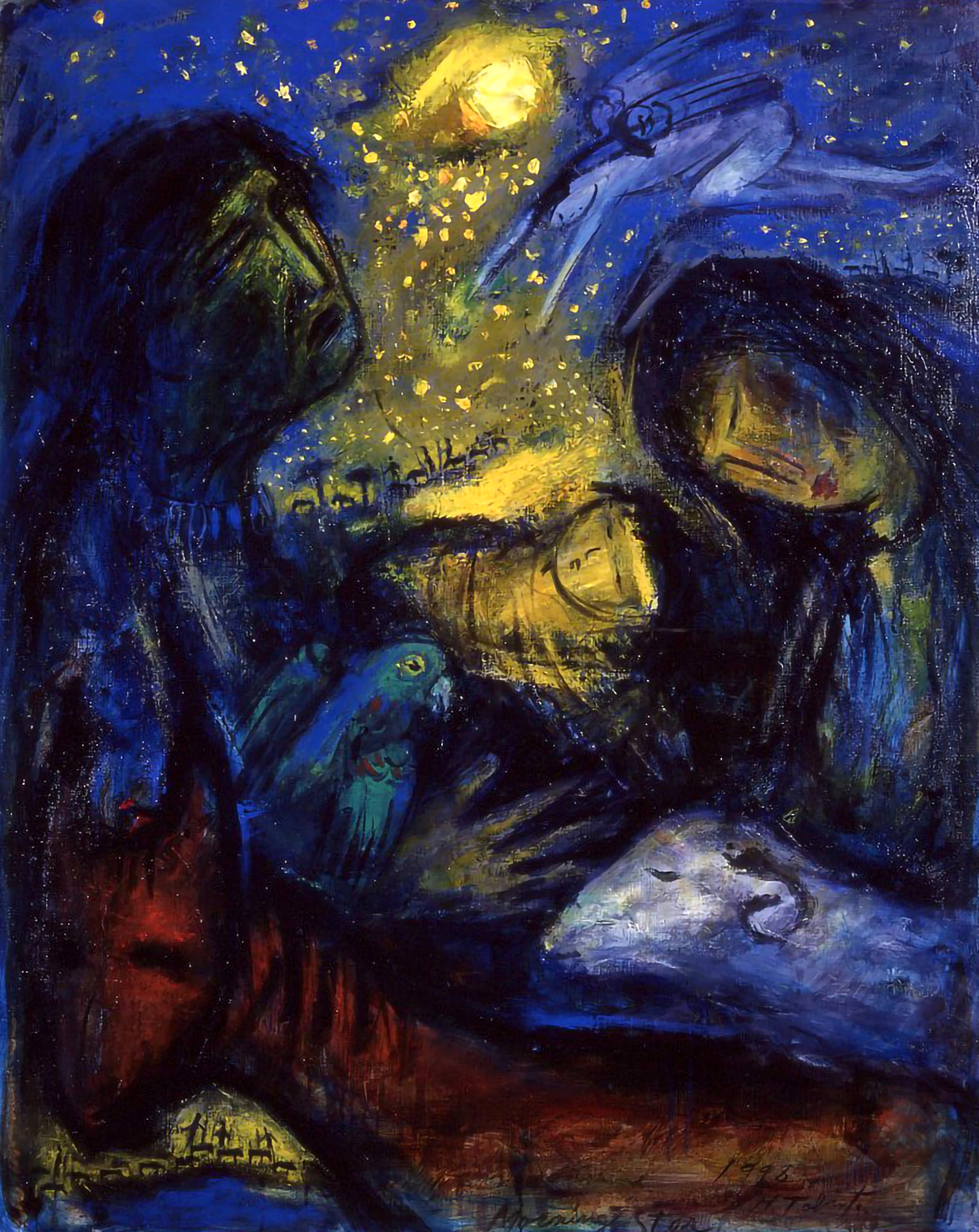
Tabata, Hiroshi_Morning Star
Hiroshi Tabata (田畑弘) (Japanese, 1929–2014), Morning Star, 1998. Oil on canvas, 90.9 × 72.7 cm. Private collection. Photo courtesy of the Estate of Hiroshi Tabata.

Born in Takaoka City, Hiroshi Tabata (1929–2014) studied art at the University of Toyama, later moving to France for two years for further art education. He exhibited his work throughout Japan and at Parisian salons. From 1966 to 1972 he lived intermittently in Brazil among the Xingu people, which led to his conversion to Christianity. From then on until his death, he painted biblical subjects. “The Bible is the ultimate theme for me,” he said; its world is “infinitely deeper” than we can comprehend.

In Tabata’s expressionistic Morning Star, starlight falls in a luminescent sheen over the face of the Christ child, whom Mary looks upon in tender adoration as Joseph wonders at the angelic activity above. The tight cropping around the Holy Family heightens the sense of intimacy. A sheep, donkey, and Amazon parrot (the latter a callback to his time in Brazil) crowd into the foreground, while on distant hills shepherds behold the glorious light display, hear the announcement that will propel them to their newborn Messiah. The wise men, too, are on their way. Epiphany is at hand. Heaven’s raining down (Isa. 45:8).

This visual reflection (by me) originally appeared in the Christmas/Epiphany 2022–23 edition of the Daily Prayer Project. Tabata’s art appears on the cover, by kind permission of his son-in-law. To view more biblical art by Tabata, see the beautifully produced, full-color book 田畑弘作品集 一つの星 (Hiroshi Tabata Works: Morning Star); the text is all Japanese.

LISTEN: “A Star Stood Still (Song of the Nativity)” | Words and music by Barbara Ruth Broderick and Johnny Broderick, 1956 | Performed by Mahalia Jackson with the Falls-Jones Ensemble, conducted by Johnny Williams, on Silent Night: Songs for Christmas, 1962

And we shall share
In the glorious light

In Bethlehem
The wind had ceased
The Lamb lay sleeping
On the hill

When all the earth
Was stilled with peace
Then lo, a star stood still

A star stood still
On yonder hill
Praise God that star still
Shining still

And we shall share
In the glory of love
Because a star stood still
That night a star stood still

A star stood still
On yonder hill
Praise God that star still
Shining still

And we shall share
In the glory of love
Because a star stood still
That night a star stood still

Note to readers: Art & Theology is noncommercial, but I do accept donations (monetary, or in-kind books!) to help keep it running. Learn more here.

Hymn 4 on the Nativity of Christ (excerpt) by Ephrem the Syrian

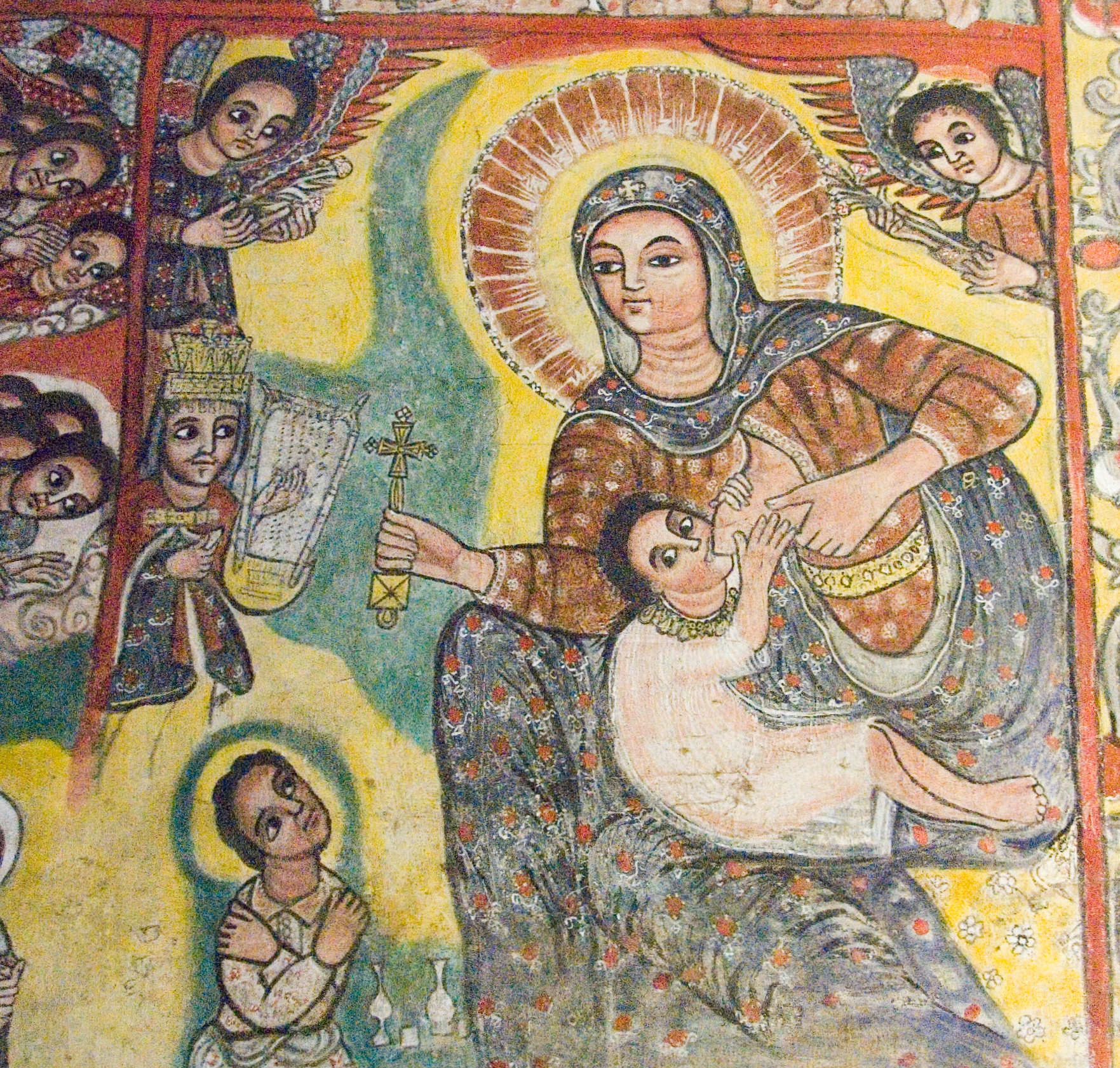
Maria lactans (Ethiopian)
Maria lactans, late 18th century. Fresco, Church of Narga Selassie, Dek Island, Lake Tana, Ethiopia. Photo: Alan Davey.

Glory to that Voice that became a body,
and to the lofty Word that became flesh.
Ears even heard Him, eyes saw Him,
hands even touched Him, the mouth ate Him.
Limbs and senses gave thanks to
the One Who came and revived all that is corporeal.
Mary bore a mute Babe
though in Him were hidden all our tongues.
Joseph carried Him, yet hidden in Him was
a silent nature older than everything.
The Lofty One became like a little child,
yet hidden in Him was a treasure of Wisdom that suffices for all.
He was lofty but he sucked Mary’s milk,
and from His blessings all creation drinks.
He is the Living Breast of living breath;
by His life the dead were suckled, and they revived.
Without the breath of air no one can live;
without the power of the Son no one can rise.
Upon the living breath of the One Who vivifies all
depend the living beings above and below.
As indeed He sucked Mary’s milk,
He has given suck—life to the universe.
As again He dwelt in His mother’s womb,
in His womb dwells all creation.
Mute He was as a babe, yet He gave
to all creation all His commands.
For without the First-born no one is able
to approach Being, for He alone is capable of it.

Translated from the Syriac by Kathleen E. McVey in Ephrem the Syrian: Hymns (Classics of Western Spirituality) (Mahwah, NJ: Paulist Press, 1989), 100–101

Roundup: News photos with Advent promises, “Tent City Nativity,” and more

PHOTO COMPILATION: “Alternative Advent 2022” by Kezia M’Clelland: Kezia M’Clelland [previously] is the children in emergencies specialist and people care director for Viva and a child protection consultant for MERATH, the Lebanese Society for Educational and Social Development’s community development and relief arm. She is a British citizen, but her work brings her around the world, seeking to safeguard the rights and well-being of children globally.

Every December M’Clelland compiles photos from that year’s news, showing people affected by natural disasters, violence, and injustice, and overlays them with Advent promises. There’s sometimes a disjunction between image and text that’s grievous and challenging, a reminder that our long-looked-for deliverance is not yet fully here, even though we receive foretastes. The twenty-eight photos M’Clelland gathered from 2022 include throngs of people making their way to Aichi cemetery in Saqqez, Iran, to attend a memorial for twenty-two-year-old Mahsa Amini, allegedly beaten to death by the country’s religious morality police for not wearing her hijab properly; a police officer helping a child flee artillery on the outskirts of Kyiv, and a baby being born in a bomb shelter; women carrying pans of granite up the side of a mine in Ouagadougou, Burkina Faso, for meager wages; a woman comforting a neighbor who lost her home to flooding in Tejerias, Venezuela; children playing in a sandstorm at the Sahlah al-Banat camp for displaced people in the countryside of Raqa in northern Syria; children clearing trash from a river in Tonlé Sap, Cambodia; and more.

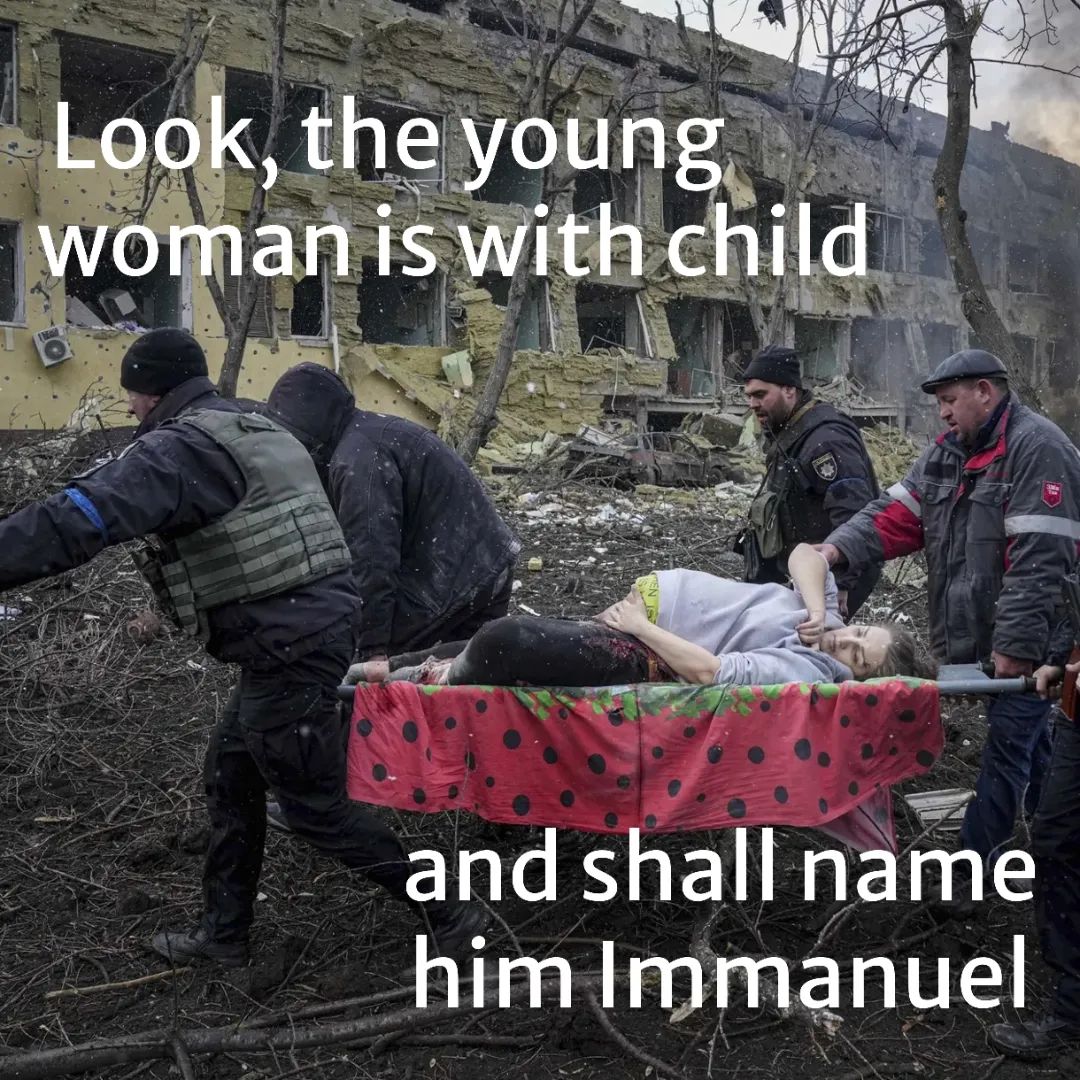
Alternative Advent 2022 (Immanuel)
March 9, 2022: An injured pregnant woman is rescued from a maternity hospital in Mariupol, Ukraine, that was bombed by Russian forces. The following week it was reported that she and her child, delivered in an emergency C-section, did not survive. Photo: Evgeniy Maloletka/AP. Scripture: Isaiah 7:14.

Alternative Advent 2022 (Repairer)
January 26, 2022: A young woman looks on from her house destroyed by tropical storm Ana in the village of Kanjedza in Malawi. Photo: Eldson Chagara/Reuters. Scripture: Isaiah 58:12.

Alternative Advent 2022 (no lions)
June 7, 2022: A man and child, part of a migrant caravan consisting mostly of Central Americans, are blocked by members of the Mexican National Guard on a Huixtla road in Chiapas state, Mexico. They seek transit visas from the National Migration Institute so that they can continue their thousand-plus-mile journey north to the US. Photo: Marco Ugarte/AP. Scripture: Isaiah 35:9 MSG.

The sequence of images is a visual prayer of lament and intercession. I appreciate how M’Clelland—via the work of photojournalists, and her sensitive curation—raises awareness about these places of suffering, putting faces to the headlines, but also spotlights moments of empowerment and joy amid that suffering. We are encouraged to seek God’s coming into these situations of distress and to see the subtle ways he does come—for example, through the consoling embrace of a friend, the nurturance of an elder sibling, the protective aid of an officer, a jug of clean water, a child’s glee, or acts of protest.  

For photo credits and descriptions, see the Instagram page @alternative_advent. (Start here and scroll left if you’re on your computer, or up if you’re on your phone.) Follow the page to receive new posts in your feed starting next Advent.

+++

SONGS by Rev Simpkins, an Anglican priest and singer-songwriter from Essex previously featured here:

>> “Hallelu! (Love the Outcast)”: This song was originally released on The Antigen Christmas Album (2014) with the byline “Ordinand Simpkins & Brother De’Ath”; it was reissued in 2016 on Rev Simpkins’s album Love Unknown, “a cornucopia of non-LP tracks, studio experiments, ingenious live re-workings, radio sessions, off-the-wall demos, obscure b-sides, & pissings about.” The music video was recorded on an iPhone 4 in the Edward King Chapel at Ripon College Cuddesdon in Oxford. [Listen on Bandcamp]

>> “Poor Jesus” (Traditional): Here the Rev. Matt Simpkins performs the African American spiritual “Oh, Po’ Little Jesus” with a soft banjo accompaniment. Harmonizing vocals are supplied by his daughter, Martha Simpkins. It’s the opening track of his EP Poor Child for Thee: 4 Songs for Christmastide (all four songs are wonderful!), released December 11, 2020, to support St Leonard’s Church, Lexden, where he serves as priest-in-charge. [Listen on Bandcamp]

+++

NEW PAINTING: Tent City Nativity by Kelly Latimore: Kelly Latimore is an Episcopalian artist from St. Louis, Missouri, who “rewonders” traditional iconography, especially with an eye to social justice. This Christmas he painted an icon called Tent City Nativity, which shows the Christ child being born in a homeless encampment. A streetlight shines directly over the Holy Family’s tent, like the star of Bethlehem, and neighbors bring gifts for warmth and sustenance: coffees, a blanket, a cup of chili. View close-ups on Instagram, and read the artist’s statement on his website. Proceeds from print and digital sales of the icon will support organizations serving the unhoused in St. Louis.

Latimore, Kelly_Tent City Nativity
Kelly Latimore (American, 1986–), Tent City Nativity, 2022. Acrylic, Flashe, and golf leaf on birch board, 27 × 32 in.

[Purchase signed print] [Purchase digital download]

+++

SONG MEDLEY: YouTube user African Beats spliced together excerpts from three songs performed at a church in Germany at Christmastime by South African singer Siyabonga Cele and an unnamed woman, including “Akekho ofana no Jesu” (There’s No One like Jesus) and “He’s Got the Whole World in His Hands.” I couldn’t find the name of the last song, and attempts to contact the singer for information were unsuccessful, but it’s in Zulu, as is the first one. Lyrics to the first song, sourced from here, are below.

Akekho ofana no Jesu (There’s no one like Jesus)
Akekho ofana naye (There’s no one like him)
Akekho ofana no Jesu (There’s no one like Jesus)
Akekho ofana naye (There’s no one like him)

Sahamba, hamba, lutho, lutho (I’m walking, walking, nothing, nothing)
Safuna, funa, lutho, lutho (I’m searching, searching, nothing, nothing)
Sajika, jika, lutho, lutho (I’m turning, turning, nothing, nothing)
Akekho afana naye (There is no one like him)

Christmas, Day 5: Unto Us

LOOK: Nativity by Azaria Mbatha

Mbatha, Azaria_Nativity
Azaria Mbatha (South African, 1941–2018), Nativity, 1964. Linocut, 33.5 × 57.5 cm. Edition of 10.

One of South Africa’s most important printmakers, Azaria Mbatha was a student and later teacher at the Evangelical Lutheran Art and Craft Centre at Rorke’s Drift. In his Nativity linocut he shows a Nguni bull, two bushpigs, an elephant, and an antelope calf paying homage to the Christ child, whom a bald, long-bearded Joseph gestures toward. Three wise men approach on elephant-back from the left, and further to the left, King Herod lurks with lion and spear, waiting to pounce on this perceived threat to his power. The top two registers fast-forward to the beginnings of Jesus’s public ministry, with John the Baptist preaching repentance and baptizing Jesus.

I’m not sure who the figure at the bottom right is supposed to be. Any guesses? It’s possible he’s just a generic worshipper, or someone of local or national significance.

LISTEN: “Sizalelwe Indodana” (Unto Us a Child Is Born) | Traditional South African Christmas song in Zulu | Arranged and performed by Concord Nkabinde, 2019 [HT: Global Christian Worship]

Sizalelwe indodana
Igama layo nguJesu
Iyo yodwa Umsindisi

English translation:

Unto us a child is born
His name is Jesus
Only he is the Savior

Musical artist Concord Nkabinde writes,

This time of the year always reminds me of my childhood & my years of growing up in Dube, Soweto. The one song that became a soundtrack for the Christmas season at that time was this simple Traditional song that really takes me back there. This is my interpretation of it.

He has overdubbed six vocal parts and multiple percussion parts.

Christmas, Day 1: Burst of Light

LOOK: STAR/KL by Jun Ong

Jun Ong_STAR/KL installation
Jun Ong (Malaysian, 1988–), STAR/KL, 2021. Installation of 111 LED beams, Air Building, Kuala Lumpur, Malaysia. Photo: David Yeow.

Installed in a former warehouse in Malaysia’s capital city, this site-specific work by Jun Ong consists of 111 LED beams fashioned into a starburst that radiates out from the center of the building. The explosive light coming from an abandoned cave-like structure is evocative of Christ’s Nativity.

LISTEN: “Joining in the Joy” by Coram Deo Music, on Swallowed Up Death (2015) | Words by Megan Pettipoole | Music by Luke and Megan Pettipoole

Founded in 2005, Coram Deo Music is a consortium of worship musicians and songwriters based out of Coram Deo Church in Omaha, Nebraska.

Darkness settled over our weary heads
Then pierced by a great and heavy light
A child, a Son, has made glorious the way

Rejoice
A child is born

Our forests felled by your hand against us
But a shoot sprouts from the stump foretold
Peace and truth and justice are its fruit

Rejoice
A child is born

A day is coming when the earth, it will be full
We’ll join together, God with man
Peace and truth we’ll pursue

Joining in the joy
Joining in the joy of redemption

“Deliverance” by Evelyn Bence (poem)

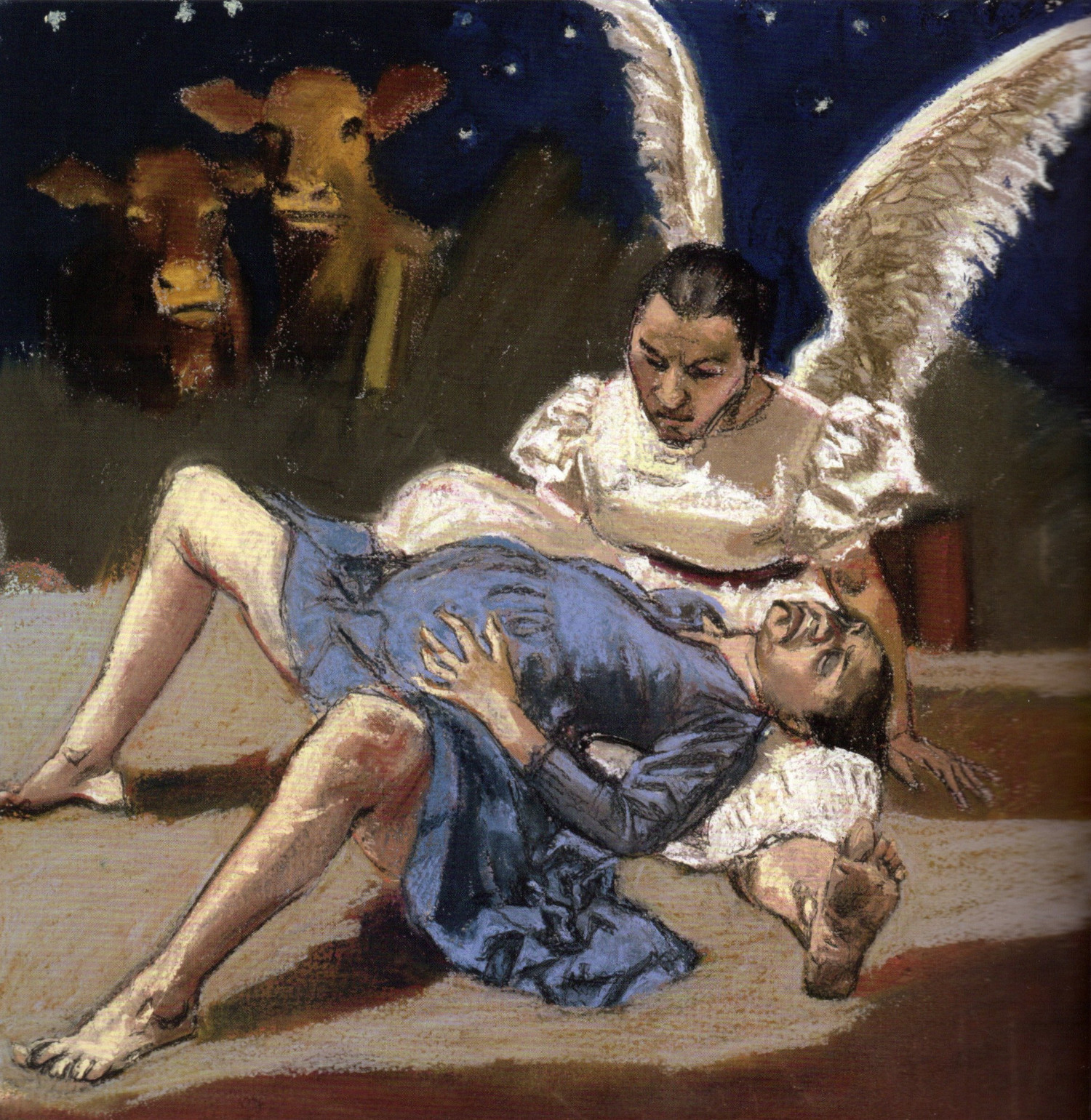
Rego, Paula_The Nativity
Paula Rego (Portuguese British, 1935–2022), The Nativity, 2002. Pastel on paper mounted on aluminum, 21 3/8 × 20 1/2 in. (54 × 52 cm). Palácio de Belém, Lisbon, Portugal. Source: Paula Rego: The Art of Story, p. 226.

It is time.
My body’s clock gongs
your salvation’s hour.
The water has left the pasture
and flowed toward the river’s mouth.
Follow or you will wither
in the desert that remains.
I will bleed for you
on this your first dark journey,
but in time, when life pushes you
headlong through black canyons,
the wounds will be your own.
May you learn early:
at the end light always shines.
It is here, child.
The time is come.
Breathe.

This poem was originally published in the Winter 1982/83 issue of Today’s Christian Woman and appears in the book Mary’s Journal: A Mother’s Story by Evelyn Bence (Grand Rapids, MI: Zondervan, 1992). Used by permission of the author. (Thanks to Maureen E. Doallas, curator of the exhibition Mary, Mary, for introducing me to it!)

Evelyn Bence (born 1952) is a writer and editor living in Arlington, Virginia. She is the author of Room at My Table; Prayers for Girlfriends and Sisters and Me; Spiritual Moments with the Great Hymns; and the award-winning Mary’s Journal, a novel written in the voice of Jesus’s mother. She has served as religion editor at Doubleday, managing editor for Today’s Christian Woman, and senior editor at Prison Fellowship Ministries. Her personal essays, poems, and devotional reflections have appeared in various publications.

Advent, Day 23: Holy One, Jesus Come

LOOK: Nativity, Netherlands, 16th century

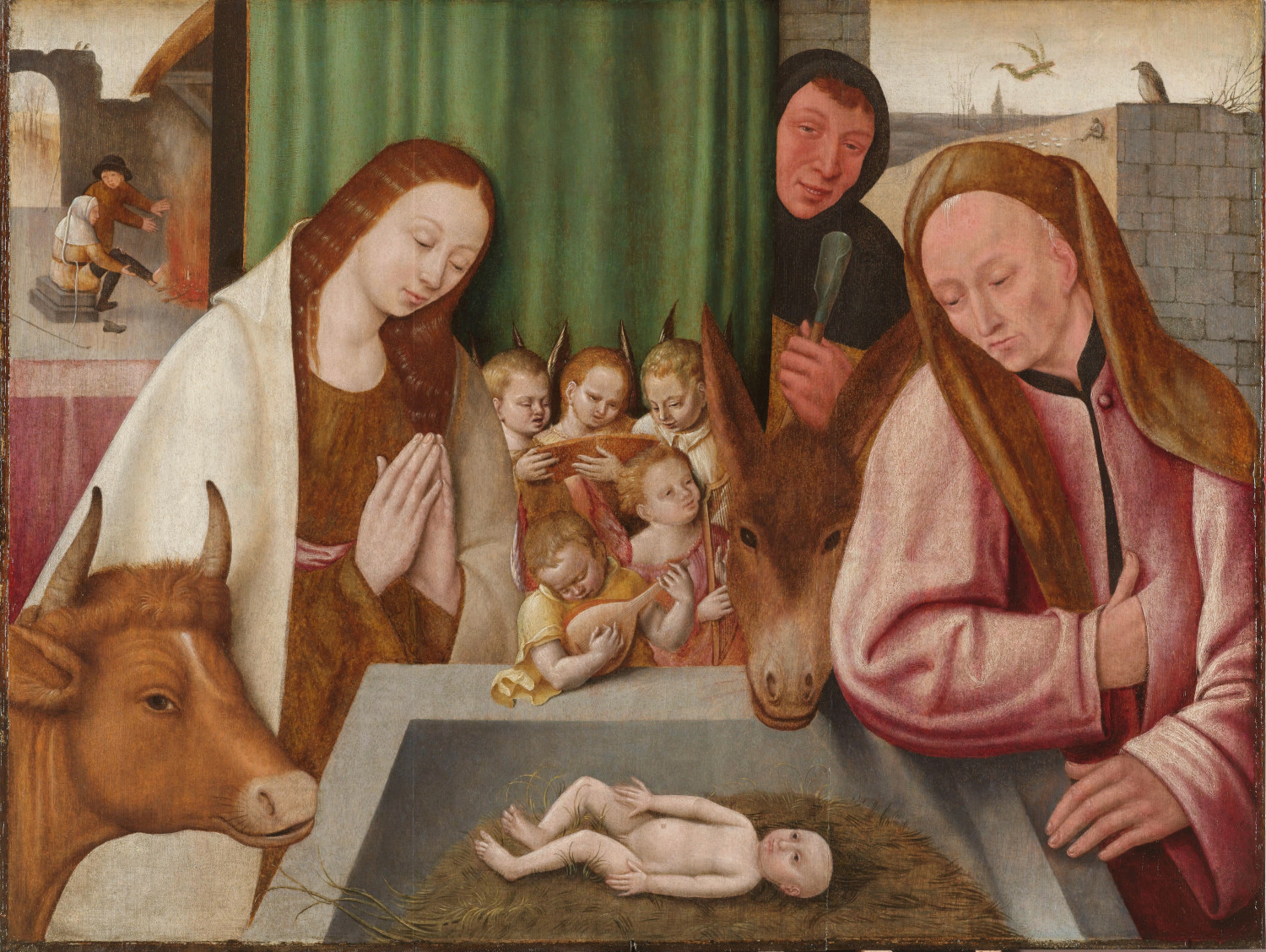
Bosch, Hieronymus (after)_Nativity
Unidentified artist (in the style of Hieronymus Bosch), Nativity, southern Netherlands, ca. 1550–1600. Oil on panel, 58 × 76 cm. Rijksmuseum, Amsterdam.

This painting in the style of Bosch shows Mary and Joseph adoring their newborn son, Jesus, who’s naked and bedded down in straw. A small angelic ensemble stands at the head of the manger with lute, harp, and songbook, softly serenading the family, while a shepherd sneaks a peek from behind a green curtain. It is as if we, the viewer, are standing opposite the shepherd on the other side of the manger, also looking down at the Christ child. Are we similarly rapt with wonder?

I love how the ox and the ass meet our gaze, acknowledge our presence!

I’m not sure of the significance of Joseph’s hand-in-jacket gesture (its association with stateliness wasn’t established until some two centuries later, from what I can tell), but it’s likely supposed to connote reverence or humility, as do Mary’s prayerful hands.

In the left background, two men warm their hands and feet outside by a fire, while at the right, an angel appears to another shepherd on a hillside, announcing the Messiah’s birth.

LISTEN: “Holy One, Jesus Come” by Andy Bast, on The Hymns of St. Ephrem for Advent by Pillar Church (2014)

The lyrics of this song are loosely based on Ephrem the Syrian’s Nativity Hymn #2 from the fourth century. (All nineteen Nativity hymns by this early Christian poet-theologian are a treasure!)

Blessed is he
Both hidden and seen
Blessed is he
Who left the height of majesty

You magnify all, come magnify me
That I may tell about
The glory of your birth
Proclaim your grace to all the earth
Holy One, Jesus, come!

Blessed is he
Who gave us all
Blessed is he
Who gave us all that he has gained

O Father of all, your glorious day
You gave not seraphim
Nor sent the cherubim
You gave your only Son instead
Holy One, Jesus, come!

All glory to thee, entirely
Glory to thee, from every tongue, entirely
Your birth is enough
For all of us

Great one became a child
Pure one became defiled
O Living One, laid in the tomb
In you we are renewed
Your washing washed us through
Let us obtain life by your death
Holy One, Jesus, come!

The Incarnation, the enfleshment of God in the person of Jesus, encompasses the God-man’s birth and death, as does this song. Salvation was wrought not through Jesus’s birth alone, or life alone, or death alone, or resurrection alone, but through all of it together.

At first I got tripped up on the line “Pure one became defiled,” because Jesus did not become defiled in the sense of succumbing to sin or moral corruption. However, in his ministry, he did touch lepers, bleeding women, and corpses, which, according to the Jewish purity laws at the time, would have made him ritually unclean. Looking back on these healings and raisings, Christians would say that rather than these people’s uncleanness transferring to him, his cleanness transferred to them. But the public perception was that he was defiling himself.

And then, of course, there’s 2 Corinthians 5:21: “For our sake God made the one who knew no sin to be sin, so that in him we might become the righteousness of God.” And Galatians 3:13: “Christ redeemed us from the curse of the law by becoming a curse for us—for it is written, ‘Cursed is everyone who hangs on a tree.’” What it means that Jesus “became sin” or “became a curse” has been the subject of much theological discussion! But suffice it to say that Jesus’s death on the cross involved not only physical debasement but also his bearing, in a metaphysical sense, the full weight of humanity’s transgressions.

Andy Bast is a singer-songwriter from Holland, Michigan. He is a musician and writer for the Christian collective Bellwether Arts and a regular contributor to Cardiphonia projects.

Advent, Day 22: Bus Stop Nativity

LOOK: Bus Stop Nativity by Andrew Gadd

Gadd, Andrew_Bus Stop Nativity
Andrew Gadd (British, 1968–), Bus Stop Nativity, 2008. Oil on canvas, 188 × 122 cm.

Painted by Royal Academy gold medal winner Andrew Gadd, Bus Stop Nativity depicts the Holy Family huddled together at night under a bus shelter, trying to stay warm. Some passersby look on with curiosity—two even kneel down on the snowy sidewalk—while others go about their business with total indifference.

This painting was commissioned by the Church Advertising Network in the UK, now ChurchAds.net, and displayed on posters at over one thousand bus stops in December 2008, printed with the text “Be Part of the Action. Church, 25-12.” (A gentle provocation to attend a Christmas service on December 25.)

Francis Goodwin, the chair of the Church Advertising Network, said, “We are very used to the Renaissance image of the Nativity. But what would it look like if it happened today? Where would it take place? We want to challenge people to make them reassess what the birth of Jesus means to them.”

Bus Stop Nativity identifies Jesus with today’s urban poor. He was born not in a comfortable palace with fine clothes and other material wealth and security, but in vulnerability and need, to working-class parents who were inconveniently out of town at the time of delivery, forced to make do with less-than-ideal accommodations. When it came time for Mary to present a purification offering in the temple forty days after giving birth, she couldn’t afford the requisite lamb, so she brought two turtledoves instead (a provision made in Lev. 12:8). Not only was Jesus not monied; he also spent his early years as a refugee in Egypt, a flight prompted by Herod’s direct threat on his life. With limited resources, his parents had to make a home for him away from home, not knowing for some time when it would be safe to return to Galilee.

That this was Jesus’s family background and experience—that he lived on the margins of society, not at its center—has always been a significant facet of the Incarnation, because it means that God knows bodily what it is to feel want and uncertainty and to be overlooked. When in his adulthood Jesus preached “Blessed are the poor,” he was affirming that God is with those of lower socioeconomic means. He is one of them.

LISTEN: “Hush Child (Get You Through This Silent Night)” from the movie Black Nativity (2013) | Written by Taura Latrice Stinson, Kasi Lemmons, and Taylor Gordon | Performed by Jennifer Hudson, Jacob Latimore, Luke James, and Grace Gibson

Silent night
Holy night
Poverty on the rise
Wealthy reverend in designer clothes
Homeless children with frostbitten toes
Sleeping in the street

I ain’t tryna be philosophical
But it’s not logical
Some folks out here freezing, others chilling like it’s tropical

The indifference is mad crazy
Like poverty’s contagious
My hands are dirty, but I’m still worthy
Step in my shoes and walk in some mercy

They say this is your punishment for such poor judgment
But you must’ve lost your mind
How you gon’ feed it when you barely eating?
Get ready for the welfare line
I ain’t tryna hear it
You make the bed, lay in it
But I’m way too strong for you to break my spirit

Is it me?
Am I the cause of all my mother’s misery?
This cloud of secrecy on my paternity
Did my very birth destroy my whole family?

I’m just a sinner, I know who I am
Just a beginner, I’m not yet a man
Send me a signal, I’ll follow your light
Just help me through this silent night

Hush child, it’ll be alright
I’ll get you through this silent night
Hush child, it’ll be alright
I’ll get you through this silent night

This ain’t living
I got a mouth to feed
But I can’t make these ends meet
Got an eviction notice
But my Lord don’t hear my prayers
I never been this scared
The silence is too loud for me
Life just ain’t fair

Is anyone out there?
Does anyone care?
Is anyone listening?
Is anyone there?
Just let me know that I’m a part of your plan
That you’re watching over and know who I am

From where we are now
How do we find our way?
Alone in the darkness, scared
With no place to stay

Hush child, it’ll be alright
I’ll get you through this silent night
Hush child, it’ll be alright
I’ll get you through this silent night

Hush child, it’ll be alright
We’ll do this together

Sleep in heavenly peace

This song is a dream sequence from the 2013 film Black Nativity, directed by Kasi Lemmons (good soundtrack, cheesy movie). The two characters who initiate the song are Maria (Grace Gibson) and Jo-Jo (Luke James), a homeless couple in New York City expecting their first child, who are caroling door-to-door. Fifteen-year-old Langston (Jacob Latimore), who has been sent to live temporarily with his estranged grandfather while his mom, Naima (Jennifer Hudson), figures out how to make ends meet for the two of them back in Baltimore, interjects with a rap expressing his frustration with economic inequality and the struggle he has seen and lived.  

The pregnant couple sings the refrain, “Hush child . . . ,” to each other and to their unborn child, and Naima sings it to Langston. But in between, all four address God in lament: God, are you there? God, why don’t you fix these inequities? I’m exhausted. Tired of being a have-not and always having to hustle, to no avail. When are you going to provide like you said you would? The night is “silent” because God is not answering, it seems. Still, the characters continue to pray their pain and grasp after hope.

Though Lemmons’s Black Nativity was marketed as being based on Langston Hughes’s 1961 musical of the same name, its only resemblance is that it is a Christmas-themed drama with Black sacred music (only two songs are held in common; most in the movie are contemporary gospel or original hip-hop/R&B). To listen to the original Broadway cast recording of *Hughes’s* Black Nativity on Spotify, click here.

Roundup: Light in Nativity and Transfiguration icons, plus more art and song

LECTURE: “Light in Sacred Space: Light from the Cave” by Matthew J. Milliner and Alexei Lidov, December 19, 2019, Bridge Projects, Los Angeles: This double lecture about the role of light in Christian spirituality and theology was organized to coincide with the premiere of 10 Columns, an immersive light installation by Phillip K. Smith III that Bridge Projects commissioned for their inaugural exhibition.

While the Light & Space movement was born in Southern California in the 1960s, in many ways it participates in a much longer history of artists in dialogue with the phenomena of light. This presentation by two art historians, Matthew Milliner and Alexei Lidov, will begin with Milliner exploring the unexpected resonance of Phillip K. Smith III’s work with Byzantine and Gothic traditions. Lidov will then expand on these ideas with his scholarship in the Eastern Orthodox tradition and its long history of engaging light and mysticism. What kinds of insights might come when Light and Space artists, including Phillip K. Smith III, are put in conversation with ancient Orthodox Christian concepts of the nativity and uncreated light? [source]

Milliner speaks for the first forty minutes, discussing Nativity and Transfiguration icons and their correlatives in the West and making, as always, fascinating connections between art of the past and present. For example, he overlays Olafur Eliasson’s Ephemeral Afterimage Star (2008) on Rublev’s Transfiguration icon (19:19), and Ann Veronica Janssens’s Yellow Rose on an Adoration of the Magi illumination from a fifteenth-century book of hours at the Getty (26:32). He also introduced me to a fascinating medieval manuscript illumination from Germany (which he in turn learned about through Solrunn Nes) that combines the light of Bethlehem and Tabor—two Gospel scenes in one. Don’t miss the quote by Gregory of Nazianzus.

Janssens, Ann Veronica_Yellow Rose
Ann Veronica Janssens (Belgian, 1956–), Yellow Rose, 2007. Projectors, dichroic filters, and artificial mist, dimensions variable (min. 360 cm diameter, min. 250 cm depth). Museum Morsbroich, Leverkusen, Germany. Photo: Philippe De Gobert.

Nativity-Transfiguration (Ottonian MS)
The Nativity and the Transfiguration, from an Ottonian Gospel-book made in Cologne, 1025–50. Bamberg State Library, Msc.Bibl.94, fol. 155r.

Combining art history and theology (he has advanced degrees in both), Milliner’s talk is organized as follows:

  1. Thessaloniki | Gregory Palamas (d. 1337)
  2. Constantinople | Pseudo-Dionysius the Areopagite (d. ca. 500)
  3. Paris | Abbot Suger (d. 1151)
  4. Los Angeles | Phillip K. Smith III (b. 1972)

+++

ART VIDEOS:

>> “A 60-second introduction to ‘The Nativity at Night’”: One of my favorite Nativity paintings! By fifteenth-century Dutch artist Geertgen tot Sint Jans, a lay brother in the religious order of St. John. In this video from the National Gallery in London, a camera scans over the painting as an atmospheric soundscape plays and captions guide us in looking at the details.

Geertgen tot Sint Jins_The Nativity at Night
Geertgen tot Sint Jans (Dutch, ca. 1455/65–ca. 1485/95), The Nativity at Night, ca. 1490. Oil on oak, 34 × 25.3 cm. National Gallery, London.

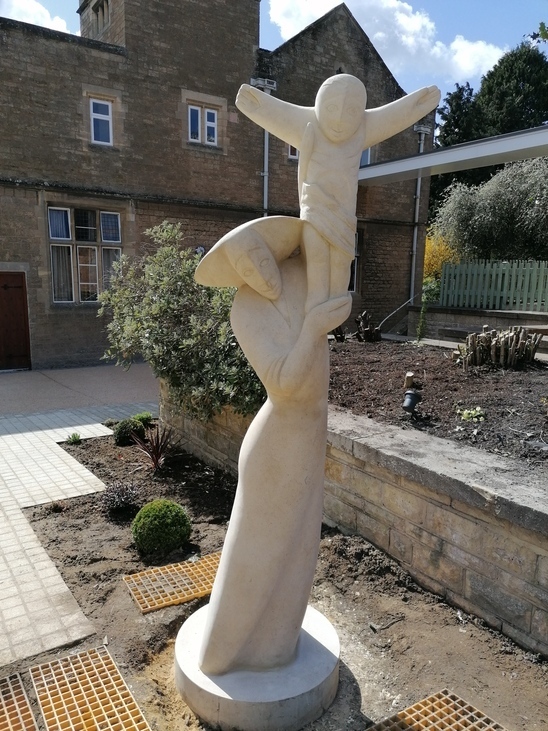
>> “Mother and Child Commission”: In this twelve-minute “making of” video, filmmaker Nick Clarke talks to artist Nicholas Mynheer over the first half of 2020, tracing his progress on the life-size Mother and Child sculpture that was commissioned by the Community of St Mary the Virgin, Wantage, an Anglican convent in Oxfordshire. I was struck by, from the looks of it, the physical demands of the sculpting process—the strength and endurance required to chip away daily at blocks of stone outside in winter, until they yield the shape you desire, then the logistics of attaching the blocks with steel, which weigh nearly a ton collectively, and disassembling, transporting, and reassembling them for installation. I was also interested to hear Mynheer discuss the expressive capabilities of English limestone—how you can convey emotional and sartorial subtleties, for example, through the precise angling of the chisel.

Mynheer, Nicholas_Mother and Child (Wantage)
Nicholas Mynheer (British, 1958–), Mother and Child, 2020–21. English limestone, height 230 cm.

Mother and Child was installed in the outdoor reception area of St Mary’s on April 12, 2021; you can watch a video of the installation here. “In very, apparently, simplified form, there is so much tenderness, energy, and something new,” says Sister Stella, the sister in charge, about the sculpture. “Jesus isn’t going to be held back. Her son’s going to go places.”

To learn more about Nicholas Mynheer, visit his website, https://www.mynheer-art.co.uk/. You can also read the artist profile I wrote on him for Transpositions in 2017.

+++

SONGS:

>> “Corazón Pesebre” (Heart Manger) by Rescate: A follower of the blog introduced me to this Christmas song from Argentina, and I dig it! Released as a single in 2017, it’s about turning our hearts into a manger to receive Christ. Read the Spanish lyrics in the YouTube video description.

The song is by the highly popular Argentinian Christian rock band Rescate, active from 1987 to 2020. Their lead singer and main songwriter, Ulises Eyherabide, died of cancer in July.

>> “Hallelujah, What a Savior!” (Christmas Version), performed by Providence Church, Austin, Texas: In 2012 Austin Stone Worship songwriters Aaron Ivey, Halim Suh, and Matt Carter rewrote the lyrics to Philip P. Bliss’s classic “Hallelujah, What a Savior!” to make them more Christmas-centered and added a new refrain; their version was released that year on A Day of Glory (Songs for Christmas). Here the song is performed by another Austin worship team—Jordan Hurst, Jaleesa McCreary, and Brian Douglas Phillips from Providence Church—for a virtual worship service on November 29, 2020. Instead of using the Austin Stone refrain, they quote Leonard Cohen’s “Hallelujah” between verses.