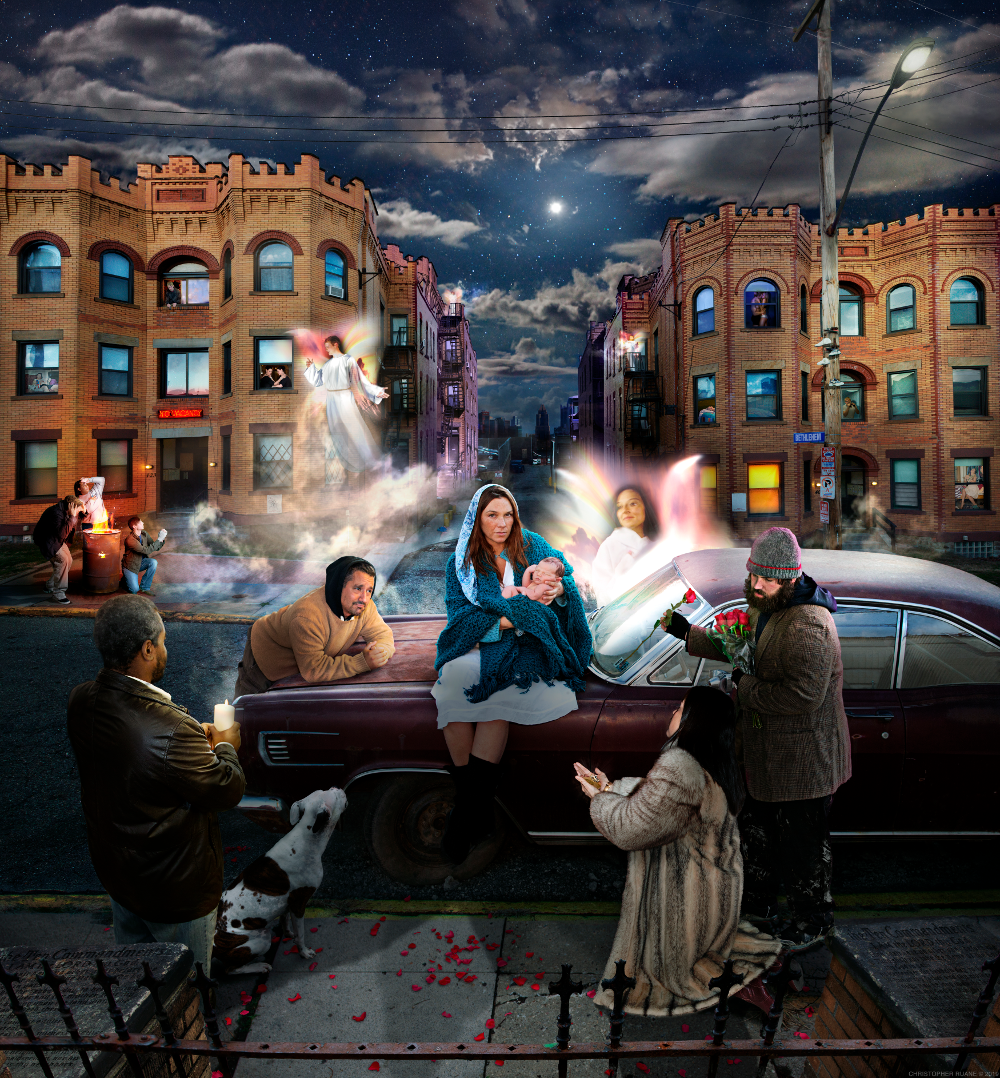
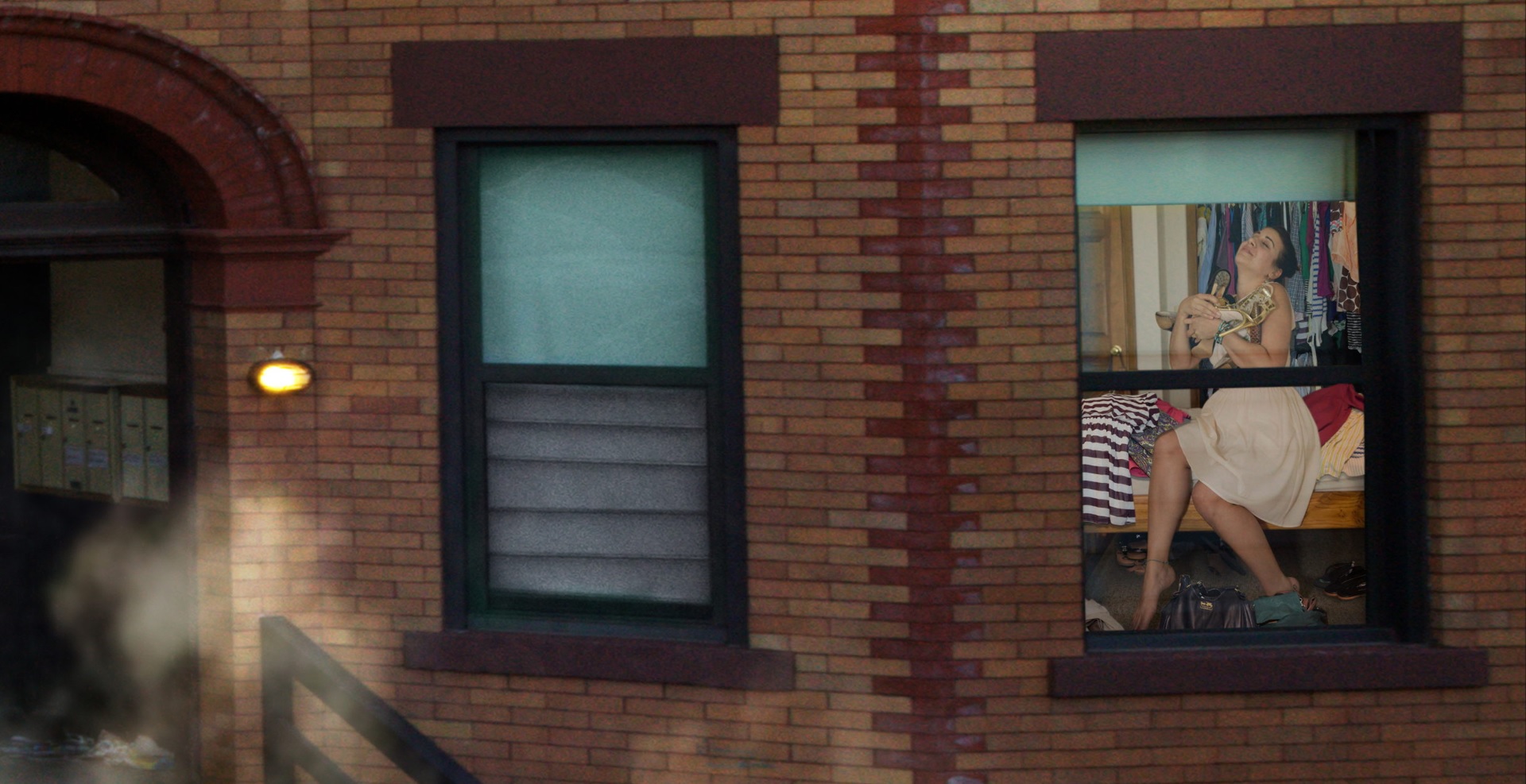
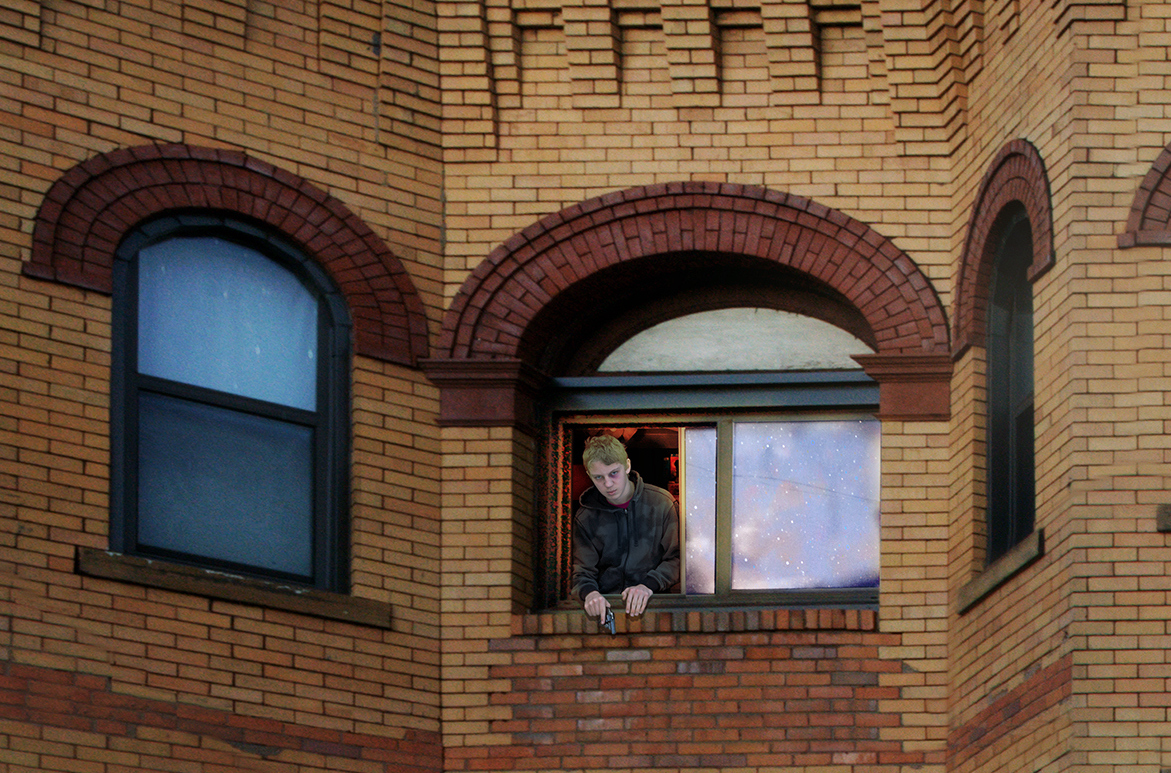
Christopher Ruane (American, 1981–), The Nativity, 2014. C-print, 52 × 48 in. Click the link to zoom in.
This image by photographer and composite artist Christopher Ruane sets the Nativity of Christ on an urban street corner marked “Bethlehem” and casts racially diverse models in the biblical roles. Mary sits on the hood of an old beat-up car holding her sweet newborn with a protective grip—she has presumably just given birth in the backseat. She’s wrapped in a blue afghan, the color traditionally associated with the Virgin. Joseph leans over, gazing proudly at his new baby son. Instead of the traditional cow and donkey looking on, there’s a spotted dog.
In the foreground are the three “wise men,” which here are two men and a woman, offering their gifts to the family. One man brings a candle; another, a rose. A wealthier woman in a fur coat brings gold jewelry. They stand or kneel on the sidewalk before this miracle baby who will be their deliverer, the way strewn with flower petals.
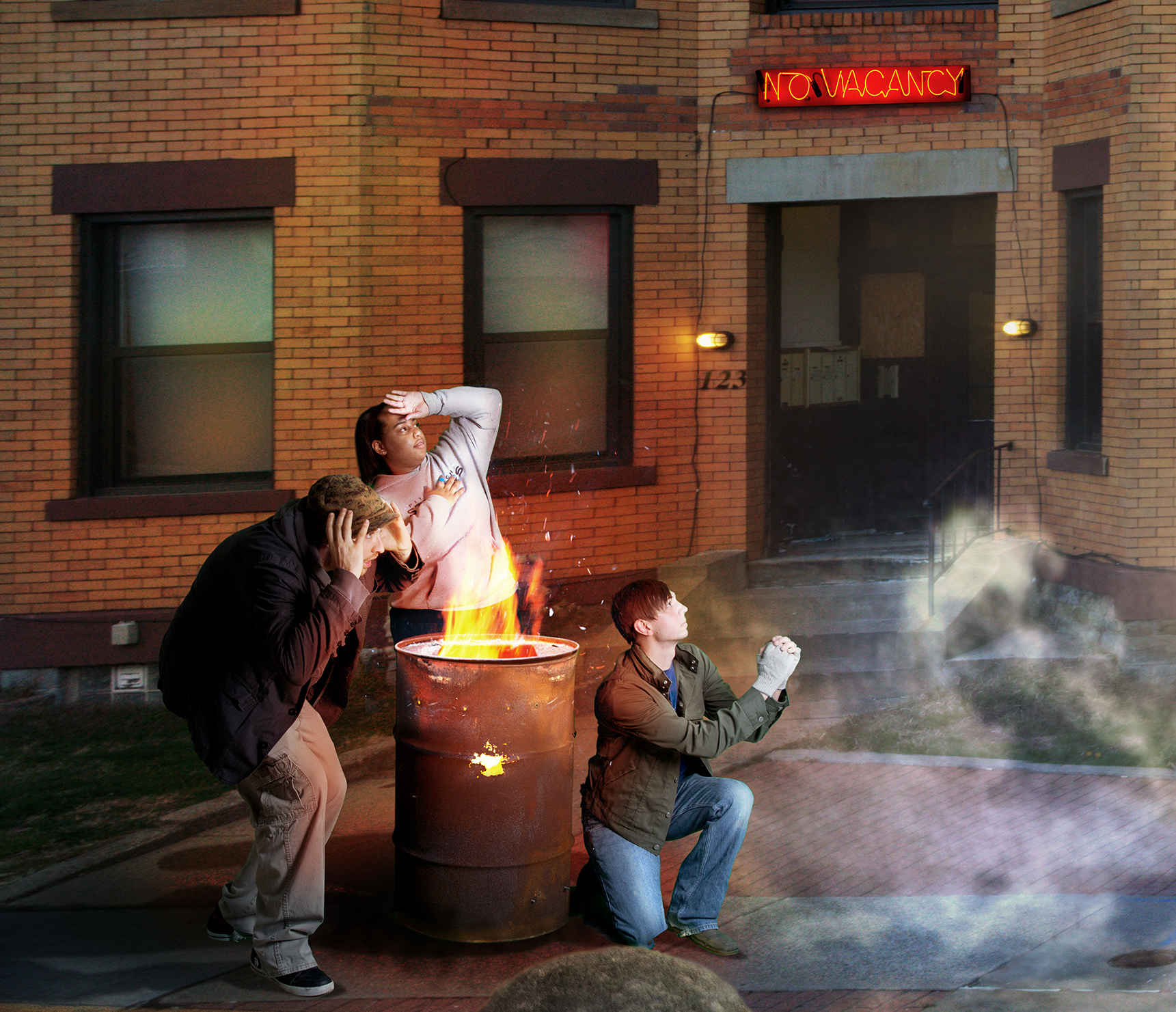
In the middle ground are three young unhoused people around a trashcan fire, standing in for the shepherds. A cloud of steam rises up out of a manhole before their eyes and coalesces with a heavenly apparition, come to personally announce to them the Messiah’s birth.
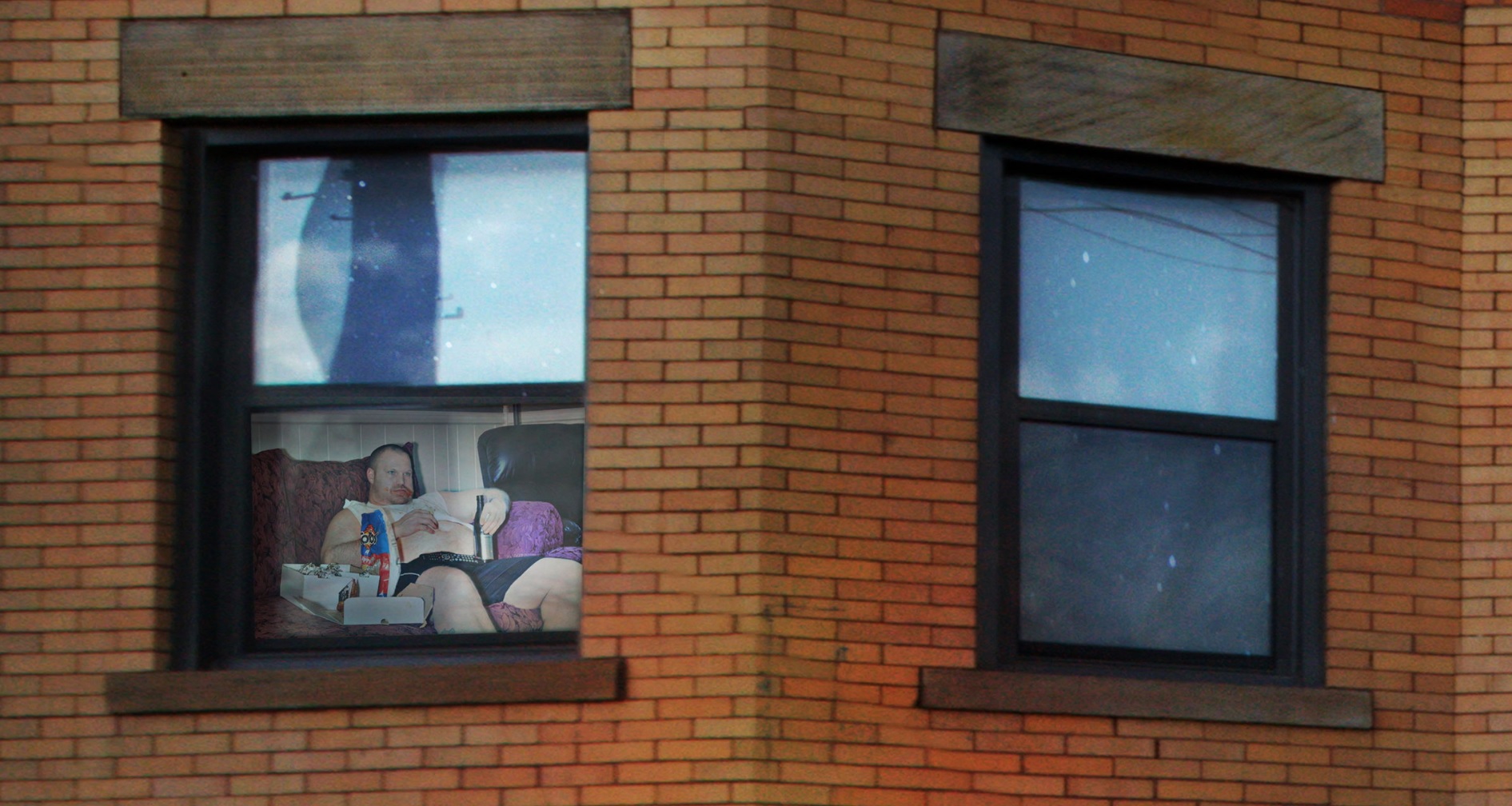
In the windows of the apartment building in the background are various people occupied with various activities. In one room a couple is engaging in sexual foreplay. Across the way, a man is vegging out in front of a TV. One woman, whose closet is spilling over with clothes, is hugging her collection of designer shoes.
These represent different values or dependencies—for example, materialism, a literal clinging to one’s possessions. But there’s also pain.
On the top floor there’s a young man in a hoodie with a black eye. Maybe he’s abused by his father. Or bullied at school. Or in too deep with a gang. Either way, he is bitter and angry and scared and distrustful and has a gun.
Christ was born into this world of hurt and false loves. He came to call us out of the darkness of these and into light, to give us abundant life in God. The bright star above beckons us all to follow the light to the feet of Jesus, Emmanuel, God-with-us.
Three wise men ridin’ hard through the cold Lost on some big city street with no place warm to go They are lookin’ for a manger, or a sign in the lights But they’re a long way from Bethlehem tonight
But they heard about a savior And a preacher in the park Who will camp with the homeless Where they shiver in the dark He’ll deliver salvation To the weary and the cold And he’ll bring joy, joy, joy to the wanderin’ soul
The cleaning lady sighs as she closes up the gate This job don’t quite pay the bills, and she’s always workin’ late But all in a moment comes a light from above It’s an angel speaking words of joy and love
And he tells her of a savior And a preacher in the park Who will camp with the homeless Under bridges in the dark He’ll deliver salvation To the weary and the cold And he’ll bring joy, joy, joy to the wanderin’ soul
Four in the mornin’ at the Tradewinds Motel The register reads, “All Full Up,” and the clerk thinks, “Just as well” But out in the toolshed by an old Coleman lamp A little family makes its meager camp
And the wise men bring presents And the angels gather round The cleaning lady slips in through the door without a sound And an old black dog looks on with the rest At the little babe upon his mother’s breast
And there comes a savior (Joy to the world) And a preacher in the park (The Lord is come) And he camps with the homeless (Let earth) Where they shiver in the dark (Receive her king) He delivers salvation To the weary and the cold (Let every heart sing) And he brings joy, joy, joy to the wanderin’ soul He brings joy, joy, joy to the wanderin’ soul
The American folk singer-songwriter Dave Carter was one half of the duo Dave Carter and Tracy Grammer, active from 1998 until Carter’s unexpected death in 2002. His songs have been covered by Joan Baez, Judy Collins, Willie Nelson, and others, and Grammer posthumously released several previously unreleased songs by Carter, including “American Noel.” She and Carter recorded the song sometime between 1999 and 2001 for a series of employee holiday gift compilations commissioned by the president of a hardware store chain.
Like Ruane’s digital photomontage, “American Noel” imagines the Incarnation happening on the margins of a modern American city, attracting low-wage workers and transients, among others. Jesus pitches his tent among the exhausted and despairing, “the weary and the cold,” coming not as an outsider to struggle but as one who will know it firsthand. His childhood, to say nothing of his adulthood, is marked by sudden flight from his homeland to escape a tyrannical king and by an upbringing in a country not his own.
City Church San Francisco put on a really enjoyable Lessons and Carols service last year, which was all-virtual given the COVID restrictions. Livestreamed December 13, 2020, it features guest vocalist Nicolas Bearde, the City Church Jazz Quintet (Patrick Wolff on tenor sax, Mike Olmos on trumpet, Marcus Shelby on bass, Adam Shulman on piano, and Jeff Mars on drums) with Karl Digerness, and a children’s ensemble. Here’s the abbreviated version I recommend, which is forty-five minutes:
The following songs are interspersed with scripture readings (the links will take you to the extracted song video on YouTube):
I suggest you light the fireplace (if you’re in a wintry clime, that is!), grab some hot cocoa, and gather the fam on the couch to give a listen together. Lyrics are printed onscreen for a few of the carols, for you to sing along with.
Or, perhaps you want to play the video while you’re doing some holiday baking!
The fuller-blown service, which is ninety minutes, includes a time of offering, a homily, communion, responsive prayers, church announcements, and a few additional songs and instrumental numbers that I’ve embedded below.
The City Church Little Big Band produced a Christmas jazz album in 2012, Go Tell It!, that includes recordings of many of the arrangements you hear here. Check it out.
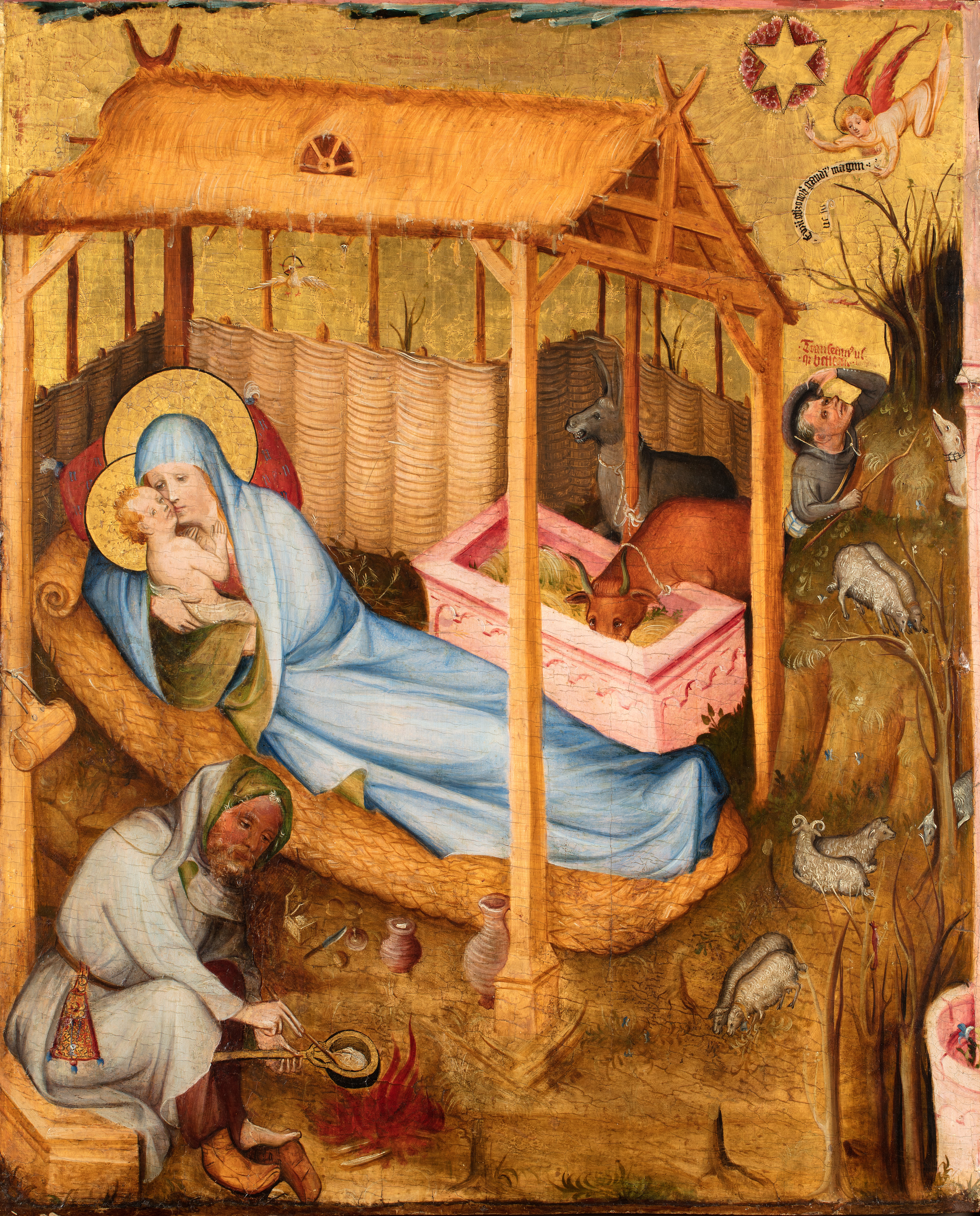
When I was at the Museum Catharijneconvent in Utrecht, Netherlands, in 2019, one of the standout pieces I saw was an early fifteenth-century altarpiece from the Middle Rhine region of Germany. The central section, which I imagine would have been a sculpted Crucifixion scene, has been lost, and the surviving panels are arranged in a modern frame.
Altarpiece from the Middle Rhine, ca. 1410. Tempera on panels. Museum Catharijneconvent, Utrecht, Netherlands. Photo: Ruben de Heer.
Ten panels depicting eight scenes from the life of the Virgin Mary decorate what would have originally been the interior wings—that is, visible when the altarpiece was open.
I’ll describe the first four, as they’re my favorites.
All photos in this post are from the museum’s website, which courteously provides them in high resolution under an open-access policy, promoting scholarship and digital engagement. The Annunciation image is a composite I made from two separate photos.
The Annunciation
In the Annunciation, Mary sits in her bedroom beside a window in front of an open pink chest (her dowry chest?), quietly reading the scriptures, when the angel Gabriel slips in through an open door, holding a banderole that bears his greeting: Ave gratia plena d[omi]n[u]s tecum (“Hail, favored one, the Lord is with you,” Luke 1:28). He then goes on to tell her that she has been chosen to bear God’s Son into the world.
What will Mary say? Four little angels look on in eager anticipation from a tower in the panel above, while in the room two angels already start rolling out the royal treatment, holding up a gilt-brocaded velvet “cloth of honor” behind the young maiden in recognition of her high calling.
A thin column divides Gabriel’s space from Mary’s, creating a sense of threshold. It marks a boundary that is about to be crossed. The separation between God and humanity will be broken down by the Incarnation.
Mary ultimately responds to the surprise invitation with acceptance: Ecce ancilla d[omi]ni fiat michi s[e]c[un]d[u]m verbu[m] t[uu]m (“Behold the handmaid of the Lord, be it unto me according to thy word,” Luke 1:38).
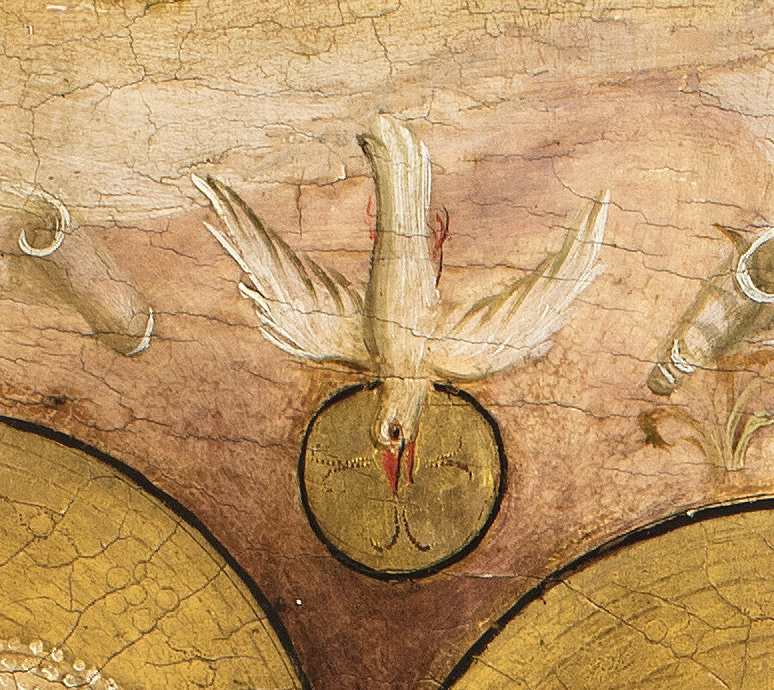
Mary’s yes triggers the release of a thick stream of light—it looks to me like a golden conveyor belt!—from the heart of God the Father, who is peering down through an upper window. Riding that stream is a haloed dove (the Holy Spirit) followed by a tiny yet fully formed infant Christ who’s holding a cross and headed straight toward Mary’s womb.
“Weeee!!!”
The homunculus (“little human”) motif in Annunciation images, though relatively rare, always makes me chuckle. It’s one way artists came up with to visualize the unvisualizable mystery of Christ’s conception, one that includes the Second Person of the Trinity as an actor in the event and shows a very literal descent. Not long after the motif started appearing in the fourteenth century, it was disapproved of by theologians, such as Antoninus of Florence and Molanus, and it was finally banned in the eighteenth century by Pope Benedict XIV as being heretical, since it suggests that Jesus did not take his body from Mary.
For brief commentary on this particular scene by Msgr. Herman Woorts, a Dutch art historian and an auxiliary bishop in the Roman Catholic Church, see this video produced by Katholiekleven.nl:
(To translate the Dutch into your language, click the “CC” button on the player, then the cog icon, and select Subtitles→Auto-translate.)
The Visitation
In the Visitation panel, Jesus and John the Baptizer are visible in their mothers’ wombs, each encased in a mandorla (almond-shaped aureole). This visual device of showing the cousins in utero was not uncommon at the time, especially in the Low Countries; art historian Matthew J. Milliner amusingly calls it “ultrasound Jesus”! Here you can actually see little John kneeling before his cousin in adoration.
Elizabeth has emerged from a door at the right, whose frame is labeled “Civitas Juda,” City of Judah (and notice the dog in the doorway! a traditional symbol of faithfulness). As she and Mary embrace each other in celebration of their miraculous pregnancies and imminent salvation, scrolls unfurl with their words from the Gospel of Luke: Et unde michi hoc q[uo]d mater d[omi]ni mei venit ad me (“And why is this granted to me that the mother of my Lord should come to me?” Luke 1:43), at right, and at left, Magnificat a[n]i[m]a mea d[omi]n[u]m. Et exultavit sp[iritu]s meus i[n] deo salutalutari (sic) meo (“My soul magnifies the Lord, and my spirit rejoices in God my Savior,” Luke 1:46–47). The scrolls provide a delicate, wing-like framing around the two women.
And at their head, in the center, an open-beaked dove descends, signifying the Holy Spirit—an extremely rare appearance in Visitation images. This is God breathing on his daughters, blessing their ministries, receiving their praise. Like the prophets of old, they are filled with God’s power and truth spills forth from their lips.
At their feet flows a spring of water, a possible allusion to Isaiah 35:6b–7a: “waters shall break forth in the wilderness, / and streams in the desert; / the burning sand shall become a pool, / and the thirsty ground springs of water.” Not to mention the Living Water that is Christ (see John 4).
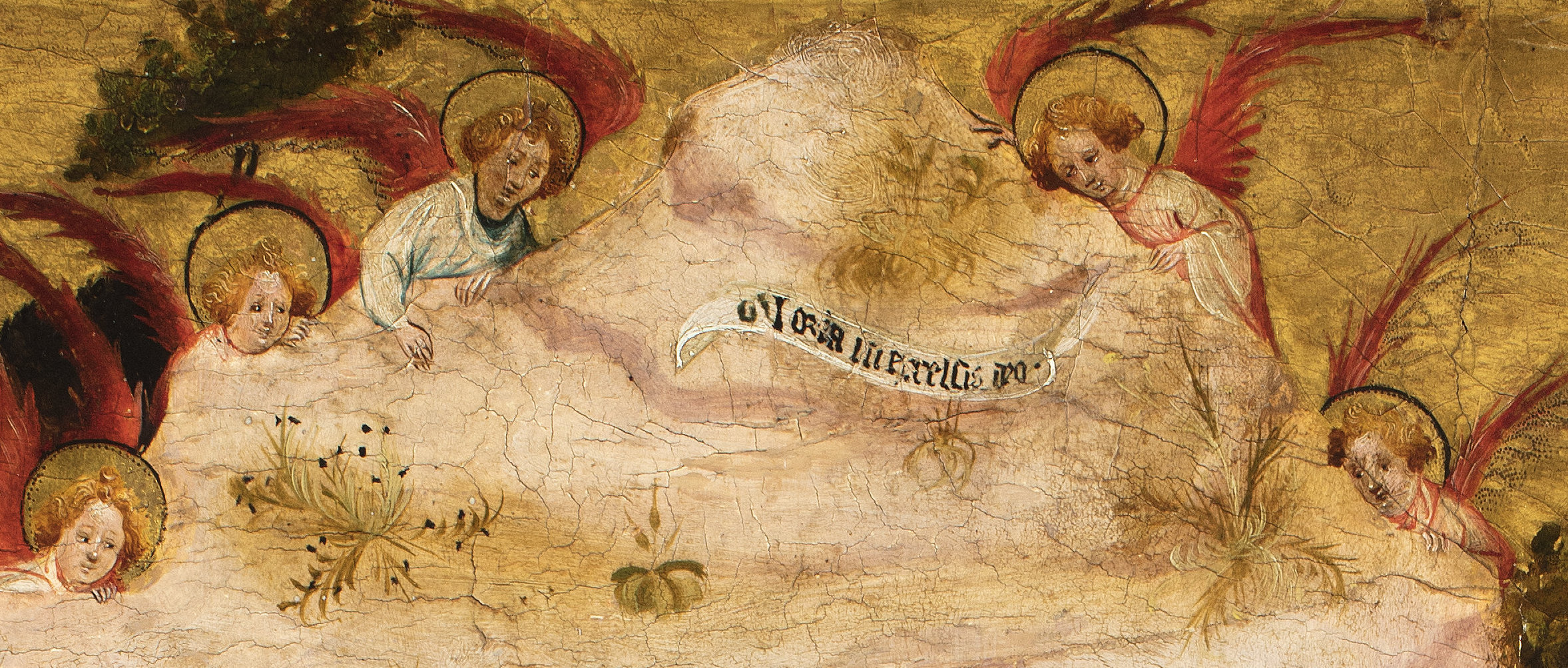
Another charming detail of this panel is the angels, with their wispy red wings, peeking in at this intimate moment from behind rocks. I’m reminded of the epistle of 1 Peter, whose author says that the mysteries of salvation are “things into which angels long to look!” (1:12). Here they seem to whisper their song that will be exclaimed at full blast on the night of Jesus’s birth: Gloria in exelsis deo (“Glory to God in the highest,” Luke 2:14).
The Nativity
Poor Joseph is often overlooked as a player in the Christmas story, and yet he, too, faithfully responded to a (quite terrifying!) divine calling: to be the adoptive father of Jesus, raising him as his own. Though he initially had doubts about Mary’s story of supernatural conception—who wouldn’t?—an angel set him straight, and he ultimately acted in love and loyalty to Mary, and to God. He was an advocate and a provider for his family, looking out for their best interests all along the way.
I mention this because the Middle Rhine Altarpiece shows an actively caring and resourceful Joseph at the Nativity, cooking porridge over an open fire to nourish his hungry and tired wife, who reclines on a rollout mat with her newborn.
Also, notice that his left foot is bare. A legend of unknown origin says that Joseph removed his stockings (German hosen) following Jesus’s birth, cutting them into strips in order to swaddle the child. This narrative detail appealed to popular imagination and was referred to in stories, poems, songs, and the visual arts from the fourteenth through sixteenth centuries in the Netherlands and the Rhineland. At the time this altarpiece was made there was even a venerated relic at Aachen Cathedral purported to be the stockings-turned-swaddling bands.
As had become standard in images of the Nativity, this one includes an ox and an ass. The canonical Gospels don’t mention any animals at the birth—though the mention of a manger in Luke 2:7 implies an animal presence. The seventh-century Gospel of Pseudo-Matthew specifically names the ox and ass, citing their supposed adoration of the Christ child as a fulfillment of an Old Testament “prophecy”: “And on the third day after the birth of our Lord Jesus Christ, the most blessed Mary went forth out of the cave, and entering a stable, placed the child in the stall, and the ox and the ass adored Him. Then was fulfilled that which was said by Isaiah the prophet, saying: The ox knows his owner, and the ass his master’s crib (Isa. 1:3).” These two domestic animals are also mentioned in the Nativity account that appears in the Golden Legend, an immensely popular text from the thirteenth century.
Here the ox is nose-deep in straw, while the ass looks up with his mouth agape. Perhaps he’s excited at having just spotted the Spirit-dove under the rafters.
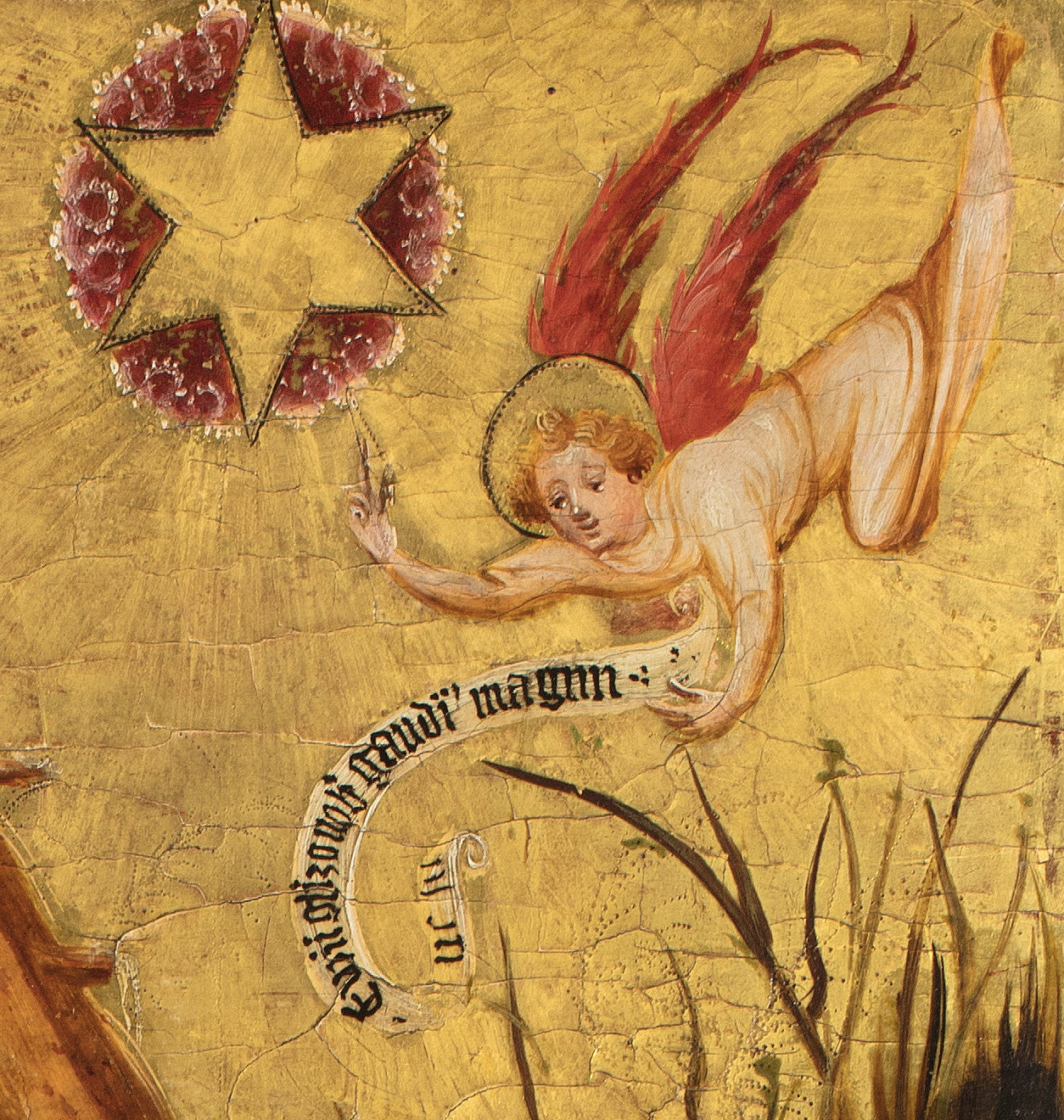
The shepherds are about to arrive at the stable, as in the right background the birth is announced to them. The scroll held by the angel reads, Evanglizo vob[is] gaudi[um] magnu[m] (“I proclaim great joy to you,” Luke 2:10), and above the shepherd is the inscription Transeamu[s] us[que] Betleem (“Let’s go to Bethlehem,” Luke 2:15).
The Adoration of the Magi
In the Adoration of the Magi panel, Mary holds the Christ child on her lap, who is nude save for a thin diaphanous drape, emphasizing his full humanity. She wears a crown, alluding to her identity (in Catholic tradition) as Queen of Heaven. As in the Annunciation, she’s backed by a cloth of honor, which Joseph pulls aside to see what new visitors have come calling. And again, the ever-present Holy Spirit hovers above!
The pointing angel at the top, with the aid of a star, has directed three magi, portrayed here as kings, from their far-off homelands to the Christ child. Ite in iudeam ubi / nascit rex iudeor[um] (“Go to Judea where the king of the Jews was born”), he says.
Having cast his crown at the child’s feet, one of the magi kneels down and kisses the hand of the King of kings. He presents a container of gold coins as tribute, which Jesus rifles through with curiosity (ooo, shiny!).
Two other magi stand behind with their gifts of frankincense and myrrh. One of them, whom tradition calls Balthazar, is African. In the eighth century the historian Bede described Balthazar as having a “black complexion,” and from around 1400 onward he came to be portrayed that way in art, reflecting the growing visibility of other races in Europe.
Exterior Panels
Just to give you a full picture of the altarpiece as a whole . . .
So all together, the altarpiece would have told the gospel story from Christ’s conception and birth to the Crucifixion to the Resurrection and Ascension to Pentecost. And it would have served as the backdrop to the celebration of the Eucharist, spiritually forming parishioners week after week.
Art museums are full of such treasures as these. I encourage you to visit one of your local museums (or maybe take a weekend trip to one), find a piece of historical art that intrigues you, and sit with it for at least ten minutes. What do you notice? What is strange to you? What makes you smile? What was the object’s original context? What lineages is it a part of (e.g., what communities has it passed through, what iconographies or textual traditions does it draw from and develop, etc.)? What theological ideas, if any, does it express?
If you struggle to meaningfully engage with an artwork, I’m sure a docent would love to help you.
You might also take a photo of the artwork and share it on your social media. Ask your friends what stands out to them.
Sometimes we rush to judgment of artworks that at first glance seem dull and conventional. We assume they have nothing to show us. But if we were to look more closely, we might find something unexpected. Even subtly subversive.
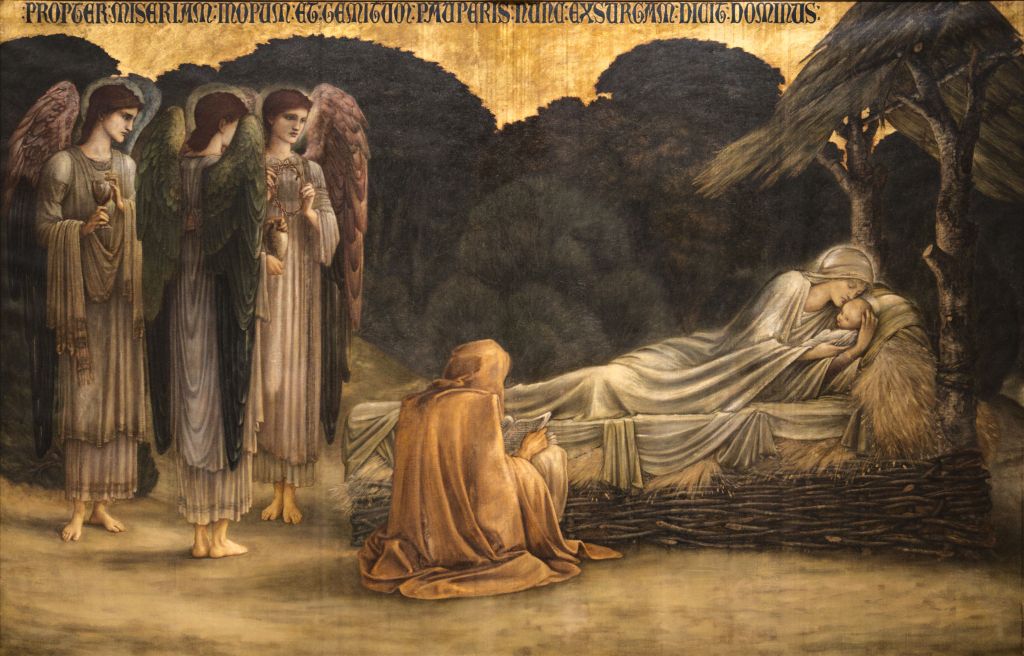
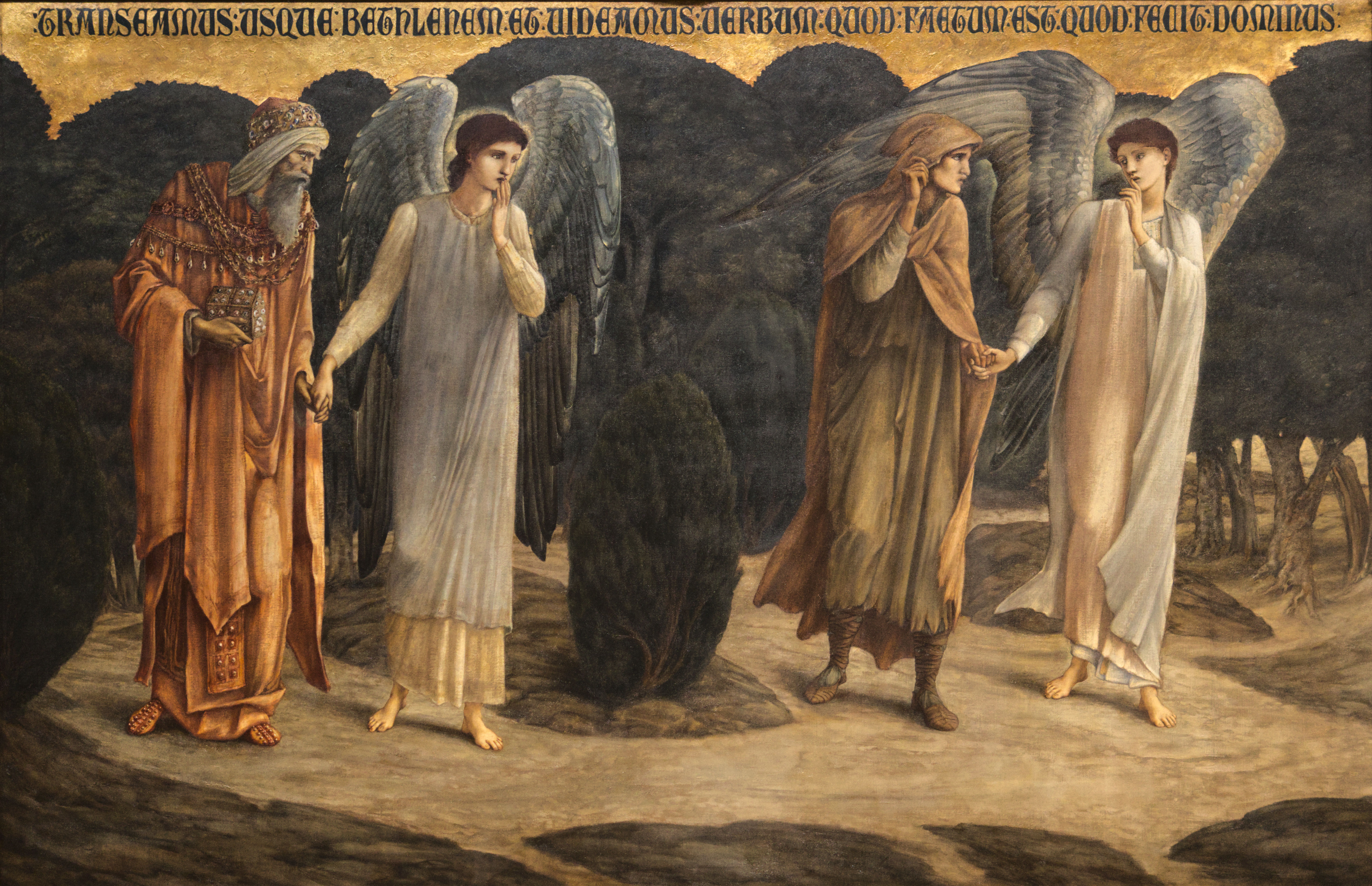
Such is the case with The Nativity and its companion piece, The King and the Shepherd, which were commissioned from the Pre-Raphaelite artist Edward Coley Burne-Jones in 1887 for the chancel of Saint John’s Church in Torquay, England. Seven by ten feet each, they hung on the north and south walls for just over a hundred years before being sold by the church in 1989 to pay for a new roof. (Copies were hung in their places.) Musical theater composer—and Victorian art collector!—Andrew Lloyd Webber bought them and, in 1997, donated them to the Carnegie Museum of Art in Pittsburgh, Pennsylvania. That’s where I saw them earlier this year.
Sir Edward Coley Burne-Jones (British, 1833–1898), The Nativity, 1888. Oil on canvas, 81 × 124 1/2 in. (205.7 × 316.2 cm). Carnegie Museum of Art, Pittsburgh, Pennsylvania.Sir Edward Coley Burne-Jones (British, 1833–1898), The King and the Shepherd, 1888. Oil on canvas, 81 1/4 × 124 1/2 in. (206.4 × 316.2 cm). Carnegie Museum of Art, Pittsburgh, Pennsylvania.
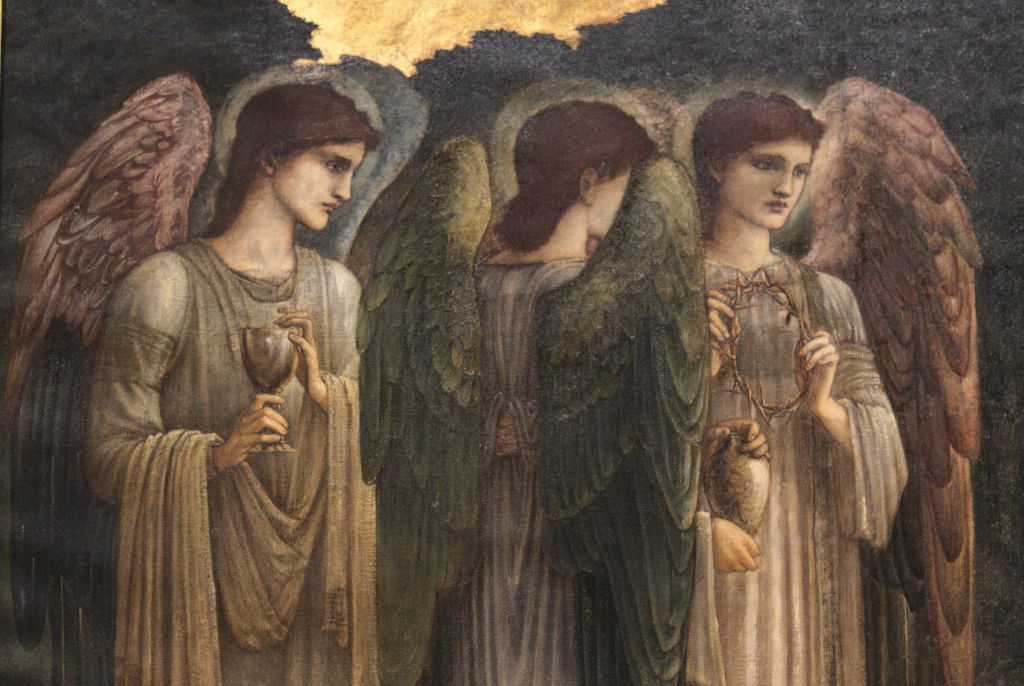
The Nativity shows Mary reclining outdoors on a rustic bed that resembles a bier with her newborn son, Jesus, both wrapped in shroud-like garments. Her partner, Joseph, who has his cloaked back to the viewer, sits on the ground reading a manuscript in Gothic script; the text is indiscernible, but I presume it’s meant to be the scriptures that prophesy the birth of a savior or his sacrificial death. Three angels stand to the side holding symbols of the passion: a crown of thorns, a chalice, and a jar of myrrh, a traditional burial spice. The painting, therefore, links the entrance of Jesus onto the world stage to his ultimate saving act on the cross.
Pastel sketch for The Nativity by Sir Edward Coley Burne-Jones, 1887. The New Art Gallery Walsall, England.
This foreshadowing approach was not new in Nativity art. But in addition to gesturing toward the redemption from sin that Jesus would bring, the painting also quotes from a community lament psalm in which God’s people cry out for deliverance from those in authority who lie and manipulate. Propter miseriam inopum et gemitum pauperis nunc exsurgam dicit Dominus, the Latin inscription reads, which translates, “Because of the misery of the poor and the groaning of the needy, now will I arise, saith the LORD” (Psalm 12:5a). When God’s people are oppressed, God is aroused to action, and Burne-Jones’s choice of this atypical scripture text for a Nativity painting reminds us of the sociopolitical context of Jesus’s birth, which involved Roman occupation of Israel and a despotic ruler so obsessed with power that he mandated the extermination of Jewish male babies in Bethlehem, thinking he would quash the threat of usurpation. This is the reality into which Jesus was born. And though he didn’t deliver Israel from Rome during his lifetime, he did launch a new “kingdom” and declare a jubilee (Luke 4:16–21).
The biblical inscription speaks not only to Jesus’s day but also to contemporary times, which were marked by high unemployment and great hardship among London’s working class. It’s “a subtle allusion to the social miseries of Victorian Britain,” says Louise Lippincott, curator for the Carnegie at the time of acquisition. She speculates that Burne-Jones intended the painting “as his public statement, albeit a muted one, on 19th-century social horrors. . . . It is quite likely that he was thinking of reports of the bestial living conditions of the London poor that were appearing in the press in the early 1880s.” In 1886, 1887, and 1888, as Burne-Jones was planning and executing the painting, violent strikes and riots were going on in London to protest economic inequality. As people starved, those in power continued to fatten themselves with apparent disregard. The incorporation into this humble scene of a divine vow from the Psalms, where God states his commitment to the poor, expresses hope that God will again arise to deliver from affliction those who trust in him.
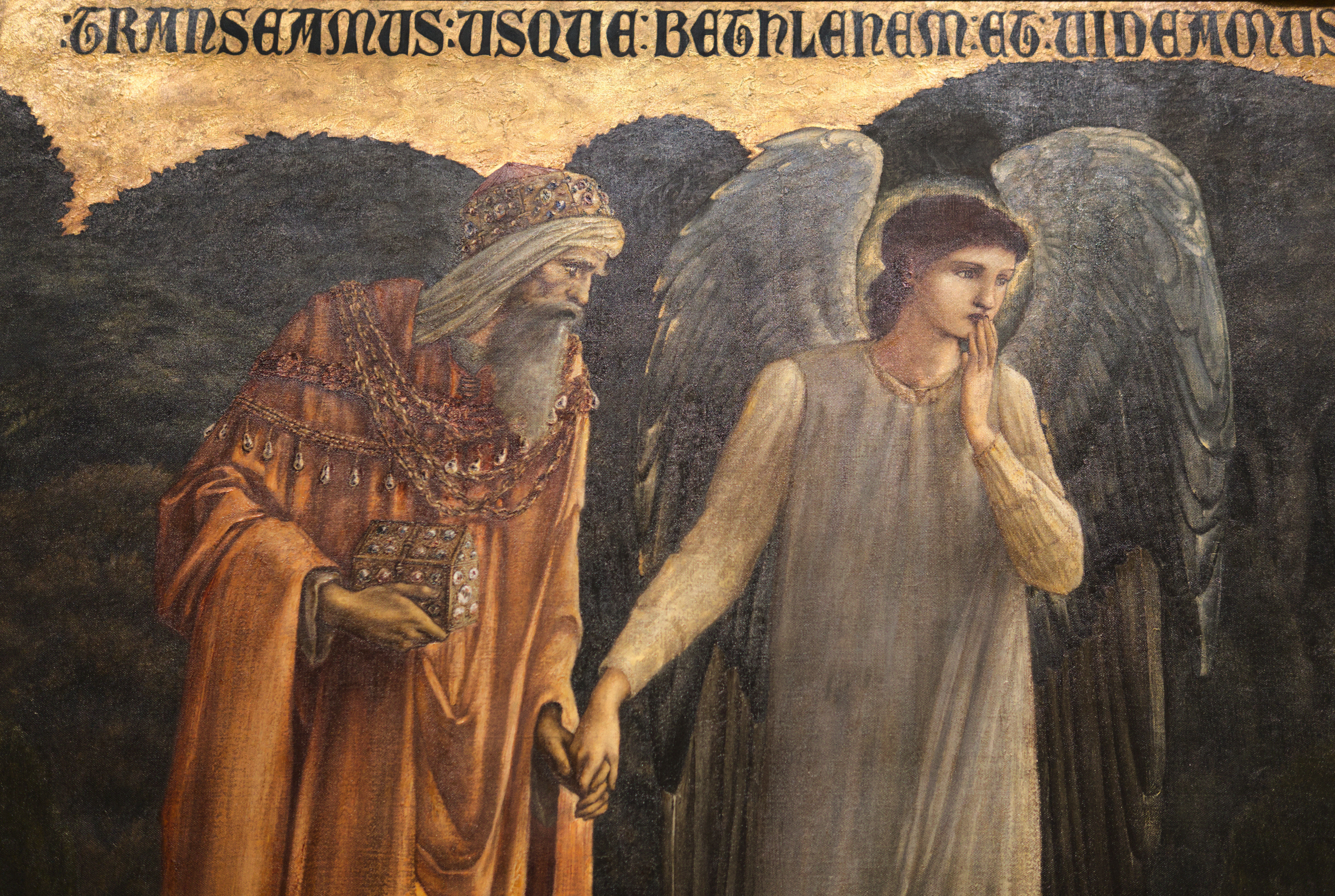
The King and the Shepherd extends this critique of the wealth gap by showing the two titular figures—one rich, the other poor—approaching the Christ child as equals. As was and still is common, Burne-Jones combines Matthew’s account of the magi with Luke’s account of the shepherds, showing both as welcome participants in the same event, but uniquely, he chooses only one figure to represent each group. (Traditionally, three magi attend the birth, along with a nonstandard number of shepherds.) An angel leads each traveler by the hand, reminding them to keep their voices low so as not to wake the sleeping infant.
“The pairings visually suggest the equality, in the face of divinity, between the wealthy king and the humble peasant,” reads the museum wall text. “In the context of the enormous social inequalities rife in Victorian England, this message smacked of social and political radicalism.” The Latin inscription—Transeamus usque Bethleem et videamus hoc verbum quod factum est quod fecit Dominus [et ostendit nobis]—comes from the New Testament description of the journey of the shepherds. “Let us now go even unto Bethlehem,” they say, “and see this thing which is come to pass, which the Lord hath made known unto us” (Luke 2:15b).
God chose to reveal his Son’s birth not only to bookish scholars or, as tradition has it, royalty, but also to a bunch of blue-collar laborers. The shepherds’ and kings’ mutual presence at Christ’s bedside was only the beginning of the reconciliation across lines of division that Christ came to enact.
“Mele Kalikimaka” (“Merry Christmas”) is a Hawaiian-themed song written in 1949 by R. Alex Anderson. Born in Honolulu in 1894, Anderson, a Caucasian, became one of the most popular composers in the hapa haole (“half-white”) genre, which describes music with a Hawaiian tune, styling, and/or subject matter but lyrics that are mostly or entirely in English. Over his long career Anderson composed nearly two hundred songs, several of which became popular standards, and he was posthumously inducted into the Hawaiian Music Hall of Fame in 1998. “His ear for Hawaiian music’s special sound and rhythm was exceptional,” the HMHF wrote, “and he was regarded as a successor to Charles E. King in maintaining the melodic and lyrical qualities which are Hawaii’s musical identity.”
In a 1994 interview, shot just a year before his death at age 100, Anderson said he was inspired to write “Mele Kalikimaka” when a coworker lamented to him one day that there were no original Hawaiian Christmas songs; all that existed were Hawaiian translations of carols from other countries.
So he got to writing:
Jingle bells upon a steel guitar Through the palms we see the same bright star
“Mele Kalikimaka” is the thing to say On a bright Hawaiian Christmas Day That’s the island greeting that we send to you From the land where palm trees sway Here we know that Christmas will be green and bright The sun to shine by day and all the stars at night “Mele Kalikimaka” is Hawaii’s way To say “Merry Christmas” to you
A year later, in 1950, the song appeared on the flip side of Bing Crosby’s White Christmas album, featuring the Andrews Sisters.
Since then it has been covered by a range of artists, including the Monkees, Bette Midler, Jimmy Buffett, Train, Teresa Carpio, Ingrid Michaelson, She & Him, the Puppini Sisters, the Petersens, Leslie Odom Jr., and others. I especially like the playful version performed by married couple Gianni Nicassio and Sarah Blackwood of the Canadian indie-pop band Walk Off the Earth. They do vocals, ukulele, guitar, djembe, chimes, cymbals, and kazoo! The song can be purchased here.
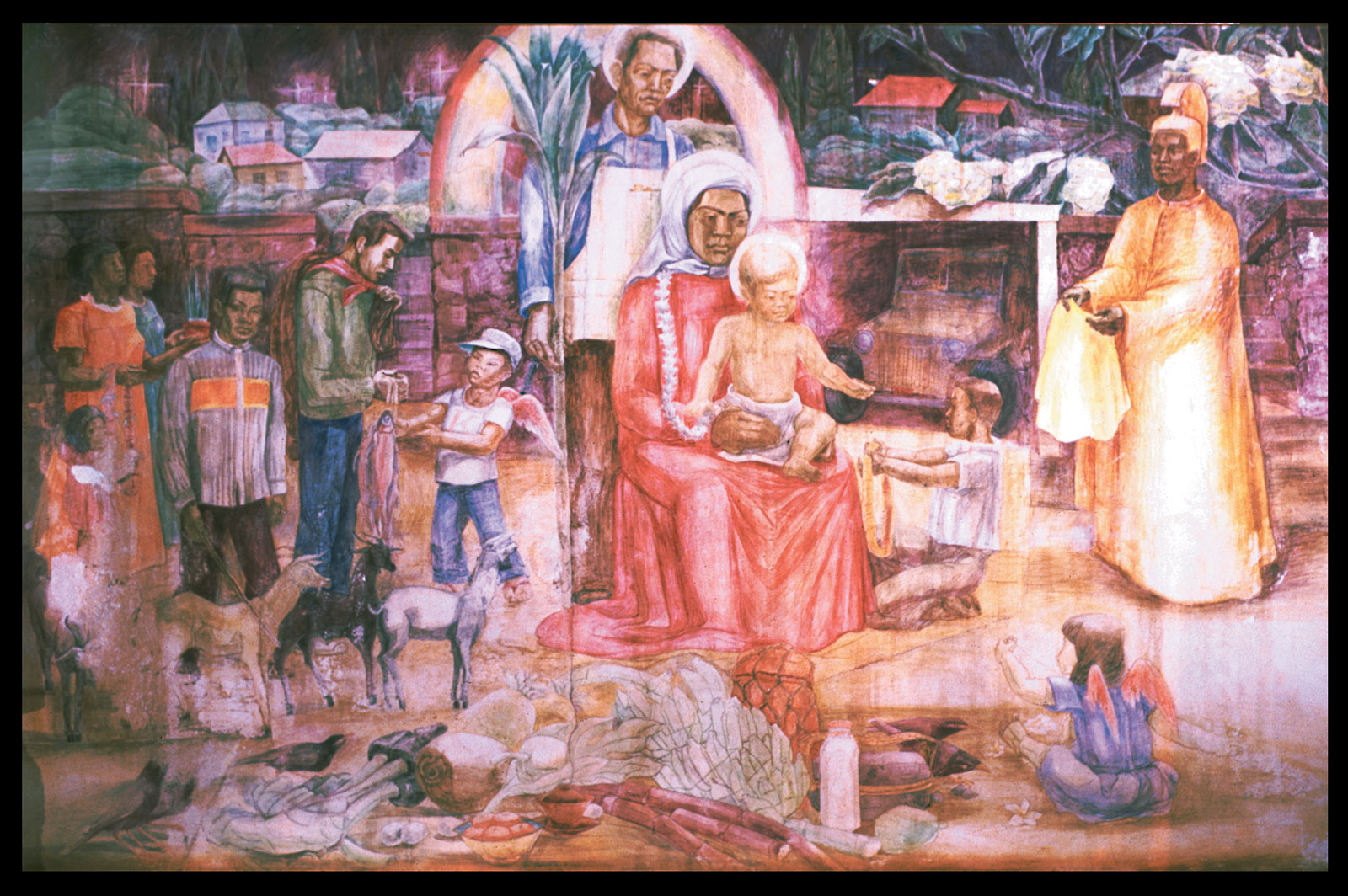
In the same decade that Bing Crosby catapulted Anderson’s Hawaiian Christmas song to nationwide popularity, painter Juliette May Fraser carried out a mural commission for the newly built St. Catherine’s Catholic Church in Kapa‘a, Kauai, commonly referred to as Hawaiian Nativity. Covering the makai (sea-facing) wall, it shows Hawaiians of various ethnicities presenting ho‘okupu (gifts) to the newborn Christ child, who sits on his mother’s lap.
Juliette May Fraser (American, 1887–1983), Hawaiian Nativity, 1958. Fresco, 4 1/2 × 8 ft. St. Catherine’s Catholic Church, Kapaʻa, Kauai, Hawaii. Photo: Timothy T. De La Vega, 1999.
Fraser is of Hawaiian, Chinese, Filipino, Portuguese, and Irish ancestry, and this multiculturalism is reflected in her Nativity. She wanted the painting to be modern and “international in flavor,” she said, reflecting Hawaii’s ethnic diversity.
Instead of a donkey, a jeep has brought the holy couple, who are portrayed as Native Hawaiian, to the place of their son’s birth. The license plate reads, “4-20-58,” the date on which St. Catherine’s was dedicated. Mary wears a muumuu and lei, while Joseph stands behind her with a sugar cane stalk. “The Holy Child is hapa [mixed race] with blond hair and strong Polynesian features,” writes Anthony Sommer in the 1999 article for the Honolulu Star-Bulletin that introduced me to this painting. That Jesus’s skin tone is the lightest of the bunch might be regarded by some as problematic, a subtle reinforcer of racial hierarchy. However, I see this more as the artist’s attempt, whether you deem it successful or not, to show a multiracial Christ, bearing the features of different peoples.
In Fraser’s fresco, locals approach with ho‘okupu, the fruits of their personal labors given freely as offerings in expression of gratitude, respect, and aloha. Filipino fishermen present their freshest catch, and Portuguese goatherds (as the artist identified them) come with their flocks; they are greeted by a Chinese angel in a T-shirt, jeans, a sideways ballcap, and flip-flops. From the right, a Hawaiian ali‘i (hereditary noble) comes with the gift of an ʻahu ʻula (feathered cloak), made only for royalty. He stands in line behind a child who offers Jesus a lei (flower garland). Traditionally, ho‘okupu are given to an akua (god), king, priest, doctor, or host, so this painting acknowledges Jesus as fulfilling all those roles.
The photo here, by Timothy T. De La Vega, was taken prior to the 2001–2 restoration; he emailed it to me when I reached out to him. I’ve sought out more recent photos through multiple channels—the church office, the parish Facebook page, a priest in the diocese, the restoration fundraiser—but have not had any success.
St. Catherine’s also houses frescoes by two other celebrated Hawaii artists: Compassionate Christ by Jean Charlot and Francis Xavier, Apostle of Asia by Tseng Yo Ho. Charlot, Tseng, and Fraser were hired by Father John McDonald—who (fun fact) was also the one who convinced movie producers to cast St. Catherine’s choir in the movies South Pacific and Blue Hawaii!
DIGITAL EXPERIENCE: “Holy Night: The Christmas Story and Its Imagery”: This “Digitorial”—a responsive, multimedia, educative webpage—was created as a supplement to a physical exhibition at the Liebieghaus Skulpturensammlung in Frankfurt that ran from October 12, 2016, to January 29, 2017, which brought together over one hundred paintings, sculptures, and other precious objects, mostly from medieval Germany, to tell the story of Jesus’s birth. Featured online are a magnificent Rhenish tapestry (seriously, click that link and zoom in!), an ivory relief carving, an altar, a wooden statuette of Mary with a removable flap on her belly that reveals the Christ child, a liturgical cradle and doll, a manuscript illumination, a woodcut, and more. Also included, for listening, are readings from the Revelations of Saint Bridget of Sweden (a fourteenth-century mystic whose vision of the nativity had widespread influence) and the Gospel of Pseudo-Matthew (source of the legend of the miraculous palm tree on the Holy Family’s flight to Egypt), as well as a lullaby from a medieval mystery play at Leipzig and perhaps also sung as part of the custom of Kindleinwiegen. Curator Stefan Roller introduces the exhibition in this video:
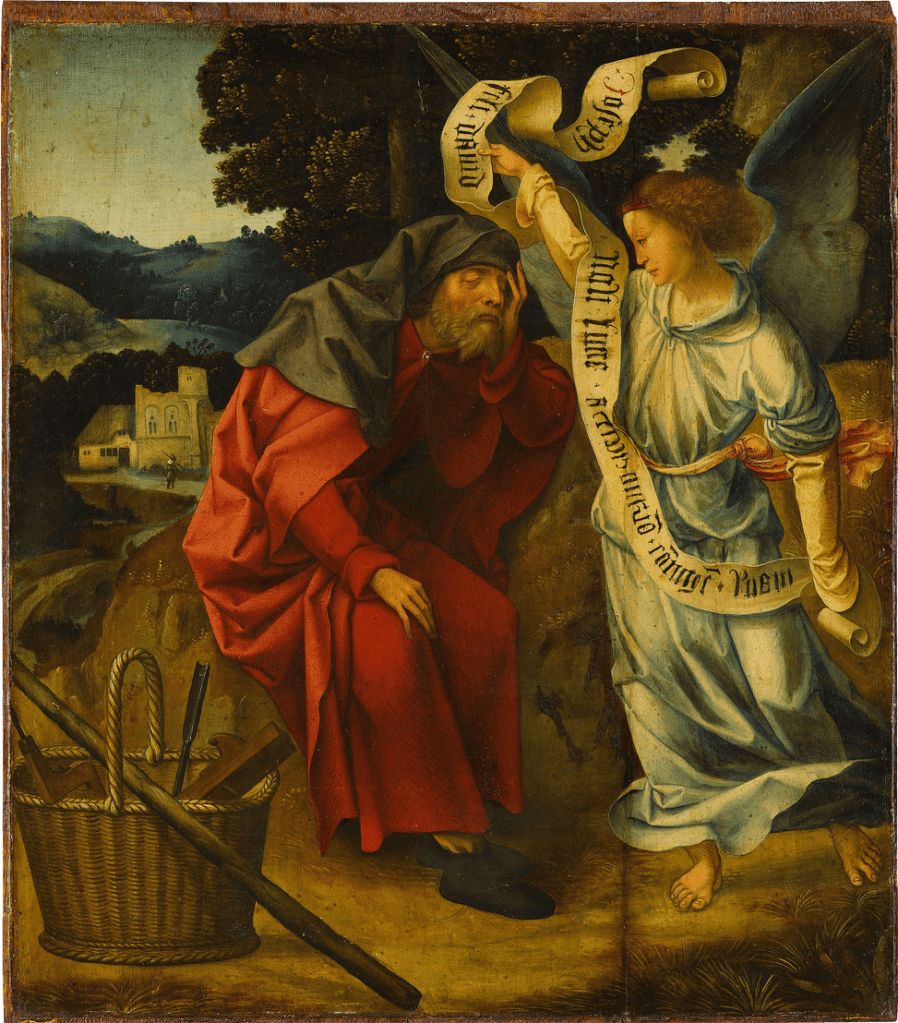
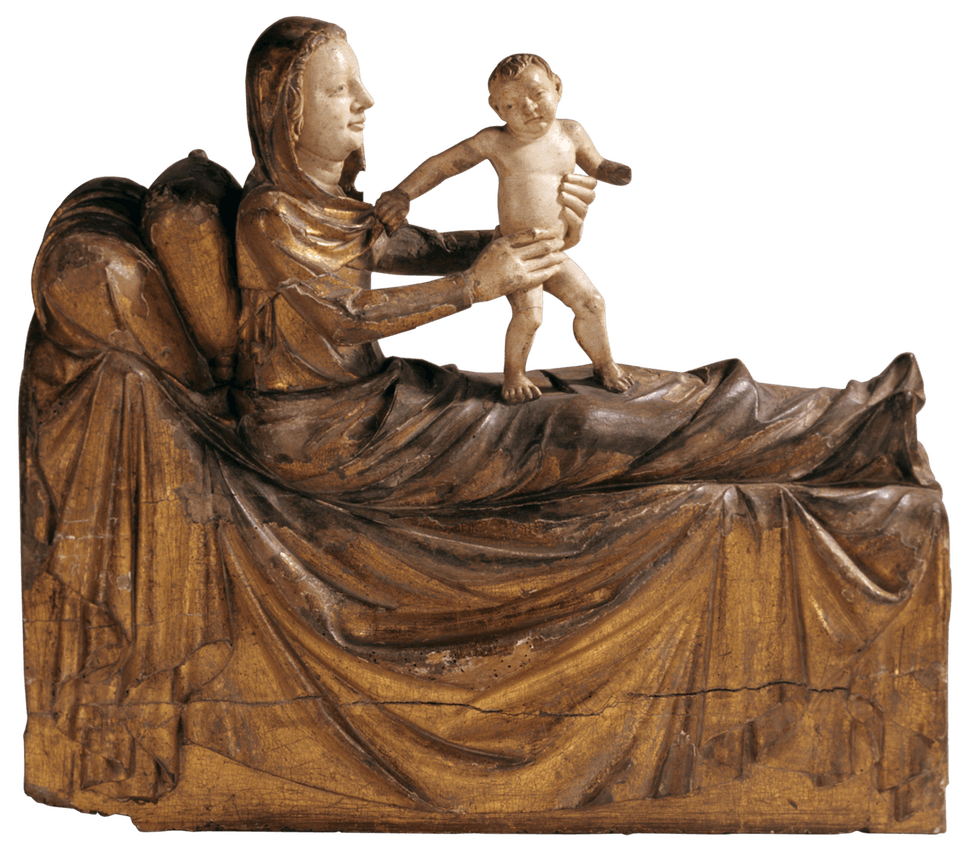
The Angel Appears to Joseph in His Dream, 1518, from the predella of the Antwerp Altarpiece in the Lady Chapel of Saint Mary’s Church, Lübeck, Germany. Mixed media on oak, 46 × 40.2 cm. Staatsgalerie Stuttgart, Germany.The Virgin Mary’s Confinement, Meuse region, ca. 1380. Walrus tooth with remains of the old coating, 51.8 × 58 × 14 cm. Badisches Landesmuseum, Karlsruhe, Germany. Photo: Thomas Goldschmidt.
The “Holy Night” Digitorial is written for a middle-grade reading level, I’d say; some of the narration seems geared toward kids. It doesn’t assume any knowledge of the Nativity story, and in addition to highlights from the biblical accounts, it mentions some apocryphal story elements, like Joseph’s backstory, the midwives at the birth, the palm tree and wheatfield miracles, and the identity of the “kings.” I appreciate how it covers the full story, including Jesus’s circumcision and the flight to Egypt. My only two wishes are that the images were provided in higher resolution and that full credits (especially the collection these objects are from) were given at the bottom.
I really love the Digitorial format! It’s engaging. If I could afford it, I would endeavor to hire web designers to help me produce products like this. This one was designed and developed by Scholz & Volkmer with funding by the Aventis Foundation. More about Digitorials: “Digitorials are short, interactive, online editorials that combine text, images and animations into a meaningful whole and enable innovative storytelling. Digitorials are not intended to replicate or replace physical exhibitions. Rather, they are a useful way of adding breadth and depth, and are usually used before or after visiting an exhibition. The format was developed by the Städel Museum, Liebieghaus Skulpturensammlung and Schirn Kunsthalle in Frankfurt and is breaking new ground in art mediation, as it uses digital technology to offer an accessible and approachable way of engaging with art. It has already been awarded the Grimme-Preis.” See other examples: https://www.staedelmuseum.de/en/digitorial; https://www.liebieghaus.de/de/angebote/digitorial; https://www.schirn.de/en/program/offerings/digitorial/.
+++
SONGS:
>>“Jeg Synger Julekvad” (In dulci jubilo): This Christmas hymn of German origin often appears in English-language hymnals as “Good Christian Men, Rejoice!” or the gender-neutral “Good Christian Friends, Rejoice!” This jazz arrangement by Heidi Skjerve, with Norwegian lyrics by Magnus Brostrup Landstad, is performed by Skjerve (she’s the vocalist on the left) and students from the Norwegian University of Science and Technology (NTNU) Department of Music [previously]. The other two vocalists are Liv Ellen Rønning and Jakob Leirvik. See the full list of musicians in the YouTube description. [HT: Global Christian Worship]
>>“Carol of the Bells,” arr. Al White, performed by the Berea College Bluegrass Ensemble: Al White, who taught Appalachian instruments at Berea College in Kentucky until retiring in May, founded the Berea College Bluegrass Ensemble in fall 1999 to give students with backgrounds or potential in bluegrass music an opportunity to play in a bluegrass band with weekly rehearsals, performances, and travel. This is one of the many arrangements he wrote—sometime around 2008. In this 2016 video, recorded inside Berea’s Danforth Chapel and outdoors, White plays mandolin and leads four other musicians: Brenna Macmillan on banjo and vocals and Theo Macmillan on fiddle (the two are siblings, now performing and recording as the Theo & Brenna Band), Matt Parsons on guitar, and Casey Papendieck on upright bass (he’s part of the Handshake Deals). As of this fall, the Berea College Bluegrass Ensemble is under the direction of Sam Gleaves. [HT: Global Christian Worship]
>>“Peace Upon the Earth” by Hillsong Worship: Since being introduced to Chopin by my piano teacher as a kid, he’s been one of my favorite composers to play—his etudes, nocturnes, waltzes, fantasias. In this 2017 song from Hillsong’s Christmas: The Peace Project, Marty Sampson wrote lyrics for Chopin’s Nocturne in E-flat major (op. 9, no. 2), which actually works really well! It’s a beautiful handling of the iconic melody. Starting at 3:44, Sampson talks about his songwriting process. He says he was inspired by “Hark! the Herald Angels Sing,” which came about when William Hayman Cummings adapted the melody of “Vaterland, in deinen Gauen,” a song from Mendelssohn’s secular Gutenberg Cantata, to fit Charles Wesley’s hymn text.
+++
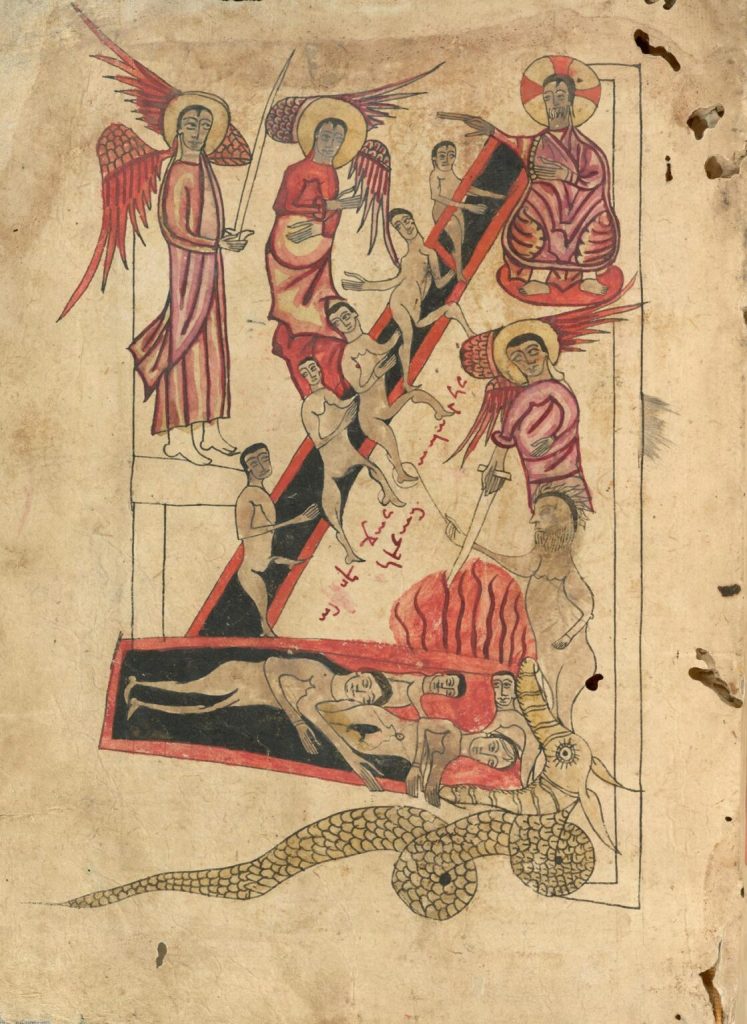
NEW ACQUISITIONS: “2 Armenian Manuscripts Join the Getty Collection”: This year the J. Paul Getty Museum in Los Angeles acquired, among other art objects, (1) a detached leaf with a full-page Nativity illumination from a seventeenth-century Armenian Gospel-book, and (2) a sixteenth-century Armenian Gospel-book illuminated by a brother and sister team, Ghoukas and Eghisabet. (A female illuminator named in an early modern manuscript—woot woot!) “Little is known about the involvement of women in the trade of manuscript illumination, but we hope that highlighting figures like Eghisabet will spark further research and understanding about their role,” write Elizabeth Morrison and Nava Streiter in this Getty blog post.
Mesrop of Khizan (Armenian, active 1605–1651), The Nativity with the Adoration of the Shepherds and Magi, from a Gospel-book made in Isfahan, Persia, 1615. Tempera, gold, and ink on parchment, 23 × 16 cm. J. Paul Getty Museum, Ms. 118 (originally from Ms. Ludwig II 7).Eghisabet (Armenian), The Way into Eternal Life, from an Armenian Gospel-book, 1583. Tempera and ink on parchment, 24.8 × 17.9 cm. J. Paul Getty Museum, Ms. 119, fol. 6v.
Ms. 119 is now the third Armenian Gospel-book in the museum’s collection, and Morrison and Streiter compare one of the illumination subjects side-by-side across all three books—in addition to providing visual comparisons with Ethiopian and Byzantine Gospel-books.
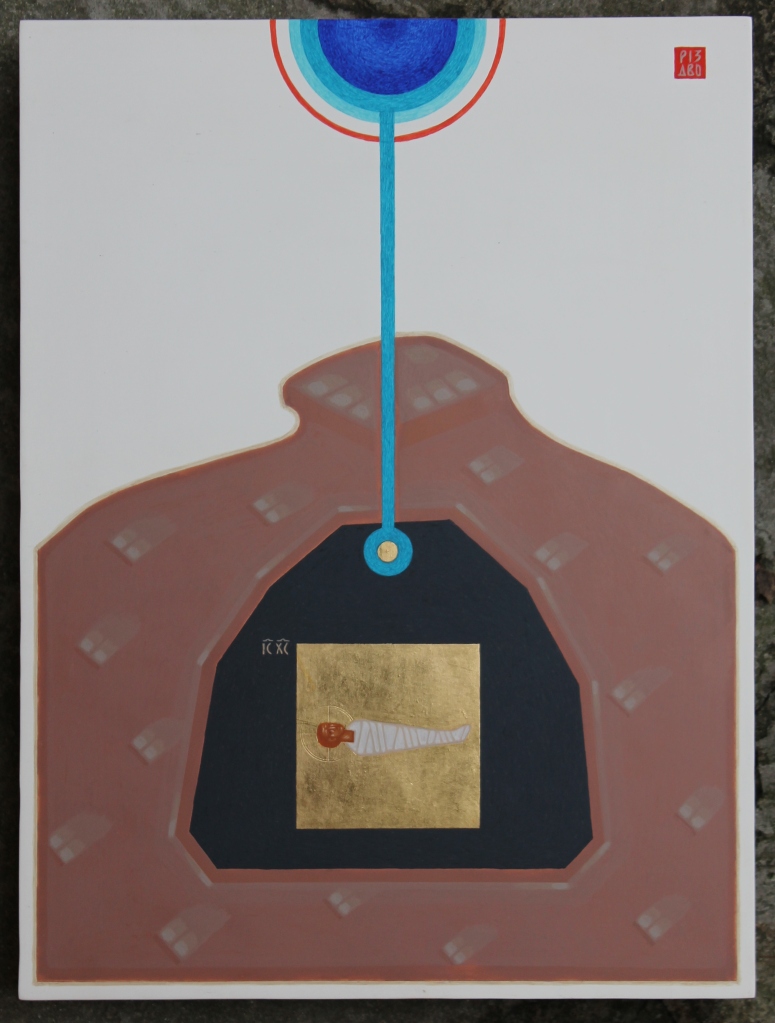
Danylo Movchan (Ukrainian, 1979–), Nativity, 2015. Egg tempera and gilding on board, 32 × 24 cm.
There has fallen on earth for a token A god too great for the sky. He has burst out of all things and broken The bounds of eternity: Into time and the terminal land He has strayed like a thief or a lover, For the wine of the world brims over, Its splendor is spilt on the sand.
Who is proud when the heavens are humble, Who mounts if the mountains fall, If the fixed stars topple and tumble And a deluge of love drowns all— Who rears up his head for a crown, Who holds up his will for a warrant, Who strives with the starry torrent, When all that is good goes down?
For in dread of such falling and failing The fallen angels fell Inverted in insolence, scaling The hanging mountain of hell: But unmeasured of plummet and rod Too deep for their sight to scan, Outrushing the fall of man Is the height of the fall of God.
Glory to God in the Lowest The spout of the stars in spate— Where the thunderbolt thinks to be slowest And the lightning fears to be late: As men dive for a sunken gem Pursuing, we hunt and hound it, The fallen star that has found it In the cavern of Bethlehem.
“Gloria in Profundis” (Latin for “Glory in the Depths”) by G. K. Chesterton is the fifth poem in the Ariel Poems series of pamphlets, published by Faber and Gwyer for the Christmas gift market from 1927 to 1931. It was reprinted in the posthumous Chesterton compilation The Spirit of Christmas: Stories, Poems, Essays(Dodd, Mead, 1985).
PANEL DISCUSSION: “Religious Art,” organized by the Forum for Philosophy: I posted about this live online event a month ago, and now that it’s passed, I want to share the video recording. Theologian Ben Quash (King’s College, London), curator Lieke Wijnia (Catharijneconvent Museum, Utrecht), and art historian Mehreen Chida-Razvi (Khalili Collections, London) discuss the relationship between art and religion, how art can function within religious practice, how to exhibit religious art in a museum, and artworks as sites of conversation across religious traditions.
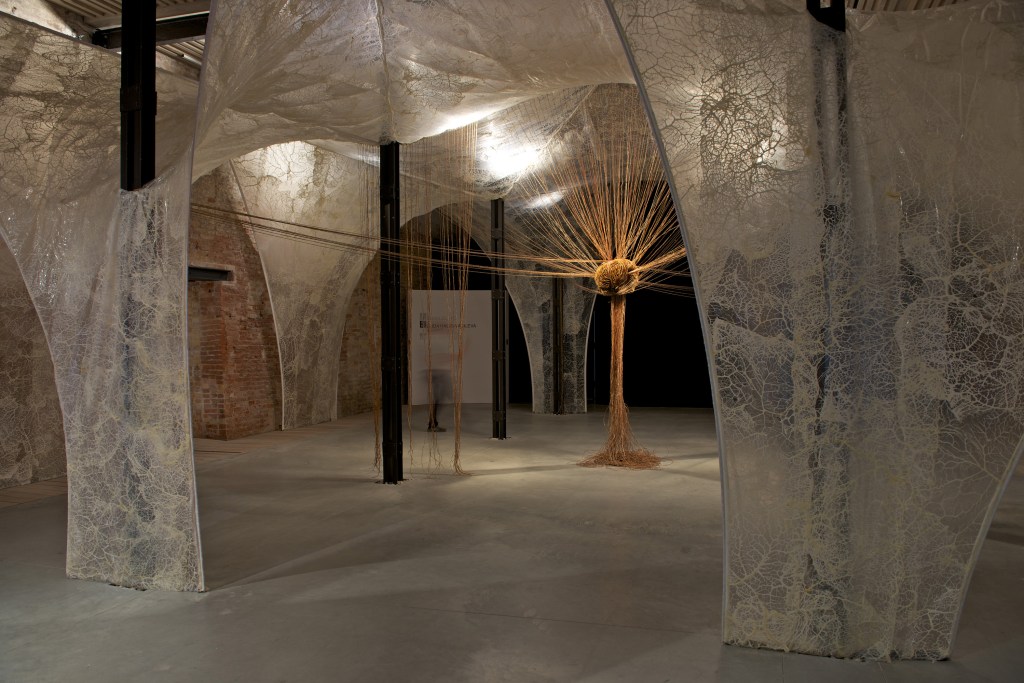
Quash opens by proposing different categories of “religious art”: art for religion, art about religion, art with religion, and art instead of religion. The three unpack those a bit, discussing the intentions of the artist or patron versus how the artwork is perceived by the viewer. Quash mentions Haruspex by Elpida Hadzi-Vasileva (a fascinating installation commissioned by the Vatican for the 2015 Venice Biennale, a contemporary artist’s response to “In the beginning . . . the word became flesh”; read Quash’s essay and an artist interview), the East Window at St Martin-in-the-Fields by Shirazeh Houshiary, the Raphael Cartoons, and Aaron Rosen’s 2016 Stations of the Cross exhibition throughout the city of London, which shows the permeability of the boundaries between sacred and secular. (I participated, as viewer/pilgrim, in a 2019 iteration of the Stations project in Amsterdam.)
Elpida Hadzi-Vasileva (Macedonian, 1971–), Haruspex, 2015. Organic materials. Installation at the Pavilion of the Holy See at the 56th Venice Biennale.
In reference to Hadzi-Vasileva’s canopy of pig’s caul fat, Quash says that challenge or provocation can be a meaningful thing to happen in a religious context:
Works that ambush you are also religiously important, because a sort of religious art that only gives you what you already expect and want quickly becomes kitsch. It’s just a reward of your expectations. And that shouldn’t be what religious art does, it seems to me. It should actually want to take you somewhere else, just as good religion should—it should be transformative, not merely confirming where you already are. So there’s a role for these sorts of artworks within religion as well as outside it.
Chida-Razvi shares slides of Islamic architectural spaces, devotional objects, and manuscript illuminations, including a Mughal painting that exemplifies the interfaith dialogue going on at the court of Akbar in Lahore, and Wijnia shares her experience curating objects people pray with for museum display and (forthcoming) an exhibition on Mary Magdalene. Such great content!
+++
ADVENT SONGS:
“He Comes,” words by Kate Bluett, music by Paul Zach: A lovely new Advent hymn, performed here by Paul Zach.
“The Heavens Shake” by Reindeer Tribe:Reindeer Tribe is a group of friends based in Los Angeles who get together each year to make a live Christmas album, a mix of originals and traditional, sometimes retuned, carols. They bring their voices, instruments, and arrangements and jam together for a long weekend in a big living room. (COVID-19 put the kibosh on this year’s gathering.) This original song, perfect for Advent, is on their 2014 album, A Great Light. “For thus says the LORD of hosts: Yet once more, in a little while, I will shake the heavens and the earth . . .” (Haggai 2:6).
+++
ARTICLE: “We don’t need to be afraid of the Christmas tree’s pagan roots” by Damian Costello, America: Dr. Damian Costello specializes in the intersection of Catholic theology, Indigenous spiritual traditions, and colonial history. In this article he considers how the Christmas tree pictures Christ as the new Yggdrasil (the giant ash tree at the center of the Norse cosmos), and the spiritual character of nature. The second half—about “the hidden agency of trees”—stretches my categories for sure, and I wonder if it’s a bit overwrought, but I’m intrigued by the links Costello draws between the Psalms, Anishinaabe spirituality, and the theology of the Catholic saint John Henry Newman. The article reminds me of Luci Shaw’s poem “Perfect Christmas Tree.”
+++
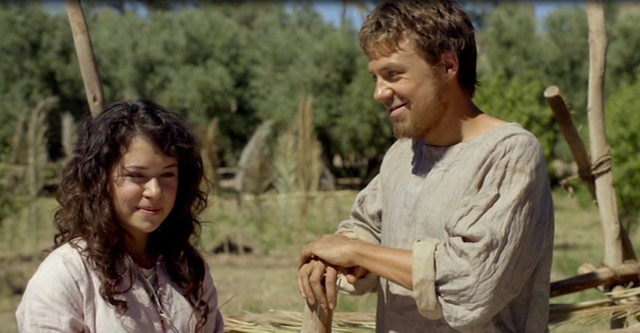
FILM: The Nativity (2010), written and directed by Tony Jordan: I’m always skeptical of film adaptations of the Bible because so many are poorly done. But I gave this four-part BBC miniseries (streaming on Amazon Prime) a shot, and, other than a really cheesy moment during the birthing scene, I thought it was quite good! Writer-director Tony Jordan is not a Christian but approaches the story with the reverent curiosity of a dramatist. He said he never connected with the nativity story until he worked on this project and started to see the very real humans beneath the auras tradition has given the “holy couple”—he saw their earthiness and complexity and began to imagine their emotional lives, especially their reactions to the disruptions they encountered. He said the relationship between Mary and Joseph was key to him. Many storytellers assume that because the marriage was arranged (or because, according to apocryphal sources, Joseph was an old man), there was no passion in their relationship, that they were bound together more by duty than by love, but Jordan, without overly romanticizing, imagines otherwise. The warmth between Mary and Joseph in the first half, which they have to work to regain after news of Mary’s pregnancy hits Joseph like a ton of bricks, is a hallmark of the movie.
Tatiana Maslany (Orphan Black) is probably my favorite Mary I’ve seen onscreen. (I also like Andrew Buchan [Broadchurch] as Joseph.) Jordan says most people see Mary as “a one-dimensional character with a halo round her head,” but actually, “she’s not saccharine. Just a nice kid—real but fallible.” He shows her as virtuous but not a goody-goody, fun-loving and confused and scared and courageous all at once, stepping into her new role by faith without seeing the full picture and even discipling Joseph into that faith. Maslany plays the part brilliantly, endearingly. The film addresses the isolation Mary felt, being rejected not only by her fiancé at first but also by the synagogue leadership and disbelieved, too, by the community she had grown up in. I’ve seen many actors portray Mary as detached, transcending all her difficult circumstances with calm, unshaken resolve. This Mary, by contrast, experiences hurt and fear and yet endures, which, I suspect, is closer to the historical reality. This in no way undermines her faith.
I was delighted by the Annunciation scene, where Gabriel comes to Mary as an ordinary man, much like the angels who visited Abraham generations earlier. He is not wearing ermine or carrying a scepter or standing on a rock above Mary with a booming voice and a heavenly glow. He’s simply a stranger who startles her, even more so when he relays his news. He speaks gently, colloquially. The moment of conception is portrayed as sudden and visceral; Mary feels Light enter her and reacts with a sort of joyful shock.
The trailer and posters, I will say, make the film seem pretty conventional. It does follow some conventions, but it’s also fresh, and while it has some flaws, I think it’s a very worthy use of two hours—it brings this ancient story to life in compelling ways.
In anticipation of the liturgical season of Christmas, I’ve created an extensive playlist of hymns, carols, and spirituals—old and new—that celebrate God’s being born in human flesh. Listen to “Christmastide: An Art & Theology Playlist” on Spotify.
The narratives of Jesus’s birth that we find in the Gospels of Matthew and Luke include both bursts of joyful exuberance, as with the angelic choir above a field of sheep, and quieter, more contemplative moments, such as when Mary pondered “all these things” in her heart (Luke 2:19). Jesus was born into darkness, so the story also involves social stigma, deprivation, military occupation, political greed, infanticide, asylum seeking—and the twinge of a future cross. So while the overall tone of this playlist is one of merriment, it does not shy away from some of the decidedly unfestive aspects of the first Christmas. And yet that God, in love, made himself vulnerable to suffering is precisely what makes the incarnation so glorious. He is not distant from human pains and woes but, rather, right in the midst of them, having experienced them firsthand.
The song selections reflect my personal taste for indie folk and newgrass, so they include, for instance, the Oh Hellos, Sufjan Stevens, Wilder Adkins, Branches, Beta Radio, the Brilliance, Lowland Hum, Penny and Sparrow, the Lower Lights, the Walking Roots Band, Folk Hymnal, Steve Thorngate, Sam P. Bush, Found Wandering, Ordinary Time, and Garrett Viggers.
Gospel songs performed by artists like Mahalia Jackson, the Staples Singers, Isaac Cates, Mariah Carey, Whitney Houston, and Liz McComb also make an appearance, as do many African American spirituals, sung by Odetta, Harry Belafonte, Elizabeth Mitchell, and others. “Go Tell It on the Mountain” is the most widely known from that repertoire.
Also from America is the eighteenth-century carol “O Sight of Anguish” by Samson Occom, a Presbyterian minister and member of the Mohegan nation. New England roots musician Tim Eriksen sings it a cappella on Every Sound Below, but in this outdoor video he plays it on bajo sexto:
(Oh how I wish Ericksen’s marvelous Star in the East album were on Spotify, which features thirteen more songs in this vein!)
The Carols for a Cure album series, made up of contributions from Broadway casts, adds some theatricality. The cast of Nine, for example, sings “Los Peces en el Río,” a traditional Spanish carol in which Mary goes about her daily tasks—combing her tangled hair, washing Jesus’s diapers—as the fish in the river swim excitedly toward the newborn Savior. It’s sung by Antonio Banderas.
In addition to this and the twelfth-century “Friendly Beasts,” another song that focuses on the animal characters at the nativity is the punchy “A Stick, a Carrot, and a String” by mewithoutYou, which sounds like it belongs on the Juno soundtrack. It’s wonderfully quirky.
Of course the Christmas playlist includes tons of classics—“Joy to the World!,” “Angels We Have Heard on High,” “Silent Night,” and so on—multiple renditions, in fact. (It’s too hard to choose just one!) There’s an upbeat swing arrangement of “O Holy Night,” but there’s also a more subdued, ethereal arrangement by Katie Melua, and several more besides. It’s fun to see how different artists interpret the same song.
The Irish folk rock band Rend Collective gives us a raucous arrangement of “Ding Dong Merrily on High,” retaining some of the archaicisms in the original lyrics but rewriting verse 3. A competing team at One Way UK’s 2017 Puppet and Creative Ministry Festival in Rugby, Warwickshire, used this song as the basis of a super-entertaining puppet performance! This made me smile.
You may be wondering, “Where’s all the choral music?!” While I do enjoy that genre, especially at Christmas, I’ve decided to exclude such songs in this list (1) to prevent it from becoming too unwieldy and (2) because I have to do a lot more searching and comparison to find the best recordings.
(Update, April 2022: I’ve decided to add several dozen choral selections to the playlist! While I considered creating a separate list of Christmas choral music, I’ve decided that I prefer an integrated approach, which is also why I scattered such songs throughout, giving some stylistic variety to those who prefer to listen to the playlist in order. My hope is that those who don’t normally go seeking out this genre will be surprised to find pieces that resonate with them.)
Merry Christmas, friends! May you rejoice in Christ with exceeding great joy, he who “comes to make his blessings flow far as the curse is found.” Amen.
“An Advent Visio Divina” by John Skillen, CIVA blog: John Skillen, author of Putting Art (Back) in Its Place, discusses four works of Advent-themed art from Italy, where he lives for part of each year leading retreats and seminars through the Studio for Art, Faith & History. He starts in Florence with The Adoration of the Shepherds altarpiece by Renaissance artist Domenico Ghirlandaio, which invites worshippers to follow the shepherds’ (and patrons’) example of adoring the Christ child. Then he moves to Orvieto, spotlighting Karin Coonrod’s directing a medieval mystery play in the city’s streets and churches. (For more on this, read Skillen’s excellent essay in Image no. 96, “Fierce Mercy: The Theater Art of Karin Coonrod.”) Advent is also about the second coming, so Luca Signorelli’s apocalyptic frescoes in the Chapel of San Brizio in Orvieto Cathedral are appropriate. Continuous, in some ways, with these late fifteenth-century paintings are the bronze reliefs on the central doors by Emilio Greco from 1962; they depict the seven works of mercy, the criteria, according to Matthew 25, by which humanity will be judged.
Actor Patrice Johnson portrays Mary, who carries the light of the world, in this contemporary adaptation of The Second Shepherds’ Play directed by Karin Coonrod. Photo: Massimo Achille.Luca Signorelli (Italian, ca. 1441/45–1523), Sermon and Deeds of the Antichrist (detail), 1499–1502. Fresco, Chapel of San Brizio, Orvieto Cathedral, Italy. The Antichrist is shown as a puppet of the Evil One.
“Passion for the Light” by Alexandra Jean Davison, ArtWay: For last Sunday, the first day of Advent, Culture Care RDU Director Alexandra Jean Davison wrote this wonderful meditation on a set of contemporary sculptures by Jaume Plensa at the North Carolina Museum of Art, connecting them to the season we’re in. She begins, “We see three identical nudes filled with light, the face and arms covered with names and Scripture. Each figure sits at rest horizontally on one of the three walls which form a triangle. The closed eyes and mouth are covered with embossed text of the names of the eight gates of the ancient city walls of Jerusalem: New, Herod, Damascus, Golden (two doors: Gate of Repentance and Gate of Mercy), Lions, Jaffa, Zion, and Dung. Tattoo-like passages from the Song of Songs emerge from the heart upon the arms.” Read more at ArtWay.eu.
Jaume Plensa (Spanish, 1955–), Doors of Jerusalem I, 2006. Resin, stainless steel, and light, 47 1/4 × 62 3/16 × 80 11/16 in. (120 × 158 × 205 cm). North Carolina Museum of Art, Raleigh. Photo: Victoria Emily Jones.
+++
VIDEO: “Matthew 1:18-23” by SALT Project: The Emmy Award–winning production company SALT Project released a short video this week setting a reading from Matthew’s Gospel (“This is how the birth of Jesus came about . . .”) against evocative time lapses of blooming flowers. They’re generously offering it for free download and use in worship services, online or in-person. It could be used as an opener, as one of the morning’s scripture readings, or in a number of other ways.
+++
SONGS (the latter two released this week!):
“Christ Child’s Coming”: This simple Advent song is based on the African American spiritual “The Train Is a-Coming” (where “train” is a multivalent metaphor having to do with salvation). While a musician at Christ Church East Bay in Berkeley, California, Keith Watts adapted the lyrics to relate more explicitly to Advent: “Christ child’s coming, oh yeah!,” “Light is coming, oh yeah!,” and “Our king’s coming, oh yeah!” The song is sung here by Trinity Majorins, accompanied by her mom, Sarah [previously], on the piano and her dad, Philip [previously], on guitar.
“Weight/Wait” by Mike McMonagle: “Hope . . . flicker[s] underneath the weight of the wait.” Introducing this new demo, Mike McMonagle, a roots rock musician from Lancaster, Pennsylvania, wrote on Facebook about how the pandemic has created an extended season of waiting in the darkness this year, which has helped him to feel both pain and longing more keenly: “For the past couple of months, I’ve found myself processing all the ups & downs of the current life experience in step with what I’d label the deepest dive into the Advent season that I’ve ever done. All my life, Advent was just a church-y word for rat race otherwise known as The Holidays. There were happy hours, shopping trips, family outings – things that made it hard to focus on the Advent season for more than an hour each Sunday. This year has been different.”
“In Distress” by the Pharaoh Sisters: Written by Austin Pfeiffer and Jared Meyer and based on Psalms 120 and 121, this song blends Latin and Appalachian folk music influences and has lyrics in both English and Spanish. “The song’s creation began in the spiritual angst after the 2016 [US presidential] election,” Pfeiffer writes. “Calling on believers to put their hope in Christ as King, the song has broad themes of Kingdom orientation, raises questions about social divisions, but also leans into Advent ideas, specifically Isaiah 9.” It premiered at the 2017 Presbyterian Church in America (PCA) General Assembly but didn’t end up fitting on the Pharaoh Sisters’ 2020 debut album, Civil Dawn. “Now as our nation plunges deeper into distress and unrest, be it political and/or social, the band is eager to release the song for Advent 2020.”
+++
ONLINE PANEL: “Religious Art,”December 9, 6:00–7:15 p.m. London time (1:00–2:15 p.m. ET): “The relationship between religion and art is ancient and complex, varying across religious traditions and cultures. In this event, Mehreen Chida-Razvi, Ben Quash, and Lieke Wijnia consider how these traditions of religious art differ and what role art plays in religion today. How should we display religious art? Might art be a way of opening interfaith dialogue? And has art itself become a kind of religion?” This free Zoom event is organized by the Forum for Philosophy and the Department of Philosophy, Logic and Scientific Method at the London School of Economics. I’ll be attending! (Note: The promotional image below is David LaChapelle’s Last Supper.) Update, 12/10/20: The panel discussion has been archived and can be viewed here.