Playlist: Funeral Songs: The Christian Hope of Life After Death

Death is hard. No matter your religion and its consolations, whether you’re the one dying or you’re saying goodbye to someone who is or has, it’s often a painful ordeal.

For the Christian, death holds a tension. It’s something to grieve, as Jesus did at the grave of his friend Lazarus; it was not part of God’s original design and so in that sense is not “natural,” even though it’s inevitable. We can and should mourn its power to (at least temporarily) sever. But death can also be something to celebrate if the deceased was in Christ, since as the apostle Paul wrote, “to be absent from the body [is] to be at home with the Lord” (2 Cor. 5:8), in a state of blissful rest.

Christians regard death as an entrance to the dwelling-place of God that we call heaven or paradise. Contrary to popular conception, that heaven is not our eternal home—not really. It’s a temporary holding place for the souls of the Christian departed, who await the general resurrection, at which time our souls will be reunited with our bodies and heaven will be remade and brought down to a new earth, where we will dwell forever, as whole, embodied persons, vibrant and active, with God. That, as the New Testament scholar and theologian N. T. Wright has been reiterating for decades, is our ultimate hope: not an ethereal existence in the skies, but physical resurrection, cosmic renewal, and God making his forever home with us here. The joining of heaven and earth—God’s space and ours—in a lasting embrace.

When my paternal grandpa passed away in May 2017, I began building a private Spotify playlist of songs about death to help me move through that loss. I’ve been adding to it for the past nine years, and now I want to make it public.

I hesitated for a while on whether to share the list, because I worry that overall, it does promote a lopsided hope, a truncated view of what eternal life looks like. Wright’s Surprised by Hope: Rethinking Heaven, the Resurrection, and the Mission of the Church was paradigm-shifting for me, and I’ve wrestled with its implications on the theologies we articulate, including through song, at funerals. Wright decries how Platonism, with its degrading of bodies and of the created order in general, has infected whole swaths of Christian thinking, misleading people into supposing that Christians are meant to devalue this present world and our material selves; that our goal is to escape them both.

The early Christian hope was not, Wright declares, to be rescued from this world, but to be rescued with and for it: that is, that the world itself, people included, would be liberated from its present state of corruption and decay. They centered this hope firmly on the resurrection. They talked very little about “going to heaven” when they died; instead, they emphasized the promise of the dead being raised on the last day to image God in a new bodily existence in a newly remade world. If they did refer to heaven as a postmortem destination, Wright says, those early Christians seemed to regard it as a temporary stage on the way to the eventual resurrection of the body.

Wright laments that so many Christian songs look forward chiefly to “life after death” (the intermediate state, entered immediately after one’s death, in which one’s soul resides in heaven while one’s body remains “asleep” in the grave) instead of “life after life after death” (the eschaton; the resurrection; the descent of the New Jerusalem; the new heavens and new earth), which is God’s whole telos. This glut of songs that focus on the prelude to eternal life as the biblical authors envisioned it has contributed to many Christians’ ignorance of the two-step narrative of life after death, with step two being what we should really be singing about.

I get what Wright is saying. But I think he sometimes overstates his points. He hates the phrase “going to heaven,” preferring instead “heaven coming to earth”—and yet “going to heaven” does accurately describe what the Christian soul does at the moment of bodily death. He also disparages lyrical expressions like “way beyond the blue,” “a faraway strand,” “up over yonder,” “the great beyond,” anything that suggests otherworldly distance . . . but again, if what is being described is that interim place of souls where God’s throne currently is, which is outside the space-time continuum but for which the Bible uses directional “up” language, such descriptions seem to me to be appropriate.

And the word heaven, I feel, can also encompass the final reality: the marriage of heaven and earth. I see the word as shorthand for “where God is.” Of course, Wright is correct that heaven-as-stopover (out there and we as incorporeal) and heaven-as-new-creation (right here and we gloriously corporeal) often get muddled in our songs, and that greater theological precision might be warranted. But we also have to consider the limits of sung verse—especially particular forms, like the spiritual, which is meant to be simple and repetitive so as to be transmitted orally—to convey nuanced ideas or to express all aspects of a given theme.

Wright also eschews the “just passing through” spirituality that infuses much hymnody, folksong, and preaching—the idea that earth is not our home; heaven is. That idea, he claims, treats the world as irrelevant at best and evil at worst, when in fact, God loves the world and wants to and indeed will redeem it, not evacuate us from it. This earth will be transformed one day into our eternal habitation.

I do agree that there’s a dangerous strand of escapist theology that has arisen in Christianity, which nurtures aspirations to flee the world, to regard is as mere dross and so to care nothing for its welfare. But I also don’t automatically dismiss hymns that describe this present life as “night,” for example, or that mention “earth’s vain shadows”—Wright negatively references both in Surprised by Hope. This present world is incomplete. It’s groaning for redemption, and we in it. We see through a glass darkly. We often stumble. We’re tempted to pursue pleasures or glories that are ultimately empty. Pain, toil, and fragmentation are part of the human experience. I think it’s right that we don’t feel entirely at home here, even as we anticipate God’s future purposes for the world—healing, transforming—through concrete actions, living as new-creation people. The apostle Paul says we’re citizens of heaven (Phil. 3:20), which is in part where the concept of “our heavenly home” comes from. The kingdom of heaven is the place from which Christ reigns. And yes, one day that will be earth, but right now, it’s not.

In the grand scheme of things, our mortal existence is short—so the idea of us being transient between this life and the next is not, I think, out of step with the biblical view, many passages of which comment on life’s brevity and the fleetingness of the flesh, which fades like grass.

While Wright stresses the continuity between earth as it is now and earth as it will be, there is also—and he does concede this—discontinuity. The earth will be itself and yet radically new when God re-creates it. It will be somehow both familiar and other. The same is true of our bodies, which—hallelujah!—God redeems along with our souls. (We are saved not as souls but as wholes, Wright quips.) These bodies we have now are good, yes, but they also break down and can be burdensome—hence why so many Christian songs of death express a yearning to cast off the body. Even the apostle Paul, in Romans 7:24, bemoans, “Who will deliver me from this body of death?” Like Wright, though, I do wish there were more songs that coupled that desire with the anticipation of a renewed body, as Paul does, instead of suggesting that a bodiless existence is the consummate state. As Wright argues, a focus on the soul’s immortality, on leaving the body behind, is a distraction from the supreme hope of the resurrection.

The funeral song that theologians, both professional and armchair, love to hate on most for its supposed Gnosticism is the Southern gospel classic “I’ll Fly Away” by Albert E. Brumley. They object to its anti-this-worldly stance that celebrates the soul’s breaking free “like a bird from prison bars has flown” (“no more cold iron shackles at my feet”), which implies that this world or this body, or both, is a prison keeping our true self captive. But is that sentiment not in some ways consonant with Romans 8:19–21, which says that “the creation waits with eager longing . . . [to] be set free from its bondage to decay and . . . obtain the freedom of the glory of the children of God”?

I see how the metaphor of the body as a prison can be problematic, but imagine it from the perspective of a person in advanced age, losing their vision, hearing, speech, reason, memory, strength, dexterity, mobility, bowel control, appetite, and so on. Or someone with chronic illness, or a debilitating disease, or on life support. That’s not at all to say such people should just die, or that they bear God’s image any less—but for them, life in the body is an immense struggle, and if they long to leave it to be with God, that’s not sinful or misguided. Many faithful Christians throughout history have prayed that God would take them or their loved one out of this life, out of their suffering.

The refrain “I’ll fly away” is actually mentioned in two biblical psalms:

My heart is in anguish within me;
    the terrors of death have fallen upon me.

Fear and trembling come upon me,
    and horror overwhelms me.

And I say, “O that I had wings like a dove!
    I would fly away and be at rest;

truly, I would flee far away;
    I would lodge in the wilderness; Selah

I would hurry to find a shelter for myself
    from the raging wind and tempest.”

—Psalm 55:4–8

For all our days pass away under your wrath;
    our years come to an end like a sigh.
The days of our life are seventy years
    or perhaps eighty, if we are strong;
even then their span is only toil and trouble;
    they are soon gone, and we fly away.

—Psalm 90:9–10

I wouldn’t program “I’ll Fly Away” for a Sunday morning worship service, but I happen to think it’s a great funeral song—I’ve included three different versions on my playlist, first from the movie soundtrack that in 2000 popularized it for a new generation—expressing an exuberant sense of release from suffering and joy in meeting God. I’d leave it to the preacher, and a fuller song set, to place it in context of the greater Christian hope of the resurrection of the body and the renewal of this world.

SONGWRITERS: To you I extend the challenge of expanding the repertoire of Christian music about last things, composing songs that capture the grander biblical vision of God’s intent for what he’s made. Give us new songs that anticipate the merging of heaven and earth! That trace the line of new creation from Jesus’s resurrection to our own. That celebrate not so much our going to live with Jesus when we die as Jesus’s coming to live with us when he brings his kingdom project to full fruition. Help us to see the goodness of our bodies and the world and to treasure God’s promise to redeem both; enlarge our concern about final destinies to encompass the whole cosmos, reorienting our hope around being raised to life in God’s new heaven and new earth. Remind us that our labor on earth is not in vain but will last into God’s future. Draw together Genesis 1–2, Isaiah 65, Romans 8, 1 Corinthians 15, 2 Peter 3:13, and Revelation 21–22.

In his engagement with Wright’s Surprised by Hope and what it means for funeral reform, John L. Drury suggests “we can still talk about grandpa going to heaven and being with Jesus. We just need to also talk about grandpa coming back with Jesus to reign with us in the new heavens and the new earth.” He advises that “one must also transform the language describing the present state of the person to express its interim character. We can still say they have gone to a better place, but we must then immediately modify this by saying that they will one day enter the best place of all, the new creation. We can still say they have entered into rest, but we must then immediately modify this by saying they are resting in the sense of waiting, waiting for the final act in God’s story.”

Why have I spent so long discussing Wright in this article that is supposed to be introducing a playlist of funeral songs? Because his teachings on eschatology, which includes the subject of heaven, have been vastly influential, not just for me but within Protestantism at large.

No doubt he will object to some of the entries on my “Funeral Songs” playlist. In building it, I eliminated some egregious offenders, but I feel comfortable putting forward these remaining songs. Even if some refer primarily to the deceased’s temporary residence “on high” or temporarily immaterial state—rather than their final, physical state in restored creation, i.e., the new heavens and the new earth—there’s still value in celebrating this initial phase of postmortem life they’ve entered. At funerals, it’s good and right to look forward to the consummation of all things, but it’s also good to assure those who grieve that their late beloved is presently in a place of rest, joy, and refreshment. It’s “home” insofar as home is where God is.

Consider the different metaphors for death represented in the playlist: Crossing the Jordan River into the promised land. Summiting a mountain. Culminating a pilgrimage. Laying down a burden. A valley. A sunset, to be followed by dawn. Death as a mode of transport, by train, chariot, or even airplane! The safe arrival of one’s ship, after a turbulent journey, into harbor. Death is conceptualized in terms of homegoing, meeting Jesus face-to-face, reunion with family, freedom, happiness, repose, healing, inheritance, victory, glory. It’s a threshold into an indescribable new reality.

Some songs incorporate descriptions of heaven or the New Jerusalem drawn from scripture, which have unfortunately become hackneyed: pearly gates and gold-paved roads (Rev. 21:21), mansions (John 14:1–3), harps (Rev. 5:8; 15:2), angelic choirs, white robes (Rev. 7:9–14) and gleaming crowns (Rev. 2:10). Concentrated mainly in the book of Revelation, these details were the writer John’s attempts to convey something of the beauty, purity, perfection, and grandeur he saw in his heavenly visions.

The playlist opens and closes with “I Bid You Goodnight,” aka “The Christian’s Good Night” or “Sleep On, Beloved,” a hymn for the lowering down of caskets written in 1871 by Sarah Doudney, with music, in 1884, by Ira David Sankey. (View the sheet music.) It was sung at the funeral of the preacher Charles Spurgeon in 1892. It later made its way to the Bahamas, where it was adapted and recorded in 1958 and 1965 by Joseph Spence and the Pinder Family. Spence’s sister, Edith Pinder, sings lead, ad-libbing a number of calls in the latter half, such as “One of these mornings, bright, early, and soon,” “Walkin’ through the valley of the shadow of death,” “His rod and staff shall comfort me,” “Goodness and mercy shall follow me on,” “John Divine said, ‘I saw the sign,’” and “Gonna walk in Jerusalem just like John.”

The Spence-Pinder recordings became the basis of subsequent folk versions in the US, such as the one that the Grateful Dead often closed their concerts with, and my two favorites: by Kent Gustavson (below) and Sweet Honey in the Rock. These all utilize only the first verse of Doudney’s original seven.

Lay down, my dear brother [sister, mother, father], lay down and take your rest
Won’t you lay your head down upon your Savior’s breast
I love you, but Jesus loves you the best
I bid you goodnight, goodnight, goodnight

The hymn wishes the departed a pleasant sleep before their eternal waking at the resurrection.

Since I shared one of my mom’s funeral picks above (“I’ll Fly Away”), now let me share one of my dad’s: “Peace in the Valley,” written by the Black gospel songwriter and musician Thomas A. Dorsey. Watching reruns of The Ed Sullivan Show, my dad would call me and my brother to the TV whenever Elvis’s performance of this song came on from the January 6, 1957, episode. As he would regale us every time: “The producers didn’t want him to sing a gospel song on national television. They just wanted his rock and roll. But he insisted. It was his mom’s favorite song. He said he wouldn’t do the show if they didn’t let him sing it.”

The Ed Sullivan performance leaves out the second verse, likely for time—it’s included in Elvis’s studio recording released a few months later—but its imagery provides a fuller picture of peace, drawing on the description of the messianic kingdom in Isaiah 11:

Well, the bear will be gentle, and the wolves will be tame
And the lion shall lie down by the lamb, oh yes
And the beasts from the wild shall be led by a child
And I’ll be changed, changed from this creature that I am, oh yes

Dorsey wrote the song as world tensions were mounting in the late 1930s, just prior to World War II. Traveling by train through Indiana, he observed horses, cows, and sheep grazing together in a small valley and wondered why humans across nations couldn’t live peaceably with one another, as these animal species were, sharing the grass. This was also a time of racial terror in America, of lynchings and other acts of anti-Black violence. “Peace in the Valley” asserts that the violence of the world will one day be undone, when creation is made new.

I like the Lower Lights’ rendition.

Another famous gospel song by Dorsey is “Precious Lord, Take My Hand.” Hearing it makes me emotional because a dear elderly friend from my church, who has since passed away, often requested it in worship. Here’s a gorgeous arrangement by Arnold Sevier, performed by the Aeolians of Oakwood University:

The genres of gospel, blues, and spirituals are heavily represented in the playlist, all birthed out of the African American experience.

The spiritual “Trouble of the World,” or “Soon-a Will Be Done,” is another song that sounded from my family television set many a time in my childhood, during my dad’s at least once-yearly watch of the 1959 film Imitation of Life. The funeral scene, which features Mahalia Jackson singing this solemn yet triumphant song that originated on Southern plantations during the era of slavery, always got him weeping:

While songs like this convey weariness, others burst with jubilation, like “Joy” by Ruthie Foster, from her 2002 album Runaway Soul:

“When I Get Home,” a traditional revival hymn performed by Elizabeth Mitchell with Dan Zanes, is more gently joyous. They based their version on a 1958 recording by Elizabeth Cotten, who recalled the song from her youth in North Carolina:

For a Christocentric song, consider Andy Zipf’s rendition of “Immanuel’s Land,” aka “The Sands of Time Are Sinking.” The hymn was written by Anne Cousins in 1854 and is traditionally sung to the tune RUTHERFORD, composed by Chrétien Urhan in 1834. Zipf sings three of its nineteen stanzas.

Oh! Christ, he is the fountain,
The deep sweet well of love!
The streams on earth I’ve tasted,
More deep I’ll drink above:
There, to an ocean fullness,
His mercy doth expand,
And glory—glory dwelleth
In Immanuel’s land.

Oh! I am my Belovèd’s,
And my Belovèd’s mine!
He brings a poor, vile sinner
Into his house of wine:
I stand upon his merit,
I know no other stand,
Not e’en where glory dwelleth
In Immanuel’s land.

The bride eyes not her garment,
But her dear bridegroom’s face;
I will not gaze at glory,
But on my King of grace;
Not at the crown he giveth,
But on his piercèd hand:
The Lamb is all the glory
Of Immanuel’s land.

There are also a few choral pieces on the playlist, including “Goin’ Home,” an adaptation of the English horn melody from the second (Largo) movement of Antonín Dvořák’s New World Symphony by one of Dvořák’s students in America, William Arms Fisher, who also added lyrics. Though Fisher says the composition was inspired by African American spirituals, it’s not Christian-specific, but it is compatible with Christian belief, its speaker “just goin’ home . . . through an open door,” to where friends and family are waiting; “nothin’ lost, all’s gain. . . . Real life’s just begun.” The arrangement sung by VOCES8 in the following video is by Jim Clements.

The Silkroad Ensemble, renowned for its unique cross-cultural collaborations, recorded the song in Mandarin and English, featuring Abigail Washburn on lead vocals and banjo, Wu Tong on backing vocals and sheng, Yo-Yo Ma on cello, Johnny Gandelsman on violin, and Kinan Azmeh on clarinet.

As for songs of the end that consider the natural world, I recommend “Over the River” by Jon Foreman, the lead vocalist of Switchfoot. It’s from his 2008 solo album Limbs and Branches:

Hush, hush, hush, hush

I heard a sound come from the ground
All of the trees are a-buzz
Talking in tongues, talking with lungs
Talking of freedom

All of the earth is soon to give birth
Look at the mountains alive
Birds and the bees, insects and leaves
All of us longing, longing for home
Home, home is somewhere I’ve never known

Refrain:
Over the river
Over the river
I’ve set my hope
Over the river
Over the river
I’ll find my hope in You, You

Death, where is your sting?
Your signet ring?
Where is your power?
Why all this war?
Death to the score
Nations are fading

Kingdom of light, setting us right
Finally human
Give me a tongue
It will be done
Inside I’m longing, longing for love
Love, love is something I’ve never known

Thoughtful lyrics are also a hallmark of the folk trio Ordinary Time, who have several songs on the playlist, two with original words and one that sets a passage, lightly adapted, from the final chapter of Augustine’s City of God, titled “All Shall Be Amen Alleluia.”

All shall be Amen, Alleluia
We shall rest and we shall see
All shall be Amen, Alleluia
We shall see and we shall know
We shall know and we shall love
We shall love and we shall praise
All shall be Amen, Alleluia
Behold our end which is no end

For songs on the playlist that I’ve previously featured on the blog, see:

Moreover, there are many hymns that build to a final stanza about death, heaven, or resurrection, several of which are funeral classics:


This is just a sampling of the nearly two hundred songs on the “Funeral Songs” playlist. Note that even though I’ve subtitled the list “The Christian Hope of Life After Death,” I mean that to include both the first and final phase of that life, both the soul’s immediate ascent to heaven and its ultimate reuniting with the raised body on a renewed earth—though as I’ve mentioned, existing catalogs skew heavily toward the former, and we’re in need of better balance that reflects Christians’ central hope of resurrection.

What songs have brought you comfort after the death of a loved one or are helping you face your own death? Is there a particular one you want sung at your funeral?
Funeral Songs playlist
Cover art: The New Jerusalem, watercolor by Lisbeth Zwerger from Stories from the Bible

Advent, Day 20: New Jerusalem

And I saw the holy city, the new Jerusalem, coming down out of heaven from God, prepared as a bride adorned for her husband.

—Revelation 21:2

LOOK: Epiphany of the Other by Richard Kenton Webb

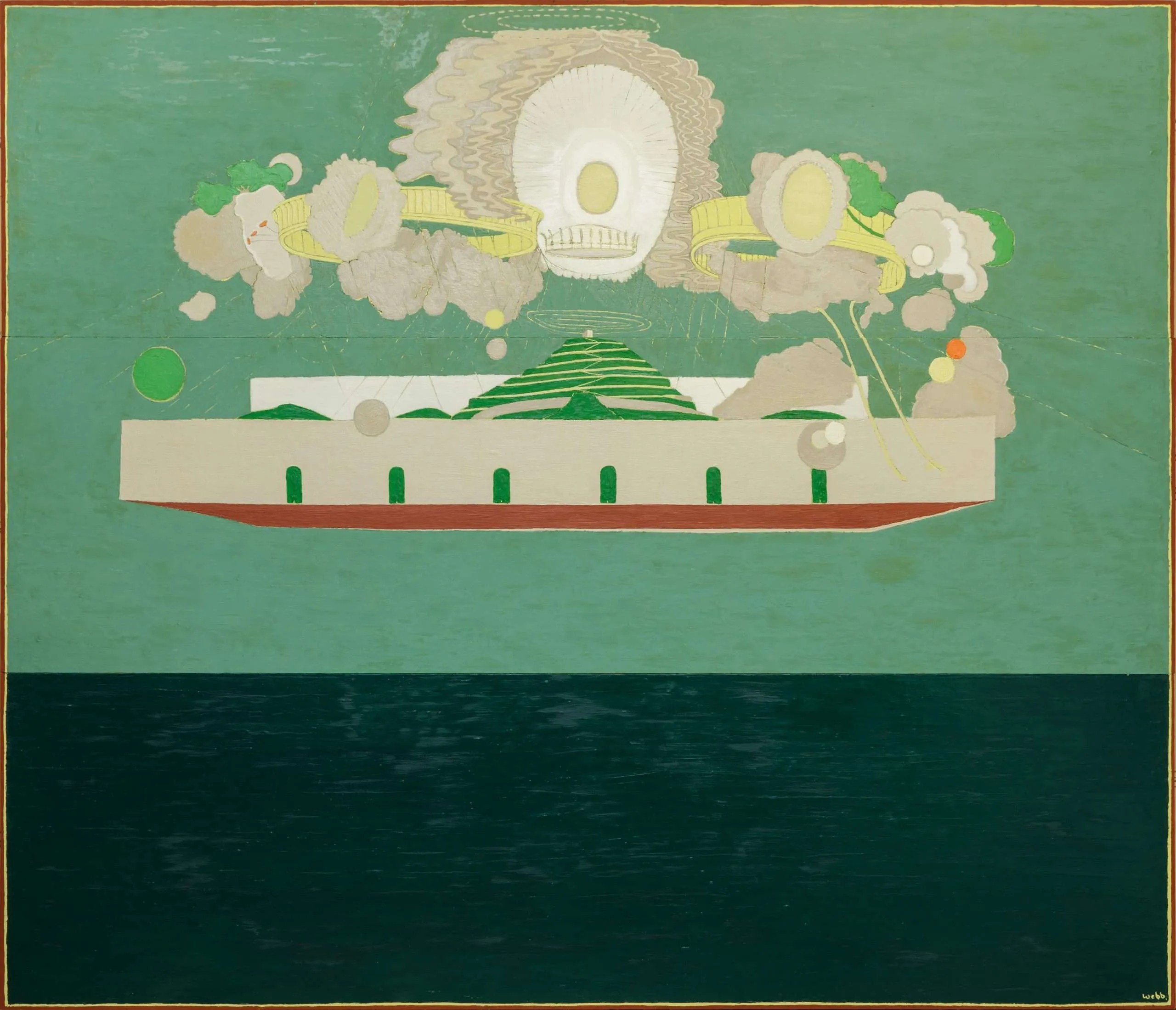
Webb, Richard Kenton_Epiphany of the Other
Richard Kenton Webb (British, 1959–), Epiphany of the Other, 2023. Oil pigment on plywood, 183 × 214 cm.

(Related posts: https://artandtheology.org/2017/10/10/grief-and-loss-will-be-undone-artful-devotion/; https://artandtheology.org/2021/12/13/advent-day-16/)

LISTEN: “How Long, Dear Savior” (NORTHFIELD) | Words by Isaac Watts, 1707 | Music by Jeremiah Ingalls, 1805 | Performed by the Boston Camerata, dir. Anne Azéma, 2020

How long, dear Savior, O how long
Shall this bright hour delay?
Fly swifter round, ye wheels of time,
And bring the promised day.

From the third heav’n where God resides,
That holy, happy place,
The new Jerusalem comes down
Adorned with shining grace.

An American Christmas is one of the Boston Camerata’s most popular programs. “It features a generous selection of carols, New England anthems, Southern folk hymns, and religious ballads for the season from the early years of the American republic, and from a wide range of early tune books and manuscripts”—including the shape-note hymn “How Long, Dear Savior” from The Christian Harmony (Exeter, New Hampshire, 1805), an arrangement of a stanza from Isaac Watts’s  “Lo! what a glorious sight appears” to the fuguing tune NORTHFIELD. The Boston Camerata adds a stanza from the same Watts hymn.

The Grace Doherty Library at Centre College in Danville, Kentucky, which owns a first edition of The Christian Harmony, provides biographical information about its compiler, Jeremiah Ingalls, to whom several of the tunes inside are attributed:

A native of Massachusetts who moved to Vermont around 1800, Jeremiah Ingalls (1764-1828) at various times worked as a farmer, cooper, and tavern keeper, in addition to serving as a choirmaster in the Congregational church, teaching singing school and composing music. Ingalls’ Christian Harmony contains many lively melodies, patterned after the secular songs and dances of the day. Such tunes were quite popular among the camp-meeting revival folk. In his hymn “Innocent Sounds,” Ingalls argues for the appropriateness of adopting these melodies for religious use.

The above performance of “How Long, Dear Savior” by the Boston Camerata was filmed at Boston’s historic Old North Church during the 2020 pandemic. To hear the song in a non-concert context, see this video taken at a Sacred Harp singing convention in Texas in 2011:

The “third heaven” refers to the dwelling place of God outside the universe. Beginning in the intertestamental period (ca. 420 BCE–ca. 30 CE), it was a common Jewish belief that God stacked the heavens in layers—as many as seven, but most typically three, sometimes delineated as: Earth’s atmosphere (the first heaven; i.e., the realm of the birds and clouds), interplanetary or interstellar space (the second heaven; i.e., the realm of the sun and stars), and God’s own abode, over and above what we can conceive (the third heaven). The term “third heaven” appears in Jewish apocalyptic and rabbinic texts such as the Testament of Levi 2, the Apocalypse of Moses 37:5, 2 Enoch 8:1, and 3 Baruch 4:7. The apostle Paul also uses it in 2 Corinthians 12:2–4 to describe one of his visionary experiences.

Christmas, Day 7: All Glory Be to Christ

LOOK: The Burning Bush by Sassandra

Sassandra_The Burning Bush
Jacques Richard Sassandra (French, 1932–), Le buisson ardent (The Burning Bush), late 1980s. Oil on canvas, 110 × 272 cm. Collection of the artist.

Last year when I was corresponding with the artist Sassandra about the New Jerusalem collage from his Apocalypse series, he sent me some photos of this painted triptych on the same subject. It’s called The Burning Bush. When open, it’s about nine feet across, and it shows Christ as the Good Shepherd standing in the river of life, which waters the roots of the tree of life, whose leafy branches extend all around. This is a depiction of the new heaven and new earth described in the book of Revelation, with angels posted at its twelve gates. (See Advent, Day 15.)

The image references other biblical passages as well. The lion and the lamb lying down together in peace—the lion having given up its carnivorous diet to eat straw instead of fellow creatures—is an allusion to the messianic kingdom prophesied in Isaiah 11. And the French inscription on the arch above Jesus and the bottom gatepost is the text of John 10:9: Je suis la porte. Si quelqu’un entre par moi il sera sauvé. (“I am the gate. If anyone enters by me, he will be saved.”) Jesus is the doorway through which we enter this glorious future.

Sassandra_The Burning Bush
Sassandra, Le buisson ardent (central panel)

It’s worth quoting the John passage in full, which rings loudly with the theme of sacrifice:

So again Jesus said to them, “Very truly, I tell you, I am the gate for the sheep. All who came before me are thieves and bandits, but the sheep did not listen to them. I am the gate. Whoever enters by me will be saved and will come in and go out and find pasture. The thief comes only to steal and kill and destroy. I came that they may have life and have it abundantly.

“I am the good shepherd. The good shepherd lays down his life for the sheep. The hired hand, who is not the shepherd and does not own the sheep, sees the wolf coming and leaves the sheep and runs away, and the wolf snatches them and scatters them. The hired hand runs away because a hired hand does not care for the sheep. I am the good shepherd. I know my own, and my own know me, just as the Father knows me, and I know the Father. And I lay down my life for the sheep. I have other sheep that do not belong to this fold. I must bring them also, and they will listen to my voice. So there will be one flock, one shepherd. For this reason the Father loves me, because I lay down my life in order to take it up again. No one takes it from me, but I lay it down of my own accord. I have power to lay it down, and I have power to take it up again. I have received this command from my Father.”

Two of the seven I AM statements that Jesus speaks in the Gospel of John are present here: “I AM the gate of the sheepfold,” “I AM the good shepherd.” The others are “I AM the bread of life,” “I AM the light of the world,” “I AM the resurrection and the life,” “I AM the way, the truth, and the life,” and “I AM the true vine.” Biblical scholars say that with these statements, Jesus was ascribing to himself the divine, if somewhat cryptic name that God disclosed to Moses in Exodus 3:14–15: I AM THAT I AM.

Sassandra_The Burning Bush (closed)
Sassandra, Le buisson ardent (closed)

Sassandra makes that connection in this triptych. When the wings are closed, the outer scene shows Moses before the burning bush, his shoes reverently removed, his arms raised in worship before the fiery Voice that calls him. Inscribed along the sides of these two exterior panels is Saint, saint, saint est le seigneur de l’univers! Toute la terre est pleine de sa gloire! (“Holy, holy, holy is the Lord of the universe! All the earth is full of his glory!”) (Isa. 6:3).

The artwork thus links Yahweh’s revelation to Moses as the great I AM with Christ’s apocalyptic appearing at the end of time. The wispy leaves on the tree of life on the interior panels appear as little flames, and Christ stands among them, the full revelation of God, who beckons us.

“Adonai” is one of the seven traditional O Antiphons, titles for Christ taken from the Old Testament and turned into short Advent refrains. It’s a Hebrew word that translates to “my Lord,” and it was used by the ancient Israelites to refer to God, as they regarded the divine name, I AM, as too sacred to be uttered. The “O Adonai” antiphon of Christian tradition recognizes that the God who spoke to Moses in the burning bush is the same God who speaks through Christ, and it entreats God to come deliver us from bondage, as he did the Israelites from Egypt:

O Adonai and ruler of the house of Israel,
who appeared to Moses in the burning bush and gave him the Law on Sinai:
come with an outstretched arm and redeem us.

Sassandra’s Burning Bush shows that deliverance—a landscape of liberation, where Christ, having given himself, holds us at rest in his arms and we are refreshed unceasingly by living water, and all creation sings God’s glory.

LISTEN: “All Glory Be to Christ” | Words by Dustin Kensrue, 2012 | Scottish folk melody, probably 17th century | Arranged and performed by The Petersens on Christmas with the Petersens, 2020

Should nothing of our efforts stand
No legacy survive
Unless the Lord does raise the house
In vain its builders strive [Ps. 127:1]
To you who boast tomorrow’s gain
Tell me, what is your life?
A mist that vanishes at dawn [James 4:13–14]
All glory be to Christ!

Refrain:
All glory be to Christ our king!
All glory be to Christ!
His rule and reign we’ll ever sing,
All glory be to Christ!

His will be done, his kingdom come
On earth as is above
Who is himself our daily bread [Matt. 6:10–11]
Praise him, the Lord of love
Let living water satisfy
The thirsty without price [Isa. 55:1; John 4:10; 7:37; Rev. 21:6]
We’ll take a cup of kindness yet
All glory be to Christ! [Refrain]

When on the day the great I Am [Exod. 3:14]
The faithful and the true [Rev. 19:11]
The Lamb who was for sinners slain [Rev. 5:6]
Is making all things new [Rev. 21:5]
Behold our God shall live with us
And be our steadfast light [Rev. 22:5]
And we shall e’er his people be
All glory be to Christ! [Refrain]

This traditional folk melody from Scotland is one of the most recognizable in the world. It is most associated with Robert Burns’s Scots poem “Auld Lang Syne,” a staple of New Year’s Eve parties. As the old year passes, it’s common to pause and consider what passes away with it and what will last, and to cast a renewed vision for the new year.

In December 2011 the American singer-songwriter Dustin Kensrue [previously] was inspired to write new lyrics for the tune AULD LANG SYNE. “The idea is that—especially at the beginning of the new year—we would dedicate all our efforts to bringing glory to Jesus Christ,” he said, “to acknowledge that anything else would be of no value, and to celebrate our redemption in him.” Kensrue’s lyrics are full of biblical allusions, whose chapter-verse references I’ve cited in brackets above.

Kings Kaleidoscope recorded “All Glory Be to Christ,” sung by Chad Gardner, on their Christmas EP Joy Has Dawned (2012). The music video was filmed on a carousel at a fair, a metaphor for the passage of time. The years go round and round as our world revolves around the sun. When the ride stops, will we have ridden wisely and well?

Rather than feature the original recording, I’ve chosen to feature a more recent version by The Petersens, a family bluegrass band from Branson, Missouri, because I absolutely love how they have reharmonized it, including starting it in a minor key. Ellen Petersen Haygood sings lead, and harmonizing vocals are supplied by her siblings Matt Petersen and Katie Petersen and her mom, Karen Petersen.

Advent, Day 16

And I saw the holy city, the new Jerusalem, coming down out of heaven from God, prepared as a bride adorned for her husband. And I heard a loud voice from the throne saying,

“See, the home of God is among mortals.
He will dwell with them;
they will be his peoples,
and God himself will be with them;
he will wipe every tear from their eyes.
Death will be no more;
mourning and crying and pain will be no more,
for the first things have passed away.”

And the one who was seated on the throne said, “See, I am making all things new.”

—Revelation 21:2–5a

LOOK: The New Jerusalem by Sassandra

Sassandra_The New Jerusalem
Jacques Richard Sassandra (French, 1932–), The New Jerusalem (Rev. 21:1–4a), 1970–80. Paper collage with AquaLac, 86 × 110 cm.

Jacques Richard, whose artist name is Sassandra, was born in 1932 to a French missionary family in Sassandra, Ivory Coast, where he spent his youth. Upon returning to France, he studied art, followed by theology, and soon became an art teacher in Paris public schools while also maintaining a studio art practice of drawing, painting, collaging, and woodblock printing.

This image is the last of thirty-four collages in his Apocalypse series, compiled in the beautifully produced book Apocalypse: A travers le dernier livre de la Bible | Bilder zum letzten Buch der Bibel (Pictures from the Last Book of the Bible) (1980), with text from Revelation in French and German. View selections from the book at http://galeriesassandra.fr/Apocalypse/index.html.

It shows the hands of God lovingly lowering the heavenly city to earth—the two realms reunited at last. The cross is at the center, forming the trunk of the tree of life, and the Holy Spirit spreads her wings over all.

[Related post: “Grief and Loss Will Be Undone (Artful Devotion)”]

LISTEN: “New World Coming” by Barry Mann and Cynthia Weil, 1969 | Performed by Nina Simone on Here Comes the Sun, 1971

There’s a new world comin’
And it’s just around the bend
There’s a new world comin’ (joy, joy, joy . . .)
This one’s comin’ to an end

There’s a new voice callin’
And you can hear it if you try
And it’s growing stronger
With every day that passes by (yeah, yeah, yeah . . .)

There’s a brand-new mornin’
Rising clear and sweet and free
There’s a new day dawning
That belongs to you and me

Yes, a new world’s comin’
You know the one I’m talking about
The one we’ve had visions of
And it’s comin’ in peace, comin’ in joy
Comin’ in peace, comin’ in joy
Come in peace, come in joy
Comin’ in love

And I saw another sign in heaven
Great and marvelous
Seven angels having the seven last plagues
For in them is filled up the wrath of God
And I saw, as it were, a sea of glass mingled with fire
And them that had gotten the victory over the beast
And over his image
And over his mark
And over the number of his name
Stand on the sea of glass
Having the harps of God all around them

There’s a new world comin’
And it’s just around the bend
There’s a new world comin’
This one’s comin’ to an end

There’s a new voice callin’
And you could hear it if you would just give it a try
And it’s growing stronger
With every day that passes by

And there’s a brand-new mornin’
Rising clear and sweet and free
There’s a new day dawning
That belongs to you and me

Yes, a new world’s comin’
The one we’ve had visions of

Comin’ in peace, yeah
Comin’ in joy, yeah
Comin’ in peace now, yeah
Comin’ in love now, yeah
Comin’ in peace now, yeah
Comin’ in joy now, yeah
Comin’ in peace now, yeah
Comin’ in love, yeah
Comin’ in peace . . .
Comin’ in joy . . .
Comin’ in love (joy)

This song, as you may have noticed, includes a recitation of Revelation 15:1–2:

Then I saw another portent in heaven, great and amazing: seven angels with seven plagues, which are the last, for with them the wrath of God is ended.

And I saw what appeared to be a sea of glass mixed with fire, and those who had conquered the beast and its image and the number of its name, standing beside the sea of glass with harps of God in their hands. (NRSV)

After a cosmic battle between good and evil, peace, love, and joy come to roost.

Grief and Loss Will Be Undone (Artful Devotion)

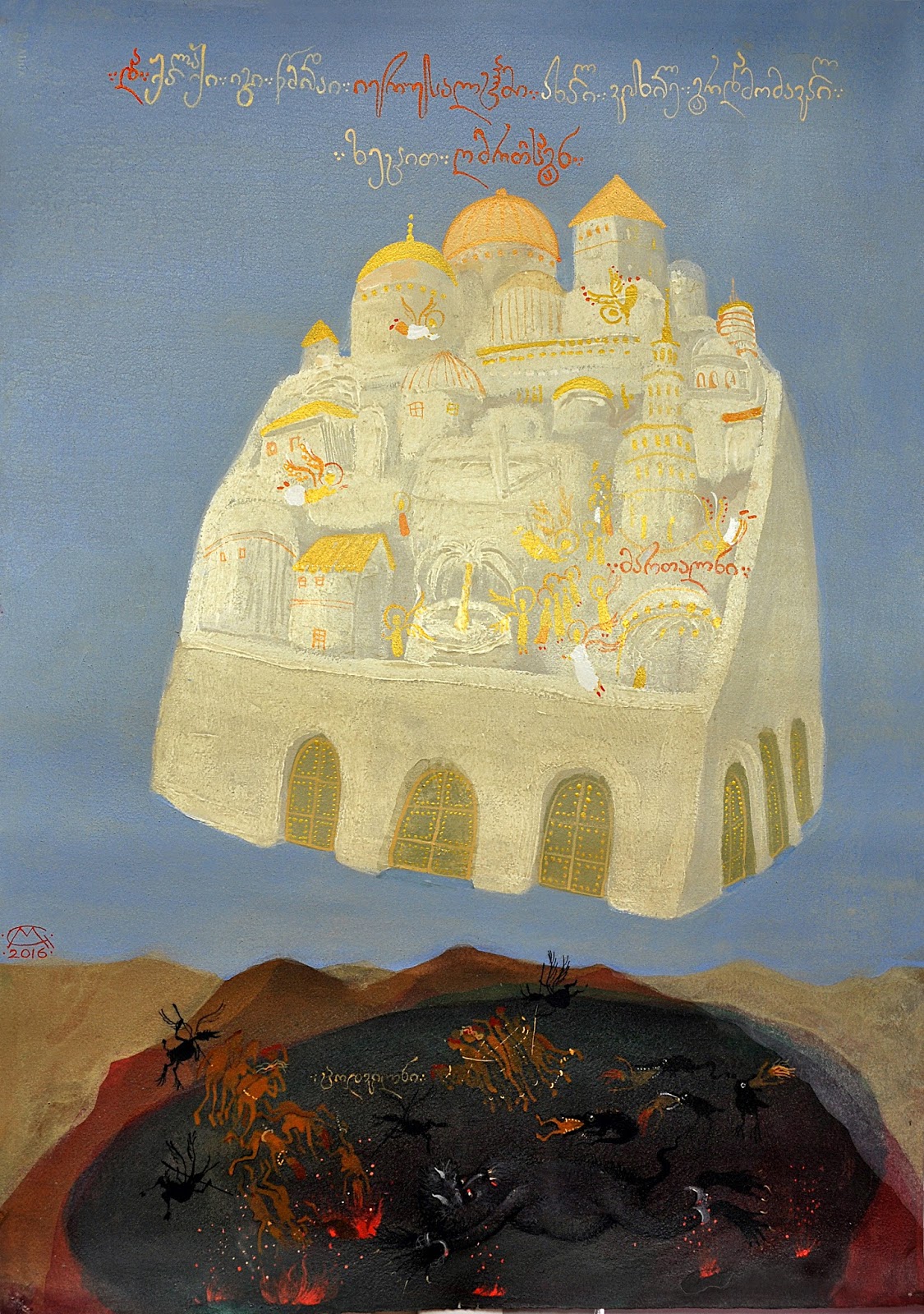
Descent of the New Jerusalem (Georgian icon)
Gocha Kakabadze (Georgian, 1966–), Descent of the New Jerusalem, 2016. Gouache on paper.

On this mountain the LORD of hosts will make for all peoples
a feast of rich food, a feast of well-aged wines,
of rich food filled with marrow, of well-aged wines strained clear.
And he will destroy on this mountain
the shroud that is cast over all peoples,
the sheet that is spread over all nations;
he will swallow up death forever.
Then the Lord GOD will wipe away the tears from all faces,
and the disgrace of his people he will take away from all the earth,
for the LORD has spoken.
It will be said on that day,
Lo, this is our God; we have waited for him, so that he might save us.
This is the LORD for whom we have waited;
let us be glad and rejoice in his salvation.

—Isaiah 25:6–9 (NRSV)

+++

SONG: “When Your Kingdom Comes” by the Silver Pages, feat. Mona Reeves, on The Silver Pages: Part II (2015)

Christians are called to be “aching visionaries,” writes Nicholas Wolterstorff in the classic Lament for a Son—much like the Hebrew prophets, who by the Spirit’s enlightening were able to see through the pain of this present era into a future where all things are made new, where sorrow is undone and Love reigns. Blessed are those who cling to this vision, and who actively live into it here and now, not ignoring hurt but acknowledging its wrongness (that’s what lament is: to say, “This is not right”) and co-laboring with God to heal it. For this task we are equipped with God’s Spirit.

(Related posts: “A sweeping vision of all things made new”; “‘Jis’ Blue’ by Etta Baldwin Oldham”)

The Christian fixation on heaven is sometimes perceived by outsiders as escapist, as opioid. Claiming its promise does console, it’s true. It does give us power to push through pain and guards us against despair. But what it absolutely does not allow is retreat from reality. On the contrary, it helps us to inhabit reality more fully. Talk of heaven doesn’t numb us to the world—or at least it shouldn’t. It makes us hyperaware, especially of history’s path. History is going somewhere! It has a telos, and it has manifestly not arrived there yet. Until then, we ache. We labor. We hope. Rather than having an idling effect, seeing the goal actually motivates us to live presently in tighter line with God’s values, because we see how beautiful a world they usher in. We know that we cannot ourselves create the final fullness that Christ will institute when he returns, nor can we remove the pall of evil (again, that’s only within Christ’s power), but we can certainly live as citizens of God’s kingdom and thus practitioners of the gospel in all its transformative goodness.

Brothers Philip and Paul Zach (The Silver Pages) are aching visionaries who write songs and sing. “When Your Kingdom Comes,” performed with Mona Reeves, helps us to see with greater clarity the glorious future that’s in store for this earth. One day when we come home to it, it will be heaven. The New Jerusalem will descend, and we’ll be wed eternally to its king.

To download the album version of the song (which has more pronounced percussion) along with five other Silver Pages tracks, go to NoiseTrade. It’s free in exchange for your email address.

Update, 9/21/20: Paul Zach posted a solo acoustic version of the song on his Instagram today.

And here he is singing the song with his friend Patrick Bagaza from Rwanda, who translated the song into Swahili:

+++

[After the Ring is destroyed]

“Gandalf! I thought you were dead! But then I thought I was dead myself. Is everything sad going to come untrue? What’s happened to the world?”

“A great Shadow has departed,” said Gandalf, and then he laughed and the sound was like music, or like water in a parched land; and as he listened the thought came to Sam that he had not heard laughter, the pure sound of merriment, for days upon days without count.

—J. R. R. Tolkien, from The Return of the King


This post belongs to the weekly series Artful Devotion. If you can’t view the music player in your email or RSS reader, try opening the post in your browser.

To view all the Revised Common Lectionary scripture readings for Proper 23, cycle A, click here.

A sweeping vision of all things made new

This Sunday’s reading in the Revised Common Lectionary is Revelation 21:1–6, in which John describes the renewal of the entire created order:

Then I saw a new heaven and a new earth, for the first heaven and the first earth had passed away, and the sea was no more. And I saw the holy city, new Jerusalem, coming down out of heaven from God, prepared as a bride adorned for her husband. And I heard a loud voice from the throne saying, “Behold, the dwelling place of God is with man. He will dwell with them, and they will be his people, and God himself will be with them as their God. He will wipe away every tear from their eyes, and death shall be no more, neither shall there be mourning, nor crying, nor pain anymore, for the former things have passed away.”

And he who was seated on the throne said, “Behold, I am making all things new.” Also he said, “Write this down, for these words are trustworthy and true.”  And he said to me, “It is done! I am the Alpha and the Omega, the beginning and the end. To the thirsty I will give from the spring of the water of life without payment.”

Jesus’s resurrection was the beginning of a new creation that starts with man. Paul mentions this in 2 Corinthians 5:17: “Therefore, if anyone is in Christ, he is a new creation. The old has passed away; behold, the new has come.” But whereas Paul is talking about individual renewal, the renewal that John envisions is all-encompassing, touching everything—“an external order in full correspondence with the new nature,” in the words of Alexander Maclaren.

Theologians disagree on whether the “new” in this Revelation passage indicates that the present heaven and earth will one day be destroyed and then newly created, or rather that heaven and earth will one day be utterly transformed, made new in nature or quality. I hold the latter view, and it appears that American artist James B. Janknegt does as well.

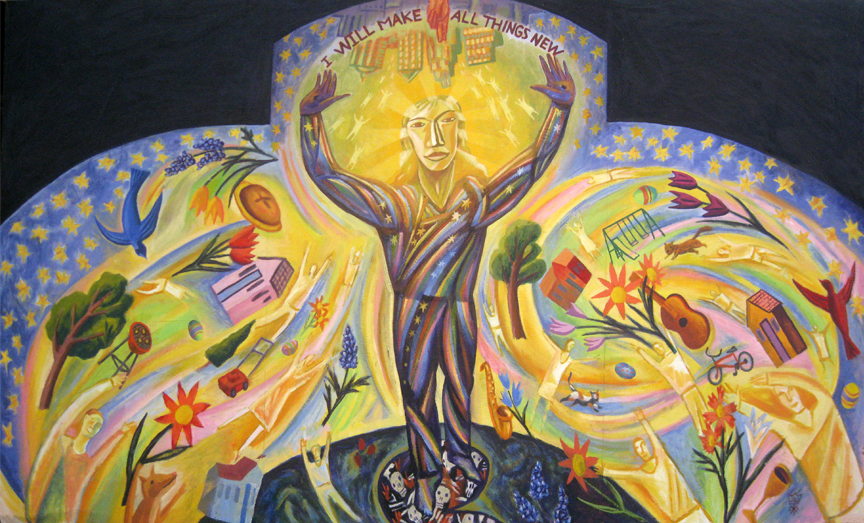
Make All Things New by James B. Janknegt
James B. Janknegt (American, 1953–), Make All Things New, 2005. Oil on canvas, 48 × 96 in.

Janknegt’s painting Make All Things New shows the risen Christ standing triumphantly over the pit of death and under the blessing hand of God, sweeping up the things of earth into a whirlpool of color. Birds, balls, and bicycles; musical instruments and charcoal grills; plants and houses, pets and people, mowers and swing sets—all are on their way to the New Jerusalem. Beauty, work, and play.

Also present in the cosmic swirl are a loaf of bread and a glass of wine, symbols of God’s broken body and spilt blood, the activators of the new covenant. These two objects are evidence on multiple levels that God does indeed transform: he transformed the shame of the cross into glory, and at the Communion table again and again he transforms common, earthly elements into means of grace.

I appreciate Janknegt’s portrayal (through the upside-down skyscrapers at the top of the painting) of heaven coming down to meet earth as it did in the beginning, a biblical truth that has far too often been misrepresented in Christian art, music, and teaching. The restoration of the union between heaven and earth is pretty much the Bible’s main theme—one that’s beautifully explained in The Bible Project’s video on heaven and earth in terms of overlap between two spaces. We won’t eventually leave one space to fly over to the other; instead, heaven and earth will become the same space.

This is a vision that we are called to live into now! As new creations, we orient ourselves around the risen Christ, and we practice resurrection wherever we go. This can mean anything from turning vacant lots into gardens to beating guns into farm tools (literally!) to building wells in villages without access to clean drinking water to fostering or adopting an abused child to supporting a friend through rehabilitation. Where there is death, we bring life.

Make All Things New is a picture of what God has started to do in the world and will one day accomplish completely, at which point we can say along with him in praise and celebration, “It is done!” In the meantime, let’s join him in his work.

This painting is available for sale on the artist’s website and is also offered as a print.