Lent, Day 40 (In the Grave)

I am counted with them that go down into the pit: I am as a man that hath no strength:

Free among the dead, like the slain that lie in the grave, whom thou rememberest no more: and they are cut off from thy hand.

Thou hast laid me in the lowest pit, in darkness, in the deeps.

Thy wrath lieth hard upon me, and thou hast afflicted me with all thy waves. Selah.

Thou hast put away mine acquaintance far from me; thou hast made me an abomination unto them: I am shut up, and I cannot come forth.

. . .

Wilt thou shew wonders to the dead? shall the dead arise and praise thee? Selah.

Shall thy lovingkindness be declared in the grave? or thy faithfulness in destruction?

Shall thy wonders be known in the dark? and thy righteousness in the land of forgetfulness?

—Psalm 88:4–8, 10–12 (KJV)

LOOK: Playa Studies by Craig Goodworth (HT)

Goodworth, Craig_Playa Studies
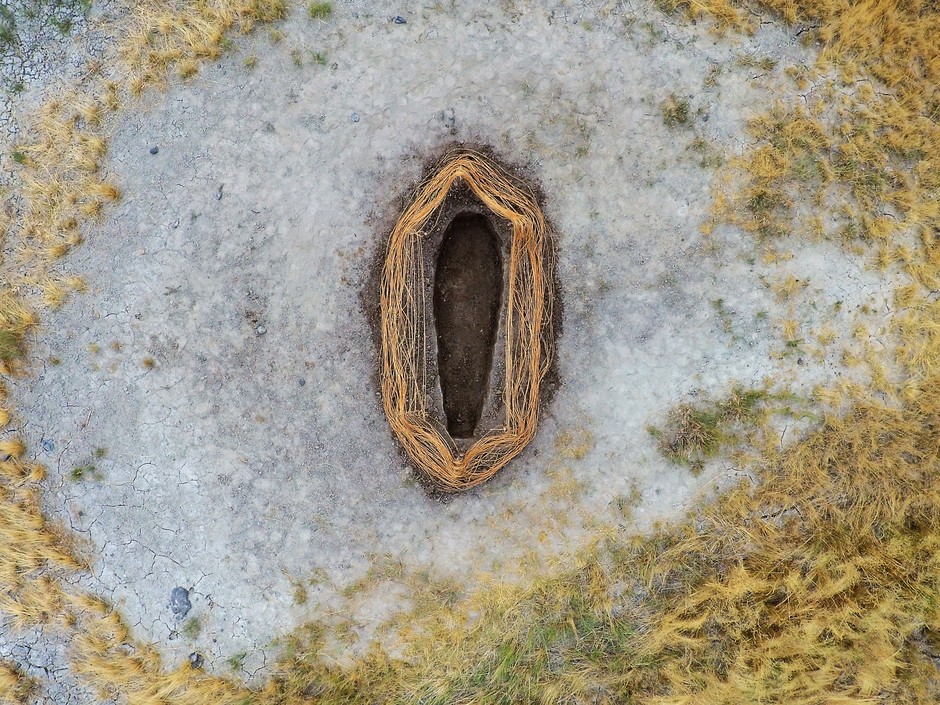
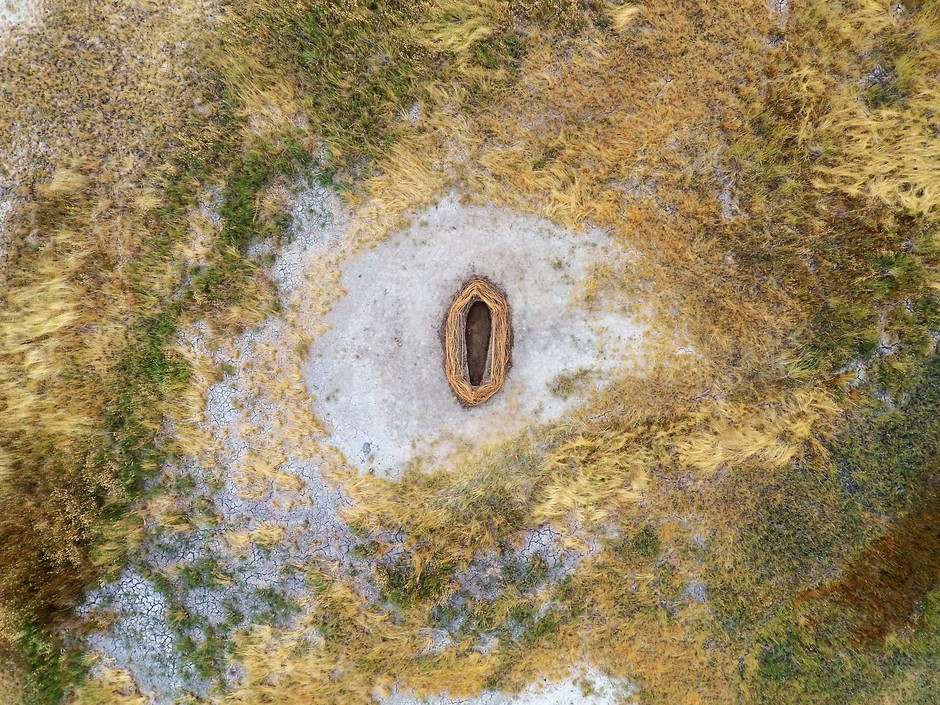
Craig Goodworth (American, 1977–), Playa Studies, 2017. Site-specific land-based artwork, Great Basin Desert, Oregon. Photograph by the artist.

Craig Goodworth’s practice encompasses installation, poetry, drawing, research, teaching, and farm labor. He holds master’s degrees in fine art, sustainable communities, and divinity, and his interests include land, place, religion, mysticism, and folk traditions.

During a four-week residency in the Great Basin Desert in Oregon, he made a series of land-based artworks called Playa Studies, which he documented through photographs. (A playa is an area of flat, dried-up land.) The shape of this one evokes a grave.

LISTEN: “Aestimatus sum” (I am counted . . .) by Tomás Luis de Victoria, 1585 | Performed by Ars Nova Copenhagen, dir. Paul Hillier, 2017

Aestimatus sum cum descendentibus in lacum,
factus sum sicut homo sine adjutorio, inter mortuos liber.
    Versus: Posuerunt me in lacu inferiori, in tenebrosis et in umbra mortis.
Factus sum sicut homo sine adjutorio, inter mortuos liber.

English translation:

I am counted with them that go down into the pit:
I am as a man that hath no strength: free among the dead.
    Verse: They have laid me in the lowest pit, in darkness, in the deeps.
I am as a man that hath no strength: free among the dead.

This is the eighth responsory for Holy Saturday. Tomás Luis de Victoria [previously] of Spain, one of the principal composers of the late Renaissance, set it to music in 1585. It’s the penultimate motet (a multivoiced musical composition sung without instrumental accompaniment) in a set of eighteen by Victoria, titled Tenebrae Responsories.

The text is taken from Psalm 87:5–7 of the Latin Vulgate (Psalm 88:4–6 in the King James Version and most modern translations). The most depressing psalm in the Psalter, Psalm 88 ends not on a note of hope but with the lament that “darkness has become my only companion.” (Hello darkness, my old friend.)

While the psalmist spoke in metaphors of death, Jesus went there literally. After suffering much affliction, he descended “into the pit” of the earth—his grave. He knew emotional and spiritual darkness, and now he was surrounded by the physical reality. The Light had gone out. The Word was made silent.

Imagine what Jesus’s followers must have felt the day after the Crucifixion. Grief, devastation, loneliness, bewilderment, hopelessness. They were left bereft of their Lord’s presence.

On Holy Saturday, we sit in the pocket of that grief, that loss.

N. T. Wright says, “We cannot be Easter people if we are not first Good Friday people and then Holy Saturday people. Don’t expect even a still, small voice. Stay still yourself, and let the quietness and darkness of the day be your only companions.”

Roundup: Georges Rouault, “The Exultant Leper,” and more

LECTURE: “Georges Rouault and the Art of Sacred Engagement” by Fr. Terrence Dempsey, SJ: “From his earliest works, Georges Rouault [1871–1958] selected subjects that combined a strong religious conviction together with a concern for suffering humanity. This lecture by MOCRA Director Terrence Dempsey, S.J., offers an overview of Rouault’s work, including his paintings, prints, and stained glass. Dempsey presents Rouault as an artist who, from his early work through his mature work, remained concerned about the disadvantaged, the outsiders, and the victims of war, and who linked all of these people to the suffering of Christ. In this way, Rouault’s engagement with the world was not so much political (although one can find political tones in his work) as it was sacred. It involved the totality of who we are—corporeal and spiritual.”

Rouault is a favorite artist of mine. I got to see his entire Miserere et Guerre (“Have mercy,” a quotation from Psalm 51, and “War”) series of etchings in person a few years ago, and it’s phenomenal. Every Christian needs to know this series. I recommend a copy of This Anguished World of Shadows: George Rouault’s Miserere et Guerre for all bookshelves.

+++

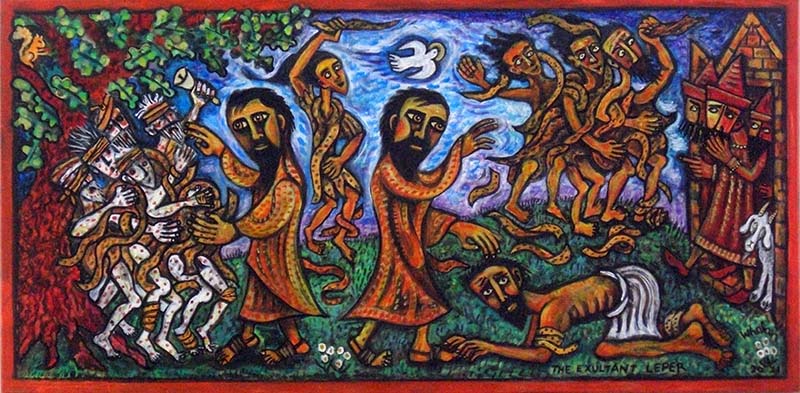
ART VIDEO: “The Story About the Painting Called The Exultant Leper: Wilder Adkins shared this video with me of his uncle Les Smith interpreting a painting he owns before his congregation last summer at Trinity Episcopal Church in Martinsburg, West Virginia. He commissioned it from artist Brian Whelan, to depict the story of Jesus healing the ten lepers from Luke 17:11–19. Sadly, Smith passed away last month.

Whelan, Brian_The Exultant Leper
Brian Whelan (Irish, 1957–), The Exultant Leper, 2021. Mixed media on canvas. Private collection.

Smith said he requested the title “The Exultant Leper” and asked that it appear on the painting itself. “I am the exultant leper,” he says, pointing to the figure at the bottom right. “I am the guy who better always be at the feet of Jesus giving thanks.”

While I have certainly seen and shared plenty of academic presentations on art (such as the one on Rouault above), there is something so special about hearing ordinary folks (that is, nonspecialists) share with others art that is personally meaningful to them—and more than that, in this case, that they helped bring to fruition. Smith’s enthusiasm was such that even his neighborhood trash collectors have been invited into his home to enjoy the piece! I love that he took the step of supporting a living artist by commissioning an original artwork, and that he integrated that art into his home life, displaying it above his mantle, where he would see it daily and be reminded of his own story of transformation through Christ.

(P.S. Last fall on Instagram and Facebook I shared a standout painting of Whelan’s from the 8th Catholic Arts Biennial at the Verostko Center for the Arts at Saint Vincent’s College in Latrobe, Pennsylvania: https://www.instagram.com/p/CVS6tlagy8s/; https://www.facebook.com/artandtheology/posts/1582166995476777.)

+++

CROSS-DISCIPLINARY VIDEO PRESENTATION: “Psalms in Dialogue: (Be)Holding the Broken Pieces”: I shared Duke’s first “Psalms in Dialogue” in October 2020. Here’s their second offering in the same vein. “In this online presentation [which premiered October 2, 2021], Duke University Chapel and the Duke Chapel Choir will welcome visual artist Makoto Fujimura, theologian Dr. Ellen Davis, Tap Legacy Foundation co-founder Andrew Nemr, Ekklesia Contemporary Ballet, and dancer Paiter van Yperen for an evening of creativity and conversation inspired by the biblical Psalms. In the program, artists, musicians, theologians, singers, and dancers will present performances and works inspired by five Psalms: 46, 88, 90, 91, and 92.” I particularly enjoyed the teen ballet number choreographed by Elisa Schroth to Karl Jenkins’s “Healing Light: A Celtic Prayer” at 52:18 (lyrics below).

Deep peace of the running wave to you
Deep peace of the flowing air to you
Deep peace of the quiet earth to you

Amen

Deep peace of the shining stars to you
Deep peace of the gentle night to you
Moon and stars pour their healing light on you

Amen

Deep peace of Christ, the light of the world, to you
Deep peace of Christ to you
Deep peace of Christ, the light of the world, to you

Amen

+++

SONGS:

>> “Fill My Cup” by Thad Cockrell, feat. The New Respects: This song appears on Cockrell’s album If in Case You Feel the Same (2020); an older version is on Alone Together (2016) under the title “Walking to a City.”

>> “Victory of Christ” by Cory Dauber: Cory Dauber is a member of the Deeper Well Gospel Collective, a group of musicians and songwriters in the Portland, Oregon, area who are connected to Door of Hope church. Last year Dauber released his second full-length album, May All Times Go to You. This song appears on his debut album, Turn into a Mountain (2016).

Roundup: Alternative Advent, Fuller Studio videos, Desmond Tutu and Jeff Chu interviews, Psalm 121 in Arabic

“Lift Up Your Eyes” (Advent 2021): Kezia M’Clelland’s annual “Alternative Advent” video is here—a compilation of news photos from the year, from various photojournalists, matched with promises/declarations from scripture and a song. (I’ve described this project in years past; see here.) Migrant caravans, refugee camps, hospitals overwhelmed with COVID patients, a protest against a military coup, wildfires, volcanic aftermath . . . the global suffering we hear about in headlines and statistics is made personal in these intimate photographs of people who are experiencing it firsthand. M’Clelland bears tender witness to this suffering, but she also takes care to include signs of hope. Alongside images of devastation and misery are images of love, joy, and fortitude. The overall tone is one of somberness but not despair. As I do with each year’s “Alternative Advent,” I spent an afternoon interceding with God for each person in the photos and for others enduring the same harrowing journeys or disasters. I realize how my privilege as a white, middle-class US American insulates me from a lot of these realities, and I know that prayer must be accompanied by action.

Find out more context for the photos and their sources on Instagram @alternative_advent.

+++

VIDEO ROUNDUP FROM FULLER STUDIO: The Arts for the Life of the Church: In these six, five-minute videos shot by Fuller Studio, artists and creatives (most of them participants in the Brehm Residency) reflect on the diverse ways that the arts enliven, shape, and define their faith, their theology, and their work. Here’s one from the series, in which interdisciplinary artist Dea Jenkins discusses the ways the Spirit’s leading can be intertwined with the process of art-making, and how art has the capacity to be both prophetic and healing.

The other videos feature . . .

  • Young-Ly Hong Chandra on how she sees her creative work participating in God’s work of creation
  • Michelle Lang-Raymond on how theater and the arts can create opportunities for us to safely yet deeply engage with today’s polarizing issues
  • Rachel Morris on how incorporating the arts into worship services and pastoral care can contribute to the church’s healing work in the lives of its members
  • Jin Cho on the holistic, social, and communal dimensions of preaching and the liturgy
  • John Van Deusen on the significance of creating art in community and on the ways we are shaped by inviting both God and others into our creative processes

+++

ON BEING INTERVIEWS:

>> “Remembering Desmond Tutu”: The South African Anglican bishop, theologian, and human rights activist Desmond Tutu died December 26, 2021, and the On Being podcast re-released this 2010 interview Krista Tippett conducted with him. It’s a great introduction to his story, which includes especially his faith. He discusses the Bible as “dynamite,” our identity as “God-carriers,” the interfaith makeup of the anti-apartheid movement, God’s sense of humor, reconciliation as a process, his experience voting for the first time at age sixty-three (after decades of disenfranchisement), how entrenched racism had become in his own thinking, the beating heart of love at the center of existence, and more. And oh, his laughter is so sweet!

>> “A Life of Holy Curiosity: In Friendship with Rachel Held Evans” with Jeff Chu: Jeff Chu is a journalist, preacher, and co-leader of the Evolving Faith community. When his friend Rachel Held Evans, the famous Christian writer, died unexpectedly in 2019, he took it upon himself to bring to fruition the unfinished book she was working on, Wholehearted Faith (HarperOne, 2021). I enjoyed learning more about Evans through this conversation, and about Chu. He and Tippett read several excerpts from the book and discuss Chu’s Chinese Baptist upbringing, the recent phenomenon of “religious-but-in-exile,” the enormity of God’s love, the Incarnation, the Psalms, doubt, grief, and the lesson of the compost pile.

(As a side note: I recently came across Evans’s other posthumously published book, for children, titled What Is God Like?, in Target and bought it on a whim. It’s fabulous.)

+++

SONG: “I Lift My Eyes” by Christopher Tin: A setting of Psalm 121 in Arabic, performed by Abeer Nehme with Christopher Tin and the Angel City Chorale. Nehme is a Lebanese singer and musicologist, one of whose specializations is sacred music from the Syriac Maronite, Syriac Orthodox, and Byzantine traditions. [HT: Joy Clarkson]

Advent, Day 1

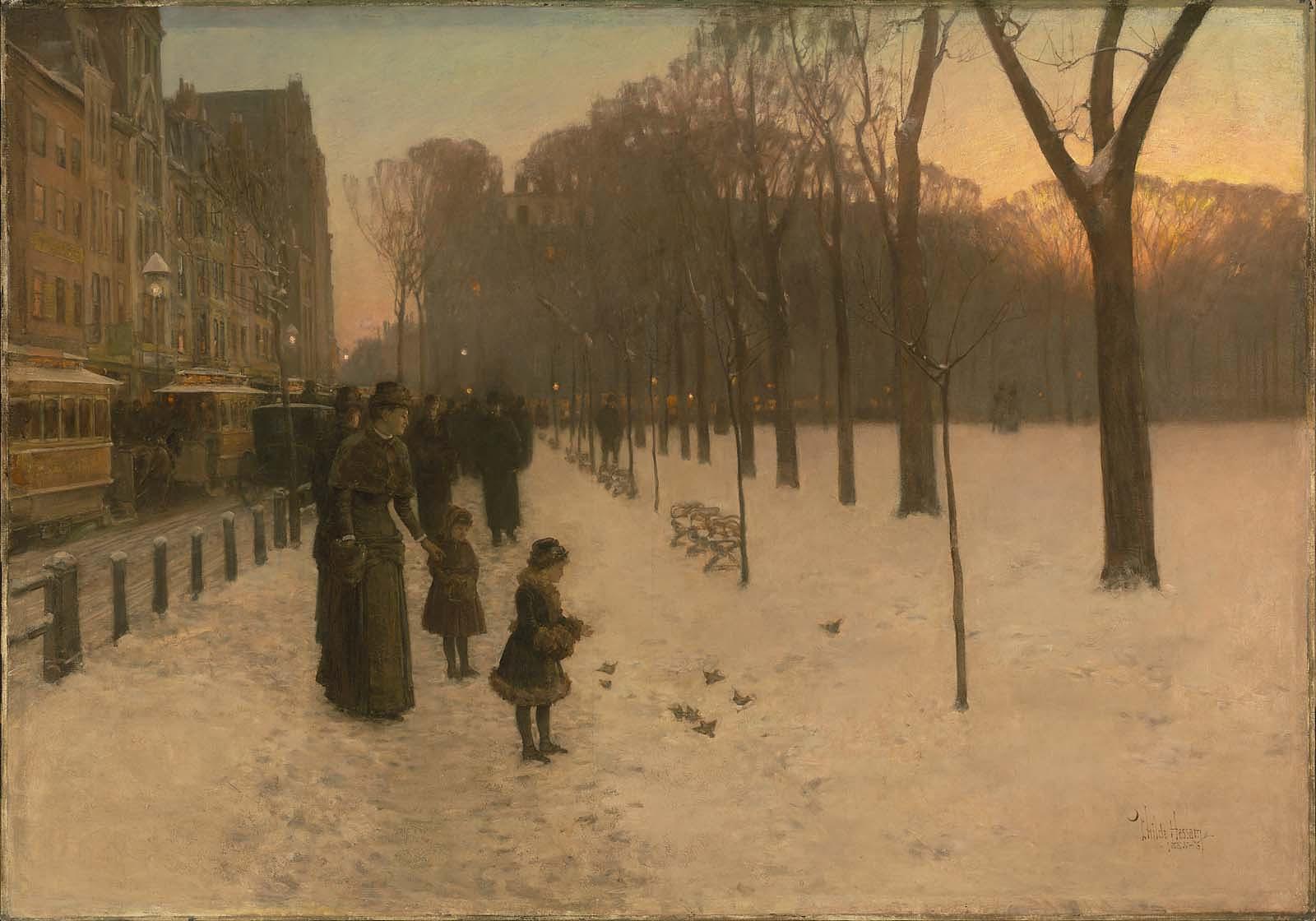
LOOK: At Dusk (Boston Common at Twilight) by Childe Hassam

Hassam, Childe_At Dusk (Boston Common at Twilight)
Childe Hassam (American, 1859–1935), At Dusk (Boston Common at Twilight), 1885–86. Oil on canvas, 42 × 60 in. (106.9 × 152.4 cm). Museum of Fine Arts, Boston.

LISTEN: “Psalm 25” by Poor Bishop Hooper, 2020 [free download]

Nobody who waits for you will see disgrace
Teach me all your righteous paths
Make known your ways to me, Lord

Lead me by your truth, my God
And teach me now
I’ll wait for you the whole day long
You are the God of my salvation

You’ve shown your love from ages past
It existed from antiquity through history
Forgotten of my sinful youth
For your goodness, God
My eyes are always on you

Psalm 25 is not a common Advent text, but it is one of the readings assigned for today by the Revised Common Lectionary. Advent is a season of waiting, penitence, and promise—themes reflected in this psalm of David’s.

Jesse and Leah Roberts, whose musical alias is Poor Bishop Hooper, adapted Psalm 25:3–7, 15 last year as part of their EveryPsalm project, an initiative to release one original psalm-based song every Wednesday. They are currently up to Psalm 100.

I’ve paired the song with a painting by turn-of-the-century American Impressionist Childe Hassam, of a rosy dusk on the outskirts of the central park in downtown Boston. The sun is descending behind the elm trees, the gaslights have been lit, and the ground is blanketed in snow. On Tremont Street on the left, trolley cars and carriages wheel busily past, while on the adjacent walkway a mother and her two young daughters have stopped to feed the birds.

Moodwise, the painting and song complement each other, the twinkling of Roberts’s piano corresponding to the play of pink light on Hassam’s canvas—and both bespeaking God’s goodness. I present the image here as an invitation to, like this family, find moments of quiet enjoyment and reflection amid the bustle of December.

The scene evokes warm memories for me, as my husband and I, then newlyweds, walked this path every Sunday to church for the five years we lived in Boston. Ten minutes from Park Street Station to the hotel where our congregation met, crunching through the snow in our insulated boots in wintertime, the natural sights and sounds of the Common preparing us for worship.

Thanksgiving Playlist

I’ve compiled a playlist of songs of thanks to God for life, beauty, family, salvation, fruitful harvests, and countless other blessings, and for God’s very self. To make a list on this theme is difficult, as every praise song, of which there are millions, is essentially a song of thanksgiving. So many songs and other musical pieces, including those from outside the Judeo-Christian tradition, testify to experiences of goodness. Perhaps I’m being too literal, but I focus (though not exclusively) on songs that explicitly say “Thanks.” I also want to make clear that God deserves thanks not just for what he’s done but for who he is.

To save the playlist to your Spotify account, click the ellipsis and select “Add to Your Library.”

The list is bookended by the seventeenth-century Trinitarian doxology written by Thomas Ken (“Praise God from whom all blessings flow . . .”), which many churches sing weekly to the tune of OLD 100TH. While the first on the list is in English, the last is in Hawaiian.

Several of the songs are settings of the biblical psalms. The Abayudaya community of Jews in eastern Uganda, for example, sings the call-and-response Psalm 136 in Luganda; led by J. J. Keki, the congregation responds after each line with “His steadfast love endures forever!” Banjoist Béla Fleck [previously] and mandolinist Chris Thile use this melody from Abayudaya as the basis of their “Psalm 136” duet, which appears on Fleck’s new album, Bluegrass Heart.

There’s also Psalm 92 (“It is good to give thanks to the Lord . . .”) from Poor Bishop Hooper’s EveryPsalm project, Wendell Kimbrough’s Psalm 107, and a classical guitar rendition of Jewish singer-songwriter Debbie Friedman’s “Hodu” [previously], a setting of Psalm 118:1–4. Rebekah Osborn also sets Psalm 118, in English.

“We Thank You” is by Broken Walls, a musical group comprising followers of the Jesus Way who seek to build bridges between the church and the First Nations people of North America. Founded by Jonathan Maracle, a Mohawk from Tyendinaga Territory in Ontario, Canada, the band uses indigenous instruments and sounds to share the Creator’s love.

Across the Atlantic, the monks of Keur Moussa Abbey [previously] in Senegal sing “Nous Te Louons, Père Invisible” (“We Praise You, Invisible Father”), accompanied by balafon (a gourd-resonated xylophone). The French lyrics translate as follows:

Lord of immortality
We praise you, invisible Father
You are the source of life
We praise you, invisible Father
The source of all light
We praise you, invisible Father
You are the source of grace
We praise you, invisible Father
Friend of mankind, friend of the poor, you draw everything unto yourself through the coming of your beloved Son!
We praise you, invisible Father

I’ve also included a dedicatory instrumental piece played on kora and oboe for the inauguration and consecration of the abbey.

Praise be to God, too, for natural wonders large and small. You’ll want to be sure to check out Alanna Boudreau’s setting of “Pied Beauty” by the poet-priest Gerard Manley Hopkins. (For you Hopkins lovers, Boudreau also set “My own heart let me more have pity on” and “God’s Grandeur,” the latter appearing on Spotify as “Wb / Bw.”) There are also classics like “This Is My Father’s World” and, retuned and retitled by Ben Thomas, “I Sing the Mighty Power of God” [previously].

“For the Beauty of the Earth,” which opens with gratitude for creation and then expands into other areas of thanks, is one of my all-time favorite hymns. Andrew Laparra’s straightforward rendition is so lovely, even though it does omit two of the verses—on the wonders of the human body (“. . . the mystic harmony linking sense and sound to sight”) and “the joy of human love . . .”

For the provision of food, there’s a delightful little song that Kim Gannon and Walter Kent wrote for the 1948 Disney short The Legend of Johnny Appleseed, the American nurseryman, conservationist, and folk hero. The song became popular in primary schools and children’s camps and at grace before meals, and in 2003 Mary Thienes Schünemann included an adaptation in the songbook and accompanying album This Is the Way We Wash-a-Day, which is what I’ve put on the list.

For another prayer appropriate for mealtime, see “Multilingual Grace” by Jaewoo Kim, Grace Funderburgh, Abraham Deng, and Josh Davis of Proskuneo Ministries [previously]. “Here in our community, we eat together a lot . . . and that means Koreans, Latinos, Americans, Burmese, and Sudanese and more coming together around the table,” Davis writes on the Proskuneo blog. “We wanted something we could sing to thank God together. And so we wrote this.” The chorus says “Thank you” in Arabic, Korean, Spanish, and Swahili:

Shukran
Gam-sa-hae
Gracias
Asante

(See the full lyrics.)

Relishing simply being alive is a common theme that comes across especially in songs like “So Glad I’m Here” by Bessie Jones, covered by Dan Zanes [previously] and Elizabeth Mitchell [previously], and “It’s Such a Good Feeling” by the Mister Rogers(!), charmingly jazzified by Holly Yarbrough.

Michael and Lisa Gungor sing of the gift of their second daughter, Lucette, in their song “Light.” Lucie, as they call her, whose name means “light,” was born in 2014 with Down syndrome and heart complications. Seven years and multiple heart surgeries later, she continues to fill the Gungors’ lives, and others’, with brightness.

Gratitude in all circumstances is another theme that comes up, in such songs as “Hallelujah” by the Sons of Rainer, “Sing” by Jon Batiste, and the traditional hymn “How Can I Keep from Singing.” And India Arie’s gorgeous “Give Thanks,” which expresses an attitude of welcome and embrace for all that life brings. In the refrain “Give thanks for all that is,” “Give thanks” is substituted in repeats with the words “Selah” (an untranslatable Hebrew word from the Psalms that probably indicates a reflective pause in the music), “Hallelujah” (Hebrew for “Praise the Lord”), “Namaste” (Sanskrit for “I bow to you”), and “Ashé” (a multivalent concept in Yoruba religion that carries the meaning, in one sense, of “So be it,” similar to “Amen” in Christianity).

Recited daily upon waking up, “Modeh Ani” by Nefesh Mountain is a Jewish prayer of thanks that translates to “I give thanks before you, King living and eternal, for You have returned within me my soul with compassion; abundant is Your faithfulness!” It’s based on the belief that every morning, God renews every person as a new creation.

There are also gospel songs aplenty by artists including Shirley Ann Lee, Mahalia Jackson, Beyoncé [previously], Regina Belle, Roberta Martin, Janice Gaines (covering Andraé Crouch), and others from the Black church tradition.

Bob Marley’s “Thank You, Lord” from 1967 isn’t on Spotify, but an admirable cover by his fellow Jamaican reggae artist Max Romeo is. Sam Cooke’s recording of “I Thank God” by Jack Hoffman, Elliott Lewis, and Bebe Blake is also missing from the streaming service, but I love what the Avett Brothers do with the song, so I’ve featured them instead.

Our gratitude for God’s love and hospitality should overflow into our relationships with other people, animals, and the earth, and our trust in God’s goodness means we should receive with openness what comes from his hand, even if it’s not what we asked for. In the playlist’s penultimate song, “The Welcome,” David Benjamin Blower sings, “Just as Love has welcomed you, my friends / Welcome one another and all things.”

+++

This blog site and the thematic playlists that accompany it take an enormous amount of time to put together. If you have been blessed by either this year, please consider making a financial contribution to support me so that I can continue doing this work. And thank you, all, for engaging with and sharing the content!

Roundup: Online convos with artists Marc Padeu (from Cameroon) and Emmanuel Garibay (from the Philippines), and more

NEW PLAYLIST: October 2021 (Art & Theology): This month’s playlist includes a benediction from the book of Jude; a percussion-driven setting of Francis of Assisi’s “Canticle of the Sun” by the Camaldolese monk Cyprian Consiglio; an Exodus-inspired song in Yorta Yorta, an indigenous Australian language, from the feature film The Sapphires; “Prodigal Son,” a little-known hymn by John Newton, from The Sacred Harp; a sixties gospel song by Shirley Ann Lee (famously covered by Liz Vice on her debut album); and closing out, in anticipation of All Saints’ Day on November 1, the jazz standard “When the Saints Go Marching In.” To save the playlist to your Spotify account, click the ellipsis and select “Add to Your Library.”

+++

IN-PERSON LECTURE: “The Works of Art in the Work of the Church” by John Skillen, October 16, 2021, Crownsville, MD: The Eliot Society, an organization I work for, is hosting our first event in over a year and a half! It’s an art talk by Dr. John Skillen [previously], director of the Studio for Art, Faith & History in Orvieto, Italy. It will be at the home of two of our board members, so if you’re in the Washington–Baltimore metropolitan area two weekends from now, consider coming by! The event starts with hors d’oeuvres at 6:30 p.m., and an RSVP is requested.

The Works of Art in the Work of the Church

In recent decades, a growing number of Christians—even those from church traditions formerly suspicious of the arts—are warming up to the idea that artworks can serve in the various practices of the life of faith, and not only in iconographic form as images of Jesus in worship. Scripturally sound and aesthetically sophisticated works of art can guide our prayer, help catechize our children, and shape the environments of our missional work. Many of us will welcome some pointers for putting art back in its place in the settings where we live and work.

To help us imagine possibilities, John Skillen will offer examples from a long period of Christian history when the arts were put to work in the collective life of the church in more places and in more ways than most of us nowadays can imagine. Not only churches but also hospitals, orphanages, the meeting rooms of parachurch organizations, baptisteries and bell towers, dining halls and cloisters in monasteries, town halls and civic fountains and public squares—all were places of serious decoration and design expected to be compatible with Christian faith.

No sphere of religious and civic life was off-limits for imagery able to instruct, to prompt memory, and to inspire emotion and action—the three functions of art most commonly cited during the Middle Ages to defend its value.

+++

UPCOMING ONLINE CONVERSATIONS:

Padeu, Marc_Le souper a Penja
Marc Padeu (Cameroonian, 1990–), Le souper a Penja, 2019. Acrylic on canvas, 82 7/10 × 106 3/10 in. (210 × 270 cm).

>> “Caravaggio in Cameroon: Marc Padeu and Jennifer Sliwka in Conversation,” October 14, 2021, 11 a.m. EST (4 p.m. BST): I spoke about Padeu’s Le souper a Penja at a recent seminar on “Picturing Jesus,” so I’m looking forward to hearing the artist himself discuss it along with the larger body of work it’s a part of. Hosted by the National Gallery in London.

Artist Marc Padeu lives and works in Cameroon. Intriguingly, his monumental paintings – exploring tender and complex relationships between family, friends, lovers and working communities – often draw on Italian Baroque compositions and especially those of Caravaggio.

Marc Padeu joins Dr Jennifer Sliwka, specialist in Italian Renaissance and Baroque art. Her research explores how 17th-century painters developed innovative approaches to religious painting, imbuing their works with an immediacy, power, and dynamism.

Together, the speakers will take Padeu’s Le Souper a Penja and its relationship to Caravaggio’s Supper at Emmaus as a jumping-off point for conversation, exploring Padeu’s wider interest and understanding of historical works, his adoption and adaptation of the visual language of the Baroque and how these inform his evocations of contemporary life in Cameroon.

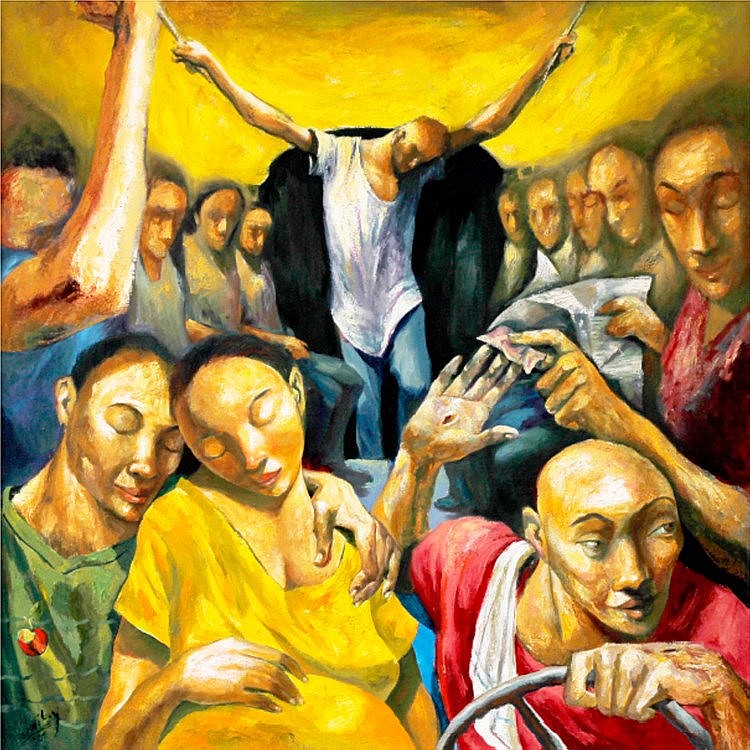
>> “In the Studio with Emmanuel Garibay,” November 11, 2021, 8:30 a.m. EST: The Overseas Ministries Study Center at Princeton Theological Seminary is hosting a conversation with Filipino artist Emmanuel “Manny” Garibay, a social realist painter who served as the 2010–2011 OMSC artist in residence. “It is the richness of the poor that I am drawn to and which I am a part of, that I want to impart,” he says. His paintings often portray Jesus among the marginalized and dispossessed and critique the church’s “compliance with greed, corruption, and social inequality.” Garibay’s children Alee, Nina, and Bam, who are also accomplished artists, will be present for the conversation as well. For more on Garibay, see this Q&A from the OMSC and the Image journal essay “Recognizing the Stranger: The Art of Emmanuel Garibay” by Rod Pattenden.

Garibay, Emmanuel_Kaganapan
Emmanuel Garibay (Filipino, 1962–), Kaganapan, 2006. Oil on canvas, 48 × 48 in. (122 × 122 cm).

+++

NEW SONGS:

>> “Keep Watch (Noelle’s Lullaby)” by Liturgical Folk, a setting of a Compline prayer from the Book of Common Prayer, on the new family album Matins & Vespers:

>> “Psalm 91” by Poor Bishop Hooper, released as part of the EveryPsalm project, through which the duo offers original weekly Psalm-based songs for free download:

Lent, Day 2

To you, silence is praise, O God . . .

—Psalm 65:1*

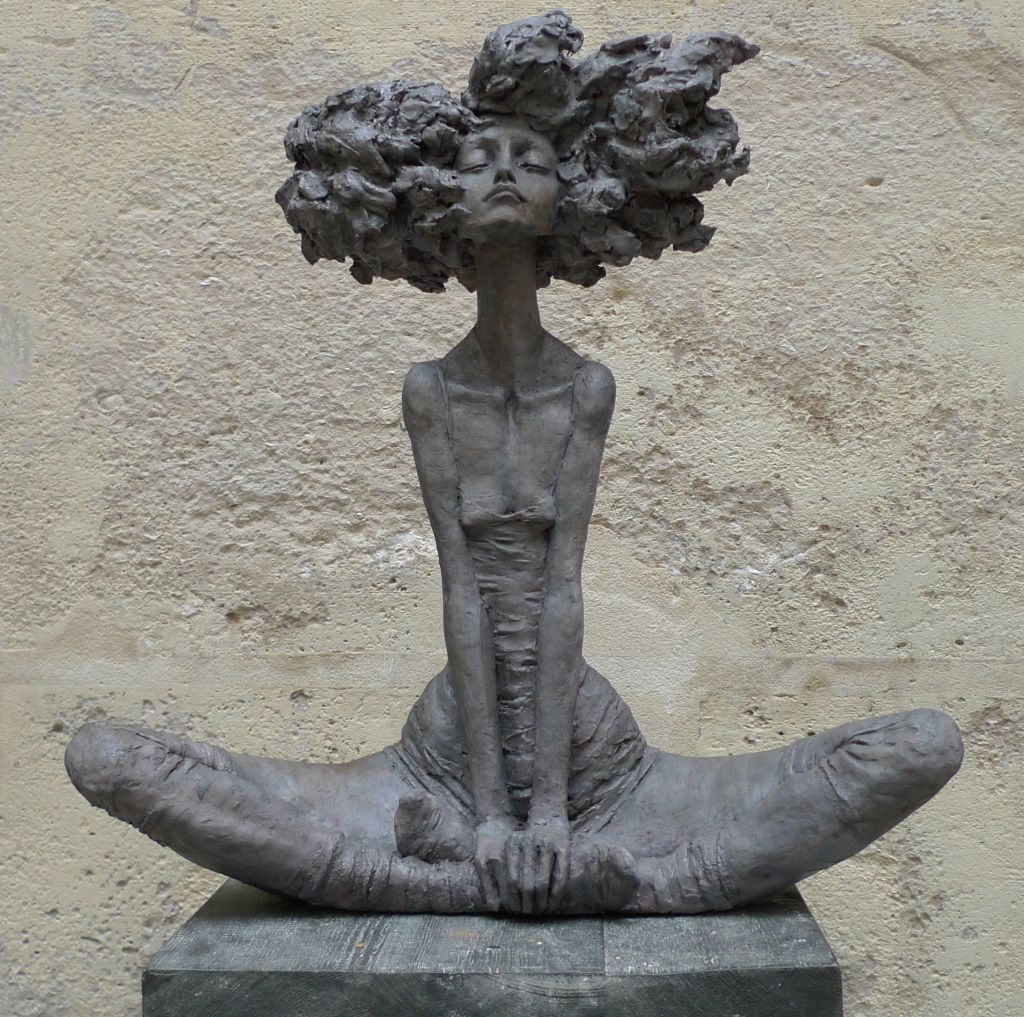
LOOK: Valérie Hadida (French, 1965–), Nuage (Cloud), 2013. Hadida is a contemporary figurative sculptor from France who works mainly in bronze and clay. Many of her “petites bonnes femmes” (little women) sculptures are available for sale through websites like Artsper and Artsy. View process photos on the artist’s Facebook page.

Hadida, Valérie_Nuage

LISTEN: “Dumiyah” by Richard Bruxvoort Colligan, on Our Roots Are in You: Short, Quiet Psalms (2013), feat. Trish Bruxvoort Colligan

Dumiyah
Tibi silens laus

English Translation:
Silence
For you, silence is praise

Dumiyyah (alternatively transliterated as dumiyah, dumiyya, or dûmîyâ) is one of several Hebrew words for “silence.” It’s used four times in the Psalms, most famously in Psalm 62:1—“For God alone my soul waits in silence; from him comes my salvation”—but also in Psalm 65:1. In addition to its straightforward sense, the word implies waiting or repose.

(Related post: “The savasana of Lent”)

The song above is a contemplative setting of the opening phrase of Psalm 65 in two languages. It layers the Hebrew dumiyyah with the Latin Vulgate translation of Leka dumiyyah tehillah.

In “Mystery of the Missing Silence,” Christian spirituality writer Carl McColman ponders why so many English translations of Psalm 65:1 eliminate or obscure the word dumiyyah that’s in the original text. The few well-established ones (in Christian circles) that retain it are:

  • The Darby Bible (DBY): “Praise waiteth for thee in silence, O God, in Zion . . .”
  • The New American Standard Bible (NASB): “There will be silence before You, and praise in Zion, O God . . .”
  • The GOD’S WORD Translation (GW): “You are praised with silence in Zion, O God . . .”
  • The English Standard Version (ESV) has “Praise is due you,” but a footnote provides the alternate translation “Praise waits for you in silence.”

McColman’s word study led him to reach out to Jewish friends with a familiarity of Hebrew, including one in rabbinical school, who pointed him to the Stone Edition Tanach from ArtScroll. First published in 1996, this translation by an international team of Torah scholars renders Psalm 65:1a as “To you, silence is praise, O God in Zion.” (Other modern Jewish translations, like Rabbi A.J. Rosenberg’s, have something similar.) A footnote in the Stone Edition cites commentary from the medieval rabbinic scholar Rashi (1040–1105), who said, “The praises of infinite God can never be exhausted. Silence is his most eloquent praise, since elaboration must leave glaring omissions.”

“Dumiyah” by Richard Bruxvoort Colligan is featured on the Art & Theology Lent Playlist on Spotify.

* Note: In most modern Jewish translations, which tend to count the original headings in the Psalms as verses, this is Psalm 65:2. In the Vulgate and in Eastern Orthodox Bibles, which follow the Septuagint numbering system instead of the Hebrew (Masoretic) one, it is Psalm 64:2. However, for consistency, I refer to it throughout this post as Psalm 65:1, following the numbering in Protestant Bibles.

Calvin Symposium on Worship 2021

The mission of the Calvin Institute of Christian Worship is to “promote the scholarly study of the theology, history, and practice of Christian worship and the renewal of worship in worshiping communities across North America and beyond.” Their programming centers on resources, grants, and events—the biggest of which is the annual Calvin Symposium on Worship, held in January at Calvin University. This year this enormous gathering of pastors, worship leaders and planners, artists, musicians, scholars, students, and others has moved online—and it’s all free! Click here to register and to gain access to a bevy of wonderful content.

Online Calvin Symposium on Worship 2021 opened January 6 and is running through January 26, and much of the content will be archived for future on-demand viewing. With more than ninety contributors, it comprises twenty livestreamed worship services from around the world, twenty livestreamed sessions (some interactive), audio and video talks and interviews, panel discussions, chapter downloads, a compilation of Psalms-based music and art, and expert-guided discussion boards on technology for worshipping communities, Christian history, and pastoral and self-care lessons from 2020.

Calvin Symposium on Worship 2021

I’ve only just dipped my toes in so far, and have a lot more to explore. A few items I’m looking at are Catherine Gunsalus González, Justo González, and David Rylaarsdam on “Learning about Worship from the Ancient Church”; Katharine Hayhoe on how worship practices can help heal our broken relationship with the more-than-human creation; and Mary Hulst, Glenn Packiam, and Joni Sancken on preaching and singing the resurrection (Jesus’s and our own) with care, including at funerals.

I’m also looking at the symposium’s many offerings on multiculturalism and racial justice, such as “Leadership for a Multicultural Age” with Juana Bordas, “Celebrating Christianity’s Global Identity” with Vince Bantu, “Faithful Anti-Racism and the Christian Life” with Christina Edmondson, “What Is the Color of Compromise?” with Jemar Tisby, racial justice and reconciliation work in Richmond, Virginia (documentary and Q&A), Justo González on how Saint Augustine’s mestizo identity (his mother was African, his father Roman) influenced his life and theology, and minister and youth advocate Khristi Lauren Adams on her new book, Parable of the Brown Girl: The Sacred Lives of Girls of Color.

I’ve really been enjoying the worship services, which are hosted by churches and institutions not just throughout the US but also in Buenos Aires, Dublin, Beirut, Cairo, Hong Kong, Singapore, and several cities in Brazil.

A bilingual service led by Constanza Bongarrá and Marcelo Villanueva, Worship with Seminario Internacional Teológico Bautista in Buenos Aires [previously] premiered January 11. The six songs, performed by a small group of supertalented musicians, represent different styles/genres originating in or developed in Argentina—tango, cueca, huayno. A full list of participants and music credits is available at the link.

  • 4:56: “Veni, Emanuel” (O Come, O Come, Emmanuel)
  • 8:06: “Hemos venido” (We’ve Come)
  • 17:58: “Este es el día” (This Is the Day)
  • 21:01: “Tenemos esperanza” (We Have Hope) [previously]
  • 26:56: “Vencerá el amor” (Love Shall Overcome)
  • 29:33: “El cielo canta alegría” (Heaven Is Singing for Joy)

Rev. Rob Jones from Ireland preaches on Romans 12 in Worship at Holy Trinity Rathmines Church, Dublin, and Discovery Gospel Choir performs three songs.

  • 5:32: “O Nzambi” (O Lord) (from the Democratic Republic of Congo, in Kongo)
  • 36:00: “Uthando Luka Baba” (The Love of the Father) (from Zimbabwe/South Africa, in Ndebele/Xhosa)
  • 48:18: “Alleluia” (from Mauritius, in Creole)

What a joy to be introduced to Ireland’s leading multicultural choir! Discovery Gospel Choir was formed in 2004 by the Church of Ireland to reflect the country’s (and the church’s) ethnic and linguistic diversity. Its motto is taken from Romans 12:17b (MSG): “Discover beauty in everyone.” The songs here, and more, can be found on the choir’s 2015 album, Look Up. I especially loved “Uthando Luka Baba” (that solo!).

There’s also a lot of music (and some visual art and dance) in the “Global Psalm Gallery,” made up of submissions from the public.

Josh Rodriguez [previously] submitted an original cello composition that’s just gorgeous. It’s movement 1 (“Oh Lord, Our Lord”) from his “Meditations on Psalm VIII,” based on a tune by Louis Bourgeois from the Genevan Psalter (1542) and performed here by Robert Nicholson. The boldface link includes a score, a reflection by Rodriguez on how the piece interprets Psalm 8, and liturgical suggestions.

Another standout in the gallery is “Psalm 150” for unaccompanied flute, by Delvyn Case, which “explores the mystical connection between breath, life, music, and praise as described in the psalm.” Wow!

Not all the submissions are instrumental art music; there’s also congregational songs, choral pieces, etc.

Again, here’s the sign-up link to the symposium: https://worship.calvin.edu/symposium/. And in addition to this year’s new content, the CICW has an enormous archive of resources from past years that is definitely worth checking out, especially if you are a church leader, of worship or otherwise.

Social critique in two Victorian Nativity paintings

Sometimes we rush to judgment of artworks that at first glance seem dull and conventional. We assume they have nothing to show us. But if we were to look more closely, we might find something unexpected. Even subtly subversive.

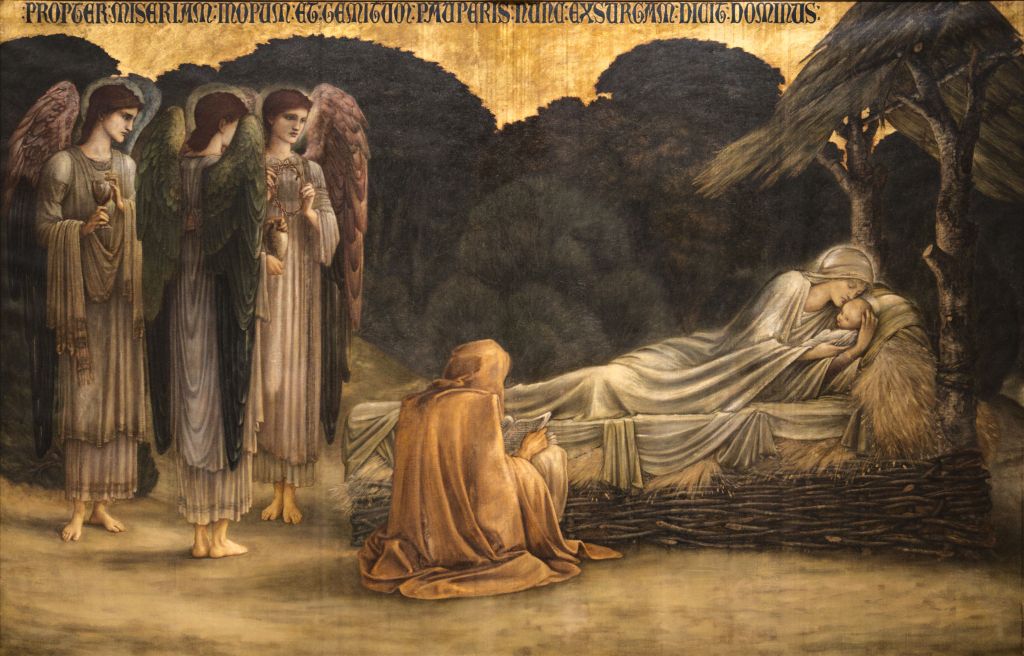
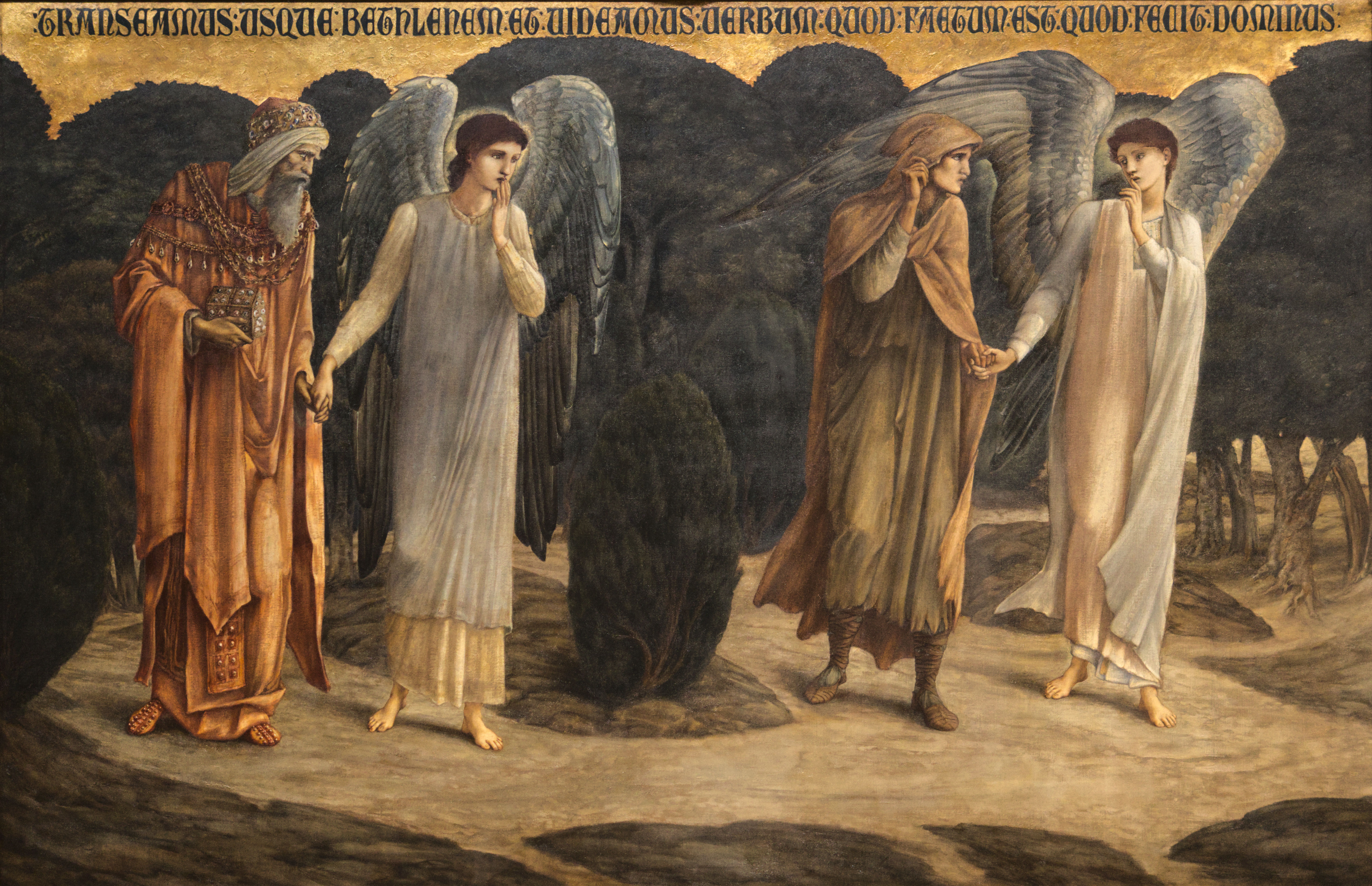
Such is the case with The Nativity and its companion piece, The King and the Shepherd, which were commissioned from the Pre-Raphaelite artist Edward Coley Burne-Jones in 1887 for the chancel of Saint John’s Church in Torquay, England. Seven by ten feet each, they hung on the north and south walls for just over a hundred years before being sold by the church in 1989 to pay for a new roof. (Copies were hung in their places.) Musical theater composer—and Victorian art collector!—Andrew Lloyd Webber bought them and, in 1997, donated them to the Carnegie Museum of Art in Pittsburgh, Pennsylvania. That’s where I saw them earlier this year.

Burne-Jones, Edward_Nativity
Sir Edward Coley Burne-Jones (British, 1833–1898), The Nativity, 1888. Oil on canvas, 81 × 124 1/2 in. (205.7 × 316.2 cm). Carnegie Museum of Art, Pittsburgh, Pennsylvania.

Burne-Jones, Edward_The King and the Shepherd
Sir Edward Coley Burne-Jones (British, 1833–1898), The King and the Shepherd, 1888. Oil on canvas, 81 1/4 × 124 1/2 in. (206.4 × 316.2 cm). Carnegie Museum of Art, Pittsburgh, Pennsylvania.

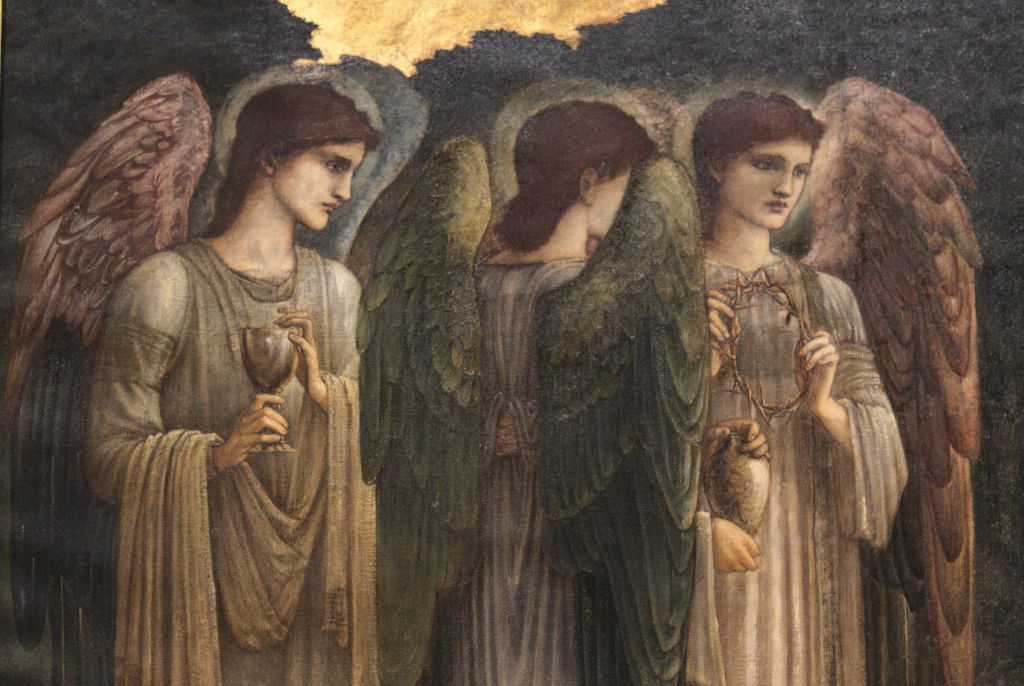
The Nativity shows Mary reclining outdoors on a rustic bed that resembles a bier with her newborn son, Jesus, both wrapped in shroud-like garments. Her partner, Joseph, who has his cloaked back to the viewer, sits on the ground reading a manuscript in Gothic script; the text is indiscernible, but I presume it’s meant to be the scriptures that prophesy the birth of a savior or his sacrificial death. Three angels stand to the side holding symbols of the passion: a crown of thorns, a chalice, and a jar of myrrh, a traditional burial spice. The painting, therefore, links the entrance of Jesus onto the world stage to his ultimate saving act on the cross.

(Related post: “Birth and death in Lavinia Fontana’s Holy Family painting”)

Burne-Jones, Edward_Nativity (pastel)
Pastel sketch for The Nativity by Sir Edward Coley Burne-Jones, 1887. The New Art Gallery Walsall, England.

Burne-Jones, Edward_Nativity (detail, angels)

This foreshadowing approach was not new in Nativity art. But in addition to gesturing toward the redemption from sin that Jesus would bring, the painting also quotes from a community lament psalm in which God’s people cry out for deliverance from those in authority who lie and manipulate. Propter miseriam inopum et gemitum pauperis nunc exsurgam dicit Dominus, the Latin inscription reads, which translates, “Because of the misery of the poor and the groaning of the needy, now will I arise, saith the LORD” (Psalm 12:5a). When God’s people are oppressed, God is aroused to action, and Burne-Jones’s choice of this atypical scripture text for a Nativity painting reminds us of the sociopolitical context of Jesus’s birth, which involved Roman occupation of Israel and a despotic ruler so obsessed with power that he mandated the extermination of Jewish male babies in Bethlehem, thinking he would quash the threat of usurpation. This is the reality into which Jesus was born. And though he didn’t deliver Israel from Rome during his lifetime, he did launch a new “kingdom” and declare a jubilee (Luke 4:16–21).

The biblical inscription speaks not only to Jesus’s day but also to contemporary times, which were marked by high unemployment and great hardship among London’s working class. It’s “a subtle allusion to the social miseries of Victorian Britain,” says Louise Lippincott, curator for the Carnegie at the time of acquisition. She speculates that Burne-Jones intended the painting “as his public statement, albeit a muted one, on 19th-century social horrors. . . . It is quite likely that he was thinking of reports of the bestial living conditions of the London poor that were appearing in the press in the early 1880s.” In 1886, 1887, and 1888, as Burne-Jones was planning and executing the painting, violent strikes and riots were going on in London to protest economic inequality. As people starved, those in power continued to fatten themselves with apparent disregard. The incorporation into this humble scene of a divine vow from the Psalms, where God states his commitment to the poor, expresses hope that God will again arise to deliver from affliction those who trust in him.

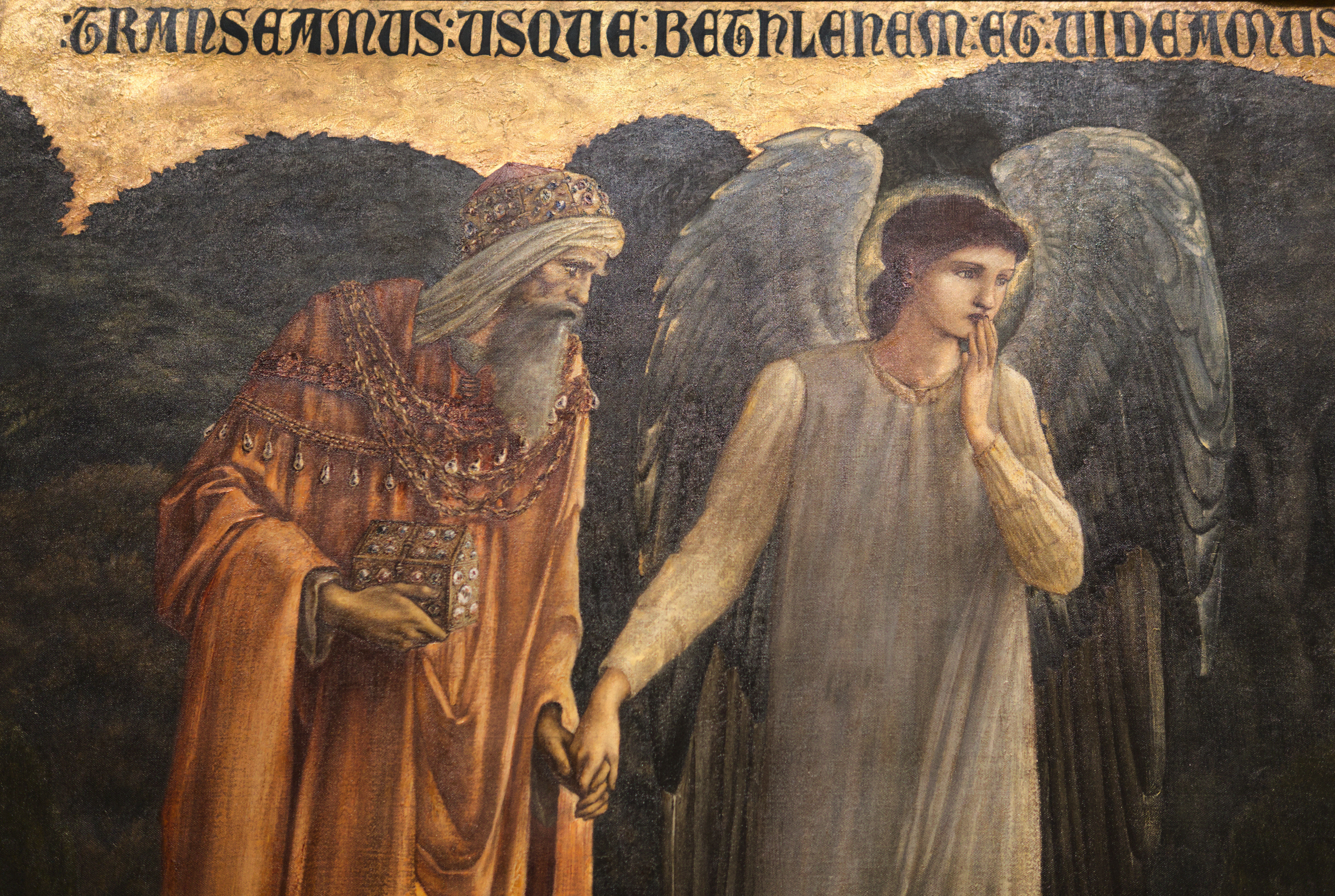
The King and the Shepherd extends this critique of the wealth gap by showing the two titular figures—one rich, the other poor—approaching the Christ child as equals. As was and still is common, Burne-Jones combines Matthew’s account of the magi with Luke’s account of the shepherds, showing both as welcome participants in the same event, but uniquely, he chooses only one figure to represent each group. (Traditionally, three magi attend the birth, along with a nonstandard number of shepherds.) An angel leads each traveler by the hand, reminding them to keep their voices low so as not to wake the sleeping infant.

Burne-Jones, Edward_The King and the Shepherd (detail, king)
Burne-Jones, Edward_The King and the Shepherd (detail, shepherd)

“The pairings visually suggest the equality, in the face of divinity, between the wealthy king and the humble peasant,” reads the museum wall text. “In the context of the enormous social inequalities rife in Victorian England, this message smacked of social and political radicalism.” The Latin inscription—Transeamus usque Bethleem et videamus hoc verbum quod factum est quod fecit Dominus [et ostendit nobis]—comes from the New Testament description of the journey of the shepherds. “Let us now go even unto Bethlehem,” they say, “and see this thing which is come to pass, which the Lord hath made known unto us” (Luke 2:15b).

God chose to reveal his Son’s birth not only to bookish scholars or, as tradition has it, royalty, but also to a bunch of blue-collar laborers. The shepherds’ and kings’ mutual presence at Christ’s bedside was only the beginning of the reconciliation across lines of division that Christ came to enact.

For further reflection on the inclusion of rich and poor in the biblical narratives of Jesus’s birth, see “Shepherds vs. Magi: Dynamics of Privilege within the Nativity Story” by Tony Kriz.

All photos, except for the pastel sketch, are by Victoria Emily Jones / ArtandTheology.org.

Whole World in His Hands (Artful Devotion)

Christ in Glory (Gospel-book of Bamberg Cathedral)
“Christ in Mandorla with evangelists,” Reichenau, Germany, early 11th century. BSB Clm 4454, fol. 20v, Bayerische Staatsbibliothek, Munich.

Oh come, let us sing to the LORD;
    let us make a joyful noise to the rock of our salvation!
Let us come into his presence with thanksgiving;
    let us make a joyful noise to him with songs of praise!
For the LORD is a great God,
    and a great King above all gods.
In his hand are the depths of the earth;
    the heights of the mountains are his also.
The sea is his, for he made it,
    and his hands formed the dry land.
Oh come, let us worship and bow down;
    let us kneel before the LORD, our Maker!
For he is our God,
    and we are the people of his pasture,
    and the sheep of his hand.

—Psalm 95:1–7

This is the Psalm reading for the last Sunday of the liturgical year, Christ the King Sunday. I’ve paired it with an Ottonian miniature from around 1015, which shows Christ, framed by a mandorla (an almond-shaped aureole), standing in a branched tree of life. The gold-leaf outline of this glory cloud encompasses heaven (Caelus, the top figure) and earth (Terra, aka Terrus, at bottom), two realms connected by Christ himself. (Earth is his footstool! That is, part of his throne.) He holds a globe in his right hand and is surrounded by symbols of the four evangelists (the tetramorph)—each supported by a water nymph representing one of the four rivers of paradise—and Sol (sun) and Luna (moon). I love how this image emphasizes the life-giving nature of Christ’s rule, and how it extends over all of creation.

From our limited human perspective, it can be hard to see the divine reality that this artist is pointing to. It sometimes doesn’t feel like Jesus is on the throne, holding together everyone and everything in love. But I look at that little orb, and I think of all the sin and suffering and love and grace and stress and beauty swirling around in that one small part of the cosmos, and I see that it’s rendered in precious gold, and is gripped firmly by the hand of God, who—zoom out—is “a great King above all,” who made the heights and the depths and who gives us his word and indeed his very self, a tree of life for the healing of the nations. As we head into Advent, may we not lose this vision of the Christ who reigns.

More about the art: In the tenth and eleventh centuries, the Benedictine abbey on the island of Reichenau in Lake Constance in southern Germany was the site of one of Europe’s largest and most influential schools of manuscript illumination, known as the Reichenau school. The painting above is from a Gospel-book produced there, commissioned by Holy Roman Emperor Henry II (r. 1002–24) for the cathedral he founded in Bamberg. The book is now housed at the Bayerische Staatsbibliothek (Bavarian State Library) in Munich, along with two other similar illuminated manuscripts from Bamberg Cathedral: the Gospel-book of Otto III (Clm 4453) and the evangeliary of Henry II (Clm 4452). Find out more about this particular manuscript at the World Digital Library. You can also browse the images here by selecting the links in the “Content” sidebar at the left.

For other artworks from Art & Theology that show, in a literal manner, “the whole world in [God’s] hands,” see this medieval Pisan fresco with signs of the zodiac; How God loves his People all over the World by John Muafangejo; Creation of the World by Lyuba Yatskiv; Salvator Mundi by Leonardo da Vinci, a common image type; and a Florentine panel painting of God the Father.

Do you know of any good nonliteral images that say to you, “The world is in God’s hands”? That is, a visual artwork that helps you sense God’s sovereignty? I often fall back on traditional visual conceptualizations of theological teachings like this, but I’d like to expand my repertoire!

+++

SONG: “He’s Got the Whole World in His Hands,” African American spiritual

There are hundreds of professional recordings and live performance videos of this traditional song. It was first published in the paperbound hymnal Spirituals Triumphant, Old and New in 1927 and became an international pop hit in 1957 when it was recorded by thirteen-year-old English singer Laurie London.

First off, I want to feature a fairly recent two-part video compilation released by TrueExclusives. Back in March, as the first wave of the coronavirus hit the US, Tyler Perry posted a video of himself singing one verse of “He’s Got the Whole World in His Hands” to provide a word of assurance in the face of rising death tolls and social isolation. He called on his fellow musicians and other friends to likewise video-record a verse or two, in whatever key or style they wished—just a simple, unpolished phone recording—tagging it #tylerperrychallenge. These were then collected into two videos, a string of contributions from people like Mariah Carey, Usher, Patti Labelle, Jennifer Hudson, Shirley Caesar, LeAnn Rimes, Aubrey Logan, Israel Houghton, and many more. For a list of all the singers with time stamps, see the comment by YouTube user benzmusiczone for the first video and the comment by The Cherie Amour Show for the second.

(Update, January 2023: The original two YouTube videos from the TrueExclusives channel have been removed—not sure why—but you can view the originals on Tyler Perry’s Facebook page: part 1 and part 2.)

Some participants sing in other languages—for example, Nicole Bus in Dutch, Jencarlos Canela in Spanish. Others adapt the lyrics to more specifically address the context of our global pandemic. Kelly Rowland, for example, sings, “He’s got the doctors and the nurses in his hands.” Stevie Mackey names specific countries and virus hot spots. And not only does God have the itty bitty babies in his hands, Ptosha Storey reminds us; he also has the elderly. BeBe Winans spans the cosmic to the small in his verse, emphasizing that God’s sovereign care is both expansive and intimate: “He’s got the moon and the stars in his hands / He’s got Pluto and Mars in his hands / And as I’m sitting in this car, I’m in his hands / He’s got the whole world in his hands.”

I love me some harmonies, so I particularly enjoyed hearing sisters Chloe and Halle Bailey (2:32) and The Walls Group (16:54).

What follows are a handful of other renditions I want to highlight.

Jeanne Lee [previously], 1961:

Ruth Brown, 1962 (classic gospel):

A live 2006 performance in Johannesburg—with hand motions!—by the African Children’s Choir:

A lush choral and orchestral arrangement by Mack Wilberg, featuring Alex Boyé [previously] and the Mormon Tabernacle Choir, from 2010:

Similarly lush, a duet performed by operatic sopranos Jessye Norman and Kathleen Battle, backed by the Metropolitan Opera Chorus, the New York Philharmonic, and the Metropolitan Opera Orchestra. The performance was conducted by James Levine at Carnegie Hall in 1990 and is included on the album Spirituals in Concert (1991). The arrangement is by Robert de Cormier:


This post belongs to the weekly series Artful Devotion. If you can’t view the music player in your email or RSS reader, try opening the post in your browser.

To view all the Revised Common Lectionary scripture readings for Proper 29 (Reign of Christ), cycle A, click here.