
What is that coming up from the wilderness like columns of smoke, perfumed with myrrh and frankincense, with all the fragrant powders of a merchant?
—Song of Solomon 3:6 (KJV)
Arise, shine; for thy light is come, and the glory of the LORD is risen upon thee.
—Isaiah 60:1 (KJV)
Awake, awake; put on thy strength, O Zion; put on thy beautiful garments, O Jerusalem, the holy city. . . . Shake thyself from the dust; arise, and sit down, O Jerusalem: loose thyself from the bands of thy neck, O captive daughter of Zion. For thus saith the LORD, Ye have sold yourselves for nought; and ye shall be redeemed without money.
—Isaiah 52:1–3 (KJV)
LOOK: Eve by Kiki Smith
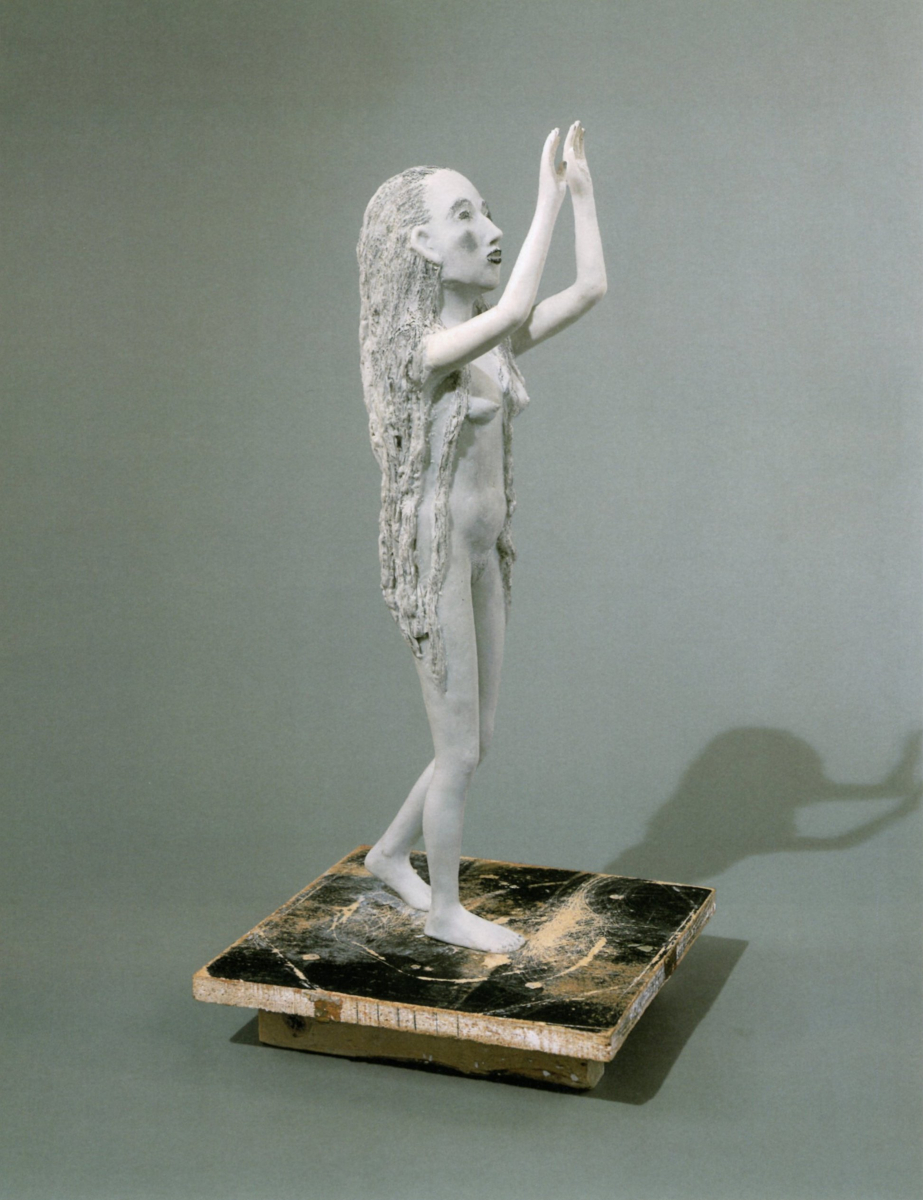
Eve, the mother of all living, a representative of humanity. The crown of God’s creation, and yet she distrusted God’s word, transgressed his command, breaking what was intended to be an eternal communion. In this small sculpture, she looks up, raising her hands in front of her face—in a gesture of prayer or praise? Shielding her eyes from brightness? Could it be she sees redemption on the horizon?
LISTEN: “Lecha Dodi” (Come, My Beloved), traditional Jewish hymn | Words by Shlomo ha-Levi Alkabetz, based on verses from the Hebrew Bible, 16th century | Music by Maayan Tzafrir, 2021 | Sung by Maayan Tzafrir, 2021
(Turn on CC on the video to read the Hebrew lyrics alongside the English.)
ENGLISH TRANSLATION (supplied by 12 Tribes Music):
Rouse yourselves! Rouse yourselves! [Isa. 51:17]
Your light is coming; rise up and shine. [Isa. 60:1]
Awake! Awake! Utter a song.
The glory of God is revealed upon you.Who is this that cometh up out of the wilderness,
Perfumed with myrrh and frankincense,
With all the fragrant powders of a merchant? [Song of Sol. 3:6]Shake off the ashes! Rise up from the dust!
Put on your garments of splendor, my people. [Isa. 52:1]
Through the son of Yishai [Jesse] of Bethlehem,
Redemption draws near to my soul.Awake! Awake! Utter a song,
Let me see thy countenance.
Awake! Awake! Utter a song,
Let me hear thy voice.
When I was a student at UNC–Chapel Hill, I was curious to learn more about the Jewish roots of my Christian faith. I reached out to the Jewish campus organization Hillel, and they invited me to attend their Shabbat dinner, hosted every Friday at sundown at a large house on Cameron Ave.
Most markedly, I remember, before eating, the communal singing of the piyyut (Jewish liturgical poem) “Lecha Dodi” as everyone turned to face the door. I had no idea what the words meant—they were in Hebrew—or what the orientation of bodies was communicating. The song was part of the group’s regular liturgy, familiar to the Jewish students who were gathered, so no introduction or explanation was given, no lyric sheet that I recall. Afterward I asked the rabbi what just happened. “We welcomed in the Shabbat bride,” she said. “The Shekinah.” (The Shekinah is a dwelling or settling of the divine presence. The word is a feminine noun in Hebrew.)
I was puzzled by this statement. It sounded so mystical, challenging my very literalistic sensibilities at the time. The words of the song, by the rabbi and Kabbalist Shlomo ha-Levi Alkabetz (1500–1576), are mostly a composite of scripture texts from the Song of Songs, Isaiah, and elsewhere. Rabbi Shlomo personifies Shabbat (the Sabbath) as a bride, and Israel as her mate. The song anticipates the everlasting Shabbat, ultimate redemption, as the people of Israel ask God to bring about messianic deliverance.
(Related posts: https://artandtheology.org/2024/12/10/advent-day-10-bridegroom-of-the-soul/; https://artandtheology.org/2019/11/26/salvation-is-him-artful-devotion/)
I was taken back to this experience from almost twenty years ago when recently, I came across a version of the “Lecha Dodi” distributed by 12 Tribes Music [previously]. There are hundreds of different tunes for Rabbi Shlomo’s text, from medieval Moorish to northern European folk; but 12 Tribes features a newer setting by the Israeli musician Maayan Tzafrir.
The YouTube video description provides some biographical background:
Maayan Tzafrir is a singer and musician who weaves Balkan and Middle Eastern musical traditions with her Jewish roots. In her music she combines ancient piyutim (chants) with folk melodies. Maayan’s original compositions are inspired by Greek, Bulgarian, Georgian, and Turkish traditions. Maayan is the founder and vocal leader of the Yearot Ensemble, a singer in the Greek band Tavernikos, founder of The Hebrew Balkan Choir, and conductor of various workshops, meetings, and tours focusing on Balkan traditional singing with a Hebrew and feminine spirit.
The lyrics provided for Tzafrir’s version differ slightly from the traditional lyrics. It appears that she uses verses 5 and 4, with complementary material in between.
As a Christian, I can’t help but hear these words in light of Jesus. Several of the Hebrew scripture texts for Jewish Shabbat overlap with the Hebrew scripture texts for the Christian season of Advent, which is itself a dedicated time of looking forward to the arrival of the Messiah, beseeching his coming to dwell.
The phrase “son of Jesse” is a reference to the royal Davidic line from which the Messiah will come—and, in Christian belief, did come, in Jesus of Nazareth, son of Mary, who has since ascended into heaven but has promised to return to bring about the fullness of God’s kingdom.
Awake! Sing! Redemption draweth nigh!


 Art & Theology