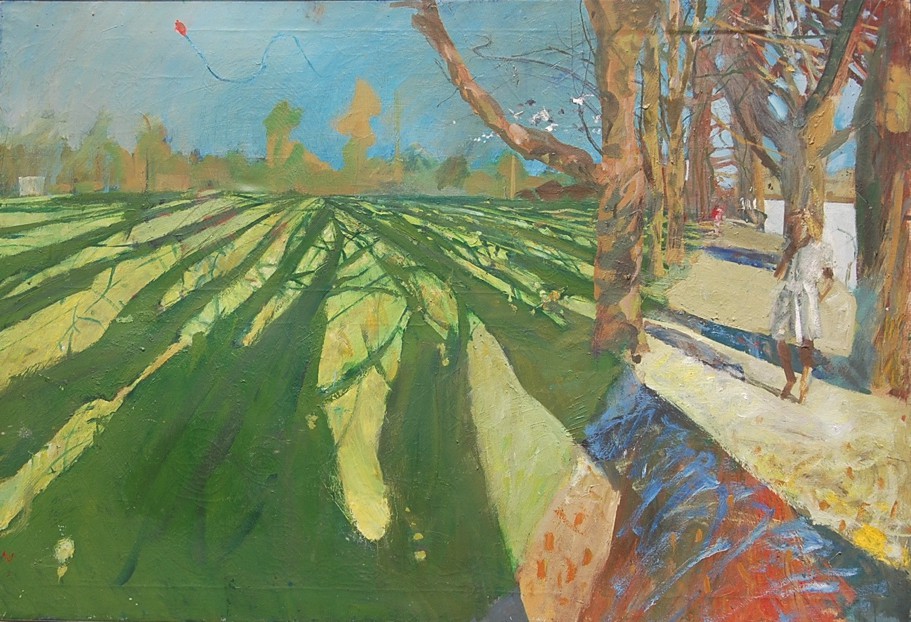
Stan Smith (British, 1929–2001), Kites Over Twickenham, ca. 1985. Oil on canvas, 82 × 121 cm.
What is this unfolding, this slow-
going unraveling of gift held
in hands open
to the wonder and enchantment of it all?

What is this growing, this rare
showing, like blossoming
of purple spotted forests
by roadside grown weary with winter months?

Seasons affected, routinely disordered
by playful disturbance of divine glee
weaving through limbs with sharpened shards of mirrored light,
cutting dark spaces, interlacing creation,
commanding life with whimsical delight.

What is this breaking, this hopeful
re-making, shifting stones, addressing dry bones,
dizzying me with blessings,
intercepting my grieving
and raising the dead all around me?
In September 2019 I visited Atlanta, Georgia, and one of the two art stops I made was the Clark Atlanta University Art Museum, whose purpose is “to collect, preserve, research, and exhibit fine art works that document the role of African Americans in American history and culture.” When I got there I was bummed to see that the museum was closed in preparation for three exhibitions that were to open that Sunday. But graciously, even though the signage and lighting hadn’t been installed and some of the objects were still being moved around, the curator allowed me in for a little glimpse.
I was stopped in my tracks by a mixed media sculpture in the gallery of recent acquisitions: Float by Alfred Conteh.
Alfred Conteh (American, 1975–), Float, 2014. Steel, epoxy dough, thermoadhesive plastic, atomized steel dust, atomized bronze dust, urethane plastic, steel chain, 93 × 46 × 35 in. Clark Atlanta University Art Museum, Atlanta, Georgia. Photo: Victoria Emily Jones.
It shows a Black female Christ figure rising up in a whirl of energy, her hat blown aloft. Wounds are visible on her hands and feet, but these are taken up into new, greening life. At the bottom is a broken chain, indicating that she has been set free. The piece expresses the exhilaration of emancipation, of being shackled no more.
I would classify Float as a resurrection image, which its staging reinforces. To its far left is a wooden crucifix by Dilmus Hall, followed by The Mourners by Frederick C. Flemister, from 1942. (Note that the two crucifix photos in this post are courtesy of the Souls Grown Deep Foundation, who donated the pieces to the museum.)
Dilmus Hall (American, 1896–1987), Untitled, n.d. Wood, wood putty, plastic beads, and paint, 12 × 9 in. Clark Atlanta University Art Museum, Atlanta, Georgia. Photo: Stephen Pitkin / Pitkin Studio.Frederick C. Flemister (American, 1916–1976), The Mourners, 1942. Oil on canvas, 39 3/4 × 31 1/4 in. Clark Atlanta University Art Museum, Atlanta, Georgia. Photo: Victoria Emily Jones.
Drawing on iconography of the Lamentation over the Dead Christ, Flemister’s The Mourners shows a mother holding the corpse of her grown son, who has just been deposed from a lynching tree. Behind her a woman in a pink dress throws up her arms in grief, and a preteen boy runs into his own mother’s arms for comfort. Like many artists before and after him, Flemister connects the killings of innocent Black men to the killing of Jesus—not because their deaths are salvific but because both they and Jesus were unjustly “crucified,” and because Black men bear God’s image, which the visual conflation reminds us of. As Jesus told his disciples, “Truly, I say to you, as you did it to one of the least of these my brothers, you did it to me” (Matt. 25:40).
Death and resurrection, suffering and hope, are the theme of this temporary exhibition. A second wooden crucifix, by Thornton Dial Jr., adorns the opposite wall. It’s titled I’ll Be Back, which, as the sculpture was made a few years after The Terminator came out, may be a playful reference to Arnold Schwarzenegger’s famous line, but it is first and foremost an affirmation that Jesus will return to earth, as promised, to fully set things right. (By the way, I wonder if Conteh, in making Float, was inspired by the hubcap component of another of Dial’s crucifixes . . .)
Thornton Dial Jr. (American, 1953–), I’ll Be Back, 1988. Wood, metal, barbed wire, string, fabric, industrial sealing compound, enamel, nails, 35 × 32 × 6 3/4 in. Clark Atlanta University Art Museum, Atlanta, Georgia. Photo: Stephen Pitkin / Pitkin Studio.
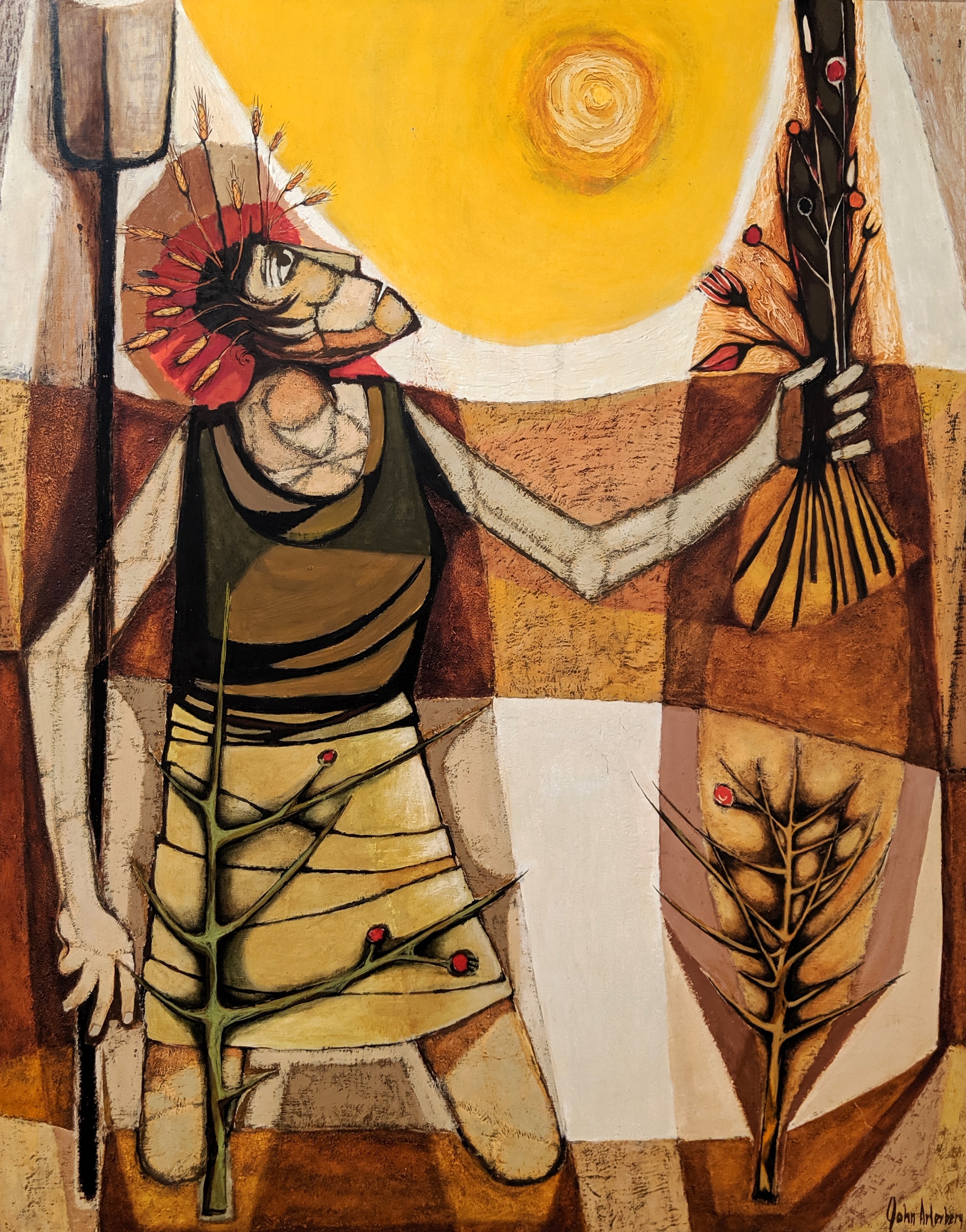
The last piece in the room is Ceres by John W. Arterbery. Ceres was the Roman goddess of agriculture, grain crops, and fertility, the equivalent of the Greek mother-goddess Demeter. In Arterbery’s painting she wears a crown of sprouting wheat stalks and holds a pitchfork in one hand and a leafless plant with buds and berries in the other. I think the flowers may be poppies, as Ceres is associated with those.
John W. Arterbery (American, 1928–1977), Ceres, 1963. Oil on Masonite, 60 × 47 1/2 in. Clark Atlanta University Art Museum, Atlanta, Georgia. Photo: Victoria Emily Jones.
It appears as though Arterbery is depicting the imminence of spring, when Ceres will be reunited with her daughter Proserpine (Persephone) and life will grow and flourish. It shows Ceres looking toward the sun in anticipation of such a time. Read in conjunction with the other pieces in the room, Ceres could be interpreted as an Advent image—a waiting for the final fulfillment of God’s good purposes for his creation, which includes a definitive end to suffering and oppression and a universal thriving.
The Clark Atlanta University Art Museum is typically open Tuesday through Friday from 11 a.m. to 4 p.m., as well as by appointment, but you may want to email ahead of time (cauArtMuseum@gmail.com) to confirm. It’s definitely worth a visit, though I can’t guarantee that the works featured here will be on display. If you wish to browse photos of pieces from the museum’s collection, see In the Eye of the Muses: Selections from the Clark Atlanta University Art Collection (2012).
EXHIBITION: Otherwise/Revival, Bridge Projects, Los Angeles, April 9–June 26, 2021: Curated by Jasmine McNeal and Cara Megan Lewis, this group exhibition visualizes the impact of the historic Black church—specifically the Black Pentecostal movement—on contemporary artists. Included are several artists I’ve featured on the blog before—Lava Thomas [here], Kehinde Wiley [here], Clementine Hunter [here], Letitia and Sedrick Huckaby [here]—plus twenty-six others.
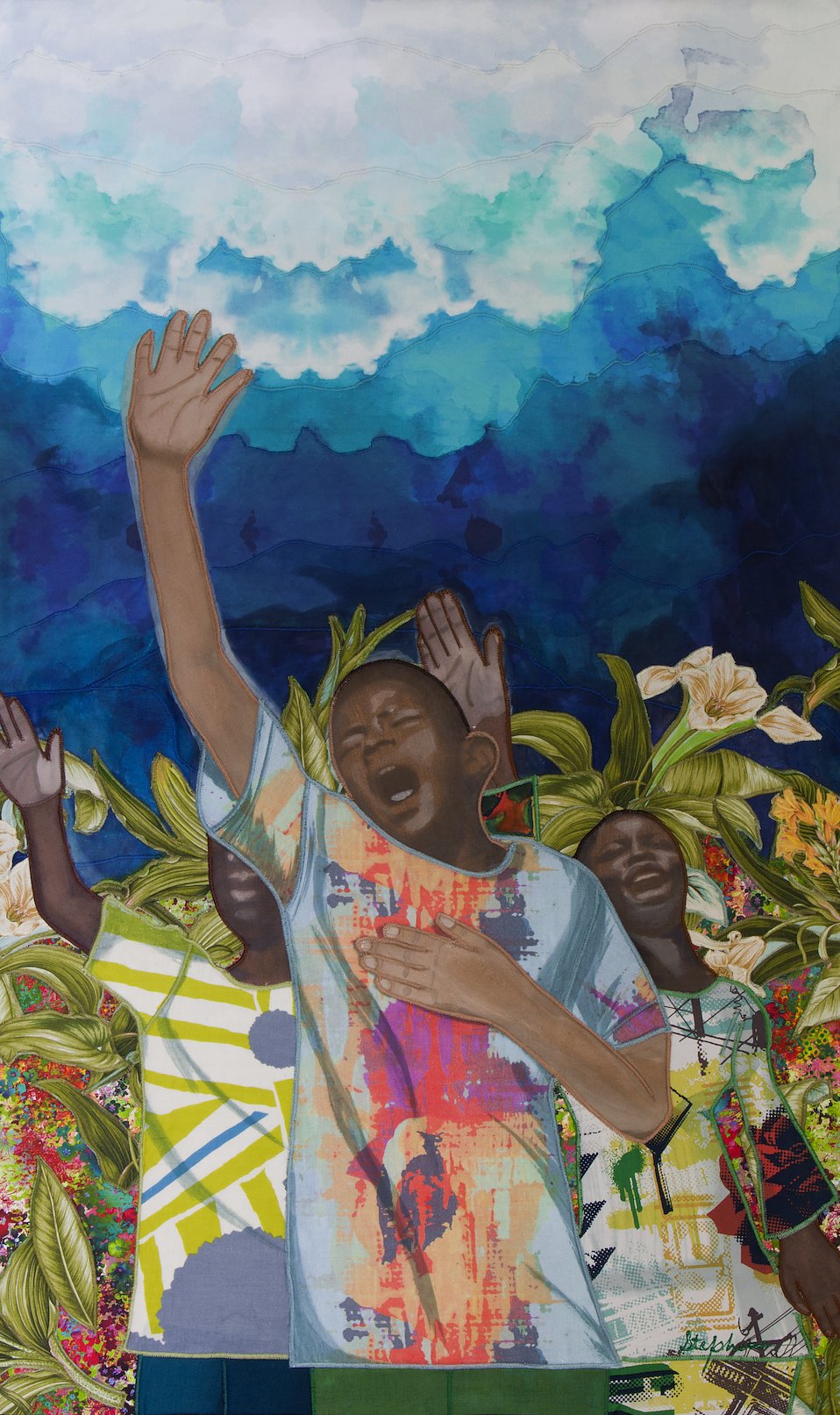
Phyllis Stephens (American, 1955–), High and Lifted Up, 2020. Cotton fabric, 57 × 33 in. Private collection. Courtesy of the artist and Richard Beavers Gallery, New York.Kenturah Davis (American, 1984–), Namesake I, 2014. Incense ink on rice paper, applied with rubber stamp letters, 39 × 36 in. Courtesy of the artist and the Petrucci Family Foundation, New Jersey.
I regret that I won’t be able to see the exhibition in person, but there’s a wealth of relevant content available on the gallery’s website, including photos, artist bios and statements, and commentaries. I haven’t fully delved in yet, but some of the artist names are new to me, and I look forward to jumping over to their websites to learn more. There’s also a series of free events that have been scheduled. The premiere of the virtual music performance yes! lord by Ashton T. Crawley and a symposium on the Azusa Street Revival have already passed (both are archived online for on-demand viewing), but here are some upcoming opportunities you can reserve a spot for:
May 1: “Jazz and the Gospel” with Daniel E. Walker, Ashon T. Crawley, Dario Robleto, Norman Teague, Lava Thomas, and Folayemi (Fo) Wilson
ARTICLE: “5 Films About the Beauty of Resurrection” by Brett McCracken: “Resurrection’ tropes are so familiar in certain genres that they can numb us to the jarring beauty and bracing surprise of resurrection. But other films capture the magic and shock of resurrection by situating it within more mundane realities and contexts. Here are five of my favorite examples of this kind—movies that capture resurrection in all of its miraculous, unsettling, hope-giving glory.” One of his selections is Happy as Lazzaro, which I saw last year and enjoyed:
+++
NEW ALBUMS:
>> Hymns I by Lovkn: Steven Lufkin is a singer-songwriter from Phoenix, Arizona, recording under the name Lovkn. His latest EP, a collection of eight acoustic hymn covers, was released April 2. (Also, he’s currently raising funds to record an album of original songs, to be released later this year: kickstarter.com/projects/lovkn/new-album-2021.)
>> Prayers for the Time of Trial by Joel Clarkson: Released April 7, this EP comprises five original SATB choral compositions by Joel Clarkson, which he recorded with his sister Joy Clarkson. My favorite is the first, “Lighten Our Darkness,” a setting of the Book of Common Prayer’s Collect for Aid Against Perils: “Lighten our darkness, we beseech thee, O Lord; and by thy great mercy defend us from all perils and dangers of this night; for the love of thy only Son, our Savior, Jesus Christ. Amen.”
The other four are “Sub Tuum Praesidium” (Beneath Thy Protection), a third-century hymn to the Virgin Mary as Theotokos; “Hail King,” a poem by Joel’s other sister, Sarah Clarkson, that marvels at how rocky cliffs and sea waves and herring gulls sing God’s praises in their own way; “Ubi Caritas,” an ancient hymn centered on the theme of Christian charity; and the simple benediction “May the peace of the Lord be with you now and always.”
ORTHODOX CHANT: Russian Kontakion of the Departed: At Prince Philip’s funeral service at St. George’s Chapel at Windsor Castle on April 17, a choir of four sang, among other pieces, the Russian Kontakion of the Departed, translated into English by William John Birkbeck and arranged by Sir Walter Parratt. “The Russian Kontakion of the Departed is an ancient Kiev chant with its origins in the Russian Orthodox liturgy. This moving chant expresses the sorrow of grief but reminds us of the Christian hope of everlasting life; in the face of sadness, we sing Hallelujahs.” [HT: Global Christian Worship]
Give rest, O Christ, to thy servant with thy saints: where sorrow and pain are no more; neither sighing but life everlasting. Thou only art immortal, the creator and maker of man: and we are mortal formed from the dust of the earth, and unto earth shall we return: for so thou didst ordain, when thou created me saying: Dust thou art und unto dust shalt thou return. All we go down to the dust; and weeping o’er the grave we make our song: Alleluia, alleluia, alleluia.
+++
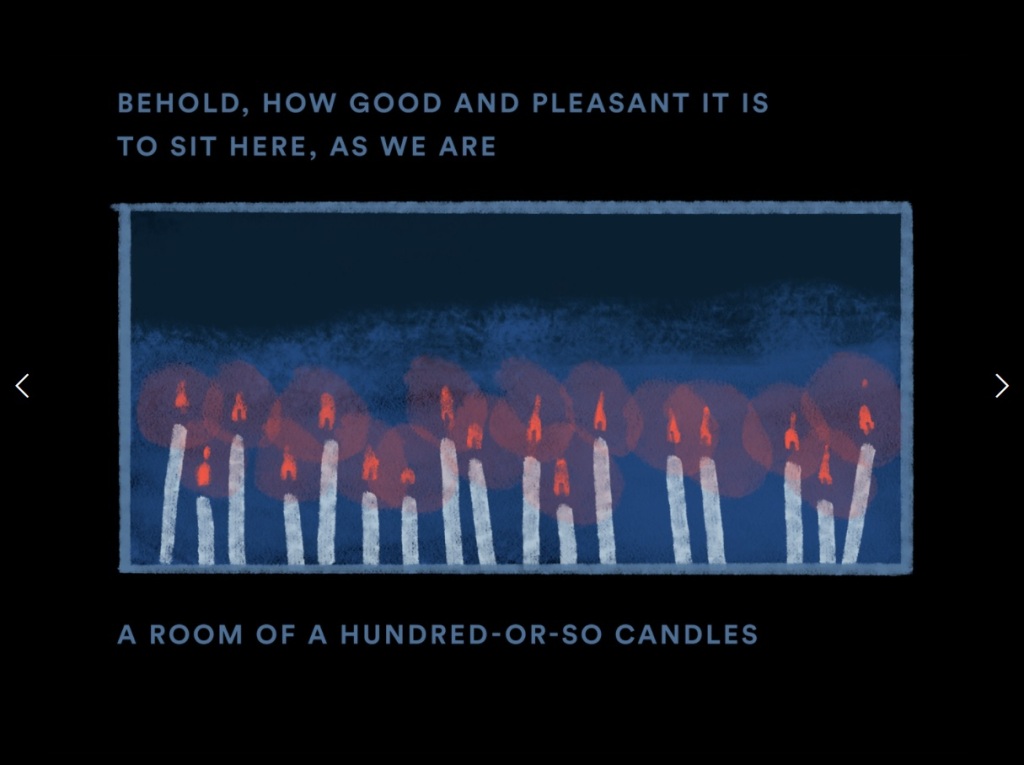
VISUAL LITURGY: “After Ezekiel” by Madeleine Jubilee Saito: Remember those flip books you probably encountered as a kid—the ones with a series of images that gradually change from one page to the next, giving the illusion of animation when viewed in quick succession? Well, this is a digital version of that. In 2019 cartoonist and illustrator Madeleine Jubilee Saito created an image sequence intended to be swiftly clicked through as part of the Easter Vigil at a church in Boston. It was inspired by the story of Ezekiel in the valley of dry bones (Ezek. 37). Very compelling!
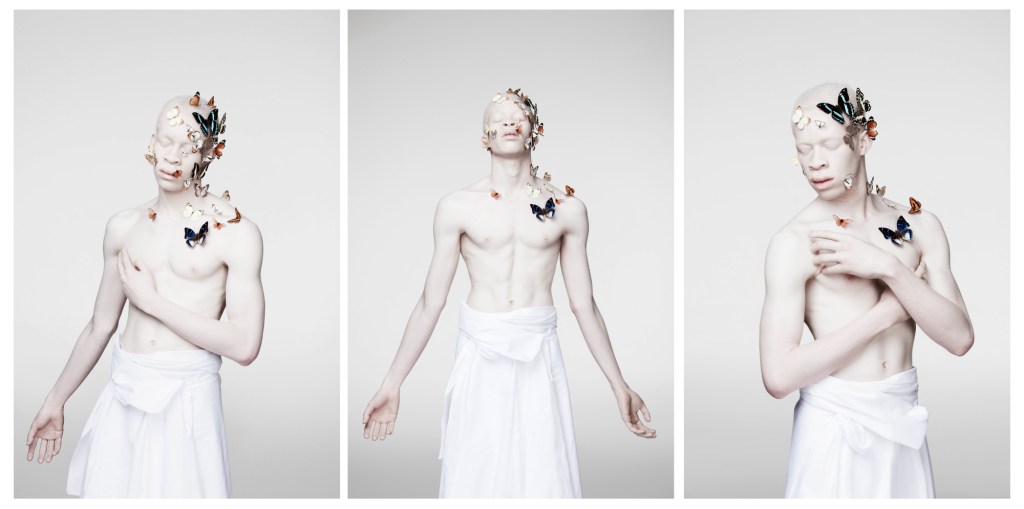
South African photographer Justin Dingwall (born 1983) seeks to depict beauty in difference. For his Albus series—Latin for “white” or “bright”—he worked with South African models and activists Thando Hopa and Sanele Junior Xaba, who have albinism. Albinism is a hereditary condition that affects melanin production, resulting in little to no pigmentation in the skin, hair, and eyes. It is more prevalent in sub-Saharan Africa than in the rest of the world, and people with the condition often face marginalization, discrimination, and even deadly violence.
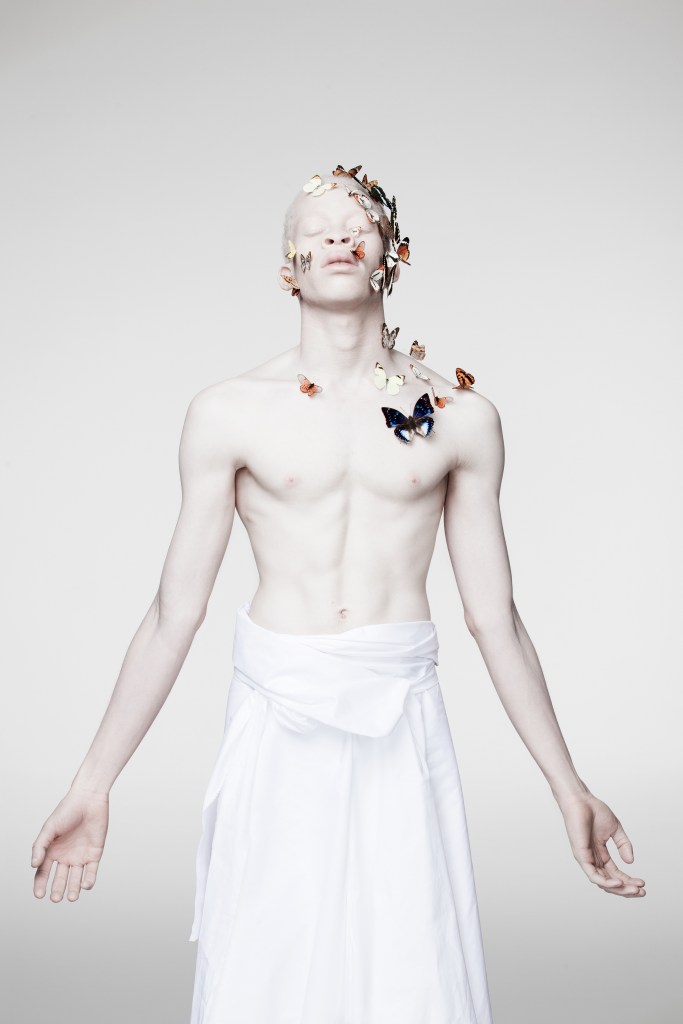
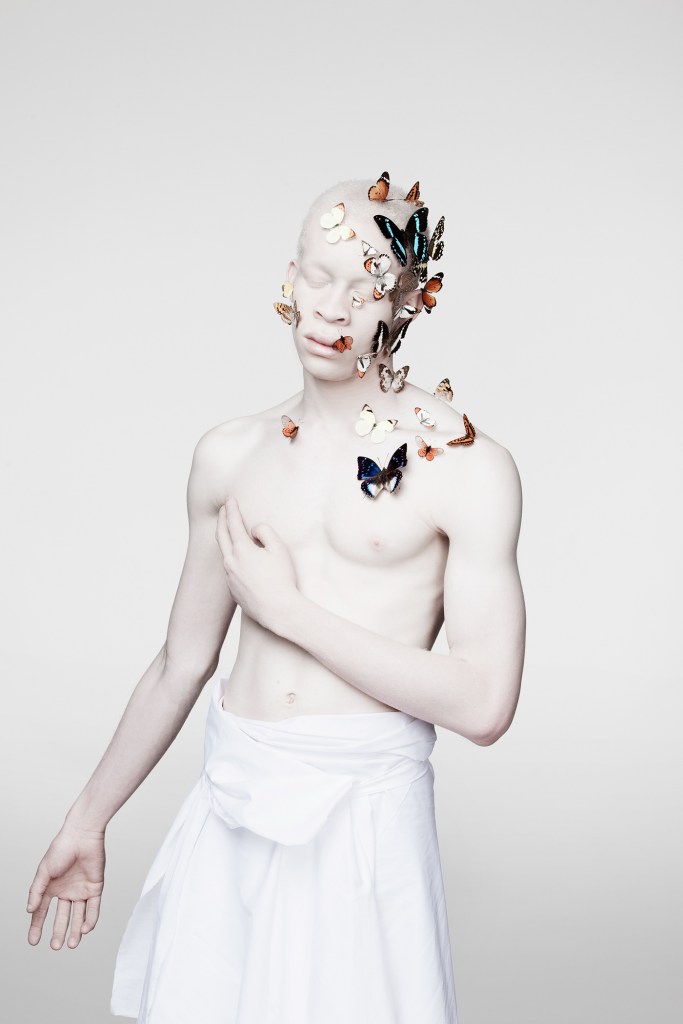
In many ways Dingwall’s Albus series, which comprises several dozen photographs, is about metamorphosing perceptions about albinism, subverting the idea that it’s a curse; “by using butterflies my aim was to influence the viewer’s vision to be transformed, allowing them to view albinism in a new light—as something unique and beautiful,” he said. But the theme of transformation, of death and rebirth, as portrayed in some of the photos of Xaba, also connects with the narrative of Jesus’s passion, death, and resurrection, the model’s poses evoking traditional Christian imagery. (Not to mention how some of the photos of Hopa, not pictured here, intentionally reference Mother Mary.)
Rhapsody I, II, and III form a passion triptych of sorts, a sequence of three photos that show a male figure, clothed in a loincloth, falling into darkness—and yet, illuminated from above, he looks up toward the light.
Justin Dingwall, Rhapsody I, II, III, 2015
I’m reminded of Jesus speaking to his Father in Gethsemane, and at his crucifixion. Of all the art that shows him stumbling on his way to Calvary (“Jesus falls” makes up three of the fourteen stations of the cross). And especially of his slumped body being lowered from the cross. All the supporting characters, however, are absent, intensifying our focus on this lone Christ figure.
Consider some of the compositional similarities between Dingwall’s three Rhapsody photographs and the following explicitly Christological artworks. (To view the full caption, click on the the image.)
William Blake (British, 1757–1827), The Agony in the Garden, ca. 1799–1800. Tempera on tinned iron, 27 × 38 cm. Tate, London. http://www.tate.org.uk/art/work/N05894
Penny Warden (British, 1956–), Station 9: Jesus Falls for the Third Time, 2005. Oil on canvas, 6 × 3 ft. Blackburn Cathedral, Lancashire, England. http://www.thejourney.me.uk/
Rembrandt Harmensz. van Rijn (Dutch, 1606–1669), Christ on the Cross, 1631. Oil on canvas, glued to panel, 39 3/8 × 28 3/4 in. (100 × 73 cm). Église Saint-Vincent, Le Mas-d’Agenais, Lot-et-Garonne, France. http://www.wikipaintings.org/en/rembrandt/christ-on-the-cross-1631
Greg Semu (New Zealand Samoan, 1971–), Auto Portrait with Crucifix, 1997. A/P selenium-toned fiber-based silver gelatin handprint. http://www.gregsemu.photography/unnerved
Descent from the Cross, South Netherlandish, early 16th century. Oak, polychromy and gilding, 23 3/4 × 11 1/4 × 4 3/4 in. (60.3 × 28.6 × 12.1 cm). Metropolitan Museum of Art, New York. http://www.metmuseum.org/art/collection/search/462888
Suggestive of burial, Embrace by Dingwall shows a man wrapped, cocoon-like, in white linen, lying against a black ground. His face, again, catches the light, and he appears to be at peace. He is resting in this silent, in-between time that precedes the emergence of new life.
Justin Dingwall, Embrace, 2015
More explicitly inspired by Christian visual traditions is Dingwall’s Liberty triptych, which shows our Christ figure risen from death, glowing, and covered in butterflies, symbol of resurrection.
Justin Dingwall, Liberty I, II, III, 2015
In Liberty II, the man extends his arms at a roughly forty-five-degree angle from his trunk, palms upward, in a beatific gesture. His eyes are closed as he bathes in light. Christ is often shown in this pose in art of the resurrection, emerging triumphant from his tomb and proudly revealing his transfigured wounds. Dingwall’s image, though, is quieter, more interior.
Liberty I is reminiscent of Jesus inviting Thomas to see and touch his wounds, and especially of Bramantino’s The Risen Christ (see tiled gallery below). People have long marveled at the incredible luminosity of Christ in the latter painting—how the light seems to come from within (the setting is nighttime, as the moon in the background indicates).
So in many ways these photographs by Dingwall are continuous with Christian art history, but they are also open enough to be read in a multitude of other ways or applied to different contexts. Though the nature of Jesus’s resurrection and what it accomplished are, Christians believe, unique in history, stories of death and rebirth are universal, traversing all cultures and religious traditions.
As the church continues in this fifty-day season of Eastertide to celebrate the resurrection of Christ, here are some songs I’ve come across for the occasion and really enjoyed. A few are brand-new, while others are new performances.
Good Shepherd New York, a church in Manhattan, has a phenomenal team of in-house musicians and collaborators from coast to coast. They provide music for weekly digital worship services as well as release recordings under the name Good Shepherd Collective. Check out their Easter service from April 4! The songs are listed below.
MEDLEY: “Christ the Lord Is Risen Today” by Charles Wesley / “Celebrate Jesus” by Gary Oliver (1:35)
The GSC has posted “Here Comes the Sun” as a standalone video on Instagram. It features Brennan Smiley on lead vocals and acoustic guitar; Liz Vice on harmonizing vocals; Charles Jones on Hammond organ; John Arndt on piano; Jesse Chandler on flute, clarinet, and saxophone; Joseph M on electric guitar; Tyler Chester on bass guitar; and McKenzie Smith on drums. The art and stop-motion animation are by Boston-based artist Soyoung L Kim.
Last year the Fundación la Caixa in Barcelona launched project #YoCanto Aleluya, soliciting professional and amateur singers alike throughout Spain and Portugal to be part of a “virtual choir,” a phenomenon that has exploded since the pandemic has made live musical concerts a health risk. Participants were asked to submit a video of themselves singing Handel’s famous “Hallelujah” chorus. Igor Cortadellas of Igor Studio then developed a concept for digitally merging all 352 submissions by projecting them on the interior architecture of Barcelona’s Basilica of Santa Maria del Mar (or overlaying them in postproduction?), and he directed a small team to execute this vision. What a feat! The final video was released a few months ago at Christmastime.
“Hallelujah” concludes part 2 of 3 of the oratorio, which covers Christ’s passion and death, resurrection, ascension, and the first spreading of the gospel. The words of the chorus are taken from Revelation 19:6, 11:15, and 19:16. For another blog post featuring an excerpt from Handel’s Messiah, see the Artful Devotion “Worthy Is the Lamb.”
“Keep the Feast (Pascha Nostrum)” by Ryan Flanigan: For this new song, Ryan Flanigan of Liturgical Folk adapted the words of the Pascha Nostrum (“Our Passover”), a traditional Christian hymn for Eastertide that, after the Reformation, was preserved in English in the Book of Common Prayer. It is based on 1 Corinthians 5:7–8, Romans 6:9–11, and 1 Corinthians 15:20–22. Flanigan wrote a fun new melody for it, which he demos here.
+++
“Zinda Yeshua (Jesus Is Alive)” by Blesson Varghese and James Bovas: This Hindi-language Easter song is from Grace Ahmedabad, an Assemblies of God church in the Indian state of Gujarat. James Bovas sings lead, with Priscilla Mozhumannil on supporting vocals. See the YouTube description for a full list of credits. [HT: Global Christian Worship]
+++
“Judah’s Lion” | Words by Fulbert of Chartres, ca. 975–1028, and Rick Barnes, 2016 | Music by Rick Barnes, 2016 | Performed by Covenant Presbyterian Virtual Choir and Orchestra, Birmingham, Alabama, 2021
Organized by Mount Tabor Ecumenical Centre for Art and Spirituality:
>> April 10, 11 a.m.–12:30 p.m. EDT: “The Victory of Life (Easter in Renaissance Art)”: “The most important event of New Testament belief, Christ’s Resurrection, is not described in the Scriptures. That has not prevented artists however from imagining it. As we celebrate Eastertide, we invite you to join Monsignor Timothy Verdon as he reflects on a number of works focused on this theme.”
>> April 15, 11:30 a.m.–1 p.m. EDT: “In the Shadow of Your Wings: Musical Bible Study on the Psalms”:Deus Ex Musica presents this interactive event in which participants watch prerecorded live performances of three brand-new vocal settings of Psalm 57, each set to music by a composer representing a different Christian tradition. After viewing the performances, participants will engage in moderated small-group discussions. No musical expertise is required.
Deus Ex Musica is an ecumenical organization of musicians, educators, pastors, and scholars that promotes the use of sacred music as a resource for learning and spiritual growth.
>> April 26, 3–4 p.m. EDT: “Art and the Liturgical Year: Bringing the Church Calendar to Life”: Organized in partnership with the CEEP Network. “This workshop explores ways of engaging artists with churches/congregations using the church calendar. What might inspire artists in engaging with the patterns that underpin the life of many churches, and how might engaging with artists open up understandings of faith in new ways for congregations? Examples of the kind of projects we will explore include initiatives using the visual arts in dialogue with scripture or exhibitions/installations in particular seasons such as Advent or Lent. Fundamentally, though, this workshop seeks explore a range of ideas and approaches and to hear about the benefits both for artists and congregations.”
Panelists:
Janet Broderick, Beverly Hills, California: Rector, All Saints Beverly Hills
Paul-Gordon Chandler, Casper, Wyoming: Bishop, Diocese of Wyoming; and Founding President of CARAVAN Arts (moderator)
Catriona Laing, Brussels: Chaplain, St. Martha & St. Mary’s Anglican Church Leuven; Associate Chaplain, Holy Trinity Brussels
Ben Quash, London: Professor, Christianity and the Arts & Director, Center for Arts and the Sacred, King’s College London; Director, Visual Commentary on Scripture Project
Aaron Rosen, Washington, DC: Professor, Religion and Visual Culture; Director, Henry Luce III Center for the Arts and Religion, Wesley Theological Seminary; Cofounder, Stations of the Cross Public Art Project
>> June 4, 11, 18, 25, 11:30 a.m.–1 p.m. EDT: “Jesus Is Just Alright: What Pop Songs About Jesus Can Teach Christians Today”: Led by composer, musician, and educator Delvyn Case of Deus Ex Musica. “For over fifty years, pop musicians in all genres have explored the meaning and significance of Jesus in their music. The result is a rich collection of songs that consider important spiritual questions like faith, doubt, and prayer in unique and often provocative ways. Through a combination of listening and discussion, this four-part series invites participants to explore a different spiritual topic each week. Join us to listen to great music that asks tough questions about our faith and our lives as Christians.”
>> April 21, 1–2 p.m. EDT: “Exhibiting Faith in the Museum and Beyond”: World-leading experts Ittai Weinryb, Neil MacGregor, and Jennifer Sliwka will discuss the joys and difficulties of introducing to the general public art that builds on a faith tradition. “They will discuss what has become a major concern for teachers, lecturers and museum curators in many countries. How do you encourage a largely secular audience to step inside a work of art, in such a way that its religious meaning is felt and understood, and the artistic experience can become immersive? . . . Among the topics to be explored are:
The opening up of museums and galleries to enhanced audiences during the pandemic.
How certain objects are altered by their move from a sacred space into a museum, yet how they also ‘live on’ beyond the museum plinth or computer screen.
The need to understand secular inhibitions and the loss of interest in Christianity and to find ways in which works of art can readdress this situation.”
>> April 29, 2–3:30 p.m. EDT: “Coventry Cathedral: Icon and Inspiration”: “Join Alexandra Epps [an Accredited Lecturer for The Arts Society and Guide and Lecturer at Tate Modern, Tate Britain and the Guildhall Art Gallery] for the extraordinary story of the rebuilding of Coventry Cathedral as a symbol of peace and reconciliation and its inspiring commitment to the modern. Experience the artistic journey that is the Cathedral discovering the work of many of the world-class artists associated with its many treasures including Jacob Epstein, Elisabeth Frink, John Piper, Graham Sutherland and more.”
>> May 5, 5–6 p.m. EDT: “The Art of Criticism: The People’s Madonna”: “Filmmaker Lucia Senesi grew up in Arezzo, Italy, within walking distance of several Old Master Madonnas. But it wasn’t until she was older—and viewing films by Andrei Tarkovsky and Valerio Zurlini, who were both captivated by the Madonna del Parto in Monterchi—that she saw these paintings with fresh eyes. Her essay in the spring issue of Image describes the fascinating history of a Madonna commissioned by peasants, executed by a Renaissance master, condemned by popes, and preserved through wars and social upheaval. She’ll talk with culture editor Nick Ripatrazone about film, the populism of sacred art, and the scandal of a woman pregnant with God.”
>> May 26, 5–6 p.m. EDT: “The Art of Imagery: You Are What You Contemplate”: “Artist Scott Erickson wanted to design a series of Stations of the Cross that people in his Portland neighborhood could encounter without the barrier of having to enter a church building—and he wanted to make them accessible to all. The result is a series of downloadable, printable images that have appeared all over the globe. His most recent book is Honest Advent: Awakening to the Wonder of God-with-Us Then, Here, and Now. He’ll speak with Image editor in chief James K.A. Smith about church, art, and ‘spiritual formation through image contemplation.’”
Now is the shining fabric of our day
Torn open, flung apart,
Rent wide by Love.
Never again
The tight, enclosing sky,
The blue bowl,
Or the star-illumined tent.
We are laid open to infinity,
For Easter Love
Has burst His tomb and ours.
Now nothing shelters us
From God’s desire—
Not flesh, not sky,
Not stars, not even sin.
Now Glory waits
So He can enter in.
Now does the dance begin.
This poem, written in 1981, is used by permission of the Elizabeth B. Rooney Family Trust, www.brighamfarm.com.
Now after the Sabbath, toward the dawn of the first day of the week, Mary Magdalene and the other Mary went to see the tomb. And behold, there was a great earthquake, for an angel of the Lord descended from heaven and came and rolled back the stone and sat on it. His appearance was like lightning, and his clothing white as snow. And for fear of him the guards trembled and became like dead men. But the angel said to the women, “Do not be afraid, for I know that you seek Jesus who was crucified. He is not here, for he has risen, as he said. Come, see the place where he lay. Then go quickly and tell his disciples that he has risen from the dead, and behold, he is going before you to Galilee; there you will see him. See, I have told you.” So they departed quickly from the tomb with fear and great joy, and ran to tell his disciples.
—Matthew 28:1–8
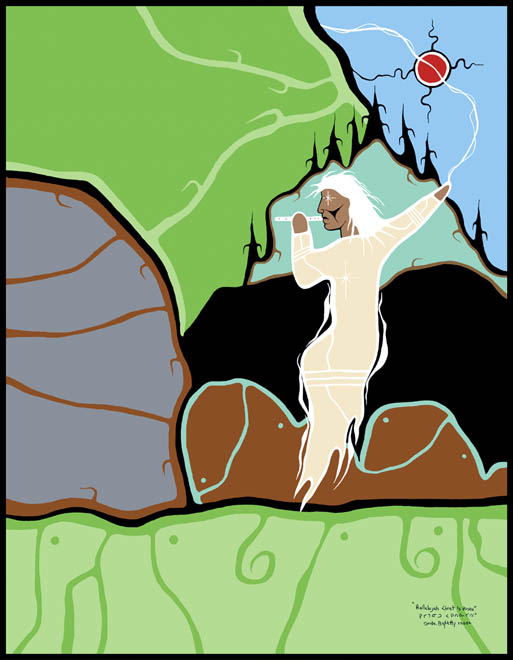
LOOK: Ovide Bighetty (Cree, 1969–2014), Hallelujah, Christ Has Risen, 2002. Acrylic on canvas. From the Kisemanito Pakitinasuwin (The Creator’s Sacrifice) cycle, commissioned by the Indian Metis Christian Fellowship.
Ovide Joseph Bighetty was a Cree (Missinippi-Ethiniwak) self-taught artist originally from Pukatawagan First Nation on the Missinippi River in northwestern Manitoba. He was influenced by the Woodland art style of Norval Morrisseau.
In 2002 the Indian Metis Christian Fellowship (now called the Indigenous Christian Fellowship, or ICF) commissioned Bighetty to create a series of paintings on Christ’s death and resurrection. According to their website, “among North American indigenous peoples, there is the story that, before Europeans arrived on Turtle Island, elders had visions about white people coming from the east with a story from the Creator.” One elder even had a vision of “the Creator’s sacrifice” that corresponds to elements of the biblical passion narratives and Easter story.
Bighetty fulfilled the commission in consultation with Pukatawagan elders, making sure he was properly honoring his people’s heritage.
Hallelujah, Christ Has Risen is the sixteenth painting in a sequence of seventeen. The ICF website offers the following description based on Matthew 28:2–4: “Early on the third day, there was a violent earthquake. A spirit sent by the Creator came down from heaven, rolled the stone away and sat on it. His appearance was like lightning and his clothes white as snow. The warriors were so afraid that they trembled and became like dead men.” It looks to me like the angel is playing a flute with one hand, and with the other he gestures toward the sky, indicating Jesus’s impending ascension.
LISTEN: “Christ the Lord Is Risen Today” | Words by Charles Wesley, 1739 | Music from the Lyra Davidica, 1708 | Arranged and performed by pianist Craig Curry on A Jazz-Inspired Easter, 2012
Christ the Lord is ris’n today, Alleluia! Sons of men and angels say,* Alleluia! Raise your joys and triumphs high, Alleluia! Sing, ye heav’ns, and earth reply, Alleluia!
Love’s redeeming work is done, Alleluia! Fought the fight, the battle won, Alleluia! Death in vain forbids him rise, Alleluia! Christ hath opened paradise, Alleluia!
Lives again our glorious King, Alleluia! Where, O death, is now thy sting? Alleluia! Once he died our souls to save, Alleluia! Where’s thy victory, O grave? Alleluia!
Soar we now where Christ has led, Alleluia! Foll’wing our exalted Head, Alleluia! Made like him, like him we rise, Alleluia! Ours the cross, the grave, the skies, Alleluia!
Hail the Lord of earth and heav’n, Alleluia! Praise to thee by both be giv’n, Alleluia! Thee we greet triumphant now, Alleluia! Hail the Resurrection, thou, Alleluia!
King of glory, soul of bliss, Alleluia! Everlasting life is this, Alleluia! Thee to know, thy pow’r to prove, Alleluia! Thus to sing, and thus to love, Alleluia!
* Alternatively, “Earth and heav’n in chorus say,” as in the United Methodist Hymnal.
This is, for me and many others, the Easter hymn par excellence. (Charles Wesley was a brillianthymn writer.) I never tire of it year after year. It’s glorious.
Happy Easter, friends. Christ is risen!
Be sure to stick around for the next fifty days as I continue to celebrate Easter here at Art & Theology.
Thistles, seaweed, ivy, and other plants and flowers appear often in the work of Dutch artist Paul van Dongen [previously], whose creative output includes a series of etchings titled Crown of Thorns. Made in 2004–5, shortly after his return to the Christian faith, each of these pieces portrays a ring of twining briars that evoke the headpiece forced mockingly on Jesus prior to his execution.
Paul van Dongen (Dutch, 1958–), Crown of Thorns (2), 2004. Etching, 25 × 37 cm. All photos courtesy of artist.Paul van Dongen (Dutch, 1958–), Crown of Thorns (3), 2004. Etching, 28 × 40 cm.Paul van Dongen (Dutch, 1958–), Crown of Thorns (4), 2004. Etching, 25 × 37 cm.Paul van Dongen (Dutch, 1958–), Crown of Thorns (5), 2005. Etching, 25 × 37 cm.
“I think all nature is not just botanical,” the artist told me in an email when I inquired about the series. “It’s also a sign—a signal, if you please—of something or Someone supernatural.” Some items found in nature, like these thorn branches, even have a Christological association, thorns having been an instrument of Christ’s passion.
Etching is a printmaking process in which a metal plate (in van Dongen’s case, zinc) is first coated in an acid-resistant ground of wax. The artist then draws a picture or design into the plate with an etching needle, exposing the bare metal so that when the plate is dipped into an acid bath, the acid bites into the exposed areas to create recesses that can retain ink. Next the artist removes the wax ground, inks the plate (letting the ink settle into the etched grooves), wipes clean the surface, and finally rolls the plate through a press with a sheet of paper, to which the reverse image adheres. Voila!
Van Dongen collects organic materials from his surroundings in Tilburg, bringing them back to his studio. His drawings on the plate are done directly from life, with no sketches beforehand or photographs. “Everything has to be present before me,” he says.
For his Crown of Thorns etchings, he gathered thorny twigs and branches from bramble bushes and bent and wove them into circular forms—“a painful job”! One of these crowns he keeps on the wall of his studio, next to a seventeenth- or eighteenth-century Portuguese corpus (body of Christ) that his aunt gifted to him.
Continuous in some ways with this somber series and yet visually and thematically distinct is van Dongen’s vibrant Verrijzenis (Resurrection) etching, made with colored inks and, using a process of his own making, printed watercolor. I and the Daily Prayer Project team chose this image for the cover of our Easter 2021 periodical, which is available for purchase in print or digital format. (As a side note, I contributed a written piece to this edition, “Praying with the Eyes.”)
Paul van Dongen (Dutch, 1958–), Verrijzenis (Resurrection), 2006. Watercolor etching, 70 × 33 cm.
I appreciate how van Dongen finds a unique way into the subject of Jesus’s resurrection, taking a nonfigural, conceptual approach that invites contemplation. His etching shows a thorny stem with a few withered shoots bisecting a crown of thorns, breaking it in two, evoking the breaking of Jesus’s body on the cross and, moreover, the breaking of the curse of sin and death, of which thorns are a symbol (Gen. 3:17–19). Consider, too, the covenant of the pieces that God made with Abraham (Gen. 15:1–15), wherein God, manifest as fire, passed between the animal sacrifices Abraham had cut in half, ratifying the promise of a land flowing with milk and honey for all his descendants.
The spherical forms in the background are skulls, an allusion to human mortality and to Golgotha, the “Place of the Skull.” (Van Dongen has worked with this vanitas motif par excellence several times, and even participated in the Skull Show at the ACEC in Apeldoorn in 2019–20; see, e.g., here and here.) But the skulls are dissolving. They and the other organic matter are rendered in red, yellow, green, blue, violet—colors of the rainbow, that ancient sign of God’s promise. The brokenness of creation is being transformed into new life, and even the orientation of the artwork invites us into that “upward call of God in Christ Jesus” (Phil. 3:14), its strong verticality lifting our eyes in a rising motion.
“For me there is no fundamental difference between my explicitly religious works and my more profane, earthly works of art,” van Dongen says. “Nature with its cycle of growing, flowering, dying, and sprouting out again is symbolic to me of Christ and his resurrection. And the other way around.”
Each of the etchings on this page, excluding Resurrection, is from an edition of 15. There are still a few impressions left; contact the artist using the contact form on his website, www.paulvandongen.com, if you wish to inquire about a purchase. Follow him on Instagram @paulvan.dongen.
Today’s two featured artists draw on the mythology of the phoenix, a fantastical bird that dies in flames but then is born again out of its own ashes. (An alternate legend, not as popular, says the phoenix dies and decomposes but then rises out of its rot.) In Christianity the phoenix became a symbol of resurrection—Jesus’s, and our own. The First Epistle of Clement to the Corinthians from the late first century CE is the first Christian writing to make this connection. And the phoenix points to not only the reconstitution of our bodies after death but also the spiritual regeneration we undergo in this life. Out of the ashes of our sin, the death of the old self, the new self rises with Christ.
Apart from (but not opposed to) this theological framework, the phoenix can be seen as a symbol of resilience through trials, of withstanding the forces of destruction, and it seems that’s the sense that life coach and creative Yolonda Coles Jones [previously] is after in her song. The chorus is a mantra that anyone, regardless of faith tradition, can make their own: “Rise from the ashes.”
LOOK: Nathan Florence (American, 1972–), Winging Phoenix, 2010. Oil on printed cotton, 20 × 20 in.
Amazed at what I’m able to do Lookin’ back on all I’ve been through Survived unimaginable things, yeah Phoenix bird claps her wings
Rise from the ashes (×4)
Spread your wings and fly Phoenix bird, rise
Note to reader: I’m not able to sustain daily posts for the duration of Lent (I’m a one-woman show here!), so there won’t be a “Lent, Day 8,” etc., but I will continue to provide regular content throughout the season. In the meantime, I hope you’re enjoying the Lent Playlist I put together.