Roundup: “Ave Maria” ballet, pregnancy, Magnificat

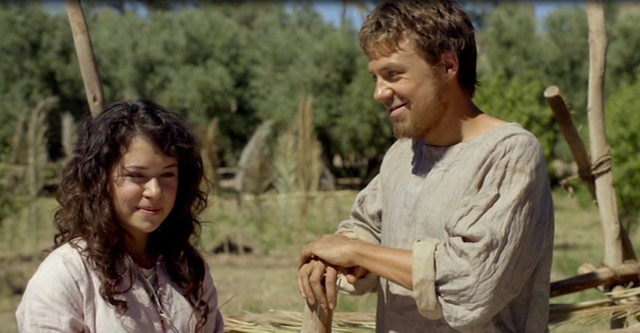
DANCE: “Ave Maria”: Queensland Ballet dancers Victor Estévez and Mia Heathcote perform a pas de deux (ballet duet) to the Schubert melody that today is most associated with the prayer “Ave Maria,” which begins, “Hail Mary, full of grace, the Lord is with thee.” These are the words the angel Gabriel spoke to Mary when he came to announce that she would bear in her body the Son of God. Though I can’t say what this duo had in mind when they choreographed the piece, I can’t help but think, given the music choice, of the Annunciation—the Divine coming to dance with humanity, to partner with her for the redemption of the world. The dancing starts thirty-five seconds in.

+++

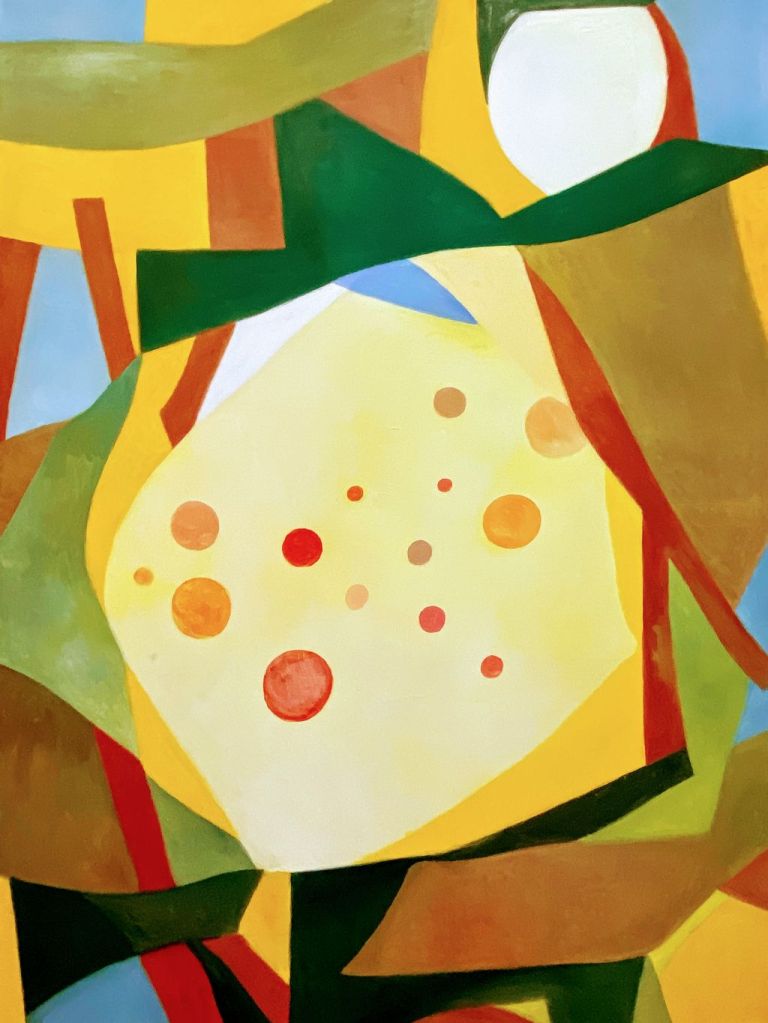
VISUAL MEDITATION: “Embodied Joy, Serious Joy: Making Room in the Body and Life for New Creation” by Alexandra Davison: I shared a visual meditation by this culture care leader just last week. In this devotional piece based on Luke 1:41–55, Davison discusses two abstract paintings from Louise Henderson’s The Twelve Months series. In October, “Henderson has a cropped representation of a pregnant woman, her belly bright and fruitful as a melon, shines with what Henderson describes from her own pregnancy as ‘bubbles of life circulating in the womb.’ She magnifies joy from its tiniest beginnings both seen and unseen in the mother and the child.” Reflecting on this ebullient image in conjunction with her own pregnancy experience and Mary’s, Davison ends by quoting an adaptation of the Magnificat by songwriter Marcus Walton.

Henderson, Louise_October
Louise Henderson (New Zealand, 1902–1994), October, from the series The Twelve Months, 1987. Oil on canvas, 250 × 150 cm. Auckland Art Gallery Toi o Tāmaki, New Zealand.

+++

VIDEO INSTALLATION: Mary! by Arent Weevers: One of the primary images or metaphors for the season of Advent is pregnancy—the pregnant Mary awaiting the birth of Jesus, her belly swelling a little more each day, and a world heavy with expectancy, at the threshold of (re)birth. In 2009, media artist and theologian Arent Weevers [previously] created a gorgeous video installation titled Mary!. “Standing in the middle, a heavily pregnant young woman. Her hair partly covers her naked body to her ankles. She peers past you, with no expression on her face. From underneath, a gusty wind begins to blow, wafting her hair slowly upwards into the air. Suddenly, the woman bends slightly forward, her left arm in front of her abdomen, and grimaces painfully. Losing her balance, she falls sideways out of the frame until only black remains.” You can preview the video here. (Because of the nudity, there will be a content warning you have to accept before proceeding.)

Weevers’s art aims to express the paradoxical nature of the human body—its vulnerability and its strength—and in her role as Mary, the actor in this video exemplifies both so well. Gloriously gravid and standing tall at first, the woman looks into the distance and sees the future suffering of her son. She clasps her belly protectively in response, hunching forward as the painful knowledge of his destiny shoots through her.

+++

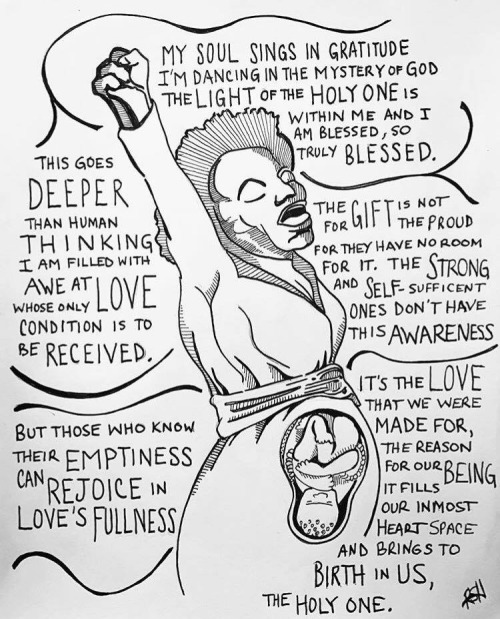
MAGNIFICAT SERMON (and sketch): “The Love That We Are Made For” by Bob Henry: Bob Henry is an American Quaker pastor who often sketches in preparation for and in response to sermons. In this sermon he delivered December 11, 2016, at Silverton Friends Church in Oregon, he reflects on the oldest and most radical Advent hymn: Mary’s Magnificat. We are so used to thinking of Mary as quiet and demure, but Henry imagines her as “a strong woman with arms flaring, fists raised, wild bodily movements, beads of sweat forming on her brow, and a strong voice throwing down these words from Luke 1:46–55.”

Henry, Bob_Mary's Freedom Song
“Mary’s Freedom Song.” Illustration and lettering by Bob Henry, 2016. Text by Joy Cowley, 2007, adapted from Luke 1:46–55.

This characterization is expressed in his drawing, which shows a Black Mary, full of faith and fire, surrounded by the words of Joy Cowley’s “Modern Magnificat.” He says the women of the African Methodist Episcopal Church in Chicago, where he used to teach Bible, embody for him Mary’s bold declaration of justice, freedom, and hope in today’s world. He challenges us to sing Mary’s song in our own political climates.

+++

SONG: “Magnify”: For its November 29 worship service, Good Shepherd New York [previously] premiered a new arrangement of Tom Wuest’s “Magnify,” sung by Paul Zach and Lauren Goans, part of the Good Shepherd Collective (see 7:33 in the video below). The piano part includes the Gloria theme from “Angels We Have Heard on High,” played liltingly. Love it! (Update 12/14/20: Paul Zach posted a standalone video of this song on Instagram this morning.)

+++

I’ve added a new batch of songs to “Advent: An Art & Theology Playlist.” I like to “DJ” them (to balance the styles and moods and create thematic links), so they’re not all grouped at the bottom, but you can look at the “Date added” column to see the latest additions. I want to acknowledge the source of those I found from other Advent playlists and resources: Credit goes to Teer Hardy of the Crackers and Grape Juice podcast, compiler of the “Advent Begins in the Dark” playlist, for “The Man Comes Around” by Johnny Cash, “Jesus Gonna Be Here” by Tom Waits, “Shepherd’s Lament” by Kirby Brown, and “Are You Ready?” by Jason Champion. Pastor, pianist, arranger, and Daily Prayer Project founding director Joel Littlepage cued me in to the songs “Tenemos Esperanza,” “Toda la Tierra,” “Hold on Just a Little While Longer,” and “He’s Right on Time” through his “DPP Advent Songbook.” “I Believe in Being Ready” by Rising Appalachia comes from Lauren Plummer’s “Advent 2020: All Earth Is Waiting,” and “My Soul Doth Magnify the Lord” by O’Landa Draper and the Associates is from Tamara Hill Murphy’s “Advent 2020: Gracious Invitation.” “Intro Comfort My People” by Jamaican artist Chrisinti is featured in Biola’s Advent Project 2020.

Roundup: Virtual Advent concerts, dreams deferred, pop-up floral memorials, and more

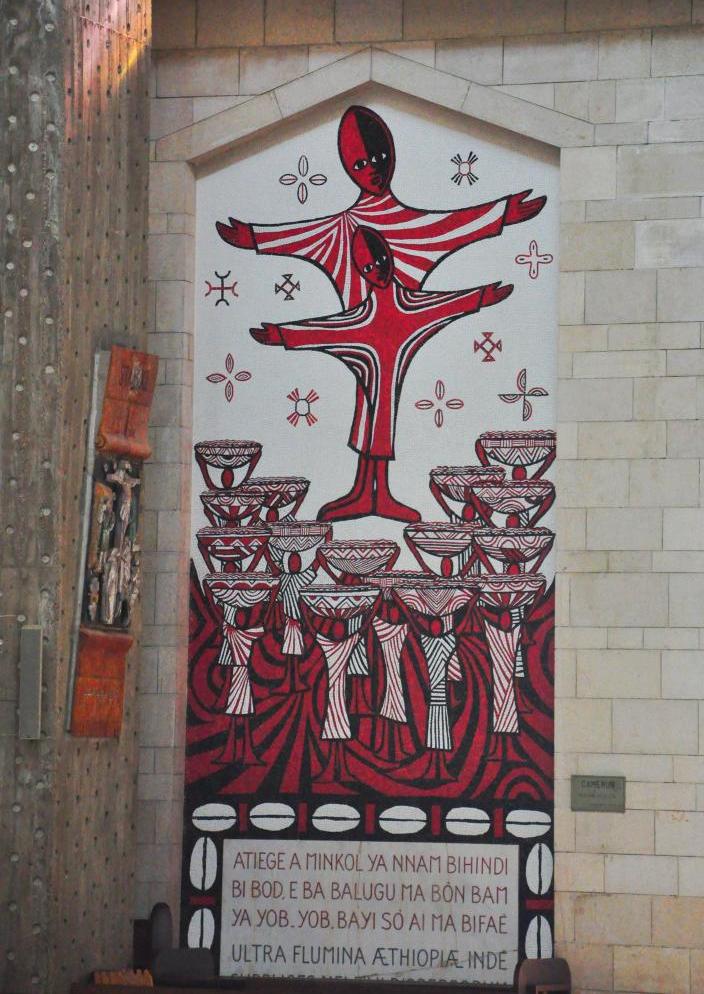
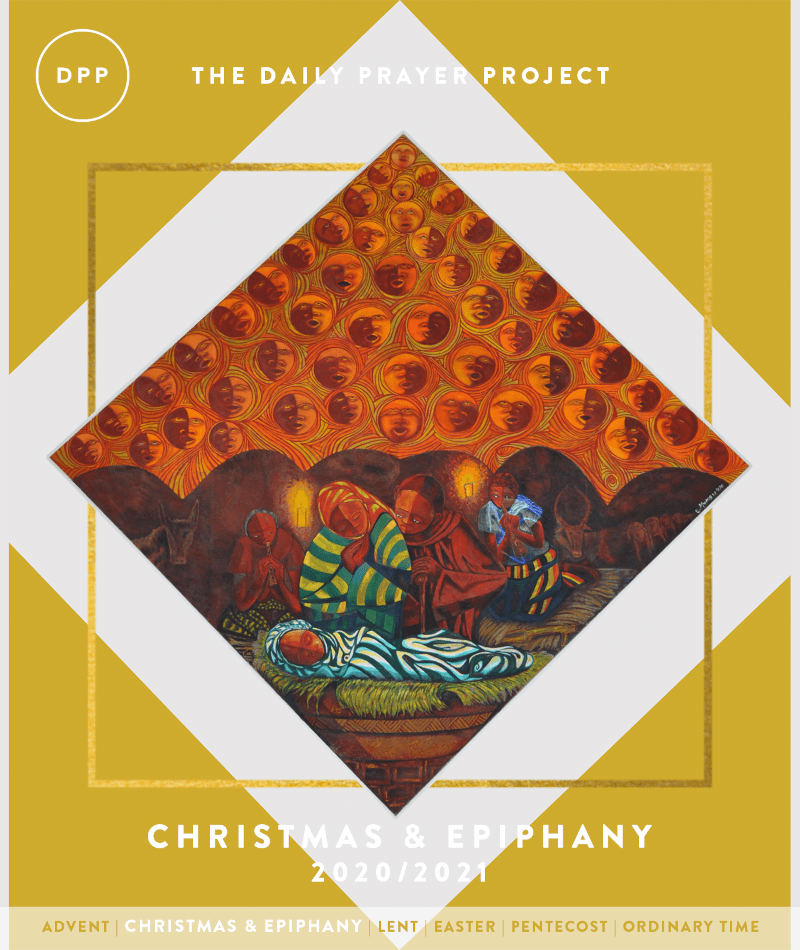
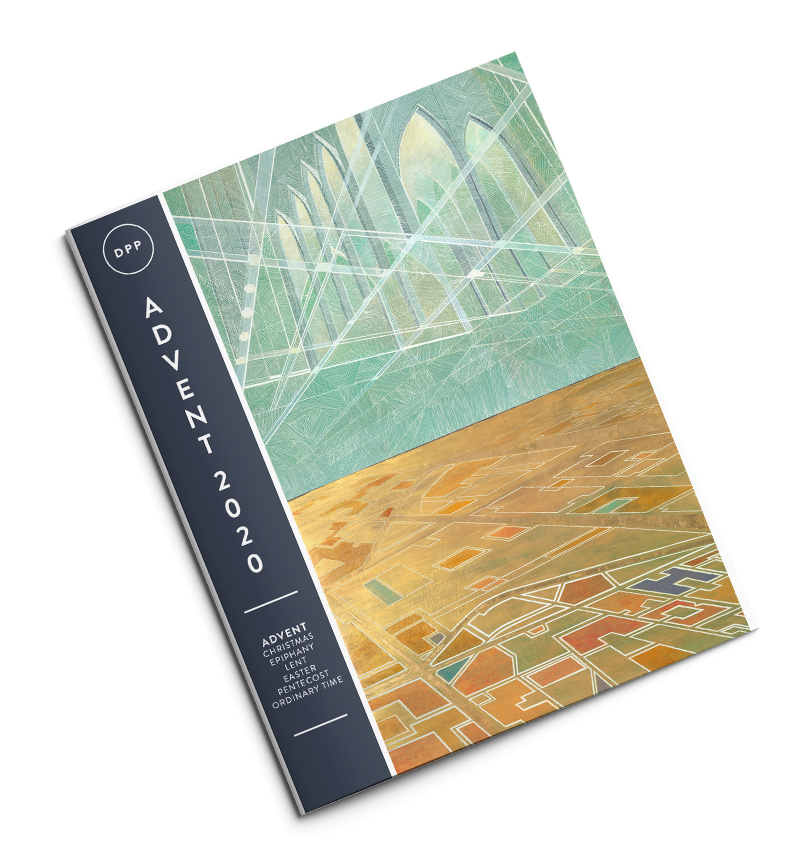
The Christmas–Epiphany 2020/21 edition of the Daily Prayer Project [previously], a publication I work for part-time, released this week! The cover image is from the sanctuary mural at Holy Angels Catholic Church in Chicago, by Cameroonian artist-priest Engelbert Mveng. (See the full mural here.) Also in this edition are images of Grace Carol Bomer’s From Strength to Strength, showing Light stepping into darkness, and the Piper-Reyntiens stained glass window in Coventry Cathedral, with its yellow sunburst amid an abstract pattern of reds, blues, and greens. We include visual art as a supplement to the prayers, scripture readings, and songs with the understanding that it, too, can promote spiritual development and a deeper communion with God.

You can purchase a digital copy (PDF) of the Christmas–Epiphany edition (December 24–February 16) through the website, and if in the future you’d like to receive hard copies, starting with Lent 2021, you can become a monthly subscriber. Part of the money goes to supporting artists.

+++

Whenever I see a Helena Sorensen [previously] byline, I perk up, because I always find myself connecting so much with her writing. She’s a regular contributor to the Rabbit Room blog. Her two most recent posts are “Things Fall Apart” and “Advent, Week One: Hope.” They’re both great.

+++

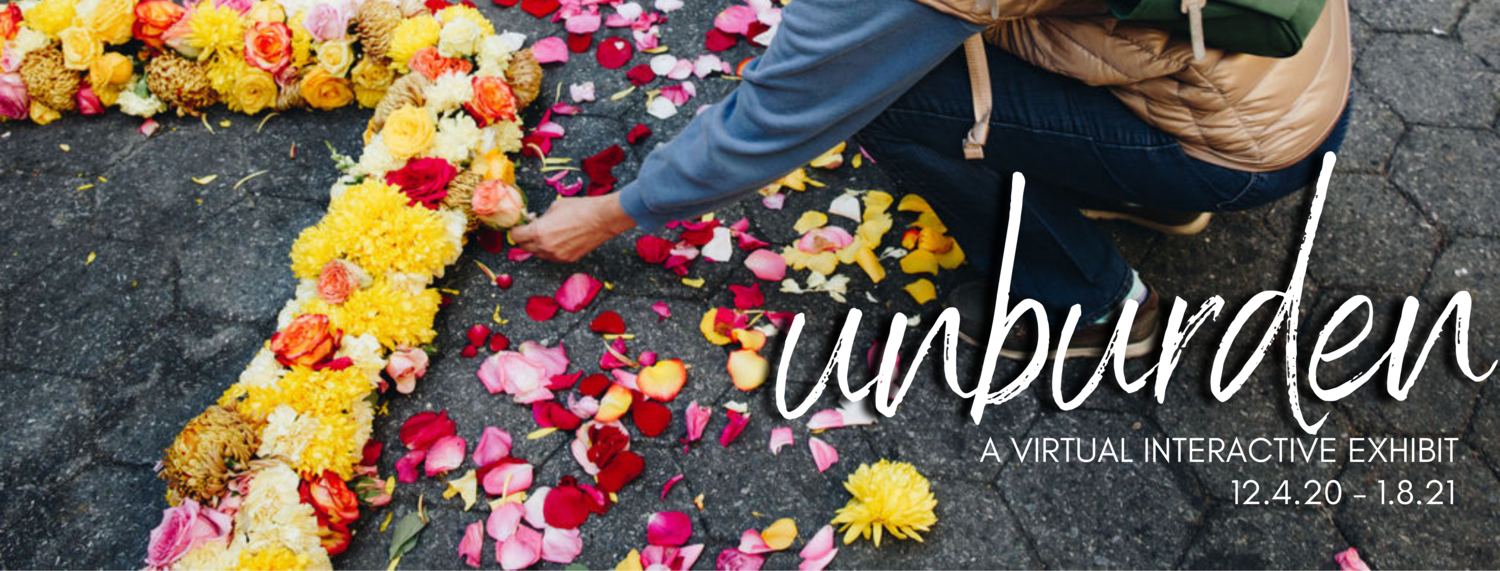
Unburden: A Virtual Interactive Exhibit, December 4, 2020–January 8, 2021: The Gallery at W83 is part of a 45,000-square-foot cultural center built by Redeemer Presbyterian Church in Manhattan’s Upper West Side as a service to the city’s artists and larger community. W83 Events and Programming Director Eva Ting has curated a virtual exhibition of photographs and stories from Kristina Libby’s Floral Heart Project, a series of living memorials to those lost to or suffering from COVID-19. Libby initiated the project in New York City in May, partnering with 1800Flowers.com to place floral heart garlands all around the city to create space for ceremony and to invite the community to process and mourn. The project has since grown nationwide.

“Many of us are carrying burdens of loss, anxiety, and uncertainty as we move towards the end of 2020,” Ting writes. “We have all been impacted in some way by the events of this year, and we bear fatigue weighed heavier by the inability to gather as a community to collectively grieve. In this interactive virtual exhibit Unburden, the Gallery at W83 invites you to participate in an unburdening of the load we carry.”

The exhibition webpage invites you to release personal burdens by writing down any grief, fears, loss, or anxiety you wish to let go of (can be submitted anonymously if desired). These words will be incorporated into a new floral heart laying on December 20 at Fort Tryon Park, an event that will be livestreamed. You can also ask for prayer, and members of the W83 team will pray for your requests. “Through these individual and collective acts of unburdening, may we imagine what it would look like to truly let go of these burdens.”

Floral Heart Project (Brooklyn Bridge)
Photo by Erica Reade

+++

I enjoyed attending the virtual “Songs of Hope: A TGC Advent Concert,” featuring music and spoken-word performances from a variety of artists (see YouTube description), interspersed with Advent readings. It was a truly meaningful worship experience.

I’m sure there are many more virtual Advent/Christmas concerts and other online events coming up. What ones are you most looking forward to?

One that I’ll probably be tuning in to is “We Three Queens Holiday Show” by Pegasis, a sister trio, on December 17, 8:30 p.m. EST (7:30 p.m. CST). It will be live on Facebook and and Instagram. (Update, 12/17/20: View the performance here. My favorite two songs are probably “Poncho Andino” at 19:04 and “Mary Had a Baby” at 45:24—such a unique arrangement!)

There’s also “A Candlelit (Virtual) Room: The Advent Christmas Music of Ben Thomas” on December 11 and 12 (10 p.m. EST and 8 p.m. EST, respectively), two private Zoom concerts open to the first twenty-five registrants each. He’ll be performing original songs from his albums The Bewildering Light, The Wilderness Voice, and Peace Here, all of which I recommend. My favorite tracks: “Justice Will Sprout from the Ground,” “Zechariah and the Least Expected Places,” and “Shepherds and Angels.” (The latter two were recorded under the name So Elated.)

+++

POEM: “Harlem” by Langston Hughes: This is a brilliant poem—its sensory images, its rhythm, its rhyme, its multivalence (especially the last line). I loved it so much when I first read it in ninth grade that I memorized it unbidden. When writer and podcaster Joy Clarkson posted a reflection on the poem for her Patreon community in October, resulting in a lively conversation thread in the comments section, it reignited my enthusiasm for and got me thinking more deeply about “Harlem.” She opened by quoting Proverbs 13:12: “Hope deferred makes the heart sick, / But desire fulfilled is a tree of life.”

“What happens to a dream deferred? // Does it dry up / like a raisin in the sun?” Written in 1951 as part of a sequence of poems exploring black life in Harlem, “Harlem” is inextricably tied to the civic discourse of the contemporary American moment, writes Scott Challener in Poetry Foundation’s guide to the poem. The “dream” he refers to is the American Dream, unattainable for so many due to racial inequalities and oppression. (Also assigned in ninth-grade English curricula in the US is Lorraine Hansberry’s A Raisin in the Sun, which takes its title from and addresses the questions of “Harlem.”)

While not wishing to strip the poem of its specific context, I have been thinking about all the dreams that have been deferred this year—put on hold, or even irretrievably lost, because of COVID-19. Hughes posits a string of descriptive similes for a deferred dream: a dried-up raisin, a festering sore, rotting meat, a crusted-over sweet, a sagging load. One commenter on Joy’s Patreon observed how a raisin can’t turn back into a grape, rotten meat can’t be made fresh again, and an overcooked dessert can’t be cooked back down, but a sore can heal and a load can be lifted.

The final suggestion—“or does it explode?”—can be read in myriad ways. In one respect it could refer to the explosion of cultural output, of creativity, that results from deferred dreams—i.e., the Harlem Renaissance. I’ve definitely seen this happen this year, as people, in the face of crushing personal and professional disappointments, have found unique ways to come together and produce and share works of beauty within the restrictiveness of health and safety protocols. One example—speaking of Harlem—is the Dance Theatre of Harlem, a groundbreaking neoclassical ballet company founded at the height of the civil rights movement in 1969 and still active today. Bans on gatherings of certain numbers have meant that dancers and other performers have had to find alternative ways of reaching their audiences, so DTH artists Derek Brockington and Alexandra Hutchinson created “Dancing Through Harlem,” taking choreography from Robert Garland’s “New Bach” out into the streets and capturing it on video for people to enjoy from home. To help support the DTH during this time, you can donate easily through the fundraising sidebar on the video’s YouTube page or through the company’s website.

+++

SONG: “400 Years” by Sarah Sparks: This original song, sung with Kate Lab, appears on Sarah Sparks’s new album, Advent, Pt. One. It’s about how the centuries-long silence of God between the ministry of Malachi (ca. 420 BCE) and the appearance of John the Baptist in the early first century CE was broken with the birth of Jesus—the Word made flesh. Its refrain, “For the first time, not a silent night,” cleverly turns on its head the sweet, familiar carol “Silent Night.” Through the incarnation, God spoke to all who would listen.

Roundup: Advent art meditations, new songs, and more

VISUAL MEDITATIONS:

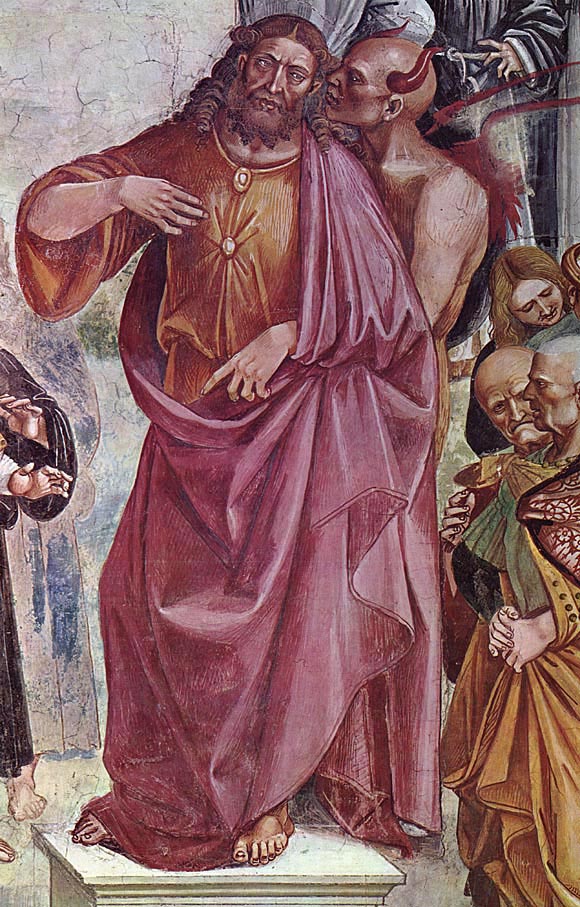
“An Advent Visio Divina” by John Skillen, CIVA blog: John Skillen, author of Putting Art (Back) in Its Place, discusses four works of Advent-themed art from Italy, where he lives for part of each year leading retreats and seminars through the Studio for Art, Faith & History. He starts in Florence with The Adoration of the Shepherds altarpiece by Renaissance artist Domenico Ghirlandaio, which invites worshippers to follow the shepherds’ (and patrons’) example of adoring the Christ child. Then he moves to Orvieto, spotlighting Karin Coonrod’s directing a medieval mystery play in the city’s streets and churches. (For more on this, read Skillen’s excellent essay in Image no. 96, “Fierce Mercy: The Theater Art of Karin Coonrod.”) Advent is also about the second coming, so Luca Signorelli’s apocalyptic frescoes in the Chapel of San Brizio in Orvieto Cathedral are appropriate. Continuous, in some ways, with these late fifteenth-century paintings are the bronze reliefs on the central doors by Emilio Greco from 1962; they depict the seven works of mercy, the criteria, according to Matthew 25, by which humanity will be judged.

Mary carries the Light of the World
Actor Patrice Johnson portrays Mary, who carries the light of the world, in this contemporary adaptation of The Second Shepherds’ Play directed by Karin Coonrod. Photo: Massimo Achille.

Signorelli, Luca_Antichrist
Luca Signorelli (Italian, ca. 1441/45–1523), Sermon and Deeds of the Antichrist (detail), 1499–1502. Fresco, Chapel of San Brizio, Orvieto Cathedral, Italy. The Antichrist is shown as a puppet of the Evil One.

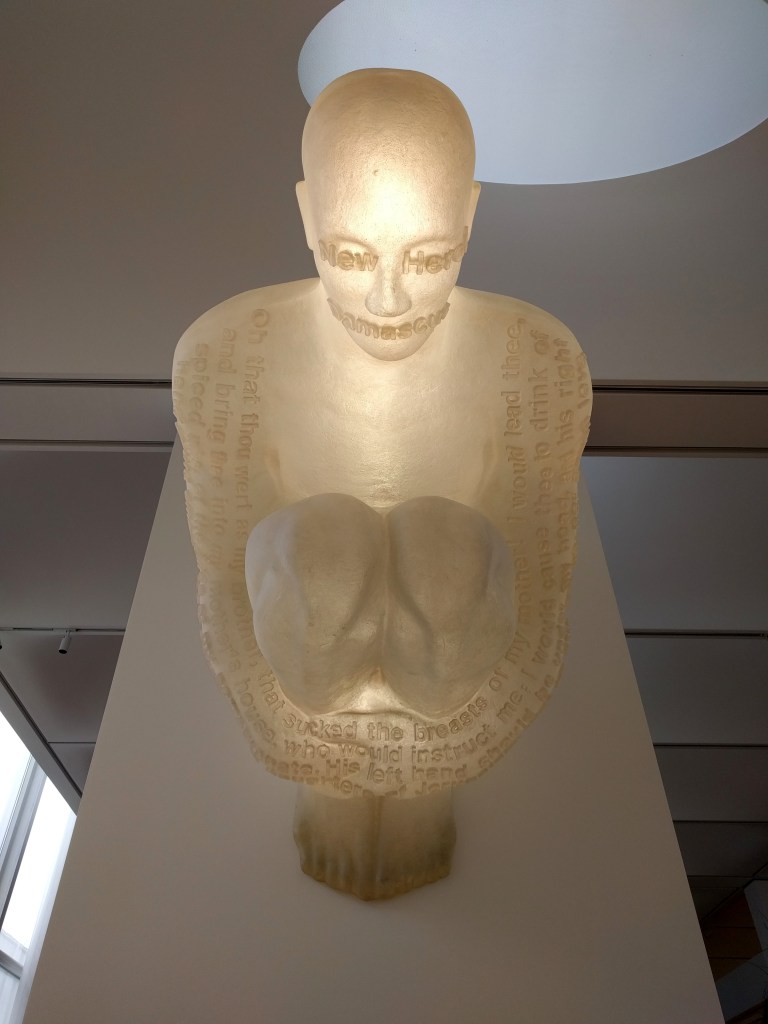
“Passion for the Light” by Alexandra Jean Davison, ArtWay: For last Sunday, the first day of Advent, Culture Care RDU Director Alexandra Jean Davison wrote this wonderful meditation on a set of contemporary sculptures by Jaume Plensa at the North Carolina Museum of Art, connecting them to the season we’re in. She begins, “We see three identical nudes filled with light, the face and arms covered with names and Scripture. Each figure sits at rest horizontally on one of the three walls which form a triangle. The closed eyes and mouth are covered with embossed text of the names of the eight gates of the ancient city walls of Jerusalem: New, Herod, Damascus, Golden (two doors: Gate of Repentance and Gate of Mercy), Lions, Jaffa, Zion, and Dung. Tattoo-like passages from the Song of Songs emerge from the heart upon the arms.” Read more at ArtWay.eu.

Plensa, Jaume_Doors of Jerusalem I
Jaume Plensa (Spanish, 1955–), Doors of Jerusalem I, 2006. Resin, stainless steel, and light, 47 1/4 × 62 3/16 × 80 11/16 in. (120 × 158 × 205 cm). North Carolina Museum of Art, Raleigh. Photo: Victoria Emily Jones.

+++

VIDEO: “Matthew 1:18-23” by SALT Project: The Emmy Award–winning production company SALT Project released a short video this week setting a reading from Matthew’s Gospel (“This is how the birth of Jesus came about . . .”) against evocative time lapses of blooming flowers. They’re generously offering it for free download and use in worship services, online or in-person. It could be used as an opener, as one of the morning’s scripture readings, or in a number of other ways.

+++

SONGS (the latter two released this week!):

“Christ Child’s Coming”: This simple Advent song is based on the African American spiritual “The Train Is a-Coming” (where “train” is a multivalent metaphor having to do with salvation). While a musician at Christ Church East Bay in Berkeley, California, Keith Watts adapted the lyrics to relate more explicitly to Advent: “Christ child’s coming, oh yeah!,” “Light is coming, oh yeah!,” and “Our king’s coming, oh yeah!” The song is sung here by Trinity Majorins, accompanied by her mom, Sarah [previously], on the piano and her dad, Philip [previously], on guitar.

“Weight/Wait” by Mike McMonagle: “Hope . . . flicker[s] underneath the weight of the wait.” Introducing this new demo, Mike McMonagle, a roots rock musician from Lancaster, Pennsylvania, wrote on Facebook about how the pandemic has created an extended season of waiting in the darkness this year, which has helped him to feel both pain and longing more keenly: “For the past couple of months, I’ve found myself processing all the ups & downs of the current life experience in step with what I’d label the deepest dive into the Advent season that I’ve ever done. All my life, Advent was just a church-y word for rat race otherwise known as The Holidays. There were happy hours, shopping trips, family outings – things that made it hard to focus on the Advent season for more than an hour each Sunday. This year has been different.”

“In Distress” by the Pharaoh Sisters: Written by Austin Pfeiffer and Jared Meyer and based on Psalms 120 and 121, this song blends Latin and Appalachian folk music influences and has lyrics in both English and Spanish. “The song’s creation began in the spiritual angst after the 2016 [US presidential] election,” Pfeiffer writes. “Calling on believers to put their hope in Christ as King, the song has broad themes of Kingdom orientation, raises questions about social divisions, but also leans into Advent ideas, specifically Isaiah 9.” It premiered at the 2017 Presbyterian Church in America (PCA) General Assembly but didn’t end up fitting on the Pharaoh Sisters’ 2020 debut album, Civil Dawn. “Now as our nation plunges deeper into distress and unrest, be it political and/or social, the band is eager to release the song for Advent 2020.”

+++

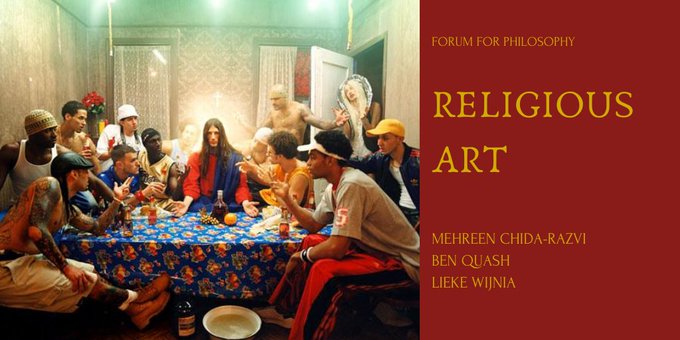
ONLINE PANEL: “Religious Art,” December 9, 6:00–7:15 p.m. London time (1:00–2:15 p.m. ET): “The relationship between religion and art is ancient and complex, varying across religious traditions and cultures. In this event, Mehreen Chida-Razvi, Ben Quash, and Lieke Wijnia consider how these traditions of religious art differ and what role art plays in religion today. How should we display religious art? Might art be a way of opening interfaith dialogue? And has art itself become a kind of religion?” This free Zoom event is organized by the Forum for Philosophy and the Department of Philosophy, Logic and Scientific Method at the London School of Economics. I’ll be attending! (Note: The promotional image below is David LaChapelle’s Last Supper.) Update, 12/10/20: The panel discussion has been archived and can be viewed here.

Religious Art Zoom panel

Roundup: Advent calendar of songs, free Alvin Ailey season, Bill Murray plays Job, and more

For those readers who are new, welcome! I want to alert you to (and remind others of) the Art & Theology Advent Music Playlist. I released it last year on Spotify and have made some additions since then, including all six songs from Lo Sy Lo’s excellent album St Fleming of Advent, selections from recent releases by the Porter’s Gate’s, Andrew Bird, and Caroline Cobb, some Nina Simone and Jackson 5, a musical setting of an Emily Dickinson poem by Julie Lee and a Count of Monte Cristo quote by the Duke of Norfolk, the shape-note hymn “Bozrah,” and more. I’ve structured the list as a journey from the early promise of a Savior in God’s covenant with Abraham (Gen. 22:18), through Isaiah’s prophecies about a great light dawning and a shoot springing up out of a stump and valleys being lifted and swords being beaten into plowshares, to the angel’s announcement to Mary and her subsequent Magnificat and pregnant waiting, which I transition into the church’s waiting for Christ’s second coming, with warnings to keep our lamps trimmed and burning, to stay awake, to watch and pray. Sprinkled throughout are groanings from God’s people as well as expressions of joyful expectancy.

A Christmas playlist will be forthcoming in just two weeks.

+++

Bard and Ceilidh Advent Calendar: This Advent, multi-instrumentalist and melodist Mary Vanhoozer (aka Bard and Ceilidh) is offering a digital “Advent calendar” with twenty-four traditional, Celtic-infused Christmas carols played on various folk instruments. For $20, you will receive a code that unlocks a new song daily for download. Here are two of Vanhoozer’s previous releases, to give you a sense of the style she plays in. The first is her own arrangement of “I Saw Three Ships” with “Branle des Chevaux” (The Horse’s Brawl). The second, “When Icicles Hang by the Wall,” is an original setting of the winter hymn from Shakespeare’s Love’s Labours Lost, which celebrates the season of biting cold and red, runny noses and sloshy roads and singing owls and simmering crabapples and interior warmth.

+++

“Veni Emmanuel: A brief meditation on the meaning of Advent” by John B. Graeber: This short piece published last year in Curator is a great introduction to the liturgical season we’re entering into on November 29. It begins, “Advent is the hope of redemption, sung in minor key. It is the promise of resurrection, and the sorrow of that hope not yet fulfilled. In this the midnight of the liturgical year, these few weeks before we celebrate the birth of Christ, we confront a world not yet reborn and embody what Saint Paul calls the ‘hope against hope,’ a hope that endures when the world says it should not. A hope that looks back to the birth of our savior, and forward to His coming again, when all will be made new.”

+++

VIRTUAL DANCE PERFORMANCES: On December 2, Alvin Ailey American Dance Theater is launching its first-ever virtual winter season—and, in the spirit of making dance accessible to all, it’s free! The season will feature the world premiere of the dance films A Jam Session for Troubling Times (choreographed by Jamar Roberts) and Testament (Matthew Rushing, Clifton Brown, and Yusha-Marie Sorzano), plus sixtieth anniversary tributes to Alvin Ailey’s Revelations, a classic that “explores the places of deepest grief and holiest joy in the soul . . . using African American spirituals, song-sermons, gospel songs, and holy blues.” The season will run through December 31. Learn more here.

+++

DRAMATIC READING AND DISCUSSION: The Book of Job: On Sunday, December 6, 4–6 p.m. ET, Theater of War Productions will be hosting a free online event where actors, including Bill Murray, will be performing Stephen Mitchell’s translation of the book of Job, adapted and directed by Bryan Doerries. “The Book of Job is an ancient Hebrew poem that timelessly explores how humans behave when faced with disaster, pestilence and injustice,” Doerries writes, and this dramatic reading aims to serve “as a catalyst for powerful, guided conversations about the impact of the COVID-19 pandemic upon individuals, families, and communities.” After the reading, four community panelists will kick off the discussion with their gut responses to what resonated with them, and then discussion will open up to the audience. RSVP here.

“Theater of War Productions works with leading film, theater, and television actors to present dramatic readings of seminal plays—from classical Greek tragedies to modern and contemporary works—followed by town hall-style discussions designed to confront social issues by drawing out raw and personal reactions to themes highlighted in the plays. The guided discussions underscore how the plays resonate with contemporary audiences and invite audience members to share their perspectives and experiences, and, helping to break down stigmas, foster empathy, compassion, and a deeper understanding of complex issues.” Their many past projects include A Streetcar Named Desire (followed by a discussion on domestic violence), scenes from King Lear (the challenges of aging and dementia), and Sophocles’s Ajax (the invisible wounds of war).

Beginning in May, the company started presenting their projects online. Because they want to cultivate “a dynamic space to participate in an ephemeral experience, in which risks can be taken, interpretations shared, and truths told,” the projects are not available afterward for on-demand views. To get an idea of the format they follow and some of the work they’ve done, see the Theater of War trailer below.

+++

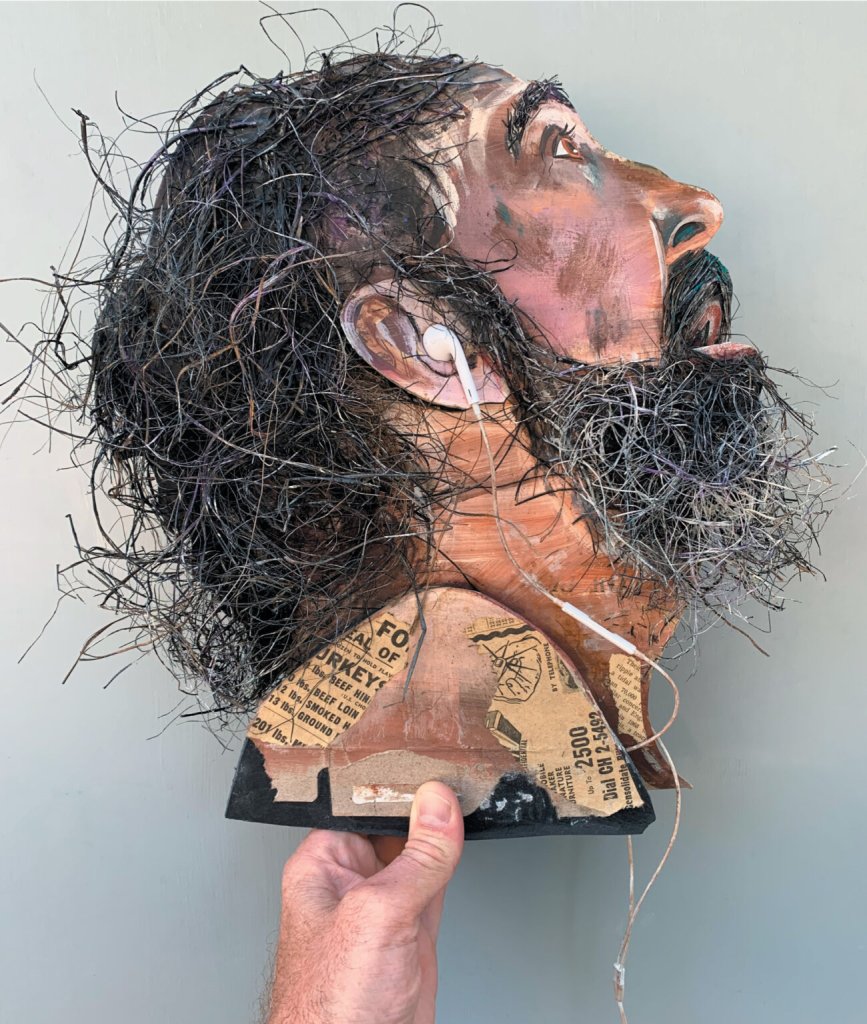
INTERVIEW: “Grief Is Hard to Look At: An Interview with Wayne Brezinka” by Brooke West, The Rabbit Room: Wayne Brezinka, a Nashville-based mixed media artist specializing in multidimensional portraits, recently launched a Kickstarter to crowdfund 2020 Disrupted: A Re-Assembled Life. (I just missed the deadline, but it turns out the project was successfully funded!)

As we sit in the year 2020 and struggle to remember what normal even feels like, I’ve been wondering about people’s emotions and how I might capture the painful realities of human existence we all seem to be feeling this year. In this new work, I will explore the pain and anxiety of massive disruption and how we are changed by it. I’ve been thinking about the biblical character Job from the land of Uz. What might he look like, plucked out of the ancient text, and plopped into modern-day? This is my attempt to bring a re-imagined 21st century Job to life in a way that encapsulates not only his experience, but also our own. I’ll be using a combination of found and repurposed objects, multi-media visuals, and incorporating input from the public on multiple panels that measure 8 feet by 5 feet—my biggest project to date.

Brezinka, Wayne_Job
Early working prototype for 2020 Disrupted: A Re-Assembled Life by Wayne Brezinka

Next year Brezinka will be taking the completed art on tour across the country in a glass box truck. “The plan is to park at notable cathedrals or churches and community centers in each city. I want to give those who funded this project and the general public an opportunity to pause, interact with the art, and reflect on the last year—the disruptions, the beauty, and the changes it all brings.” He says the art is an invitation for people to feel their sorrow and their grief. Read the interview to find out more about his process and his hopes for the project.

+++

NEW SONG RELEASE: “O Love That Casts Out Fear”: This is my favorite track from the new sacred chamber pop EP by Bobby Krier, Jon Green, and friends, Cast Out All Our Fears. The hymn text was written by Horatius Bonar in 1861, and the music is by Bobby Krier and Justin Ruddy [previously], who collaborated often as musicians at Citylife Presbyterian Church in Boston. (Their retuned version premiered on the 2013 album Castle Island Hymns; they have since moved on from Citylife.) This rendition is sung by Molly Parden.

Roundup: Christianity in Africa, Zwingli’s plague hymn, biblical art database, and more

VISUAL MEDITATION: “At the Whipping Post” by Victoria Emily Jones: Last year the Museu de Arte de São Paulo (MASP) ran a major retrospective on Djanira da Motta e Silva, “a central artist in Brazilian mid-century modernism” (Rodrigo Moura). ArtWay’s editor asked me to choose a painting of hers to write about—I chose the one she submitted to the 1955 “Christ of Color” contest, showing Jesus as an enslaved African being scourged in the historic center of Salvador de Bahia, the first colonial capital of Brazil.

Djanira_Largo do Pelourinho, Salvador
Djanira da Motta e Silva (Brazilian, 1914–1979), Largo do Pelourinho, Salvador, or Cristo na coluna (Christ at the Column), 1955. Oil on canvas, 81 × 115 cm. Private collection, Rio de Janeiro, Brazil. Photo: Jaime Acioli.

+++

LECTURE: “Is Christianity a White Man’s Religion?” by Dr. Vince L. Bantu: I first encountered Vince Bantu in a Conversing (Fuller Studio) podcast episode on African American identity and the church. (He joined the Fuller faculty last year as assistant professor of church history and Black church studies.) In this video from January 2018, he returns to his alma mater, Wheaton College, to discuss the history of Christianity in Africa—which some people are surprised to learn predates colonialism. “To study ancient African history is to study Christianity. They go together,” he says. “If you want to study Ethiopian literature, . . . you’re going to be reading a whole bunch of Christian literature. Same thing in Nubian. Same thing in Coptic.” While the Anglo-Saxons were still worshipping Odin and Thor, Bantu says, Black Africans were building churches, establishing seminaries, and writing Christian theological treatises!

The talk starts at 11:34 and really kicks into gear at around 24:00. Q&A starts at 52:40 and includes discussion of a three-point spectrum of approaches to culture, mission as “cultural sanctification,” and internalized theological racism. Take note of Bantu’s response, at 1:09:35, to the question “What do we do with this information?”

“Christianity is and always has been a global religion,” Bantu reminds us. Unfortunately, people tend to associate it most with western Europe. That’s because Rome, the dominant culture for some time, essentially said, “Christianity belongs to us,” instituting a theological hegemony. The West proclaimed itself the guardian of the Christian faith, declaring heretical churches in other regions that didn’t express theology the same way they did, with no regard for differences in language and philosophical frameworks.

I appreciate how Bantu teaches Christian history in part through art and architecture, which are material witnesses to the faith and sometimes even modes of theology. He shows photos of churches and monasteries and their interior decoration. Most fascinating to me is a tenth-century wall painting he photographed at the Great Monastery of Saint Anthony in Old Dongola (present-day Sudan), a Nativity scene that shows Africans wearing animal crest masks and worshipping Christ with traditional instruments. (You can view some photos here. See also The Wall Paintings from the Monastery on Kom H in Dongola by Malgorzata Martens-Czarnecka, or the freely accessible essay by the same author, “The Christian Nubia and the Arabs.”)

Bantu is the author of A Multitude of Peoples: Engaging Ancient Christianity’s Global Identity from IVP Academic and the editor of Gospel Haymanot: A Constructive Theology and Critical Reflection on African and Diasporic Christianity, both released this year.

+++

SONGS:

“Azim ast name To Isa”: Nora Kirkland from Iran performs this Christian praise song in Farsi, English, and Greek. [HT: Global Christian Worship]

Great is your name, Lord Jesus Christ
Praise to your name, Lord Jesus Christ
Power to your name, Lord Jesus Christ
Praise to your name, exalted Jesus Christ

Hallelujah, hallelujah
Praise to your name, exalted Jesus

“I Am Thine (Plague Hymn)”: Made especially timely by the current COVID-19 pandemic, this hymn text was written in 1519 by Swiss Reformer Ulrich Zwingli while convalescing from the bubonic plague, having caught it ministering to others. This year Zac Hicks wrote a new melody for it, and it’s sung here by Leif Bondarenko. Released by Advent Birmingham.

+++

BIBLICAL ART DATABASE: Visual Midrash: “Visual Midrash is an online bilingual (Hebrew and English) collection of Bible art and commentary, sponsored by the TALI Education Fund in Israel. At present, the site contains more than 1100 art images relating to 33 different subjects from all three divisions of the Hebrew Bible – including such figures as Abraham, Jacob, Moses, David, the women of the Book of Judges, the scrolls of Ruth and Esther and much more. Among the images are objects from the Ancient Near East; frescoes from the ancient synagogue of Dura Europos; medieval illuminated manuscripts; paintings, sculptures, lithographs, and nearly 100 other art media from Michelangelo to Rembrandt to Chagall to contemporary artists.” I’ve had fun browsing! Below is just a small sampling of images from the site.

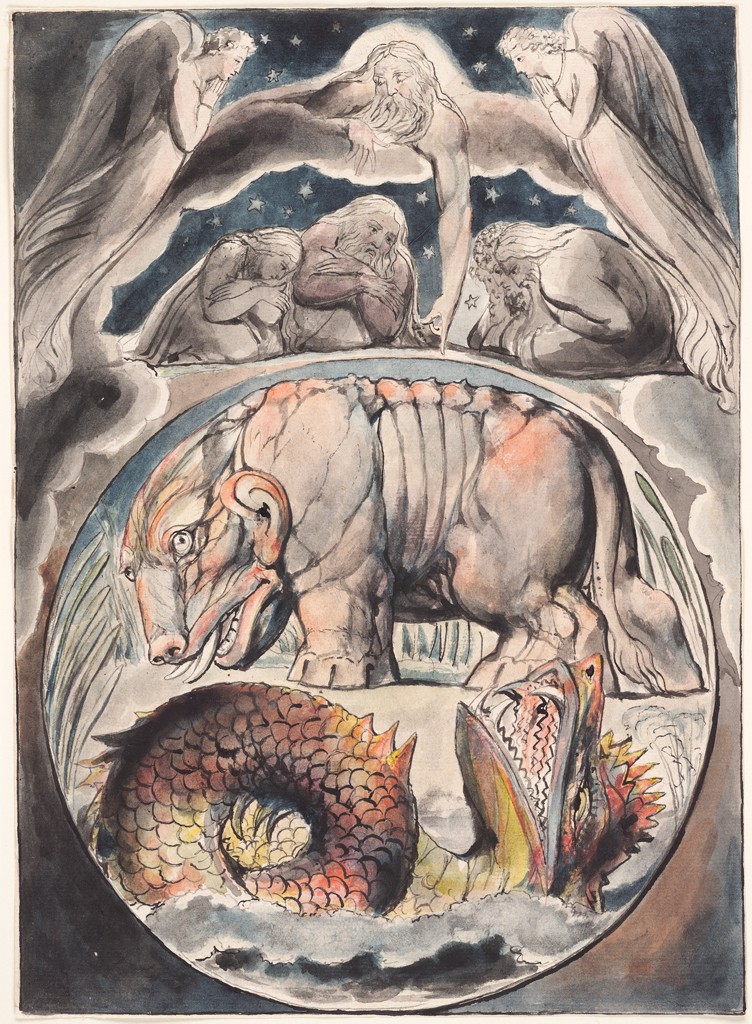
Blake, William_Behemoth and Leviathan
William Blake (British, 1757–1827), Behold Now Behemoth, Which I Made With Thee (The Book of Job) (Linnell set), 1821. Watercolor, black ink, and graphite on off-white antique laid paper, 27.5 × 20 cm. Harvard Art Museums/Fogg Museum, Cambridge, Massachusetts. [HT]

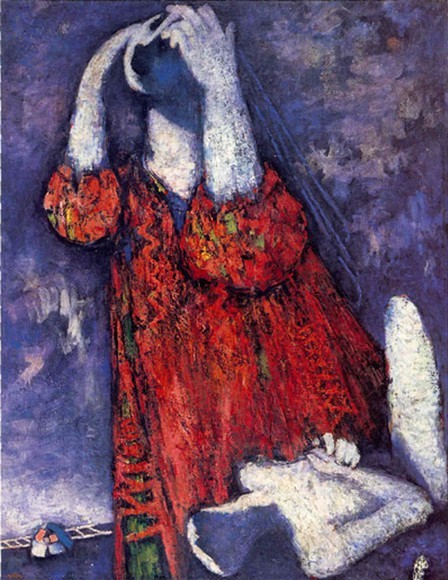
Mordecai Ardon (Israeli, 1896–1992), Sarah, 1947. Oil on canvas, 138 × 108 cm. Jewish National and University Library, Jerusalem.

The Finding of Moses (Dura-Europos Synagogue)
“The Finding of Moses,” wall painting made in 244 CE, from Dura-Europos Synagogue in Syria. Preserved at the National Museum of Syria, Damascus. [HT]

Crossing the Red Sea (Alba Bible)
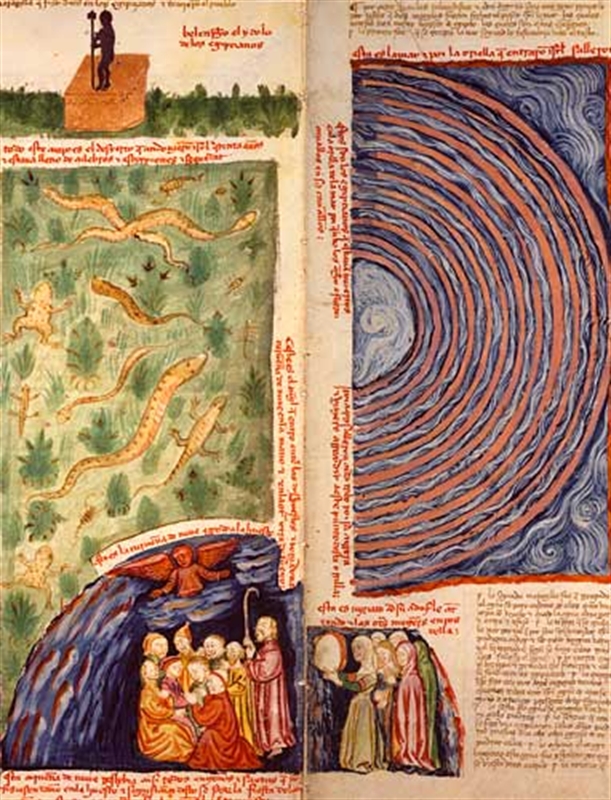
“Crossing of the Red Sea,” Spain, 1430. Illumination from the Alba Bible (fol. 68v–69r), Liria Palace, Madrid.

Jonah (Islamic)
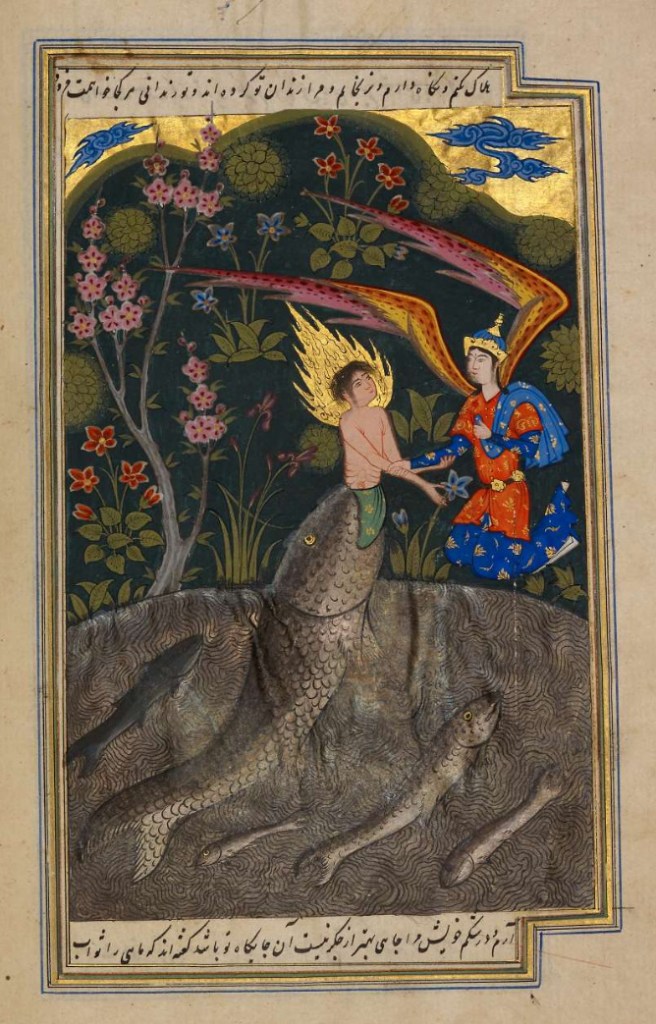
“Jonah,” Iran, 1577. Illumination from the Qisas al Anbiya (Diez A Fol. 3, fol. 142v), Staatsbibliothek, Berlin. [HT]

Roundup: Art and the Psalms, “We Americans,” the Walking Roots Band, and more

“Psalms in Dialogue: Psalms 22, 23, and 24,” presented by Duke University Chapel: This multidisciplinary video presentation brings together dancers, musicians, a theologian, a painter, and (other) members of the Duke community to draw out the meaning of, or respond to, these three sequential psalms through art, prayer, and conversation. The livestreamed event aired October 17 and will be available for viewing for a limited time. Several of the segments, which I’ve time-stamped below, are intercut with photos from the streets in 2020 (showing the impact of the pandemic and racial unrest), of artist Makoto Fujimura in his studio and of his three finished paintings, and of Ekklesia Contemporary Ballet dancers in training. I wish more university chapels and well-resourced churches would offer experiences like this! Thank you to my friend Peggy for telling me about it. Read more about Duke Chapel’s multiyear Psalms project here.

1:51: “How do we name the impossible mystery?,” a theological reflection by Morley Van Yperen

6:02: Organ: “Jésus accepte la souffrance,” from La Nativité du Seigneur [previously] by Olivier Messiaen, performed by Christopher Jacobson

10:58: Psalm 22 by Makoto Fujimura, 2020, oyster shell on Belgium canvas, 48 × 48 in.

11:09: Reading of Psalm 22:1–22 by Luke A. Powery, with balletic responses by Paiter van Yperen, Elijah Ryan, Heather Bachman, and Sasha Biagiarelli

15:40: Lament, ballet solo danced by Paiter van Yperen (music by Max Richter, choreo by Elisa Schroth)

18:10: Psalm 22:22–32 chant by Zebulon Highben

21:09: Conversation on the Psalms with Makoto Fujimura and Ellen F. Davis, moderated by Amanda Millay Hughes

29:32: Organ: “Christus, der uns selig macht,” BWV 620, by Johann Sebastian Bach, performed by Christopher Jacobson

32:00: Prayer by Nathan Liang

34:11: Recitation of Psalm 23 by Julia Hendrickson

35:22: 6IX, a tap dance by Andrew Nemr

37:10: “The 23rd Psalm,” text adaptation and music by Bobby McFerrin, performed by the Duke Chapel Staff Singers (*this was my favorite!)

40:42: Prayer by Jonathan Avendano

42:39: “The Lord Is My Shepherd,” music by Howard Goodall, performed by the Royal School of Church Music in America Choristers

46:13: Psalm 24 remix produced by Andrew Nemr

48:21: Prayer by Jordyn Blake

49:45: Recitation of Psalm 24 by Julia Hendrickson

51:32: Conversation continued

1:11:49: “He’s Got the Whole World in His Hands,” African American spiritual arranged by Mark A. Miller, performed by the Duke Chapel Choir

+++

POEMS: This week’s edition of ImageUpdate includes two poems that I really appreciated. The first, which was new to me, is “America” by Claude McKay, a key figure in the Harlem Renaissance. Originally published in The Liberator in 1921, it expresses the pain of living in a country where you’re hated for your race and yet remains optimistic, beginning, “Although she feeds me bread of bitterness, / And sinks into my throat her tiger’s tooth, / Stealing my breath of life, I will confess / I love this cultured hell . . .” The second poem is “Making Peace” by Denise Levertov, one of the best-known Christian poets of the twentieth century. “The poets must give us / imagination of peace, to oust the intense, familiar / imagination of disaster,” she writes. Poets can help us feel our way toward shalom—give us a vision of its permeating the world that inspires us to live out its rhythms, its metaphors, its structure, its grammar, our lives like poems.

+++

MUSIC VIDEO: “We Americans” by the Avett Brothers: I’m so moved by this song from the Avett Brothers’ 2019 album Closer Than Together—its grappling with the historical legacy of the US, its greatness and its guilt, with a mixture of heartache, empathy, and hope. It’s one of the healthiest expressions of patriotism I’ve ever come across in a song. We need to see America as the complex entity that she is, which means in part not ignoring her flaws but with love exposing them so that they can be remediated and we can move forward together more faithful to her celebrated ideals. “We Americans” is both confession and supplication, an “I’m sorry, God” and “God, help us to do better.” The final chorus:

I am a son of God and man
And I may never understand
The good and evil
But I dearly love this land
Because of and in spite of We the People
We are more than the sum of our parts
All these broken bones and broken hearts
God, will you keep us wherever we go?
Can you forgive us for where we’ve been?
We Americans

I was reminded of this song in the September 17 episode of the RTN Theology podcast, “You Shall Know the Truth and the Truth Shall Unsettle You.” Chris Breslin interviews Mark Charles, a Native American activist, public speaker, Christian leader, and independent candidate in this year’s US presidential election. He is the coauthor, with Soong-Chan Rah, of Unsettling Truths: The Ongoing, Dehumanizing Legacy of the Doctrine of Discovery. Charles enters at 12:40 with a discussion of the lack of common memory.

+++

SONGS:

>> “Whatever Comes Next” by Drew Miller: This song came out of “Hutchmoot: Homebound,” a virtual arts gathering organized by the Rabbit Room that took place earlier this month. In writing the song, Drew Miller [previously] was inspired in part by Shigé Clark’s new poem “Grateful” (see her perform the poem here).

>> “Bring Your Peace” by the Walking Roots Band: This song was written this year by Seth Thomas Crissman and Greg J. Yoder of the Walking Roots Band as part of a collection of fifteen songs for Shine, a children’s Sunday school curriculum published by MennoMedia and Brethren Press. It appears on Everybody Sing: Worship Songs for Children, released in June as a double album with Everybody Sing: Songs for the Seasons (which comprises ten original songs by The Many). The song asks God to bring his peace into our fears and into the storms we face, and to make us instruments of that peace to others.

>> “Rest Assured,” sung by the Walking Roots Band: TWRB learned this song from a bandmate’s parent (original authorship unknown) and recorded it a cappella in their separate locations at the start of quarantine in March. The chorus goes,

Rest assured, He’s not forgotten
Rest assured, He’ll take care of you
Look at the times He’s been there before
He’ll be there again, rest assured

>> “Let Justice Roll Like a River,” sung by Eric Lige: Bobby Gilles and Rebecca Elliott of Sojourn Music wrote this song in 2017, inspired by Amos 5. In this lyric video from July 5, it’s performed by Eric Lige and Paul Lee of Ethnos Community Church. The singing starts at 1:33. [HT: Global Christian Worship]

Roundup: Jesus as Dancer, The Daily Prayer Project, ethnoarts in Indonesia, and more

BLOG POST: “Jesus as Dancer: Jyoti Sahi’s ‘Lord of Creation’” by Victoria Emily Jones: I wrote a guest post for the Sojourn Arts blog about a gouache I own by Indian artist Jyoti Sahi, which shows Jesus leading the dance of new creation. On one side he pounds a drum, and on the other he emerges from a lotus. The painting brings together Jyoti’s interests in Christian and Hindu theologies and folk symbolism.

Sahi, Jyoti_Lord of Creation
Jyoti Sahi (Indian, 1944–), Lord of Creation, 1982. Gouache on paper, 14 3/4 × 20 in. Collection of Victoria Emily Jones.

Sojourn Arts is a ministry of Sojourn Church Midtown in Louisville, Kentucky, that seeks to support artists and build up the church through the arts. They have organized and/or hosted numerous exhibitions over the years and have commissioned temporary installations for their sanctuary, as well as coordinated community art projects. Visit www.sojourn-arts.com.

+++

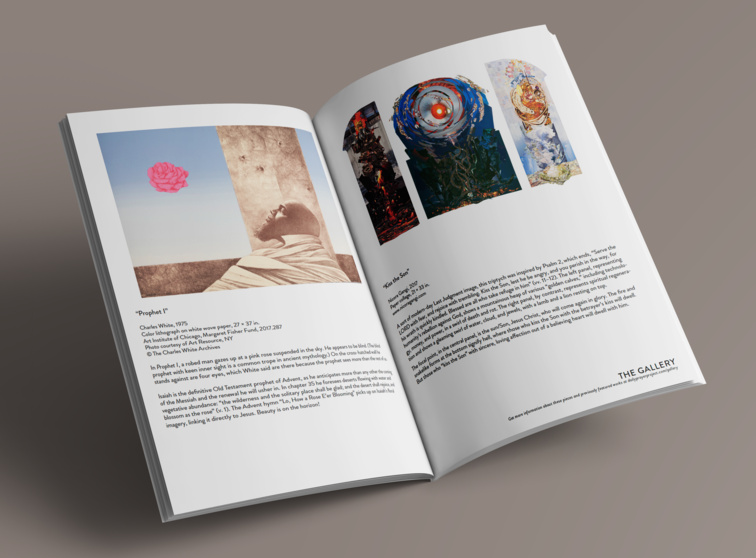
THE DAILY PRAYER PROJECT: This fall I joined the team at the Daily Prayer Project as curator of visual art. The Daily Prayer Project is a periodical that covers every season of the Christian year with robust, rooted, and cross-cultural liturgies for use in congregations, households, workplaces, small groups, or other gatherings. Released in seven editions per year, it features daily morning and evening prayer guides for the week, which include Psalm, Old Testament, and New Testament readings; short prayers sourced from around the globe and from different eras; specific prayer prompts; and songs (including lead sheets). In addition to the cover image, there is a mini-gallery of two art images inside, reproduced in full color, to serve as visual prompts for further contemplation and prayer. There is also a section called “The Practices,” with two page-long seasonal reflections by staff members or guest contributors.

The Advent 2020 issue of the DPP, covering November 29 through December 24, was released last week. It features prayers by African American civil rights leader Fannie Lou Hamer, the tenth-century English saint Ethelwold, and others; a Hebrew folk song, a Taizé chant, and an Argentine hymn by Federico J. Pagura; a striking cover image by Hilary Siber, which shows heaven coming down to earth; Charles White’s Prophet I, which resonates with passages from Isaiah; and an apocalyptic paper collage by Nicora Gangi.

The periodical is available as a physical booklet or as a PDF download. Visit the website for more information. If you are an artist and are interested in having your work considered for publication in a future prayerbook, email team@dailyprayerproject.com.

DPP Advent 2020 interior

+++

VIDEO: “Local Riches: Ethnoarts and Sumba”: A workshop for churches on the island of Sumba in Indonesia, led by Yayasan Suluh Insan Lestari in July 2019, reinforced that God is best honored, and the global body of Christ built up, when people worship God using their unique cultural and linguistic gifts, bringing their whole, authentic selves before him in praise. [HT: Global Christian Worship]

For centuries many Christian missionaries to other countries brought with them Western hymns and images, presenting them as definitive—as forms that alone are good and pleasing to God. (For example, a woman in the video mentions how she had previously thought that worship songs had to be based on Western scales and performed using certain instruments to be acceptable.) But in the last fifty or so years especially, at least from what I’ve noticed, many missionaries have recognized the falsity of this line of thinking and seek to undo negative conditioning by promoting the use of indigenous artistic expressions (sometimes called “ethnoarts”) in Christian worship, be it dance, drama, music, storytelling, carving, or what have you. I found it interesting that the interviewees seem to suggest that now it’s the forces of modernism that most threaten the survival of traditional cultures, whereas it used to be that the church was largely blamed (missionaries did undeniably play a large part, banning this and that, though in every era there were exceptions to the rule). Now the church is at the forefront of trying to preserve not only traditional languages but also traditional art forms.

“Everything we have was created by God, and we need to return to it with gratefulness because this is how God made us!” says Rev. Herlina of the Christian Church of Sumba. “With whatever we already have, we can be a blessing to our people.”

+++

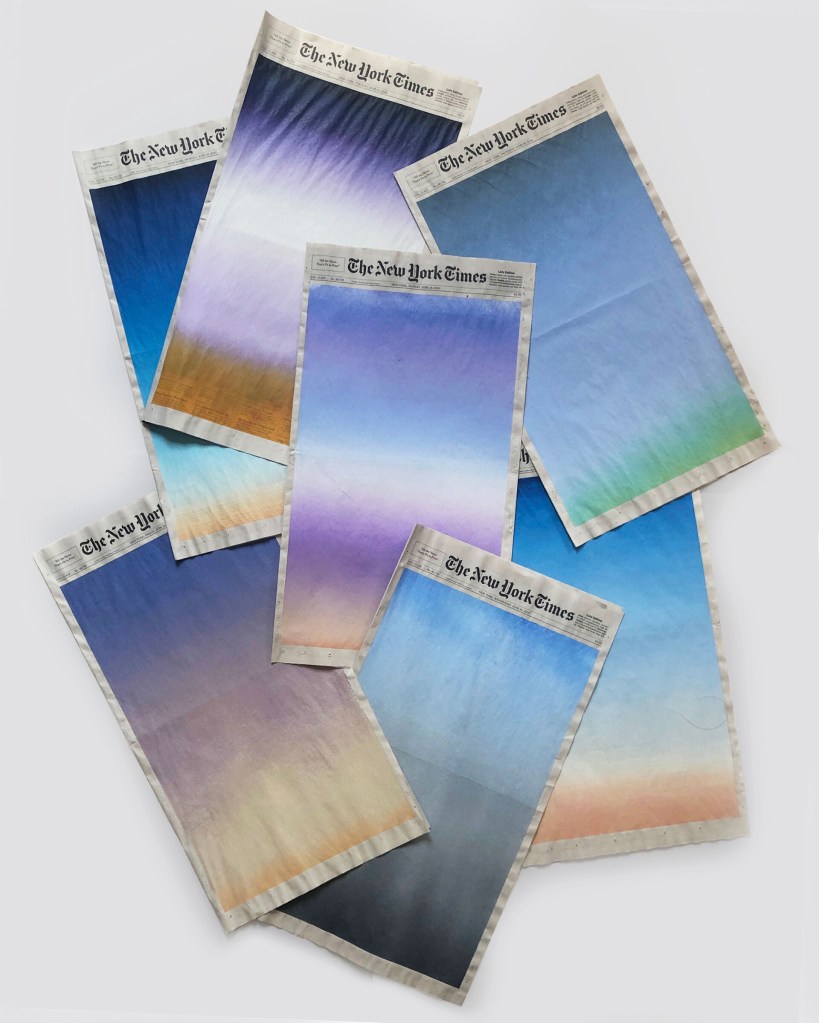
NEW ART SERIES: “Organic, Sunrise Gradients Mask Front Pages of the New York Times by Artist Sho Shibuya”: Since the lockdown started in March, Brooklyn-based artist and graphic designer Sho Shibuya has been painting color gradients in acrylic over the front pages of the New York Times, inspired by each morning’s sunrise. He calls the series “Sunrises from a Small Window.” I love how he’s able to express gratitude for a beautiful new day and to access calm amid dire news cycles. Shibuya is still reading those headlines and articles; he’s just putting them in a larger perspective. (As for myself, call me escapist, but I’ve found that actually blocking out the news—turning down the noise—for certain periods can be a helpful spiritual practice.)

Sho Shibuya, Sunrises from a Small Window, June 22–28, 2020. Acrylic on newsprint.

“I started . . . contrasting the anxiety of the news with the serenity of the sky, creating a record of my new normal,” Shibuya says. “Their front page has always been a time capsule of a day in history, so it made sense to use history as the canvas because the paintings are meant to capture a moment in time. . . . The spirit of the project is that maybe, even after the pandemic subsides, people can continue some of the generosity and peace we discovered in ourselves and that the sky reminds us of every day with a sunrise through a small window. If one thing the news has made clear, we need generosity and peace for all people now more than ever.”

+++

TWO FILMS: “Death on Netflix: I’m Thinking of Ending Things and Dick Johnson Is Dead by Mitch Wiley: I really liked both these cinematic reflections on mortality, but they’re completely different, as this short Gospel Coalition article bears out. Dick Johnson Is Dead is the more “Christian” of the two because of its hopeful perspective—the human subject of the film is a Seventh-Day Adventist, so death for him is not a final end. After her father was diagnosed with dementia, filmmaker Kirsten Johnson asked her dad if he’d be interested in a collaborative film project where, to help them both face the inevitable, she would stage his death in inventive and comical ways. Relishing the opportunity to spend more time with his busy daughter, he enthusiastically agreed.

The documentary shows them preparing and carrying out these stunts but also interacting in other contexts—birthday parties, trick-or-treating, looking through old photo albums, cleaning out Dick’s office, Dick’s being asked to give up driving, and so on. It made me laugh and cry—films that can do both tend to rate highly on my favorites list. There’s so much love and warmth and heartache and whimsy in it as father and daughter confront death together, talking very openly about it, which I found, strange as it may seem, refreshing. Oh, and the heaven sequences just may be the best I’ve ever seen.

For a more cynical take on death, here’s the trailer to I’m Thinking of Ending Things (Charlie Kaufman isn’t for everyone, but I’m still thinking about this movie after watching it a month ago, which means it made an impression!):

Seeing and Believing, a Christ and Pop Culture podcast, covered Ending Things and Dick Johnson in episodes 264 and 266, respectively, as have most other film podcasts and reviewers, with Dick Johnson being uniformly lauded as one of the best movies of the year.

+++

SONG: “Hodu” (Give Thanks), performed by the Platt Brothers: The Platt Brothers [previously] singing scripture to me? Yes, please. The text of this song is Psalm 118:1–4, and the music is by Debbie Friedman (1951–2011), a Jewish singer-songwriter whose songs are used widely in Reform and Conservative Jewish liturgies in North America. Friedman’s “Hodu” was originally released on her 1981 album And the Youth Shall See Visions. (Find sheet music here.)

In this video from earlier this month, Henry, Jonah, and Ben Platt sing “Hodu” to a guitar accompaniment by Al Seller.

Hodu l’Adonai kitov
Ki l’olam chasdo, ki l’oam chasdo
Yomar na, yomar na, Yisraeil
Ki l’olam chasdo, ki l’olam chasdo
Yomru na, yomru na veit Aharon
Ki l’olam chasdo, ki l’olam chasdo

Let all who revere G-d’s name now say
Ki l’olam chasdo
Give thanks to the Lord for G-d is good
Ki l’olam chasdo

The first time the Platt Brothers performed in public as a trio was this April, when they appeared in a virtual Yom Ha’atzmaut celebration at the request of the Jewish Federations of North America, singing “Ahavat Olam.” Ben and Jonah are musical theater performers: Ben originated the title role in Broadway’s Dear Evan Hansen and won a Tony for it, and Jonah is best known for playing Fiyero in Wicked on Broadway from 2015 to 2016. Henry is a senior at the University of Pennsylvania, where’s he’s a member of the a cappella group Counterparts.

Roundup: CIVA art auction, lament album, Kaphar and “things unseen,” empathy

Several readers have asked if there’s a way to donate to the work of this blog. After much thought I’ve decided to go ahead and add a Donation page, where those who wish to send a small financial gift to support the blog’s upkeep and development can do so through PayPal if they feel so inclined. Thank you!

+++

CIVA ART AUCTION, November 13–15, 2020: In a few weeks CIVA (Christians in the Visual Arts) is hosting an online auction of art created and/or donated by CIVA members. The lots comprise a range of media, sizes, and styles—a little something for everyone. It’s a great way to support artists of faith (by supporting CIVA), and to acquire beautiful art for your home!

The first artwork I ever purchased was through a CIVA auction: a linocut by Steve Prince, who has three new works up for bid this year. Sandra Bowden has donated several works from her extensive and esteemed collection of religious art, including an Adoration of the Magi lithograph by the major modern artist Otto Dix and a mola (handmade textile) from Panama, which I’m eyeing. I also noticed 40 Days, Forty Sacraments, a set of gouaches painted by Kari Dunham over the course of Lent one year as a way to rediscover beauty in the ordinary. And a mixed-media piece by Joseph di Bella, whose theme of redemption is underscored by the making of the substrate, which consists of “failed and unfinished works on paper” that “are destroyed, then reformed into new, yet still imperfect sheets.”

Steve Prince, Faith Walk. Linocut, 12 × 9 in. “Shows a woman walking in faith while the ancestors encourage, uplift, and guide her along the way.”

Jehovah Is My Light (Panama)
Jehova es mi luz (Jehovah Is My Light), San Blas Islands, Panama, 1980s. Reverse embroidery, 14 × 17 1/2 in.

di Bella, Joseph_Tree Parables (Generations)
Joseph di Bella, Tree Parables (Generations), 2017. Gouache, dry pigment, and ashes on handmade paper, 38 1/2 × 30 1/2 × 1 1/2 in. (framed).

If you plan on bidding, be sure to register; you will be able to see all the other bids and can set up notifications. And if you don’t win, don’t be discouraged: you can always go to the artist’s website, and there will likely be other works available for purchase there.

+++

ALBUM: Daughter Zion’s Woe: Produced by Rachel Wilhelm and released last month by Cardiphonia, this new album features thirteen lament songs written, arranged, and performed by women. It will be available on Spotify after Christmas, but until then, all Bandcamp sales benefit Hagar’s Sisters, an organization that serves victims of domestic violence. My favorite song on the album is “The Glory Shall Be Thine” by Christy Danner, a retuning of the late nineteenth-century “Transformed” by F. G. Burroughs (pseudonym for Ophelia Burroughs, later Adams, née Browning); this hymn text is completely new to me, and what a gem! Danner’s music really draws out its poignancy. Other highlights include Eden Wilhelm’s “Lord, Draw Near” (Psalm 88), Sister Sinjin’s “Silence,” and Lo Sy Lo’s “Let It Be So” (Psalm 12).

+++

EXHIBITION: The Evidence of Things Unseen by Titus Kaphar, October 16–November 28, 2020, former Église du Gesù, Brussels: Titus Kaphar’s [previously] art, which reinterprets traditional Anglo-centric imagery through a Black lens, has grown out of his “spending time in European museums and longing for pictures that looked like they actually made space for individuals that look like me.” In this new exhibition, staged by the Maruani Mercier gallery in a deconsecrated church in Belgium, Kaphar revises Christian paintings by silhouetting, covering in tar, or duct-taping over likenesses of white Jesus, drawing attention to unseen people and narratives. The exhibition’s title is taken from Hebrews 11:1.

Kaphar, Titus_Untitled (Entombment)
Titus Kaphar, Untitled, 2020. Oil and tar on canvas. Photo courtesy Maruani Mercier.

The press release reads: “It is virtually impossible to tell the story of Renaissance art without an exploration of Christianity. While the personal faith of the individual artist varied from devotee to atheist opportunist, the largest patron of the arts was the Church, and Catholic iconography the artist’s lingua franca. . . .

“In The Evidence of Things Unseen, Kaphar utilizes Catholic iconography as a ground on which to explore ideas beyond simple proselytization. Kaphar utilizes his whole vocabulary of formal innovation in this exhibition: canvases aggressively fold, crumple, undulate, and project from the wall, forcing themselves into the space of the viewer. Through Kaphar’s physical interventions, works like Susan and the Elders and Eve exist as bodies transformed into landscape and typography rather than polite easel paintings. In Jesus Noir Kaphar duct-tapes a portrait of a young black man over the face of Christ. Christ’s outstretched right hand, originally pointing to the heavens, now appears as a plea for help. The application of duct tape – a utilitarian material known to be used in all kinds of industrial and household repairs – suggest urgency and impermanence.

“Even though many biblical stories take place in the Middle East and Africa, representations of Christ and his followers are almost always depicted as European. It is not surprising that the devoted attempt to see themselves in the stories of the Bible, and to envision a Christ they can recognize: Christian tradition teaches that mankind was created in God’s own ‘image and likeness.’ And yet, religious paintings from the Renaissance unwittingly oversimplify an understanding of God by excluding a part of his creation. There are no black angels of the Renaissance. The Evidence of Things Unseen is Kaphar’s latest attempt at revision.”

+++

ANIMATED SHORT: “Brené Brown on Empathy”: In this 2013 video from the RSA (Royal Society for Arts, Manufactures and Commerce), Katy Davis animates an excerpt from a talk by Professor Brené Brown, “The Power of Vulnerability.” “The Webby Award-winning RSA Shorts animation series provides a snapshot of a big idea, blending voices from the RSA Public Events Programme and the creative talents of illustrators and animators from around the world. It responds to the ever-increasing need for new ideas and inspiration in our busy lives and acts as a jolt of ‘mental espresso’ that will awaken the curiosity in all of us. If you’re interested in the opportunity of animating one of our Shorts, please email your bio and links to your portfolio to shorts@rsa.org.uk.” Other RSA shorts include Jonathan Haidt on Why We’re Convinced We’re Right, David Brooks on Character in a Selfie Age, and David Graeber on the Value of Work.

+++

PANEL DISCUSSION: “Perspectives on Empathy and the Arts”: In 2017 Roots of Empathy brought together a panel of three—Cameron Bailey, artistic director of the Toronto International Film Festival (TIFF); Martha Durdin, chair of the board of trustees of the Royal Ontario Museum (ROM); and Raymond Mar, professor of psychology at York University—to discuss the connection between art and empathy and why it’s so important. The conversation is moderated by Mary Ito. I especially appreciated from 42:32 onward.

4:10: Children who take acting lessons are more prosocial and empathetic
5:48: Films and empathy
9:34: Fiction and empathy
12:42: Moonlight (2016)
21:54: Learning from mistakes: Into the Heart of Africa (1989) and point of view
28:38: Pompeii: In the Shadow of the Volcano (2015)
30:37: Forced assimilation of Native people in church-run residential schools
31:18: Can art museums institutionalize empathy?
34:48: How does me empathizing with a character in a book or a painted figure translate to me being empathetic to actual people?
39:05: Superhero comics and movies
41:22: Are we suffering from an empathy deficit?
44:37: Empathy for ideological opponents
46:10: Where does empathy run up against morality/ethics? Are we to empathize with abusers?
46:56: How do we do better through the arts?

Roundup: Jewish prayer song, stolen paintings, graphic novels by John Lewis, and new VCS videos

SONG: “Ahavat Olam”: Back in April the Platt Brothers—Jonah, Henry, and Ben—posted a home-recorded video of themselves singing this traditional Jewish prayer arranged by Gabriel Mann and Piper Rutman. (I know actor-singer Ben Platt from The Politician, which is probably how the video came to be recommended to me by YouTube!)

It stoked a lot of public enthusiasm, so on September 21 they released a studio recording, available for streaming and download from all major music platforms.

A translation of the Hebrew is as follows:

With an eternal love have You loved your people Israel, by teaching us the Torah and its commandments, laws, and precepts. Therefore, Adonai our God, we shall meditate on Your laws when we lie down and when we rise up, and we shall rejoice in the words of Your Torah and Your commandments forever. For they are our life and the length of our days, and we shall reflect upon them day and night.

O may You never remove Your love from us. Blessed are You, Adonai, Who loves your people Israel. [source]

+++

PIANO CONCERTO: Tomás de Merlo by Xavier Beteta: In February 2014 six religious paintings by the early eighteenth-century Guatemalan painter Tomás de Merlo were stolen from a church in Antigua. Although the thieves have been caught, the paintings have disappeared into the black market and have likely been smuggled out of the country. Wanting to preserve the essence of the paintings in music, Guatemalan composer Xavier Beteta wrote a piano concerto whose three movements, titled after the stolen paintings, are “La Oración en el Huerto” (The Prayer in the Garden), “La Piedad” (The Pietà), and “El Rey de Burlas” (The Mocking of Christ). Beteta said he may eventually compose three additional movements, one for each of the other three lost paintings.

Tomás de Merlo (Guatemalan, 1694–1739), El Rey de Burlas (aka La Coronación de Espinas), 1737

Last year the Camellia Symphony Orchestra in Sacramento, California, premiered the concerto. Listen to excerpts, interspersed with interview clips of the composer by Josh Rodriguez, in the video below—which is itself excerpted from the Deus Ex Musica podcast episode “How Stolen Sacred Paintings Inspired a New Piano Concerto.”

See photos of the other paintings at https://www.soy502.com/articulo/capturan-dos-robo-valiosas-obras-iglesia-calvario.

+++

DOCUMENTARY: The Painter and the Thief (2020), dir. Benjamin Ree: A story of crime and trauma, love and redemption, this documentary follows Oslo-based Czech artist Barbora Kysilkova as she confronts one of the men, Karl-Bertil Nordland, who stole two of her most prized paintings. A mutual friendship develops, and it’s so beautiful to watch.

What I love about the film is how it captures the rehabilitation of both subjects—in a way that honors the complexity, the nonlinearity of that process—and the role art can play in healing. “Barbar” forgives “the Bertilizer” and helps him on his road to sobriety, and he helps her access deep parts of herself and come to grips with the history of abuse she’s suffered. They become, in a sense, each other’s muses. His stunned, tearful reaction when he sees the first portrait she paints of him melted me—someone sees him for the first time.

With documentaries I always wonder who’s the person making it and why. I had cynically assumed the project was instigated by the artist to try to vitalize her career, but no, the filmmaker, who has had an ongoing interest in art theft, contacted Kysilkova after reading about the gallery break-in in the news. As is true with most documentarians, he had no idea when he started filming that the story would evolve the way it did and shift genres, and even become feature-length. Streaming on Hulu.

+++

INTERVIEW: In 2016 Adelle M. Banks of the Religion News Service interviewed Rep. John Lewis about the National Book Award–winning graphic novel trilogy March, the role of music and religious faith in the civil rights movement, protest (and getting into “good trouble”) as a form of Christian ministry, the urgent need for the church to be a headlight, not a taillight, and more.

+++

VCS VIDEO EXHIBITION SERIES: The Visual Commentary on Scripture [previously] is an online, open-access resource for those looking to explore the biblical text through art. For every passage of scripture, an art historian, artist, theologian, media theorist, or other is solicited to select and comment on three art images that illuminate the text in some way. The site’s typical format is written commentaries, but by way of experimentation, the VCS has just released video commentaries instead for four new texts. Ben Quash comments on the story of Lot’s Wife through the lens of an early English stained glass panel, a Flemish Renaissance landscape, and a stunning photograph taken after the Allied bombing of Dresden. For Belshazzar’s Feast from the book of Daniel, Michelle Fletcher is guided by paintings from the Dutch Golden Age and the English Romantic period, which she juxtaposes with a contemporary room installation. But here I’ll highlight the videos for two New Testament passages.

The Burial of Christ, with commentary by Italian Renaissance art expert Jennifer Sliwka [previously], covers Andrea Mantegna’s innovatively foreshortened Christ on a marble slab; an altarpiece painting by Michelangelo, in which Christ’s dead body is held up for display, evoking the presentation of the eucharistic host; and a contemporary Pietà, of sorts, by Swiss artist Urs Fischer, which involves a skeleton and a fountain.

Michelle Fletcher, a feminist scholar and specialist on the book of Revelation, comments on the controversial apocalyptic figure known as The Whore of Babylon, which she discusses as a symbol of a city, as a satirization of the goddess Roma, and as bequeathing a legacy of vilification of prostitutes. Fletcher selected a didactic painting by street evangelist Robert Roberg, an ancient Roman coin, and William Hogarth’s A Harlot’s Progress.

Roundup: Works of mercy, #GettyMuseumChallenge, new gospel songs, and poems

RADIX ARTICLE: “The Seven Works of Mercy: How two Dutch artworks—one Renaissance, one contemporary—can help us recover an ethic of neighborly care” by Victoria Emily Jones: When I was in the Netherlands last year, I saw lots of artistic representations of what are called the seven works of mercy, derived from Matthew 25. (Even after the Protestant Reformation, the subject remained popular among Dutch artists, who delighted in representations of everyday life.) In this article, published last week, I share just two. One is a multipaneled painting, now at the Rijksmuseum, commissioned in 1504 by the Holy Ghost Confraternity in Alkmaar, which ran an almshouse that provided medical care for the sick and housing for the poor (social welfare programs were carried out by the church in those days); notably, in each contemporary townscape, Jesus stands among the afflicted—a theologically loaded artistic choice. The other artwork is a set of photographs by Thijs Wolzak on display inside Rotterdam Cathedral, which feature community service organizations in action, caring for drug users, undocumented immigrants, and others. (Note: The chapel was in a bit of disarray when I was there, with light fixtures disassembled all over the floor and a ramp blocking my entrance, hence the messy staging of my photo! See a professional photograph in the article link, including photos of individual panels.)

Feeding the Hungry by the Alkmaar Master
Master of Alkmaar, Feeding the Hungry, leftmost panel from the Seven Works of Mercy polyptych, 1504. Oil on panel, 103.5 × 55 cm. Rijksmuseum, Amsterdam. The inscription on the original frame underneath (not pictured) is a rhyming Dutch couplet: “Deelt mildelick den armen / God zal u weder ontfarmen” (Share generously [with] the poor, [and] God shall have mercy on you).
Wolzak, Thijs_Works of Mercy
Thijs Wolzak (Dutch, 1965–), in collaboration with Kathelijne Eisses, Werken van Barmhartigheid (Works of Mercy), 2010. Duratrans prints in light boxes. Chapel of Works of Mercy, Sint-Laurenskerk (Church of St. Lawrence), Rotterdam, Netherlands. Photo: Victoria Emily Jones.

It’s interesting to consider the overlap of Christian and civic duty the images present and the way in which they function(ed) in their disparate spaces. The more explicitly theological Alkmaar polyptych was originally owned by a lay brotherhood and sited in a church beside the collection box, and its primary purpose was “to stir up . . . to love and good works” (Heb. 10:24), and to financial giving—but it is now in a large, government-run art museum, where it’s viewed mainly as an art historical object. The Wolzak piece, on the other hand, was commissioned as a permanent installation inside an active church that is also a heritage museum and something like a community center, with the purpose of highlighting the charitable work being done in the city. I like how Wolzak helps us to see where some of the needs lie in contemporary society and examples of tangible ways they might be met, through such services as safe-injection sites (for those suffering from heroin addiction) or the Lonely Funeral Foundation (for the anonymous dead).

The summer 2020 issue of Radix magazine also includes an interview with Mark Labberton, president of Fuller Theological Seminary, on his book The Dangerous Act of Loving Your Neighbor: Seeing Others Through the Eyes of Jesus; an interview with D. L. Mayfield on her book The Myth of the American Dream: Reflections on Affluence, Autonomy, Safety, and Power; Martin Buber on genuine dialogue; Simone Weil and the “kinship of affliction”; a review of the film Just Mercy; and more.

+++

NEW BOOK: Off the Walls: Inspired Re-Creations of Iconic Artworks: This March on social media, the Getty Museum issued the #GettyMuseumChallenge, inviting art lovers to channel the stir-crazy energy of COVID-19 quarantine into crafting themselves, their families, and their pets into masterpieces of world art and posting the photos online. By May there were at least 100,000 re-creations uploaded to the Internet—246 of which are featured in the new book Off the Walls, released this month by Getty Publications. All profits from the book will go to the charity Artist Relief to support artists facing financial emergencies to the coronavirus pandemic. This is such a fun way to get people to engage with art!

+++

NEW SONG RELEASES

“Hallelujah (Come Bless the Lord)” by September Penn: September Penn is a singer, songwriter, performance artist, worship leader, and cofounder of The Power of Song Inc., an organization that educates about social justice issues through song, theater, and art. She wrote “Hallelujah” while directing the Kaleo Choir at Fuller Theological Seminary, where she earned an MDiv this year with a focus on Worship, Theology, and the Arts. The song was released September 3 as a single on all music-streaming platforms.

“Nara Ekele Mo” by Tim Godfrey, performed by Resonance: Last month the Global Resonance Multicultural Worship Collective, under the organization Arts Release, posted on YouTube a multicontinent, multilingual cover of the Nigerian Igbo song “Nara Ekelo Mo” by Tim Godfrey. It features thirty-seven singers from Brazil, England, France, Indonesia, Singapore, and Spain, with lyrics in Igbo, Yoruba, Tamil, Bahasa Indonesia, French, Mandarin, Portuguese, Spanish, and English. (See the original version of the song here.) [HT: Global Christian Worship]

+++

POEMS

“Field Guide” by Tony Hoagland: A few weeks ago SALT Project reprinted this poem that celebrates the ordinary in nature—along with brief commentary and a stunning macrophoto of a dragonfly. An excerpt from the opening chapter of Ralph Waldo Emerson’s essay “Nature” is referenced: “If the stars should appear one night in a thousand years, how would men believe and adore; and preserve for many generations the remembrance of the city of God which had been shown! But every night come out these envoys of beauty, and light the universe with their admonishing smile.” (The poem is from Hoagland’s 2010 collection Unincorporated Persons in the Late Honda Dynasty, published by Graywolf Press.)

from the current issue of Image: Image journal is the one piece of mail I most look forward to receiving every quarter—full of poetry, visual art, literary essays, and short stories with a spiritual sensibility. In its current issue, no. 105, some of the poems I particularly enjoyed were “Trench Coat” by Cameron Alexander Lawrence, on the accumulation of things; “Pastoral with Wheat” by John Hart, on fatherhood as beatitude, and as a continual lesson in dying to self; “Duet” by Chelsea Wagenaar [previously], about the “music” of the ordinary moments of motherhood, like tending to your child’s bee sting; and “The Eighth Sacrament” by Peter Cooley, on grief, written after the death of his wife, Jacqueline.