Roundup: Memento mori; works of mercy; ring shout; The Seventh Seal

Affiliate links: Art & Theology is now a participant in the Amazon Associates program, an affiliate marketing tool that enables me to potentially collect a little change by hosting Amazon links on my website. I already do that anyway—link to Amazon product pages when I mention books, movies, or less often, music (I try to drive sales directly to the artist’s website, if one exists)—so you will not notice any change in blog post appearance or the frequency of links. But now that I’m registered, if you were to click through one of those Amazon links (for example, Shout Because You’re Free or The Seventh Seal below) and make a purchase, any purchase, I would earn a referral fee of 2.5% to 5% of the purchase price. I have to generate at least three purchases every 180 days to stay in the program. As of now, this is the website’s sole income stream.

+++

EXHIBITION: “The Ivory Mirror: The Art of Mortality in Renaissance Europe,” June 24–November 26, 2016, Bowdoin College Museum of Art, Brunswick, Maine: Skeletons, skulls, and other dark images of death from the fourteenth and fifteenth centuries were meant to remind their owners of life’s brevity and thereby prompt repentance. Some target specific sins, like clinging too tightly to one’s wealth or good looks. “This exhibition represents a significant contribution to our understanding of the rich visual culture of mortality in Renaissance Europe. The appeal of the memento mori, featuring macabre imagery urging us to ‘remember death,’ reached the apex of its popularity around 1500, when artists treated the theme in innovative and compelling ways. Exquisite artworks—from ivory prayer beads to gem-encrusted jewelry—evoke life’s preciousness and the tension between pleasure and responsibility, then and now.” A symposium, “Last Things: Luxury Goods and Memento Mori Culture in Europe, ca. 1400-1550,” will be held November 3–4. You can read a review of the exhibition at Hyperallergic.

Memento mori (prayer bead)
Ivory prayer bead, France or southern Netherlands, 1530. Victoria and Albert Museum, London. On one side of the carving is a man, on another a woman, and grinning sardonically between them is a skull, worms crawling through its bared teeth.
Vanitas (16th century)
Vanitas, Germany, ca. 1525. Boxwood. Harvard Art Museums/Busch-Reisinger Museum, Cambridge, Massachusetts.

+++

ART COMMENTARY: The Seven Works of Mercy by the Master of Alkmaar: The corporal works of mercy, seven in number, are a traditional Catholic practice of serving the physical needs of others. Derived from Matthew 25:31–46 (cf. Isaiah 58:6–10) and Tobit 1:16–22, they are to: (1) feed the hungry, (2) give water to the thirsty, (3) clothe the naked, (4) shelter the homeless, (5) care for the sick, (6) visit the imprisoned, and (7) bury the dead. Earlier this month Marleen Hengelaar-Rookmaaker wrote a two-part visual meditation on a Netherlandish polyptych (altarpiece with four or more panels) from the sixteenth century that treats this topic. In the background of each contemporary enactment of mercy stands a silently affirming Jesus. To view the panels in high resolution, visit the Rijksmuseum website.

Seven Works of Mercy
The Master of Alkmaar, The Seven Works of Mercy, 1504. Oil on seven panels, 120 × 472 cm. Rijksmuseum, Amsterdam.

+++

ALBUM: Spirituals and Shout Songs from the Georgia Coast by the McIntosh County Shouters: The McIntosh County Shouters from coastal Georgia are the last community in America to perform the traditional ring shout, a shuffle-step devotional movement, accompanied by singing, that is rooted in the ritual dances of West Africa and was forged by the Atlantic slave trade. Shouting differs from traditional black religious music in repertory, style, and execution, Art Rosenbaum writes in Shout Because You’re Free: The African American Ring Shout Tradition in Coastal Georgia. In 1980 two folklorists, astonished to find the form still in use, encouraged practitioners to take it public. The community thus assembled a small touring group, and in 1984, under the Smithsonian Folkways label, they released their first album. This year they released their second, with a mostly new selection of songs (all but three) and all-new performances. You can watch “Jubilee” below. (Thanks, Global Christian Worship, for the tip!)

+++

FILM: The Seventh Seal (1958): After receiving several recommendations, I finally watched this classic of world cinema, directed by Ingmar Bergman, and actually enjoyed it more than I expected. It follows the medieval knight Antonius Block as he returns, disillusioned and exhausted, from a decade-long Crusade, only to encounter Death, whom he challenges to a fateful game of chess. (This central image, Bergman said, was inspired by a church fresco, reproduced below.)

Death Playing Chess by Albertus Pictor
Albertus Pictor (Swedish, ca. 1440–ca. 1507), Death Playing Chess, 1480s. Fresco, Täby Church, Uppland, Sweden.

The movie’s title is taken from Revelation 8:1—“And when the Lamb opened the seventh seal, there was silence in heaven for about half an hour”—establishing the silence of God as a major theme. Antonius’s monologue in the chapel confessional evinces his struggle between doubt and belief:

I want to confess as best I can, but my heart is void. The void is a mirror. I see my face and feel loathing and horror. My indifference to men has shut me out. I live now in a world of ghosts, a prisoner in my dreams. . . .

Is it so hard to conceive God with one’s senses? Why must he hide in a mist of vague promises and invisible miracles? How are we to believe the believers when we don’t believe ourselves? What will become of us who want to believe but cannot? And what of those who neither will nor can believe? Why can I not kill God within me? Why does he go on living in a painful, humiliating way? I want to tear him out of my heart, but he remains a mocking reality which I cannot get rid of. . . .

I want knowledge. Not belief. Not surmise. But knowledge. I want God to put out his hand, show his face, speak to me. . . . I cry to him in the dark, but there seems to be no one there.

But along his way he ends up meeting a “holy family”—simple and with pure faith and hope—whose names, Mia and Jof, are diminutives of Mary and Joseph. Bergman presents their worldview as a contrast to the bitter skepticism of Antonius.

For reviews that trace themes of faith and doubt in The Seventh Seal, see David Nilsen and Steven D. Greydanus.

Roundup: Ecclesia, black gospel cover, Nat Turner, and more

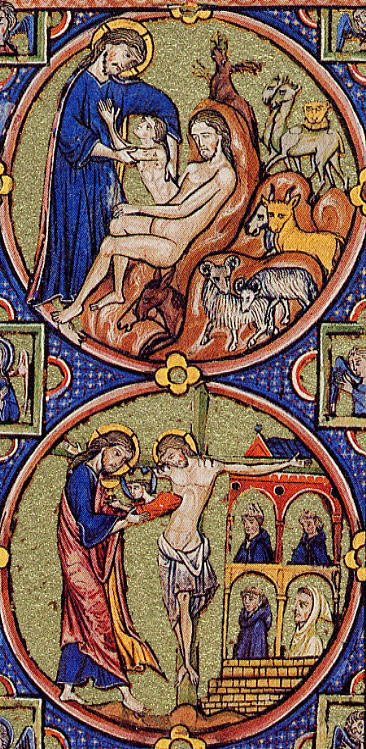
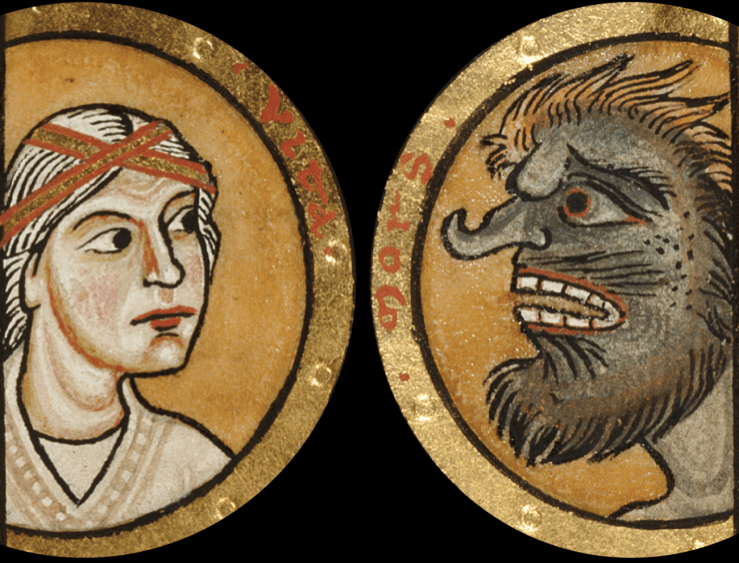
VISUAL MEDITATION: “The Birth of Ecclesia”: On Sunday I wrote a piece for ArtWay on a thirteenth-century Bible moralisée illumination that pairs the creation of Eve out of the side of sleeping Adam with the birth of the church out of the side wound of the New Adam, Christ, our spouse, who “fell asleep” on the cross. The painting offers a great example of how art can do theology.

Birth of Ecclesia
Bible moralisèe: “The Creation of Eve” and “The Birth of Ecclesia,” fol. 2v (detail), ONB Han. Cod. 2554, Österreichische Nationalbibliothek, Vienna. Made in Paris, 1225–49.

+++

POETRY LECTURE: “Believing in Poetry for a Secular Age: Michael Symmons Roberts and Mark Oakley,” October 5, 2017, 6:30 p.m., 77 Great Peter Street, London SW1P 2EZ: “If we live in a secular age, you wouldn’t know it from our poetry. Not only are some of the greatest poets of recent years overtly Christian, such as Geoffrey Hill and Les Murray, but many who are not remain drawn to and fascinated by ‘the soul in paraphrase, heart in pilgrimage.’” To facilitate discussion on poetry’s spiritual power, the religion and society think tank Theos has organized an evening with the award-winning poet Michael Symmons Roberts and arts writer and advocate Mark Oakley, who will draw on their most recent publications. General admission is £7.

Inspired by his hometown of Manchester, Roberts’s seventh poetry collection, Mancunia, released last month, has received critical acclaim. “Mancunian Miserere” is reprinted in full in the Guardian’s review, but here’s a taste: “As I walk west on Cross Street have mercy on me, O God, / . . . / for the wide berth I gave that man-cocoon asleep on the steps / of a new-closed bank where once I queued to find my balance.”

As canon chancellor of St. Paul’s Cathedral, one of Mark Oakley’s responsibilities is to advance the church’s engagement with the arts. Last year he wrote The Splash of Words: Believing in Poetry, a series of reflections on twenty-nine poems that speak into the life of faith. Earlier books of his include The Collage of God, A Good Year, and compilations of readings for weddings and funerals.

+++

ALBUM: Grace by Lizz Wright: Lizz Wright’s sixth album, Grace, dropped on September 15 to rave reviews. “A sophisticated straddler of down-home blues, jazz, gospel, folk, southern pop and confessional singer-songwriter traditions,” Wright, with the help of album producer Joe Henry, chose nine covers from an array of sources and eras and cowrote the tenth track with Maia Sharp. My favorite is “Singing in My Soul,” written by Thomas Dorsey and popularized by Sister Rosetta Tharpe—about the steadfast joy that is ours in Christ.

+++

FILM: The Birth of a Nation (2016): My husband never learned about Nat Turner in school, he recently told me when the name came up at an exhibition opening. So when we got home we decided to watch Nate Parker’s biopic of Turner, an enslaved black preacher who in 1831 led a revolt against the slaveholding families of Southampton County, Virginia, killing about sixty white men, women, and children. It was a watershed moment in American history that spread fear throughout the South and resulted in the execution of fifty-six slaves and the lynching of over a hundred nonparticipants.

As do most cinematic retellings of history, The Birth of a Nation contains inaccuracies, and in its attempts to be a hero’s story, it lacks nuance. But it effectively shows how entrenched Turner was in scripture—he was literate—and how his growing understanding of God’s will for his people, combined with supernatural visions and other pressings of the Spirit, impelled him to act decisively on the side of justice. Because of my pacifist convictions, I cannot commend Turner’s violent methods . . . but I say this as a free white woman in the twenty-first century, whose privilege has protected me from the kind of desperation that was present on the antebellum plantations of the American South; were I in a state of constant oppression with no other way out, and forced to witness daily the abuse of my spouse, my children, my mother, and others I love, maybe my feelings would be different. I can still appreciate Turner’s ministry to his fellow slaves and his hunger and thirst for righteousness, as well as his internal wrestling with what was an extremely difficult situation.

On a related note, Nat Turner’s Bible is one of the collection highlights at the new National Museum of African American History and Culture in Washington, DC. Worth a visit!

+++

FROM THE ARCHIVES: “This is what hope usually feels like”: In October 2015 I wrote an essay on George Frederic Watts’s allegorical painting Hope and how it pictures the posture that my family and I assumed after my Aunt Marjie’s cancer diagnosis. I am sad to report that Aunt Marjie passed away in July. We spent so many fun times together, traveling, eating, singing and dancing, our weeklong excursion through Italy, along with my mom, being a main highlight. Aunt Marjie’s boundless enthusiasm, positivity, selflessness, and sense of adventure will continue to inspire me. Tomorrow I’ll be flying out to Montana for a party in her honor, where I’ll be telling 150-plus friends and family members what she meant to me—and then dancing it up, just like she wanted! Here are a few favorite photos from my albums.

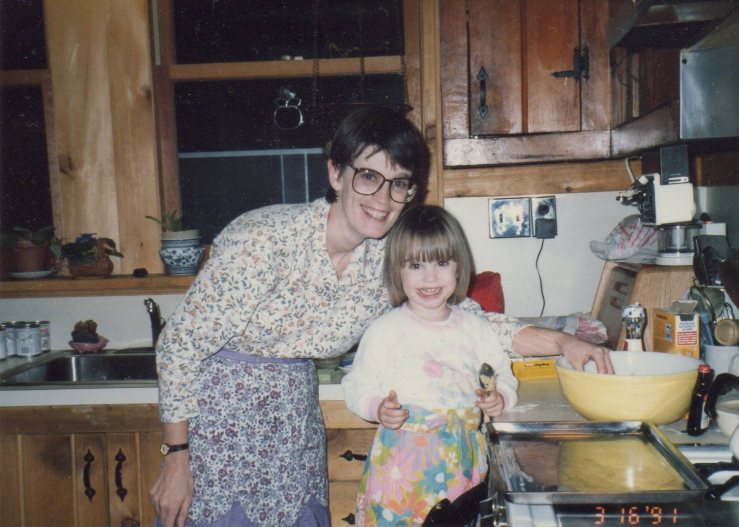
Making cookies with Aunt Marjie
Me and Aunt Marjie making cookies at Grandmom and Poppies’ house in Pleasantville, New York, in March 1991. When I was older Aunt Marjie told me that she had actually been in mourning that month over the loss of a child through miscarriage, and that this was the first time she had smiled in weeks. “It was a healing moment I have never forgotten,” she said.
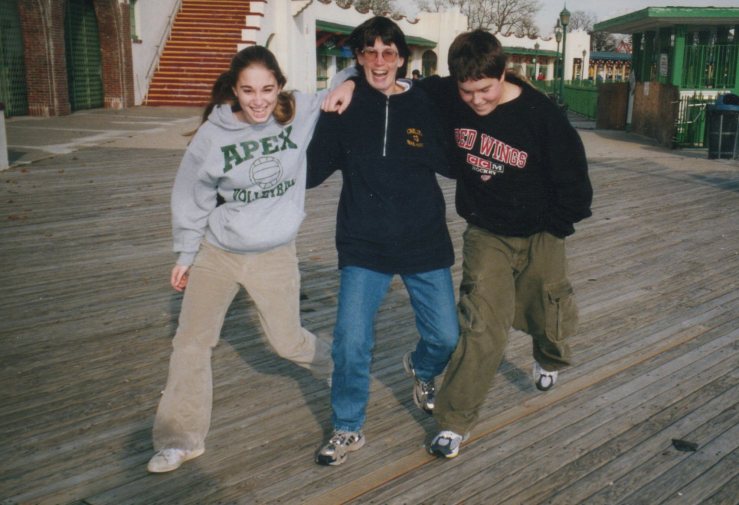
Marjie, Vic, and Orion
Aunt Marjie was endearingly goofy, and completely unselfconscious about it. She livened up every outing and taught me not to care what other people think. Here we are with her son Orion, singing “Follow the Yellow Brick Road” on a boardwalk in 2002—deserted because it’s December!
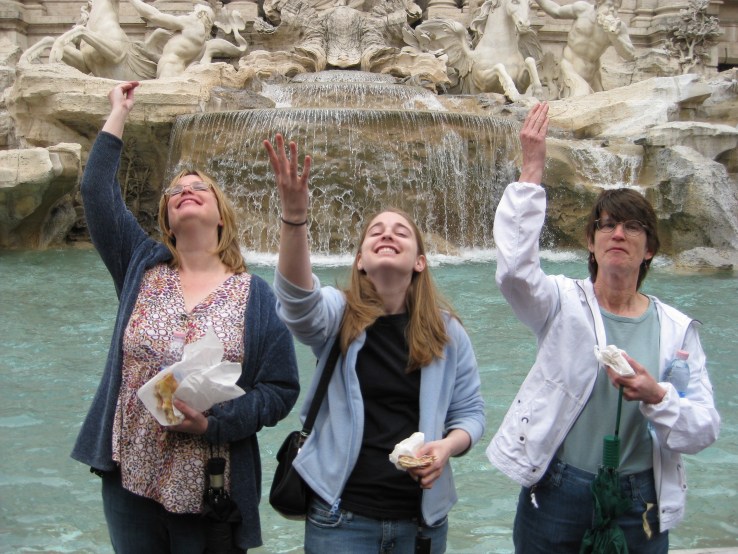
Trevi Fountain
Mom, me, and Aunt Marjie throwing coins into the Trevi Fountain in Rome. This photo has been framed on my bedroom dresser since I got back to the States from that semester abroad in 2009.
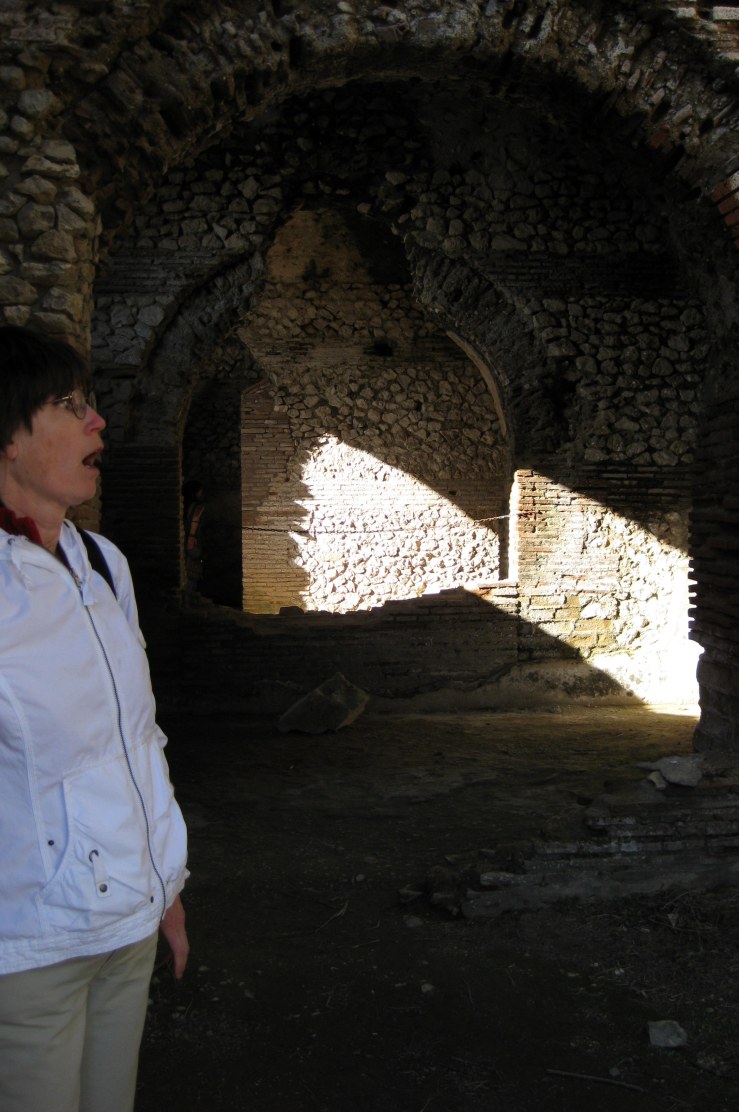
Aunt Marjie at Villa Jovis
This is a genuine reaction to I-don’t-remember-what inside Villa Jovis on Capri. Aunt Marjie’s ultra-expressiveness was one of her much-beloved traits, and archaeological sites always brought it out. (She had a PhD in the field . . . in addition to master’s degrees in geology and geophysics, anthropology, and social science!)
Aunt Marjie dancing
Aunt Marjie was always the first one out on the dance floor at weddings. Here she is at my wedding in 2010 with my cousins Alex and Danny. To this day, whenever I reference her to friends, they say, “I remember her! The dancing lady in the red dress!”

Roundup: Jazz hymns; stained glass symposium; diversifying medieval studies; Josefina de Vasconcellos; Playing for Change

NEW ALBUM: Makes the Heart to Sing: Jazz Hymns: Last month award-winning composer Deanna Witkowski released an album of fourteen new jazz hymn arrangements for instrumental trio (piano, bass, drums). Injecting an element of surprise—such as changed harmonies and/or rhythms—into the church’s well-worn repertoire of hymn tunes helps people reengage with them in a fresh way, she says. It defamiliarizes. In addition to making the CD available for purchase, Witkowski is offering fully notated sheet music for piano, with the hope that church music directors will consider planning a jazz service for their congregation. (All arrangements are fit for congregational singing.) Hear more about the motivation behind the album, plus track samples, in the video below.

+++

SYMPOSIUM: “In Glass Thy Story,” September 8–9, Robinson College, Cambridge, UK: This weekend Art and Christianity Enquiry (ACE) is holding a two-day symposium that will cover over seventy years of innovation and iconography in the glass art of European churches and cathedrals. The event will seek to draw out the challenges, possibilities, and purpose of stained glass—that is, what it means theologically, and how it relates to the liturgy. Speakers include Martin Crampin, Frances Spalding, Jasmine Allen, Caroline Swash, Jonathan Koestlé-Cate, Deborah Lewer, and Fanny Drugeon. Click here for the schedule and here to register (it costs £120, with discounted options).

Light of the World by John Piper
John Piper (British, 1903–1992), Light of the World, 1980. Stained glass. Robinson College Chapel, University of Cambridge.

+++

EXHIBITION-IN-PROGRESS: “Dialogue: Exposing the Rhetoric of Exclusion through Medieval Manuscripts”: Getty Museum curators are soliciting advance feedback for a January 2018 exhibition that will address the persistence of prejudice as seen through lingering stereotypes from the Middle Ages. (Input on wording and on points of view to consider, for example, is welcome and is already flowing in through comment threads.) As a museum, the Getty acknowledges and takes seriously its role as a repository of history and memory, knowing full well that its manuscripts collection, which consists primarily of medieval luxury art objects from western Europe, is full of caricature and erasure of “out groups,” such as Jews and Muslims, the poor, those perceived as sexual or gender deviants, and non-Europeans. This presents challenges when trying to connect with a multicultural and increasingly international audience. Click here to read a working description of the exhibition and, if desired, provide critique.

(Updates, 10/3/17, etc.: “More Details on Exhibition-in-Progress” (Getty blog); archived exhibition page, Outcasts: Prejudice and Persecution in the Medieval World; three specially commissioned essays on race, anti-semitism, and gender identity in the Middle Ages, available for free download)

Jewish caricature (12th c)
Anti-semitic representation from the Stammheim Missal, made in Germany, 1170s. Ms. 64 (97.MG.21), fol. 86 (details), J. Paul Getty Museum, Los Angeles.

On a similar note, this Pacific Standard article appeared in my Twitter feed yesterday: “What to do when Nazis are obsessed with your field: How medieval historians can counter white supremacy.” History professor David M. Perry writes,

White supremacists explicitly celebrate Europe in the Middle Ages because they imagine that it was a pure, white, Christian place organized wholesomely around military resistance to outside, non-white, non-Christian forces. Marchers in Charlottesville held symbols of the medieval Holy Roman Empire and of the Knights Templar. . . . Someone sprayed “saracen go home” and “deus vult”—a Latin phrase meaning “God wills it” and associated with the history of the Crusades—on a Scottish mosque. . . .

Thankfully there have been robust efforts among medievalists as of late to show how the Middle Ages was actually a religiously, culturally, and ethnically diverse era (which our focus on western European Christian culture has partially disguised) and to learn from fields like critical race theory and ethnic studies how to better understand the ideologies and distributions of power that define the modern world.

+++

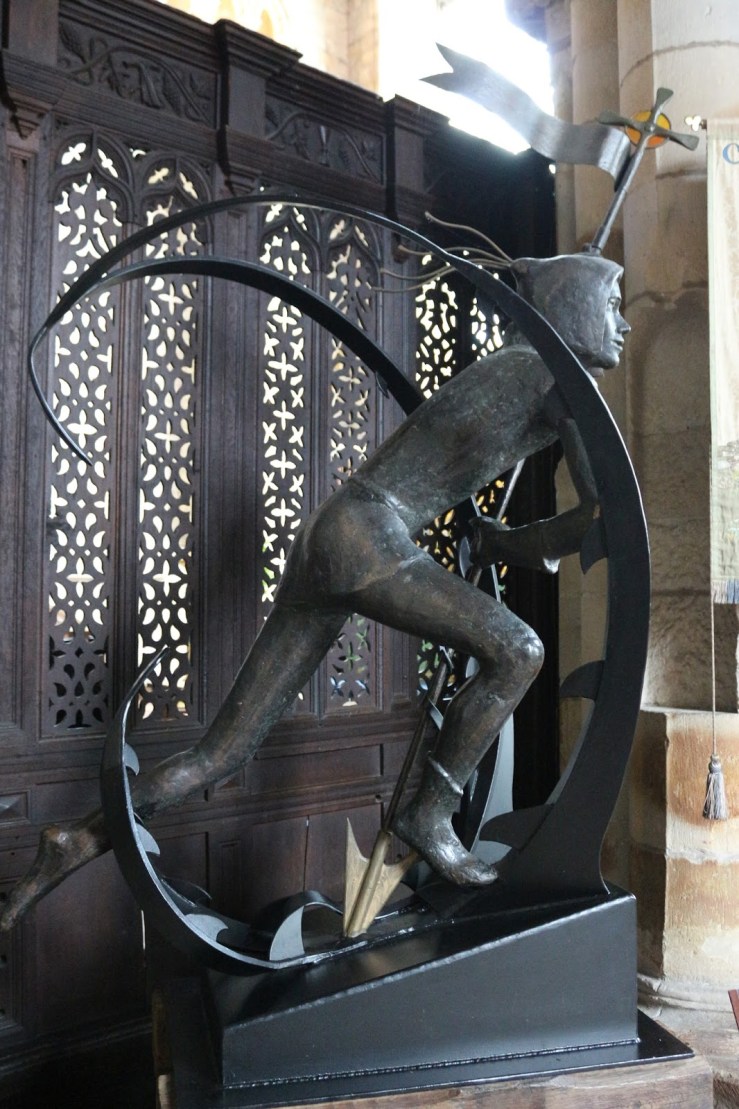
ARTIST SPOTLIGHT: Josefina de Vasconcellos: One of the bloggers I follow is Jonathan Evens, an Anglican priest and art critic who serves as secretary to commission4mission, an organization that encourages the commissioning and placing of contemporary art in churches as a means of fundraising for charities. He frequently undertakes “church art pilgrimages” throughout the UK, researching, photographing, and writing about his discoveries. His recent visit to Kendal Parish Church and Cartmel Priory has yielded a lovely piece on the twentieth-century British sculptor Josefina de Vasconcellos. Featured artworks include the Madonna and Child in a refugee camp, St. Michael the Archangel battling his way through the jaws of a dragon, a martyrs’ memorial, and a compositionally unique Rest on the Flight to Egypt. Click here to view additional photos and information about the artist.

The Family of Man by Josefina de Vasconcellos
Josefina de Vasconcellos (British, 1904–2005), The Family of Man. Fiberglass. South Aisle, Kendal Parish Church, Cumbria, England. Photo: Jonathan Evens
St. Michael the Archangel by Josefina de Vasconcellos
Josefina de Vasconcellos (British, 1904–2005), Saint Michael the Archangel. Cartmel Priory, Cumbria, England. Photo: Jonathan Evens

+++

PLAYING FOR CHANGE DAY (September 23, 2017): “One World, One Voice”: The mission of the Playing for Change Foundation (PFCF) is to create positive change through music education. To that end the organization develops, funds, and supports music schools and programs that are operated by their local communities and then works to connect those communities around the world. Every week 1200-plus young people in Bangladesh, Brazil, Ghana, Mali, Nepal, Rwanda, South Africa, Thailand, Morocco, and Argentina attend free PFCF classes in dance, instruments, music theory, languages, and cultural heritage. PFCF’s community development and empowerment efforts also contribute to meeting essential needs like food, clean water, medicine, and more.

To raise funds to further its peace-building mission, PFCF has set an annual global day of music for September 23. Last year Playing for Change Day resulted in over two hundred events in forty-eight countries on six continents, and consequently more instruments and resources for all the schools. To host an event, attend an event, or donate to the cause, click here.

From 2004 to 2008 a small Playing for Change film crew traveled the world’s highways and byways, recording hundreds of musicians from dozens of countries independently playing a set list of songs; the performances, each with its own distinctive style and texture, were then intercut to create e pluribus unum (out of the many, one; or, unity in diversity)—one seamless video performance, an across-the-globe collaboration. All the videos are up on YouTube, but they’re so much fun to watch, I bought all three DVDs, Songs Around the World 1–3. My favorite track is probably “Down by the Riverside,” a celebration of heavenly harmony featuring Grandpa Elliott, the Preservation Hall Jazz Band, the Congolese Choir of Grace, and over a dozen other musicians. Indigenous instruments include the bombo (large bass drum) from Portugal, the pandeiro (hand drum) from Brazil, the tambura kontra (long-necked lute) and begesh (double bass) from Serbia, and the washboard and cigar box banjo from the United States.

Visit http://playingforchange.com to peruse more videos, music, merchandise, and tour information.

Reformation Roundup

FIVE R’S FOR REFORMATION COMMEMORATION

As a guard against Reformed hubris, Churches Together in England has issued a statement urging churches to mark the Reformation’s fifth centenary with sensitivity to other branches of the faith, providing 5 R’s as guidelines. Keep the anniversary, it says, with the spirit of

Rejoicing – because of the joy in the gospel which we share, and because what we have in common is greater than that which divides; and that God is patient with our divisions, that we are coming back together and can learn from each other.

Remembering – because all three streams of the Reformation have their witnesses and one church’s celebration could be another’s painful memory; and yet all believed they acted in the cause of the gospel of Jesus Christ for their time.

Reforming – because the Church needs always to grow closer to Christ, and therefore closer to all who proclaim him Lord, and it is by the mutual witness of faith that we will approach the unity for which Christ prayed for his followers.

Repenting – because the splintering of our unity led us to formulate stereotypes and prejudices about each other’s traditions which have too often diverted our attention from our calling as witnesses together to the mercy of God in proclamation and service to the world.

Reconciling – because the call to oneness in Christ begins from the perspective of unity not division, strengthening what is held in common, even though the differences are more easily seen and experienced.

This is not to say we can’t celebrate the achievements of the Reformation (we certainly should!), but we ought not to do so with denigration toward our Catholic brothers and sisters, nor hold our own branch above reproof. All church history, before and after the major splits, is our history as a body. Read the full CTE statement here. For other initiatives to foster common witness, service, and understanding between Protestants and Catholics, see the documents “Evangelicals and Catholics Together” (1994) and “Joint Declaration on the Doctrine of Justification” (1999).

+++

ECUMENICAL ARTS SYMPOSIUM

The last two weekends in October will cap off the international “Arts and Ecumenism” symposium organized by the Mount Tabor Ecumenical Centre for Art and Spirituality to commemorate the five hundredth anniversary of the Reformation. With events in Paris, Strasbourg, and Florence, the symposium is now coming to the US to continue the discussion on Catholic and Protestant approaches to art.

The penultimate session, “Sacred Arts in North American Contexts,” will take place October 20–21 at Yale University. “Arts in Celebration: The Word in Color, Action, Music, and Form,” the final session, will take place October 27–29 at the Community of Jesus in Orleans, Massachusetts, and will include demonstrations of mosaic, fresco, and Gregorian chant; lectures and panel discussions with Timothy Verdon, William Dyrness, Deborah Sokolove, and others; exhibits of contemporary sacred art by Susan S. Kanaga and Filippo Rossi (view the catalog); liturgies of the Divine Office and Holy Eucharist; an organ recital; and a fully staged presentation of Ralph Vaughan Williams’s opera The Pilgrim’s Progress, performed by the community’s critically acclaimed Gloriae Dei Cantores choir and Elements Theatre Company. Click here for the schedule.

I stayed at the Community of Jesus last week, and trust me, $425 is a great price for two days and nights at this beautiful Cape Cod monastery, with its Benedictine hospitality, and access to a high caliber of visual, musical, and dramatic art and prominent voices in the field of Christianity and the arts. But the best part, I think, will be the opportunity to inhabit the ecumenical vision the community has established, whereby all Christians—Catholic, Protestant, and Orthodox—live together, eat together, and worship together. Some community members have taken vows of celibacy, while others have chosen marriage and live with spouse and children on the compound. Partaking of the Eucharist last Friday with brothers and sisters from other streams of Christianity and multiple generations was an experience I will not soon forget. Be sure to take advantage of the early-bird registration discount, which ends September 1.

(Click here to take a virtual tour of the Community of Jesus’s Church of the Transfiguration.)

Church of the Transfiguration
Church of the Transfiguration, Orleans, Massachusetts. Photo: Victoria Emily Jones
Vento by Filippo Rossi
Vento (detail) by Filippo Rossi, from the exhibition “Spirito Creatore”

+++

PAST LECTURE: “Visual Ecumenism” by Matthew Milliner: Milliner is an evangelical Anglican who teaches art history (his specialization is Byzantine) at a Protestant liberal arts college in Illinois. In this talk given April 7, 2017, at the Wheaton Theology Conference “Come, Let Us Eat Together!,” he discusses how we can “put on” other Christian traditions without losing our own by engaging their artistic output, by opening ourselves up to the material expressions of the gospel present all across the denominational spectrum:

I’m taking a particularly cherished part of my tradition—the law/gospel distinction—and showing that it can be found in other traditions as well. This might seem like I’m colonizing other traditions with my Protestantism, but I’m actually trying to strip my own tradition of its exclusive possession of this message and see it elsewhere, so that evangelicals can be at home in late medieval Catholic devotional manuals or in Russian Orthodox cathedrals. (19:04)

In reverse chronological fashion, he examines Lucas Cranach’s Law and Grace (Protestant), Berthold Furtmeyr’s Tree of Life and Death (Catholic), and the Sinai Pantocrator icon (Orthodox). Michelangelo’s late drawings and tomb for Pope Julius II are discussed in light of his involvement in the Spirituali, a Catholic reform movement in Italy that emphasized intensive personal study of scripture and justification by faith. More personally, Milliner describes how he was able to make it through repeated Hail Marys during a Catholic prayer service he inadvertently stumbled into one time and, on another Marian note, shares the Madonna of Mercy mural created last year by a group of Protestant art students he co-taught in Orvieto, Italy, with Bruce Herman, showing how they honored this subject that originated outside their tradition while also bringing it in line with their theological convictions—which, they discovered, were corroborated by Vatican II. In an earlier essay on visual ecumenism, Milliner wrote,

Just as there is, according to our Bibles, ‘one Lord, one faith, one baptism,’ so perhaps there is also one variegated yet unified Christian aesthetic, to which the different traditions, at their utter best, ascend. Full maturity (which for evangelicals has been a long time coming!) is not to see with Protestant, Orthodox or Catholic eyes—but with the eyes of Christ.

Madonna of Mercy (Gordon in Orvieto)
Madonna of Mercy painting by the 2016 Gordon in Orvieto cohort

Milliner has given similar talks in the past: “Toward a Visual Ecumenism,” at Duke; “Toward 2017: Visualizing Christian Unity,” at George Fox; “Altars on the Jordan and the Rhine,” at the Institute for Ecumenical Research in Strasbourg; “Against Confessional Aesthetics,” at Baylor; and “Hearing Law, Seeing Gospel: A Mockingbird History of Art,” at the 2017 Mockingbird Conference. I hope they turn into a book!

+++

UPCOMING LECTURE: “An Evening with Ken Myers: Luther’s Artistic Legacy,” Saturday, September 9, 7:30 p.m., Wallace Presbyterian Church, College Park, Maryland: To kick off its second season, the Eliot Society has scheduled Mars Hill Audio founder Ken Myers to discuss Martin Luther’s contributions to Christian hymnody. “With the help of some local musicians, Myers will examine the artistic climate Luther helped to create, as well as some of the great composers of sacred music who followed after him. The lecture will argue that the pattern of Luther’s artistic engagement provides a model for contemporary efforts to reconnect faith and the arts.” Click on the link above to reserve your free ticket.

+++

FROM THE ARCHIVES: “An early Protestant painting (commissioned by Luther)”: On my previous blog I wrote a post about an altarpiece Martin Luther commissioned from his friend Lucas Cranach to promote Protestant theology. (It’s the same painting Milliner opens his above talk with.) Luther was more accepting of religious images than many of his fellow reformers, elucidating his position in his Invocavit Sermons (1522) and in the treatise Against the Heavenly Prophets in the Matter of Images and Sacraments (1525). I plan to feature vast swaths of these texts on Art & Theology in the near future.

Law and Grace by Lucas Cranach the Elder
Lucas Cranach the Elder (German, 1472–1553), Law and Grace, 1529. Tempera on linden wood, 82.2 × 118 cm. Castle Museum Schloss Freidenstein, Gotha, Germany.

Roundup: Contemporary santos; singing grace with knives; Auden interprets Bruegel; “The Old Churchyard”; pyrotechnic ladder

“The Cosmopolitan and the Campesino: The Sacred Art of Luis Tapia” by Dana Gioia: I first learned about the pioneering Chicano artist Luis Tapia from the book Crafting Devotions: Tradition in Contemporary New Mexico Santos. His work was memorable, so when I saw it on the cover of the latest Dappled Things issue, I was eager to read inside. Dana Gioia’s essay introduces us to work that is “both strikingly original and deeply respectful of its origins” in the Hispano religious folk art tradition established in New Mexico in the seventeenth century. Pushing the art of polychrome wood sculpture to new levels of craftsmanship and social and political commentary, Tapia “has enlarged his tradition to make it capacious enough to contain his imagination and the complexities of contemporary Latino experience.”

The art world is more accustomed to disruption and transgression than to transformative renewal. (What is more normative in art nowadays than transgression?) It is easier to renounce or mock the past than to master and reshape it to new ends. Assimilating the past, however, allows new work to carry powerful formal and cultural resonance, such as Tapia’s adaptations of New Mexican Catholic folk subjects and symbolism into new secular and social contexts. Tapia does not approach the past with the distanced irony and intellectual condescension of artists such as John Currin or Jeff Koons. Tapia remains invested in the forms, themes, and techniques of the New Mexican Latino Catholic tradition.

(Related post: “Religious art highlights from New Mexico”)

Pieta by Luis Tapia
Luis Tapia (American, 1950–), Pietà, 1999. Carved and painted wood, 20¼ × 14½ × 9½ in. Collection of John Robertshaw. Photo: Dan Morse, courtesy The Owings Gallery, Santa Fe.

+++

Renaissance-era cutlery engraved with musical notations: The Victoria and Albert Museum in London has in its collection a rare “notation knife” from sixteenth-century Italy, whose blade contains on each side a line of music expressing gratitude for a meal. The inscription on one side reads, “The blessing of the table. May the three-in-one bless that which we are about to eat,” while the other reads, “The saying of grace. We give thanks to you God for your generosity.” The knife, which contains only a tenor voice part, belongs to a set. Art historian Flora Dennis, whose background is in musicology, tracked down the other three in the set and, with the help of the Royal College of Music, transcribed the voice parts into modern notation, then had the benediction and grace from the knives sung and recorded (listen below). Click on the link to hear curator Kirstin Kennedy discuss the knife’s possible uses, to view footage from the recording session, and to listen to two alternate recordings.

Notation Knife
Left and right views of an etched, engraved, and gilded steel knife with ivory, brass, and silver handle, by an unknown maker, Italy, 1500–50. Victoria & Albert Museum, London.

Benediction, Version 1

Grace, Version 1

+++

“‘About Suffering They Were Never Wrong’” by Kevin Antlitz: This essay about human indifference to others’ suffering centers on W. H. Auden’s poem “Musée des Beaux Arts,” which is itself a response to two paintings by Pieter Bruegel the Elder: The Census at Bethlehem and The Fall of Icarus. Insights from Mark Twain, Rabbi Abraham Joshua Heschel, Elie Wiesel, Nuremberg prosecutor Benjamin Ferencz, novelist Aleksandr Solzhenitsyn, and St. Theophan the Recluse add to the commentary, which is personalized by the author’s reflections on his visit to Yad Vashem, the World Holocaust Remembrance Center in Jerusalem. The indictment is sobering: we are all of us guilty of evil—the enabler just as much as the perpetrator.

The Census at Bethlehem by Pieter Bruegel
Nobody notices the need of the pregnant couple—the Holy Family—making their way into town. Pieter Bruegel the Elder (Dutch, 1525/30–1569), The Census at Bethlehem, 1566. Oil on panel, 116 × 164.5 cm. Royal Museums of Fine Arts of Belgium, Brussels.
Landscape with the Fall of Icarus by Pieter Bruegel
The plowman, shepherd, and angler continue with their work, indifferent to the upside-down, flailing legs in the sea beside them, and “the expensive delicate ship” at the crash site “had somewhere to get to and sailed calmly on.” 1560s copy of: Pieter Bruegel the Elder (Dutch, 1525/30–1569), Landscape with the Fall of Icarus, ca. 1558. Oil on canvas, 73.5 × 112 cm. Royal Museums of Fine Arts of Belgium, Brussels.

+++

Offa Rex records spiritual folk standard “The Old Churchyard”: Olivia Chaney has teamed up with the Decemberists under the name Offa Rex to record an album that pays homage to British folk music. Released this month, The Queen of Hearts features a beautiful rendition of “The Old Churchyard,” a song about the pain of death and the hope of resurrection. It invites you, first, to come pay respect to loved ones who have passed out of this world over the years, then entreats you not to feel sorrow for them, “for sweet is their sleep, though cold and hard their pillows may be.” The song acknowledges that words are insufficient to comfort those left behind but nonetheless offers the reassurance of peace and rest for the deceased, and a glorious rising on the last day. (Thanks to Paul Neeley for this find!)

Come, come with me out to the old churchyard,
I so well know those paths ’neath the soft green sward.
Friends slumber in there that we want to regard;
We will trace out their names in the old churchyard.

Mourn not for them, their trials are o’er,
And why weep for those who will weep no more?
For sweet is their sleep, though cold and hard
Their pillows may be in the old churchyard.

I know that it’s vain when our friends depart
To breathe kind words to a broken heart;
And I know that the joy of life is marred
When we follow lost friends to the old churchyard.

But were I at rest ’neath yonder tree,
Oh, why would you weep, my friends, for me?
I’m so weary, so wayworn, why would you retard
The peace I seek in the old churchyard?

Why weep for me, for I’m anxious to go
To that haven of rest where no tears ever flow;
And I fear not to enter that dark lonely tomb
Where our saviour has lain and conquered the gloom.

I rest in the hope that one bright day
Sunshine will burst to these prisons of clay,
And old Gabriel’s trumpet and voice of the Lord
Will wake up the dead in the old churchyard.

+++

Sky Ladder documentary (2016): This Netflix original directed by Kevin Macdonald (The Last King of Scotland) profiles the world-renowned contemporary artist Cai Guo-Qiang (pronounced Tsai gwo chi-ONG), who is best known for reinventing the possibilities of the firework, opening its purpose up beyond mere entertainment. Through interviews with the artist and his family, friends, and critics, the film tracks Cai’s rise from childhood in Mao’s China to global fame, addressing the cultural influences on his work, his desire to effect social change, and his struggles to maintain integrity and artistic freedom (his acceptance to design the fireworks display for the opening ceremony of the 2008 Beijing Olympics was controversial).

The documentary shares its title with Cai’s decades-long obsession and most ambitious work to date: a pyrotechnic ladder that rises up over a quarter mile into the sky, as successive explosions etch each new rung and rail segment into place. “I want to connect the earth to the universe,” Cai said. It was fascinating to be let in on his process for this, his working through all the technical details and other hurdles. Three previous attempts to realize Sky Ladder were canceled—in 1994, due to bad weather; in 2001, due to the 9/11 attacks; and in 2012, due to a revoked permit. It wasn’t until 2015 that the project finally succeeded, in a small Chinese fishing village before an audience of a few hundred. It lasted approximately two and a half minutes. Cai’s Sky Ladder reminds me of “Jacob’s ladder” from Genesis 28:10–19, burning bright, connecting two worlds.

Sky Ladder by Cai Guo-Qiang
Sky Ladder rising. Photo: Lin Yi & Wen-You Cai, courtesy Cai Studio.
Sky Ladder by Cai Guo-Qiang
Cai Guo-Qiang (Chinese, 1957–), Sky Ladder. Realized at Huiyu Island Harbour, Quanzhou, Fujian, June 15, 2015, at 4:49 a.m., approximately 2 minutes and 30 seconds. Photo: Lin Yi & Wen-You Cai, courtesy Cai Studio.

Roundup: Nuns onscreen; Jesus in pop music; El Greco knits

Nuns in pop culture: Anna Silman writes on the current “Nunnassaince” in movies and television, the biggest since the late 1950s and ’60s. She quotes Rebecca Sullivan, author of Visual Habits: Nuns, Feminism, and American Postwar Popular Culture, on the first wave as a reaction against the sexual revolution. For a list of flicks both new and old, see “Ten Essential Movies About Nuns.”

I’ve seen two movies from 2016 that center on a nun, or nuns. The first is Little Sister, a dramedy directed by Zach Clark. It’s about twenty-something Colleen Lunsford, a novice (prospective nun) who’s temporarily called away from the convent when her brother returns from the Iraq War, suffering from depression after a bomb left his face disfigured. In the town she grew up in Colleen is known as the Goth girl, so former high school friends are shocked to learn about her new religious vocation.

I wish the faith dimension was explored a bit more—the only insight we get into Colleen’s decision to become a Christian and pursue the monastic life is a line she mutters about structure and stability. (Was that her only motivation?) The film is more about reconnecting with family and recognizing that even though you grow up and your interests and bearing and goals may change, your past self, or selves, always remain a little bit a part of you. It’s empathetic and dark but also funny, and it shows how there’s no one mold that makes a nun; nuns come from different places in life, and oftentimes sustain (complicated) relationships outside the cloister. (Watch on Netflix)

The second one I’ve seen and commend is The Innocents, directed by Anne Fontaine. Set in a convent in late-1945 Poland and based on a true story, it documents the crisis of faith the nuns of that community are forced to undergo when many of them are raped by invading Russian troops and some pregnancies result. The nuns respond in diverse ways to the horror, struggling to regain their spiritual equilibrium. In desperation, they employ an atheistic French female doctor from the Red Cross, stationed nearby, to help them deliver their babies and to bear their secret. (Watch on Amazon Video)

+++

“If I Believe You: Agnostic Songs to Jesus” by Joy Clarkson: This article analyzes the song “If I Believe You” by the 1975—which opens with “I’ve got a God-shaped hole that’s infected . . .”—in light of the wider trend of self-proclaimed unreligious artists writing songs addressed to Jesus. Clarkson observes that (1) even within the profoundly secular industry of popular music, there is an openness to spirituality, religion, and Jesus; (2) songs written not only about Jesus, but to Him, create a unique discursive space; and (3) an invocation of negative transcendence may create an openness to a true spiritual experience. I’m intrigued by the titles of the books she references, including The Bible in/and Popular Culture: A Creative Encounter (2010); Mashup Religion: Pop Music and Theological Invention (2011); and Personal Jesus: How Popular Music Shapes Our Souls (2013).

+++

Knits by Petros Vrellis: Designed using an algorithm, Vrellis’s re-creations of figures from famous El Greco paintings are formed by knitting a single thread across anchor pegs on a circumference loom. Watch a time-lapse video of Vrellis putting together a knit based on El Greco’s Christ Blessing, below, and read more about his process here. (Another Jesus portrait Vrellis has done is based on El Greco’s Christ in Prayer, visible at 2:27 at the bottom right.) Vrellis has a master’s degree in art sciences; he enjoys exploring the potential of new media through digital art and interactive installations and considers himself more of a “toy inventor” than an artist. Thank you to Tobias M. from Vienna for informing me of this impressive work.

Christ by Petros Vrellis
Knit by Petros Vrellis (Greek, 1974–), based on the painting Christ Blessing by El Greco.

Some of Vrellis’s knits are for sale via Saatchi Art.

Roundup: Global passion art, free song downloads, “Refiguring the Biblical,” boxwood minis, reassembled altarpiece

“Journey to the Cross: Artists Visualize Christ’s Passion” (+ Part 2): As a devotional support for Passion Week and to show the breadth of Christian art across cultures, I’ve curated an online gallery of thirteen art images for the International Mission Board. Spanning the Last Supper through the Resurrection, the images come from the Democratic Republic of Congo, Japan, Bulgaria, the Philippines, China, Croatia, India, South Africa, Australia, Ecuador, Ukraine, Malaysia, and Slovenia.

Good Friday by Clifford Possum Tjapaltjarri
Clifford Possum Tjapaltjarri (Anmatyerre, 1932–2002), Good Friday, 1994. Acrylic on canvas, 116 × 154 cm. National Gallery of Australia, Parkes, ACT, Australia.

+++

FREE SONG DOWNLOADS:

“Into the Woods My Master Went”: Last summer singer-songwriter Seth Woods (The Whiskey Priest) discovered in an old Baptist hymnal an unusual nineteenth-century hymn text by Sidney C. Lanier, about Christ in Gethsemane—unusual not just for its content but for its rhyme and meter. In the first verse, Jesus enters the garden and receives the friendship of nature—the olive leaves caress him for comfort, and the thorns retract so as not to hurt him. In the second verse, Jesus departs from the garden, assured in his mission, and is forthwith arrested, taken from trees (olive grove) to tree (cross). Woods and Richard Kentopp (The Gentle Wolves) each took a stab at setting the text to music, and they invited four other friends—Jana Horn, Bruce Benedict, Alex Dupree (Idyl), and Chris Simpson (Mountain Time)—to do the same. These six retunings are available for free download via Bandcamp. The diverse results demonstrate how the same text can inspire different creative approaches.


“Wheat and Tares” and “Draw Me to You”: The Windtalkers is a Florida-based husband and wife duo (Benny and Ashley Permuy) backed by a band of musician friends who seek to create songs of life and truth unto the Lord. Through NoiseTrade they’re offering two of the seven tracks from their upcoming album All Creation Groans (available May 30): the blues-inflected “Wheat and Tares,” and the cello-backed “Draw Me to You.”

+++

KICKSTARTER PROJECT: “Refiguring the Biblical” juried exhibition (includes cash prizes): Others Imagining Initiative hopes to organize a juried art exhibition featuring racially diverse depictions of biblical characters, awarding prize money to select artists. The purpose is to help promote a Christian visual culture that does not elevate white Jesus but rather is inclusive of minorities. Submissions would be limited to current and recently graduated art students (BA/BFA within the last two years), and the exhibition would open in January 2018 at Biola University, hopefully traveling to other US universities as well. The viability of this project is dependent on the raising of funds through Kickstarter.

+++

EXHIBITIONS:

“Small Wonders: Gothic Boxwood Miniatures” (The Met Cloisters): On display through May 20. “Small in scale, yet teeming with detail, miniature boxwood carvings have been a source of wonder since their creation in the Netherlands in the 16th century. On these intricately carved objects—some measuring a mere two inches (five centimeters) in diameter—the miracles and drama of the Bible unfold on a tiny stage. Many of the works can be opened and closed: masterfully crafted hinges and clasps still function today. . . . Offering new insight into the methods of production and cultural significance of these awe-inspiring works of art, this exhibition [organized in partnership with the Art Gallery of Ontario and the Rijksmuseum] highlights more than four years of research that has used cutting-edge technology to understand these elegantly precise miniature rosaries, prayer beads and altarpieces.” The AGO’s Boxwood Project is a fantastic resource—an online catalogue raisonné, with photos and essays.

Boxwood prayer bead
Boxwood prayer bead (closed), Netherlands, ca. 1500–25, from the Metropolitan Museum of Art.
Boxwood prayer bead
Boxwood prayer bead (open), Netherlands, ca. 1500–25, from the Metropolitan Museum of Art.

“Gerard David: An Early Netherlandish Altarpiece Reassembled” (The Getty): The long-separated components of a fifteenth-century triptych by Netherlandish painter Gerard David have been reassembled following eighteen months of technical study and conservation treatment of the wings at the Getty. On display from March 21 to June 18, Pilate’s Dispute with the High Priest and The Holy Women and Saint John (from the Koninklijk Museum in Antwerp) flank Christ Nailed to the Cross (from the National Gallery in London), a dynamic scene rendered in exquisite detail. For more on the artist, see Gerard David: Purity of Vision in an Age of Transition by Maryan Ainsworth, available for free e-viewing through the Getty Research Portal.

Christ Nailed to the Cross by Gerard David
Installation view at the Getty: Gerard David (Netherlandish, ca. 1460–1523), Christ Nailed to the Cross triptych, 1480–85. Oil on panels.

Roundup: “. . . circle through New York,” New Zealand chapel, animating the Beast, phantasmagoric Head of Christ, biblical cities song cycle

Gonzalez-Torres at St. Philip's Church, Harlem
In March 2017, the “. . . circle through New York” project brought Felix Gonzalez-Torres’s 1991 work Untitled (Public Opinion)—a large pile of individually wrapped licorice candies, available for viewers to take and eat—from the Guggenheim to St. Philip’s Church in Harlem. St. Philip’s, in turn, lent out its call to social justice, which will rotate among the project’s five other participating venues.

“. . . circle through New York” project: What a clever way to foster relationships and spread cultural wealth! “In their new project A talking parrot, a high school drama class, a Punjabi TV show, the oldest song in the world, a museum artwork, and a congregation’s call to action circle through New York, artists Lenka Clayton and Jon Rubin create a complex system of social and material exchange that brings together city communities often separated by cultural, economic, geographic, or circumstantial boundaries. The artists have drawn an imaginary circle through Harlem, the South Bronx, Queens, and Manhattan’s Upper East Side and invited six public venues along the circle’s path to participate in a system of social and material exchange. These spaces, which include a pet store, a high school, a TV network, an academic research institute, the Guggenheim, and a church, serve as the project’s cocreators and hosts. The artists worked with the venues to select aspects of their identities—referenced in the project’s full title—that will rotate among the six locations over a period of six months.” Commissioned as part of the Guggenheim Social Practice initiative, the project is now in its second month and will wrap up in August.

+++

“The Shimmering Glory of a Modern Indigenous New Zealand Chapel”: Completed in 1961, the Futuna Chapel in Wellington is, according to architect Nick Bevin, “New Zealand’s most significant building of the twentieth century.” Influenced by elements of wharenui (Maori meetinghouses), it was designed by John Scott, the country’s first university-trained Maori architect, as part of a retreat center for the Catholic Marist Brothers, and was built by volunteers from the order. Auckland artist Jim Allen was hired to design the acrylic glass windows, a Stations of the Cross frieze, and several mosaics, and to sculpt a crucifix for the main altar. The Society of Mary had to sell the retreat center in 2000 for financial reasons; the Futuna Trust has been formed to protect the chapel from demolition, but not before the surrounding land was turned into a townhouse development. The chapel is now deconsecrated, serving as host to lectures, concerts, and other events. Many great photos of its interior and exterior can be viewed at the link above, or, for further study, check out the recent book Futuna: Life of a Building.

Futuna Chapel
Futuna Chapel, Wellington, New Zealand, designed by John Scott. Photo: Claire Voon/Hyperallergic
Futuna Chapel, Wellington, New Zealand
Main altar of Futuna Chapel, Wellington, New Zealand, showing a mahogany crucifix and rough-hewn granite slab altar by Jim Allen. Photo: Claire Voon/Hyperallergic

+++

Disney animator Glen Keane on spiritual transformation: Last month’s theatrical release of Disney’s live-action Beauty and the Beast has sparked renewed interest in the 1991 animated classic. On one of the special features of the DVD/Blu-ray release of the animated version, I was fascinated to hear that Glen Keane—who animated the original Beast along with Ariel, Aladdin, Pocahontas, Tarzan, Rapunzel, and many other beloved Disney characters—is a Christian whose own story of spiritual transformation was the driving inspiration, for him, behind the Beast’s transformation sequence at the end of the movie. (Visual influences included Rodin’s The Burghers of Calais and Michelangelo’s slave sculptures.) In an interview, Keane described his approach to animating this climactic moment:

For me, it’s really an expression of my spiritual life. There’s a verse in the Bible that says, “If any man is in Christ, he is a new creation. Old things have passed away, and all things have become new.” I wrote that on my exposure sheet there as I’m drawing this, because it’s really about an inner spiritual transformation that’s taking place with the Beast. And I saw it as a parable of my own life—that I got to express that. It was sincere, it was real for me. It was very real for the prince. I don’t know that there’s ever an illustration more clear as to what really can take place in a person’s life spiritually than this animated character transforming from an animal to the prince.

(Update, 6/6: Thank you to Chris S. at Green Egg Media for alerting me to a series of biblically inspired children’s books by Glen Keane, Adam Raccoon. Also check out the Bancroft Brothers Animation Podcast interview with Keane on faith and art or, for a shorter segment on the same topic, his First Person interview. Both were recorded this spring.)

+++

“The Dark of Doubt Dispelled: Odilon Redon’s Day appears at last . . .: On March 26 I wrote a reflection for ArtWay on one of Odilon Redon’s lithographs. Showing the head of Christ haloed by the sun, his crown of thorns disentangling, it’s the last in a suite of twenty-four prints inspired by Gustave Flaubert’s novel/drama The Temptation of Saint Anthony.

Head of Christ by Odilon Redon
Odilon Redon (French, 1840–1916), Day appears at last . . . and in the very disk of the sun shines face of Jesus Christ (detail), 1896. Lithograph on chine appliqué, from Redon’s third Temptation of Saint Anthony portfolio, published by Ambroise Vollard, Paris.

+++

Cities, a five-song cycle by Jonathon Roberts: “I have a personal goal of setting the whole Bible to music,” writes Jonathon Roberts. “The Bible is the starting point for most of my projects, regardless of the style. I connect best with a passage of Scripture when I explore it artistically. The challenge has led me down some interesting roads musically and lyrically, since the subject matter doesn’t always fit in a nice box.” Cities is Roberts’s most recent work; it’s a chamber-pop song cycle personifying the biblical cities of Bethlehem, Ephesus, Jerusalem, Jericho, and the “New City” described in Revelation. Listen to “Bethlehem,” inspired by Micah 5:2, below, and the rest here. The whole piece is a lot of fun!


Roberts’s interest in deepening his and others’ engagement with the Bible led him to found, with Emily Clare Zempel, the organization Spark and Echo Arts, which commissions works of visual art, music, theater, poetry, fiction, dance, and film that respond directly to scripture. Its aim is to “illuminate” the entire Bible, using various art forms, by 2020, creating a platform and framework for artists to explore this ancient sacred text, as well as a rich resource for the church. Look out for a major web redesign, to launch in the next few months.

Roundup: “Art as Mission,” Ken Myers on culture care, Quadri Plastici, heavy-metal hymn, cultural liturgies

“Translate: Art as Mission” symposium, February 25, 9 a.m.–3:30 p.m.: This Saturday, Third Church of Richmond, Virginia, is bringing together twenty practitioners, advocates, and theorists of the arts as front-line missions (both local and abroad) for a series of presentations and discussions that is free and open to the public. “Our aim is to demonstrate that ‘art as mission’ is not about using people and objects merely as ‘tools’ for missions or proselytization, but is about recognizing that generative, creative practices can and should be intrinsically, inherently ‘missional’ because they put on display and draw people towards the rich, abundant life we were made to experience and have together as God’s children, renewed as the Body of Christ. Together we’ll explore how the arts are a distinctively integrative, incarnational way to be human, and to bear the image of our creator God.” Click on the link to see the schedule and to find out more about the speakers.

+++

“Charged with the Grandeur of God: Faithful Imaginations in a Meaningful Creation” lecture, February 25, 7–9 p.m.: Also on Saturday, Ken Myers, founder and host of Mars Hill Audio and author of All God’s Children and Blue Suede Shoes: Christians and Popular Culture, will be speaking at Wallace Presbyterian Church in College Park, Maryland, on how alert imaginations enable us to receive the meaning in Creation and to rearticulate Creation’s meaning in works of art. A former arts and humanities editor for NPR, Myers writes of the mission of Mars Hill’s bimonthly “audio journal”: “We explore the various factors that have given modern Western culture its distinctive character. We also try to describe what cultural life — its practices, beliefs, and artifacts — might look like if it was the product of thoughtful Christian imaginations.” Each issue features guests from a variety of disciplines (poets, visual artists, scientists, philosophers, musicians and musicologists, social commentators, etc.); you can listen to back issues here, and read a 2013 profile on Myers from the Weekly Standard here. This event is sponsored by the Eliot Society, a new nonprofit in Washington, DC, that aims to “draw Christian faith and artistic culture back together, by promoting the thoughtful exploration of the work of creative men and women from both the past and the present.” Click here to RSVP.

+++

Last season’s Italia’s Got Talent featured a group called Quadri Plastici (“Living Paintings,” or “Tableaux”), which uses actors in period costumes and special lighting effects to recreate famous religious paintings in the flesh. According to the group’s website, the tradition of staging live reproductions of paintings originated in Avigliano in southern Italy in the 1920s: the participants, frozen in position, would be rolled into the town square on mule-drawn carts as part of the celebration of Saint Vitus’s feast day on June 15. In their television performance last year, Quadri Plastici recreated three Caravaggio paintings: The Crucifixion of Saint Peter, The Calling of Saint Matthew, and The Death of the Virgin. Gabriele Finaldi, director of London’s National Gallery, was impressed, and he commissioned the group to perform two of the paintings from the museum’s “Beyond Caravaggio” exhibition in October: The Taking of Christ and Salome Receives the Head of John the Baptist. To better engage the public, these stagings took place outside in Trafalgar Square.

+++

Through Paul Neeley’s Global Christian Worship blog, I discovered a gem of a song: a heavy-metal arrangement of the nineteenth-century Swedish hymn “Bred dina vida vingar” (Thy Holy Wings) by the Finnish worship band Metallmässa (Metal Mass). Unlike its marginal status in most countries, heavy metal music is mainstream in Finland, which has the most heavy metal bands per capita in the world. “Metal masses”—church services performed in a heavy-metal style—became a trend in 2006; into this current stepped the group Metallmässa, whose lead singer, Christer Romberg, was a contestant on the 2007 Finnish Idols. Their headbanging rendition of “Bred dina vida vingar,” performed in the music video below, is from their 2012 EP Sanctus. The words are by Lina Sandell, “the Fanny Crosby of Sweden”; the tune—which I think is just beautiful (and quite catchy!)—is a traditional Swedish folk tune. Metallmässa is no longer active, but Romberg can be found performing a cappella with his four siblings as part of Vokalgruppen Romberg.

+++

Recently I enjoyed listening online to James K.A. Smith’s lecture “A Postmodern Saint? Augustine in France,” given at Wheaton College on August 31, 2016. Because I’m interested in how culture shapes our longings (in particular, visual culture), the bit that starts at 19:57 jumped out at me:

Augustine is a remarkable exegete of cultural liturgies that beset us—the rites and rituals of ambition, consumption, privilege, that aren’t just things that we do but do things to us. The frat house, the football stadium, the rituals of Wall Street finance—these are quasi-religious sites in late modern culture, not because they purvey a message but because they are incubators of love that are rife with rituals that train and direct our hearts and our desires. And conversion is no magical panacea for that; belief doesn’t inoculate our loves from their immersion in those cultural liturgies. So we need to constantly take stock of the formation of our loves and longings, all the subtle ways that secular liturgies bend our desires toward earth rather than heaven.

Consider, too, the act of looking as a cultural liturgy: at our phones and computer screens; at the staged displays in store windows, and the staged photos on social media; at the thirty-second commercial the network forces us to watch before we get back to our show, or the billboard we can’t help but notice when we’re stuck in traffic. Sometime around the year 600, Pope Gregory I insightfully wrote that pictures teach us what to adore, what to imitate. What pictures do you see throughout the day? Is Christ one of them?

Roundup: Free arts conference, new book series, Liturgical Folk, Jesus in Israeli art, Hacksaw Ridge

SYMPOSIUM: “Art in a Postsecular Age,” hosted by Biola University’s Center for Christianity, Culture, and the Arts: The twelfth annual Biola Arts Symposium is taking place Saturday, March 4, in La Mirada, California, covering “What is Postsecularity?,” “Seeing in a Postsecular Age,” “Making in a Postsecular Age,” and “Art in a Postsecular Age.” The all-star speaker lineup includes Sally Promey (The Visual Culture of American Religions), James Elkins (On the Strange Place of Religion in Contemporary Art), Jeffrey Kosky (Arts of Wonder: Enchanting Secularity), and more. I’m super-excited to be going. I hope to see you there! It’s free, and no registration is required.

Art in a Postsecular Age.png

+++

CALL FOR BOOK PROPOSALS: Arts and the Sacred (ASAC) series: Brepols Publishers has launched a new academic series of richly illustrated books on theology and the arts, with a focus on visual art—historical and contemporary—and they’re looking for proposals. The series editors are Chloë Reddaway (Howard and Roberta Ahmanson Fellow in Art and Religion at the National Gallery, London) and Aaron Rosen (author of, among other titles, Art and Religion in the 21st Century). First-time authors are welcome.

+++

DOUBLE ALBUM RELEASE: Table Settings and Edenland by Liturgical Folk: This month Ryan Flanigan, worship director at All Saints Dallas, released the first two albums of his Liturgical Folk project, the aim of which is to root historical church language in the inherently joyful sounds of the American folk tradition. I love how Flanigan describes it: “a vision of something refreshingly old for churches that have grown tired of the same new thing.” The first volume, Table Settings, offers twelve traditional prayers and creeds—among them the Lord’s Prayer, the Gloria, and the Trisagion—for churches and families, set to singable tunes; accompanying Flanigan on vocals are his wife, Melissa, and his three kids. The second volume, Edenland, is a collaboration with retired priest and contemplative poet Nelson Koscheski, who wrote all the lyrics; it features a wider range of vocalists. The intergenerational partnership is one element that drew producer Isaac Wardell to the project and that is highlighted in last month’s Dallas News feature story, in addition to the project’s contributions to the liturgical renewal movement in North America.

+++

ART EXHIBITION: “Behold the Man: Jesus in Israeli Art,” December 22, 2016–April 16, 2017, Israel Museum, Jerusalem: “From the 19th century until today, Jewish and Israeli artists have engaged with the figure of Jesus, addressing complex questions of collective and individual identity. This exhibition, the result of extensive scholarly research, presents multivalent, unexpected, and at times subversive artistic responses: European artists reclaimed Jesus as a Jew and portrayed him as a symbol of Jewish suffering, and Zionist artists used the resurrection as a metaphor for the rebirth of the Jewish homeland; some Israeli artists related to Jesus as a social rebel or misunderstood prophet, while others identified with his personal torment or his sacrifice for the sake of humanity, which they connected to more recent victims of intolerance and warfare.” Click here to listen to audio commentary on fourteen of the works from the exhibition. See also this essay from the IMJ on the figure of Jesus in the work of Reuven Rubin.

Via Dolorosa by Motti Mizrachi
Motti Mizrachi (Israeli, 1946–), Via Dolorosa, 1973. Lambda print. The Israel Museum, Jerusalem.
Lamb by Menashe Kadishman
Menashe Kadishman (Israeli, 1932–2015), Untitled (Lamb), 1999. Acrylic on canvas. Rachel and Dov Gottesman Collection, Tel Aviv.

+++

MOVIE TRAILER: Hacksaw Ridge, directed by Mel Gibson: The hero of one of this year’s Academy Award nominees for Best Picture is a Christian whose beliefs impel him to enlist in the US Army only on the condition that he not be made to carry a weapon—and this during World War II, when pacifism was far less acceptable than it is today. “While everybody else is takin’ life, I’m gonna be savin’ it,” says Desmond T. Doss, played by Andrew Garfield, in the trailer below. “That’s gonna be my way to serve.” Based on the true story of Desmond T. Doss, who served during the Battle of Okinawa and became the first man in American history to receive the Medal of Honor without firing a shot.