Roundup: “Soul Food Love,” call for Sufjan Stevens papers, and more

LECTURES:

Calvin University’s January Series is an annual fifteen-day series of lectures and conversations that “aims to cultivate deep thought and conversations about important issues of the day, to inspire cultural renewal and make us better global citizens in God’s world.” It brings in various scholars on various topics, but the two lectures I want to call out in particular are both about food!

Also note: upcoming events in the series include “Neurodivergent Storytelling” with Daniel Bowman Jr., a novelist and professor with autism; a live recording of the Poetry for All podcast featuring guest poet Marilyn Nelson; and “Tuning Our Minds, Ears, and Hearts to Sing God’s Grace: Reflections of a Conductor” with Pearl Shangkuan.

>> “Soul Food and the Collective Cultural Memory” by Caroline Randall Williams (available through Feb. 15): Caroline Randall Williams is a multigenre writer (of poems, YA fiction, essays, recipes), educator, activist, and home cook in Nashville whom Southern Living recognized as one of “50 People Changing the South” for her work around food justice. She’s the coauthor (with her mother, Alice Randall) of Soul Food Love: Healthy Recipes Inspired by One Hundred Years of Cooking in a Black Family and host of the TV show Hungry for Answers. I enjoyed this wonderful introduction to her work—though frustratingly, the sound cuts in and out several times. The introduction starts at 14:05, and the Q&A starts at 1:04:40. She opens with a reading of the delicious poem “When the Burning Begins” by Patricia Smith.

>> “Table Conversations: Building Community as We Eat” by Kendall Vanderslice: Kendall Vanderslice is a baker, writer, and the founder of the Edible Theology Project, an educational nonprofit connecting the Communion table to the kitchen table. She earned her master’s of theological studies from Duke Divinity School and master’s in gastronomy from Boston University. . . . Through her work in food studies and theology, Vanderslice explores the ways God uses the table to restore communities and creation. In her most recent book, By Bread Alone: A Baker’s Reflection on Hunger, Longing, and the Goodness of God, she discusses her faith journey, shares recipes, and dives into the role of bread in church history.” Introduction starts at 11:45; Q&A, at 50:33.

+++

CALLS FOR PAPERS:

>> For inclusion in the forthcoming book My Impossible Soul: The Metamodern Music of Sufjan Stevens: Dr. Tom Drayton and Greg Dember are compiling essays for a new book on Sujan Stevens, and they’re seeking contributing writers from across academic disciplines. “My Impossible Soul will be the first academic volume dedicated to the work of multi-instrumentalist singer-songwriter Sufjan Stevens. A staple of the indie/alternative music scene since 2000, Stevens’ work transcends genres – ranging from minimalist folk to maximalist electronica. His prolific discography blends “stories of his own life with ancient mythology and religious references” (McKinney 2015), interweaving themes of grief (Minton 2023), nostalgia, queer relationships (Postelli 2016; Glow 2021), Christianity, disease, problematic families, and the apocalypse with intricately produced compositions. . . . This volume aims to provide the first international and interdisciplinary analysis of the music, lyrics, performance process and cultural impact of Sufjan Stevens, through the framework of metamodernism . . .” Proposal deadline: March 1, 2024.

>> On Religion and Film: The International Conference on Religion and Film is held every two years, gathering leading scholars in the fields of religious studies and film; 2022’s was in Amsterdam, and this year’s (June 27–28, 2024) is in Hollywood! The Brehm Center at Fuller Seminary is soliciting papers for the conference. “We invite papers exploring Hollywood films from their origins in the 1890s through the silent film era as well as the Classic Hollywood studio film era from the 1930s through the end of the Hays Code (1968). How did religion influence the creative process, production, reception, and distribution of these films? How might the intersection of religion and film in this historic era inform our conversations about religion and film today? We are especially interested in contemporary films that deal with the future and the role of religion in the future. In addition, we seek papers exploring how advances in film technologies and our collective experience of film (in-theater technologies, VR, Streaming) will influence the future of filmmaking. Additionally, how might AI change storytelling and human creativity? How will those who work in Religion and Film Studies adapt/respond to these changes?” Abstracts are due by February 10, 2024.

+++

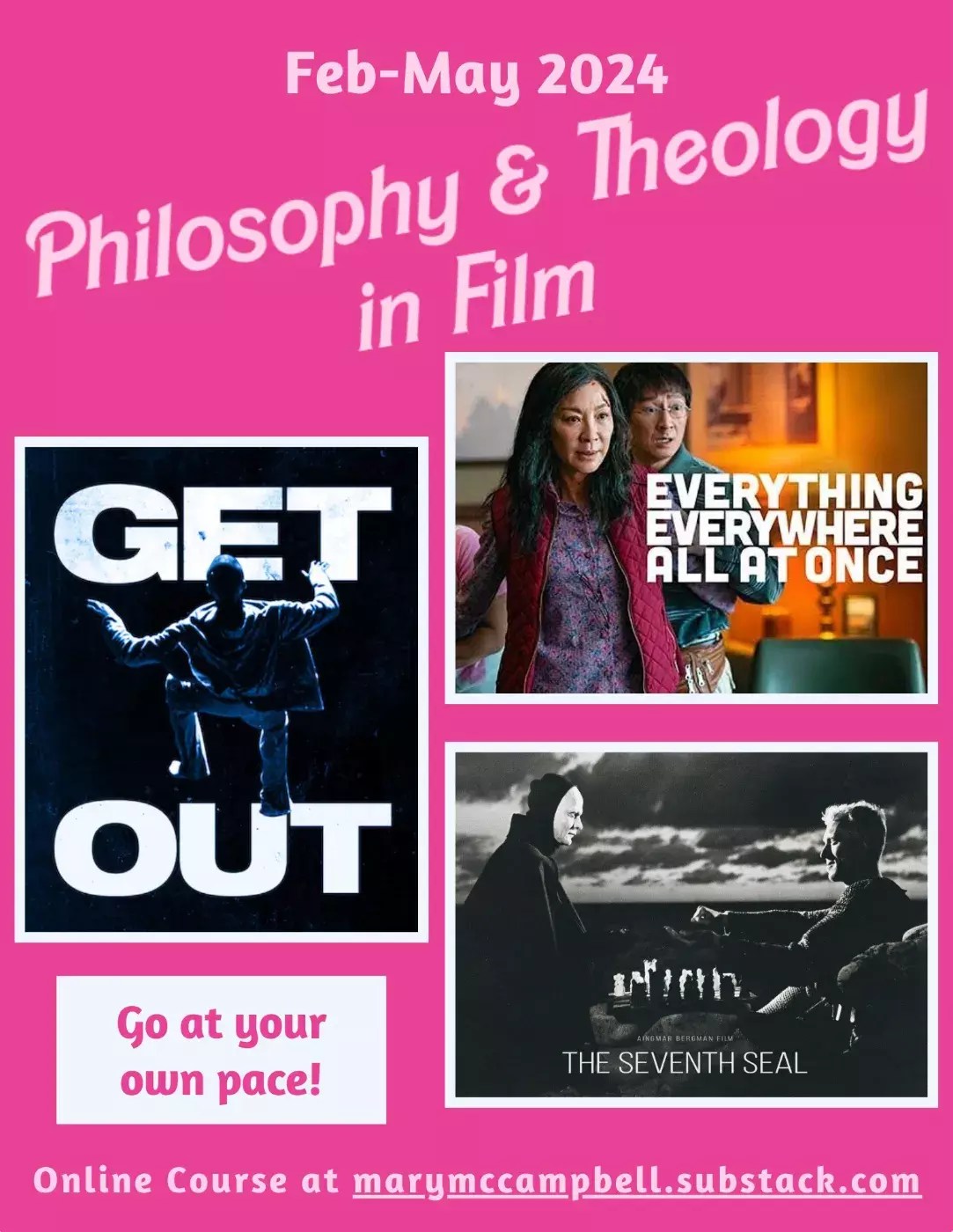
ONLINE COURSE: “Philosophy and Theology in Film” with Dr. Mary McCampbell, February–May 2024: Mary McCampbell [previously] is a writer and educator on film, literature, and popular culture whose Substack, The Empathetic Imagination, is one of my favorites! In December she and nine other professors lost their jobs at Lee University because the university’s humanities major has been suspended due to financial difficulties—and this despite her being tenured and having taught there for fourteen years.

So, she won’t be in a traditional classroom this spring, but the course she had prepared to teach undergraduates she is adapting for online and opening up to the public! It costs just $20 (a four-month paid subscription to The Empathetic Imagination), which is a real steal. Beginning near the end of February and running through May, the course will include:

  • An introductory video for each of ten films, including a lesson on the main philosophical influences and parallels (including intro lectures on Marx, Nietzsche, Freud, Sartre, Descartes, and more)
  • A live Zoom discussion of each film
  • A written Substack post of McCampbell’s analysis of each film, hopefully followed by a lively discussion in the comments section

I’ll be participating!

+++

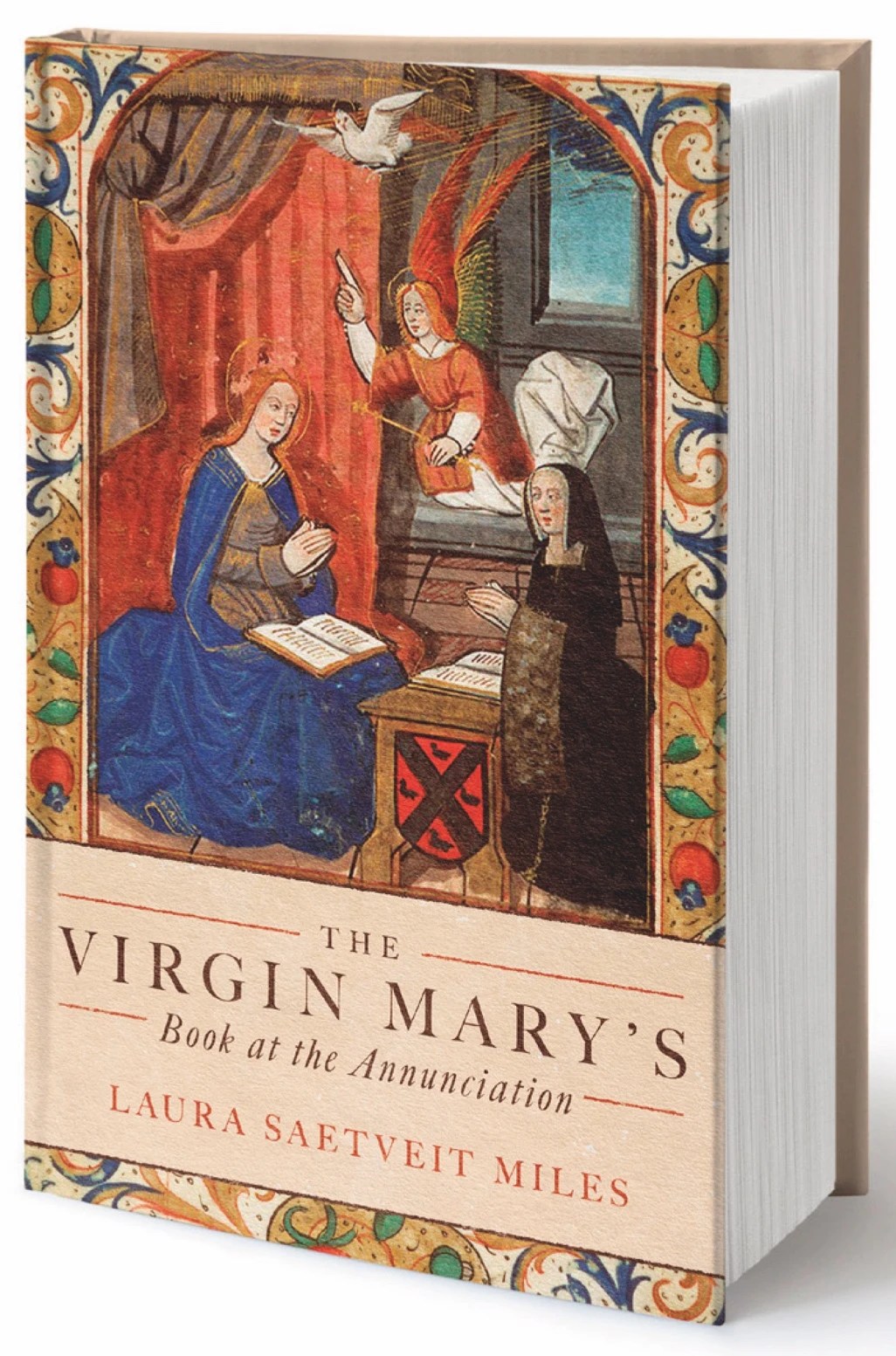
UPCOMING (ONLINE) LECTURE: “Reading alongside the Virgin Mary in Late Medieval Books of Hours Annunciation Scenes” by Laura Saetveit Miles, February 1, 2024: Professor Laura Saetveit Miles’s book The Virgin Mary’s Book at the Annunciation (Boydell & Brewer, 2020) has been one of my favorite reads of the last several years—so I was delighted to see she’ll be giving a free online talk on the topic next week! Organized by the Centre for Marian Studies at St Mary’s University in Twickenham, Miles’s lecture “will focus on two rare and fascinating versions of the standard Annunciation scene, as they are developed in both devotional literature and illuminations in Books of Hours. One type of representation captures the moment before Gabriel arrives; the other type depicts the reader herself as part of the scene. Some versions even combine these two. Where do these variations come from, and what do they mean? This neglected story of imitatio Mariae sheds new light on what Mary’s role in the Incarnation meant for medieval Christians across Europe.” (Update, 2/2: Here’s the recording.)

Roundup: Upcoming conferences, “Rupture as Invitation,” and more

UPCOMING CONFERENCES:

>> Calvin Symposium on Worship, February 7–9, 2024, Calvin University, Grand Rapids, MI: I’ve promoted this event in years past—see, e.g., here and here—and am excited to be attending again this year! I’ll be coleading a breakout session with Joel Littlepage and Ashley Williams about our work at the Daily Prayer Project, curating textual, visual, and musical resources from across time and place to encourage a life of prayer that reflects the church’s beautiful diversity. There are plenty of other sessions being offered as well; a few that stand out to me are “Blues: The Art of Lament” with Ruth Naomi Floyd (she’s also leading a Jazz Vespers service), “Music, Architecture, and the Arts: Early Christian Worship Practices” with Vince Bantu [previously], and “The First Nations Version New Testament and Its Impact on Worship” with Terry Wildman. This is in addition to what is probably my favorite part: the multiple worship services, led by liturgists, preachers, and musicians from different denominations and cultural backgrounds. I love my local church community, but I also love worshipping with folks from outside it—a reminder that the church is far broader than what I’m used to on a weekly basis.

>> “Poetry and Theology: 1800–Present,” February 22–24, 2024, Duke University, Durham, NC: Supported in part by Duke Initiatives in Theology and the Arts, next month Duke is hosting a poetry symposium that’s free and open to the public! The speakers are Lisa Russ Spaar, Judith Wolfe, Toby Martinez de las Rivas, Thomas Pfau, Kevin Hart, Anne M. Carpenter, Ian Cooper, Anthony Domestico, Luke Fischer, Dante Micheaux, Łukasz Tischner, and Bernadette Waterman Ward. Papers are on the poetry of Hopkins, Eliot, Rilke, Miłosz, and more.

>> “Return to Narnia: Creativity, Collaboration, and Community” (Square Halo Books), March 8–9, 2024, Lancaster, PA: Organized by book publisher, author, illustrator, printmaker, and gallerist Ned Bustard, this year’s Square Halo conference will feature author Matthew Dickerson as its keynote speaker and Sarah Sparks as its musical guest, along with various breakout session leaders, such as Brian Brown of the Anselm Society and Stephen Roach of the Makers & Mystics podcast. Tickets are $210 if purchased in advance or $220 at the door.

>> The Breath and the Clay, March 22–24, 2024, Awake Church, Winston-Salem, NC: Organized by Stephen Roach and friends, this annual creative arts gathering aims to foster community and connection around the pursuit of truth, beauty, and goodness, providing opportunities for immersive encounters and kindling for the imagination. There will be main-room sessions, workshops, a juried art exhibition (entry deadline: February 16), a poetry slam and songwriters’ round, a panel discussion on reconciling artists and the church, concerts, a dance performance, a short film screening, and more. Musical artists include Victory Boyd, John Mark McMillan, Young Oceans, and Lowland Hum, and among the keynote speakers are Rachel Marie Kang, Mary McCampbell, Junius Johnson, Vesper Stamper, and Justin McRoberts. I appreciate the bringing together of various artistic disciplines and the emphasis on practice. For tickets, there are both virtual ($99) and in-person ($299) options.

+++

NEW SONG: “MLK Blessing” by the Porter’s Gate: Written by Paul Zach and IAMSON (Orlando Palmer) and just released for Martin Luther King Jr. Day, this song is based on a benediction that MLK prayed, a variant of the ancient Jewish benediction known as the Birkat Kohahim or Aaronic blessing (Num. 6:24–26). It’s sung by Liz Vice and Paul Zach.

+++

PAST LECTURE: “Rupture as Invitation: Generosity and Contemporary Art” by Elissa Yukiko Weichbrodt: I’ve mentioned Elissa several times on the blog—I find her work so illuminating—and was grateful to have her in town last fall to deliver a lecture for the Eliot Society. “Contemporary art can often be unexpected or downright unsettling in its form and subject matter. But what if we reframed our discomfort as an invitation to enter rather than an unbridgeable divide? In this lecture from November 11, 2023, Dr. Elissa Yukiko Weichbrodt demonstrates how approaching contemporary art with humility, love, and courage can be a powerful means of growing in love for our neighbors.”

+++

UPCOMING EVENT: “Why Should Christians Care About Abstract Art?” with Elissa Yukiko Weichbrodt and Jonathan Anderson, February 22, 2024, Gordon-Conwell Theological Seminary–Charlotte, NC: Hosted by the Leighton Ford Initiative for Art, Theology, and Gospel Witness, this evening will consist of an opening of the exhibition Alfred Manessier: Composer in Colors (on display through April 30) and dessert reception, lectures by Elissa Yukiko Weichbrodt and Jonathan Anderson, and a Q&A. “For some people of faith, abstract art is difficult to engage because the meaning remains unclear, and the form can appear chaotic or uncompelling. For others, abstract art is an invitation to engage the whole person, contemplate spiritual realities, and encounter God in transformative ways. If abstract art can facilitate the latter, then Christians have a unique opportunity to learn and care about abstract art for theological, practical, missional, and relational reasons. This event is a unique opportunity to experience abstract art, learn about abstract art, and have formative interaction with one another on this topic.” The cost is just $10, and there is an online option.

Manessier, Alfred_Mount Calvary
Alfred Manessier (French, 1911–1993), La montée au Calvaire (Mount Calvary), from the Suite de Pâques (Easter Series), 1978. Chromolithograph on Arches paper, 22 × 29 9/10 in. (56 × 76 cm). Edition of 99.

+++

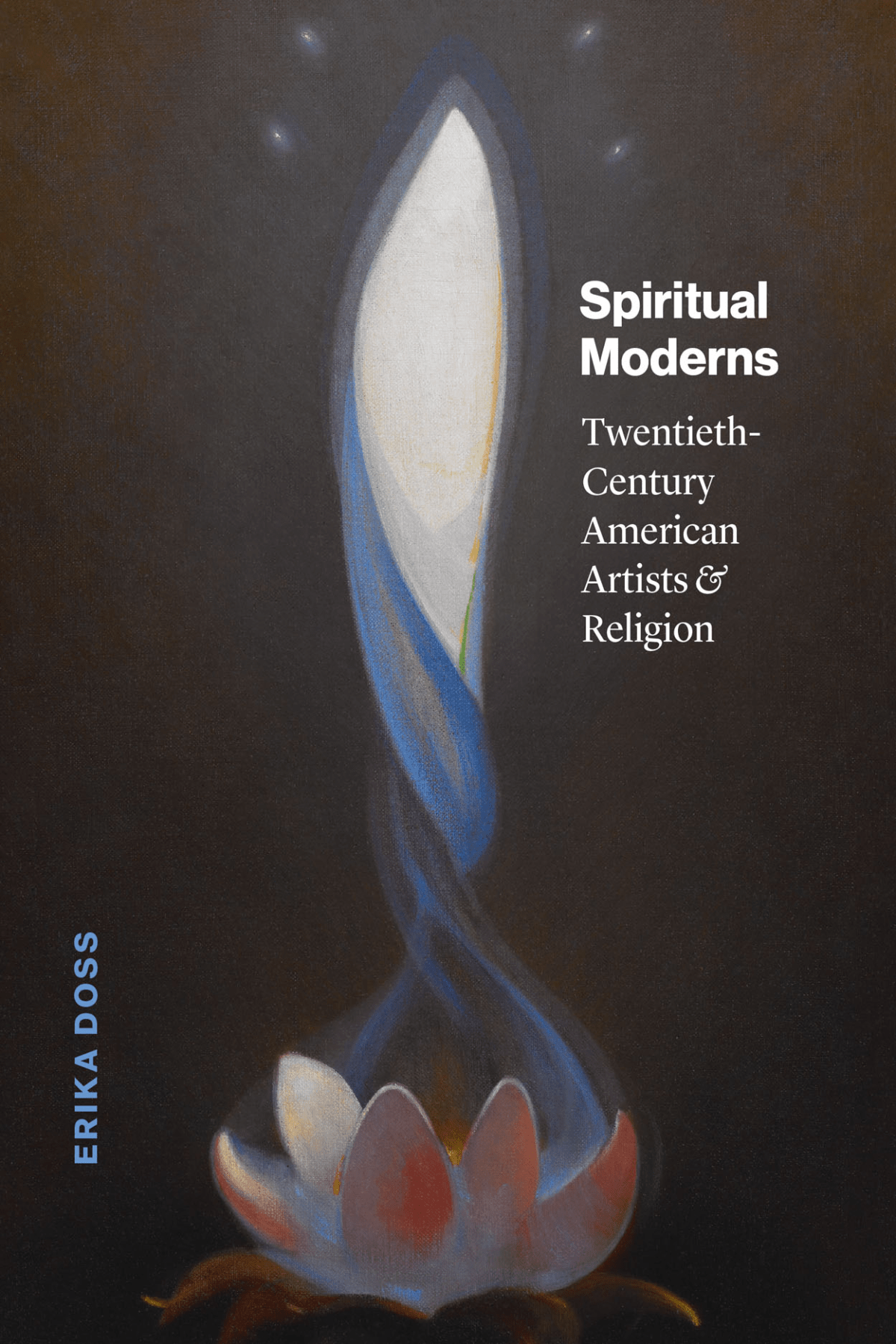
BOOK REVIEW: “Religion’s Understated Influence on Modern Art” by Daniel Larkin, on Spiritual Moderns: Twentieth-Century American Artists and Religion by Erika Doss: Challenging the presumed secularity of modern art, the new book Spiritual Moderns centers on four iconic American artists who were both modern and religious: Andy Warhol, Mark Tobey, Agnes Pelton, and Joseph Cornell.

+ ROUNDTABLE DISCUSSION: Also responding to this publication: the Association of Scholars of Christianity in the History of Art (ASCHA) will be presenting a session at the College Art Association Annual Conference in Chicago on February 16 at 2:30 p.m. that will put four prominent scholars—Stephen S. Bush, Matthew J. Milliner, Robert Weinberg, and Gilbert Vicario—in dialogue with Doss to “explore the assumptions, motivations, and insights of [her] analysis, and consider a more open, inclusive, and diverse reading of American Modernism.”

Roundup: Unique Nativity from Burgundy, Jamaican choral work for Epiphany, Vatican-sponsored art contest, and more

I’ve just published a new Spotify playlist for January (thirty spiritual songs on no particular theme), and I want to also remind you of my Epiphany Playlist.

+++

ANNOUNCEMENT: Vatican to hold Stations of the Cross art contest: Artists from across the globe are encouraged to participate in the Vatican-sponsored contest for fourteen new Stations of the Cross paintings. The winner will be announced September 30, 2024, awarded €120,000 (about $131,000), given a year to complete the commission, and then have their set of paintings exhibited in St. Peter’s Basilica during Lent 2026. The first step is to fill out an online application, which will become available January 8, with a deadline of January 31. Learn more at the link. (Update: The registration link is now live at https://contest.viacrucis2026.va/en/registration.)

+++

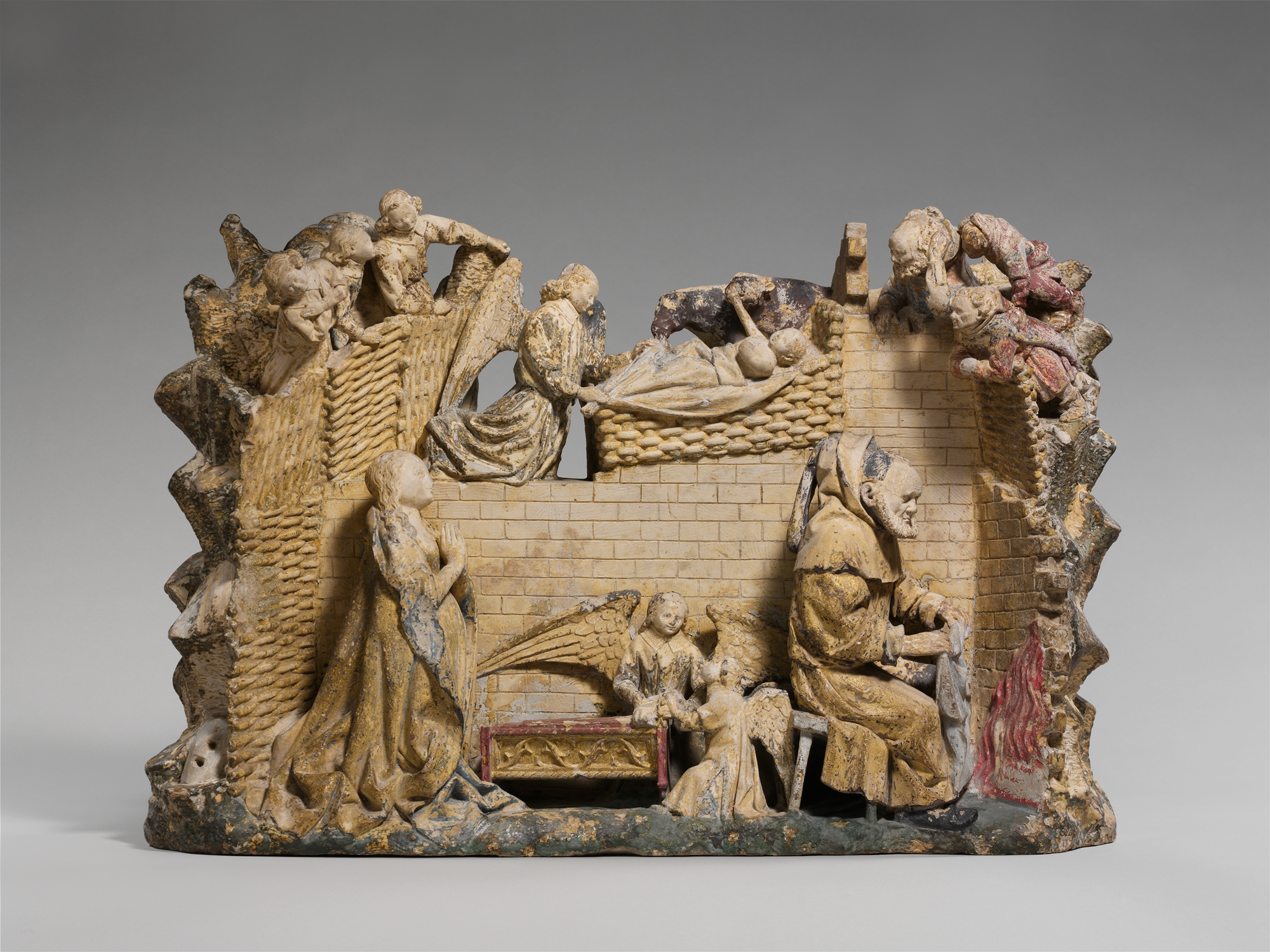
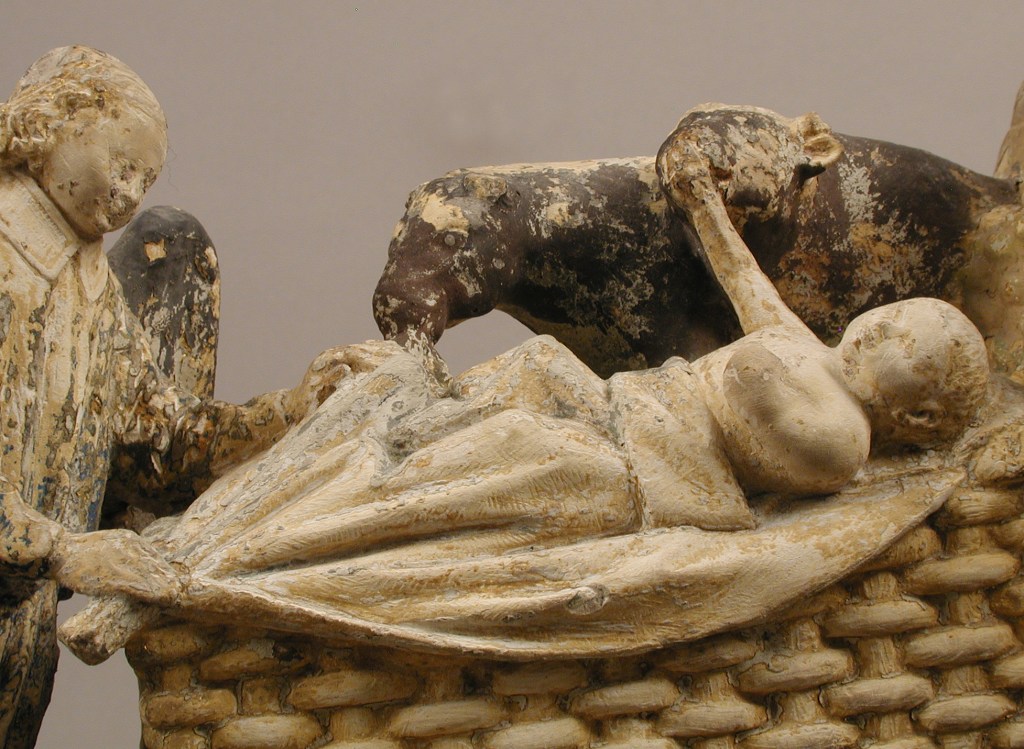
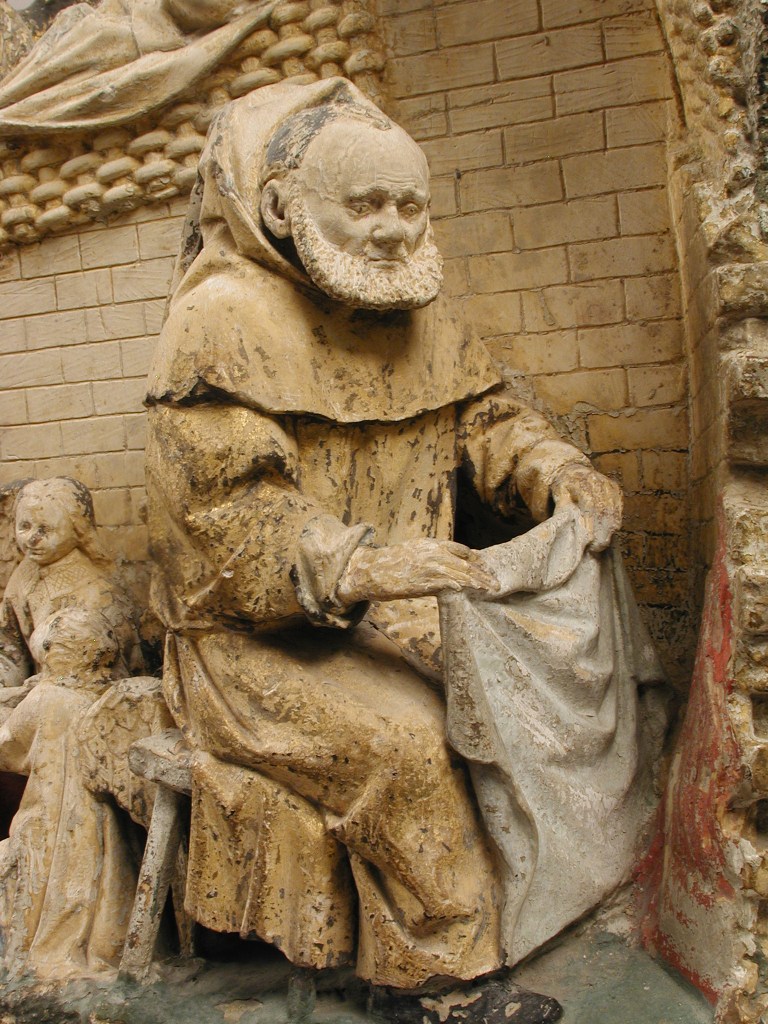
ART OBJECT: Burgundian Crèche, ca. 1450: In researching depictions of Joseph at the Nativity, I came across this charming little limestone-carved crèche from fifteenth-century Burgundy, France, acquired by the Metropolitan Museum of Art. Set inside a dilapidated brick interior patched with wattled matting, the scene portrays the infant Christ lying in a wattled manger that rests on a crumbling wall ledge. Such an unusual composition! I’m not sure why the infant is placed so precariously and at a height when there’s a carved cradle available on the ground, where angels kindly fluff his pillow, but I suppose it was to avoid overcrowding and for visual balance.

Burgundian creche
Circle of Antoine Le Moiturier (French, 1425–1495), Nativity, Burgundy, France, ca. 1450. Limestone with later paint and gilding, 17 3/4 × 25 7/8 × 7 1/4 in. (45.1 × 65.7 × 18.4 cm). Metropolitan Museum of Art, New York.

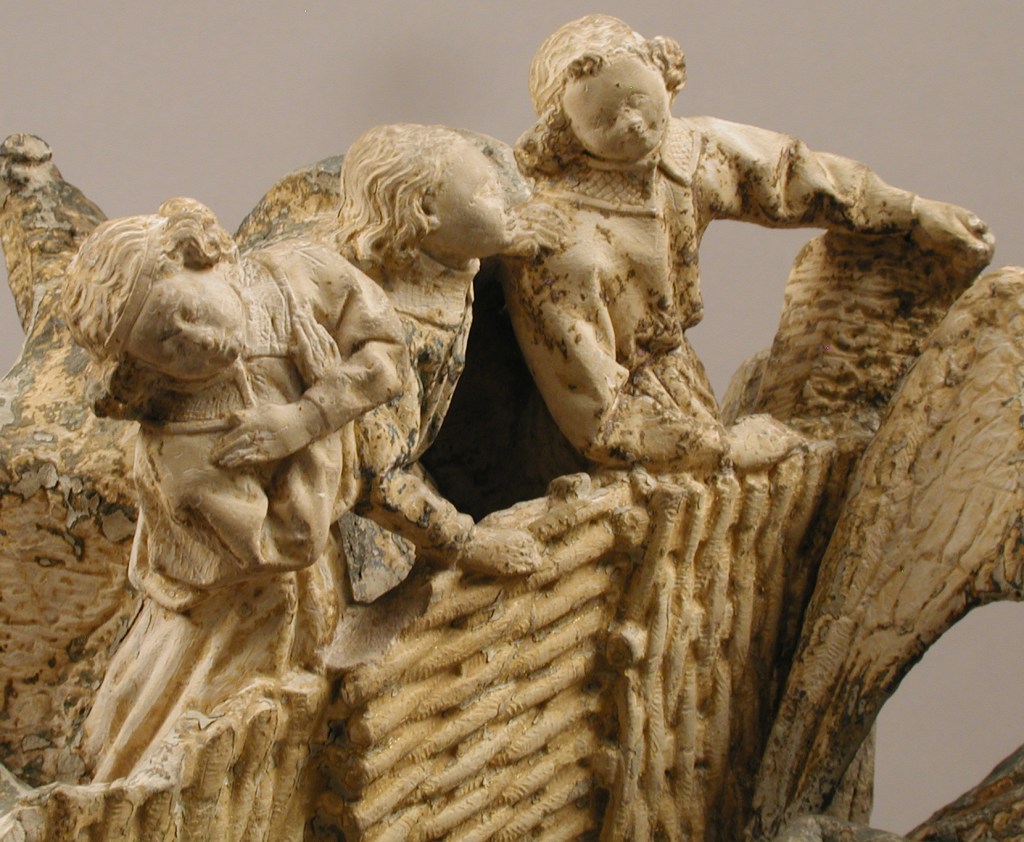
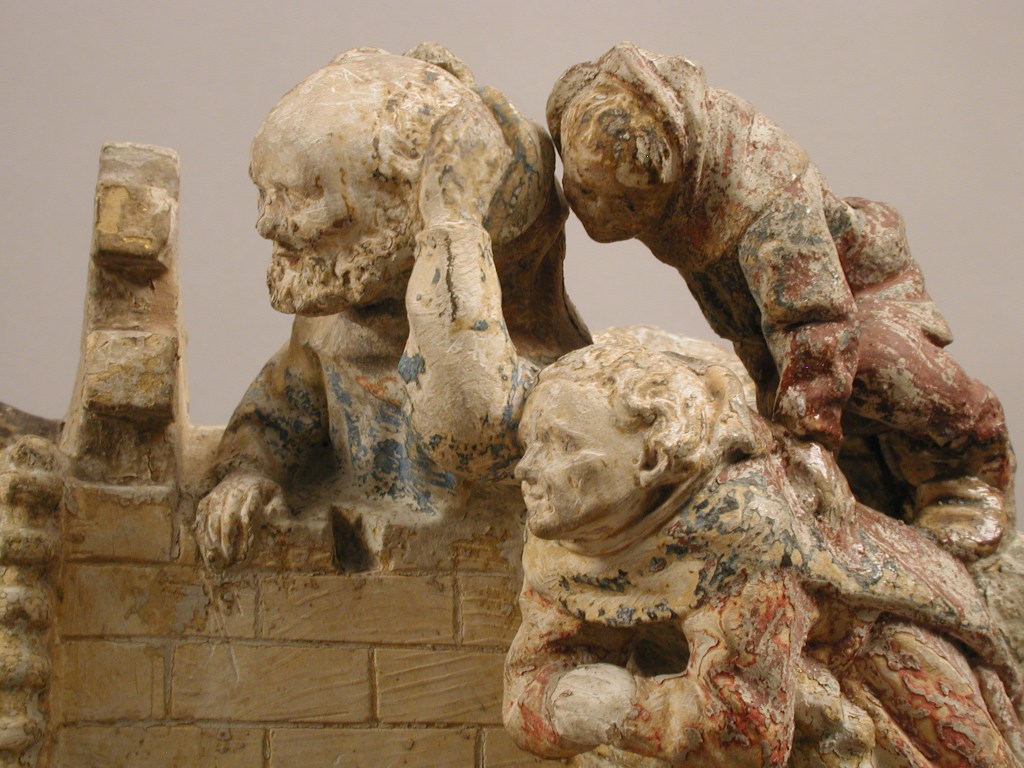
A donkey licks Christ’s feet while an ox licks his hand, which he appears to delight in, as he lifts his arm for better access. To the left and right of him are a trio of angels and shepherds, respectively, excitedly leaning in from outside to get a better look. Mary gazes up at her son in adoration while Joseph dutifully tends to a parental chore: drying one of Jesus’s freshly washed linens at the fire. (Dad doing laundry—huzzah!)

To learn more about this sculpture, see the journal article “Popular Imagery in a Fifteenth-Century Burgundian Crèche” by William H. Forsyth.

+++

ART COMMENTARY: On The Adoration of the Magi by Domenico Veneziano: From the Visual Commentary on Scripture comes this 2022 video, one in a series filmed on-site at the Gemäldegalerie in Berlin. Theologian Ben Quash and art historian Jennifer Sliwka discuss an early Italian Renaissance tondo depicting the Adoration of the Magi.

+++

SONGS:

>> “Rejoice with Exceeding Great Joy”: Written by Lanny Wolfe in 1978 and performed by Reggie Smith, Charlotte Ritchie, and Ladye Love Smith at Bill and Gloria Gaither’s Homecoming Christmas 2006:

>> “Star of Bethlehem”: Written by Noel Dexter, arranged by C. S. (Cedron) Walters, and performed by the Jamaica Youth Chorale at their 2019 Christmas concert. Noel Dexter (1938–2019) was a Jamaican composer, choir director, and music educator, and this is probably his best-known work. It’s set to a Nyabinghi rhythm.

When the star of Bethlehem arise, hallelujah
When the star of Bethlehem arise
Come show me where the young child born!

There were wise men coming from the east, hallelujah
There were wise men coming from the east
Come show me where the young child born!

They brought gold, frankincense, and myrrh . . .

Not a man can save my soul . . .
But Jesus!
Show me where the young child born!

+++

VIDEO: “#NatZooZen: Giant Pandas Mei Xiang and Tian Tian in the Snow”: This Smithsonian’s National Zoo cam footage from January 2021 shows two giant pandas at play, sliding down a snowy hill! So adorable. Tian Tian and Mei Xiang arrived at the National Zoo in 2000 and in 2020 produced a cub, Xiao Qi Ji. All three pandas returned to Beijing in November, having been lent to the US by China as part of a cooperative research program whose contract has expired.

Roundup: Nativity art from Asia, the Christ Hymn in Thai, and more

ARTICLES:

>> “How Asian Artists Picture Jesus’ Birth from 1240 to Today” by Victoria Emily Jones, December 18, 2023, Christianity Today: My first CT article was published this week! I was asked to curate and introduce a sampling of Nativity art from across Asia. By representing Jesus as Japanese, Indonesian, or what have you, these artists convey a sense of God’s immanence, his “with-us–ness,” for their own communities—and for everyone else, the universality of Christ’s birth.

Turun, I Wayan_In Bethlehem
I Wayan Turun (Indonesian, 1935–1986), In Bethlehem, 1958. Acrylic on canvas, 46 × 64 cm. Collection of Stichting Zendingserfgoed (Missionary Heritage Foundation), Zuidland, Netherlands.

>> “The Story of Christ in Chinese Art: Scholars at Peking University Make a Christmas Portfolio for LIFE,” Life, December 22, 1941, pp. 40–49: In doing research for my Christianity Today article, I found this old article from Life magazine that features eight Chinese watercolors on silk from the collection of Dr. William Bacon Pettus (1880–1959), an American educator and president of the California College of Chinese Studies in Peking (Beijing) in the 1920s and ’30s, which were being exhibited at New York’s American Bible Society at the time. With the ordination of six Chinese bishops by Pope Pius XI in 1926, the Chinese Catholic Church was transitioning from a mission church to an indigenous local church, and Chinese-style religious art—much of it coming out of the art department of the new Catholic University of Peking (Beiping Furen Daxue)—was part of that localization. Productivity seems to have continued at Furen during the Japanese occupation, as this article attests. Many of the students and faculty were recent converts to Christianity, though the article reports that non-Christians also enrolled and taught in the art program.

Lu Hongnian_Nativity
Lu Hongnian (Lu Hung-nien) ( 陸鴻年) (Chinese, 1914–1989), The Birth of Jesus, ca. 1941. Chinese watercolor on silk.

Here is one of the paintings by Lu Hongnian, who sometime after this article was published, in part through his having engaged the New Testament as inspiration for his paintings, became a Christian and took the name John. It shows the Holy Family in a mountainside cave, Mary gazing adoringly at her newborn son as Joseph brings more straw to cushion him. Beside them, an angel holds up a lantern for light, while two shepherd children approach from the entrance, eager to meet their Savior.

+++

SONGS:

>> “Philippians 2:511” by HARK Music: This song takes a traditional Thai melody, arranged by Tirasip Kraitirangul, and puts it to a Thai translation of the famous Christ Hymn from Philippians 2. It’s performed by the HARK Duriya Tasana Singers (feat. Somchairak Sriket and Damrongsak Monprasit) and Dancers, filmed on location at Chaloem Kanchanaphisek Park in Bangkok. The song is from HARK’s Thai Hymns Album (2014), which can be downloaded for free at https://harkpublications.com/?product=thai-hymns-album-2. The two-stringed bowed instrument you see at 3:21 is a saw u.

The Duriya Tasana (“Curators of the Arts”) ensemble was formed in 2012 under the commission of the Thai-Psalms Project, an endeavor to create Thai traditional and classical music settings for the psalms of the Bible. Many of the members are affiliated with the Bunditpatanasilpa Institute of Fine Arts in Bangkok. Thanks to my friend Janet, whose sister is preparing a move to Thailand, for alerting me to this group!

>> “Jesus You Come” by Tenielle Neda, performed with Jon Guerra: This song by the Australian singer-songwriter Tenielle Neda [previously], which she sings with Jon Guerra, makes a nice complement to the Thai song above. The performance is from “Songs for Hope: A TGC Advent Concert” on December 6, 2020.

+++

MIDDLE ENGLISH LULLABY: “As I lay upon a night”: Medievalist Eleanor Parker introduces a charming Christmas lullaby from fourteenth-century England, a dialogue between Mary and the Christ child, and provides a modern English translation of its thirty-seven stanzas. In the Middle Ages, says Rosemary Woolf, the subject matter of lullabies was often a prophecy of the baby’s future—presumably a romantic promise of great and happy achievements. But here it is the child who relates the future to his mother, thus providing the material for his own lullaby.

+++

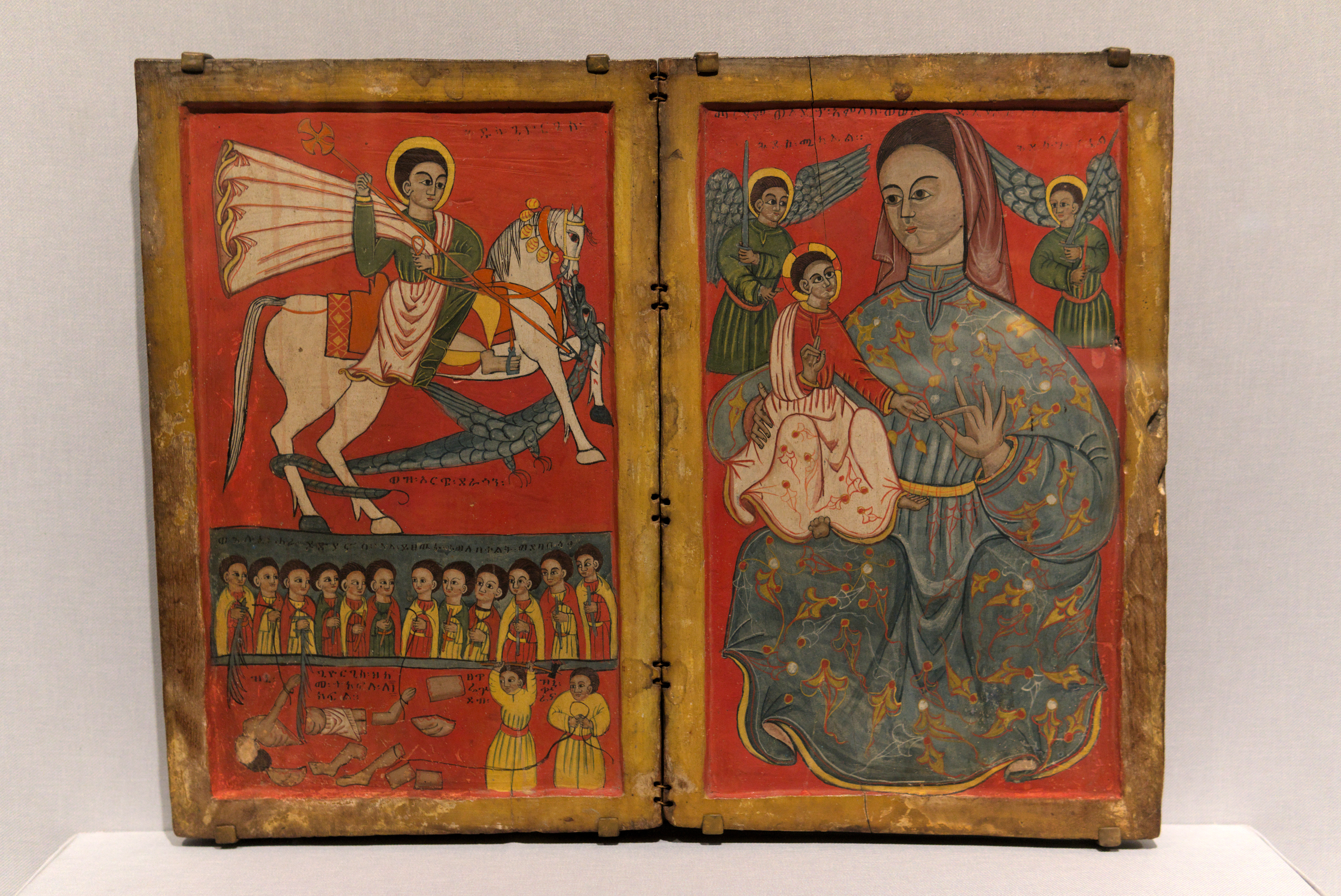
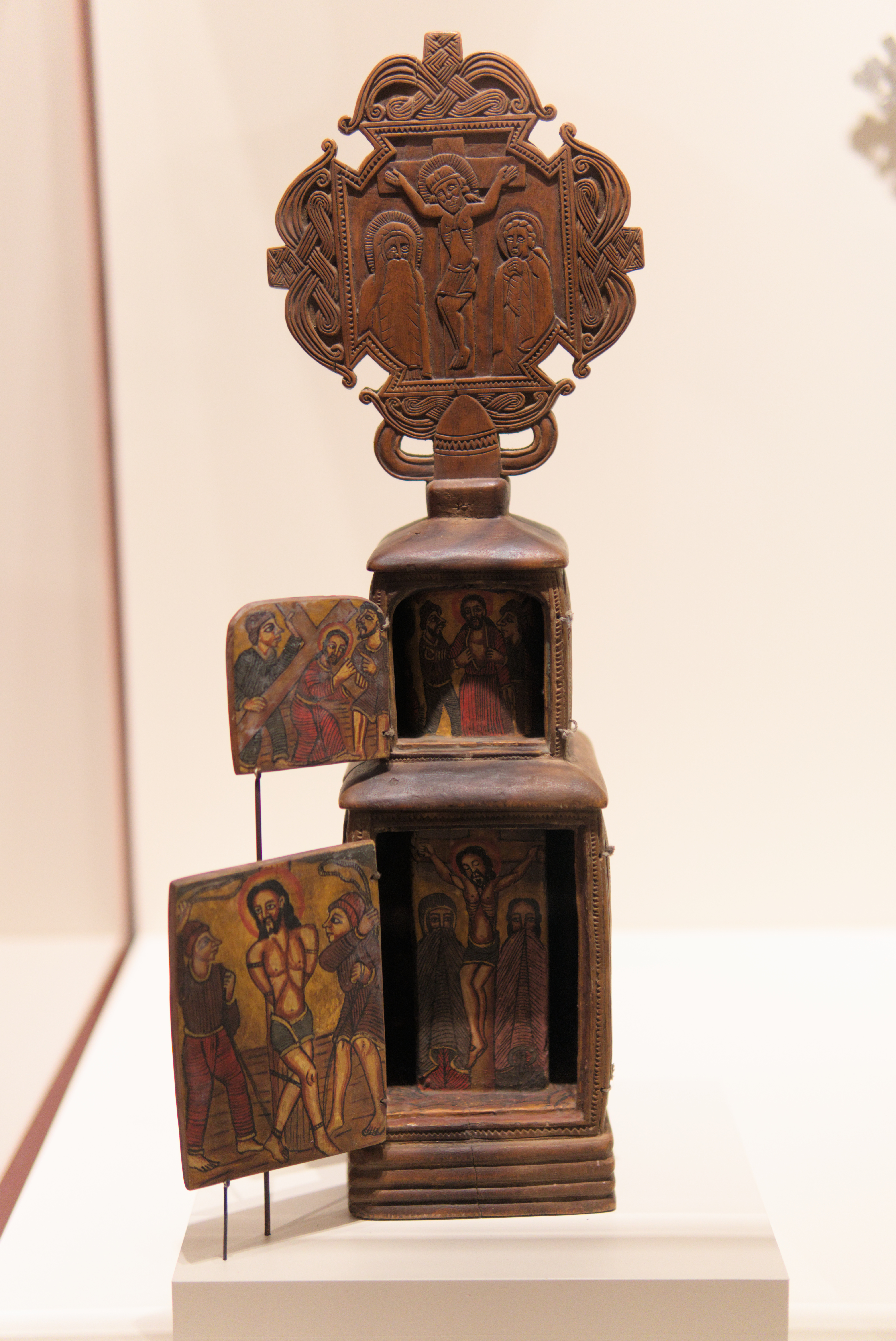
ART VIDEO: “Third Sunday of Advent: Ethiopian Art: Gospel Book” by James Romaine: Every December, my friend James Romaine, an art historian who teaches at Lander University, publishes four videos on his Seeing Art History YouTube channel related to the themes of the season, part of his annual Art for Advent series. This year he’s chosen to focus on Ethiopian art, covering illuminations from two different manuscripts, a diptych icon, and a rock-hewn church.

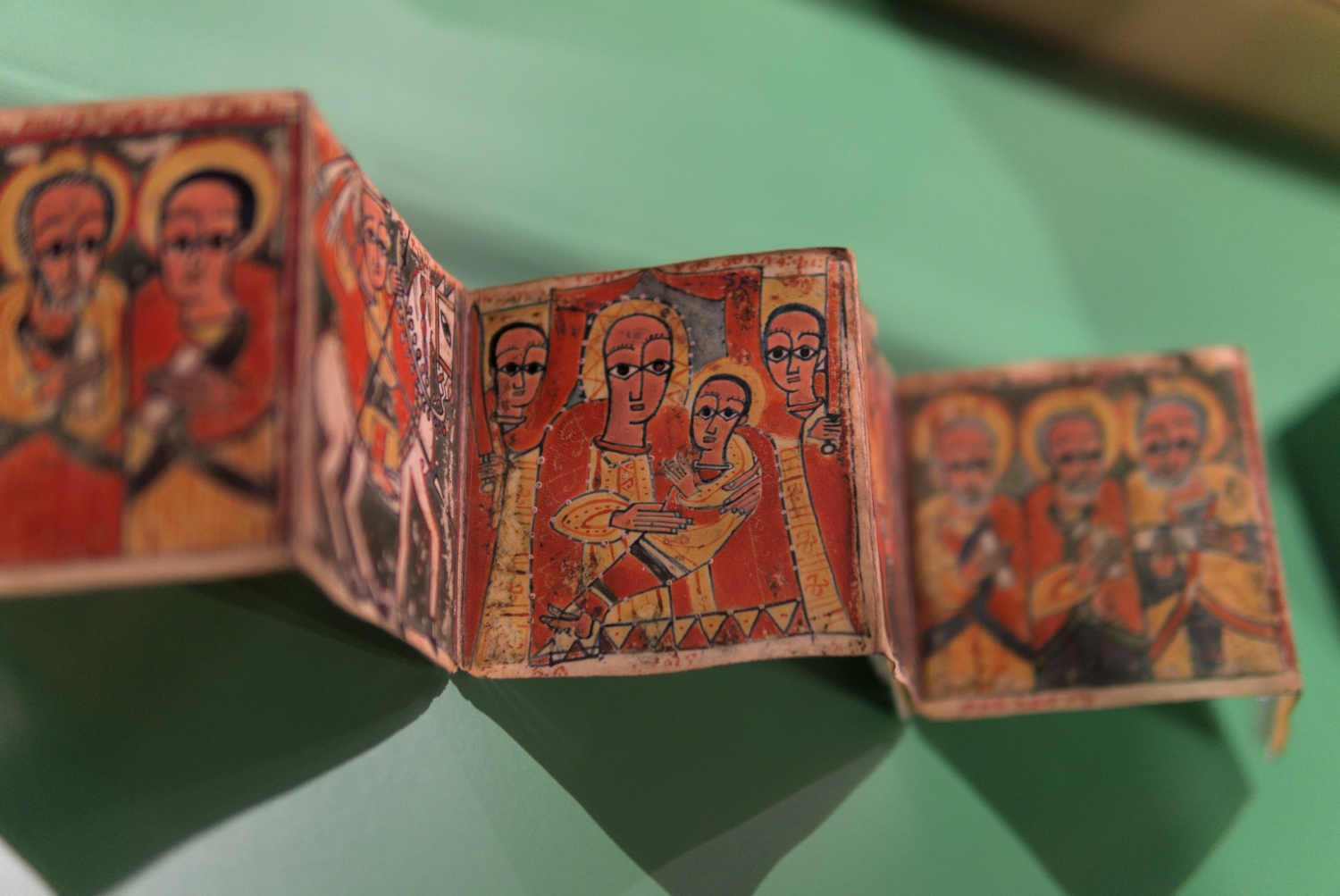
In this video Romaine discusses the formal qualities of two paintings from a sixteenth-century Ethiopian Gospel-book, the identity of the figures, and the liturgical context of the book, including the use of the red veil that’s attached at the top, which, Romaine says, “both protects and sanctifies the icon,” creating a sense of anticipation for the Orthodox believer who, in faith, lifts the veil to see what is revealed.

Roundup: Pregnancy prints, “Hearth” by Janine Antoni, and more

ARTICLES:

>> “Picturing Pregnancy in Early Modern Europe” by Rebecca Whiteley, Public Domain Review: Adapted from the book Birth Figures: Early Modern Prints and the Pregnant Body by Dr. Rebecca Whiteley (University of Chicago Press, 2023), this article explores how the womb and fetuses were depicted in medical book illustrations in Europe during the sixteenth and seventeenth centuries. Pregnancy is such a potent image for Advent, as we await the birth of Jesus—who, fully God and fully human, dwelled for nine months in his mother Mary’s uterus before emerging from her birth canal!

Child in uterus
Woodcut illustration of a baby in the womb from De conceptu et generatione hominis (Zurich, 1554), the first Latin edition of a midwifery handbook by Jacob Rueff

Woodcut illustration of an open uterus from La commare o raccoglitrice . . . (Verona, 1642), a manual about pregnancy and childbirth by Girolamo Mercurio

>> “Rupy C. Tut’s Landscapes of Belonging” by Bridget Quinn, Hyperallergic: Bridget Quinn reviews Rupy C. Tut’s solo exhibition Out of Place that’s running at the Institute of Contemporary Art San Francisco through January 7. I love, love, love her art! It’s inspired by traditional Indian miniature painting and “is an effort to belong, to feel in place,” Tut says. Tut is a first-generation immigrant from India’s Punjab region who settled in California with her Sikh family at age twelve. Her Searching for Ancestors reminds me, visually but not thematically, of Jyoti Sahi’s Incarnation within the Anthill, and her Portrait of a Woman gives me some serious Marian vibes—as it did too the reviewer, who refers to this pregnant woman as “a kind of cross-cultural Madonna, reminiscent of the central mother figure, mandorla, and sun rays of Our Lady of Guadalupe so familiar across California via Mexico.”

Tut, Rupy C._Portrait of a Woman
Rupy C. Tut (Indian American, 1985–), Portrait of a Woman, 2023. Handmade pigments and shell gold on hemp paper, 57 × 37 in.

+++

INSTAGRAM POST: “Birthing // Love” by Elissa Yukiko Weichbrodt: Last Advent, art historian and educator Elissa Yukiko Weichbrodt (@elissabrodt) reflected on Janine Antoni’s Hearth ceramics, part of the artist’s Pelvic Vessels series, and on the biological reality that during the act of childbirth, both the mother’s and baby’s bodies are changed by one another. What might this mean for Advent?

Antoni, Janine_Hearth
Janine Antoni (Bahamian American, 1964–), Hearth, 2014. Set of three pit-fired ceramic vessels, 4 3/4 × 6 1/2 in., 4 3/4 × 7 7/8 in., 5 1/8 × 8 in.

+++

DEVOTIONAL COLUMN: “Jesus’ Bloody Birth” by Lauren F. Winner, Christian Century: “Jesus . . . is bloody in many senses,” writes Rev. Dr. Lauren Winner [previously]. One of those senses is that he came into this world covered in his mother’s blood. Something is lost in the Christmas story when we evade the details of childbirth, Winner says. I was alerted to this short reflection of hers from 2015 by its inclusion in the new book A Radiant Birth: Advent Readings for a Bright Season.

+++

PODCAST EPISODE: “The Incarnation and Health Care as Ministry” with Denise Hess, Hear Me Now Podcast, December 24, 2020: “There is a long tradition of faith-based healthcare. On this Christmas episode—filled with music, poetry, and conversation—we ask: How has the belief that God became human in the flesh inspire care for people and their bodies? Rev. Denise Hess [MDiv, BCC-PCHAC] of the Supportive Care Coalition (now part of the Catholic Health Association) joins host Seán Collins in a reflection on the Christian doctrine of the Incarnation and the ways it has inspired centuries of healthcare. They talk about the example of Jesus-as-healer, the crucial role women have served in promoting healthcare ministries, and the place suffering plays in our understanding of caring for the whole person.”

The conversation is interspersed with poetry readings and performances of carols by a violin-guitar-bass trio. Hess mentions this wonderfully shocking sentence from Chris Abani’s poem “The New Religion”: “what was Christ if not God’s desire / to smell his own armpit?” She also shares Brian Wren’s beautiful hymn text “Good Is the Flesh.” The podcast is a production of the Providence Institute for Human Caring.

Roundup: Baby Jesus in the rubble of Gaza, a dragon at the Nativity, and more

CHRISTMAS CRÈCHE: After my Advent Day 2 post, a reader shared with me a photo of this jarring crèche from Bethlehem:

Rubble Creche, Bethlehem
Crèche, December 2023, Evangelical Lutheran Christmas Church, Bethlehem. Photo: Munther Isaac.

It shows the baby Jesus wrapped in a black-and-white checkered keffiyeh (Palestinian headdress) and lying in a pile of rubble while Mary, Joseph, the shepherds, the wise men, and the animals search for him. It is situated at the side of the altar in Bethlehem’s Evangelical Lutheran Christmas Church, which Rev. Dr. Munther Isaac, a prominent Palestinian Christian peacemaker, pastors. He said he wants the world to know that this is what Christmas looks like in Palestine this year, and for his own congregation to know the solidarity of Christ with the oppressed. Al Jazeera ran a news segment on the crèche on Tuesday, which features an interview with Isaac:

Since October 7, over 16,000 Palestinians have been killed by Israeli forces, and almost 1.9 million Palestinians (over 80 percent of the population) have been displaced. Morgues and hospital halls are overflowing in Gaza, and many people remain trapped under buildings felled by air strikes.

“In Gaza today, God is under the rubble. He is in the operating room,” Isaac wrote on Instagram. “If Christ were to be born today, he would be born under the rubble. We see his image in every child killed and pulled from under the rubble. In every child in incubators.” He expanded on these sentiments in a sermon preached October 22, titled “God Is Under the Rubble in Gaza,” reproduced in Sojourners. See also this video clip of Isaac explaining why his church chose to display such a scene in their sanctuary.

Besides serving as a pastor, Isaac is also the academic dean at Bethlehem Bible College, director of the Christ at the Checkpoint conferences, and author of The Other Side of the Wall: A Palestinian Christian Narrative of Lament and Hope.

+++

“Alternative Advent 2023” by Kezia M’Clelland: I wrote about M’Clelland’s “Alternative Advent” last year and in previous years, an annual online project that thoughtfully brings together global photojournalism from the year with scripture. Following along with her daily Instagram posts @alternative_advent (which she will later compile at https://keziahereandthere.org/) has become an integral part of my Advent practice. Here’s day one:

+++

SONG: “How Long, How Long?” by Jordan Hurst: Worship musicians Jordan Hurst, Jaleesa McCreary, and Brian Douglas Phillips [previously] from Providence Church in Austin, Texas, perform an original lament song from Providence’s 2020 album Long-Awaited / You Arrived.

+++

BLOG POST: “When a Dragon Tried to Eat Jesus: The Nativity Story We Don’t Talk About” by Chad Bird: “I’m still searching for a Christmas card with a red dragon in the nativity, lurking amidst the cows and lambs, waiting to devour the baby in the manger,” writes Bible scholar Chad Bird [previously]. “None of the Gospels mention this unwelcome visitor to Bethlehem, but the Apocalypse does. John paints a seven-headed, ten-horned red dragon onto the peaceful Christmas canvas. You can read all about it in Revelation 12. It’s the nativity story we don’t talk about. A dragon trying to eat our Lord . . .”

I’ve been wanting to write a long-form essay on this topic for some time—the dragon as a character in the Christmas story; a cosmic battle underlying our cozy little crèches. I would pull in iconography of the Woman of the Apocalypse and the treading of the beasts, as well as some Christmas songs and poems that reference the dragon. I won’t get around to it this season . . . but it’s coming sometime!

For now, I simply offer Chad Bird’s wonderful blog post to get you thinking about it. Since it was published in 2016, I’ve started seeing more people bringing it up. In 2019, Glen Scrivener, a minister in the Church of England, released the kids’ video “There’s a Dragon in My Nativity,” with illustrations by Alex Webb-Peploe and animation by Diego M. Celestino:

In 2020, Rev. Yohanna Katanacho, a Bible professor in Nazareth, wrote “The Christmas Dragon” for Radix, a retelling of the Nativity story through the lens of Revelation 12. And in a Christianity Today article published last December, Julie Canlis recommended adding a red dragon to your nativity set! Apparently some families have been doing this for years, such as the Gowins and the Palpants:

Dragon at the Nativity
Left photo by Michael Gowin; right photo by Ben Palpant

This year I bought a little plastic dragon myself to add to my household nativity! Below are some photos my husband and I took. The clay figurines and adobe-style backdrop were made by Barbara Boyd, an artisan from New Mexico. (I bought them in 2016 at a festival in Albuquerque.)

The dragon was part of a cheap multipack from Amazon, and there are twenty-three other dragons that I don’t know what to do with—so if you live in the US and you want one, shoot me an email at victoria.emily.jones@gmail.com and your physical mailing address and I’ll send you one! The first three respondents get a red one. None of them are seven-headed or horned per Revelation (a gap in the Christmas market, perhaps?!), but they still convey the gist.

+++

LECTURE: “What Is God’s Future for the World?: An Eschatological Vision for the Kingdom on Earth” by N. T. Wright: This talk on inaugurated eschatology, on heaven and earth coming together redemptively and new-creatively, was delivered at the Fuller Forum at Fuller Theological Seminary on May 3, 2014. Any time we talk, sing, or preach about the return of Christ and the end, Wright says, we’re really using signposts that point into a bright mist. But we need those signposts. Wright seeks to dispel the popular belief that humans’ ultimate destination is some disembodied existence “up there” and instead have us embrace the ancient vision of this world as the site of the Messiah’s eternal reign and these bodies as participants, a vision of creation made new from the old. To believe that God will eventually abandon the world to the forces of human wickedness or entropy and decay instead of claiming it as his own undermines the entire narrative of scripture. Wright makes his case by way of the books of Genesis, Isaiah, Ezekiel, Daniel, the Psalms, the Gospels, Romans, and Revelation—the whole gamut.

“The Jewish vision of God’s ultimate future was never that people would leave this world and end up somewhere else called heaven in the company of God. . . . When eschatology comes into full focus, . . . it is all about God’s kingdom being set up on earth as in heaven, and indeed on earth by means of heaven.” He continues, “Heaven is the place where God’s future purposes are stored. And the New Jerusalem comes down from heaven to earth so that the dwelling of God is with humans.”

There’s so much more I could say—but instead of reading my takeaways, listen to the talk itself! It ends at 1:04:45 and is followed by an hour of Q&A. Here is a list of the questions with time stamps:

  • 1:05:33: What is your reading of 2 Peter 3:10–12, which says that the earth will be burned up?
  • 1:08:18: What does Paul mean in 1 Thessalonians 4:17: “Then we who are alive, who are left, will be caught up in the clouds together with them to meet the Lord in the air, and so we will be with the Lord forever”?
  • 1:13:05: Where do you land on premillennialism, amillennialism, postmillennialism?
  • 1:15:42: If earth is already crowded, how will everyone fit in the renewed creation after the resurrection?
  • 1:21:42: If this world is going to be renewed, why should we make economic and lifestyle sacrifices now to protect endangered species and such?  
  • 1:24:18: How do you interpret John 14:3: “I go and prepare a place for you; I will come again and take you to myself”?
  • 1:27:48: How do you understand hell? What are your thoughts on the teaching of universal restoration, the idea that everyone will eventually be saved?
  • 1:33:48: Since you take issue with Michelangelo’s Last Judgment, what would you have painted at the east end of the Sistine Chapel instead?
  • 1:34:17: How does Paul’s “now and not yet” correlate with Jesus’s teaching that “this generation will not have passed away before all this has happened” (Matt. 24:34; Mark 13:30; Luke 21:32)?
  • 1:36:59: What is the role of departed saints (the “cloud of witnesses”)? What are your thoughts on the intercession of the saints?
  • 1:41:17: What are your words of advice for preaching on these subjects and for pastorally caring for congregants who come with certain stock images of and language about heaven?
  • 1:44:30: Since we believe in Jesus’s bodily resurrection, where is Jesus now?
  • 1:46:28: Please give us some guidance on Paul’s view on homosexuality and how to address this complex issue in the church.
  • 1:52:16: Is there any sense in which the State of Israel founded in 1948 could be the fulfillment of biblical prophecy?
  • 1:56:40: What impact do you hope your work has on Christian discipleship?
  • 2:10:34: What’s the relationship between faith and action?

Oh, and at 1:18:58, Wright offers this rousing sidebar on Christian art:

We are starved imaginatively as Christians. Christian art easily collapses into sentimentalism, just as contemporary postmodern art easily collapses into brutalism. Both of those are ways of seeing something but not the whole picture. Sentimentalism is what you get when you’re determined to smile even if the whole world is falling apart; it becomes inane, this sort of silly grin, and sadly, there’s a lot of Christian art like that.

But actually, Christians ought to be at the forefront of the art and the music, because that creates the imaginative world within which it’s possible to think differently about things. I think the secular world has done a pretty good job, and we’ve colluded with that, of keeping our imaginative levels down to the level of eighteenth- and nineteenth-century Epicureanism or deism, so that heaven is just this odd place, etc., etc. We need the new art and the new music which will create a world in which it makes sense to think of these things.

+++

BLOG POST: “Advent Love and Anselm Kiefer’s Alchemist” by Alexandra Davison: I grew up, and my parents and sibling still live, in a suburb of Raleigh, North Carolina, so I’m a somewhat frequent visitor to the North Carolina Museum of Art. Their untitled triptych by Anselm Kiefer is one of my favorite pieces in their collection—it transfixes me every time—so I was delighted to see that Alexandra Davison [previously], a creative director of Artists in Christian Testimony International whom I bump into at arts conferences now and again, wrote about it a few years ago. She describes it as an image of “cosmic drama that waits for resolution,” conveying “an unflinching Advent longing.” I sense that too when I stand in front of it.

Kiefer, Anselm_Untitled (NCMA)
Anselm Kiefer (German, 1945–), Untitled, 1980–86. Oil, acrylic, emulsion, shellac, lead, charcoal, and straw on photograph, mounted on canvas, with stones, lead, and steel cable, overall 130 1/4 × 218 1/2 in. North Carolina Museum of Art, Raleigh. Photo: Victoria Emily Jones.

Kiefer is the subject of an acclaimed new documentary by Wim Wenders (which I’m eager to see when it comes to streaming!). He was born in Germany at the tail end of World War II, and his art, which often incorporates materials such as lead, ash, and straw, is inextricably connected to the ravaged landscapes and haunted history of his country.

Roundup: Epiphany Playlist, thread installation, and more

In the church calendar, the linked seasons of Advent, Christmas, and Epiphany are sometimes referred to as the “cycle of light.” “Since earliest times the Christian community has utilized light as a primary symbol to convey the meaning of the Christ-event,” writes Wendy M. Wright in The Vigil: Keeping Watch in the Season of Christ’s Coming. “The power of the symbol was not lost on most generations of believers who lived closer than we do to the truth that we are all ultimately dependent upon the light of the sun for warmth, vision, and life itself” (152). Light imagery permeates scripture and the writings of the church fathers.

The capstone of the cycle of light, celebrated each year on January 6, is Epiphany, which means “manifestation” or “appearance.” In the West, this feast commemorates the visit of the magi, to whom the divinity of Christ was revealed, and who brought back the light they received to their homelands, an early spreading of the gospel. Epiphany is exactly one month away, but I wanted to provide a few resources in advance. For those in the DC metro area: note that there are just two weeks left to see the Anne Lindberg exhibition!

+++

NEW PLAYLIST: Epiphany (Art & Theology): I put together a playlist of nearly a hundred Epiphany songs that celebrate Jesus as the light of the world and that mark the magi’s transformative encounter with him.

Besides the classic “We Three Kings,” it also includes a few versions of the ancient hymn “Phos Hilaron” (originally written in Koine Greek and translated into English as “Gladsome [or Gladdening] Light”), a Provençal carol popularized by Bizet, a shape-note hymn from Appalachia, aguinaldos from Puerto Rico, Arabic hymns from Syria and Lebanon, plainchant scripture settings, Renaissance motets, traditional and contemporary Black gospel songs, indie songs (including retuned hymns) from the past decade, and choral works from the UK, Jamaica, and Argentina. Some of the selections are quieter, more reflective, whereas others are very exuberant, like “Jesus Is the Light” by Hezekiah Walker and the Love Fellowship Crusade Choir:

And “Los Reyes Magos,” the fifth movement of Ariel Ramirez’s folk drama Navidad Nuestra (lyrics here); the song was written as a taquirari, a type of Bolivian folk song that has a syncopated rhythm and that is danced to, and features a charango (small guitar) and siku (Andean panpipe):

+++

ART COMMENTARIES: The VCS Advent Calendar 2023: Every Advent, the Visual Commentary on Scripture sends out a daily image from its online archives to its email list around a seasonal theme. This year’s theme is “light.” The images are keyed to particular scripture passages having to do with light and are accompanied by commentary from a range of contributors. So far the VCS has featured a Genesis 1–inspired Sistine Chapel fresco, John Piper and Patrick Reyntiens’s extraordinary Baptistery Window at Coventry Cathedral, a Trinitarian miniature from an English book of hours, a heliotropic landscape sculpture by David Wood, a light installation by Dan Flavin at a church in Milan, and Vincent van Gogh’s Starry Night.

Baptistery Window, Coventry
Baptistery Window, Coventry Cathedral. Designed by John Piper and made by Patrick Reyntiens, 1957–61. Stained glass, 85 × 56 ft.

+++

EXHIBITIONS:

>> What color is divine light? by Anne Lindberg, January 5–December 22, 2023, Textile Museum at George Washington University, Washington, DC: I saw this installation last month, and it is striking! About four thousand strands of complementary yellow and blue cotton thread (and some white and green), stretching across the gallery against a backdrop of lavender-painted walls, evoking light. The artist describes the work as a drawing made of textile material in the air. It was inspired by a 1971 essay of the same title by the art historian Patrik Reuterswärd (see The Visible and Invisible in Art: Essays in the History of Art), and it opened adjacent to an exhibition of prayer carpets, titled Prayer and Transcendence.

Lindberg, Anne_What color is divine light
Anne Lindberg (American, 1962–), What color is divine light?, 2023. Cotton thread, staples, 5 × 55 × 14 ft. Solo exhibition at the Textile Museum, George Washington University, Washington, DC. Photo: Derek Porter.

In addition to the video above, you can view gorgeous photos of the installation on Lindberg’s website.

>> Bubble Universe: Physical Light, Bubbles of Light, Wobbling Light, and Environmental Light by teamLab, opens early February 2024, Borderless (museum), Azabudai Hills, Tokyo: teamLab is an international collective of “ultra-technologists” consisting of artists, programmers, engineers, CG animators, mathematicians, and architects who collaborate on immersive art projects. One of their upcoming installations is a room with hundreds of glowing spheres, each containing unique changing lights that interact with guests and the environment itself. [HT: My Modern Met]

Bubble Universe
teamLab, Bubble Universe, 2023 (work in progress). Interactive installation, Borderless, Azabudai Hills, Tokyo.

+++

NEW ALBUMS:

>> The Light by Sarah Sparks: A four-song EP by a Christian singer-songwriter from Hawaii. Here’s the first track:

>> Morning Star: Music for Epiphany Down the Ages by the Gesualdo Six: Released November 3, this wonderful album comprises twenty-one choral pieces for Epiphany—a mix of plainchant propers for Mass, hymns, Renaissance motets, and twenty-first-century works. One of the contemporary works is a setting by Owain Park of Psalm 43:3: “O send out thy light and thy truth, that they may lead me; let them bring me unto thy holy hill, and to thy dwelling”:

Roundup: “Sing Hallelujah,” giant Advent calendar, snow drawings, and more

SONGS by Ordinary Time:

>> “Every Ditch, Every Valley,” on Until He Comes (2008). Based on Isaiah 40:3–9.

>> “Sing Hallelujah,” on Ordinary Time’s forthcoming album, and released last Friday as a single. Based on Isaiah 8:12–13; 9:1–7; and 60:1–2.

+++

EXHIBITIONS:

>> Light in the Dark, Sojourn Church Midtown, Louisville, Kentucky, November 17, 2023–January 7, 2024: Organized by Sojourn Arts, this juried exhibition features work by twenty-four artists from throughout the United States. It explores contrasts between light and dark, a powerful artistic as well as biblical theme with strong connections to the Christmas story. A complementary lecture on “Light in the Gospels” by Dr. Jonathan Pennington will take place on January 11, 2024.

Light in the Dark exhibition view
Hochhalter, Brandon_The Incredible Power of Light
Brandon Hochhalter, The Incredible Power of Light, 2023. Reclaimed lath wood from homes in Old Louisville, 18 × 24 × 1 in. [artist’s website]

>> Wilson Abbey Advent Windows, 935 W. Wilson Ave., Chicago, December 1, 2023–January 6, 2024: A business under the umbrella of Jesus People USA, Wilson Abbey in uptown Chicago is a neighborhood gathering place for coffee, art shows, workshops, theater, dance, film screenings, and live music. Every December since 2016, they have installed a three-story-tall Advent calendar in their windows to be enjoyed from the streets, with one new artwork revealed each day from December 1 to 24. Directed by the building manager, Karl Sullivan, the project commissions local artists to contribute a painting, photograph, or other graphic work, and this year there are twenty-three participating artists. It will be a brand-new series of images, all on the theme “The Soul Felt Its Worth”—which, Sullivan told me, will “explore the idea of the Christ child coming to earth as a promise of justice and care for those who are seen by God, showcasing people groups who may not be seen, or whom we may not want to see because their problems are bigger than us.”

Wilson Abbey Windows 2022
Wilson Abbey Advent Windows, December 2022 [see nighttime view]

Below are two of the paintings from a previous iteration of the project, which together form an Annunciation scene. The drone video that follows was shot in 2020 by Mike Angelo Rivera.

Bertsche, Sarah_Annunciation
Sarah Bertsche, Gabriel and Mary, 2020. Painted for the Wilson Abbey Advent Windows. [artist’s website]

Stop by 935 West Wilson Avenue in Chicago to see the progressively illuminated windows throughout the month of December (the full display will be up from December 24 to January 6), or follow along on Facebook or Instagram @wilsonabbeywindows. What a unique gift to the city! A fun way to engage the community.

+++

LAND ART: Snow Drawings by Sonja Hinrichsen: German-born, San Francisco–based artist Sonja Hinrichsen creates large-scale, ephemeral “snow drawings” in wintry locations around the world with the help of local volunteers who don snowshoes and track through the snow in patterns. She then photographs the land art from a helicopter or ski lift. These are amazing! Here’s a video by Cedar Beauregard of a drawing in progress at Rabbit Ears Pass, Colorado:

Hinrichsen, Sonja_Snow Drawings
Snow Drawing by Sonja Hinrichsen, Rabbit Ears Pass, Colorado, 2012

Roundup: Advent songs, “Medicinal Flowers of Lebanon,” and more

ONLINE EVENT: “Every Breath a Birth: Meditations for Advent and Christmastide,” Wednesday, December 13, 5–6 p.m. ET: RSVP for Image journal’s third annual Advent Art Salon [previously], featuring a musical performance by Page CXVI, seasonal recipes by Ashley Rodriguez and Mark Sprinkle, poetry readings by Thomas Lynch and Suphil Lee Park, a homily by Bobby Gross, and a blessing by James K. A. Smith.

Image has also published a new chapbook this month, Every Breath a Birth, featuring twenty-three distinct creative works (poems, short stories, literary essays, visual art) that draw from its thirty-five-year archival history to celebrate the seasons of Advent and Christmas. Before December 3, it’s $17—or you can purchase it along with an annual subscription to the quarterly Image for just $30!

Every Breath a Birth

(The cover art is the painting Ice Out (Allagash) by Eric Aho, from the “In the Studio” feature in Image no. 110.)

+++

SONGS:

Advent is a season of waiting with deep longing and hope for that long-looked-for day when fear and pain will be no more because Christ will reign and set this world free. These songs tap into that.

>> “It Will Go One Day” by Mac Meador (2015):

>> “Redemption Draweth Nigh” by Gordon Jensen (1970), performed by Rumbi Lee (2018): The title and refrain of this contemporary hymn are drawn from Luke 21:28: “And when these things begin to come to pass, then look up, and lift up your heads; for your redemption draweth nigh” (KJV).

+++

STREET ART SERIES: Medicinal Flowers of Lebanon by Faith XLVII: In September 2021, South African artist Faith XLVII (Liberty Du) traveled to Beirut to paint curative flowers across the rubble of the Lebanese city in the wake of the August 4, 2020, port explosion that caused at least 218 deaths, 7,000 injuries, and $15 billion in property damage, as well as leaving an estimated 300,000 people homeless. Rosehips, horned poppies, chicory, African carline thistle—all these botanicals are used in remedies for common ailments. “Each flower urges us, in a sense, towards healing as they grow out of the concrete,” the artist said.

Faith47_Medicinal Flowers of Lebanon
Faith XLVII (South African, 1979–), Glaucium flavum, from the Medicinal Flowers of Lebanon series, Beirut, Lebanon, 2021. Photo courtesy of the artist.

+++

NEW ALBUMS:

>> The Soil and The Seed Project, vol. 8: Advent-Christmas-Epiphany: For the Advent-Christmas-Epiphany triad of the church year comes this new album from The Soil and The Seed Project, a ministry of Virginia Mennonite Missions—and recently Lilly-Endowed! All their music is free—for download, and even as physical CDs while supplies last. Below are two of my favorite tracks, both written by new contributors to the project. The first verse of Philip Fisher Rhodes’s “Bethlehem One” is in the voice of the in utero Christ; the second, the shepherds; the third, the wise men. The song is sung by Ben Luna. And “Peace Prayer” by Susan Gascho-Cooke is a plea that God would hold his arms around “this tilting planet,” the world’s wounds, and all people.

Each TSATP album is part of a larger project that also includes “Little Liturgies” booklets perfect for families with small kids (but that can also be used by individuals and small groups). Each booklet includes litanies, prayers, reflection questions, suggested activities, and visual art—and again, they’re free! Request a digital or physical copy here.

>> Kindness Is Solid Stone, Violence Is a Heavy Loan to Pay by David Benjamin Blower: Released November 3 and available on Bandcamp only, this album features nine original songs by writer, poet, theologian, and podcaster David Benjamin Blower of Birmingham, UK. I appreciate the minimalist sound and the stark lyricism. My favorite track is probably “Meet Me Where I Sing and Stamp My Feet”:

Roundup: “A Radiant Birth,” Kate Bowler’s Advent Guide, messy family trees, and more

This year I’m continuing my Advent and Christmas tradition of daily art-music pairings on the blog, from December 2 (a prologue before the official start of Advent on December 3) through January 6, Epiphany. If you know of anyone who might be interested to follow along, they can subscribe here.

Advent 2023 promo

An ancient catacomb painting, a contemporary light installation, an Urdu anthem, a French West Indian carol, an Ethiopian tapestry, an impearled chasuble, a kinetic sculpture, a jazz rhapsody, a Byzantine-inspired piano quintet, an isicathamiya-style song, a Puerto Rican bulto, a Netherlandish altarpiece, and settings of Herbert, Blake, Wilbur, and Augustine—these are some of the gifts from artists on offer this season, inviting us to deepen our desire for and celebration of Christ Emmanuel, God with us.

+++

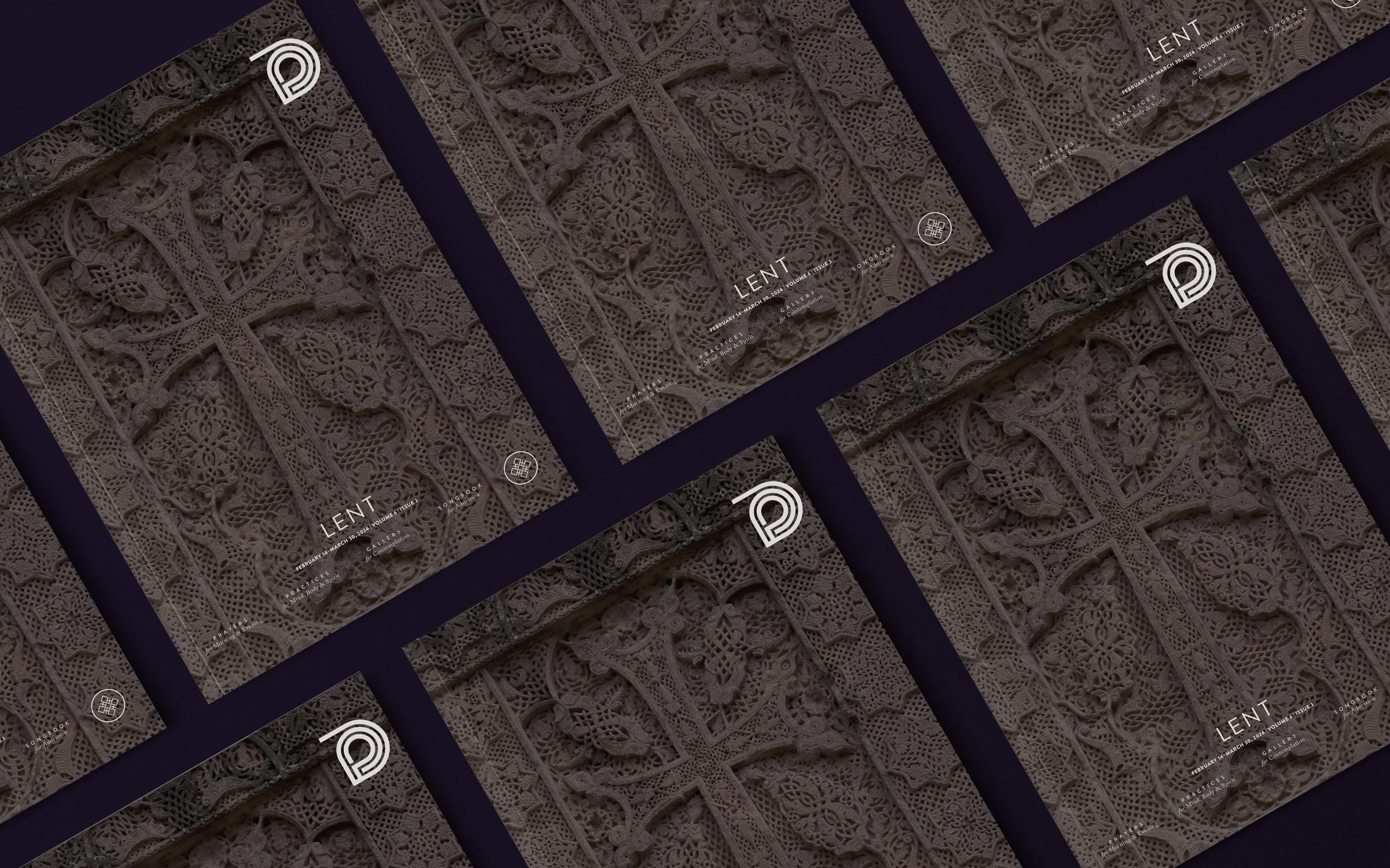
THE DAILY PRAYER PROJECT: Advent 2023: With Advent comes the start of a new liturgical year—which means a new volume of the Daily Prayer Project’s Living Prayer Periodical! Published in six editions a year, this periodical aims to “connect and unify Christians by resourcing them with daily prayers, practices, and music from the global-historical church, and visual art of spiritual and artistic value.” I curate the art. The cover image for Advent 2023—which, providentially, was finalized before the Hamas attack on Israel on October 7 and the ensuing retaliations—is a calligraphic rendering of the Hebrew word shalom by Michel D’anastasio, a French Catholic artist with Jewish ancestry. The lamed is like a candle held hopefully aloft against a dark-blue midnight.

Advent LPP

Rev. Joel Littlepage, who is the pastor of worship and formation at Grace Mosaic in Washington, DC, curates the prayers. Here’s Friday evening’s, from the church in New Guinea: “Lord, oil the hinges of our hearts’ doors, that they may swing gently and easily to welcome your coming.” Wednesday morning’s prayer is a responsive confession by Jorge Lockward, a Dominican song leader from New York, which begins, “Por tantas injusticias, perdón, Señor. Por tanta indiferencia, perdón, Señor.” (For so much injustice, forgive us, Lord. For so much indifference, forgive us, Lord.)

+++

NEW BOOK: A Radiant Birth: Advent Readings for a Bright Season, ed. Leslie Leyland Fields and Paul J. Willis: New this fall from InterVarsity Press, this Advent devotional book is a multiauthor compilation of forty-two readings for Advent through Epiphany, consisting of literary essays, poems, and short stories. Contributors are affiliated with the Chrysostom Society and include Richard Foster, Lauren Winner, Madeleine L’Engle, Philip Yancey, Walter Wangerin Jr., Eugene Peterson, Luci Shaw, and Marilyn McEntyre. About one-third of the content is previously unpublished, including a wonderful little reader’s theater (pages 81–89) by Leslie Leyland Fields that I can imagine working really well as part of a church service (and I received confirmation from Fields that people may use it freely in such settings). I know the market is really thick with Advent books, and I’ve read a lot of them, but this one has to be one of my favorites—the selections are wonderful.

+++

ART SERIES: Advent by Riki Yarbrough: For Advent 2018, artist Riki Yarbrough set herself a challenge: each day, create a 24 × 24-inch mixed media work corresponding to that day’s family devotions, structured around Jesus’s lineage. She didn’t have nearly enough canvases to last the duration of the season, so on day two “I woke up, took the very same canvas I had painted the day before, and worked right on top.” The final product was an artwork twenty-seven layers deep—the various people, prophecies, and foreshadowings adding weight and texture to the progressing story that culminated, in Yarbrough’s devotional program, with the infant Christ in a manger. “To cover the previous day’s work under the beauty of a new focus and set of Scriptures became both an offering and a sacrifice,” she said. “I wasn’t worried about meeting someone’s expectation or coming back to rework it later. I was simply conversing with the Lord over the truth of His Word in those wonderful moments on that particular day.”

Yarbrough, Riki_Joseph, Husband of Mary
Riki Yarbrough (American, 1975–), Joseph, Husband of Mary, 2018. Mixed media on canvas, 24 × 24 in.

Here’s a thirty-second time lapse of the Cain and Abel composition transforming into Noah:

In Advent 2022 Yarbrough reprised the daily challenge, this time executing her images on separate canvases. You can find this series on her Instagram @rikiyarbrough, starting with the candle image—but you can also purchase it in book form, as this month, Yarbrough released Advent in Art and Verse, combining full-color photos of all twenty-seven works from her 2022 Advent series with scripture passages and original poetic reflections. I received my copy, and my first impression was: what a beautiful design!

Advent in Art and Verse

I like the allusiveness of her paintings: a set of footprints, stalks of grain, a red cord, tongs gripping a hot coal, tree rings, harp strings, a split fig, a cairn—simple objects like these guide us through the narrative of the Old Testament and the opening pages of the New.

+++

SONG MEDLEY: “O Come, O Come, Emmanuel / Come, Thou Long-Expected Jesus” by the Petersens: In this video shot in Weddings at the Homestead in their hometown of Branson, Missouri, family bluegrass band The Petersens perform the two best-known Advent hymns—the one mournful, meditative, and minor key, the other bright and exuberant. They recorded both songs (released as two separate tracks) for their 2020 album Christmas with the Petersens.

+++

SUBSTACK POST: “O Come, Thou Rod of Jesse” by Grace Hamman, Medievalish 1.12, December 12, 2022: In last December’s installment of her monthly Medievalish newsletter, Grace Hamman considers Jesus’s family tree, visualized in the Middle Ages as what’s called, after Isaiah 11:1, the Tree of Jesse [previously here and here]. What does it mean that Jesus came from a real human family, a “complex web of generation, adoption, relationship, and dependence”? “The Son did not only take on flesh,” Hamman writes, “he took on David’s sometimes troublesome courage and cowlicks, Anne’s devotion and double-jointed pinky fingers. He comes from a line of real and complex people: faithless and faithful, abusers and abused, holy and broken. Baby Jesus is born into our funny human particularities and our burdensome histories, into created time and place.”

Tree of Jesse (English Psalter)
Tree of Jesse from an English Psalter in Latin, ca. 1190–1210. Bayerische Staatsbibliothek, Munich, BSB Clm 835, fol. 121r.

+++

PODCAST EPISODE: “The Season of Waiting (and Waiting . . . and Waiting),” Everything Happens with Kate Bowler, November 29, 2022: In this podcast episode from the beginning of last Advent, bestselling author Kate Bowler introduces the season as one of waiting. She explains the history of the Advent wreath, and takes calls from listeners who share Christmas traditions they observe to honor a loved one they’ve lost. Be sure to download Bowler’s 2023 Advent guide, titled Bless the Advent We Actually Have. Here’s an excerpt from Day 1:

Advent is a time marked by waiting. We wait for God to make all things right. For justice to be meted. For democracy to feel stable. For wrongs to be righted. For our communities to be safe spaces for the vulnerable. For our earth to heal. We wait for our lives to get easier—for us to have the financial security we need, for our relationships to be restored, for our bodies to ache less. We wait for our parents to understand us and our families to feel whole. We wait for our kids and grandkids to be healed or come back home. We wait for the grief to end.

But the waiting of Advent is one marked by hope. We wait with expectancy. With anticipation for the inbreaking of God to make all things new. . . .

Advent hope is gritty. It shirks all false optimism. It is hope as protest. Hope in the face of impossibilities. . . .

The excerpt Bowler reads in the podcast is from her 2022 Advent guide, The Season of Waiting (and Waiting . . . and Waiting . . .) (which you can also download for free, along with 2021’s A Good Enough Advent + Christmastide, at https://katebowler.com/advent/).