LISTEN: “How Long, Dear Savior” (NORTHFIELD) | Words by Isaac Watts, 1707 | Music by Jeremiah Ingalls, 1805 | Performed by the Boston Camerata, dir. Anne Azéma, 2020
How long, dear Savior, O how long Shall this bright hour delay? Fly swifter round, ye wheels of time, And bring the promised day.
From the third heav’n where God resides, That holy, happy place, The new Jerusalem comes down Adorned with shining grace.
An American Christmas is one of the Boston Camerata’s most popular programs. “It features a generous selection of carols, New England anthems, Southern folk hymns, and religious ballads for the season from the early years of the American republic, and from a wide range of early tune books and manuscripts”—including the shape-note hymn “How Long, Dear Savior” from The Christian Harmony (Exeter, New Hampshire, 1805), an arrangement of a stanza from Isaac Watts’s “Lo! what a glorious sight appears” to the fuguing tune NORTHFIELD. The Boston Camerata adds a stanza from the same Watts hymn.
The Grace Doherty Library at Centre College in Danville, Kentucky, which owns a first edition of The Christian Harmony, provides biographical information about its compiler, Jeremiah Ingalls, to whom several of the tunes inside are attributed:
A native of Massachusetts who moved to Vermont around 1800, Jeremiah Ingalls (1764-1828) at various times worked as a farmer, cooper, and tavern keeper, in addition to serving as a choirmaster in the Congregational church, teaching singing school and composing music. Ingalls’ Christian Harmony contains many lively melodies, patterned after the secular songs and dances of the day. Such tunes were quite popular among the camp-meeting revival folk. In his hymn “Innocent Sounds,” Ingalls argues for the appropriateness of adopting these melodies for religious use.
The above performance of “How Long, Dear Savior” by the Boston Camerata was filmed at Boston’s historic Old North Church during the 2020 pandemic. To hear the song in a non-concert context, see this video taken at a Sacred Harp singing convention in Texas in 2011:
The “third heaven” refers to the dwelling place of God outside the universe. Beginning in the intertestamental period (ca. 420 BCE–ca. 30 CE), it was a common Jewish belief that God stacked the heavens in layers—as many as seven, but most typically three, sometimes delineated as: Earth’s atmosphere (the first heaven; i.e., the realm of the birds and clouds), interplanetary or interstellar space (the second heaven; i.e., the realm of the sun and stars), and God’s own abode, over and above what we can conceive (the third heaven). The term “third heaven” appears in Jewish apocalyptic and rabbinic texts such as the Testament of Levi 2, the Apocalypse of Moses 37:5, 2 Enoch 8:1, and 3 Baruch 4:7. The apostle Paul also uses it in 2 Corinthians 12:2–4 to describe one of his visionary experiences.
PRAYER: “God, I Wake” by Rev. Maren Tirabassi: A morning prayer for Ordinary Time.
+++
SONG: “Sólo le pido a Dios” (I Only Ask of God), performed by the Alma Sufí Ensamble: This is a cover of a 1978 song written in Spanish by the Argentine folk rock singer-songwriter León Gieco—a personal prayer that he would not be unfeeling, not numb to injustice. In a November 2023 collaboration with the Alma Sufí Ensamble, Gieco joined the Argentine Jewish cantor Gastón Saied (also a guest artist) and the ensemble’s own Nuri Nardelli, a practicing Sufi (Muslim mystic), in singing the song in Spanish, Hebrew, and Arabic, respectively. “Three languages, one heart. And one prayer for peace in the Middle East,” they write. View the original Spanish lyrics and English translation here.
+++
VIDEOS:
The following videos are two of thirteen—the ones focusing on the continent’s Christian heritage—from the docuseries Africa’s Cultural Landmarks, produced by the Metropolitan Museum of Art in collaboration with the World Monuments Fund and directed by Sosena Solomon. The series was commissioned to coincide with the reopening of the museum’s Arts of Africa galleries this May, after being closed for four years as part of a major redesign and renovation of the Michael C. Rockefeller Wing.
>> “Rock-Hewn Churches of Lalibela, Ethiopia”: “Stepping into one of the rock-hewn churches of Lalibela is an experience unlike any other. Carved directly from volcanic rock, from the top to bottom, unlike traditional buildings built from the ground up, the eleven wondrous churches of Lalibela are monumental expressions of devotion and symbols of Ethiopia’s spiritual heartland. Visually captivating and rich with personal insights from priests entrusted with care of the churches, this documentary reveals how these sanctuaries—both magnificent and fragile—face the constant threat of erosion. Meet the dedicated guardians balancing conservation and sacred duty, to ensure Lalibela’s living pilgrimage tradition thrives for generations to come.”
Bete Giyorgis (Church of Saint George), Lalibela, Ethiopia, 13th century
>> “Rock-Hewn Churches of Tigray, Ethiopia”: “High in Ethiopia’s Northern Highlands, the rock-hewn churches of Tigray stand as breathtaking sanctuaries of faith carved into sandstone cliffs. For centuries, some 120 rock-hewn churches, and the paintings and artifacts preserved within their walls, were protected by their remote locations. However, during the 2020–2022 war in Tigray, some churches were targeted, and the use of heavy weapons resulted in vibrations that caused cracks in the stone. Through evocative imagery and intimate testimonies, this documentary explores the endurance of these remarkable sites of devotion, as local priests reflect on the spiritual and cultural legacies at risk.”
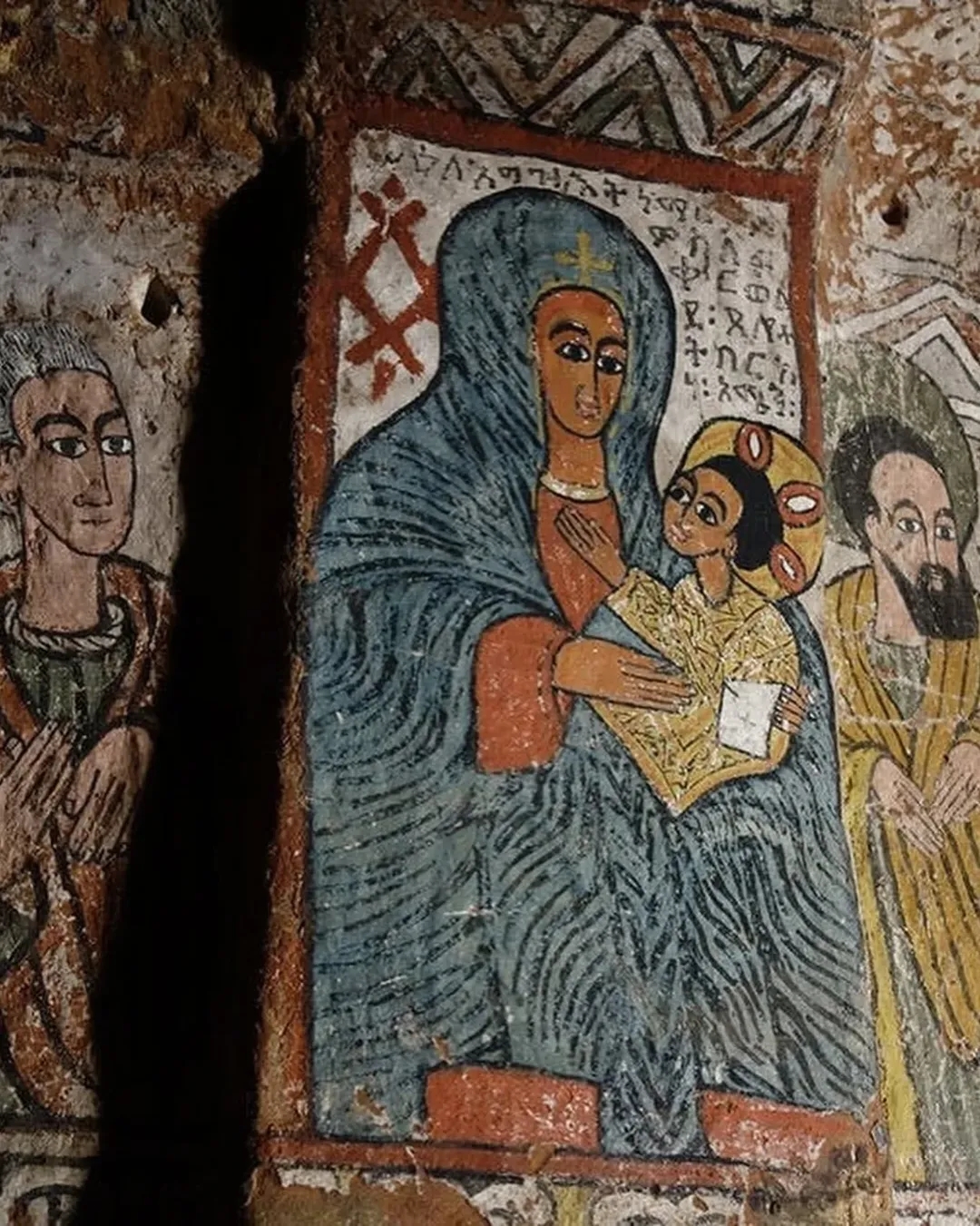
Virgin and Child wall painting, 15th century, inside Abuna Yemata Guh (The Chapel Near the Sky) in Tigray, Ethiopia, which contains the best-preserved medieval paintings in the region
+++
ESSAY: “Shaped for People: Sacred Harp Singing in the Age of AI” by Mary Margaret Alvarado: From Image journal’s summer 2025 issue: “What is that, I thought, when I first heard shape note singing. It was groaning, and some voices keened. It was loud. It was muscular, this music. There was glory, but it was not pretty. The voices did not blend, and the sound was not nice. All I knew was that I wanted to hear it again. Maybe it seemed to me like an aesthetic that does not lie? I feel surrounded, often, by aesthetics that do lie. . . . So there’s a contrarian appeal to a song that sounds sung by humans in their (young, old, crooked, fat, gorgeous, hairy, halt, jacked, sexy, bald, injured, hale) human bodies . . .”
Writer Mary Margaret Alvarado reflects on her experiences participating in shape-note hymn sings, a democratic form of communal music making using the “sacred harp” of the human voice. She provides an abridged history of such singing, which developed in late eighteenth- and early nineteenth-century New England but is now carried on throughout the US and in the UK and Germany. I’d love to take part in a shape-note hymn sing someday, as I’ve long been drawn to the sound and tradition, which I know only from recordings. Besides the small gatherings organized by local communities, there are also large conventions, and I’ve been intrigued to learn that, despite the hymns’ deep rootedness in Christianity, non-Christians are often among the attendees.
Below are a few of the hymns Alvarado mentions in her essay: “Youth like the Spring Will Soon Be Gone” (MORNING SUN), “David’s Lamentation” over the death of his son Absalom, and “I’m Not Ashamed of Jesus” (CORINTH). Traditionally, the singers start by singing through an entire verse using only the four syllables of the Sacred Harp notation system (fa, sol, la, mi) as their lyrics, to orient themselves to the tune.
To browse previous Art & Theology posts that have featured hymns from the Sacred Harp tradition—albeit not all performed in a traditional manner; several are arranged for soloists or otherwise stylistically adapted—see https://artandtheology.org/tag/sacred-harp/.
+++
NEW ALBUM: Radiant Dawn by the Gesualdo Six: Released August 1 by the British vocal ensemble the Gesualdo Six, this album features “an ethereal combination of trumpet and voices to explore different shades of light . . . from the soft, golden glow of a summer evening as shadows lengthen to the shimmering of moonlight on calm waters,” writes director Owain Park. “Some texts contrast the terror of darkness with the brilliance of dazzling sunlight; others explore the blurred boundaries between heaven and earth. Plainchant threads this programme together . . .” A range of composers are represented, from the Middle Ages to the present day.
Several of the songs are based on biblical episodes—Simeon’s response to having held the Christ child in the temple, the transfiguration of Christ on Mount Tabor, the arrival of the holy women at Jesus’s tomb on Easter morning, the walk to Emmaus—or passages such as Psalm 5:2 (“O hearken thou . . .”) and Revelation 21:23 (“And the city had no need of the sun . . .”). There are bedtime prayers, a meditation on the glory of the angels, an O Antiphon for the approach of Christmas, and settings of contemporary poems, like “Grandmother Moon” by the Mi’kmaq poet Mary Louise Martin and “Aura” by Emily Berry, about the death of her mother. View the track list at https://www.hyperion-records.co.uk/dc.asp?dc=D_CDA68465.
Below, from the album, is the Gesualdo Six’s performance of “Night Prayer” by Alec Roth, a setting of the Te lucis ante terminum, featuring Matilda Lloyd on trumpet. “The stark setting reminds me of the ravages of war,” one YouTube user remarks. “The singing, of a prayer sent out over the carnage, blessing those who have suffered. Sacred space indeed.”
Here are three sung invocations of the Holy Spirit, seeking his power, liberation, comfort, light, and renewal.
>> “Holy Spirit, Come with Power”: This hymn was written by Anne Neufeld Rupp in 1970, who set it to a Sacred Harp tune from 1844 attributed to B. F. White. It’s performed here by the Bel Canto Singers from Hesston College in Kansas, featuring Gretchen Priest-May on fiddle and Tim May on acoustic guitar.
I was introduced to this hymn through the Voices Together Mennonite hymnal, where it appears in both English and Spanish as no. 57.
>> “Mweya Mutsvene” (Holy Spirit, Take Your Place) by Joshua Mtima and The Unveiled:The Unveiled is a collective of Christian musicians from Harare, Zimbabwe, founded by Joshua Mtima in 2020. Here they sing one of their songs in Shona. An English translation is provided onscreen. [HT: Global Christian Worship]
>> “Ven Espíritu Divino (Secuencia de Pentecostés)” (Come, Spirit Divine) by Pablo Coloma, performed by Chiara Bellucci: The Spanish lyrics of this contemporary Christian song from the Latin American Catholic tradition are in the YouTube video description. They ask the Holy Spirit, “sweet guest of our souls,” to come bringing healing, regeneration, growth, joy, and charisms.
+++
SUBSTACK POST: “Veni Creator Spiritus: A Lush Middle English Hymn” by Grace Hamman, Medievalish: Dr. Grace Hamman shares Friar William Herebert’s (ca. 1270–ca. 1333) Middle English translation of the classic Latin Pentecost hymn attributed to Rabanus Maurus (ca. 780–856), “Veni Creator Spiritus” [previously]. Herebert uses words like vor-speker (for-speaker; i.e., intercessor), lodes-mon (lodesman; i.e., journeyman or navigator), and shuppere (shaper) as titles for the Holy Spirit.
+++
ORGAN WORK: “Improvisation on Veni Creator Spiritus” by Alfred V. Fedak: “Your congregation will hear the rushing of the Holy Spirit in this improvisatory prelude (taken from Fedak’s and Carl P. Daw’s oratorio The Glories of God’s Grace),” writes Selah Publishing. “Fedak effectively uses sweeping whole-tone scale passages and arpeggios to indicate the Spirit’s presence, while the pedal plays phrases of the hymn tune,” a medieval plainchant. The publisher has posted the following performance of the piece (audio only), by the composer himself, along with a selection of Pentecost art from the thirteenth to eighteenth centuries. [HT: Global Christian Worship]
There are many other works on organ (fantasias, partitas, fugues) based on the “Veni Creator Spiritus” tune; view a select list on Wikipedia.
+++
POEM:“Book of Hours”by Kimberly Johnson: “A pentecost of bloom: all the furred tongues / awag in the iris patch, windrush through the fireflower.” So opens the poem “Book of Hours” by Kimberly Johnson [previously], from her collection Uncommon Prayer (Persea, 2014). A book of hours is a genre of medieval prayer-book used by laypeople, which arranges prayers, scripture, and other devotional texts for reading at prescribed times of the day. Johnson’s “Book of Hours” draws on the fields of codicology (the study of manuscripts as physical objects) and botany to consider how God’s Spirit moves through and enlivens the material world, be it the irises, fire lilies, alyssum, and paperwhite narcissus in her garden, or the ink and natural pigments on calfskin—green verdigris, red cochineal, yellow curcumin—in the rare manuscripts library where she examines a book of hours whose embellished Latin text she can’t quite make out but whose beauty enraptures her nonetheless. These are but two untranslatable experiences of sensual, embodied communion with God that Johnson narrates in the collection, the paint flakes on her lips and the pollen on her wrist a chrism and a prayer.
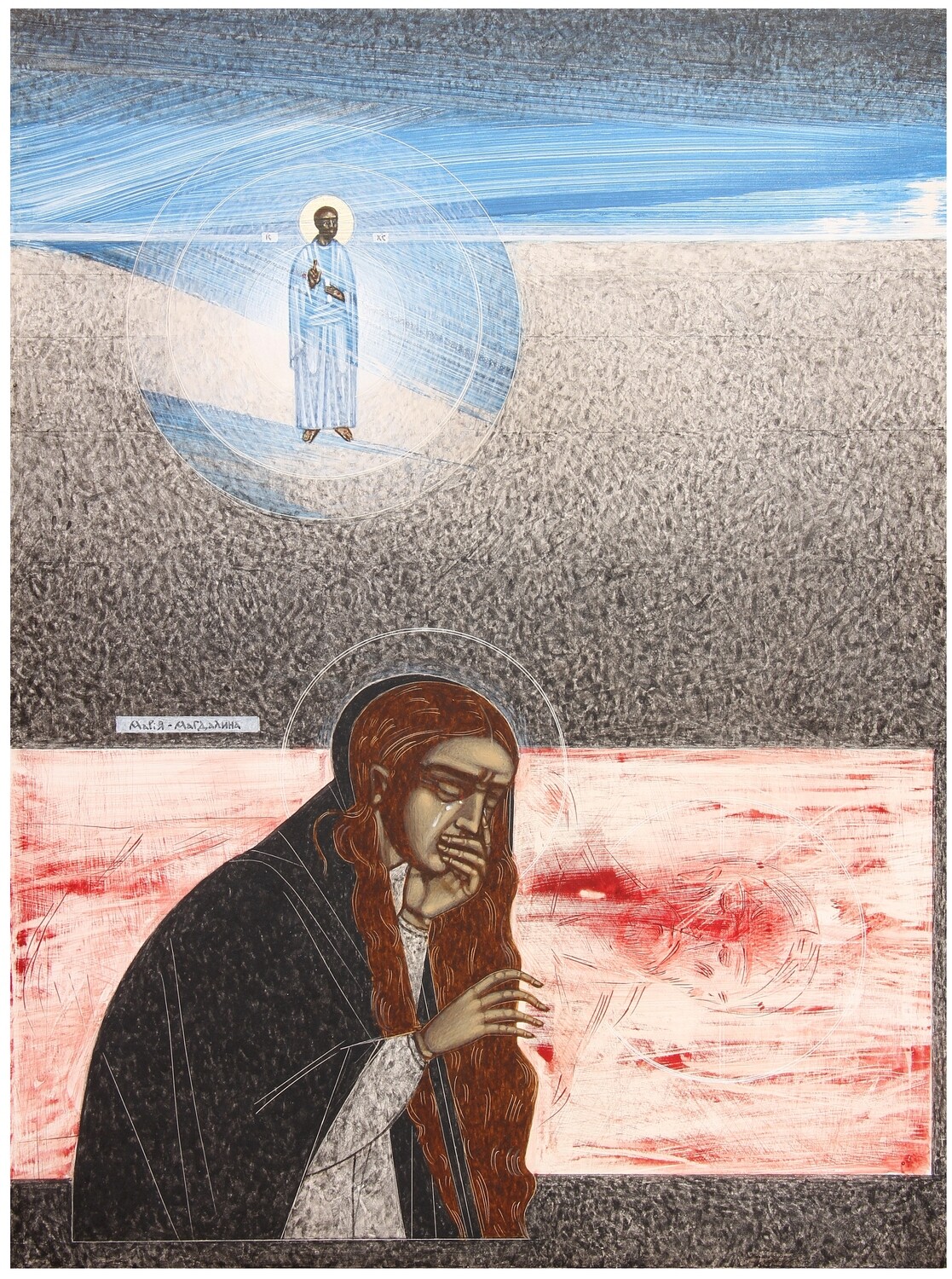
LOOK: Mary Magdalene Stood Crying by Kateryna Kuziv
Kateryna Kuziv (Ukrainian, 1993–), Mary Magdalene Stood Crying, 2021. Egg tempera and gilding on gessoed wood, 40 × 30 cm.
LISTEN: “Weeping Mary” | Traditional American, 19th century | Arranged by Dan Damon and performed by the Dan Damon Quartet, feat. Sheilani Alix, on Beautiful Darkness, 2022
Is there anybody here like Mary a-weeping? Call to my Jesus and he’ll draw nigh. Is there anybody here like Mary a-weeping? Call to my Jesus and he’ll draw nigh.
Refrain: Glory, glory Glory, glory Glory be to my God on high Glory, glory Glory, glory Glory be to my God on high
Is there anybody here like Peter a-sinking? . . .
Is there anybody here like jailers a-trembling? . . .
This early American spiritual was transmitted orally before first being recorded in The Social Harp (Philadelphia, 1855), a shape-note hymnal compiled by John Gordon McCurry (1821–1886). McCurry was a farmer, tailor, and singing teacher who lived most of his life in Hart County in northeastern Georgia. The Social Harp credits the music for “Weeping Mary” to him and gives it the year 1852, but I think that indicates not composition but notation and harmonization; in other words, McCurry is the arranger.
In the description of their 1973 facsimile reprinting of The Social Harp, the University of Georgia Press writes, “In the time between the [American] Revolution and the Civil War, the singing of folk spirituals was as common among rural whites as among blacks. This was the music of the Methodist camp meeting and the Baptist revival, and white spirituals in fact are known chiefly because homebred composers sometimes wrote them down, gave them harmonic settings, and published them in songbooks.”
I regard “Weeping Mary” as an Easter song, since the primary verse refers to Mary Magdalene standing outside the empty tomb weeping because she doesn’t know what happened to the body of her Lord (John 20). Then a man she supposes to be the gardener engages her in conversation—and turns out to be the one she’s been seeking, only he’s alive!
The jailer in the third verse refers to the Philippian jailer from Acts 16, tasked with guarding the prisoners Paul and Silas, who were falsely charged with disturbing the peace. One night an earthquake strikes, releasing the chains from the walls and breaking open the cell doors. The jailer raises his sword to kill himself to avoid the shame of having let his wards escape. But Paul alerts him that they’re still there, after which the jailer “fell down trembling” and asked the two what he must do to be saved. “Believe in the Lord Jesus,” they reply. After which he and his whole household convert to the new faith.
“Call to my Jesus and he’ll draw nigh,” the song promises.
Another “Weeping Mary” verse not in The Social Harp but that I’ve heard added in some renditions is “Is there anybody here like Thomas a-doubting?”
More subdued than the typical Easter fare, “Weeping Mary” testifies to the nearness of God in our sorrows, fears, doubts, and weaknesses. It embraces those who are anxious, grieving, or struggling, offering a gentle word.
I first learned this song from a recording by the American folk musician Sam Amidon, which I also really like:
In Brattleboro, Vermont, where he grew up in the 1980s and ’90s, he told NPR, shape-note singing was a social tradition, something that happened once a month, with singers moving to different people’s houses, including his own. His parents are the well-known folk musicians Peter and Mary Alice Amidon.
In his rendition he uses the grammatically incorrect but historically faithful verb that appears in original songbook, “Are there anybody . . .”
For a more vigorous jazz arrangement, which includes scat singing and a trumpet solo, see June April’s 2007 album What Am I?. She uses just the first verse.
And here’s a traditional performance in four-part a cappella by the Dordt College Concert Choir, directed by Benjamin Kornelis:
BibleProject is a nonprofit in Portland, Oregon, that offers free videos, podcasts, articles, and classes to help people experience the Bible in a way that is approachable and transformative.
The following two songs are from the music ministry of the Cathedral Church of the Advent in downtown Birmingham, Alabama. The ministry flourished under the leadership of Rev. Dr. Zac Hicks, who served as the church’s canon for worship and liturgy from 2016 to 2021. (He is now pastor of Church of the Cross, also in Birmingham.)
The music videos used to be available on YouTube, but it appears that the church has undergone some restructuring, and they have been removed. For now, though, they are still available through Facebook, and the audio releases are available through streaming services.
>> “Lord, Who Throughout These Forty Days”: This 1873 hymn by Claudia Frances Hernaman recounts the forty days Jesus spent in fasting and prayer in the Judean wilderness at the outset of his ministry and beseeches God to give us strength, like Jesus, to fight temptation, to die to self, and to live by his word and with a keen sense of his abiding presence. It’s set to an American folk tune from the Sacred Harp tradition, known as LAND OF REST, which has roots in the ballads of northern England and Scotland. The hymn is sung by Madison Craig (née Hablas), with Emma Lawton (née Dry) and Annie Lee on background vocals, Joey Seales on pump organ, Charley Rowe on cajon, and Zac Hicks on acoustic guitar.
>> “Spring Up, O Well”: This is an original song by Zac Hicks, sung by Jordan Brown. It draws especially on the narrative in John 4, where Jesus tells a Samaritan woman at a well, “Everyone who drinks of this water will be thirsty again, but those who drink of the water that I will give them will never be thirsty. The water that I will give will become in them a spring of water gushing up to eternal life” (vv. 13–14). The exclamation “Spring up, O well!” in the song’s refrain comes from Numbers 21:17, where the Israelites praise God for providing them water in the desert, and that musical phrase is adapted from the old children’s church song “I’ve Got a River of Life.”
+++
SHORT FILM: “Silences,” dir. Nathan Clarke: Shot in 2016 at Box Canyon near Laity Lodge in the Texas Hill Country, this contemplative short film features cellist Steuart Pincombe playing a short improvisation that interacts with the natural space. The impromptu music making was for him an exercise in prayer.
Three years earlier, also while on retreat at Laity Lodge, Pincombe’s wife shot him doing the same inside the newly constructed Threshold, an interactive, site-specific, permanent outdoor installation by Roger Feldman consisting of three curved walls:
The Threshold improvisation, Pincombe writes, “stemmed from a particular note (and its harmonic overtones) that naturally resonated in the space—the cello’s lowest strings were tuned to match this strongest resonation. Playing with the confusion of resonances (or pitches) was an important part of this short musical and spatial exploration—pitches are bent or adjusted in a way that create audible pulses in the sound and play on the conflicts of resonation within the space.”
+++
ESSAY: “Silence in an Age of Mass Media: John Cage and the Art of Living” by Dr. Jonathan A. Anderson, ARTS (Spring 2017): Many twentieth- and twenty-first-century artists have explored the necessities and possibilities for aesthetic stillness and silence, Anderson writes. In this essay he considers the composer John Cage (1912–1992), best known—and most excoriated—for his modernist piano composition 4′33″ (1952), in which the pianist sits at the bench for four minutes and thirty-three seconds, playing no notes. The point was to attune the audience to the ambient sounds of the concert hall (coughing, rustling, creaking, mechanical humming, outside traffic, etc.), testing the distinction between “music” and “noise.” Cage found the fundamental difference between the two to be not in the qualities of sound but in the attentiveness of the listener.
I was pleasantly surprised to learn from Anderson’s article that even after Cage left Christianity (in which he was raised) and turned to Zen Buddhism, he continued to link his love for the givenness of environmental sounds to Jesus’s admonition to “consider the lilies” (Luke 12:27). “Cage sought to quiet his own aesthetic ‘worry’ for musical meaning,” Anderson writes, “and to instead receive the given sounds of the world as richly meaningful in themselves.”
+++
VIDEO: Lenten Jazz Vespers, Duke University Chapel, March 23, 2023: This Jazz Vespers service combines the liturgical traditions of Vespers with the musical improvisation of jazz. Exploring the theme of hope, the service is presided over by Rev. Racquel C. N. Gill, minister for intercultural engagement at Duke University Chapel. Musical leadership is provided by the John Brown Little Big Band.
Here are the time stamps:
0:01: Song: “I Came to Tell You” by Trinity Inspirational Choir
5:40: Welcome and Prayer
8:33: Song: “Miracle (It’s Time for Your Miracle)” by Marvin Sapp
14:38: Poetry reading: “Dark Testament (8)” by Pauli Murray
LENT SERIES: “Let go of unlove this Lent: Let’s practice love together—a new and improved Lenten reflection series starting March 5th” by Tamara Hill Murphy: I’ve been nurtured for years by Murphy’s gentle spiritual writing and curated beauty and wisdom, and I especially appreciate her annual Advent and Lent Daybook series. This Lent, she’ll be exploring four postures of cruciform love given to us in 1 Corinthians 13, providing daily scripture readings, prayers, and art, along with weekly practices. You can gain access for just $16. (She uses the Substack platform.)
Forgive Thy Other by Scott Erickson
I like how Murphy frames the season: “Lent is a significant time for us to seek a deeper understanding of God’s heart and recognize the gaps in our experiences of His love. Through its beautiful stories, prayers, and practices, Lent also invites us to reflect on our own expressions of love and unlove. The Book of Common Prayer encourages us to let go of our unloving ways so we can love what (and who) God loves. Let’s joyfully embrace this transformative season together, reflecting God’s love with compassion and understanding.”
+++
NEW PLAYLIST: God’s Love (Art & Theology): Related to Tamara Hill Murphy’s 2025 Lent Daybook theme: here’s a new playlist I put together of songs about the abounding, ever-present love of God the Father, Son, and Holy Spirit, a love that seeks, heals, and transforms.
The cover photo is of an early twentieth-century relief sculpture from the exterior of Holy Trinity Church in the town of St Andrews, Scotland, taken by Joy Marie Clarkson; it shows a pelican pecking her breast to feed her young with her own blood, a medieval symbol of Christ’s self-giving love.
There’s some overlap between this playlist and my dedicated Lent Playlist. I hope it uplifts you in the knowledge of the depths and riches of God’s love for you.
+++
SONGS:
>> “And Am I Born to Die?”: Lent opens with a call to “remember you are dust, and to dust you shall return.” A reflection on human mortality, this somber hymn was written by the great English Methodist hymnist Charles Wesley (1707–1788) and set to music—a shape-note tune—by Ananias Davisson (1780–1857), a Presbyterian elder from Virginia. In this video from January 2023, it’s performed by the Appalachian folk musician Nora Brown, with Stephanie Coleman on fiddle and James Shipp on harmonium.
And am I born to die? To lay this body down? And must my trembling spirit fly Into a world unknown?
Awaked by trumpet sounds, I from my grave shall rise, And see the Judge, with glory crowned, And see the flaming skies.
Soon as from earth I go, What will become of me? Eternal happiness or woe Must then my portion be.
>> “Nunc tempus acceptabile” (Now Is the Accepted Time): Second Corinthians 5:20b–6:10 is traditionally read on Ash Wednesday, a passage that includes the adjuration, “Behold, now is the acceptable time; behold, now is the day of salvation!” (2 Cor. 6:2). There’s a beautiful tenth-century Latin hymn for Lent, from the Liber Hymnarius, that opens with this line. In 2013, the Chicago-based composer and conductor Paul M. French set it to music for SSA a cappella choir, its unison opening unfolding into an increasingly expressive three-part harmony. It’s performed here by the Notre Dame Magnificat Choir under the direction of Daniel Bayless.
Nunc tempus acceptabile
Fulget datum divinitus,
Ut sanet orbem languidum
Medela parsimoniae.

Christi decoro lumine
Dies salutis emicat,
Dum corda culpis saucia
Reformat abstinentia.

Hanc mente nos et corpore,
Deus, tenere perfice,
Ut appetamus prospero
Perenne pascha transitu.

Te rerum universitas,
Clemens, adoret, Trinitas,
Et nos novi per veniam
Novum canamus canticum.

Amen.
Today is the accepted time. Christ’s healing light, the gift divine, shines forth to save the penitent, to wake the world by means of Lent.
The light of Christ will show the way that leads to God’s salvation day. The rigor of this fasting mends the hearts that hateful sinning rends.
Keep all our minds and bodies true in sacrifice, O God, to you, that we may join, when Lents have ceased, the everlasting Paschal feast.
Let all creation join to raise, most gracious Trinity, your praise. And when your love has made us new, may we sing new songs, Lord, to you.
LECTURE: “Embracing the Ephemeral: How Art Honors Creaturehood” by James K. A. Smith, Duke Divinity School, February 17, 2022: Mortality means something more than being a creature who will someday die, says philosopher James K. A. Smith; it is a way of being, not defined solely by its terminus. “To be created is to be ephemeral, fugitive, contingent. To be a creature is to be a mortal, subject to the vicissitudes of time.” Part of the Duke Initiatives in Theology and the Arts Distinguished Lecture Series, this talk about developing a Christian temporal awareness is based on chapter 4 of Smith’s then-forthcoming, award-winning book How to Inhabit Time (Brazos, 2022), titled “Embrace the Ephemeral: How to Love What You’ll Lose.”
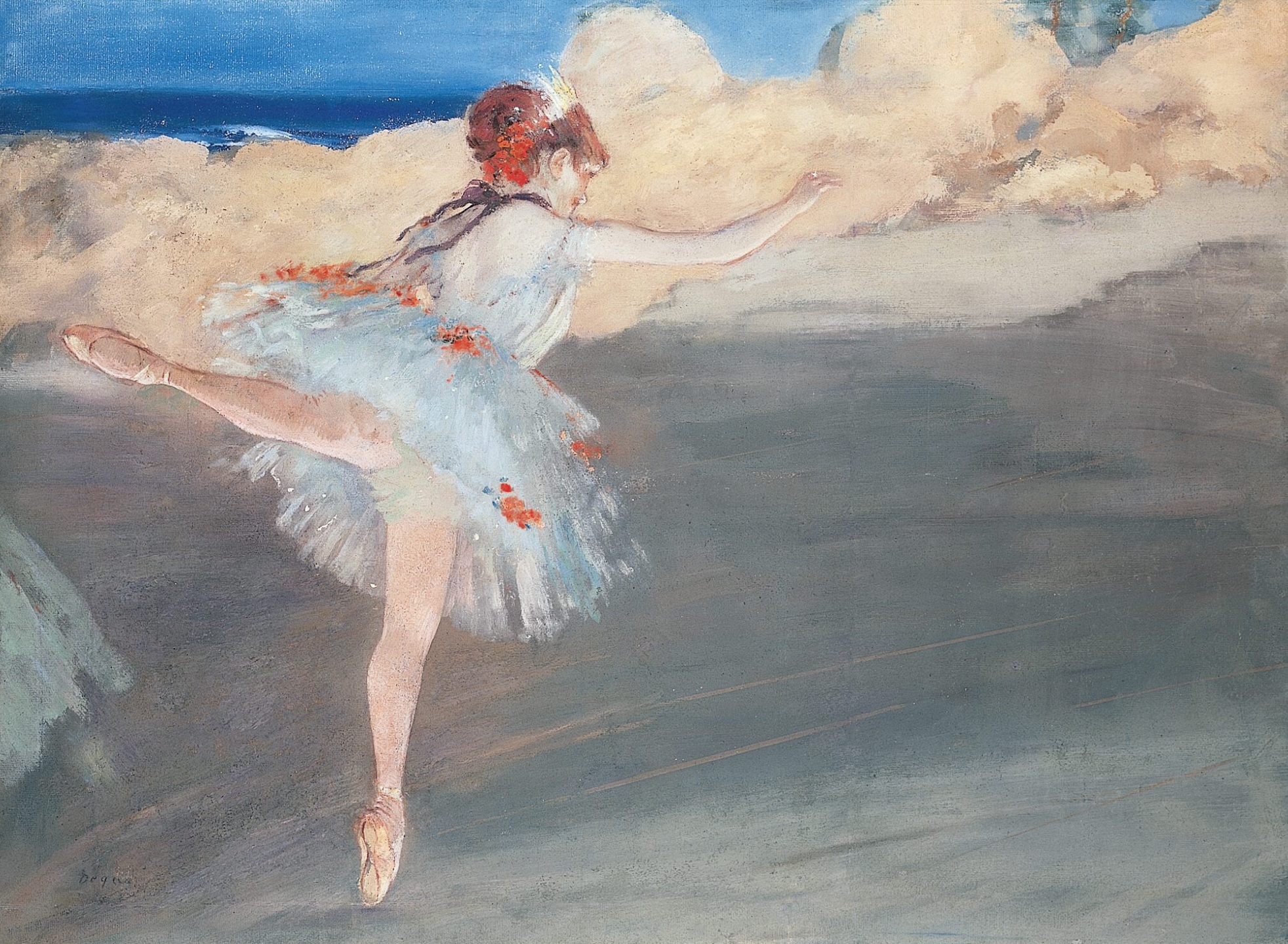
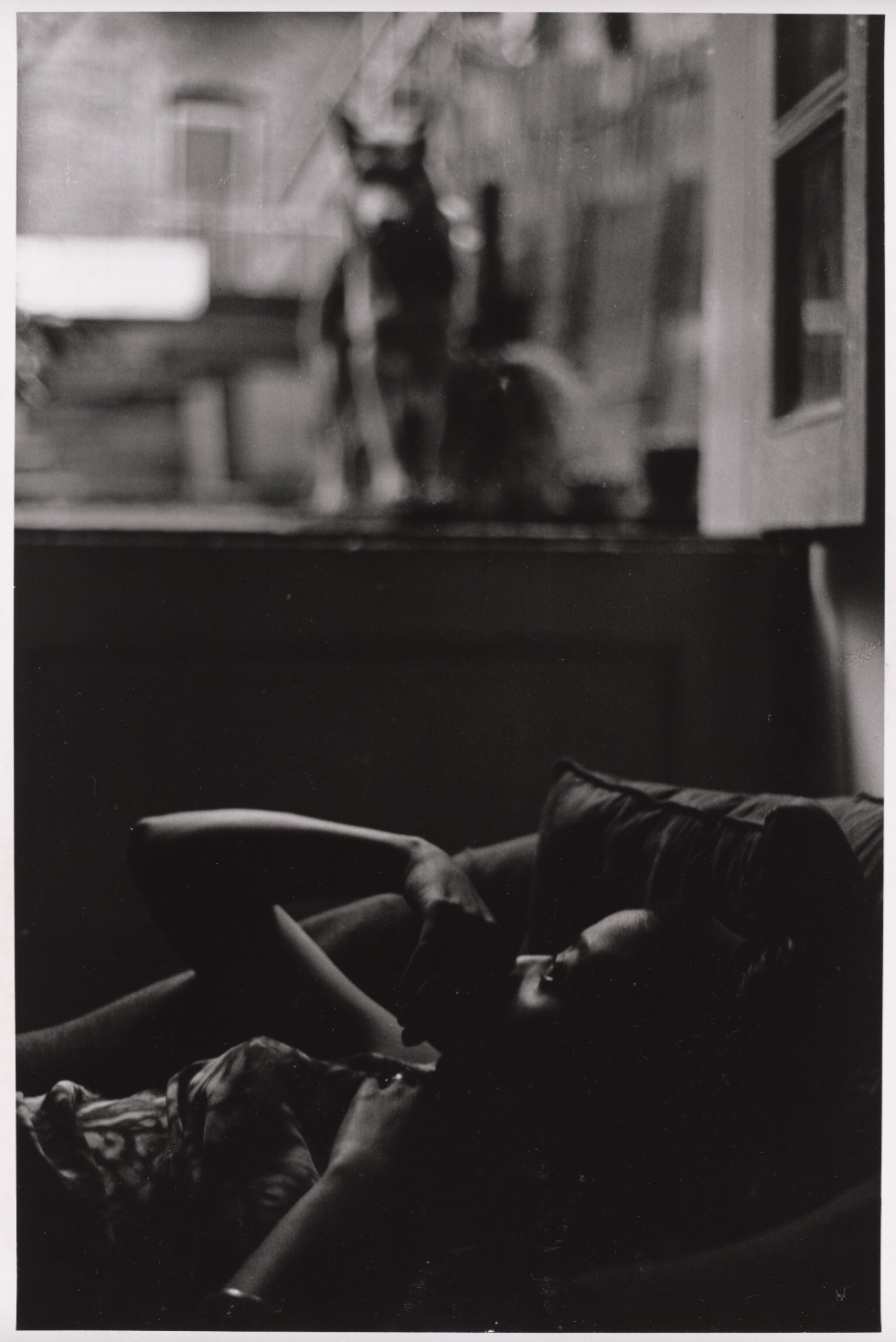
Edgar Degas (French, 1834–1917), The Star: Dancer on Pointe, ca. 1878–80. Gouache and pastel on paper, mounted on board, 22 1/4 × 29 3/4 in. (56.5 × 75.6 cm). Norton Simon Museum, Pasadena, California.Herbert Randall (American, 1936–), Untitled (Lower East Side, New York), 1960s. Gelatin silver print, 13 7/16 × 8 7/8 in. (34.2 × 22.5 cm). J. Paul Getty Museum, Los Angeles.
Some notes I took:
“We need not only memento mori, but also memento tempore—reminders of our temporality, not just our mortality.”
“Imagine embracing the ephemeral as a discipline of not only conceding our mortality as a condition but also receiving our mortality as a gift.”
“Our finitude is not a fruit of the fall, even if it is affected by the fall. Contingency is not a curse. . . . Aging is not a curse. Autumn is not a punishment. Not all that is fleeting should be counted as loss. The coming to be and passing away that characterize our mortal life are simply the rhythms of creaturehood.”
Resting in our mortality instead of resenting it
Theologian Peter Leithart says hebel means not “emptiness,” “vanity,” or “meaninglessness” but, literally, “mist” or “vapor.” The Teacher in Ecclesiastes uses that word repeatedly to describe human life: it’s vaporous, elusive, escapes our efforts to hold on to it, to manage it.
How to sift tragedy from good creaturely rhythms in which good things fade?
“To dwell faithfully mortally is to achieve a way of being in the world for which not all change is loss and not all loss is tragic, while at the same time naming and lamenting those losses that ought not to be. . . . To be faithfully mortal is a feat of receiving and letting go, celebrating and lamenting. Being mortal is the art of living with loss, knowing when to say thank you and knowing when to curse the darkness.”
“One Art” by Elizabeth Bishop: “The art of losing isn’t hard to master . . .”
A Q&A takes place from 39:00 onward. The first question, asked by theologian Jeremy Begbie, is the one I had, and it recurs with different phrasing at 58:17.
Mortality is one of the main themes in Silver’s poetry, including the physicalities of being human, as reflected in “Ash Wednesday,” in which she, the speaker, muses on the shared Christian ritual of the imposition of ashes at the beginning of Lent. Silver, who died of breast cancer eight years after writing this poem, was used to practicing memento mori (“remember you must die”): her mastectomy scar and silicone breast prosthesis are constant reminders of the fact, she writes. She wants to touch the body of God, wants to wrap her fingers around some tangible promise of healing, but both remain elusive. Instead she resolves to embrace the finiteness of her present form, taking the burnt remains of those Hosanna palms from last year and wearing them with repentance and praise, knowing that what is sown in perishability will be raised in imperishability (1 Cor. 15:42).
I’m compelled by how Silver both laments her fragility and owns it. There’s a defiant quality to the tone, the ash-and-oil mixture that’s thumbed into her forehead in the shape of a cross evoking a football player applying eye black in front of a locker room mirror before the big game. Wearing the mark of Christ, she’s ready for the face-off between herself and death.
CONCERT RECORDING: “Found in Translation: Cross-Cultural Musical Explorations of the Bible” with John Pfumojena and Delvyn Case: “In this unique concert, acclaimed Zimbabwean musician John Pfumojena and award-winning American pianist Delvyn Case reinterpret traditional sacred music by drawing upon traditions from Africa, Western Europe, and the Americas. Featuring one-of-a-kind arrangements for voice, mbira, and piano of gospel songs, African American spirituals, and hymns, the concert celebrates the unique power of sacred music to foster Christian unity—while simultaneously challenging us to consider the ways the church has fallen short of its ideals. Presented in June 2024 in historic Exeter College chapel at the University of Oxford.”
The program includes, among other selections, a medley of the nineteenth-century hymn “Abide with Me” from the UK and the nineties Zimbabwean song “Iwe Nesu” (Lord God, Be with Your Children) by Chiwoniso Maraire and Chirikure Chirikure; a powerful performative reading of Psalm 22 in English and Ndebele; and perhaps my favorite, the closer, the gospel song “Precious Lord, Take My Hand” with a verse in Shona.
To inquire about bringing this concert to your church, school, or organization in the UK, contact Deus Ex Musica.
+++
CONCERT TOUR:Tafod Arian (Silver Tongue), a.k.a. theLost Welsh Folk Hymns, a project by Lleuwen Steffan: This year the progressive Welsh folk artist Lleuwen Steffan has been traveling to chapels and other venues across the UK to present a trove of little-known Welsh folk hymns that she uncovered from the sound archive of St Fagans National Museum of History. (The field recordings were made by folklore and oral history expert Robin Gwyndaf in 1964.) Mostly dating from the eighteenth century, these hymns were passed down orally and never made it into church hymnals.
“They’re conversational and the lyrics feel so current,” Steffan says. “There were committees who would choose what hymns would go into the hymn books. These were the unchosen ones, the ‘canceled’ ones, if you like. Many of them are about addiction, mental illness, the dark side of the psyche. You have one that talks of drunkenness and alcoholism that is transformed into drinking the wine from God’s cellar.”
In addition to showcasing her own contemporary arrangements of the hymns, Steffan is also performing electronic renditions of nineteenth-century “hwyl” (spirit) sermons. Here’s an April 17, 2024, performance of hers at Drygate Brewing in Glasgow, part of the Celtic Connections festival:
What a strange and interesting soundscape! I’m eager to hear more of these hymns, and I’d love to see at least some of them translated into English.
+++
DOCUMENTARY: “The Canaan Hymns,” part 4 of The Cross: Jesus in China, dir. Yuan Zhiming (2003): Lu Xiaomin (吕小敏) (b. 1970) is China’s most prolific and beloved Christian hymn-writer, having written over 1,800 hymns since 1990, published in Canaan Hymns (迦南诗选). She didn’t finish junior high school, and she’s had no musical education (at least not at the time the documentary was filmed two decades ago, a full decade into her hymn-writing endeavors), but despite her inability to read music or notate it, she has had a tremendous impact on the development of indigenized Christian worship in her home country. To set down the hymns she composes, she’ll sing them, either in person or into a recorder, and someone else transcribes them.
This documentary tells Lu’s story and features many of her beautiful hymns. It’s the final (fifty-minute) segment of the four-part documentary The Cross: Jesus in China (2003), made by the China Soul for Christ Foundation, and it’s been translated into fifteen languages: English, Arabic, Tamil, French, German, Polish, Dutch, Finnish, Norwegian, Swedish, Russian, Japanese, Korean, and Spanish. See https://www.chinasoul.org/en_US/the-cross.
+++
HYMNS:
I’m always finding new-to-me hymns from YouTube’s recommendations algorithm. Here are two that popped up in that sidebar recently that I particularly enjoyed.
>> “The Rock That Is Higher Than I,”performed by Hannah Fridenmaker: Written in 1871 by Erastus Johnson (words) and William Fischer (music), this hymn is based on Psalm 61:2b–3a: “Lead me to the rock that is higher than I, for you have been my refuge . . .” The video is from the Folks and Hymns YouTube channel of Hannah Fridenmaker, whose tagline is “Creating simple, singable versions of hymns and folk songs for family worship and connection, and for the joy of singing together.”
>> “I’m Not Ashamed to Own My Lord,”performed by Nathan Clark George and family: This 1707 hymn by the great Isaac Watts is set to the early American melody PISGAH from Kentucky Harmony (1817). (I love a good shape-note tune!) The phrase “to own God” in the opening line sounds odd to modern ears, as we typically equate that word with possession or mastery over, but here it’s used in the sense of to profess, to claim, to acknowledge to be true or valid. The hymn is an elaboration of Romans 1:16 (“For I am not ashamed of the gospel; it is the power of God for salvation to everyone who has faith, to the Jew first and also to the Greek”) and Matthew 10:32 (“Everyone, therefore, who acknowledges me before others, I also will acknowledge before my Father in heaven”).
Check out the other songs on George’s YouTube channel, and on Spotify!
+++
ALBUM: Cross Culture: Songs of Faith from Near and Far (2003): Consisting of Mary Preus, Donna Peña, ValLimar Jansen, Tom Witt, and José Antonio Machado, Cross Culture was an ecumenical group originally formed to lead music and worship for Lutheran Global Mission events around the US. “While at these events and listening to the many stories and testimonies that were coming from the various countries that this music was born in,” they write in the liner notes, “we could not help but bond with the song, the stories, the spirit, and the heart of those who live in these realities, be they joyous or be they of struggle. We found ourselves forming a deep love and commitment to carry on their truths to you, the musicians and the listeners, so you too may develop a love and understanding that goes way beyond our parish doors.”
This album of theirs brings together nineteen songs from South Africa, Mozambique, Cameroon, Tanzania, Pakistan, Palestine, Taiwan, Sweden, Argentina, Nicaragua, Arapaho Nation, Cherokee Nation, and the US. You can listen to full album on YouTube or Spotify, or buy a digital download from GIA Music; or, like me, you can buy a used physical copy from Amazon. I wanted to have the liner notes. Unfortunately they don’t include most of the original lyrics, but they do provide English translations or paraphrases as well as info about the source and performance of each song.
Let me share just three. The medley “Nzamuranza / African Processional” opens with a traditional Xitswa song from Mozambique, arranged by Patrick Matsikenyiri, who roughly translates it to “Be joyful! We are made in the image of God,” or alternatively, “I worship Jesus. There is no one like him!” (Those meanings are quite different, so it’s possible those are two different verses; it’s not clear from the liner notes which words are sung.) At 2:16, “African Processional” enters; this song was adapted from “Praise, Praise, Praise the Lord,” written by a group of women from Cameroon and collected by Elaine Hanson. Mary Preus is the caller:
The CD also includes a beautiful arrangement of “Amazing Grace” with bombo and Native American flute and rain stick, sung in Cherokee by Donna Peña, who is of Mexican and Cherokee descent:
One of the two featured songs from Palestine is “Yarabba Ssalami,” a traditional chant in Arabic that’s well known by Christians there and in Lebanon, and that’s led on the album by Jim Rolland. The liner notes provide the translation “God of peace, rain peace upon us. Fill our hearts with peace. God of peace, rain peace upon us. Give our land peace.” But let me instead share this “virtual choir” rendition of the song made earlier this year for the World Day of Prayer, amid Israel’s still-ongoing war on Gaza, which in addition to an English translation of the Arabic also features sung Spanish, French, German, Taiwanese, and Mandarin translations:
Tomorrow’s readings in the Revised Common Lectionary, for the fourth Sunday of Easter, include what’s probably the most famous passage in the Bible, Psalm 23:
The LORD is my shepherd; I shall not want.
He maketh me to lie down in green pastures: he leadeth me beside the still waters.
He restoreth my soul: he leadeth me in the paths of righteousness for his name’s sake.
Yea, though I walk through the valley of the shadow of death, I will fear no evil: for thou art with me; thy rod and thy staff, they comfort me.
Thou preparest a table before me in the presence of mine enemies: thou anointest my head with oil; my cup runneth over.
Surely goodness and mercy shall follow me all the days of my life: and I will dwell in the house of the Lord for ever.
In characterizing God as a shepherd, the psalmist expresses how God leads, protects, rescues, feeds, and cares for his own. The author of Psalm 95 uses the same metaphor when he writes, “For he is our God, and we are the people of his pasture, and the sheep of his hand” (v. 7)—as do Isaiah and Ezekiel. During his teaching ministry, Jesus described himself as “the good shepherd [who] lays down his life for the sheep,” and whose flock knows his voice and follows him (John 10:1–18).
Ronald Rae (Scottish, 1946–), Shepherd, 1988. Granite, 4 × 5 × 4 ft. Private collection, Peak District, Scotland.
The Psalm 23 settings that are most widely reproduced in modern English-language hymnals are:
“The Lord’s My Shepherd,” written by Francis Rous but extensively revised by committee and published by the General Assembly of the Church of Scotland in the Scottish Psalter (1650). This text is most commonly matched with the 1872 tune CRIMOND by Ms. Jessie Seymour Irvine of Scotland, but I really like it with the early American folk tune PISGAH, as recorded, for example, by the William Appling Singers. However, both melodies, I feel, are difficult to sing congregationally.
“My Shepherd Will Supply My Need” by Isaac Watts, from The Psalms of David Imitated in the Language of the New Testament (1719). This text is traditionally paired with the tune RESIGNATION, first published in the fifth edition of the shape-note hymnal The Beauties of Harmony (Pittsburgh, 1828), compiled by Freeman Lewis, but first appearing with the Watts text in The Valley Harmonist in 1836. My playlist features a performance by the female a cappella quartet Anonymous 4 (the music arranged by Johanna Maria Rose; see video embed below), as well as by folk singer Claire Holley, who recorded the hymn at the request of a friend who told her it was the song that helped her get sober for good. I also like the minor-key setting by Stephen Gordon.
“The Lord Is My Shepherd (No Want Shall I Know)” by James Montgomery (1822), with music by Thomas Koschat (1862). Here’s the Lower Lights:
“The King of Love My Shepherd Is” [previously] by Henry Williams Baker (1868). This hymn is most often sung to a traditional Irish tune known as ST. COLUMBA (my playlist features both a choral performance by the Choir of Kings School, Canterbury, and a folksy solo by Luke Spehar) and occasionally to MCKEE, also from Ireland, as recorded by Redeemer Knoxville.
At my church we use Wendell Kimbrough’s musical adaptation of the psalm, “His Love Is My Resting Place.” Do you sing Psalm 23 at your church, and if so, what version?
Probably my favorite choral setting is by Bobby McFerrin, “The 23rd Psalm,” performed below by his VOCAbuLarieS, featuring SLIXS & Friends, live in Gdansk, Poland, at the Solidarity of Arts Festival on August 17, 2013:
Some people are thrown off by McFerrin’s use of feminine pronouns for the Divine in this song. God has no literal sex because God does not possess a body, so our gendered binaries are inadequate—but scripture and church tradition refer to God using masculine pronouns. I’m not bothered by the “She” throughout, or even “Mother,” but the substitution of “Daughter” for “Son” in the Trinitarian doxology at the end is theologically confusing, since Jesus was a man. But I get what McFerrin is doing.
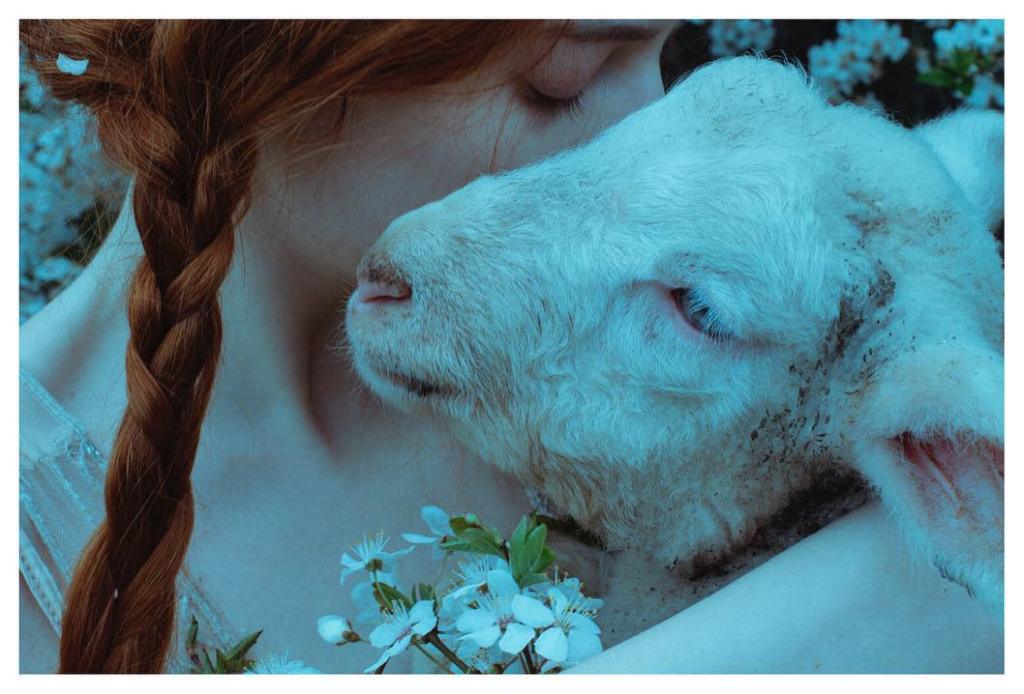
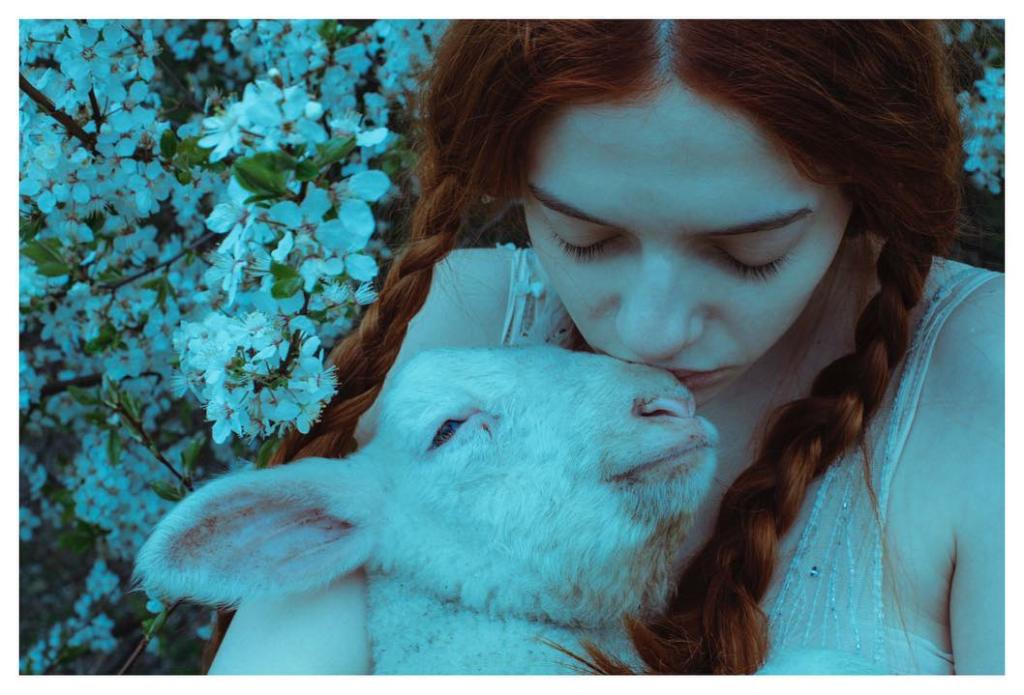
How does the change in gender impact your reception of the psalm text? We’re used to seeing religious imagery of a man with a sheep slung over his shoulders to embody the metaphor of God as shepherd—but what happens when you picture a shepherdess in the role? Note that it was not unusual in the ancient Near East for girls and women to tend their family herds (think of Rachel and Zipporah in the Old Testament, for example), and still today across the globe there are many female shepherds.
McFerrin dedicated his “23rd Psalm” to his mother.
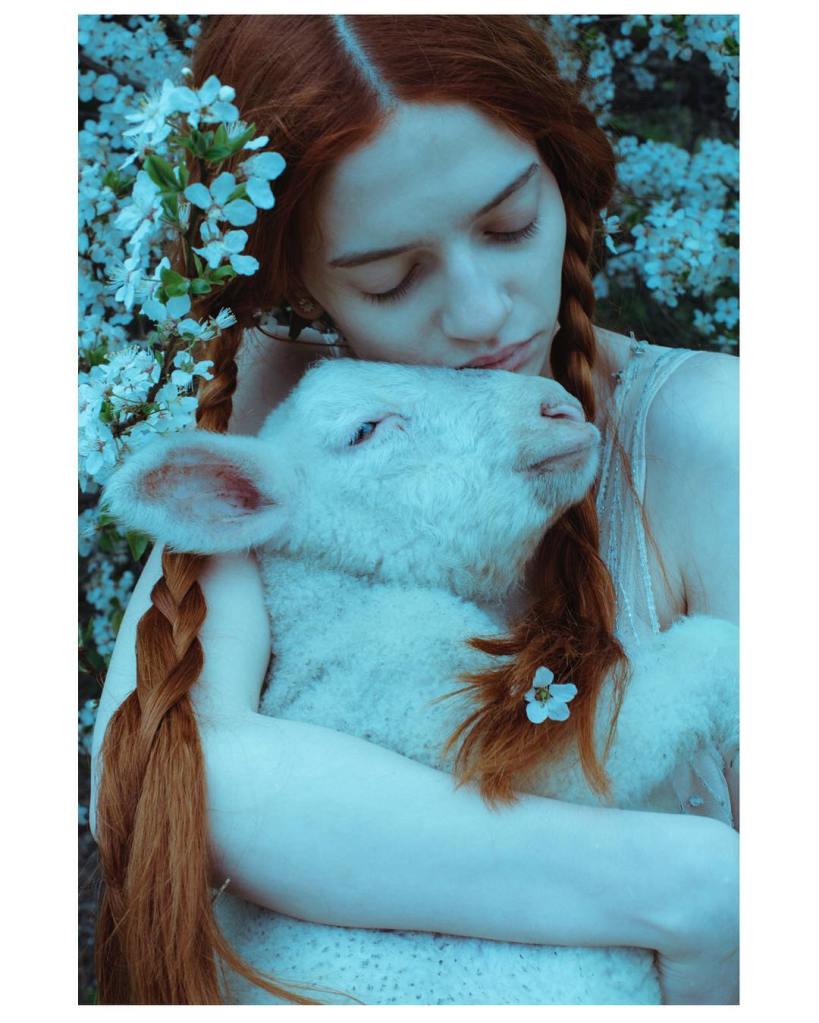
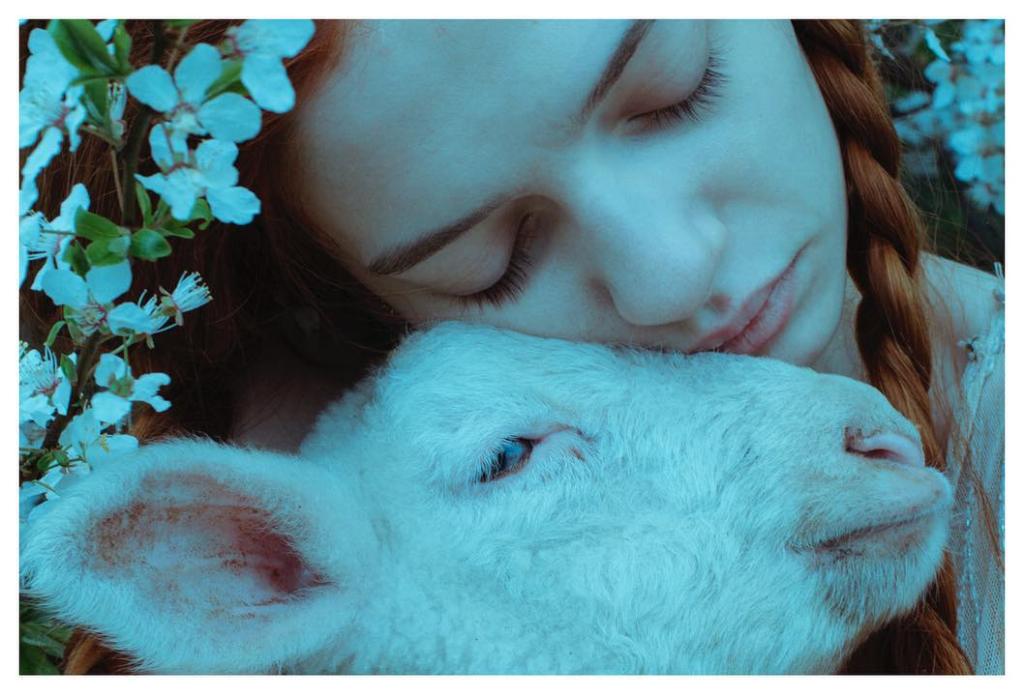
(The above artworks, sourced from Instagram, are from the 2019 series The Shepherd by Laura Makabresku, a fine-art photographer from Poland whose work is influenced by her Catholic faith and by fairy tales.)
Here is a selection of other songs from the playlist:
>> “Adonai Ro’i” is a setting of the original Hebrew of Psalm 23 by Jamie Hilsden of Misqedem, a band from Tel Aviv, Israel, that is heavily influenced by Middle Eastern and North African music styles, often utilizing microtonal scales, irregular time signatures, and regional instruments. The song is sung by Shai Sol. (Available on Bandcamp.)
>> “The Lord Is My Shepherd” by Paul Zach of the United States:
>> “El Señor es mi Pastor” by Omar Salas of the Dominican Republic, a salsa song:
>> “Ke Na Le Modisa” by the Soweto Gospel Choir, sung live at the Nelson Mandela Theatre in Johannesburg in 2008. The song is in Sotho, an official language in South Africa and Lesotho.
>> “The Shadow Can’t Have Me” by Arthur Alligood:
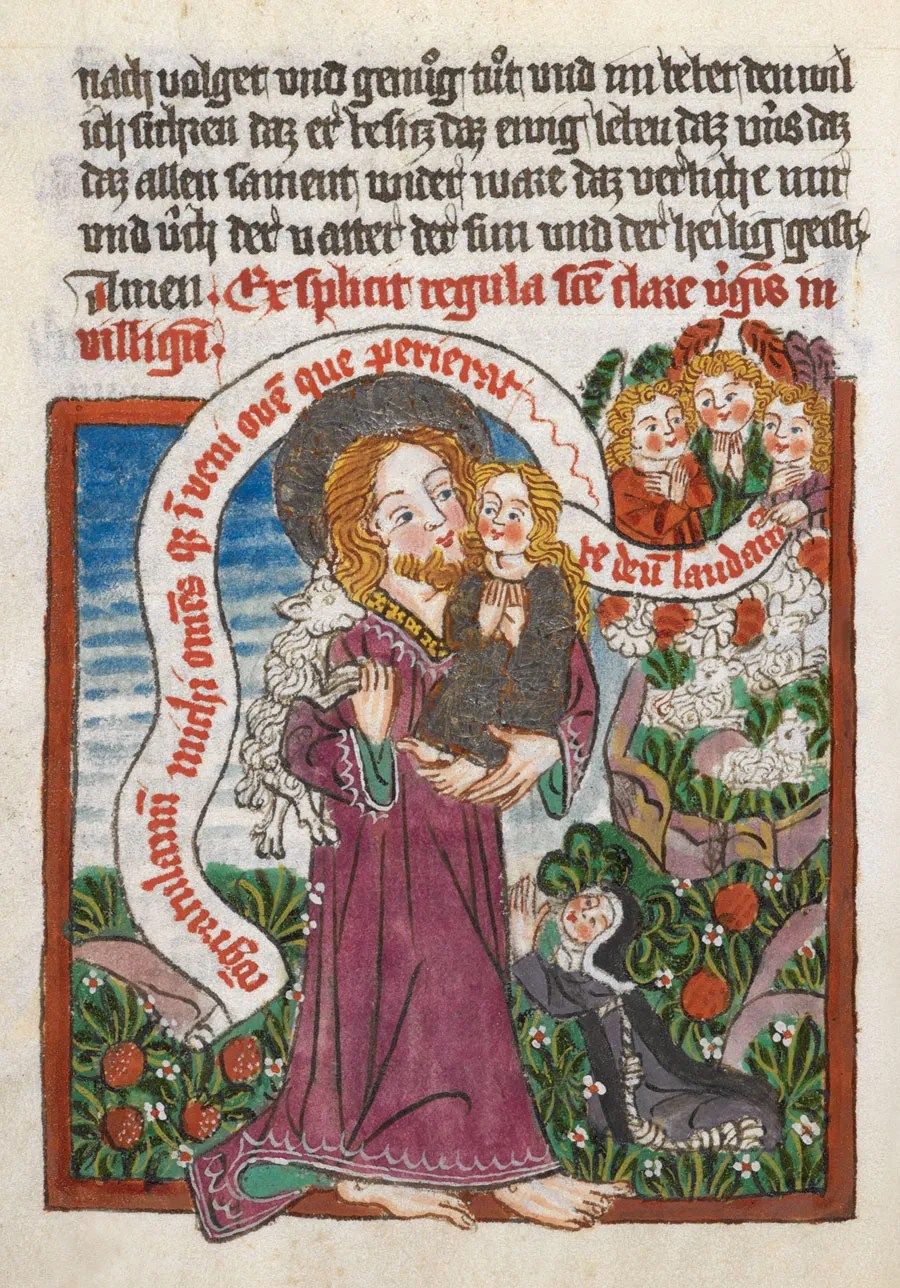
>> “Done Found My Lost Sheep,” an African American spiritual sung by Lucy Simpson [previously] for Smithsonian Folkways, based on Jesus’s parable of the lost sheep (Luke 15:1–7):
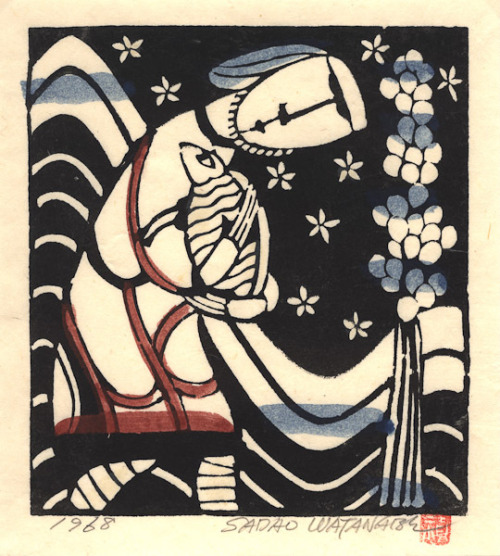
Illustration by the nun Sibylla von Bondorf (German, ca. 1440–1525), from a copy of the Clarrissan Rule, Freiburg, ca. 1480. Opaque pigments on parchment, 15 × 10 cm. London, British Library, Add. MS 15686, fol. 30v. The banderole reads, “Rejoice with me, for I have found my sheep that was lost” (Luke 15:6). [HT]Sadao Watanabe (Japanese, 1913–1996), Good Shepherd, 1968. Katazome stencil print.
>> “Our Psalm 23” by Gabriella Velez, Kevin Dailey, Justin Gray, and JonCarlos Velez of Common Hymnal, featuring Sharon Irving:
The high point of the church year, Easter is a fifty-day festal season, beginning today, that celebrates the Resurrection of Christ with concentrated vigor! The first eight days of Easter are called the Easter Octave. During this octave I will be publishing daily art-and-song posts, as I did for Holy Week, in the hopes that these works of beauty will help you to bask, wonder, and rejoice in the world-changing truth that Christ is risen.
LOOK: Alleluia by Helen Siegl
Helen Siegl (Austrian/American, 1924–2009), Alleluia, 1975. Color woodcut, 20.5 × 12 cm.
Jesus flipped the script on death! On the bottom of this woodcut, Jesus hangs dead on a tree. The sun and moon have gone black. In the center of the composition, a large crown of thorns encircles instruments of the passion: the titulus, the rooster, the three nails, the spear, the sponge-tipped reed, the scourge, the bread and the wine. But Jesus emerges victorious from the whole ordeal. The serpentine creature that bares its teeth could be read as the serpent from Genesis, whom God prophesied would have his head crushed by the offspring of Eve (Gen. 3:15), or as the sea monster from the book of Jonah as an allegory of the tomb in which Jesus spent three days before emerging anew (Matt. 12:38–41). Sun, stars, planets—the cosmos rejoices. Its Savior has risen.
LISTEN:“Praise the Savior, Now and Ever” | Original Latin words by Venantius Fortunatus, 569 CE; adapted into Swedish by Johan Olaf Wallin, 1819; translated into English by Augustus Nelson, 1925 | Music: American shape-note tune (HOLY MANNA), attributed to William Moore, 1829 | Performed by the musicians of Redeemer Presbyterian Church, Indianapolis, 2007
Praise the Savior, now and ever; Praise him, all beneath the skies! Prostrate lying, suff’ring, dying On the cross, a sacrifice. Vict’ry gaining, life obtaining, Now in glory he doth rise.
Man’s work faileth, Christ’s availeth; He is all our righteousness. He, our Savior, has forever Set us free from dire distress. Through his merit we inherit Light and peace and happiness.
Sin’s bond severed, we’re delivered; Christ has bruised the serpent’s head. Death no longer is the stronger, Hell itself is captive led. Christ has risen from death’s prison; O’er the tomb he light has shed.
For his favor, praise forever Unto God the Father sing; Praise the Savior, praise him ever, Son of God, our Lord and King. Praise the Spirit; through Christ’s merit He doth us salvation bring!
This song has its roots in one of the oldest Easter hymns, “Pange, lingua, gloriosi proelium certaminis” (Sing, My Tongue, the Glorious Battle)—from the sixth century. It’s been copiously translated and adapted over the years. This version comes from Redeemer Indy, a Presbyterian church in Indianapolis. While working as a worship director there in the 2000s, Bruce Benedict found the English text in the Trinity Hymnal and paired it with the shape-note tune HOLY MANNA to give it an “Easter jamboree vibe,” arranging it for bluegrass instruments.
The Psalter Hymnal Handbook notes, “The text sets forth the gospel of Easter: Christ who died has risen in victory (st. 1), has set us free from sin (st. 2), and has conquered death and hell itself (st. 3); to that confession we respond with our praise—a doxology to the Trinity (st. 4).”
How condescending and how kind Was God’s eternal Son! Our mis’ry reached his heav’nly mind, And pity brought him down.
When justice, by our sins provoked, Drew forth its dreadful sword, He gave his soul up to the stroke Without a murmuring word.
He sunk beneath our heavy woes, To raise us to his throne; There’s ne’er a gift his hand bestows But cost his heart a groan.
This was compassion like our God, That when the Savior knew The price of pardon was his blood, His pity ne’er withdrew.
Now though he reigns exalted high, His love is still as great: Well he remembers Calvary, Nor should his saints forget.
Here we behold his bowels roll, As kind as when he died; And see the sorrows of his soul Bleed through his wounded side.
Here we receive repeated seals Of Jesus’ dying love; Hard is the heart that never feels One soft affection move.
Here let our hearts begin to melt While we his death record, And with our joy for pardoned guilt, Mourn that we pierced the Lord.
Virginia musician Timothy Seaman plays a variety of instruments, including the hammered dulcimer, mountain dulcimer, various flutes and whistles, bowed and plucked psalteries, and guitar. He has recorded fifteen albums featuring his instrumental arrangements of traditional music (especially American mountain and Scots-Irish tunes), as well as original compositions, many of them inspired by local wildlife and nature and by the Christian faith. He has eight years’ worth of videos on his YouTube channel, a mix of tutorials and informal performances. For this time of year especially, I’d also commend to you another of his Appalachian folk hymn arrangements, “Behold the Lamb of God” on hammered dulcimer.
Of “Condescension,” he writes,
In 1986 I found this profound folk hymn in an old book, and I’ve loved to play and sing it ever since—but not till now have I recorded it. I’ve considered ensemble arrangements with intriguing chords and rhythms, etc., but I keep coming back to a cappella bamboo flute, or voice. Here it is in its instrumental form! The tune is anonymous, and the words are by the master hymn writer Isaac Watts.
The mention of rolling bowels in the sixth stanza may sound strange to us today (sounds like a digestive issue!), but traditionally, the bowels were regarded as the seat of tender and sympathetic emotions—felt in the gut. Several of the biblical authors mention the moving of that organ in relation to yearning, anguish, compassion, or mercy (e.g., Gen. 43:30; Isa. 63:15; Jer. 4:19; 1 John 3:17). The KJV translation preserves the expression, still commonly used in the seventeenth century, with literalness, translating the Hebrew mēʿêand Greek splagchnon as either “bowels,” “belly,” or “inward parts.” Today we locate such emotions in the heart instead.
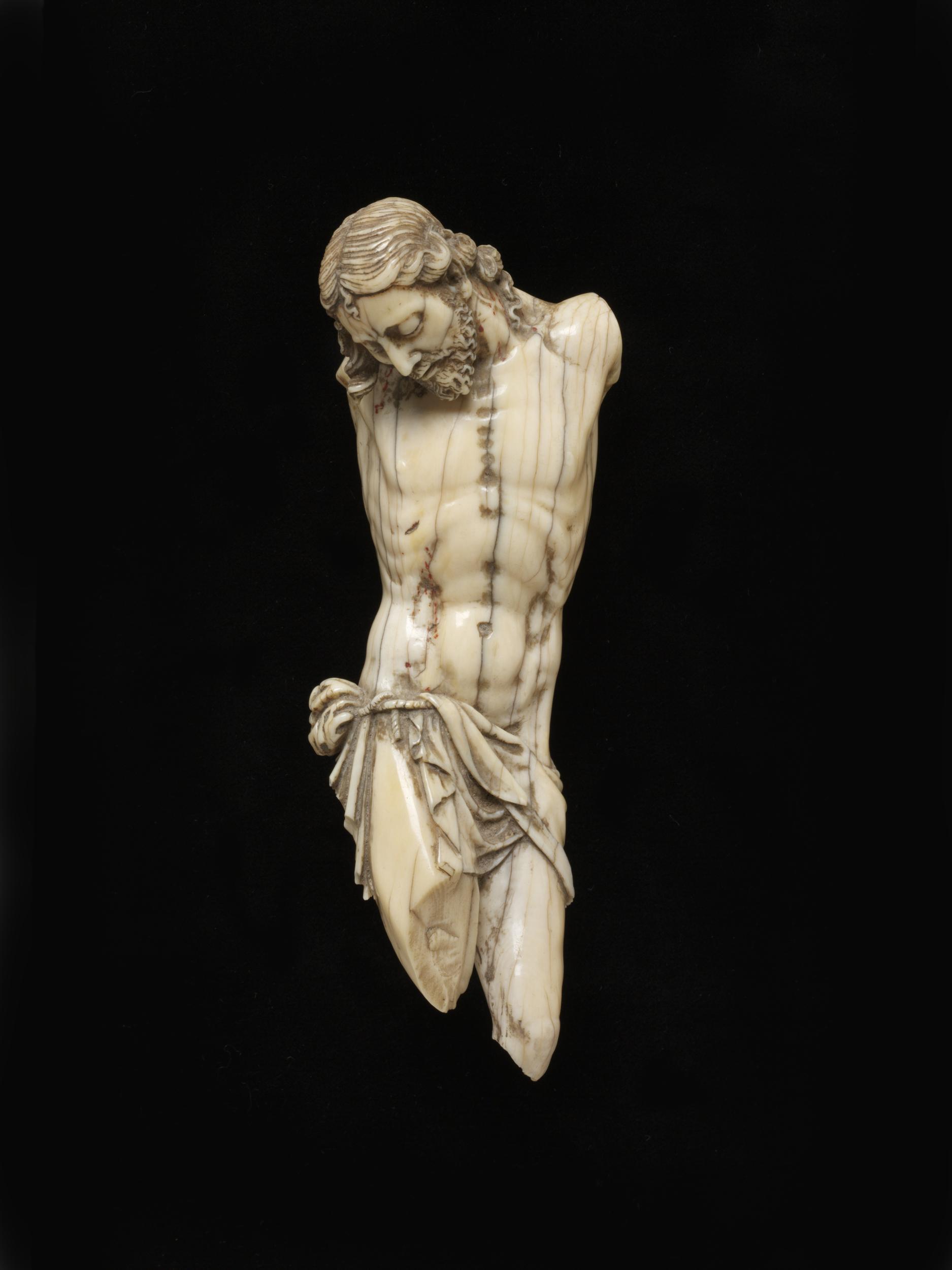
This stanza is actually my favorite in the hymn. There’s such a poetic quality to it! Watts is meditating on Christ exalted, who is not at all impassive in that high estate, but rather is still moved to compassion for humanity, every bit as much as when he hung on the cross. He still bears the wounds of crucifixion, and, in a figurative sense, those wounds still bleed for us.
Here we behold his bowels roll, As kind as when he died; And see the sorrows of his soul Bleed through his wounded side.




 Art & Theology