
Easter, Day 3: Christ Is the Song

The flowers appear on the earth; the time of the singing of birds is come, and the voice of the turtle[dove] is heard in our land.

—Song of Solomon 2:12 (KJV)

LOOK: Mann mit Vögeln by Max Hunziker
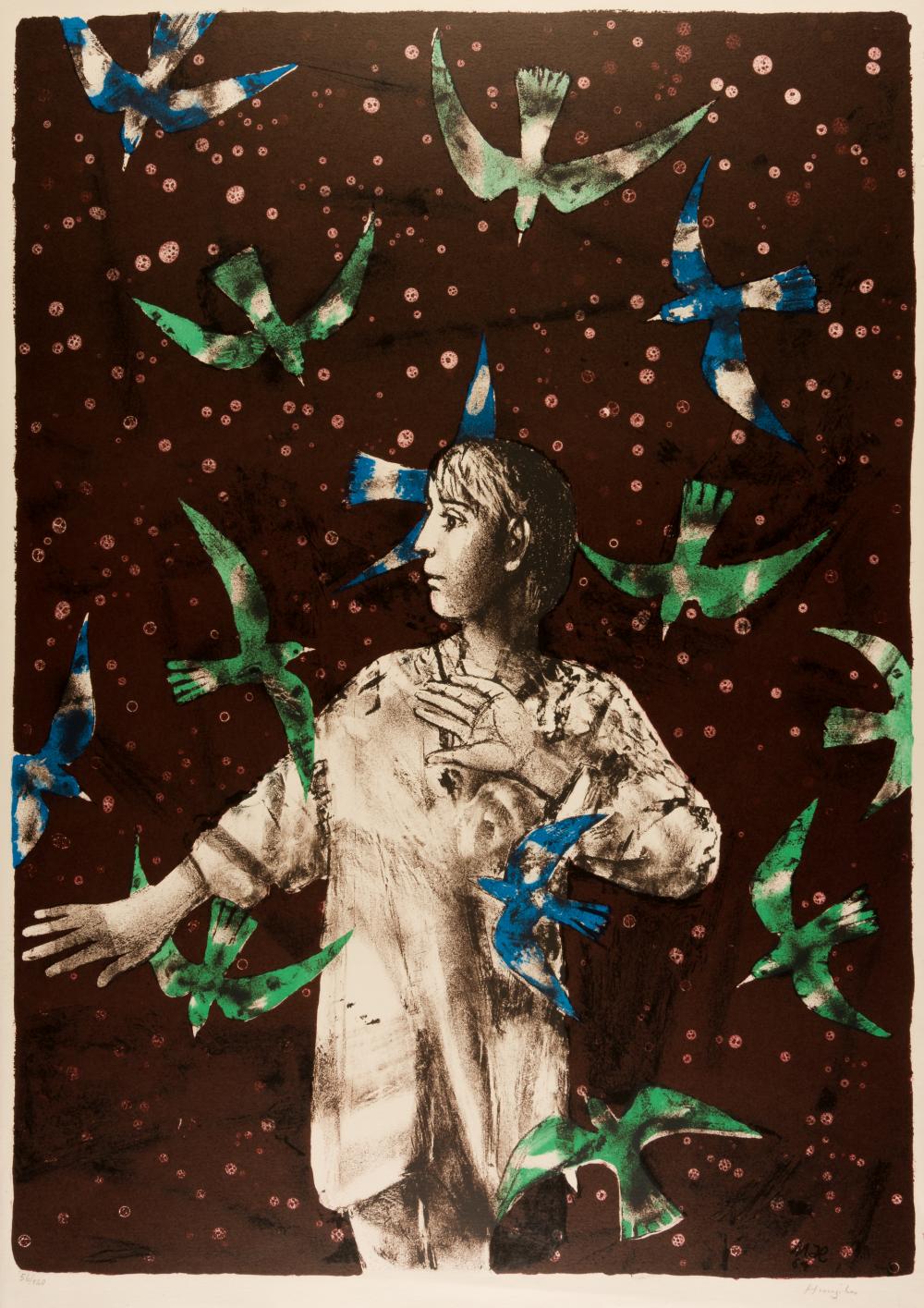
Hunziker, Max_Man with Birds
Max Hunziker (Swiss, 1901–1976), Mann mit Vögeln (Man with Birds), n.d. Lithograph, edition 56/120, 81 × 58 cm.

LISTEN: “The Song of the Birds” | Words by Arthur Cleveland Coxe, 1862 | Music by Wilder Adkins, 2023 | Performed by Wilder Adkins with Eliza King on Cardiphonia’s Resurrect, vol. 1, 2023

The winter is over and gone at last;
The days of snow and cold are past.
Over the fields the flowers appear;
It is the Spirit’s voice we hear, voice we hear.

Refrain 1:
The singing of birds, a warbling band,
And the Spirit’s voice,
The voice of all truth,
And the fountain of youth
Is heard in our land, is heard in our land.

The tomb, it was sealed, a rock at its door;
But winter is gone and comes no more.
The seal is broken and now are seen
Valleys and woods and gardens green, and gardens green.

Refrain 2:
The singing of birds, a warbling band,
And flowеrs are words
Which even a child,
So free and so wild,
May undеrstand, surely understand.

And Christ is the song of everything,
For death is winter, and Christ is spring.

Fountains that warble in purling words,
Hark, how they echo the song of birds, the song of birds.

Refrain 3:
The singing of birds, a warbling band,
And the purling words
Of sea and of surf
And mountain streams pure,
Are heard in our land, are heard in our land.

This hymn text originally appeared in A New Service and Tune Book for Sunday School by Alfred Bailey Goodrich (Utica, New York, 1862), and its author, Rev. Dr. A. Cleveland Coxe, the second Episcopal bishop of Western New York, later compiled it in his collection of original poems The Paschal: Poems for Passion-tide and Easter (New York, 1889). Wilder Adkins has lightly adapted it and set it to music—a light, gentle, lilting melody.

Many hymns connect springtime, with its flowering abundance and sunshiny warmth, to Christ’s resurrection. But Coxe bowled me over with these two lines that articulate the metaphor so freshly: “And Christ is the song of everything, / For death is winter, and Christ is spring.” Wow!

“An Easter Carol” by Christina Rossetti (poem)

Woman gathering flowers (Stabiae)
Woman gathering flowers, first century CE. Detached fresco, 38 × 32 cm, from the Villa Arianna in Stabiae, Campania, Italy, now in the Collection of the Museo Archeologico Nazionale di Napoli, Naples, Italy. The woman may be Primavera (a personification of spring) or Flora (the Roman goddess of flowers, fertility, and abundance), or simply a generic maiden at leisure.

Spring bursts today,
For Christ is risen and all the earth’s at play.

Flash forth, thou Sun,
The rain is over and gone, its work is done.

Winter is past,
Sweet Spring is come at last, is come at last.

Bud, Fig and Vine,
Bud, Olive, fat with fruit and oil and wine.

Break forth this morn
In roses, thou but yesterday a Thorn.

Uplift thy head,
O pure white Lily through the Winter dead.

Beside your dams
Leap and rejoice, you merry-making Lambs.

All Herds and Flocks
Rejoice, all Beasts of thickets and of rocks.

Sing, Creatures, sing,
Angels and Men and Birds and everything.

All notes of Doves
Fill all our world: this is the time of loves.

This poem was originally published in A Pageant, and Other Poems (London, 1881) and is in the public domain.

One of the most celebrated poets of the Victorian era, Christina Georgina Rossetti (1830–1894) was an English writer of Romantic, devotional, and children’s poems. She was the youngest of four siblings, among them the Pre-Raphaelite artist Dante Gabriel Rossetti, several of whose paintings she sat for, famously modeling for the Virgin Mary. A devout Anglican whose verse gives vivid expression to the life of faith and to spiritual longing, she is recognized as a saint by the Church of England and the Episcopal Church, who celebrate April 27 as her feast day.

A version of Hildegard of Bingen’s “Ave generosa” by Gabriele Uhlein

Hudyma, Olesya_Ukrainian Madonna
Olesya Hudyma (Ukrainian, 1980–), Ukrainian Madonna, 2021. Oil on canvas.

Mary,

God delights in you so much,
God was so taken with you,
he sank his love’s fire
deep within you.

So much love he gave you,
that with it you nurture his son.

So full of ecstasy is your body
that it resounds with heaven’s symphony.

Your womb exults.

It exults like the grass,
grass the dew has nestled on,
grass the dew has infused with verdant strength.

That is how it is with you,
Mother of all joy.

From Meditations with Hildegard of Bingen, introduction and versions by Gabriele Uhlein (Rochester, VT: Bear & Company, 1983). Used by permission of Inner Traditions International. All rights reserved.

This book is the first time Hildegard’s writings appeared in English. In selecting, translating, and adapting the material for it, Uhlein worked from the German critical editions of De Operatione Dei (1965), Liber Vitae Meritorum (1972), and Hildegard’s letters (Briefweschel) (1965) and songs (Lieder) (1969), all published by Otto Müller Verlag in Salzburg.

For the original Latin of the above hymn and a more straightforward translation by Nathaniel M. Campbell, see here. This link also includes a musical performance of the Latin (Hildegard wrote her own lyrics and music!).


Hildegard of Bingen, OSB, (ca. 1098–1179) was a German Benedictine abbess, theologian, preacher, poet, composer, playwright, and medical writer and practitioner. She founded the monasteries of Rupertsberg and Eibingen and was named a “doctor of the church” by Pope Benedict XVI in recognition of “her holiness of life and the originality of her teaching.” Hildegard’s most significant works are her three volumes of visionary theology: Scivias (Know the Ways) (for which she also supervised miniature illuminations), the Liber Vitae Meritorum (Book of Life’s Merits), and the Liber Divinorum Operum (Book of Divine Works). But she is also well known for her liturgical hymns and antiphons, as well as the many letters she wrote to popes, emperors, abbots, abbesses, fellow mystics, and layfolk, dispensing wisdom and advice.

Gabriele Uhlein, OSF, (born 1952) is a retreat guide, workshop leader, and artist dedicated to the recovery of the Christian mystical tradition and the honoring of intuition and creativity in spiritual deepening. Born in Klingenberg, Germany, she emigrated to the US at age two. She has a PhD in process theology and Jungian-oriented psychology from Chicago Theological Seminary and is a member of the core staff at the Christine Center, a natural sanctuary in Willard, Wisconsin, rooted in the Franciscan principles of contemplation, hospitality, compassion, simplicity, transformation, and care for the earth.