Pentecost roundup: “All Flesh” by Steve Thorngate, animated fabrics, and more

LIVING PRAYER PERIODICAL: Pentecost 2024: The latest edition of the Daily Prayer Project’s Living Prayer Periodical is available for purchase! Pentecost is this Sunday, May 19, so grab your copy soon. The booklet provides a distinct liturgy of scripture and prayer for each day of the week, through August 31, as well as art with accompanying reflections, songs, spiritual practice essays, and, new this issue, a poem! I curate the art and poetry for the DPP. The cover image is cropped from a painting by the Guatemalan artist Juan Francisco Guzmán (it’s reproduced in full in the interior). And the poem we feature, which I wrote a short commentary for to help readers engage it more meaningfully, is “Not Like a Dove” by Mary F.C. Pratt; I’m grateful to the directors for taking a risk with this unusual, even difficult, poem, which rewards those willing to sit with its imagery over time.
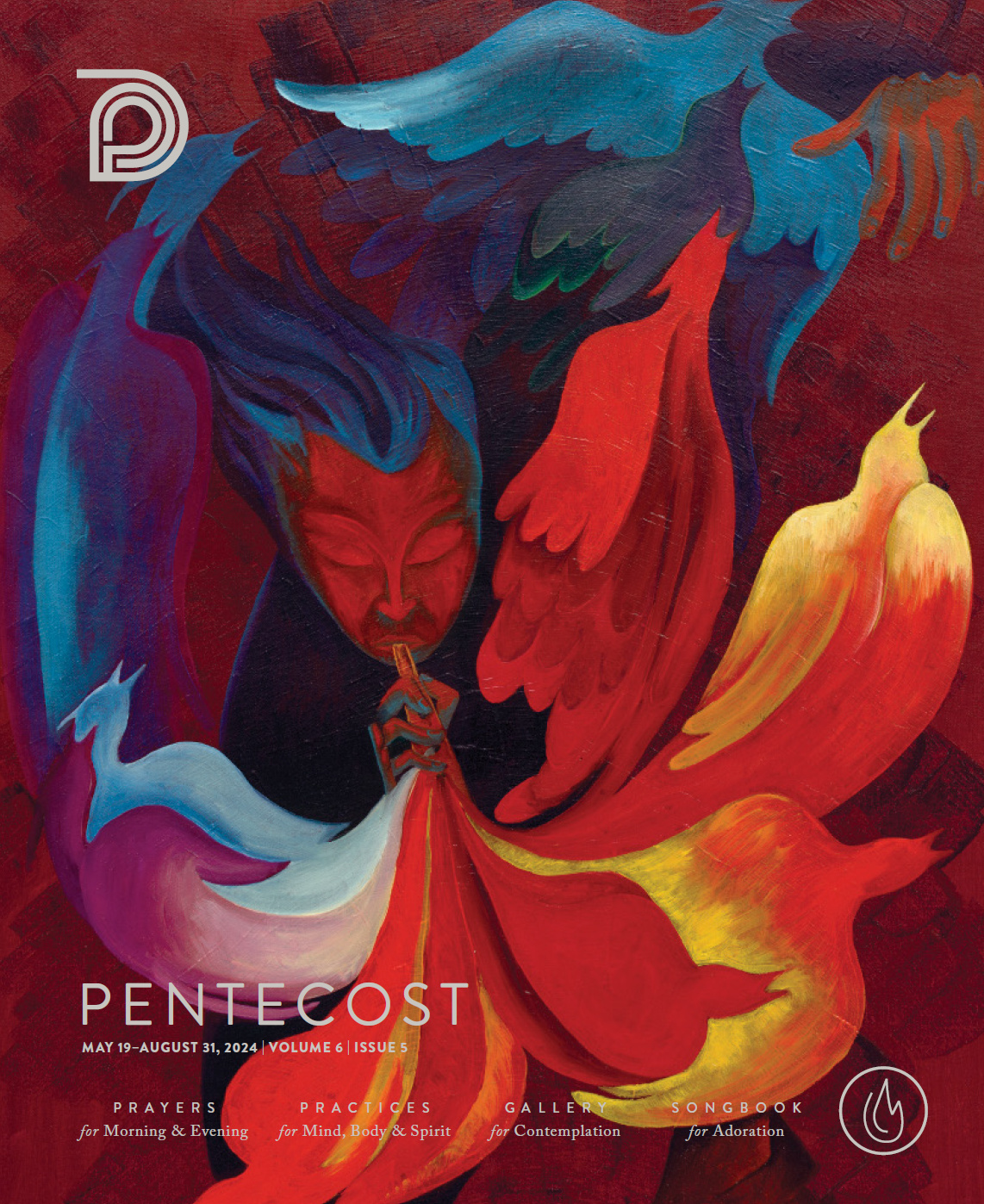
Pentecost LPP 2024

+++

SERMON (text only): “When the Spirit Comes” by N. T. Wright: Preached May 23, 2010, at Durham Cathedral, where he was bishop at the time, this Pentecost sermon by the esteemed N. T. Wright is a rousing call to stand, like Jesus, at the place where heaven and earth collide: in the Spirit. Here are two excerpts:

  • “The point about Pentecost is that it’s the point at which two worlds collide and look like they are now going to be together for keeps. The two worlds are of course heaven and earth. . . .
              The whole point of heaven and earth in Jewish thought is that they are meant to meet and merge. And the point of the gospel story as Luke has told it in his first volume is that Jesus had come to bring the life of heaven and earth together. That is the meaning of the ‘kingdom of God’. Thy kingdom come, he taught us to pray, on earth as in heaven. The disciples, we may presume, had been praying that prayer, among others, in the fifty days since Easter. And now the prayer is answered.”
  • “When the Spirit comes, the Spirit will prove the world wrong [in how things are run] . . . which is not a comfortable message, and it’s not meant to be. But if we can at least recognise that discomfort, and see it as the thing you should expect when the two worlds collide, we can put our shoulders back, take a deep breath – in other words, breathe in God’s breath – and get on with the task to which the New Testament commits us but in which . . . we feel a strange reluctance.
              Of course we can get it wrong, and of course we will find it awkward. But how much more wrong would it be not to try! How much more awkward, when God finally brings heaven and earth fully together, will it be to discover that we had continued to live in the split-level world when we were invited, by Ascension and Pentecost together, to dare and to risk the possibility of bringing them together in our own lives and in our own witness! Because of course none of this is in the last analysis ‘about’ us. If we are embarrassed at the heaven-and-earth conjunction, we are forgetting that we are not, after all, the centre of attention in all this. Jesus went on to say that the Spirit would glorify him, not us: he will take what belongs to Jesus and declare it to us and through us to the world.”

+++

MUSIC:

>> “All Flesh” by Steve Thorngate: This playfully serious song is rooted in Joel 2:28–29, which Peter quotes in his sermon at Pentecost: “I will pour out my spirit on all flesh; your sons and your daughters shall prophesy, your old men shall dream dreams, and your young men shall see visions. Even on the male and female slaves, in those days I will pour out my spirit.” Thorngate wrote it several years ago, but this recording, new this year, is the first he’s released, and it’s available only on Bandcamp for now.

>> “Ruach” by Delvyn Case, performed by the Mivos Quartet: Inspired by the story of Pentecost in Acts 2, this sacred concert work for string quartet, writes composer Delvyn Case, “bring[s] to our awareness many different ways ‘breath’ and ‘spirit’ can become sonically and dramatic present. Throughout the piece the performers are asked to make various kinds of breath sounds with their instruments and their own voices, blurring the line between music and sound. Overall, the piece emphasizes idea of the spirit as a powerful force that is surprising, shocking, and fundamentally resistant to control.”

>> “Sweet, Sweet Spirit” by Doris Akers, performed by Ruah Worship: Consisting of siblings Joshua Mine, Julia Mine, Erika Grace Izawa, and Marian Mine, Ruah Worship from Japan performs original worship songs as well as covers. I especially love their a cappella arrangements of Black gospel songs. Here they sing a song by Gospel Music Hall of Famer Doris Akers (1923–1995), about the sweetness of the Holy Spirit, who revives communities and fills them with love.

+++

ART INSTALLATION: Fanions et Carillons by Pinaffo & Pluvinage: I learned of this kinetic sculpture by the French artist duo Marion Pinaffo (b. 1987) and Raphaël Pluvinage (b. 1986) in a Colossal article in February and thought of the movement of the Holy Spirit. Fanions et Carillons, French for “Pennants and Chimes,” was commissioned by Fontevraud Abbey and was on display earlier this year in one of the abbey’s twelfth-century chapels. Inspired by the historical striking clocks of churches, the automaton comes to life every half hour, sending fourteen pennants of blue, red, pink, and purple swinging and swirling.
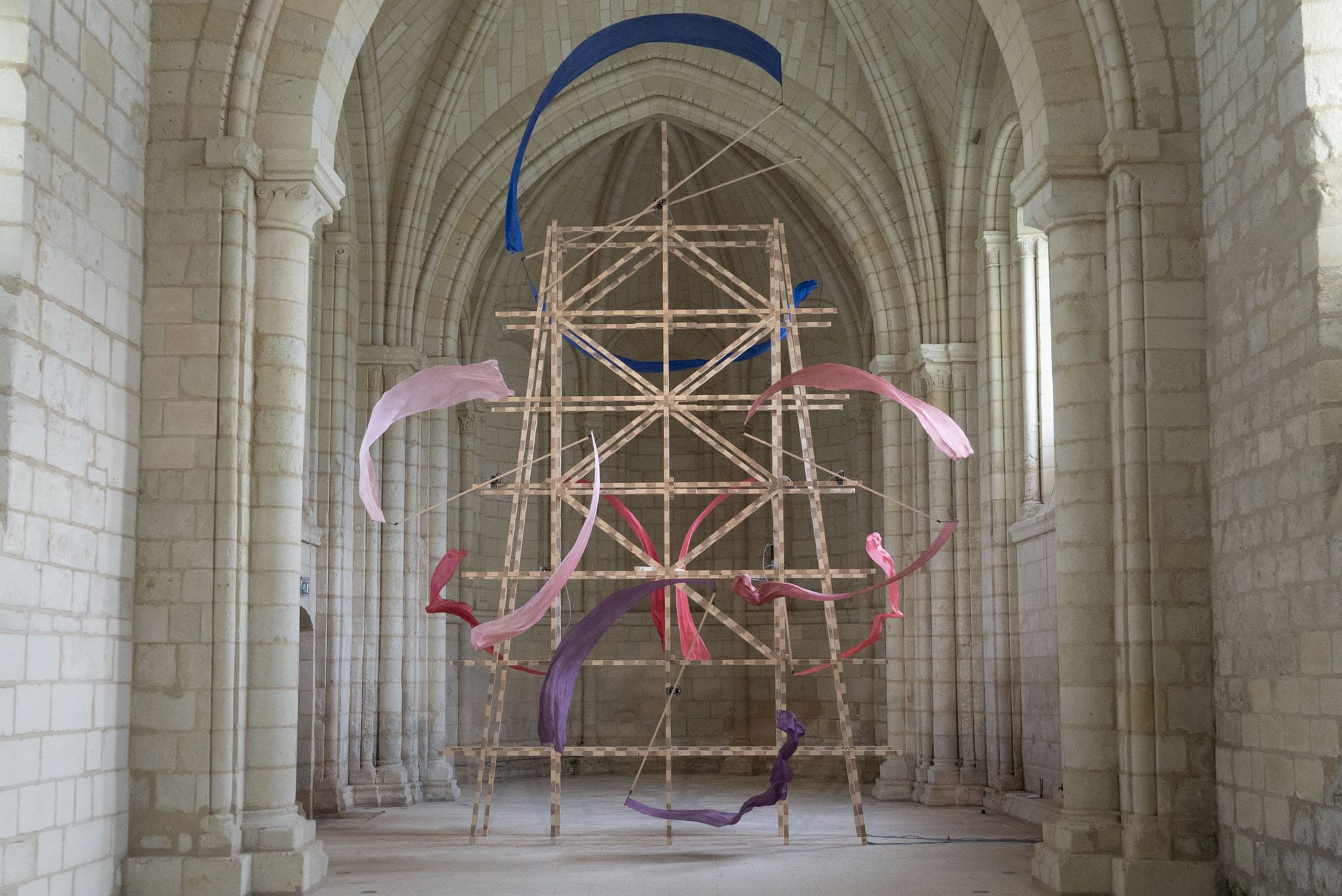
Fanions et Carillons
Marion Pinaffo and Raphaël Pluvinage (aka Pinaffo & Pluvinage), Fanions et Carillons, 2023. Painted wood, motor, silk, electronic, 4 × 2 × 7 m. Temporary installation at the Chapelle St-Benoît, Abbaye Royale de Fontevraud, Anjou, Maine-et-Loire, France.

On their website, Pinaffo & Pluvinage write of the piece, “Although its mechanics are simple and rudimentary, using rotational or pendulum movements, it doesn’t produce the sound of bells, but rather animates fabrics. A set of 14 inert pennants awaken in turn to create ephemeral forms that mutate, respond and compose. Like a harmony of chimes creating a melody, this ensemble creates a choreography lasting a few minutes at regular intervals.” Whereas one might associate a certain rigidness and predictability with clocks, in this piece there’s a freedom, with the pennants moving at different rates and occasionally reversing direction.

+++

ARTICLE: “Painting Pentecost: Painter Sawai Chinnawong saturates the outpouring of the Spirit with the colors Thai art traditionally associates with the holy” by Amos Yong and Jonathan A. Anderson, Christian Century: Adapted from the book Renewing Christian Theology: Systematics for a Global Christianity (Baylor University Press, 2014), this article explores one of the Pentecost paintings of Thai Christian artist Sawai Chinnawong, who adopts and adapts a Thai Buddhist visual vernacular in terms of color choices, design elements, and the gestures and postures of figures. I’m appreciative of how the painting shows both men and women, and even a child, present at Pentecost and being recipients of the gift of the Spirit, as they surely were.
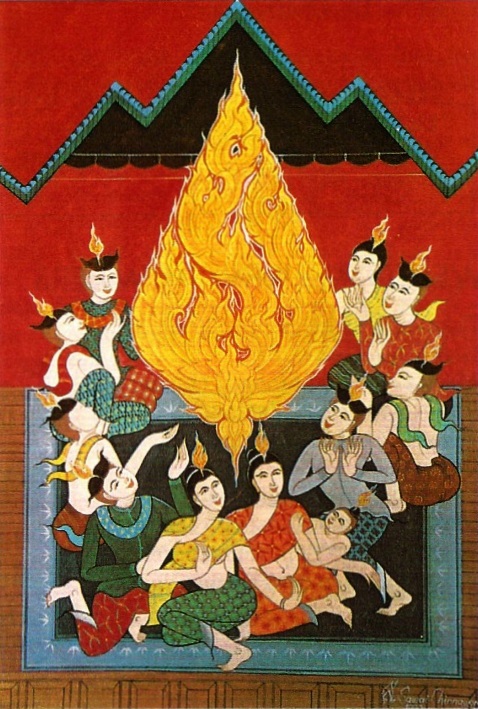
Chinnawong, Sawai_Pentecost
Sawai Chinnawong (Thai, 1959–), Pentecost, 1997. Acrylic on canvas.

(Related post: “Pentecost art from Asia”)

Some Christians are uncomfortable with art that transposes biblical events into other cultural contexts. But I think it’s a beautiful picture of the global character of the gospel, which has taken root in countries all over the world. As the authors write, in addition to celebrating a historic event, Chinnawong’s Pentecost “prompts us to see this as another event altogether: the outpouring of the Spirit in a room in 21st-century Bangkok rather than first-century Jerusalem. Chinnawong sets the scene here not out of disregard for the historical particularity of the original event but as a means of imagining and visually praying for the Spirit’s presence in his own historical moment. For Chinnawong, the Holy Spirit’s filling is not isolated to a single event, a particular moment, or one place but may be repeated at any time and place and for any people. Thus the circle of believers being filled with the Spirit is repeatedly repopulated and renewed.”

Roundup: Biber’s Mystery Sonatas, icons by Maxim Sheshukov, “Mercy at the Movies,” and more

SPOTIFY PLAYLIST: March 2024 (Art & Theology): My new monthly playlist of thirty songs is up a day early and, as usual, includes both recent releases and older favorites. Let me also point you to the longer, thematically distinct playlists I made for Lent, Holy Week, and Eastertide.

+++

CONCERT: Phantasia performs Biber’s Mystery Sonatas, St Hubert’s Church, Corfe Mullen, England, February 17, March 23, and April 13, 2024: The Mysteries of the Rosary are a set of fifteen meditations on episodes in the lives of Jesus and his mother, Mary. They are divided into three groups: the Joyful Mysteries (the Annunciation, the Visitation, the Nativity, the Presentation of the Infant Jesus in the Temple, the Twelve-Year-Old Jesus), the Sorrowful Mysteries (Christ on the Mount of Olives, the Scourging at the Pillar, the Crown of Thorns, Jesus Carries the Cross, and the Crucifixion), and the Glorious Mysteries (the Resurrection, the Ascension, Pentecost, the Assumption of the Virgin, and the Beatification of the Virgin).

Around 1676, the Bohemian Austrian composer Heinrich Ignaz Franz von Biber (1644–1704) wrote fifteen short sonatas for violin and continuo based on these mysteries. In a free three-part event sponsored by Deus Ex Musica, the newly formed period-instrument ensemble Phantasia will be performing Biber’s Mystery Sonatas at St Hubert’s Church, Corfe Mullen, on the south coast of England, accompanied by commentary by musician and educator Dr. Delvyn Case, who will provide thoughts about the ways each sonata reflects its “mystery,” linking specific elements of the musical structure to themes or ideas in the biblical scene. The performance of the first cycle of the work has already passed, but the remaining two are still upcoming: the Sorrowful Mysteries on March 23 (the Saturday just before the start of Holy Week), and the Glorious Mysteries on April 13.

Case tells me that Deus Ex Musica hopes to eventually provide video excerpts from the performances on their YouTube channel. In the meantime, here’s a little teaser, a snippet from the “Presentation in the Temple” movement, performed by Phantasia musicians Emma-Marie Kabanova on Baroque violin and Chris Hirst on German theorbo (long-necked lute).

+++

ARTICLES:

>> “Mercy at the Movies: Ten Films That Flip the Script” by Meaghan Ritchey, Mockingbird: “Spanning almost a century of cinema, this list of films maps a world—real and imagined—devoid of the mercy for which we all have need, as well as a world animated by unexpected and unearned mercies, flipping the script and leaving the plot forever changed.” What a great list! Number 7 is one of my all-time favorite films.

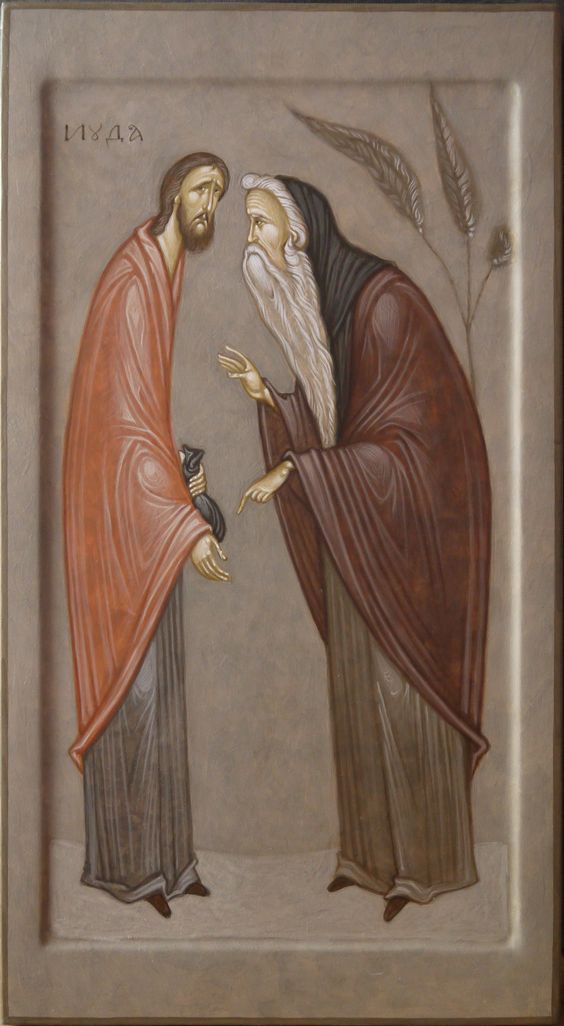
>> “As If Through a Child’s Inner Eye: The Contemporary Icons of Maxim Sheshukov” by Fr. Silouan Justiniano, Orthodox Arts Journal: In this article from 2016, Fr. Silouan Justiniano, a monk at the Monastery of Saint Dionysios the Areopagite on Long Island, explores the work of contemporary iconographer Maxim Sheshukov (Максим Шешуков) of Pskov, Russia, finding it “exemplary of the diversity and flexibility possible within our ever-renewing and living Tradition.”

Sheshukov, Maxim_Zacchaeus
Maxim Sheshukov, Zacchaeus, 2015. Egg tempera on gessoed wood.

Sheshukov, Maxim_Judas
Maxim Sheshukov, Judas, 2020. Egg tempera on gessoed wood.

+++

NEW ALBUMS:

>> Volume 9 (Lent-Easter-Pentecost) of The Soil and The Seed Project: This is the latest release in an ongoing series of music for the church year by musicians of faith from the Shenandoah Valley. Some of my favorite tracks are “I Will Sing to the LORD” (a setting of Psalm 104:33) and “Hosanna, Loud Hosanna” (a newly retuned but old-timey-sounding hymn for Palm Sunday). I also really like “Gentle Shepherd,” a lullaby written for the children of Salford Mennonite Church to sing in worship in 2018 and performed in this music video by the sister folk duo Spectator Bird:

>> Life and Death and Life: Songs for Lent, Holy Week, and Easter by Steve Thorngate: Chicago-based church musician and songwriter Steve Thorngate has followed up his excellent album After the Longest Night: Songs for Advent, Christmas, and Epiphany with an album for the next two seasons of the church year, including the Day of Pentecost! In addition to twelve original songs, it includes two African American spirituals, a Charles Tindley hymn, and, perhaps my favorite, a cover of (new-to-me) Brett Larson’s poetic country song “Rolling Away,” about barriers to sight and wholeness being removed and a fresh new clarity, a freedom, a path opening up:

>> JOY JOY JOY JOY JOY by Paul Zach: The ever prolific Paul Zach of Virginia’s latest release is an effusively joyous ten-track album celebrating God’s love, salvation, and sustenance. He collaborated with other musicians on the project, including Jon Guerra, Tristen Stuart-Davenport, and IAMSON. Here’s a snippet of the opening song, “Nothing,” based on Romans 8 (listen to the full track here):

Advent, Day 25: Our Candles Burn

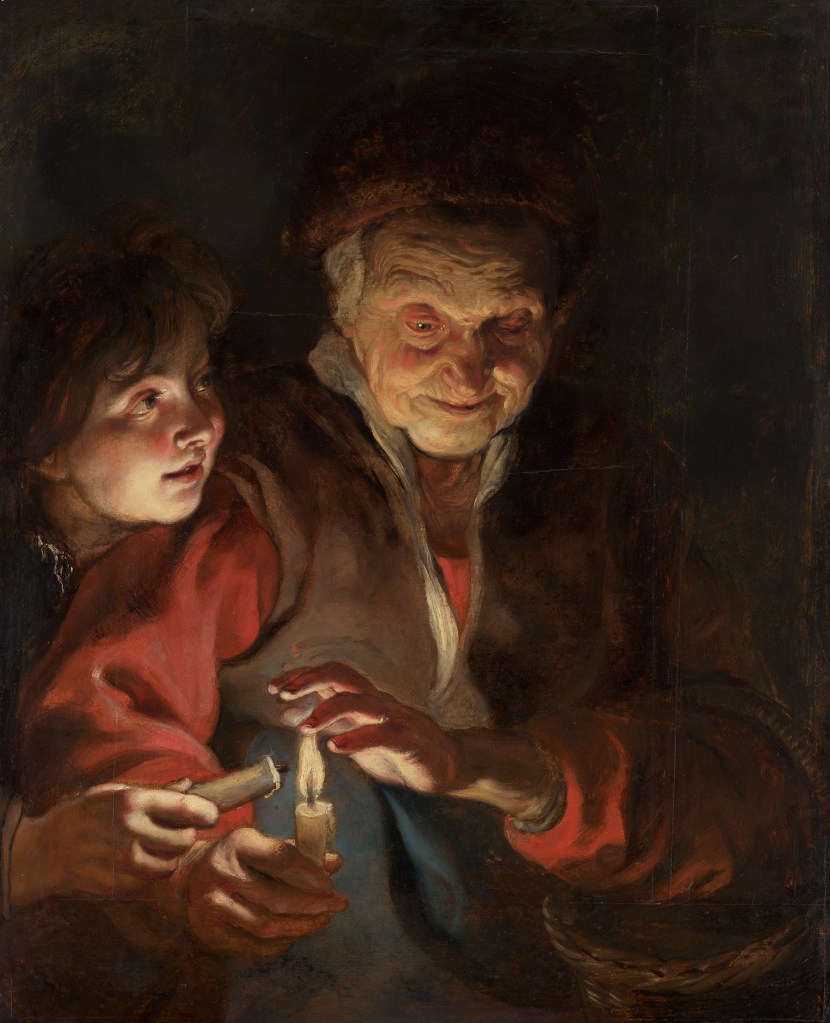
LOOK: Old Woman and Boy with Candles by Peter Paul Rubens

Rubens, Peter Paul_Old Woman and a Boy with Candles
Peter Paul Rubens (Flemish, 1577–1640), Old Woman and Boy with Candles, ca. 1616–17. Oil on panel, 77 × 62.5 cm. Mauritshuis, The Hague, Netherlands.

LISTEN: “The Night Is Long (But Not for Long)” by Steve Thorngate, on After the Longest Night (2018) (sung by Libby Thorngate)

Our nights are long, but they’re getting shorter
Ever since you crossed over our border.
Our candles burn while we wait for dawn.
The night is long, but not for long.

Our hope has come. Our despair is buried.
The light of the world is the child of Mary.
God in our bones, God who knows our song.
The night is long, but not for long.

It seems so hard, harder than it should be,
To see the world the way it could be,
To press right on when hope is almost gone.
The night is long, but not for long.

But this world is good, good enough for Jesus
To come and live a life that frees us,
To bend toward right everything that’s wrong.
The night is long, but not for long.

Our nights are long, but they’re getting shorter.
These growing days show a new order.
Winter will pass. Spring will come along.
The night is long, but not for long.

My Eyes Have Seen (Artful Devotion)

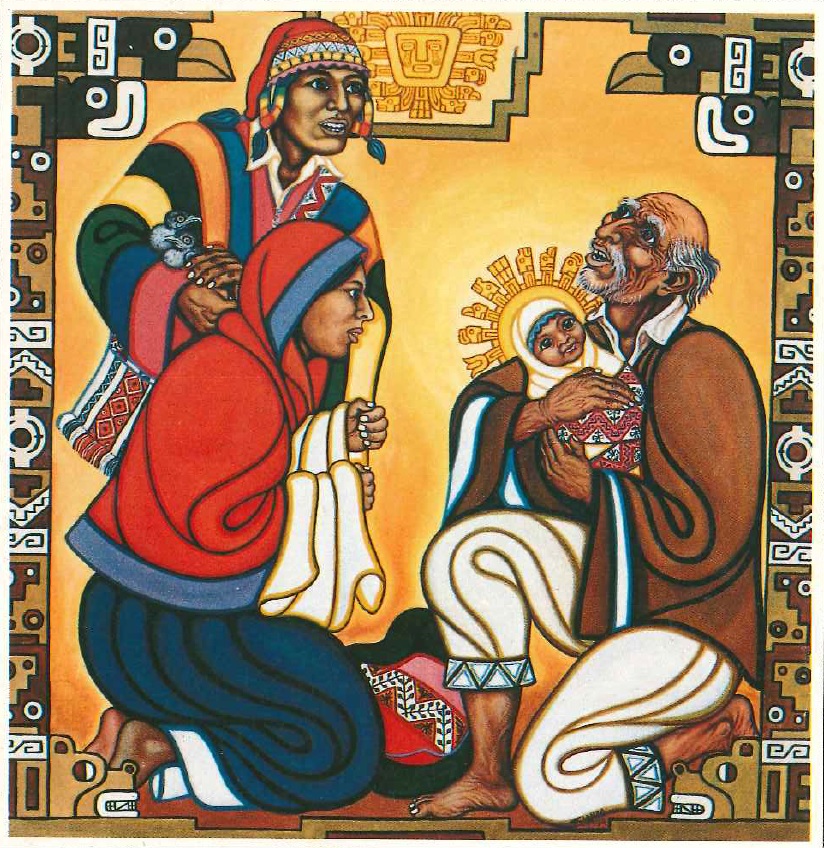
Blanco, Severino_Simeon Blessing the Christ Child
Severino Blanco, Simeon Blessing the Christ Child, 1980s. Image courtesy of Ayopaya Mission.

Now there was a man in Jerusalem, whose name was Simeon, and this man was righteous and devout, waiting for the consolation of Israel, and the Holy Spirit was upon him. And it had been revealed to him by the Holy Spirit that he would not see death before he had seen the Lord’s Christ. And he came in the Spirit into the temple, and when the parents brought in the child Jesus, to do for him according to the custom of the Law, he took him up in his arms and blessed God and said,

“Lord, now you are letting your servant depart in peace,
according to your word;
for my eyes have seen your salvation
that you have prepared in the presence of all peoples,
a light for revelation to the Gentiles,
and for glory to your people Israel.”

—Luke 2:25–32

+++

SONG: “You Send Your Servant Forth in Peace” by Steve Thorngate, on After the Longest Night: Songs for Advent, Christmas, and Epiphany (2018)

+++

Severino Blanco is a Quechuan Christian artist from Cochabamba, Bolivia. In the early 1980s he was commissioned by Father Manfred Rauh (1932–2011), a Jesuit missionary from Germany who spent most of his priestly life in Bolivia, to create a Life of Christ painting cycle for the interior of the chapel of the Casa del Catequista (CADECA), a training center for catechists. To make the gospel story really come alive for the catechists, who are mostly Quechua and Aymara, Blanco chose to set it in an Andean context, with Jesus as an indigenous South American—fully human, fully immersed in history and culture, fully for them. The images are reproduced, with commentary, in the German-language book Von Befreiung und Erlösung: Bilder in CADECA Cochabamba/Bolivien (Of Liberation and Redemption: Pictures in CADECA Cochabamba, Bolivia). A few can also be viewed online here, here, and here. The chapel was consecrated in 1984 and is still in use.

Blanco’s Simeon Blessing the Christ Child is one of the many painted scenes inside the CADECA chapel. Joseph, dressed in poncho and chullo (knitted hat with earflaps), carries two little birds to present as an offering for his son’s dedication. Mary, barefoot, is dressed in a red hooded shawl and a long blue skirt—the colors traditionally associated with Mary in the West—and has just laid down what I’m guessing might be an aguayo, the sling she uses to transport Jesus on her back. (Or perhaps it’s Simeon’s hat, which he removed in reverence?) As for Jesus, he is swaddled in colorful, patterned, homespun wool. When Mary passes the babe to Simeon, he is elated to receive into his arms salvation incarnate. He turns his eyes upward to God the Father, whose presence is suggested by a golden sun-face, whose rays shine forth also in the halo of the Son. The designs on these terminals, and around the border of the painting, are deeply influenced by traditional Andean art.

“A light for revelation to the Gentiles,” salvation prepared for “all peoples”—these phrases from the lectionary jingle in my ears as I meditate on Blanco’s painting.

+++

Here are the Artful Devotions for Candlemas from the previous two church year cycles:


This post belongs to the weekly series Artful Devotion. If you can’t view the music player in your email or RSS reader, try opening the post in your browser.

To view all the Revised Common Lectionary scripture readings for the feast of the Presentation of the Lord, cycle A, click here.

Roundup: Peaceable Kingdom; Mary Poppins; art writing contest; “On Reading Well”; new Advent/Christmas albums

Congrats to the three winners of the Wounded in Spirit book giveaway. Thank you all for entering. I will be giving away another free book, from Eerdmans, sometime in the next month or two, so stay tuned!

+++

The Peaceable Kingdom (detail) by Edward Hicks
A bear and a cow share a snack of grass, and a child pets a leopard without consequence, in this charming little detail from Edward Hicks’s 1834 Peaceable Kingdom in the National Gallery of Art.

ADVENT ART VIDEO: The Peaceable Kingdom by Edward Hicks: This year I was invited to make a guest contribution to art historian James Romaine’s annual Art for Advent video series on YouTube. For 2018, he is spotlighting paintings from the National Gallery of Art in Washington, DC, my neck of the woods. I chose to write about The Peaceable Kingdom by the nineteenth-century Quaker preacher-artist Edward Hicks, which visualizes the prophecy of Isaiah 11 about predators and prey lying down together in friendship, and a little child leading them. But Hicks’s image of “peace on earth” is not as simplistic as it may seem at first; there is tension. See the video below, and be sure to check back on the Seeing Art History YouTube channel next week for subsequent videos. For more on Hicks and this favorite subject of his, see this post of mine from 2016. Thank you to Rain for Roots for letting me use their wonderfully playful musical rendition of Isaiah 11 from their family Advent album Waiting Songs.

+++

Mary Poppins

PODCAST EPISODE: “Mary Poppins,” Technicolor Jesus, episode 49: “If you want a movie that really shows the foolishness of the gospel next to what the world thinks is wise and is turned on its head . . . if you want a movie about the great reversals that are present in the kingdom of God, you don’t need to look any further than Mary Poppins,” says Pastor Becca Messman. The oppressive orderliness booming over people’s lives “is contrasted with something unpredictable and joyful—the wind, dancing chimney sweeps, and this beautiful bird woman giving her crumbs away.” The movie is about what happens when both adults and kids relax into joy.

It’s also about charity. Last year Niles Reddick wrote an article about Mary Poppins as the first female Christ figure in American film, and “Feed the Birds” as a “song-parable” that serves as the linchpin of the movie. While the world would have us pile up our coins in a bank vault, Jesus calls us, against the world’s wisdom, to give them away.

Feeding the Birds (Mary Poppins)

I love this movie. My mom says that from a young age she would play it for me, and I would sit mesmerized for the entire 139 minutes. I remember trying to soothe my baby brother many a time by singing “Let’s Go Fly a Kite.” Once we were elementary school–age, we would eagerly await the “Step in Time” scene, at which point we would rush to grab brooms from the garage, using them as props as we danced along with Dick Van Dyke—which sometimes ended in injury . . . Now as an adult, I can appreciate some of the movie’s deeper themes, and pick up on its resonances with the upside-down nature of Christ’s kingdom. Can’t wait to see the new Mary Poppins Returns next month!

+++

WRITING CONTEST FOR UK TEENS: “Write on Art”: In an effort to get teenagers learning and writing about art, Art UK and the Paul Mellon Centre for Studies in British Art are co-sponsoring “Write on Art” for the second year in a row. Any kid between the ages of 15 and 18 who is enrolled in a UK school (Years 10–13) is eligible to enter to win up to £500 by submitting a short personal write-up (400–600 words) on any artwork in the UK’s national collection. “With a disturbing decline in the teaching of art and art history in schools, our Write on Art competition . . . is designed to highlight the importance of art as an academic discipline.” The website includes tips on how to write about art, including where to find relevant vocabulary and other resources. All entries must be submitted by January 31, 2019.

+++

BOOK REVIEW: On Reading Well: Finding the Good Life through Great Books by Karen Swallow Prior, reviewed by Nick Roark: In September, Brazos Press released Prior’s latest book on reading widely and well, which received a starred review and a Best Book of 2018 in Religion from Publishers Weekly. I’m a big fan of her previous Booked: Literature in the Soul of Me, so I’m really looking forward to this one. “Covering authors from Henry Fielding to Cormac McCarthy, Jane Austen to George Saunders, and Flannery O’Connor to F. Scott Fitzgerald, Prior explores some of the most compelling universal themes found in the pages of classic books, helping readers learn to love life, literature, and God through their encounters with great writing. In examining works by these authors and more, Prior shows why virtues such as prudence, temperance, humility, and patience are still necessary for human flourishing and civil society.”

On Reading Well by Karen Swallow Prior

Purchase the book between now and Christmas, and receive a piece of free downloadable art by Ned Bustard. Instructions are on her website, https://karenswallowprior.com/.

+++

NEW ADVENT/CHRISTMAS ALBUMS

Watches of the Night; After the Longest Night

Watches of the Night by Matt Searles: “Christian believers are like watchmen, longing to see the first rays of dawn. We long for the darkness of this world to be finally taken away, and the light of Christ to rise in all its splendour. This album is intended to help us as we wait; to lament the brokenness of this world, but to look to the riches of that which is to come. It is an album of longing, but also of profound hope. Light has dawned. Christ has been raised. But we await the full revelation of him in glory. We are still watchmen. Still waiting.


“This is not a loud album. It is one I hope you might be able to listen to if you lie awake unable to sleep, as I so often find the case. I pray it is an album that might help you – like David in Ps 63:6 – to meditate on God in the watches of the night. An album that will orient you to the future, and help you increasingly be someone whose mind is set on the city that is to come. Songs to help you fix your eyes on Christ, and long above all else for his return when we see him face to face.”

After the Longest Night: Songs for Advent, Christmas, and Epiphany by Steve Thorngate: These fourteen songs are a mix of originals, including settings of the Lukan Canticles (the songs of Zechariah, Mary, and Simeon), and traditionals: “Creator of the Stars of Night,” “What Child Is This,” “Bright Morning Stars,” and “Let the Light of Your Lighthouse Shine on Me.” Best $7 I’ve spent in a while! (Purchase even includes lead sheets.)