Advent, Day 10: Lo, He Comes

To him who loves us and freed us from our sins by his blood and made us a kingdom, priests serving his God and Father, to him be glory and dominion forever and ever. Amen.

Look! He is coming with the clouds;
    every eye will see him,
even those who pierced him,
    and all the tribes of the earth will wail on account of him.

So it is to be. Amen.

—Revelation 1:5b–7

LOOK: The Last Judgment by Jan van Eyck  

van Eyck, Jan_Last Judgment
Jan van Eyck (Netherlandish, ca. 1390–1441), The Last Judgment, ca. 1436–38. Oil on canvas, transferred from wood, 22 1/4 × 7 2/3 in. (56.5 × 19.7 cm). Metropolitan Museum of Art, New York.

What is your reaction to this image? Terror? Awe? Gratitude? Disgust? Intrigue? Indifference?

I’m often repulsed by how the Last Judgment was interpreted by medieval and Renaissance artists, with graphic displays of torture intending to compel people to righteous living through fear. To be sure, the subject has made for some truly remarkable paintings, full of fantastical grotesqueries and masterfully executed—like this one—but I worry that the scare tactics such paintings use are not helpful and are even harmful.

Nonetheless, the Last Judgment is an unavoidable topic in scripture. The Bible refers several times to God as judge and describes a final accounting of sin upon Christ’s return, resulting in reward for the righteous and punishment for the unrighteous. It’s also in our creeds: “He [Jesus Christ] will come again to judge the living and the dead” (see 2 Tim. 4:1; 1 Pet. 4:5). Those who seek to be faithful to scripture must reckon with the idea of the Last Judgment. Advent, which is penitential in character, has historically been a period for the church to do that. As the Episcopal priest and author Fleming Rutledge points out in her published collection of Advent sermons, judgment is one of the four traditional themes of the season—the other three being death, heaven, and hell.

The early Northern Renaissance master Jan van Eyck’s Last Judgment from ca. 1436–38 is one of history’s most famous and most gruesome. “The diabolical inventions of Bosch and Brueghel,” writes art historian Bryson Burroughs, “are children’s boggy lands compared to the horrors of the hell [van Eyck] has imagined.”

The midground portrays the resurrection of the dead, who rise up out of their graves on land or at sea to be judged by Christ. One of the inscriptions on the frame is Revelation 20:13: “And the sea gave up the dead which were in it; and death and hell delivered up the dead which were in them: and they were judged every man according to their works.”

In the center Saint Michael the Archangel, dressed in his jewel-studded armor and with sword unsheathed, stands atop the giant batlike wings of Death personified, which are inscribed with the words CHAOS MAGNVM (“great chaos”) and UMBRA MORTIS (“shadow of death”). Death is a skeletal figure who excretes the damned through his bowels into hell’s dark slime, where bestial demons tear at, choke, devour, crush, and impale them. One man’s legs are being ripped apart at the anus.

Even kings and clergymen are part of the tragic death-heap—see the bishop’s miter, the cardinal’s galero, the royal crown. Not all who say, “Lord, Lord,” will enter heaven (Matt. 7:21); even the most outwardly pious will have their sins exposed on the last day, and those who prove to be hypocrites, who have harmed others and shamed God without repentance, will be thrown into the pit.

Shooting down like arrows into this pit is the double inscription ITE VOS MALEDICTI IN IGNEM ETERNAM (“Go, ye cursed, into everlasting fire”), taken from Matthew 25:41. And Deuteronomy 32:23–24, a warning from God via Moses to the people of God in their disobedience, is one of the inscriptions on the frame:

I will heap mischiefs upon them; I will spend mine arrows upon them. They shall be burnt with hunger, and devoured with burning heat, and with bitter destruction: I will also send the teeth of beasts upon them, with the poison of serpents of the dust.

Perhaps your chest is tightening right now, your stomach churning. How does this picture cohere with the God of love and mercy?

Look up.

See Jesus Christ, the Son of Man, coming in glory. See his glowing stigmata, beacons of love and mercy. He is dressed in a long, red, open mantle and is barefoot, revealing all five wounds. All around him, angels bear the instruments of his passion: the cross, the three nails, the crown of thorns, the lance, the sponge-tipped reed. See him flanked by all the ranks of the redeemed, including, on a larger scale, the Virgin Mary and John the Baptist, the first two witnesses of Jesus’s divinity.

VENITE BENEDICTI PATRIS MEI, read the inscriptions fanning out from Christ’s elbows: “Come, ye blessed of my Father” (Matt. 25:34). This good word is taken from Jesus’s parable of the sheep and the goats, in which he teaches that those who feed the hungry, clothe the naked, shelter the immigrant, care for the sick, and visit the imprisoned will be honored by God on the last day.

Another benediction is inscribed on the picture’s frame:

And I heard a loud voice from the throne saying,

“See, the home of God is among mortals.
He will dwell with them;
they will be his peoples,
and God himself will be with them and be their God;
he will wipe every tear from their eyes.
Death will be no more;
mourning and crying and pain will be no more,
for the first things have passed away.” (Rev. 21:3–4 NRSV)

Van Eyck’s Last Judgment does not stand alone. For centuries it has been configured as a diptych (two-paneled artwork) with a Crucifixion on the left and is thus intended to be read in light of God’s supreme act of vulnerable love and self-giving:

van Eyck, Jan_Crucifixion and Last Judgment
Jan van Eyck (Netherlandish, ca. 1390–1441), The Crucifixion; The Last Judgment (with recently conserved frame), ca. 1436–38. Oil on canvas, transferred from wood, each panel 22 1/4 × 7 2/3 in. (56.5 × 19.7 cm). Metropolitan Museum of Art, New York.

Originally these two paintings very likely served as the wings of a triptych with a painted or sculpted centerpiece, or as the doors to a tabernacle or reliquary shrine. In 2019 the Metropolitan Museum of Art had the frames restored from their modern brass color to their original red.

So, what are we to make of this image today? Is there value in meditating on it?

I’ve presented it here, so I think it’s definitely worth knowing about. It’s a stunning art object that gives us a glimpse into the religious imagination of late medieval Christians. But I would also advise caution, especially to those who have been traumatized by hell teachings in the past. While Christians are called to cultivate a holy fear of God, a soberness around the weight of our sin and the power of God’s justice, this fear is not supposed to be the kind of fear that induces anxiety or paralyzes. That kind of fear will never lead us to love God.

We are never meant to think on hell apart from the grace Christ extends to us with his pierced and outstretched hands, which plead our case before God. Van Eyck holds both together in this painting, but the more visually immersive bottom half seems to indulge some pretty sick fantasies that could well generate an unhealthy fear of God if one were to stay stuck there, not to mention create the false impression that God is monstrously vindictive.

There is debate within Christianity, and has been since the patristic era, whether Jesus’s justice is merely punitive or ultimately restorative—that is, whether hell is a place of eternal conscious torment or a place where one is purged of evil and that will in the end be emptied. (There is biblical support for both views, which I won’t get into here.) There is also disagreement as to whether the Bible’s language about hell, such as its being a place of “fire” and “brimstone” (sulfur) (e.g., Rev. 21:8), is meant to be taken literally or figuratively.

Whatever the duration, physical nature, and ultimate purpose of hell, I want to emphasize that biblical passages about the Last Judgment ought not drive us to despair; they should drive us into the arms of Christ, who receives into his presence all those who trust in his merits and turn from their wickedness. The wounds that Christ so prominently displays in van Eyck’s painting are tokens of divine forgiveness as well as a model of the kind of selfless love we are to follow, a love vulnerable enough to receive injury but never to inflict it. Those who tumble into the depths of the underworld to be ravaged by externalizations of their own destructive evils have rejected the call to “do justice, love mercy, and walk humbly with [their] God” (Mic. 6:8). Many of them are ones who on earth bore much power but used it to abuse others or were neglectful.

For more on the characterization of Jesus as judge in the art and theology of the Middle Ages (whose influence was felt in the Renaissance and later eras), see chapter 2, “The Judge,” of Jesus through Medieval Eyes by Grace Hamman. “The promise of answering unanswered evil, acknowledging the recognized and unrecognized wrongs of the mortal world—everlasting justice and compassion—is ultimately what Christ the Judge signifies. It’s a promise, a prophecy, and a call for action now,” Hamman writes (28). She discusses how neighborliness and fear of God are twinned: “Am I seeing the immortal being, the image of God, Jesus himself, in every person I encounter?” medieval imagery prompted viewers to ask (37). “Jesus the Judge reminds us of our divine community and invites a fear that guides us to love our neighbor as we love ourselves. . . . Fear of Jesus the Judge becomes a gift for our practice of justice, in the radiant light of his justice. Such a fear softens flinty hearts” (21, 36). In the chapter Hamman does also acknowledge the complications and misuses of fear in the medieval church and its legacy today.

I urge you to consider the van Eyck diptych in light of the retuned hymn below as you meditate on Christ’s return and his role as judge.

LISTEN: “Lo! He Comes with Clouds Descending” | Words by Charles Wesley, 1758 | Music by Thomas Vito Aiuto, 2012 | Performed by the Welcome Wagon on Precious Remedies Against Satan’s Devices, 2012

Lo! he comes with clouds descending,
once for favored sinners slain;
thousand, thousand saints attending
swell the triumph of his train.

Ev’ry eye shall now behold him,
robed in dreadful majesty;
those who set at naught and sold him,
pierced, and nailed him to the tree,
deeply wailing, deeply wailing,
shall the true Messiah see.

Ev’ry island, sea, and mountain,
heav’n and earth, shall flee away;
all who hate him must, confounded,
hear the trump proclaim the day:
Come to judgment, come to judgment!
Come to judgment, come away!
Alleluia, alleluia!
God appears on earth to reign.

The dear tokens of his passion
Still his dazzling body bears,
Cause of endless exultation
To his ransomed worshippers.
With what rapture, with what rapture
Gaze we on those glorious scars!
Alleluia, alleluia!
God appears on earth to reign.

Yea, amen! Let all adore thee,
high on thine eternal throne;
Savior, take the pow’r and glory,
claim the kingdom for thine own.
O come quickly, O come quickly;
everlasting God, come down.
O come quickly, O come quickly;
everlasting God, come down.
O come quickly, O come quickly;
everlasting God, come down.

I’m struck by the bright, celebratory, homey tone of the new tune Rev. Vito Aiuto gave this old Wesley hymn about Christ’s second coming. One might expect, with its verses about judgment, to have a dark or foreboding tone. But for those who are in Christ, his return, and even the day of judgment, will be an occasion of rejoicing!

Note that “dreadful” here is used in the archaic sense of inspiring awe or reverence.


This post is part of a daily Advent series from December 2 to 24, 2023 (with Christmas to follow through January 6, 2024). View all the posts here, and the accompanying Spotify playlist here.

Advent, Day 19: Healing Wings

LOOK: Ronde au Soleil (Sun Circle) by Pablo Picasso

Picasso, Pablo_Sun Circle
Pablo Picasso (Spanish, 1881–1973), Ronde au Soleil (Sun Circle), 1959. Color lithograph on Arches wove paper, 19 1/2 × 17 1/2 in. (49.5 × 44.5 cm).

In this color lithograph, writes the Masterworks Fine Art gallery in San Francisco,

figures frolic happily in a circle, reminiscent of the sardana, a traditional Catalonian dance that appears in Picasso’s body of work. Some figures clutch flowers in their hands, others hold hands, signifying the strong bonds that can exist between people, and many also throw their hands over their heads with joy. Flowers fill the center of the circle as well, as if those dancing have been tossing them into the middle. None of the people are detailed with any facial features, but Picasso has done an inspiring job of bringing intense feeling through simple lines. The dancers abound with feeling, from their joyfully moving feet, to their hands opened wide towards the sky. Above the circle of youths is a glowing yellow sun, emblazoned with the outline of a white dove . . . [that] encapsulates the feeling of the dancers – both the hope that bursts forth from them, and also the freedom that the hope implies.

LISTEN: “But for You Who Fear My Name” by Lenny Smith, 1975 | Arranged and performed by The Welcome Wagon on Welcome to The Welcome Wagon, 2008

But for you who fear my name
The sun of righteousness will rise
With healing in his wings
And you shall go forth again
And skip about like calves
Coming from their stalls at last

You shall be my very own
On the day that I
Caused you to be my special home
I shall spare you as a man
Has compassion on his son
Who does the best he can

Written in God’s voice by way of the prophet Malachi, this song is by Leonard Earl Smith Jr. of Philadelphia; it appears on his 2000 album Deep Calls to Deep with the title “But For You.” Vito and Monique Aiuto, who comprise the Brooklyn-based duo The Welcome Wagon, recorded their own homespun arrangement, replete with stomps and claps, for their 2008 debut album Welcome to The Welcome Wagon.

The song is based on Malachi 4:2 and 3:17:

But for you who revere my name the sun of righteousness shall rise, with healing in its wings. You shall go out leaping like calves from the stall. . . .

They shall be mine, says the LORD of hosts, my special possession on the day when I act, and I will spare them as parents spare their children who serve them.

“Fear” in the song’s first verse is used in the archaic sense of to give reverence to or to be in awe of. God records the names of those who fear him in a “book of remembrance,” states Malachi 3:16.

I love the image in Malachi of baby cows being released from their pens to frolic freely in the fields, to skip and to play, which are likened in their joy to God’s redeemed on the last day when the “sun of righteousness” arises on them at last—when they are liberated.

The English language makes possible a wordplay on “sun” that is not in the original Hebrew, such that we can identify the bright solar orb with God’s Son, Jesus, who sheds his light upon us. (Get it? Sun/Son.) The “wings” of the sun are its rays.

You may recognize this poetic image from “Hark, the Herald Angels Sing”:

Hail the heaven-born Prince of Peace!
Hail the Sun of Righteousness!
Light and life to all He brings, risen with healing in His wings.

The second verse of “But for You Who Fear My Name” opens by celebrating how God has made his home among us—in the flesh in the person of Jesus, and then by sending his Spirit to reside in those who believe. Malachi is referring specifically to Israel as God’s people, his treasured possession, but the New Testament writers apply those epithets more broadly to the new people God was forming through the work of Christ—that is, the church (e.g., 1 Pet. 2:4–10).

The song then references God’s parental mercy and grace in fully embracing us children who want to please him but who fail so many times.

Good Friday, Part 2: My God, My God

Now from the sixth hour there was darkness over all the land until the ninth hour. And about the ninth hour Jesus cried out with a loud voice, saying, “Eli, Eli, lema sabachthani?” that is, “My God, my God, why have you forsaken me?” And some of the bystanders, hearing it, said, “This man is calling Elijah.” And one of them at once ran and took a sponge, filled it with sour wine, and put it on a reed and gave it to him to drink. But the others said, “Wait, let us see whether Elijah will come to save him.” And Jesus cried out again with a loud voice and yielded up his spirit.

—Matthew 27:45–50 (emphasis added; cf. Mark 15:33–37)

According to the ESV Study Bible, “Jesus’s call to God in Aramaic (’Eli, ’Eli) sounds similar to the Hebrew name for Elijah (’Eliyahu), which the bystanders misunderstand as a summons to the prophet.” A minority opinion among scholars is that, instead, the bystanders deliberately twist Jesus’s words to further mock him. It was a common expectation of Jews during Jesus’s time that Elijah would return as a precursor to the great day of the Lord (see Mal. 4:5).

What Jesus was in fact citing was Psalm 22, a lament of David, which opens with this searing cry of dereliction: “My God, my God, why have you forsaken me?” A series of raw and wrenching poetic descriptions of suffering and pleas for deliverance, the psalm is nevertheless punctuated with reflections on God’s holiness, faithfulness, and care. Verse 22 (“I will tell of your name . . .”) marks a clear turn in which the speaker moves into a hope that is triumphant.

My God, my God, why have you forsaken me?
    Why are you so far from saving me, from the words of my groaning?
O my God, I cry by day, but you do not answer,
    and by night, but I find no rest.

Yet you are holy,
    enthroned on the praises of Israel.
In you our fathers trusted;
    they trusted, and you delivered them.
To you they cried and were rescued;
    in you they trusted and were not put to shame.

But I am a worm and not a man,
    scorned by mankind and despised by the people.
All who see me mock me;
    they make mouths at me; they wag their heads;
“He trusts in the LORD; let him deliver him;
    let him rescue him, for he delights in him!”

Yet you are he who took me from the womb;
    you made me trust you at my mother’s breasts.
On you was I cast from my birth,
    and from my mother’s womb you have been my God.
Be not far from me,
    for trouble is near,
    and there is none to help.

Many bulls encompass me;
    strong bulls of Bashan surround me;
they open wide their mouths at me,
    like a ravening and roaring lion.

I am poured out like water,
    and all my bones are out of joint;
my heart is like wax;
    it is melted within my breast;
my strength is dried up like a potsherd,
    and my tongue sticks to my jaws;
    you lay me in the dust of death.

For dogs encompass me;
    a company of evildoers encircles me;
they have pierced my hands and feet—
I can count all my bones—
they stare and gloat over me;
they divide my garments among them,
    and for my clothing they cast lots.

But you, O LORD, do not be far off!
    O you my help, come quickly to my aid!
Deliver my soul from the sword,
    my precious life from the power of the dog!
    Save me from the mouth of the lion!
You have rescued me from the horns of the wild oxen!

I will tell of your name to my brothers;
    in the midst of the congregation I will praise you:
You who fear the LORD, praise him!
    All you offspring of Jacob, glorify him,
    and stand in awe of him, all you offspring of Israel!
For he has not despised or abhorred
    the affliction of the afflicted,
and he has not hidden his face from him,
    but has heard, when he cried to him.

From you comes my praise in the great congregation;
    my vows I will perform before those who fear him.
The afflicted shall eat and be satisfied;
    those who seek him shall praise the LORD!
    May your hearts live forever!

All the ends of the earth shall remember
    and turn to the LORD,
and all the families of the nations
    shall worship before you.
For kingship belongs to the LORD,
    and he rules over the nations.

All the prosperous of the earth eat and worship;
    before him shall bow all who go down to the dust,
    even the one who could not keep himself alive.
Posterity shall serve him;
    it shall be told of the Lord to the coming generation;
    they shall come and proclaim his righteousness to a people yet unborn,
    that he has done it.

—Psalm 22

Ever since the early church, Christians have interpreted this psalm messianically, as there are many clear parallels to Christ’s passion, which the Gospel writers were well aware of.

To read a new poetic interpretation of Psalm 22 by Andy Patton, visit The Rabbit Room. For an unpacking of the significance of Jesus’s quotation of this psalm, which addresses a common misinterpretation, see the Christianity Today article “He’s Calling for Elijah! Why We Still Mishear Jesus” by Dr. Al Hsu.

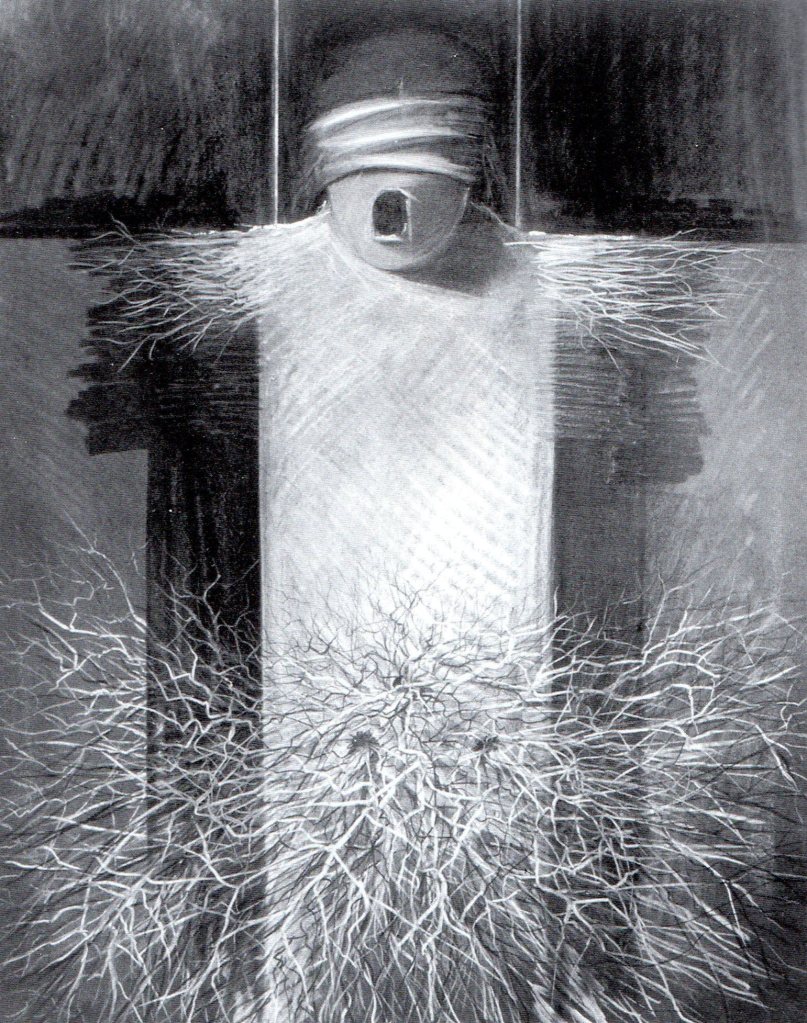
LOOK: Enrico Pinardi (American, 1934–2021), Crucifixion with Thorns, 2002. Oil on canvas.

Pinardi, Enrico_Crucifixion

I corresponded with the artist of this painting a few years ago after having found a black-and-white photo of it in the book The Crucifixion in American Art by Robert Henkes (2003). He granted me permission to reproduce the image on my blog, said he didn’t have a color photo. (“The image is kinda black, white, and blue,” he clarified.) I haven’t gotten around to posting it until now. I wish I had thought to ask about its location; I’m assuming it’s in a private collection somewhere, probably in the United States. After searching for Pinardi online the other week to see what he’s been up to, I found that he died January 30 due to complications from COVID-19.

Crucifixion with Thorns captures something of the horror of Christ’s felt abandonment on the cross. In the throes of death, he opens his mouth in a primal wail—the “loud voice” Matthew and Mark speak of, the “God, why?” He is becoming frayed, unraveled. A thicket of thorns tears through his body—or perhaps that is the cross-post (Pinardi’s expressionistic style deliberately makes it difficult to distinguish between the two). He is pierced.

He is also blindfolded. Luke 22:64 says that Jesus’s captors blindfolded him prior to his appearance before the Sanhedrin, striking him and asking him mockingly to identify, if he’s the Son of God, who it was who struck him. Though his eyes were not covered while he hung on the cross, the artist’s choice to cover them here amplifies the sense of his being in the dark, cut off, and also serves to identify him with other victims of political torture.

LISTEN: “My God, My God, Parts 1 & 2” | Metrical translation of Psalm 22:1–22 by the Committee of the United Presbyterian Church, 1912 | Music by Vito Aiuto of The Welcome Wagon, on Precious Remedies Against Satan’s Devices, 2012

The following text was written by committee (with the input of nine Presbyterian denominations) and first published in Pittsburgh in The Psalter: With Responsive Readings (1912), paired with an older tune by Lowell Mason. It covers two-thirds of Psalm 22, omitting the last nine verses—or rather, if you want to look at it this way, compacting them into four lines, as they contain a lot of repetition. I’ve noted in a separate column which verses of the biblical psalm each line of the song corresponds to.

My God, my God, I cry to Thee;
O why hast Thou forsaken Me?
Afar from Me, Thou dost not heed,
Though day and night for help I plead.

But Thou art holy in Thy ways,
Enthroned upon Thy people’s praise;
Our fathers put their trust in Thee,
Believed, and Thou didst set them free.

They cried and, trusting in Thy Name,
Were saved, and were not put to shame;
But in the dust My honor lies,
While all reproach and all despise.

My words a cause for scorn they make,
The lip they curl, the head they shake,
And, mocking, bid Me trust the Lord
Till He salvation shall afford.

My trust on Thee I learned to rest
When I was on My mother’s breast;
From birth Thou art My God alone,
Thy care My life has ever known.

O let Thy strength and presence cheer,
For trouble and distress are near;
Be Thou not far away from Me,
I have no source of help but Thee.

Unnumbered foes would do Me wrong;
They press about Me, fierce and strong;
Like beasts of prey their rage they vent;
My courage fails, My strength is spent.

Down unto death Thou leadest Me,
Consumed by thirst and agony;
With cruel hate and anger fierce
My helpless hands and feet they pierce.

While on My wasted form they stare,
The garments torn from Me they share,
My shame and sorrow heeding not,
And for My robe they cast the lot.

O Lord, afar no longer stay;
O Thou My helper, haste, I pray;
From death and evil set Me free;
I live, for Thou didst answer Me.

I live and will declare Thy fame
Where brethren gather in Thy Name;
Where all Thy faithful people meet,
I will Thy worthy praise repeat.
v. 1

v. 2


v. 3

v. 4


v. 5

v. 6


v. 7

v. 8


v. 9

v. 10


v. 11


v. 12

v. 13
v. 14

v. 15

v. 16


v. 17
v. 18


v. 19

vv. 20–21a
v. 21b

v. 22

One hundred years later, the Rev. Vito Aiuto wrote a new melody for this metrical translation, his only modifications to the text being to substitute out the archaic pronouns (e.g., Thee, Thou) and verb forms (e.g., hast, dost), unless needed to retain the rhyme scheme or meter. He and his wife, Monique, perform the song on their second full-length album along with a team of other musicians, listed here. Sufjan Stevens is among those in the seven-person choir that wails and sings echoes in the first half.

The song opens with a metallic screeching sound, harsh and grating. There are tensions and dissonances in the music, but at verse 5 (around 4:07) a tonal shift happens, as groping in the dark gives way to greater clarity and confidence. The pain is still there, but, like the psalm on which it’s based, it stretches toward hope.

A graduate of Princeton Theological Seminary, Aiuto is one of the founders of Resurrection Brooklyn, a church network of five Presbyterian (EPC) congregations serving the borough. He has been the lead pastor of Resurrection Williamsburg since it began in May 2005. I had the pleasure of hearing him preach in person at CIVA’s 2019 conference.

I’ve featured retuned hymns by The Welcome Wagon twice before on the blog; see Artful Devotion posts “Hail to the Lord’s Anointed” (for the Baptism of the Lord) and “The Strife Is Over” (for Easter).

“My God, My God, Parts 1 & 2” by The Welcome Wagon appears on the Art & Theology Holy Week Playlist.

Hail to the Lord’s Anointed (Artful Devotion)

Arian Baptistery mosaic
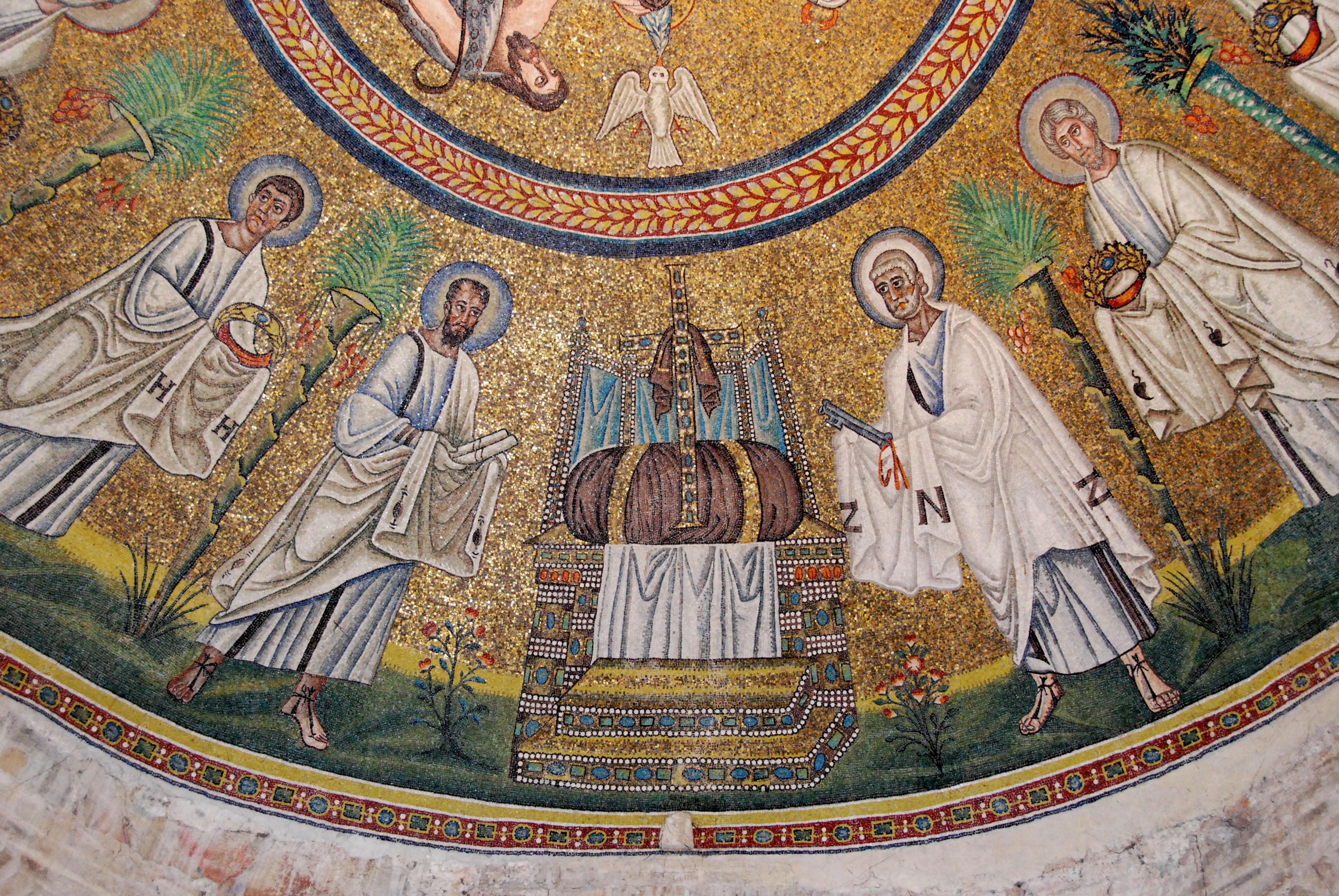
The Baptism of Christ, early 6th century. Ceiling mosaic, Arian Baptistery, Ravenna, Italy. Photo: Jim Forest.

Behold my servant, whom I uphold,
my chosen, in whom my soul delights;
I have put my Spirit upon him;
he will bring forth justice to the nations.
He will not cry aloud or lift up his voice,
or make it heard in the street;
a bruised reed he will not break,
and a faintly burning wick he will not quench;
he will faithfully bring forth justice.
He will not grow faint or be discouraged
till he has established justice in the earth;
and the coastlands wait for his law.

Thus says God, the LORD,
who created the heavens and stretched them out,
who spread out the earth and what comes from it,
who gives breath to the people on it
and spirit to those who walk in it:
“I am the LORD; I have called you in righteousness;
I will take you by the hand and keep you;
I will give you as a covenant for the people,
a light for the nations,
to open the eyes that are blind,
to bring out the prisoners from the dungeon,
from the prison those who sit in darkness.
I am the LORD; that is my name;
my glory I give to no other,
nor my praise to carved idols.
Behold, the former things have come to pass,
and new things I now declare;
before they spring forth
I tell you of them.”

—Isaiah 42:1–9

Then Jesus came from Galilee to the Jordan to John, to be baptized by him. John would have prevented him, saying, “I need to be baptized by you, and do you come to me?” But Jesus answered him, “Let it be so now, for thus it is fitting for us to fulfill all righteousness.” Then he consented. And when Jesus was baptized, immediately he went up from the water, and behold, the heavens were opened to him, and he saw the Spirit of God descending like a dove and coming to rest on him; and behold, a voice from heaven said, “This is my beloved Son, with whom I am well pleased.”

—Matthew 3:13–17

You yourselves know what happened throughout all Judea, beginning from Galilee after the baptism that John proclaimed: how God anointed Jesus of Nazareth with the Holy Spirit and with power. He went about doing good and healing all who were oppressed by the devil, for God was with him. . . .

He is the one appointed by God to be judge of the living and the dead. To him all the prophets bear witness that everyone who believes in him receives forgiveness of sins through his name.

—Acts 10:37–38, 42–43

+++

SONG: “Hail to the Lord’s Anointed” | Words by James Montgomery, 1821 | Music by the Rev. Vito Aiuto, on Welcome to the Welcome Wagon, 2008 [previously]

https://open.spotify.com/track/6g28yW9SilEHfMZ7WoLfYc?si=YlCyMYclTpmgT6kNHWABXQ

Hail to the Lord’s Anointed,
great David’s greater Son!
Hail in the time appointed,
his reign on earth begun!
He comes to break oppression,
to set the captive free;
to take away transgression,
and rule in equity.

He comes with succor speedy
to those who suffer wrong;
to help the poor and needy,
and bid the weak be strong;
to give them songs for sighing,
their darkness turn to light,
whose souls, condemned and dying,
are precious in his sight.

He shall come down like showers
upon the fruitful earth;
love, joy, and hope, like flowers,
spring in his path to birth.
Before him on the mountains
shall peace, the herald, go,
and righteousness, in fountains,
from hill to valley flow.

To him shall prayer unceasing
and daily vows ascend;
his kingdom still increasing,
a kingdom without end.
The tide of time shall never
his covenant remove;
his name shall stand forever;
that name to us is love.

+++

Arian Baptistery
Arian Baptistery, Ravenna. Photo: Georges Jansoone.

Baptism of Christ, Arian Baptistery
Photo: Peter Milošević

Baptism of Christ, Arian Baptistery
Photo: Fr. Lawrence Lew, OP

Baptism of Christ (detail)
Photo: Jim Forest

The dome of the great sixth-century Arian Baptistery in Ravenna, Italy, shows, in glimmering mosaic, a young, beardless, fully nude Christ standing waist-deep in the waters of the Jordan as John the Baptist, dressed in leopard skin, anoints him—the archetypal event for the liturgy that used to be performed below. And actually, the anointing water in this representation comes from the beak of a dove, God the Holy Spirit.

The old man on the left is a personification of the Jordan River, whose attributes are derived from that of the Hellenistic river gods. He holds a reed in his hand and leans against a spilled jar, from whose mouth flows the river water, while from his head there sprouts a pair of red crab claws. He is clothed in the same moss that covers the rock John stands on.

Around this central scene, which is framed by a laurel wreath, is a procession of the twelve apostles, led by Peter (the gray-haired man with the key) and Paul (the dark-haired man with the scrolls). The apostles carry jeweled crowns in their veiled hands—a sign of humility—as they make their way to the empty throne of Christ’s promised return, the hetoimasia, prepared with a plush purple cushion and jeweled cross.

Hetoimasia mosaic (Ravenna)
Photo: Jim Forest

The iconography here is very similar to that of the ceiling mosaic in the even older (Orthodox) Baptistery of Neon, also in Ravenna.

I’ve featured baptistery dome art two other times on the blog: a painting of Paradise from the Padua Baptistery and a Last Judgment mosaic from the Florence Baptistery. Also related are the compilation of contemporary icons of the Baptism of Christ that I published two years ago (the ones by Jerzy Nowosielski and Ivanka Demchuk are favorites of mine) and last year’s Artful Devotion for this calendar day, featuring a Baptism of Christ from the Hitda Codex and a virtuosic piano piece.


This post belongs to the weekly series Artful Devotion. If you can’t view the music player in your email or RSS reader, try opening the post in your browser.

To view all the Revised Common Lectionary scripture readings for the feast of the Baptism of the Lord, cycle A, click here.

The Strife Is Over (Artful Devotion)

Resurrection by Otto Dix
Otto Dix (German, 1891–1969), The Resurrection, 1949. Oil on canvas, 213 × 163.5 cm. Kunstmuseum Stuttgart, Germany.

He . . . has risen.

—Luke 24:6a

The Lord is my strength and my song;
he has become my salvation.
Glad songs of salvation
are in the tents of the righteous:
“The right hand of the Lord does valiantly,
the right hand of the Lord exalts,
the right hand of the Lord does valiantly!”

I shall not die, but I shall live,
and recount the deeds of the Lord.

—Psalm 118:14–17

+++

SONG: “The Strife Is O’er” | Words: Anonymous Latin poem (first compiled 1695), translated by Francis Pott, 1861 | Music: Rev. Vito Aiuto, on Precious Remedies Against Satan’s Devices by the Welcome Wagon (2012)

The strife is o’er, the battle done;
The victory of life is won;
The song of triumph has begun:
Alleluia! Alleluia!

The pow’rs of death have done their worst;
But Christ their legions hath dispersed;
Let shouts of holy joy outburst:
Alleluia! Alleluia!

The three sad days are quickly sped;
He rises glorious from the dead;
All glory to our risen Head:
Alleluia! Alleluia!

He closed the yawning gates of hell;
The bars from heav’n’s high portals fell;
Let songs of praise his triumph tell:
Alleluia! Alleluia!

Lord, by the stripes which wounded thee,
From death’s dread sting your servants free,
That we may live, and sing to thee:
Alleluia! Alleluia!

(I’ve noticed several slight variations in the English lyric translation attributed to Francis Pott. This is the version used by the Welcome Wagon.)


This post belongs to the weekly series Artful Devotion. If you can’t view the music player in your email or RSS reader, try opening the post in your browser.

To view all the Revised Common Lectionary scripture readings for Easter Sunday, cycle C, click here.