Easter, Day 4: They Were Afraid

The two earliest surviving complete manuscripts of the Gospel of Mark in Greek (the Codex Sinaiticus and the Codex Vaticanus), in narrating the visit of the women to Jesus’s tomb on Easter morning, do not include 16:9–20, the so-called longer ending of Mark. Instead, they end on an abrupt and astonishing note, stating that when the women saw the empty tomb and received the angel’s announcement that Jesus had risen, “they went out and fled from the tomb, for terror and amazement [or bewilderment] had seized them, and they said nothing to anyone, for they were afraid” (16:8). Fear, confusion, and silence—not a very triumphant way to cap off the story of Jesus’s life, death, and resurrection!

The longer ending provides more closure and galvanization. It recounts Jesus appearing to Mary Magdalene, to two disciples “walking into the country” (to Emmaus, most likely), and to the Eleven, whom Jesus commissions to preach the gospel throughout the world. He then ascends into heaven. This longer ending concludes with an exultant verse 20: “And they went out and proclaimed the good news everywhere, while the Lord worked with them and confirmed the message by the signs that accompanied it.”

Most biblical scholars, even the most theologically conservative, believe Mark 16:9–20 to be a later addition by another author, for reasons including its absence in early manuscripts, the ignorance of some church fathers such as Origen and Clement of Alexandria about the verses, and its differences in language and style from the rest of Mark. Thus, nearly all English translations of Mark place 16:9–20 in brackets.

However, the longer ending is quoted regularly by ecclesiastical writers, including from the patristic era, and became the almost universal ending of Mark in later manuscripts. Although it contains a few unique emphases, it is consistent with the rest of the New Testament, and no major doctrine is affected by whether one views verse 8 or verse 20 as the canonical ending.

I, for one, am intrigued by what most consider to be Mark’s original ending: “They were afraid.” It honors the complicated emotions of Mary Magdalene, Mary the mother of James, and Salome, who had just seen a celestial being and been notified of an event that would change the course of history. I’d be trembling too. Maybe they didn’t tell the others right away because they wanted to take a little time to gather themselves, to process. Maybe the shock had rendered them temporarily speechless, physically unable to utter a word.

But we know from the witness of the other Gospels (Matt. 28:8; Luke 24:8–11; John 20:18) that the women did, of course, tell the apostles the news—startling, joyous, transforming—and it birthed a global movement of Christ followers committed to sharing and embodying his message of love.

Read Mark 16 here.

LOOK: La casa blanca by José Clemente Orozco

Orozco, Jose Clemente_The White House
José Clemente Orozco (Mexican, 1883–1949), La casa blanca (The White House), ca. 1925. Oil on canvas, 25 3/16 × 30 1/2 in. (64 × 77.5 cm). Museo de Arte Carrillo Gil, Mexico City.

This easel painting by the famous Mexican artist José Clemente Orozco, best known for his murals, shows three frightened women standing in the dark outside a small rectangular stone or cement structure against which leans a dry tree. We don’t know what they’re reacting to, as it’s out of frame, but they are clearly alarmed and appear to be fleeing.

I first encountered The White House in the highly recommended book Imaging the Word: An Arts and Lectionary Resource, volume 3. The editors take for granted that it illustrates Mark 16:8, writing,

The response of the women at the tomb in Mark’s Gospel—to run away frightened—is depicted here. The Resurrection is suggested by the dazzling light reflected on the white building and in the faces of the women hastening away. (194)

In the object record on its website (which I accessed a few years ago but can no longer find), the Museo de Arte Carrillo Gil, which owns the painting, does not acknowledge this connection and speaks only in more general terms of an “invisible danger” and escape from a hideout.

But I think Imaging the Word’s reading is definitely valid.

LISTEN: “Evangile de la Résurrection (Mc 16, 1-8)” (Good News of the Resurrection, Mark 16:1–8) by the monks of Keur Moussa Abbey, on L’heure vient (The Hour Is Coming) (2007)

1 Le sabbat terminé, Marie Madeleine, et Marie, la mère de Jacques, et Salomé achetèrent des parfums pour aller embaumer le corps de Jésus. 2 De grand matin, le premier jour de la semaine, elles se rendent au sépulcre au lever du soleil. 3 Elles se disaient entre elles : « Qui nous roulera la pierre pour dégager l’entrée du tombeau ? » 4 Au premier regard, elles s’aperçoivent qu’on a roulé la pierre, qui était pourtant très grande. 5 En entrant dans le tombeau, elles virent, assis à droite, un jeune homme vêtu de blanc. Elles sont saisies de peur. 6 Mais il leur dit : « N’ayez pas peur ! Vous cherchez Jésus de Nazareth, le Crucifié ? Il est ressuscité : il n’est pas ici. Voici l’endroit où on l’avait déposé. 7 Et maintenant, allez dire à ses disciples et à Pierre : “Il vous précède en Galilée. Là vous le verrez, comme il vous l’a dit.” » 8 Elles sortirent et s’enfuirent du tombeau, parce qu’elles étaient toutes tremblantes et hors d’elles-mêmes. Elles ne dirent rien à personne, car elles avaient peur.

English translation (NRSVue):

1 When the Sabbath was over, Mary Magdalene and Mary the mother of James and Salome bought spices, so that they might go and anoint him. 2 And very early on the first day of the week, when the sun had risen, they went to the tomb. 3 They had been saying to one another, “Who will roll away the stone for us from the entrance to the tomb?” 4 When they looked up, they saw that the stone, which was very large, had already been rolled back. 5 As they entered the tomb, they saw a young man dressed in a white robe sitting on the right side, and they were alarmed. 6 But he said to them, “Do not be alarmed; you are looking for Jesus of Nazareth, who was crucified. He has been raised; he is not here. Look, there is the place they laid him. 7 But go, tell his disciples and Peter that he is going ahead of you to Galilee; there you will see him, just as he told you.” 8 So they went out and fled from the tomb, for terror and amazement had seized them, and they said nothing to anyone, for they were afraid.

This setting of the words of Mark 16:1–8 in French, sung to a tenor kora accompaniment, comes from Keur Moussa Abbey in Senegal [previously]. According to the liner notes of the CD, the melody is inspired by a Mandinka scale reminiscent of the Latin Gospel chant of the Easter Vigil.

Holy Week: The Women Prepare Burial Spices

LOOK: Myrrhbearers by Kateryna Kuziv

Kuziv, Kateryna_Myrrhbearers
Kateryna Kuziv (Ukrainian, 1993–), Myrrhbearers, 2021. Egg tempera on gessoed wood, 40 × 40 cm.

LISTEN: “The Women Prepare the Spices (Song of Songs 8)” by Katy Wehr, a setting of Song of Songs 8:6–7, 13–14, on And All the Marys (2018)

O set me as a seal upon thy heart
O set me as a seal upon thine arm
For love is strong, strong as death, my love
And jealousy is cruel as the grave

Its flashes are the living flame of a blazing fire
That cannot be drowned out in a flood
All earthly gold in exchange for love
Would be utterly contemptible and scorned

Come, my love
Let me hear your voice
My companions and I wait in the garden
Make haste, my love, and shine out like the rising sun
Like a stag appearing on the mountain

After the crucifixion of Jesus, a small group of his female followers purchased spices and prepared them to bring to the tomb to anoint his body on Sunday morning. (Sabbath restrictions prevented them from doing work on Saturday.) This was an act of love and reverence that served the practical function of counteracting the smell of decomposition.

The singer-songwriter Katy Wehr [previously] imagines the women consoling each other by singing excerpts from the Song of Songs as they crushed the myrrh, mixed it with oil, and bottled it up for transport—maybe also as they headed over to the gravesite. Wehr has set to music four of the verses from the book’s final chapter, a setting she says she hopes conveys a tone that is both mournful and hopeful.

The Song of Songs, or Song of Solomon, is an ancient collection of Hebrew love poems that Christians have long read as allegorical of the love between Christ and his bride, the church.

Wehr’s selections comment on the nature of love: it is permanent, strong, passionate, inextinguishable, and priceless. The female speaker in the poem seeks to stamp herself on her lover’s heart like a seal, claiming him as hers. She professes love’s power, which is as severe and enduring as death. In the context of this passage, the word “jealousy” appears to be used in the positive sense to mean zeal or passion—a resolute devotion.

She goes on to describe love as fiery and intense.

It seems her lover has gone out for the day, or gone on a trip, and she calls him back home. She can’t wait to hear his voice again. She waits outside for him in the garden, wishing for him to come bounding back into her arms.

“Make haste, my love, and shine out like the rising sun.” One can imagine the myrrh-bearing women of the Gospels hoping beyond hope that their beloved Jesus would arise, would speak their names once more, would prove that love is indeed stronger than death.

Roundup: Via Dolorosa with medical X-rays, hope in the night, and more

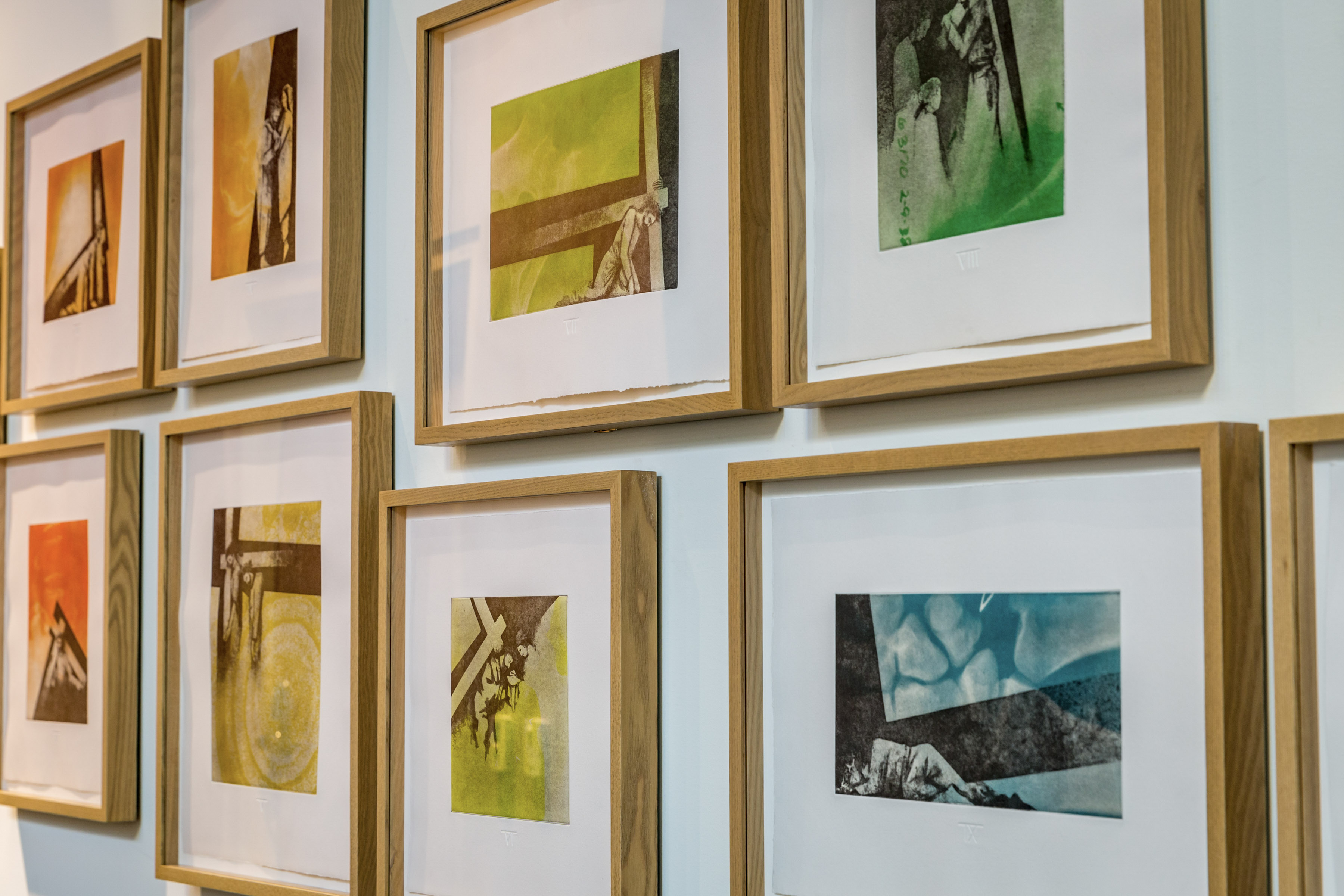
PRINT SUITE: Via Dolorosa by William Frank: Commissioned by SSM Saint Louis University Hospital for their chapel, this set of Stations of the Cross prints by William Frank combines depictions of Christ’s passion with diagnostic X-ray imaging of patients from the hospital’s archives. “The human body, and the community, act as the landscape,” he told me. A bullet in the spine, a kidney stone, a wrist fracture, a tumor, tuberculosis of the bones—Jesus’s suffering unfolds against the backdrop of these specific, tangible forms of suffering. But the rainbow color scheme transforms the stark black-and-white medical images into something a little less scary, suggesting hope and promise—maybe healing, maybe not, but at the very least, divine accompaniment along the path of sorrow.

Frank, William_Via Dolorosa
William Frank (American, 1984–), Via Dolorosa (installation detail), 2020. Etching, archival inkjet, chin collé, with embossment, suite of fourteen prints, overall 4 × 16 ft. SSM Saint Louis University Hospital Chapel, St. Louis, Missouri. Photo: Lisa Johnston, courtesy of the artist.

This year, the Catholic Health Association of the United States created a set of video reflections around Frank’s Stations, one for each piece, which you can find at https://www.chausa.org/prayers/lent-reflections. They also shot a video conversation with the artist:

The suite won a Faith & Form International Award for Religious Architecture & Art.

+++

NEW SONG: “Spooling” by Rev. Matt Simpkins: Diagnosed with stage 4 skin cancer, the Rev. Matt Simpkins [previously] of Lexden in Colchester, an Anglican vicar and a rock musician, said the only way he could calm his nerves enough to get through his next MRI scan was by writing a song from inside the machine. He composed some words and harmonies in his head to the “groovy,” sonorous beeps of the scanner, recording the song afterward using sampling, thus turning a typically threatening, antiseptic medical sound into a party vibe. He was interviewed on the BBC about it last month:

And here’s the bizarre music video, with special effects!

“I’m in a difficult situation with stage 4 cancer, but again, you’ve got a choice, and this song is a good example of that—how you can take something up into song and live,” he says. He hopes the song will minister to those who are undergoing cancer treatment or facing a possible diagnosis—that it is a small oasis, a source of silly laughter, comfort, and strength, for those in dire health.

“Spooling” is the first single from Simpkins’s forthcoming album Pissabed Prophet, a collaboration with his friend Ben Brown. The album is available for preorder on Bandcamp.

+++

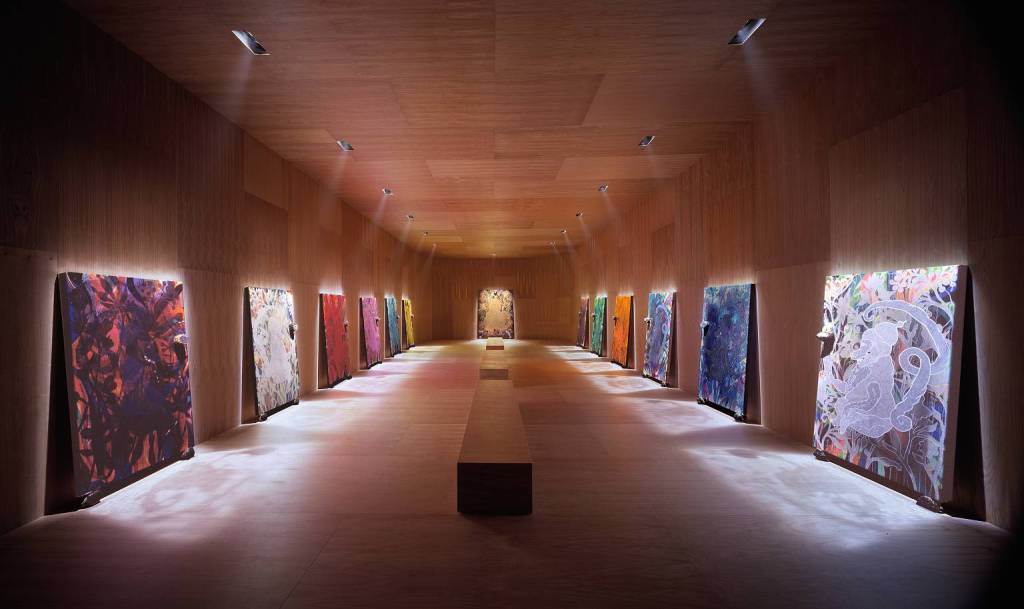
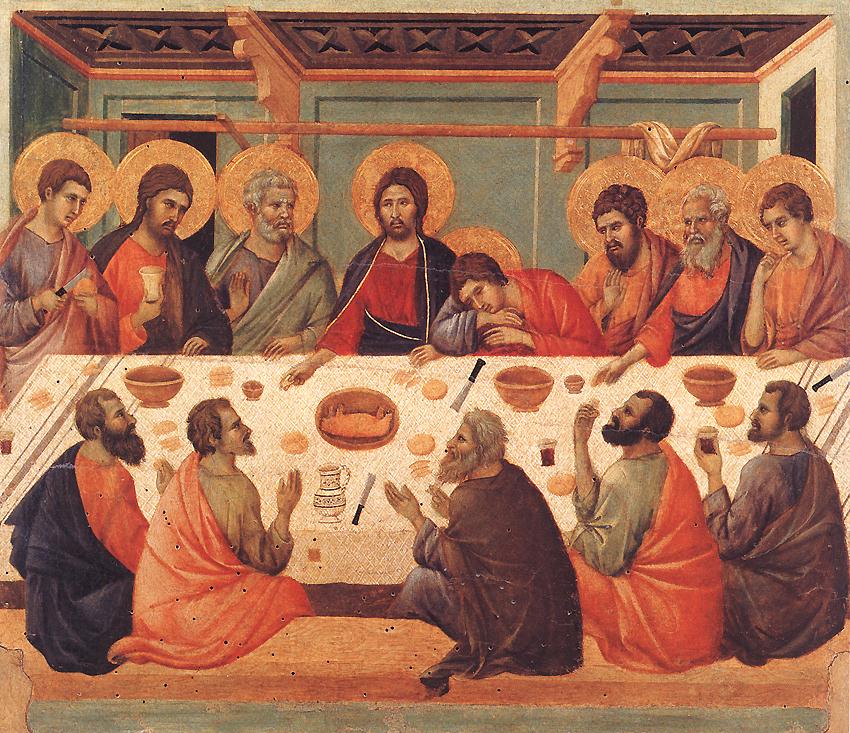
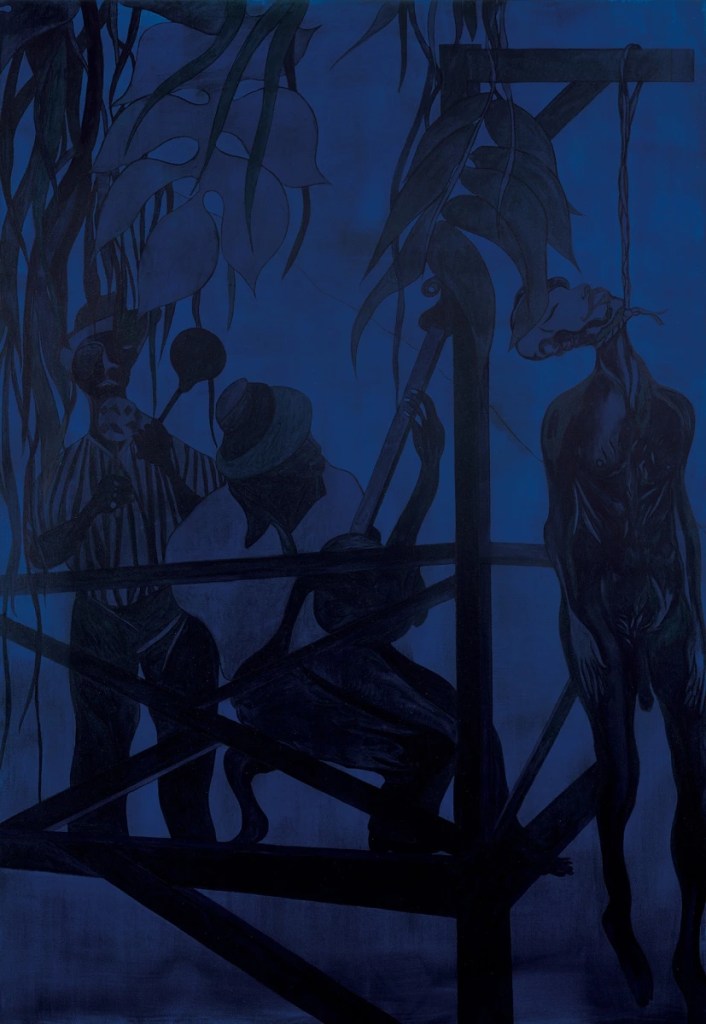
ART COMMENTARY: The Apostle Judas by Adrienne Dengerink Chaplin: As part of the Visual Commentary on Scripture project, Dr. Adrienne Dengerink Chaplin has selected three artworks that in some way interpret Matthew 26:20–25 (and parallel passages), when at the Last Supper Jesus announces that someone there will betray him. Rather than featuring the more common portrayals of Judas as malevolent, halo-less, and/or segregated from the group at the far end of the table, Dengerink Chaplin has chosen works that show him integrated and indistinct, one of twelve betrayers, whose treachery, she boldly proposes, we might construe as “a happy fault.”

  • Ofili, Chris_The Upper Room
  • Duccio_Last Supper
  • Ofili, Chris_Iscariot Blues

With the Duccio panel, she points out something I’ve often contemplated as well: that Jesus feeds Judas with the element he calls his body, keeps communion with him, and is there not a preemptive forgiveness implicit in that act?

+++

SONG: “In the Night” by Andrew Peterson: At a Laity Lodge retreat in 2015, Andrew Peterson of Nashville performed one of the songs from his album Counting Stars (2010) with fellow musicians Buddy Greene, Jeff Taylor, and Andy Gullahorn. “In the Night” rehearses “dark night” stories from scripture: Israel wrestles with God, is enslaved by Egypt, is pressed in by Syria; a prodigal son must resort to eating pig slop; the Son of Man is beaten and killed. But in each of these stories, deliverance comes. Hence the refrain: “In the night, my hope lives on.”

+++

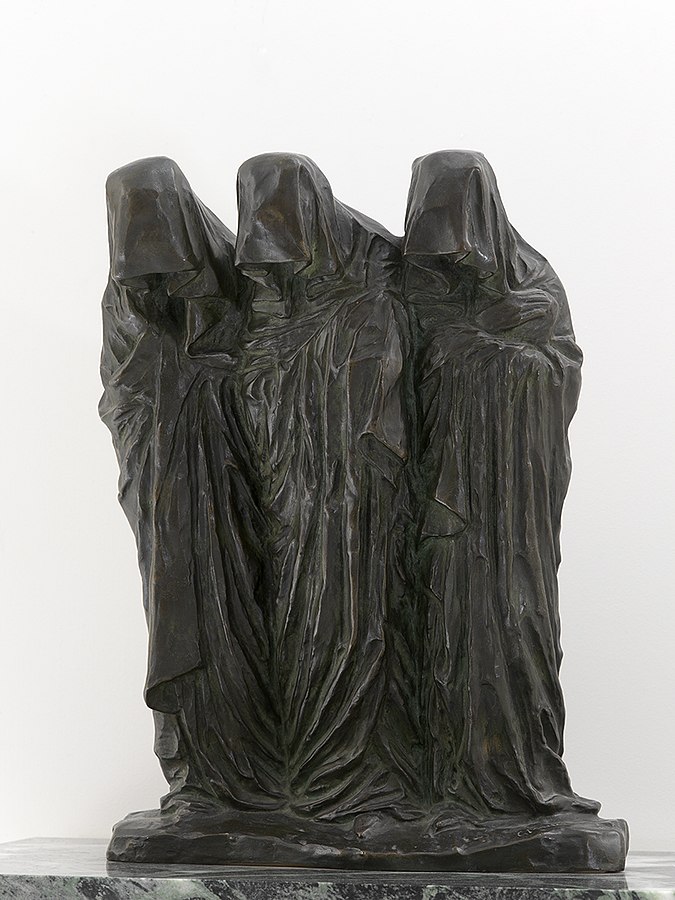
VISUAL MEDITATION: On The Holy Women at the Tomb by George Minne, commentary by Marleen Hengelaar-Rookmaaker: Marleen Hengelaar-Rookmaaker, the creator of ArtWay, writes about a nineteenth-century bronze sculpture by the Belgian artist George Minne, which shows the three women who went to Jesus’s tomb on Easter morning in an attitude of grief—bent backs, bowed heads—drawing on the gothic pleurants, or weepers, of late medieval tombs. The women are “totally enwrapped in mourning their beloved,” Hengelaar-Rookmaaker writes. “This is in fact the very last moment of the passion, the last moment of suffering past the Pietà and the burial of Christ. It will only be a minute before their hoods will come off and the news of the resurrection will enter their numbed minds.”

Minne, George_The Holy Women at the Tomb
George Minne (Belgian, 1866–1941), Les saintes femmes au tombeau (The Holy Women at the Tomb), 1896. Bronze, 44.5 × 62 × 20.5 cm. Groeningemuseum, Bruges, Belgium.

This composition by Minne also exists in granite, wood, and plaster versions.

+++

NEW PLAYLIST: April 2023 (Art & Theology): Includes an excerpt from the psychedelic rock–style Mass in F Minor by the Electric Prunes, “The Outlaw” by Jesus Movement icon Larry Norman, a chuckle-inducing bluegrass song first recorded in 1926 by Gid Tanner and Faith Norris and covered here by the Local Honeys, a choral setting of Psalm 128 (“Happy is everyone who fears the Lord, who walks in his ways . . .”) by the Italian Jewish Renaissance composer Salomone Rossi, Whitney Houston’s rendition of “His Eye Is on the Sparrow,” and a short Kiowa Apache church song that translates to “Son of our Father will set up a cedar tree / Now he is calling to us / He’s going to heal our minds / That’s why he is calling to us.”