
In Antwerp sometime around 1600, the Flemish printmaker Anton Wierix II (whose name is alternatively rendered as Antonie, Anthony, Antoine, or Antonius) engraved a series of seventeen* cardiomorphic emblems called the Cor Jesu amanti sacrum (The Heart Consecrated to the Loving Jesus), which portray the human heart as the dwelling-place, schoolroom, and throne of Christ. Commissioned by the Jesuit order, the series shows the Christ child cutting through the net that has ensnared the heart, knocking at the heart’s door, shining a light inside, sweeping out the monsters and vices, purging it with his blood, establishing his reign therein, teaching it, adorning it, making music in it, defending it from hostile invasion, piercing it with the arrows of love, and setting it aflame with desire.
These prints circulated as loose sheets and inside books, and various artists copied Wierix’s designs throughout the seventeenth century. The most famous book that uses the Cor Jesus images is Le coeur dévot, throsne royal de Iesus, Pacifique Salomon (The Devout Heart, Royal Throne of Jesus, Pacific Salomon) by Etienne Luzvic, SJ, originally written for a religious community, perhaps one devoted to the Sacred Heart. The book’s initial publication—in Paris in 1626—was without illustrations, but an enlarged edition was reissued in Douai and Antwerp the following year, containing twenty Cor Jesu engravings adapted by Martin Baes from Wierix’s originals, as well as additional meditations called “Incentives” by Fr. Etienne Binet, SJ.
Also in 1627, Le coeur dévot was translated into Latin, which became the basis for a number of vernacular translations throughout Europe, including an English version translated by Henry Hawkins in 1634, titled The Devout Hart, or Royal Throne of the Pacifical Salomon. This English edition includes a hymn by Hawkins for each emblem.
The odd-sounding subtitle of the book is a reference to King Solomon of the Old Testament, whom Luzvic apparently read a type of Christ in his majesty. “Pacifical” is an archaic word meaning conciliatory, peaceable.
Below I reproduce Wierix’s seventeen emblems, a loose-leaf edition held by the Wellcome Collection in London; you can click on the image to be taken to its object page.
Each engraving contains at the bottom a rhyming Latin verse in two stanzas of three lines each, interpreting the picture. The English translations provided below are sourced from the Wellcome Collection website, unless otherwise noted.
The engravings are not numbered, and their order was not fixed; they show up in variable sequences in different books. I’ve ordered them as they appear in Hawkins’s The Devout Hart. Scholars and editors have given them different descriptive titles over the years. I use Hawkins’s titles, only I’ve modernized the spellings. I’ve also provided a few quotes from Hawkins’s translation of Luzvic’s meditational texts that accompany the images in The Devout Hart, with page numbers provided in parentheses.
1. The world, the flesh, and the devil assail the heart, but Jesus saves it for himself
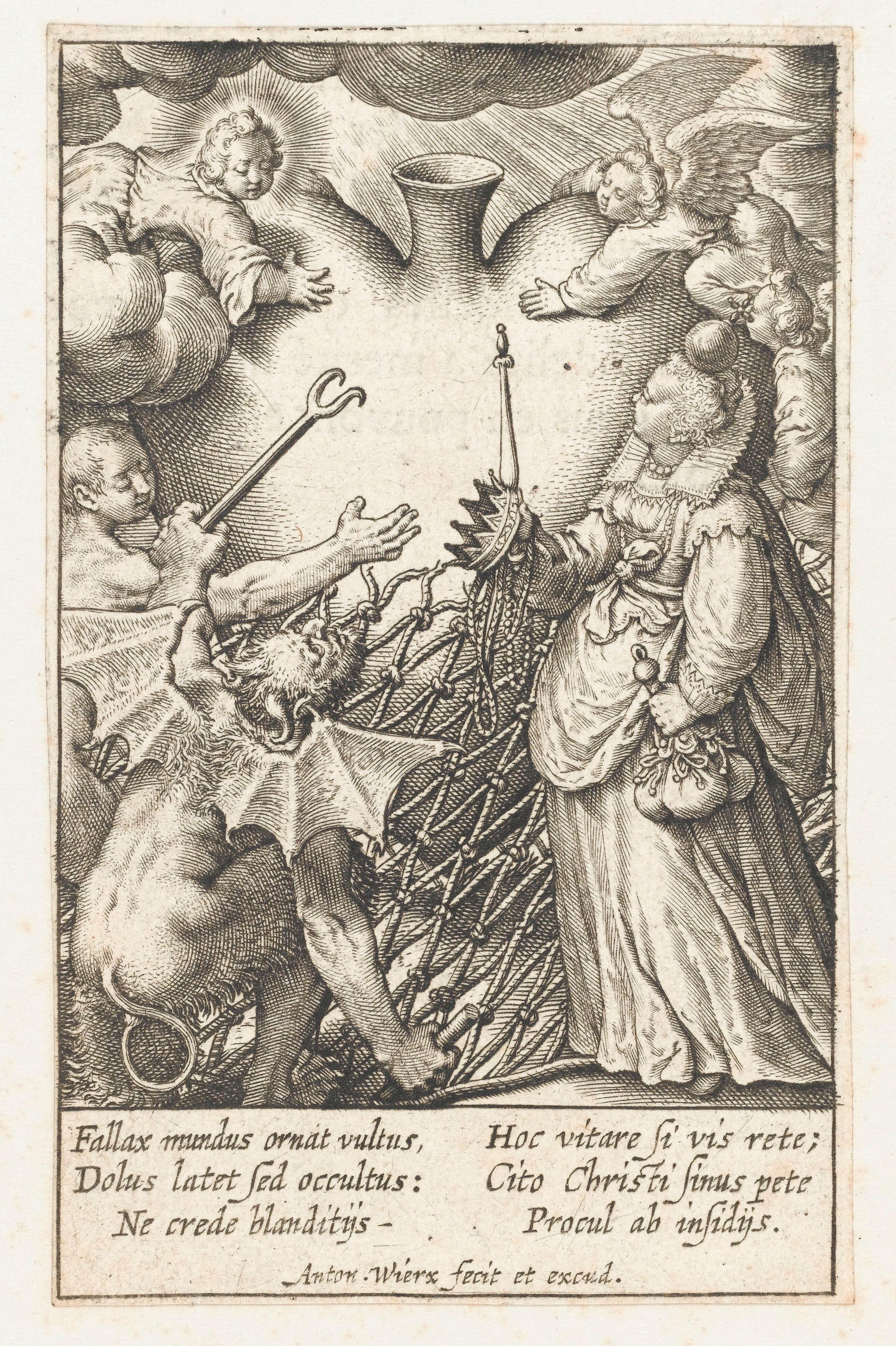
Fallax mundus ornat vultus,
dolus latet sed occultus:
ne crede blanditiis.Hoc vitare si vis rete;
cito Christi sinus pete
procul ab insidiis.(The deceptive world makes up its face, yet trickery lurks concealed. Do not trust in blandishments if you want to avoid this net! Quickly seek the breast of Christ, far from ambushes.)
2. The most amorous Jesus knocks at the door of the heart
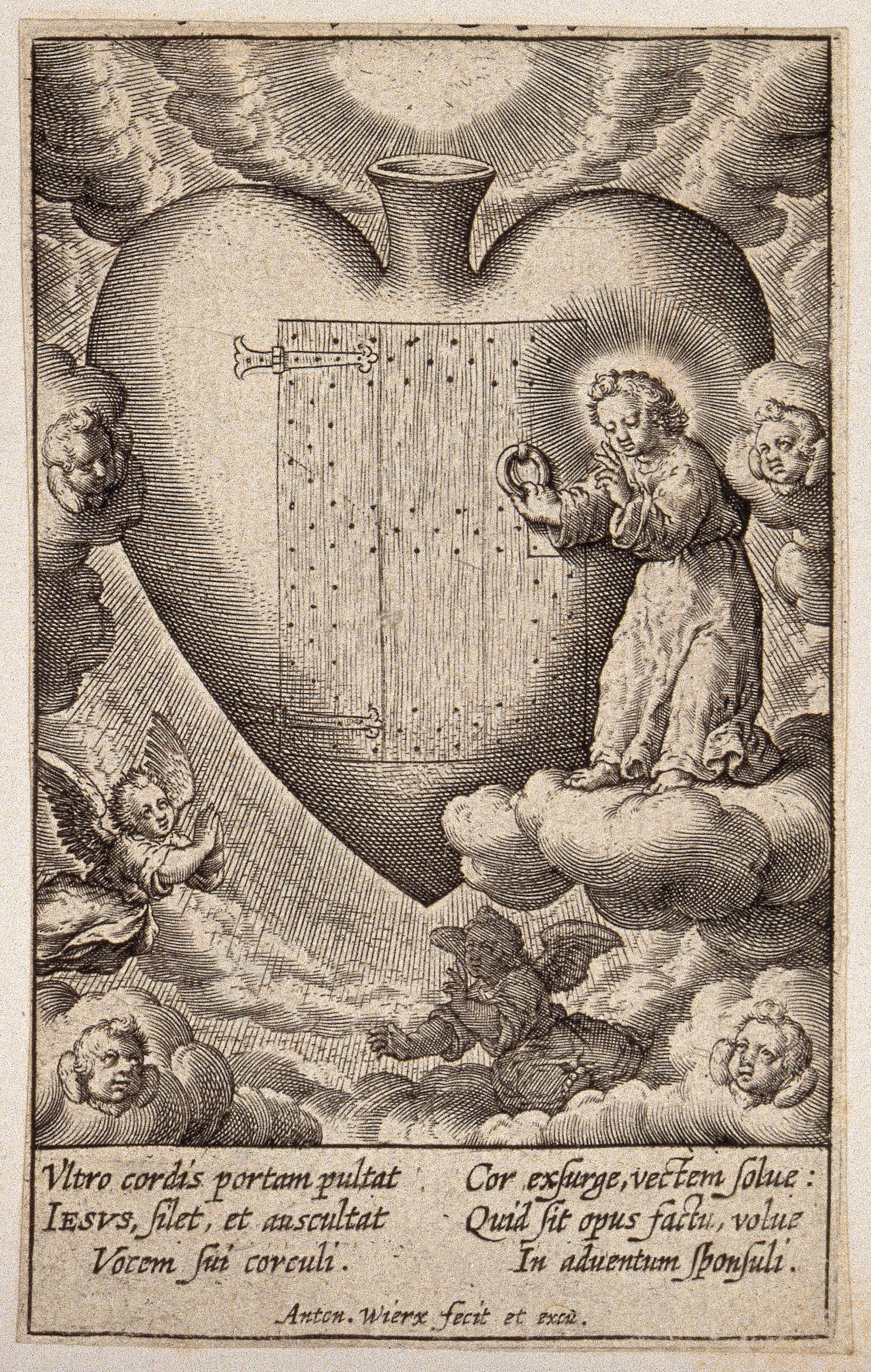
Ultro cordis portam pultat
Iesus, silet et auscultate
vocem sui corculi.Cor exsurge, vectem solve:
Quid sit opus factu, volve
in adventum sponsuli.(Outside the door of the heart Jesus knocks, is silent, and listens for the voice of his little heart. Heart, rise up! throw back the bolt! think what needs to be done at the arrival of the little betrothed one!)
This image is rooted in Revelation 3:20: “Behold, I stand at the door, and knock: if any man hear my voice, and open the door, I will come in to him . . .” (KJV).
If you cannot hear the knocking, Etienne Luzvic encourages you to consider,
Is it the noise perhaps of the guests thou hast admitted in already, which so tacked up, and stupefies thine ears, as thou canst not hear thy beloved’s voice? Oh guests, or haunting ghosts, I may call you, rather! Oh sinister affections! Oh inordinate appetites! What a tumult have you made here? (49)
He further exhorts:
Hasten, therefore, O fairest of all beauties; what? Sleepest thou yet? Shake off this sluggishness. Is there a mutiny at home, then quiet the tumults, command silence, bid the door be set open. And if thy spouse now wearied with thy demurs should chance to divert from thee, and go his ways, follow him at the heels with cries, and prayers, and tiring him outright, urge him hard, that he would deign to return again to his sanctuary. (50)
3. Jesus searcheth out the monsters lurking in the dark corners of the heart
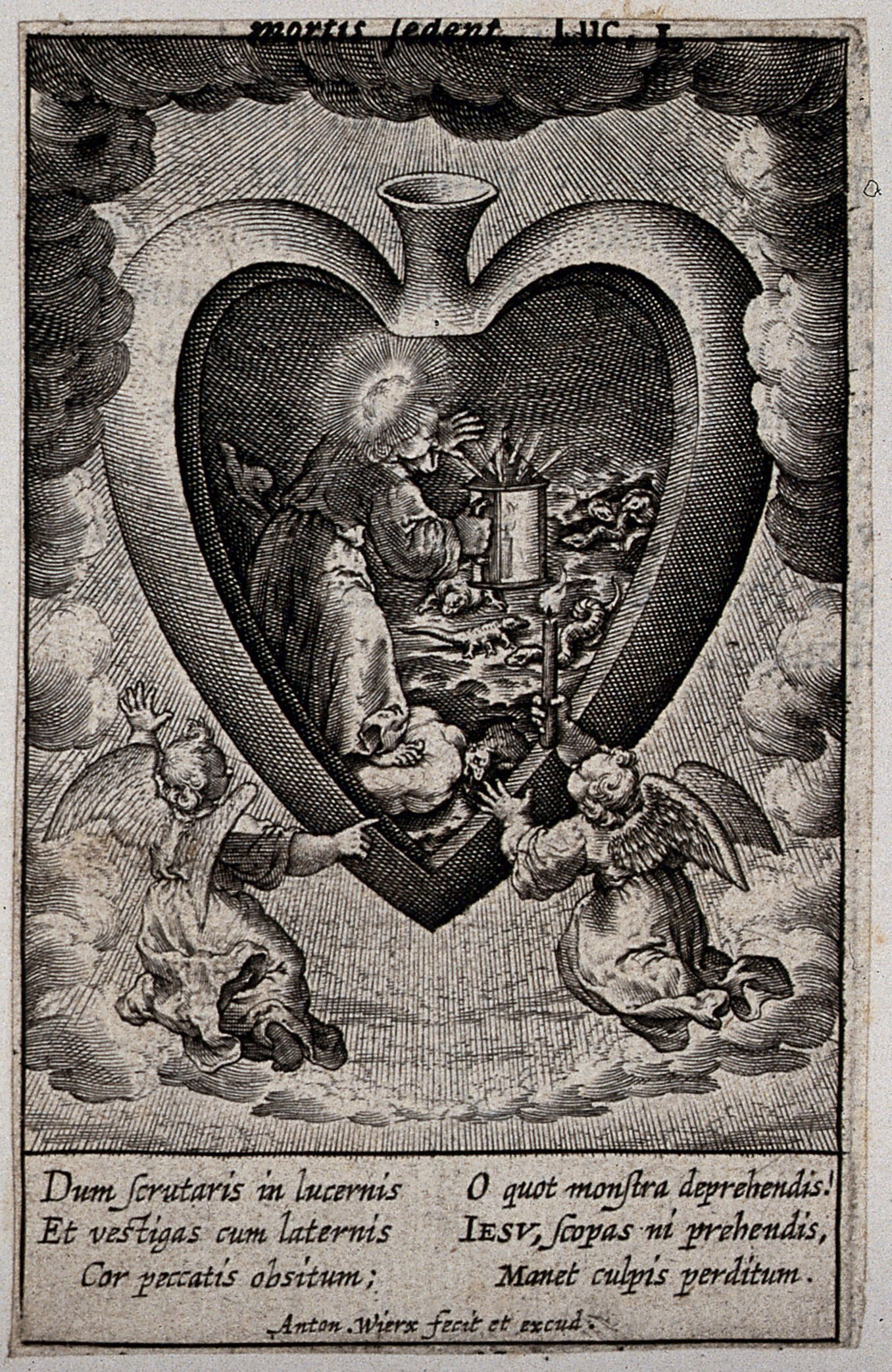
Dum scrutaris in lucernis
et vestigas cum laternis
cor peccatis obsitum;o quot monstra deprehendis!
Iesus, scopas ni prehendis,
manet culpis perditum.(While you search among the lights and track the heart besieged by sins, oh how many monsters do you find! Jesus, if you do not find a broom, [the heart] remains lost in wrongs.)
From Luzvic:
So long as Jesus is absent from my heart. Ah me! what monsters? what sordidies? what Gorgons? what wicked fiends? what hells are centered there?
When Jesus enters into the heart, and therein pours his light, good God? what foul, what horrible prodigies of vices the mind discovers there which the eyes had never yet detected? I say while Jesus puts forth his rays, what bestial manners? what perfidiousness? what blots of an ungrateful mind? what heinous crimes are represented in this detestable heart?
At these portents the very angels tremble. Yet go thou on, my most sweet Jesus: illuminate the darksome corners of the soul; cleanse this foul, infamous stable. Amid this Cimmerian darkness, with glimpse of thy light bewray [reveal] me to myself that . . . at length [I] may fly to thee, love nothing else but thee. Oh the only Darling of my soul! O only love of my heart, my little Jesus! (60–61)
Oh how I tremble at it, to see how many snakes there are! What spiders, what scorpions, and other such like plagues . . . (65)
Consider, then, how powerfully Jesus, as soon as admitted to enter into the heart, expels and banisheth all sins from the secretes nooks thereof. (68)
4. Jesus sweeps the dust of sins from the heart
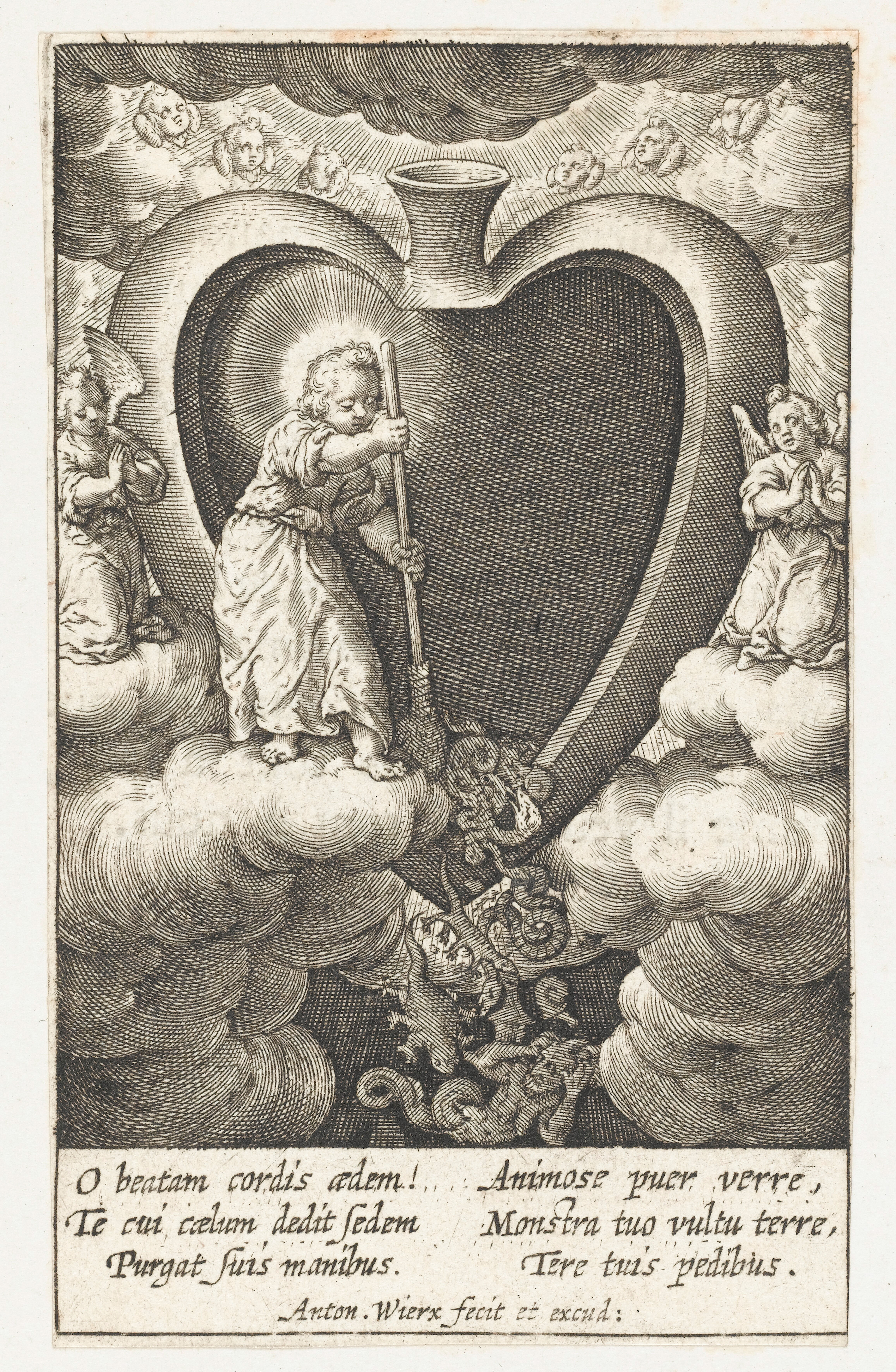
O beatam cordis aedem!
Te cui caelum dedit sedem
purgat suis manibus.Animose puer verre,
monstra tuo vultu terre,
tere tuis pedibus.(O blessed temple of the heart! Let him to whom heaven has given his abode clean you with his own hands. Spirited boy, sweep away! Frighten the monsters with your look! Crush them under your feet!)
Once Jesus locates the toads, snakes, and other slimy creatures (symbols of sin) hiding in the heart’s cave, he sweeps them out. Luzvic welcomes this purging:
Go on, my little Jesus, and oh! expel, tread, crush under thy holy feet this poisonous virulence of serpents, which with their venom intoxicate and kill my soul. Destroy them quite, and so frame me a heart wholly according to thy heart. (73–74)
He asks Jesus that, once he banishes the monsters, he keep them out for good:
Thou, most Blessed Darling of my heart, fortify and prevent all the ways and passages of the enemy, and place strong guards at the entrance and gates thereof, lest happily they steal or rush in anywhere . . . (77)
But he also owns his own responsibility in keeping them out:
Oh what dullness of mind is this, what stupidity of heart, that we should so long suffer these monsters to rest and abide with us, as if they were some friends and familiars of ours! Oh truly admirable goodness of God! who hath attended and expected us so long to return to the duty and office of good men; and now at last most powerfully hath brought us into liberty, wherefore we will steadfastly purpose, and determine hereafter, to die rather than once to afford any place in our heart to sins. (82)
5. Jesus the Living Fountain in the heart
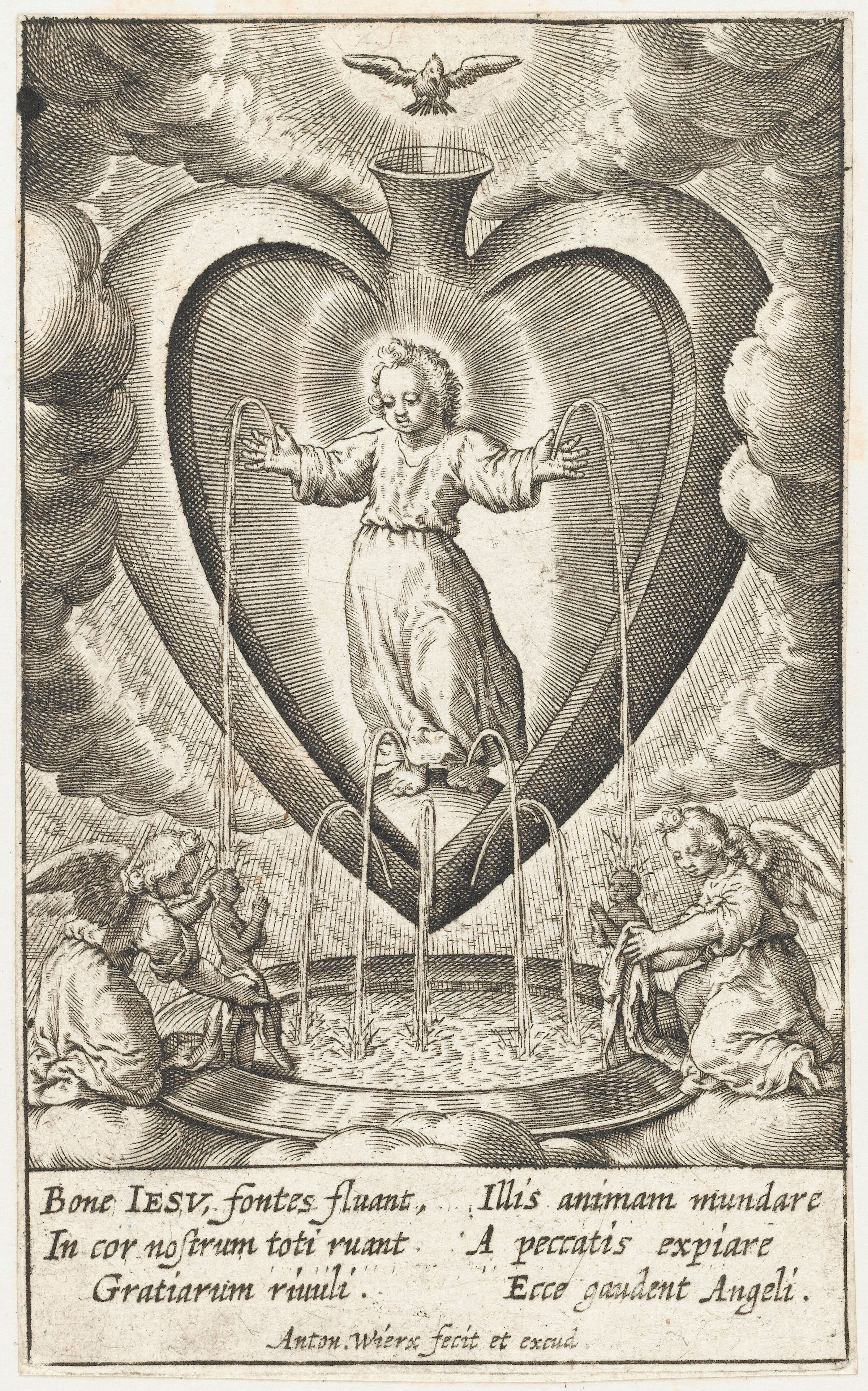
Bone Iesu fontes fluant,
in cor nostrum toti ruant,
gratiarum rivuli.Illis animam mundare,
a peccatis expiare,
Ecce gaudent angeli.(Good Jesus, into the heart let fountains flow, let all the streams of graces [flow]. With them to clean the soul and expiate [it] from sin, behold angels rejoice.)
In this image, blood flows out of the nail wounds in Christ’s hands and feet—a cleansing, refreshing fount.
Luzvic rhapsodizes,
If Jesus be absent, I am arid, dry, and without juice, so as neither I feel God, nor anything of God. Oh cruel aridity! O fatal drought!
If Jesus be present, he sheds divine dews of graces; he opens springs of incredible sweetness; the heart floats only and swims and sinks in these torrents of celestial delights. Oh grateful dews! O blessed springs! O ineffable delights!
Angelical hands laid hither those waters of life; sprinkle therewith my heart and soul, cleanse, and water them with endless springs of paradise. (85)
He asks God’s angels to “plunge this my dry and thirsty heart, drown it in the ocean of love” (91).
6. Jesus purgeth the heart with expiatory blood
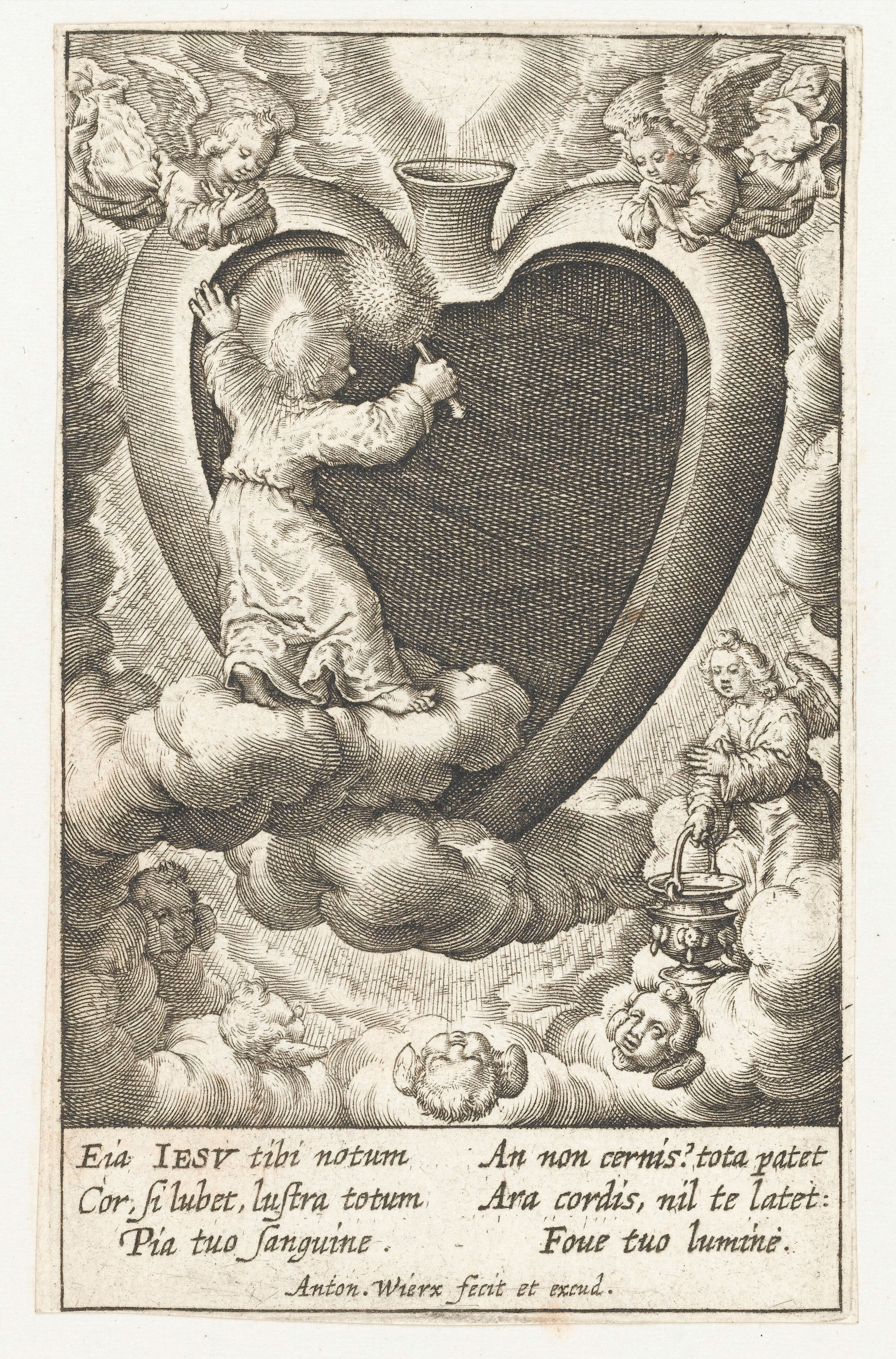
Eia Iesu tibi notum
cor, si lubet, lustra totum,
pia tuo sanguine.An non cernis? tota patet
ara cordis, nil te latet:
Fove tuo lumine.(Ahh, Jesus, the heart which you know, clean it all, if you like, purify it with your blood! Or do you not see? The whole altar of the heart lies open, nothing is hidden from you. Sustain it with your light.)
“Purge me with hyssop,” prays David the psalmist (Ps. 51:7). In this image Jesus uses an aspergillum to sprinkle his blood on the believer’s heart, much like Moses did with the blood of oxen (Exod. 24:1–8)—sprinkling it on the altar and on God’s covenant people—and like the Levitical priests did with the blood of bulls and goats before the mercy seat (Lev. 16).
Binet writes of the immediate effect: “Lo, the heart came presently to itself again, as soon as it felt but one little drop of thy divine love to be sprinkled on it” (98). I love that phrase: “the heart came presently to itself again.” Jesus reconciles us not only to God but also to ourselves, taking away our guilt so that we can live in the freedom we were always meant to have. He brings us home to our truest selves.
There’s power in the blood! Luzvic beseeches Jesus for just a few drops:
Take, therefore, O Jesus, love of my soul, from this infinite bath of thine some few little drops, at least, and sprinkle thy sanctuary therewith, I say—the ample field of my heart, whose sure possession thou hast taken to thyself long since. (99–100)
7. Jesus rules and reigns in the loving and devout heart
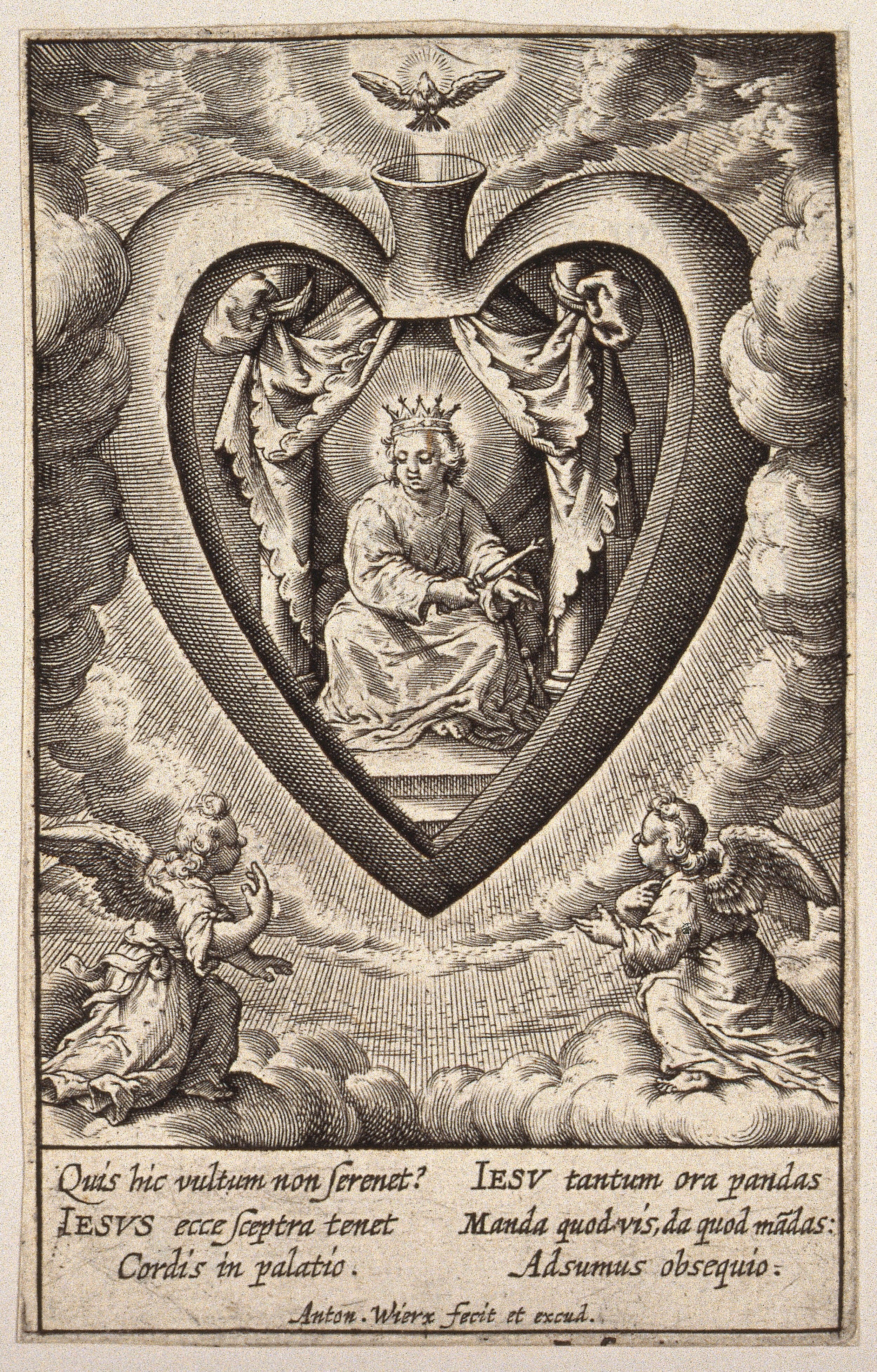
Quis hic vultum non serenet?
Iesus ecce sceptra tenet
cordis in palatio.Iesu tantum ora pandas,
manda quod vis, da quod mandas;
adsumus obsequio.(Who would not here have a serene expression? Behold, Jesus holds the scepter in the palace of the heart. Jesus, just open your mouth, order what you want, give what you order: we are present to obey.)
Here’s a beautiful prayer by Luzvic. Its last line is a quotation from Song of Solomon 6:3, a book that Christians have read, on one level, as an allegory of the love between Christ and the human soul:
The heart . . . is hungry and thirsty, nor lives contented with any owner, unless thou fix the seat of thy kingdom in its precincts. If thou beest present with, it desires no more; if absent, come in all created things at once and woo it never so much, there will yet be place enough for more. If thou gettest from thence, all felicity departs with thee: if thou abides, all beatitude comes suddenly thither. Reign, therefore, and eternally reign in my heart, O love of my heart. Quiet the motion of perturbations, nor ever suffer the unhappy heart to thrust the king out of his seat, then which cannot happen a greater disaster to it. Nor suffer, I say, O darling and delight of my heart, that one heart should be shared into many parts. For thou sufferest no rival. Oh suffer it not ever to be enticed with the allurements of worldly pleasure, which gate being once set open, I see how easily the enemy will rush in. Be thou to it a brazen, yea, a wall of fire, which may so roundly girt the tower, as that no passage may be found unto it. But that only the Holy Ghost may come down from heaven, whereto the heart lies open, and enter therein with a full gale, and occupy the whole heart, that so I may truly profess and glory, My beloved to me and I to him. (116–18)
8. Jesus teacheth the devout heart

Sunt auscultent qui Platoni,
aut facundo Ciceroni,
aut mundi stultitiae.Tu ne verba vitae sperne:
Audi patris aeviterne
dicta sapientiae.(Some listen to Plato or to eloquent Cicero, or to the stupidity of the world. [But] you, do not scorn the words of life! Listen to the Father’s sayings of everlasting wisdom!)
In this image Christ is portrayed as the heart’s instructor. He sits with an open book that reads, “Erunt omnes docibiles Dei” (All shall be the pupils of God).
Luzvic imagines one of the directives he gives:
Hear, my child (for so Jesus advises from the pulpit of the heart): Do thou give thyself to me. Let me be thy possession, thy nurse, thy food, for nothing can satiate thine appetite without me. My child, throw away those leeks and garlic of Egypt, turn thy face from the stinking waters of [vain] pleasure, and put thy mouth rather to my side, the wine-cellar of graces, whence at ease thou mayest draw and derive to thyself most sovereign and incomparable joys. (128–29)
9. Jesus paints the images of the last things in the table of the heart

Sume Iesu penicilla,
corque totum conscribilla
piis imaginibus:sic nec Venus prophanabit,
nec Voluptas inquinabit
vanis phantasmatibus.(Take, Jesus, your paintbrushes and daub over the whole heart with holy images. Thus neither shall Venus profane it nor shall pleasure pollute it with empty fantasies.)
The four last things, clockwise from bottom left inside the heart, are death, judgment, heaven, and hell. The image asks Jesus to make these future realities vivid in our minds so that we would live blamelessly until then.
10. Jesus brings the cross into the heart, and easily imprints it in the lover
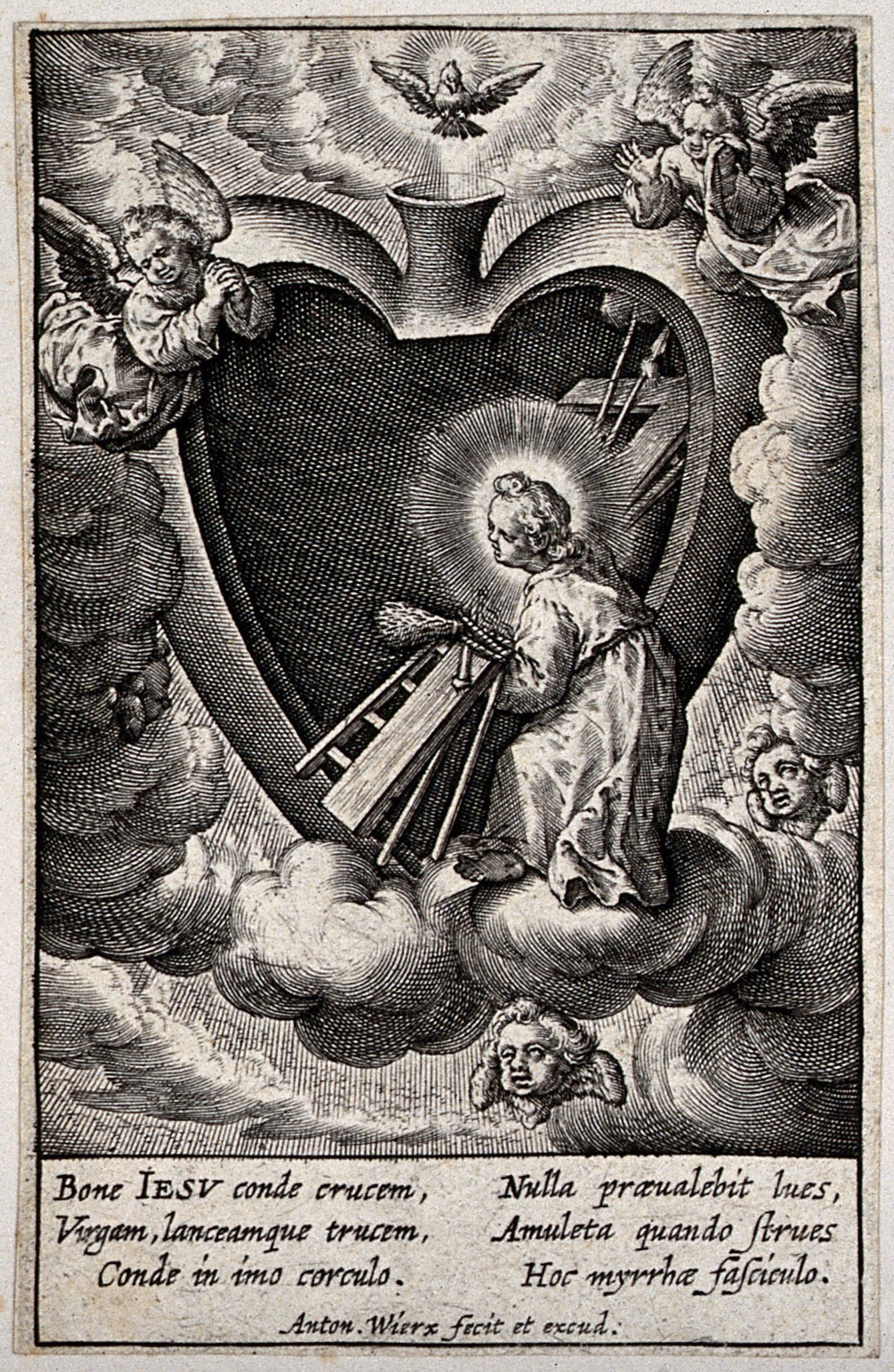
Bone Iesu conde crucem,
virgam, Ianceamque trucem,
conde in imo corculo.Nulla praevalebit lues,
amuleta quando strues
hoc myrrhae fasciculo.(Good Jesus, stow the cross, the lash, and the cruel lance, stow it at the bottom of the little heart. No sin shall prevail when you pile up this preservative on a gathering of myrrh.)
In this image, Christ deposits the instruments of his passion in the heart of the believer, where they serve as a reminder of the cross-shaped ethic we are to adopt—giving ourselves for others—as well as a call to gratitude for Christ’s sacrifice and a source of strength in times of suffering.
Go in, lovely cross; enter, lance, sponge, nails, scourge; bloody thorns, get you into the closet of the heart. Welcome still, but on this condition that Jesus bring you in himself; for myrrh with Jesus is admirable, and mere sweetness.
Thou sayest thou lovest Jesus; then needs must thou his cross, for if otherwise thou boast to love Jesus, thou deceivest thyself and others.
Most sweet child, what have you and I to do with this lumber here? Scarce art thou come into the world, but thou art oppressed with the weight of punishments. Oh plant thy seat in my heart! and then shall I challenge hell itself: for if Jesus and I hold together, what Hercules can stand against us both? (150–51)
11. The heart consecrated to the love of Jesus is a flourishing garden
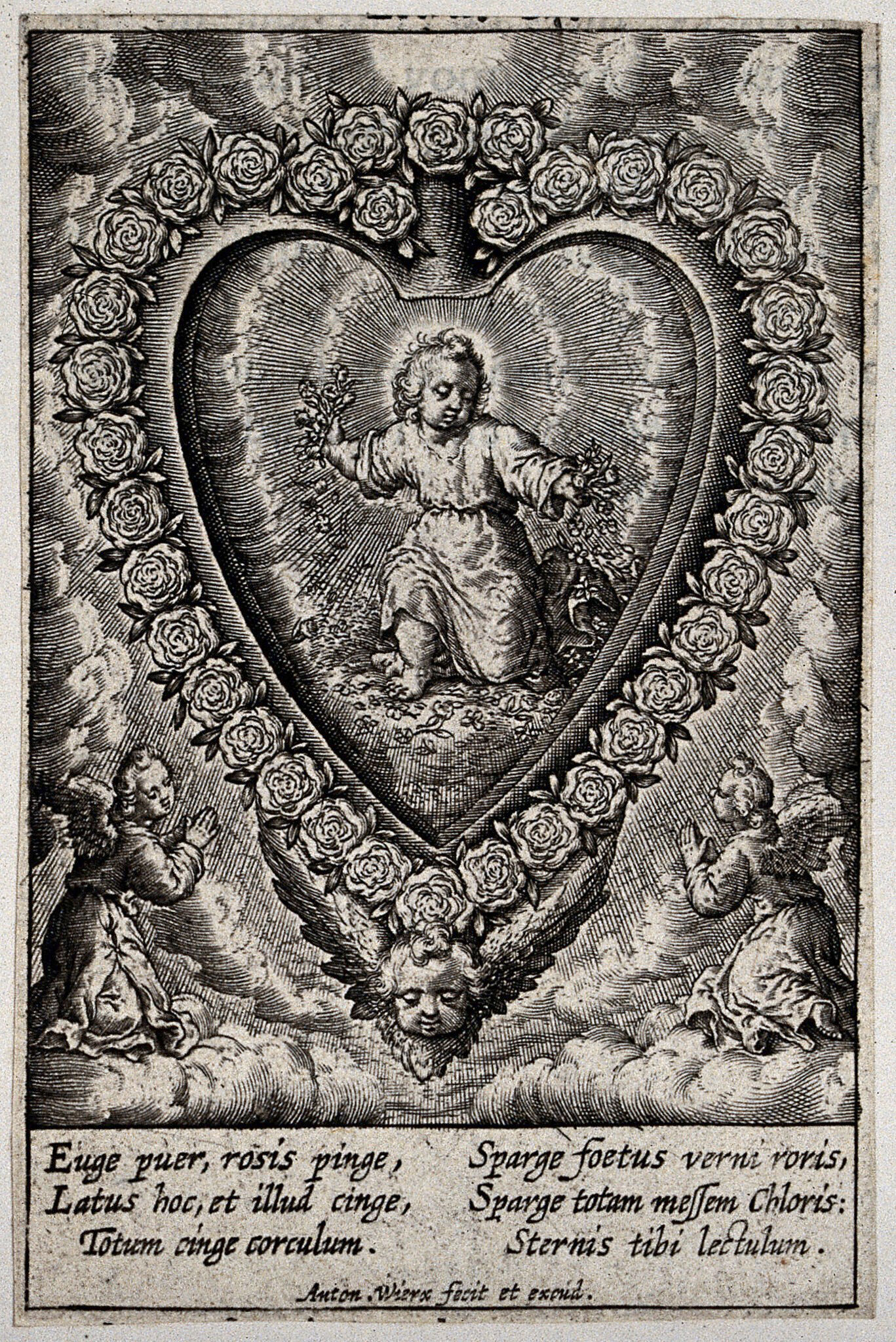
Euge puer, rosis pinge,
latus hoc, et illud cinge,
totum cinge corculum.Sparge foetus verni roris,
sparge totam messem Chloris:
sternis tibi lectulum.(Bravo, boy! paint this side and that and surround it with roses, surround the entire little heart! Spread the fruit of the spring dew, spread the entire harvest of the realm of flowers: you are [thus] laying a cot for yourself.)
(Alt translation by Walter S. Mellion: Bravo, lad! Embroider with roses now this side, now that, encompass them. Wreath the little heart, all of it. Strew it with the progeny of the springtime dew, with the whole harvest of Chloris: spread for yourself a [flowery] bed.)
Jesus bedecks the heart with roses in this image—makes it beautiful and fragrant. Again, this image evokes the Song of Solomon, with its scenes of lovers in the garden.
12. Jesus sings in the choir of the heart, to the angels playing on musical instruments
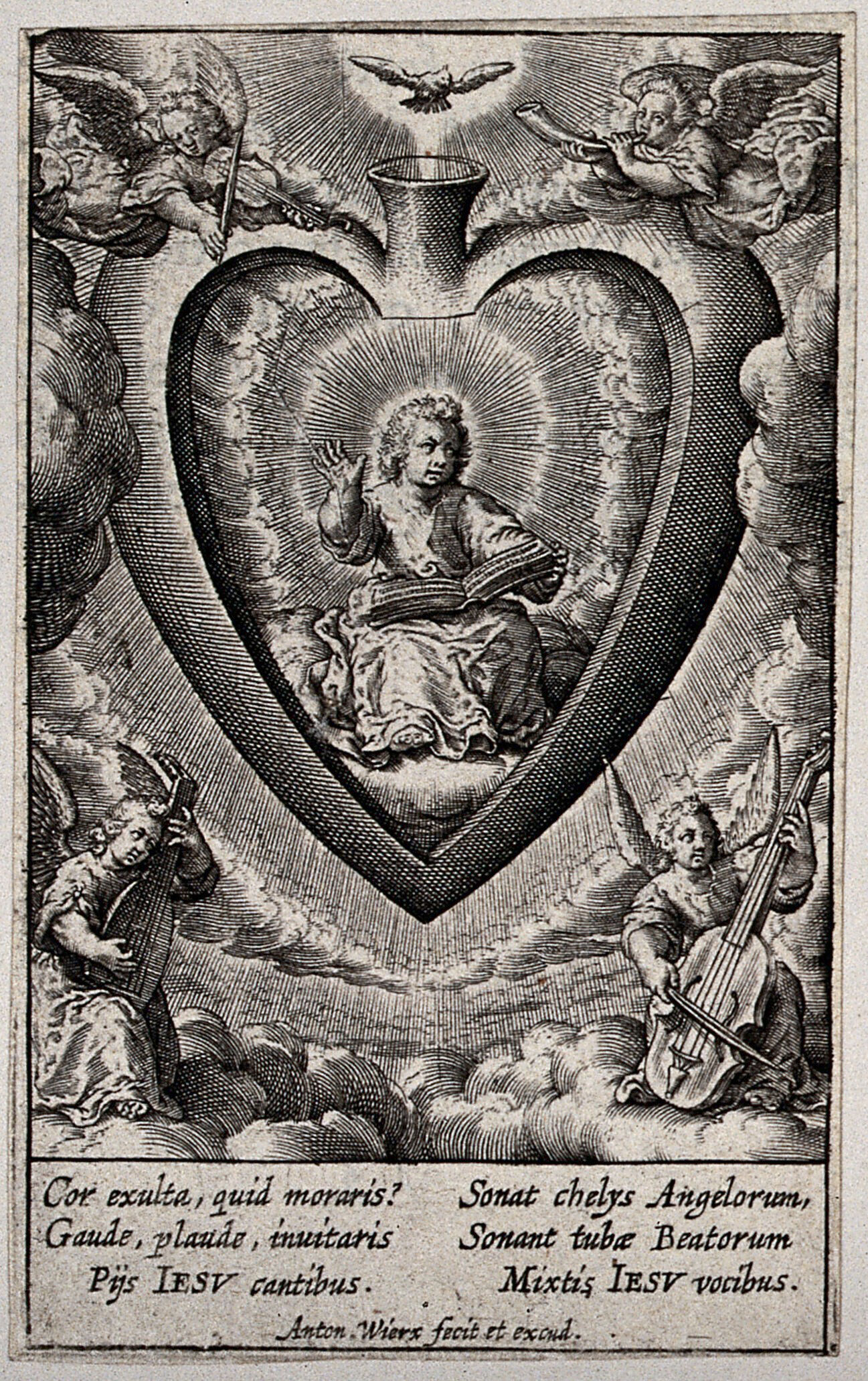
Cor exulta quid moraris?
Gaude, plaude, invitaris
piis Iesu cantibus.Sonat chelys angelorum,
sonant tubae beatorum
mixtis Iesu vocibus.(Heart, exult! Why do you hesitate? Rejoice! Applaud! Invite Jesus with sacred songs! The [name of] Jesus sounds forth in the lyre of angels, it sounds in the trumpets of the blessed mixed with voices [singing].)
Luzvic fancifully develops the image of Jesus as singer and choir conductor in the sanctum of our hearts, making sweet, melodious music:
I will chant the mercies of the Lord forever. For to this purpose Jesus, the prime Christ, records his ancient loves to the human heart, and now mixing with admirable skill flats with sharps, sharps with flats, the tenor with the bass, and running diversely divisions he touches with a sweet remembrance now with a moderate, now remiss, now slow, and now with a quick voice, the innumerable number of his benefits wherewith heretofore he hath wooed the heart . . . (176)
13. Jesus, the son of David, plays on the harp in the heart, while angels sing

Pulsa chordas, sonet chelys,
dum nos recreas de caelis
Iesu cordis gaudium.Dulce melos intonabunt,
novum nobis excitabunt
angeli tripudium.(Strike the strings! Let the lyre sound forth! While from heaven you renew us, Jesus, joy of the heart. A sweet tune angels shall intone [and they] shall arouse a new dance within us.)
14. Jesus rests in the lover’s heart

Frustra Boreas minatur,
frustra fulmen debacchatur,
frustra spumant caerula:dum in corde lectum stravit,
atque sponsus dormitavit,
tuta ridet sponsula.(In vain the north wind threatens, in vain the thunder runs wild, in vain the sea foams: while in the heart the betrothed has spread his bed and gone to sleep, the bride elect smiles in safety.)
What a moving image—the heart as a place of rest for Jesus. From the four corners the four winds blow, but Jesus is not perturbed, so why should we be? He still has the world in his hands (well, in his lap!).
The image is an allusion to the episode in all three Synoptic Gospels where a storm arises on the Sea of Galilee while Jesus and the disciples are in a boat; the disciples are frantic, and exasperated that Jesus is snoozing, but he tells them not to worry, and then he silences the wind and waves with a command: “Peace, be still!”
The image projects peace and stillness onto our troubled hearts.
15. Jesus wounds and pierces the heart with the shafts of love
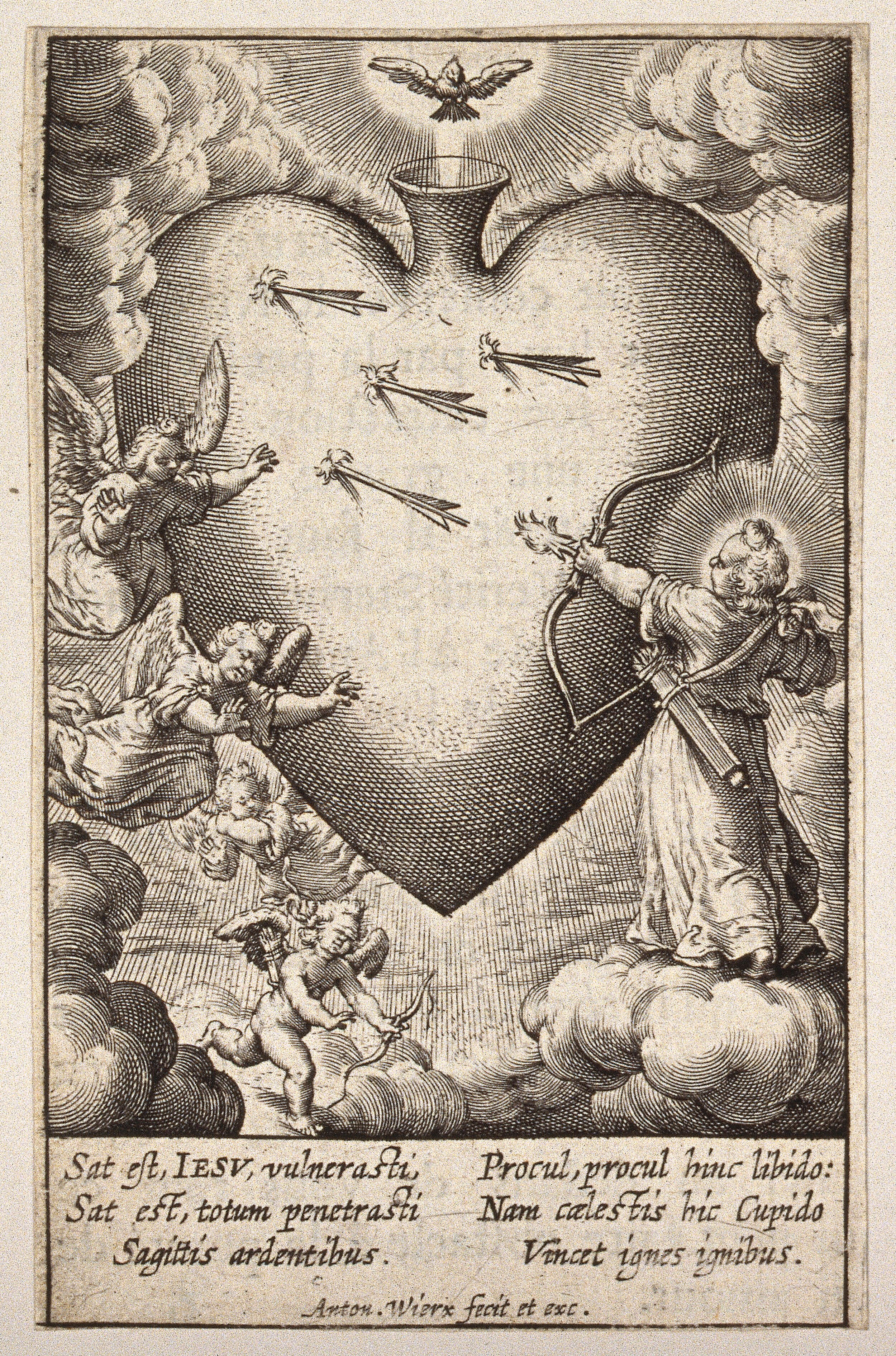
Sat est, Iesu, vulnerasti,
sat est, totum penetrasti
sagittis ardentibus.Procul, procul hinc libido:
nam caelestis hic Cupido
vincet ignes ignibus.(Enough, Jesus, enough! You have shot through the whole heart with flaming arrows. Lust, [be gone] far, far from here! For here is a heavenly Cupid who will conquer fire with fire.)
Luzvic quotes from chapter 2 of Augustine’s Confessions in this section: “Lord, thou hast pierced our hearts with thy charity.”
He elaborates with his own ecstatic words:
My good Archer, shoot, ah, shoot again! shoot through this heart of mine, with a million shafts, this refractory and rebellious heart, to thy divine love: slay and kill all love that is not thine, or is adversary to it. O sweet wounds! O dear to me! O arrows dipped and tipped with honey. . . .
The heart is never in so good a plight as when it is transfixed with a thousand points of sharpest love. (216)
16. The heart enflamed with the love of Jesus shines with light and flames

En armatas flammis tendit
Iesus manus, cor accendit
hinc et illinc facibus.Age, totum comburatur,
in favillam redigatur
cor amoris ignibus.(Behold, Jesus holds out his hands armed with flames, and sets alight the heart with torches on this side and that. Come, let it all burn, let the heart be reduced to an ember by the fires of love.)
17. Jesus crowns his dear heart with palms and laurels
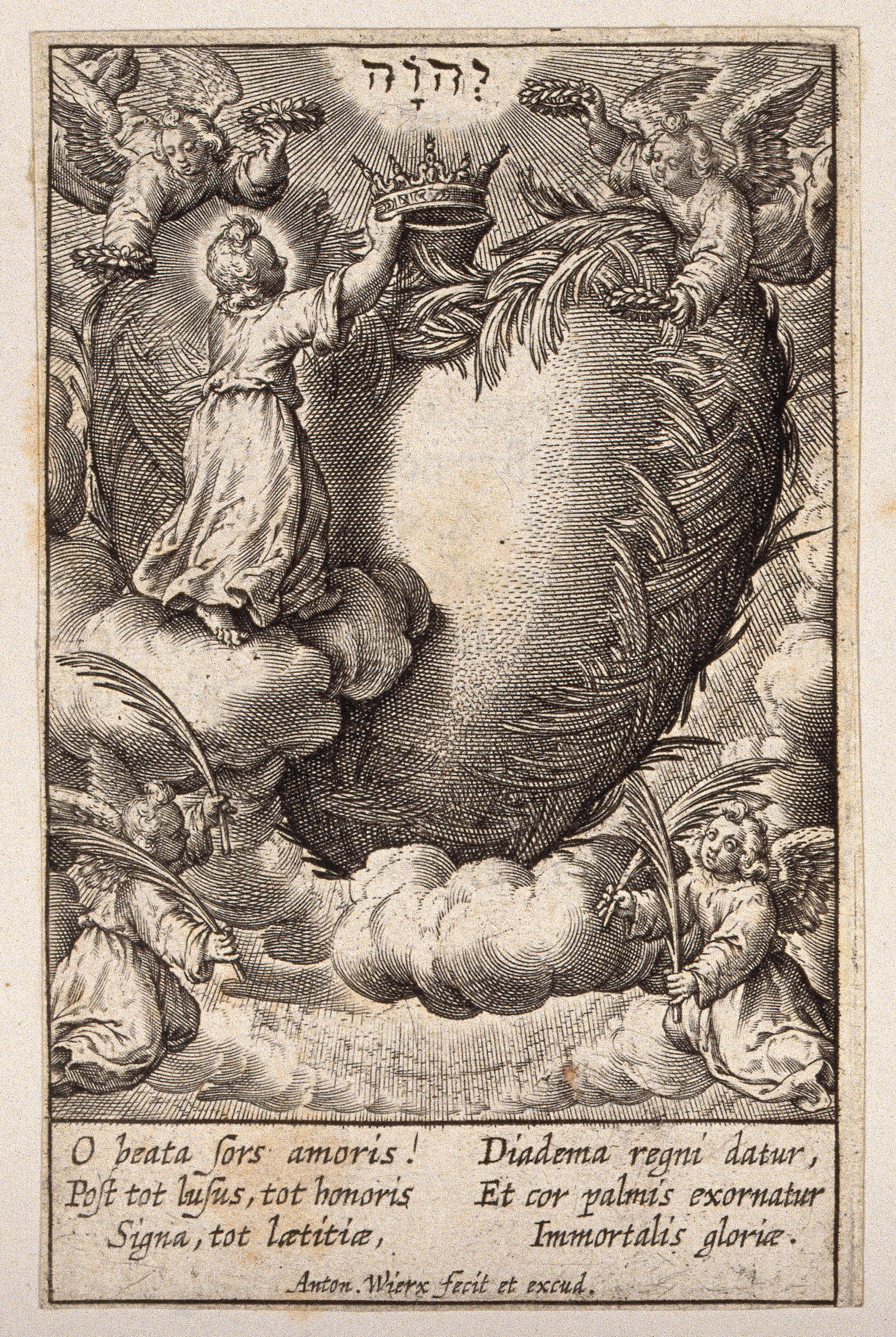
O beata sors amoris!
Post tot lusus, tot honoris
signa, tot laetitiae,diadema regni datur,
et cor palmis exornatur
immortalis gloriae.(O blessed fortune of love! After so many games, so many tokens of honor, so many of joy, the crown of the kingdom is bestowed, and the heart is adorned with the palms of immortal glory.)
* I am excluding the title page engraving from the count, which shows a flaming heart, inscribed with the words Cor Jesu amanti sacrum, held up by a Jesuit and a Franciscan friar; Jesus is not pictured, and there is no corresponding verse. And it appears that the Wellcome Collection does not own (or has not digitized) this print.
FURTHER READING
Daly, Peter M. The Emblem in Early Modern Europe: Contributions to the Theory of the Emblem. Surrey, UK: Ashgate, 2014.
Grześkowiak, Radosław, and Paul Hulsenboom. “Emblems from the Heart: The Reception of the Cor Iesu Sacrum Engravings Series in Polish and Netherlandish 17th-Century Manuscripts.” Werkwinkel 10, no. 2 (2015): 131–54.
Menegon, Eugenio. “Jesuit Emblematica in China: The Use of European Allegorical Images in Flemish Engravings Described in the Kouduo Richao (ca. 1640).” Monumenta Serica 55 (2007): 389–437.
Metzger, Franziska, ed. Sacred Heart Devotion: Memory, Body, Image, Text—Continuities and Discontinuities. Cologne: Böhlau Verlag, 2020.
Špániová, Marta. “Cor castum Dei speculum: Emblematics and the Heart Emblem in Jesuit Literature.” Z Badań nad Książką i Księgozbiorami Historycznymi (Studies into the History of the Book and Book Collections) 16, no. 3 (2022): 340–57.
Young, Louisa. The Book of the Heart. New York: Doubleday, 2003.


Thank you so much for sharing these beautiful images and wonderful words!Melina
LikeLike
Terrific post Victoria,Will use these emblems
LikeLike
Thanks, an amazing visual reminder of what the gospel is all about and how the human heart is his treasure, goal and possession. How easily we lose this vision as the world, the flesh and the devil assail our hearts.
LikeLike
Deo gratias.
LikeLike
[…] Morgan contrasts this emblematic series with the related Cor Jesu amanti sacrum by Anton Wierix (which I wrote about here). Whereas the Wierix engravings from Antwerp are marked by sweetness, with the Christ child gently […]
LikeLike
[…] (Related post: “Cor Jesu amanti sacrum: An emblematic print series of Christ setting up house in the heart of the…) […]
LikeLike
[…] https://artandtheology.org/2024/11/16/cor-jesu-amanti-sacrum-emblematic-print-series-christ-setting-… […]
LikeLike