With the feast of Pentecost coming up this Sunday, celebrating the gift of the Holy Spirit and the mission of the church, here are a few items of interest from around the web.
VISUAL COMMENTARIES: “The Risen Christ Appearing to the Disciples” by Victoria Emily Jones: This spring my latest exhibition for the Visual Commentary on Scripture was published, on Luke 24:36–49 and John 20:19–23, where Jesus appears to his frightened disciples after his resurrection, giving them peace, assurance, renewed purpose, and power. (In John’s telling of this episode, sometimes referred to as the Johannine Pentecost, Jesus breathes his Spirit onto them!) I selected and wrote about paintings by a medieval German artist, an Italian Renaissance artist, and a contemporary Indian artist that triangulate these parallel passages.
>> “O for a Thousand Tongues to Sing,” arr. Christopher M. Smith, performed by the MNU Heritage Choir: Smith arranged two stanzas of this Wesleyan hymn for the student choir he directs at MidAmerica Nazarene University in Olathe, Kansas. They perform the song inside the Bell Cultural Events Center, which has lines from the hymn inscribed on the walls.
>> “Citizen” by Philippa Hanna and Israel Houghton, performed with Moses Bliss
>> “For Your Gift of God the Spirit” by Margaret Clarkson (words) and Darwin Jordan (music), performed by musicians at Philpott Church in Hamilton, Ontario
+++
ARTICLE: “Vivid Spectrums of Color Radiate from Chris Wood’s Intricate Installations of Dichroic Glass” by Grace Ebert, Colossal: When I saw photos of this artwork by the Cambridgeshire-based light artist Chris Wood, with its prismatic colors and outward expansion, I thought of Pentecost—of the radiant gospel of Jesus Christ, from the launchpad of his resurrection and subsequent giving of his Spirit, going out to the world via and to various people groups, setting it ablaze. The artist says she was inspired by the logarithmic spiral of the nautilus shell. “We find in this a representation of how radiance can be embodied within us, as projected to those around us,” she says.
Chris Wood (British, 1954–), 40 × 40, 2022. Dichroic glass, diameter 160 cm. Commissioned by Clé de Peau Beauté.
40 × 40 was commissioned in 2022 by the Japanese luxury skincare and makeup brandClé de Peau Beauté for its fortieth anniversary. The work comprises forty spirals, each made up of forty pieces of dichronic glass, each forty millimeters long.
“Dichroic is a material that is colorless, but it has an optical filter on it,” Wood explains. “So when light hits it, certain wavelengths, which are manifested as colors, reflect back, and the remaining wavelengths pass through, creating two colors. Those colors change depending on the angle and quality of the light and the viewpoint. It’s just the most eloquent description of the magic of light that I could find.”
+++
VIDEO: “The Lord’s Prayer: One Church, One Prayer”: ICF (International Christian Fellowship) Rotterdam-Noord, an intercultural church in the Netherlands, recently put together a video compilation of some of its members praying the Lord’s Prayer in their mother tongues; represented are English, Papiamentu, Dutch, Malayalam, Swahili, Arabic, Twi, Spanish, Tagalog, Chinese, and German.
Rotterdam is a diverse city, home to 170 different nationalities. In the neighborhoods ICF North serves, 70 percent of residents have a migrant background. Every Sunday the church, pastored by Fred Kappinga, offers an Arabic-Dutch service and an English-Dutch service, with translations into other languages when necessary and possible. They sing Christian worship songs from around the world and host guest preachers of various ethnicities.
Occurring forty days after Easter, Ascension Day is this Thursday, May 14, and will be celebrated by many churches on Sunday, honoring Jesus’s ascent to heaven. This historic event “represents both a conclusion and a commencement,” writes Ashley Tumlin Wallace: “Jesus finished his earthly work while setting into motion the gift of the Holy Spirit and the birth of the Church.” Below are a few items for the occasion.
QUOTE: “In the mystery of the Ascension we reflect on the way in which, in one sense, Christ ‘leaves’ us and is taken away into Heaven, but in another sense he is given to us and to the world in a new and more universal way. He is no longer located only in one physical space to the exclusion of all others. He is in the Heaven which is at the heart of all things now and is universally accessible to all who call upon Him. And since His humanity is taken into Heaven, our humanity belongs there too, and is in a sense already there with him. ‘For you have died,’ says St. Paul, ‘and your life is hidden with Christ in God.’ In the Ascension Christ’s glory is at once revealed and concealed, and so is ours.”—Malcolm Guite
+++
ARTICLE: “Ten Reasons to Celebrate Ascension Day” by John Witvliet, Reformed Worship: John Witvliet, senior scholar and professor of theology, worship, and the arts at Belmont University, answers the question “Why does Ascension Day matter?” He concludes with two book recommendations and some suggestions for corporate worship.
+++
ALBUM: Ascension Songs by Cardiphonia: This compilation album from 2012 features nineteen traditional hymns about Christ’s ascension, seventeen of which have been retuned by contemporary singer-songwriters and worship leaders. I featured one by Sarah Majorins back in 2019; here are two other favorites, the latter from the Sacred Harp tradition:
>> “Today Our Lord Went Up On High” | Words by Johann Zwick, 1542; trans. Catherine Winkworth, 1858 | Music by Rebekah Osborn, 2012
>> “Jesus, My All, to Heav’n Has Gone” | Words by John Cennick, 1743 | Music (NORTH PORT) by R. R. Osborne, 1850 | Arranged by Bruce Benedict, 2010
ORATORIO: Lobet Gott in seinen Reichen (Praise God in His Realms) by J. S. Bach: Known as the Ascension Oratorio, Bach’s BWV 11 was composed for the Feast of the Ascension almost three centuries ago. It is structured in eleven movements in two parts and runs about a half hour. Its libretto comprises some original texts (likely written by the German poet and Bach’s regular collaborator Picander) as well as quotations from the Bible and hymns by Johann Rist and Gottfried Wilhelm Sacer. It both mourns Christ’s bodily departure and extols his universal reign.
The oratorio’s closing chorale fantasia (starting at 25:48 in the video above) is often cited as one of many examples of Bach’s sophisticated expression of theology through music. The orchestra plays in D major while the chorus sings in B minor—“When shall it happen, / When will the dear time come, / That I shall see him / In his glory?”—conveying the human state of waiting and hoping for Christ’s return and the fulfillment of that hope. Both jaunty and full of longing, and harmonious between the two, movement 11 anticipates the day when we will be reunited with Christ in the flesh. Craig Smith writes,
The final chorale is an amazing tour de force. A verse set to the melody of the grave chorale “Von Gott will ich nicht lassen” is imbedded in the brilliant trumpet- and drum-dominated D Major texture of the orchestra. The B minor of the chorale never loses its identity but is simply swallowed up in the D Major. Bach understands the melancholy of being left behind, and profoundly includes it here in this ostensibly joyous festival.
The above performance from 2013 is by the Monteverdi Choir and English Baroque Soloists, conducted by John Eliot Gardiner. An English translation of the German lyrics is given as subtitles, but you can also follow along here.
+++
REFLECTION: “Let me go, because then the Spirit will come” by Jonathan Evens: Jonathan Evens, a vicar in the Church of England, shares the reflection he gave on Ascension Day at St Martin-in-the-Fields in London in 2020, which concludes with a verse-style meditation that I really like. Here’s the first stanza:
Touch me not. I am not yours to have and hold, in this shape in this form. Let go. Let me go. Let my Spirit come. Divine my Spirit, know me within.
+++
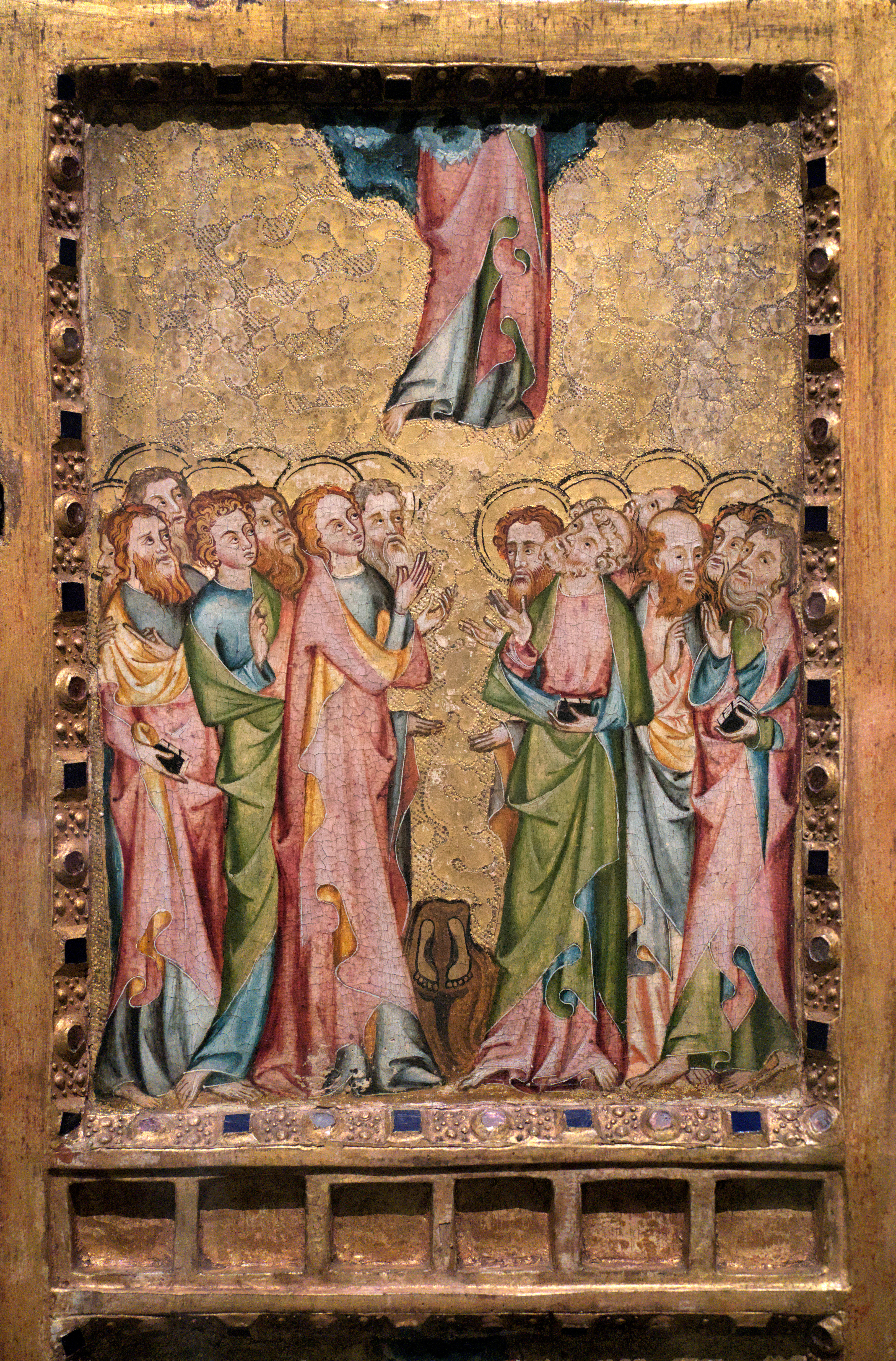
PAINTING: The Ascension, ca. 1340–50: Last fall while I was in Cologne, I visited the Wallraf-Richartz-Museum, which has an excellent collection of medieval German art. Here’s a lovely little Ascension painting I saw:
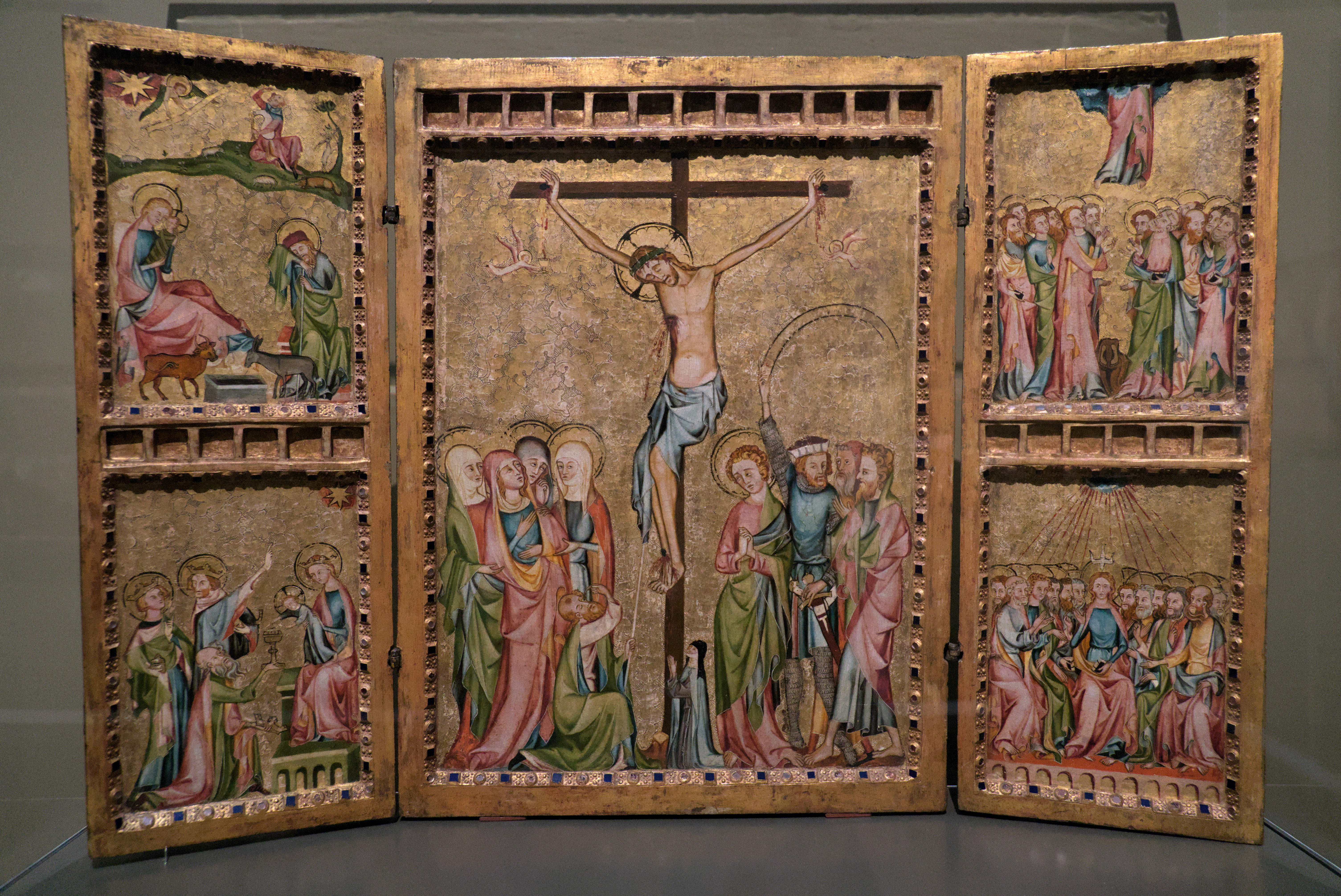
It’s from a small triptych made in the mid-fourteenth century in a Cologne workshop for a Poor Clares cloister in the city. The object would have been used by the nuns for private contemplation. Its central scene is the Crucifixion, and the wings portray, in addition to the Ascension: the Nativity, the Adoration of the Magi, and the Descent of the Holy Spirit.
Triptych with Depiction of the Outworking of God’s Plan for Salvation, Cologne, ca. 1340–50. Tempera on oak. Wallraf-Richartz-Museum, Cologne, Inv. 1. Photo: Victoria Emily Jones.
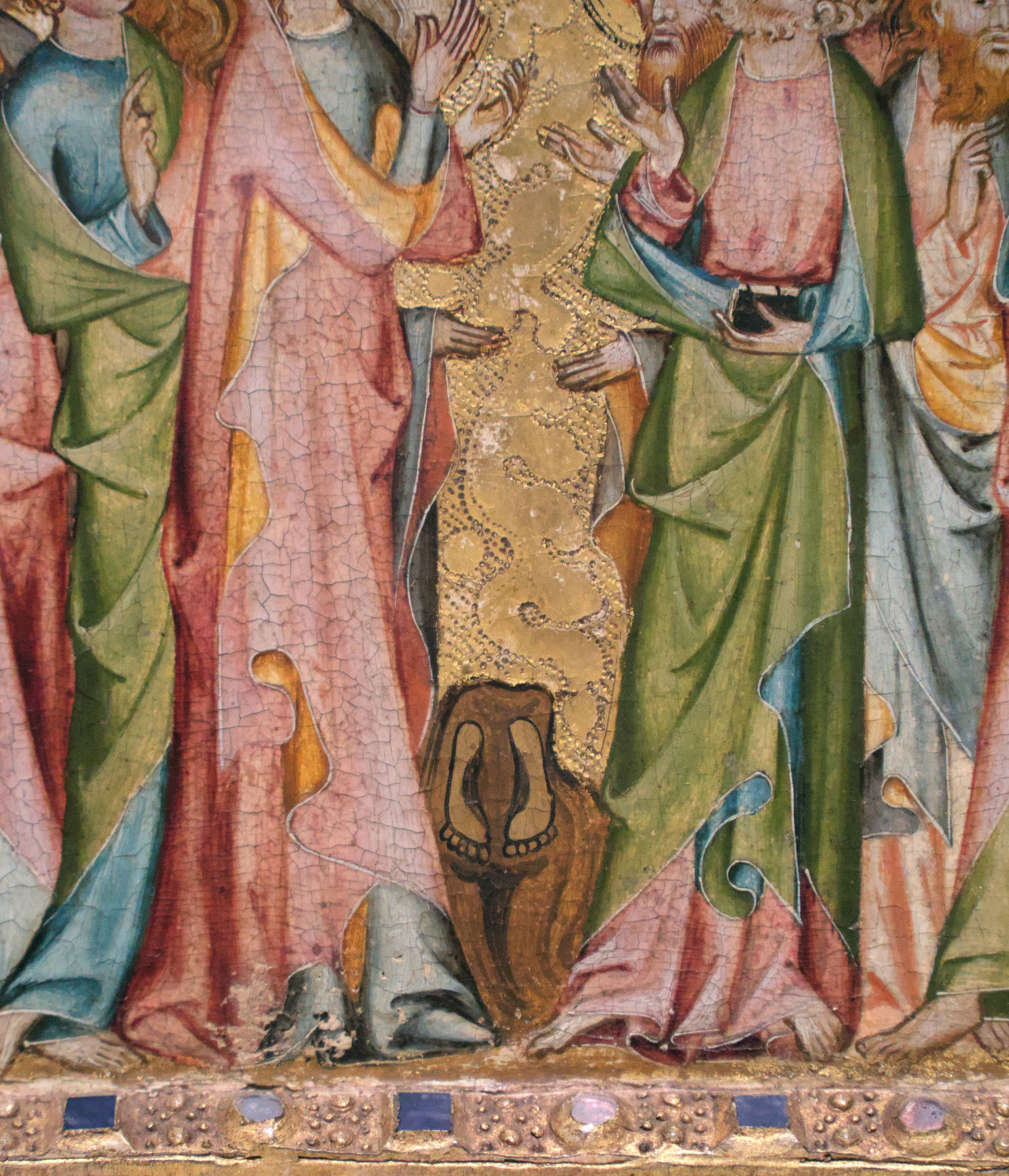
As is common in medieval paintings of the Ascension, that panel shows Jesus from the waist down, rising out of frame, leaving behind a set of footprints on the Mount of Olives. To me, that physical impression is a reminder of how Jesus, the God-man, has a body—he walked the earth in it, feeling dirt between his toes, and went to heaven with it, prefiguring the day when those who are in Christ will also, soul and body, join the Father in glory. That little mark on the mound, a negative space where Jesus’s weight once pressed, speaks both presence and absence. Ten days later, he’d send down his Spirit on the same gazing group, and many more besides, and their beautiful feet would carry the good news of his risen life far and wide.
PODCAST SERIES: Dissident Cinema Marathon, Filmspotting: Over the next two months, Filmspotting, my favorite film podcast, is running a marathon on the theme of politically dissident cinema, exploring six films that confront authoritarian power and state abuse. They come from the US, Italy, Japan, Greece, France, and Iran:
The Great Dictator (Chaplin, 1940) – Kanopy, HBO, Amazon Prime, Criterion Channel, etc.
Rome, Open City (Rossellini, 1945) – HBO
No Regrets for Our Youth (Kurosawa, 1946) – Criterion Channel
Z(Gavras, 1969) – HBO
The Sorrow and the Pity (Ophuls, 1969) – Kanopy, Kino Film Collection (free trial)
The first episode of the marathon aired May 4 (see below). It reviews Charlie Chaplin’s first true sound film, The Great Dictator, a political satire denouncing Hitler and Nazism. Chaplin stars as Adenoid Hynkel, the delusional, power-hungry, self-obsessed “phooey” (parody of Führer) of Tomainia. Chaplin started writing the script in fall 1938 and began filming it in September 1939; the movie was released in the US in October 1940. At a time when European nations were making concessions to Hitler and many Germans, swayed in part by his charisma and promises, were supporting his ultranationalist ideology, and others were simply conveniently ignoring him (Chaplin’s own adopted country was trying to maintain neutrality), Chaplin had the guts to call a spade a spade and openly mock the world leader and, in the character of a Jewish barber who’s mistaken for Hynkel, deliver a sincere and rousing speech against his fascist rule.
Chaplin realized, says cohost Josh Larsen [previously], that “it’s a crucial thing . . . calling out a dictator, whether it’s Hitler or someone we’re living with. You call him out as an idiot, because as a comedian, this is what Chaplin is going to be able to do: lampoon the inherent silliness . . . the puffery, the pageantry, the needing of arches and ballrooms and your face on every frickin’ thing everyone looks at. . . . It takes a comedian to spoof all of this self-important buffoonery that, to my mind, is really just an attempt to mask a lack of moral authority.” The movie contains one of cinema’s most memorable and prescient scenes: the demented globe dance, where Hynkel gracefully tosses, kicks, and balances a balloon globe, imagining a “pure Aryan world” with himself as a god.
To participate in the marathon, watch the films on your own (above, I shared the streaming services they’re on, but you might also see if DVDs are available at your local library), and listen to the podcast discussions that will be released one by one in the coming weeks on YouTube and your favorite podcast platform.
What do you remember most about the movie—what stands out for you?
What was a highlight for you, and what was a challenge?
What questions does the film raise for your own life or for the world as you see it?
And he suggests several more questions to consider as and after you watch.
This excerpt is published on the Substack Soul Telegram, which Norris and Higgins also jointly author. The second half comprises Norris’s reflections on Life Itself, a 2014 documentary about the famous film critic Roger Ebert.
+++
PODCAST EPISODE: “Songs for Public Faith, with Jon Guerra,”Conversing, February 10, 2026: “Singer-songwriter Jon Guerra [previously] joins Mark Labberton to explore devotional songwriting, public faith, and the tension between the kingdom of Jesus and American cultural power. Through music and reflection, Guerra considers how art can hold grief, courage, and hope together in turbulent times.” Guerra says he wants his music to help orient people to higher and longer and deeper things. He discusses his songs “American Gospel,” “Love Your Enemies,” “The Kingdom of Jesus,” and “Citizens” (last two embedded below).
+++
DOCUMENTARY: Listers: A Glimpse into Extreme Birdwatching (2025), dir. Owen Reiser: In 2024, twenty-something brothers Quentin and Owen Reiser, the latter a wildlife photographer, embarked on what birders call a “big year,” traveling the contiguous United States attempting to witness and identify as many bird species as possible, trying to beat the record of 751 birds. They undertook this challenge on a meager $16,000 budget (in contrast to most big year competitors, who spend hundreds of thousands of dollars), driving and sleeping in a Kia Sedona and eating mostly beans and canned tuna. Listers—a term describing birdwatchers who keep detailed records of the birds they encounter—is a documentary about the Reisers’ whimsical excursion, learning the ins and outs of birding by poring over field guides, calling rare bird hotlines, interviewing members of the birding community, and simply doing. The film alternates between high-resolution footage of the birds they observe and handheld camcorder footage of their other experiences on the road and in the wild. They delve into relevant controversies and debates, such as the playback of recorded bird calls to attract birds into view and the increasing gamification of birding through the citizen science app eBird.
But the film also encourages an appreciation of the beauty and variety of North American birds. It closes with an intertitle quote by the naturalist Kenn Kaufman, from his book Kingbird Highway: “As trivial as our listing pursuit may be, it gets us out there in the real world, paying attention, hopeful and awake. Any day could be a special day, and probably will be, if we just go out to look.”
The Reisers received distribution offers from Netflix, HBO, and Amazon but turned them all down, as they want Listers to be freely accessible to everyone. Watch the film here; trailer below. They also self-published their own field guide as a supplement.
+++
ARTICLE: “Lessons from the Hidden Vault of Thomas Kinkade” by Michael Wright: After Thomas Kinkade, the best-selling evangelical Christian “painter of light,” died of an overdose in 2012, his estranged family found a vault in his home containing hundreds of off-brand paintings he had made. Dark, moody, experimental—they are a far cry from the idyllic cottages that made him rich and famous. These previously unseen paintings are featured in the recent documentary Art for Everybody, directed by Miranda Yousef. (See trailer below.) Michael Wright shares some thoughts after seeing the film, which he says cultivated sympathy in him for Kinkade and the pressures he faced to be a “Good Christian Leader” and softened his harsh opinions of the artist into more complicated questions, such as “Why does an artist hide vital parts of himself for the sake of success? What happens when we curate branded versions of ourselves? Why do we continue to see this cycle of Christian leaders wrecking their lives? How can we imagine new social landscapes?” How can the market make room for an artist’s whole self?
Death is hard. No matter your religion and its consolations, whether you’re the one dying or you’re saying goodbye to someone who is or has, it’s often a painful ordeal.
For the Christian, death holds a tension. It’s something to grieve, as Jesus did at the grave of his friend Lazarus; it was not part of God’s original design and so in that sense is not “natural,” even though it’s inevitable. We can and should mourn its power to (at least temporarily) sever. But death can also be something to celebrate if the deceased was in Christ, since as the apostle Paul wrote, “to be absent from the body [is] to be at home with the Lord” (2 Cor. 5:8), in a state of blissful rest.
Christians regard death as an entrance to the dwelling-place of God that we call heaven or paradise. Contrary to popular conception, that heaven is not our eternal home—not really. It’s a temporary holding place for the souls of the Christian departed, who await the general resurrection, at which time our souls will be reunited with our bodies and heaven will be remade and brought down to a new earth, where we will dwell forever, as whole, embodied persons, vibrant and active, with God. That, as the New Testament scholar and theologian N. T. Wright has been reiterating for decades, is our ultimate hope: not an ethereal existence in the skies, but physical resurrection, cosmic renewal, and God making his forever home with us here. The joining of heaven and earth—God’s space and ours—in a lasting embrace.
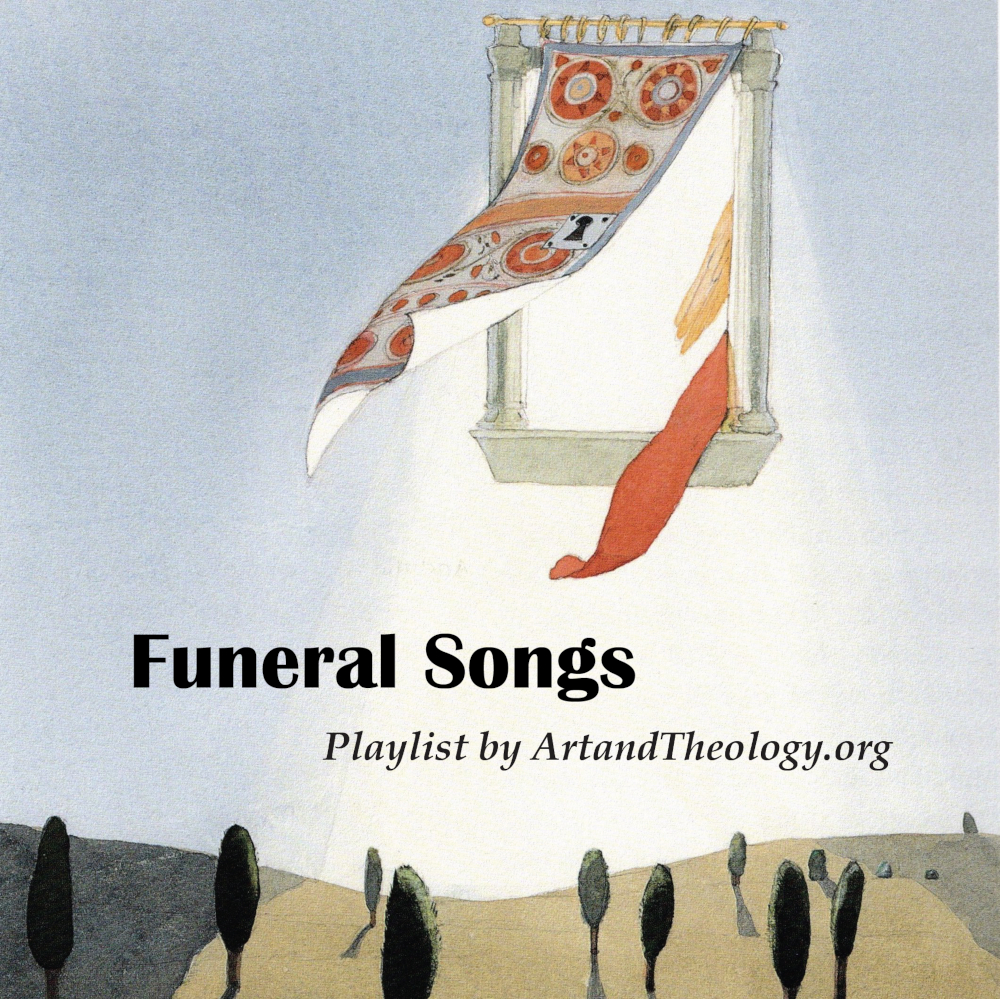
When my paternal grandpa passed away in May 2017, I began building a private Spotify playlist of songs about death to help me move through that loss. I’ve been adding to it for the past nine years, and now I want to make it public.
I hesitated for a while on whether to share the list, because I worry that overall, it does promote a lopsided hope, a truncated view of what eternal life looks like. Wright’s Surprised by Hope: Rethinking Heaven, the Resurrection, and the Mission of the Churchwas paradigm-shifting for me, and I’ve wrestled with its implications on the theologies we articulate, including through song, at funerals. Wright decries how Platonism, with its degrading of bodies and of the created order in general, has infected whole swaths of Christian thinking, misleading people into supposing that Christians are meant to devalue this present world and our material selves; that our goal is to escape them both.
The early Christian hope was not, Wright declares, to be rescued from this world, but to be rescued with and for it: that is, that the world itself, people included, would be liberated from its present state of corruption and decay. They centered this hope firmly on the resurrection. They talked very little about “going to heaven” when they died; instead, they emphasized the promise of the dead being raised on the last day to image God in a new bodily existence in a newly remade world. If they did refer to heaven as a postmortem destination, Wright says, those early Christians seemed to regard it as a temporary stage on the way to the eventual resurrection of the body.
Wright laments that so many Christian songs look forward chiefly to “life after death” (the intermediate state, entered immediately after one’s death, in which one’s soul resides in heaven while one’s body remains “asleep” in the grave) instead of “life after life after death” (the eschaton; the resurrection; the descent of the New Jerusalem; the new heavens and new earth), which is God’s whole telos. This glut of songs that focus on the prelude to eternal life as the biblical authors envisioned it has contributed to many Christians’ ignorance of the two-step narrative of life after death, with step two being what we should really be singing about.
I get what Wright is saying. But I think he sometimes overstates his points. He hates the phrase “going to heaven,” preferring instead “heaven coming to earth”—and yet “going to heaven” does accurately describe what the Christian soul does at the moment of bodily death. He also disparages lyrical expressions like “way beyond the blue,” “a faraway strand,” “up over yonder,” “the great beyond,” anything that suggests otherworldly distance . . . but again, if what is being described is that interim place of souls where God’s throne currently is, which is outside the space-time continuum but for which the Bible uses directional “up” language, such descriptions seem to me to be appropriate.
And the word heaven, I feel, can also encompass the final reality: the marriage of heaven and earth. I see the word as shorthand for “where God is.” Of course, Wright is correct that heaven-as-stopover (out there and we as incorporeal) and heaven-as-new-creation (right here and we gloriously corporeal) often get muddled in our songs, and that greater theological precision might be warranted. But we also have to consider the limits of sung verse—especially particular forms, like the spiritual, which is meant to be simple and repetitive so as to be transmitted orally—to convey nuanced ideas or to express all aspects of a given theme.
Wright also eschews the “just passing through” spirituality that infuses much hymnody, folksong, and preaching—the idea that earth is not our home; heaven is. That idea, he claims, treats the world as irrelevant at best and evil at worst, when in fact, God loves the world and wants to and indeed will redeem it, not evacuate us from it. This earth will be transformed one day into our eternal habitation.
I do agree that there’s a dangerous strand of escapist theology that has arisen in Christianity, which nurtures aspirations to flee the world, to regard is as mere dross and so to care nothing for its welfare. But I also don’t automatically dismiss hymns that describe this present life as “night,” for example, or that mention “earth’s vain shadows”—Wright negatively references both in Surprised by Hope. This present world is incomplete. It’s groaning for redemption, and we in it. We see through a glass darkly. We often stumble. We’re tempted to pursue pleasures or glories that are ultimately empty. Pain, toil, and fragmentation are part of the human experience. I think it’s right that we don’t feel entirely at home here, even as we anticipate God’s future purposes for the world—healing, transforming—through concrete actions, living as new-creation people. The apostle Paul says we’re citizens of heaven (Phil. 3:20), which is in part where the concept of “our heavenly home” comes from. The kingdom of heaven is the place from which Christ reigns. And yes, one day that will be earth, but right now, it’s not.
In the grand scheme of things, our mortal existence is short—so the idea of us being transient between this life and the next is not, I think, out of step with the biblical view, many passages of which comment on life’s brevity and the fleetingness of the flesh, which fades like grass.
While Wright stresses the continuity between earth as it is now and earth as it will be, there is also—and he does concede this—discontinuity. The earth will be itself and yet radically new when God re-creates it. It will be somehow both familiar and other. The same is true of our bodies, which—hallelujah!—God redeems along with our souls. (We are saved not as souls but as wholes, Wright quips.) These bodies we have now are good, yes, but they also break down and can be burdensome—hence why so many Christian songs of death express a yearning to cast off the body. Even the apostle Paul, in Romans 7:24, bemoans, “Who will deliver me from this body of death?” Like Wright, though, I do wish there were more songs that coupled that desire with the anticipation of a renewed body, as Paul does, instead of suggesting that a bodiless existence is the consummate state. As Wright argues, a focus on the soul’s immortality, on leaving the body behind, is a distraction from the supreme hope of the resurrection.
The funeral song that theologians, both professional and armchair, love to hate on most for its supposed Gnosticism is the Southern gospel classic “I’ll Fly Away” by Albert E. Brumley. They object to its anti-this-worldly stance that celebrates the soul’s breaking free “like a bird from prison bars has flown” (“no more cold iron shackles at my feet”), which implies that this world or this body, or both, is a prison keeping our true self captive. But is that sentiment not in some ways consonant with Romans 8:19–21, which says that “the creation waits with eager longing . . . [to] be set free from its bondage to decay and . . . obtain the freedom of the glory of the children of God”?
I see how the metaphor of the body as a prison can be problematic, but imagine it from the perspective of a person in advanced age, losing their vision, hearing, speech, reason, memory, strength, dexterity, mobility, bowel control, appetite, and so on. Or someone with chronic illness, or a debilitating disease, or on life support. That’s not at all to say such people should just die, or that they bear God’s image any less—but for them, life in the body is an immense struggle, and if they long to leave it to be with God, that’s not sinful or misguided. Many faithful Christians throughout history have prayed that God would take them or their loved one out of this life, out of their suffering.
The refrain “I’ll fly away” is actually mentioned in two biblical psalms:
My heart is in anguish within me; the terrors of death have fallen upon me.
Fear and trembling come upon me, and horror overwhelms me.
And I say, “O that I had wings like a dove! I would fly away and be at rest;
truly, I would flee far away; I would lodge in the wilderness; Selah
I would hurry to find a shelter for myself from the raging wind and tempest.”
—Psalm 55:4–8
For all our days pass away under your wrath; our years come to an end like a sigh. The days of our life are seventy years or perhaps eighty, if we are strong; even then their span is only toil and trouble; they are soon gone, and we fly away.
—Psalm 90:9–10
I wouldn’t program “I’ll Fly Away” for a Sunday morning worship service, but I happen to think it’s a great funeral song—I’ve included three different versions on my playlist, first from the movie soundtrack that in 2000 popularized it for a new generation—expressing an exuberant sense of release from suffering and joy in meeting God. I’d leave it to the preacher, and a fuller song set, to place it in context of the greater Christian hope of the resurrection of the body and the renewal of this world.
SONGWRITERS: To you I extend the challenge of expanding the repertoire of Christian music about last things, composing songs that capture the grander biblical vision of God’s intent for what he’s made. Give us new songs that anticipate the merging of heaven and earth! That trace the line of new creation from Jesus’s resurrection to our own. That celebrate not so much our going to live with Jesus when we die as Jesus’s coming to live with us when he brings his kingdom project to full fruition. Help us to see the goodness of our bodies and the world and to treasure God’s promise to redeem both; enlarge our concern about final destinies to encompass the whole cosmos, reorienting our hope around being raised to life in God’s new heaven and new earth. Remind us that our labor on earth is not in vain but will last into God’s future. Draw together Genesis 1–2, Isaiah 65, Romans 8, 1 Corinthians 15, 2 Peter 3:13, and Revelation 21–22.
In his engagement with Wright’s Surprised by Hope and what it means for funeral reform, John L. Drury suggests “we can still talk about grandpa going to heaven and being with Jesus. We just need to also talk about grandpa coming back with Jesus to reign with us in the new heavens and the new earth.” He advises that “one must also transform the language describing the present state of the person to express its interim character. We can still say they have gone to a better place, but we must then immediately modify this by saying that they will one day enter the best place of all, the new creation. We can still say they have entered into rest, but we must then immediately modify this by saying they are resting in the sense of waiting, waiting for the final act in God’s story.”
Why have I spent so long discussing Wright in this article that is supposed to be introducing a playlist of funeral songs? Because his teachings on eschatology, which includes the subject of heaven, have been vastly influential, not just for me but within Protestantism at large.
No doubt he will object to some of the entries on my “Funeral Songs” playlist. In building it, I eliminated some egregious offenders, but I feel comfortable putting forward these remaining songs. Even if some refer primarily to the deceased’s temporary residence “on high” or temporarily immaterial state—rather than their final, physical state in restored creation, i.e., the new heavens and the new earth—there’s still value in celebrating this initial phase of postmortem life they’ve entered. At funerals, it’s good and right to look forward to the consummation of all things, but it’s also good to assure those who grieve that their late beloved is presently in a place of rest, joy, and refreshment. It’s “home” insofar as home is where God is.
Consider the different metaphors for death represented in the playlist: Crossing the Jordan River into the promised land. Summiting a mountain. Culminating a pilgrimage. Laying down a burden. A valley. A sunset, to be followed by dawn. Death as a mode of transport, by train, chariot, or even airplane! The safe arrival of one’s ship, after a turbulent journey, into harbor. Death is conceptualized in terms of homegoing, meeting Jesus face-to-face, reunion with family, freedom, happiness, repose, healing, inheritance, victory, glory. It’s a threshold into an indescribable new reality.
Some songs incorporate descriptions of heaven or the New Jerusalem drawn from scripture, which have unfortunately become hackneyed: pearly gates and gold-paved roads (Rev. 21:21), mansions (John 14:1–3), harps (Rev. 5:8; 15:2), angelic choirs, white robes (Rev. 7:9–14) and gleaming crowns (Rev. 2:10). Concentrated mainly in the book of Revelation, these details were the writer John’s attempts to convey something of the beauty, purity, perfection, and grandeur he saw in his heavenly visions.
The playlist opens and closes with “I Bid You Goodnight,” aka “The Christian’s Good Night” or “Sleep On, Beloved,” a hymn for the lowering down of caskets written in 1871 by Sarah Doudney, with music, in 1884, by Ira David Sankey. (View the sheet music.) It was sung at the funeral of the preacher Charles Spurgeon in 1892. It later made its way to the Bahamas, where it was adapted and recorded in 1958 and 1965 by Joseph Spence and the Pinder Family. Spence’s sister, Edith Pinder, sings lead, ad-libbing a number of calls in the latter half, such as “One of these mornings, bright, early, and soon,” “Walkin’ through the valley of the shadow of death,” “His rod and staff shall comfort me,” “Goodness and mercy shall follow me on,” “John Divine said, ‘I saw the sign,’” and “Gonna walk in Jerusalem just like John.”
The Spence-Pinder recordings became the basis of subsequent folk versions in the US, such as the one that the Grateful Dead often closed their concerts with, and my two favorites: by Kent Gustavson (below) and Sweet Honey in the Rock. These all utilize only the first verse of Doudney’s original seven.
Lay down, my dear brother [sister, mother, father], lay down and take your rest Won’t you lay your head down upon your Savior’s breast I love you, but Jesus loves you the best I bid you goodnight, goodnight, goodnight
The hymn wishes the departed a pleasant sleep before their eternal waking at the resurrection.
Since I shared one of my mom’s funeral picks above (“I’ll Fly Away”), now let me share one of my dad’s: “Peace in the Valley,” written by the Black gospel songwriter and musician Thomas A. Dorsey. Watching reruns of The Ed Sullivan Show, my dad would call me and my brother to the TV whenever Elvis’s performance of this song came on from the January 6, 1957, episode. As he would regale us every time: “The producers didn’t want him to sing a gospel song on national television. They just wanted his rock and roll. But he insisted. It was his mom’s favorite song. He said he wouldn’t do the show if they didn’t let him sing it.”
The Ed Sullivan performance leaves out the second verse, likely for time—it’s included in Elvis’s studio recording released a few months later—but its imagery provides a fuller picture of peace, drawing on the description of the messianic kingdom in Isaiah 11:
Well, the bear will be gentle, and the wolves will be tame And the lion shall lie down by the lamb, oh yes And the beasts from the wild shall be led by a child And I’ll be changed, changed from this creature that I am, oh yes
Dorsey wrote the song as world tensions were mounting in the late 1930s, just prior to World War II. Traveling by train through Indiana, he observed horses, cows, and sheep grazing together in a small valley and wondered why humans across nations couldn’t live peaceably with one another, as these animal species were, sharing the grass. This was also a time of racial terror in America, of lynchings and other acts of anti-Black violence. “Peace in the Valley” asserts that the violence of the world will one day be undone, when creation is made new.
Another famous gospel song by Dorsey is “Precious Lord, Take My Hand.” Hearing it makes me emotional because a dear elderly friend from my church, who has since passed away, often requested it in worship. Here’s a gorgeous arrangement by Arnold Sevier, performed by the Aeolians of Oakwood University:
The genres of gospel, blues, and spirituals are heavily represented in the playlist, all birthed out of the African American experience.
The spiritual “Trouble of the World,” or “Soon-a Will Be Done,” is another song that sounded from my family television set many a time in my childhood, during my dad’s at least once-yearly watch of the 1959 film Imitation of Life. The funeral scene, which features Mahalia Jackson singing this solemn yet triumphant song that originated on Southern plantations during the era of slavery, always got him weeping:
While songs like this convey weariness, others burst with jubilation, like “Joy” by Ruthie Foster, from her 2002 album Runaway Soul:
“When I Get Home,” a traditional revival hymn performed by Elizabeth Mitchell with Dan Zanes, is more gently joyous. They based their version on a 1958 recording by Elizabeth Cotten, who recalled the song from her youth in North Carolina:
For a Christocentric song, consider Andy Zipf’s rendition of “Immanuel’s Land,” aka “The Sands of Time Are Sinking.” The hymn was written by Anne Cousins in 1854 and is traditionally sung to the tune RUTHERFORD, composed by Chrétien Urhan in 1834. Zipf sings three of its nineteen stanzas.
Oh! Christ, he is the fountain, The deep sweet well of love! The streams on earth I’ve tasted, More deep I’ll drink above: There, to an ocean fullness, His mercy doth expand, And glory—glory dwelleth In Immanuel’s land.
Oh! I am my Belovèd’s, And my Belovèd’s mine! He brings a poor, vile sinner Into his house of wine: I stand upon his merit, I know no other stand, Not e’en where glory dwelleth In Immanuel’s land.
The bride eyes not her garment, But her dear bridegroom’s face; I will not gaze at glory, But on my King of grace; Not at the crown he giveth, But on his piercèd hand: The Lamb is all the glory Of Immanuel’s land.
There are also a few choral pieces on the playlist, including “Goin’ Home,” an adaptation of the English horn melody from the second (Largo) movement of Antonín Dvořák’s New World Symphony by one of Dvořák’s students in America, William Arms Fisher, who also added lyrics. Though Fisher says the composition was inspired by African American spirituals, it’s not Christian-specific, but it is compatible with Christian belief, its speaker “just goin’ home . . . through an open door,” to where friends and family are waiting; “nothin’ lost, all’s gain. . . . Real life’s just begun.” The arrangement sung by VOCES8 in the following video is by Jim Clements.
The Silkroad Ensemble, renowned for its unique cross-cultural collaborations, recorded the song in Mandarin and English, featuring Abigail Washburn on lead vocals and banjo, Wu Tong on backing vocals and sheng, Yo-Yo Ma on cello, Johnny Gandelsman on violin, and Kinan Azmeh on clarinet.
As for songs of the end that consider the natural world, I recommend “Over the River” by Jon Foreman, the lead vocalist of Switchfoot. It’s from his 2008 solo album Limbs and Branches:
Hush, hush, hush, hush Hush, hush, hush, hush
I heard a sound come from the ground All of the trees are a-buzz Talking in tongues, talking with lungs Talking of freedom
All of the earth is soon to give birth Look at the mountains alive Birds and the bees, insects and leaves All of us longing, longing for home Home, home is somewhere I’ve never known
Refrain: Over the river Over the river I’ve set my hope Over the river Over the river I’ll find my hope in You, You
Death, where is your sting? Your signet ring? Where is your power? Why all this war? Death to the score Nations are fading
Kingdom of light, setting us right Finally human Give me a tongue It will be done Inside I’m longing, longing for love Love, love is something I’ve never known
Thoughtful lyrics are also a hallmark of the folk trio Ordinary Time, who have several songs on the playlist, two with original words and one that sets a passage, lightly adapted, from the final chapter of Augustine’s City of God, titled “All Shall Be Amen Alleluia.”
All shall be Amen, Alleluia We shall rest and we shall see All shall be Amen, Alleluia We shall see and we shall know We shall know and we shall love We shall love and we shall praise All shall be Amen, Alleluia Behold our end which is no end
For songs on the playlist that I’ve previously featured on the blog, see:
This is just a sampling of the nearly two hundred songs on the “Funeral Songs” playlist. Note that even though I’ve subtitled the list “The Christian Hope of Life After Death,” I mean that to include both the first and final phase of that life, both the soul’s immediate ascent to heaven and its ultimate reuniting with the raised body on a renewed earth—though as I’ve mentioned, existing catalogs skew heavily toward the former, and we’re in need of better balance that reflects Christians’ central hope of resurrection.
What songs have brought you comfort after the death of a loved one or are helping you face your own death? Is there a particular one you want sung at your funeral?
Cover art: The New Jerusalem, watercolor by Lisbeth Zwerger from Stories from the Bible
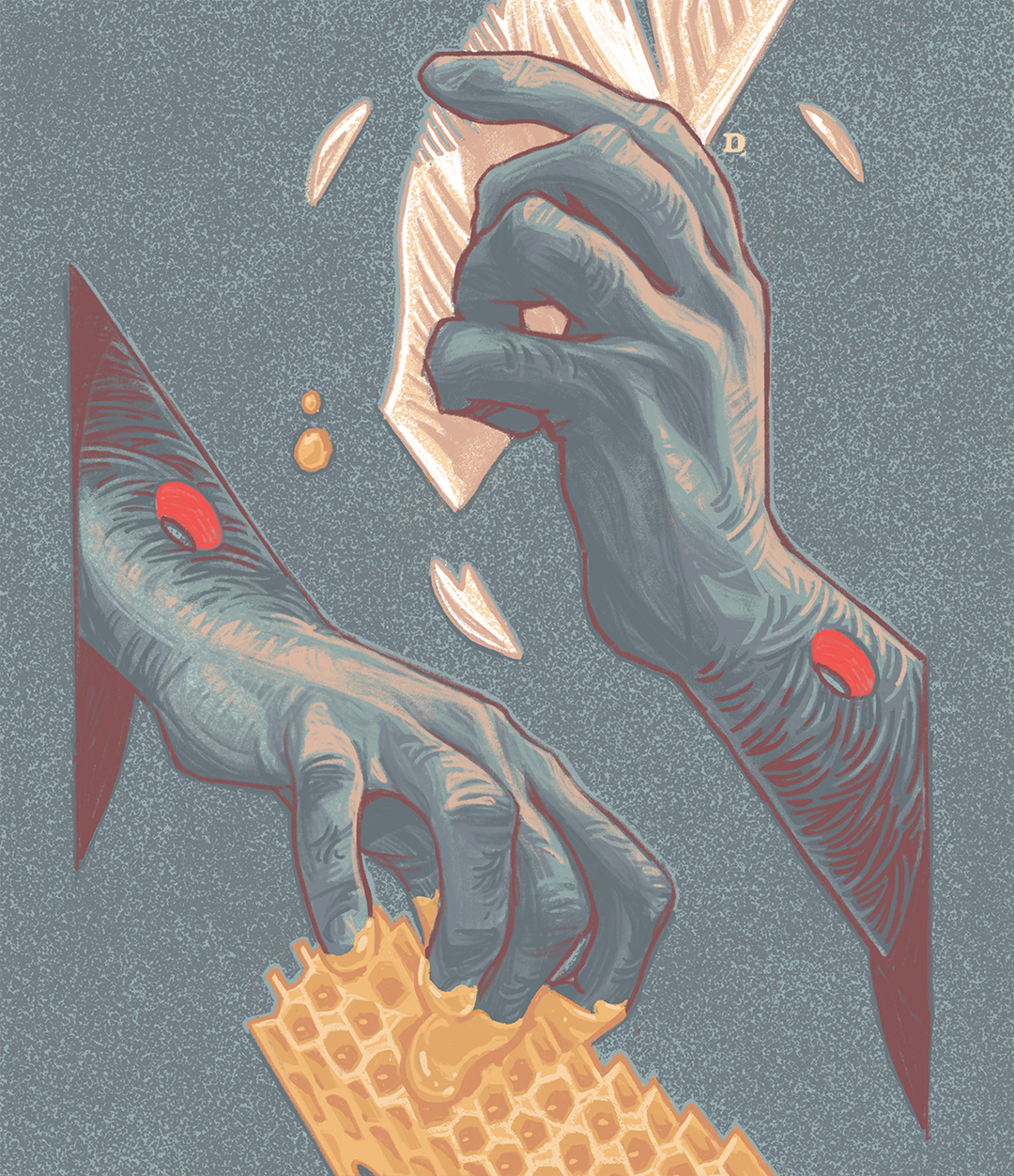
Illustration by Duncan Robertson for BEHOLD: The Resurrection and the Life trading cards from Fish Coin Press
On that final night, his meal was formal:
lamb with bitter leaves of endive, chervil,
bread with olive oil and jars of wine.

Now on Tiberias’ shores he grills
a carp and catfish breakfast on a charcoal fire.
This is not hunger, this is resurrection:

he eats because he can, and wants to
taste the scales, the moist flakes of the sea,
to rub the salt into his wounds.
From Corpus(Jonathan Cape / Penguin Random House, 2004)
Sharing food with friends was a significant aspect of Jesus’s ministry, so it’s no surprise that it’s one of the first things he does with his resurrected body. Based on the “breakfast on the shore” episode in John 21, “Food for Risen Bodies – II” by Michael Symmons Roberts “exults in the renewal of bodily sensations” experienced by the risen Christ, writes commentator Janet Morley in The Heart’s Time. Gloriously corporeal, Jesus enjoys tastes and textures once again, and is even glad to be able to feel pain, because it’s a marker of being alive. Roberts mentions the saltiness of the fish; I think, too, of the stickiness of the honeycomb, which some manuscripts of the parallel passage in Luke 24 mention Jesus ate that day. The poem contrasts the somber formality of the Last Supper with the joyous informality of this barbecue on the beach, this Easter feasting.
Michael Symmons Roberts (born 1963) is an award-winning British poet, librettist, broadcaster, and dramatist. A Fellow of the Royal Society of Literature, he is the author of nine poetry collections and a professor of poetry at Manchester Metropolitan University.
Most of us grew up celebrating Easter Sunday like it was the finish line, the big, joyful mic drop: “He is risen!” But the church, historically, has never treated Easter as a single day. It’s a whole season—Eastertide, stretching fifty days from resurrection to Pentecost. Fifty days of practicing resurrection. Of sitting in the reality that new life doesn’t just burst forth . . . it unfolds.
And yet, many evangelical spaces move on by the next Sunday. Back to regular programming. Back to “what’s next.”
What if we didn’t rush past resurrection? What if we let joy linger? What if we made space for wonder, for doubt, for the slow work of becoming people shaped by an empty tomb?
Eastertide invites us to stay. To notice. To live like resurrection is still happening. Maybe that’s something worth recovering.
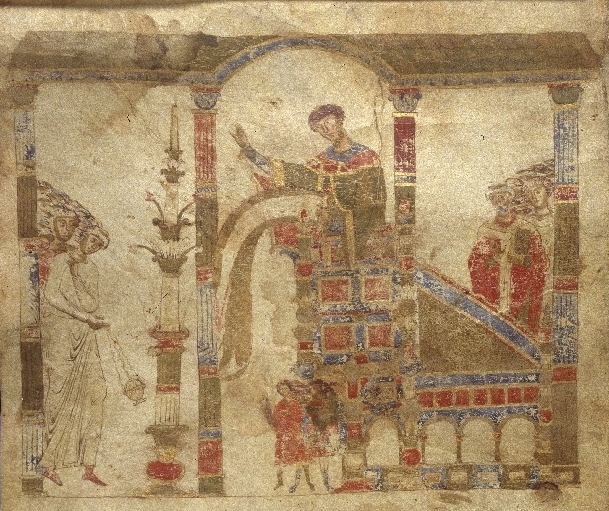
BLOG POSTS: “Rejoice Now!” by Sarah J. Biggs and “Exultet rolls: Celebrating the return of light” by Eleanor Jackson: These two posts from the British Library’s Medieval Manuscripts Blog contain overlapping content; the first (from 2013) is better for images, the second for text. “The medieval churches of Southern Italy maintained a very special Easter tradition,” writes curator Ellie Jackson. “They celebrated the Easter Vigil of Holy Saturday from a scroll made to be used once a year for this specific ritual. Known as Exultet rolls, these manuscripts combine words, music and pictures to create an enthralling multimedia experience centred on the joyful theme of light returning to the world.” Their name comes from the first word of the ancient proclamation sung by a deacon or priest during the blessing of the Paschal candle in the Roman Rite: “Exultet iam angelica turba caelum . . .” (Rejoice now, all you heavenly choirs of angels . . .) “Exsultent,” with an s, is a variant spelling.
A deacon reading the Exultet roll in church, from the Monte Cassino Exultet Roll, made at the Benedictine abbey of Monte Cassino in southern Italy, ca. 1075–80. London, British Library, Add MS 30337, membrane 11.
The British Library has one Exultet roll in its collection (Add MS 30337); learn more about it from either of these blog posts. Unfortunately, the full digitized manuscript file was among the thousand-plus lost in a massive cyberattack in October 2023, and it has not yet been rescanned, but select images can be viewed in low resolution in the posts. These images include a personification of Mother Earth and her abundance, a comparison of the Crossing of the Red Sea (the quintessential saving act in Israel’s history) to the Harrowing of Hell, bees gathering nectar (which accompanies words of gratitude to the bees that produced the wax of the Paschal candle), and more.
>> “Surrexit Christus” by Jacques Berthier: Kester Limner and Andy Myers perform a 1984 song from Taizé, an ecumenical monastic community in Burgundy, France. Its Latin refrain, “Surrexit Christus . . . Cantate Domino,” translates to “Christ is risen . . . Sing to the Lord!”
>> “Sing, Little Bird” by Dan Damon: In 2024, the California-based hymnist Dan Damon penned new lyrics to a traditional Ukrainian folk tune that I’m sure you’ll recognize. He writes,
The Ukrainian folk song SHCHEDRYK (lit. “bountiful evening”) is a shchedrivka, or New Year’s song, known in English as “The Little Swallow.” It tells of a swallow bringing good news for the coming year. Ukrainian composer Mykola Leontovych (1877–1921) arranged the folk song in 1916. Twenty years later, American composer Peter J. Wilhousky published his own lyrics for the song. His choral arrangement, “Carol of the Bells,” has become a standard in the Christmas repertoire. As I was working on a solo piano arrangement of this song, I got an idea for an Easter text that could be sung by a congregation. The swallow in the original folk song made me think of a little bird singing the good news of the resurrection.
“Sing, Little Bird” is the title song of his latest hymn collection that is forthcoming from Hope Publishing Company in July 2026. Another new Easter hymn that will be included is “Last night did Christ the Sun rise from the dark,” a setting of a ninth-century text by Sedulius Scottus that I featured last year; follow the link to listen to Damon’s demo.
>> “Gone” by Eldridge Fox: Teddy Huffam and the Gems, with pianist Anthony Burger, perform a classic Southern gospel song written by Eldrige Fox in 1972.
+++
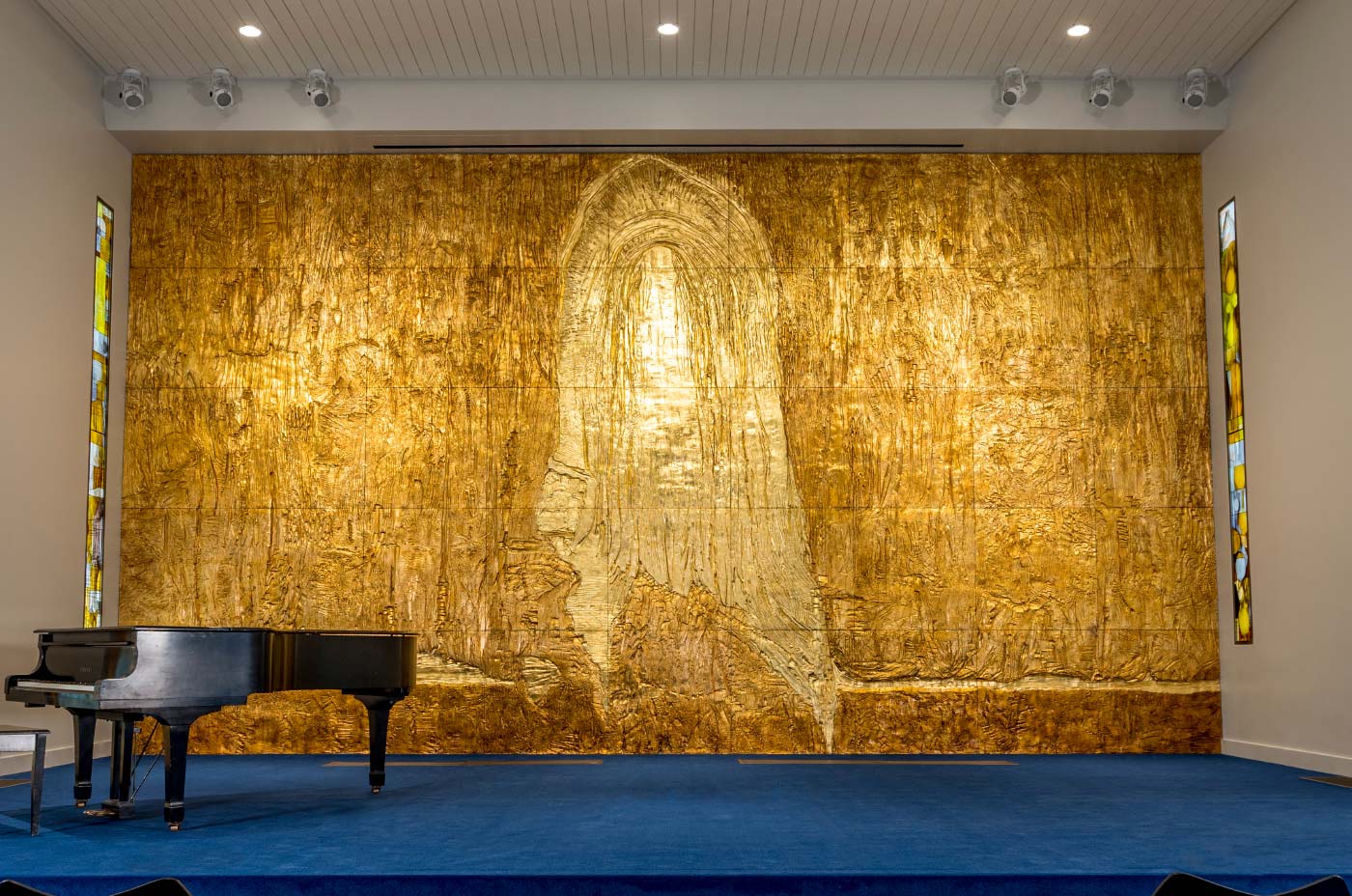
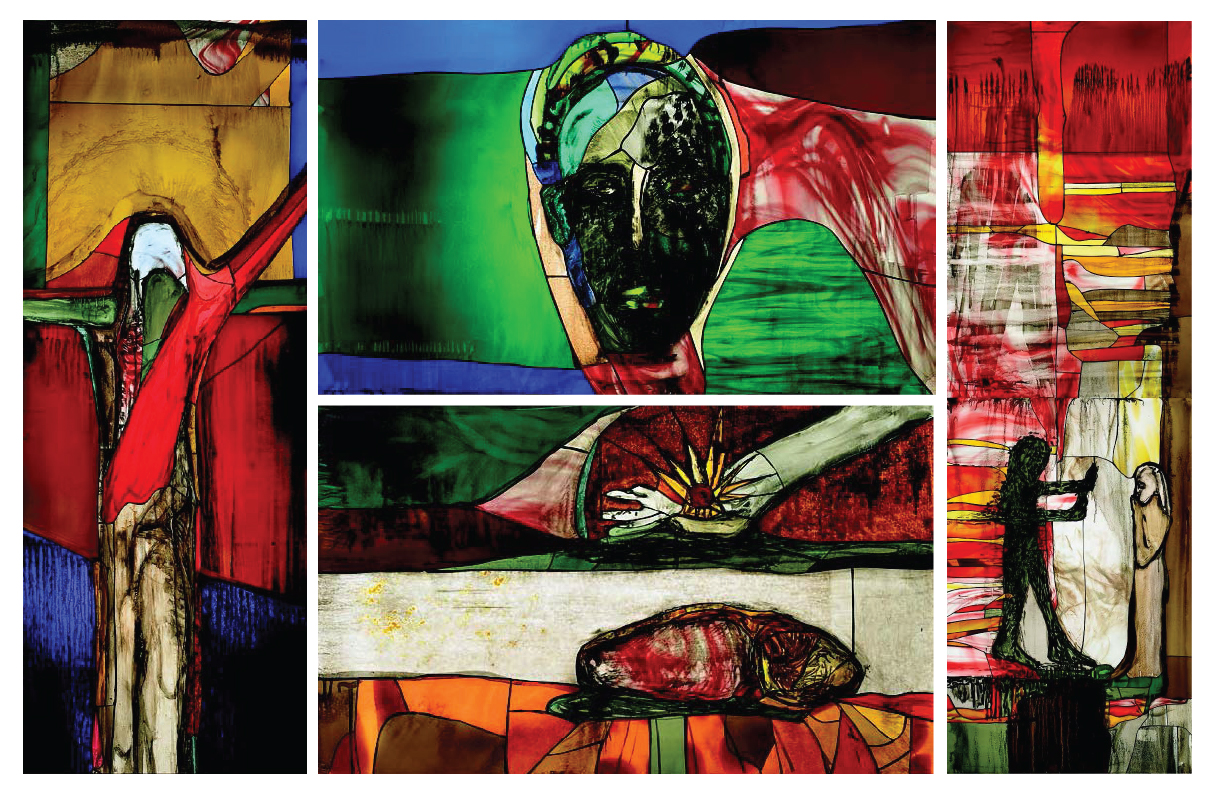
VIRTUAL TOUR: Calvary Chapel, Biola University, La Mirada, California: Constructed in 1975, Biola University’s Calvary Chapel [previously] was completely renovated in summer 2018 to enhance the sense of the sacred in that space. Biola commissioned leading Danish artists Peter Brandes and Maja Lisa Engelhardt, a husband-wife team, to conceive and carry out a creative vision that would involve updated lighting, colors, flooring, and seating and the making of new art. The renovated chapel features thirty-two handcrafted stained glass windows by Brandes (integrating innovative LED illumination technology) and two large gilded sculptures by Engelhardt, all created around the central theme of the Resurrection. The focal point is a thirty-one-foot-long gold relief sculpture that depicts the resurrected Christ emerging from the tomb, radiant with glory.
Biola’s website offers a self-guided tour comprising six videos—one for each of the four wings, plus an intro and a conclusion—and photographs and descriptions of the art. I highly encourage you to explore this resource! Here’s the video for the “western wing” (the liturgical east end):
Maja Lisa Engelhardt (Danish, 1956–), Resurrection, 2018. Gilded plaster relief wall, 31 × 18 ft. Calvary Chapel, Biola University, La Mirada, California.Peter Brandes (Danish, 1944–2025), The Crucifixion of Christ, Supper at Emmaus, and The Resurrected Christ Encounters Mary Magdalene, 2018. Stained glass, Calvary Chapel, Biola University, La Mirada, California.
I really like the allusiveness of the altarpiece and the semiabstract style of the biblical scenes in the windows, which include the Sacrifice of Isaac, Elijah Raising the Widow’s Son, David Playing the Harp for King Saul, Cain Killing Abel, the Baptism of Christ, Nicodemus Visiting Christ, Christ in Gethsemane,the Crucifixion, the Eucharist, the Supper at Emmaus, Christ as the Sowing Farmer, and the Return of the Prodigal Son.
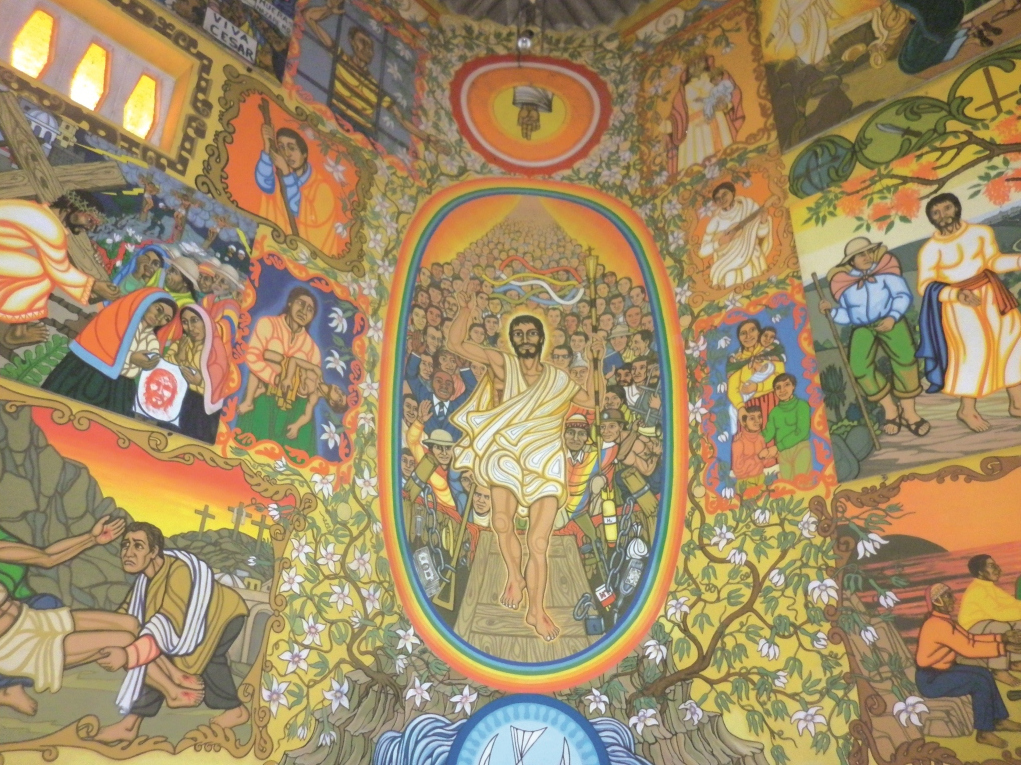
Severino Blanco (Quechua, 1951–2020), The Resurrection, ca. 1984. Mural, Casa del Catequista (CADECA) Chapel, Cochabamba, Bolivia.
Severino Blanco (1951–2020) [previously] was a Quechua Christian artist from Ayopaya, Bolivia. His magnum opus is an extensive cycle of biblical paintings inside the chapel of the Casa del Catechista (CADECA) in Cochabamba, a center for training catechists (lay Catholic missionaries) and pastoral leaders to serve the sixty villages in the city’s archdiocese.
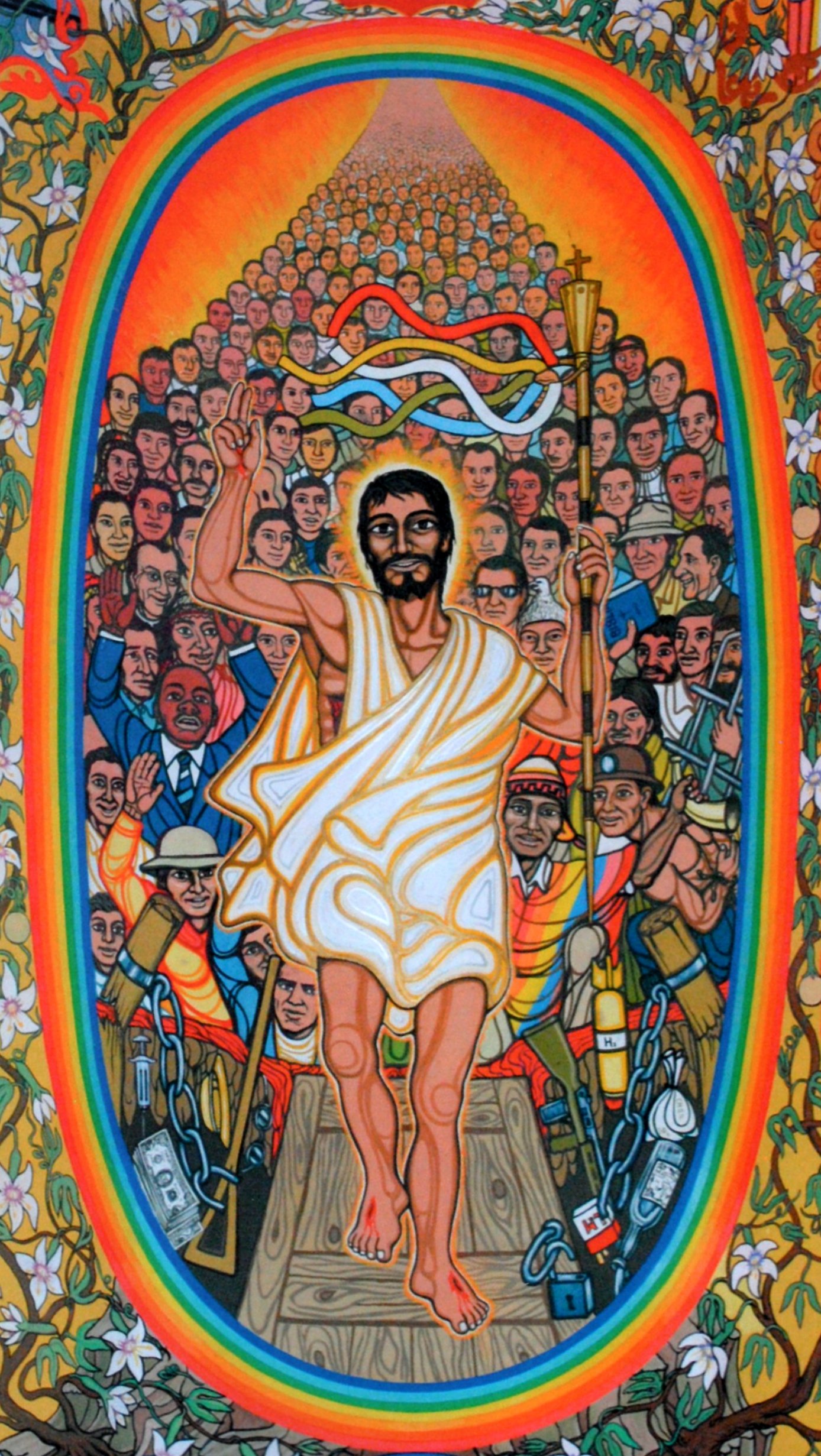
The centerpiece of the mural is an image of the risen Christ breaking through the chains of hell, trampling down its gates and leading an exodus of departed saints into new life. I can spot Rev. Dr. Martin Luther King Jr. of the United States and Archbishop Óscar Romero of El Salvador, martyrs of the faith, and I’m sure there are many other Latin American Christian preachers and activists pictured—those who walk the way of liberation.
Source: Von Befreiung und Erlösung: Bilder in CADECA Cochabamba/Bolivien (Missionskreis Ayopaya, 2012), p. 156
Barefoot and glowing, Jesus bears the puncture wounds from his crucifixion, but they are now glorified, and he holds high a cacique’s (Indigenous chief’s) staff, signifying his leadership. Beneath his feet are symbols of some of the hellish obsessions or addictions from which he frees us: a rifle and a hydrogen bomb (war and violence), money (greed, materialism), a needle and a liquor bottle (substance abuse). He walks through a rainbow-rimmed portal that frames him and his followers like an aureole and that is surrounded by flowering tree branches.
Above this vignette is the blessing hand of God the Father, and below is the Holy Spirit as dove, from whom issues forth streams of living water (see John 7:37–39). The presence of these two other persons of the Trinity emphasizes the Resurrection as a Trinitarian event.
This image is used on the cover of the German-language book Von Befreiung und Erlösung: Bilder in CADECA Cochabamba/Bolivien (Of Liberation and Redemption: Pictures in CADECA Cochabamba, Bolivia) by Alois Albrecht. The book features reproductions of the mural scenes alongside relevant Bible passages and texts by Latin American theologians and other members of the church.
One of the texts reproduced in the book is a letter from a Paraguayan base community to European Christians. (The date is not provided, nor is the original Spanish.) Here’s Google’s translation from the German:
Good people, our brothers and sisters in Europe!
Here as there, we celebrate Easter these days. How do you celebrate the feast of the resurrection of our suffering Lord, his passing from death to new life?
Here, the few rich people pass by the suffering of the poor. It is said of Jesus that he did not cling to his divinity as if it were a prize. But here, the few rich people plunder everything from the poor majority: bread, land, work, wages, health, housing, security.
How is passing over to a new life, like Easter, like resurrection, possible then? Are we not all brothers and sisters, you there and we here? Easter is an international affair.
Our situation has international roots and is caused by those who make decisions in the world, carry out plans, and in doing so forget us, the little brothers and sisters of the suffering and slain Jesus.
Easter is the feast of hopeful departure, of joyful new beginnings, of enthusiastic new life. But who among us feels anything of departure, joy, new beginnings, new life? Yes, hope—we have it! Easter is a feast of expectation; for whoever is always on the way also reaches their destination.
So, brothers and sisters! Despite everything, let us go our own way, you there and we here, in the light of Christ, the Lord raised to new life, to seek together equality and freedom for all.
We Paraguayans need you there, and not just your money, but above all your sure and loud voice against the ideology that enslaves and kills us all, us poor and you rich alike.
We all live in the same danger of death. But our risen Lord has also made us all his equal brothers and sisters. Please don’t forget that!
Arnoldo and friends and family
Another text is an excerpt from a document of the Third General Assembly of the Latin American Episcopate in Puebla, Mexico, in 1979. Again, Google Translate:
In fulfillment of the commission he received from his Father, Jesus voluntarily offered himself up to death on the cross, which was the goal of his life’s journey. As the bringer of the freedom and joy of the kingdom of God, he wanted to become the decisive sacrifice for injustice and evil in this world. On the cross, he takes upon himself the pain of creation and offers his life as a sacrifice for all.
In this way, he is the high priest who is able to share our weaknesses with us. He is the Easter sacrifice that redeems us from our sins. He is the obedient Son who, in the face of his Father’s redeeming justice, incarnates the cry for liberation and salvation of all people. . . .
Therefore, the Father raises his Son from the dead. He exalts him in glory to his right hand, pours out upon him the life-giving power of his Spirit, appoints him as head of his body, that is, the church, and confirms him as Lord of the world and of history.
Jesus’s resurrection is a sign and guarantee of the resurrection to which we are all called, as well as of the final transformation of the whole world. Through him and in him, the Father wished to re-create what he had already created.
Amen, and amen.
Addendum: At my church this morning, an invited guest preached a sermon on Colossians 1:18–20 titled “Leading the Resurrection Parade” after Eugene Peterson’s translation of the christological descriptor “the firstborn from the dead” in verse 18. I instantly thought of this image I had posted just hours earlier, in which Jesus’s staff is reminiscent of a drum major mace! The preacher spoke of Jesus steering a resurrection train of people, the new humanity, and cross-referenced 2 Corinthians 2:14: “Thanks be to God, who in Christ always leads us in triumphal procession and through us spreads in every place the fragrance that comes from knowing him.”
LISTEN: “We Walk His Way (Ewe Thina),”aSouth Africanfreedom song from the apartheid era | Translated by Anders Nyberg, Jonas Johnson, and Sven-Bernhard Fast, 1984 | Arranged by John L. Bell and performed by the Wild Goose Collective on We Walk His Way: Shorter Songs for Worship, 2008
Refrain (English): We walk his way, we walk his way We walk his way, we walk his way We walk his way, we walk his way We walk his way, we walk his way
Unarmed, he faces forces of demons and death We walk his way, we walk his way Unarmed, he faces forces of demons and death We walk his way, we walk his way [Refrain]
He breaks the bonds of hell, dying on the cross We walk his way, we walk his way He breaks the bonds of hell, dying on the cross We walk his way, we walk his way [Refrain]
The tree of freedom blooms by his empty grave We walk his way, we walk his way The tree of freedom blooms by his empty grave We walk his way, we walk his way [Refrain]
Do you not know that all of us who were baptized into Christ Jesus were baptized into his death? Therefore we were buried with him by baptism into death, so that, just as Christ was raised from the dead by the glory of the Father, so we also might walk in newness of life.
For if we have been united with him in a death like his, we will certainly be united with him in a resurrection like his.
—Romans 6:3–5
If anyone is in Christ, they are a new creation: everything old has passed away; look, new things have come into being!
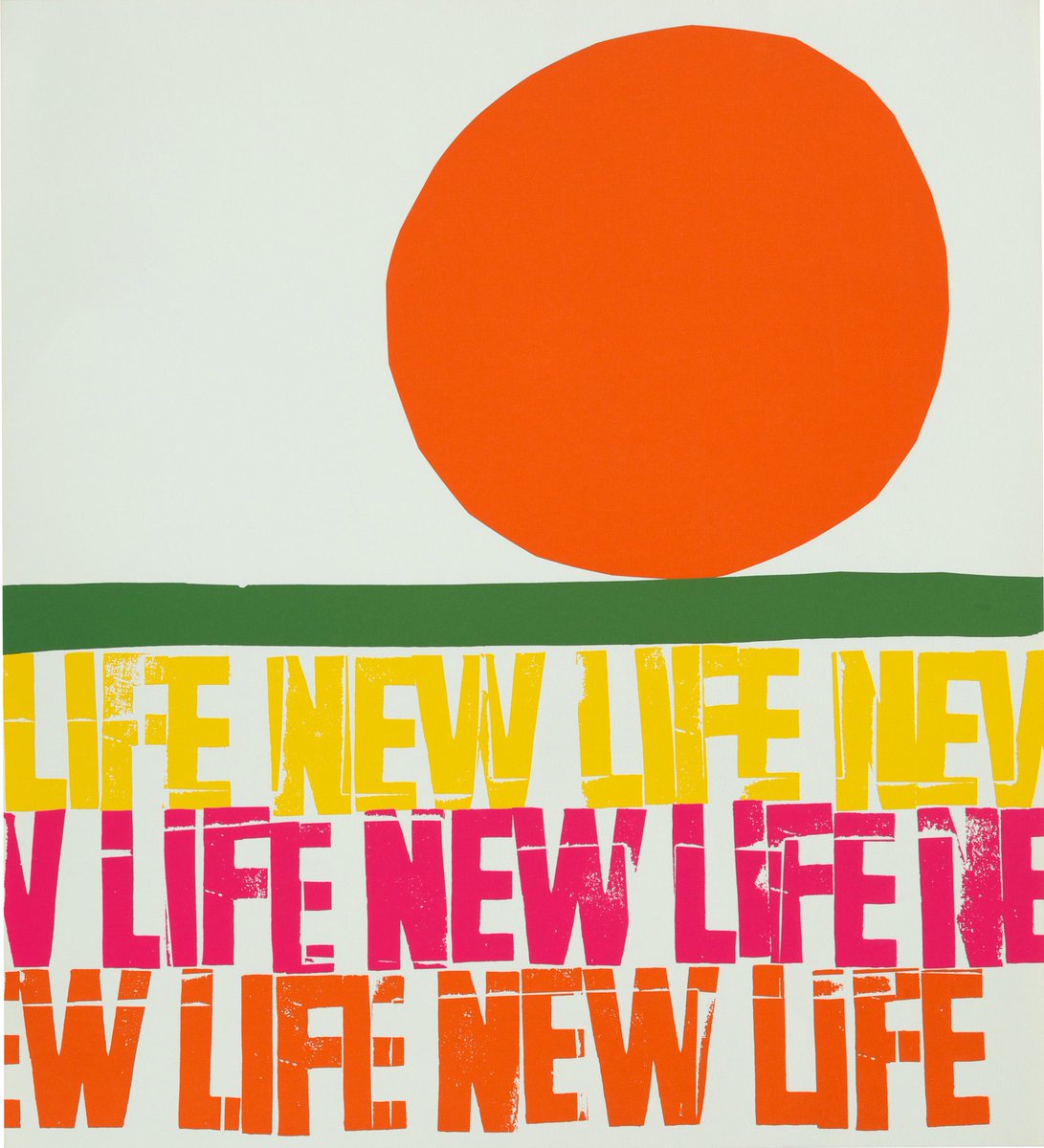
LISTEN: “New Life” by Broken Walls, on Drum,Created for Worship (2005)
Yahweh, hey-ya . . .
Yahweh, hey-o-hey, hey-o-hey . . .
Ga-ya-wey, o-hey, yo-hey-hey, yo-wey . . .
Rake ni:ha [My Father], hey-o-hey You bring your warmth, hey-o-hey Rake ni:ha [My Father], hey-o-hey You give new life, hey-o-hey
. . .
Jonathan Maracle is a Mohawk singer from Tyendinaga Mohawk Territory, Ontario, who works as a bridge-builder between the church and First Nations peoples. In 1995 he founded Broken Walls, a musical group whose songs “communicate a message of restoration, dignity, self-respect, and the Creator’s love to all cultures.” The other two members are Bill Pagaran (Tlingit) and Josh Maus.
Written by Maracle, “New Life” is from Broken Walls’ album Drums, Created for Worship. “The song could be considered a typical Mohawk longhouse song,” he tells me, “with the call-and-response and the water drum (a part of our cultural heritage).” It consists of vocables (nonlexical syllables) interwoven with the Hebrew word Yahweh, the covenantal name of God in the Bible, and then a verse that addresses the Creator as “Rake ni:ha,” Mohawk for “my Father,” praising him for the warmth and life he brings.
While this is not explicitly an Easter song, new life is one of the key themes of this festal season. The Father raised the Son from the dead, and this “Sonrise” brings light and enables flourishing. We, too, can share in the resurrection life of Jesus.
It is the day of Resurrection and an auspicious beginning. Let us be made brilliant by the feast and embrace each other. . . .
Yesterday the lamb was slaughtered, and the doorposts were anointed, and the Egyptians lamented the firstborn, and the destroyer passed over us, and the seal was awesome and venerable, and we were walled in by the precious blood. Today we have totally escaped Egypt and Pharaoh the harsh despot and the burdensome overseers, and we have been freed from the clay and the brick-making. And nobody hinders us from celebrating a feast of exodus for the Lord our God. . . .
Yesterday I was crucified with Christ, today I am glorified with him; yesterday I died with him, today I am made alive with him; yesterday I was buried with him, today I rise with him.
—Gregory of Nazianzus, “On Pascha and on His Slowness,” an Easter sermon from ca. 362, trans. Nonna Verna Harrison in Festal Orations by Saint Gregory of Nazianzus (St. Vladimir’s Seminary Press, 2008)
LOOK: Miniature from the Tomić Psalter
The prophet Miriam leading the women with timbrels and dances, from the Tomić Psalter, Bulgaria, ca. 1360. Tempera on paper, 30 × 25 cm. State Historical Museum, Moscow.
This miniature comes from a fourteenth-century illuminated psalter from Bulgaria, a masterpiece of the Tarnovo art school. It’s linked to Psalm 105, which exults in the memory of God bringing Israel up out of Egypt, providing for them in the desert, and establishing them in the promised land. “So he brought his people out with joy, his chosen ones with singing,” the psalmist writes (Ps. 105:43).
More directly, the image is an illustration of Exodus 15:20–21, an episode of female-led worship that occurs just after the crossing of the Red Sea:
And Miriam the prophetess, the sister of Aaron, took a timbrel in her hand; and all the women went out after her with timbrels and with dances.
And Miriam answered them, Sing ye to the LORD, for he hath triumphed gloriously; the horse and his rider hath he thrown into the sea.
The only percussion instrument mentioned in the Hebrew Bible, the timbrel (Heb. toph), or hand drum, consists of a hoop of wood or metal over which the skin of an animal is stretched. Some have jingles around the rim, like the modern tambourine, and some do not. The instrument is associated with women and celebration.
In the visual imagination of the anonymous Tomić Psalter artist, Miriam beats a drum with a stick while two of her companions clash cymbals and other women interlock arms and dance. The artist probably took inspiration from the folk music and dancing of women in his own culture.
LISTEN: “Da Mariae tympanum” (Give Mary a Tambourine) | Words by Peter Abelard, 1130s | Music by Georg Forster, 16th century | Performed by the Augsburg Early Music Ensemble on Medieval Pilgrimage to Santiago, 2003
Da Mariae tympanum
resurrexit Dominus,
Hebraes ad canticum
cantans provocet,
Holocausta carminum
Iacob immolet.

Subvertens Aegyptios,
resurrexit Dominus,
Rubri Maris alveos
replens hostibus,
quos involvit obrutos
undis pelagus.

Dicat tympanistria,
Resurrexit Dominus,
illa quidem altera
re, non nomine,
resurgentem merita
prima cernere.

Cantet carmen dulcius,
resurrexit Dominus,
reliquis fidelibus
mixta feminis,
cum ipsa narrantibus
hoc discipulis.

Deo patri gloria,
resurrexit Dominus,
salus et victoria
Christo Domini;
par honor per saecula
sit Spiritui.
Give Mary a tambourine,
    for the Lord has risen;
as she sings, let her incite
    Hebrew women to song;
let too Jacob sacrifice
    holocausts of songs.

Egyptians he did overwhelm,
    for the Lord has risen,
filled the Red Sea’s submerged caves
    with his enemies,
whom the sea caught and buried
    in the waves below.

Let the timbrel player sing,
    For the Lord has risen,
a second Mary, different in
    her person, not in name,
she deserved to be the first
    to see him risen up.

Let her sing a sweeter song,
    for the Lord has risen,
as she mingles with the rest
    of the faithful women,
who with her proclaim the news
    to the Lord’s disciples.

Glory be to God the Father,
    for the Lord has risen,
health restored and victory
    to the Lord’s anointed;
equal honor through the years
    to the Holy Spirit.
This hymn is from the second book of the Hymnarius Paraclitensis (Hymnary of the Paraclete), a collection of over 130 Latin hymns written by the French philosopher and theologian Peter Abelard (1079–1142) [previously] for the convent of the Paraclete near Troyes, headed by Héloïse. It imagines Mary Magdalene as the New Miriam (Mary is the anglicized form of the Hebrew Miriam), leading women in song and dance in celebration of God’s victory over the forces of sin and death through the resurrection of God’s Son, Jesus Christ.
In Christianity, the exodus is interpreted not just as a literal saving act in Israel’s history but also as a prefigurement of the Resurrection. In many churches, Exodus 14, recounting the Israelites’ crossing of the Red Sea, is part of the Easter liturgy. The Orthodox word for Easter, Pascha—a Greek word from the Hebrew Pesach—itself means “Passover,” further reinforcing the connection between the Israelites’ liberation from Egyptian slavery and the liberation of God’s New Testament people from spiritual bondage, both made possible by the blood of a lamb and requiring passage through the waters—sea versus baptismal.
Mary Magdalene was one of Jesus’s closest disciples, and it’s she, according to the Gospel of John, to whom he first appeared following his resurrection. He then commissioned her to go tell the other disciples—to beat the drum, as it were, announcing the good news that he is alive. The Gospels of Matthew and Luke have her joined in this task by other faithful women: “the other Mary” and “Joanna, Mary the mother of James, and the other women,” respectively.
I like the image Abelard gives us of Mary Magdalene rousing her female companions with a tambourine, leading them in the song and dance of resurrection. In the new exodus, Christ guides humanity into freedom, from death to life, as Mary praisefully proclaims, across the path he has paved by his own rising. “Resurrexit Dominus!” The men at first disbelieve her testimony . . . but once they see what she’s seen, they, too, rejoice.
The musical setting of Abelard’s text featured above is by the German Renaissance composer and physician Georg Forster (ca. 1510–1568).
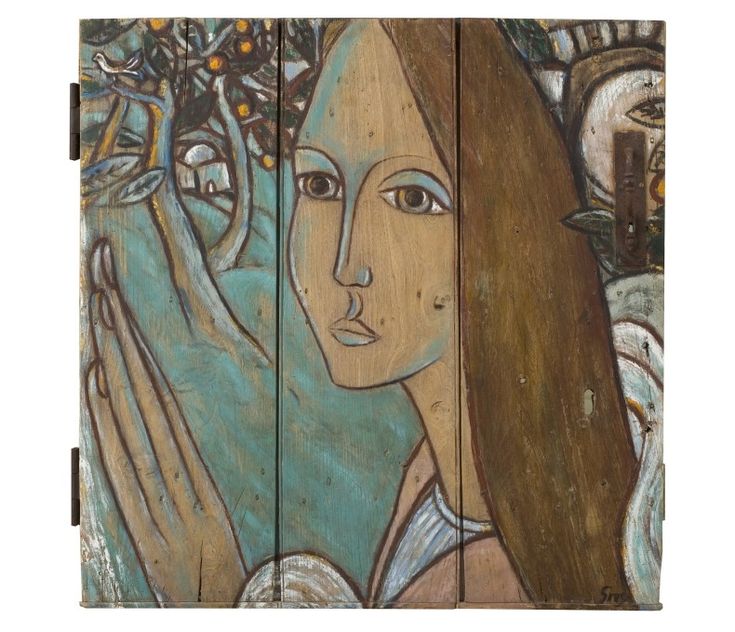
Greg Tricker (British, 1951–), Magdalene: The Tomb, 2010. Oil, acrylic, and gold leaf on wood door, 33 3/8 × 32 1/2 in. (84.7 × 82.6 cm).
I learned about Greg Tricker from Sister Wendy Beckett, a nun who narrated several BBC docuseries about art throughout the 1990s. In the following Piano Nobile video from 2011, Sister Wendy converses with Tricker at Gloucester Cathedral about his exhibition Pillars of Faith. While they don’t discuss Magdalene: The Tomb, which is shown at 1:03, they do discuss a similar painting at 7:11.
LISTEN: “They Have Taken Him” by The Soil and The Seed Project | Words by Greg Yoder, 2023 | Music by Greg Yoder, Valerie Bess, and Taylor Bess, 2023 | Performed by Valerie Bess and Taylor Bess on The Soil and The Seed Project, Volume 9: Lent, Easter, Pentecost, 2024
Early on the first day of the week I slip into the darkness while the garden lies sleeping Feel the dew upon my hand, cool from the weeping of the stone Night still clings heavy like a shroud I whisper to the emptiness, and the echo is as loud As thunder, it’s a wonder the dead slumber and leave us here alone
They have taken him, and I do not know where he’s gone
Then all the world is in motion Running like the waves trying to outrun the ocean They overtake each other, brother tumbling over brother To the threshold, but daring not go in Standing in the flowers, unbelieving Hearing voices in the garden, “Woman, why are you grieving?” They have taken him away And I do not know where they have taken him
They have taken him, and I do not know where he’s gone Someone has taken him, and I do not know where he’s gone
Now I have seen the lilies of the field And I have seen the sparrows winging o’er But if this is how you show your love I’m not sure that I can take much more
Early on the first day of the week I slip into the darkness where the gardener is keeping Watch over the mourning ones He’ll watch until the morning comes aflame “Sir, if you have carried him away Tell me where you laid him so I may go to him today” His silence breaks my spirit, then so soft I barely hear it He remakes me with the whisper of my name
They have not taken him; I have seen the coming dawn I know they have not taken him; I know I’ve seen the coming dawn






 Art & Theology