Non-Christians respond to Christian artworks

One of the art blogs I follow is Hyperallergic, “a forum for serious, playful, and radical thinking about art in the world today.” It’s not Christian-affiliated, but because of Christianity’s vast influence on the arts, it’s not unusual for “Christian” works, or works that reference Christianity, to be covered. This past month two such features stood out to me for the outsider perspectives they offered:

(1) “A Meditation on the Ineffable Grandeur of Churches” by Jennifer R. Bernstein: An “irreligious, halfhearted Jew” describes “what it means to love church but not God,” to be transported in a way that she has never been in synagogue. By way of example, she shows a photo of La Sagrada Familia in Barcelona; an agnostic friend of mine had a similar experience as this author—he told me that when he visited that cathedral last year, he came very close to believing in God and falling to his knees right then and there in repentance, so moved was he by the architecture and what it signified.

La Sagrada Familia
Interior of La Sagrada Familia in Barcelona

Here are some excerpts from Bernstein’s article:

Crossing the narthex of a cathedral is like starting a great book: You simply aren’t in your home world anymore.

***

In my view, the truest kind of reader/viewer is not the intellectual, but the supplicant. To “consume” a work of art is really to be consumed by it: to surrender your will to the vision of the creator — or, in this case, the Creator.

***

Organized grandeur makes us feel small and powerless, yet connected to something all-powerful.

***

Church, if we take it seriously, if we give in to stillness, threatens to reorder what we care about. . . . An extraordinary environment forces us into a confrontation with a striking somewhere, reminding us that we can and should take care in choosing where we place our bodies, for there we also place our minds.

(2) “A Timely Performance of MLK’s Final Sermon Takes Viewers to Church” by Seph Rodney: Commissioned by BRIC for its inaugural BRIC OPEN Festival, The Drum Major Instinct is a dramatization of the Rev. Dr. Martin Luther King Jr.’s final sermon accompanied by original music by Phil Woodmore, presented on April 30 by Theater of War Productions and NYC Public Artist in Residence Bryan Doerries. True to BRIC’s mission, it was followed by an open community discussion on race and social justice.

What was shocking, to me, about this article is the reviewer’s candid opposition to King on the grounds of his “rigid, hierarchic, conservative” Christianity. We’ll take the social justice he promoted, Rodney seems to say, but without all the God-talk. Does he not understand how integral King’s religious faith was to shaping his vision and motivation? And he achieved practical, world-changing results. If our “desire to follow our inherited religious templates” “dooms us,” then why did King’s template, taken from the Bible, usher in such positive change in America? Citing today’s (Muslim) theocracies as evidence of how religion and human rights violations go hand in hand is irrelevant.   Continue reading “Non-Christians respond to Christian artworks” →

“Not as a dove…”: Two Pentecost poems by Mark DeBolt

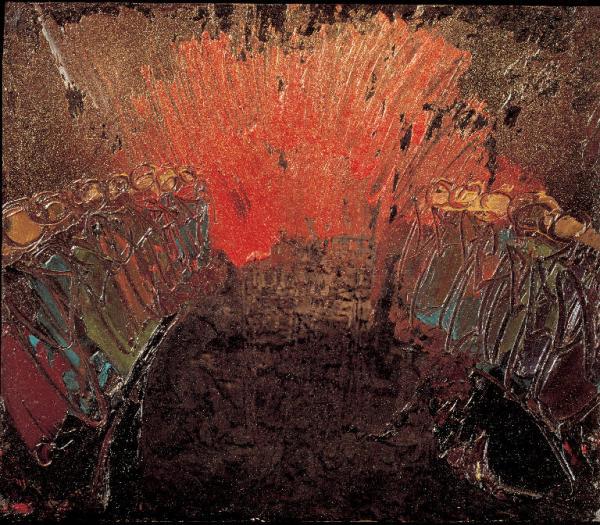
Pentecost by William Congdon
William Congdon (American, 1912–1998), Pentecost 2, ca. 1962. Oil on tile, 4 × 4 cm. The Province of Milan Art Collection.

“Pentecostal Hour” by Mark DeBolt

No zephyr soft
but cyclone strong
bore thoughts aloft
in windy song.

No flicker mild
but flames of red
danced hot and wild
upon each head.

And so fierce was
our thundering word
in languages
of all who heard,

all knew it meant
the Spirit’s power.
This was our Pent-
ecostal hour.

“Pentecost Villanellette” by Mark DeBolt

Not as a dove the Holy Spirit came
to the disciples gathered in a room,
but as a violent wind and tongues of flame.

A cyclone roared the ineffable name
as fire on each blushing brow did bloom.
Not as a dove the Holy Spirit came

to give sight to the blind and heal the lame
and raise the dead and dispel error’s gloom,
but as a violent wind and tongues of flame.

The Breath of God is anything but tame.
Who dally with it dally with their doom.
Not as a dove the Holy Spirit came,
but as a violent wind and tongues of flame.

These poems are published in For the Mystic Harmony: Collected Poems 1997–2011 by Mark DeBolt and are used by permission of the author.

+++

This Sunday Christians will celebrate Pentecost, the historic giving of the Holy Spirit to all believers in Jesus Christ and thus the birthday of the church.

Before it was the name of a Christian holiday, Pentecost (Heb. Shavuot) was celebrated annually by the Jewish people in honor of the giving of the Torah on Mount Sinai. Jews still celebrate it today, fifty days after Passover—hence the name Pentecost (“pente” = five). (Appropriately, Christian Pentecost occurs fifty days after Easter.) Because of the importance of the feast, ancient Jews traveled from all over the known world to their religious capital, Jerusalem, for the occasion, and that’s what we see in Acts 2—a multiregional, multilinguistic gathering.   Continue reading ““Not as a dove…”: Two Pentecost poems by Mark DeBolt” →

Roundup: Nuns onscreen; Jesus in pop music; El Greco knits

Nuns in pop culture: Anna Silman writes on the current “Nunnassaince” in movies and television, the biggest since the late 1950s and ’60s. She quotes Rebecca Sullivan, author of Visual Habits: Nuns, Feminism, and American Postwar Popular Culture, on the first wave as a reaction against the sexual revolution. For a list of flicks both new and old, see “Ten Essential Movies About Nuns.”

I’ve seen two movies from 2016 that center on a nun, or nuns. The first is Little Sister, a dramedy directed by Zach Clark. It’s about twenty-something Colleen Lunsford, a novice (prospective nun) who’s temporarily called away from the convent when her brother returns from the Iraq War, suffering from depression after a bomb left his face disfigured. In the town she grew up in Colleen is known as the Goth girl, so former high school friends are shocked to learn about her new religious vocation.

I wish the faith dimension was explored a bit more—the only insight we get into Colleen’s decision to become a Christian and pursue the monastic life is a line she mutters about structure and stability. (Was that her only motivation?) The film is more about reconnecting with family and recognizing that even though you grow up and your interests and bearing and goals may change, your past self, or selves, always remain a little bit a part of you. It’s empathetic and dark but also funny, and it shows how there’s no one mold that makes a nun; nuns come from different places in life, and oftentimes sustain (complicated) relationships outside the cloister. (Watch on Netflix)

The second one I’ve seen and commend is The Innocents, directed by Anne Fontaine. Set in a convent in late-1945 Poland and based on a true story, it documents the crisis of faith the nuns of that community are forced to undergo when many of them are raped by invading Russian troops and some pregnancies result. The nuns respond in diverse ways to the horror, struggling to regain their spiritual equilibrium. In desperation, they employ an atheistic French female doctor from the Red Cross, stationed nearby, to help them deliver their babies and to bear their secret. (Watch on Amazon Video)

+++

“If I Believe You: Agnostic Songs to Jesus” by Joy Clarkson: This article analyzes the song “If I Believe You” by the 1975—which opens with “I’ve got a God-shaped hole that’s infected . . .”—in light of the wider trend of self-proclaimed unreligious artists writing songs addressed to Jesus. Clarkson observes that (1) even within the profoundly secular industry of popular music, there is an openness to spirituality, religion, and Jesus; (2) songs written not only about Jesus, but to Him, create a unique discursive space; and (3) an invocation of negative transcendence may create an openness to a true spiritual experience. I’m intrigued by the titles of the books she references, including The Bible in/and Popular Culture: A Creative Encounter (2010); Mashup Religion: Pop Music and Theological Invention (2011); and Personal Jesus: How Popular Music Shapes Our Souls (2013).

+++

Knits by Petros Vrellis: Designed using an algorithm, Vrellis’s re-creations of figures from famous El Greco paintings are formed by knitting a single thread across anchor pegs on a circumference loom. Watch a time-lapse video of Vrellis putting together a knit based on El Greco’s Christ Blessing, below, and read more about his process here. (Another Jesus portrait Vrellis has done is based on El Greco’s Christ in Prayer, visible at 2:27 at the bottom right.) Vrellis has a master’s degree in art sciences; he enjoys exploring the potential of new media through digital art and interactive installations and considers himself more of a “toy inventor” than an artist. Thank you to Tobias M. from Vienna for informing me of this impressive work.

Christ by Petros Vrellis
Knit by Petros Vrellis (Greek, 1974–), based on the painting Christ Blessing by El Greco.

Some of Vrellis’s knits are for sale via Saatchi Art.

A eulogy for Pop-Pop

The light he was returns
Unto the Light that is.
—Wendell Berry

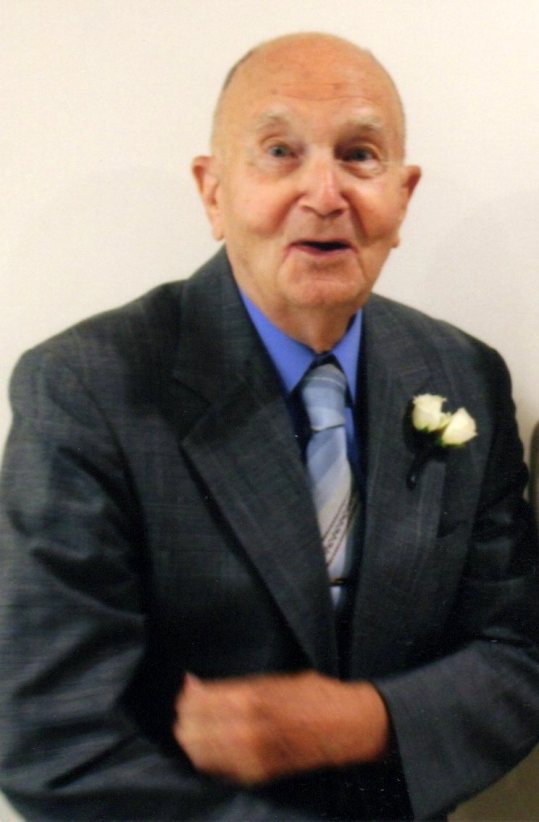
My grandpa, Richard Joseph Hartz, passed away on May 22 at age ninety-two. A cradle-to-tomb resident of Mercer County, New Jersey, he was a simple man who loved his Lord, his family and friends, and his work. He was faithful, caring, contented, ingenuous, and conservative in every sense of the word. Clocks, cars, and Phillies baseball were among his hobbies. He got thrills from things like cereal box prizes (his favorite was a plastic spoon that lights up—he said, facetiously, that it helps him find his mouth), Dollar Tree purchases (“Can you believe this only cost a dollar?”), and fish sandwiches from Burger King (I don’t think I ever saw him so excited as when he unwrapped a BK gift card for his ninetieth birthday).

Rick Hartz

Pop-Pop’s Bible never gathered dust; he read it every morning, along with Our Daily Bread. His constancy in this regard is something my dad inherited. It is because of Pop-Pop’s (and Mom-Mom’s) religious faith, which they lived and breathed and passed on to their kids, that I am a Christian. It is the greatest treasure I have ever received.

The highlight of Pop-Pop’s week was always Saturday morning breakfast with the ROMEOs (“Retired Old Men Eating Out”)—a moniker bestowed affectionately by his sister Theresa to describe him and his group of cronies. In flat cap and cardigan, he’d be dressed to go. Scrambled eggs and coffee was his custom, and a plate of sausage split with his brother-in-law Don.

Pop-Pop’s most distinctive, and most beloved, trait was his joke telling. His jokes were mainly of the Reader’s Digest variety—that is, clean and corny. After making sure he had our attention, he’d start in, wide eyed and serious, all the way up to the punchline, when he’d break down chuckling. His repertoire wasn’t too large, so during any one visit, we’d hear the same joke at least twice, and then again the next time we saw him. But we’d always laugh as if it were brand-new to our ears.

Some staples:

If a bear was chasing you and up ahead there was a tree on one side and a church on the other, would you run up the tree or into the church?

Response: I don’t know—into the church?

With a bear (bare) behind?

[When we’re eating corn] We’re having a chicken dinner!

I went to the doctor’s, and he gave me a prescription for smart pills. When I saw the bill, I couldn’t believe it. “$100!” I said. “These aren’t worth that much!”

The doctor replied, “See, you’re smarter already.”

If we were to shrink your head to the size of your brain, you could wear a peanut shell for a Panama hat.

One time he floored us all with a real grade A insult at my younger brother’s expense. We were posing for a photo, and Rob, clowning around, bent over and stuck his head between his legs. Pop-Pop, camera in hand, retorted, “You’ll have to smile, Robbie, so that I know which end’s your face.” Ooo, burn!   Continue reading “A eulogy for Pop-Pop” →

Mother Mary teaches her son Jesus

Christ and His Mother Studying the Scriptures by Henry Ossawa Tanner
Henry Ossawa Tanner (American, 1859–1937), Christ and His Mother Studying the Scriptures, ca. 1909. Oil on canvas, 48.8 × 40 in. Dallas Museum of Art, Dallas, Texas.

“The Son of Man” by Charles L. O’Donnell

He lit the lily’s lamp of snow
And fired the rose’s sunset heart,
He timed the light’s long ebb and flow
And drove the coursing winds apart.

He gathered armfuls of the dew
And shook it over earth again,
He spread the heaven’s cloth of blue
And topped the fields with plenteous grain.

He tuned the stars to minstrelsy
As twilight soft, as bird song wild,
Who learned beside His Mother’s knee
His prayers like any other child.

This poem was originally published in The Dead Musician, and Other Poems by Charles L. O’Donnell (New York: Laurence J. Gomme, 1916) and is now in the public domain.

+++

Mary gave her son everything she had—body, mind, and soul. These three served as the seedbed of his maturation. She surrendered her womb, where Jesus progressed through the various stages of embryonic and fetal development as he took in the nutrients supplied by her blood. Once born, she gave him her body’s milk, and often forwent sleep to attend to his cries, a deprivation all mothers have known. But her provision was more than physical. She also nurtured, with the help of Joseph, his intellectual, emotional, and spiritual growth, fulfilling as best she could her parental calling.

O’Donnell’s poem juxtaposes the deity of Christ—in particular, his role as Creator and Sustainer of the universe—with his humanity, highlighting how he is one who both shapes and was shaped. He chose the color of each and every flower, he programmed the angular speed of Earth’s rotation and its atmospheric circulation patterns, he wrote the laws of thermodynamics, he makes energy-rich grain to grow under his vast expanse of sky, and he conducts the choir of Nature: makes the stars to sing in soft duet with the twilight, then cues in the wild avian melodies of the morning. Monumental feats—all these. Testaments to his mastery and might.

And yet as the incarnate boychild Jesus of Nazareth, he sat at his mother’s knee, learning from her the sacred stories of his people, and how to address the Father they had in common (albeit in different senses).

We know from her Magnificat that Mary was a woman of deep passion and yearning, gratitude and praise, and from the Annunciation account, we get a sense of her courageous trust. Luke 2:19 points to her contemplative nature, and the Passion narratives attest to her faithfulness. These qualities characterized the way she lived and infused the spiritual instruction she gave her son.   Continue reading “Mother Mary teaches her son Jesus” →

More conferences

In addition to those I posted in March, here are a few more conferences of note. (Update, 5/4: I’ve added two more entries since the original publication of this post. Thanks, Chloë Reddaway and Talita Peters, for the tips!)

UPCOMING CONFERENCES

Title: “The Place of Sacred Art: Exploring the Interpretation of Sacred Art in Secular and Faith Contexts”
Date: May 9, 2017
Location: AV Room, Gas Hall, Birmingham Museum and Art Gallery, Birmingham, England
Organizer: Canon Dr. Andrew Smith, director of interfaith relations for the bishop of Birmingham
Cost: £20
Speakers: David Cheetham, Catherine Ogle, Orit Azaz, Rebecca Bridgman, Peter Bradley
Description: This symposium will consider the ways in which people reinterpret sacred art when it is displayed in new contexts or alongside art from different faith traditions, and how displaying different types of art in sacred spaces transforms our understanding of the sacred and the artistic. Presentations address how cathedrals have negotiated being open to artists of different religious backgrounds and exhibiting work that challenges and questions, and how contemporary art can offer unexpected encounters with the sacred. Registration also includes a tour through the award-winning Faith in Birmingham Gallery by curator Rebecca Bridgman.

Title: “‘any-angled light’: Poetry and the Mission of Your Church”
Date: May 16–18, 2017
Location: Yale University, New Haven, Connecticut
Organizer: Yale Institute of Sacred Music
Cost: $65 (registration ends May 8, noon ET!)
Keynote speakers: Mary Karr and Christian Wiman
Description: How does poetry equip the church to fulfill its mission of inviting others into God’s future? Drawing on spiritual verse spanning all eras from the biblical to the contemporary, this conference for church leaders and laypeople will (1) inspire the integration of poetry into a church’s congregational life and its public outreach and activism; (2) model the introduction of poetry and poetic sensibilities into worship; and (3) expose participants to diverse poetry and poetic forms. Besides plenary sessions with two of America’s finest poets, the conference includes workshops, musical worship, and a poetry slam.

Title: “Catholicism, Literature and the Arts: 1850–Present”
Date: July 5–7, 2017
Location: Durham University, Durham, England
Organizers: Centre for Catholic Studies at Durham University and Ushaw College
Cost: £70 (discount rates for students, low-income, paper presenters)
Speakers: Eamon Duffy, Terry Eagleton, Paul Lakeland, Anna Lawson, Melanie McDonagh, HE Daniel Mulhall, Paul Anthony Murray
Description: The conference “will bring together leading scholars to address key questions in the study of Catholic art and writing, including the question of whether there is a distinctive tradition of ‘Catholic literature’. Among the main topics and themes of the conference are Catholic memoir and autobiography; Catholic fiction and poetry; Catholic readership; journalism; publishers and archives; and the visual arts. The conference will include film, music, and the visual arts, as well as literature,” and will consist of lectures, discussion groups, and workshops.

Title: “Canvas: A Conference on Theology and Creativity—Inscape, God, Art, and the Inner Life”
Date: August 11–12, 2017
Location: Imago Dei Community, Portland, Oregon
Organizers: Humble Beast and Western Seminary
Cost: $100
Speakers: TBA
Description: “The Canvas Conference humbly exists to inform all acts of human creativity and beauty with biblical, gospel-centered theology for the worship of the triune God. . . . We want to help build strong theological foundations for the artist and, likewise, to push Christians to pursue creative orthodoxy in their theological craft. We have found that without theology, creativity wanders from its original significance and purpose; while without creativity, theology often becomes cold, distant, and futile. In response, The Canvas Conference seeks to build bridges between the artist and the theologian by inviting God to take center stage in every human endeavor.”

Title: “Arts + Spirituality” (11th annual Verge Conference)
Date: September 28–29, 2017
Location: Trinity Western University, Langley, British Columbia
Organizer: School of the Arts, Media, and Culture, TWU
Cost: $199 (discount rates for presenters, students, seniors, and single-day attendees)
Keynote speaker: Cam Anderson, executive director, Christians in the Visual Arts
Description: Throughout human history and across cultures, the arts have been closely associated with spirituality and religious practice. This conference seeks to explore that connection. Paper submissions are welcome on any topic relating to the arts and spirituality, as are proposals for presentations in the form of performances. The deadline for submissions is May 31.

PAST CONFERENCE

There have been so many events organized around the topic of art and religion in the past year that it’s hard to keep up. Below is a “Study Day” that slipped by before I had the chance to promote it; I’m posting the info here so that you can see the kinds of conversations that are going on among religious studies scholars and museum professionals and can look for future opportunities to join in. (If you’re not in either field but are a museumgoer—and if you’re reading this blog, I imagine you are—a great way to get involved would be to give feedback to the museums you visit. Did their presentation of religion through art and artifact, and wall text, help you connect in a deeper way to your own faith tradition, or see others in a new light? Or did you feel it was offensive, unfair, or in some way else deficient, and if so, why?)

Title: “Encountering the Sacred in Museums”
Date: March 15, 2017
Cost: £35
Location: Stevenson Lecture Theatre, British Museum, London
Organizer: British Museum
Description: This day of discussions on the role museums play in caring for and presenting religious art and artifacts included the lectures “What Is Sacred?” by religious historian Karen Armstrong and “Beyond Belief: The Role of Museums in Interpreting Religion” by Rickie Burman, development manager of London’s National Gallery. In other sessions, visitor experiences at diverse venues were discussed: the Museum of Witchcraft and Magic in Cornwall, the Creation Museum in Kentucky, and the British Museum during its “Treasures of Heaven: Saints, Relics, and Devotion in Medieval Europe,” an exhibition shaped by consultation with community groups.
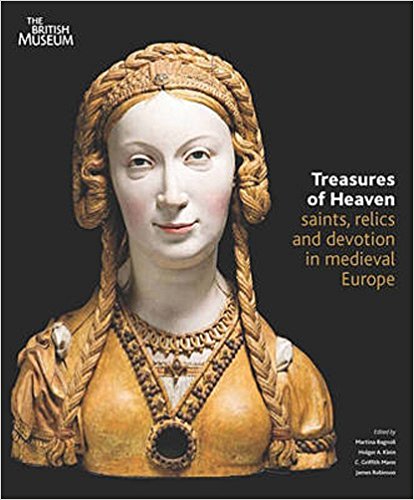
Treasures of Heaven (book cover)

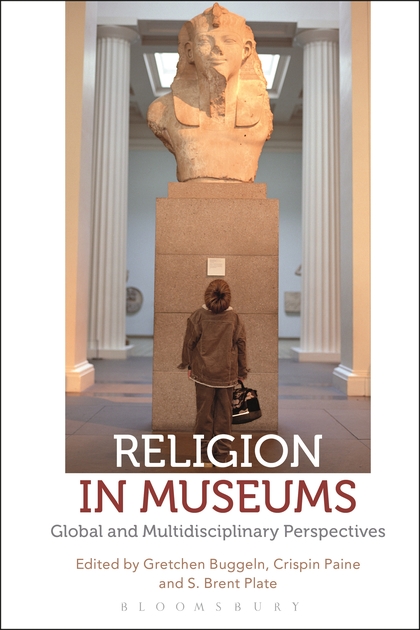
Religion in Museums (book cover)

I found out about this event, and the first one above, through the Religion in Museums blog, maintained by Crispin Paine and Steph Berns. Paine is a founder-editor of Material Religion: The Journal of Objects, Art and Belief and coeditor (with Gretchen Buggeln and  S. Brent Plate) of the recently published book Religion in Museums: Global and Multidisciplinary Perspectives (read the introduction here). Berns is a researcher in the fields of museum studies and the sociology of religion.

The Unnamed Emmaus Disciple: Mary, wife of Cleopas?

Centuries of preaching and art have led us to assume without a thought that the two disciples who traveled from Jerusalem to Emmaus the Sunday after the Crucifixion, and dined there with the resurrected Christ, were men. Surely one of them was: the Bible tells us his name was Cleopas (Luke 24:18). But it leaves his companion unnamed.

Some Bible scholars have suggested that Cleopas’s fellow traveler was his wife, Mary. (N. T. Wright, James Montgomery Boice, and Jim Cole-Rous, to name just three, believe this to be the most reasonable interpretation, and many others, such as Wayne Grudem, consider it a possibility.)

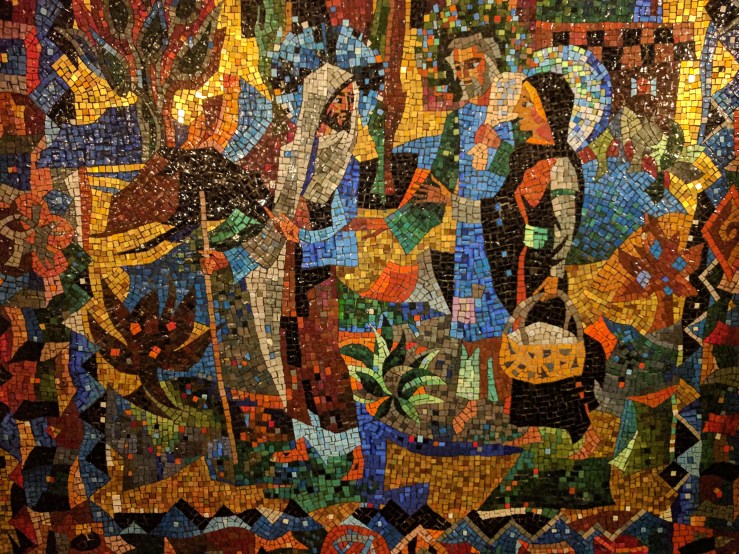
Emmaus by Rowan and Irene LeCompte
Rowan LeCompte (American, 1925–2014) and Irene Matz LeCompte (American, 1926–1970), Third Station of the Resurrection: The Walk to Emmaus (detail), 1970. Mosaic, Resurrection Chapel, National Cathedral, Washington, DC. Photo: Victoria Emily Jones

Their case is built by conflating the identities of “Mary, mother of James” (Matt. 27:56; Mark 15:40, 16:1; Luke 24:10), present at the Crucifixion and a witness of the empty tomb, and “Mary, wife of Clopas” (John 19:25), also present at the Crucifixion, and then recognizing “Clopas” as a variant spelling of “Cleopas.” Alphaeus—identified in Matthew 10:3, Mark 3:18, Luke 6:15, and Acts 1:13 as the father of James—is thought to be the Aramaic form of the name. These connections are well supported by church tradition, dating as far back as the second century.

If Cleopas’s wife, Mary, was in Jerusalem for Passover, it makes sense that she would have traveled back home to Emmaus (or stopped overnight in Emmaus en route to home) with her husband afterward. It wouldn’t have been unusual for a married couple, in this relatively private context, to converse with each other along the way about what they had experienced—the rabbi they had been following, dead, and rumored to have risen—and what it might mean.

Mary had seen the empty tomb with her own eyes and even encountered an angel who affirmed, “Christ is not here! He is risen!” But when she told the other disciples, they dismissed her account as too fantastic, perhaps instilling in her a new skepticism; she hadn’t, after all, seen the body. Or maybe her faith remained fortified, and her trip home was spent trying to convince her husband that Jesus was indeed alive.

Whatever the precise content of their discussion, a “stranger” sidled up alongside them, giving his own interpretation of the weekend’s events. They did not notice it was Jesus because “their eyes were kept from recognizing him.” It wasn’t until they arrived home with their newly invited guest in tow, put dinner on the table, and saw him bless the meal that “their eyes were opened.”

Although artistic portrayals of the Emmaus episode overwhelmingly cast a male as the second disciple, there are a few I’ve found that turn that presupposition on its head by casting a female, presumably Mary.   Continue reading “The Unnamed Emmaus Disciple: Mary, wife of Cleopas?” →

Egg Sketches by Autumn Brown

Happy Bright Week!

We’re currently in the Octave of Easter, the first week of the church’s most festal season of the year. It may be that your church celebrates only one day of Easter (last Sunday). But those that follow the liturgical calendar extend the celebration for fifty days, all the way to Pentecost Sunday! The stores have already moved on, rushing us ahead to Mother’s Day, but counterculturally, we linger at the Resurrection, dwelling with its mystery and joy over a longer span.

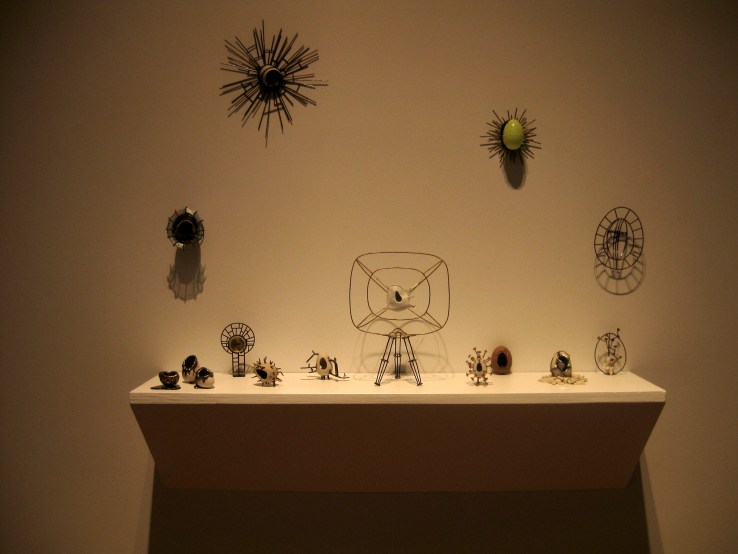
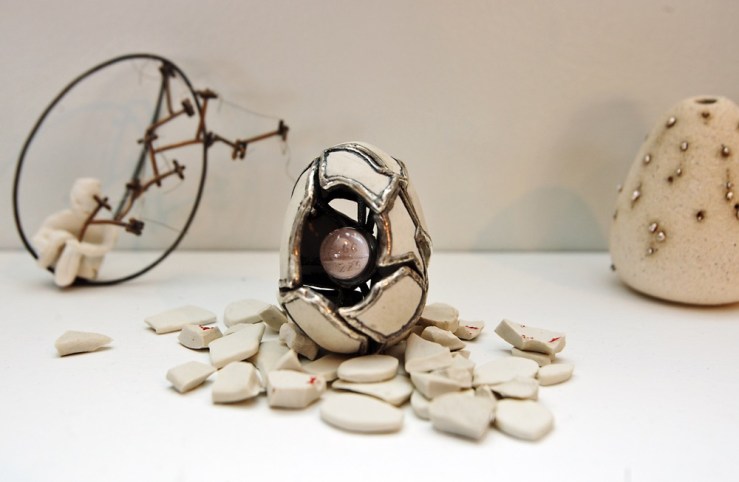
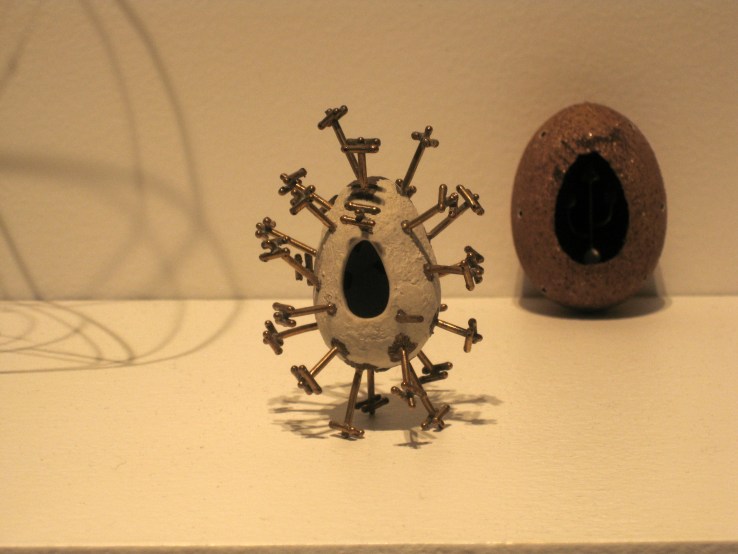
Last summer I visited the Grand Rapids Art Museum in Michigan for the first time. One of the pieces that has stayed in my mind is Egg Sketches by contemporary small metals artist Autumn Brown. It’s an installation of thirteen mixed-media egg vignettes—bursting, melting, sprouting, stretching—arranged on a shelf and wall. The artist said these sketches were inspired by the work of Peter Carl Fabergé, whose egg-shaped objets d’art, commissioned annually as Easter gifts for the Russian empress between 1885 and 1916, contained surprises inside, and Hieronymus Bosch, who used the egg in some, shall we say, abnormal ways.

I immediately thought of the Resurrection when I saw it.

Egg Sketches by Autumn Brown
Autumn Brown (American, 1982–), Egg Sketches, 2010. Porcelain, enamel, copper, silver, bronze, eggshells, plastic, steel, and found object. Collection of the artist. Photographed at Grand Rapids Art Museum, Grand Rapids, Michigan, 2016, by Victoria Emily Jones.

(See better photo, via ArtPrize, at bottom of post. The elements are arranged in a slightly different way.)

The egg as a symbol of fertility and rebirth predates Christianity, having been used in the ancient cultures of Egypt, Mesopotamia (the Near East), and Crete. For the early Christians, it had obvious crossover appeal: the extrusion of a living creature from a shell, after its vital principle has lain dormant or seemingly extinct, became a picture of the incubation of Christ in the tomb and his subsequent “hatching,” his being risen to new life. Traditions of egg dyeing, eating, and game playing emerged in Christian communities in connection to Easter, an extension of religious celebration. As you hard-boil eggs, paint them, display them in baskets, crack them together with friends, and snack on them, you are, the church taught, reinforcing the precious gospel truth that Christ has cracked open the shell of death that encased him—and us—making eternal life possible.

The first of Brown’s egg sketches that attracted me was the tomb-like one on the right. Its cracks lined with silver, it is reminiscent of kintsugi, the Japanese art of repairing broken pottery using gold, silver, or platinum. The front of this egg has a large aperture, which reveals a glass-encased pill. The egg sits atop a pile of stones—or is it the broken ceramic shell pieces?

Egg Sketches (detail) by Autumn Brown
Photo via ArtPrize

Several constituent pieces of Brown’s Egg Sketches make use of cross-forms. One egg is pierced all around by them. But a hole provides a way out, from darkness into light.

Egg Sketches (detail) by Autumn Brown
Photo: Victoria Emily Jones

Another egg is formed in outline only—a metal frame, arcing underneath a kneeling human figure who holds what appears to be a broken network of crosses (resembling telephone poles). The wire that once presumably held them together is snapped in multiple places, twisting every which way, as the crosses come tumbling down. The posture of the figure recalls Christ in Gethsemane, pleading with God to let the impending suffering pass him by. Life and death play together in this sketch, two elements of one story.   Continue reading “Egg Sketches by Autumn Brown” →

Roundup: Global passion art, free song downloads, “Refiguring the Biblical,” boxwood minis, reassembled altarpiece

“Journey to the Cross: Artists Visualize Christ’s Passion” (+ Part 2): As a devotional support for Passion Week and to show the breadth of Christian art across cultures, I’ve curated an online gallery of thirteen art images for the International Mission Board. Spanning the Last Supper through the Resurrection, the images come from the Democratic Republic of Congo, Japan, Bulgaria, the Philippines, China, Croatia, India, South Africa, Australia, Ecuador, Ukraine, Malaysia, and Slovenia.

Good Friday by Clifford Possum Tjapaltjarri
Clifford Possum Tjapaltjarri (Anmatyerre, 1932–2002), Good Friday, 1994. Acrylic on canvas, 116 × 154 cm. National Gallery of Australia, Parkes, ACT, Australia.

+++

FREE SONG DOWNLOADS:

“Into the Woods My Master Went”: Last summer singer-songwriter Seth Woods (The Whiskey Priest) discovered in an old Baptist hymnal an unusual nineteenth-century hymn text by Sidney C. Lanier, about Christ in Gethsemane—unusual not just for its content but for its rhyme and meter. In the first verse, Jesus enters the garden and receives the friendship of nature—the olive leaves caress him for comfort, and the thorns retract so as not to hurt him. In the second verse, Jesus departs from the garden, assured in his mission, and is forthwith arrested, taken from trees (olive grove) to tree (cross). Woods and Richard Kentopp (The Gentle Wolves) each took a stab at setting the text to music, and they invited four other friends—Jana Horn, Bruce Benedict, Alex Dupree (Idyl), and Chris Simpson (Mountain Time)—to do the same. These six retunings are available for free download via Bandcamp. The diverse results demonstrate how the same text can inspire different creative approaches.


“Wheat and Tares” and “Draw Me to You”: The Windtalkers is a Florida-based husband and wife duo (Benny and Ashley Permuy) backed by a band of musician friends who seek to create songs of life and truth unto the Lord. Through NoiseTrade they’re offering two of the seven tracks from their upcoming album All Creation Groans (available May 30): the blues-inflected “Wheat and Tares,” and the cello-backed “Draw Me to You.”

+++

KICKSTARTER PROJECT: “Refiguring the Biblical” juried exhibition (includes cash prizes): Others Imagining Initiative hopes to organize a juried art exhibition featuring racially diverse depictions of biblical characters, awarding prize money to select artists. The purpose is to help promote a Christian visual culture that does not elevate white Jesus but rather is inclusive of minorities. Submissions would be limited to current and recently graduated art students (BA/BFA within the last two years), and the exhibition would open in January 2018 at Biola University, hopefully traveling to other US universities as well. The viability of this project is dependent on the raising of funds through Kickstarter.

+++

EXHIBITIONS:

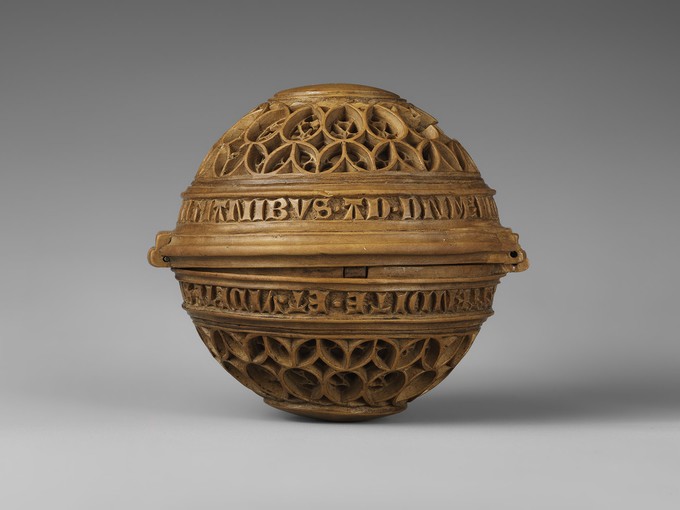
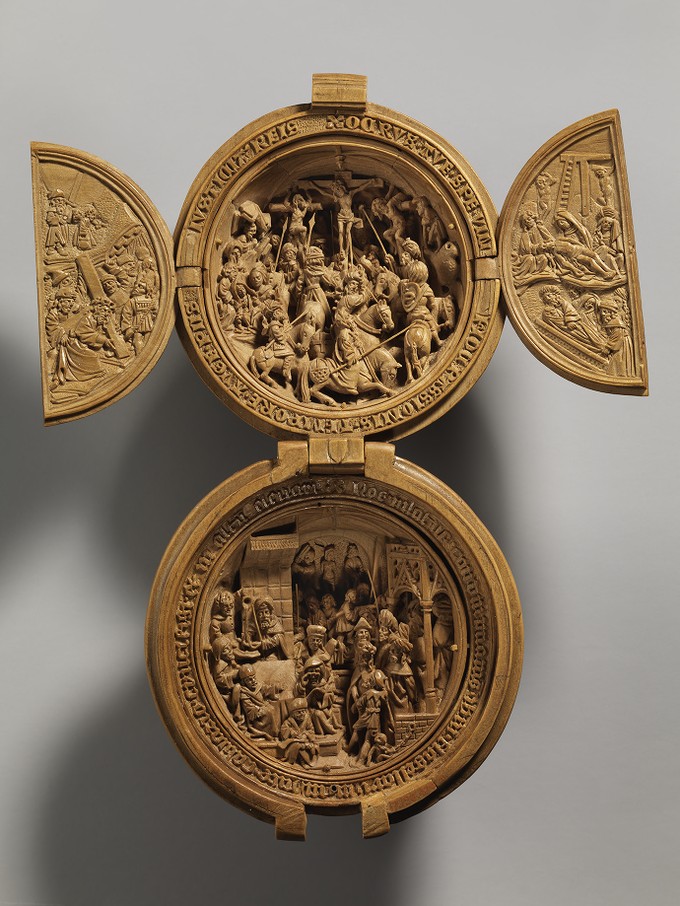
“Small Wonders: Gothic Boxwood Miniatures” (The Met Cloisters): On display through May 20. “Small in scale, yet teeming with detail, miniature boxwood carvings have been a source of wonder since their creation in the Netherlands in the 16th century. On these intricately carved objects—some measuring a mere two inches (five centimeters) in diameter—the miracles and drama of the Bible unfold on a tiny stage. Many of the works can be opened and closed: masterfully crafted hinges and clasps still function today. . . . Offering new insight into the methods of production and cultural significance of these awe-inspiring works of art, this exhibition [organized in partnership with the Art Gallery of Ontario and the Rijksmuseum] highlights more than four years of research that has used cutting-edge technology to understand these elegantly precise miniature rosaries, prayer beads and altarpieces.” The AGO’s Boxwood Project is a fantastic resource—an online catalogue raisonné, with photos and essays.

Boxwood prayer bead
Boxwood prayer bead (closed), Netherlands, ca. 1500–25, from the Metropolitan Museum of Art.
Boxwood prayer bead
Boxwood prayer bead (open), Netherlands, ca. 1500–25, from the Metropolitan Museum of Art.

“Gerard David: An Early Netherlandish Altarpiece Reassembled” (The Getty): The long-separated components of a fifteenth-century triptych by Netherlandish painter Gerard David have been reassembled following eighteen months of technical study and conservation treatment of the wings at the Getty. On display from March 21 to June 18, Pilate’s Dispute with the High Priest and The Holy Women and Saint John (from the Koninklijk Museum in Antwerp) flank Christ Nailed to the Cross (from the National Gallery in London), a dynamic scene rendered in exquisite detail. For more on the artist, see Gerard David: Purity of Vision in an Age of Transition by Maryan Ainsworth, available for free e-viewing through the Getty Research Portal.

Christ Nailed to the Cross by Gerard David
Installation view at the Getty: Gerard David (Netherlandish, ca. 1460–1523), Christ Nailed to the Cross triptych, 1480–85. Oil on panels.

The “Nothing” that won our salvation

Now Jesus stood before the governor, and the governor asked him, “Are you the King of the Jews?” Jesus said, “You have said so.” But when he was accused by the chief priests and elders, he gave no answer. Then Pilate said to him, “Do you not hear how many things they testify against you?” But he gave him no answer, not even to a single charge, so that the governor was greatly amazed.

—Matthew 27:11–14

Consider the incredible self-control Jesus exercises in his appearance before Pilate. He has just come from his religious trial, where he was passed from Annas to Caiaphas to the Sanhedrin and found guilty of blasphemy. But the Sanhedrin does not have the authority to issue death sentences, so they turn Jesus over to the civil authorities, claiming he’s a threat to Roman power, guilty of sedition.

Both charges are false, and yet Jesus gives no defense against either one. Why? Why not prove that he truly is the Son of God, and that he’s no insurrectionist? Why not clear his name? In John’s account of the trial before Pilate (18:33–38), Jesus is more verbal; he explains, “My kingdom is not of this world.” But still, he offers no hard evidence, calls no witnesses (they’ve scattered anyway). He essentially sits back and lets the judgment fall.

English poet and clergyman Richard Crashaw (1612–1649) was inspired by Christ’s silence under pressure to pen an epigrammatic verse unpacking its significance. As a teenager attending Charterhouse School in London, he and his fellow students were required to write epigrams based on the epistle and Gospel readings from the day’s chapel services, and it’s a practice Crashaw continued throughout his life. The following was originally published in Steps to the Temple: Sacred Poems, with Other Delights of the Muses in 1646.

“Matthew 27” by Richard Crashaw

And he answered them nothing.

O Mighty Nothing! unto thee,
Nothing, we owe all things that be.
God spake once when he all things made,
He sav’d all when he Nothing said.
The world was made of Nothing then;
’Tis made by Nothing now again.

In “Matthew 27,” Crashaw apostrophizes the word Nothing. (Apostrophe is a poetic device in which the speaker addresses an absent person, an abstract idea, or a thing; Paul does it, for example, in 1 Corinthians 15:55: “O death, where is thy sting? O grave, where is thy victory?”) He plays on its opposite: everything. By no thing comes all things.   Continue reading “The “Nothing” that won our salvation” →