Felice Casorati (Italian, 1883–1963), Study for Portrait, 1919. Oil on cardboard. Museo del Novecento, Florence.
God whispered, and a silence fell; the world Poised one expectant moment, like a soul Who sees at heaven’s threshold the unfurled White wings of cherubim, the sea impearled, And pauses, dazed, to comprehend the whole; Only across all space God’s whisper came And burned about her heart like some white flame.
Then suddenly a bird’s note thrilled the peace, And earth again jarred noisily to life With a great murmur as of many seas. But Mary sat with hands clasped on her knees, And lifted eyes with all amazement rife, And in her heart the rapture of the spring Upon its first sweet day of blossoming.
This sonnet by Theodosia Garrison (1874–1944) originally appeared in The Earth Cry: And Other Poems (New York: Mitchell Kennerly, 1910) and is in the public domain.
There are hundreds of thousands of musical works, from a range of genres, inspired by Christ’s passion, especially his death on the cross, which, along with the resurrection, is the centerpiece of the Christian faith. I’ve curated just a sampling of these on Spotify, from across time periods and countries, to serve as an aural guide through the final week of Jesus’s life. The drama begins with Christ’s triumphal entry into Jerusalem on a donkey, where he’s hailed with hosannas, and then continues with a last supper shared with his disciples, an agonized prayer in Gethsemane followed by betrayal and arrest, then, all in one day, multiple trials (religious and civil), conviction by mob, a public execution, and burial. Many of the playlist selections are narrative in character, while some have a more theological bent. My hope is that these pieces aid you in observing this most holy of weeks, walking with Christ through the shadows, taking in how “he himself bore our sins in his body on the tree, that we might die to sin and live to righteousness. By his wounds [we] have been healed” (1 Pet. 2:24).
To add the playlist to your account, open the Art & Theology Holy Week Playlist link, then click on the More (…) icon and select “Save to Library.”
[Playlist cover art: Odilon Redon, Christ, ca. 1895, charcoal, chalk, pastel, and pencil on paper, Museum of Modern Art, New York]
The playlist is a mixture of classical and popular (indie-folk, gospel) music. In this post I want to provide a little context for some of the pieces, by which I mainly mean translations of all the non-English lyrics. Because of what you see here, you might get the wrong impression that the list is almost entirely classical; actually, it’s only about half.
The opening track, “Herr, unser Herrscher” (Lord, Our Ruler), is a unique arrangement of the opening chorus from Johann Sebastian Bach’s St. John Passion, a Good Friday oratorio in German.
Herr, unser Herrscher, dessen Ruhm
In allen Landen herrlich ist!
  Zeig uns durch deine Passion,
  Daß du, der wahre Gottessohn,
  Zu aller Zeit,
  Auch in der größten Niedrigkeit,
  Verherrlicht worden bist!
Lord, our ruler, whose fame
In every land is glorious!
  Show us, through your passion,
  That you, the true Son of God,
  Through all time,
  Even in the greatest humiliation,
  Have become transfigured! [source]
Unique, because the Baroque choir and orchestra are accompanied by an ensemble of Gabonese musicians who contribute their own rhythmic profile, along with solo percussionists Sami Ateba from Cameroon and Naná Vasconcelos from Brazil. The recording, rereleased on the compilation album Babel (2008), is originally from Lambarena: Bach to Africa (1995), a collaboration between French composer and producer Hughes de Courson and Gabonese composer and guitarist Pierre Akendengué, synthesizing two disparate sound worlds. (“Bombé / Ruht wohl, ruht wohl, ihr heiligen Gebeine” is another highlight from the album. For weeks I debated whether to include it on this playlist—adding it, taking it off, adding it back again—ultimately deciding to leave it off, the reason being that it overlays Bach’s choral rondo with music and invocations to the dead from a Bwiti religious ritual. Though sonically compelling and worth listening to, I felt that it might impede some Christians’ ability to engage this list in a devotional way; so I opted for a traditional Western classical recording instead.)
Other selections from Bach’s St. John Passion are:
>> “Christus, der uns selig macht”
Christus, der uns selig macht,
Kein Bös’ hat begangen,
Der ward für uns in der Nacht
Als ein Dieb gefangen,
Geführt für gottlose Leut
Und fälschlich verklaget,
Verlacht, verhöhnt und verspeit,
Wie denn die Schrift saget.
Christ, who makes us blessed,
committed no evil deed,
for us he was taken in the night
like a thief,
led before godless people
and falsely accused,
scorned, shamed, and spat upon,
as the scripture says. [source]
>> “Petrus, der nicht denkt zurück”
Petrus, der nicht denkt zurück,
Seinen Gott verneinet,
Der doch auf ein' ernsten Blick
Bitterlichen weinet.
Jesu, blicke mich auch an,
Wenn ich nicht will büßen;
Wenn ich Böses hab getan,
Rühre mein Gewissen!
Peter, who did not recollect,
denied his God,
who yet after a serious glance
wept bitterly.
Jesus, look upon me also,
when I will not repent;
when I have done evil,
stir my conscience! [source]
>> “O große Lieb”
O große Lieb, O Lieb ohn alle Maße,
Die dich gebracht auf diese Marterstraße!
Ich lebte mit der Welt in Lust und Freuden,
Und du mußt leiden.
O great love, O love beyond measure,
that brought you to this path of martyrdom!
I lived with the world in delight and joy,
and you had to suffer. [source]
>> “Ruht wohl, ihr heiligen Gebeine”
Ruht wohl, ihr heiligen Gebeine,
Die ich nun weiter nicht beweine,
Ruht wohl und bringt auch mich zur Ruh!
Das Grab, so euch bestimmet ist
Und ferner keine Not umschließt,
Macht mir den Himmel auf und schließt die Hölle zu.
Rest well, you blessed limbs;
now I will no longer mourn you.
Rest well and bring me also to peace!
The grave that is allotted to you
and encloses no further suffering
opens heaven for me and closes off hell. [source]
For Bach’s St. Matthew Passion—one of the most celebrated works of classical sacred music ever written, right up there with Handel’s Messiah—I’ve drawn from the abridged English version (rather than the original German), translated by the Rev. Dr. John Troutbeck and performed in 1962 by the New York Philharmonic and Collegiate Chorale under the direction of Leonard Bernstein. I chose just a few pieces from it, not wishing to replicate the whole thing; as you can see, I tend to favor chorales over arias.
O come away, Make no delay, Come while my heart is clean and steady! While faith and grace Adorn the place, Making dust and ashes ready!
No bliss here lent Is permanent, Such triumphs poor flesh cannot merit; Short sips and sights Endear delights: Who seeks for more, he would inherit.
Come then, True Bread, Quick’ning the dead, Whose eater shall not, cannot die! Come, antedate On me that state Which brings poor dust the victory.
Ay! victory, Which from Thine eye Breaks as the day doth from the East; When the spilt dew Like tears doth shew The sad world wept to be released.
Spring up, O wine, And springing shine With some glad message from His heart, Who did, when slain, These means ordain For me to have in Him a part.
Such a sure part In His blest heart, The Well where living waters spring, That with it fed, Poor dust, though dead, Shall rise again, and live, and sing.
O drink and bread, Which strikes Death dead, The food of man’s immortal being! Under veils here Thou art my cheer, Present and sure without my seeing.
How dost thou fly And search and pry Through all my parts, and, like a quick And knowing lamp, Hunt out each damp, Whose shadow makes me sad or sick!
O what high joys! The turtle’s voice And songs I hear! O quick’ning showers Of my Lord’s blood, You make rocks bud, And crown dry hills with wells and flowers!
For this true ease, This healing peace, For this taste of living glory, My soul and all Kneel down and fall, And sing His sad victorious story!
O thorny crown, More soft than down! O painful cross, my bed of rest! O spear, the key Opening the way! O Thy worst state, my only best!
Oh! all Thy griefs Are my reliefs, And all my sins Thy sorrows were! And what can I To this reply? What—O God!—but a silent tear?
Some toil and sow That wealth may flow, And dress this Earth for next year’s meat: But let me heed Why Thou didst bleed And what in the next world to eat.
Henry Vaughan (1621–1695) [previously] was a Welsh metaphysical poet, translator, and physician, known chiefly for his religious poetry in English. For info on his life and times, as well as his literary importance, see https://www.poetryfoundation.org/poets/henry-vaughan.
Vaughan’s “The Feast” was originally published in 1655 in the expanded edition of his celebrated collection Silex Scintillans (1650). (The book’s title is Latin for “The Fiery Flint,” referring to the stony hardness of man’s heart, from which divine steel strikes fire.) The poem consists of thirteen sestets (six-line stanzas), each following the syllable pattern 4-4-8-4-4-8, with a few cheats. More specifically: the first two lines of each stanza are in iambic dimeter, and the third is in iambic tetrameter, repeat. Which is simply the technical way of saying that the rhythm sounds like da-DUM, da-DUM—unstressed syllable, stressed syllable. The rhyme scheme is aabccb. I mention these details because it’s important to see the structure of a poem.
Now let’s walk through it piece by piece.
O come away, Make no delay, Come while my heart is clean and steady! While faith and grace Adorn the place, Making dust and ashes ready!
No bliss here lent Is permanent, Such triumphs poor flesh cannot merit; Short sips and sights Endear delights: Who seeks for more, he would inherit.
The speaker starts out by beseeching Christ’s return. He’s saying that he, who is mere dust, has put the affairs of his heart in order and is ready for the next life. He has come to realize that earthly pleasures are but “short sips,” quick delights, and he wants a long, slow drink, one that infinitely satisfies. Like the Samaritan woman at the well in John 4:13–14, to whom Jesus said, “Everyone who drinks of this [physical] water will be thirsty again, but whoever drinks of the water that I will give him will never be thirsty again. The water that I will give him will become in him a spring of water welling up to eternal life.”
Those who truly seek for more than what this world has to offer will find it.
Come then, True Bread, Quick’ning the dead, Whose eater shall not, cannot die! Come, antedate On me that state Which brings poor dust the victory.
“Come then, True Bread,” the speaker exclaims, addressing Christ in biblical metaphor. John 6 is a major reference point for Vaughan throughout this poem, which is where Jesus addresses the crowds whom he had just fed the day before with miraculously multiplied loaves and fishes:
“Do not work for the food that perishes, but for the food that endures to eternal life, which the Son of Man will give to you. For on him God the Father has set his seal.” Then they said to him, “What must we do, to be doing the works of God?” Jesus answered them, “This is the work of God, that you believe in him whom he has sent.” So they said to him, “Then what sign do you do, that we may see and believe you? What work do you perform? Our fathers ate the manna in the wilderness; as it is written, ‘He gave them bread from heaven to eat.’” Jesus then said to them, “Truly, truly, I say to you, it was not Moses who gave you the bread from heaven, but my Father gives you the true bread from heaven. For the bread of God is he who comes down from heaven and gives life to the world.” They said to him, “Sir, give us this bread always.”
Jesus said to them, “I am the bread of life; whoever comes to me shall not hunger, and whoever believes in me shall never thirst. . . .
“Your fathers ate the manna in the wilderness, and they died. This is the bread that comes down from heaven, so that one may eat of it and not die. I am the living bread that came down from heaven. If anyone eats of this bread, he will live forever. And the bread that I will give for the life of the world is my flesh.”
Jesus is the bread of life, whose flesh we eat at the Communion table, taking his self into our selves. Those who feed on Christ are strengthened in their union with him in both his crucifixion and resurrection. As the apostle Paul writes in 1 Corinthians 10:16, “The cup of blessing that we bless, is it not a participation in the blood of Christ? The bread that we break, is it not a participation in the body of Christ?”
“Come,” the poem’s speaker continues, “antedate / On me that state / Which brings poor dust the victory.” He, as one who has already lost battle after battle against sin, asks that Christ grant him the victory post-factum, rendering his past losses of no account. In other words: “Christ, have mercy.”
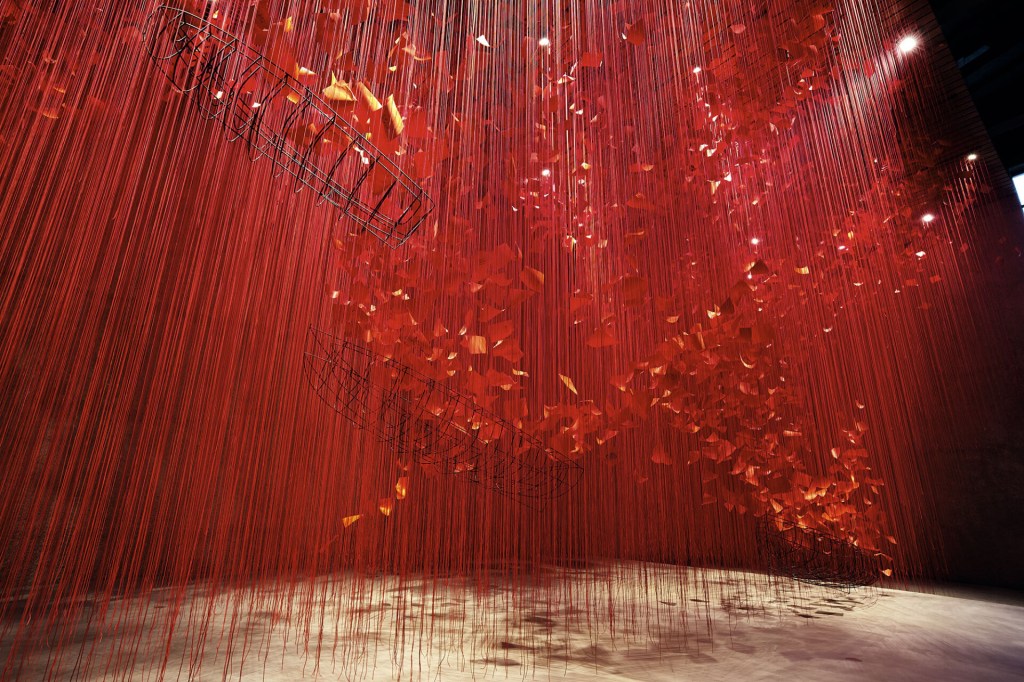
EXHIBITION: “I hope . . .” by Chiharu Shiota, January 12–March 21, 2021, König Galerie, Berlin: Grace Ebert of Colossal writes, “A towering expanse of red thread, a new installation by Chiharu Shiota suspends 10,000 letters within the nave of Berlin’s König Galerie, a Brutalist-style space located in the former St. Agnes church. The immersive construction runs floor to ceiling and is awash with notes from people around the world who share their dreams following a particularly devastating year. Aptly named ‘I hope…,’ the large-scale project hangs two wire boats that appear to float upward at its center, evoking travel into an unknown future.” On view for a few more days!
>> “Saint Ephrem” by Prairie House Hymns: Sam(antha) Connour, whom you might know as Lo Sy Lo, has a new home for her church music: she will now be releasing it under the name Prairie House Hymns, which harkens to her roots in small-town churches and Midwestern culture. (“Seriously melodic theology from the Great Plains”!) Her first single since this rebrand is a prayer attributed to the fourth-century Syrian theologian Ephrem. “In the Byzantine tradition, this prayer is considered to be the most succinct summation of the spirit of Great Lent and is hence the Lenten prayer par excellence, prayed during all Lenten weekday services” (source). The video below is a demo that Connour recorded in November 2020, followed by the official recording released March 15, which includes backup vocals by Alec Watson. I’ve added the song to the Art & Theology Lent Playlist on Spotify.
O Lord and Master of my life Keep me from indifference Keep me from discouragement Lust of power and idle chatter
Will you grant to me your servant The spirit of wholeness of being Humblemindedness Patience and love
O Lord and King of my life Grant me grace to be aware Of my sins and not to judge My brother and my sister
For you are blessed Now and forever For you are blessed Now and forever
>> “Your Blood” by Matt Redman, arr. Sam JC Lee: This video recording is from the “Jazz Hymns and Liturgy” concert at The Lilypad in Cambridge, Massachusetts, on February 16, 2020. Composer, bassist, and bandleader Sam JC Lee [previously] leads his group in an original jazz arrangement of this contemporary hymn. The musicians are Gabriela Martina on vocals, Gregory Groover Jr. on sax, Jiri Nedmoa on piano, Tyson D. Jackson on drums, and Lee himself on bass.
+++
VIRTUAL EXHIBITION/PILGRIMAGE: Global Stations of the Cross 2021: These fifteen contemporary artworks, organized around the Stations of the Cross but with a multifaith approach, were curated by Dr. Aaron Rosen, director of the Henry Luce III Center for the Arts and Religion at Wesley Theological Seminary in Washington, DC. In 2019 I participated, as pilgrim, in the Amsterdam iteration of the annual Stations of the Cross project that Rosen cofounded (which I chronicled in detail here), and his project inspired the Stations of the Cross experience I designed, independently, at the Smithsonian American Art Museum—which, I know from people having reached out to me, has been utilized by several churches, families, and neighborhoods over the years.
Antonio McAfee (American, 1983–), Roger’s Station (Ninth Station), 2021
Though “in previous years, the central experience of Stations of the Cross involved walking through host cities, inviting visitors to experience the incidental insights and revelations that come from navigating urban spaces in search of sacred experiences,” COVID has required adaptation. So Rosen took the opportunity to make this year’s exhibition multicity and global, and entirely online. Audio commentary is provided by the artists, as are photos of each work. The theme is “monuments and memorials,” and many of the artists have a personal connection to the topics they address, which include the execution of Catholics under the Joseon dynasty in nineteenth-century Korea, political imprisonment under Stalin, the bombing of Coventry during World War II, displacements caused by the British Partition of India in 1947, rising Sinophobia (anti-Chinese sentiment) this past year, California wildfires, gun violence, police brutality, and the ongoing refugee crisis. Here is an excerpt from Rosen’s curatorial statement:
Each station in this journey responds to a monument or memorial, reflecting a tumultuous year in which fresh memorials sprung up to grieve the dead and historic monuments to prejudice were toppled and dismantled. We invited artists to keep these connotations in mind, but ultimately we left the terms ‘monument’ and ‘memorial’ open to interpretation, for artists to construct as they saw fit. Some, like Todd Forsgren, turned familiar images, like the Washington Monument, on their head—evoking the disorienting, disturbing politics of the past four years, and especially the recent insurrection at the nation’s capital. G. Roland Biermann photographed the Millennium Wheel in London, a tourist attraction that now sits sedentary as a stone, lit by an eerie blue light in honor of National Health Service workers. Others chose sites which are legible as memorials only to an intimate circle, who know the tragedy which transpired there. This is the case for Antonio McAfee’s work, which honors his cousin, murdered at a Baltimore metro stop. Another artist, S. Billie Mandle, reminds us that the natural world can, within moments, turn into a graveyard, as she reveals in a photograph taken in the aftermath of devastating wildfires in her home state of California.
There is no single memorial which can effectively capture the myriad traumas of the past year, from the staggering toll of the pandemic to bleak examples of systemic racism and climate crises of biblical proportion. While these challenges have intersected this past year, often with devasting effect, Stations of the Cross does not attempt to summarize them, or generalize the agonizing impact they have had on specific communities, families, and individuals. Instead, this project invites viewers to bear witness to this troubling season through the intimate reflections of individual artists, who find in the Passion a lens to interpret the present.
. . .
While the celebration of resurrection is unabashedly Christian, as it should be, the via dolorosa offers a path that can be instructive across multiple faiths, and none. Christians may travel its route in anticipation of salvation, but that is not the only possible destination. The Stations of the Cross invite an empathy that knows no theological copyright and requires no passport. It demands, quite simply, the capacity to behold—to truly see—the suffering of the Other in our midst. And, at least for the moment, that may be miracle enough.
+++
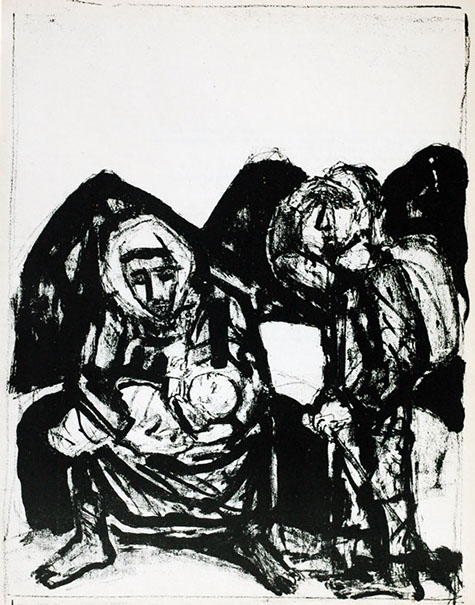
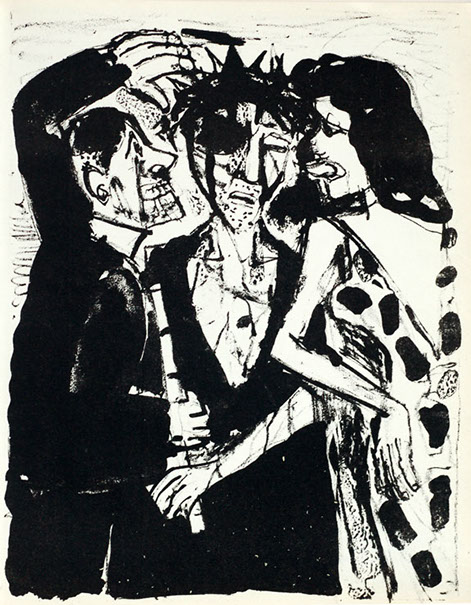
LECTURE: “Otto Dix and the Gospel of Matthew: An Exercise in Wirkungsgeschichte” by Dr. Jonathan T. Pennington: In 1960 the German expressionist artist Otto Dix [previously] published Matthäus Evangelium, a cycle of thirty-three lithographs based on the Gospel of Matthew, recounting Jesus’s birth, healing ministry and other miracles, passion, and resurrection. Last year Sojourn Arts, a ministry of Sojourn Church in Louisville, Kentucky, hosted an exhibition of this body of work as well as a contextualizing talk by New Testament scholar and Sojourn East staff preacher Jonathan T. Pennington, given February 21, 2020. Pennington shows how Dix uses Matthew to say something about his own time and culture, and how Dix helps us see certain things about Matthew because of his own situatedness. Starting at 13:25, Pennington walks through the images one by one, interpreting them with a facility I don’t often see in preachers without an art specialization! (He says he spent several weeks studying and reflecting on the lithographs, which goes to show how an image’s meaning reveals itself to those who are willing to sit with it; a bit of biographical research helps too.)
The exhibition Otto Dix: Matthäus Evangelium is available for rental for just $250/month plus shipping—a killer deal! The loaner is Sandra Bowden, a collector of twentieth- and twenty-first-century biblical art who is also an artist herself. She’s such a generous person, and I had the pleasure of meeting her once at her home in Cape Cod, not far from the Community of Jesus, of which she is an oblate.
Otto Dix (German, 1891–1969), Die Flucht nach Ägypten (The Flight to Egypt), lithograph from Das Evangelium nach Matthäus (The Gospel according to Matthew), 1960Otto Dix (German, 1891–1969), Die Verspottung (Christ Mocked), lithograph from Das Evangelium nach Matthäus (The Gospel according to Matthew), 1960
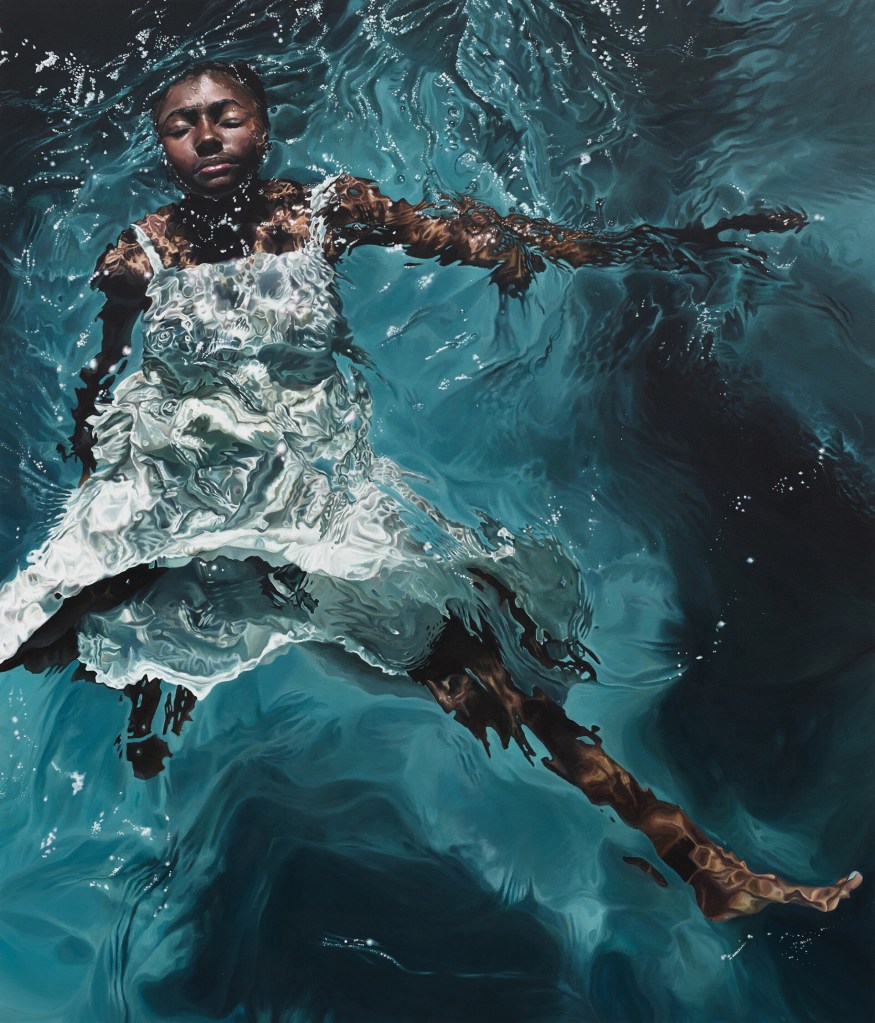
Calida Garcia Rawles (American, 1976–), Radiating My Sovereignty, 2019. Acrylic on canvas, 84 × 72 in.
For Carolyn Kizer and John Woodbridge, Recalling Our Celebration of George Herbert’s Birthday, 1983
As swimmers dare to lie face to the sky and water bears them, as hawks rest upon air and air sustains them, so would I learn to attain freefall, and float into Creator Spirit’s deep embrace, knowing no effort earns that all-surrounding grace.
SONGS: The following two songs appear on the Art & Theology Lent Playlist on Spotify. (Note: I’ve also integrated some Lovkn, Sarah Juers, and a few others into the list since originally publishing it.)
>> “Kyrie / Oh Death,” performed by Susanne Rosenberg: March 11 marks one year since the coronavirus outbreak was officially declared a pandemic, and the tremendous number of lives lost is staggering. (A friend from Japan reminded me that it’s also the ten-year anniversary of the Great Tōhoku earthquake and tsunami that killed some 16,000 people; 3/11, he says, is as important in Japan as 9/11 is in the United States.) This lament by Susanne Rosenberg, one of Sweden’s foremost folk singers, seems appropriate. It combines a twelfth-century Kyrie chant with the Appalachian folk song “Oh Death,” the latter made famous by Ralph Stanley. Kyrie eleison, Christe eleison, Greek for “Lord, have mercy, Christ, have mercy,” is a short, repeated invocation used in many Christian liturgies, and Rosenberg seamlessly integrates it with these few lines: “Oh Death, oh Death, won’t you spare me over till another year?” The video recording is from a February 2010 concert in Dublin, and a similar version of the medley, in a different key, appears on Rosenberg’s album of the same year, ReBoot/OmStart.
>> “Washed in the Blood,” performed by Pokey LaFarge and Harry Melling: The Devil All the Time (2020) isn’t a great movie, but it has a great soundtrack. Harry Melling—known for his roles as Dudley Dursley in the Harry Potter series and, more recently, Harry Beltik in TheQueen’s Gambit—plays a spider-handling preacher named Roy, and singer-songwriter Pokey LaFarge (whose style pulls from ragtime, jazz, country, and blues) plays his guitar-playing sidekick, Theodore. The two actors sing as their characters in the film, this classic hymn by Elisha Hoffman. Love it!
+++
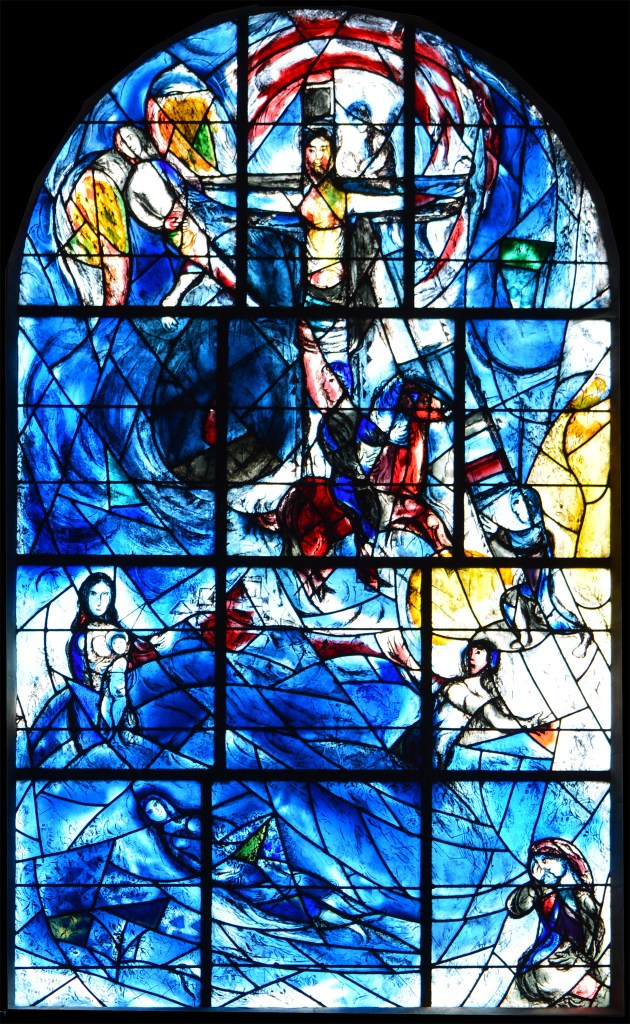
SERMON: “Chagall at Tudeley” by Rev. James Crockford, University Church, Oxford, April 7, 2019: This sermon, preached on Passion (Palm) Sunday two years ago, is an excellent example of how pastors can draw on visual art as a theological and homiletical resource—not to merely illustrate a point already made or to add some pretty dressing to a sermon, but taking it on its own terms and allowing it to generate insight and guide the congregation someplace new. Crockford uses the East Window in All Saints’ Church in Tudeley, Kent, England, designed by the Russian Jewish artist Marc Chagall, to open up profound discussion on human loss, hope, renewal, and the cross. [HT: Jonathan Evens]
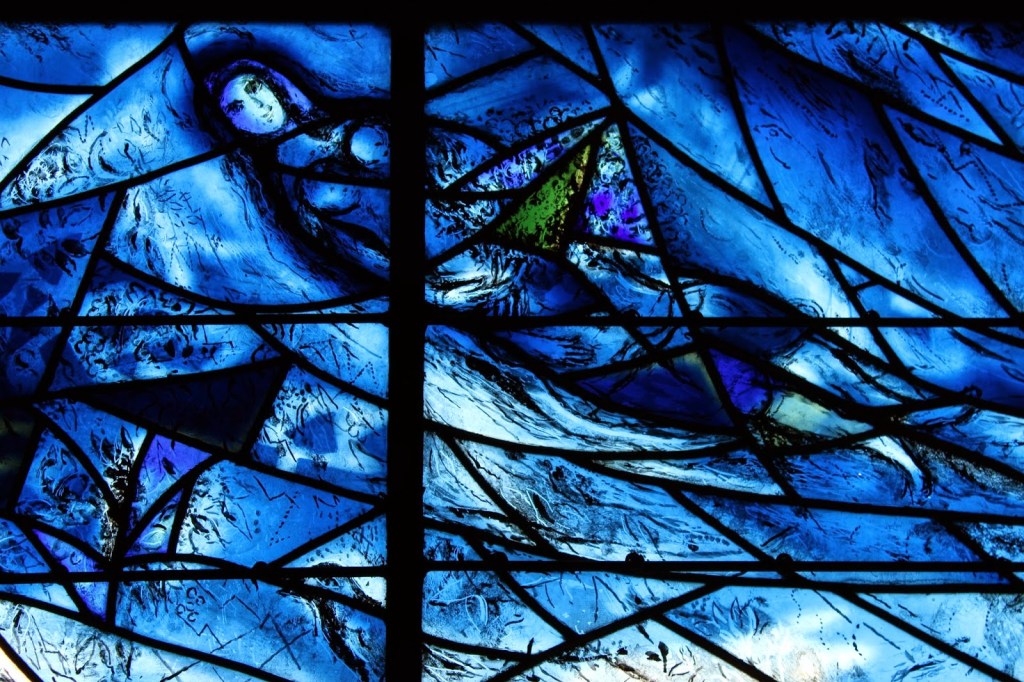
The window was commissioned by the parents of twenty-one-year-old Sarah d’Avigdor-Goldsmid, who in 1963 drowned off the coast of Sussex in a boating accident. “What I see in that East Window,” Crockford says, “is a remarkable exercise in the nature of suffering, and the interaction of human tragedy with the reality of Christ’s death and victory on the cross. It is a carefully composed centrepiece that asks us to face the depths of an abiding experience of grief, and to be faced with that grief each time we remember the grief of God, in broken bread and wine outpoured. But the window also shows a bigger picture – one that does not shut out the pains of our past, and the wounds in our hearts – and you’ll notice, when we come to it, that the scene of Sarah’s death still takes up over half of the window – but the bigger picture asks us to frame our grief and suffering on the centrality and promise of a God who, in Christ, is both suffering and victorious, broken and yet glorious, wounded but risen and standing among us to breathe Peace.” You can read the full transcript, or listen to an audio recording, at the link above.
East Window, All Saints’ Church, Tudeley, Kent, designed by Marc Chagall and executed by Charles Marq. Installed 1967. Photo: George Rex.Detail photo by Jonathan Evens
+++
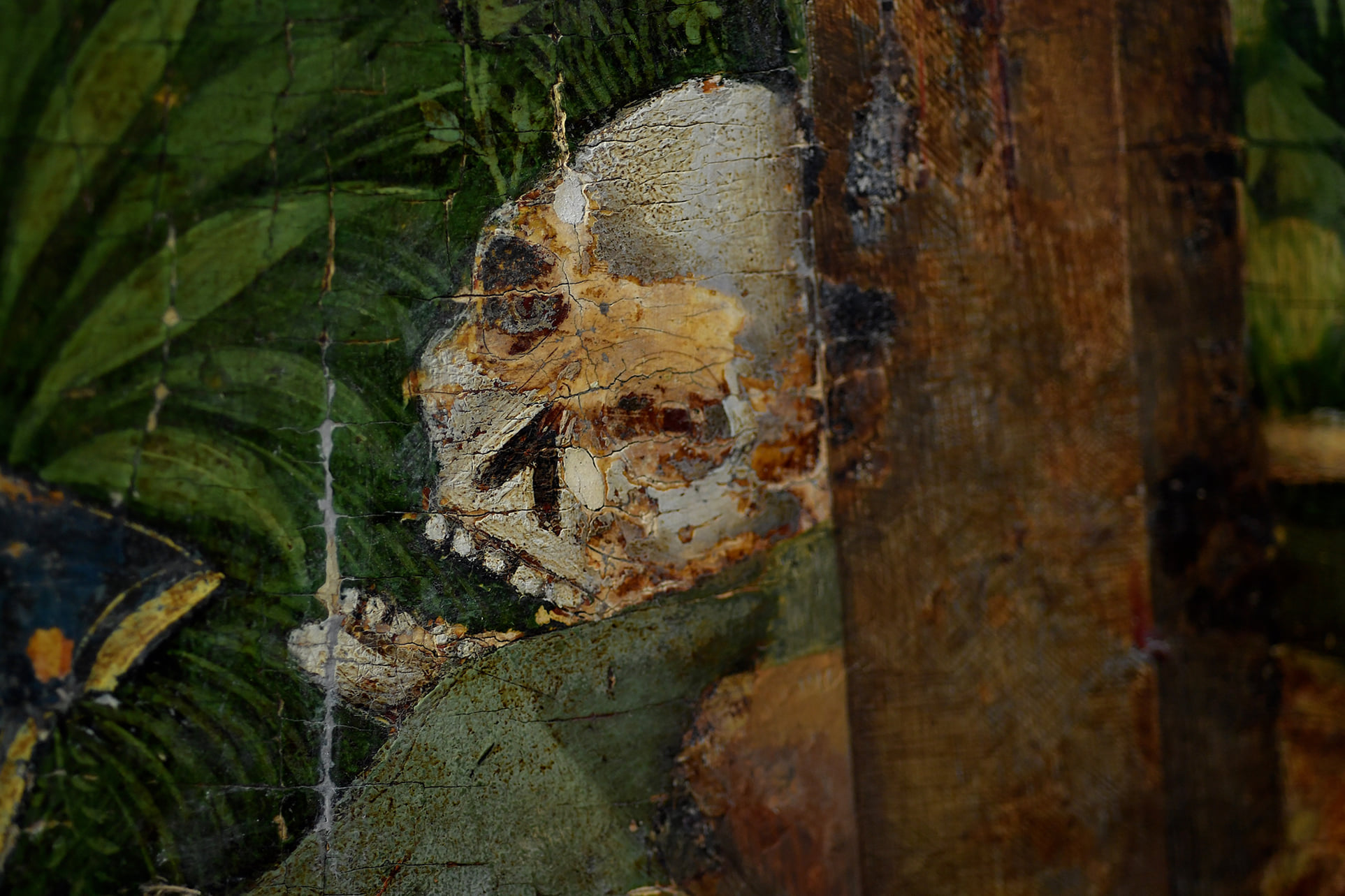
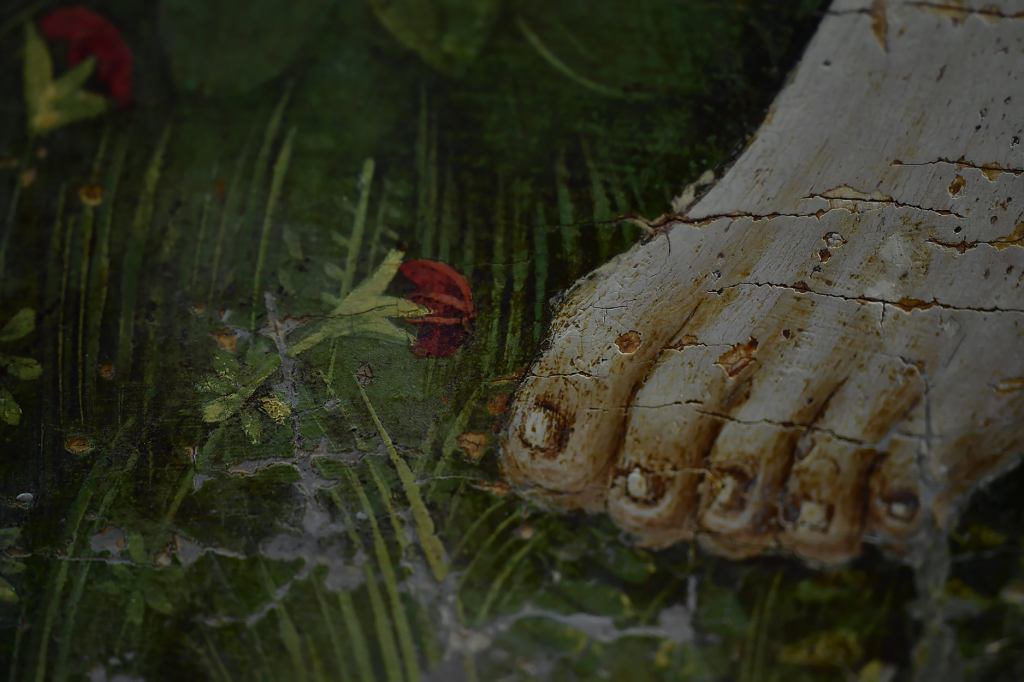
ART RESTORATION:“Hidden Gem: The Crucifixion by the Master of the Lindau Lamentation”: A Crucifixion painting from around 1425 by the Master of the Lindau Lamentation was recently restored by conservator Caroline van der Elst, and this short video documents part of that process. The Museum Catharijneconvent in Utrecht, the Netherlands, acquired the painting in 1875, but since then it had lain mostly forgotten in storage until being rediscovered by a staff member a few years ago, who recognized it as a masterpiece worthy of restoration efforts and public display. After the surface dust and discolored varnish were removed, in addition to other treatments, it was unveiled last year as the centerpiece of the Body Language exhibition (check out that link!), which ran from September 25, 2020, to January 17, 2021.
Curators Micha Leeflang and Annabel Dijkema discuss how the painting was made, how it was originally used, and its theological significance, and van der Elst explains some of the conundrums she faced while restoring the work—when it came to light, for example, that the azurite background was added in the sixteenth century. View the full painting here.
Master of the Lamentation of Christ in Lindau, Crucifixion (detail), ca. 1425. Tempera on panel, 125 × 89 cm. Catharijneconvent Museum, Utrecht, the Netherlands. Photo: Marco Sweering.
+++
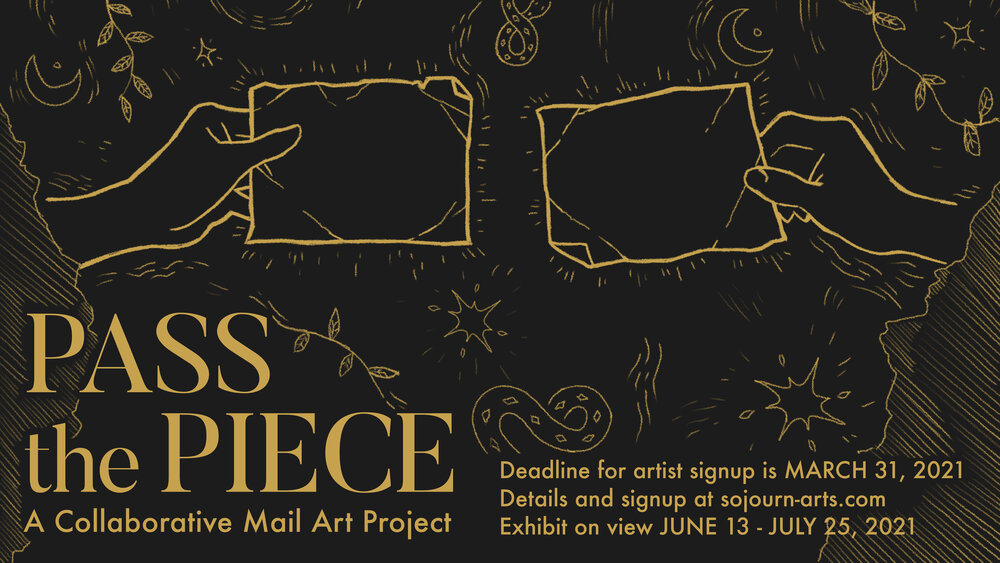
CALL FOR ARTISTS: Pass the Piece: A Collaborative Mail Art Project: A neat opportunity for artistic collaboration, organized by Sojourn Arts [previously] and open to US artists ages 13+. “Pass the Piece is a collaborative mail art project to be exhibited at Sojourn Arts in June 2021. Deadline for participating artists to sign up is March 31, 2021. Project is limited to 100 participants. We’re mailing out up to one hundred 8″ × 10″ panels, one to each participating artist. Each artist will start a panel that another artist will complete. Each artist will finish a panel that someone else started. Each artist will have their work exhibited and have a printed zine-style catalog of each piece from the exhibit. Artworks will be auctioned online with 50% going to the artists and 50% going towards Sojourn Arts interns’ travel expenses for the upcoming CIVA conference.”
NEW ALBUM: for / waters by Joshua Stamper:Joshua Stamper [previously] composed this four-movement instrumental piece about marriage for pianist Bethany Danel Brooks and violinist David Danel, who are themselves married and perform on the recordings. Its title and that of each movement is taken from Isaiah 35, which was read at the couple’s wedding.
Stamper writes,
Marriage, ideally, is about two people in a state of mutual belonging. But marriage is more than a state of belonging: it includes an ongoing journey toward and into belonging. It encompasses the trajectories and momentum of individuals towards each other, even before an initial connection takes place. People are therefore in relationship with each other before they are “in relationship” with each other. From this perspective, marriage might be understood as another mystical manifestation of the inscrutable and unknowable fault line between free will and providence. Two lives are always in reference to one another before the initial “hello,” because though individual trajectories have not yet crossed, they will. This interweaving begins early: each life is conditioned, shaped, sensitized to see, hear, feel the other. Home is created in each for each.
Stamper goes on to describe how he reflects these ideas through the structure, melodic and rhythmic motifs, harmonies, and other musical elements of for / waters. Read more and stream/purchase at Bandcamp.
“Joshua Stamper has been a restless composer and collaborator for over twenty-five years. His work reflects a deep interest in the intersection points between seemingly disparate musics, and a profound love for the intimacy, charm, and potency of chamber music. Equally at home in the jazz, classical, avant-garde, and indie/alternative worlds, his work ranges from large-scale choral and instrumental works to art-pop song cycles to chamber jazz suites. Joshua has worked as an orchestral arranger and session musician for Columbia / Sony BMG and Concord Records, and for independent labels Domino, Dead Oceans, Important Records, Sounds Familyre, Smalltown Supersound, and Mason Jar Music, collaborating with such luminaries as Todd Rundgren, Robyn Hitchcock, Sufjan Stevens, Danielson, and Emil Nikolaisen.” [source]
Michael Wright is the creator of Still Life, a free weekly letter on art and spirit that I look forward to receiving in my inbox every Monday. On March 8 he wrote about Keith Haring (1958–1990), an artist whose work I first encountered as a child on the cover of the compilation album A Very Special Christmas, which we pulled out from the CD shelf in the family room every December. As an adult I came across Haring’s Life of Christ triptych inside Saint John the Divine in Manhattan (I instantly recognized the style), and one of his anti-apartheid paintings at the Stedelijk Museum Amsterdam. Wright discusses Haring’s connection to the Jesus People movement, which I, too, was unaware of! I share this excerpt from the latest edition of Still Life with Wright’s permission. Subscribe here.
This week I discovered that the famous street artist Keith Haring was part of the Jesus People before moving to New York City. He grew up in a Christian home in Kutztown, PA, went to church every Sunday and church camp every summer, and read the Bible voraciously. He even carefully read and rated each of the 150 Psalms. In his youth he found his way to the Jesus People movement, most likely through communes local in the area, and his early journals are filled with Christian symbols and apocalyptic ideas: “We must repent now and devote our lives to Jesus Christ! The time is now, time is running out, It can happen at any time! Be prepared for God!” Whew. I had no idea.
The Jesus People movement was a counter-cultural Christian movement of people who were anti-establishment (including church), highly critical of materialism, and committed to living with and supporting the poor. They shared their convictions through the Hollywood Free Paper, a free mailing that featured cartoons lampooning politicians, new age hucksters, and lukewarm Christians. While Haring no longer officially participated as an adult, American Art writer Natalie Phillips says there’s a “direct iconographic connection” between his style and the imagery of the paper. The Jesus People left an indelible mark on his “visual memory,” and once you know it, it’s hard to miss.
In his early subway drawings, Haring often drew the Radiant Child, a small crawling baby surrounded by beams of light. In one of the earliest versions, the baby is the central figure of a nativity scene: the Christ Child. Here’s his own description: “lines radiate from the baby indicating spiritual light glowing from within, as though the baby were a holy figure from a religious painting, only the glow is rendered in the visual vocabulary of a cartoon.” Another common image Haring used was the figure with a chest-sized hole. Sometimes filled with dollar signs, other times broken open by packs of wolves, the imagery evokes unfilled (or wrongly filled) longings and desire. And do you know what was common throughout the Hollywood Free Paper? Chest-sized holes in cartoon after cartoon, an image of spiritualvoids filled by Christ himself.
On top of this, some of his late works were explicitly religious. He created a monumental series of the Ten Commandments, he created a mural for a church in Pisa, and, most poignantly, his final work was an altarpiece of the Last Judgment, on view at both New York’s Cathedral of St John the Divine and San Francisco’s Grace Cathedral. That’s not to say “Gotcha! He’s a Christian artist!” As a gay man dying of AIDS, Haring was vocally critical of the institutional church and kept his distance during his adult life. Nor should we say this is his “religious art” and everything else is the popular stuff. His compassion for the weak and vulnerable, his critical eye to unjust systems, his celebration of the body and human dignity—this was all part of Haring’s sensibility, and it’s deeply Christ-like too, even if it’s harder to trace in work without obvious religious subject matter.
I guess I’m bringing all this up because I want you to be surprised with me. When I say “Jesus Freak,” the first thing that comes to mind is dc Talk—not a sex-positive, ambiguously spiritual, gay street artist. And yet as a teen, that’s what he called himself. Keith Haring wrote about it in his journals, and he talked openly about the influence of his Christian background. Uncovering this history doesn’t burden the artwork or the artist—it gives me renewed interest in his work. Granted, I write about these topics in Still Life all the time, but I don’t think we have to be afraid of letting religion be one of the many interpretive lenses we use to enjoy the arts. At their best, art and religion can be exactly what Haring hoped for in his own creative work: “It should be something that liberates the soul, provokes the imagination and encourages people to go further. It should celebrate humanity instead of manipulating it.”
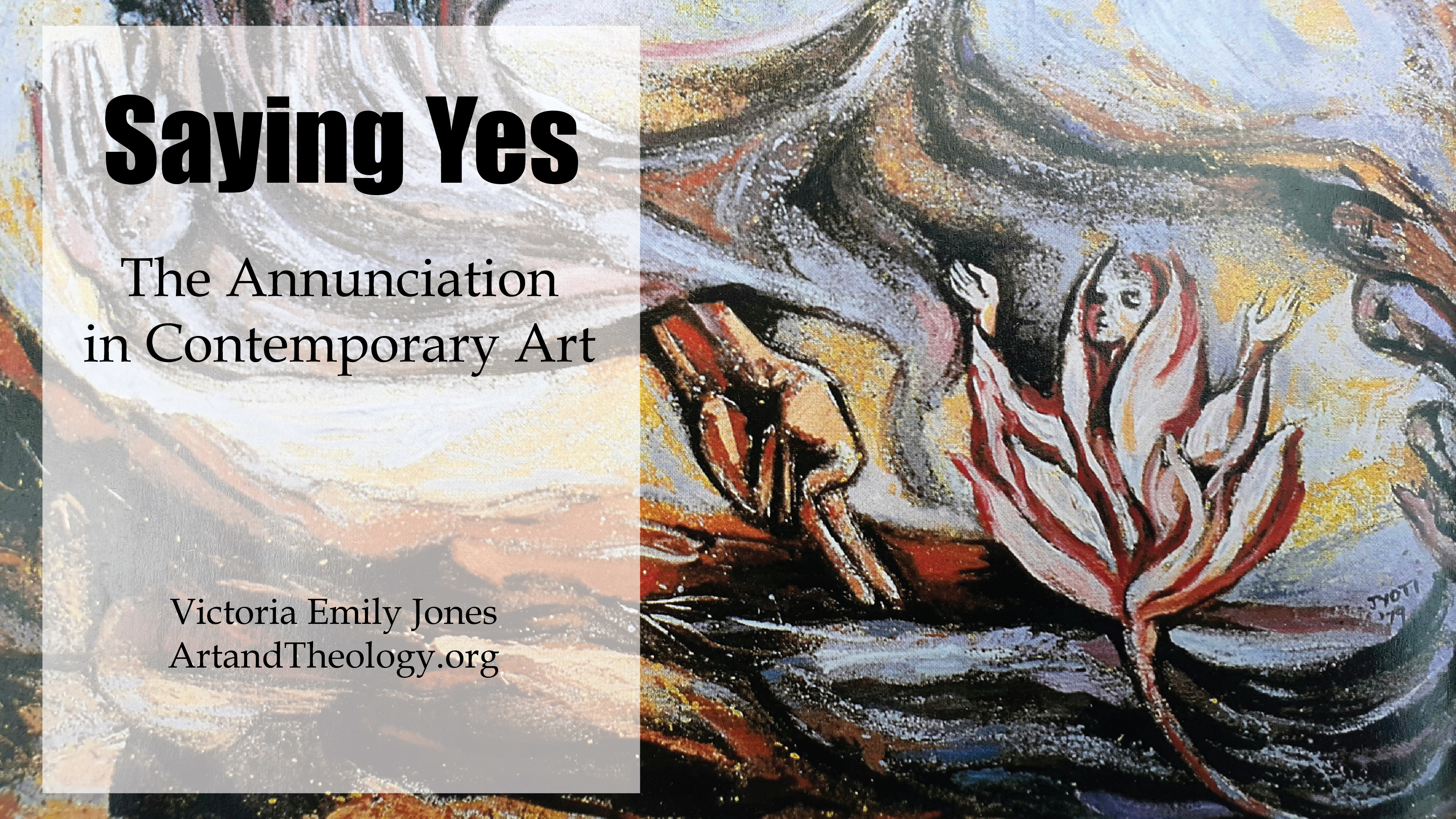
This year’s The Breath and the Clay creative arts gathering, on the theme of “Reenchantment,” is taking place March 17–21, with both in-person (in Winston-Salem, North Carolina) and virtual options. Registration for virtual attendees is pay-what-you-wish. Presenters include theologian Jeremy Begbie, poet Pádraig Ó Tuama, singer-songwriter Joy Ike, contemplative author Christine Valters Paintner, dancer Camille D.C. Sutton, and many more . . . including me! On the evening of March 18 I’ll be giving a twenty-minute talk titled “Saying Yes: The Annunciation in Contemporary Art,” which will be archived online afterward. (The global church celebrates the feast of the Annunciation the following week, on March 25.) (Update: Watch here.) Here’s the description:
The story of Jesus’s miraculous conception in the womb of Mary, a first-century Galilean peasant girl, told in Luke 1 has activated the imaginations of artists since the early Christian era. When an angelic messenger came and told Mary she had been chosen to bear God’s Son, she cycled through a range of emotions before ultimately accepting the call, stepping onto a path that, though scary, would be life-giving not only for her but also for her religious and ethnic community and for the whole world.
God invites us to participate in his work in the world and gives us the grace to do it. When his voice breaks through our safe, predictable routines, calling us to something big, do we respond with brave obedience? In this talk Victoria Emily Jones will share a handful of contemporary artworks that visualize that pivotal moment in salvation history when Mary said yes and set in motion the incarnation. These works show us the wild beauty of God’s plans and can help us tune our ears to the annunciations in our own lives.
(The title slide image is a detail of an Annunciation painting by Jyoti Sahi.)
I’m always impressed by the variety of artists, arts professionals, and art lovers that director Stephen Roach manages to bring together for The Breath and the Clay. Click here to learn more and to register.
+++
ONLINE LENT SERIES:
>> VCS Lent 2021: The Visual Commentary on Scripture is highlighting a different exhibition from its archives for each week of Lent, with new content including a video introduction to the week by Ben Quash and an audio reading of each of the three constituent commentaries.
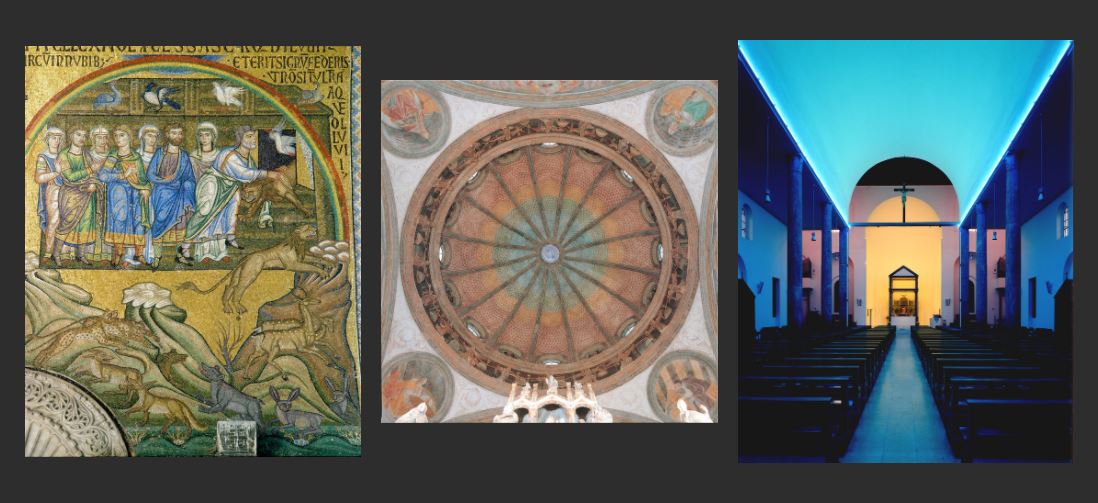
The first week was on the theme of Covenant and covers Genesis 8:20–9:17. Stefania Gerevini curated three artworks from Italy that convey some aspect of the rainbow as divine promise: a thirteenth-century mosaic from the Basilica di San Marco in Venice, a colorful dome fresco (fifteenth century) from the Cappella Portinari in Milan, and a contemporary light installation by Dan Flavin at Santa Maria Annunciata in Chiesa Rossa, also in Milan.
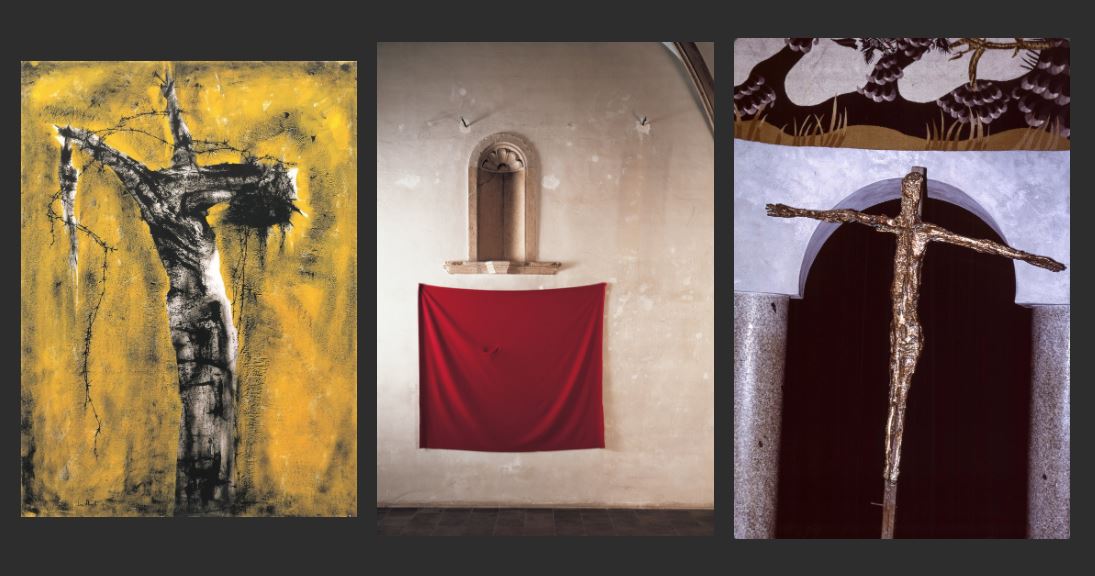
Week 2, on Prophecy, explores the Suffering Servant of Isaiah 53. Jonathan Koestlé-Cate comments on three modern artworks: Crucified Tree Form by Theyre Lee-Elliott, a crucifix by Germaine Richier (which sparked outrage when it was unveiled at Notre-Dame de Toute Grâce, Assy, in 1950), and an installation by postminimalist artist Anish Kapoor at the church of Saint Peter, Cologne.
>> “The Many Faces of Jesus”: I’ve been enjoying this Lenten series (on blog andpodcast) by medievalist Dr. Grace Hamman, who makes medieval lit super accessible.“For Lent, Old Books With Grace will share and explore some medieval representations of Jesus in art and literature—the versions of Jesus that dominate the medieval church’s imagination. These medieval portrayals of Jesus may strike us as odd, threatening, charming, creative, stupid, or inspiring. In attending to these versions of Jesus, I hope for a few end goals: the first is that we may expand our Christian imagination. Perhaps a side of Jesus that has never occurred to you, or been sideswept by our contemporary culture, will suddenly illuminate an aspect of the Jesus of scripture. The second is that we may better identify the ways that we ourselves have culturally contained and portrayed Jesus, in positive and negative ways. Often the strangeness of the past helps us recognize the weird or damaging things we believe in order to make Jesus more palatable, understandable, or like us.”
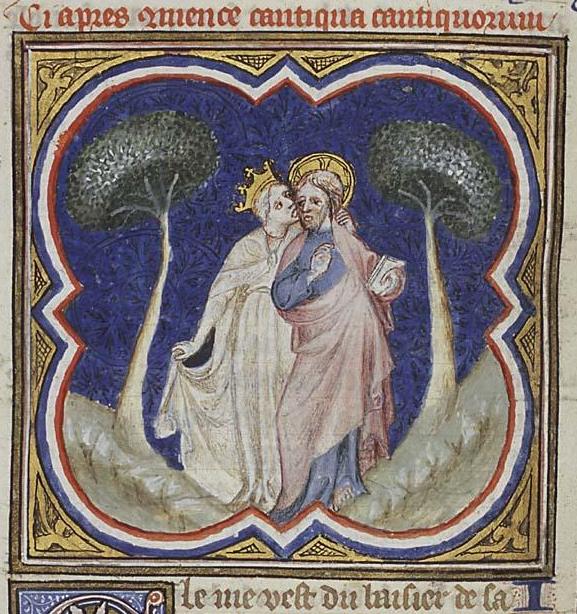
Jean Bondol, “The bride (Ecclesia) and bridegroom (Christ),” from a Bible Historiale made in Paris, 1371–72. The Hague, MMW, 10 B 23, fol. 330v.
>> “Up from My Youth (Psalm 129)” by Advent Birmingham, feat. CashBack and Terence June Gray: This is such a strange and compelling fusion! “An 1806 hymn by Isaac Watts meets hip-hop meets Johnny Cash meets folk meets New Orleans jazz meets industrial steel factory.”
Led by Zac Hicks, Advent Birmingham [previously] is a group of worship musicians from the Cathedral Church of the Advent in downtown Birmingham, Alabama. Hicks wrote this new tune for Isaac Watts’s metrical paraphrase of Psalm 129 and integrated a rap by guest artist Terence June Gray from Memphis. Singing lead (and playing drums) is Leif Bondarenko, the front man of the Johnny Cash tribute band CashBack. The video was filmed at Birmingham’s historic Sloss Furnaces. Available on iTunes, Amazon, and Spotify.
You can read the lyrics here, which include a slight revision of Watts’s verse 6.
POETRY READING:“Phase One” by Dilruba Ahmed, read, with commentary, by Pádraig Ó Tuama, Poetry Unbound: “What do you find hard to forgive in yourself? What might help? In this poem, the poet makes a list of all the things she holds against herself: opening fridge doors, fantasies, wilted seedlings, unkempt plants, lost bags, feeling awkward, treating someone poorly. Dilruba Ahmed repeats the line ‘I forgive you’ over and over, like a litany, in a hope to deepen what it means to be in the world, and be a person of love.”
Susan Adams (British, 1966–), Waiting for Something, 2002. Oil on panel, 36 × 58 cm. Gwynedd Museum and Art Gallery, Bangor, Wales.
What love is this of thine, that cannot be In thine infinity, O Lord, confined, Unless it in thy very person see Infinity and finity conjoin’d? What! hath thy Godhead, as not satisfied, Married our manhood, making it its bride?
Oh matchless love! filling heaven to the brim! O’errunning it: all running o’er beside This world! Nay, overflowing hell, wherein, For thine elect, there rose a mighty tide! That there our veins might through thy person bleed, To quench those flames that else would on us feed.
Oh! that thy love might overflow my heart! To fire the same with love: for love I would. But oh! my straight’ned breast! my lifeless spark! My fireless flame! What chilly love, and cold? In measure small! In manner chilly! See. Lord, blow the coal: thy love enflame in me.
Edward Taylor (1642–1729) was an American Puritan poet and minister of the Congregational church in Westfield, Massachusetts, for over fifty years. This is Meditation 1 in his Preparatory Meditations, a collection of over two hundred poems divided into two series. A private spiritual diary written from 1682 to 1725, the collection was unpublished until the twentieth century.
>>Black Art: In the Absence of Light (HBO): Directed by Sam Pollard, this ninety-minute documentary is an excellent introduction to the work of some of the foremost Black visual artists working in the US today. It opens by discussing the landmark 1976 exhibition Two Centuries of Black American Art, the first comprehensive survey of such. Curated by art historian and artist David C. Driskell (the main voice of the documentary), the exhibition, which opened at LACMA, showed the public that there is a lineage and a history, starting with early Black American artists like Joshua Johnson, Robert S. Duncanson, Edward Bannister and extending forward to artists like Romare Bearden, Charles White, Alma Thomas, and others. The exhibition inspired a whole new generation of Black artists, many of whom were encountering the work of their artistic forebears in person for the first time.
A range of contemporary Black artists are interviewed: Kerry James Marshall, Sanford Biggers, Jordan Casteel, Faith Ringgold, Richard Mayhew, Radcliffe Bailey, Kehinde Wiley, Amy Sherald, Hank Willis Thomas, Glenn Ligon, Fred Wilson, Carrie Mae Weems, Kara Walker, Theaster Gates, Betye Saar. So are several Black curators, art historians, and collectors, like Kasseem “Swizz Beatz” Dean, and Thelma Golden, director of the Studio Museum in Harlem, “the focal point of African American cultural and artistic production” since 1968 and “one of the most important institutions that we have,” as Weems says in the film. Another interviewee throughout is Maurice Berger, an art historian (who is white) and longtime voice against racism in the art world.
Both Driskell and Berger died of coronavirus while the film was in postproduction, and it is dedicated to their memory, as a postscript reads.
You can watch it for free, regardless of HBO subscription status, through March 17. HBO has also published a curriculum and art-making activities as supplements, which you can find at the link.
>> The Black Church: This Is Our Story, This Is Our Song (PBS): Written, hosted, and co-produced by Henry Louis Gates Jr., this two-part docuseries premiered February 16. It’s impossible to separate Black religion, politics, and culture, so the documentary weaves them all together over the course of four hours, showing how for centuries the Black church was the epicenter of Black life and exploring its role in the twenty-first century. I think it does a great job overall of avoiding an overly simplistic narrative.
The Black Church “traces the 400-year-old story of the Black church in America, all the way down to its bedrock role as the site of African American survival and grace, organizing and resilience, thriving and testifying, autonomy and freedom, solidarity and speaking truth to power. The documentary reveals how Black people have worshipped and, through their spiritual journeys, improvised ways to bring their faith traditions from Africa to the New World, while translating them into a form of Christianity that was not only truly their own, but a redemptive force for a nation whose original sin was found in their ancestors’ enslavement across the Middle Passage.”
You can watch online for free; just download the PBS Video app, or visit YouTube: episode 1; episode 2.
+++
SONG: “Lift Every Voice and Sing,” performed by Victory Boyd: WOW. Such a beautiful interpretation of this classic hymn. Victory writes, “I’m continually inspired by this song and how it was written in the 1800’s by 2 brothers both African Americans that saw and experienced great affliction in this Country… yet they still had hope. They still had a song of freedom on their lips and they encouraged EVERY voice to join in and sing alongside them this song of freedom. Recorded LIVE at The Secret Place.” [HT: SALT Project]
Guatemalan Annunciation by Fr. John GiulianiJesus and His Disciples (Navajo) by Fr. John Giuliani
“As a Catholic priest and son of Italian immigrants, I bear the religious and ethnic burden of ancestral crimes perpetrated on the first inhabitants of the Americas,” Giuliani once said. “Many have been converted to Christianity, but in doing so some find it difficult to retain their indigenous culture. My intent, therefore, in depicting Christian saints as Native Americans is to honor them and to acknowledge their original spiritual presence on this land. It is this original Native American spirituality that I attempt to celebrate in rendering the beauty and excellence of their craft as well as the dignity of their persons.”
ALBUM: Hymns by Paul Zach: Released February 5, this new album by Paul Zach comprises eight of his favorite hymns plus two originals, with vocal contributions by Liz Vice, Page CXVI, Leslie Jordan, Taylor Leonhardt, and The Sing Team. There has been a lot of experimentation in the hymns genre among recording artists, but what Zach gives us is something quiet and pared-down, which is exactly what I like. And as I’ve said before, Zach’s voice is so wonderfully expressive. He’s a joy to listen to and to sing along with. Below is the opening track, “Just a Closer Walk with Thee,” followed by Zach’s gorgeous setting of Psalm 23. The album is available on iTunes and Spotify.






 Art & Theology